18114. Bank of Tennessee (Nashville, TN)

Bank Information

Episode Type
Suspension โ†’ Closure
Bank Type
state
Start Date
February 1, 1877*
Location
Nashville, Tennessee (36.166, -86.784)

Metadata

Model
gpt-5-mini
Short Digest
31c02e4e988ae58e

Response Measures

None

Description

Articles describe the Bank of Tennessee being in the hands of a receiver (Clerk and Master Ewing) and court litigation over the bank's new issue notes; no articles describe a depositor run, but the bank's assets were turned over and receiver appointed, indicating suspension/closure and receivership. I therefore classify this as suspension leading to closure (receiver). Dates are taken from the newspaper publication dates; OCR appears intact.

Events (3)

1. February 1, 1877* Receivership
Newspaper Excerpt
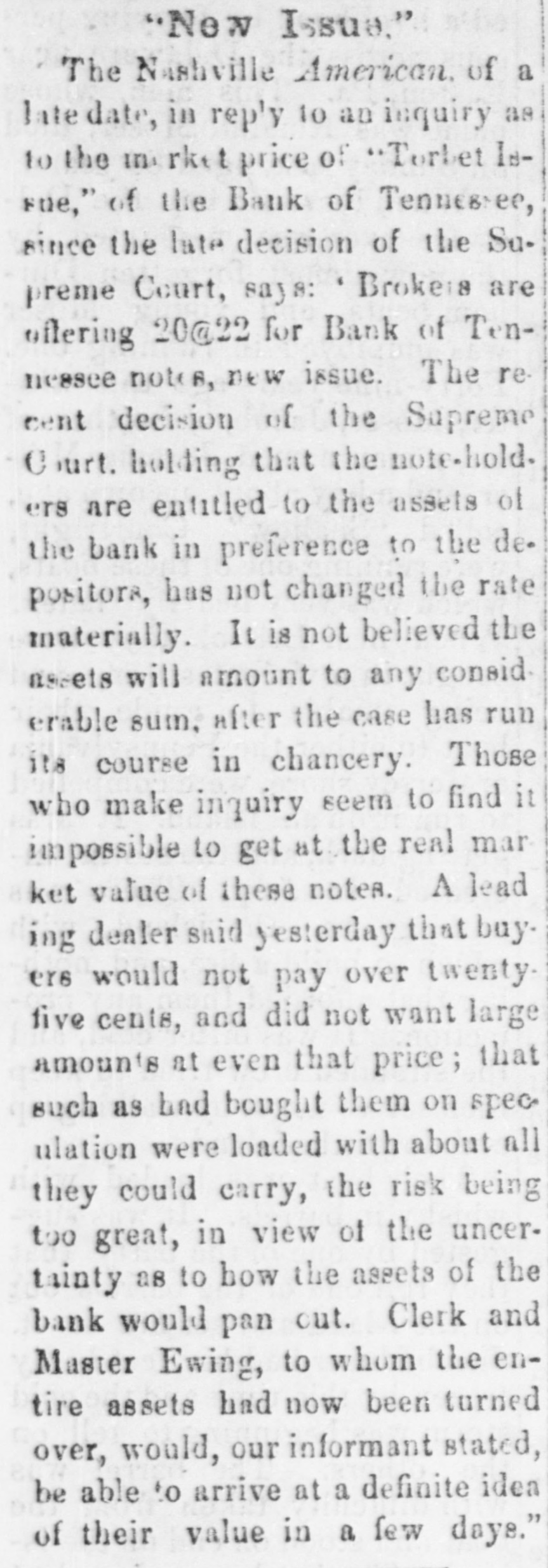
Clerk and Master Ewing, to whom the entire assets had now been turned over, would ... be able to arrive at a definite idea of their value in a few days. (Fayetteville Observer, 1877-02-15).
Source
newspapers
2. May 9, 1877 Other
Newspaper Excerpt
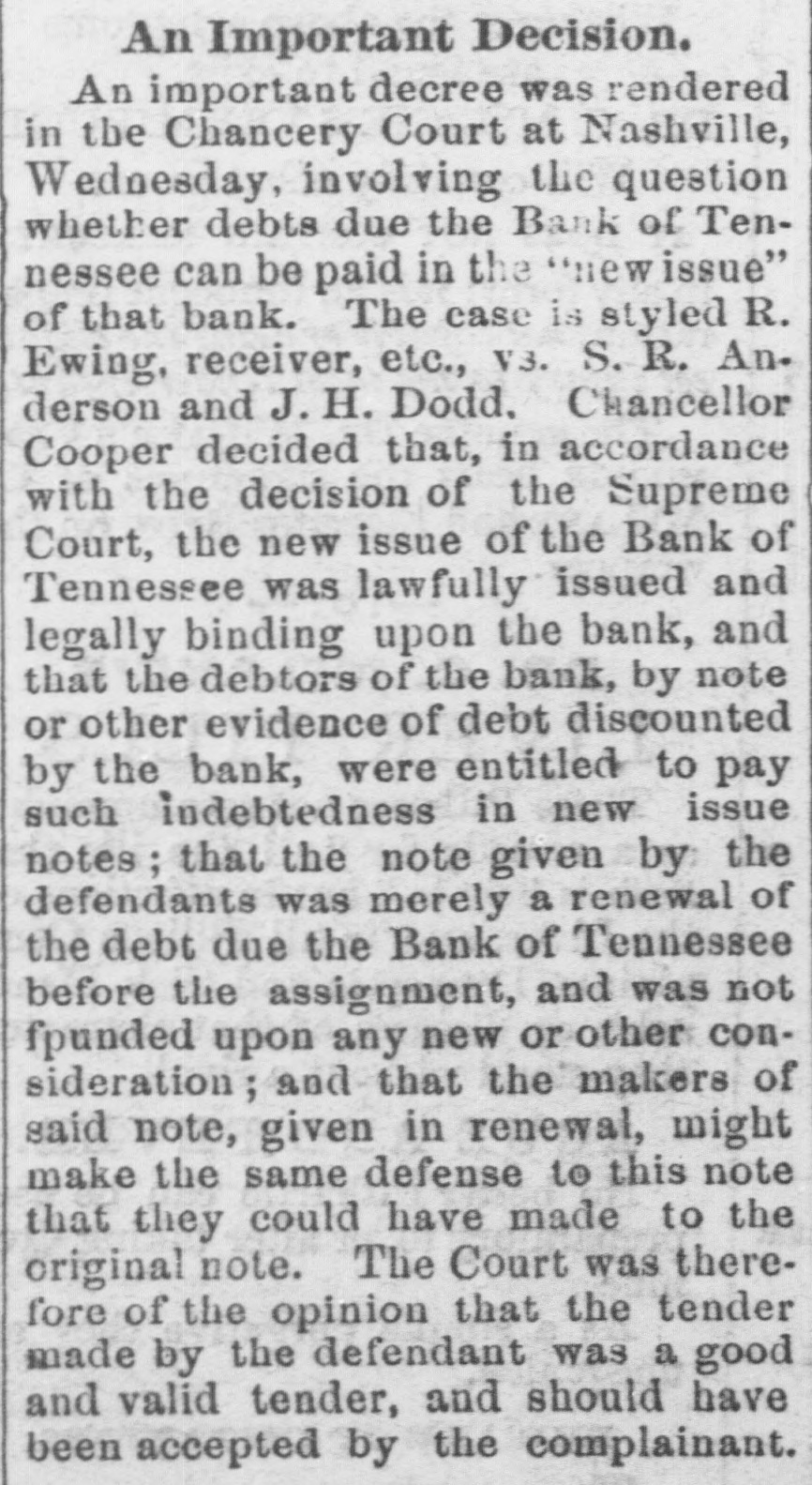
Chancery Court at Nashville ... R. Ewing, receiver, etc., v. S. R. Anderson and J. H. Dodd ... decided that the new issue of the Bank of Tennessee was lawfully issued and legally binding upon the bank.
Source
newspapers
3. January 4, 1878 Other
Newspaper Excerpt
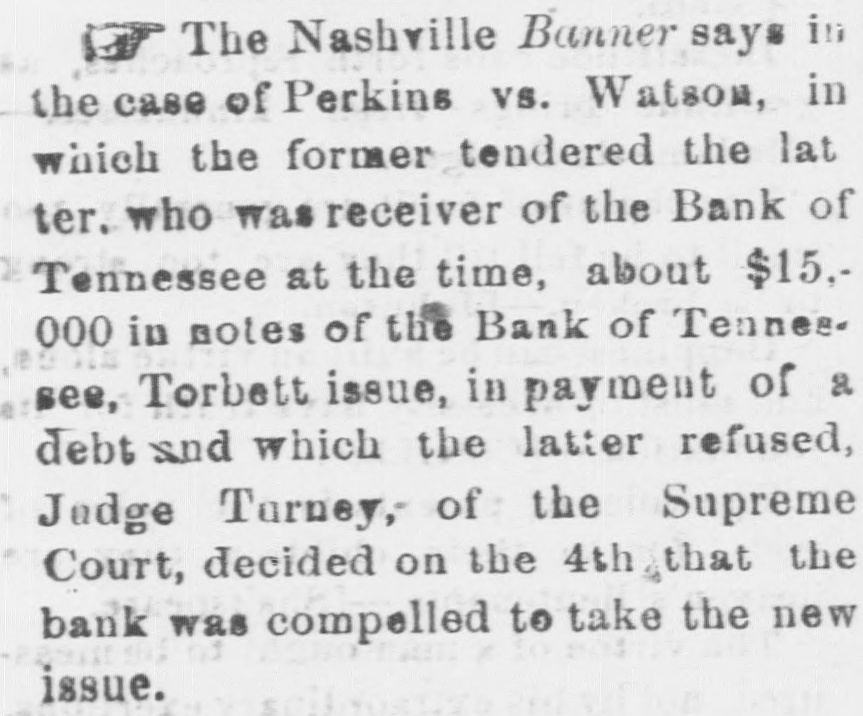
Judge Turney, of the Supreme Court, decided on the 4th that the bank was compelled to take the new issue. (reported 1878-01-16).
Source
newspapers

Newspaper Articles (4)

Article from Fayetteville Observer, February 15, 1877

Click image to open full size in new tab

Article Text

# "New Issue." The Nashville American, of a late date, in reply to an inquiry as to the market price of "Torbet Issue," of the Bank of Tennessee, since the late decision of the Supreme Court, says: * Brokers are offering 20@22 for Bank of Tennessee notes, new issue. The recent decision of the Supreme Court, holding that the note-holders are entitled to the assets of the bank in preference to the depositors, has not changed the rate materially. It is not believed the assets will amount to any considerable sum, after the case has run its course in chancery. Those who make inquiry seem to find it impossible to get at the real market value of these notes. A leading dealer said yesterday that buyers would not pay over twenty-five cents, and did not want large amounts at even that price; that such as had bought them on speculation were loaded with about all they could carry, the risk being too great, in view of the uncertainty as to how the assets of the bank would pan out. Clerk and Master Ewing, to whom the entire assets had now been turned over, would, our informant stated, be able to arrive at a definite idea of their value in a few days."
Article from The Morristown Gazette, May 9, 1877

Click image to open full size in new tab

Article Text

An Important Decision. An important decree was rendered in the Chancery Court at Nashville, Wednesday, involving the question whether debts due the Bank of Tennessee can be paid in the "newissue" of that bank. The case is styled R. Ewing, receiver, etc., V3. S.R. An. derson and J. H. Dodd, Chancellor Cooper decided that, in accordance with the decision of the Supreme Court, the new issue of the Bank of Tennessee was lawfully issued and legally binding upon the bank, and that the debtors of the bank, by note or other evidence of debt discounted by the bank, were entitled to pay such indebtedness in new issue notes; that the note given by: the defendants was merely a renewal of the debt due the Bank of Tennessee before the assignment, and was not founded upon any new or other consideration; and that the makers of said note, given in renewal, might make the same defense to this note that they could have made to the original note. The Court was therefore of the opinion that the tender made by the defendant was a good and valid tender, and should have been accepted by the complainant.


Article from The Home Journal, May 10, 1877

Click image to open full size in new tab

Article Text

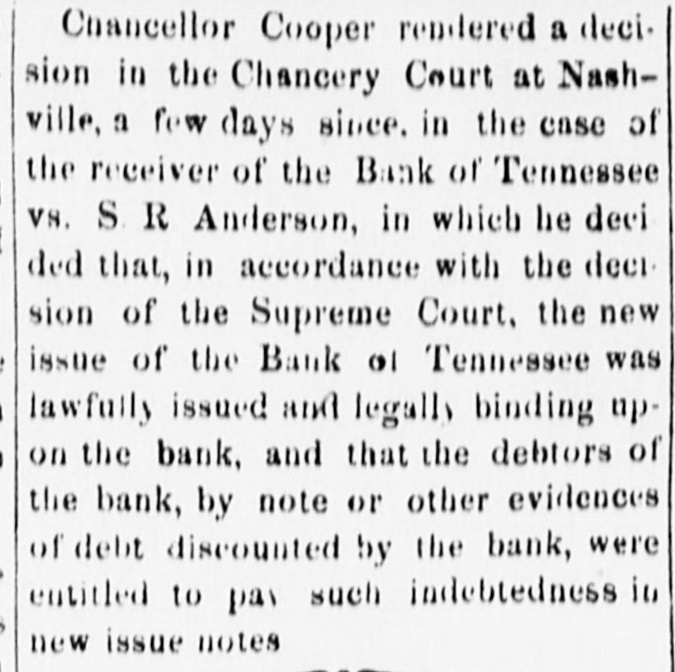
Chancellor Cooper rendered a decision in the Chancery Court at Nashville, a few days since. in the case of the receiver of the Bank of Tennessee VS. S R Anderson, in which he deci ded that, in accordance with the dect sion of the Supreme Court, the new issue of the Bank of Tennessee was lawfully issued and legally binding upon the bank, and that the debtors of the bank, by note or other evidences of debt discounted by the bank, were entitled to pay such indebtedness in new issue notes


Article from The Morristown Gazette, January 16, 1878

Click image to open full size in new tab

Article Text

The Nashville Banner says in the case of Perkins vs. Watson, in which the former tendered the latter, who was receiver of the Bank of Tennessee at the time, about $15,000 in notes of the Bank of Tennessee, Torbett issue, in payment of a debt and which the latter refused, Judge Turney, of the Supreme Court, decided on the 4th that the bank was compelled to take the new issue.