18110. Bank of Tennessee (Nashville, TN)

Bank Information

Episode Type
Run → Suspension → Reopening
Bank Type
state
Start Date
October 15, 1857
Location
Nashville, Tennessee (36.166, -86.784)

Metadata

Model
gpt-5-mini
Short Digest
245e5b7eaf82c8f4

Response Measures

None

Description

Contemporary articles (Oct 1857) describe large crowds and runs on the Bank of Tennessee, followed by the Board ordering a suspension/partial suspension of specie payments. Later reporting (1858) describes branches voluntarily resuming specie (August) and the mother bank continuing operations; no evidence of permanent closure or receivership in these articles.

Events (4)

1. October 15, 1857 Run
Cause
Macro News
Cause Details
Panic stemming from failures and suspensions in New York and other cities (Oct 1857) produced heavy withdrawals and runs for gold on Tennessee banks.
Measures
Directors resisted for weeks but then ordered a partial suspension of specie payments; communicated reasons to legislature and public.
Newspaper Excerpt
The Bank of Tennessee figured as the centre of attraction for a large crowd...we heard upon the very steps of the Bank that it had suspended specie payments!...The Bank of Tennessee has been sustaining a considerable run for gold for some days
Source
newspapers
2. October 16, 1857 Suspension
Cause
Macro News
Cause Details
Board ordered partial suspension of specie payments in response to nationwide banking suspensions and tight money markets (inability to rely on correspondent cities and outflow of specie).
Newspaper Excerpt
YESTERDAY morning there came whizzing over the wires, the astounding news that the Bank of Tennessee had suspended...Next morning the determination of the Bank to suspend specie-payment, was announced at Nashville
Source
newspapers
3. October 20, 1857 Other
Newspaper Excerpt
On Thursday morning last a partial suspension of specie payment, was, with great reluctance, ordered by the Board...They learned on yesterday morning, that not only the Banks in New York and New Orleans had suspended...which will probably lead to a general suspension of the banks in the United States.
Source
newspapers
4. August 1, 1858* Reopening
Newspaper Excerpt
Under such circumstances, the Branches, finding that no business could be safely done by discounts for the public, and knowing their ability to meet all demands against them, in August voluntarily resumed the payment of specie, and have since continued it.
Source
newspapers

Newspaper Articles (22)

Article from Daily Nashville Patriot, October 1, 1857

Click image to open full size in new tab

Article Text

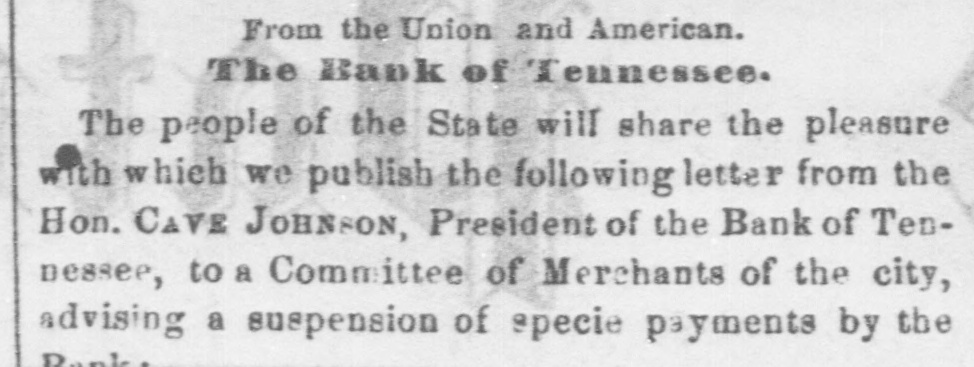
From the Union and American. The Bank of Tennessee. The people of the State will share the pleasure with which we publish the following letter from the Hon. CAVE JOHNSON, President of the Bank of Tenpessee, to a Committee of Merchants of the city, advising a suspension of specie payments by the Banks


Article from Weekly Clarksville Chronicle, October 2, 1857

Click image to open full size in new tab

Article Text

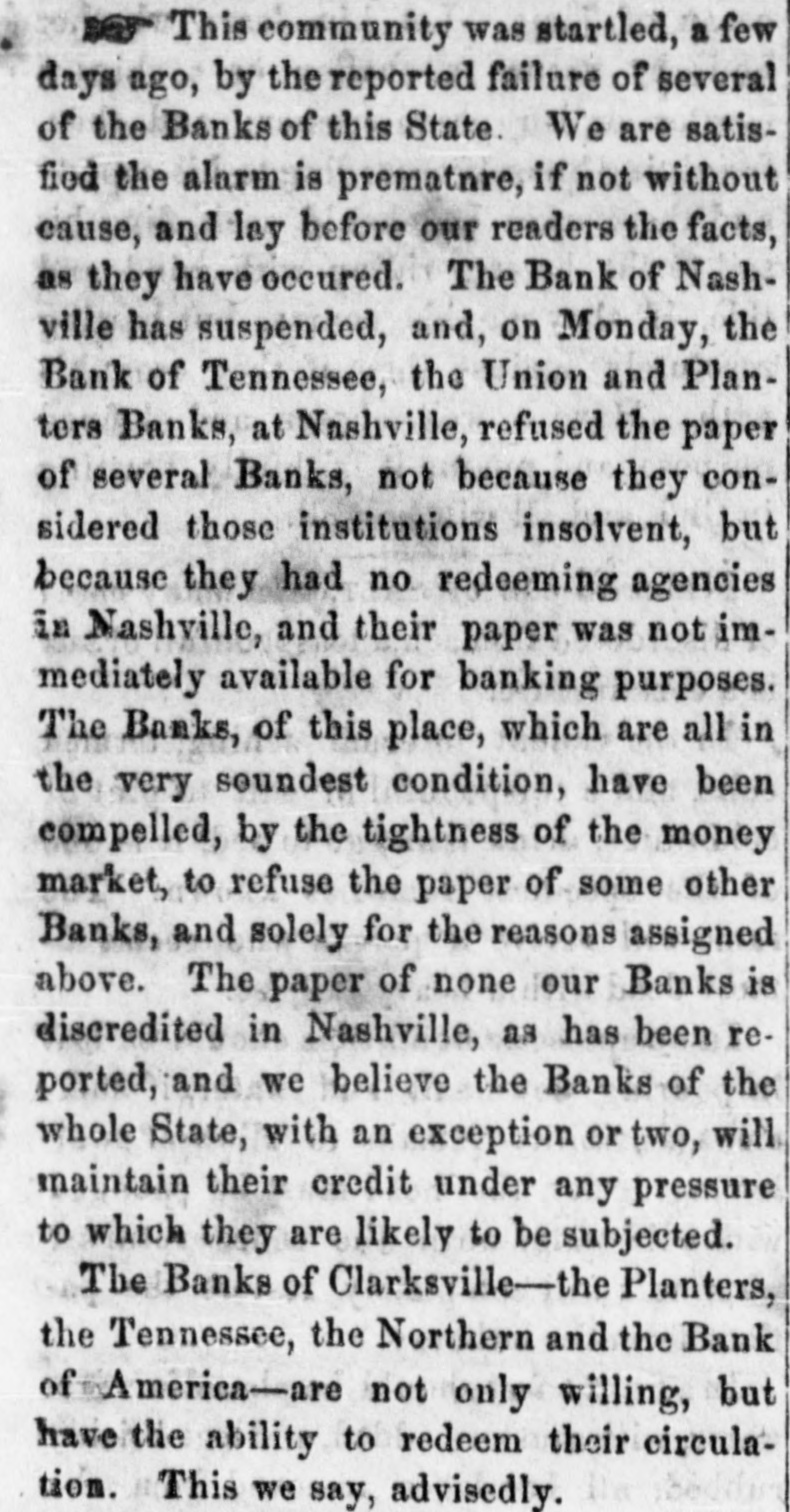
This community was startled, a few days ago, by the reported failure of several of the Banks of this State. We are satisfied the alarm is prematnre, if not without cause, and lay before our readers the facts, as they have occured. The Bank of Nashville has suspended, and, on Monday, the Bank of Tennessee, the Union and Planters Banks, at Nashville, refused the paper of several Banks, not because they considered those institutions insolvent, but because they had no redeeming agencies in Nashville, and their paper was not immediately available for banking purposes. The Banks, of this place, which are all in the very soundest condition, have been compelled, by the tightness of the money market, to refuse the paper of some other Banks, and solely for the reasons assigned above. The paper of none our Banks is discredited in Nashville, as has been reported, and we believe the Banks of the whole State, with an exception or two, will maintain their credit under any pressure to which they are likely to be subjected. The Banks of Clarksville-the Planters, the Tennessee, the Northern and the Bank of America-are not only willing, but have the ability to redeem their circulation. This we say, advisedly.


Article from Daily Nashville Patriot, October 15, 1857

Click image to open full size in new tab

Article Text

NASHVILLE: THURSDAY, OCTOBER 15, 1857. # The Money Crisis and the Tennessee Banks. The panie which occurred in the City of New York, on the failure of the Ohio Trust Company some four weeks since, and which it appeared for a short time would be local and temporary in its consequences, is proven to have been the beginning of such a storm, as has not before been felt in the country, since 1837. The firmness of the Boston Banks, and those of the whole South and West, which stood up so resolutely in the early stages of the panic. gave some assurance that they would be able to weather out the gale. But those appearances have turned out to be delusive. The suspension of eight banks in the City of New York, three days ago-the suspension of several, and the suspicion which rested upon others, of the South Carolina Banks, as reported by telegraph yesterday morning; and the further news that all the banks of the city of New York had suspended yesterday, and that exchange between that city and Philadelphia had been equalized, altogether have produced a marked impression, and have placed a gloomy face upon the financial affairs of the entire country. These facts have sent a thrill through our whole community here and the chief and almost only question on our streets yesterday, was, what will our Tennessee Banks do? Large crowds assembled at our old banks, several times during the day-many believing that there was an immense run going on upon the banks in their very presence and that these institutions were compelled to go by the board. The Bank of Tennessee figured as the centre of attraction for a large crowd, some absolutely dumb-founded, some highly excited, and some amazingly cool, at what seemed the process of prostrating that institution. Indeed, we heard upon the very steps of the Bank that it had suspended specie payments! The same was the case at some of the other banks; and the opinion was prevalent that it was probable that every bank in the city would suspend this morning. We have no doubt that highly exaggerated reports will go out from this city to the country of these occurrences. We almost deem it unnecessary to express our disbelief that any state of facts could now arise, that would force the three old banks of this city to suspend business. We feel every assurance that they can, and will if it is required, go on, and meet all their engagements, and redeem the last dollar of their circulation. It may strain them to do it, but they are, in our judgment, honest and able, and will stand as firm as the rock. We, therefore, consider that the main question is not whether our principal Tennessee banks will suspend, but whether the people will be able to stand the run which is, and is about to be, made upon them. It is our opinion that the people of Tennessee are much less able to stand the run upon the banks, than the banks themselves. And whenever they permit themselves to be carried away in this whirlwind of bank excitement, and are induced to make a a run upon these institutions, they wrong themselves infinitely more than they damage the banks by so doing. Every one will readily see that if the paper currency of the State is discredited, and the bills are returned to the banks, the currency will be reduced at once to specie. And if the banks are deprived of their silver and gold and are left with nothing but depreciated paper, they will be utterly powerless to afford any assistance whatever to the country. The immediate effect of this is to reduce the price of produce to a specie standard; to cut off all means of exchange between different sections of the country, and to paralyze every species of trade and commerce. These facts are amply illustrated in the decline of grain and provisions in the eastern cities within the last month, the fall being from 50 to 75 per cent. in a few days; and in the cotton markets of New Orleans and Mobile. The Banks of these latter cities have so far stood firm, and yet the general derangement of monetary affairs, and the difficulty of exchange, have reduced the price of cotton from 16 to 9 cents within the space of two weeks. Although their banks are good they have been compelled to look out for themselves, and this is the result upon the great body of farmers at the South. The same will be the inevitable result upon the farming interests of Tennessee unless our currency is sustained. Granting then that our banks are sound and able to meet the crisis without the quivering of a nerve or the blanch of a single feature, it becomes an inquiry of serious import whether the community is able to support it? And if not, what is the remedy? The remedy which was applied with greatest success in 1837, was the stepping in of Legislatures and legalizing suspensions. Where banks are undoubtedly sound, this is unquestionably the best remedy for immediate relief, that can be suggested. This is nothing more nor less than to allow the banks to discontinue the payment of specie, while all its other operations are permitted to go on in their usual course. There may be a vast difference between a suspension and a failure. A bank may be immensely rich, and really impregnable, and yet by an inconsiderate and suicidal run on the part of depositors and note holders, be forced into temporary suspension. In legalizing a suspension, there-


Article from Weekly Clarksville Chronicle, October 16, 1857

Click image to open full size in new tab

Article Text

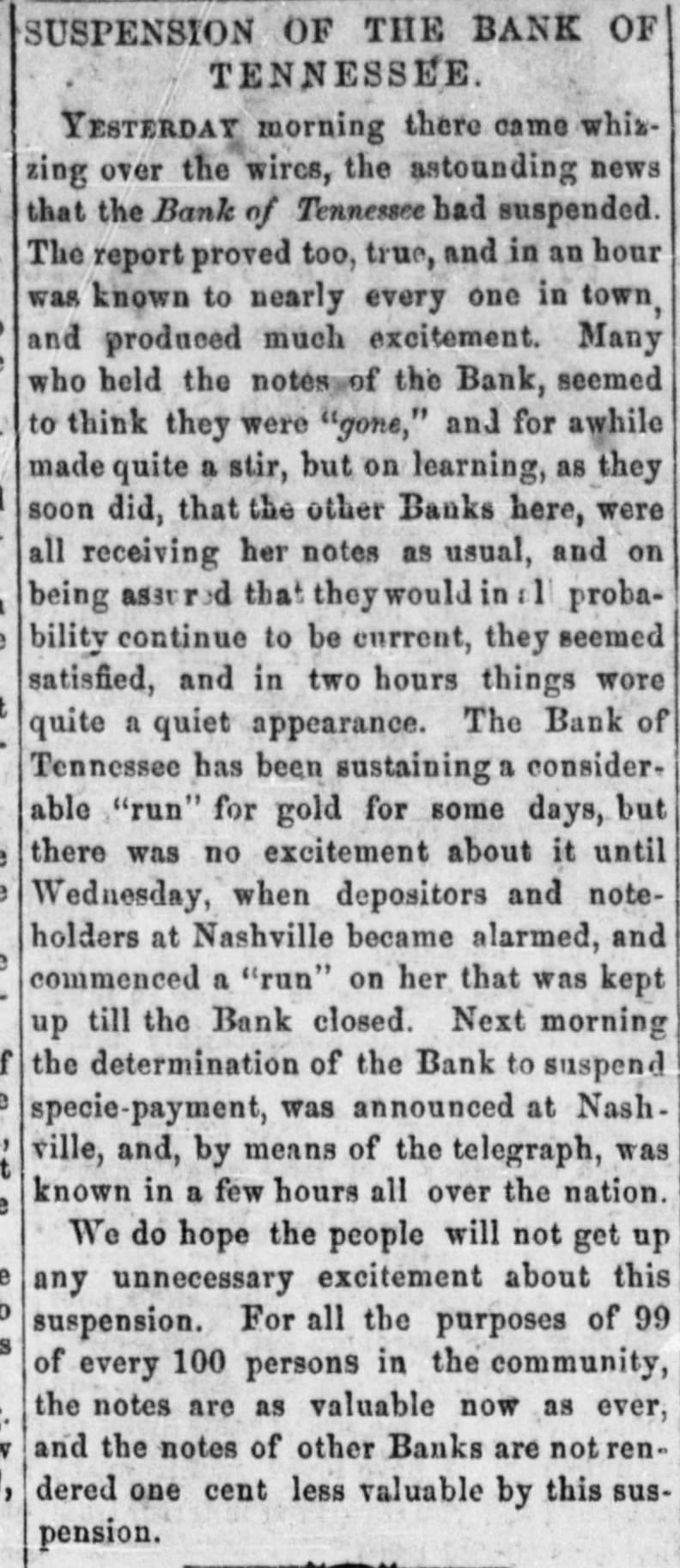
SUSPENSION OF THE BANK OF TENNESSEE. YESTERDAY morning there came whizzing over the wires, the astounding news that the Bank of Tennessee had suspended. The report proved too, true, and in an hour was known to nearly every one in town, and produced much excitement. Many who held the notes of the Bank, seemed to think they were "gone," and for awhile made quite a stir, but on learning, as they soon did, that the other Banks here, were all receiving her notes as usual, and on being assured that they would in 1 probability continue to be current, they seemed satisfied, and in two hours things wore quite a quiet appearance. The Bank of Tennessee has been sustaining a considerable "run" for gold for some days, but there was no excitement about it until Wednesday, when depositors and noteholders at Nashville became alarmed, and commenced a "run" on her that was kept up till the Bank closed. Next morning the determination of the Bank to suspend specie-payment, was announced at Nashville, and, by means of the telegraph, was known in a few hours all over the nation. We do hope the people will not get up any unnecessary excitement about this suspension. For all the purposes of 99 s of every 100 persons in the community, the notes are as valuable now as ever, and the notes of other Banks are not rendered one cent less valuable by this suspension.


Article from Daily Nashville Patriot, October 19, 1857

Click image to open full size in new tab

Article Text

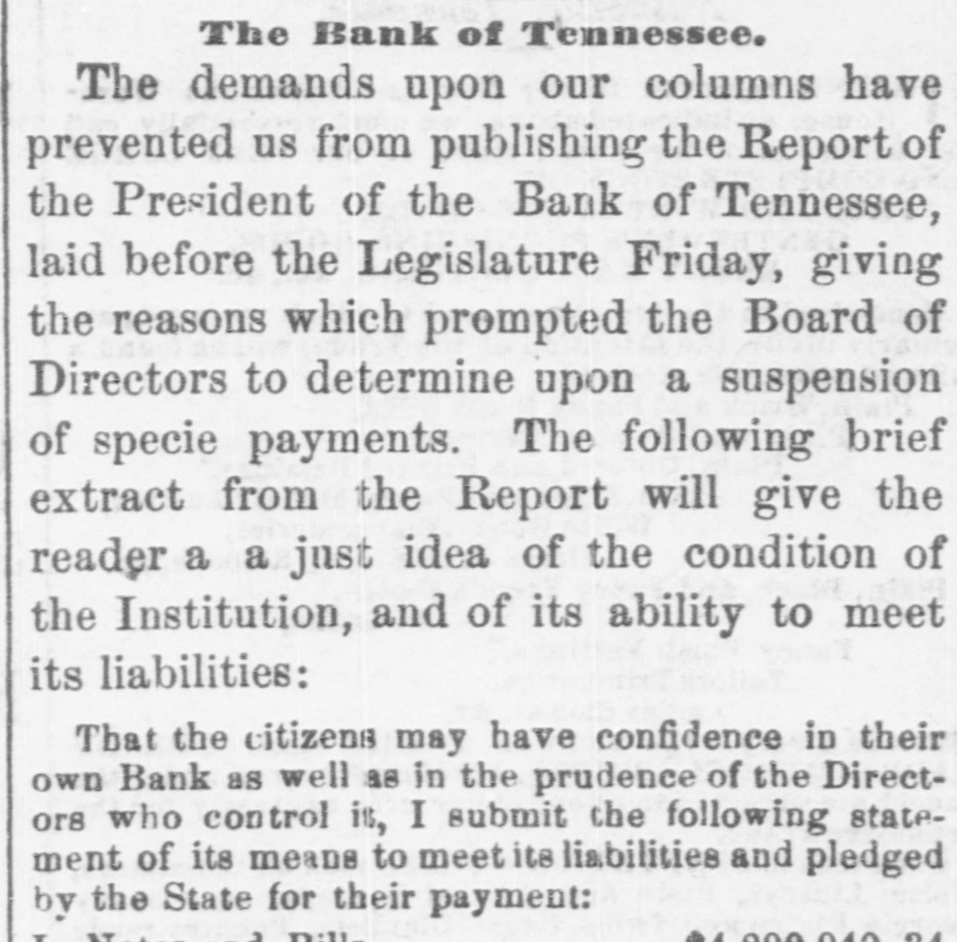
The Bank of Tennessee. The demands upon our columns have prevented us from publishing the Report of the President of the Bank of Tennessee, laid before the Legislature Friday, giving the reasons which prompted the Board of Directors to determine upon a suspension of specie payments. The following brief extract from the Report will give the reader a a just idea of the condition of the Institution, and of its ability to meet its liabilities: That the citizens may have confidence in their own Bank as well as in the prudence of the Directors who control it, I submit the following statement of its means to meet its liabilities and pledged by the State for their payment: Date


Article from Memphis Daily Appeal, October 20, 1857

Click image to open full size in new tab

Article Text

To the General Assembly of the State of Tennessee. The President and Directors of the Bank of Tennessee, have taken a step of so much importance to the Institution and to the interest of the citizens of the State, as to make it their duty to communicate to the General Assembly, the grounds upon which they acted. On Thursday morning last a partial suspension of specie payment, was, with great reluctance, ordered by the Board; they had resisted steadily, for weeks, the most urgent representations of many leading citizens and business men, as to the propriety and the necessity of a suspension under the confident belief that the banks of New York and New Orleans, with which a very extensive business had, for years, been transacted, would be able to meet and successfully resist the pressure existing in the money market. They learned on yesterday morning, that not only the Banks in New York and New Orleans had suspended, but that the leading Banks in New England and several of the Southern States, had done so likewise, which will probably lead to a general suspension of the banks in the United States. Such a course may operate very seriously upon the interests of this bank. Most of the bills maturing between this and the first of the year, are payable. and now in their possession, how and when they are to be paid, cannot now be ascertained. If promptly paid at maturity, as we confidently expected they would be, this bank would not have had the least difficulty in meeting any demand against it, as heretofore stated in a letter addressed to the citizens and business men of Nashville. If these bills when paid can only be made available to us on the currency, which may be adopted in those cities, it must be apparent to every one that we could not deal with them upon such terms, and pay in gold and silver, and time may be required to collect the other dues of the bank from our own citizens, to meet its liabilities. Without the amount due on those bills, the bank would still be able to meet and pay every demand against it in a reasonable time. It did not appear to the Board prudent to stand still and pay its liabilities in gold, when the banks in other States refused to do so. By the suspension in the principal cities, the value of gold has been so much enhanced, that the brokers and other speculators in money have already made it their especial business to hunt up the notes in every section of the country, of our branches, which constitute our principal circulation, and demand their payment in the precious metals for shipment to other sections. The interests of the bank, as well as the State, therefore, seemed to demand the course adopted by the Board. The interests of the individual citizens are not less involved than those of the Bank itself. If the Bank had declined to suspend and paid out their gold as demanded, it must be apparent to every one, that it could have granted no accommodations to any interest whatever, not even to its debtors and its best customers, its currency would have been withdrawn, its debts collected as rapidly as possible, and the debtors left to pay with the present deranged currency of the State, reduced near one-half in amount. The partial stoppage of specie payments adopted by the Board, will enable the Bank to go on with its regular business, and maintain its present circulation. When the citizens see the present condition of the Bank, and recollect that the faith of the State stands pledged for its liabilities, it is confidently believed that its value as a currency in the State will not be diminished. It will be enabled to continue, as heretofore, its usual accommodations to its customers, and relieve to some extent, under proper circumstances, many of its debtors; and, under the supervision and control of prudent and discreet directors, without danger to the interests of the institution or the State. Without some such relief as this, it cannot be doubted that the present state of our currency, and the derangement in commercial affairs, the citizens would have been greatly embarrassed in the transaction of their ordinary business. The Directors have already considered it not only their duty to watch carefully the interests of the institution which they were selected to control, but to protect and relieve the citizens from the revulsions in trade and the contractions and expansions in the currency of the Banks which so often occur, to their great loss and injury. During the last season much was done for relief by keeping up its circulation and continuing its discounts, and much more is expected to be done during the existence of the present embarrassment in our trade and commerce by affording the necessary facilities for the shipment of the products of the State to their appropriate markets. That the citizens may have confidence in their own Bank, as well as in the prudence of the Directors who control it, I submit the following statement of its means to meet its liabilities and pledged by the State for their payment:


Article from Daily Nashville Patriot, October 21, 1857

Click image to open full size in new tab

Article Text

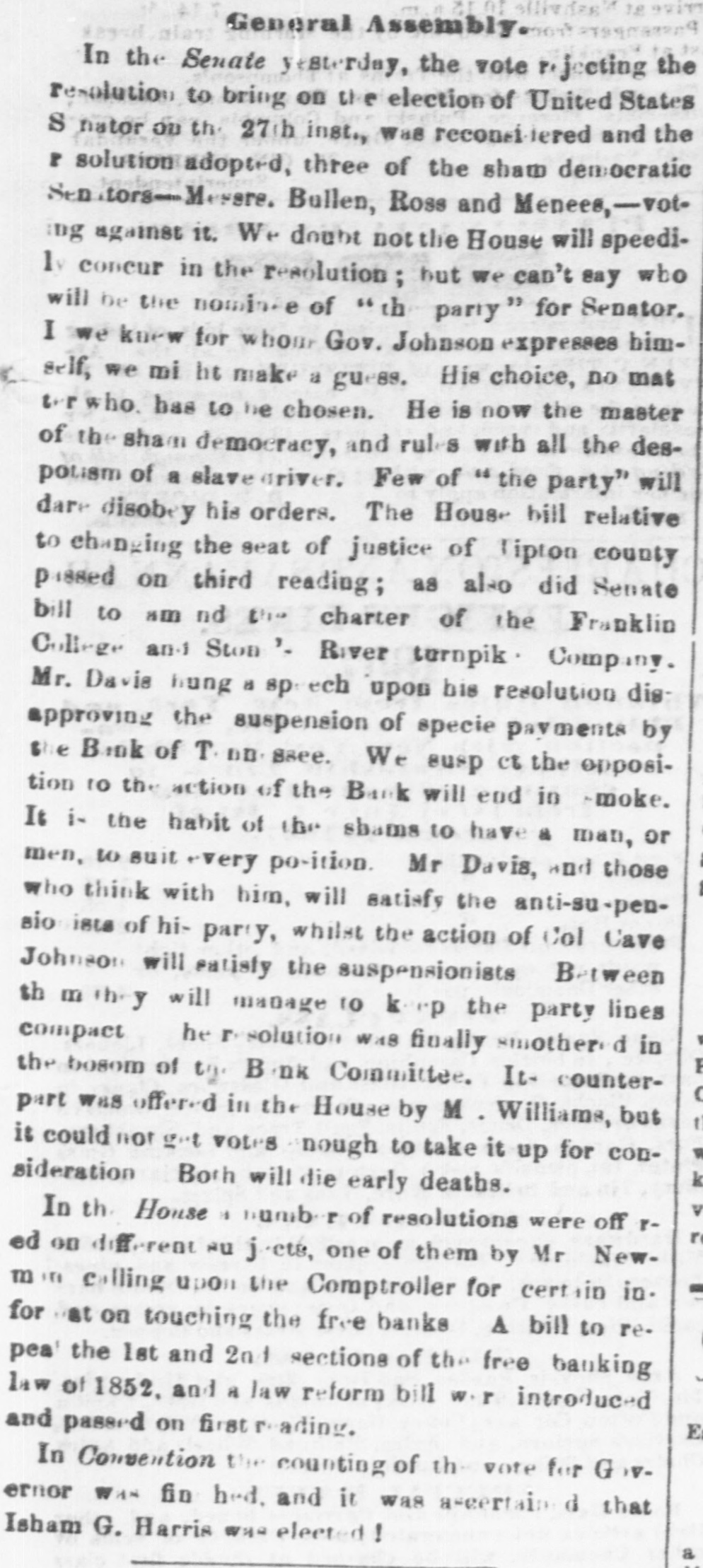
General Assembly In the Senate yesterday, the vote rejecting the resolution to bring on the election of United States S nator on th, 27th inst., was reconsibered and the , solution adopted, three of the sham democratic Sen Bullen, Ross and Menees,-voting against it. We doubt not the House will speedi1v concur in the resolution; ; but we can't say who will be the nominee of "th party" for Senator. I we knew for whom Gov. Johnson expresses himself, we mi ht make a guess. His choice, no mat tor who. has to he chosen. He is now the master of the sham democracy, and rules with all the despotism of a slave oriver. slave driver. Few of the party" will dare disobey his orders. The House bill relative to changing the seat of justice of Tipton county passed on third reading; as also did Senate bill to am nd the charter of the Franklin College and Ston River turnpik Company. Mr. Davis hung a sp: ech upon bis resolution disapproving the suspension of specie payments by the Bank of T. DB 8see. We susp ct the opposition to the action of the Bank will end in -moke. It i- the habit of the shams to have a man, or men, to suit every position. Mr Davis, and those who think with him, will satisfy the anti-su-pensio ists of hi- party, whilst the action of Col Cave Johnson will eatisfy the suspensionists Between th m they will manage to keep the party lines compact he resolution W 18 finally smother di in the bosom of ty, Bink Committee. It- counterpart was offered in the House by M Williams, but it could not get votes nough to take it up for consideration Both will die early deaths. V In th. House 1 number of resolutions were off red on different su jets, one of them by Mr Newm in calling upon the Comptroller for certain in. for wat on touching the free banks A bill to repea the 1st and 2nd sections of the free banking law of 1852, and a law reform bill w.r introduced and passed on first reading. In Convention the counting of th vote for G v. ernor Was fin hed. and it was asgertain di that Isham G. Harris was elected !


Article from Daily Nashville Patriot, November 17, 1857

Click image to open full size in new tab

Article Text

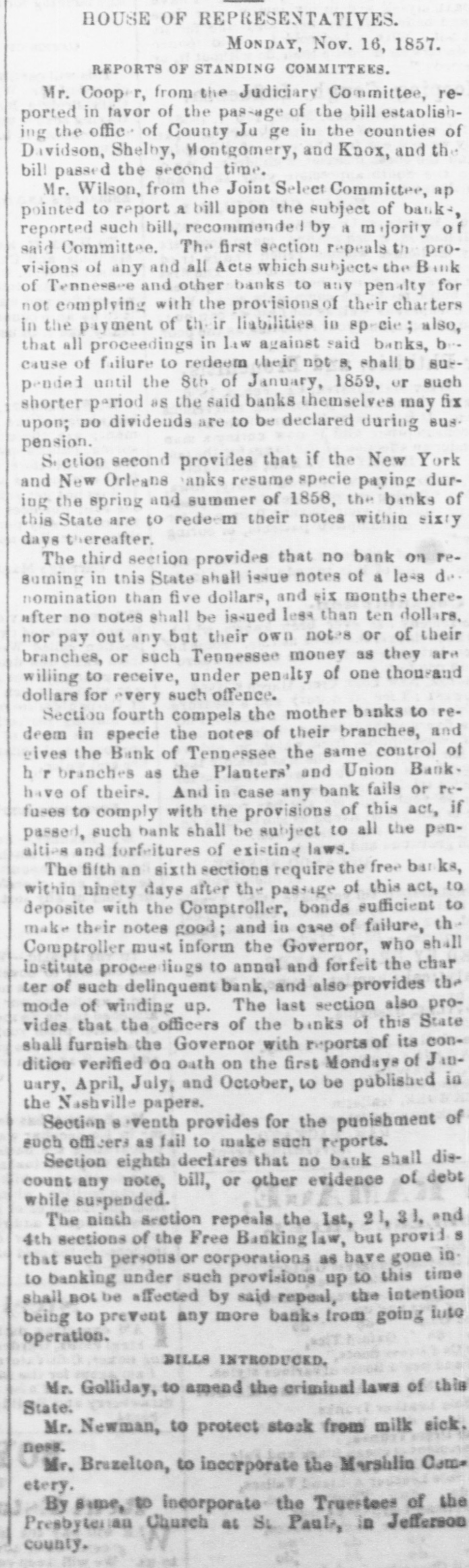
HOUSE OF REPRESENTATIVES. Monday, Nov. 16, 1857. REPORTS OF STANDING COMMITTEES. Mr. Coop from the Judiciary Committee, reported in favor of the passage of the bill establishing the office of County Ju ge in the counties of Davidson, Shelby, Montgomery, and Knox, and the bill passed the second time. Mr. Wilson, from the Joint Select Committee, ap pointed to report a bill upon the subject of banks, reported such bill, recommende by a jority of said Committee. The first section repeals th provisions of any and all Acts which subjects the Bank of Tennessee and other banks to any penalty for not complying with the provisions of their charters in the payment of ch. ir liabilities in specie; also, that all proceedings in law against said banks, b.. cause of fuilure to redeem their not s, shall b BUPpended until the 8th of January, 1859, or such shorter period as the said banks themselves may fix upon; DO dividends are to be declared during suspension. S. etion second provides that if the New York and New Orleans anks resume specie paying during the spring and summer of 1858, the binks of this State are to redeem their notes within sixty days thereafter. The third section provides that no bank on resuming in this State shall issue notes of a less de. nomination than five dollars, and six months thereafter no notes shall be issued less than ten dollars, nor pay out any but their OWD notes or of their branches, or such Tennessee money as they are willing to receive, under penalty of one thousand dollars for every such offence. Section fourth compels the mother binks to redeem in specie the notes of their branches, and gives the Bank of Tennessee the same control of h r branches as the Planters' and Union Bank. have of theirs. And in case any bank fails or refuses to comply with the provisions of this act, if passed, such bank shall be subject to all the penalties and forfeitures of existing laws. The fifth an sixth sections require the free bar ks, within ninety days after the passage of this act, to deposite with the Comptroller, bonds sufficient to make their notes good; and in case of failure, the Comptroller must inform the Governor, who shall institute procee lings to annul and forfeit the char ter of such delinquent bank, and also provides the mode of winding up. The last section also provides that the officers of the binks of this State shall furnish the Governor with reports of its condition verified on oath on the first Mondays of January, April, July, and October, to be published in the Nashville papers. Section 8 venth provides for the punishment of such officers as fail to make such reports. Section eighth declares that no bank shall discount any note, bill, or other evidence of debt while suspended. The ninth section repeals the 1st, 21, 31, end 4th sections of the Free Banking law, but provid 8 that such persons or corporations as have gone into banking under such provisions up to this time shall not be affected by said repeal, the intention being to prevent any more banks from going into operation. BILLS INTRODUCED. Mr. Golliday, to amend the criminal laws of this State. Mr. Newman, to protect stock from milk sick. ness. Mr. Brazelton, to incorporate the Marshlin Cametery. By sime, to incorporate the Truestees of the Presbyter an Church at St Paul, in Jefferson county.


Article from Nashville Union and American, December 3, 1857

Click image to open full size in new tab

Article Text

The bill [286] to make more secure the rights of vendors of land-recommending passage. The bill [189] relative to debt contracted by women before marriage-recommending rejection. The bill [208] to vest magistrates with power to make appropriations to pay themselves for attending quorum and quarterly courts-recommending rejection. The bill [88] to amend the act requiring the sale of land and negroes to be advertised in a newspaper -recommending rejection. The bill [198] requiring Clerks and other county officers to live within their county towns, and for other purposes-recommending rejection. The resolution [64, Mr Copeland's] to amend the State Constitution-recommending rejection. The bill [97] to amend the criminal laws-which was recommitted-recommending, again, rejection. The bill [192] to establish a Mayor's Court for the town of Shelbyville-recommending passage. Mr NEWMAN, from the Committee on Internal Improvements, reported. The bill [187] to autherize the erection of mill dams across Duck river below Columbia-recommending passage. The bill [158] for benefit of Nashville and Northwestern, and other Railroad Companies, and lessen the State liability with an amendment, recommending passage. The resolution directory to the President of the Louisville and Nashville Railroad Company, asking to be discharged from its consideration. The Senate bill (56) to amend the Act amendatory of the charter of the Nashville and Cincinnati Railroad Company-recommending passage, with the amendment for benefit of Louisville and Nashville Railroad Company; recommending the rejection of the House amendment for the benefit of the Atlantic, Tennessee and Ohio Railroad Company; and recommend also, that the Louisville and Nashville Railroad Company be authorized to elect a Vice President, and that the iron mentioned in the bill be under the control of the Road Commissioner. PROPOSITIONS PASSED THE FIRST READING. Mr CARTER of Carter, introduced a bill [No. 284] to charter the Virginia, Tennesseee and North Carolina Railroad Company. Mr EWING introduced a la bill [No. 285] to amend the criminal laws. Mr WHITE of Knox, introduced a bill [No. 2861 to provide for the maintainance of the Deaf and Dumb Asylum at Knoxville. LIQUIDATION OF THE BANK OF TENNESSEE. Mr ALGEE submitted the following, which lies over: Pasche Committee nanas be, and they are hereby required to take into consideration that part of the Governor's message which relates to the State Bank, recommending the putting of that institution into a state of liquidation, and report a bill in conformity therewith. THE HOLIDAYS. Mr BRADFORD submitted the following, which lies over: WHEREAS, It has heretofore been the custom of a large portion of the members of the Legislature of Tennessee to visit their homes during the Christmas holidays, so as not to leave a quorum, or number sufficient to transact business, thereby encumbering the State with a heavy expense, without a corresponding benefit. Therefore, Be it resolved by the General Assembly of the State of Tennessee, That to avoid a useless drain upon the treasury, the present General Assembly will adjourn on Saturday, 18th of December, to Monday, the 4th day of January, 1858. NEW COUNTY OF SEQUATCHIE. On motion by Mr RAWLSTON, the House took up the consideration of the bill (23) to establish the county of Herndon, with Mr Roberts' amendments of boundary. The amendments were adopted. Mr RAWLSTON proposed further to amend, by striking out "Herndon," and inserting "Sequatchie." Mr WHITE believed that name would be preferred by the people set off; it was appropriate, name from the aborigines of the country and he would like to have it preserved in this way. The amendment was adopted; and so the bill passed the second reading. LAUDERDALE REVENUE. On motion by Mr LACKEY, the bill (102) for benefit of the securities of a Lauderdale Revenue Collector, was taken up. The Judiciary Committee's bill in lieu, having been adopted heretofore, was passed the third and last reading in the House of Representativer. SOMERVILLE. On motion by Mr MARIS, the bill (278) to amend the Charter of the town of Somerville, was taken up and passed the second reading. GILES COUNTY JUDGE. On motion by Mr WILLIAMS, the House took up the consideration of the Senate's amendment to the bill establishing the 14th civil district in the county of Hickman, to wit: authorizing the Governor to appoint a Giles county Judge for the December term; and the same being read by the Clerk, was concurred in by the House of Representatives. SPECIAL ORDER-BANKS AND BANKING. On motion by Mr ROWLES, the House now resumed the unfinished special order, to wit: Mr Polk's bill (265) to regulate the business of Banking -the question being on Mr Polk's amendment, for the suppression of small notes issued without the State of Tennessee. Mr ROWLES proposed to amend, by inserting appropriately the word, "knowingly," so as to read, "If any person shall knowingly bring into this State," &c. Mr POLK said it would destroy the force of the provision. Mr FRAZER made a general speech in opposition. Mr STANTON followed-looking to the Congress of the United States for remedy against the evils of small notes of circulation. Mr WILLIAMS said: Mr Speaker, I must beg the kind indulgence of the House, to submit a few remarks on the very important subject now under investigation. I have offered no bill of my own for the action of the House, not caring to be officious or prominent in the matter, and being willing to rely on the very sound judgement of the many learned and able gentlemen whose opinions accord with my own. I may, perhaps, suggest an amendment or two to some of the provisions of the various bills before us. The currency of every country is the great vital moving power that gives life and momentum to every department of its governmental and social policy, and whatever deranges that currency, is felt by all its relations proportionately, to destroy it, is not only to destroy the social relations of a country, but the government itself. The agriculturist plows the field-the mariner plows the main, because he sees in that a reward for his toil-the mechanic pours out his sweat only because he expects to receive a remuneration in money. View it as we please, sir, money is the great motive power that urges men to action; the wheels of government would stop to roll, and society would be reduced to confusion without it. Commerce could not subsist without some great medium and regulator. So obviously necessary is a currency to the convenience and comfort of man, that we find from the remotest ages of antiquity it was known and used It is likewise, knownto ali nations, from the barbarous African, to enlightened christaindom, and by all it seems to be taciturnly agreed, that that currency should be constituted of silver and gold. By international comity, the particular coin of one country recognized in another, and hence its importance asa commercial agent is immensely magnified. Then, if a currency is necessary, (and long usage, teaches that it is)it isjust as necessary that it should be uniform and not subject to sudden and violent fluctuations, it is important not only that it should be good to day, but in all times to come. For several thousand years the precious metal was its own represon-tative, and while that was so, although nations were swept away, and dynasties annihilated, no fluctuation, no panic or pressure was known, but for the last two or three centuries the ingenuity of man has been continually exerted to find some substitute for a metalic currency, alledging that there was not enough of the precious metals to supply the increasing wants of the commercial world, and hence, we have been cursed by fluctuatious, contractions and revulsions, occasioned by the system of banking, which blights not only the prosperity of our own country, but of every country where banks are known. The system was founded on two great fundamental absurdities. One, that there was not gold and silver enough to supply commercial wants; and another still greater absurdity, that paper money, or rather bills of credit, could be made a valuable and reliable substitute for metalic currency. To refute the former, we need only look at the thousands of millions of gold and silver floating through the commercial world-the golden strands of California and Australia, and the gold studded hills of South America. The greatest danger is of their being too much, which might depreciate its value. But that paper issues or bills of credit cannot be made a reliable substitute, is a truth demonstrated everywhere where it is in use. The colonies tried it during their revolutionary struggle, but it rolled back over them an overwhelming tide of ruin, more disastrous than the British arme. The United States Bank tried it on

Article from Daily Nashville Patriot, December 21, 1857

Click image to open full size in new tab

Article Text

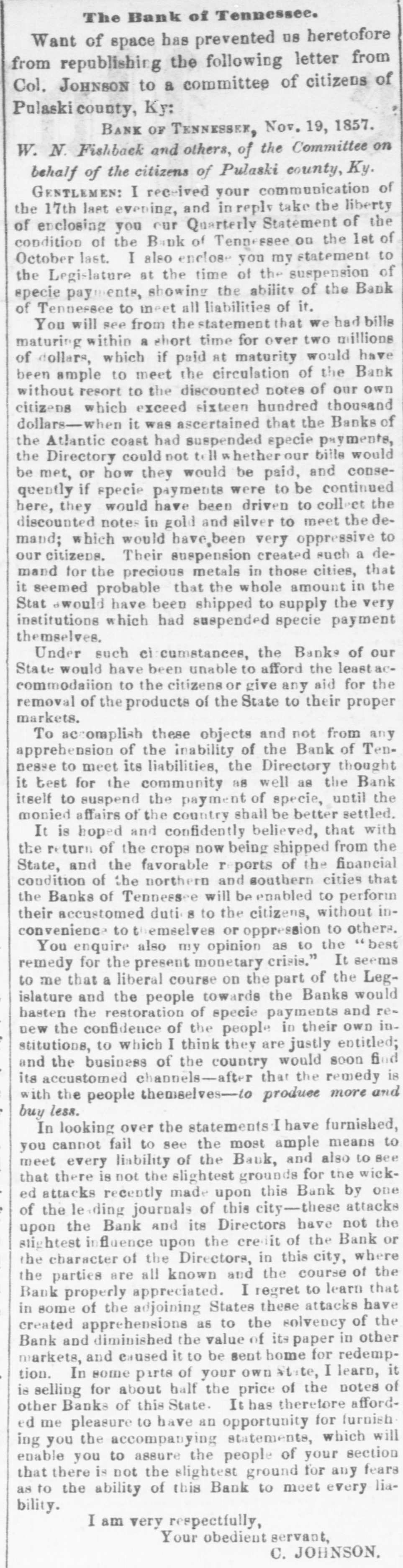
The Bank of Tennessee. Want of space has prevented us heretofore from republishing the following letter from Col. JOHNSON to a committee of citizens of Pulaski county, Ky: BANK OF TENNESSEE, Nov. 19, 1857. W. N. Fishbaek and others, of the Committee on behalf of the citizens of Pulaski county, Ky. GENTLEMEN: I received your communication of the 17th last evening, and in reply take the liberty of enclosing you cur Quarterly Statement of the condition of the Bank of Tennessee on the 1st of October last. I also enclose you my statement to the Legislature at the time of the suspension of specie payments, showing the ability of the Bank of Tennessee to meet all liabilities of it. You will see from the statement that we had bills maturing within a short time for over two millions of dollars, which if paid at maturity would have been ample to meet the circulation of the Bank without resort to the discounted notes of our own citizens which exceed sixteen hundred thousand dollars-when it was ascertained that the Banks of the Atlantic coast had suspended specie payments, the Directory could not tell whether our bills would be met, or how they would be paid, and consequently if specie payments were to be continued here, they would have been driven to collect the discounted notes in gold and silver to meet the demand; which would have been very oppressive to our citizens. Their suspension created such a demand for the precious metals in those cities, that it seemed probable that the whole amount in the Stat would have been shipped to supply the very institutions which had suspended specie payment themselves. Under such circumstances, the Banks of our State would have been unable to afford the least accommodation to the citizens or give any aid for the removal of the products of the State to their proper markets. To accomplish these objects and not from any apprehension of the inability of the Bank of Tennessee to meet its liabilities, the Directory thought it best for the community as well as the Bank itself to suspend the payment of specie, until the monied affairs of the country shall be better settled. It is hoped and confidently believed, that with the return of the crops now being shipped from the State, and the favorable reports of the financial condition of the northern and southern cities that the Banks of Tennessee will be enabled to perforin their accustomed dutis to the citizens, without inconvenience to themselves or oppression to others. You enquire also my opinion as to the "best remedy for the present monetary crisis." It seems to me that a liberal course on the part of the Leg-islature and the people towards the Banks would hasten the restoration of specie payments and renew the confidence of the people in their own institutions, to which I think they are justly entitled; and the business of the country would soon find its accustomed channels-after that the remedy is with the people themselves to produce more and buy less. In looking over the statements I have furnished, you cannot fail to see the most ample means to meet every liability of the Bauk, and also to see that there is not the slightest grounds for the wicked attacks recently made upon this Bank by one of the leading journals of this city these attacks upon the Bank and its Directors have not the slightest influence upon the credit of the Bank or the character of the Directors, in this city, where the parties are all known and the course of the Bank properly appreciated. I regret to learn that in some of the adjoining States these attacks have created apprehensions as to the solvency of the Bank and diminished the value of its paper in other markets, and caused it to be sent home for redemption. In some parts of your own state, I learn, it is selling for about half the price of the notes of other Banks of this State. It has therefore afforded me pleasure to have an opportunity for furnish-ing you the accompanying statements, which will enable you to assure the people of your section that there is not the slightest ground for any fears as to the ability of this Bank to meet every liability. I am very respectfully, Your obedient servant, C. JOHNSON.


Article from Nashville Union and American, March 6, 1858

Click image to open full size in new tab

Article Text

say to serving puoces 22/1 uo Bureq uomsanb 2/2-898T bill, to re-organize the Bank of Tennessee. Mr. ROSS said: Mr. SPEAKER: Sir, I introduced the bill now before the Senate, for the purpose indicated in the bill; but before 1 proceed to discuss the merits of the proposition, I desire to say 8 few words in relation to my opinions about banks. As an abstract bulls 118 01 pesoddo ше I quistions original us 20 of circulation, or in other words, banks to make and put in circulation paper money. But as & Senator. here upon this floor, I take this position, that the Legislature of Tennessee has, in gone by days, created the present currency of the State such as it is. And I hold it to be the duty of the present Legislature to sustain for & given period that currency, until the people can manage their affairs and be prepared to meet the change; and whenever the people are ready for the change, and desire it, then would like to see the policy adopted that would gradually remove every bank of circulation in the State, and come to & gold and siver currency. But I hold that it would be manifestly unjust to a large portion of the people, who went into business and bought property at very high prices under the 8Xpansion of the currency when money was abundant and cheap, now to compel them to pay out under the unprecedented contraction of the circulation, which now amounts to but little over one-third of what it -oddo entire being puy '0.98 the S'B.M. PIO any JO 'Meu Aue chartering 07 pes bank, I thought the best policy that could be adopted to obtain the desired relief for the country, was to increase the capital of the Bank of Tennessee, 80 88 to enable her to throw into circulation, and keep in circulation, some three millions of dollars more than she can at present. This additional amount of circulation furnished by the Bank of Tennessee, will supply the vacuum occasioned by the withdrawal of the circulation of the Union and Planters' Banks, which must continue until the expiration of the charters of said banks, which are now close at hand. And another reason I have for this increase of the capital of the Bank of Tennessee is, that she has furnished & circulation of more uniform value, and with which the community are better satisfied, believing it to be the most reliable currency in the State, under the present difficulties of the monetary affairs of the country. I thought the best interests of the country would be promoted by increasing the capital of the Bank of Tennessee; and, hence, I supported the proposition that passed the Senate 07 the "MOIA m object the 'ore shay emos return to my proposition, which is to re-organize the Bank of Tennessee. The bank has yet ten years to run by its charter Iam aware of the fact, that different Governors, and the present President of the bank, have recommended to different Legislatures to put the bank in liquidation. But to take as data what has been done in that direction, I am not inclined to think it will be done at all; therefore, looking to the interest and protection of the people, I propose in this bill, now before the Senate, to re-organize by calling in and winding up all its branches, now eight in number, and establish one branch in the eastern division of the State at Knoxville, supposing it to be the most important commercial point in that division, and one branch at Memphis, for the reason that it is the great commercial emporium in West Tennessee; the mcther bank to remain as at present, in the city of Nashville. Now, my object in this re organization, is to place the bank in the first place, in & situation that she will have it in her power to make money, and make it largely, for he State, thereby aiding the treasury and lessening the tax upon the people, by centralizing her capital at three of the most important commercial points in the State. Now, in relation to her presentsituation, with her branches scattered all over the State-many branches located where they cannot do & very promost Jo ABA eq: u! business 1 profitable business for banks is & bill business, and the remote distance that many of them are situated from any important commercial point, puts it out of their power to do any thing of importance in the way of buying bills, unless they operate through an irresponsible carpet bag system, which, to say the least of it, is fraught with too much risk, when the public money is concerned. In relation to the adthe pus 1he 07 accrue pinom table branch 8 sq peeple the 01 at Memphis, they would appear to be incalculable, when we come to consider that Memphis is the natural market for West Tennessee, and North Missississippi, in the great staple of cotton, where from three to four hundred thousand bales of cotton must go every year to find a market. The cotton trade of Memphis alone, is worth from twelve to fifteen millions of dollars every year, and increasing, to say nothing about the large amout of wheat, corn, oats, and various other products that find 8 ready market there. The bank with & branch at -100 uo 01 shile eq pinom ton bills enough to carry on the commercial business II of the State. There is another very important consideration in this proposition, that is that the State would save at least $50,000 a year in administering the Bank, that amount saved is that made, and properly belongs to the treasury of the State. And that amount made every year with the interest accruing and reinvesting the same, would amount to over [$800,000] eight hundred thousand dollars, that would be saved in administering the bank for ten years. This large 0 sum would properly go into the Treasury of the State if o defray the ordinary expenses of the Government, eq 01 taxes JO junome eq: Peduce thereby put ollected off of the people. I say to gentlemen Senators, this is not an over estimate by any means, ut in my opinion, falls short of the true amount L bat would be saved, when we look to the fact that his bill proposes to administer the bank with two ranches in connection with the mother Bank. th Well there is one point embraced in this bill, bout which, I presume we will all agree, that is, 70 reduce the number of agents, officers, &c., two hirds, and I presume every Senator here will agree ith me in saying the fewer agents you have to andle the public money the safer for the people II's Renerally poo8 equi 07 base ou nd defalcations, when there & misuse of the public oney em BY eq 07 using you op I no cts of the officers or agents of the Bank, for I am ot & man to make complaints of that character. here has been & great deal said about the rights interest of the people since the meeting of this


Article from Nashville Union and American, March 19, 1858

Click image to open full size in new tab

Article Text

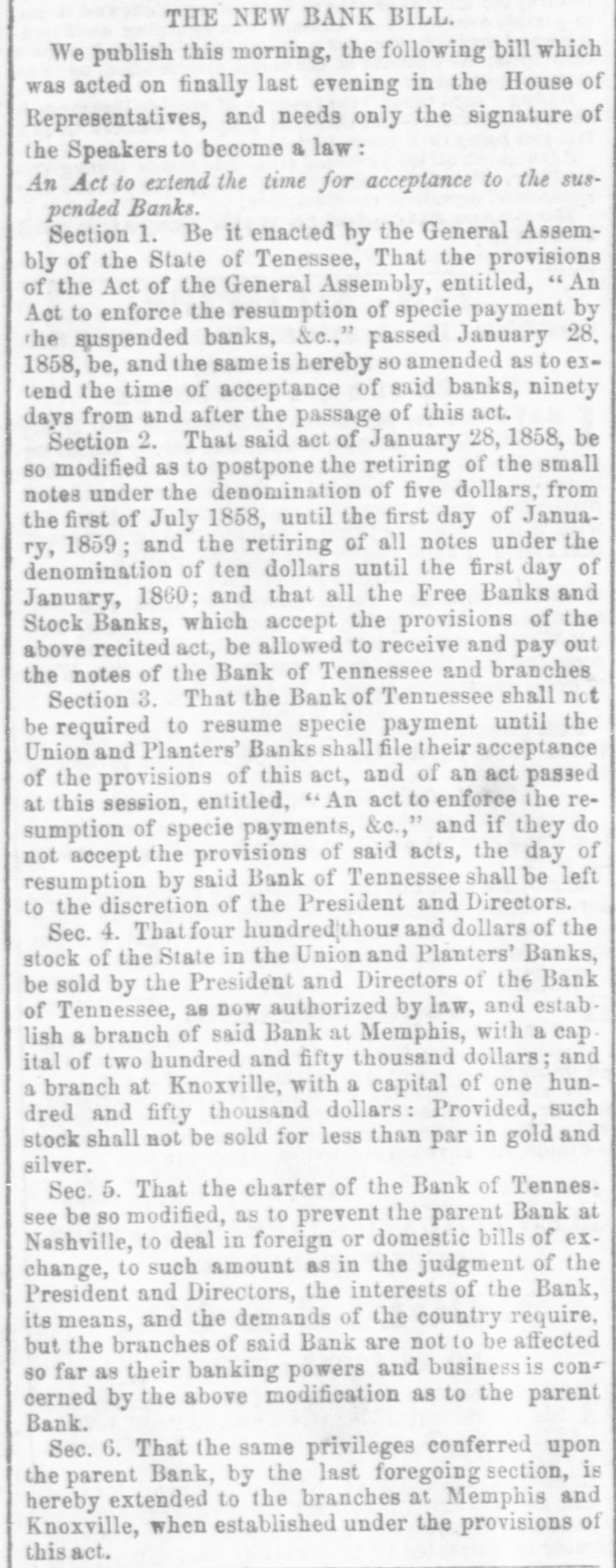
# THE NEW BANK BILL. We publish this morning, the following bill which was acted on finally last evening in the House of Representatives, and needs only the signature of the Speakers to become a law: An Act to extend the time for acceptance to the suspended Banks. Section 1. Be it enacted by the General Assembly of the State of Tenessee, That the provisions of the Act of the General Assembly, entitled, "An Act to enforce the resumption of specie payment by the suspended banks, &c.." passed January 28, 1858, be, and the same is hereby so amended as to extend the time of acceptance of said banks, ninety days from and after the passage of this act. Section 2. That said act of January 28, 1858, be so modified as to postpone the retiring of the small notes under the denomination of five dollars, from the first of July 1858, until the first day of January, 1859; and the retiring of all notes under the denomination of ten dollars until the first day of January, 1860; and that all the Free Banks and Stock Banks, which accept the provisions of the above recited act, be allowed to receive and pay out the notes of the Bank of Tennessee and branches Section 3. That the Bank of Tennessee shall not be required to resume specie payment until the Union and Planters' Banks shall file their acceptance of the provisions of this act, and of an act passed at this session, entitled, "An act to enforce the resumption of specie payments, &c.," and if they do not accept the provisions of said acts, the day of resumption by said Bank of Tennessee shall be left to the discretion of the President and Directors. Sec. 4. That four hundred thousand dollars of the stock of the State in the Union and Planters' Banks, be sold by the President and Directors of the Bank of Tennessee, as now authorized by law, and establish a branch of said Bank at Memphis, with a capital of two hundred and fifty thousand dollars; and a branch at Knoxville, with a capital of one hundred and fifty thousand dollars: Provided, such stock shall not be sold for less than par in gold and silver. Sec. 5. That the charter of the Bank of Tennessee be so modified, as to prevent the parent Bank at Nashville, to deal in foreign or domestic bills of exchange, to such amount as in the judgment of the President and Directors, the interests of the Bank, its means, and the demands of the country require, but the branches of said Bank are not to be affected so far as their banking powers and business is concerned by the above modification as to the parent Bank. Sec. 6. That the same privileges conferred upon the parent Bank, by the last foregoing section, is hereby extended to the branches at Memphis and Knoxville, when established under the provisions of this act.


Article from Nashville Patriot, March 20, 1858

Click image to open full size in new tab

Article Text

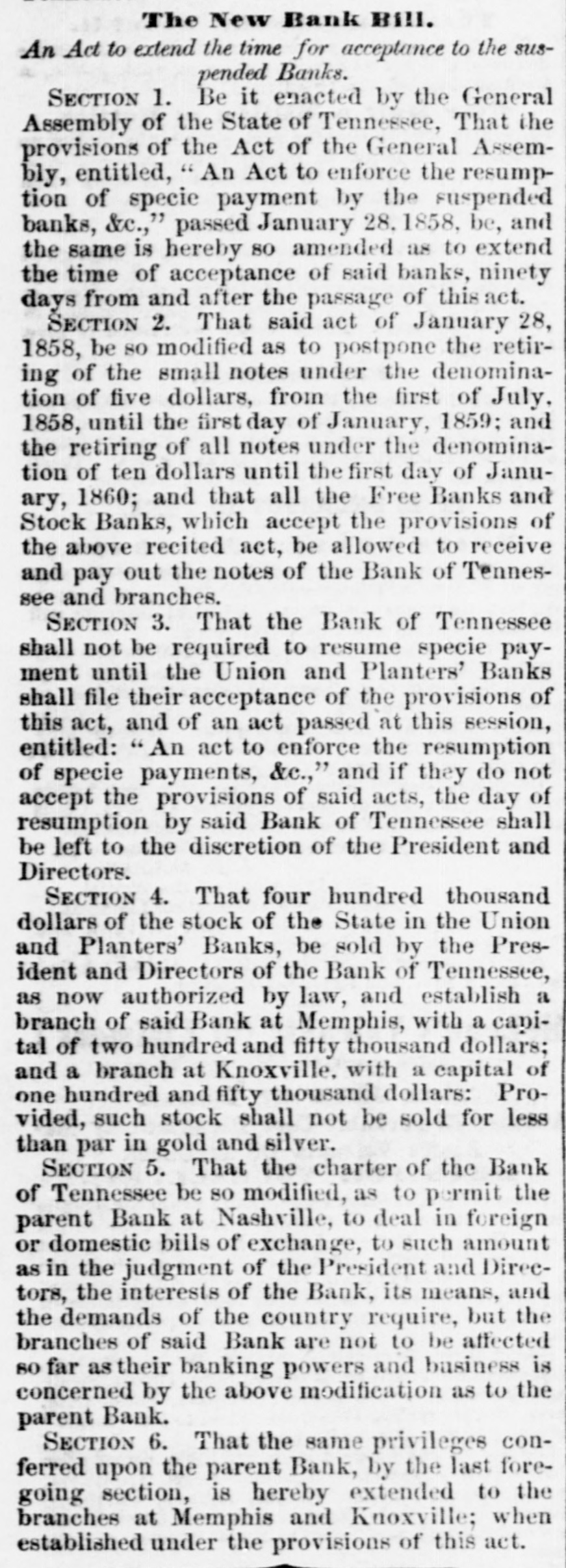
# The New Bank Bill. An Act to extend the time for acceptance to the sus- pended Banks. SECTION 1. Be it enacted by the General Assembly of the State of Tennessee, That the provisions of the Act of the General Assem- bly, entitled, "An Act to enforce the resump- tion of specie payment by the suspended banks, &c.," passed January 28, 1858, be, and the same is hereby so amended as to extend the time of acceptance of said banks, ninety days from and after the passage of this act. SECTION 2. That said act of January 28, 1858, be so modified as to postpone the retir- ing of the small notes under the denomina- tion of five dollars, from the first of July, 1858, until the first day of January, 1859; and the retiring of all notes under the denomina- tion of ten dollars until the first day of Janu- ary, 1860; and that all the Free Banks and Stock Banks, which accept the provisions of the above recited act, be allowed to receive and pay out the notes of the Bank of Tennes- see and branches. SECTION 3. That the Bank of Tennessee shall not be required to resume specie pay- ment until the Union and Planters' Banks shall file their acceptance of the provisions of this act, and of an act passed at this session, entitled: "An act to enforce the resumption of specie payments, &c.," and if they do not accept the provisions of said acts, the day of resumption by said Bank of Tennessee shall be left to the discretion of the President and Directors. SECTION 4. That four hundred thousand dollars of the stock of the State in the Union and Planters' Banks, be sold by the Pres- ident and Directors of the Bank of Tennessee, as now authorized by law, and establish a branch of said Bank at Memphis, with a capi- tal of two hundred and fifty thousand dollars; and a branch at Knoxville, with a capital of one hundred and fifty thousand dollars: Pro- vided, such stock shall not be sold for less than par in gold and silver. SECTION 5. That the charter of the Bank of Tennessee be so modified, as to permit the parent Bank at Nashville, to deal in foreign or domestic bills of exchange, to such amount as in the judgment of the President and Direc- tors, the interests of the Bank, its means, and the demands of the country require, but the branches of said Bank are not to be affected so far as their banking powers and business is concerned by the above modification as to the parent Bank. SECTION 6. That the same privileges con- ferred upon the parent Bank, by the last fore- going section, is hereby extended to the branches at Memphis and Knoxville; when established under the provisions of this act.


Article from The Athens Post, March 26, 1858

Click image to open full size in new tab

Article Text

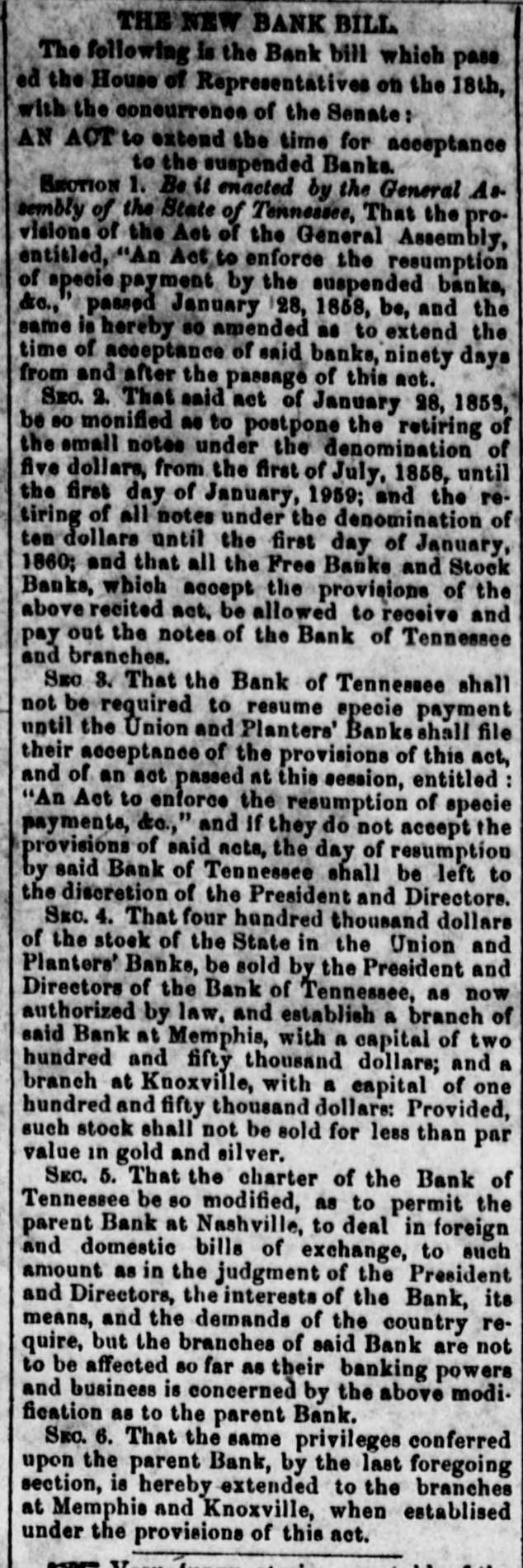
THE NEW BANK BILL The following is the Bank bill which pass ed the House of Representatives on the 18th, with the concurrence of the Senate: an act to extend the time for acceptance to the suspended Banks. SECTION 1. Be it enacted by the General Assembly of the State of Tennessee, That the provisions of the Act of the General Assembly, entitled, "An Act to enforce the resumption of specie payment by the suspended banks, &c.,' passed January 128, 1858, be, and the same is hereby so amended as to extend the time of acceptance of said banks, ninety days from and after the passage of this act. Sec. 2. That said act of January 28, 1853, be so monified as to postpone the retiring of the small notes under the denomination of five dollars, from the first of July, 1858, until the first day of January, 1959; and the retiring of all notes under the denomination of ten dollars until the first day of January, 1860; and that all the Free Banks and Stock Banks, which accept the provisions of the above recited act, be allowed to receive and pay out the notes of the Bank of Tennessee and branches. Smo 3. That the Bank of Tennessee shall not be required to resume specie payment until the Union and Planters' Banks shall file their acceptance of the provisions of this act, and of an act passed nt this session, entitled "An Act to enforce the resumption of specie payments, &c.," and if they do not accept the provisions of said acts, the day of resumption by said Bank of Tennessee shall be left to the discretion of the President and Directors. Ssc. 4. That four hundred thousand dollars of the stock of the State in the Union and Planters' Banks, be sold by the President and Directors of the Bank of Tennessee, as now authorized by law. and establish a branch of said Bank at Memphis, with a capital of two hundred and fifty thousand dollars; and a branch at Knoxville, with a capital of one hundred and fifty thousand dollars: Provided, such stock shall not be sold for less than par value in gold and silver. SEC. 5. That the charter of the Bank of Tennessee be so modified, as to permit the parent Bank at Nashville, to deal in foreign and domestic bills of exchange, to such amount as in the judgment of the President and Directors, the interests of the Bank, its means, and the demands of the country require, but the branches of said Bank are not to be affected 80 far as their banking powers and business is concerned by the above modification as to the parent Bank. SEC. 6. That the same privileges conferred upon the parent Bank, by the last foregoing section, is hereby extended to the branches at Memphis and Knoxville, when establised under the provisions of this act. MM


Article from Nashville Patriot, October 28, 1858

Click image to open full size in new tab

Article Text

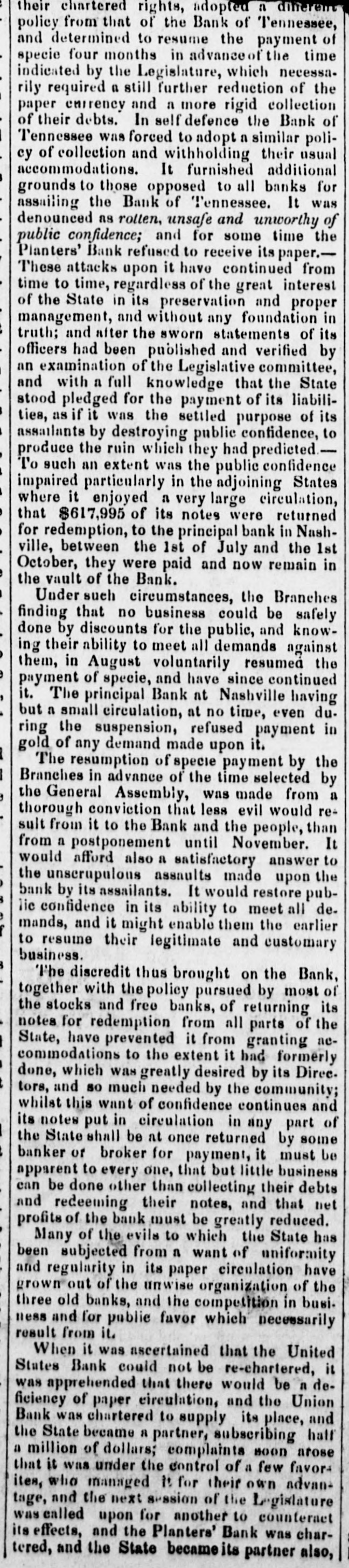
# Bank of Tennessee-Letter from President Johnson. BANK OF TENNESSEE, Oct. 20, 1858. TO THE COMPTROLLER OF THE TREASURY- Sir: In compliance with the act of the General Assembly at its last session I enclose you a statement of the condition of the Bank of Tennessee on the 1st October, the end of the first quarter of the Bank year. In doing so, I think it my duty to accompany it with a brief representation of the conduct and policy adopted by its Directors, that its operations may be better and more readily understood. The suspension of specie payments by the Bank in October last, at this time needs no vindication. The causes which led to that event are now known to have been general, extending over the United States, as well as all other commercial countries, and may be properly traced to an undue expansion of the commerce and trade of the country. The expansion of the banks in the different States, may have had much influence in producing it. But whatever that influence may have been, it cannot in the slightest degree be traced to the Bank of Tennessee. For some years before, its circulation had been at no time so expanded as to excite over trading or encourage the spirit of wild and hazardous speculation; nor has it on the other hand been so reduced as to harass and oppress its debtors. The circulation had averaged about two millions upon a specie basis of about half that sum. The statement now presented together with those sent to the General Assembly at its last session, which were carefully examined by a committee composed of a majority of the decided opponents of the Bank, abundantly prove that it has at all times been kept within reasonable bounds, avoiding extremes on either side, and affording to the people a currency as sound and uniform as the circumstances and business of the country would permit, and at the same time using all its means to keep the exchanges within reasonable and proper limits, at no time exceeding one per. cent premium, and most of the time half that amount. When the suspension was ordered by the Directors, they determined that it should not be made a pretext for enlarging its business or increasing its circulation, and that its discounts should be limited by its collections; by so doing, its paper circulation was kept about the same amount which seemed to be as necessary for the interest and accommodation of the people as of the Bank, and the Bank itself in a condition to resume the payment of specie whenever the interests of the country required it. The course adopted by the Bank was indirectly approved by the General Assembly, when it directed that the Bank should not be compelled to resume before the 1st of November, evidently intending to favor the Banks and the debtors, by enabling them to obtain the benefit of the present crops for the payment of their debts: at the same time imposing on them severe restrictions in the management of their business, and the heaviest penalties for a violation of them-these were obligatory upon the Bank of Tennessee, and requires the utmost caution in its management to avoid a forfeiture of its charter. Acting in accordance with the supposed policy of the General Assembly, the Bank of Tennessee afforded every aid to its debtors, consistent with its safety, by extending the time of payment on their bills and renewing their notes in all such cases as seemed to require it. The statement exhibits but a moderate reduction in the line of discounts since July last, less than one hundred thousand dollars on its notes and still less on its bills. The principal stock banks having refused to accept the provisions of the late act of the General Assembly, and claiming to be exempt from its penalties as a violation of their chartered rights, adopted a different policy from that of the Bank of Tennessee, and determined to resume the payment of specie four months in advance of the time indicated by the Legislature, which necessarily required a still further reduction of the paper currency and a more rigid collection of their debts. In self defence the Bank of Tennessee was forced to adopt a similar policy of collection and withholding their usual accommodations. It furnished additional grounds to those opposed to all banks for assailing the Bank of Tennessee. It was denounced as rotten, unsafe and unworthy of public confidence: and for some time the Planters' Bank refused to receive its paper. These attacks upon it have continued from time to time, regardless of the great interest of the State in its preservation and proper management, and without any foundation in truth; and after the sworn statements of its officers had been published and verified by an examination of the Legislative committee, and with a full knowledge that the State stood pledged for the payment of its liabilities, as if it was the settled purpose of its assailants by destroying public confidence, to produce the ruin which they had predicted. To such an extent was the public confidence impaired particularly in the adjoining States where it enjoyed a very large circulation, that $617,995 of its notes were returned for redemption, to the principal bank in Nashville, between the 1st of July and the 1st October, they were paid and now remain in the vault of the Bank. Under such circumstances, the Branches, finding that no business could be safely done by discounts for the public, and knowing their ability to meet all demands against them, in August voluntarily resumed the payment of specie, and have since continued it. The principal Bank at Nashville having but a small circulation, at no time, even during the suspension, refused payment in gold of any demand made upon it. The resumption of specie payment by the Branches in advance of the time selected by the General Assembly, was made from a thorough conviction that less evil would result from it to the Bank and the people, than from a postponement until November. It would afford also a satisfactory answer to the unscrupulous assaults made upon the bank by its assailants. It would restore public confidence in its ability to meet all demands, and it might enable them the earlier to resume their legitimate and customary business. The discredit thus brought on the Bank, together with the policy pursued by most of the stocks and free banks, of returning its notes for redemption from all parts of the State, have prevented it from granting accommodations to the extent it had formerly done, which was greatly desired by its Directors, and so much needed by the community; whilst this want of confidence continues and its notes put in circulation in any part of the State shall be at once returned by some banker or broker for payment, it must be apparent to every one, that but little business can be done other than collecting their debts and redeeming their notes, and that het profits of the bank must be greatly reduced. Many of the evils to which the State has been subjected from a want of uniformity and regularity in its paper circulation have grown out of the unwise organization of the three old banks, and the competition in business and for public favor which necessarily result from it. When it was ascertained that the United States Bank could not be re-chartered, it was apprehended that there would be a deficiency of paper circulation, and the Union Bank was chartered to supply its place, and the State became a partner, subscribing half a million of dollars; complaints soon arose that it was under the control of a few favorites, who managed it for their own advantage, and the next session of the Legislature was called upon for another to counteract its effects, and the Planters' Bank was chartered, and the State became its partner also, subscribing or purchasing near a quarter of a million of dollars of its stock. The expansions and contractions of these


Article from The Athens Post, November 5, 1858

Click image to open full size in new tab

Article Text

l'ennessee was forced to adopt a similar poli of collection and withholding their usua ecommodations. It furnished additiona grounds to those opposed to all banks fo assailing the Bank of Tennessee. It was denounced as rotten, unsafe and unworthy of public confidence; and for some time the Planters' Bank refused to receive its paper.These attacks upon it have continued from time to time, regardless of the great interes of the State in its preservation and proper nanagement, and without any foundation in ruth; and after the sworn statements of it ficers had been published and verified by examination of the Legislative committee and with a full knowledge that the State tood pledged for the payment of its liabili ies, as if it was the settled purpose of it assailants by destroying public confidence, to produce the ruin which they had predicted Po such an extent was the public confidence mpaired particularly in the adjoining State where it enjoyed a very large circulation that $617,995 of its notes were returned for redemption, to the principal bank in Nash ville, between the 1st of July and the 1s October, they were paid and now remain ir the vault of the Bank. Under such circumstances, the Branches inding that no business could be safely lone by discounts for the public, and know their ability to meet all demands agains hem, in August voluntarily resumed the payment of specie, and have since continue The principal Bank nt Nashville having but a small circulation, at no time, even du ring the suspension, refused payment it gold of any demand made upon it. The resumption of specie payment by the Branches in advance of the time selected by the General Assembly, was made from : thorough conviction that less evil would re sult from it to the Bank and the people, that from a postponement until November. I would afford also a satisfactory answer to the unscrupulous assaults made upon the bank by its assailants. It would restore pub confidence in its ability to meet all de mands, and it might enable them the earlie to resume their legitimate and customary business. The discredit thus brought on the Bank together with the policy pursued by most o the stocks and free banks, of returning it notes for redemption from all parts of the State, have prevented it from granting ae commodations to the extent it had formerly done, which was greatly desired by its Direc tors, and so much needed by the community whilst this want of confidence continues and notes put in circulation in any part o he State shall be at once returned by some banker or broker for payment, it must be pparent to every one, that but little business be done other than collecting their debt nd redeeming their notes, and that he profits of the bank must be greatly reduced. Many of the evils to which the State has subjected from a want of uniformity nd regularity in its paper circulation have rown out of the unwise organization of the hree old banks, and the competition in busi ess and for public favor which necessarily esult from it. When it was ascertained that the United States Bank could not be re-chartered, i vas apprehended that there would be a de ciency of paper circulation, and the Union Bank was chartered to supply its place, and State became a partner, subscribing half million of dollars; complaints soon atose


Article from Nashville Union and American, July 16, 1859

Click image to open full size in new tab

Article Text

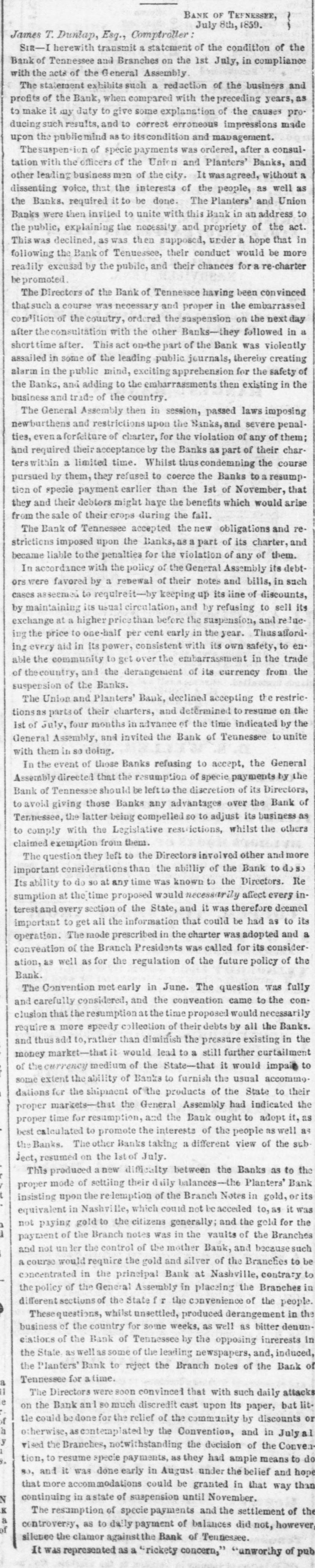
Sin-I herewith transmit a statement of the condition of the Bank of Tennessee and Branches on the 1st July, in compliance with the acts of the General Assembly. The statement exhibits such a reduction of the business and profits of the Bank, when compared with the preceding years, as to make it my duty to give some explanation of the causes producing such results, and to correct erroneous impressions made upon the publicmind as to itscondition and mapagement. Thesuspension of specie payments was ordered, after a consultation with the officers of the Union and Planters' Banks, and other leading business of the city. It wasagreed, without a dissenting voice, that the interests of the people, as well as the Banks, required it to be done. The Planters' and Union Banks were then invited to unite with this Bank in an address to the public, explaining the necessity and propriety of the act. Thiswas declined, as was then supposed, under a hope that in following the Bank of Tenuessee, their conduct would be more readily excussd by the public, and their chances for a re-charter bepromoted. The Directors of the Bank of Tennessee having been convinced thatsuch a course was necessary and proper in the embarrassed condition of the country, ordered the suspension on the next day after the consultation with the other Banks-they followed in a short time after. This act on-the part of the Bank was violently assailed in some of the leading public journals, thereby creating alarm in the public mind, exciting apprehension for the safety of the Banks, and adding to the embarrassments then existing in the business and trade of the country. The General Assembly then in session, passed laws imposing newburthens and restrictions upon the Sanks, and severe penal ties, forfeiture of charter, for the violation of any of them and required their acceptance by the Banks as part of their charterswithin a limited time. Whilst thus condemning the course pursued by them, they refused to coerce the Banks to a resumption of specie payment earlier than the 1st of November, that they and their debtors might have the benefits which would arise from the sale of their crops during the fall. The Bank of Tennessee accepted the new obligations and restrictions imposed upon the Banks,a a part of its charter, and became liable tothe penalties for the violation of any of them. In accordance with the policy of the General Assembly its debtors were favored by a renewal of their notes and bills, in such cases asseemed to requireit-by keeping up its line of discounts, by maintaining its usual circulation, and by refusing to sell its exchange at a higher before the suspension, and redueing the price to one-half per cent early in the year. Thusafford ing every aid in its power, consistent with its own safety, to en able the community to get over the embarrassment in the trade of the country, and the derangement of its currency from the suspension of the Banks. The Union and Planters' Bank, declined accepting the restrictionsas parts their charters, and determined to resume on the 1st of July, four months in advance of the time indicated by the General Assembly, and invited the Bank of Tennessee to unite with them in so doing. In the event of those Banks refusing to accept, the General Assembly directed that the resumption of specie payments by the Bank of Tennessee should be left to the discretion of its Directors to avoid giving those Banks any advantages over the Bank of Tennessee, the latter being compelled so to adjust its business as to comply with the Legislative restrictions, whilst the others claimed exemption from them. The question they left to the Directors involved other and more important considerations than the abilliy of the Bank to do SO Its ability to do $0 at any time was known to the Directors. Re sumption at the time proposed would necessarily affect every in terestand every section of the State, and it was therefore deemed important to get all the information that could be had as to it operation. The mode prescribed in the charter was adopted and a convention of the Branch Presidents was called for its consider ation, as well as for the regulation of the future policy of the Bank. The Convention met early in June. The question was fully and carefully considered, and the convention came to the con clusion that the resumption at the time proposed would necessaril; require a more speedy collection of their debts by all the Banks and thus add to,rather than diminish the pressure existing in th money market-that it would lead to a still further curtailmen t of the currency medium of the State-that it would impain some extent the ability of Banks to furnish the usual accommo dations for the shipment of the products of the State to thei proper markets-that the General Assembly had indicated th proper time for resumption, and the Bank ought to adopt it, a best calculated to promote the interests of the people as well a the Banks. The other Banks taking a different view of the sul Ject, resumed on the 1st of July. This produced a new difficulty between the Banks as to the proper mode of setting their daily balances-the Planters' Ban insisting upon the redemption of the Branch Notes in gold, or if equivalent in Nashville, which could not be acceded to, as it wa not paying gold to the citizens generally; and the gold for th payment of the Branch notes was in the vaults of the Branche and not un ler the control of the mother Bank, and because suc a course would require the gold and silver of the Branches to 1 concentrated in the principal Bank at Nashville, contrary the policy of the General Assembly in placeing the Branches i different sections of the State f r the convenience of the peopl Thesequestions, whilst unsettled, produced derangement in tl business of the country for some weeks, as well as bitter denu clations of the Bank of Tennessee by the opposing inrerests the State as well as some of the leading newspapers, and, induce the Planters' Bank to reject the Branch notes of the Bank Tennessee for a time. The Directors were soon convinced that with such daily attac on the Bank and 80 much discredit cast upon its paper, but li tle could be done for the relief of the community by discounts otherwise, ascontemplated by the Convention, and in July a vised the Branches, notwithstanding the decision of the Conve tion, to resume specie payments, as they had ample means to ( 80, and it was done early in August under the belief and ho that more accommodations could be granted in that way th: continuing in astate of suspension until November. The resumption of specie payments and the settlement of t controversy, as to daily payment of balances did not, however silence the clamor againstthe Bank of Tennessee.


Article from Nashville Union and American, July 16, 1859

Click image to open full size in new tab

Article Text

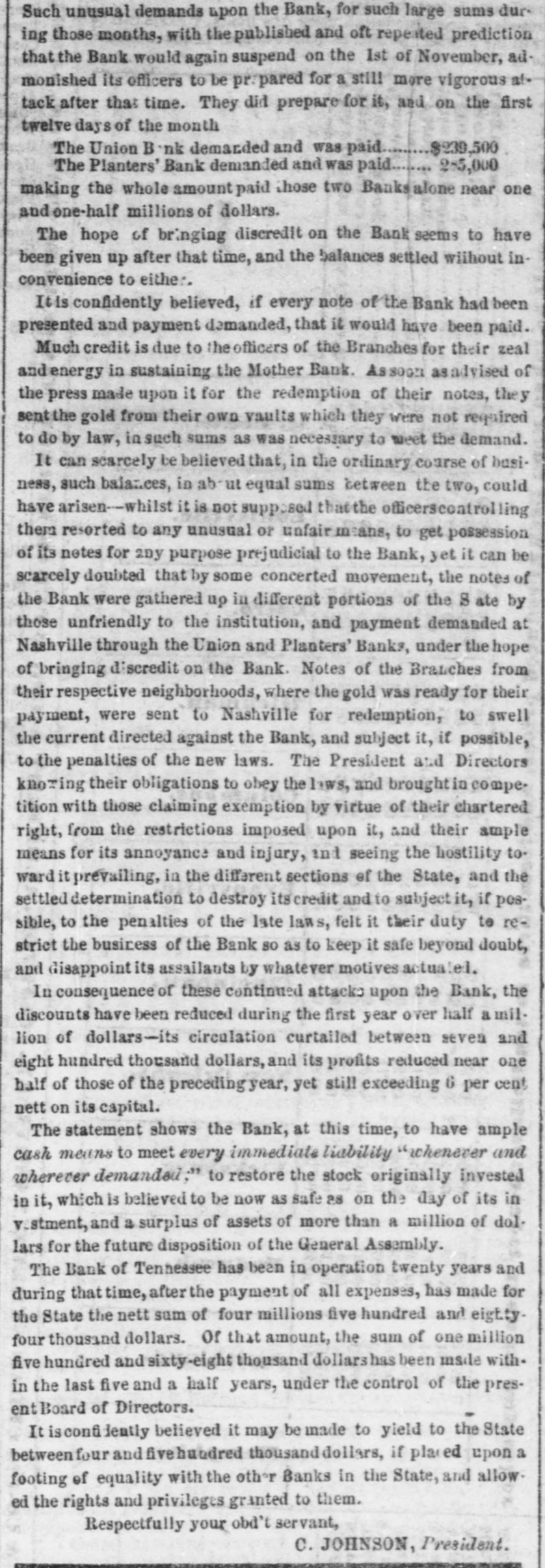
Such unusual demands upon the Bank, for such large sums dur- ing those months, with the published and oft repeated prediction that the Bank would again suspend on the 1st of November, ad- monished its officers to be prepared for a still more vigorous at- tack after that time. They did prepare for it, and on the first twelve days of the month The Union Bank demanded and was paid...$239,500 The Planters' Bank demanded and was paid... 2-5,000 making the whole amount paid those two Banks alone near one and one-half millions of dollars. The hope of bringing discredit on the Bank seems to have been given up after that time, and the balances settled without in- convenience to either. It is confidently believed, if every note of the Bank had been presented and payment demanded, that it would have been paid. Much credit is due to the officers of the Branches for their zeal and energy in sustaining the Mother Bank. As soon as advised of the press made upon it for the redemption of their notes, they sent the gold from their own vaults which they were not required to do by law, in such sums as was necessary to meet the demand. It can scarcely be believed that, in the ordinary course of busi- ness, such balances, in about equal sums between the two, could have arisen—whilst it is not supposed that the officers controlling them resorted to any unusual or unfair means, to get possession of its notes for any purpose prejudicial to the Bank, yet it can be scarcely doubted that by some concerted movement, the notes of the Bank were gathered up in different portions of the State by those unfriendly to the institution, and payment demanded at Nashville through the Union and Planters' Banks, under the hope of bringing discredit on the Bank. Notes of the Branches from their respective neighborhoods, where the gold was ready for their payment, were sent to Nashville for redemption, to swell the current directed against the Bank, and subject it, if possible, to the penalties of the new laws. The President and Directors knowing their obligations to obey the laws, and brought in compe- tition with those claiming exemption by virtue of their chartered right, from the restrictions imposed upon it, and their ample means for its annoyance and injury, and seeing the hostility to- ward it prevailing, in the different sections of the State, and the settled determination to destroy its credit and to subject it, if pos- sible, to the penalties of the late laws, felt it their duty to re- strict the business of the Bank so as to keep it safe beyond doubt, and disappoint its assailants by whatever motives actuated. In consequence of these continued attacks upon the Bank, the discounts have been reduced during the first year over half a mil- lion of dollars—its circulation curtailed between seven and eight hundred thousand dollars, and its profits reduced near one half of those of the preceding year, yet still exceeding 6 per cent nett on its capital. The statement shows the Bank, at this time, to have ample cash means to meet every immediate liability "whenever and wherever demanded;" to restore the stock originally invested in it, which is believed to be now as safe as on the day of its in- vestment, and a surplus of assets of more than a million of dol- lars for the future disposition of the General Assembly. The Bank of Tennessee has been in operation twenty years and during that time, after the payment of all expenses, has made for the State the nett sum of four millions five hundred and eighty- four thousand dollars. Of that amount, the sum of one million five hundred and sixty-eight thousand dollars has been made with- in the last five and a half years, under the control of the pres- ent Board of Directors. It is confidently believed it may be made to yield to the State between four and five hundred thousand dollars, if placed upon a footing of equality with the other Banks in the State, and allow- ed the rights and privileges granted to them. Respectfully your obd't servant, C. JOHNSON, President.


Article from Nashville Patriot, October 24, 1859

Click image to open full size in new tab

Article Text

The portions of the School Fund heretofore apportioned amongst the Branches have been transferred to the mother Bank, and 08 lieu us paggides Branches the that their books in future will exhibit their entire capital 08 cash. The hole School Fund in the Bank amounts to 1,120,589 14. The report states that a comparison of the statements accompanying it, with those of preceding years, show a large reducJO SB 11em SB business the u! uo! the Institution. The profits for the year ending on the 1st of July, 1859, compared with those of the preceding year, " show an actual loss to the State of 954 63." A considerable portion of the Report is occupied with an explanation of the causes of this unfortunate state of things. The last Legislature enacted laws imposing restrictions upon the Banks andrequiring them to resume the payment of specie on the 1st of November, 1858. The Bank of Tennessee accepted these restrictions-the Union and Planters' Banks did not. The Bank of Tennessee determined upon a line of policy which would enable her to accommodate the people, and resume at the time re quired by law. The Union and Planters' Banks resolved to re*ume on the 1st of July, and invited the Bank of Tennessee to join them. The invitation was submitted to a convention of the Presidents of the Bank and Branches and -p= 01 better SB papreded being 1! declined here to the policy already adopted From this moment, the Bank of Tennessee was denounced as unsound, and the denunciations were kept so vigorously as to prevent her from carrying out her line of policy and re sumption was determined upon, and carried into effect. Notwithstanding this, the clamor against the Bank was continued. The settling of balaaces between her and the old banks was made the occasion of drawing from her from the 1st of July to the 12th of u! 88 $1313116 Jo uns the Noverber specie. The President thinks the heavy demands made upon her for specie were the result of a determination to force her into a second suspension.and consequent forfeiture of charter. He does not, however, doubt the statement of the officers of the old banks that no unusual and unfair means were resorted ill uodn spusmed such buing 01 used hq 01 The effect of these demands was to cause a beavy reduction of the discounts of the Bank, and of the profits to the sum mentioned above, in one year. Another effect was the injury done to the credit of the State in the depreciation abroad of the price of State Bonds. The Report recommends again the adoption of amendments of the charter of Bank '91 which 10 Tears OM1 the placing of the branches under the control of the mother bank; and another, to authorize the courts, upon certificate of the defalcation of any debtor. to issue an execution for 88 anp Aquour em Jo Supper eq: in cases of money of minors loaned by masters in Chancery. A repeal of article 1814 in the Code establishing the counter note system is recommended. The act of January 28, Section 7, prohibits the banks from paying out any notes but 18" which am 10 'UMO their sued or paid out; but to avoid the evil effects -ne 'passed SUM 108 us 'sign jo thorizing the banks which should accept the restrictions of the former act. to receive and pay out the notes of the Bank of Tennessee and branches. The act of January was incorporated in the Code, whilst the subsequent modification was not. This oversight has de prived the Bank of Tennessee of important advantages, and entailed upon her serious evils. The Report states them as followsBy these provisions, the Bank and its -fud notes uno my mo had S|uo 083 branches able at the counter, whilst by other laws, they are compelled to receive in pay ment of debts the notes of each other; and cannot, with a proper regard for their credit, refuse to recerve them on deposit. The notes of the branches in the course of trade and business, will necessarily concentrade at the principal points of business. Thousands of dollars of the branch notes are daily paid to the Bank in Nashville, and cannot be used for any purpose until sent to the branches payable. the gold obtained and brought back-so with each of the branches- thus incurring heavy additional expenses, besides the hazard of transmitting the gold from one to the other. The Bank before the middle of September. found itself in possession of more than half a million of its branch notes and yet unable to discount area ITEMS 811 aog Jellop . in circulation and could not be had for immediate use. New notes based upon the currency of the branches could not be safely isseq dued em to business em benee puu :pans been in a great degree suspended since the 1st of September. The same thing occurs with every branch; their circulation is gener siqap em :apdood am jo spusy em u! "11" collected often the notes of the other branch-qo eq meo p108 I!!!!! pasn eq cannot pue tained for them. The Report regards the restrictions as improper for Banks with branches over which they have no contr ol, and says their operation upon the Bank of Tennessee .. has been Bing of 'yses pup ware sp in ''' pduces 02 gold from the Branches to Nashville for the benefit of Brokers and other Banks." The notes of the Bank under five dollars, 18mg SU completed may ммирфцим been earq as possible and destroyed but their place has been supplied with small notes of the banks of other States. It is apprehended that after the 1st of January next, when no em 'panse! en 01 Pollars Jepun seles are Indoss amos unless 'ousua 11!" result surve taken by the Legislature to prevent it. -ap em eq II"9" " II up s! II termination of the General Assembly to continue banking as it has done for. the last action puu asim uses pinom 11 Years' them am 10 control exclusive the amasse 01 " Jos eqs su DOOR SB State am "II pasn Senous paded same can be done consistently with the char-


Article from Nashville Union and American, November 27, 1860

Click image to open full size in new tab

Article Text

-08 JO classes II" 03 pus Surmary ciety. A few facts will better illustrate my meanBranch the Jo euo Suy phis, found, that for soine time previous to the date of my examination, the Bank had discounted cotton Bills to the extent of about two hundred and thirty thousand dol'ars per week. The Bills taken, were based upon actual shipments of cotton bough at fair rates,drawn by first class men at home,accept ed by first class houses in New Orleans, having but thirty days to run, and yet such was the conditon of things that the Bank, thus furnishing the local currency with which to pay for the cotton at Memas piscount Jo out siq1 dots 01 had 'sryd whole, and why We will see by following the basis of this operation (the eotton) to another mar ket. When it arrived at New Orleans the Memphis buyer placed it upon the market, and his purchaser buying mostly for foreign markets, must obtain the local currency at New Orleans with which to pay for by selling to the New Orleans Banks his sterling bills, drawn upon credits furnished him by bis foreign correspondent. New Orleans having but little foreign trade, unless these sterling bills find buyers in New York, st 4! ano jo focus Breat )the manifestly impossible for the New Orleans Banks to furnish the local currency with which to pay the Memphis buyer for his cotton. The fact is well known that there is now no market in New York for Sterling Bills, except at ruinous rates. The par quesand : 1601 believe "st Sugars Jo selling rate at New York is about 98, an actual discount of 11 per cent, when it only requires about one per cent to bring the coin from Europe to New York. 8 rate of discount so ruinous that operators can not and will not stand it. Thus the Memphis buyer can not meet his bills, and must renew or go to protest, and the Bank furnishing the local currency 04 usang 81 home 18 pind 81 planter the which protect its circulation to use the gold in its vaults and wait the uncertain result of the original drawer's operation for 8 replenishment of the metal thus abstracted. Manifestly no Bank can keep out and protect a circulation with the stream of metal thus -ast euou pus 61! 10 no while the II" Surmoy turning. If, however, the depressing influences PIP country am jo орвл the uodn operature Mou not exist, the Memphis buyer would find & purchaser in New Orleans, the New Orleans buyer would find a sale for his sterling exchange with which to pay. And with acredit, in the Banks of New Orleans, equal to the amount of circulation to purchase the cotton at Memphis, in favor of the Memphis Bank, (which could be ordered home in gold to replace that used to protect the circulation used in the first 02[1] 01 condition u! 09 mede pinom # ('esupand other bills and furnish the buyer with home cur rency with which to pay the planter for his cotton. Thus would be produced an equilibrium in the 04 Surme and appli metal the Jo Moy put qqa the disturbing causes above referred to, there is damming up of the commercial stream at New York, the reflex action of which is R total destruction of public confidence, or more preperly speaking, of public credit, driving home the notes of the Banks -sip II" dois 01 Banks the canaling Joj onp money am collect 01 them Subject puv country them upon notes and bills previously discounted. This again causes the debtor class to push their creditors, all resulting under forced sales, to a loss hhe u! Superous Maadead 10 en ut pood auo jo Anjua the uuq: JOJE " was 01 mus st country on when time ' 1" 001 sin pus 'do.ro pasodum the Jopun sdore successive chice u! Failure particl B jo The article of cotton IS taken simply for the sake of illustration; the same facts obtain with reference -qo eq II!M 41 mmg one 10 other the that served, however, that in every case the loss falls on the producer. The buyer, having to sustain a loss of eleven per cent on his sterling exchange in order to obtain the local currency with which to purрлода only use pus Anq counse Jo 111 chase -as paid jo B 111 Ang 01 duced. Thus, I again repeat, the loss falls on the labor of the count.y and the products of this labor being the true basis of all pecuniary prosperity, a depressed pecuniary condition must follow in exact atio with the depression of the great industrial basis. There is still another cause, deducible. it is true, from those already given. but which esteem wor thy of especial notice. By reference to the Bank Code, sec on 6th, it will be seen that each and every UB has uo dear 04 ST State am u! Bank -ua #11 jo print euo 01 June punj speate Jo junome tire liabilities. It is further provided that in case this specie fund shall fall short of this proportion, until for forty days, then all discounts shall cease such proportion is restored. The Bank of Tennesand the Union and Planters' Banks had, on the specie jo millings OMT "staquinu puno. u! aas 181 funds, and their immediate liabilities, in deposits and circulation, were five millions of dollars. From this it will be seen that they were entitled to an increased circulation, had the country been in condition to receive it, of one million of dollars. But peperits 10 pursnoqi ag asoddns and circulati were returned to the Banks for specie and specie funds. Then the Banks would hold one and a half millions of specie and specie funds. 4q susodep pur checkstic a! amount per anoj 01 eq 01 DAVE Decessarily plnom MIL and a half millions. For every dollar thus returned to the Bank for redemption, the Bank would be compelled, in order to keep in line, to collect three dolcreditors 811 ano.y 8.18] You are doubtless aware that all of the Banks of the State, except the Bank of Tennessee, Union Bank, Planters Bank. Shelbyvllle Bank, and the Bank of Middle Ternesse, at Lebanon, deny my # THIS punoas am nodn them 01 is an infringment of their vested rights. I mention tihs fact to account to you for my failure to except Banks and Jo AUB jo condition the 01 refer those above enumerated. Of the condition of such informa- other ou have I op1st Ranks tion than their published statements, and these facts being equally in your possession, respectfully re11 fer you to them for information as to their condition, expressly disclaiming, however, the knowledge Jo euo Aug Jo the 07 Sujos the Aue JO them. The following statements of the condition of the Bank of Tennessee, the Union Bank, the Planters' Blank, the Shelbyville Bank, and the Bank of Midd lle Tennessee, regard as perfectly reliable, having to great extent verified them by actual personal Condition of examination the Bank of Tennessee and Branches, Nash 0981 'I 'ma 'SNV2K 28 E06'098'1$ Discounted Not.s #1118 of 806'866'1 Bills Domestic and Notes Suit 1-08'991 State Bonds Discounted School Land Notes OF ERD'940'S Real Estate 13 L6 266'116 from Banks out of the State 113 61 815'51 ams eus at Banks most and on( Branch Interest paid on Balances State Bonds ZIA


Article from Daily Nashville Patriot, January 15, 1861

Click image to open full size in new tab

Article Text

TENNESSEE LEGISLATURE. EXTRA SESSION. SENATE. MONDAY, Jan. 14, 1861. Mr. Speaker Newman read a communication from the Officers of the three old Banks, in answer to S-nate resolution calling for information as to the amount of accommodations they could afford the people if their suspensions were legalized. On motion of Mr. Richardson the communication was referred to the special Finance Committee. Mr. Bradford offered a resolution to appoint a committee, to prepare, in connection with a similar committee of the House, an address on our Federal relations. Mr. Bradford a resolution on the subject oi non-intervention with the North. Mr. Bradford a resolution asking the General Government to prevent any movement of the army and navy that may be calculated to lead to a collision between any of the States and the Federal Government. Mr. Speaker Newman a resolution on the subject of a Convention of the Southern States at Richmond. These resolutions lie over one day under the rule. The Bill to give the Banks further time to resume specie payments was called up.on third reading. Mr. Lane moved that the Bill be amended so as to allow the Bank of Tennessee to issue bills of the denominations of oue, two and three dollars. The amendment was adopted, and the Bill passed third and last reading. Mr. Wood asked leave to withdraw the Bill for amendment. On motion of Mr. Stokes the vote passing the Bill was reconsidered, and the Bill was withdrawn for amendment. Mr. Payne, from the Committee on Federal Relations, read a majority report, sub. mitting a series of resolutions and recommending their adoption in lieu of Senate resolutions No. 4. On motion of Mr. Payne, the report was made the special order for Wednesday at 10 o clock, A. M. On motion of Mr. Horne 75 copies were ordered to be printed. The Bill to give the Banks further time to resume specie payments was called up, with Mr. Wood's amendment, requiring Magistrates and other officers to issue DO execution until they have first received a written obligation from the plaintiff to receive payment in current bank bills, and the amendment having been rejected by a vote of 18 to 5. the bill passed third and last reading. by a vote of 20 to 4, upon its reconsideration, and was ordered to be transmitted to the House. House Bill No. 3, calling a State Convention, was taken up and passed first reading. On motion of Mr. Payne, the vote making Senate Bill calling State Convention the special order for to-day was reconsidered. Mr. Payne submitted a Bill to incorporate the Memphis Light Dragoon Company. Raferred to Joint Select Committee on Military Affairs. Mr. Peters offered a Bill to organize a Vol unteer corps of 15,000 men. Passed first reading and referred to Committee on Military Affairs. On motion of Mr. Trimble, the Senate adjourned till to morrow morning at 10 o'clock.


Article from Western Reserve Chronicle, January 8, 1862

Click image to open full size in new tab

Article Text

DEATH BY DROWNING.-On Sunday last several boys being upon Shockolog Pond, in Copley, sliding and skating. Norman Bosworth, aged about 15 years, a son of Delos Bosworth, Esq., broke through the ice and was drowned.-Alron Beacon. The debt of Aleghany county, Pa., including Pittsburgh and Alleghany City, is nearly seven million, seven hundred thousand dollars, and the value of the tax able property is but twenty-eight millions. BANK SUSPENSION.-The Northern Bank of Kentucky, at Louisville, and the Citizens, Exchange, Merchants, and Manufacturers, of Pittsburgh, and Allegheny Banks, have suspended specie payments. The Lake Officers resident in Buffalo are moving to organize an Independent Naval Corps, to be about 300 strong, and the seamen of Oswego are organizing a Naval School in that city. The Ohio State Board of Agriculture will hold its annual session at Columbus on the 8th of January. The Sorghum State Convention will be held at Columbus the day previous. THE STATE BANK.-The State Journal says that at a meeting of the Board of Control of the State Bank of Ohio held on Friday, it was resolved not to suspend specie payment. The French transport ship, the Resource, bound to Callao, 40 miles south foundered of Valparaiso. She had over 600 souls on board 'only 5 or 6 of whom were saved. Mrs. L. Udell, of Freedom, Portage Co., was SO badly burned by her clothes accidentally taking fire on Friday, that her life is despaired of. A wedding occured at a church in Boston, at which the bride appeared in white, and the two bridesmaids respectively in red and blue. The Bank of Tennessee, at Nashville, is issuing notes from one dollar do wn to five cents! Themas Francis Meagher has been appointed a Brigadier General.