
18041. Farmers & Merchants Bank (Memphis, TN)

Bank Information

Episode Type
Suspension → Reopening
Bank Type
state
Start Date
November 24, 1839
Location
Memphis, Tennessee (35.150, -90.049)

Metadata

Model
gpt-5-mini
Short Digest
bba2568d0a7f2f64

Response Measures

None

Description

Newspapers from 1839 report the Farmers & Merchants (also OCR'd as Farmers & Mechanics) Bank of Memphis suspended specie payments in late November 1839 along with other Tennessee/Nashville banks. Later coverage in 1842 describes state-directed resumption (resolution calling for resumption on July 5, 1842) and reports the bank paying out coin in August 1842. No explicit depositor run on this specific bank is described in these clippings; the suspension appears linked to wider bank suspensions in Tennessee (other banks). OCR variants of the bank name (Mechanics vs Merchants) corrected to Farmers & Merchants Bank (Memphis).

Events (3)

1. November 24, 1839 Suspension
Cause
Local Banks
Cause Details
Suspension occurred when Nashville banks and other Tennessee banks suspended specie payments; Tennessee banks generally suspended in late Nov. 1839.
Newspaper Excerpt
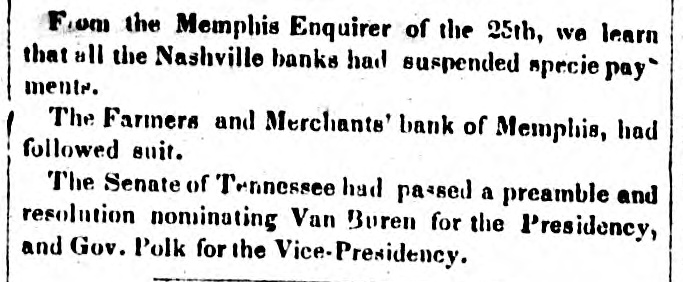
The Farmers and Merchants' bank of Memphis, had followed suit.
Source
newspapers
2. July 5, 1842 Other
Newspaper Excerpt
The banks of Tennessee are to resume specie payment on the 5th of July next ... This order includes ... the Farmers and Merchants' Bank of Memphis.
Source
newspapers
3. August 15, 1842 Reopening
Newspaper Excerpt
The Memphis papers of the 29th July state that the Farmers' and Merchants' Bank of that place anticipated the regular day of resumption, and was then paying out coin. Her ability to continue is said to be ample.
Source
newspapers

Newspaper Articles (7)

Article from Lexington Union, December 22, 1838

Click image to open full size in new tab

Article Text

# BANK CONVENTION. At meeting of the delegates from the Banks of Mississippi and Tennessee, convened at the Commercial & Rail Road Bank of Vicksburg, the following Banks were represented, viz: Farmers & Mechanics Bank of Memphis; Planters Bank, Natchez; Agricultural Bank, Commercial & Rail Road Bank of Vicksburg, West Feliciana Rad Road & Banking Company, Commercial Bank of Natchez, Commercial Bank of Manchester, Commercial Bank of Rodney, Bank of Lexington, Vicksburg Waterworks & Banking Company, Mississippi Rail Road Company, Citizens Bank of Madison County, Mississippi Union Bank, Real Estate Banking Company of Hinds County, Bank of Vicksburg. On motion, H G Runnels was called to the Chair, and J J Chewning was appointed Secretary. On motion, Resolved, That Messers. J Wood and George G Skipwith of Nashville, be invited to take a seat in this Convention. The following resolutions was offered by Stephen Duncan: Resolved, That the first monday in January next be the period fixed on for a resumption of specie payments by the Banks represented in this Convention; provided the delegates from the Union Bank of Mississippi will give assurance that the post notes of that Bank will be redeemed with specie, or its equivalent, when presented at her counter. On motion to strike out all after the word "provided," the yeas and nays being called, the vote stood thus; Ayes. E Montgon.ery, of Planters Bank; M B Irmer, Commercial Bank of Manchester; J C Bole, Lexington Bank; S P Webster, Vicksburg W W & Banking Co; J A Quitman, Miss. R R Co; W Hardeman, Citizens Bank of Madison county; H G Runnels and R M Williamson, Mississippi Union Bank. Nays-E W Lucas, of Famers and Mechanics Bank, Memphis; S Duncan, Agricultural Bank, J J Chewning, Com. & R R Bank of Vicksburg; G H Gordon, West Feliciana R R & Banking Co; L R Marshall, Com. Bank of Natchez; Thos. Freeland, Com, Bank of Rodney; A M Paxton, Bank of Vicksburg. This being a tie, the motion was lost. S P Webster proposed to strike out all the above resolutions, after the word "resolved," and proposed the following as a substitute: Whereas, in the opinion of this Convention, a resumption of specie payments by the Banks of Mississippi on the first day of January next, would be prejudicial to the interest of the community, for the following, among other reasons: 1. Because the month of January is the middle of the business season, and the period of the year when both planter and merchant stand in most need of all the bank facilities which can be afforded them. 2. Because it is the season of the year at which the largest amount of engagements have usually been made to fall due, and causes the months of January and February, in ordinary times, to be seasons of peculiar pressure in the money market. 3. Because the engagements maturing in January and February have, to a considerable extent, been passed to foreign creditors, and would immediately be demanded in specie or Eastern exchange. 4. Because of the present high rate of exchange against this state, in which condition a resumption of specie payments is unprecedented in any state of nation. The recent resumption in New York not being made until exchange had been for a period of two months in their favor, and in Philadelphia not until five months after that condition of things existed and at a time when the importation of specie by the banks of those places was a business of profit. 5. Because a resumption in January would cause the whole bank note circulation of the State to come in upon the banks, and leave the state without a circulating medium at all, to the great detriment of trade, and to the utter ruin of all who have money to pay at our spring courts, or provisions to purchase for the coming season. 6. Because it would be a burden of from 2 to 5 percent. of their whole circulation, upon the resuming banks without corresponding benefit to any class of persons, other than the Northen holders of our circulation, who have purchased it on speculation at from 15 to 40 percent discount.
Article from True American, October 31, 1839

Click image to open full size in new tab

Article Text

From the Memphis Enquirer of the 25th, we learn that all the Nashville banks had suspended specie pay` mente. The Farmers and Merchants' bank of Memphis, had followed suit. The Senate of Tennessee had passed a preamble and resolution nominating Van Buren for the Presidency, and Gov. Polk for the Vice- Presidency.


Article from Morning Herald, November 19, 1839

Click image to open full size in new tab

Article Text

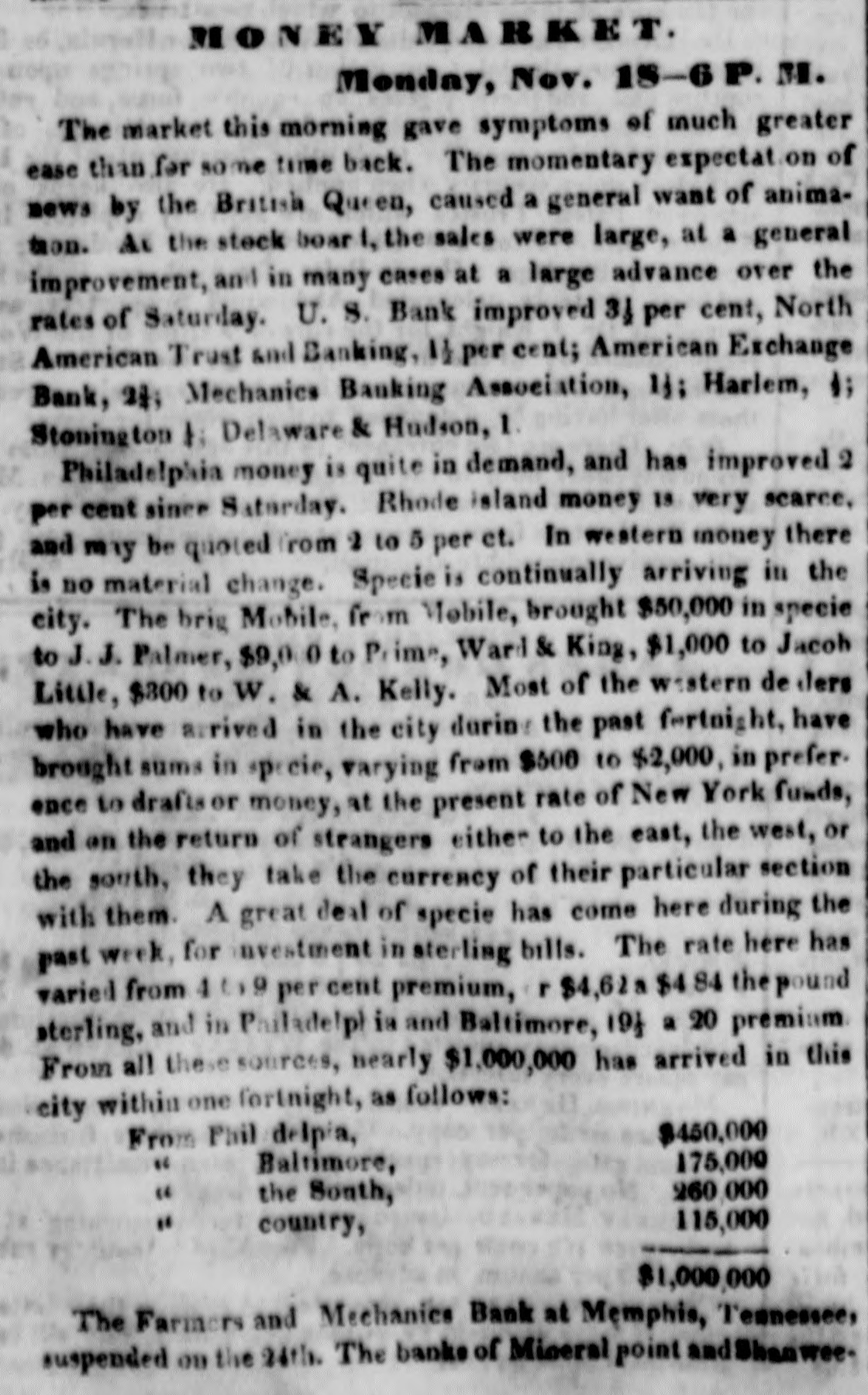
# MONEY MARKET. Monday, Nov. 15-6 P. M. The market this morning gave symptoms of much greater ease than for some time back. The momentary expectation of news by the British Queen, caused a general want of anima-hon. At the stock boar 1, the sales were large, at a general improvement, and in many cases at a large advance over the rates of Saturday. U. S. Bank improved 3 per cent, North American Trust and Banking, 1½ per cent; American Exchange Bank, 2½; Mechanics Banking Association, 1½; Harlem, ½; Stonington ½; Delaware & Hudson, 1. Philadelphia money is quite in demand, and has improved 2 per cent since Saturday. Rhode island money is very scarce, and may be quoted from 2 to 5 per ct. In western money there is no material change. Specie is continually arriving in the city. The brig Mobile, from Mobile, brought $50,000 in specie to J. J. Palmer, $9,0.0 to Prime, Ward & King, $1,000 to Jacob Little, $300 to W. & A. Kelly. Most of the western de ders who have arrived in the city during the past fortnight, have brought sums in specie, varying from $500 to $2,000, in prefer-ence to drafts or money, at the present rate of New York funds, and on the return of strangers either to the east, the west, or the south, they take the currency of their particular section with them. A great deal of specie has come here during the past week, for investment in sterling bills. The rate here has varied from 4 to 9 per cent premium, r $4,62 a $4 84 the pound sterling, and in Philadelphia and Baltimore, 19½ a 20 premiam From all these sources, nearly $1,000,000 has arrived in this city within one fortnight, as follows: From Phil delpia, $450,000 " Baltimore, 175,000 " the South, 260.000 " country, 115,000 $1,000,000 The Farmers and Mechanics Bank at Memphis, Tennessee, suspended on the 24th. The banks of Mineral point and Shanwee-


Article from Richmond Enquirer, November 22, 1839

Click image to open full size in new tab

Article Text

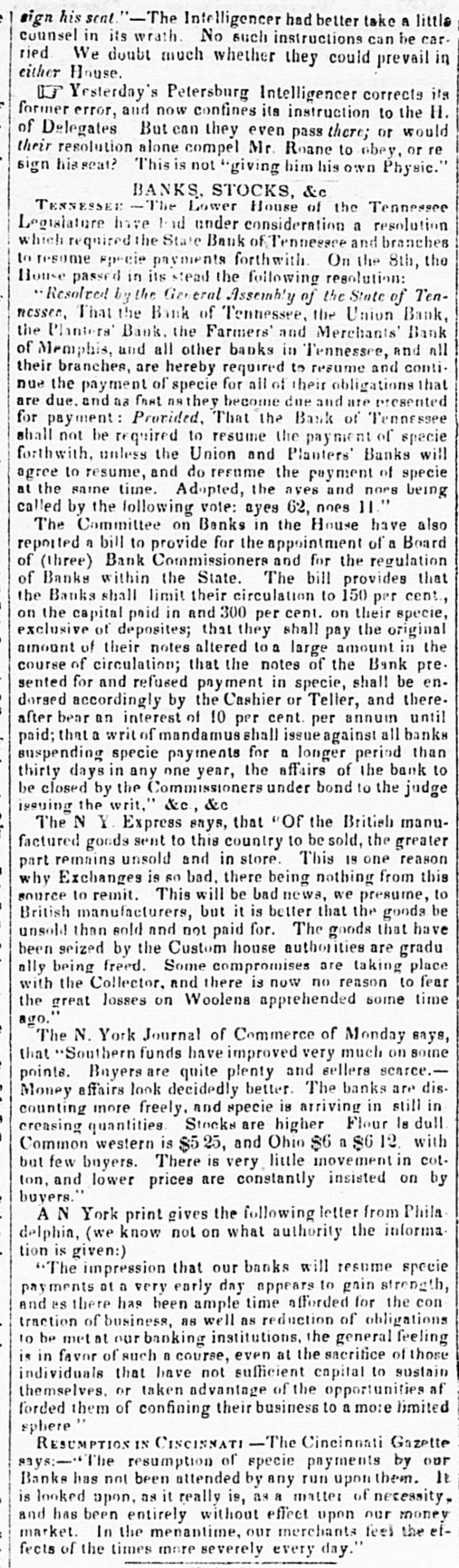
sign his scal." "-The Intelligencer had better take A little counsel in its wrath. No such instructions can be car. ried We doubt much whether they could prevail in either House. IJ Yesterday's Petersburg Intelligencer corrects its former error, and now confines its instruction to the H. of Delegates But can they even pass there; or would their resolution alone compel Mr. Roane to obey, or re sign his seat? This is not "giving him his own Physic.' BANKS, STOCKS, &c TENNESSEE - The Lower House of the Tennessee Legislature have 1.nd under consideration a resolution which required the State Bank of Tennessee and branches to resome specie payments forthwith On the 8th, the House passed in its stead the following resolution: Resolved by the General Assembly of the State of Tennessee, That the Bank of Tennessee, the Union Bank, the Planters' Bank. the Farmers' and Merchants' Bank of Memphis, and all other banks in Tennessee, and all their branches, are hereby required to resume and continue the payment of specie for all of their obligations that are due. and as fast nathey become due and are presented for payment: Provided, That the Bank of Tennessee shall not be required to resume the payment of specie forthwith, unless the Union and Planters' Banks will agree to resume, and do resume the payment of specie at the same time. Adopted, the aves and nors being called by the following vote: ayes 62, noes 11." The Committee on Banks in the House have also reported a bill to provide for the appointment of a Board of (three) Bank Commissioners and for the regulation of Banks within the State. The bill provides that the Banks shall limit their circulation to 150 per cent, on the capital paid in and 300 per cent. on their specie, exclusive of deposites; that they shall pay the original amount of their notes altered to a large amount in the course of circulation; that the notes of the Bank pre. sented for and refused payment in specie, shall be endorsed accordingly by the Cashier or Teller, and there. after bear an interest of 10 per cent. per annum until paid; that a writ of mandamus shall issue against all banks suspending specie payments for a longer period than thirty days in any one year, the affairs of the bank to be closed by the Commissioners under bond to the judge issuing the writ," &c, &c The N Y. Express says, that "Of the British manufactured goods sent to this country to be sold, the greater part remains unsold and in store. This 18 one reason why Exchanges is so bad, there being nothing from this source to remit. This will be bad news, we presume, to British manufacturers, but it is better that the goods be unsold than sold and not paid for. The goods that have been geized by the Custom house authorities are gradu ally being freed. Some compromises are taking place with the Collector, and there is now no reason to fear the great losses on Woolens apprehended some time ago. The N. York Journal of Commerce of Monday says, that Southern funds have improved very much on some points. Bayers are quite plenty and sellers scarce.Money affairs look decidedly better. The banks are dis. counting more freely. and specie is arriving in still in creasing quantities Stocks are higher Flour Is dull Common western is $525, and Ohio $6 a $612 with but few buyers. There is very little movement in cotton, and lower prices are constantly insisted on by buyers." A N York print gives the following letter from Phila delphia, (we know not on what authority the information is given:) "The impression that our banks will resume specie payments at a very early day appears to gain strength, and as there has been ample time afforded for the con traction of business, as well as reduction of obligations to be metal our banking institutions, the general feeling is in favor of such a course, even at the sacrifice of those individuals that have not sufficient capital to sustain themselves. or taken advantage of the opportunities af forded them of confining their business to a more limited sphere RESUMPTION IN CISCISSATI -The Cincinnati Gazelle says:-"The resumption of specie payments by our Banks has not been attended by any run upon them. It is looked upon, as it really is, as a matter of necessity, and has been entirely without effect upon our money market. In the menantime, our merchants feel the effects of the times more severely every day."


Article from The New York Herald, June 6, 1842

Click image to open full size in new tab

Article Text

he selection of the lands granted by Congress to that State, under the Distribution law. There remains to be located, to make up the quantity of 500,000 acres, only 210,000 in tracts of 320 acres each. The State Bank of Illinois forfeits its charter by non-assumption in June. It will then have five years to wind up according to law. The banks of Tennessee are to resume specie payment on the 5th of July next, according to the following resolution of the legislature of that State:- Resolved, That the Attorneys General aforesaid are hereby directed to stay said proceedings against said corporations respectively: Provided, The President, Directors and Company of the said corporations shall bona fide resume the payment of specie for their respective liabilities, according to their said charters, on or before the first day of January, in the year 1843; but if the Banks of Kentucky and Louisiana shall resume specie payments before the first of January, 1843, then the several Banks in this State shall resume within twenty days from the time of resumption by the Banks of Kentucky and Louisiana. But if said corporate authorities, or either of them, shall fail or refuse to resume specie payments, on or before the first day of January, 1843, then the said proceedings shall be prosecuted against the corporation so refusing, without delay to final judgment, unless otherwise directed by the Legislature of this State. This order includes the State Bank and branches, the Union Bank, the Planters' Bank, and the Farmers and Merchants' Bank of Memphis. The penalty is peremptory, and, as the New Orleans Banks have resumed and those of Kentucky are to do so on the 15th June, inst., the first week in July will effect specie payments in Tennesse. How long is a fraudulent suspension to be tolerated in the "Old Dominion?" The North Western Bank of Virginia has had the audacity to authorise the publication of a notice, that she will redeem her own notes, either in drafts or specie, at 8 per cent discount!! This is equivalent to a notice of bankruptcy with a declaration of 92 cents on the dollar, and yet such a concern is allowed to go on and do business. We have received the message of Henry Hubbard, Governor of the State of New Hampshire, to the legislature of that State. It is an admirable document, and adheres strictly to those great republican principles which are the foundation of our institutions. After logically and clearly exposing the unconstitutionality of the distribution of the public lands, he remarks as follows:- Believing as I most conscientiously do, that no such power exists in either case, that the avails of the public lands are but portions of the public revenue, and can no more be applied for the use of the separate States, than that part of the revenue derived from imposts, I cannot in the performance of the high and responsible duty which devolves upon me, fail to recommend to the legislature to give no authority for receiving into our treasury the money assigned to New Hampshire, according to the terms of the act distributing the proceeds of the sales of the public lands among the States. Should the effect of such a proceeding be to leave in the public treasury this portion of the public revenue, we shall have the satisfaction of having done our duty, in preventing so much of the public money from being withdrawn from the public use. Here we recognise principle. There is none of that chuckling glee, which exclaims on coming into power, after a season of extravagance and debauch, "Rob me the exchequer (Hal.) the first thing thou doest, and do it with unwashed hands too;" on the contrary, the credit and honor of the federal government is looked up to as something worth preserving. The Governor then touches upon the effect of the distribution in causing an increased tariff to be necessary, and also alludes to the aristocratic principle of protection in the following terms:- A tariff of duties which gives protection to one class of our citizens, may in its operation be unequal and oppressive to others; and if so, can have none of the qualities of an uniform system, which alone Congress has the power to establish. It would be difficult to find a reason in favor of the general policy of this distribution measure. At a time like this, when the revenues of our national government are exhausted-when it has been compelled to resort to every expedient for a supply of the means necessary for its support-when one issue of Treasury notes has followed close upon another-when in a season of peace we are forced into the money market, and reduced to the humiliating necessity of making loans or suffering dishonor-at a time like this, when in a little more than a year we have seen an entire revolution in the financial condition of the country-when at the close of the last administration our means were abundantly sufficient to meet our liabilities, with a temporary debt which the accruing revenues would readily have extinguished-with our expenditures so reduced and so reducing that our annual charge would have been balanced by our annual income-with a character untarnished-with a credit at home and abroad unsuspected-and when in a single year under a new administration, a debt of more than twenty millions has been fastened upon the country, and our annual expenditures have been greatly increased; it must alarm the patriotism of the country that the Congress of these United States, in the midst of these embarrassments, should assent that one fifth of the ordinary revenues of the government should be withdrawn from the National Treasury and distributed among the States. The governor then alludes to the unconstitutional nature of the bankrupt act, on account of its violating the obligation of contracts. He then concludes by recommending measures to be taken for the immediate repeal of both those measures. In this view, the election of a new Senator to fill the place of the Hon. F. Pierce, will be made. In relation to banks, the governor recommends a modification of the present system, so as to make stockholders individually liable for their joint debts. This is most judicious, and highly necessary to check the evils of the present system. The Committee of Ways and Means of the House of Representatives, have made another report on the tariff of purely a protective nature. The gentlemen composing the committee are Messrs. Fillmore, of New York, Botts, of Virginia, Mason, of Ohio, Wallace, of Indiana, Marshall, of Kentucky, Joseph R. Ingersoll, of Pennsylvania, Jones, of Virginia, Atherton, of New Hampshire, and Lewis, of Alabama. These gentlemen have come forward with a bill, on which hangs the commercial prosperity of 17,000,000 of people, seemingly without any correct sense of the vast importance of the matter committed to their charge. How much reflection they have all bestowed upon the matter, we, of course, cannot determine; but a man who is travelling the country, lecturing upon temperance, at the same moment that the bill is in preparation, cannot have done much towards inspiring public confidence in the bill. The leading features of the bill compared with the proposition of the Secretary, are as follows:-The latter proposed to retain the public lands in the treasury, and the former to persist in giving it away.


Article from New-York Daily Tribune, August 15, 1842

Click image to open full size in new tab

Article Text

Commercial and Money Matters. SATURDAY, P. M. There was a large business done at the board to-day, but generally the feeling was not very good. Farmers' Loan declined 1, Harlem declined 11, Long Island improved 14, Stonington 1. Mohawk and Delaware and Hudson firm.There was a heavy decline in Ohio Life and Trust in consequence of the authorization of a new issue of $800,000 Ohio State stock at 10 per cent interest, which will depress that stock and affect the value of the Life and Trust, that Company being a large holder. There was but little dene in State stocks and but little variation to notice excepting in Ohio Sixes which fell off S per cent. the effect of the vote to issue $800,000 of bonds, above alluded ta. At 70 the stocks of 1260 pay 101 per cent interest. It strikes us that the attempt to issue so large an amount of new stock, and at so large a rate of interest, is very impolitic and must result in the depression of the Sixes to the lowest point of last summer. 50. Since that time they have been gradually recovering, and as the State has always punctually paid her interest, there was no reaso n to antici pate that tricy would have fallen below 73 to 75. The new stock will probably come to this market, but capitalists will probably be sby of State Securities bearing 10 per cest interest. The sales were: 71 21 $1,000 Ohio 6s, 1860 $5,000 Indiana 5. $2,000 do 600 70. $2,000 N. Y. City 6s. 1850.58 70 $5,500 do do $1,120 C Best 7 pr ct.. 1003 There is a moderate demand for Exchanges and the market is firm in consequence of the continued light supply of bills. Sterling Francs 5.35. Domestic bills are very quiet. Georgia is getting to be nearly as bad as 'Mobile, and is worse than the Alabama branches, excepting Decatur. We quote Coston Mobile a 39 a 39 Decatur a10 Philadelphia Baltimore Other branches State par -prem Virginia 21 27 30 31 Bank Alabama 3 24 N. Carolina New-Orleans 1 a 1 prem 1 Charleston 6 Nashville Augusta 13 Louisville 24 3 so 35 Columbus St. Louis 3 30 S5 Macon Cincinnati 4 11 2 Apalachicola Counterfeit 12s. Seneca County Bank, are in circulation. Letter C, June 1. 1841, pay D. Hall-vignette, an Indian hunter with two dogs. W. V.J. Mercer, Cashier-D. B. Jones, President. Bill half an inch longer than the genuinc. 50s, Eagle Bank, Boston, altered from 1s. The genuline has the figures 50 on two corners, the Roman L on the other two. The altered note has 50 on all corners. In the money market there is no change to notice. For first class paper money is abundant both in bank and the street, but for other descriptions it is scarce. There was never a worse time for credit, which is at all tainted, to bolster itself. The street rate for money is per cent. The Board of Brokers has appointed a Committee to inquire into and report on the matters in dispute between Messrs. Boorman, Johnston & Co. and Messrs. J. Little & Company. At Boston the following sales of stocks have been made 40 shares Western Railroad at 63 a 631, 19 Boston and Worcester at 10) a 102 adv; 48 Boston and Providence at 853 86, Eastern Railroad 851, 5 Eagle Bank at 87g. The St. Louis New Era in relation to the injunction on State Bank of Illinois says: Mr. Whitesides, the Fund Commissioner, has issued a quo warranto against the Bank to come forward and shew by what authority she was exer. cising Banking privileges, &c. The question cannot be tried before November. The Era says that the present move of the Fund Commissioner against the Bank is with a view to force the Bank in pay him $50.000 in specie to enable him purchase up State Bonds to make good a loss he caused the State by a negotiation he made to meet some State interest This statement however of course has two sides. The Wheeling Times states that the Banks of that place will resume with the other banks of the State of Virginia on the 15th of September next. The Memphis papers of the 29th July state that the Farmers' and Merchants' Bank of that place anticipated the regular day of resumption, and was then paying out coin. Her ability to continue is said to be ample. The Nashville Banks are reported to find no difficulty in continuing specie payments. The Bank of Tennessee has received more coin than she has paid out. The branch notes of the Union Bank are paid at the principal Bank and the branch notes of the Planters' Bank are received on deposit No arrangement has been made between the branches of the State Bank and the Principal Bank, and none to redeem the Memphis notes at Nashville. A New-Orleaus house in order to facilitate business mat ters in that city, has commenced issuing certificates of $20, $50, $100 and $500 on deposits of specie. The deposits are special. The house is said to be of the highest character. At New-Orleans, Treasury Notes in request at 2 per cent discount. Exchange improving-60 day bills on New-York 1 to 3 per cent dis. Bank of Louisiana checking at par.Considerable improvement in suspended bank notes. Mechanics' and Traders' scarce at If per cent discount. Union in great demand-sells at 12 per cent discount. State also in demand. City rather heavy. Markets. ASHES-The market remains without particular change with moderate sales at $5 for Pets and $5.75 a $581} for Pearls. COTTON-Nothing of importance doing. Market firm. FLOUR-There is no material change to note from yesterday. We can hear of very little doing, and although pricesare nominally the same, yet this staple is if any thing worse than yesterday. Genesee wequote at 25: Ohio and Michigan 18 525. Receipts limited and sales still more so. Southern continues very dull. Georgetown, Howard street and Brandywin cannot be quoted over 5 and could probably be bought lower. GRAIN-The supply of Wheat has beer increased by the arrival of three cargoes of North Carolina. mostly however of poor quality. A sale of 2,000 bushels Illinois was made for milling at 103c. We hear of nothing doing in other grain there being very little offering. We quote Jersey and Northern Corn 60 a 61c; Ohio Canal at 55. Rye 63 a 65:Canal Oats 31 a S2-River 29 a 30. Four Dollar Hats.-WARNOCK,170Broa way, invites the attention of gentlemen to a superior black Hat at the moderate price of Four Do.lars. This quality of hat is particularly commended to the economist as an article possessing largely the essentials of the most costly. and prepared with all the neatness and external finish of his first jy11 MW&Sistf quality.


Article from Memphis Daily Appeal, October 21, 1857

Click image to open full size in new tab

Article Text

# The Consequences of the Suspersion. [For the Memphis Appeal] It may be disastrous to the business and prosperity of Memphis. Let us see how. One chief cause, if not the very principal cause of the growth and prosperity of our city, has been, that the planter and farmer of the surrounding country has found here a market where he can sell under his own eye, the cotton which he produces. Of course, selling his cotton here, here he buys the supplies of his family and farm. These two branches of trade go very much together-and together they have created here a vast commerce. Let the cotton of the country be shipped for sale, on the growers account, at New Orleans, and at once is transferred to New Orleans, much of the trade here in supplies, for family and plantation use. Persons living here in former years and familiar with the history and course of trade, will readily remember, that in those times, the trade in supplies was largely done in New Orleans; and Memphis was little more than a mere shipping point, where a few merchants only were required to conduct the transit of the products of the country out and of its supplies in. It takes but few merchants to transact all this business. To understand the danger we are now in, let us recall to memory the course of banking and commercial operations in the period of the former bank suspension of 1837-1842. The currency of Tennessee stood at a discount, in comparison with coin, through much of that period, between 7 and 12 per cent. The banks of that day were, the Bank of Tennessee, the Planters', the Union and the Farmers' and Merchants' Bank of Memphis, and there was no difference in the value of their paper, unless a little in favor of the Farmers' and Merchants' Bank. This latter and the Union was the only Banks having officers in Memphis, and Mr. Seth Wheatly during most of the period was the President of the Farmers' and Merchants' Bank, and enjoyed most deservedly the entire confidence of the city and country, both as to his integrity and financial ability. The bank currency was under par, generally about 8 per cent., sometimes lower. This currency was issued in the purchase of bills on New Orleans, at which place its currency was upon par with coin. At Memphis, the cotton was paid for in Tennessee currency, at New Orleans in the currency of that place, and at both places at very nearly the same nominal prices. Cotton was paid for at Memphis in Tennessee currency, at, say, ten cents per pound, and in New Orleans in the currency of that place at, say, sometimes over ten cents, enough for a margin to cover freight, insurance, &c., and a reasonable profit. Thus, the cotton was sold at New Orleans for coin and paid for at Memphis in Tennessee bank notes, and so the planter actually got for his cotton some 8 to 12 per cent, less than it was sold for in New Orleans, and this because of the difference between New Orleans currency and Tennessee currency. How did this operate with the Tennessee banks? They put out their currency for bills on New Orleans, and according to the varying rate of exchange, gave a little more or less of their notes for an equivalent amount of bills-say about $1,000 of their notes for a bill on New Orleans of the same amount $1,000. When the bill was paid in New Orleans, the bank had their $1,000 of coin, for which it had given, however, about $1,000 of its notes which had been put in circulation, and for which the bank was liable to the full extent of $1,000. How did these bank notes get back to the bank and the bank thus discharge its liabilities to the holders of them? The proceeds of the bills in New Orleans, of par with coin, were transferred by the bank to Philadelphia or New York, and thus became a fund at the North, on which the bank could sell to the merchants Northern Exchange. The planter paid his Tennessee bank notes to his merchant whom he owed, and the merchant owing for his goods at the North, bought from the bank the Northern Exchauge, and paid for it to the bank its own notes or the notes of any other Tennessee bank, which was all the same thing. Here lay most of the profit which the banks


