Bank voluntarily closed and went into receivership on Dec 16, 1912; no run reported. Receiver pursued recovery actions and directors/officers were charged; the bank did not reopen and was liquidated.
Events (5)
1.December 16, 1912Receivership
Newspaper Excerpt
John W. Green, attorney for the bank, was named as receiver... The receiver states that the business of the bank will be wound up speedily and at the minimum cost, and the first dividend may be paid within sixty days. / The bank closed its doors to-day for voluntary liquidation, John W. Green taking charge as receiver. (Dec. 16, 1912 reports).
Source
newspapers
2.December 16, 1912Suspension
Cause
Voluntary Liquidation
Cause Details
Bank closed for voluntary liquidation/voluntary bankruptcy and placed in receivership due to insolvency; receiver named John W. Green.
Newspaper Excerpt
The Knoxville Banking and Trust company today went into voluntary bankruptcy.... The bank closed its doors to-day for voluntary liquidation, John W. Green taking charge as receiver.
Source
newspapers
3.December 17, 1912Other
Newspaper Excerpt
A warrant was issued ... against W. H. Gass, president, and W. W. Willis, cashier, ... charging them with receiving deposits after having knowledge that the bank was insolvent. They waived examination and made bond for their appearance in criminal court.
Source
newspapers
4.March 14, 1913Other
Newspaper Excerpt
Receiver ... filed a bill in chancery against directors and stockholders ... seeking to have them reimburse the receiver to the extent of all dividends paid by said bank since January 1, 1908 ... recovery of these dividends ... would put $34,000 in the hands of the receiver for distribution among the depositors.
Source
newspapers
5.January 17, 1914Other
Newspaper Excerpt
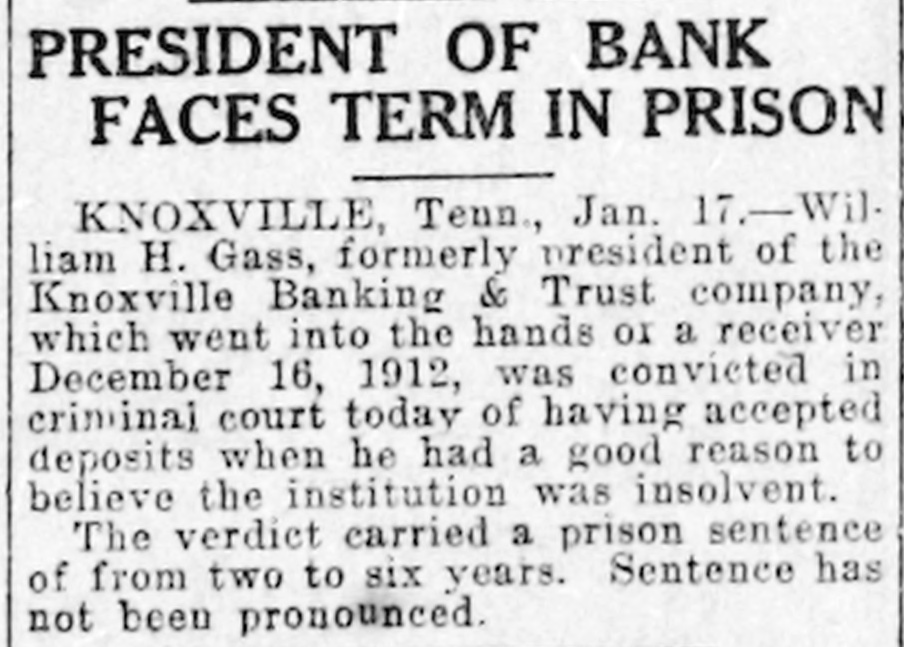
William H. Gass ... was convicted in criminal court ... of having accepted deposits when he had a good reason to believe the institution was insolvent. The verdict carried a prison sentence of from two to six years.
Source
newspapers
Newspaper Articles (11)
1.December 17, 1912Atlanta Semi-Weekly JournalAtlanta, GA
Click image to open full size in new tab
Article Text
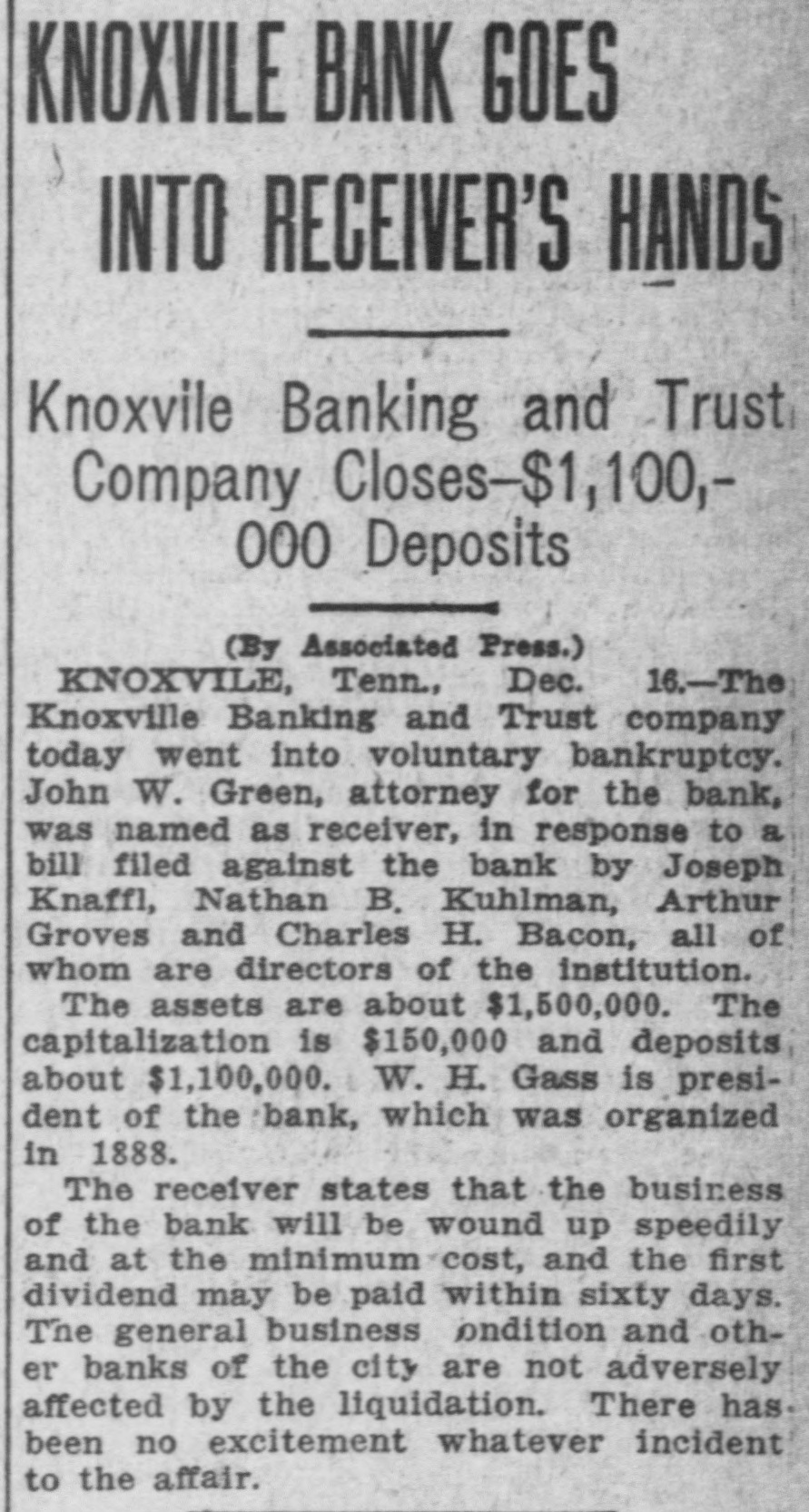
KNOXVILE BANK GOES INTO RECEIVER'S HANDS Knoxvile Banking and Trust Company Closes-$1,100,000 Deposits (By Associated Press.) KNOXVILE, Tenn., Dec. 16.-The Knoxville Banking and Trust company today went into voluntary bankruptcy. John W. Green, attorney for the bank, was named as receiver, in response to a bill filed against the bank by Joseph Knaffl, Nathan B. Kuhlman, Arthur Groves and Charles H. Bacon, all of whom are directors of the institution. The assets are about $1,500,000. The capitalization is $150,000 and deposits about $1,100,000. W. H. Gass is president of the bank, which was organized in 1888. The receiver states that the business of the bank will be wound up speedily and at the minimum cost, and the first dividend may be paid within sixty days. The general business ondition and other banks of the city are not adversely affected by the liquidation. There has. been no excitement whatever incident to the affair.
2.December 17, 1912Atlanta GeorgianAtlanta, GA
Click image to open full size in new tab
Article Text
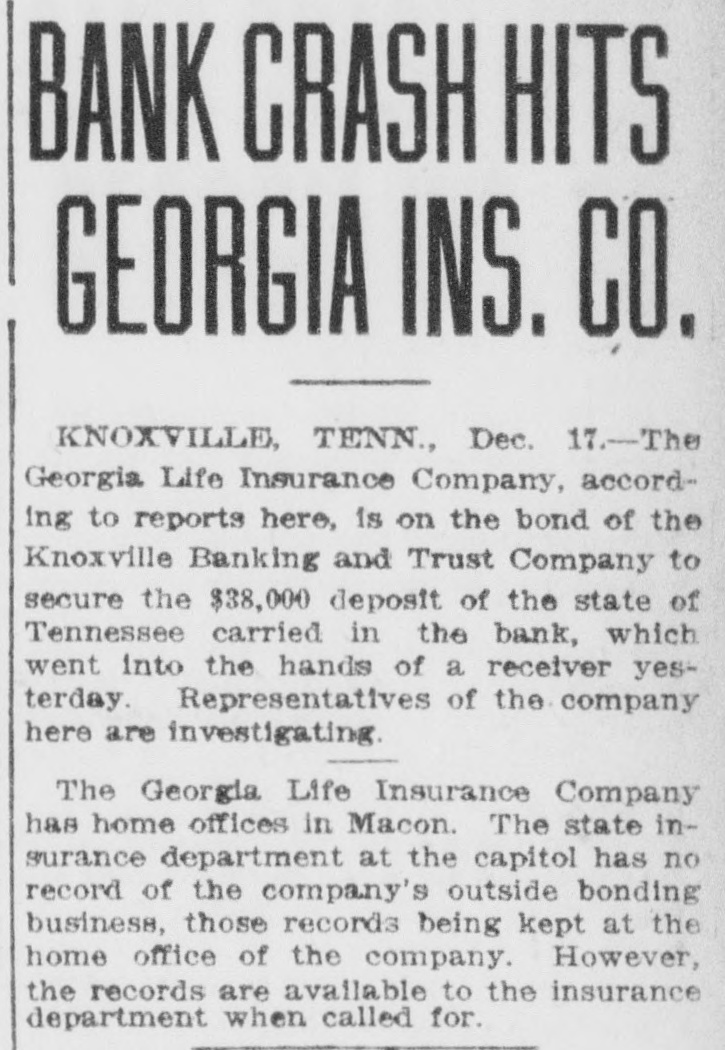
BANK CRASH HITS GEORGIA INS. CO. KNOXVILLE, TENN., Dec. 17.-The Georgia Life Insurance Company, according to reports here, is on the bond of the Knoxville Banking and Trust Company to secure the $38,000 deposit of the state of Tennessee carried in the bank, which went into the hands of a receiver yesterday. Representatives of the company here are investigating. The Georgia Life Insurance Company has home offices in Macon. The state insurance department at the capitol has no record of the company's outside bonding business, those records being kept at the home office of the company. However, the records are available to the insurance department when called for.
3.December 17, 1912The Washington HeraldWashington, DC
Click image to open full size in new tab
Article Text
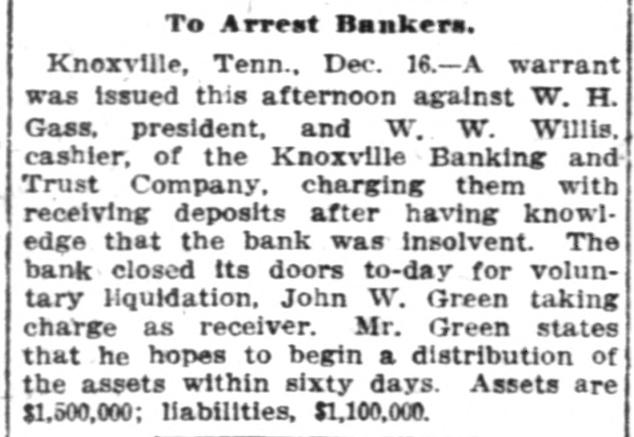
To Arrest Bankers. Knoxville, Tenn., Dec. 16.-A warrant was issued this afternoon against W. H. Gass, president, and W. W. Willis, cashier, of the Knoxville Banking and Trust Company, charging them with receiving deposits after having knowledge that the bank was insolvent. The bank closed its doors to-day for voluntary Hquidation, John W. Green taking charge as receiver. Mr. Green states that he hopes to begin a distribution of the assets within sixty days. Assets are $1,500,000; liabilities, $1,100,000.
4.December 20, 1912The Columbia HeraldColumbia, TN
Click image to open full size in new tab
Article Text
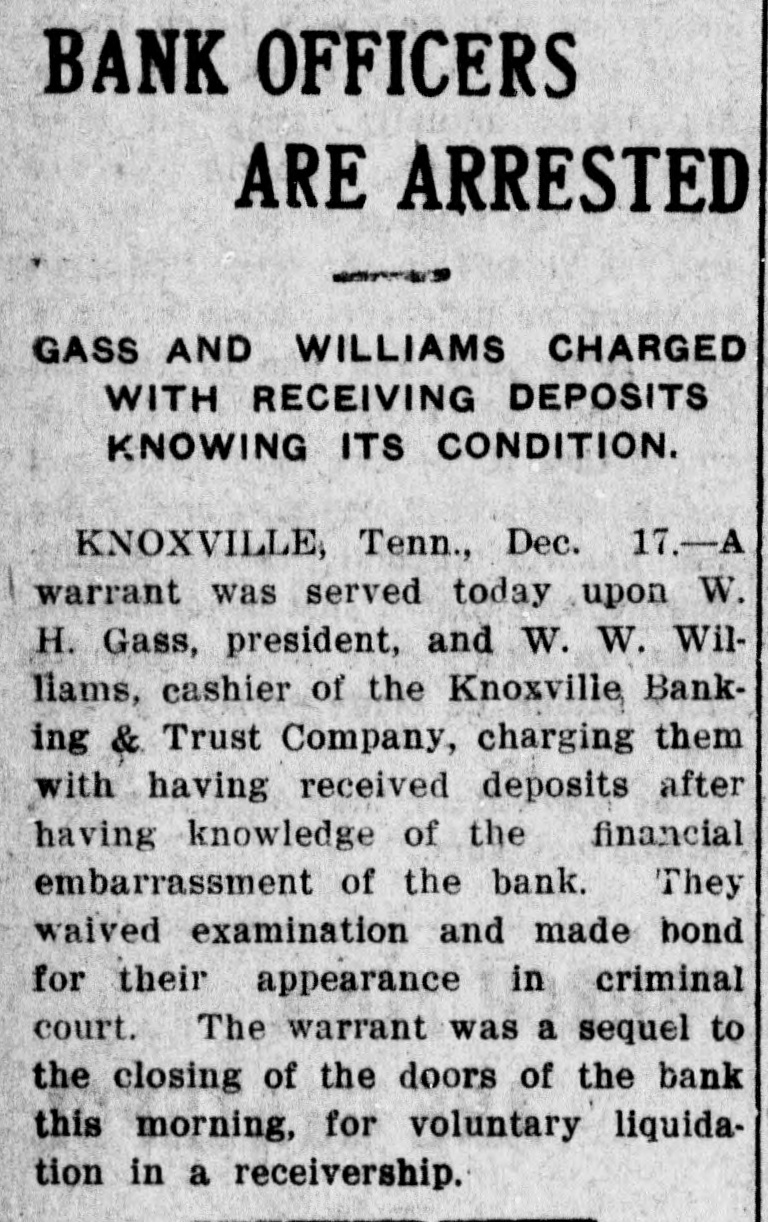
BANK OFFICERS ARE ARRESTED GASS AND WILLIAMS CHARGED WITH RECEIVING DEPOSITS KNOWING ITS CONDITION. KNOXVILLE, Tenn., Dec. 17.-A warrant was served today upon W. H. Gass, president, and W. W. Williams, cashier of the Knoxville Banking & Trust Company, charging them with having received deposits after having knowledge of the financial embarrassment of the bank. They waived examination and made bond for their appearance in criminal court. The warrant was a sequel to the closing of the doors of the bank this morning, for voluntary liquidation in a receivership.
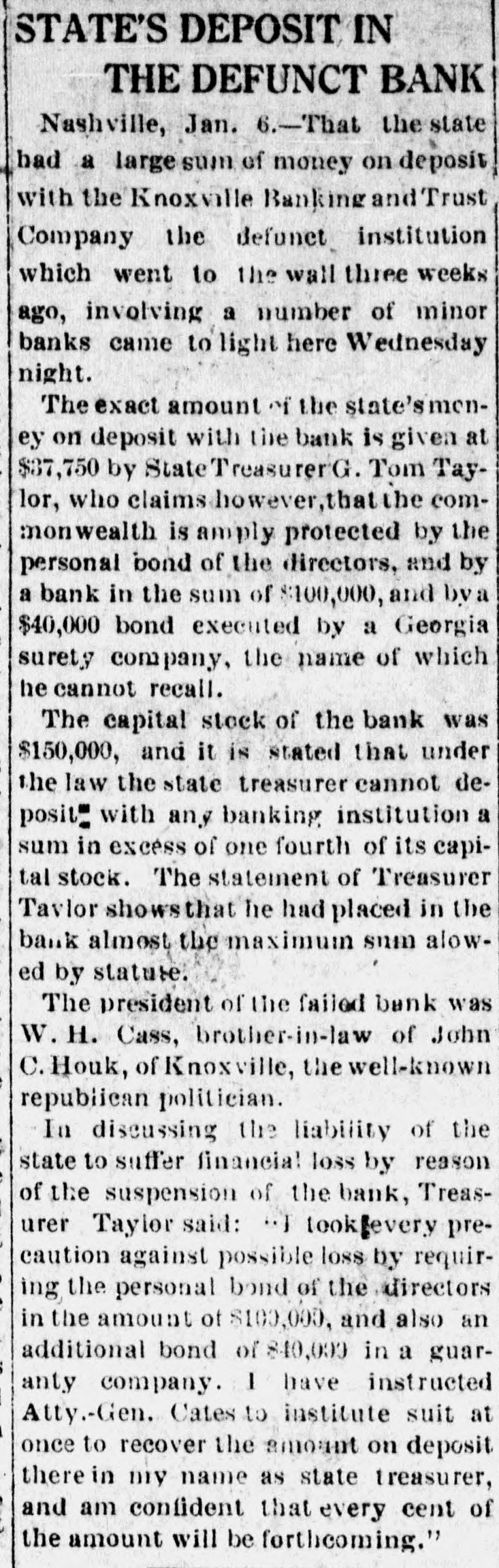
STATE'S DEPOSIT IN THE DEFUNCT BANK Nashville, Jan. 6.-That the state had a large sum of money on deposit with the Knoxville Banking and Trust Company the defunet institution which went to the wall three weeks ago, involving a number of minor banks came to light here Wednesday night. The exact amount of the state'smeney on deposit with the bank is given at $37,750 by State TreasurerG. Tom Taylor, who claims however, that the commonwealth is amply protected by the personal bond of the directors, and by a bank in the sum of $100,000, and by a $40,000 bond executed by a Georgia surety company, the name of which he cannot recall. The capital stock of the bank was $150,000, and it is stated that under the law the state treasurer cannot deposit: with any banking institution a sum in excess of one fourth of its capital stock. The statement of Treasurer Tavlor showsthat he had placed in the bank almost the maximum sum alowed by statute. The president of the failed bank was W. H. Cass, brother-in-law of John C. Houk, of Knoxville, the well-known republican politician. In discussing the liability of the state to suffer financial loss by reason of the suspension of the bank, Treasurer Taylor said: **] tooklevery precaution against possible loss by requiring the personal bond of the directors in the amount of $100,000, and also an additional bond of $40,000 in a guaranty company. I have instructed Atty.-Gen. Cates to institute suit at once to recover the amount on deposit there in my name as state treasurer, and am confident that every cent of the amount will be forthcoming."
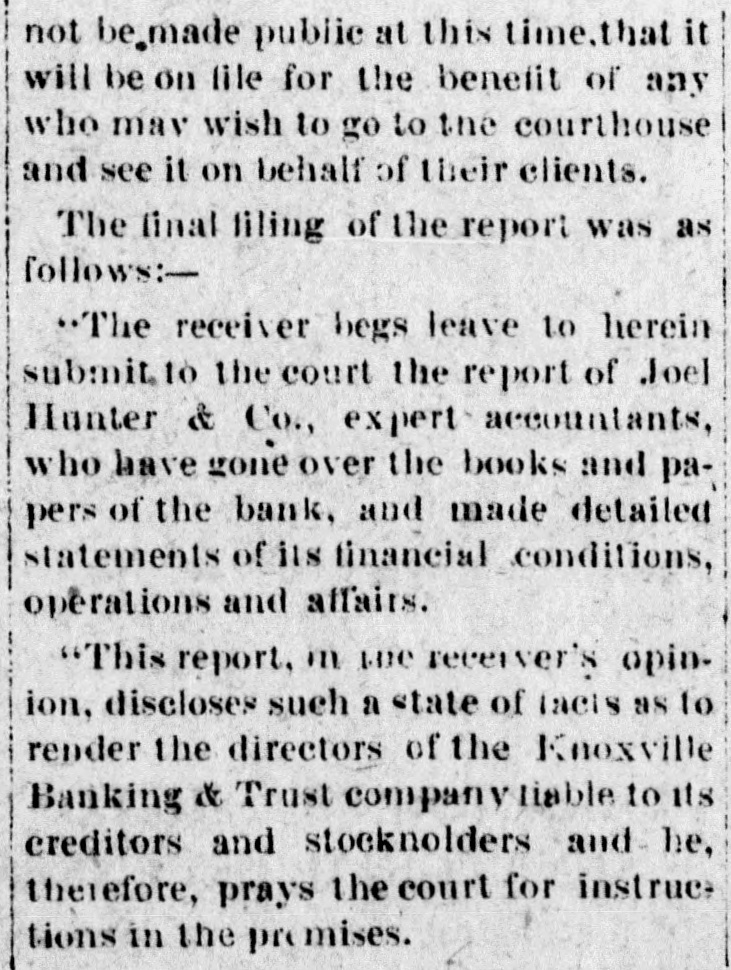
not be made public at this time that it
will be on file for the benefit of any
who may wish to go to the courthouse
and see it on behalf of their clients.
The final filing of the report was as follows:-
"The receiver begs leave to herein
submit to the court the report of Joel
Hunter & Co., expert accountants,
who have gone over the books and pa-
pers of the bank, and made detailed
statements of its financial conditions,
operations and affairs.
"This report, in the receiver's opin-
ion, discloses such a state of facts as to
render the directors of the Knoxville
Banking & Trust company liable to its
creditors and stockholders and he,
therefore, prays the court for instruc-
tions in the promises.
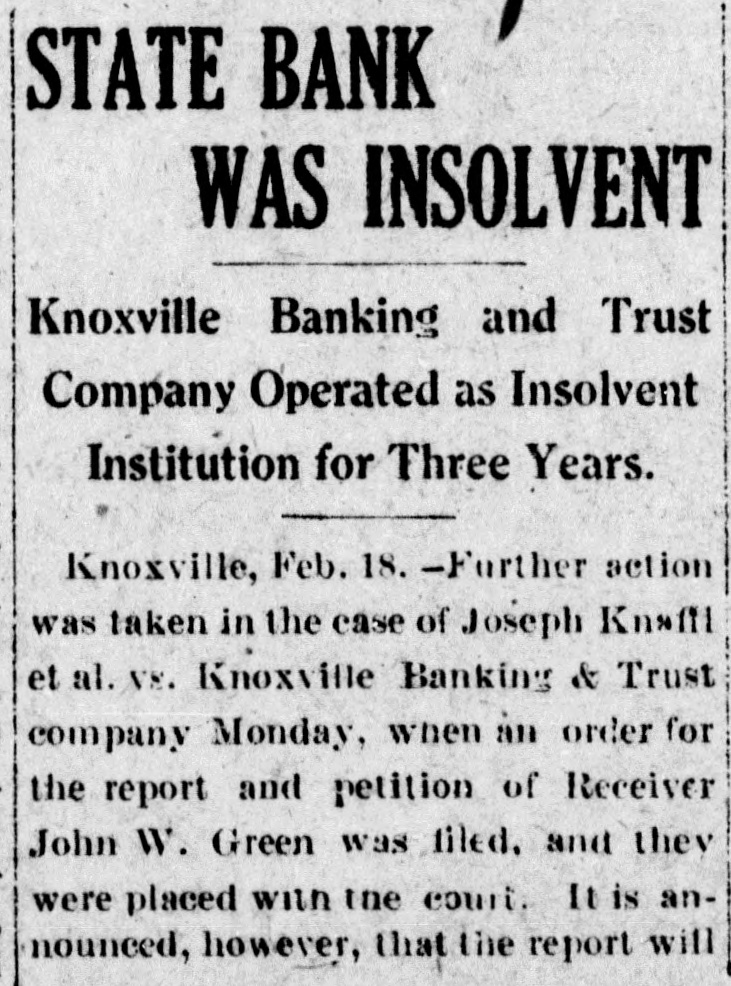
STATE BANK WAS INSOLVENT Knoxville Banking and Trust Company Operated as Insolvent Institution for Three Years. Knoxville, Feb. 18. -Further action was taken in the case of Joseph Knsffl et al. vs. Knoxville Banking & Trust company Monday, when an order for the report and petition of Receiver John W. Green was filed. and they were placed with the court. It is announced, however, that the report will
8.March 14, 1913McNairy County IndependentSelmer, TN
Click image to open full size in new tab
Article Text
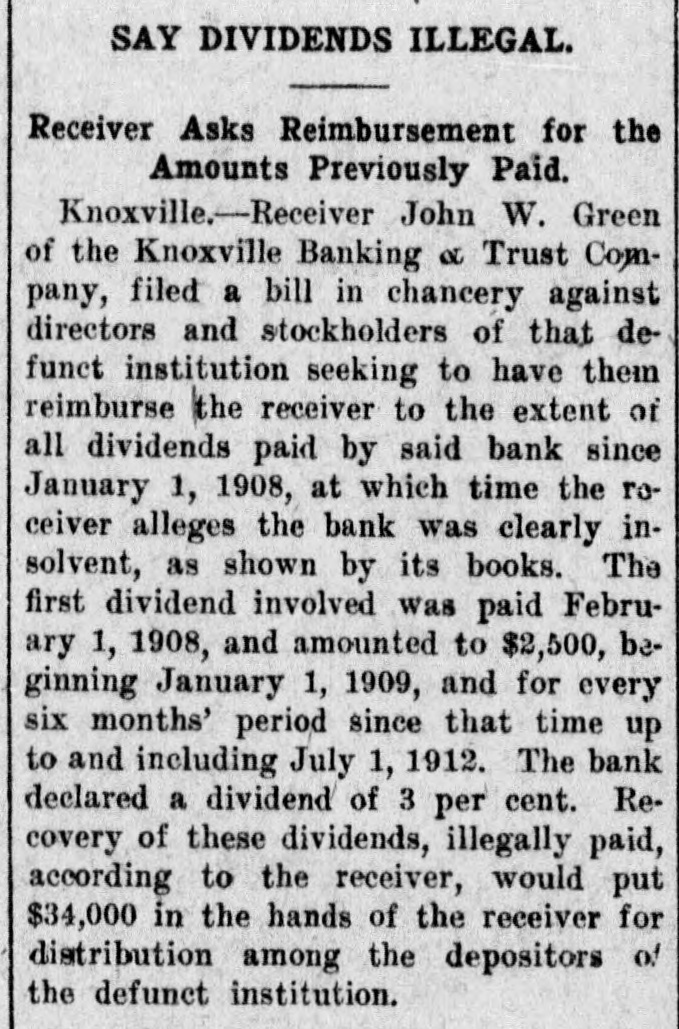
# SAY DIVIDENDS ILLEGAL.
Receiver Asks Reimbursement for the
Amounts Previously Paid.
Knoxville.—Receiver John W. Green
of the Knoxville Banking & Trust Com-
pany, filed a bill in chancery against
directors and stockholders of that de-
funct institution seeking to have them
reimburse the receiver to the extent of
all dividends paid by said bank since
January 1, 1908, at which time the re-
ceiver alleges the bank was clearly in-
solvent, as shown by its books. The
first dividend involved was paid Febru-
ary 1, 1908, and amounted to $2,500, be-
ginning January 1, 1909, and for every
six months' period since that time up
to and including July 1, 1912. The bank
declared a dividend of 3 per cent. Re-
covery of these dividends, illegally paid,
according to the receiver, would put
$34,000 in the hands of the receiver for
distribution among the depositors of
the defunct institution.
9.January 18, 1914The Salt Lake TribuneSalt Lake City, UT
Click image to open full size in new tab
Article Text
PRESIDENT OF BANK FACES TERM IN PRISON KNOXVILLE, Tenn., Jan. 17.-William H. Gass, formerly president of the Knoxville Banking & Trust company, which went into the hands or a receiver December 16, 1912, was convicted in criminal court today of having accepted deposits when he had a good reason to believe the institution was insolvent. The verdict carried a prison sentence of from two to six years. Sentence has not been pronounced.
10.January 18, 1914Evening StarWashington, DC
Click image to open full size in new tab
Article Text
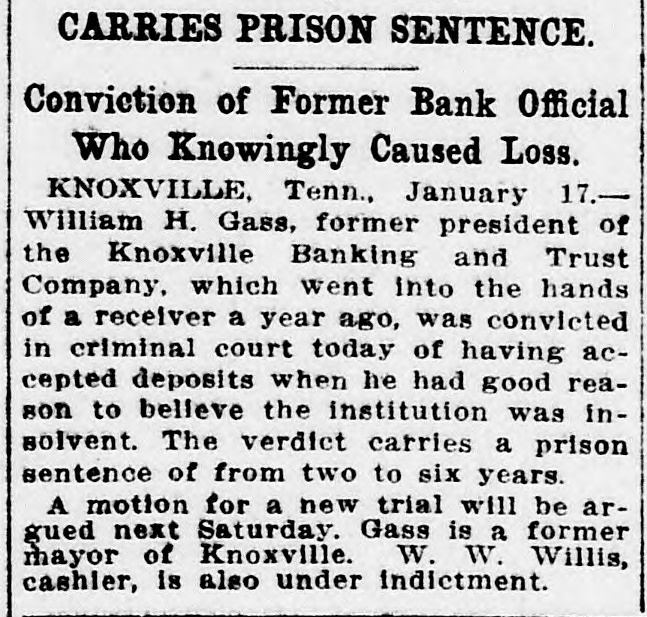
CARRIES PRISON SENTENCE. Conviction of Former Bank Official Who Knowingly Caused Loss. KNOXVILLE, Tenn., January 17.William H. Gass, former president of the Knoxville Banking and Trust Company, which went into the hands of a receiver a year ago, was convicted in criminal court today of having accepted deposits when he had good reason to believe the institution was insolvent. The verdict carries a prison sentence of from two to six years. A motion for a new trial will be argued next Saturday. Gass is a former mayor of Knoxville. W. W. Willis, cashier, is also under indictment.
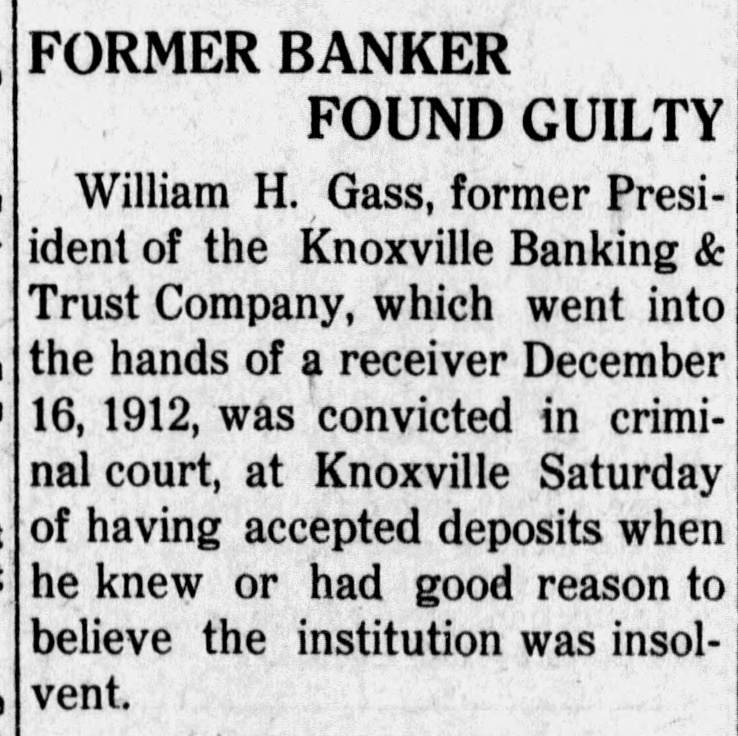
FORMER BANKER FOUND GUILTY William H. Gass, former Presiident of the Knoxville Banking & Trust Company, which went into the hands of a receiver December 16, 1912, was convicted in criminal court, at Knoxville Saturday of having accepted deposits when he knew or had good reason to believe the institution was insolvent.