Multiple contemporaneous articles (Nov 22–24, 1899) report a run triggered by the defalcation/embezzlement of County Treasurer A. W. (or Peterson/Petterson) Peterson, leading the Yankton Savings Bank to close its doors (Nov 22/23). A receiver (E. G. Edgerton) was appointed Nov 29 and the bank remained in receivership, later paying partial dividends; it did not resume normal operations. OCR shows minor name spelling variants (Peterson/Petterson/Pederson) in different reports; corrected to A. W. Peterson in notes above.
Events (4)
1.November 22, 1899Run
Cause
Bank Specific Adverse Info
Cause Details
Defalcation/embezzlement by County Treasurer A. W. Peterson, a heavy depositor in the bank, when his shortage became known depositors withdrew funds.
Measures
Bank paid withdrawals promptly up until funds were exhausted over about 1.5–3 days.
Newspaper Excerpt
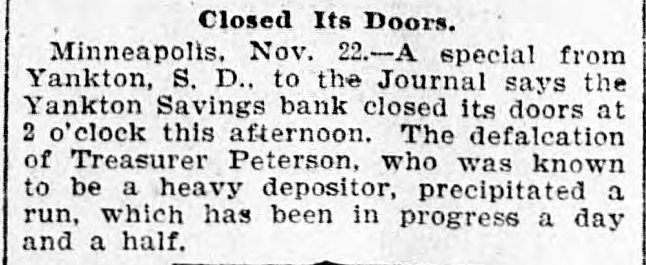
The defalcation of Treasurer Peterson ... precipitated a run which has been in progress a day and a half.
Source
newspapers
2.November 22, 1899Suspension
Cause
Bank Specific Adverse Info
Cause Details
Closure forced after the run caused by Treasurer Peterson's defalcation exhausted the bank's cash; articles state the bank closed at 2pm after paying out until supply was exhausted.
Newspaper Excerpt
The Yankton Savings Bank closed its doors at 2 o'clock this afternoon.
Source
newspapers
3.November 29, 1899Receivership
Newspaper Excerpt
E. G. Edgerton has been appointed receiver for the Yankton Savings bank which failed last week.
Source
newspapers
4.July 19, 1900Other
Newspaper Excerpt
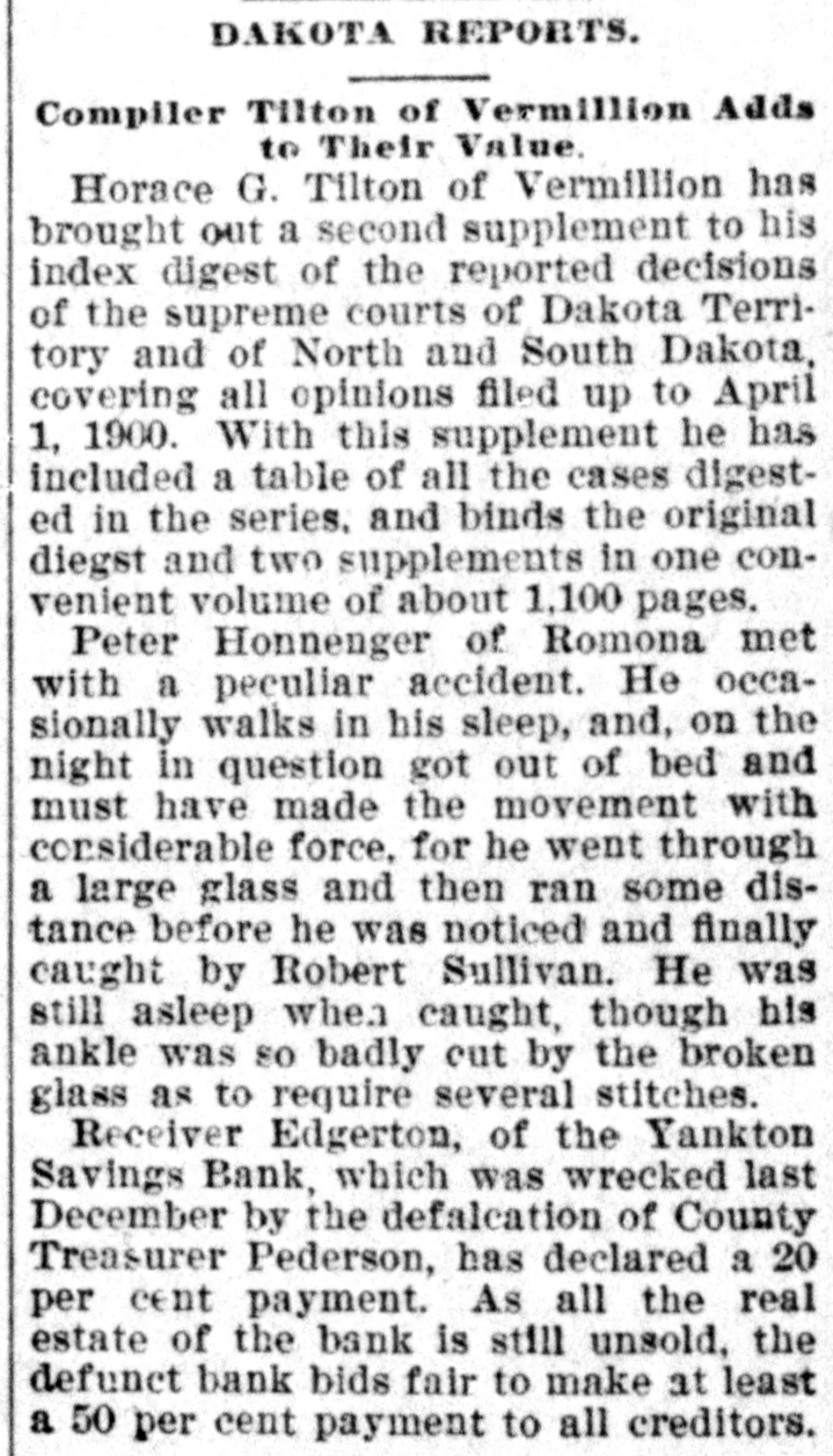
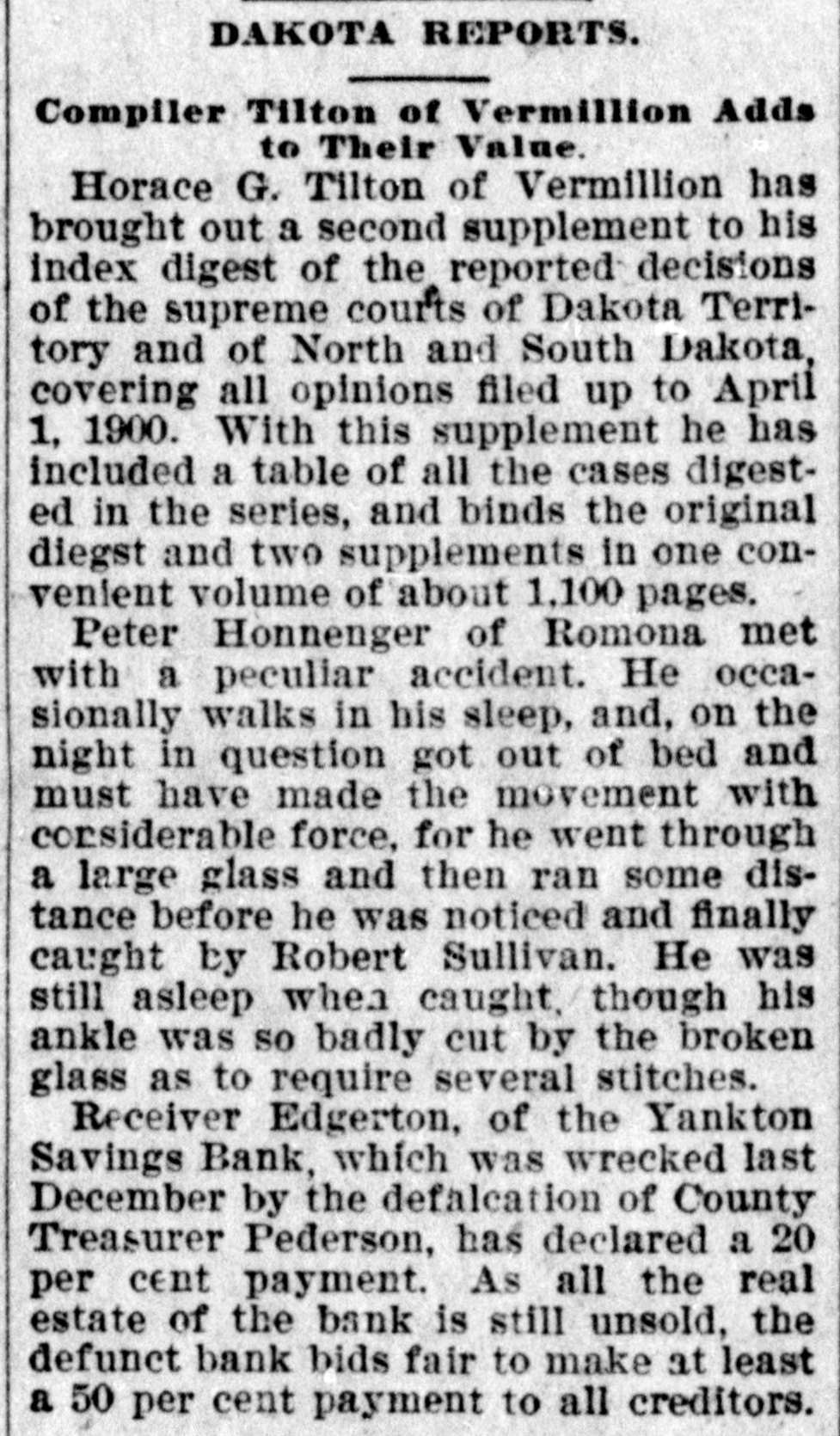
Receiver Edgerton ... has declared a 20 per cent payment. ... the defunct bank bids fair to make at least a 50 per cent payment to all creditors.
Source
newspapers
Newspaper Articles (22)
1.November 23, 1899The Indianapolis JournalIndianapolis, IN
Click image to open full size in new tab
Article Text
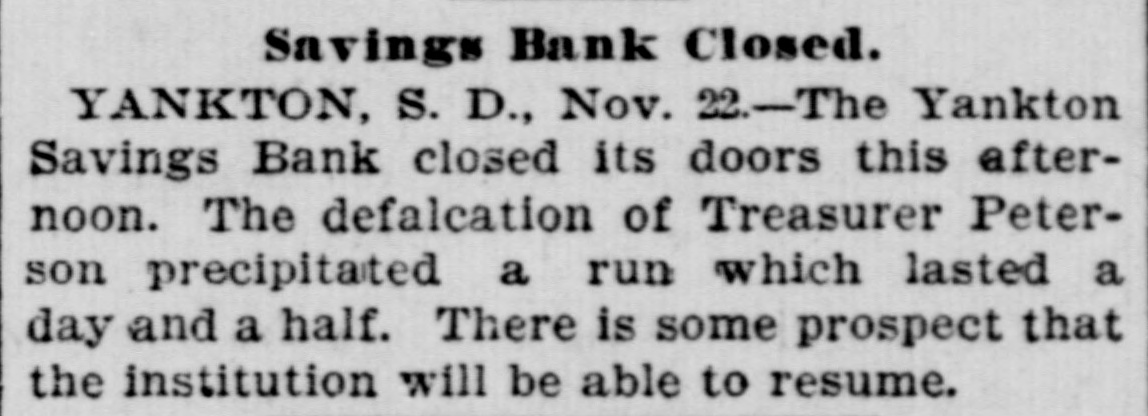
Savings Bank Closed. YANKTON, S. D., Nov. 22.-The Yankton Savings Bank closed its doors this afternoon. The defalcation of Treasurer Peterson precipitated a run which lasted a day and a half. There is some prospect that the institution will be able to resume.
2.November 23, 1899Daily Inter MountainButte, MT
Click image to open full size in new tab
Article Text
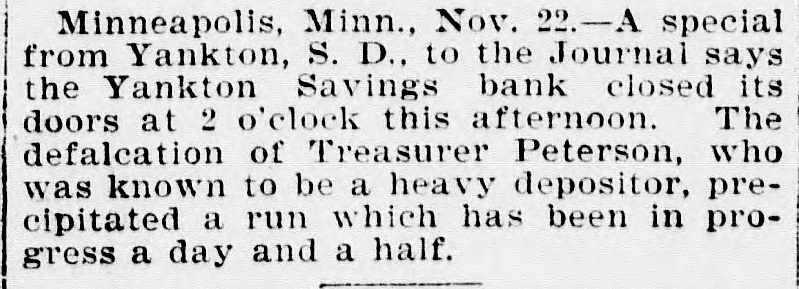
Minneapolis, Minn., Nov. 22.-A special from Yankton, S. D., to the Journal says the Yankton Savings bank closed its doors at 2 o'clock this afternoon. The defalcation of Treasurer Peterson, who was known to be a heavy depositor, precipitated a run which has been in progress a day and a half.
3.November 23, 1899The Seattle Post-IntelligencerSeattle, WA
Click image to open full size in new tab
Article Text
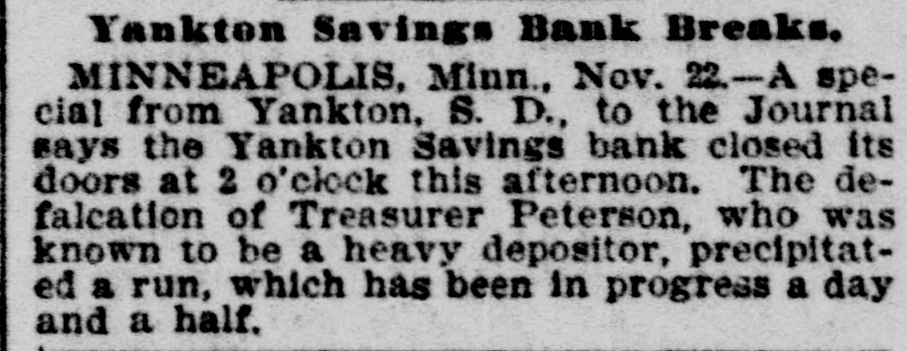
Yankton Savings Bank Breaks. MINNEAPOLIS, Minn., Nov. 22-A special from Yankton, S. D., to the Journal says the Yankton Savings bank closed its doors at 2 o'clock this afternoon. The defalcation of Treasurer Peterson, who was known to be a heavy depositor, precipitated a run, which has been in progress a day and a half.
4.November 23, 1899The Topeka State JournalTopeka, KS
Click image to open full size in new tab
Article Text
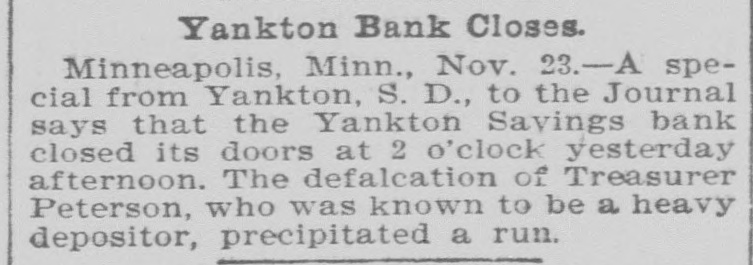
Yankton Bank Closes. Minneapolis, Minn., Nov. 23.-A special from Yankton, S. D., to the Journal says that the Yankton Savings bank closed its doors at 2 o'clock yesterday afternoon. The defalcation of Treasurer Peterson, who was known to be a heavy depositor, precipitated a run.
Closed Its Doors. Minneapolis. Nov. 22.-A special from Yankton, S. D., to the Journal says the Yankton Savings bank closed its doors at 2 o'clock this afternoon. The defalcation of Treasurer Peterson, who was known to be a heavy depositor, precipitated a run, which has been in progress a day and a half.
6.November 23, 1899The Record-UnionSacramento, CA
Click image to open full size in new tab
Article Text
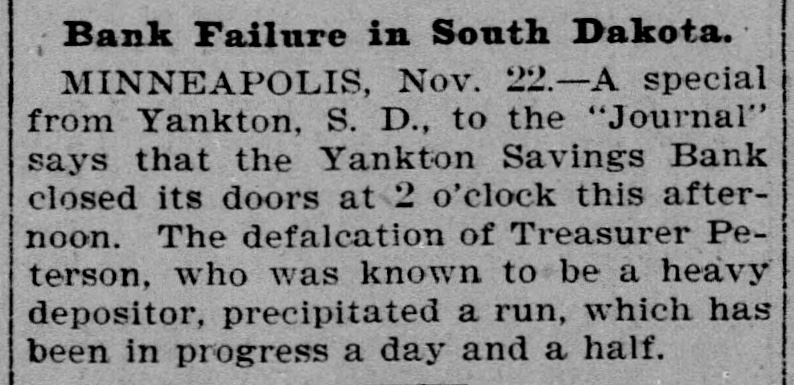
Bank Failure in South Dakota. MINNEAPOLIS, Nov. 22.-A special from Yankton, S. D., to the "Journal" says that the Yankton Savings Bank closed its doors at 2 o'clock this afternoon. The defalcation of Treasurer Peterson, who was known to be a heavy depositor, precipitated a run, which has been in progress a day and a half.
7.November 23, 1899The Salt Lake HeraldSalt Lake City, UT
Click image to open full size in new tab
Article Text
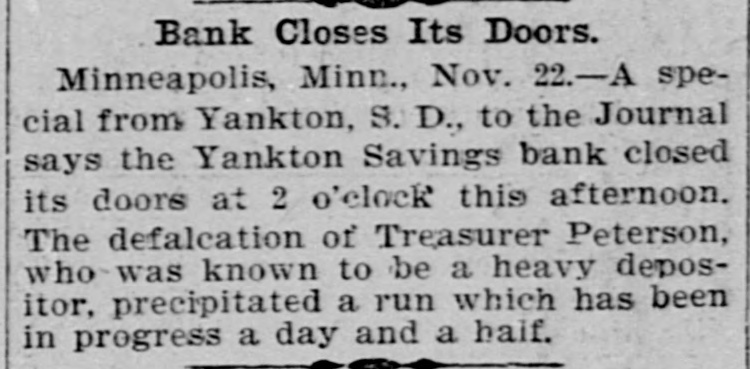
Bank Closes Its Doors. Minneapolis, Minn., Nov. 22.-A special from Yankton, S.D., to the Journal says the Yankton Savings bank closed its doors at 2 o'clock this afternoon. The defalcation of Treasurer Peterson, who was known to be a heavy depositor, precipitated a run which has been in progress a day and a half.
8.November 23, 1899Omaha Daily BeeOmaha, NE
Click image to open full size in new tab
Article Text
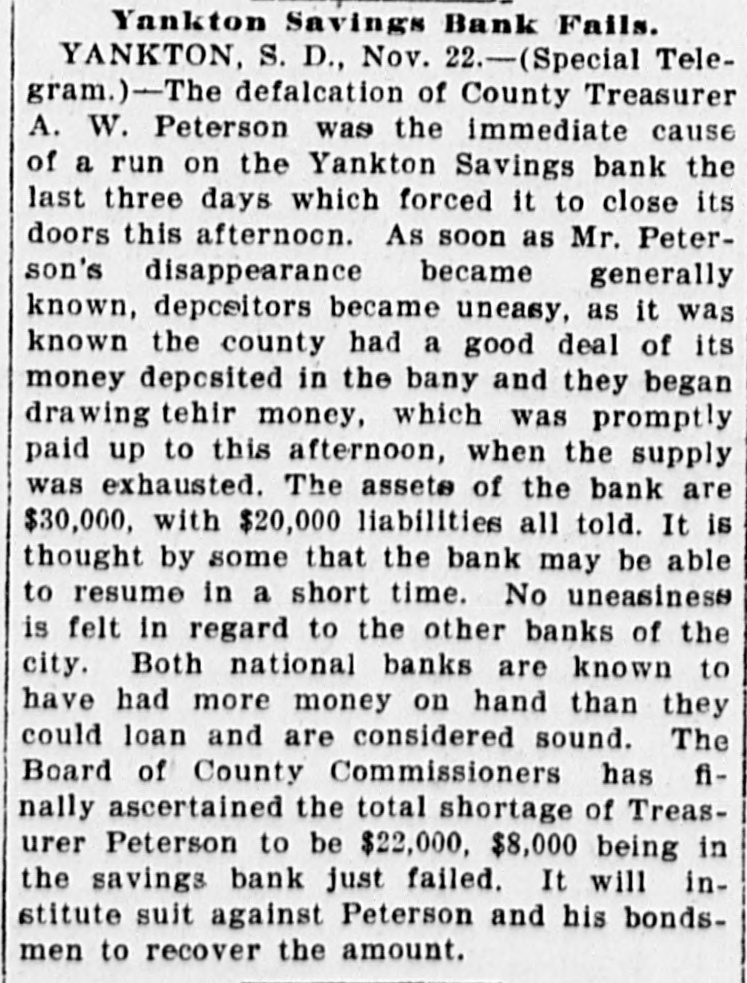
Yankton Savings Bank Fails. YANKTON, S. D., Nov. 22.-(Special Telegram.)-The defalcation of County Treasurer A. W. Peterson was the immediate cause of a run on the Yankton Savings bank the last three days which forced it to close its doors this afternoon. As soon as Mr. Peterson's disappearance became generally known, depositors became uneasy, as it was known the county had a good deal of its money deposited in the bany and they began drawing tehir money, which was promptly paid up to this afternoon, when the supply was exhausted. The assete of the bank are $30,000, with $20,000 liabilities all told. It is thought by some that the bank may be able to resume in a short time. No uneasiness is felt in regard to the other banks of the city. Both national banks are known to have had more money on hand than they could loan and are considered sound. The Board of County Commissioners has finally ascertained the total shortage of Treasurer Peterson to be $22,000, $8,000 being in the savings bank just failed. It will institute suit against Peterson and his bondsmen to recover the amount.
9.November 23, 1899The Morning AstorianAstoria, OR
Click image to open full size in new tab
Article Text
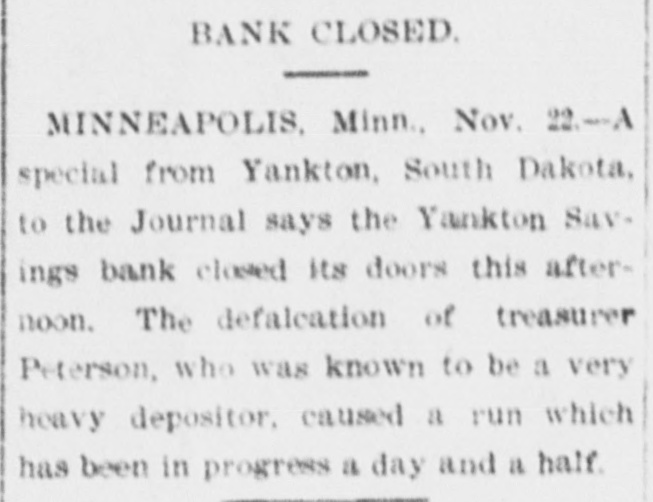
BANK CLOSED. MINNEAPOLIS, Minn., Nov. 22-A special from Yankton, South Dakota, to the Journal says the Yankton Savings bank closed its doors this afternoon. The defalcation of treasurer Peterson, who was known to be a very heavy depositor. caused a run which has been in progress a day and a half.
10.November 24, 1899Little Falls Weekly TranscriptLittle Falls, MN
Click image to open full size in new tab
Article Text
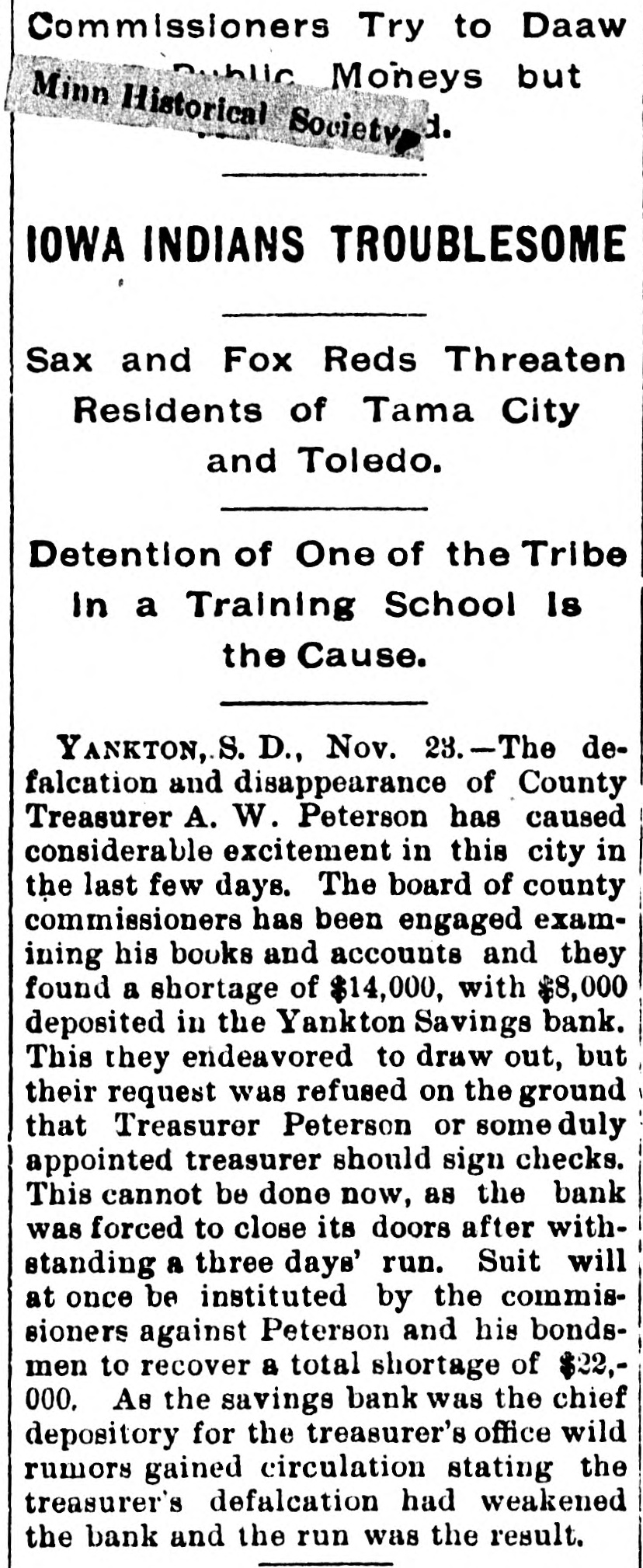
Commissioners Try to Daaw Public Moneys but Minn Historical Soviety d. IOWA INDIANS TROUBLESOME Sax and Fox Reds Threaten Residents of Tama City and Toledo. Detention of One of the Tribe In a Training School Is the Cause. YANKTON, S. D., Nov. 23. -The defalcation and disappearance of County Treasurer A. W. Peterson has caused considerable excitement in this city in the last few days. The board of county commissioners has been engaged examining his books and accounts and they found a shortage of $14,000, with $8,000 deposited in the Yankton Savings bank. This they endeavored to draw out, but their request was refused on the ground that Treasurer Peterson or some duly appointed treasurer should sign checks. This cannot be done now, as the bank was forced to close its doors after withstanding a three days' run. Suit will at once be instituted by the commissioners against Peterson and his bondsmen to recover a total shortage of $22,000. As the savings bank was the chief depository for the treasurer's office wild rumors gained circulation stating the treasurer's defalcation had weakened the bank and the run was the result.
11.November 24, 1899The Madison Daily LeaderMadison, SD
Click image to open full size in new tab
Article Text
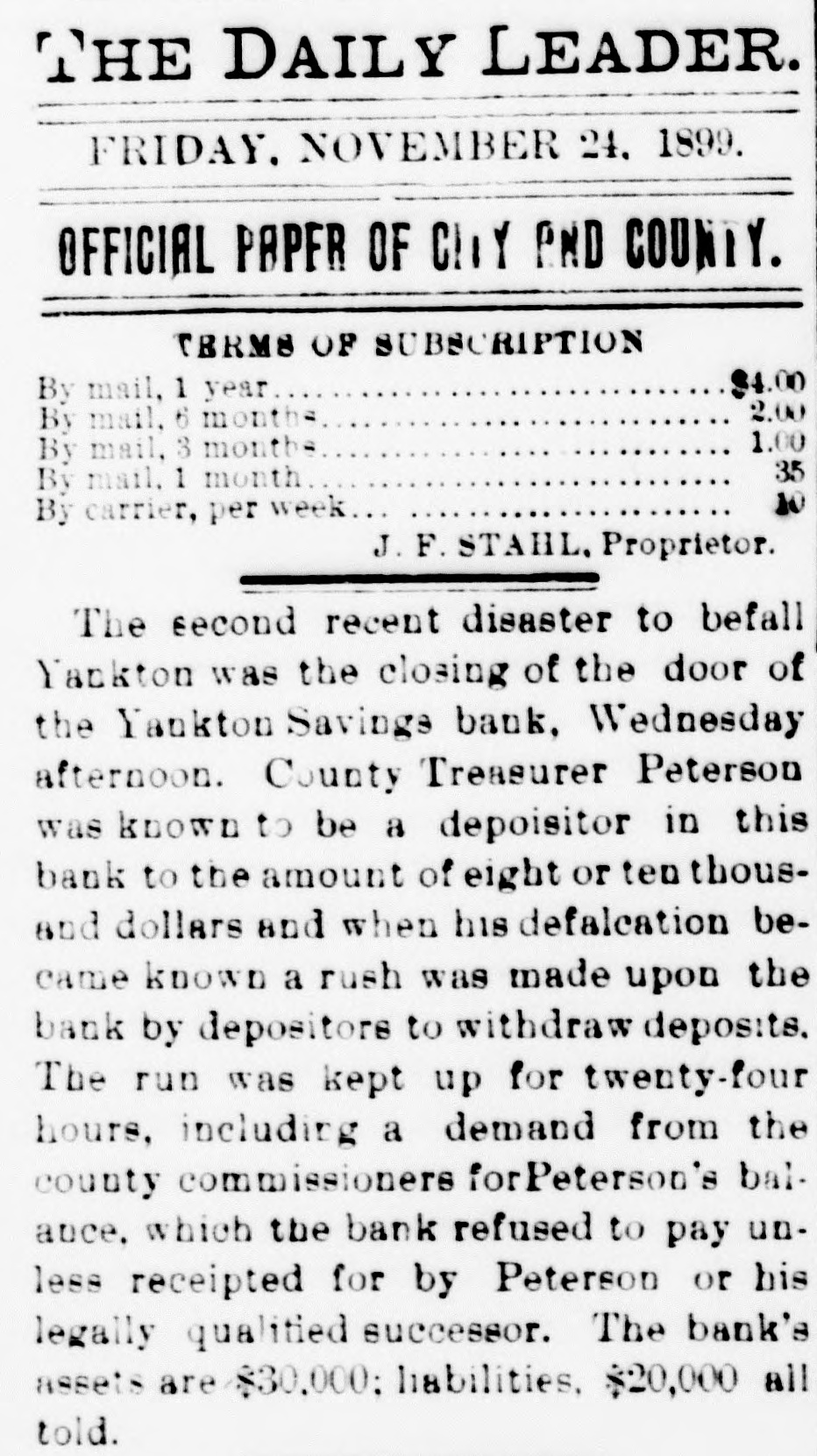
THE DAILY LEADER. FRIDAY. NOVEMBER 24. 1899. OFFICIAL PAPER OF CITY PND COUNTY. TERMS OF SUBSCRIPTION $4.00 By mail, 1 year 2.00 By mail, 6 months 1.00 By mail, 3 months 35 By mail. 1 month 10 By carrier, per week J. F. STAHL. Proprietor. The second recent disaster to befall Yankton was the closing of the door of the Yankton Savings bank, Wednesday afternoon. County Treasurer Peterson was known to be a depoisitor in this bank to the amount of eight or ten thousand dollars and when his defalcation became known a rush was made upon the bank by depositors to withdraw deposits. The run was kept up for twenty-four hours, including a demand from the county commissioners forPeterson's balance, which the bank refused to pay unless receipted for by Peterson or his legally qualitied successor. The bank's assets are $30,000; liabilities, $20,000 all told.
12.November 24, 1899Daily Kennebec JournalAugusta, ME
Click image to open full size in new tab
Article Text
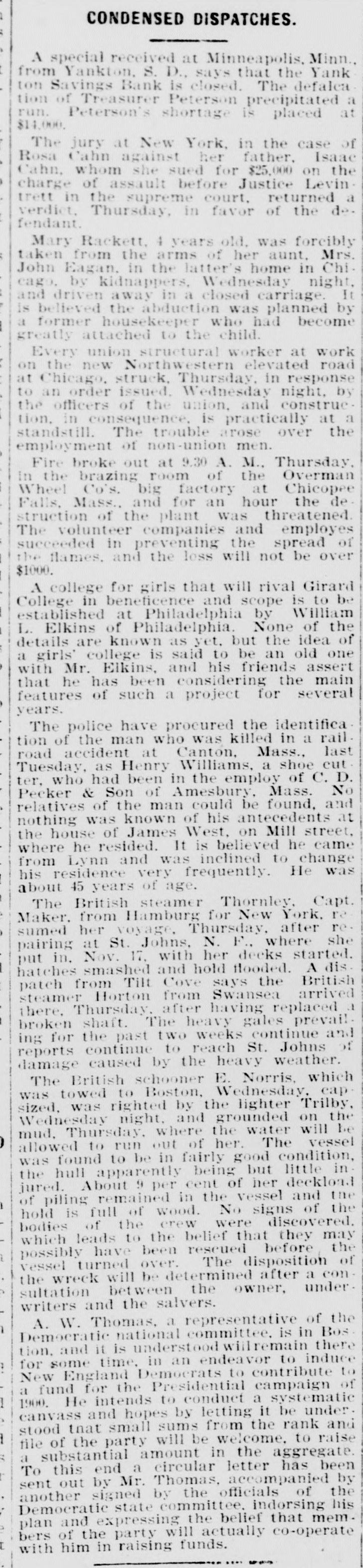
CONDENSED DISPATCHES. A special received at Minneapolis from Yankton, S. D., says that the ton Savings Bank is closed. The ( tion of Treasurer Peterson precipi run. Peterson's shortage is pla $14,000. The jury at New York, in the Rosa Cahn against her father, Cahn, whom she sued for $25,000 charge of assault before Justice trett in the supreme court. retu verdict. Thursday, in favor of 1 fendant. Mary Rackett, $ years old. was 1 taken from the arms of her aun John Eagan. in the latter's home cago, by kidnappers, Wednesday and driven away in a closed carria is believed the abduction was plan a former housekeeper who had greatly attached to the child. Every union structural worker a on the new Northwestern elevate at Chicago. struck, Thursday. in r to an order issued. Wednesday ni; the officers of the union. and co tion. in consequence, is practicall standstill. The trouble arose OV employment of non-union men. Fire broke out at 9.30 A. M., Th in the brazing room of the O Wheel Co's. big factory at C Falls, Mass., and for an hour 1 struction of the plant was thre The volunteer companies and en succeeded in preventing the spr the flames, and the loss will not 1 $1000. A college for girls that will rival College in beneficence and scope i established at Philadelphia by \ L. Elkins of Philadelphia. None details are known as yet, but the a girls' college is said to be an . with Mr. Elkins, and his friends that he has been considering the features of such a project for years. The police have procured the ide tion of the man who was killed in road accident at Canton, Mass Tuesday, as Henry Williams, a sh ter, who had been in the employ o Pecker & Son of Amesbury, Mas relatives of the man could be four nothing was known of his anteced the house of James West, on Mill where he resided. It is believed h from Lynn and was inclined to his residence very frequently. I about 45 years of age. The British steamer Thornley, Maker. from Hamburg for New Y sumed her voyage, Thursday, af pairing at St. Johns, N. F., whe put in. Nov. 17. with her decks $ hatches smashed and hold flooded. patch from Tilt Cove says the steamer Horton from Swansea there. Thursday. after having rep broken shaft. The heavy gales I ing for the past two weeks contin reports continue to reach St. Jo damage caused by the heavy we The British schooner E. Norris, was towed to Boston, Wednesda sized, was righted by the lighter Wednesday night, and grounded mud. Thursday. where the water allowed to run out of her. The was found to be in fairly good co the hull apparently being but lit jured. About 9 per cent of her de of piling remained in the vessel : hold is full of wood. No signs
13.November 24, 1899The Bourbon NewsParis, KY
Click image to open full size in new tab
Article Text
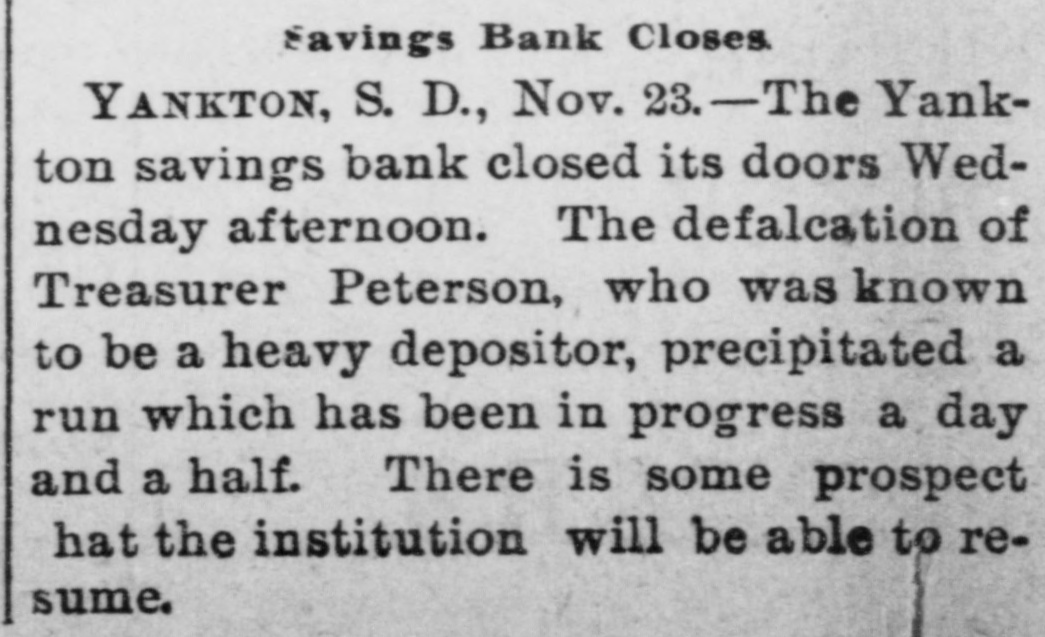
Savings Bank Closes YANKTON, S. D., Nov. 23.-The Yankton savings bank closed its doors Wednesday afternoon. The defalcation of Treasurer Peterson, who was known to be a heavy depositor, precipitated a run which has been in progress a day and a half. There is some prospect hat the institution will be able to resume.
14.November 25, 1899Chicago EagleChicago, IL
Click image to open full size in new tab
Article Text
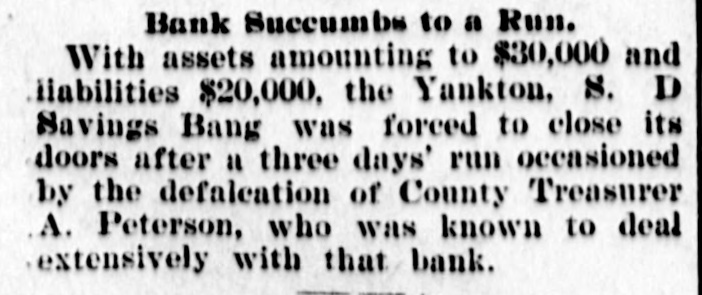
Bank Succumbs to a Run. With assets amounting to $30,000 and liabilities $20,000, the Yankton, S. D Savings Bang was forced to close its doors after a three days' run occasioned by the defalcation of County Treasurer A. Peterson, who was known to deal extensively with that bank.
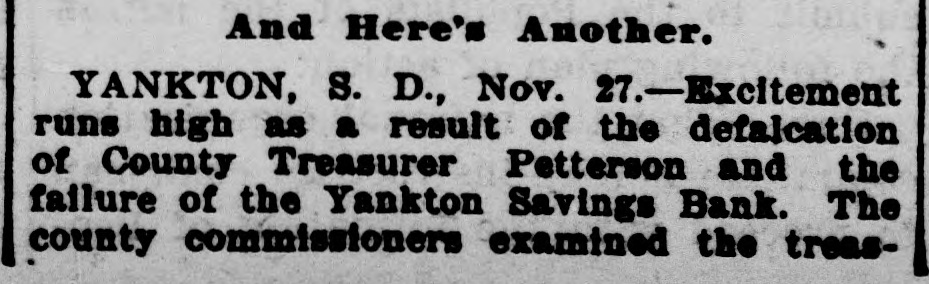
And Here's Another. YANKTON, S. D., Nov. 27.-Excitement runs high as a result of the defalcation of County Treasurer Petterson and the failure of the Yankton Savings Bank. The county commissioners examined the treas-
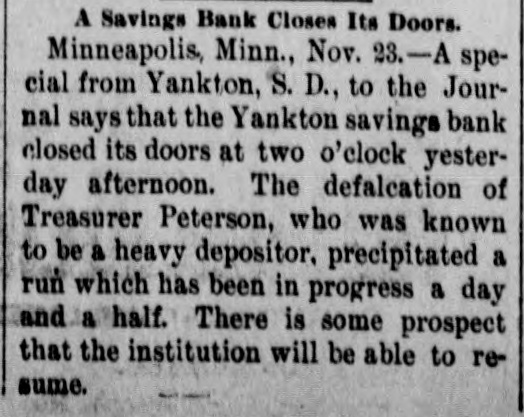
A Savings Bank Closes Its Doors. Minneapolis, Minn., Nov. 23.-A special from Yankton, S. D., to the Journal says that the Yankton savings bank closed its doors at two o'clock yesterday afternoon. The defalcation of Treasurer Peterson, who was known to be a heavy depositor, precipitated a run which has been in progress a day and a half. There is some prospect that the institution will be able to resume.
17.December 1, 1899The Black Hills UnionRapid City, SD
Click image to open full size in new tab
Article Text
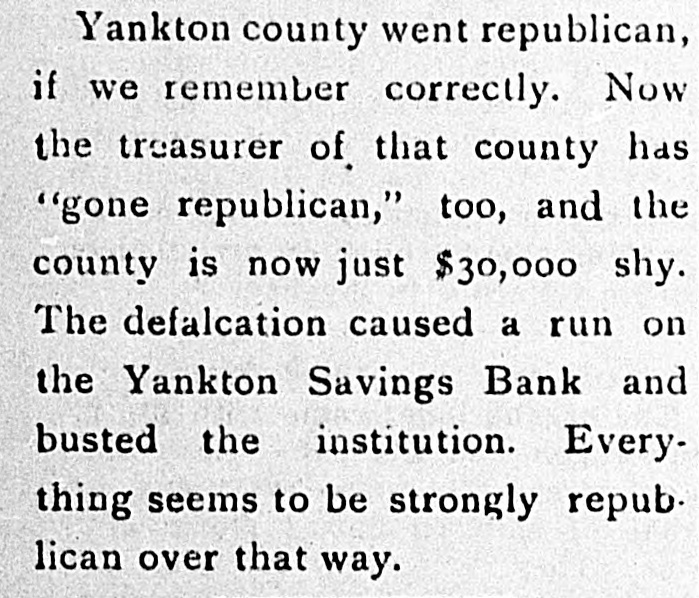
Yankton county went republican, if we remember correctly. Now the treasurer of that county has "gone republican," too, and the county is now just $30,000 shy. The defalcation caused a run on the Yankton Savings Bank and busted the institution. Everything seems to be strongly republican over that way.
18.December 2, 1899The Kimball GraphicKimball, SD
Click image to open full size in new tab
Article Text
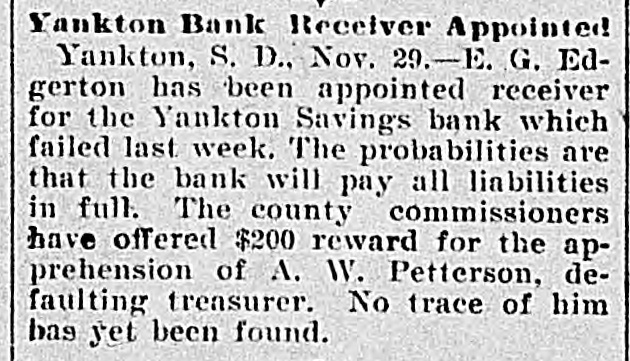
Yankton Bank Receiver Appointed Yankton, S. D., Nov. 29.-E. G. Edgerton has been appointed receiver for the Yankton Savings bank which failed last week. The probabilities are that the bank will pay all liabilities in full. The county commissioners have offered $200 reward for the apprehension of A. W. Petterson, defaulting treasurer. No trace of him bas yet been found.
19.December 2, 1899The Saint Paul GlobeSaint Paul, MN
Click image to open full size in new tab
Article Text
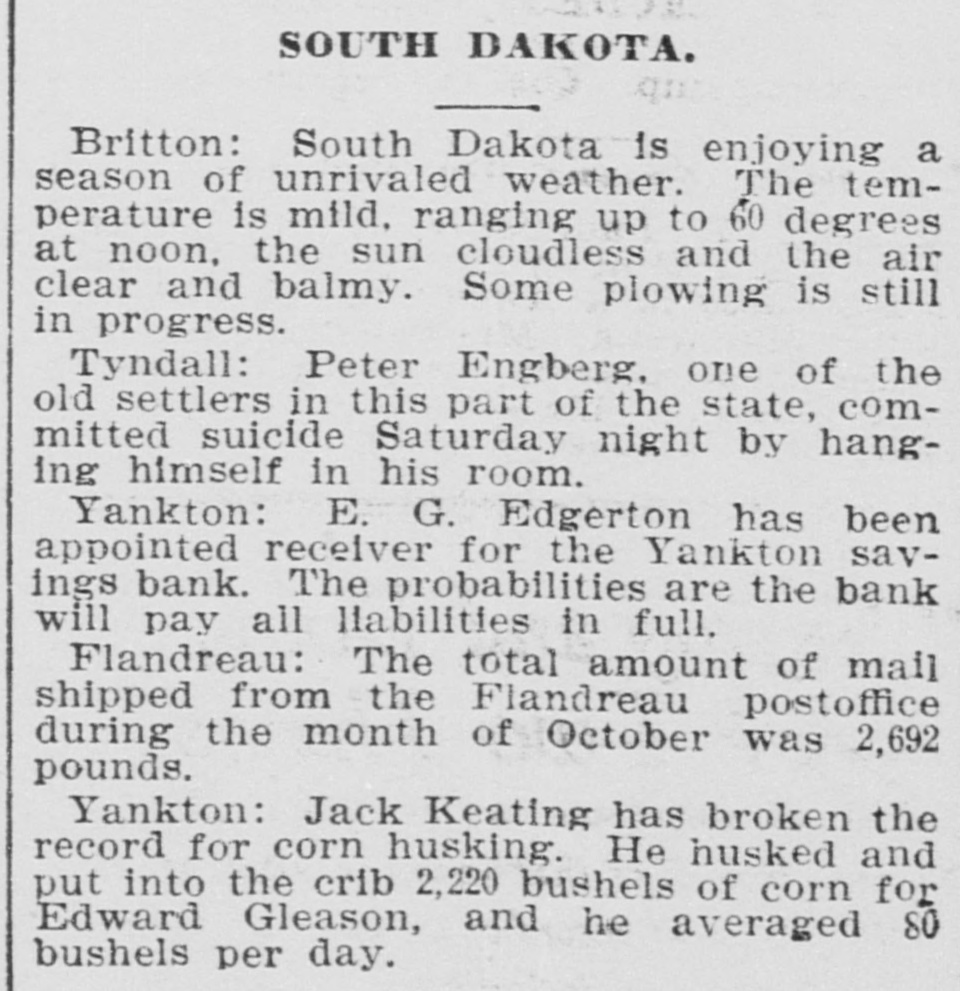
SOUTH DAKOTA. Britton: South Dakota is enjoying a season of unrivaled weather. The temperature is mild. ranging up to 60 degrees at noon, the sun cloudless and the air clear and balmy. Some plowing is still in progress. Tyndall: Peter Engberg. one of the old settlers in this part of the state, committed suicide Saturday night by hanging himself in his room. Yankton: E. G. Edgerton has been appointed receiver for the Yankton savings bank. The probabilities are the bank will pay all liabilities in full. Flandreau: The total amount of mail shipped from the Flandreau postoffice during the month of October was 2,692 pounds. Yankton: Jack Keating has broken the record for corn husking. He husked and put into the crib 2,220 bushels of corn for Edward Gleason, and he averaged 80 bushels per day.
20.December 24, 1899The SunNew York, NY
Click image to open full size in new tab
Article Text
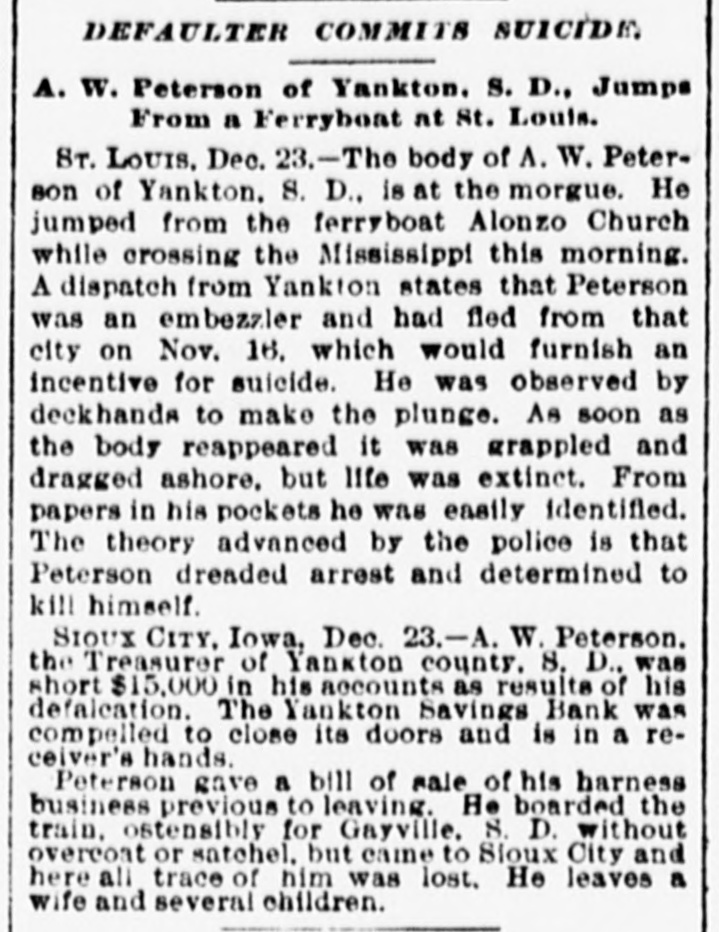
DEFAULTER COMMITS SUICIDE. A. W. Peterson of Yankton. S. D., Jumps From a Ferryboat at St. Louis. Sr. LOUIS, Dec. 23.-The body of A. W. Peterson of Yankton. S. D., is at the morgue. He jumped from the ferryboat Alonzo Church while crossing the Mississippi this morning. A dispatch from Yankton states that Peterson was an embezzler and had fled from that city on Nov. 16. which would furnish an incentive for suicide. He was observed by deckhands to make the plunge. As soon as the body reappeared it was grappled and dragged ashore. but life was extinct. From papers in his pockets he was easily identified. The theory advanced by the police is that Peterson dreaded arrest and determined to kill himself. SIOUX CITY, Iowa, Dec. 23.-A. W. Peterson. the Treasurer of Yankton county. S. D., was short $15,000 in his accounts as results of his defalcation. The Yankton Savings Bank was compelled to close its doors and is in a receiver's hands. Peterson gave a bill of sale of his harness business previous to leaving. He boarded the train, ostensibly for Gayville. S. D. without overcoat or satchel. but came to Sloux City and here all trace of him was lost. He leaves a wife and several children.
21.July 19, 1900Reporter and FarmerWebster, SD
Click image to open full size in new tab
Article Text
DAKOTA REPORTS. Compiler Tilton of Vermillion Adds to Their Value. Horace G. Tilton of Vermillion has brought out a second supplement to his index digest of the reported decisions of the supreme courts of Dakota Territory and of North and South Dakota, covering all opinions filed up to April 1, 1900. With this supplement he has included a table of all the cases digested in the series. and binds the original diegst and two supplements in one convenient volume of about 1,100 pages. Peter Honnenger of Romona met with a peculiar accident. He occasionally walks in his sleep, and, on the night in question got out of bed and must have made the movement with considerable force, for he went through a large glass and then ran some distance before he was noticed and finally caught by Robert Sullivan. He was still asleep when caught, though his ankle was 80 badly cut by the broken glass as to require several stitches. Receiver Edgerton, of the Yankton Savings Bank, which was wrecked last December by the defalcation of County Treasurer Pederson, has declared a 20 per cent payment. As all the real estate of the bank is still unsold, the defunct bank bids fair to make at least a 50 per cent payment to all creditors.
22.July 19, 1900The Pioneer PressMiller, SD
Click image to open full size in new tab
Article Text
DAKOTA REPORTS. Compiler Tilton of Vermillion Adds to Their Value. Horace G. Tilton of Vermillion has brought out a second supplement to his index digest of the reported decisions of the supreme courts of Dakota Territory and of North and South Dakota, covering all opinions filed up to April 1, 1900. With this supplement he has included a table of all the cases digested in the series, and binds the original diegst and two supplements in one convenient volume of about 1,100 pages. Peter Honnenger of Romona met with a peculiar accident. He occasionally walks in his sleep, and, on the night in question got out of bed and must have made the movement with considerable force, for he went through a large glass and then ran some distance before he was noticed and finally caught by Robert Sullivan. He was still asleep when caught. though his ankle was SO badly cut by the broken glass as to require several stitches. Receiver Edgerton, of the Yankton Savings Bank, which was wrecked last December by the defalcation of County Treasurer Pederson, has declared a 20 per cent payment. As all the real estate of the bank is still unsold, the defunct bank bids fair to make at least a 50 per cent payment to all creditors.