Click image to open full size in new tab
Article Text
# IN SENATE.
SATURDAY, April 6, 1861-10 A. M.
Prayer by Rev. Mr. Morris
PETITIONS AND MEMORIALS
They are in such abundance in his region of the
State, as to cover thousands of acres. He be-
lieved that concerted action for three years
would entirely rid the country of them. But
this bill would not interfere with the law against
the Canada thistle; and it would materially as-
sist in the execution of that law.
Mr. BRUFF feared that the passage of this
bill would from the impossibility of either
obeying or enforcing it-tend to make the first
law a nullity, and leave us without such protec-
tion against the Canada thistle as that law af-
fords.
Mr. CONVERSE moved to amend by mak-
ing it include weeds, which was disagreed to-
yeas 27, naya 54.
Mr. VAN VORIS moved to strike out all af-
ter the enacting clause, which was agreed to-
yeas 45, nays 22.
The committee on Municipal Corporations re-
ported H. B. 473-To authorize the Commis-
sioners of Montgomery county to build a bridge
over the Miami River at Dayton-which was
read the first time.
Mr. SCHIFF, from the select committee to
which was referred S. B. 272-Providing for a
tax to buy the Hamilton County Fair Grounds,
etc., reported the same back, and recommended
its passage, and stated the object of the bill.
Mr. DAVIS moved that the bill be amended
by striking out the third section, which provides
for an increase of the salaries of the Common
Pleas Judges.
He held the bill was contrary to the Consti-
tution, as containing two objects. He also ob-
jected to the increase of the salaries of Judges
in any case.
Mr. FLAGG explained that this bill had but
one object, with several details, and therefore
does not conflict with the Constitution. As to
the third section, it was a matter wholly with
Hamilton county, whose people chose to pay
their judges in this way; and finding that the
plan worked well in the city, they desired to ex-
tend it to the Common Pleas judges.
Mr. BLAKESLEE advocated the bill.
Mr. JONAS explained the necessity for the
payment of higher salaries to judges.
Mr. ROGERS hoped the bill would pass. He
had a pecuniary interest in it. They had two
good Common Pleas judges in their county, who
get but $1,500 a year, and this kept them so
poor that whenever he went there he had to
buy them something to drink, and after that
give them a chew of tobacco. He hoped the
bill would pass.
Mr. HILLS took the same position as Mr.
Davis, as to the constitutional question, and
protested against the passage of the bill on this
ground, as well as against a kind of surrepti-
tious increase of the salaries of judges.
Mr. WOODS replied to the constitutional ob-
jection, showing that the practice of grouping
several objects in one bill is well established in
the legislation of the State.
Mr. SCOTT, of Warren, moved to amend by
striking out the provision exempting fair
grounds from execution, which was disagreed
to.
The vote was then taken on the passage of
the bill, which resulted-yeas 54, nays 25.
The Judiciary committee reported back H.
B. 439-To change the number of Common
Pleas Judges, with sundry amendments, which
were agreed to.
Mr. COLLINS moved to amend the bill by
adding Vinton county to the first subdivision of
the Seventh Judicial District, which was agreed
to, when the bill was ordered to be engrossed,
and read a third time on Tuesday next.
Mr. MYERS offered the following, which was
laid over under the rule:
WHEREAS, It has been established as a rule
by the Board of Trustees of the Blind Asylum,
that the pupils who remain in the institution for
five years shall be discharged therefrom; and,
WHEREAS, It appears that many pupils are
discharged under the rule, while others are re-
tained beyond the period named; and,
WHEREAS, Many persons desire admission
who cannot be accommodated therein: There-
fore,
Be it Resolved, by the General Assembly of the
State of Ohio, That from and after the date of
the adoption of this resolution, the Trustees and
Superintendent of the Blind Asylum are hereby
directed to discharge all pupils who are now re-
maining in the Asylum over five years, from
admission; and they are hereby further directed
to discharge all pupils who may hereafter be ad-
mitted, after they shall have remained five years
in said institution.
Mr. VINCENT offered the following resolu-
tion which was laid over under the rule:
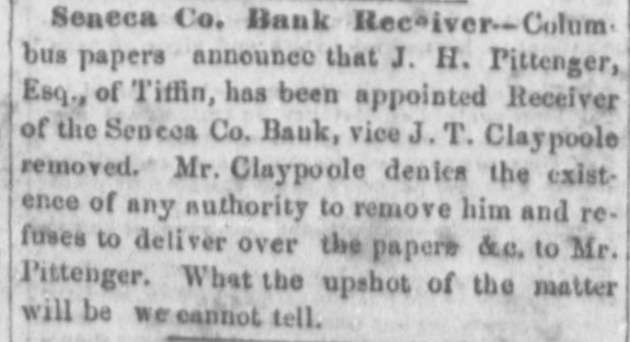
Resolved, by the General Assembly of the State of
Ohio, That the office of the Receiver of the
Seneca County Bank, should, of right, be kept
in the city of Tiffin; and the Auditor, Treasu-
rer, and Secretary of State, be and they are
hereby directed to remove J. T. Claypool, the
present Receiver, and appoint some suitable
and trustworthy person, who shall keep his
office, as such Receiver in said city of Tiffin.
Adjourned.
In Thursday morning's report, on the passage
of Mr. Baldwin's bill, regulating the fees of
county treasurers, there is a misprint that re-
verses the character of the report. The report
was printed:
"Mr. JONAS moved to amend by making it to
take effect in September, 1862.
"Mr. BALDWIN approved this amendment,
as it would materially affect the objects of the
bill."
It should have been, Mr. B. opposed the
amendment, &c. This places Mr. Baldwin in a
wrong light, and as favoring an amendment
that destroyed his bill. He not only opposed
the amendment, but supported his bill in an able
argument, made up of a mass of valuable sta-
tistical matter relating to the subject.