17721. First State Bank (Onida, SD)

Bank Information

Episode Type
Suspension โ†’ Closure
Bank Type
state
Start Date
January 26, 1911
Location
Onida, South Dakota (44.708, -100.060)

Metadata

Model
gpt-5-mini
Short Digest
6ff2ff60f06f1817

Response Measures

None

Description

Articles (1911 and 1913) state the First State Bank at Onida was in the hands of the bank examiner (Jan 1911) and is listed among six banks that suspended payments in the biennial examiner's report (covering the two years to June 30, 1912). Examiner attributes suspensions/failures to impaired reserves, large delinquent loans, negligence and misconduct by officers. No article indicates the bank reopened; evidence points to permanent suspension/closure.

Events (1)

1. January 26, 1911 Suspension
Cause
Bank Specific Adverse Info
Cause Details
Examiner report cites failure to maintain required legal cash reserve, large delinquent loans, negligence of officers and improper loans/transactions leading to unsatisfactory condition of affairs.
Newspaper Excerpt
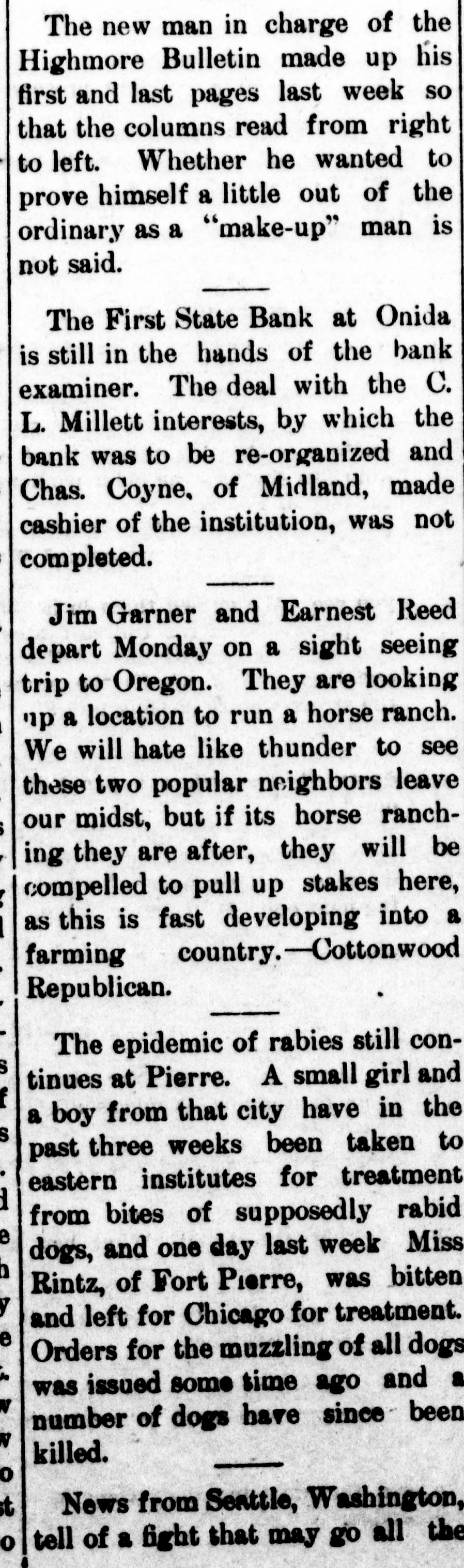
The First State Bank at Onida is still in the hands of the bank examiner.
Source
newspapers

Newspaper Articles (3)

Article from Philip Weekly Review, January 26, 1911

Click image to open full size in new tab

Article Text

The new man in charge of the Highmore Bulletin made up his first and last pages last week so that the columns read from right to left. Whether he wanted to prove himself a little out of the ordinary as a "make-up" man is not said. The First State Bank at Onida is still in the hands of the bank examiner. The deal with the C. L. Millett interests, by which the bank was to be re-organized and Chas. Coyne. of Midland, made cashier of the institution, was not completed. Jim Garner and Earnest Reed depart Monday on a sight seeing trip to Oregon. They are looking np a location to run a horse ranch. We will hate like thunder to see these two popular neighbors leave our midst, but if its horse ranching they are after, they will be compelled to pull up stakes here, as this is fast developing into a farming country.-Cottonwood Republican. The epidemic of rabies still continues at Pierre. A small girl and a boy from that city have in the past three weeks been taken to eastern institutes for treatment from bites of supposedly rabid dogs, and one day last week Miss Rintz, of Fort Pierre, was bitten and left for Chicago for treatment. Orders for the muzzling of all dogs was issued some time ago and a number of dogs have since been killed. News from Seattle, Washington, tell of a fight that may go all the


Article from The Mitchell Capital, January 2, 1913

Click image to open full size in new tab

Article Text

Examiner WingSends Biennial Report to Governor. ECOMME NDATION commends Changes in Laws to Protect Depositors and Stockholders. his tenth biennial report to vernor Vessey State Bank ExamWingfield of this city covers an eresting period of the banking iness in this state, as refers to banks, and the report indithat at the close of business the period of to years, June 30, the banks are in a generally sperous condition. The report the condition of five hundred banks, fourteen private banks, twelve trust companies doing iness in the state on the date of last call, June 14. During the periods covered by the forty state banks, one private and four trust companies were anized: six banks left the jurisby becoming national banks; private banks incorporated as banks, and eight banks fortheir charters by failing to for business within the time ecified by law, making a total net of twenty-nine banks for the of two years. Six banks suspended payments in past two years, viz: Chelsea State First State bank, Onida, Northstern State bank, Newell, Meade bank, Sturgis, Farmers State Mobridge, Henderson State Wessington Why Banks Failed. The examiner traces the failure these banks to various causes, from the failure to maintain required legal cash reserve, large of delinquent loans, negliof officers in conduct of afcarrying exceedingly heavy without good security. Reting from two of the failures at and South Shore two cashcommitted suicide, and several have been given terms in the penitentiary for their violaof the state law. The Newell Bank Failure. Concerning the failure of the Norwestern State Bank at Newell, S. and which occasioned much comduring the recent campaign in state, the bank examiner makes following statement: The Northwestern State Bank of well was suspended on account of generally unsatisfactory condiof its affairs, due to negligence the part of the officers and directand fraudulent transactions on part of the cashier. An examinaof its affairs developed a greatly paired cash reserve, misappropriembezzlement, forgery and Isification by the cashier, and other transactions wherein the officers were beneficiaries. As result of this general misconduct affairs, improper assets aggregatmany thousands of dollars were mitted. 'Shortly before the suspension of bank the capital stock was transto an entirely new managewith the exception of the cashwho was temporarily retained on count of his familiarity with the siness. No criticism is due the peowho took over the bank from the stockholders, The causes resulted in the suspension of bank were traceable to the fordirectors and officers in charge. this point it may be well to note wisdom of the provisions of Sec41 of Article 2, Chapter 222, Laws of 1909 as amended the Session of 1911, State of South wherein it provides in part follows: "The stockholders of evbank shall be individually liable,


Article from The Brookings Register, January 16, 1913

Click image to open full size in new tab

Article Text

BANKS IN GOOD SHAPE In his tenth biennial report to the governor, State Bank Examiner Wingfield of Mitchell, says the banks are in a generally prosperous condition. The report discusses the condition of 500 state banks, fourteen private banks and twelve trust companies. During the period covered by the report, forty state banks, one private bank and four trust companies were organized; six banks left the jurisdiction by becoming national banks, twenty-one liquidated voluntarily; three private banks incorporated as state banks, and eight banks forfeited their charters by failing to open for business within the time specified by law, making a total not gain of twenty-nine banks for the two years. Six banks suspended payments in the two years, namely, Chelsea State Bank, First State Bank, Onida; Northwestern State Bank, Newell; Meade County Bank, Sturgis; Farmers' State Bank, Mobridge; Henderson State Bank, Wessington. The examiner traces the failure of these banks to various causes, ranging from failure to maintain the required legal cash reserve, a large amount of delinquent loans, negligence of officers, and the carrying of heavy loans without good security. Because of the failures at Sturgis and South Shore, two cashiens committed suicide; several others have been given terms in the state penitentiary. In the case of impairment of capital, the examiner finds that stockholders in the majority will refuse to make an assessment on the stock, with the idea of forcing the minority stockholders into voluntary liquidation or submit to suspension by the examiner. The law does not give the bank examiner authority to intercede for the minority stockholders (and force the majority to make concessions. He suggests that the examiner be joined with the board of directors, which would then give him authority to levy an assessment to make stronger the impaired capital. The examiner makes a strong contention against the "one man" bank, as he has found it to exist in several cases. He suggests that the directors be increased from three to five and require from the five a closer attendance on the meetings of the board of directors. As a further protection to the stockholders and depositors, the examiner recommends the double liability of stockholders. To avoid the loaning of funds to officers of the bank, the examiner makes the following statement: "Much pooling, wrongful diversion and entanglement of funds from loaning to associated interests could be prevented by amending section 29, article 2; by inserting the word corporation, and making it read as follows: 'No individua, firm or corporation transacting a banking business in this state shall loan to any single corporation, firm or individual, including such loan or loans made to the several members of such corporation, firm or co-partnership, more than 25 per cent of the paid up capital and surplus of such bank.' I invite close inquiry into the preceding suggestion and trust some action will be taken."