Article Text
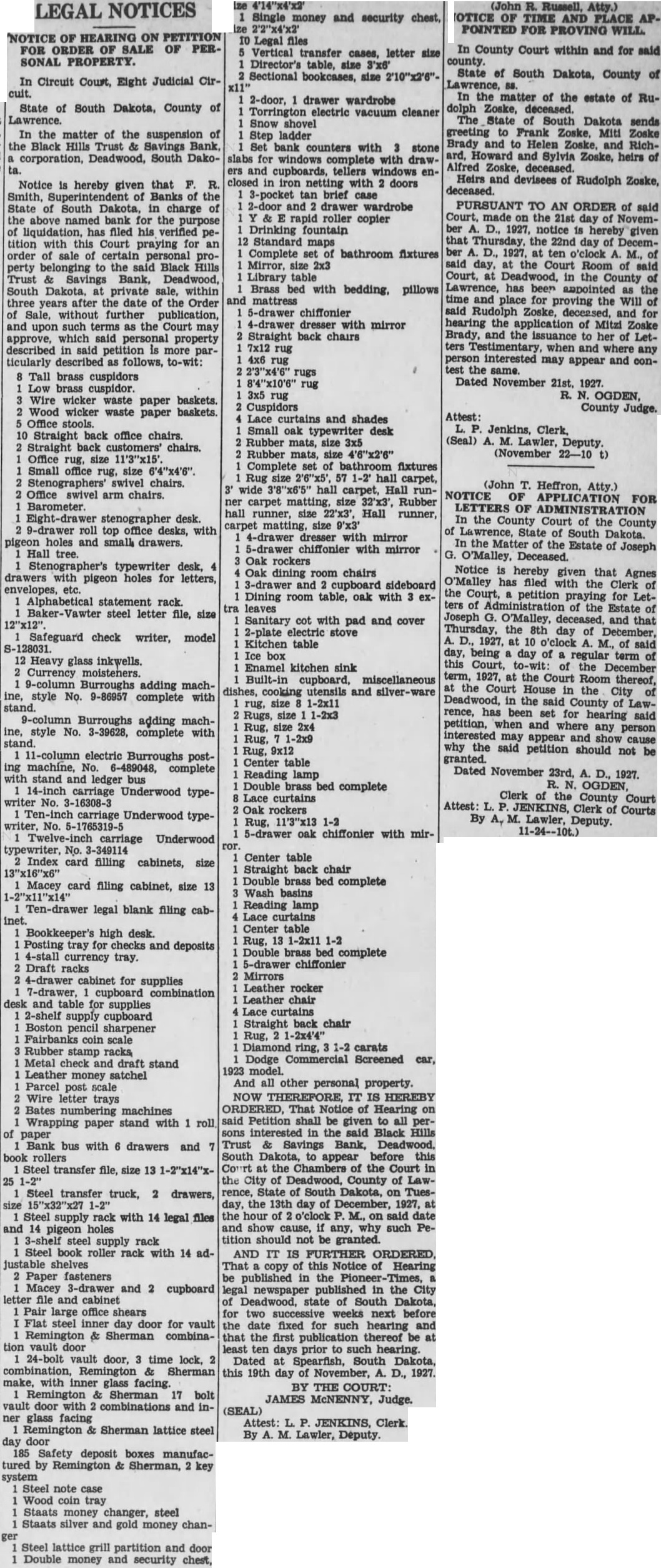
LEGAL NOTICES NOTICE OF HEARING ON PETITION FOR ORDER OF SALE OF PERSONAL PROPERTY. In Circuit Court, Eight Judicial Circuit. State of South Dakota, County of Lawrence. In the matter of the suspension of the Black Hills Trust & Savings Bank, corporation, Deadwood, South Dakota. Notice is hereby given that F. R. Smith, Superintendent of Banks of the State of South Dakota, in charge of the above named bank for the purpose of liquidation, has filed his verified petition with this Court praying for an order of sale of certain personal property belonging to the said Black Hills Trust Savings Bank, Deadwood, South Dakota, at private sale, within three years after the date of the Order of Sale, without further publication, and upon such terms as the Court may approve, which said personal property described in said petition more particularly described as follows, to-wit: 8 Tall brass cuspidors Low brass cuspidor. Wire wicker waste paper baskets. Wood wicker waste paper baskets. Office stools. 10 Straight back office chairs. 2 Straight back customers' chairs. Office rug, size 11'3"x15'. Small office rug, size 6'4"x4'6". swivel chairs. Office swivel arm chairs. Barometer Eight-drawer stenographer desk. 2 9-drawer roll top office desks, with pigeon holes and small drawers. Hall tree. Stenographer's typewriter desk, 4 drawers with pigeon holes for letters, envelopes, etc. Alphabetical statement rack Baker-Vawter steel letter file, size 12"x12". Safeguard check writer, model S-128031. 12 Heavy glass inkwells. 2 Currency moisteners. 9-column Burroughs adding machine, style No. 9-86957 complete with stand. 9-column Burroughs adding machine, style No. 3-39628, complete with stand. 11-column electric Burroughs posting machine, No. 6-489048, complete with stand and ledger bus 14-inch carriage Underwood typewriter No. 3-16308-3 carriage Underwood typewriter, No. 5-1765319-5 carriage Underwood typewriter, No. 3-349114 Index card filling cabinets, size 13"x16"x6" Macey card filing cabinet, size 13 1-2"x11"x14" Ten-drawer legal blank filing cabinet. Bookkeeper's high desk. Posting tray for checks and deposits 4-stall currency tray. Draft racks 2 4-drawer cabinet for supplies 7-drawer, cupboard combination desk and table for supplies 2-shelf supply cupboard Boston pencil sharpener Fairbanks coin scale 3 Rubber stamp racks Metal check and draft stand Leather money satchel Parcel post scale Wire letter trays 2 Bates numbering machines Wrapping paper stand with roll of paper Bank bus with 6 drawers and 7 book rollers Steel transfer file, size 13 1-2"x14"x25 1-2" Steel transfer truck, 2 drawers, size 15"x32"x27 1-2" Steel supply rack with 14 legal files and 14 pigeon holes 3-shelf steel supply rack Steel book roller rack with 14 adjustable shelves 2 Paper fasteners Macey 3-drawer and 2 cupboard letter file and cabinet Pair large office shears Flat steel inner day door for vault Remington & Sherman combination vault door 24-bolt vault door, 3 time lock, 2 combination, Remington & Sherman make, with inner glass facing. Remington & Sherman 17 bolt vault door with 2 combinations and inner glass facing Remington & Sherman lattice steel day door 185 Safety deposit boxes manufactured by Remington & Sherman, 2 key system Steel note case Wood coin tray Staats money changer, steel Staats silver and gold money chan- ger Steel lattice grill partition and door Double money and security chest, size 4'14"x4'x2' Single money and security chest, size 2'2"x4'x2' 10 Legal files 5 Vertical transfer cases, letter size Director's table, size 3'x6' Sectional bookcases, size 2'10"x2'6"- 2-door, drawer wardrobe Torrington electric vacuum cleaner Snow shovel Step ladder Set bank counters with 3 stone slabs for windows complete with drawers and cupboards, tellers windows enclosed in iron netting with 2 doors 3-pocket tan brief case 2-door and drawer wardrobe Y & E rapid roller copier Drinking fountain 12 Standard maps Complete set of bathroom fixtures Mirror, size 2x3 Library table Brass bed with bedding, pillows and mattress 5-drawer chiffonier 4-drawer dresser with mirror Straight back chairs 7x12 rug 4x6 rug 2'3"x4'6" rugs 8'4"x10'6" rug 3x5 rug Cuspidors Lace curtains and shades Small oak typewriter desk 2 Rubber mats, size 3x5 2 Rubber mats, size 4'6"x2'6" Complete set of bathroom fixtures Rug size 2'6"x5', 57 1-2' hall carpet, 3' wide 3'8"x6'5" hall carpet, Hall runner carpet matting, size 32'x3', Rubber hall runner, size 22'x3', Hall runner, carpet matting, size 9'x3' 4-drawer dresser with mirror 5-drawer chiffonier with mirror Oak rockers Oak dining room chairs 3-drawer and cupboard sideboard Dining room table, oak with 3 extra leaves Sanitary cot with pad and cover 2-plate electric stove Kitchen table Ice box Enamel kitchen sink Built-in cupboard, miscellaneous dishes, cooking utensils and silver-ware rug, size 1-2x11 2 Rugs, size 1-2x3 Rug, size 2x4 Rug, 1-2x9 Rug. 9x12 Center table Reading lamp Double brass bed complete Lace curtains Oak rockers 11'3"x13 1-2 5-drawer oak chiffonier with mir- Center table Straight back chair Double brass bed complete Wash basins Reading lamp Lace curtains Center table Rug, 13 1-2x11 1-2 Double brass bed complete 5-drawer chiffonier Mirrors Leather rocker Leather chair Lace curtains Straight back chair Rug, 1-2x4'4" Diamond ring, 1-2 carats Dodge Commercial Screened car, And all other personal property. NOW THEREFORE, IT IS HEREBY ORDERED, That Notice of Hearing on said Petition shall be given to all persons interested in the said Black Hills Trust & Savings Bank, Deadwood, South Dakota, to appear before this Court at the Chambers of the Court in the City of Deadwood, County of Lawrence, State of South Dakota, on Tuesday, the 13th day of December, 1927, at the hour of o'clock P. M., on said date and show cause, if any, why such Petition should not be granted. AND IT IS FURTHER ORDERED That copy of this Notice of Hearing be published in the Pioneer-Times, legal newspaper published in the City of Deadwood, state of South Dakota, for two successive weeks next before the date fixed for such hearing and that the first publication thereof be at least ten days prior to such hearing. Dated at Spearfish, South Dakota, this 19th day of November, A. D., 1927. BY THE COURT: JAMES McNENNY, Judge. (SEAL) Attest: L. P. JENKINS, Clerk. By A. M. Lawler, Deputy. (John R. Russell, Atty.) NOTICE OF TIME AND PLACE APPOINTED FOR PROVING WILL In County Court within and for said county. State of South Dakota, County of Lawrence, In the matter of the estate of Rudolph Zoske, deceased. The State of South Dakota sends greeting to Frank Zoske, Miti Zoske Brady and to Helen Zoske, and Richard, Howard and Sylvia Zoske, heirs of Alfred Zoske, deceased Heirs and devisees of Rudolph Zoske, deceased. PURSUANT TO AN ORDER of said Court, made on the 21st day of November A. D., 1927, notice is hereby given that Thursday the 22nd day of December A. D., 1927, at ten o'clock A. M., of said day, at the Court Room of said Court, at Deadwood, the County of Lawrence, has been appointed the time and place for proving the Will of said Rudolph Zoske, deceased, and for hearing the application of Mitzi Zoske Brady, and the issuance to her of Letters Testimentary, when and where any person interested may appear and contest the Dated November 21st. 1927 R. N. OGDEN, County Judge. Attest: L. P. Jenkins, Clerk, (Seal) A. M. Lawler, Deputy. (November 22-10 t) (John T. Heffron, Atty.) NOTICE OF APPLICATION FOR LETTERS OF ADMINISTRATION In the County Court of the County of State of South Dakota. In the Matter of the Estate of Joseph G. O'Malley. Deceased. Notice is hereby given that Agnes O'Malley has filed with the Clerk of the Court, petition praying for Letters of Administration of the Estate of Joseph G. O'Malley, deceased, and that Thursday, the 8th day of December, A. D., 1927, at 10 o'clock A. M., of said day, being day of regular term of this Court, to-wit: of the December term, 1927, at the Court Room thereof, at the Court House the City of Deadwood, the said County of Lawrence, has been set for hearing said petition, when and where any person interested may appear and show cause why the said petition should not be granted. Dated November 23rd, A. D., 1927. R. N. OGDEN Clerk of the County Court Attest: L. P. JENKINS, Clerk of Courts By A, M. Lawler, Deputy. 11-24--10t.)