First National Bank (Sioux City, IA)

Episode Information

Episode UID
175701163
Episode Type
Run โ†’ Suspension โ†’ Reopening
Bank Type
national
Bank ID
17570 national
Charter Number
1757
Start Date
November 19, 1896
Location
Sioux City, Iowa (42.500, -96.400)

Metadata

Model
gpt-5-mini (chosen from majority vote of a three-model LLM ensemble)
Short Digest
3fca179472558f4a

Response Measures

Capital injected, Full suspension, Books examined

Receivership Details

Date receivership started
1897-01-07
Date receivership terminated
1897-03-16

Description

Temporary receiver appointed Jan 7 pending resumption; full reorganization plan approved Dec 22 and bank resumed March 1897.

Events (9)

1. December 28, 1870 Chartered
Source
historical_nic
2. November 19, 1896 Run
Cause
Local Banks
Cause Details
Heavy withdrawals triggered by the recent failure of the Iowa Savings Bank and related rumors about local banks.
Measures
Bank closed and bank examiner Blanding notified and placed in charge; comptroller notified.
Newspaper Excerpt
closed its doors ... as a result of heavy withdrawals since the failure of the Iowa Savings bank last week.
Source
newspapers
3. November 19, 1896 Suspension
Cause
Government Action
Cause Details
Bank suspended operations and was placed in charge of a bank examiner (Comptroller notified; examiner placed in charge).
Newspaper Excerpt
The First National bank of Sioux City closed its doors at 11 o'clock this morning ... Bank Examiner Blanding has been placed in charge.
Source
newspapers
4. December 22, 1896 Other
Newspaper Excerpt
The stockholders ... decided upon a plan of reorganization. The bank will be reopened with a capital stock of $200,000 ... reorganization early next month under an entirely new management.
Source
newspapers
5. January 7, 1897 Receivership
Source
historical_nic
6. January 7, 1897 Receivership
Newspaper Excerpt
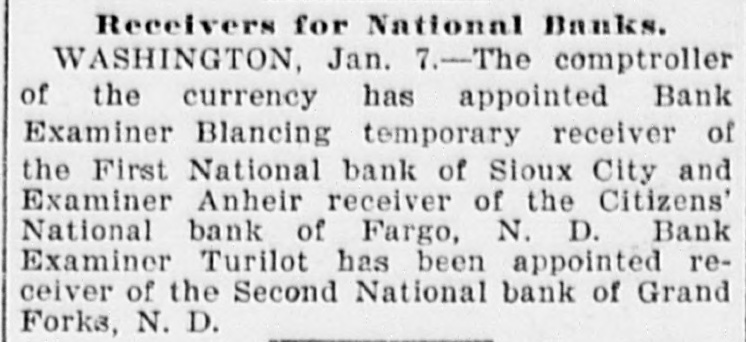
The comptroller of the currency has appointed Bank Examiner Blanding temporary receiver of the First National Bank of Sioux City ... temporary pending resumption.
Source
newspapers
7. March 16, 1897 Restored To Solvency
Source
historical_nic
8. March 17, 1897 Reopening
Newspaper Excerpt
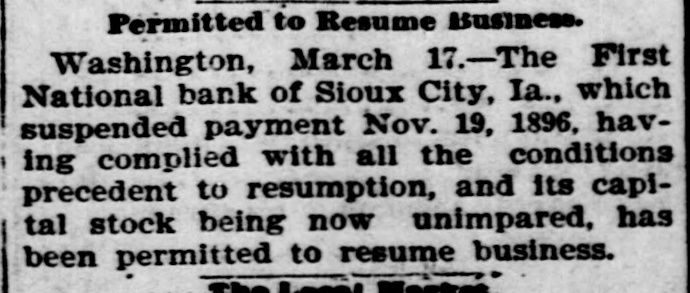
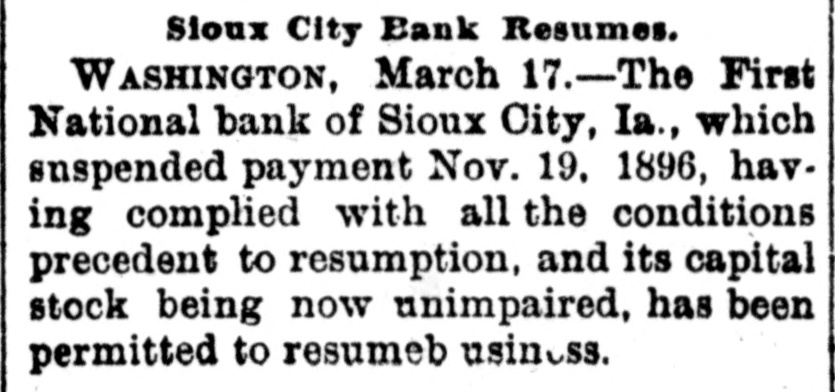
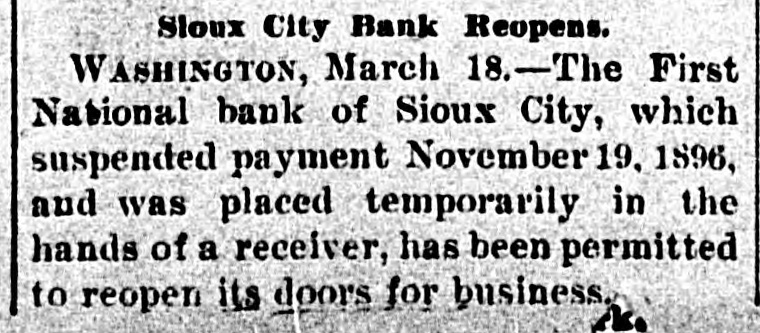
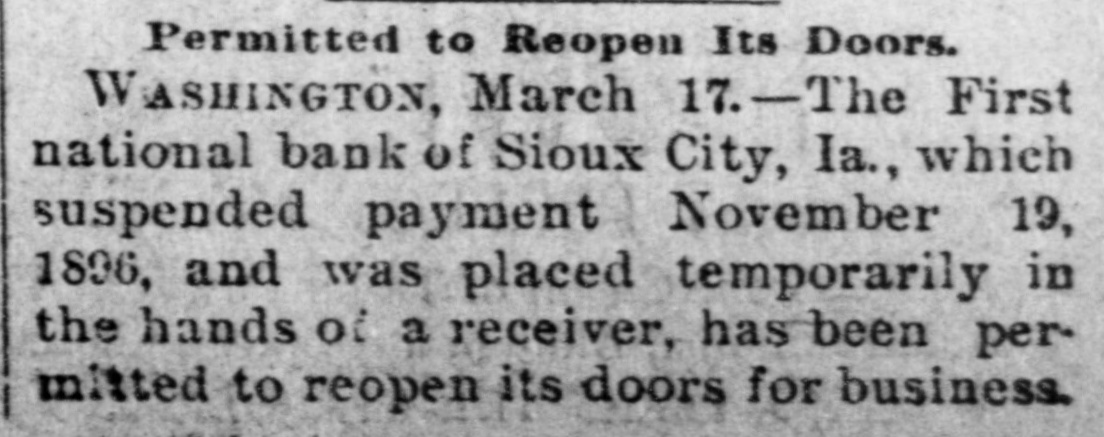
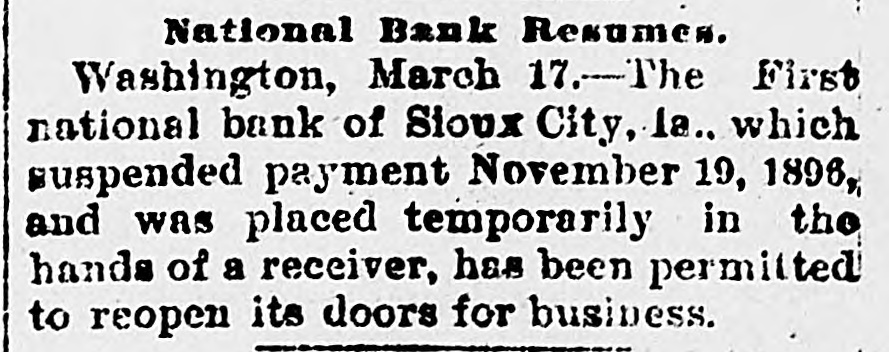
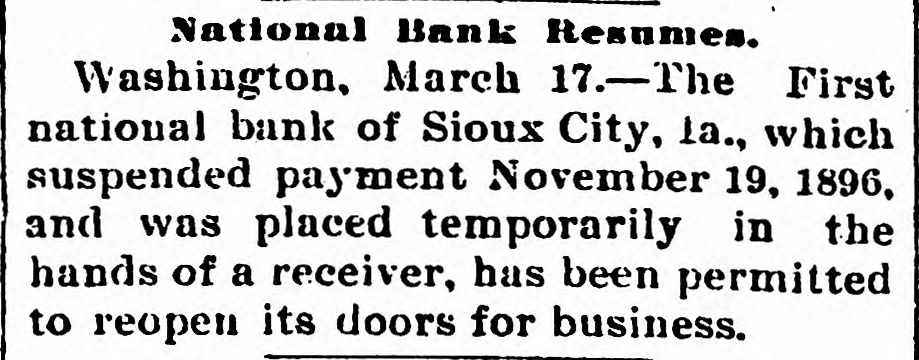
The First National bank of Sioux City, Ia., which suspended payment Nov. 19, 1896, has resumed business.
Source
newspapers
9. December 8, 1930 Receivership
Source
historical_nic

Newspaper Articles (23)

Article from Deseret Evening News, November 19, 1896

Click image to open full size in new tab

Article Text

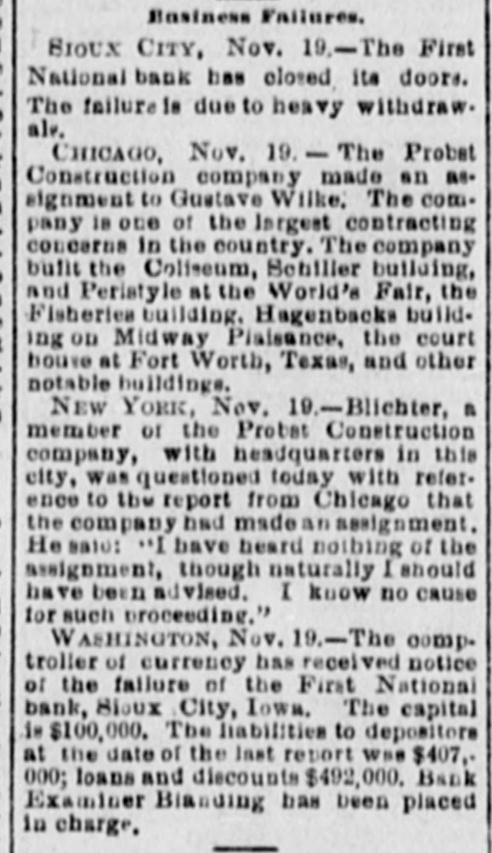
Business Failures. Broux CITY, Nov. 19,-The First National bank has closed its doors. The failure is due to heavy withdraw. ale. CHICAGO, Nov. 19. - The Probet Construction company made an assignment to Gustave Wilke, The company is one of the Inrgest contracting concerns in the country. The company buflt the Coliseum, Schiller bullding, and Peristyle at the World's Fair, the Fisheries building. Hagenbacks building on Midway Plaisance, the court house at Fort Worth, Texas, and other notable buildings. NEW YORK, Nov. 19.-Blichter, a member of the Probat Construction company, with headquarters in this city, was questioned today with reference to the report from Chicago that the company had made an assignment. He 9810: "I have heard nothing of the assignment, though naturally I should have been advised. I know no cause for such proceeding." WASHINGTON, Nov. 19.-The comptroller of currency has received notice of the failure of the First National bank, Sioux City, Iowa. The capital is $100,000. The liabilities to depositors at the date of the last report Was $407,000; loans and discounts $492,000. Bank Examiner Bianding bas been placed in charge.
Article from The Portland Daily Press, November 20, 1896

Click image to open full size in new tab

Article Text

Sioux City Bank Closed. Sioux City, Iowa, November 19.-The First National bank closed its doors uuexpectedly this morning. No statement of its condition has been made. The statement of October sixth showed capital and surplus, $140,000: loans, $192,564; deposits, $537,993. The officers of the bank declare the bank is perfectly solvent and dollar for dollar will be paid its creditors. The crash was caused by the recent heavy withdrawals and difficulty in realizing on assets. Many bad investments were made within the last few years and much of the bank's money is in unproductive property. The publication this morning of the reported weakness of & Sioux City bank to which, no direct reference was made, is also said to have precipitated matters. As a result of the suspension of the bank a receiver was appointed this afternoon for the Sioux City savings bank. The officers declare that all depositors were paid in full. The bank assets are estimated at $100,000.


Article from Kansas City Daily Journal, November 20, 1896

Click image to open full size in new tab

Article Text

A TRIO OF FAILURES. Sioux City, Ia., Bank Goes Down and With It Two Other Institutions. Sioux City, Ia., Nov. 19.-The First National bank, of Sioux City, closed its doors at 11 o'clock this morning, a result of heavy withdrawals since the failure of the Iowa Savings bank last week. The bank has always been considered one of the most solid financial institutions in the Northwest. It was organized in 1870. E. H. Hubbard, attorney for the bank, made the following statement to-night: "There is nothing to say further than that the bank is closed on account of steady withdrawals and the inability to get necessary money. Whether it will reopen again I cannot say. No definite statement can be made until the bank examiner comes. The comptroller of the currency, Mr. Eckels, has been notified, and until the examiner comes we shall have nothing more to say." The bank had nearly $400,000 in deposits; loans and discounts, $49,000; capital, $100,000. The failure of the First National caused a run on the Sioux City Savings bank, T. J. Stone being president of both institutions. The officers took advantage of the sixty day law. but late in the day F. B. Ross was appointed receiver for the protection of the stockholders and creditors. No further trouble is looked for by the bankers of Sioux City. J. K. Prugh & Co., china and queensware, made an assignment as the result of the failure of the First National. Liadilities are given as $23,000, with $41,000 assets.


Article from The Herald, November 20, 1896

Click image to open full size in new tab

Article Text

THE PROMISED PROSPERITY Has Missed Some Citizens in Its Forward March A Sioux City Bank Fails and the Great Probst Construction Company Goes to the Wall. SIOUX CITY, Ia., Nov. 19.-The First National bank of Sioux City closed its doors at 11 oclock this morning as a result of heavy withdrawals since the failure of the Iowa Savings bank last week. The bank has always been considered one of the most solid financial institutions in the west. It was originated in 1871. E. H. Hubbard, attorney for the bank, made the following statement tonight: "There is nothing to say further than that the bank is closed on account of steady withdrawals and the inability to get necessary money. Whether it will reopen again I cannot say. No definite statement can be made until the bank examiner comes. The comptroller of the currency, Mr. Eckles, has been notified and until the examiner comes we shall have nothing more to say." The bank had nearly $400,000 in deposits; loans and discounts, $492,000; capital, $100,000. The failure caused a run on the Sioux iCty Savings bank, T. J. Stone being The president of both institutions. officers took advantage of the sixtydays law, but late in the day F. B. Ross was appointed receiver for the protection of the stockholders and creditors. No further trouble is looked for by the bankers of Sioux City. J. K. Prugh & Co., china and queensware, made an assignment as the result of the failure of the First national. Liabilities are given as $23,000, with $41,000 assets.


Article from Evening Journal, November 20, 1896

Click image to open full size in new tab

Article Text

BANK FAILURES. Sloux City Financial Institutions Embarrassed by Lack of Funds. SIOUX CITY, Ia., Nov. 20.-The First National bank of this city has closed its doors, a result of heavy withdrawals since the failure of the Iowa Savings bank last week. The bank has always been considered one of the most solid financial institutions in the northwest. It was originated in 1870. E. H. Hubbard, attorney for the bank, makes the following statement: "There is nothing to say further than that the bank is closed on account of steady withdrawals and the inability to get necessary money. Whether it will open again, I cannot say. No definite statement can be made until the bank examiner comes." The bank had nearly $400,000 in deposits; loans and discounts, $492,000; capital, $100,000. The failure of the First National caused a run on the Sioux City Savings bank, T. J. Stone being president of both institutions. The officers took advantage of the 60 day law, but late in the day F. B. Ross was appointed receiver, for the protection of stockholders and creditors. J. K. Prugh & Co., china and queensware, made an assignment as the result of the failure of the First National. Liabilities are given as $23,000, with $41,000 assets.


Article from The Wichita Daily Eagle, November 20, 1896

Click image to open full size in new tab

Article Text

SIOUX CITY BANK FAILS, First National Has Been Placed in the Hands of the Examiner. Sioux City, Ia., Nov. 19.-The First National bank of Sioux City closed its doors at 11 o'clock this morning, as a result of heavy withdrawals since the foilure of the lowa Savings bank last week. The bank has always been considered one of the most solid financial institutions in the northwest. It was originated in 1870. E. H. Hubbard, attorney for the bank, made the following statement tonight: "There is nothing to say further than that the bank is closed on account of steady withdrawals and its inability to get necessary money. Whether It will reopen again I cannot say. No definite statement can be made until the bank examainer comes. The comptroller of the currency, Mr. Eckels, has been notified, and until the examiner comes we shall have nothing more to say." The bank had nearly $400,000 in deposits; loans and discounts $492,000; capital $100,000. The failure of the First National caused a run on the Sloux City savings bank, T. J. Stone being president of both institutions. The officers took advantage of the sixty-days law, but late in the day F. B. Ross was appointed receiver for the protection of the stockholders and creditors. No further trouble is looked for by the bankers of Sioux City. J. K. Prugh & Co., china and queensware, made an assignment as a result of the failure of the First National. Liabilities are given as $28,000, with $41,000 assets. Washington, Nov. 19.-The comptroller of the currency has received a telegram announcing the failure of the First National bank of Sloux City, Iowa, capital $100,000. Its liabilities to depositors at the date of last report was $407,000; loans and discounts, $492,000. Bank Examiner Blanding has been placed in charge.

Article from The Morning News, November 20, 1896

Click image to open full size in new tab

Article Text

SIOUX CITY BANK SHUT. Inability to Realize on Its Assets the Cause. Sioux City, Ia., Nov. 19.-The First National Bank closed its doors unexpectedly this morning. No statement of its condition has yet been made, but the statement of Oct. 6, showed capital and surplus of $140,000; loans, $492,064; deposits, $537,998. The officers of the bank declare that the bank is perfectly solvent, and that dollar for dollar will be paid creditors. The crash was caused by recent heavy withdrawals and difficulty in realizing on its assets. Many bad investments have also been made within the past few years, and much of the concern's money is in unproductive property. The publication this morning of the reported weakness of a Sioux City bank, to which, however, no direct reference was made, is also said to have precipitated matters. J. K. Prugh, a large dealer in crockery, followed the First National to the wall. His business was extensive, but no statement of his assets and liabilities is yet obtainable.


Article from Omaha Daily Bee, November 20, 1896

Click image to open full size in new tab

Article Text

$813,400.83 Total Thomas J. Stone was also president of the Sioux City Savings bank and as soon as the news of the failure of the First National became known there was a run on that bank, which continued until it was placed in charge of Charles B. Godd, late president. Officers refuse to make any statement of its finances, but there were about 2,000 depositors, mostly small amounts. The firm of J. K. Prugh & Co., dealers in crockery and glassware, and doing a large retail and jobbing trade, assigned on account of the bank failures. W. I. Buchanan, United States minister to Argentina, was a member of the firm until he took charge of the agricultural department of the World's fair, but Mr. Julian K. Prugh is now the entire firm. He gives his condition as follows: Assets-Stock on hand, $35,000; book accounts, $6,000; bills receivable, $500. Total, $41,500. Liabilities-Due First National bank, $16,500; rent due T. J. Stone, $3,000; account for goods purchased, $8,500. Total, $28,000. E. H. Hubbard, attorney for the First National bank, made the following statement tonight: "There is nothing to say further than that the bank is closed on account of steady withdrawals and the inability to get necessary money. Whether it will reopen again I cannot say. No definite statement on be made until the bank examiner comes. The comptroller of the currency, Mr. Eckels, has been notified, and until the examiner comes we shall have nothing more to say." WASHINGTON, Nov. 19.-The comptroller of the currency has received a telegram announcing the failure of the First National bank of Sioux City, Ia., capital, $100,000. Its liabilities to depositors at the date of its last report was $407,000; loans and discounts, $492,000. Bank Examiner Blaning has been placed in charge.

Article from Omaha Daily Bee, November 20, 1896

Click image to open full size in new tab

Article Text

Two Banks and a Jobbing Firm Go to the Wall. SIOUX CITY, Nov. 19.-(Special Telegram.)-One of the oldest and supposedly the soundest bank in Sioux City went down today, carrying with it another bank and one good business house. The First National bank, organized twenty-six years ago by Thomas J. Stone, who was a pioneer in banking circles here and had conducted a private bank for years, closed at 10 o'clock owing to a run which had exhausted the availabe funds. The bank helped nearly all the other banks three years ago. and was known at that time to have a large amount of money available. Recently the depositors have heard rumors which caused the run. The bank examiner will arrive tomorrow and take charge. The only statement is that made to the comptroller a month 260, as follows:


Article from The Superior Times, November 21, 1896

Click image to open full size in new tab

Article Text

Oyster Supper in The Hughes Building. The Ladies Aid Society of the Thompson avenue M. E. Church will give a supper in the Hughes building on Fifth street, Tuesday evening, Nov. 24th. Oysters stewed, fried and raw will be served, and cold meats, coffee, salads, etc. Supper 25 cents. Don't fail to get your supper down town Tuesday night. -The First National Bank, of Sioux City, Iowa, closed its doors at 11 o'clock Thursday morning. The suspension was caused by the heavy withdrawals resulting from the failure of the Iowa Savings bank last week. The bank had nearly $400,000 in deposits; loansand discounts, $490,000; capital, $100,000.


Article from The Salt Lake Herald, November 21, 1896

Click image to open full size in new tab

Article Text

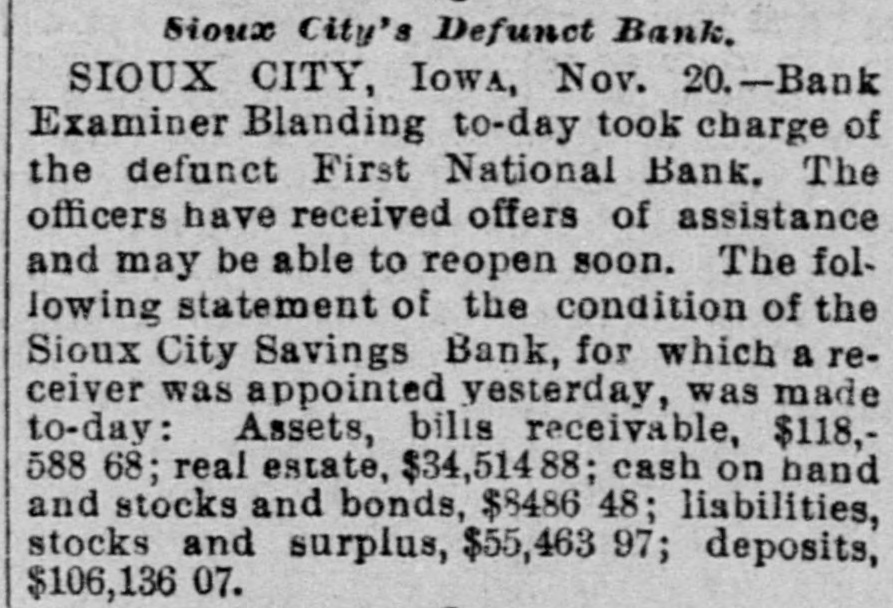
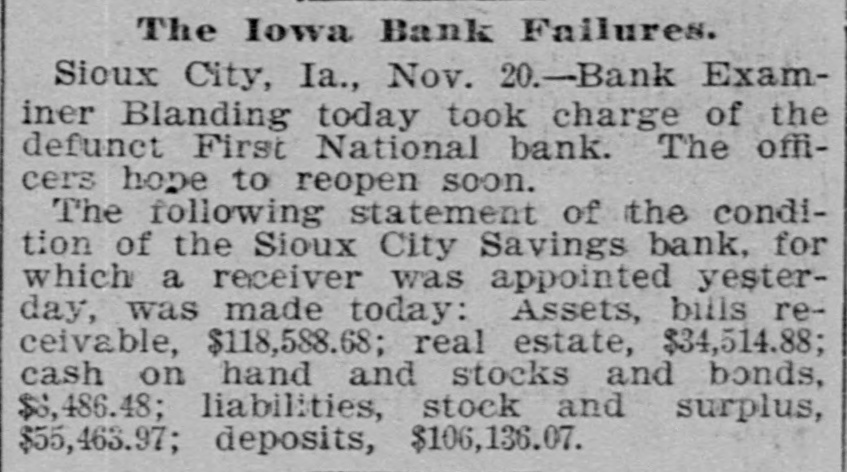
The Iowa Bank Failures. Sioux City, Ia., Nov. 20.-Bank Examiner Blanding today took charge of the defunct First National bank. The officers hope to reopen soon. The following statement of the condition of the Sioux City Savings bank, for which a receiver was appointed yesterday, was made today: Assets, bills receivable, $118,588.68; real estate, $34,514.88; cash on hand and stocks and bonds, $6,486.48; liabilities, stock and surplus, $55,463.97; deposits, $106,136.07.


Article from Twice-A-Week Plain Dealer, November 27, 1896

Click image to open full size in new tab

Article Text

# OUR CANDIDATE IN 1900 # THANKSGIVING CRUMBS. Reasons for Thankfulness(?) for a Few Who Voted for the Advance Agent of Prosperity. A soup house will be opened in Des Moines and a charity ball will be given during the holidays to raise funds to buy the bovine bones to flavor the liquid; tickets one dollar. Johnson, Ohrundro & Co., the largest dry goods and notton house Baltimore failed the 19th with liabilities of $189,000. The Probst Construction Company filed the 19. It was the largest contracting concern in the country with headquarters in New York. No statement of liabilities but understood it be heavy. The Sullivan county Savings bank New Hampshire is called upon to face a loss of $1,000,000. The banker John L. Farwell has gone to Europe and left only worthless or depreciated paper to the confiding depositers. Another wave of prosperity struck Sioux City Thursday last when the First National bank closed its doors upon its creditors. Its statement of October 6 showed capital $140,000, deposits $537,998.57. The crash was caused by depositors asking for cash instead of confidence. J. K. Prugh a large crockery dealer of Sioux City failed on Thursday last. No statement of liabilities, assets in the First National bank. Large cloak house in New York made assignment Thursday with $150,000 liabilities and meagre assets. CHILLICOTHE, 111., Nov. 16.-The Lacon Woolen Mills of John Grieves Son of Lacon, Ill., gave notice last night that the night force would be laid off for an indefinite period on account of lack of orders. They have tin night and day for several years and a few days before election they practiced the same game that many others did. They showed their men orders for woolens which would have required full force to make by April 1. They said that in case Bryan was elected the orders would be countermanded. Now that election is over it is apparent that these pretended orders were a fraud. The Tribune at Des Moines says: among the reports of many factories starting their wheels is one to the effect that a Des Moines factory, employing 200 men, has started up since the election. Nobody in Des Moines appears to know anything about it, and it can't be located. Wonder if most of the other reports are not based upon the same kind of a "confidence" foundation? The opening factories seem to be just over in the other state. The B. B. Richards Lumber company at Duluth has failed with $295,800 liabilities. B. B. Richards is president of a National bank at Dubuque, thinks there is money enough in the country, is a professed democrat, who went into the republican camp and voted for McKinley the advance agent of prosperity. POSTVILLE, Ia, Nov. 20.-The high wave of prosperity has swept over the Iowa and Dakota division of the . M. & St. P. railroad, which runs from North McGregor to Mitchell, South Dakota and left in its wake the mangled remains of 12 train crews sand numerous assistants at the depots who were laid off on account of "no business." As a train crew consists of two brakemen, conductor, fireman and engineer, it will be seen that 60 men who looked forward to steady work at good wages, when it was announced on Nov. 4th that the advance agent of prosperity had been elected are now standing around with their hands in their pockets, asking themselves the question, "Was all this a game of bluff or will the prosperity came later on?" Under the title, "Prosperity is Here," the Emmetsburg Democrat says, "Seven freight crews on the Milwaukee road were laid off the day after election, and five 'more are to lose their jobs. A large number of operators will also have to look elsewhere for positions. This is prosperity for you. However, the mills that closed the day before election, for the purpose of forcing their employees to vote the gold standard, have started up again. The dailies are talking about this. have nothing to say about those who have lost their positions since the defeat of Bryan," CHICAGO, Nov. 21.-The South Chicago Calumet announces that the Illinois Steel company has posted a notice of reduction in wages paid its blast furnace men, ranging from 10 to 25 per cent, to take effect December 1. The new scale ranges from $2.40 per day for keepers down to $1.35 for common labor and 85 cents for sample boys. The men affected work 12 hours per day and number several hundred. Only two out of eight blast furnacee at the South Chicago works are now running. SAGINAW, Mich., Nov. 21.-The First national bank of East Saginaw lis in the hands of National Bank Examiner Caldwell, who took charge of its affairs Saturday morning. YONKERS, N. Y., Nov. 20.-Owing to a large surplus of carpets on hand the big tapestry mill of the Alexander Smith & Sons' carpet company closed down Friday. It is rumored that the shutting down of other mills operated by the company will shortly follow. Friday's close down throws


Article from Omaha Daily Bee, December 23, 1896

Click image to open full size in new tab

Article Text

Plan of Reorganizing a Bank. SIOUX CITY, Dec. 22.-(Special Telegram.) -The stockholders of the suspended First National bank held a meeting today, presided over by George M. Coffin, deputy comptroller of the treasury, and decided upon a plan of reorganization. The bank will be reopened with a capital stock of $200,000, of which $50,000 will be contributed by depositors who are willing to thus invest a part of their deposits. The shrinkage in value of assets of the bank will not exceed $140,000 and it is believed there will be little trouble in effecting a reorganization early next month under an entirely new management.


Article from St. Johnsbury Caledonian, January 1, 1897

Click image to open full size in new tab

Article Text

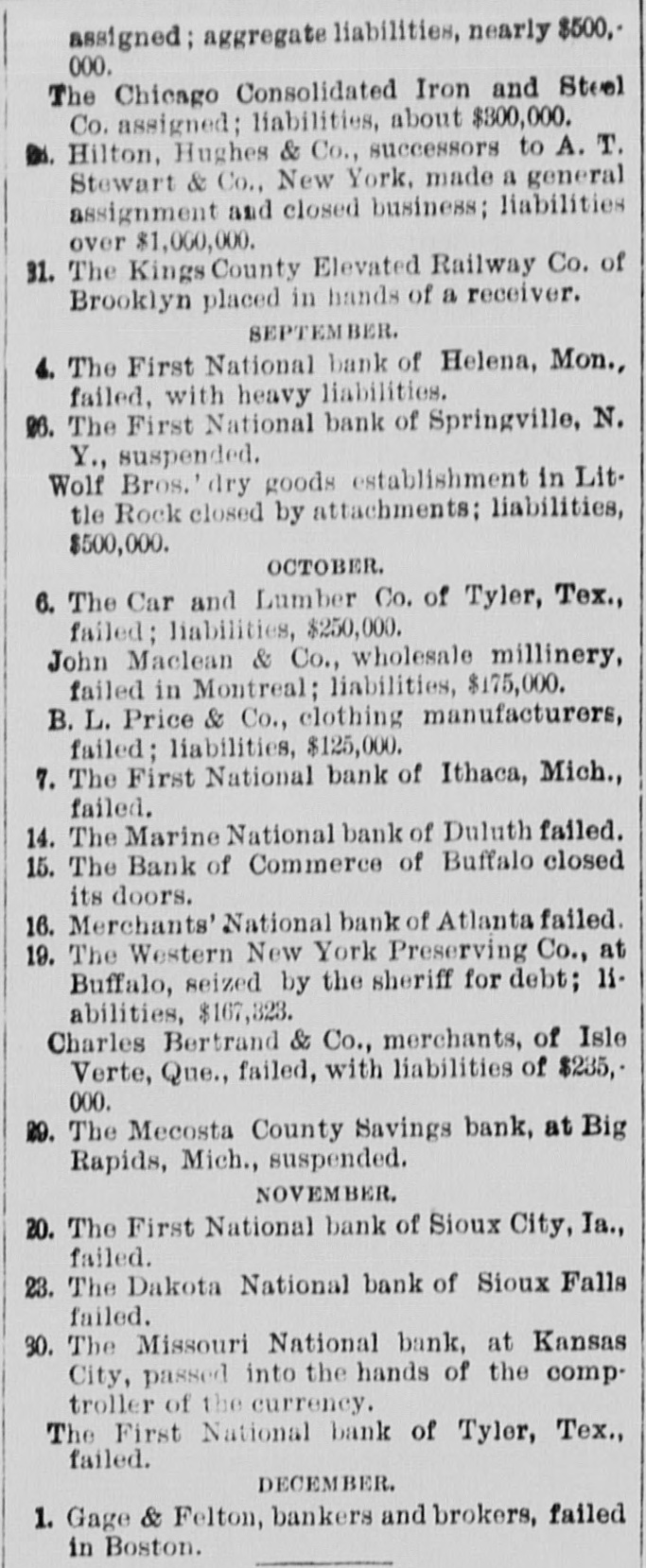
assigned; aggregate liabilities, nearly $500,000. The Chicago Consolidated Iron and Steel Co. assigned; liabilities, about $300,000. B. Hilton, Hughes & Co., successors to A. T. Stewart & Co., New York, made a general assignment and closed business; liabilities over $1,000,000. 31. The Kings County Elevated Railway Co. of Brooklyn placed in hands of a receiver. SEPTEMBER. 4. The First National bank of Helena, Mon., failed, with heavy liabilities. 26. The First National bank of Springville, N. Y., suspended. Wolf Bros.' dry goods establishment in Little Rock closed by attachments; liabilities, $500,000. OCTOBER. 6. The Car and Lumber Co. of Tyler, Tex., failed; liabilities, $250,000. John Maclean & Co., wholesale millinery, failed in Montreal; liabilities, $175,000. B. L. Price & Co., clothing manufacturers, failed; liabilities, $125,000. 7. The First National bank of Ithaca, Mich., failed. 14. The Marine National bank of Duluth failed. 15. The Bank of Commerce of Buffalo closed its doors. 16. Merchants' National bank of Atlanta failed. 19. The Western New York Preserving Co., at Buffalo, seized by the sheriff for debt; 11abilities, $167,323. Charles Bertrand & Co., merchants, of Isle Verte, Que., failed, with liabilities of $235,000. 29. The Mecosta County Savings bank, at Big Rapids, Mich., suspended. NOVEMBER. 20. The First National bank of Sioux City, Ia., failed. 23. The Dakota National bank of Sioux Falls failed. 30. The Missouri National bank, at Kansas City, passed into the hands of the comptroller of the currency. The First National bank of Tyler, Tex., failed. DECEMBER. 1. Gage & Felton, bankers and brokers, failed in Boston.


Article from The Kimball Graphic, January 2, 1897

Click image to open full size in new tab

Article Text

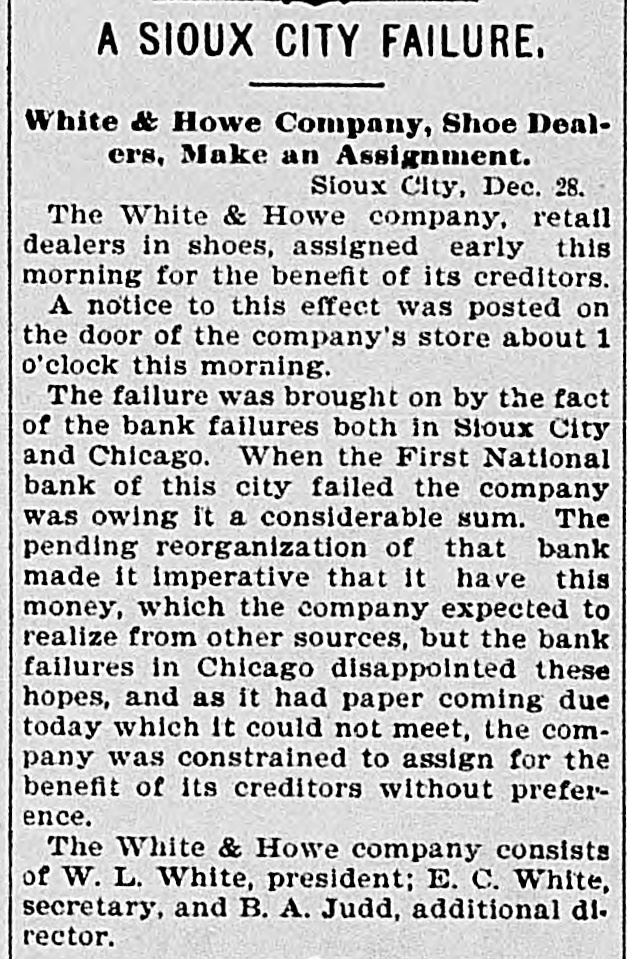
A SIOUX CITY FAILURE. White & Howe Company, Shoe Dealers, Make an Assignment. Sioux City, Dec. 28. The White & Howe company, retail dealers in shoes, assigned early this morning for the benefit of its creditors. A notice to this effect was posted on the door of the company's store about 1 b'clock this morning. The failure was brought on by the fact of the bank failures both in Stoux City and Chicago. When the First National bank of this city failed the company was owing it a considerable sum. The pending reorganization of that bank made it imperative that it have this money, which the company expected to realize from other sources, but the bank failures in Chicago disappointed these hopes, and as it had paper coming due today which it could not meet, the company was constrained to assign for the benefit of its creditors without preference. The White & Howe company consists of W. L. White, president; E. C. White, secretary, and B. A. Judd, additional di. rector.


Article from Wheeling Register, January 8, 1897

Click image to open full size in new tab

Article Text

TEMPORARY RECEIVERS NAMED. WASHINGTON January 7.-The comptroller of the currency has appointed Bank Examiner Blanding temporary receiver of the First National Bank of Sloux City, Iowa, and Examiner Anheir receiver of the Citizens' National Bank of Fargo, N. D. Both of these appointments are temporary pending resumption. The comptroller has received ,information that the Commercial National Bank of Poanoke, Va., which suspended some time ago, has raised sufficient funds with which to go into liquidation without the intervention of a receiver.


Article from The Wichita Daily Eagle, January 8, 1897

Click image to open full size in new tab

Article Text

GOT A STRAIGHT TIP BANKS THAT STOOD FROM UNDER A GREAT FINANCIAL SMASH. Somebody. Nobody Will Tell Who, Told Certain Favored Banks What Was Going to Happen to the National Bank of IIIIneis, Giving Them an Opportunity to Withdraw Their Deposits Which They Were Swift to Improve-Eckles Names Bank Receivers-American National, of Denver Re-opens-Day's List of Failures Chicago, Jan. 7.-It has been ascertained positively that several banks which had deposits in the defunct Natioral Bank of Illinois were warned of what was to come and as a result their money was withdrawn just in time to save them from being carried down with the wreck. Henry W. Austin, president of the Oak Park State bank, made the statement today that he had received information of the dangerous condition of the Illinois National during the week previous to the failure. Acting upon this tip, Mr. Austin says, he immediately took out of the bank the money his bank had there. Five thousand dollars was withdrawn Friday previous to the Monday in December when the National Bank of Illinois failed to open its doors for business. The following day, Saturday, $45,000 more, which constituted the balance due the Oak Park State bank by the National Bank of Illinois was taken out. Hinckley and Tilden, proprietors of the West Side bank, were also warned In time to withdraw their cash from the tottering institution. Mr. Austin refused positively to state who his informant was. He said, however, that he was not a director or official of the Illinois National. BANK RECEIVERS NAMED. Washington, Jan. 7.-The comptroller of the currency has appointed Bank Examiner Blancing temporary receiver of the First National Bank of Sioux City, and Examiner Anheir receiver of the Citizens National bank, of Fargo, N. D. Both of these appointments are temporary, pending resumption. Bank Examiner Turtilot has been appointed rereiver of the Second National, of Grand Forks, N. D. The comptroller has received information that the Commercial National bank of Roanoke, W. Va., which suspended some time ago, has raised sufficient funds with which to go into liquidation without the intervention of a receiver. DENVER BANK RE-OPENS. Washington, Jan. 7.-The American National bank of Denver, Colo., which suspended payment April 21, 1896, having complied with the conditions imposed by the comptroller of the currency precedent to resumption, has today been permitted to re-open its doors for business as a national banking association. Denver, Colo., Jan. 7.-The American National bank re-opened today under its old management with $600,000 cash on hand to meet liabilities and conduct business. There remains but $200,000 of liabilities to be provided for out of all other assets of the bank. DAY'S LIST OF FAILURES. New York, Jan. 7.-J. J. Johnston & Co., a corporation, dealers in diamonds, jewelry and silverware, today assigned to John R. Keim, and Arthur H. Masten. The liabilities are reported to be $219,000 and assets about $201,000. St. Paul, Minn., Jan. 7.-A Preston, Minn., dispatch to the Dispatch says: The Bank of Canton, at Canton, and the Citizens bank of Lanesboro, both owned and operated by Field, Kelsey & Co., suspended business yesterday. Lancaster, Pa., Jan. 7.-Schroder, Smith & Schroder's ready-mixed paint works were entirely destroyed by fire today. The origin of the fire is unknown. The members of the firm decline to make an estimate of the loss, but it is thought to be fully covered by insurance.


Article from Evening Journal, January 8, 1897

Click image to open full size in new tab

Article Text

The Insolvent Banks, WASHINGTON, Jan. 8.-The comptroller of the currency has appointed Bank Examiner Blanding temporary receiver of the First National bank of Sloux City, Ia., and Examiner Anheir receiver of the Citizens' National bank of Fargo, N. D. Both of these appointments are temporary, pending resumption. Bank Examiner E. C. Turtelot has been appointed receiver of the Second National bank of Grand Forks, N. D. The comptroller has received information that the Commercial National bank of Roanoke, Va., which suspended some time ago, has raised sufficient funds with which to go into liquidation without the Intervention of a receiver.


Article from The Providence News, March 17, 1897

Click image to open full size in new tab

Article Text

BRIEF DISPATCHES. I Constellation lodge, A. F. A. M., ot Dedham, Mass., celebrated its 25th anniversary yesterday. Charley Mitchell, the pugilist, has deposited, at London, $2500 to bind a match with John L. Sullivan. The First National bank of Sloux City, Ia., which suspended payment Nov. 19, 1896. has resumed business. Captain Albert Kautz of the Charlestown navy yard has been ordered to Washington, to take the examination for promotion. Knowles & Poole, shoe manufacturers at Pittsfield, Mass., have assigned. Liabilities said to be about $75,000. Two hundred operatives will be out of work. William H. Burke, formerly a police Justice at New York, and one of those legislated out of office' when the power of removal bill went into effect, has made an assignment. "Marina," the handsome residence of the late P. T. Barnum, at Bridgeport, Conn., has been sold to I. Dever Warnor, the corset manufacturer. The price paid is said to be about $125,000. The 17th annual conclave of the Grand Commandery, Knight's Templar, of Connecticut, was held at New Haven yesterday, a large number of members from various parts of the state being present. The New York assembly has passed a bill which provides that none but citizens of the United States shall be employed on public works, and that unskilled laborers on such work shall not receive less that 15 cents an hour. About 200 medical students of Laval university, at Montreal. besieged the office of Les Nouvelles, the French Canadian Sunday paper, and threatened to demolish It, because an article appeared reflecting upon them. The police $,30 persed them before any harm - done.


Article from River Falls Journal, March 18, 1897

Click image to open full size in new tab

Article Text

LATER NEWS. The Minneapolis base ball club arrived at Hot Springs, Ark., the 15th. Thomas B. Reed was elected speaker of the house of representatives and all the officers of the 54th congress reelected. The new tariff bill prepared by the ways and means committee was presented by Chairman Dingley. Bids for revenue cutters Nos. 4 and 5 for service on the great lakes were opened at the treasury department the 15th. Thesingle bid received was from the Globe iron works of Cleveland at $198,000 each. They will probably get the contract. Fire the 15th destroyed the store and stock of the Ely Walker dry goods company at St. Louis, causing a loss of over $1,000,000. George Gatewold, a fireman, was caught by falling walls and killed. The levee on the Mississippi river, near Nodena, Ark., broke the 15th, and in a short time a large portion of the country was overflowed. Steamers were sent out at once and many flood victims rescued. A horrible accident happened to several unknown men a few miles below Vaneeburg, Ky., the 15th. They were on a family boat and were run down by a tow boat, and all were drowned. There is no means of identification. When the doors of the customs house in New York closed the 15th, there had been collected exactly $2,667,979.51 in import duties. A gun on the Russian ironclad Cessoi Veliki, at Crete, exploded the 15th, killing 14 men and an officer. The attention of the United States supreme court was given largely the 15th to the power of states to tax the franchies of corporations, such as express, telegraph and railroad companies. Two Kentucky cases, involving the constitutionality of the state law of 1892, one affecting the Henderson bridge and the other the Adams Express company, were both decided favorably to the state. The president the 16th sent the following nominations to the senate: To be ambassador extraordinary and minister plenipotentiary to Great Britain, John Hay, the District of Columbia; Horace Porter, of New York, to be ambassador to France; Henry White, of Rhode Island, to be secretary of the embassy of the United States to Great Britain. It is the general belief at Athens, Greece, that nothing can prevent war. and the government has its plan of campaign fully prepared. The cabinet had a long session the 16th, as to the attitude to be taken in face of the coercive program of Europe, and it is reported that a decision was reached to take active measures, as being the only solution possible for Greece. Nearly 2,000 homeless and halfstarved persons, rescued from the overflowed districts of eastern Arkansas, were cared for in Memphis, Tenn., the 16th. The refugees are mostly negroes and of the lower classes, who show scant appreciation of the charity extended. In the U. S. Senate the 16th 438 bills and eight joint resolutions introduced. They embrace nearly every phase of public business. Mr. Allen's batch of business numbered about 75. They include bills directing the foreclosure of the government lien on the Union Pacific railroad; to prevent professional lobbying. defining the powers of the judiciary; for service pensions, etc. Fire destroyed the residence of Wm. Spier, at Chicago, the 16th. Mr. Spier, who is an invalid, was rescued by the eighbors, and his wife and three children barely had time to escape from the building before the roof fell. Barbara Newman, a niece of Mrs. Spier, imprisoned on the top floor, was burned to a crisp. Charles Mitchell, the English pugilist, deposited $2,500 in a London bank to bind a match with John L. Sullivan. The First National bank, of Sioux City, Io., which suspended last November, has been permitted to resume. Five men were injured, two of them fatally, in a railroad accident at La Grange, Ind., the 16th. A meat train bound for Hammond, Ind., jumped the tracks on the Belt Line of the Chicago, Hammond and Western railway. The engine was ditched, two of the cars were telescoped and the remainder of the train thrown from the track. The fataily injred are; George Maxwell, fireman inhaled and severely


Article from The Diamond Drill, March 20, 1897

Click image to open full size in new tab

Article Text

home near Keithsburg, III., aged 87 years. The Mississippi river reached the highest mark ever known at Memphis, Tenn., and vicinity, and several towns were flooded and great damage done. The United States supreme court says that states have power to tax the franchaises of corporations, such as express, telegraph and railroad companies. Mount Baker, one of the loftiest peaks in the Cascade range, is in a state of eruption for the first time in 70 years. Barney McKernan, the last survivor in this country who took part in the famous charge of the Light brigade at Balaklava, died at Phoenixville, Pa. The lives of hundreds of families and thousands of live stock were in peril throughout the lower Mississippi valley on the Arkansas side from the disastrous flood that was sweeping down upon them. Three negroes who murdered John Barfield and John R. Turner at Juliette, Fla., were lynched by a mob. The visible supply of grain in the United States on the 15th was: Wheat, 41,449,000 bushels; corn, 26,795,000 bushels; oats, 13,528,000 bushels; rye, 3,616,000 bushels; barley, 3,135,000 bushels. President McKinley in his first message to congress declares in favor of a protective policy and says that prompt revenue legislation is the first duty of the lawmakers. The wholesale dry goods house of Ely, Walker & Co., the largest in St. Louis, was destroyed by fire, the loss being $1,000,000, and George Gutewald, a fireman, was killed and others were injured by falling walls. Seven tollgates were destroyed in Mercer county, Ky., by regulators. The jail at Dover, Tenn., was destroyed by fire and three colored prisoners were cremated. Chairman Dingley, of the ways and means committee, says the new tariff bill is expected to increase the revenue $112,000,000. Secretary Sherman informed the Spanish minister, Senor de Lome, that this administration will insist upon Americans in Cuba being amply protected. In South Dakota over 600 miles of road have been practically abandoned for fully two weeks because of a snow blockade. A train was wrecked at Wolf Creek, Kan., and Engineer Nye, Fireman Connor and J. P. Meador, a passenger, were killed and six persons were injured. John Cramer, aged 16, son of Jacob Cramer, of Duryea, Pa., died of hydrophobia and his father while witnessing his son's struggles dropped dead. The Headley Grocery company (wholesale) at Springfield, Mo., failed for $100,000. Postmaster-General Gary says that the administration has decided to adhere to the four-year-tenure-of-oflice policy for all postmasters. John O'Rourke, John Burns and Antonio Molinaskj were fatally burned by explosions of molten iron at the Emma blast furnace in Cleveland, O. For the eight months ended February 28 there has been a gain of over $132,000,000 in the amount of merchandise exported and a decrease of nearly $119,000,000 in the amount imported. The First national bank of Sioux City, Ia., which suspended payment November 19, 1896, has resumed business. The five new state senators, four republicans and one democrat, were sworn in by the Kentucky legislature, and this will insure the election of a republican United States senator. Charles Rodatinsky and his wife and baby were burned to death near Omaha, Neb., by the explosion of a gasoline stove. The piano and organ firm of Estey & Camp, which has been in business in Chicago for 30 years, has decided to retire. Gen. James M. Warner, aged 62, a prominent resident of Albany, N. Y., and postmaster under Harrison's administration, died while attending a theater. Nearly 2,000 homeless and half-starved persons rescued from the overflowed districts of eastern Arkansas are being cared for in Memphis, Tenn.


Article from The Pioneer Press, March 25, 1897

Click image to open full size in new tab

Article Text

The Pacific coast poyder war is ov An agreement has been effected tween the Atlantic and Pacific co: companies. Isaac S. Dement of Chicago, cha pion shorthand writer, broke his P vious record of 39 words by writing words in one minute at Quincy, Ill It is very probable that the Noi California division of the League American Wheelmen will go out of istence. The De Leeuw & Oppenheimer Pri ing company in New York have signed to Rudolph M. De Leeuw. T company was incorporated in 196, wi a capital stock of $100,000. Mrs. Mollie Grady died at Knoxvil Tenn., from a peculiar trouble. S had been unconscious for ten da One hour before her death her sk burst open. Then her feet and har turned, reversing their natural positi On going out from a hot qitchen hang out a washing Mrs. Leroy Sha non of Stevens Point, Wis., was tak with a severe attack of pneumonia a died within forty minutes. She w forty years of age. The attorneys for Mrs. Craven, w claims to be the contract widow ex-Senator James G. Fair, has filed the San Francisco superior coart 1 original pencil deeds to property y ued at $2,000,000 conveyed by Fair Mrs. Craven. The cloth weavers employed in Jo and James Dobson's big mill, Philad phia, who struck about ten days a because of a ten per cent reduction, turned to work to-day, a satisfact agreement haveing been reached w Mr. Dobson. The First National Bank of Sio City, Iowa, which suspended payme Nov. 19, 1896, having complied w all the conditions precedent to resur tion, and its capital stock being n unimpaired, has been permitted to sume business. The Vermont Marble company Proctor, Vt., has brough suit again William W. Winfree and George Sheeban of Washington to recover $1 535, alleged to be due for mater used in the amusement hall of the ) tional Soldiers' home at the capital. Mary Anderson De Navarro has S for about $44,000 her house at 31 W Thirty-eighth street, Ne wYork. a fo story brownstone dwelling. The bu is a Mrs. Prince, who will occupy she was on the stage Mary Anders lived there. The house is now leased Judge Goff has appointed Z T. V cent receiver for U. S. Buskirk, m chant and timberman of Logan, Va. Assets, $125,000; liabilities known. This is a result of the rec failure of the Sliger Lumber and Ma facturing company. The trial of twelve women and t men was begun at Hold Mezo-Vas hely, on Lake Hodos. Hungary. 1 prisoners are charged with poison their husbands or others of their re tives in oredr to obtain insura money. Some of the prisoners are cused of four or five murders. It is reported that Sir William \ Horne. president of the Canadian cific railroad, and Mr. Angus, preside of the Bank of Montreal, have beco associated with Gen. R. A. Alger of troit, secretary of war, in operat the Leurentide Pulp company of Gra Mere, Que. Secretary W. G. Preutt of the bos of Montana stock commissioners, sa "The stock on the ranges has had a markably hard time the whole wint In the extreme northern part of


Article from The Pioneer Press, April 8, 1897

Click image to open full size in new tab

Article Text

The First National Bank of Sioux City, Iowa, which suspended payment Nov. 19. 1896, has been permitted to resume. In nine days farmers near Spencer, Wis., where the local blast furnace buys wood, hauled to town and sold 5,000 cords at $1.50 a cord. The schooner Frank A. Palmer. the largest of its class on the high seas, has been successfully launched at Bath, Me. The pope has conferred decorations upon several French officers who saved the Roman Catholle religious houses during the tires at Canea. The Guatemala exposition has been officially opened by the government. It will be opened to the general public 10. on Ap One Wall street firm refused to float the bonds of a Nevada enterprise because of the thug element attracted there by the fight. Judge Goff has appointed Z. T. Vinson receiver for U. B. Bushkirk, merchant and timberman of Logan, W. Va. Assets. $125,000. Charley Johnson of Minneapolis knocked out Jerome Quigley of Philadelphia in the sixth round at the Quaker City Athletic club. The London Daily Chronicle states: "Grave news has been received with respect to the health of Emperor William. and certain constitutional possibilities are being discussed." Con Doyle of Chicago and Jack Reid of Ireland fought at 150 pounds before 5,000 people at the American Sporting club, New York. Reed was knocked out in the fifteenth round. Representatives from a number of labor organizations and trades unions met at New York and arranged for a mass meeting, having for its object the amelioration of American seamen The Brooks locomotive works at Dunkirq. N. Y., are to be started up on full time and with a complete force. This means work for 1,500 men and boys. A jury in the common pleas court at Cleveland decided that Charles N. Cunningham, who is charged with the forgery of the name of Judge E. T. Hamilton to a check for $75,000. The last of the missing fishermen carried out from Bay City, Mich.. on the ice. have returned home. and it is believed all have now safely landed. Only a few hundred shanties and none of the nets were saved. At New York Carlo Barsotti, a banker and proprietor of Ilanio Americano, an Italian daily newspaper, has been arraigned charged with larceny in connection with his banking business. He was held under $1,000 bail. It is understood that Mr. Cleveland will become the senior partner of a law firm bearing the style of Cleveland, Carlysle & Stetson, and that the office will be situated in the vicinity of Wall street, New York. Judge Smith has rendered a decision to the effect that $1,500 of labor claims take precedence to the mortgages on the Barclay mill. The mill sold for $25,300 at West Superior. The secured claims amount to $34,000. Two thousand medical students of Laval university, at Montreal, besieged the office of Les Nouvelles, the French Canadian Sunday paper, and threatened to demolish it because an article appeared reflecting upon them The earnings of the B. & O. Railroad company for February, 1897. were $1,725,235, an increase of $187,230 over the month of February, 1896. The increase for the eight months of the fiscal year was $1,100,476. Bishop Lenihan celebrated high pontificial mass at Corpus Christi church at Fort Dodge, Iowa. These services have never before been given in the state outside of Davenport and Dubuque. Fifteen priests were on the altar. A Budapest advice says the trial of twelve women and two men has commenced at Hold Mezo-Vasarhely, on Lake Hodos. The prisoners are charged with poisoning their husbands or others of their relatives in order to obtain insurance money. The various parties to three foreclosure suits against the Helena Consolidated Water company have come to a partial agreement, as a result of which Capt. James H. Mills of Deer Lodge was made receiver of the property. Commissioner of Patents Seymour has rendered a decision affirming the decision of the board of examiners-inchief in the patent office, awarding priority of invention of Fowler in the interference of Joseph C. Fowler vs.