1757. National City Bank (Washington, DC)

Bank Information

Episode Type
Suspension โ†’ Closure
Bank Type
national
Bank ID
7936
Charter Number
7936
Start Date
May 14, 1908
Location
Washington, District of Columbia (38.895, -77.036)

Metadata

Model
gpt-5-mini
Short Digest
968f94b0ca8e76e4

Response Measures

None

Description

Articles do not describe a depositor run. Article 1 (1908-05-14) reports a transfer of control/sale of the National City Bank; Article 2 (1921-07-24) states that of the national banks in 1907 only the National City and Traders' banks have gone by the board through liquidation. This indicates the bank ultimately closed via liquidation rather than reopening. No specific suspension date is given in the excerpts; closure is described as liquidation. I therefore classify this as a suspension leading to permanent closure (suspension_closure).

Events (4)

1. October 4, 1905 Chartered
Source
historical_nic
2. May 14, 1908 Other
Newspaper Excerpt
Papers were signed today transferring the control of the National City Bank to financial interests identified with the Washington Exchange and the Union Savings banks... The Comptroller of the Currency issued permission for the National City Bank to open for business October 4, 1905.
Source
newspapers
3. May 1, 1911 Voluntary Liquidation
Source
historical_nic
4. * Suspension
Cause
Voluntary Liquidation
Cause Details
Article states the bank 'went by the board through liquidation' (no detailed cause given).
Newspaper Excerpt
Of the national banks then in existence only the National City and the Traders' banks have gone by the board through liquidation.
Source
newspapers

Newspaper Articles (2)

Article from The Washington Times, May 14, 1908

Click image to open full size in new tab

Article Text

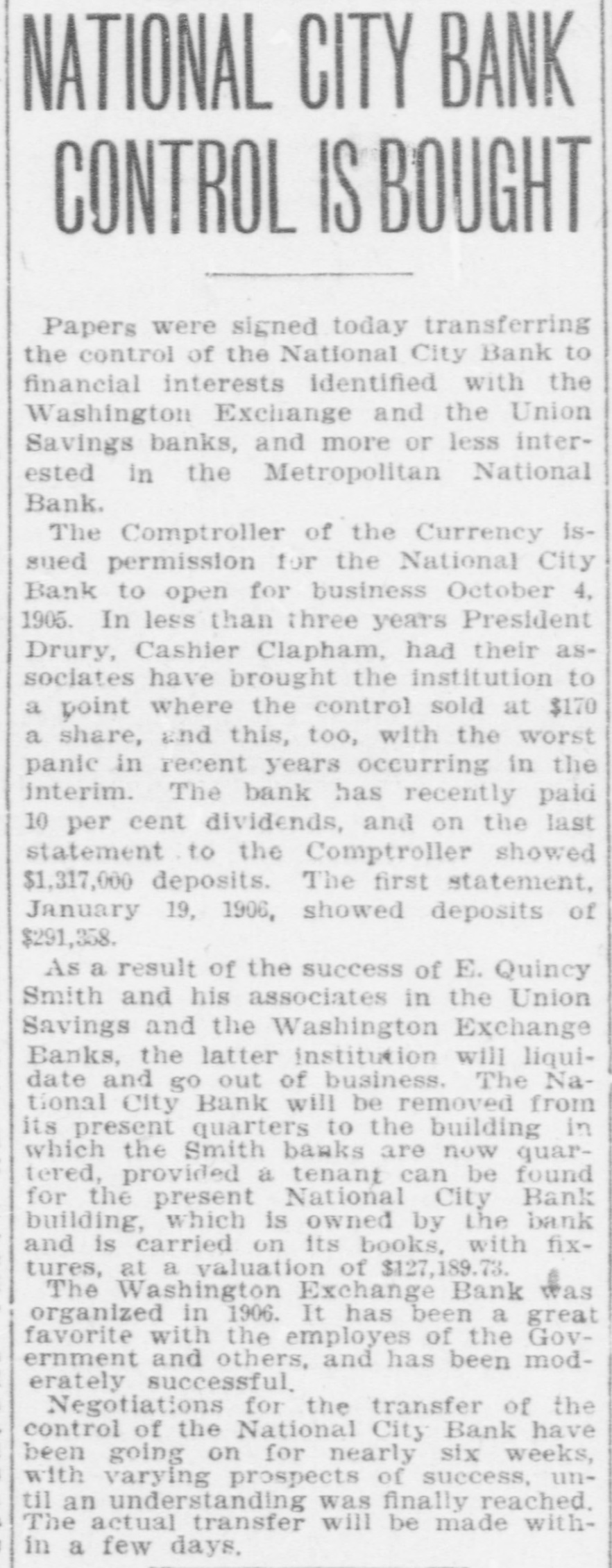
NATIONAL CITY BANK CONTROL S BOUGHT Papers were signed today transferring the control of the National City Bank to financial interests identified with the Washington Exchange and the Union Savings banks, and more or less interested in the Metropolitan National Bank. The Comptroller of the Currency issued permission for the National City Bank to open for business October 4, 1905. In less than three years President Drury, Cashier Clapham, had their associates have brought the institution to a point where the control sold at $170 a share, and this, too, with the worst panic in recent years occurring in the interim. The bank has recently paid 10 per cent dividends, and on the last statement to the Comptroller showed $1,317,000 deposits. The first statement, January 19, 1906, showed deposits of $291,358. As a result of the success of E. Quincy Smith and his associates in the Union Savings and the Washington Exchange Banks, the latter institution will liquidate and go out of business. The National City Bank will be removed from its present quarters to the building in which the Smith banks are now quartered, provided a tenant can be found for the present National City Bank building, which is owned by the bank and is carried on its books, with fixtures, at a valuation of $127,189.73. The Washington Exchange Bank was organized in 1906. It has been a great favorite with the employes of the Government and others, and has been moderately successful. Negotiations for the transfer of the control of the National City Bank have been going on for nearly six weeks, with varying prospects of success, until an understanding was finally reached. The actual transfer will be made within a few days.

Article from Evening Star, July 24, 1921

Click image to open full size in new tab

Article Text

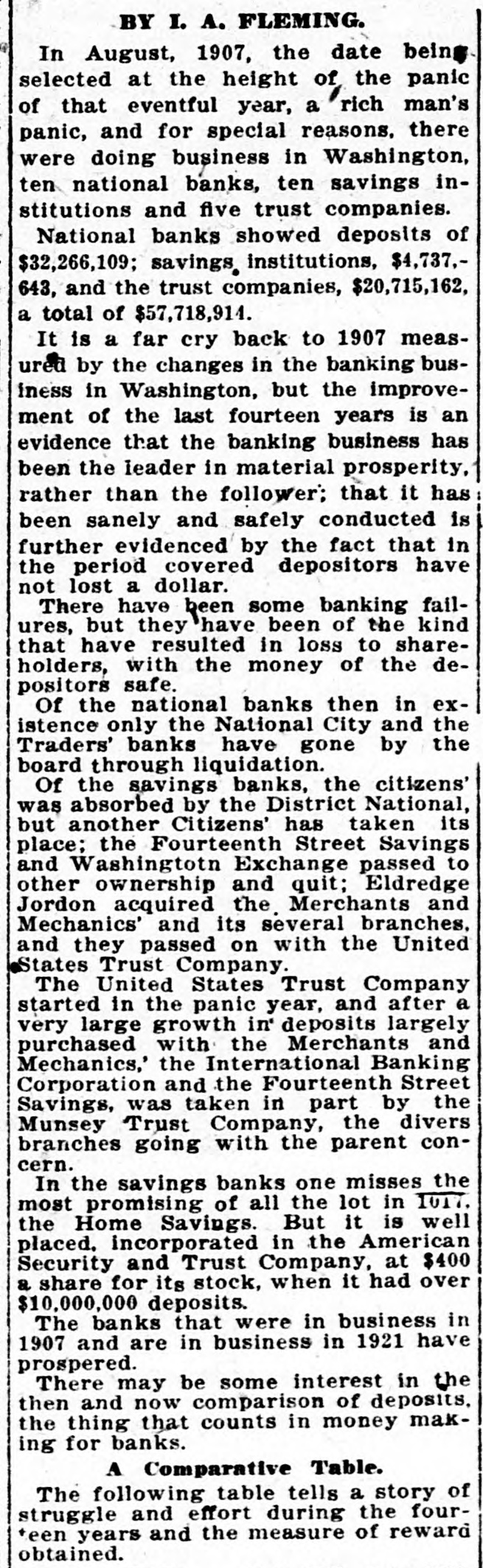
BY I. A. FLEMING. In August, 1907, the date being selected at the height of the panic of that eventful year, a rich man's panic, and for special reasons, there were doing business in Washington, ten national banks, ten savings institutions and five trust companies. National banks showed deposits of $32,266,109; savings institutions, $4,737.643, and the trust companies, $20,715,162, a total of $57,718,914. It is a far cry back to 1907 measured by the changes in the banking business in Washington, but the improvement of the last fourteen years is an evidence that the banking business has been the leader in material prosperity, rather than the follower; that it has been sanely and safely conducted is further evidenced by the fact that in the period covered depositors have not lost a dollar. There have been some banking failures, but they have been of the kind that have resulted in loss to shareholders, with the money of the depositors safe. Of the national banks then in existence only the National City and the Traders' banks have gone by the board through liquidation. Of the savings banks, the citizens' was absorbed by the District National, but another Citizens' has taken its place; the Fourteenth Street Savings and Washingtotn Exchange passed to other ownership and quit; Eldredge Jordon acquired the Merchants and Mechanics' and its several branches. and they passed on with the United States Trust Company. The United States Trust Company started in the panic year, and after a very large growth in deposits largely purchased with the Merchants and Mechanics,' the International Banking Corporation and the Fourteenth Street Savings, was taken in part by the Munsey Trust Company, the divers branches going with the parent concern. In the savings banks one misses the most promising of all the lot in 1017. the Home Savings. But it is well placed. incorporated in the American Security and Trust Company, at $400 a share for its stock, when it had over $10,000,000 deposits. The banks that were in business in 1907 and are in business in 1921 have prospered. There may be some interest in the then and now comparison of deposits, the thing that counts in money making for banks. A Comparative Table. The following table tells a story of struggle and effort during the fourteen years and the measure of reward obtained.