Teutonia National Bank (New Orleans, LA)

Episode Information

Episode UID
174700885
Episode Type
Suspension → Closure
Bank Type
national
Bank ID
17470 national
Charter Number
1747
Start Date
September 25, 1873
Location
New Orleans, Louisiana (29.955, -90.075)

Metadata

Model
gpt-5-mini (chosen from majority vote of a three-model LLM ensemble)
Short Digest
0afb23f9dfb104c0

Response Measures

None

Description

Multiple distinct episodes appear (1873 city-wide suspension; 1874 voluntary liquidation; later 1912 receivership).

Events (5)

1. December 5, 1870 Chartered
Source
historical_nic
2. September 25, 1873 Suspension
Cause
Macro News
Cause Details
Nationwide financial panic after Jay Cooke & Co. failure led New Orleans banks to partially suspend payments for 30 days.
Newspaper Excerpt
The New Orleans banks, with the exception of the Southern, have suspended currency payment.
Source
newspapers
3. August 30, 1874 Suspension
Cause
Voluntary Liquidation
Cause Details
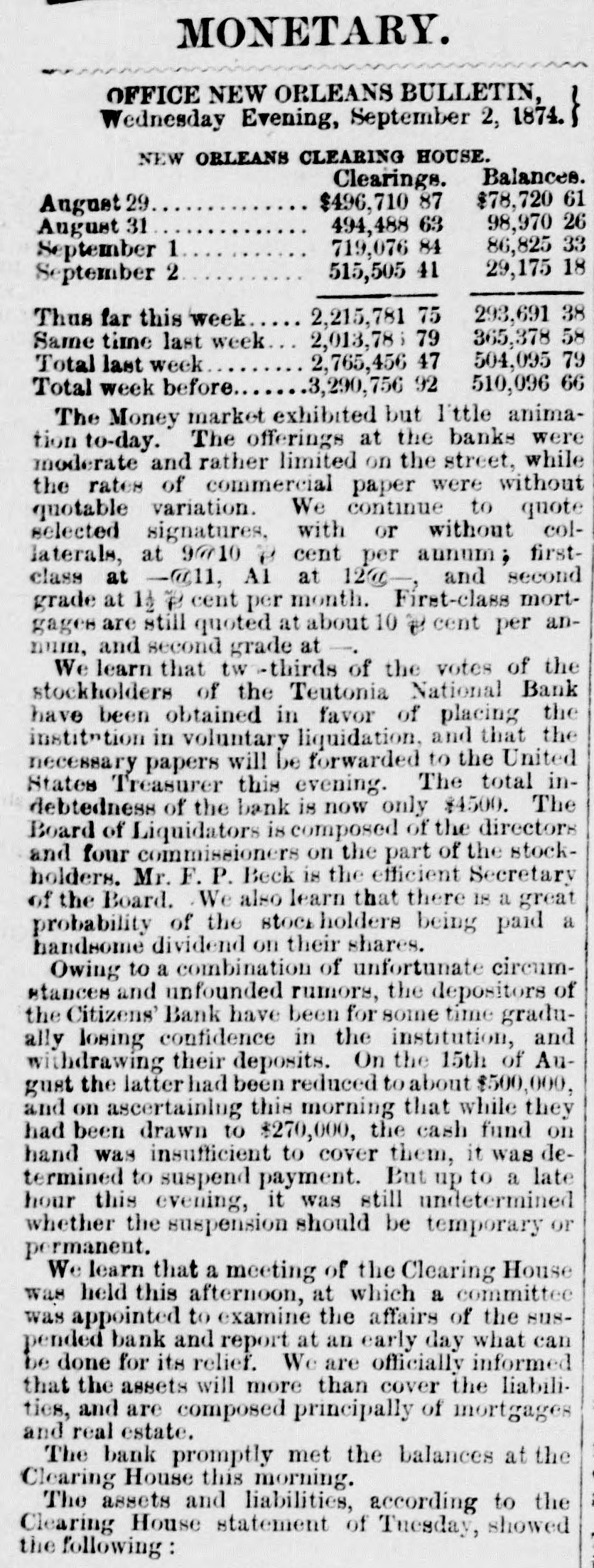
Controller authorized voluntary liquidation of Teutonia National Bank; stockholders to liquidate and depositors called to withdraw balances
Newspaper Excerpt
the Controller of the Currency has authorized the institution to go into voluntary liquidation
Source
newspapers
4. September 2, 1874 Voluntary Liquidation
Source
historical_nic
5. April 27, 1912 Receivership
Newspaper Excerpt
The Teutonia Bank, of New Orleans, has been placed in the hands of a receiver...an investigation...disclosed gross mismanagement and crookedness...T. Walter Danziger is receiver for the broken bank (Apr 27, 1912).
Source
newspapers

Newspaper Articles (23)

Article from Evening Star, September 25, 1873

Click image to open full size in new tab

Article Text

# The New Orleans Banks Suspend, [By Automatic Telegraph.] NEW ORLEANS, Sept. 25. - The New Orleans banks, with the exception of the Southern, have suspended currency payment.


Article from Public Ledger, September 25, 1873

Click image to open full size in new tab

Article Text

LATEST TELEGRAMS. AMERICAN FRESS ASSOCIATION. VIA 8. P. AND/IA. TELEGRAPH COMPANY. Specials to thelLedger. Suspension of Banks. NASHVILLE, September 25.-All Na. tional banks in this city suspended at 11:30 a.m. KOITA NEW ORLEANS, September 25.--All the banks here have suspended, but are paying large cheeks which go through the clearing house.


Article from The Louisiana Democrat, October 1, 1873

Click image to open full size in new tab

Article Text

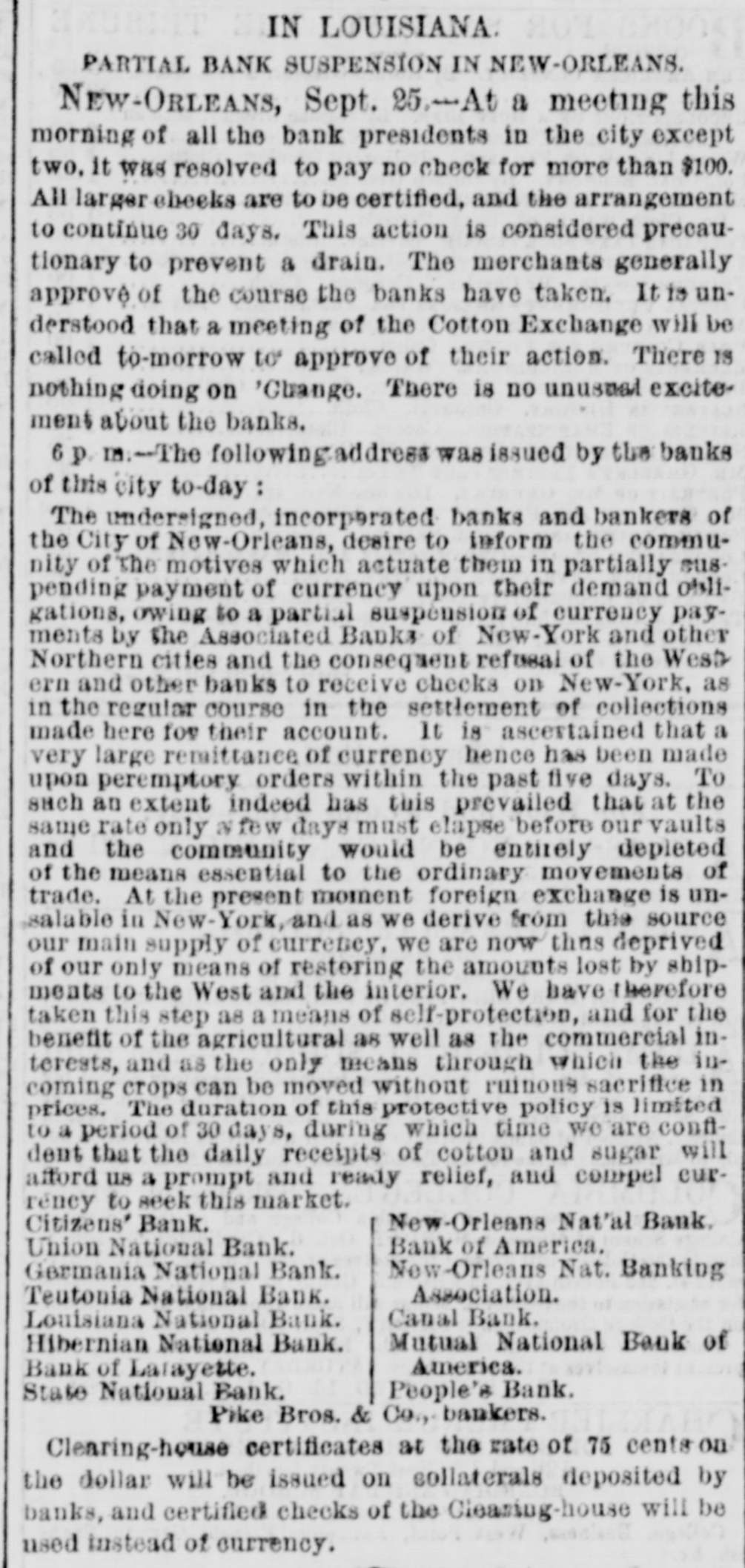
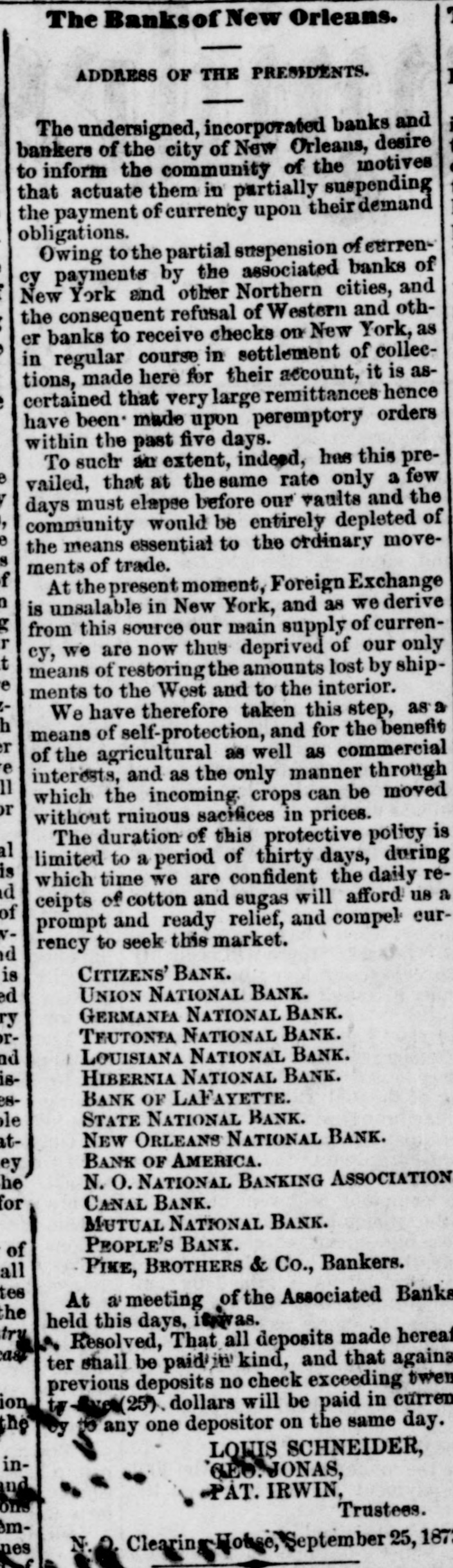
The financial crisis has reached New Orleans. All the Banks have partially suspended "payment of currency upon their demand obligations." This is to continue thirty days.


Article from Wood County Reporter, October 2, 1873

Click image to open full size in new tab

Article Text

ther currency payments. It was rumored, in Washington, on the 25th, that the President had been advised to call an extra session of Congress. A dispatch from St. Louis, of the 25th, says that the banks of that city had held a meeting on the evening of that day, and resolved to adopt the plan of issuing Clearing-House certificates. A Newark (N. J.) telegram of the 25th announced that the State Bank of New Brunswick had suspended. This is the bank that was crippled by the irregularities of Appleton, the Cashier. A dispatch from Nashville, Tenn., says that the National Banks of that city had suspended currency payments on all balances exceeding $200. A dispatch from Selma, Ala., of the 25th, says that the Savings Bank of Selma had suspended in consequence of an extraordinary run by depositors. All the banks of New Orleans partially susper led payment on the 25th, according to a dispatch from that city. The suspension was to remain in force for thirty days. Telegrams from various cities in Georgia, of the 25th, say the following banks had suspended: National Exchange, the Merchants' and Planters' National, the Planters' Loan and Savings Bank, of Augusta, Ga.; the Dollar Savings Bank, of Atlanta, Ga.; Savannah Bank and Trust Company, and the Southern Bank of Georgia. A Detroit dispatch of the 25th announces that the schooner W. J. Whaling had been beached at Grand Haven, Michigan, on the forenoon of that day. Vessel and cargo were a total loss. Two of the crew were drowned. A Wapello, Iowa, dispatch of the 25th says that on the afternoon of that day Professor


Article from The Donaldsonville Chief, October 4, 1873

Click image to open full size in new tab

Article Text

The financial scare, which began with the failure of Jay Cooke & Co., and spread like wild-fire over the country, still prevails and prostrates every description of trade. The New Orleans banks suspended payments in larger sums than $25 per day to any one depositor, for the purpose of preventing a run upon their vaults, and when confidence is restored and business is resumed upon the former basis the wisdom of this action will be apparent to all. The foolish panic has been the result of want of confidence, and it will turn out that all were more scared than hurt. It is thought the crisis will end during the coming week.


Article from Rapides Gazette, October 4, 1873

Click image to open full size in new tab

Article Text

# BANK SUSPENSION.-- In another place we give the address of the Presidents of the New Orleans Banks, announcing a suspension for thirty days, and giving their reasons for it. Of course this action will produce its effects throughout our State, and cause great inconvenience and distress, which we hope, however, will only prove temporary.


Article from New-York Tribune, October 30, 1873

Click image to open full size in new tab

Article Text

thrown out of employment, including the body of opera- tives who were most prominent in the strike of last Sum- mer, and who, it may be supposed, drew most largely on their savings to support that movement. The Atlantic Delaine Mills are controlled by Hoyt, Spragues & Co. of New-York, though not run in their name. Messrs. Sprague have shown themselves very chary of informa- tion as to the steps they have taken or propose to take in curtailing their production, and seem inclined to allow the cloud, which Rhode Island manufacturers say hangs over all interests in the State from the enormous volume of their obligations, to put on its darkest aspect. # REDUCTION OF THE PRICE OF GOODS BY BROWN & IVES. The Lonsdale Manufacturing Company, which is con- trolled by the house of Brown & Ives, runs five mills at Lonsdale and Ashton, manufacturing villages in the valley of the Blackstone, a few miles from Providence. Here are manufactured cambrics, Lonsdale bleached shirtings, jaconets, etc., and in these five mills are 144,000 spindles and about 3,000 operatives. These mills are still running on full time and with no reduction of wages or employés. The agents state that they desire to keep with them all their operatives, some of whom have been in their employ 30 years and even more, and have as yet decided on no curtailment on account of the financial troubles. Unless matters soon mend, how- ever, they will be forced to retrench. The reduction would probably be made in the wages rather than in hours or force. The agents assert that the operatives have been getting such very high wages that they can well stand a reduction. They look, however, for an early revival of business. The Lonsdale Company this week reduced the price of their goods one cent per yard. Other manufacturers following the example have given orders to their selling agents in New-York to re- duce prices correspondingly. The agents of the Lons- dale Company say that as cotton is falling ½ of a cent per pound daily, with reduced wages they can make a fair profit at the lower rate. The reduction has not been wel- comed by their competitors, who say that they could keep up their mills at full time at the old rate, but must now curtail. Brown & Ives also control the Hope Mill, at Scituate, which makes shirtings. The mill contains 28,000 spindles and employs 350 hands. They also control the Berkeley Mill, in Cumberland, seven miles from Providence, which is a new enterprise. The mill is now running over 300 looms, and, having a capacity of 40,000 spindles, employs about 400 persons. Here are made fine goods, sixties, eighties, and one-hundreds. The Hope and Berkeley mills are running on full time, and at the latter place new looms are being frequently added. The manufacture of the class of goods made at the Berkeley is said to be new in this country. The same policy will be pursued at these two mills as at Lonsdale and Ashton. Beside these a print cloth manufactory in Blackstone, Mass., with 50,000 spindles and some 600 hands, is con- trolled by Brown & Ives. This manufactory was shut yesterday, partly for repairs, but more on account of the depression. The present intention is to resume at full time on Monday next, but action will be governed by the condition of trade. Belonging to the Crawford-Allen estate, and now con- trolled by M. B. I. Goddard of this city, are the Allen Print Works in Providence, the print cloth mill of the Bernon Manufacturing Company at Georgiaville, R. I., the Woonsocket Company's cotton mill at Woonsocket, R. I., and the two mills of the Smithfield Manufacturing Company, one in Alleaville, R. I., the other in Dedham, Mass. Mr. Goddard also acts as agent for the Fitchville Manufacturing Company, whose mill, at Fitchville, Conn., manufactures shirtings. The Allen Print Works, which have a dozen machines with a capacity of about 15,000 pieces per week, and employ nearly 400 hands, stopped a month ago. At these, as at other print works, a stop of a fortnight twice a year, in the Spring and Autumn, for repairs and preparation for the change between light and dark goods, has been cus- tomary. The time of the Autumn closing has been Nov. 1. The panic hastened the suspension this season, and no time of resumption is yet fixed upon. The Bernon Mill, which has 603 looms, 30,000 spindles, and about 450 hands; the mill of the Woonsocket Company, with 13,000 spindles and 170 hands, and the Allenville Works of the Smithfield Manufacturing Company, with 10,200 spindles and 150 hands, all stopped on Saturday, the 11th inst. When they resume-a time as yet not fixed with certainty, but possibly Monday next-there will be some reduction, probably in time. It is thought by the representatives of these mills that a suspension of a few weeks will be lightly borne by the operatives, but longer idleness would drive many of the French Canadians of whom there is a large number employed throughout Rhode Island-to Canada for the Winter, and cause distress among them and trouble to the em- ployers to get labor in the Spring. The Fitchville Com- pany-whose new works have a capacity of 15,000, now running 12,000 spindles-has made no reduction of any kind. Two hundred hands are employed. At the Ded- ham Mill of the Smithfield Company, now running on full time, are 163 hands and 12,000 spindles. # PARTIAL SUSPENSION OF WORK IN OTHER MILLS. The Albion Manufacturing Company at Albion, R. I., runs a mill for the manufacture of print cloths, which has 400 looms and about 22,000 spindles. It will run on full time up to Jan. 1, as it has contracts to fill up to that time. The Monville Manufacturing Company, whose new mill at Monville, R. I., is one of the largest cotton mills in the country, having a capacity for 100,000 spindles, has as yet put in but 1,200 looms, and has been employing 1,000 hands in the manufacture of print cloths, jaconets, &c. On Saturday, the 11th inst., the mill was closed, with the intention of resuming this week on half time. The Chace Mill at Washington Village, Pawtuxet, R. I., which has 4,000 spindles, was closed the same day. The Central Manufacturing Company, which has a mill at Plainfield, Conn., with 10,000 spindles, is now running on two-thirds time. The great cotton mills at Wauregan, Conn., and at Ponema, near Nor- wich-the latter ranking among the chief mills of the country, and having 72,000 spindles, and the former hav- ing 56,000 spindles-which are controlled by Providence capitalists, have been running on half time since Mon- day, the 20th instant. Their agent in this city, Edward P. Taft, says that the operatives are excellently well sit- uated to bear the reduction, being a very thrifty class, and having saved from 30 to 35 per cent of their abun- dant wages. The Warren Manufacturing Company of Warren, R. I., which has near 60,000 spindles, shut down entirely for a few days, and with the Cutler Manufac- turing Company of the same place is now running on half time. Mills in the Quinebaug Valley, in Eastern Connecticut, which are controlled by Rhode Island man- ufacturers, have almost all cut down their running time to seven hours per day for five days in the week. The owners of the large woolen mills at Woonsocket, R. I., and Waterford, Mass., are now considering the question of running only half time. None of the Rhode Island woolen mills have yet stopped entirely. The closing of a woolen mill causes so much more derangement and loss than that of a cotton mill that the woolen manufac- turers are very loth to suspend wholly, even though they cannot sell their goods. The Greene Manufacturing Company, at Norwich, R. I., which has 25,000 spindles, and makes print cloths, shirtings, and similar goods, has been running for a fortnight on three-quarters time. The Luppitt Mill, at the same place, which makes print cloths and has 7,000 spindles, will run full time to Nov. 1, when it will either stop or reduce. The Coventry Mills, at Anthony village, Coventry, R. I., with 10,000 spindles, making print cloths, will pursue the same course. Many other small mills have either reduced their running time or will do so soon. # GENERAL PROSPECTS. NEW-ORLEANS BANKS TO RESUME NOV. 10-A STRIKE OF COLORED LABORERS.

Article from The Portland Daily Press, December 23, 1873

Click image to open full size in new tab

Article Text

# MINOR TELEGRAMS. Beinforcements are going forward rapidly for the government troops before Cartagena. The British ship America foundered off the Newfoundland banks, and the captain and three men were drowned. The crew were out in a boat six days before they were picked up. Bell & Co.'s tobacco warehouse at Hadley, Mass., was burned Monday morning, with 330 cases tobacco. Loss $28,000; insurance $25,000. In a fight between two Chicago policemen and four thieves, one of the latter was shot. Eighteen lives were lost by a late explosion of a magazine in Cartagena. A Washington despatch says there are twenty candidates for the Kansas Senatorial vacancy, and really but two parties in the State, the grangers and the railroad interest. In Chicago a large meeting of workingmen passed resolutions demanding labor of the city when other sources fail. J. W, Morrison's store and outbuildings in Plymouth, N. H., were burned Monday. Loss $3000. Hayti has a political trouble. President Saget will not vacate the presidency except to Dominique, whom the House of Representatives don't want. Yellow fever prevails at Port Royal, Hayti, among Europeans. George B. Noyes was killed at Manchester, N. H., Monday, by being run over by a load of wood which he was driving. Capt. J. E. Michener, chief opener of dead letters at Washington, has been held to the action of the grand jury on the charge of robbing letters. The Catholic Bishop Queretara of Mexico, advises his people to submit to the civil authorities. The government candidate has been elected Speaker of the Mexican House of Representatives. The banks of New Orleans resumed currency payment Monday. A despatch dated at Rome says that on Monday the Pope delivered an allocution and appointed twelve cardinals. A Belgian pleasant is said to have discovered a substitute for coal. He saturates earth with a solution of soda. It gives a strong and steady heat. The St. Albans Messenger says George W. Jones, a well known citizen of Brandon, Vt., has been lodged in jail at Rutland for chastising his daughter with whips and chains. Six thousand dollars was realized for the Centennial by the Philadelphia tea party. In New York last night Maurice Daly beat Francis Ubassy at a game of three ball French carom billiards, by a score of 350 to 303. Internal revenue receipts Monday were $576,725. David Nesbitt of Lindsey, Canada, was hung Monday for the murder of Miss Hapwood last July. Five or six boys ranging from 15 to 18 years of age were arrested Monday in Schnectady, N. Y., for setting buildings on fire. A lot of striking longshoremen in Philadelphia attempted to get up a riot yesterday but were quelled by the police.


Article from The Opelousas Courier, December 27, 1873

Click image to open full size in new tab

Article Text

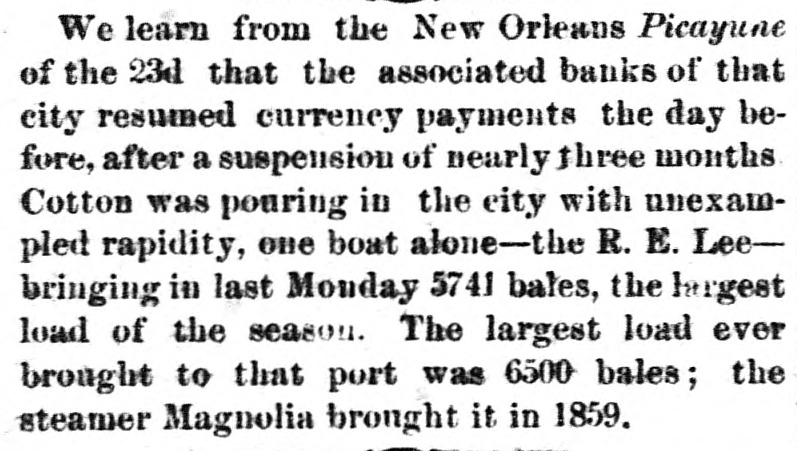
We learn from the New Orleans Picayune of the 23d that the associated banks of that city resumed currency payments the day before, after a suspension of nearly three months Cotton was pouring in the city with unexampled rapidity, one boat alone-the R. E. Leebringing in last Monday 5741 bales, the largest load of the season. The largest load ever brought to that port was 6500 bales; the steamer Magnolia brought it in 1859.


Article from The Morning Star and Catholic Messenger, December 28, 1873

Click image to open full size in new tab

Article Text

# New Year's. Before another number of this paper issues, the new year-1874-will have written its name upon the roll of the century. When the last of its years shall have been inscribed on that roll, when its full list shall have been folded up and laid away for ever, and the spotless new roll of the twentieth century opened out before man to write thereon his history with many a stain of tears, and blood, and fire, then the world shall be just as busy and bustling and just as intent upon its own transient interests as now. But how many of us shall take a part in its busy scenes ? This is one view of the case, but it shall not, by any means, prevent us from wishing a happy New Year now to our contemporaries. The present alone is ours. If people are never content with what they have that is the present-let them at least look at the near future only. There we may find a good deal of consolation apparently in store for us. The hard times are rapidly passing away, and green backs are once more coming prominently before the public. Our banks have resumed payment and we can hardly want better assurance that the storm is over. The safe, skilful financiers in control of them, who so prudently shortened sail in the hour of danger, can be relied on as pilots throughout. Then cotton is commanding a better price and fortunately a great deal of it yet remains to be shipped. Very soon people will find themselves entirely over their panic, their pockets well lined and the spirit of adventure growing strong within them. This will set all the wheels a-going -not only commerce, but manufacture and agriculture and building. Improvements on real estate will go forward once more, and mechanics and laborers find plenty of employment. In politics the signs indicate relief. Animosities resulting from the war are disappearing, and the political corruption which plunged the whole country in debt-not only South but North also-is awakening a storm of general execration that will drive it from its bad and impudent pre-eminence into comparative obscurity. Our Northern brethren begin to see that robbers are not safe agents to employ. A Government which openly robs and plunders a helpless section of the country, cannot be relied on as honest in the other sections. Our beautiful New Orleans is spoken of farther North, even by its friends, as the "doomed city," but their sympathy is probably uncalled for. Rivalry and money have thus far been able to check that prosperity to which nature has manifestly destined our queenly city. So far as capital in its thousand appliances of railroads and canals and banking facilities has been able to supersede nature and its works, so far New Orleans has hitherto been doomed; but to all this there is a limit. There is a period when the tidal wave of natural development will burst all the barriers that human skill can interpose to cramp it. In wishing a happy New Year to our friends, we experience a conviction that a day will come when the royal banner of the world's commerce and the world's wealth, will wave from the towers of the Queen City of the South.


Article from New Orleans Republican, August 29, 1874

Click image to open full size in new tab

Article Text

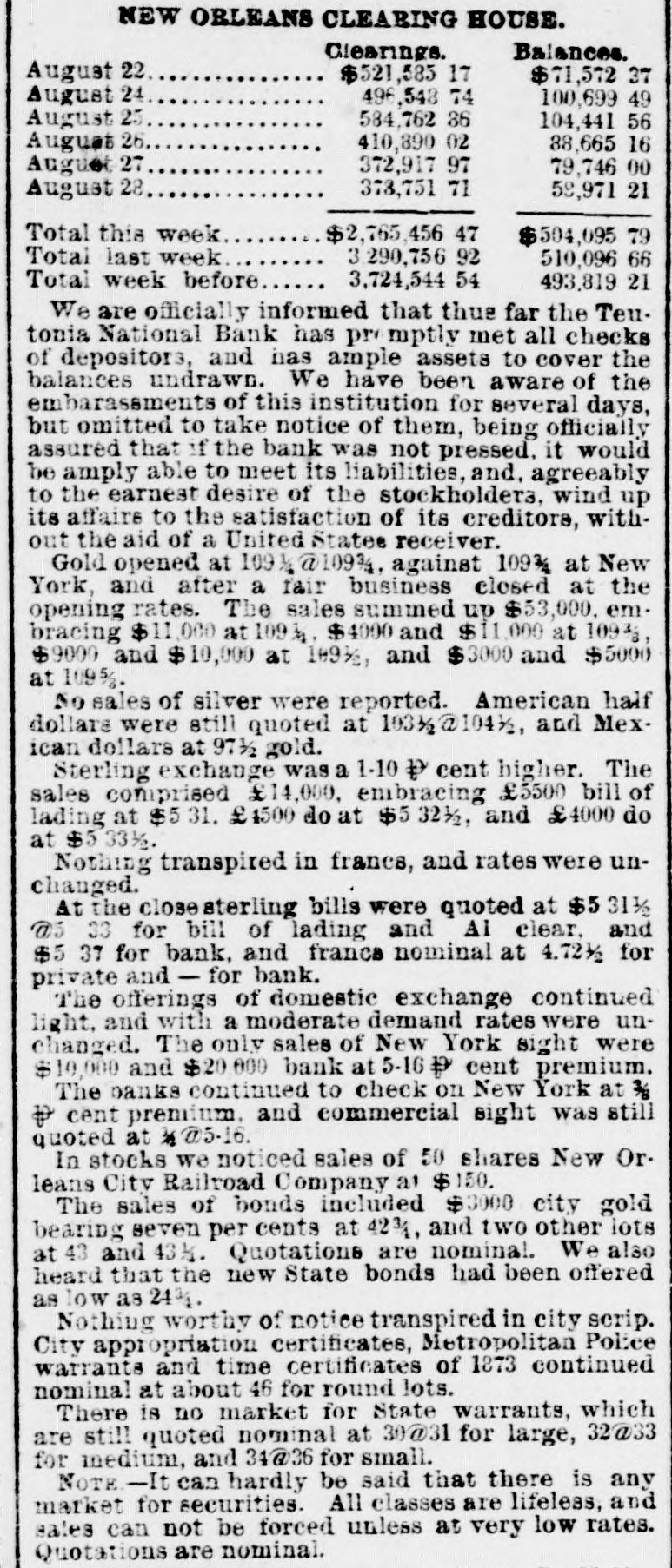
NEW ORLEANS CLEARING HOUSE. Clearings. Balances. August 22 $521,585 17 $71,572 37 August 24 496,548 74 100,699 4 584.762 36 August 25 104,441 56 August 26 410,890 02 38,665.16 372,917 97 August 27 79,746.00 373,751 71 59,971 21 August 28 Total this week $2,765,456 504,095 79 Total last week 3.290.756 92 510,096 66 Total week before 3,724,544.54 493,819 21 We are officially informed that thue far the Teutonia National Bank has pr mptly met all checks of depositors, and has ample assets to cover the balances undrawn. We have been aware of the embarasements of this institution for several days, but omitted to take notice of them, being officially assured that if the bank was not pressed, it would be amply able to meet its liabilities, and, agreeably to the earnest desire of the stockholdera. wind up its affairs to the satisfaction of its creditora, without the aid of a United States receiver. Gold opened at 1091,@10934. against 109% at New York, and after a fair business closed at the opening rates. The sales summed uo $53,000. embracing $11 at 109 is $4000 and $11,000 at 1093, $9000 and $10,000 at 109% and $3000 and $5000 at 109 5. No sales of silver were reported. American half dollars were still quoted at 1031041/2, and Mexican dollars at 971/2 gold. Sterling exchange was a 1-10 ₽ cent higher. The sales comprised £14,000, embracing £5500 bill of lading at $531. £ 500 do at $5321/2, and £4000 do at $5.33% Nothing transpired in france, and rates were unchanged. At the closesterling bills were quoted at $5 31 1/2 @5 33 for bill of lading and Al clear. and $5.37 for bank. and france nominal at 4.721/2 for private and - for bank. The offerings of domestic exchange continued light. and with a moderate demand rates were unchanged. The only sales of New York sight were $10,000 and $20.000 bank at 5-16 ₽ cent premium. The banks continued to check on New York at % cent premium. and commercial sight was still quoted at is @5-16. In stocks we noticed sales of 50 shares New Orleans City Railroad Company at $150. The sales of bonds included $3000 city gold bearing seven per cents at 42 3/4 and two other lots at 43 and 43 k. Quotations are nominal. We also heard that the new State bonds had been offered as low as 24 Nothing worthy of notice transpired in city scrip. City appropriation certificates, Metropolitan Police warrants and time certificates of 1873 continued nominal at about 46 for round lots. There is no market for State warrants, which are still queted nominal at 30@31 for large, 32@33 for medium, and 31@36 for small. NOTE-It can hardly be said that there is any market for securities. All classes are lifeleas, and sales can not be forced unless at very low rates. Quotations are nominal.


Article from The New Orleans Bulletin, August 30, 1874

Click image to open full size in new tab

Article Text

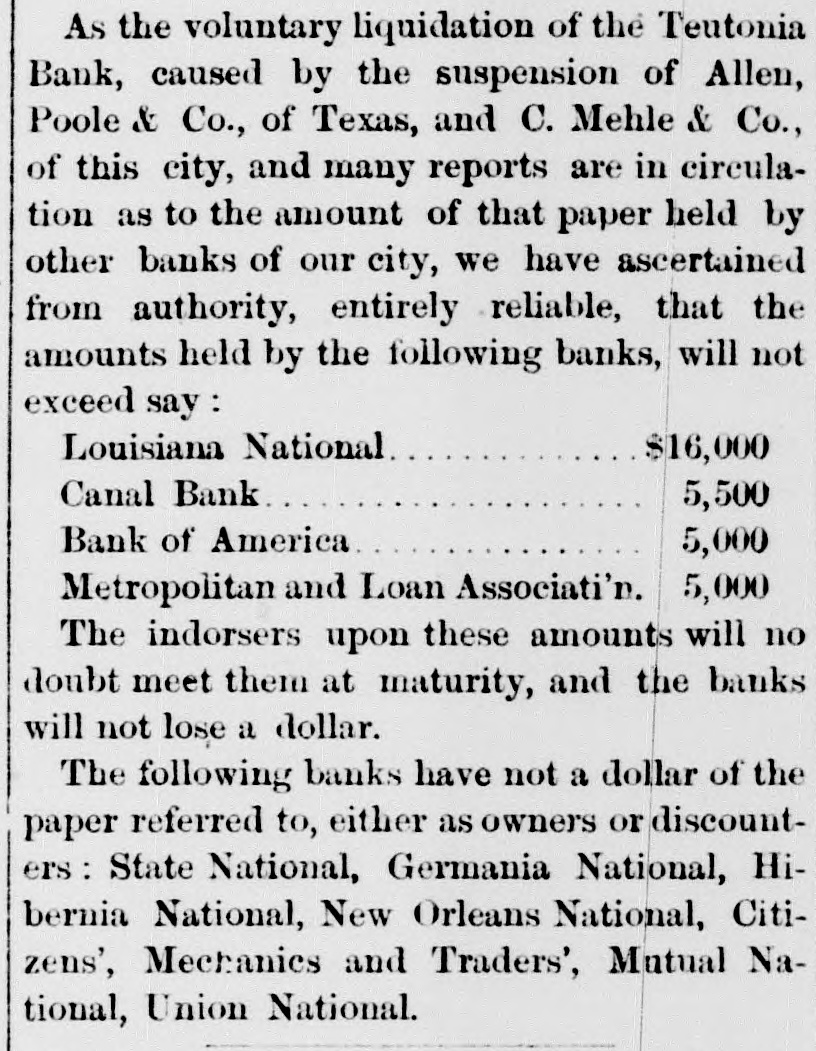
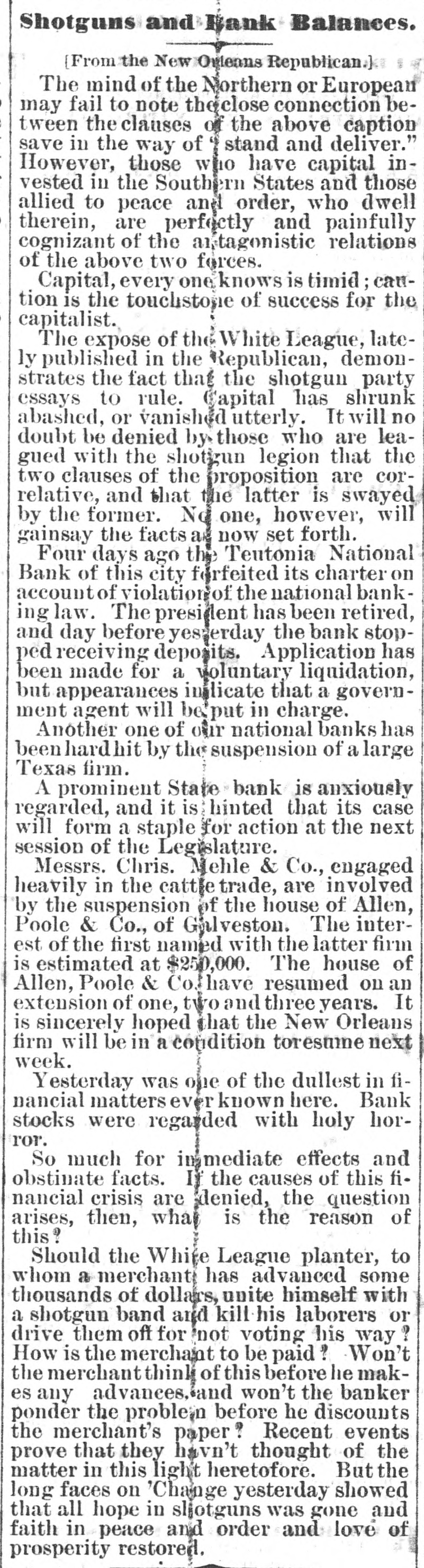
As the voluntary liquidation of the Teutonia Bank, caused by the suspension of Allen, Poole & Co., of Texas, and C. Mehle & Co., of this city, and many reports are in circulation as to the amount of that paper held by other banks of our city, we have ascertained from authority, entirely reliable, that the amounts held by the following banks, will not exceed say Louisiana National 16,000 Canal Bank 5,500 Bank of America 5,000 5,000 Metropolitan and Loan Associati'r. The indorsers upon these amounts will no doubt meet them at maturity, and the banks will not lose a dollar. The following banks have not a dollar of the paper referred to, either as owners or discounters : State National, Germania National, Hibernia National, New Orleans National, Citizens', Mechanics and Traders', Mutual National, Union National.


Article from New Orleans Republican, August 30, 1874

Click image to open full size in new tab

Article Text

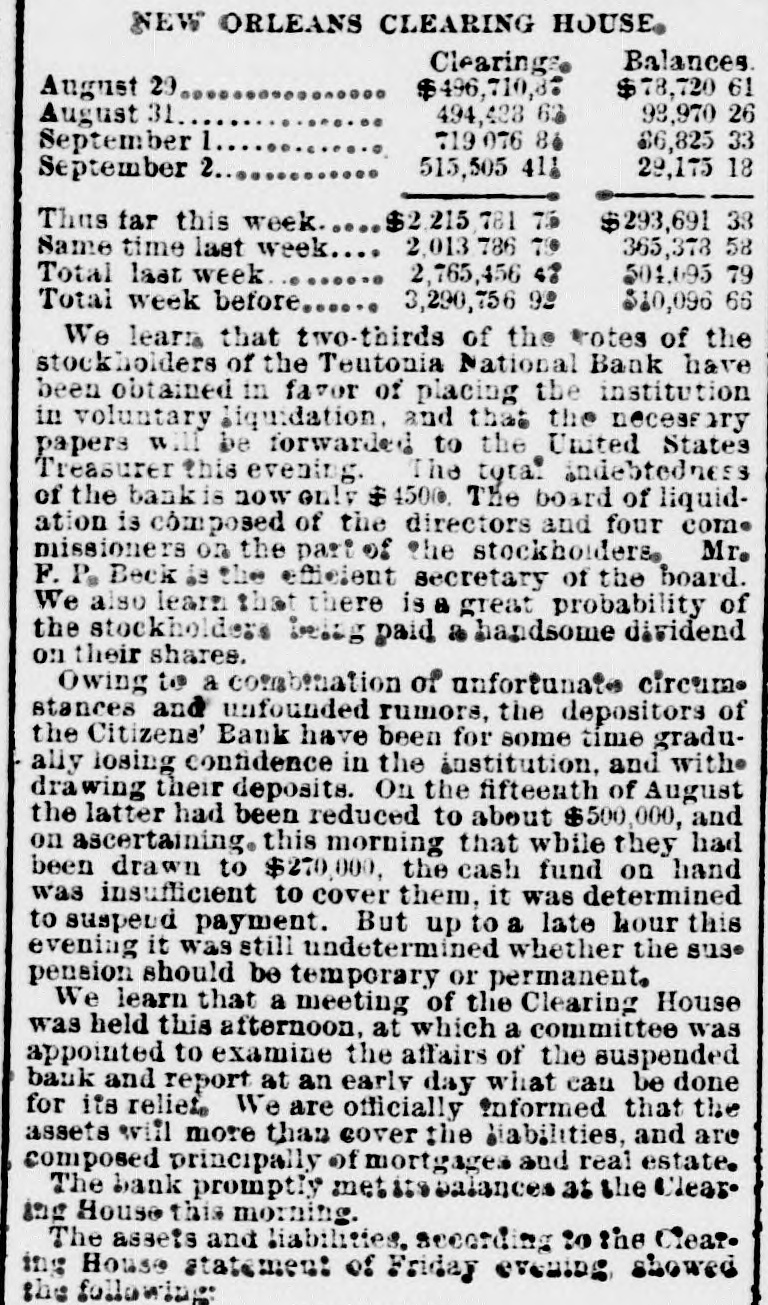
# MONETARY. OFFICE OF THE DAILY REPUBLICAN.} SATURDAY EVENING, August 29, 1874.3 The money market is quiet and unchanged. The offerings are of fair extent at the banks, and mod- erate on the street, while the rates of commercial paper continue without apparent variation. We continue to quote selected signatures, with or with- out collaterals at 9@10 cent per annum; first class at @11; A1 at 12@-, and second grade at 1½ cent per month. First class mortgages are still quoted at about 10 cent per annum, and second grade at -. # NEW ORLEANS CLEARING HOUSE. Clearings. Balances. August 29... $496,710,87 $78,720 61 Same time last week... 521,585 17 71,572 00 Total last week... 2,765,456 47 504,095 79 Total week before. 3,290,756 92 510,096 66 We are indebted to Mr. I. N. Maynard, manag- er of the New Orleans Clearing House, for the follow- ing comparative statement of the associated banks for the week ending August 29: Increase. Decrease. Specie... $30.000 Currency 145,000 Loans.. 90.000 Deposits. We are gratified to learn that the affairs of the Teutonia National Bank have been honorably and satisfactorily settled. On the report, we presume, of the bank examiner and other evidence, the Controller of the Currency has authorized the in- stitution to go into voluntary liquidation, which would not have been done had not that officer been satisfied of the good faith and integrity of the present management. Otherwise a receiver would have been appointed. Nothing now remains but for the stockholders by their votes on Tues- day to authorize the liquidation, to which, of course, they will assent. The deposits have been drawn down to a very low point, but in order to enable the bank to pay all it has been necessary for it to accept the offers of the Germania, Canal, State National, Union National and Metropolitan Banks to rediscount its portfolios. The bank now calls upon depositors to withdraw their balances, and upon all creditors to present their claims for immediate settlement. it would be difficult to find in the annals of banking under the national banking law an instance in which a bank has been liquidated more creditably, for which much is due to the confidence reposed in the cashier, and that officer's energy and perseverance. Gold continued to rule at 109¼ @109¾ in this mar- ket and 109¼ in New York. The business was of moderate extent, being confined to $19,000, em- bracing $1000 at 109¼, $8000 at 109⅜, $5000 at 109½, and $6000 at 109⅝. No sales of silver were reported. American half dollars were still quoted at 103½ @104½, and Mex- ican dollars at 97½ gold. Nothing transpired in city scrip. City appropria- tion certificates, Metropolitan Police warrants and time certificates of 1873 are now quoted nominal at 45@46. Old State warrants are still quoted nominal at 30@31 for large, 32@33 for medium, and 34@36 for small. No sales are reported. New State warrants are entirely nominal. Foreign exchange was without quotable varia- tion. The only sale of sterling reported was £1000 bill of lading at $5 33, but nothing transpired in francs. At the close sterling bills were still quoted at $5 31½@5 33 for bill of lading and A1 clear, and -@$5 31 for bank, and francs nominal at 4.72½ for private and - for bank. The offerings of domestic exchange continued quite limited, and with a moderate demand rates were without quotable variation. The only sales of New York sight reported were $25,000 commer- cial at 9-32 cent premium and $35,000 bank at 5-16. The banks continued to check on New York at ⅜ cent premium, and commercial sight was still quoted at @5-16. Nothing transpired in stocks. In bonds we noticed a better feeling in city gold bearing seven per cents, which were, however, without quotable variation, being still quoted nominal at 43@44. The sales included $2000 at 42¾, and $1000 at 43⅛.


Article from New Orleans Republican, September 1, 1874

Click image to open full size in new tab

Article Text

aging, the demand revived, and factors were enabled to recover ¾ @ ⅞c of the previous decline. Passing over the advance during the first fortnight, and comparing the closing with the opening rates, the quotations on September 30 showed a net falling off of only ⅝ @ 1c. The improvement, however, was somewhat illusive, being partly caused by the change in the measure of value from currency to certified checks, which was equal to ⅓ @ ¼c ⅟₈ lb on the price of cotton. This change took place on September 25, when the following resolution was adopted by the Clearing House banks: "Resolved, That all deposits made hereafter shall be paid in kind, and that against previous deposits no checks exceeding $25 will be paid in currency to any one depositor on the same day." The resolution was followed by the publication of the agreement for self-protection, which was signed by nearly all the incorporated banks. The cotton movement in September had been only moderately active, the sales summing up 17,900 bales, against gross receipts of 26,732, while the stock by our running statement had increased to 22,386, and the amount unsold was 11,400. This indicates that although the demand had not been very animated the supplies were proportionately light, an actual supply of 11,400 bales, a considerable part of which was unmerchantable or held off the market for further developments, showing that the offerings had been pretty well absorbed by the demand. Buyers having adjusted their operations to the new order, October opened with a more active demand, and, although the New York panic had still a disturbing and unfavorable influence, yet, the supply being light, the previous upward tendency continued, and at the end of the first ten days factors had been enabled to establish an advance of ⅜c, but on the eleventh, in response to a decline at New York, the market took an unfavorable turn, and prices receded from day to day until they closed at a net falling off of 1⅜ @ 1¼c from the opening rates and a reduction of 2⅜ @ 2½c from the highest point. The movement at the same time had exhibited considerable activity, the month's sales amounting to


Article from The New Orleans Bulletin, September 6, 1874

Click image to open full size in new tab

Article Text

# Our National Banks and the Protection Offered by them to Depositors. In view of the liquidation of the Teutonia National Bank and the suspension of the Citizens' Bank, it is well that the security afforded by the laws of the United States to parties depositing money in National Banks should be generally known. By express provision of the act of Congress of the United States, creating National Banks, depositors are preferred creditors in the event of failure of any National Bank No better illustration can be given than the recent event in the above named institution. In the case of the Teutonia National Bank, the deposits had to be paid or there could be no liquidation by the stockholders. In the other case, the depositors, though not losing in the end, must take the regular course of liquidation with other creditors. It may be well to remember that with the National Banks all the assets and all the stock is liable for deposits, and though it may be a position of responsibility under the laws of the United States to be a stockholder in a National Bank, there can be no risk to be a depositor. We look to see all our banks national in the end. "SECURITY."


Article from The Donaldsonville Chief, April 27, 1912

Click image to open full size in new tab

Article Text

FAILURE OF THE TEUTONIA BANK. The Teutonia Bank, of New Orleans, has been placed in the hands of a receiver, an investigation by the state bank examiner and the district attorney of Orleans parish having disclosed gross mismanagement and crookedness on the part of several of the institution's officers and employees, resulting in an impairment of the capital and resources to the extent of approximately $800,000. Criminal charges are pending against President Eugene Buhler, Vice President Adam Wagatha, Director Jos. H. Gomila, and former Assistant Cashier Frank J. Braud, while Cashier W. E. Dunn and Assistant Cashier A. E. Mazurette and two or three others have been placed under bond as material witnesses. Dunn and Mazurette have acknowledged falsifying books and securities for the purpose of deceiving the examiners, at the instance and with the knowledge of Buhler and Gomila, who were in complete control of the bank's affairs. T. ,Walter Danziger is receiver for the broken bank and is making such good progress in the work of calling in loans and utilizing resources that he feels confident the depositors will receive fully fifty per cent of their claims. It was at first feared that the failure was such a bad one the creditors could scarcely look for more than a ten per cent dividend. The collapse of the Teutonia naturally made many depositors in the other New Orleans banks uneasy, and some of the more timid began drawing out their deposits, but a rigid inquiry by the clearing house showed all the city's banks in sound condition, and public confidence is being rapidly restored.


Article from The Colfax Chronicle, May 11, 1912

Click image to open full size in new tab

Article Text

# No Use for a Bank Examiner. That the State has no use for a Bank Examiner and that it is a sinecure which ought to be abolished and his salary saved, has been conclusively demonstrated by the recent failure of the Teutonia Bank in New Osleans. The failure of this bank, in the manner by which it was accomplished, is the greatest scandal in the history of the banking business in this State, and perhaps, the greatest outrage upon the depositors, who are likely to receive but a small, if any portion of their deposits. The cashier, who had embezzled $60,000, was kept in employment for more than a year by a dishonest president and directory—who had alsó converted the bank's money to their own use and behoof—because, as alleged by them, his discharge "might create suspicion and cause a run on the bank." We assume that the bank examiner made the periodical examinations of this bank required by law during the existence of this peculation. He discovered nothing to create suspicion that any thing of a "crooked" nature was in operation. On the contrary, the investigation was either so superficial in character, or his ability so limited, that he found nothing of an irregular, much less of a peculative nature, on a scale of such magnitude, although the bank was in a wrecked condition. In fact, he was first "put onto the job," by being given "a tip" from the outside. Is the bank examiner giving the State value for what he receives from it, when he fails to detect the most notorious instance of bank pillage and wreckage in its history? Could he detect them if similar conditions existed in some other bank? There must be a remedy found, but it is a matter for legislative action. This official has been a failure in this case, and we must judge the future by the past, as to what may be expected of him hereafter. - Alexandria Democrat.


Article from The Hattiesburg News, August 14, 1912

Click image to open full size in new tab

Article Text

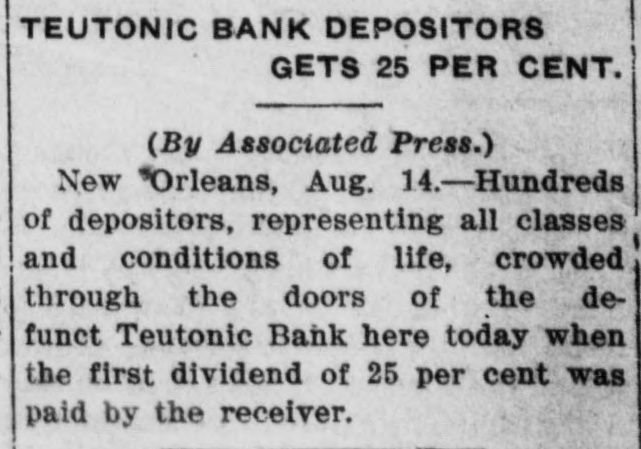
TEUTONIC BANK DEPOSITORS GETS 25 PER CENT. (By Associated Press.) New *Orleans, Aug. 14.-Hundreds of depositors, representing all classes and conditions of life, crowded through the doors of the defunct Teutonic Bank here today when the first dividend of 25 per cent was paid by the receiver.


Article from The Birmingham Age-Herald, August 15, 1912

Click image to open full size in new tab

Article Text

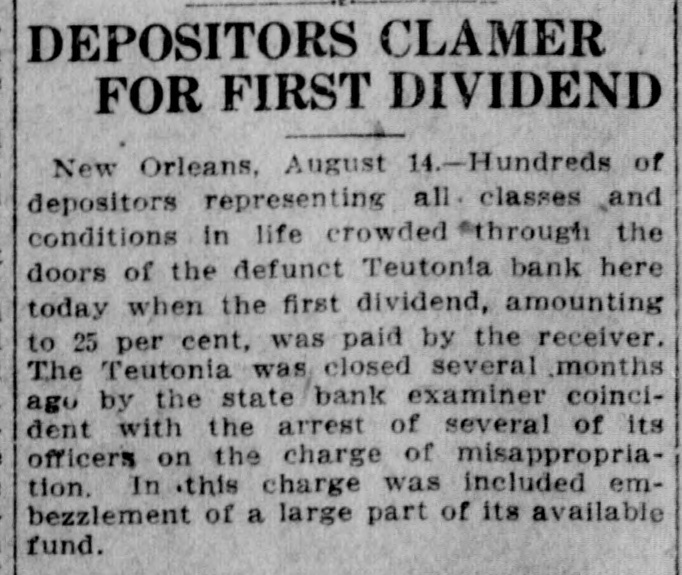
DEPOSITORS CLAMER FOR FIRST DIVIDEND New Orleans, August 14.-Hundreds of depositors representing all. classes and conditions in life crowded *through the doors of the defunct Teutonia bank here today when the first dividend, amounting to 25 per cent, was paid by the receiver. The Teutonia was closed several months ago by the state bank examiner coincident with the arrest of several of its officers on the charge of misappropriation. In this charge was included embezzlement of a large part of its available fund.


Article from Pine Bluff Daily Graphic, August 16, 1912

Click image to open full size in new tab

Article Text

TEUTONIO BANK PAYS DIVIDEND TO DEPOSITORS New Orleans, Aug. 15.-Hundreds of depositors representing all kinds of conditions of life. crowded through the doors of the defunet Teutonic Bank here today, when the first div dend of 25 per cent was paid by the receiver. The Teutonic was closed several months ago by he State bank examiners, coincident with the arrest of several of its officers on the charge of misappropriation and embezzling.


Article from The Neshoba Democrat, February 6, 1913

Click image to open full size in new tab

Article Text

TWO NEW ORLEANS BANKERS CONVICTED EUGENE F. BUHLER AND JOSEPH GOMILA ARE ACCUSED. WILL BE SENTENCED LATER The President and Directors of the Defunct Teutonia Bank Accused of Receiving Deposits After bank Failed. New Orleans, La.-A verdict of guilty was returned in the case of Eugene F. Buhler, president of the defunct Teutonia Bank, and Joseph Gomila, director and chairman of the bank's finance committee, charged jointly with having received deposits knowing the institution to be in a failing condition. Sentence was deferred. The trial brought to light many startling disclosures of loose banking methods, "kiting," falsifying of records and other methods of frenzied finance resorted to by those at the head of the institution to keep it from going under. When bank examiners finally completed their investigation it was found that more than $300,000 in practically worthless paper was in the vaults. Many notes were signed by $75 a month clerks and others who testified that they never owned property and had no assets. It was also brought out that former Cashier Brand, who eighteen months before the bank suspended had made way with about $60,000, had been retained in the bank several months and his bond of $15,000 never collected.


Article from Greene County Herald, February 7, 1913

Click image to open full size in new tab

Article Text

TWO NEW ORLEANS BANKERS CONVICTED EUGENE F. BUHLER AND JOSEPH GOMILA ARE ACCUSED. WILL BE SENTENCED LATER The President and Directors of the De. funct Teutonia Bank Accused of Receiving Deposits After Bank Failed. New Orleans, La.-A verdict of guilty was returned in the case of Eugene F. Bubler, president of the defunet Teutonia Bank, and Joseph Gomila, director and chairman of the bank's finance committee charged jointly with having received deposits knowing the institution to be in a failing condition. Sentence was deferred. The trial brought to light many start. ling disclosures of loose banking methods, "kiting," falsifying of records and other methods of frenzied finance resorted to by those at the head of the institution to keep it from going under. When bank examiners finally completed their investigation it was found that more than $300,000 in practically worthless paper was in the vaults. Many notes were signed by $75 a month clerks and others who testified that they never owned property and had no assets. It was also brought out that former Cashier Brand, who eighteen months before the bank suspended had made way with about $60,000, had been retained in the bank several months and his bond of $15,000 never collected.


Article from The Birmingham Age-Herald, December 29, 1913

Click image to open full size in new tab

Article Text

WALTER DANZIGER IS STILL MISSING New Orleans, December 28.-The whereabouts of T. Walter Danziger, young financier and real estate dealer, was still unknown tonight, according to reports from police headquarters. Mr. Danziger has been missing since last Tuesday. Accountants are still engaged in checking up the books of various enterprises in which he was interested, and their reports are not expected until some time this week. The real estate firm of Danziger & Tessier has been dissolved. Michael Mitchell is now receiver for the Mitchell-Borne Construction company, in place of Mr. Danziger. St. Clair Adams has been appointed as successor to Danziger in the receivership of the Teutonia bank.