17412. Franklin Bank (Columbus, OH)

Bank Information

Episode Type
Suspension → Reopening
Bank Type
state
Start Date
March 12, 1842
Location
Columbus, Ohio (39.961, -82.999)

Metadata

Model
gpt-5-mini
Short Digest
cf6b9227

Response Measures

None

Description

Bank commissioners instituted proceedings and placed the Franklin Bank of Columbus into receivership in March 1842; later (Sept 1842) newspapers report the bank again on its legs and having specie and deposits. No explicit contemporaneous article describes a depositor run; the primary action was a suspension/receivership by authorities followed by resumption of specie payments.

Events (2)

1. March 12, 1842 Suspension
Cause
Government Action
Cause Details
Bank Commissioners instituted proceedings and delivered the bank's effects to receivers (formal regulatory action leading to suspension).
Newspaper Excerpt
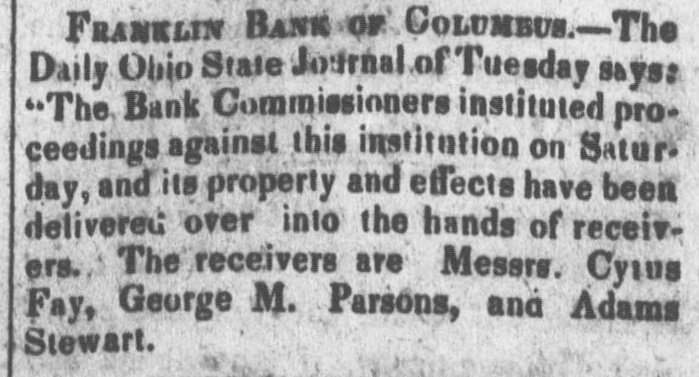
The Bank Commissioners instituted proceedings against this institution ... its property and effects have been delivered over into the hands of receivers. The receivers are Messrs. Cyrus Fay, George M. Parsons, and Adam Stewart.
Source
newspapers
2. September 7, 1842 Reopening
Newspaper Excerpt
The Franklin Bank of Columbus, Ohio, is again on its legs, having recovered from the embarrassment arising out of its loan to the State. On the 7th inst. had $85,278 specie ... circulation $187,332 Deposites $79,145.
Source
newspapers

Newspaper Articles (15)

Article from Democratic Standard, May 11, 1841

Click image to open full size in new tab

Article Text

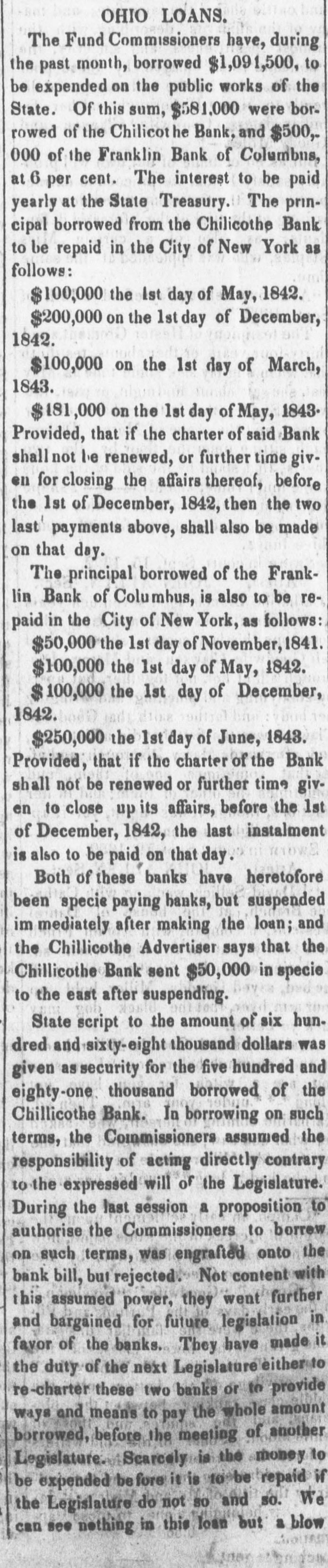
OHIO LOANS. The Fund Commissioners have, during the past month, borrowed $1,091,500, to be expended on the public works of the State. Of this sum, $581,000 were borrowed of the Chilicot he Bank, and $500,000 of the Franklin Bank of Columbus, at 6 per cent. The interest to be paid yearly at the State Treasury. The principal borrowed from the Chilicothe Bank to be repaid in the City of New York as follows: $100,000 the 1st day of May, 1842. $200,000 on the 1st day of December, 1842. $100,000 on the 1st day of March, 1843. $181,000 on the 1st day of May, 1843Provided, that if the charter of said Bank shall not be renewed, or further time given for closing the affairs thereof, before the 1st of December, 1842, then the two last payments above, shall also be made on that day. The principal borrowed of the Franklin Bank of Columbus, is also to be repaid in the City of New York, as follows: $50,000 the 1st day of November, 1841. $100,000 the 1st day of May, 1842. $ 100,000 the 1st day of December, 1842. $250,000 the 1st day of June, 1843. Provided, that if the charter of the Bank shall not be renewed or further time given to close up its affairs, before the 1st of December, 1842, the last instalment is also to be paid on that day. Both of these banks have heretofore been specie paying banks, but suspended im mediately after making the loan; and the Chillicothe Advertiser says that the Chillicothe Bank sent $50,000 in specie to the east after suspending. State script to the amount of six hun. dred and sixty-eight thousand dollars was given as security for the five hundred and eighty-one thousand borrowed of the Chillicothe Bank. In borrowing on such terms, the Commissioners assumed the responsibility of acting directly contrary to the expressed will of the Legislature. During the last session a proposition to authorise the Commissioners to borrew on such terms, was engrafted onto the bank bill, but rejected. Not content with this assumed power, they went further and bargained for future legislation in favor of the banks. They have made it the duty of the next Legislature either to re -charter these two banks or to provide ways and means to pay the whole amount borrowed, before the meeting of another Legislature Scarcely is the money to be expended be fore it is to be repaid if the Legislature do not so and so. We can see nothing in this loan but a blow


Article from New-York Tribune, February 28, 1842

Click image to open full size in new tab

Article Text

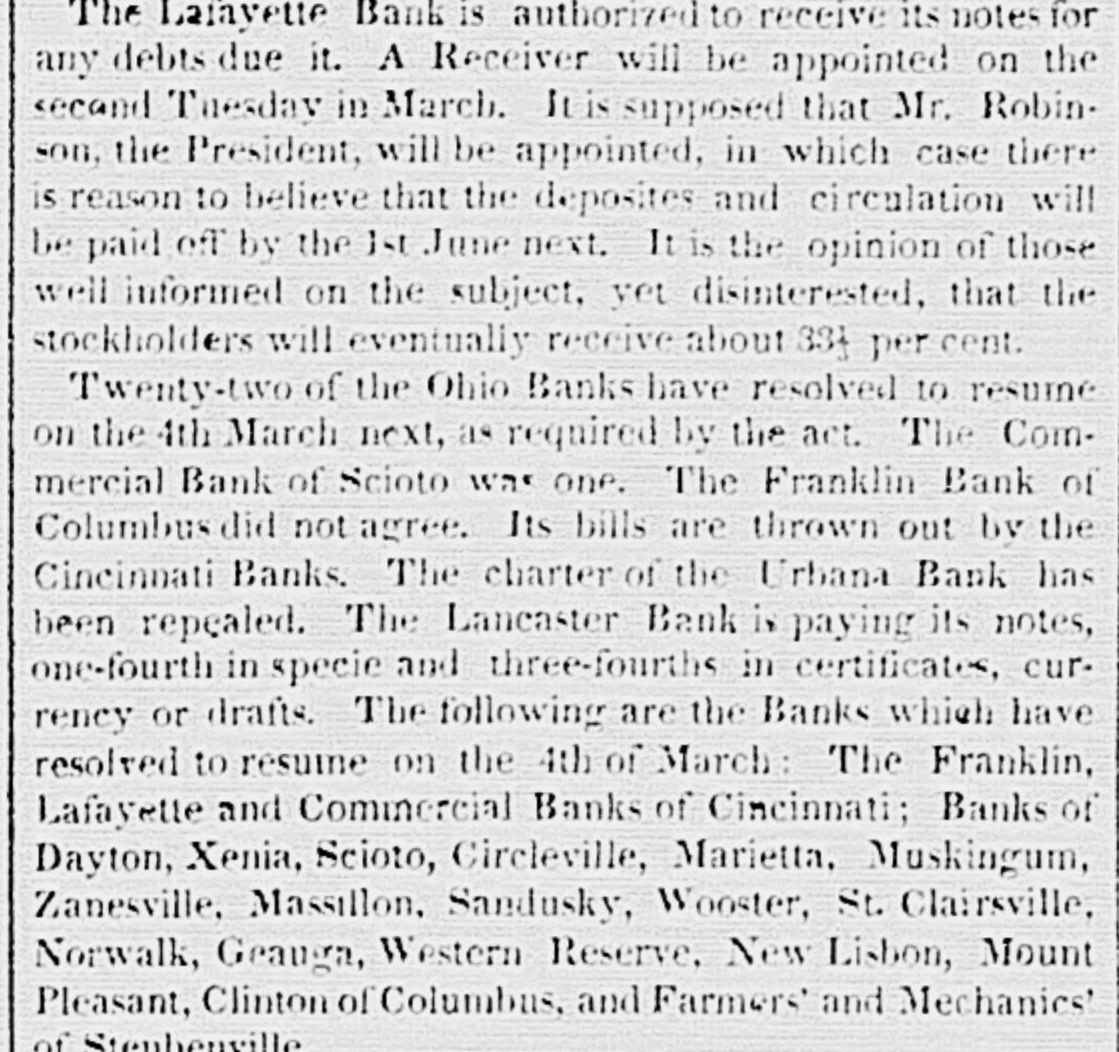
The Lajayette Bank is authorized to receive its notes for any debts due it. A Receiver will be appointed on the second Tuesday in March. It is supposed that Mr. Robinson, the President, will be appointed, in which case there is reason to believe that the deposites and circulation will be paid off by the 1st June next. It is the opinion of those well informed on the subject, yet disinterested, that the stockholders will eventually receive about 33j per cent. Twenty-two of the Ohio Banks have resolved to resume on the 4th March next, as required by the act. The Commercial Bank of Scioto was one. The Franklin Bank of Columbus did not agree. Its bills are thrown out by the Cincinnati Banks. The charter of the Urbana Bank has been repealed. The Lancaster Bank is paying its notes, one-fourth in specie and three-fourths in certificates, currency or drafts. The following are the Banks which have resolved to resuine on the 4th of March The Franklin, Lafayette and Commercial Banks of Cincinnati; Banks of Dayton, Xenia, Scioto, Circleville, Marietta, Muskingum, Zanesville, Massillon, Sandusky, Wooster, St. Clairsville, Norwalk, Geauga, Western Reserve. New Lisbon, Mount Pleasant, Clinton of Columbus, and Farmers' and Mechanics' of Stenhensille


Article from Democratic Standard, March 15, 1842

Click image to open full size in new tab

Article Text

FRANKLIN BANK OF Columbus.-The Daily Obio State Journal.of Tuesday says: 66 The Bank Commissioners instituted proceedings against this institution on Satur. day, and its property and effects have been delivered over into the hands of receivers. The receivers are Messrs. Cytus Fay, George M. Parsons, and Adams Stewart.


Article from Carroll Free Press, March 18, 1842

Click image to open full size in new tab

Article Text

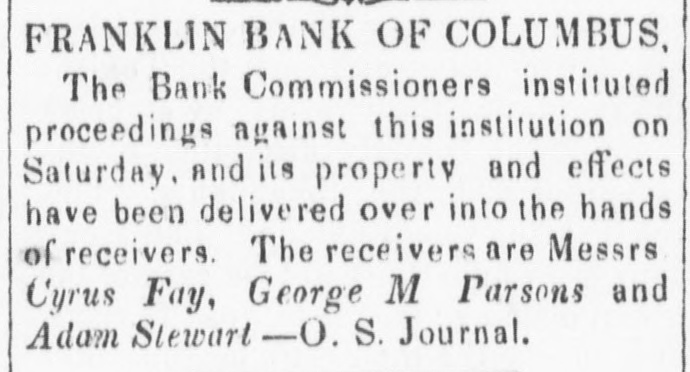
FRANKLIN BANK OF COLUMBUS, The Bank Commissioners instituted proceedings against this institution on Saturday. and its property and effects have been delivered over into the hands of receivers. The receivers are Messrs Cyrus Fay, George M Parsons and Adam Stewart -0. S. Journal.


Article from The New York Herald, March 21, 1842

Click image to open full size in new tab

Article Text

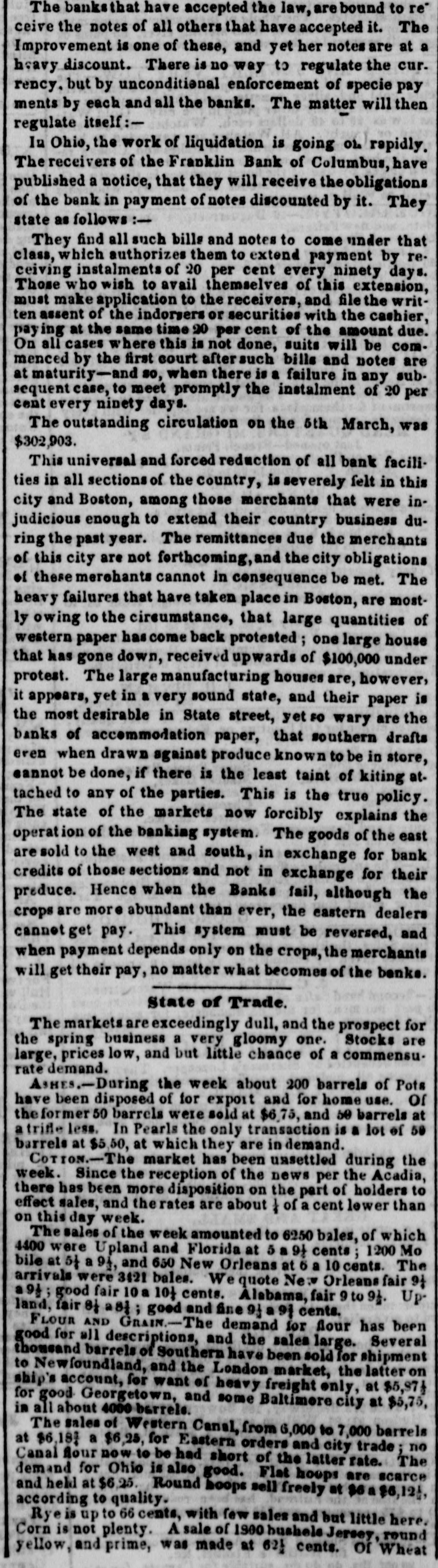
The banksthat have accepted the law, bound to re ceive the notes of all others that have accepted it. The Improvement is one of these, and yet her notes are at a heavy discount. There is no way to regulate the cur. rency. but by unconditional enforcement of specie pay ments by each and all the banks. The matter will then regulate itself:In Ohio, the work of liquidation is going 01. rapidly. The receivers of the Franklin Bank of Columbus, have published a notice, that they will receive the obligations of the bank in payment of notes discounted by it. They state as follows They find all such bills and notes to come under that class, which authorizes them to extend payment by receiving instalments of 20 per cent every ninety days. Those who wish to avail themselves of this extension, must make application to the receivers, and file the written assent of the indorgers or securities with the cashier, paying at the same time 20 per cent of the amount due. On all cases where this is not done, suits will be com. menced by the first court after such bills and notes are at maturity-and so, when there is a failure in any subsequent case, to meet promptly the instalment of 20 per cent every ninety days. The outstanding circulation on the 5th March, was $302,903. This universal and forced reduction of all bank facilities in all sections of the Country, is severely felt in this city and Boston, among those merchants that were injudicious enough to extend their country business during the past year. The remittances due the merchants of this city are not forthcoming, and the city obligations of these merchants cannot in consequence be met. The heavy failures that have taken place in Boston, are mostly owing to the circumstance, that large quantities of western paper has come back protested; one large house that has gone down, received upwards of $100,000 under protest. The large manufacturing houses are, however, it appears, yet in a very sound state, and their paper is the most desirable in State street, yet FO wary are the banks of accommodation paper, that southern drafts eren when drawn against produce known to be in store, cannot be done, if there is the least taint of kiting attached to any of the parties. This is the true policy. The state of the markets now forcibly explains the operation of the banking system. The goods of the east are sold to the west and south, in exchange for bank credits of those sections and not in exchange for their produce. Hence when the Banks fail, although the crops are more abundant than ever, the eastern dealers cannot get pay. This system must be reversed, and when payment depends only on the crops, the merchants will get their pay, no matter what becomes of the banks. State of Trade. The markets are exceedingly dull, and the prospect for the spring business a very gloomy one. Stocks are large, prices low, and but little chance of a commensurate demand. Ashes.-During the week about 200 barrels of Pots have been disposed of for export and for home use. Of the former 50 barrels were sold at $6.75, and 50 barrels at trifle less. In Pearls the only transaction is a lot of 50 barrels at $5.50, at which they are in demand. COTION.-The market has been ussettled during the week. Since the reception of the news per the Acadia, there has been more disposition on the part of holders to effect sales, and the rates are about of a cent lewer than on this day week. The sales of the week amounted to 6250 bales, of which 4400 were Upland and Florida at 5 a 9) cents 1200 Mo bile at 51 a 94, and 650 New Orleans at 6 a 10 cents. The arrivals were 3121 bales. We quote New Orleans fair 91 a9j; good fair 10 104 cents. Alabama, fair 9 to 9. Up land, fair 8j asi; good and fine 9) a 91 cents. FLOUR AND GRAIN.-The demand for flour has been good for all descriptions, and the sales large. Several thousand barrels of Southern have been sold for shipment to Newfoundland, and the London market, the latter on ship's account, for want of heavy freight only, at $5.97 for good Georgetown, and some Baltimore city at $5,75, in all about 4000 barrels. The sales of Western Canal, from 6,000 to 7,000 barrels at $6,181 a $6,25, for Eastern orders and city trade no Canal flour now to be had short of the latter rate. The demand for Ohio is also good. Flat hoops are scarce and held at $6.25. Round hoops sell freely at se a $6,12 according to quality. Rye is up to 66 cents, with few sales and but little here. Corn is not plenty. A sale of 1900 hushels Jersey, round yellow, and prime, was made at 621 cents. or Wheat


Article from The Madisonian, March 22, 1842

Click image to open full size in new tab

Article Text

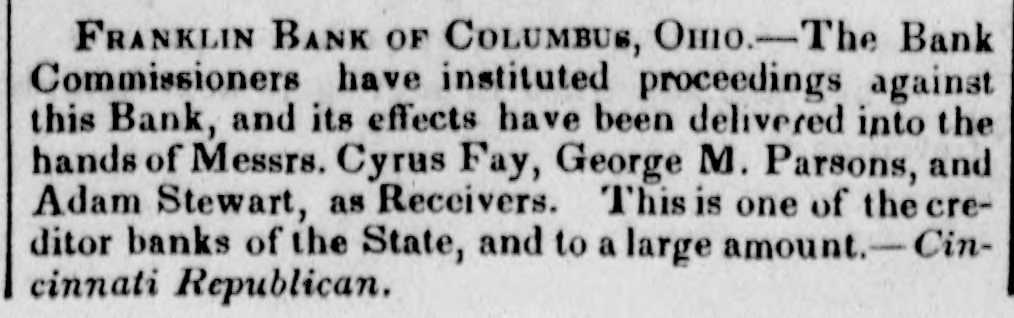
FRANKLIN BANK OF COLUMBUS, Omo.-The Bank Commissioners have instituted proceedings against this Bank, and its effects have been delivered into the hands of Messrs. Cyrus Fay, George M. Parsons, and Adam Stewart, as Receivers. This is one of the creditor banks of the State, and to a large amount.- Cincinnati Republican.


Article from The Ohio Democrat, March 24, 1842

Click image to open full size in new tab

Article Text

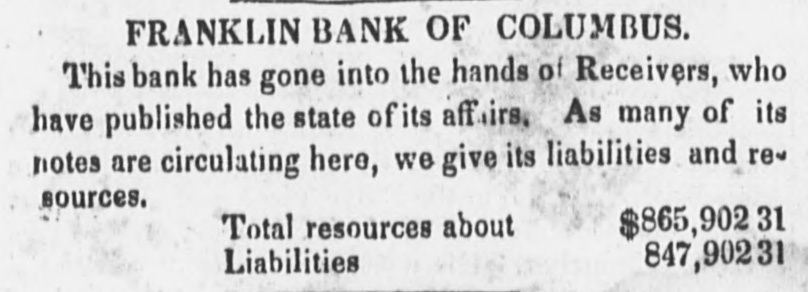
FRANKLIN BANK OF COLUMBUS. This bank has gone into the hands of Receivers, who have published the state of its affairs. As many of its notes are circulating here, we give its liabilities and rew sources. $865,902.31 Total resources about 847,90231 Liabilities


Article from The Ohio Democrat, March 31, 1842

Click image to open full size in new tab

Article Text

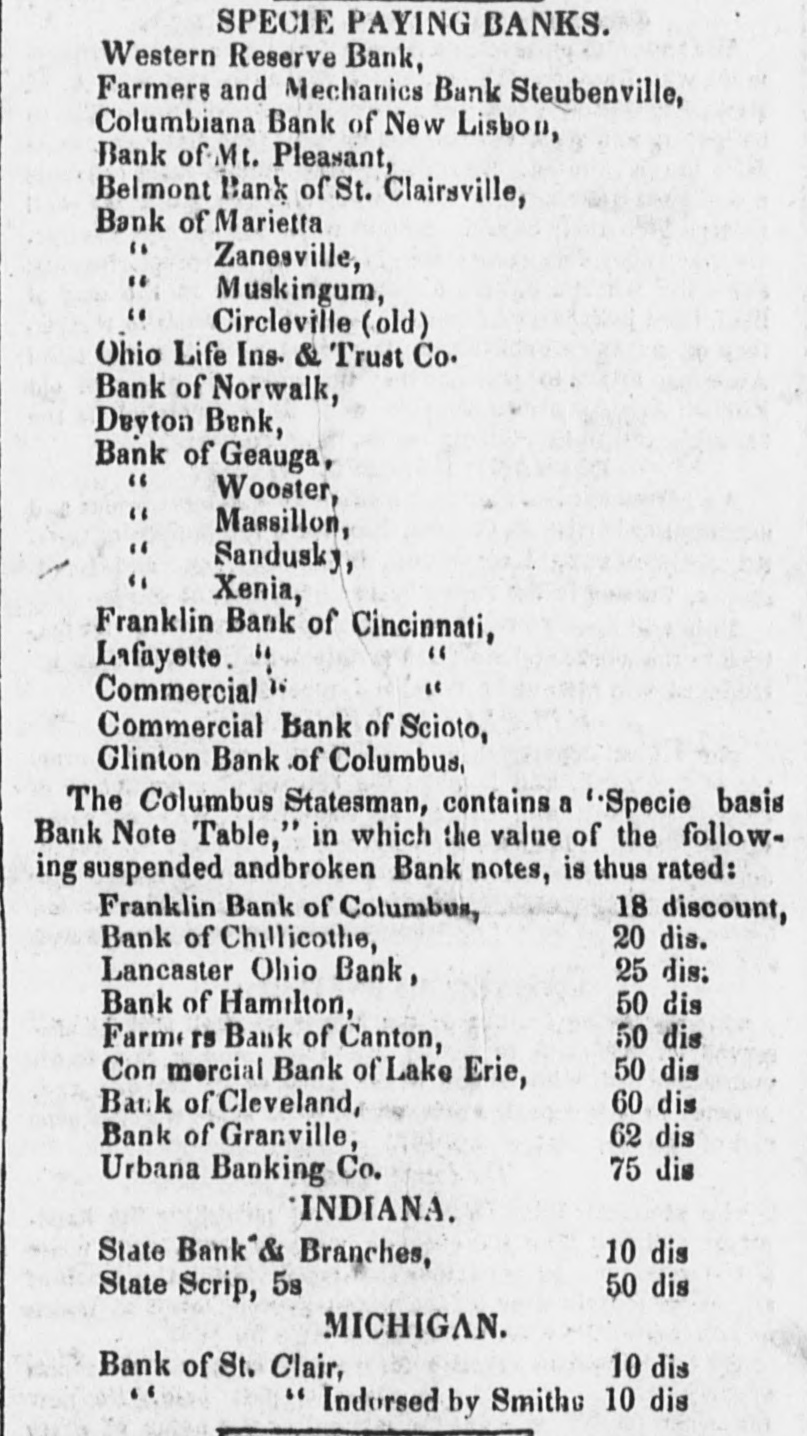
SPECIE PAYING BANKS. Western Reserve Bank, Farmers and Mechanics Bank Steubenville, Columbiana Bank of New Lisbon, Bank of Mt. Pleasant, Belmont Bank of St. Clairsville, Bank of Marietta " Zanesville, " Muskingum, " Circleville (old) Ohio Life Ins. & Trust Co. Bank of Norwalk, Deyton Benk, Bank of Geauga, " Wooster, " Massillon, Sandusky, Xenia, Franklin Bank of Cincinnati, Lafayette. is " Commercial Commercial Bank of Scioto, Glinton Bank of Columbus, The Columbus Statesman, contains a 'Specie basis Bank Note Table," in which the value of the following suspended andbroken Bank notes, is thus rated: Franklin Bank of Columbus, 18 discount, 20 dis. Bank of Chillicothe, 25 dis: Lancaster Ohio Bank, 50 dis Bank of Hamilton, 50 dis Farmers Bank of Canton, 50 dis Con mercial Bank of Lake Erie, 60 dis Bank of Cleveland, 62 dis Bank of Granville, 75 dis Urbana Banking Co. INDIANA. 10 dis State Bank'& Branches, 50 dis State Scrip, 5s MICHIGAN. 10 dis Bank of St. Clair, Indorsed by Smithe 10 dis


Article from The Ohio Democrat, April 14, 1842

Click image to open full size in new tab

Article Text

From the Ohio Statesman. EJOURNAL AND THE FRANKLIN BANK BANK-GOVERNOR CORWINS COMMISSIONERS. The Journal of Thureday has the following: "A PLAIN CASE. "Before the meeting of the Legislature Bank in last, the notes of the Franklin were in high credit among of and were considered equal to dess December Columbus men, wellknown busi the in the State. It was and that the Bank best currency had been prudently minaged, reabundantly able, ultimately, to all 110 liabilities. Well, the leaders concected deem that assembled-the it was Commissioners Legislature their this- seimeasures. the B r.k Frankteen the effects and asses's of the man zed upon wrested them from cuetody and of the agents of the them over to three agement lin delivered Bank, stockholders, Receivers depreciates The and of the Bank immediately this paper twenty-five cents on the dollar! Is not namense sacrifice properly chargeable upon the Before Legislature?' the question put by the Journal is allwe have a word or two to say on this the swered, malter.- On the first day of May, 1841, Canal Fund Commissioners borrowFranklin Bank of in the promises to pay of that 000, ed Board of the of Columbus, institution $500, State and security therefor. hypothecated bond to the amount of $600,000. Two, out of three of these Fund Commissionere Gov. were appointed, as we have before shown, by the Corwin, and one of them is 80 much in Governor's confidence, that he acted as epokes Confor Corwin at the 22d of February nominman and accepted in his name, the Governor. At the time, or in A after this loan was made, short ation vention, time for the Frank very The lin Bank suspended specie payments. Bank, on the notes thus loaned, drew an 80⑉ to nual interest of six per cent, amounting loan thousand dollars In making tbis thirty of the Bank, Gov. Corwin's Fund Commiseionera beyond all doubt exceeded their powers, and should bear the odium of the transaction. The late Legislature met. and found the of most of the Ohio Banke at-a discount, from notes the fact of their being in a state of suspension. They took means to enforce a comwith the law, by passing a bill compel10 redeem their promises or Many of them ling pliance their concerns. them complied for wind their with up >the law, and are now paying specie nolee on demand, and as a necessary conse- with their notes become of equal value while the notes of the worth no less, than Banks specie, quence are previous non-resuming dollars to the of ef the bill. One hundred of the Franklin Bank at the passage paper would this previous moment much epecie as it of the Legislature, that the notes of that bank charge will buy as to the meeting dollar, have and in depre- con- the cialed twenty-five cents on the of the resumption of specie payments ground sequence other Banks, is utterly false and If change has been W orth more than before by less, notes the are any effected, the passage the of the resumption bill, for now the holders can for ree a chance at least, of getting the hard the lying promises. The bank has overtraded can re Insput forth more promises than she and must suffer the fate of all other spe their culators, deem, who have foolishly gone beyond means. We again assert without the fear of successful contradiction. that, to the resumption enchance hill, is properly to be charged, the bank of the value of every note on a and ment which was then in a etate of suspension, now specie, and that the notes are of now in the hands of one copper less than previous which not worth banks pays receivers, but to that for It was not through patriotiem, little annual sum of Thirty the enug event. issued Thousate new that the Franklin Bank a of notes. In this, as in every where the profit is large. the Dollars, culation batch other spe risk was federal No doubt they trusted that the and grea'. in Ohio would be maintained, would supremacy with the other banks, their suspension legalized. Instead of putting have that were-mietaken. insulution, In their this house their they and raising means to to pay, they relied upon premises in order, redeem their evil smiles, day. 10 stave off the niles had not the desired rebill was passed, the 4th Their sumption d'blandishments 9 effect, of the March doors came and they were not able to pay, the were of the bank were closed, and Receivers wind appointed 10 take charge of the assets, and for their business and pay their debts, owninorthis, up they have only to blame their dinate love of money. .10 the Receivers appointed, the stockholdthe bill holders have every confidence. the Cashier of the Bank, is assist in settling its affairs, and Mr. ers to and Espy. the retain- deb's and the bank are being rapidly all the debts will be 100, ete long, in a due we ed doub not, satisfactory called paid, manner. in, and that, This, in our opinion, presente a.plain from case the inference which should draw 8 and recapitulation of the facts, are different, from that drawn by the Journal. LET US NOT BE NAPPING.-We Free be a all surprised (eays the Natchez MexiTrader) not if, in the-forthcoming contest, she should beaided by England, to whom revenues for yearn. are nledued CO ow,deeply is debt, and to whom her mines, Brite


Article from Carroll Free Press, April 15, 1842

Click image to open full size in new tab

Article Text

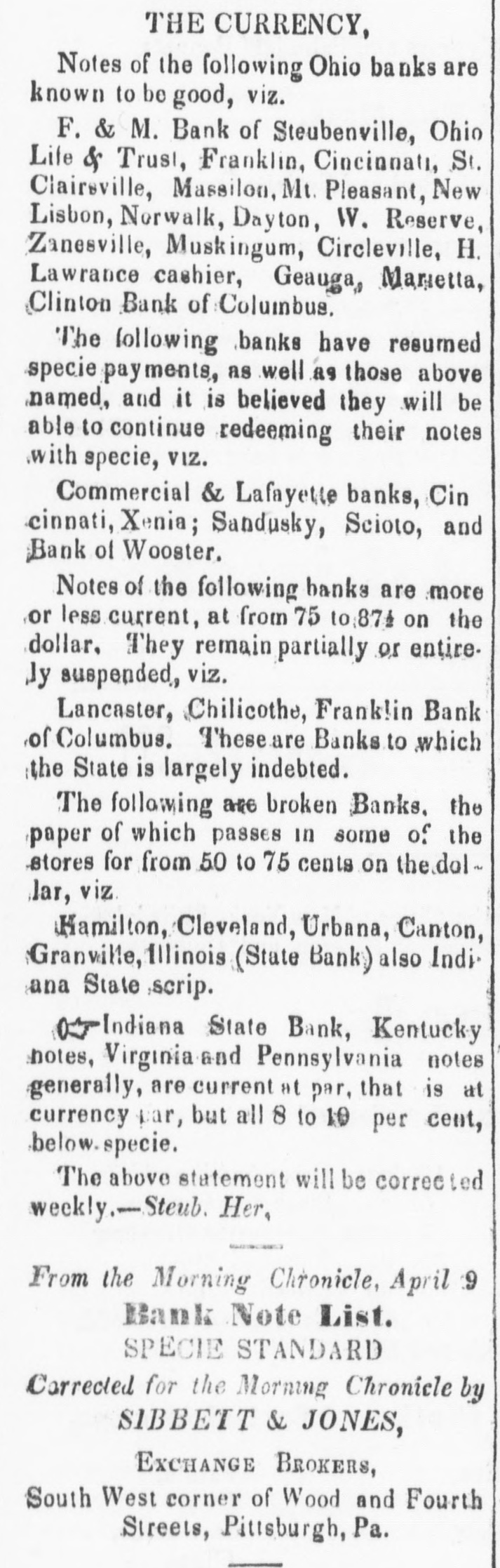
THE CURRENCY, Notes of the following Ohio banks are known to be good, viz. F. & M. Bank of Steubenville, Ohio Life & Trust, Franklin, Cincinnati, St. Clairsville, Massilon, Mt. Pleasant, New Lisbon, Norwalk, Dayton, W. Reserve, Zanesville, Muskingum, Circleville, H. Lawrance cashier, Geauga, Marietta, Clinton Bank of Columbus. The following banks have resumed specie payments, as well as those above named, and it is believed they will be able to continue redeeming their notes with specie, VIZ. Commercial & Lafayette banks, Cin cinnati, Xenia; Sandusky, Scioto, and Bank of Wooster. Notes of the following banks are more or less current, at from 75 10,874 on the dollar. They remain partially or entire. ,ly suspended, viz. Lancaster, Chilicothe, Franklin Bank of Columbus. Theseare Banks to which the State is largely indebted. The following are broken Banks, the paper of which passes in some of the stores for from 50 to 75 cents on the dol lar, viz. Hamilton, Cleveland, Urbana, Canton, Granville, Illinois (State Bank) also Indi. ana State scrip. Indiana State Bank, Kentucky notes, Virginia and Pennsylvania notes generally, are current at par, that is at currency car, but all 8 to 10 per cent, below.specie. The above statement will be corrected weekly.-Steub. Her, From the Morning Chronicle, April 9 Bank Note List. SPECIE STANDARD Corrected for the Morning Chronicle by SIBBETT & JONES, EXCHANGE BROKERS, South West corner of Wood and Fourth Streets, Pittsburgh, Pa.


Article from The Ohio Democrat, April 21, 1842

Click image to open full size in new tab

Article Text

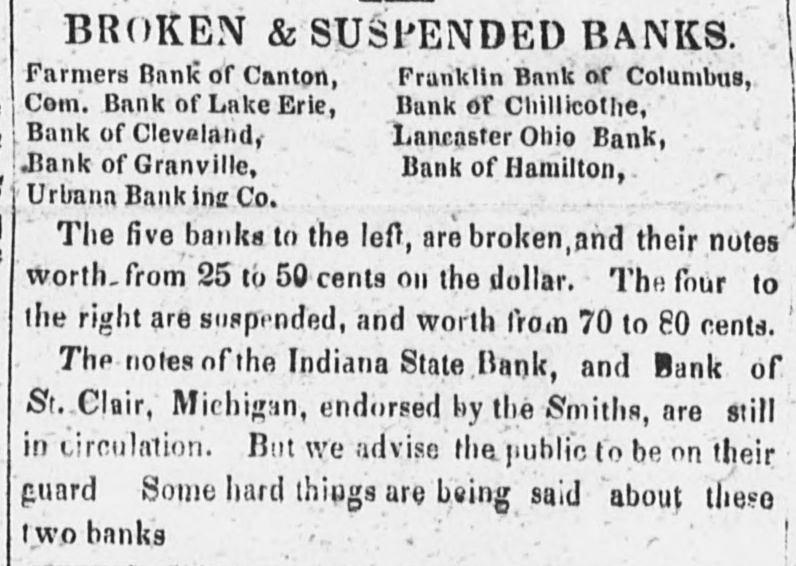
BROKEN & SUSPENDED BANKS. Farmers Bank of Canton, Franklin Bank of Columbus, Bank of Chillieothe, Com. Bank of Lake Erie, Bank of Cleveland, Lancaster Ohio Bank, Bank of Granville, Bank of Hamilton, Urbana Bank ing Co. The five banks to the left, are broken, and their notes worth. from 25 to 50 cents OII the dollar. The four to the right are suspended, and worth from 70 to 80 cents. The notes of the Indiana State Bank, and Bank of St. Clair, Michigan, endorsed by the Smiths, are still in circulation. But we advise the public to be on their guard Some hard things are being said about these wo banks


Article from New-York Daily Tribune, September 17, 1842

Click image to open full size in new tab

Article Text

MONEY MARKET. Sales at the Stock Exchange, Sept. 16. cash 8: 25 Harlem R 1100 Sd 84 do cash 843 33d 50 do cash State 75 NY 200 Long 1s! bsod Com 100 92 scrip. b30d 50% 92 cash 100 Hariem 30d 18 Farmers' Loan do 504 s10d 150 cash 36 Mohawk R b30d 50 do $60d 50% SECOND BOARD. 25 Mohawi E 66 do b30d 364 25 Commercial and AVE oncy Watters P. M. FRIDAY There was rather more doing to-day, but no improv ment in prices. Delaware was beavy and dec lined 11 per The sales of Long Island on time. Harlem steady. Mohawk fel off per cent. the last The only sale of Stock Stocks was 3.000 Keatucky Sixes same last sale. For State Sevens 993. terest 1862, asked. Fancies firm The transac tions were$3000 Kentucky Bonds. Sixes for the firmly The Foreign Exchange market closed has steamer at Boston. The amount of very large. Sterling 7 Francs 5.32c, with bills higher. Amsterdam 39 391; Hambarg 35 S5 Bremer 751 a 76. Mobile is rather heavier to day and more off ring. North 28 Mobile for other branches. Virginia at 11 discount. The brokers buying Bank Lyons notes at 25 a 30 per cent. discount. There is another Bank belonging to waak cliqueas the Bank of Lyons which is which the brokers generally have confidence. If it should called upon for what owes the State would probably by the board, like the other. There in the street for United States Bar notes, some sales have been made at 41 cents on the dollar. Treasury Notes are quoted at par and 14 discount. None of the notes authorized by the late act of Congress have ap. peared The Receiver of the Lafayette Bank has given notice that all debts due by be paid on presentation at his office. 31 Wall-street, on and after the 19th inst. We noticed few days since, the Farmers' and Mechan. ics' Bank of Rochester stating the circulation not secured. We have seen o-day some new notes of this the face New. arked OR secured by are Bank, which York per cent. stocks. These notes are no doubt well secured and perfectly safe. The American says that the State debt of Alabama, instead of being $15,000,000, as is generally supposed, only $9,874,550, payable from 1844 to 1866, bearing an annual in terest, including exchange, of 8526,341, or 51 per cent. This the State can be called upon to pay, even in case of total loss of the capital of the State Bank and branches. The entire receipts of the United States from 1789 to 1840 were $1,112,076,586. The entire expenditures were $1,082, 113,422. of which $436,700,648 were on account of public debt. Business in stacks is dull at Philadelphia The Banks are of ineans, and discoant all the good business paper offering The following stocks sold in Boston 103 per cent. ad shares Boston and Worcester Railroad vance; 20 do Western Railroad, $641 a 641 shares; Boston and Maine Ra ilroad, 79 pershare do Boston do Eng $500 : New 8115-par Company change Bank,971; 7 do Atlantic Bank. 864: do Eagle Bank Neponset Bank, 4do Methuen Manufactur Company,2 Jassachusetts Fives. 1857, offered but not sold, only 83 being bid. Demands belonging estate of Grant, Seaver & Co. to the amount $76,000, for ciniling $4,400 dema against the United States, sold $1,532.5M The Franklin Bank of Columbus, Ohio, is again on its legs, having reco from the embarrassment arising out of its loan to the State. On the 7th inst. had $85,278 Cirspecie $20,000 funds New-York Bank notes $11,536. culation $187,332 D reposites $79,145. The principle of Metual Insurance has been adopted in Baltimore. The Bahimore Insurance Company is winding up, and in its place the Atlantic Mutual Company has been organized. At Cincinnati, Exchange on New-1 York had declined 10 21 premium. At Louisville the Banks were drawing for customers in small sums 1 premium. The supply out of doors was 85 equal to the demand. Kentucky SO year Bonds 75 Scrip 70. The Savannah Re that is informed that, Central Bank, while in New-York lately, the agen in in-order to pay the interest upon the State bonds due land, deposited two dollars for one in the bills of that Bank. and agreed to pay at the rate of twenty percent. per annum for ninety days, until the deposite was redeemed. Whether the sum deposited was to be forfeited if not redeemed in the ninety days, our informant did not learn. Markets Carefully reported for The Tribune. ASHES.-There are no new bills out to-day, and some of the lots offered yesterday remain unsold, some of holders ab.ut sales of We hear rates. current relove 100 bbls. Pots at $5 874, and 40 to 50 obis. Pearls 62A.The receipts are rather limited, as is usual during this month. The market cannot be considered very firm, although Pots are in pretty fair demand the quoted rate. noticed before as market continues, COTTON.-T quiet, with sales to-day of 250 to 300 bales at previous rates. The stock on the market for sale one reason for the small operations, and also has the effect keep holders firm. of The stock is estimated at about 8,000 bales. A portion the Cotton being shipped goes out from first hands. FLOUR-There has been fair demand to-day for Eastports and for shipment, but not enough to induce holdern ers any advance. The sales of Genesee have been at 4 62j ; we heard of but one sale below that price. Re ceivers are generally firm, but the market cannot be con sidered quite so favorable as yesterday. Michigan has old as at 4 561, but most of the receipts sell at the same rate Genesee, being as good, if not better article, and coming 60. in in good order. A lot of few hundred bbls. sold at Small sales of Troy at 4 62], comprising all afloat. About 1,000 bbls., variou- descriptions, taken for the British Provinces, which 700 were flat Ohio and limitation Genesee at 561, and 300 round Ohio at 4 50. A sale of 100 bbls. Genesee at 4 62 ₫ was reported for London. We quote Geuesee 4 62}; Michigan 563 a 462 Ohio flat 564 of transac no hear exceptwe Southern In 450. round ing parcel of 340 bbls. Richmond Country at 4624 Georgetown new we quote at 87/ a $5; old 25 5371 Brandy wine $5. There is no stock of Southern here of any importance, excepting of urgetown. North River Rye Flour plenty Jersey scarce. We quote the former $8 S 12 ; the later S 25. No sales Corn Meal. Jersey 2 87 2 $3; Brandywise$3; hids. 13 50,4 mos. of about since few days made was sale GRAIN 1,400 busbels North Carolina Wheat at 75c, for milling. To day and yesterday there have been sales of S,500 bushels new Ohio about 93c, and 500 bushels Genesce 93 100c, milling. There is not now much Wheat offering The supplies of Corn continue to be light, and the Eastern demand cannot be supplied. Southern is wanted, and we believe there none on the market. Since our last report of Southern there has been sold 1,500 bushels Yellow Maryland 55c, measure, for the East, and about 3,000 bushels inferior at 58 55c, weight, for distilling. We notice sales to day of 600 to 800 bushels North River at 58c. measure, and 800 Jersey Yellow at 59 60c. No Rye in market, and it i wanted. parcel or IWE offered, to arrive, 59c. Oats are without change moderate business doing, and receipts ample. Old Canal so 31 new so River 28 30; new 26 a 28 for fair quality. No receipts of Barley since the first lot, which sold at 53c. SEEDS We notice sale of 100 bbls. Ohio Clover good. at 84c. for export PROVISIONS There is considerable demand for Pork and the market firm. We notice sale to-day of 700 bbls. Ohio Prime and Mess 5311 as S74 and $8. In Beef there is but moderate business doing at $8 and 62 and at for this State. For Refuse Provisions the demand continues good but the only transactions which we heard of 200 bbis. soft Prime Pork $4. The balance of the parcel is held at 4 25. In Butter and Chee there is no change, and a fair business doing. WHISKY.-Sales of 150 ubls. good Western at 207 21c WHALE OIL.-A further sales of 400 bbls. has been made export. WHALEBONE.-A parcel of 16,000 lbs. has been tab en for ipment at 32jc, an advance of 1)c per lb. on the last sale. TE AS.-The Teas imported in the barque Olof Wych
Article from Democratic Standard, December 13, 1842

Click image to open full size in new tab

Article Text

sources, a strict fidelity in the fulfilment of obligations already contracted, and due caution in the further extension of Sate credit, it cannot be doubted that all our public works will be completed in reasonable time, and every engagement of the State faithfully kept. When this state of things shall exist, the increased wealh and population of the country will enable the Legislature to relieve the burden of taxation, which at this time weighs heavily upon all, but especially upon the farming portion of the State. The presant scarcity of money, and depression of value in the staple products of the country, is greatly to be deplored. In such a state of things, while the amount of taxes the people are compelled to pay, remains the same, the value of labor and property, from which these taxes are to be raised is constantly falling in porportion to the diminution in the amount of money in the country. Measures therefare, which look to a still further reduction of the currency in circulation, are equivalent to an increase of taxation to that amount. The situation of the Banking institutions of the State, is a subject which necessarily cennects itsself intimately with the foregoing suggestions. According to a Report made by the Bank Commissioners to the Legislature in July last, there were in the State at that time, twenty-two Banks doing business, and redeeming their liabilities with coin on demand. Since that report was made, the Franklin Bank of Columbus, which, in consequence of a failure on the part of the State to comply with its engagement, was in a State of suspension, has resumed payment of specie, and may be considered a nongst the soundest institutions of the State. From these data, it will appear that there are at this time twentythree Banks in the State, all of which may be considred as justly entitled to full confidence. Of this number, however, the charters of thirteen expire on the first day of January, 1843, and of two others in January, 1844. The capital of these Banks paid in, from the best data at my command, amounts to about five millions of dollars. Thus, it will be seen, that ithout legislative action on this subject, within the present month, thirteen of the dtwenty-two Banks in the State must immediately cease business operation, and wo others in a year from this time. This will necessarily require about 5 millions of capital, now engaged in furnishing a sound currency, to be withdrawn from that operation, to be collected and paid out to stock holders, many of whom reside in our State. This process must inevitably have the effect to increase existing embarrassment, retard the payment of debts, sink still further the market value of property, impoverish the debtor class of comtauni-ty, without any benefit to the creditor, and result only in advantage to the capitalist, who will be enabled to speculate upon the wrecked fortunes of debtors, who have only property wherewith to pay demands against them. The subject calls for, and I cannot doubt but it will command, the prompt, sincere and patriotic attention of the General Assembly. If Banks are to be tolerated at all, the renewal of the charters of such of them as are now about to expire, and are known to be perfectly solvent, in some forin, alike accessable to stockholders and the public, would seem to be demanded by every consideration of public interest and legislative duty. If it shall be resolved by the Legislature, that the true interests of the State demand the destruction of all Banks and the exclusion of all Bank paper as a circulating medium, then it would be proper to permit the thirteen existing Banks, whose chartered powers are limited to January, 1843, and the two others, limited to January 1844, to expire. This would only leave eight Banking institutions in the State, whose charters falling in within a few years, would bring us by gradual steps to a metalic currency alone, so far as our own legislation could enforce such a state of things. However disastrous to the State such a course of policy might be, it would obviously inflict less evil upon the country, if arrived at by a slow process, than by a sudden and total change of the system now existing. Should such a course of policy be adopted at the present session, in order to avoid the supposed evils of paper money, it will be necessary also to enact laws forbiding the circulating in this State of the Bank paper of any other State or country. The laws of trade will still bring Bank notes in Ohio, in despite of the exclusion of our own paper, whilst neighboring States have Banks, unless Bank paper of all descriptions shall be expelled from our borders by laws to that effect. If, however, the known will of a great majority of the people, and what has hitherto been considered our true interest, are taken as guides, it will hecome the duty, as I doube not it will be the pleasure of the Legislature, to adopt at the present session such a system in reference to this subject as will permanently establish


Article from Carroll Free Press, December 16, 1842

Click image to open full size in new tab

Article Text

this attempt, I became satisfied that further sales, in amount large enough to justify the incidental expenses, could I therefore took no meaafter the sale in June to put sures, not be made, submit last, the these lands in market. I to Legislature the propriety of reducing minimum price of these lands, as at established by law, as which it seems the present mode by practicable the only der 10 effect sales of them at this time. In termining this question, the necessities who have received bonds, near or remote, a and of contractors the prospect value of land, of in the present market at once suggest as rise will themselves bear this upon any measure on which it may ing subject, directly become the necessary Board of to adopt. The Reports of Public Works, and the Commissioners be of the Canal Fund, will in due time the Legislature, present in the facts connected laid detail, before and with and that of branch of the public service, course throw much light on the topic just suggested. The interest on the public debt has been punctually paid, and the instalment to become due on the 1st of Jan. will be promptly and It is a of great 10 every citizen of while in various uary, that just pride 1843, subject gratification portions discharged. the sinking of State, the Union, States and communities, the pressure of the times, have to with faith of Ohio under failed the pledged comply their has compacts, stain been hitherio preserved without a a economy in our resources; a fulfilment of our and due With ready in mento the contracted, proper obligations caution strict the manage fidelity it in can the al. further extension of State credit, not be doubted that all our public works in a and engagement of the will every be completed reasonable State of things faith. time, fully kept. When this State the increased of the country population shall exist, will burden wealth enable of tax and the Legislature to relieve the ation, which at this time weighs heavily upon all, but especially upon the farm of the State. The present of money, and the of in the staple scarcity ing value portion products depression of the In country is greatly to be deplared. a state of things, while the amount to the people are remains the same, the from of such taxes compelled value these of tax lato be raised. is bor as and are property, diminution constantly which in (alling the in proportion to the of money in the country. which look amount sures, therefore, still Mea. far- in ther to a reduction of the currency are equivalent to an increase to that amount. ion of the banking circulation, of taxation institutions The of situa. the is a subject which necessarily itself intimately connects State, with the 10 fore. re. suggestions. According a the Bank the in July last, going port Legislature made by Commissioners to there were in the State at that time, twenty.two business. and redeeming with coin on Banks their liabilities doing demand- the Frank Since that report was made, lin Bank of Columbus, which, in conse the of a failure on the part of quence with its engagements. a state of State wasin to comply suspension. and has resum be ed the payment of specie, may institu considered among the soundest tions of the State. From this data, it will appear that the there are at this time 23 banks in State, all of which may be justly entitled confidence. of this number, the charters of on 1st of January, 1843, however, to the full thirteen and expire of two others in January, 1844. The capital of these banks paid in, from the best da about command, amounts to a millions of dollars. that without five be at seen my legislative Thus it action month will on this subject, within the present State of the 23 banks in the cease business operations, others in a year from this must thirleen time. and This mil- two will necessarily require about five lions of capital, now ongaged in fornish a sound currency, to be withdrawn and that to be out to stockholders, many paid ing from operation, collected of whom reside in other States. This process in have the of debta, sink value of property, sh the debtor class of must crease the the market payment inevitably existing embarrassments, community, effect still impover. further to retard with benefit to the creditor, and reout any in advantage to the capitalist,


Article from The New York Herald, January 10, 1843

Click image to open full size in new tab

Article Text

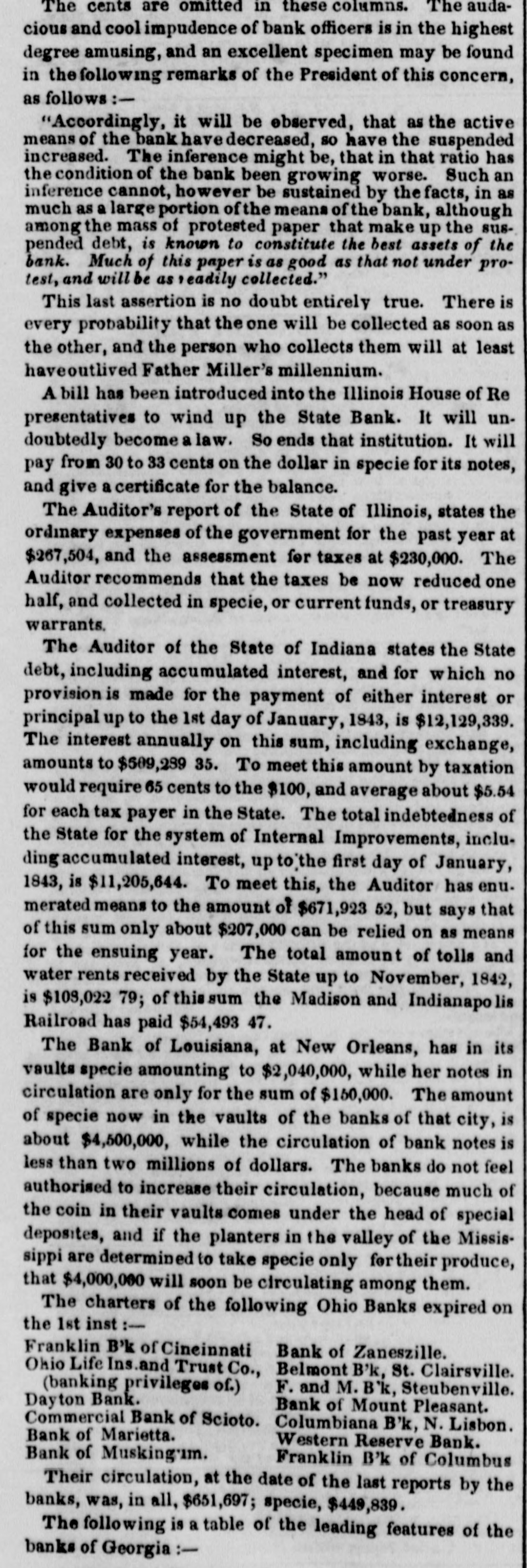
The cents are omitted in these columns. The audacious and cool impudence of bank officers is in the highest degree amusing, and an excellent specimen may be found in the following remarks of the President of this concern, as follows :"Accordingly, it will be observed, that as the active means of the bank have decreased, so have the suspended increased. The inference might be, that in that ratio has the condition of the bank been growing worse. Such an inference cannot, however be sustained by the facts, in as much as a large portion of the means of the bank, although among the mass of protested paper that make up the suspended debt, is known to constitute the best assets of the bank. Much of this paper is as good as that not under protest, and will be as eadily collected." This last assertion is no doubt entirely true. There is every probability that the one will be collected as soon as the other, and the person who collects them will at least haveoutlived Father Miller's millennium. A bill has been introduced into the Illinois House of Re presentatives to wind up the State Bank. It will undoubtedly become a law. So ends that institution. It will pay from 30 to 33 cents on the dollar in specie for its notes, and give a certificate for the balance. The Auditor's report of the State of Illinois, states the ordinary expenses of the government for the past year at $267,504, and the assessment for taxes at $230,000. The Auditor recommends that the taxes be now reduced one half, and collected in specie, or current funds, or treasury warrants. The Auditor of the State of Indiana states the State debt, including accumulated interest, and for which no provision is made for the payment of either interest or principal up to the 1st day of January, 1843, is $12,129,339. The interest annually on this sum, including exchange, amounts to $509,289 35. To meet this amount by taxation would require 65 cents to the $100, and average about $5.54 for each tax payer in the State. The total indebtedness of the State for the system of Internal Improvements, including accumulated interest, up to the first day of January, 1843, is $11,205,644. To meet this, the Auditor has enu. merated means to the amount of $671,923 52, but says that of this sum only about $207,000 can be relied on as means for the ensuing year. The total amount of tolls and water rents received by the State up to November, 1842, is $103,022 79; of this sum the Madison and Indianapo lis Railroad has paid $54,493 47. The Bank of Louisiana, at New Orleans, has in its vaults specie amounting to $2,040,000, while her notes in circulation are only for the sum of $150,000. The amount of specie now in the vaults of the banks of that city, is about $4,500,000, while the circulation of bank notes is less than two millions of dollars. The banks do not feel authorised to increase their circulation, because much of the coin in their vaults comes under the head of special deposites, and if the planters in the valley of the Mississippi are determined to take specie only for their produce, that $4,000,000 will soon be circulating among them. The charters of the following Ohio Banks expired on the 1st inst :Franklin B'k of Cineinnati Bank of Zaneszille. Okio Life Ins and Trust Co., Belmont B'k, St. Clairsville. (banking privileges of.) F. and M.B'k, Steubenville. Dayton Bank. Bank of Mount Pleasant. Commercial Bank of Scioto. Columbiana B'k, N. Lisbon. Bank of Marietta. Western Reserve Bank. Bank of Musking-im. Franklin B'k of Columbus Their circulation, at the date of the last reports by the banks, was, in all, $651,697; specie, $449,839. The following is a table of the leading features of the banks of Georgia :-