17310. Bank of Cleveland (Cleveland, OH)

Bank Information

Episode Type
Suspension → Closure
Bank Type
state
Start Date
February 22, 1842
Location
Cleveland, Ohio (41.499, -81.695)

Metadata

Model
gpt-5-mini
Short Digest
874c288d

Response Measures

None

Description

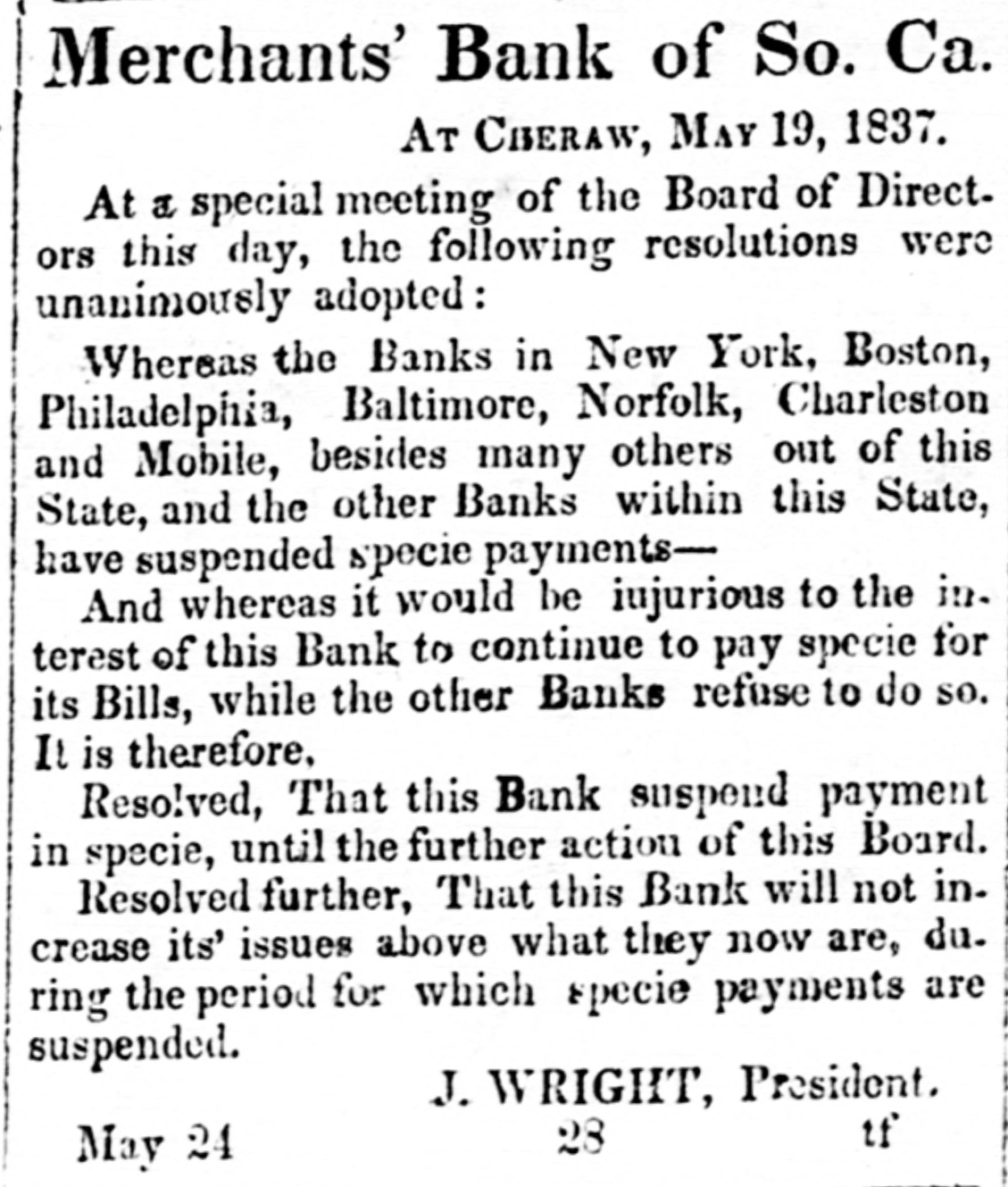
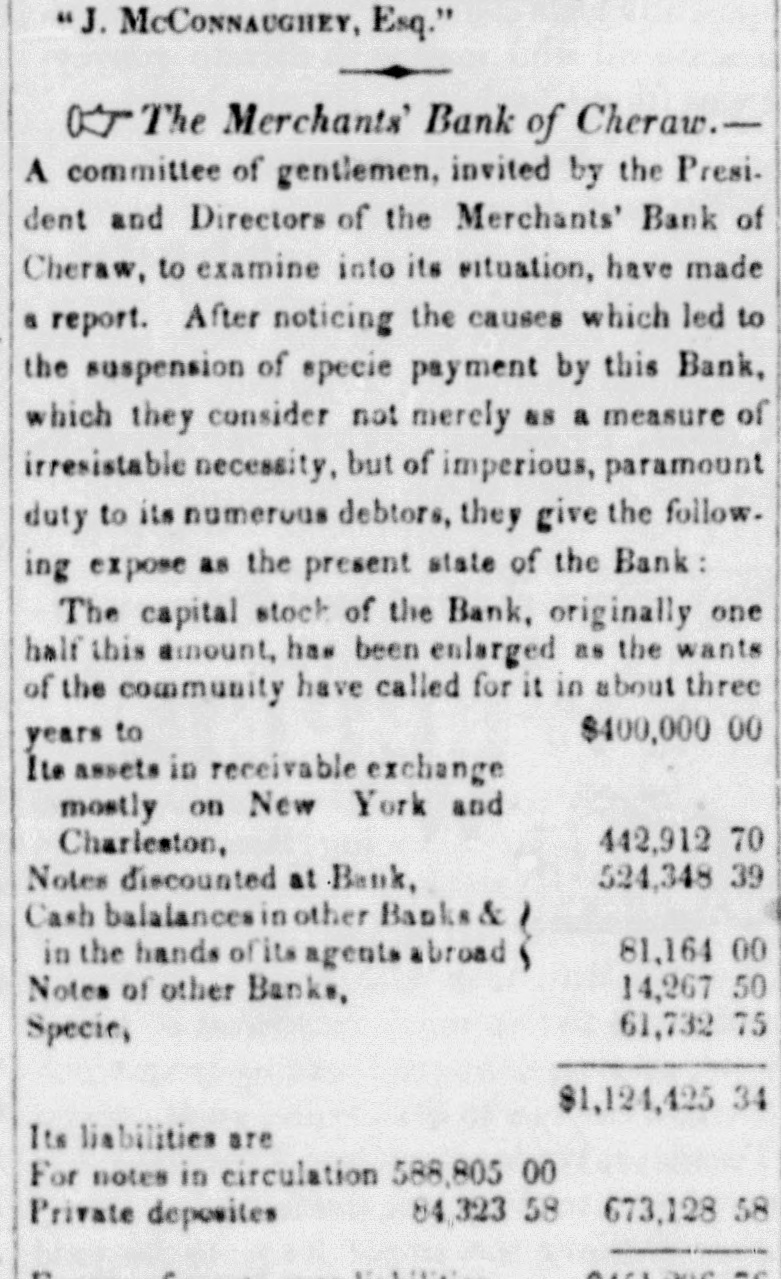
Articles (Feb–May 1842) report the Bank of Cleveland paying off depositors, winding up, its notes heavily discounted, and receivers appointed to close affairs. No run is described; court-appointed receivers and 'closing up' indicate suspension followed by permanent closure/receivership. Cause of suspension likely driven by the broader resumption law/specie demands and bank insolvency pressures (treated as government_action leading to suspension/liquidation). Dates derived from article publication dates (Feb 22 note about paying off; receivers/salary discussion in May 27).

Events (5)

1. February 22, 1842 Suspension
Cause
Government Action
Cause Details
Pressure from the Ohio resumption/specie payment requirements and consequent winding up; notes discredited and bank preparing to wind up rather than continue specie payments.
Newspaper Excerpt
The Bank of Cleveland, as well as the Commercial Bank of Lake Erie, are paying off their depositors and winding up their concerns.
Source
newspapers
2. March 31, 1842 Other
Newspaper Excerpt
Bank of Cleveland ... 62 dis (discount) (listed among suspended/broken banks).
Source
newspapers
3. April 21, 1842 Other
Newspaper Excerpt
BROKEN & SUSPENDED BANKS ... Bank of Cleveland (listed among broken/suspended banks).
Source
newspapers
4. May 27, 1842 Other
Newspaper Excerpt
The Court of Common Pleas ... fixed the salaries of the SIX Bank Receivers appointed to close up the affairs of the Commercial Bank of Lake Erie and the Bank of Cleveland, at FIFTEEN HUNDRED DOLLARS each receiver per annum!
Source
newspapers
5. May 27, 1842 Receivership
Newspaper Excerpt
salaries of the SIX Bank Receivers appointed to close up the affairs of the Commercial Bank of Lake Erie and the Bank of Cleveland
Source
newspapers

Newspaper Articles (7)

Article from New-York Tribune, February 15, 1842

Click image to open full size in new tab

Article Text

# SECOND BOARD. 1,000 Illinois.... 18 4,000 do..s 10 days 20 1,000 Indianas8 days 19 8,000 do... Thursday 19 2,000 do.... 19 2,000 dob 3 days 19 There has not been much change in Inland Bills. We quote- Philadelphia 7 a 71; Baltimore 3 a 31: Virginia 9 a 94; N. Carolina 5 a 51: Charleston 11 a 14; Savannah 24 a 2; Au- gusta 24 a 24; Macon 14; Columbus 15: Mobile 12 a 123: Montgomery 131; New-Orleans 6 a 61; Nashville 14 a 15; Louisville 9 a 10; Cincinnati a 16; Indiana 15 a 19; Illi- nois 25. We see by an advertisement that R. M. Blatchford, Esq. Receiver of the Commercial Bank, instead of paying thirty per cent dividend to the creditors of that institution to-day will to-morrow pay forty-four per cent. When will Gov. Marcy be prepared to pay a dividend to the creditors of the City Bank of Buffalo? He was appointed receiver some two years since and nothing has been heard of him since. The Express of yesterday says: The new Comptroller, Mr. Flagg, has sent a letter to the several banks of this city to whom the State of New-York is indebted, stating that the temporary loan borrowed of the banks, amounting to one million two hundred and five thousand dollars, and due on the 1st of March, will not be paid until the Comptrolier can raise money on new stocks, which are authorized to be issued. This is the first act of the new Comptroller, and a most se- rious one it is. The banks hereafter will be exceedingly cautious how they lend money even to the great and power- ful State of New-York, when it is in the hands of those who pay so little regard to its obligations. The Assembly of New-Jersey have passed the bill requir- ing the Banks to pay specie for $5 notes and under on the 4th of July next, and for all notes on the 1st October. The bill which passed the Council requires all notes to be paid in specie on the 4th of July. Should the Philadelphia Banks resume before the 1st October, the West Jersey Banks are required by the Assembly to do so also. The Cincinnati Gazette of the 3d says: 'The excitement among the people has become distressing. Whatever notes are held, they send to the broker's office to sell-the discount is not considered-what one sells another will buy. The banks yesterday determined, that if required to pay specie on the 4th of March, they must begin to prepare to protect themselves. They have determined that they would not that day receive the following notes-Urbana Bank, Com- mercial Bank of Lake Erie, Bank of Cleveland, Merchants' and Mechanics' Bank of Wheeling.' It has been stated that the Chillicothe Bank owned $75,- 000 of the stock of the Gerard Bank. This is now denied. The Chillicothe Gazette states that there are no rumors there to the discredit of that or the Lancaster Bank.


Article from New-York Tribune, February 22, 1842

Click image to open full size in new tab

Article Text

SECOND BOARD. 2,000 Indiana...b 3 day 19 2,000 do 96 1,000 do 19 There have been some sales of Francs to-day at 5.281. In sterling there is very little doing. The leading rate is 8 a 31. On Amsterdam 391 a 40: Bremen 76 a 77: Hamburg 35, a 35. There is a slight decline in the rates on Philadelphia and N. Orleans. On Illinois the rate is worse. We quote Phila- delphia 5a 51: Baltimore sa 3, Virginia 75 a 81: Mobile 14 a 154; New-Orleans 65 a 6: Cincinnati 13, St. Louis 17: Louisville 9. For the stock of the Lafavette Bank 15 was offered to-day It is privately stated that the bills of this Bank will be re- deemed in 90 days. The Brokers are buying at about 8 per cent, discount. The Bank of Cleveland, as well as the Commercial Bank of Lake Erie, are paying off their depositors and winding up their conceres. The circulation of the Banks of Baltimore on the 17th was $894,000; specie on hand $2.200,000. A bill has been reported in the Pennsylvania Legislature to annul the charter of the Bank of Chambersburg. Nothing decisive has yet been done in the Legislature on the subject of resumption. The moderate men of both parties think the Ist of August early enough. The resumption bill is still under consideration in the Ma- ryland Legislature. Several large failures have taken place in Philadelphia; among them the firm of Charles Davidson & Son and J. F. Ohl. Some failures, we understand, had also occurred in Boston. The Citizens Bank of N. Orleans has again suspended specie payment. Since the passage of the resumption act many of the Banks, among them the Bank of Louisiana, de- cline deposits except in geld and silver, and are preparing to wind up. The Banks of Tennessee are to resume on the 1st January next. The bill forcing the Banks of Ohio to resume on the 4th March has passed the Senate. The Banks are about to hold a Convention at Columbus. The notes of the Bank of Cleveland are discredited at Cincinnati. The Urbana Bank has made an assignment. The resumption bill recently passed by the Legislature of Louisiana requires that the Banks, after the S0th Sept., 1842, shall pay their liabilities in specie, and upon refusal to pay, the protest of the Notary shall constitute the forfeiture of the charter of the Bank. All the parties to commercial paper, which is not paid at maturity, are to be reported to all the Banks, and no discounts made to them until such paper is full. A Board of Currency is appointed, witk full powers of supervision, &c. The Banks are required to make weekly reports to this Board, and the Board are tu make an annual report to the Legislature. No commercial paper is to be discounted having over 90 days to run and no renewal al- lowed. The account of any person asking such renewal is to be closed with the Bank and notice given to all the other Banks. Any Director absenting himself from the State thirty days, or failing to appear at five consecutive meet- ings of the Board, is to be considered as having resigned. The act also regulating the loans and discounts at the Banks, and the terms upon which the 'dead weight' or extended debt may be settled. The Banks are allowed to issue notes payable 30th September, to twice the amount of the specie on hand, provided an equal amount of Louisiana State Bonds, or bonds and mortgages with twenty per cent ex- cess shall be deposited as security with the Board of Cur- rency. The above notes shall be received by all the Banks. The act provides for placing Banks in liquidation, and re- quires Banks not in liquidation to receive at par, in payment of debts, the bills of such Banks, which are to be distributed according to the circulation of the Banks not in liquidation, and the cash assets of the liquidating Banks are to be distri- buted in like proportion. Eight per cent interest to be charged on bills so received, and they to be secured by oth- er assets of the Bank. Banks are required to accept this act within twenty-five days, or the Attorney General must sue for the forfeiture of the charter, and if he does not within ten days the Government is authorised to declare his place vacant and appoint another. The Banks after thirty days are forbidden to pay out asy but their own notes and are required to pay balances weekly in specie. ### New-York Market. ASHES-Between 50 and 60 barrels Pots have been taken by the principal holder in the market 6371. In Pearls we hear of no transactions. They are held at 575; but could be bought at a lower rate. COTTON-The market is very quiet in anticipation of the arrival of the steamer. FLOUR-The market continues exceedingly heavy, and the operations are too tritling for report. The large holders generally demand 625 for Genesee, but this price is obtained only for small parcels. Sales Rochester are reported as low as 6 124. We quote New-Orleans at 6 60: Ohio 6124: Troy 661a 6 121. Sales 800 barrels-some Western at 475. No important sales Southern; but 2,000 barrels Georgetown for England are in negotiation. We quote Georgetown and Howard st. 6.00; Brandywine 600; Alexandria and Fred- ericksburgh 5 75 a 6.00. Sales 50 hhds, Brandywine Corn Meal at 15.00,4 mos. to arrive. GRAIN-The market is very quiet. No Wheat yet offer- ing. No sales Rye. The parcel Northern is yet unsold.- No such sale as reported in the Journal of Commerce has been made. Corn is dull. A cargo Southern, afloat, unsold. Sales 8,000 bushels Southern Oats at 464 a 47. ### New-York Cattle Market. [Reported for The Tribune.l


Article from The New York Herald, February 22, 1842

Click image to open full size in new tab

Article Text

ана ше шеcur, law Hotes and Blue denier enлогы them, and did the cashier discount them with the funds of the bank? Did the cashier agree with the builder that he and his partner would provide for the notes, and that in no event shoull the builder be called upon to pay them? Were these lots and buildings afterwards mort gaged to a free banking association, and the amount taken in its stock? How many thousand dollars in fa- cilities did the cashier grant this dealer? Was it not beyond the teens? When the directors discovered how iarge this man's liabilities were, and ordered them to be reduced, did not the cashier allow him to overdraw his account, and then discount other notes to make good such overdrafts? How many thousand dollars will the bank lose by this man? What sort of settlement has he made with the bank? Hss the cashier given security for his propertion? What other and large facilities did the cashier allow this director? These are some of the questions pertinent to the state of affairs that were asked of Mr. Chandler Starr, on and about 1st of November, and yet neither in his report, nor publicly has he answered them in any shape. The public are now told that the bills will be paid in nanty days-by what means is not stated. The safety fund has ceased to exist for all practical purposes, and the assets of the bank, it may be supposed, will be realized with difficulty. The legislature has before it resolutions pro posing an investigation into the conduct of the commis sioners, and the quicker it is brought about the better for the community, and for other banks. There are three or four other institutions, both chartered and free, the notes of which are very low in the market, and if deposi- tors suddenly find their funds locked up from them they must not be surprised. The resumption bill has at length been perfected in the Ohio legislature, and the sound banks are collect- ng their debts and discharging their liabilities as fast as possible. The bill provides also for the just distri- bution of the assets of the insolvent banks, as follows:- Any bank which shall fail or refuse to pay in coin on demand, any note or other evidence of debt, issued by or for the bank, and intended to circulate as money, shall be deemed to have abandoned and forfeited its charter, and to be insolvent, and the president, directors, and stockholders shall be held jointly and severally liable in their individual capacity, for all acts done or liabilities incurred after such refusal to pay. If any bank, which has refused to pay as aforesaid, or is in an insolvent or falling conditton, shall, after the passage of the act, transfer any of its effects for any purpose, such transfer shall be utterly void. This law will have a very beneficial effect in giving a sound currency to Ohio, and rapidly sweep away the rubbish left by the failing banks. The Commercial Bank of Lake Erie has been paying off its depositors, and has nearly exhausted its ready means. It is going on collecting its debts, and, as fast as it realizes any funds, it applies them to discharging its liabilities. The Bank of Cleveland has also adopted the same course. It has paid nearly all of its depositors, and will collect as fast possible and provide for its liabilities. The rich and populous State of Ohio, the credit of which a short time since, stood highest in the market, and its stock was one of the three which was selected by the administration of Paris for introduction upon the Bourse, on account of its high character, and is now, by the mere influence of the borrowing policy of its rulers, who chose rather to sell the right of suspension to the banks for the means of paying the state debt, than honest- ly to confine its expenditures within legitimate means, and levying taxes for the amount, selling at 32 per cent discount. In order to show the actual resource of that state we give the table of the appraised value of certain descriptions of property within the state returned in 1941 appraised for taxation. It may be remarked, that the val- uations falls far short, generally, of the true one; this is particularly the case in reference to real estate, which is returned often at one fourth its true value. RESOURCES OF OH


Article from The Ohio Democrat, March 31, 1842

Click image to open full size in new tab

Article Text

SPECIE PAYING BANKS. Western Reserve Bank, Farmers and Mechanics Bank Steubenville, Columbiana Bank of New Lisbon, Bank of Mt. Pleasant, Belmont Bank of St. Clairsville, Bank of Marietta " Zanesville, " Muskingum, " Circleville (old) Ohio Life Ins. & Trust Co. Bank of Norwalk, Deyton Benk, Bank of Geauga, " Wooster, " Massillon, Sandusky, Xenia, Franklin Bank of Cincinnati, Lafayette. is " Commercial Commercial Bank of Scioto, Glinton Bank of Columbus, The Columbus Statesman, contains a 'Specie basis Bank Note Table," in which the value of the following suspended andbroken Bank notes, is thus rated: Franklin Bank of Columbus, 18 discount, 20 dis. Bank of Chillicothe, 25 dis: Lancaster Ohio Bank, 50 dis Bank of Hamilton, 50 dis Farmers Bank of Canton, 50 dis Con mercial Bank of Lake Erie, 60 dis Bank of Cleveland, 62 dis Bank of Granville, 75 dis Urbana Banking Co. INDIANA. 10 dis State Bank'& Branches, 50 dis State Scrip, 5s MICHIGAN. 10 dis Bank of St. Clair, Indorsed by Smithe 10 dis


Article from The Ohio Democrat, April 21, 1842

Click image to open full size in new tab

Article Text

BROKEN & SUSPENDED BANKS. Farmers Bank of Canton, Franklin Bank of Columbus, Bank of Chillieothe, Com. Bank of Lake Erie, Bank of Cleveland, Lancaster Ohio Bank, Bank of Granville, Bank of Hamilton, Urbana Bank ing Co. The five banks to the left, are broken, and their notes worth. from 25 to 50 cents OII the dollar. The four to the right are suspended, and worth from 70 to 80 cents. The notes of the Indiana State Bank, and Bank of St. Clair, Michigan, endorsed by the Smiths, are still in circulation. But we advise the public to be on their guard Some hard things are being said about these wo banks


Article from Carroll Free Press, May 27, 1842

Click image to open full size in new tab

Article Text

From the Cleveland He:ald. WHO WOULDNT BE A BANK RECEIVER? THE WAY THE AS. SETS GO!-LOCO FOCO REGARD FOR POOR NOTE HOLDERS! The Court of Common Pleas-Judge Warren, the only White on the Bench, disseating have fixed the salaries of the SIX Bank Receivers appointed to close up the affairs of the Commercial Bank of Lake Erie and the Bank of Cleveland, at FIFTEEN HUNDRED DOLLARS each receiver per annum! The law allows the receivers two years 10 wind up the banks in, so that this item alone will eat out EIGHTEEN THOUSAND DOLLARS of the best assest of two banks, for be it recullected, that these "funeral expenses," 88 they are appropriately stvied by one of the receivers, belong to the first class of claims to be cancelled under the law. Then the reasons assign. ed for the extravegant salaries-"Heavy bail is exacted of the receivers-the reare sponsibility is great." Conclusive, itey not? honest bill holder; already shaved out of fifty or sixty per cent. on dollar. and a strong prospect that "funeral expenses" will take the last copper from the eyelids of the "dead monsters!" Bir lot US figure a little. Arithmetic oltimes useful in bank matters. The salary of three receivers for the Bank of Cleveland, one year, 18 $4,500, This is to be paid in the "hard," or its equivalent. Three dollars in Cleveland paper are now worth hardly one in specie.Three times 4500 will be thirteen thousand five hundred dollars! Sal ry for two years, twenty.seven thousand dollars in Cleveland paper! provided note holders lose only some sixty-six cents on the dollar!! But the paper mustgo down still lower, if assets are thus squandered. The Bank of Cleveland will soon take up all its circulation at this rate, or rath er the receivers will, and no mistake.Nearly the same figuring will apply to the Commercial Bank of Lake Erie.The difference is, that the paper of that bank is now worth some sixty cents; but how long il will remain so under such a system of spoils as thie allowance of sal. aries exhibits, time will determine. We do not ceasure the receivers for rec. 6 eiving liberal salaries as the court choose 10 allow. Not at all; for some $5 per day will make pockets feel pretty com fortable these hard times, and their good luck will induce many others to wish similar "friends at court." Already the Ohio Railroad Company are besieged with applicants for receivership! e P. S. We have just learned that the Locofoco court very generously tnok the burden of labor from the well paid Loco foco receivers, by allowing each board a 0 clerk's salary of $500! TEN THOUSAND DOLLARS a year "funeral ex penses" for two dead banks! A costly e wake that! Honest note holders, how do ye like paying the piper? We hope you may not be called on to contribute more than the entire notes you hold!


Article from Carroll Free Press, December 16, 1842

Click image to open full size in new tab

Article Text

No. 10--WHOLE No. 426 en. salaries, he spurned it with scorn and pa contempt"- - and also the other ope charges of the gentleman That atved tempts had been made to entrap him, to eel get him to compromit himself upon this nd, matter, thereby to find grounds of imons peachment, and remove him from a staun. tion that certain gentlemen were opposda. ed to his occupying. That the public should judge between them. for he was determined that their proceedings, with upon the records of the Court, & printthe exceptions thereto, should be april ed in the journals of the State. Benjamin Harrington, Esq. another of and the Receivers of the Bank of Cleveland, ake also addressed the Court; but in respect. ivful language. Mr. Harrington claimed are that the Back was able to pay all the to bill holders and have something left.ad Whereupon Judge Hay ward asked him. the if he had not good reason to believe, that ing there was a large amount of the said bills ala. out standing, of which they had no account ted and which did not appear on the books of ers the bank. To this seirching interroga. ed, tory Mr. Harrington replied-that he er. had reason to believe there was, and that he would give his reasons if required. the His Honor said he would not ask it at ong this time." de Such, says the Cleveland Herald from rewhich we take this account, was the de painful exhibition made in open Court. a W. 8 to It is a war, that paper continuer, between brethren of the same political faith, and at the result will be, if it is continued as em de it has begun. that, to use their own clashe sie language, "dog will eat dog." Yet this is the result of our promised back ore reform. This is the hatred of Locoloco on. leaders towards Banks! But more on ect this subject anon. - Cin. Gaz.