17239. Franklin Bank (Cincinnati, OH)

Bank Information

Episode Type
Suspension → Closure
Bank Type
state
Start Date
January 1, 1843
Location
Cincinnati, Ohio (39.103, -84.515)

Metadata

Model
gpt-5-mini
Short Digest
49df3292

Response Measures

None

Description

The articles describe the Franklin Bank of Cincinnati making an assignment and winding up/liquidating its affairs in 1843, with stockholders seeking receivers and courts addressing the assignment. There is no description of a depositor run; the sequence is a suspension/assignment and liquidation leading to receivership/closure.

Events (3)

1. January 1, 1843 Suspension
Cause
Voluntary Liquidation
Cause Details
Charter expiration and the bank made an assignment and later stockholders passed resolutions to wind up and dissolve the institution; trustees/assignees were handling assets rather than resuming normal operations. Court disputes over assignees followed.
Newspaper Excerpt
The charters of the following Ohio Banks expired on the 1st inst : Franklin B'k of Cineinnati... The Franklin Bank of Cincinnati has made an assignment.
Source
newspapers
2. February 23, 1843 Other
Newspaper Excerpt
One of the stockholders of the late Franklin Bank of Cincinnati, has filed a bill before the Court of Common Pleas against the assignees, complaining that they continue to transact banking business, and praying the Court to enjoin them from doing so; and to place the Bank assets into the hands of Receivers To be appointed by the Court. (Cited in multiple papers.) Court later decided assignment noll and void; late Directors are Trustees and Court will not appoint Receivers or enjoin the Bank (Mar 22).
Source
newspapers
3. March 22, 1843 Receivership
Newspaper Excerpt
The Court of Common Pleas at Cincinnati have decided that the assignment of the assets of the Franklin Bank to Trustees is noll and void that the late Directors are Trustees, and that the Court will not appoint Receivers or enjoin the Bank.
Source
newspapers

Newspaper Articles (9)

Article from The Middlebury People's Press, February 15, 1842

Click image to open full size in new tab

Article Text

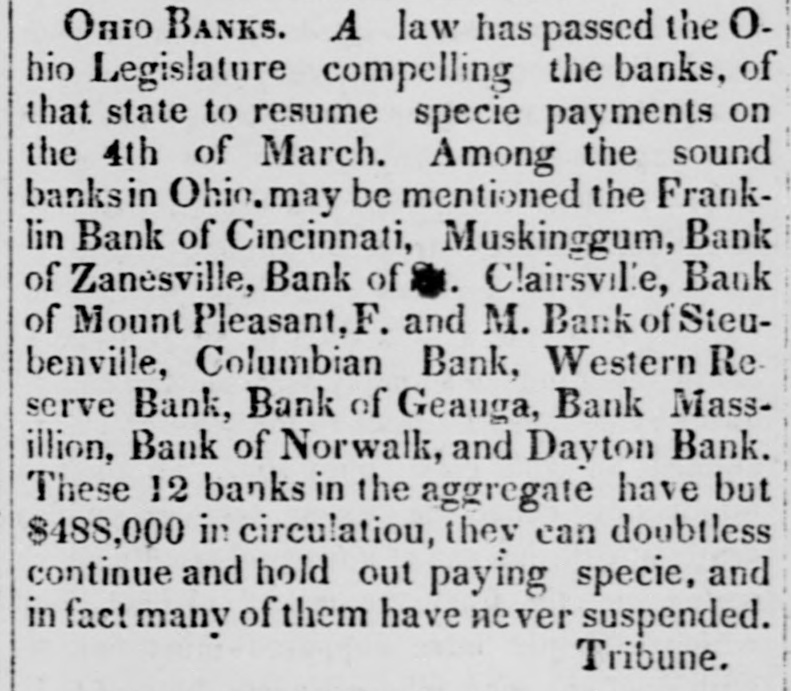
Onio BANKS. A law has passed the O. hio Legislature compelling the banks, of that state to resume specie payments on the 4th of March. Among the sound banks in Ohio, may be mentioned the Franklin Bank of Cincinnati, Muskinggum, Bank of Zanesville, Bank of Clairsvile, Bank of Mount Pleasant, F. and M. Bank of Steubenville, Columbian Bank, Western Re serve Bank, Bank of Geauga, Bank Massillion, Bank of Norwalk, and Dayton Bank. These 12 banks in the aggregate have but $488,000 in circulation, they can doubtless continue and hold out paying specie, and in fact many of them have never suspended. Tribune.


Article from New-York Tribune, February 28, 1842

Click image to open full size in new tab

Article Text

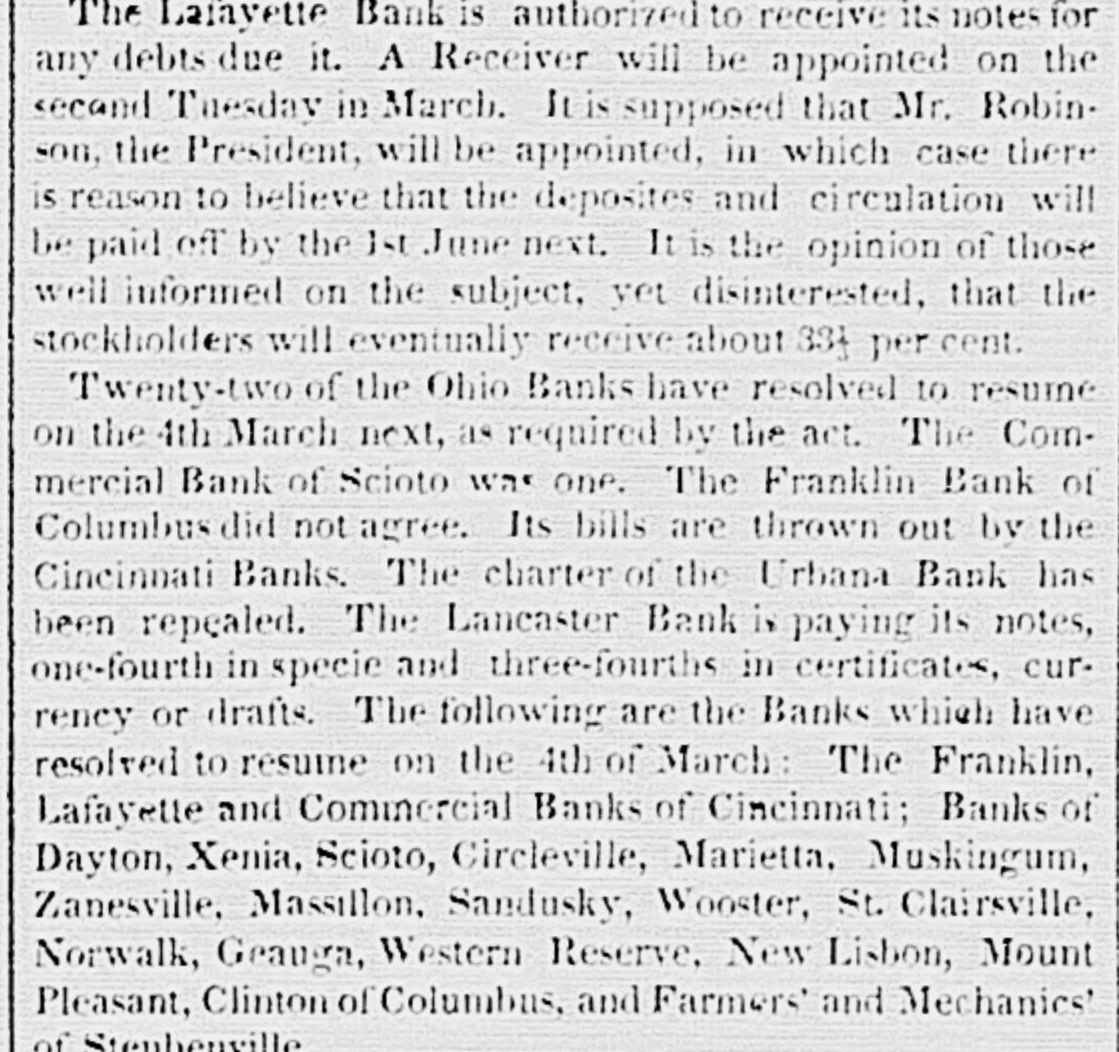
The Lajayette Bank is authorized to receive its notes for any debts due it. A Receiver will be appointed on the second Tuesday in March. It is supposed that Mr. Robinson, the President, will be appointed, in which case there is reason to believe that the deposites and circulation will be paid off by the 1st June next. It is the opinion of those well informed on the subject, yet disinterested, that the stockholders will eventually receive about 33j per cent. Twenty-two of the Ohio Banks have resolved to resume on the 4th March next, as required by the act. The Commercial Bank of Scioto was one. The Franklin Bank of Columbus did not agree. Its bills are thrown out by the Cincinnati Banks. The charter of the Urbana Bank has been repealed. The Lancaster Bank is paying its notes, one-fourth in specie and three-fourths in certificates, currency or drafts. The following are the Banks which have resolved to resuine on the 4th of March The Franklin, Lafayette and Commercial Banks of Cincinnati; Banks of Dayton, Xenia, Scioto, Circleville, Marietta, Muskingum, Zanesville, Massillon, Sandusky, Wooster, St. Clairsville, Norwalk, Geauga, Western Reserve. New Lisbon, Mount Pleasant, Clinton of Columbus, and Farmers' and Mechanics' of Stenhensille


Article from The New York Herald, January 9, 1843

Click image to open full size in new tab

Article Text

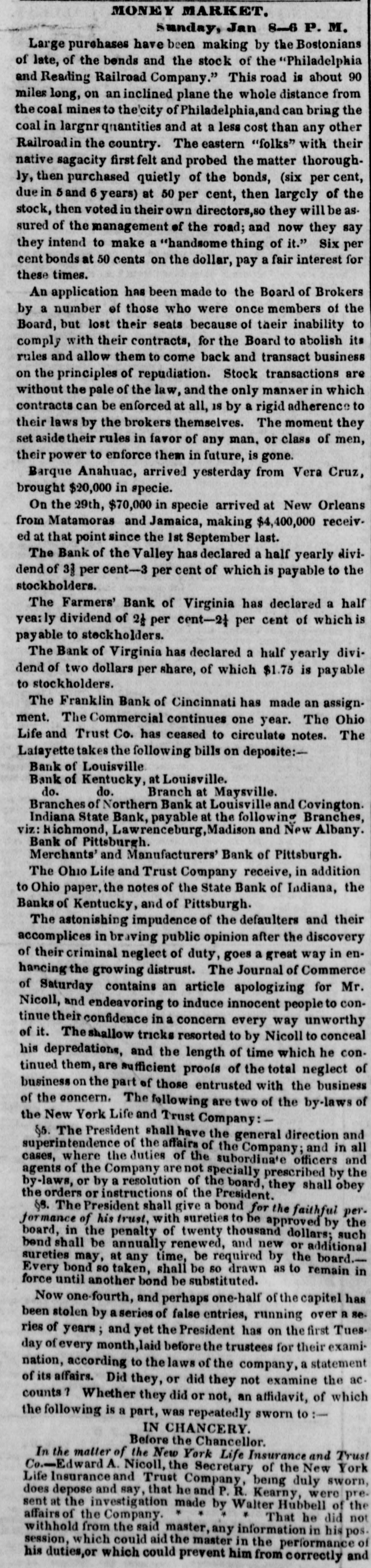
MONEY MARKET. Sunday, Jan 8-6 P. M. Large purchases have been making by the Bostonians of late, of the bonds and the stock of the "Philadelpkia Reading Railroad Company." This road is about 90 miles long, on an inclined plane the whole distance from the coal mines the'city of Philadelphia, and can bring the coal in largnr quantities and at a less cost than any other Railroad in the country. The eastern "folks" with their native sagacity first felt and probed the matter thoroughly, then purchased quietly of the bonds, (six per cent, due in 5 and 6 years) at 50 per cent, then largely of the stock, then voted in their own directors,so they will be as. sured of the management of the road; and now they say they intend to make a "handsome thing of it." Six per cent bonds at 50 cents on the dollar, pay a fair interest for these times. An application has been made to the Board of Brokers by a number of those who were once members of the Board, but lost their seats because of their inability to comply with their contracts, for the Board to abolish its rules and allow them to come back and transact business on the principles of repudiation. Stock transactions are without the pale of the law, and the only manxer in which contracts can be enforced at all, 18 by a rigid adherence to their laws by the brokers themselves. The moment they aside their rules in favor of any man. or class of men, their power to enforce them in future, is gone. Barque Anahuac, arrived yesterday from Vera Cruz, brought $20,000 in specie. On the 29th, $70,000 in specie arrived at New Orleans from Matamoras and Jamaica, making $4,400,000 received at that point since the 1st September last. The Bank of the Valley has declared a half yearly dividend of 3 per cent-3 per cent of which is payable to the stockholders. The Farmers' Bank of Virginia has declared a half yearly dividend of 24 per cent-21 per cent of which is payable to stockholders. The Bank of Virginia has declared a half yearly dividend of two dollars per share, of which $1.75 is payable to stockholders. The Franklin Bank of Cincinnati has made an assignment. The Commercial continues one year. The Ohio Life and Trust Co. has ceased to circulate notes. The Lafayette takes the following bills on deposite:Bank of Louisville Bank of Kentucky, at Louisville. do. do. Branch at Maysville. Branches of Northern Bank at Louisville and Covington. Indiana State Bank, payable at the following Branches, viz: Richmond, Lawrenceburg, Madison and New Albany. Bank of Pittsburgh. Merchants' and Manufacturers' Bank of Pittsburgh. The Ohio Life and Trust Company receive, in addition to Ohio paper, the notes of the State Bank of Indiana, the Banks of Kentucky, and of Pittsburgh. The astonishing impudence of the defaulters and their accomplices in br ving public opinion after the discovery of their criminal neglect of duty, goes a great way in enhancing the growing distrust. The Journal of Commerce of Saturday contains an article apologizing for Mr. Nicoll, and endeavoring to induce innocent people to continue their confidence in a concern every way unworthy of it. The shallow tricks resorted to by Nicoll to conceal his depredations, and the length of time which he continued them, are sufficient proofs of the total neglect of business on the part of those entrusted with the business of the concern. The following are two of the by-laws of the New York Life and Trust Company:§5. The President shall have the general direction and superintendence of the affairs of the Company; and in all cases, where the duties of the subordinate officers and agents of the Company are not specially prescribed by the by-laws, or by a resolution of the board, they shall obey the orders or instructions of the President. §5. The President shall give a bond for the faithful performance of his trust, with sureties to be approved by the board, in the penalty of twenty thousand dollars; such bend shall be annually renewed, and new or additional sureties may, at any time, be required by the board.Every bond so taken, shall be so drawn as to remain in force until another bond be substituted. Now one-fourth, and perhaps one-half of the capital has been stolen by a series of false entries, running over A se. ries of years and yet the President has on the first Tuesday every month,le before the trustees for their examination, according to the laws of the company, a statement of its affairs. Did they, or did they not examine the ac. counts ? Whether they did or not, an atfidavit, of which the following is a part, was repeatedly sworn to:IN CHANCERY. Before the Chancellor. In the matter of the New York Life Insurance and Trust Co.-Edward A. Nicoll, the Secretary of the New York Life Insurance and Trust Company, being duly sworn, does depose and say, that he and P. R. Kearny, were present at the investigation made by Walter Hubbell of the affairs of the Company. That he did not withhold from the said master, any information in his pos. session, which could aid the master in the performance of his duties,or which could prevent him from correctly and


Article from The New York Herald, January 10, 1843

Click image to open full size in new tab

Article Text

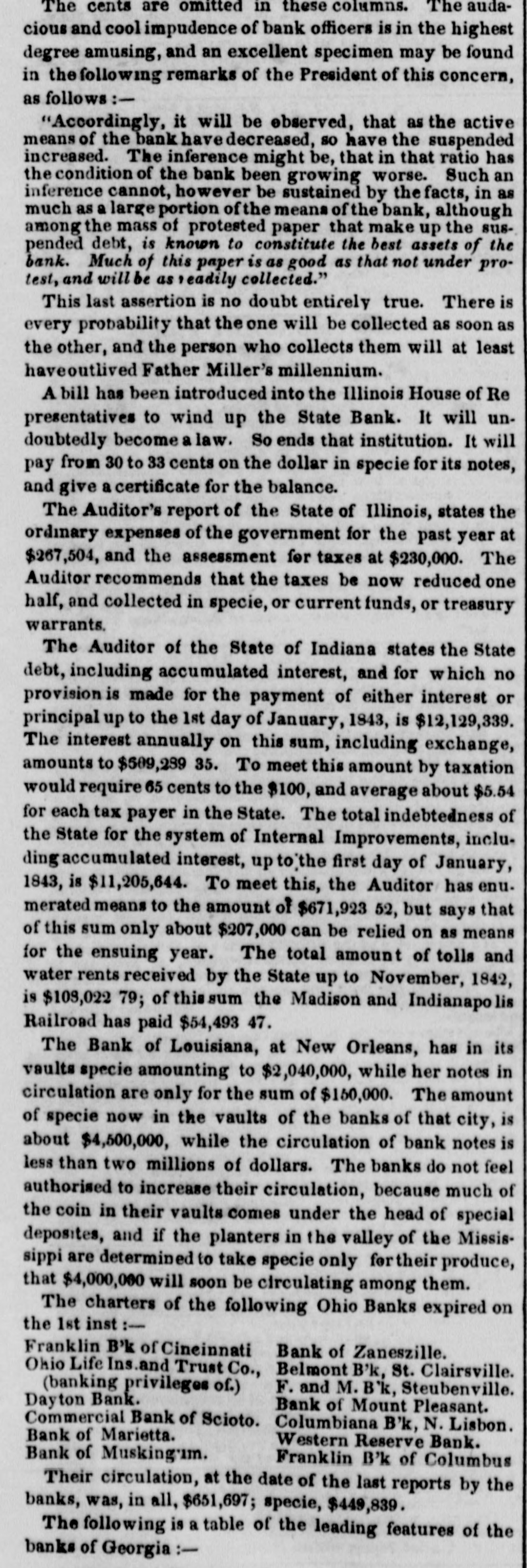
The cents are omitted in these columns. The audacious and cool impudence of bank officers is in the highest degree amusing, and an excellent specimen may be found in the following remarks of the President of this concern, as follows :"Accordingly, it will be observed, that as the active means of the bank have decreased, so have the suspended increased. The inference might be, that in that ratio has the condition of the bank been growing worse. Such an inference cannot, however be sustained by the facts, in as much as a large portion of the means of the bank, although among the mass of protested paper that make up the suspended debt, is known to constitute the best assets of the bank. Much of this paper is as good as that not under protest, and will be as eadily collected." This last assertion is no doubt entirely true. There is every probability that the one will be collected as soon as the other, and the person who collects them will at least haveoutlived Father Miller's millennium. A bill has been introduced into the Illinois House of Re presentatives to wind up the State Bank. It will undoubtedly become a law. So ends that institution. It will pay from 30 to 33 cents on the dollar in specie for its notes, and give a certificate for the balance. The Auditor's report of the State of Illinois, states the ordinary expenses of the government for the past year at $267,504, and the assessment for taxes at $230,000. The Auditor recommends that the taxes be now reduced one half, and collected in specie, or current funds, or treasury warrants. The Auditor of the State of Indiana states the State debt, including accumulated interest, and for which no provision is made for the payment of either interest or principal up to the 1st day of January, 1843, is $12,129,339. The interest annually on this sum, including exchange, amounts to $509,289 35. To meet this amount by taxation would require 65 cents to the $100, and average about $5.54 for each tax payer in the State. The total indebtedness of the State for the system of Internal Improvements, including accumulated interest, up to the first day of January, 1843, is $11,205,644. To meet this, the Auditor has enu. merated means to the amount of $671,923 52, but says that of this sum only about $207,000 can be relied on as means for the ensuing year. The total amount of tolls and water rents received by the State up to November, 1842, is $103,022 79; of this sum the Madison and Indianapo lis Railroad has paid $54,493 47. The Bank of Louisiana, at New Orleans, has in its vaults specie amounting to $2,040,000, while her notes in circulation are only for the sum of $150,000. The amount of specie now in the vaults of the banks of that city, is about $4,500,000, while the circulation of bank notes is less than two millions of dollars. The banks do not feel authorised to increase their circulation, because much of the coin in their vaults comes under the head of special deposites, and if the planters in the valley of the Mississippi are determined to take specie only for their produce, that $4,000,000 will soon be circulating among them. The charters of the following Ohio Banks expired on the 1st inst :Franklin B'k of Cineinnati Bank of Zaneszille. Okio Life Ins and Trust Co., Belmont B'k, St. Clairsville. (banking privileges of.) F. and M.B'k, Steubenville. Dayton Bank. Bank of Mount Pleasant. Commercial Bank of Scioto. Columbiana B'k, N. Lisbon. Bank of Marietta. Western Reserve Bank. Bank of Musking-im. Franklin B'k of Columbus Their circulation, at the date of the last reports by the banks, was, in all, $651,697; specie, $449,839. The following is a table of the leading features of the banks of Georgia :-


Article from Wheeling Times and Advertiser, February 23, 1843

Click image to open full size in new tab

Article Text

Ons of the stockholders of the late Franklin Bank of Cincinnati, has filed a bill before the Court of Common Pleas. against the assignees, complaining that they continue to transact banking business, and praying the Court to enjoin them from doing so;and to place the Bank assets into the hands of Receivers To be appointed by the Court.


Article from Democratic Standard, March 7, 1843

Click image to open full size in new tab

Article Text

# THE FRANKLIN BANK. One of the stockholders of the late Franklin Bank has filed a bill before the Court of Common Pleas against the assignees, complaining that they continue to transact banking buisiness; and praying the Court to enjoin them from doing so, and to place the bank assetts into the hands of Receivers to be appointed by the Court! The application is set for argument on Saturday next.—Cin. Enq.


Article from New-York Daily Tribune, March 23, 1843

Click image to open full size in new tab

Article Text

Commercial and Money Matters. WEDNESDAY, March 22. The sales of State and Government Securities were very large to day, being at both Boardsabout $200,000 par value. Prices generally were firm. Mobile is rather better, sales having been made as low as 174 discount. There was great disinclination to buy Northampton Bank, Pa. to-day, in consequence of some large amounts having been thrown on the market improperly. Endeavors are being made to arrange the matter, which it is to be hoped will prove successful. We shall probably have some rich developments to make in a few days in relation to this Bank. The motion for an injunction against the assignees of the American Life and Trust Co. has been denied. The Court of Common Pleas at Cincinnati have decided that the assignment of the assets of the Franklin Bank to Trustees is noll and void that the late Directors are Trustees, and that the Court will not appoint Receivers or enjoin the Bank. The books of the Mount Pleasant Bank, Ohio, were opened a few days since under the new banking law, but not a share was subscribed for. It is said that Col. Oakley and Senator Ryan, of Illinois, will proceed to England in a short time for the purpose of disposing of the State Bonds authorized by the Canal Law, for the completion of the Illinois Canal. They might as well save themselves the journey. The Fund Commissioner of Illinois was brought to the Bar of the House by the Sergeant at Arms, where he stated that he was ready to account for every cent of public money which had passed through his hands.


Article from The New York Herald, November 28, 1843

Click image to open full size in new tab

Article Text

chants find they can get their country notes collected just as well without the banks as with-in fact better, for private houses take less time, and at cheaper rates; and so far as safety goes, every commercial man knows the difference between individual and corporate responsibility. The receipts of specie at Mobile on the 16th inst., were $136,500, and on the 17th $26,000. The Governor of Alabama has postponed to the 18th of December the sale of real estate belonging to the branch of the Bank of the State of Alabama, at Mobile, which has gone into liquidation. The stockholders of the Franklin Bank of Cincinnati, sometime since, passed resolutions to wind up Lits affairs, and dissolve the institution. Since the late election in Ohio, the trustees of the bank have changed their minds, thinking the party in power would renew and extend their charter. They accordingly addressed the eastern stockholders, suggesting the importance of continuing the business of the bank. A meeting of parties interested was held in this city on the 13th inst., when they unanimously agreed to have the affairs of the bank liquidated as soon as possible, and that a division of the capital and assets be made as soon as the interests of the stockholders will admit. The Governor of Georgia, in a special message to the Legislature of that State, in relation to the affairs of the Central Bank, urges that body to adopt measures to increase the value of the circulation of the bank. He proposes to require the bank to issue certificates of deposite in sums not less than fifty dollars, for the redemption of its circulation, which shall bear an interest at the rate of an eighth per cent per annum, and be redeemed at the end of eighteen months, or sooner, at the will of the bank. The bank has gone into liquidation, and makes no discounts after next fall. This is paying interest to its bill holders instead of paying specie. The State has used the depreci. ated bills of this bank to pay its creditors, which has caused this move of the Governor. The Phonix Bank of Columbus, Ga.; received $60,000, on the 21st, for the north. A bill has been introduced into the Tennessee Assembly to incorporate the Traders' and Farmers' Bank of Tennessee, with a capital of $600,000, of which $400,000 is to be subscribed by the State, which passed a first reading. The States of this Union have contracted large debts in loaning their credits to banks; many of those debts they repudiate; and still they follow the same policy that compelled them to disown legal loans. Honest principles have not taken any root in our legislative councils. The end is not yet commenced. At a late meeting of the Indiana State Board, the Lawrenceburg Branch Bank was suspended, and put into the hands of receivers, who immediately proceeded to wind up its affairs.


Article from The Evening Telegraph, June 18, 1869

Click image to open full size in new tab

Article Text

Reminiscences of Prof. Mitchel. contriof Wabash College, following inMitchel:butes teresting President to the reminiscences Tuttle, Cincinnati Gazette of Professor the O. M. PUTTING DOWN A MOB. Prodate of an incident connected for want of with a newsfessor The Mitchel I cannot state it to have been Cineinnati In the paper file, but suppose 3, when the city of times. As a was winter almost of 1842 bankrupted by I recollect the hard the fact street that specimen of the season, wholesale firm on Pearl several two members of a Indiana and Illinois travelled over endeavor to weeks in of notes, amounting to six weeks portion the dollars. In collect one hundred dollars some the and fifty collected thousand only nine 1843. hundred About that time two men was in the spring of the great bank mob of It was a fearful children, Cincinnati. This as supposed, occurred even sight to see engaged mad- that dened men, women, and Several banks The in the work of destruction. and failed were gutted. losers by had been 'run on were said to be great work. and were banks on Main, remember, thus broken As these German failures, people several furious in their Banks open beI now Third and Fourth, were and Lafayette and to be attacked The whole expected tween robbed. The Franklin to resist. and were said scene there to be thoroughly prepared to financiers, that and to the was most disgraceful for the mob, should be any occasion it should be possible do authorities few hundred of the city, men, that in open daylight, to for a there done that day. was engaged in the It was destruction that my and which work what was while the mob attention com- was was of noise up the street, of a directed to explained a by the appearance lead of Professor suddenly soldiers under the and at a rapid pany of With fixed bayonets track through the Mitchel. pace the which soldiers at first cleared scattered, a Mitchel and wheeled then closed his mob, as quickly as ever. back again. My impres- fire, up company is that and this walked time he ordered cartridges. his men By to this they finding the place day looked as sion time which the mob, did with professor blank that and business little too as warm, fled. The lion, but, as I thought, work a brave as a Certainly he he did afterwards his did in bellion. his thoroughly pompous. celebrated and raid rapidly into as the very heart of reMITCHEL'S OBSERVATORY. Mitchel developed his plan of When an Professor observatory and buying by securing a telescope, subthe expenses stock were at twenty-five taught a his full and the wonderful man personally scriptions building of day and then to be actually met This dollars solicited was in share, sub- the scriptions time each from before the the citizens. close of the hundred summer shares, term spring, and had secured three and he in June once he the society was organized, the instrument, to hear and at to Europe to purchase fall it was my good hall forthe sent Some time during the the Professor in story the of same his adrelate tune to a great that audience journey. It what was egotistic he had ventures during for he was relating and he did it most himself of necessity, done and experienced; away from Cincinnati In June four eloquently. and in He Europe was a hundred and in September days. he months, his classes, them the first day. resumed he examined the instruction he of had visited England, EngIn France, that and short Germany, period at and least then two returned weeks to in the satisfied Greenwich land, observatory where at he Greenwich. spent by conference with Airy, as he and Professor Having such of object himself glass Observatory, to needed Paris, that to there was in England, no he passed result over there. He sight- then be had came to the same entirely ignoring all straight started soon for Germany. him an inch out of excited the the seeing, if it took His course Here closed wonder line he was of some. following. and the anger he of was others. after, and, he called at Munich, he found the bargain, what started back, on Pro- post gress having for England. Observatory Again to report methods protelescope. was haste, fessor and Airy consult at the him as to the The best Englishman of of motions mounting evidently the disgusted at who the rapid had 'done with up" American Munich, brother, France To and get Germany, clear of the unbecoming haste. as he regarded down such Paris his and fellow, would go Mitchel, he to superficial him if he there see a Cambridge very gruffly mounted Observatory told by himself he mention. would and embodying improvement of the Englishman first he reThe to the American, this was to risk his every telescope suggestion he it, could but and at few was weeks very solved unpleasant not greatly to follow coveted chance With of a character he only the and Greenwich Observatory. he left Professor the Airy, railway in istic promptness, cab and as drove rapidly time to for the train called for reaching a there just place in he sprang found into that a station, Cambridge. At this Observatory, but the night. cab to and drove to the locked in it for an interview director was at once SO well the Professor's succeeded in spend its with Professor Mitchel she already herself wife, and sought stranger to pleaded getting his her case husband that to him allow in the the Observatory. were explained Here the night with of the telescope miultitude of obserthe mountings studied minutely, recorded. and a Professor that Mitchel night's and vations made and the notes of he was in the showed his audience, At daylight time Professor work at Cambridge. London, and about the table Mitchel first was train for leaving his breakfast The Englishman's Airy was at his door. concluded not to take Oh,_ my ringing salute advice was, about "So going you said to Cambridge Mitchell, "I have "You taken do sir, by no means, down there already on me, do you? it, not and mean been to incredulous impose that reply, Airy. story "and "I tell if you you done will the asked simple the fact, will was convince the you that I have just allow what me, you I advised.