The articles consistently describe the Bank of Blacksburg as a defunct/closed bank with a receiver (Lieut. Gov. T. B. Butler) appointed when the bank failed last year. There is no mention of a depositor run or of the bank reopening — instead the coverage focuses on the receivership, an audit showing a ~$29,000 shortage, and subsequent legal actions. OCR errors in articles (e.g., Blackburg vs. Blacksburg, numeric variations $29,680/$29,690/$29,000) were corrected in interpretation. Exact failure date not stated; newspaper context places the failure in 1929 (referred to as failed last year in 1930 articles), so dates use 1929 with unknown day/month.
Events (3)
1.January 1, 1929*Receivership
Newspaper Excerpt
Lieut. Gov. Butler was appointed receiver for the bank when it failed last year; audit revealed shortage of about $29,000 in the accounts of Butler as receiver of the defunct Bank of Blacksburg (1930 articles).
Source
newspapers
2.January 1, 1929*Suspension
Cause Details
Article states the bank 'failed last year' but gives no cause (no run, no scandal described as cause of failure in these excerpts).
Newspaper Excerpt
Butler was appointed receiver for the bank when it failed last year.
Source
newspapers
3.September 5, 1930Other
Newspaper Excerpt
An audit made public ... revealed a shortage of $29,690 in the accounts of Lieutenant Governor T. B. Butler as receiver of the defunct Bank of Blacksburg; grand jury action and possible breach of trust investigated; indictment later withheld (Nov. 1930).
Source
newspapers
Newspaper Articles (12)
1.July 27, 1930The StateColumbia, SC
Click image to open full size in new tab
Article Text
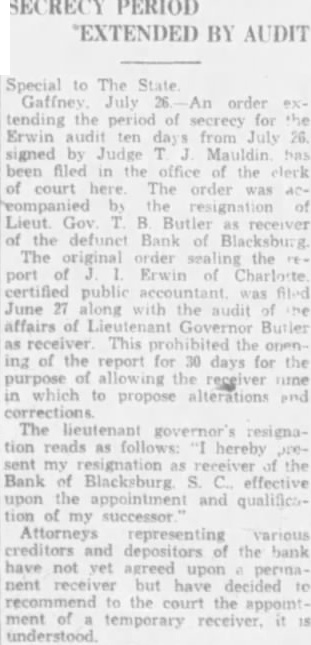
SECRECY PERIOD EXTENDED BY AUDIT
Special to The for Erwin signed Judge court The order was Lieut of defunct The original the Erwin Charloste certified public was June with the audit affairs Governor This the ing report for days for the the which to propose The resignahereby my the Bank Blacksburg. effective the and qualifiesmy successor Attorneys representing various creditors and depositors the bank yet agreed upon perina but have decided the the ment of temporary receiver
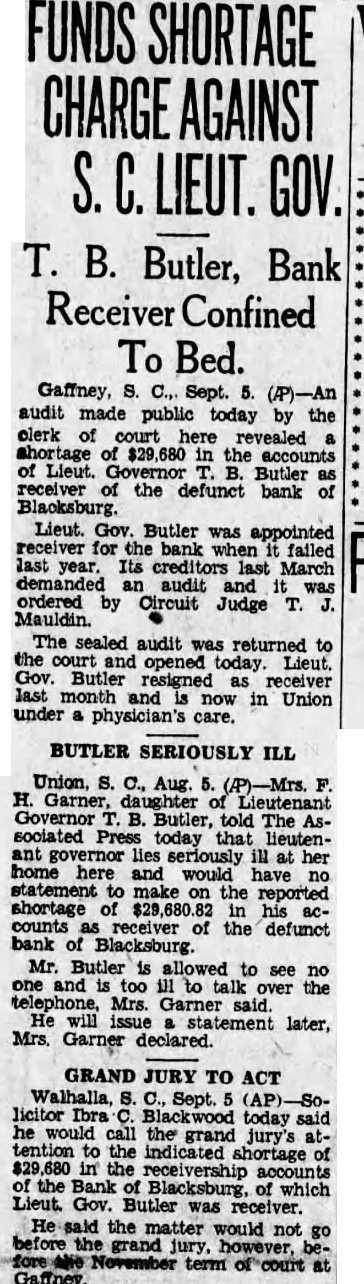
SHORTAGE
B. Bank Butler, Receiver Bed.
Gaffney, Sept. audit made public the today by court here revealed shortage of in the accounts Lieut. Governor Butler receiver of the defunct bank of Blacksburg. Lieut. Gov. Butler was appointed receiver for the bank when failed last year. Its creditors last March demanded audit and was ordered by Circuit Judge Mauldin. The sealed audit was returned to the court and opened today. Lieut. Gov. Butler resigned as receiver last month and now in Union under physician's care.
BUTLER SERIOUSLY ILL
S. Aug. Garner, Lieutenant Governor Butler, told The Associated Press that lieutentoday ant lies seriously ill at her home here and would have to make on the reported shortage of in counts receiver of the defunct bank of Blacksburg. Mr. Butler allowed to see no one and too talk the over telephone, Mrs. Garner said. issue statement later, Mrs. Garner declared.
GRAND JURY TO ACT Walhalla, Sept. licitor Ibra Blackwood today said would call the grand jury's tention the indicated shortage $29,680 the receivership the Bank Blacksburg, which Lieut. Gov. Butler receiver. the matter would not before grand term Gaffney.
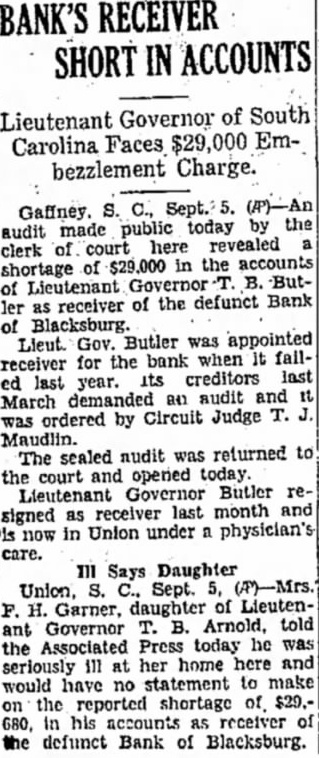
RECEIVER BANK'S SHORT IN of South Lieutenant Governor Faces $29,000 EmCarolina bezzlement Charge.
Gaffney. today the made public clerk of court here revealed in the accounts shortage of ButLieutenant the defunct Bank as receiver of Gov. Butler was appointed Lieut. bank when fallreceiver for the creditors last last March demanded BUT audit and ordered by Circuit Judge Maudlin. The sealed nudit was returned the court and opened today. Lieutenant Governor Butler signed as receiver last month and in Union under physician's
Says Daughter Union, Sept. Garner, daughter LieutenArnold, told ant Governor the Associated Press today he was seriously her home would have no statement to make the reported shortage of his accounts receiver defunct Bank of Blacksburg.
4.September 5, 1930St. Louis Post-DispatchSt. Louis, MO
Click image to open full size in new tab
Article Text
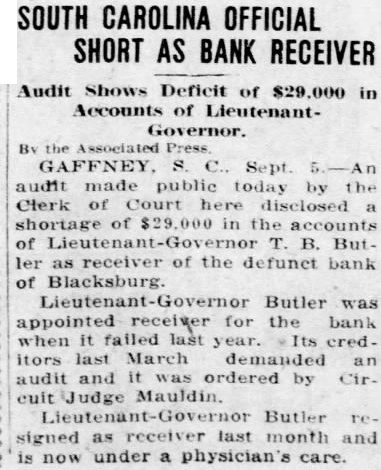
SOUTH CAROLINA OFFICIAL SHORT AS BANK RECEIVER
Audit Shows Deficit of in Accounts of LieutenantGovernor. Sept. audit made public today by the Clerk of Court here disclosed shortage of $29.000 in the accounts of Butler as receiver of the defunct bank of Blacksburg. Butler was appointed for the bank when failed last year. Its creditors last March demanded an audit and ordered by Circuit Judge Mauldin. Butler signed receiver last month and now under a physician's care.
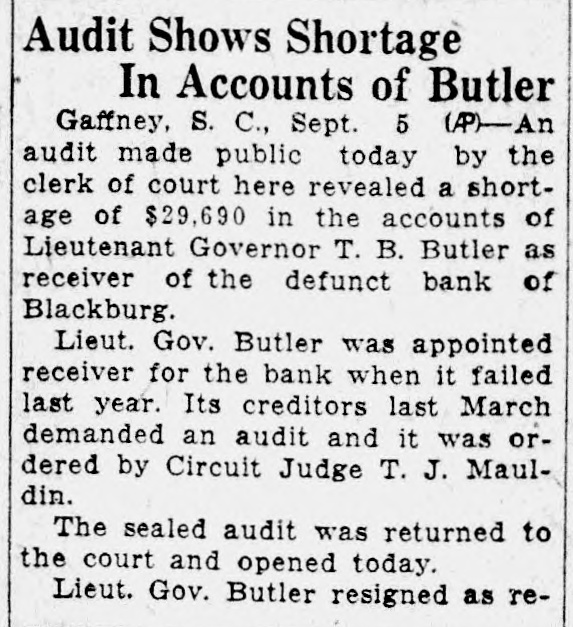
Audit Shows Shortage In Accounts of Butler Gaffney, S. C., Sept. 5 (AP)-An audit made public today by the clerk of court here revealed a shortage of $29,690 in the accounts of Lieutenant Governor T. B. Butler as receiver of the defunct bank of Blackburg. Lieut. Gov. Butler was appointed receiver for the bank when it failed last year. Its creditors last March demanded an audit and it was ordered by Circuit Judge T. J. Mauldin. The sealed audit was returned to the court and opened today. Lieut. Gov. Butler resigned as re-
6.September 5, 1930The Capital TimesMadison, WI
Click image to open full size in new tab
Article Text
S. C. Official is Short in Account
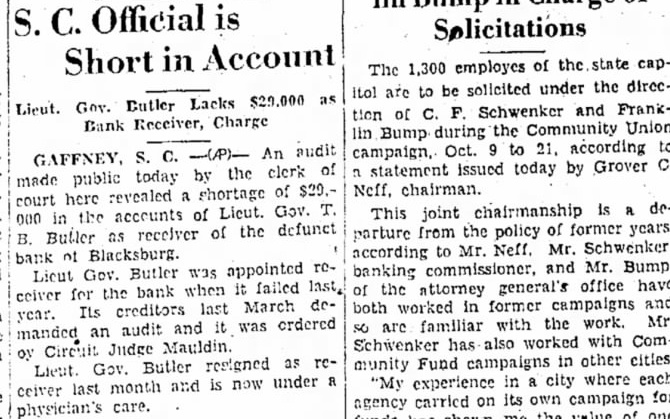
Lieut. Gov. Butler Lacks $20.000 as Bank Receiver, Charge campaign. Oct. 9 to 21. according to GAFFNEY, S. C. -(P)- An audit n statement issued today by Grover C. made public today by the clerk of Neff. chairman. court here revealed shortage of $20. 000 in the accounts of Licut. Gov. T. This joint chairmanship is R. deB. Butler as receiver of the defunct parture from the policy of former years, according to Mr. Neff. Mr. Schwenker bank of Blacksburg. Licut Gov. Butler was appointed re- banking commissioner, and Mr. Bump. ceiver for the bank when it failed last, of the attorney general's office have both worked in former campaigns and year. Its creditors last March dcso are familiar with the work. Mr. manded an audit and it was ordered Schwenker has also worked with Comoy Circuit Judge Mauldin. munity Fund campaigns in other cities. Lieut. Gov. Butler resigned as re"My experience in a city where each ceiver last month and is now under R agency carried on its own campaign for physician's care. funds has shown me the value of one
7.September 5, 1930Biddeford-Saco JournalBiddeford, ME
Click image to open full size in new tab
Article Text
BANK RECEIVER'S ACCOUNTS SHORT
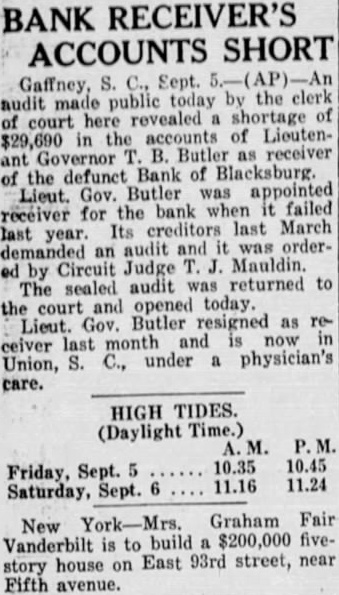
Gaffney, S. C., Sept. (AP)-An audit made public today by the clerk of court here revealed a shortage of $29,690 in the accounts of Lieutenant Governor T. B. Butler as receiver of the defunct Bank of Blacksburg. Lieut. Gov. Butler was appointed receiver for the bank when it failed last year. Its creditors last March demanded an audit and it was ordered by Circuit Judge T. J. Mauldin. The sealed audit was returned to the court and opened today. Lieut. Gov. Butler resigned as receiver last month and is now in Union, S. C., under a physician's care.
HIGH TIDES. (Daylight Time.) A.M. P.M. 10.35 10.45 Friday, Sept. 5 11.16 11.24 Saturday, Sept. 6
New York-Mrs. Graham Fair Vanderbilt is to build $200,000 fivestory house on East 93rd street, near Fifth avenue.
8.November 17, 1930Evening StarWashington, DC
Click image to open full size in new tab
Article Text
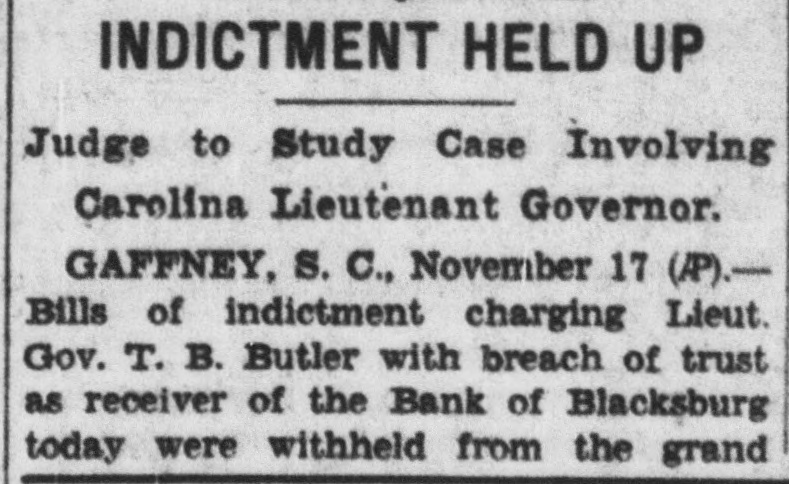
INDICTMENT HELD UP Judge to Study Case Involving Carolina Lieutenant Governor. GAFFNEY, S. C., November 17 (AP).Bills of indictment charging Lieut. Gov. T. B. Butler with breach of trust as receiver of the Bank of Blacksburg today were withheld from the grand
9.November 20, 1930The Gaffney LedgerGaffney, SC
Click image to open full size in new tab
Article Text
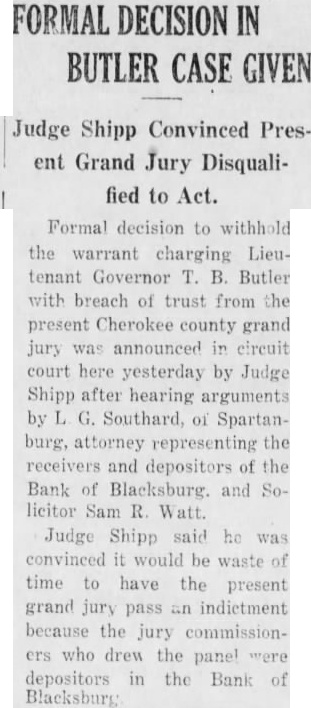
DECISION IN BUTLER CASE
Judge Shipp Convinced Present Grand Jury Disqualified to Act.
Formal decision to withhold the warrant charging Lieutenant Governor Butler with breach of trust from the present Cherokee county grand jury announced circuit court here yesterday by Judge Shipp after hearing arguments by Southard, 01 Spartanburg, attorney representing the receivers depositors of the Bank of Blacksburg. and licitor Sam R. Watt. Judge Shipp said he convinced it would be waste time have the present grand jury pass an indictment because the jury commissionwho drew the panel depositors in the Bank Blacksburg
10.February 10, 1931The Gaffney LedgerGaffney, SC
Click image to open full size in new tab
Article Text
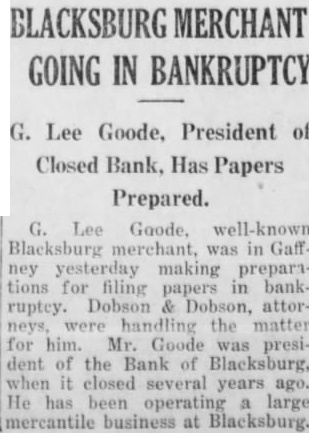
BLACKSBURG MERCHANT GOING IN BANKRUPTCY
G. Lee Goode, President of Closed Bank, Has Papers Prepared.
G. Lee Goode, well-known Blacksburg merchant, was in Gaffyesterday making preparations for filing papers in bankruptcy. Dobson Dobson, attorwere handling the matter for him. Mr. Goode dent of the Bank Blacksburg, when closed several years ago. He has been operating large mercantile business at Blacksburg.
11.June 17, 1931The Charlotte ObserverCharlotte, NC
Click image to open full size in new tab
Article Text
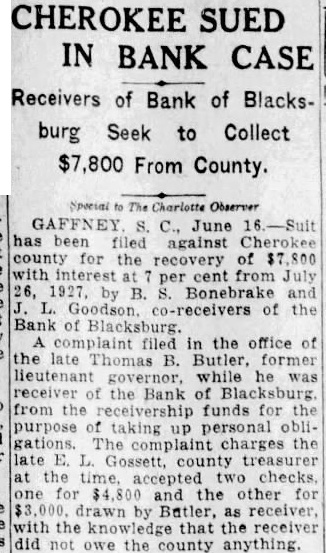
CHEROKEE SUED IN BANK CASE
Receivers of Bank of Blacksburg Seek to Collect $7,800 From County.
S. C., June has filed against Cherokee for the recovery of per cent 1927. Bonebrake and L. Goodson. co-receivers of the Bank of Blacksburg. complaint in the office the late Thomas B. Butler, former lieutenant while he the Bank of from the funds for the purpose taking personal gations. complaint charges the late county treasurer the two for the other for Batler, as receiver, the the receiver did the county
12.April 7, 1932The Gaffney LedgerGaffney, SC
Click image to open full size in new tab
Article Text
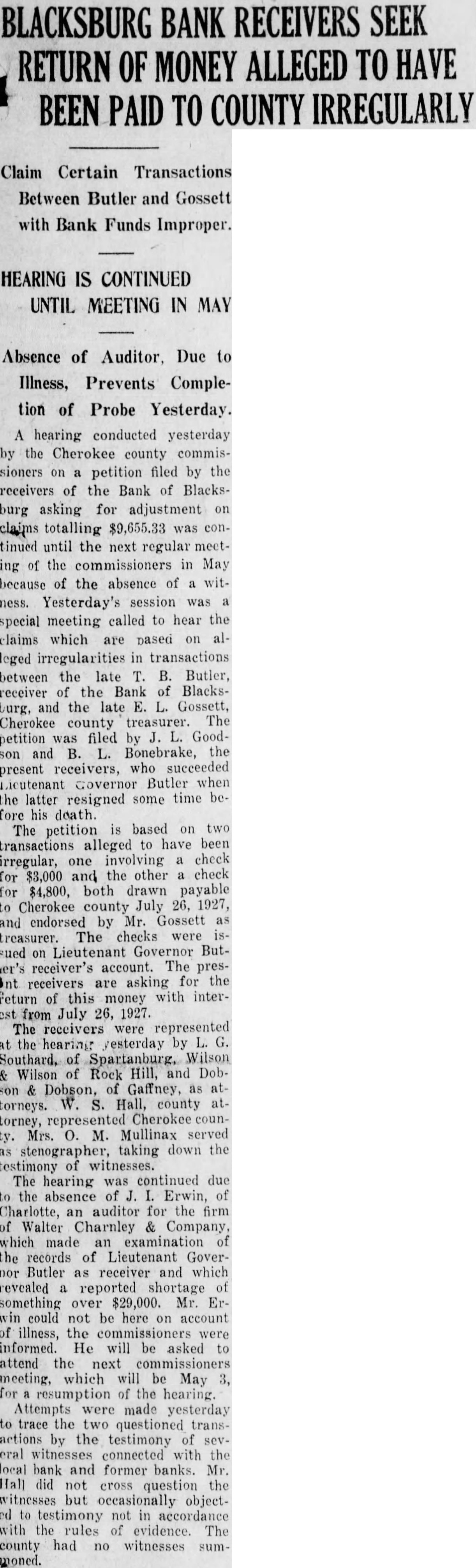
BLACKSBURG BANK RECEIVERS SEEK RETURN OF MONEY ALLEGED HAVE PAID TO COUNTY IRREGULARLY
Claim Certain Transactions
Between Butler and Gossett with Bank Funds Improper.
IS CONTINUED
MEETING IN MAY
Absence of Auditor. Due to Illness, Prevents Completion of Probe Yesterday. hearing conducted yesterday the Cherokee county commissioners petition filed by the receivers of the Bank of Blacksasking for adjustment claims totalling $9,655.33 was tinued until the next regular the commissioners in May because of the absence of Yesterday's session special meeting called to hear the claims which are pased leged irregularities in transactions between the late Butler, receiver the Bank of BlacksLurg, and the late Gossett, Cherokee county treasurer petition filed GoodBonebrake, present receivers, succeeded Governor Butler when latter resigned some time beThe petition based two transactions alleged to have been check irregular, $3,000 and the other check $4,800, both drawn payable Cherokee county July 1927, endorsed by Mr. Gossett treasurer. The checks sued Lieutenant Butreceiver's account. The presreceivers asking for the are of this money with interJuly 1927. The receivers were represented hearing by Southard, Wilson Wilson Rock Hill, and DobDobson, Gaffney, torneys. Hall, county torney, Cherokee Mrs. M. Mullinax served taking down the testimony The hearing continued due the absence Erwin, of Charlotte, auditor for the firm Walter Charnley which made examination records of Lieutenant GoverButler receiver and which revealed reported shortage something over $29,000. Mr. could not be here on account illness, the commissioners were informed. He will asked attend the next which will be May resumption the hearing Attempts made yesterday trace the questioned transactions the testimony of connected the bank and former banks. did question the cross witnesses but objecttestimony not the rules The county had witnesses moned.