1720. Freedman's Savings & Trust Company (Washington, DC)

Bank Information

Episode Type
Suspension โ†’ Closure
Bank Type
federal
Start Date
February 20, 1896
Location
Washington, District of Columbia (38.895, -77.036)

Metadata

Model
gpt-5-mini
Short Digest
7c9ac2b2f57e63c5

Response Measures

None

Description

Articles refer to the suspension of payments at Freedman's Bank in Washington and court matters appointing commissioners (receiver). No explicit contemporary run is described in these excerpts; the bank was suspended and placed under commissioners/receiver, consistent with a permanent closure/receivership. Dates of the original suspension are not given in these snippets; OCR errors corrected (e.g., 'Freedman's National Savings Bank' in one obituary context refers to Freedman's bank at Washington).

Events (2)

1. February 20, 1896 Receivership
Newspaper Excerpt
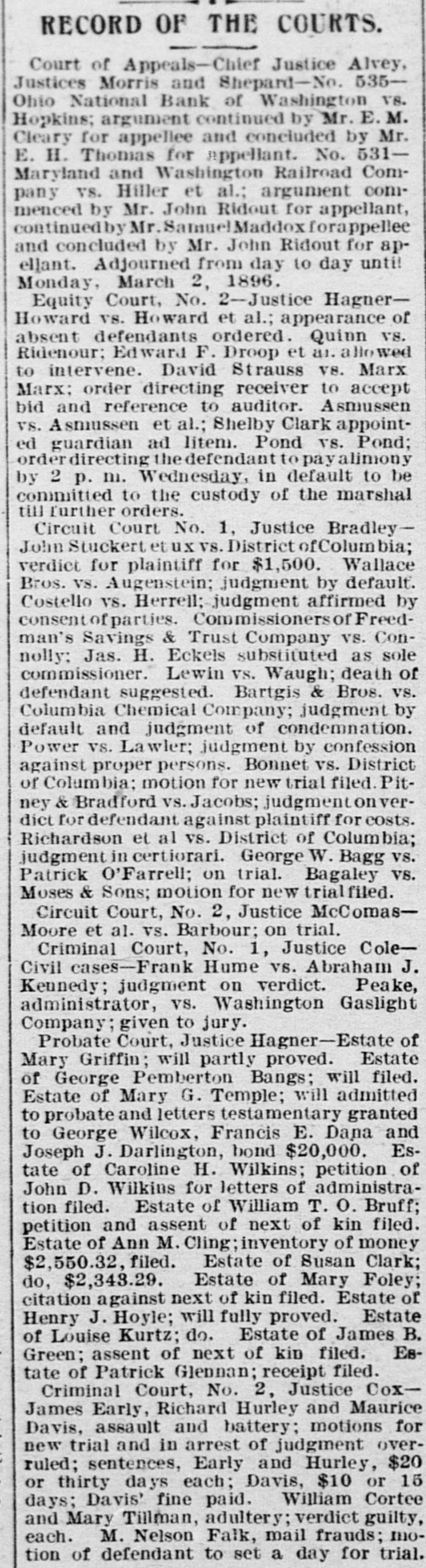
Commissioners of Freedman's Savings & Trust Company vs. Connolly: Jas. H. Eckels substituted as sole commissioner.
Source
newspapers
2. * Suspension
Cause
Government Action
Cause Details
Payments were ordered stopped by authority (telegram reported 'pay out no more money until further ordered'), indicating an official suspension of payments.
Newspaper Excerpt
the suspension of the bank at Washirgton... pay out no more money until further ordered.
Source
newspapers

Newspaper Articles (2)

Article from The Morning Times, February 20, 1896

Click image to open full size in new tab

Article Text

RECORD OF THE COURTS. Court of Appeals-Chief Justice Alvey, Justices Morris and Shepard-No. 535-Ohio National Bank of Washington vs. Hopkins; argument continued by Mr. E. M. Cleary for appellee and concluded by Mr. E. H. Thomas for appellant. No. 531-Maryland and Washington Railroad Company vs. Hiller et al.; argument commenced by Mr. John Ridout for appellant, continued by Mr. Samuel Maddox for appellee and concluded by Mr. John Ridout for appellant. Adjourned from day to day unti! Monday, March 2, 1896. Equity Court, No. 2-Justice Hagner-Howard vs. Howard et al.; appearance of absent defendants ordered. Quinn vs. Ridenour; Edward F. Droop et al. allowed to intervene. David Strauss vs. Marx Marx; order directing receiver to accept bid and reference to auditor. Asmussen vs. Asmussen et al.; Shelby Clark appointed guardian ad litem. Pond vs. Pond; order directing the defendant to pay alimony by 2 p. m. Wednesday, in default to be committed to the custody of the marshal till further orders. Circuit Court No. 1, Justice Bradley-John Stuckert et ux vs. District of Columbia; verdict for plaintiff for $1,500. Wallace Bros. vs. Augenstein; judgment by default. Costello vs. Herrell; judgment affirmed by consent of parties. Commissioners of Freedman's Savings & Trust Company vs. Connolly: Jas. H. Eckels substituted as sole commissioner. Lewin vs. Waugh; death of defendant suggested. Bartgis & Bros. vs. Columbia Chemical Company; judgment by default and judgment of condemnation. Power vs. Lawler; judgment by confession against proper persons. Bonnet vs. District of Columbia; motion for new trial filed. Pitney & Bradford vs. Jacobs; judgment on verdict for defendant against plaintiff for costs. Richardson et al vs. District of Columbia; judgment in certiorari. George W. Bagg vs. Patrick O'Farrell; on trial. Bagaley vs. Moses & Sons; motion for new trial filed. Circuit Court, No. 2, Justice McComas-Moore et al. vs. Barbour; on trial. Criminal Court, No. 1, Justice Cole-Civil cases-Frank Hume vs. Abraham J. Kennedy; judgment on verdict. Peake, administrator, vs. Washington Gaslight Company; given to jury. Probate Court, Justice Hagner-Estate of Mary Griffin; will partly proved. Estate of George Pemberton Bangs; will filed. Estate of Mary G. Temple; will admitted to probate and letters testamentary granted to George Wilcox, Francis E. Dana and Joseph J. Darlington, bond $20,000. Estate of Caroline H. Wilkins; petition of John D. Wilkins for letters of administration filed. Estate of William T. O. Bruff; petition and assent of next of kin filed. Estate of Ann M. Cling; inventory of money $2,550.32, filed. Estate of Susan Clark; do, $2,343.29. Estate of Mary Foley; citation against next of kin filed. Estate of Henry J. Hoyle; will fully proved. Estate of Louise Kurtz; do. Estate of James B. Green; assent of next of kin filed. Estate of Patrick Glennan; receipt filed. Criminal Court, No. 2, Justice Cox-James Early, Richard Hurley and Maurice Davis, assault and battery; motions for new trial and in arrest of judgment overruled; sentences, Early and Hurley, $20 or thirty days each; Davis, $10 or 15 days; Davis' fine paid. William Cortee and Mary Tillman, adultery; verdict guilty, each. M. Nelson Falk, mail frauds; motion of defendant to set a day for trial.


Article from The Appeal, April 17, 1897

Click image to open full size in new tab

Article Text

# Well to Emulate-A Good Citizen, a Faithful Friend. At Louisville, Ky., the home of his birth, on the 30th ult., surrounded by a loving family, "entered into rest," a man deserving of more than passing notice. Horace Morris was born at Louisville, Ky., February 3rd, 1832. He was the son of Shelton Morris, a nephew of Robert Morris, of Revolutionary fame. Upon the death of the father of Shelton Morris, he left all his vast fortune, comprising the most va'ued business property in the "Fal's City" to his four childrer, share and share alike. It was then only natural that Horace Morris should have received every advantage of an early collegiate education, which so completely fitted him for his life's work -the uplifting of the Afro-American. In early life yourg Morris showed remarkable aptitude for drawing and sketching, he was therefore properlv encouraged and apprenticed to one of the leading photographers of Cincinnati, where he became proficient in the art, and opened an establishment at Xenia, O, afterward he became connected with the firm of Ball & Thomas of Cincinnati. It was duiring his residence at Cincinnati that he was associated with his father in conducting an "Under ground Railroad" station; and in the famous Marguerite-Greener trial an Cincinnati in 1850, he figured quite prominently. At the out break of the war of the rebellion Mr. Morris entered the service of the govern ment as steward of a supply steamer, and as such had many a trilling experience in blockede running. At the close of the warand upon the establishment of the "Freedman's National Savings Bank" at Washington, D. C., with Frederick Douglass as president, Mr. Morris was elected as cashier and manager of the Louisville branch, and remained in the position until the suspension of the bank at Washirgton. He was the only Afro-American cashier called to Wast-ington to assist in posting the accounts of the defunct institution. During Grant's administration he filled an im-portant position at Washington in the Treasury department. Under the Hayesadministrationhe was appointed Steward of the U. S. Marine Hospital at Louisville, Ky., the first and only Afro-American in the United States to fill such a position. The late Gen. Benj. Bristow tendered Mr. Morria the position of private secretary during his term of membership of Gen'l Grants' Cabinet, but Mr. Morris refused it on account of failing health and a desire to live with his family at Louisville. By reason of his birth and early childhood at Louisville, the playmates of his youth becoming prominent factors in the conduct of the city's affairs, Mr. Morris was enabled to do much in a personal way towards winning friends to the cause of educating the Freedman after the war. By continued agitation with both voice and pen the present public school system was established and Mr. Morris was appointed secretary of the first Afro-American board of visitors, an auxillary to the board of trustees, since dispensed with. Mr. Morris was a natural literateur; a terse and forceful writer, and always a staunch and uncompromising Republican in politics. A man of sterling honesty and intergritv. He was an editorial contributor for years to the leading Republican organ of his state, it has been said by the proprietor of that paper that Mr. Morris' nationalty was all that kept him from being made editor-in-chief of one of the greatest dailies in the South. He was for a time also principal writer for The Bulletin, than conducted by the present proprie-tors of THE APPEAL. An incident of the through honesty and integrity of Mr. Morris is recalled when he was cashier of the Freedman's Bank. Mr. Morris had a large personal account with the bank ons vinzs deposit, as did several other members of his household and family. On the fateful morning of the suspension of payment that eventful hour that destroyed the confidence of 5,000,000 people and blighted and ruined so many homes, Mr. Morris' eldest son was bargaining for the purchase of a cow and calf, and had the animals driven to the bank in order that he might draw the money for the payment, arriving there just ten minutes after he had re-ceived the telegram from Washington announcing "pay out no more money until further ordered." Mr. Morris refused to allow his son the previlege of drawing out any funds, nor would he take any advantage by withdrawing his own personal account, and in consequence lost several thousand dollars. Regarding his devotion to the principles of the Republican party. a few years ago when Mr. Cleveland was first elected to the office of the President of the Unlted Stater, one of the leaders of the of Democracy of the South a man well and favorably known as a distiller, who had been a playmate of Horace Morris in childhood, throught, in a measure, he he would do a kindness for the old friend of his boy-hood, and asked Mr. Morris if he would accept office under Mr. Cleveland, promising him if he would.to