17183. Brotherhood Bank (Cincinnati, OH)

Bank Information

Episode Type
Run → Suspension → Reopening
Bank Type
state
Start Date
June 17, 1930
Location
Cincinnati, Ohio (39.103, -84.515)

Metadata

Model
gpt-5-mini
Short Digest
1a7e1cdb

Response Measures

Borrowed from banks or large institutions, Capital injected, Full suspension, Books examined

Other: Assets placed in hands of Comptroller/receiver; later takeover by Central Trust and reopening as branch.

Description

Heavy withdrawals (a depositor run) precipitated directors to close the bank June 26, 1930. The underlying trigger was fraud/check-kiting by W. (Amor) Shafer and related bank-specific malfeasance; the Comptroller appointed a receiver and the bank later was taken over by Central Trust and reopened as a branch in early July 1930. Dates drawn from contemporaneous Cincinnati articles (closure/receiver June 26, 1930; reopening early July 1930).

Events (4)

1. June 17, 1930 Run
Cause
Bank Specific Adverse Info
Cause Details
Large withdrawals triggered by revelations/rumors tied to the check-kiting and other manipulations of W. (Amor) Shafer that undermined confidence.
Measures
Directors voted to close the bank to protect depositors and conserve assets; sought formal approval from the Comptroller of the Currency.
Newspaper Excerpt
depositors withdrew over $1,000,000 ... unusually heavy withdrawals the last three days
Source
newspapers
2. June 26, 1930 Receivership
Newspaper Excerpt
the comptroller of the currency appointed Ira Fulton ... as receiver for the Brotherhood ... which closed its doors in Cincinnati.
Source
newspapers
3. June 26, 1930 Suspension
Cause
Bank Specific Adverse Info
Cause Details
Directors closed the bank because heavy withdrawals (run) driven by the discovery of large irregularities and alleged check-kiting by Shafer threatened liquidity; assets placed in hands of the Comptroller for liquidation/receivership.
Newspaper Excerpt
directors met Wednesday night and drafted closing resolution ... closing of the Brotherhood Bank came ... doors yesterday
Source
newspapers
4. July 5, 1930 Reopening
Newspaper Excerpt
the bank ... has been taken over by the Central Trust and will reopen as branch ... office reopens tomorrow (article dated July 4, 1930).
Source
newspapers

Newspaper Articles (14)

Article from The Cincinnati Enquirer, June 27, 1930

Click image to open full size in new tab

Article Text

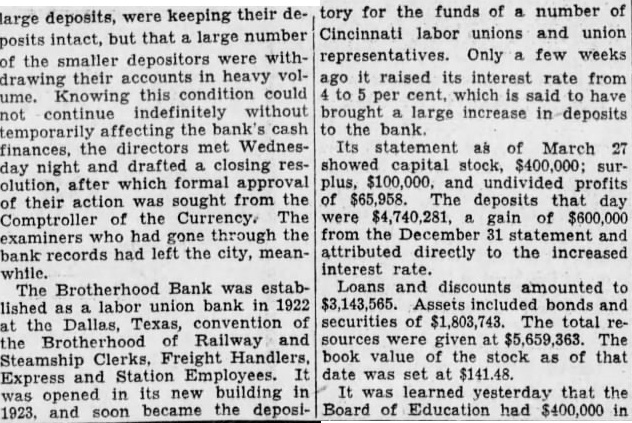
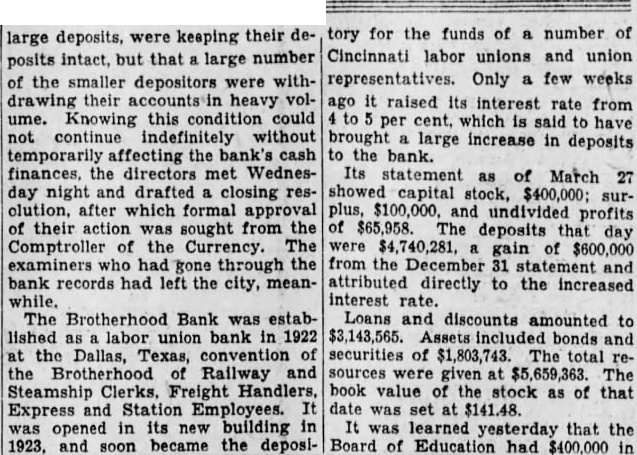
large deposits, were keeping their posits intact, but that large number of the smaller depositors were withdrawing their accounts in volume. Knowing this condition could not continue indefinitely temporarily affecting the cash finances, the directors Wednesday night and drafted closing resolution, after which formal of their action was sought from the Comptroller of the Currency. The examiners who had gone through the bank records had left the city, meanwhile. The Brotherhood Bank was established labor union bank in 1922 the Dallas, Texas, convention the Brotherhood Railway and Steamship Clerks. Freight Handlers, Express and Station Employees. opened in its new building 1923. soon became the deposiand tory for the funds of number of Cincinnati labor unions and union representatives. Only few weeks ago raised its interest rate from per cent, which is said to brought large increase in deposits to the bank. Its statement as March 27 capital stock, $400,000; surplus, $100,000. and undivided profits of $65,958. The deposits that day were $4,740,281. of $600,000 from the December 31 statement and attributed directly to the increased interest Loans and discounts amounted to $3,143,565. Assets included bonds and securities of $1,803,743. The total sources were given $5,659,363. The book value of the stock as of that date was set $141.48. was learned yesterday that the Board of Education had $400,000


Article from The Cincinnati Enquirer, June 27, 1930

Click image to open full size in new tab

Article Text

large deposits, were keeping their deposits intact, but that large number of the smaller depositors were withdrawing their heavy volume. Knowing this condition could not continue indefinitely without temporarily affecting the cash finances, the directors met Wednesday night and drafted closing resolution, after which formal approval of their action was sought from the Comptroller of the Currency. The examiners who had gone through the bank records had left the city, meanwhile. The Brotherhood Bank was established as labor union bank in 1922 the Dallas, Texas, convention Brotherhood Railway and Steamship Clerks. Freight Handlers, Express and Station Employees. opened in its new building in 1923, and soon became the deposi- tory for the funds of a number of Cincinnati labor unions and union representatives. Only few weeks ago raised its interest rate from per cent, which is have brought large increase in deposits the bank. Its statement of March as capital stock, $400,000; surplus, undivided profits $65,958. The deposits day were $4,740,281. of $600,000 from the December and attributed directly to the increased interest rate. Loans and discounts amounted to $3,143,565. Assets included bonds and securities of $1,803,743. The total sources were given $5,659,363. The book value of the stock as of that date was set at $141.48. was learned yesterday that the Board of Education had $400,000


Article from The Cincinnati Enquirer, June 27, 1930

Click image to open full size in new tab

Article Text

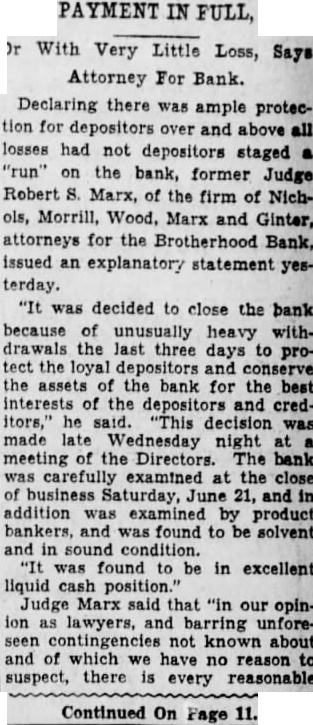
PAYMENT IN FULL, With Very Little Loss, Says Attorney For Bank. Declaring there was ample protection for depositors over and above all losses had not depositors staged "run" on the bank, former Judge Robert Marx, of the firm of Nichols, Morrill, Wood, Marx and Ginter, attorneys for the Brotherhood Bank, issued an explanatory statement yesterday. "It was decided to close the bank because of unusually heavy withdrawals the last three days to protect the loyal depositors and conserve the assets of the bank for the best interests of the depositors and creditors,' he said. "This decision was made late Wednesday night meeting the Directors. The bank examined the close business Saturday, June 21, and addition examined by product bankers, and was found to be solvent and in sound "It was found to be in excellent liquid cash position.' Judge Marx said that "in our opinion as lawyers, and barring unforeseen contingencies not known about and of which we have no reason suspect, there every reasonable Continued On Fage 11.


Article from The Jersey Journal, June 27, 1930

Click image to open full size in new tab

Article Text

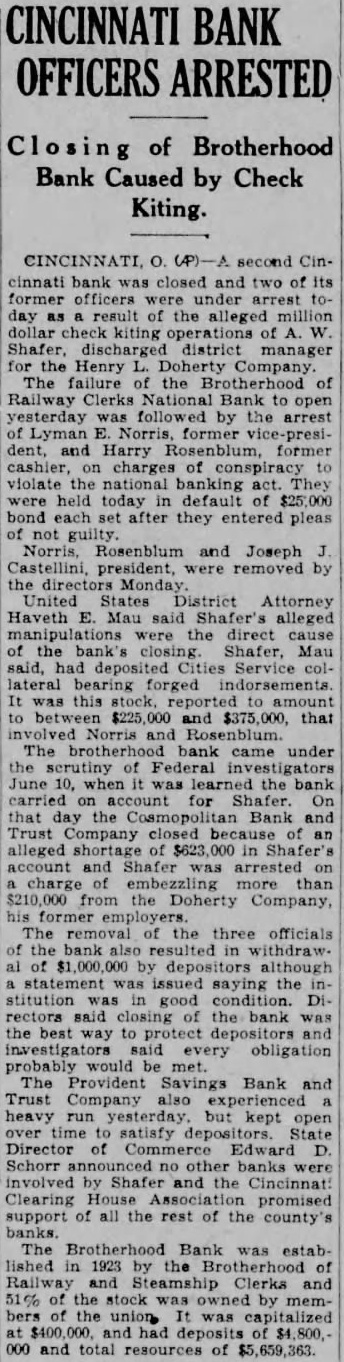
CINCINNATI BANK OFFICERS ARRESTED Closing of Brotherhood Bank Caused by Check Kiting. CINCINNATI, O. second Cincinnati bank was closed and two of its former arrest day result of the alleged dollar kiting of W. Shafer, district manager for the Henry failure of the of Railway National Bank to open yesterday by the arrest Lyman E. former dent, and Harry cashier, on charges of conspiracy violate the national banking They were held today default of $25,000 bond each after they entered pleas of not guilty. Norris, Rosenblum and Joseph Castellini, president, were removed by the Monday United States District Attorney Haveth E. Mau said alleged the direct cause of Shafer, Mau said, had Service lateral this amount $375,000, that Norris Rosenblum. The bank came under the scrutiny Federal investigators June 10, when was learned the bank carried on account for Shafer. On that day the Cosmopolitan Bank and Trust Company of an alleged of $623,000 in account and Shafer on charge more than from the Doherty Company, of the three officials the bank withdraw. al depositors although statement issued saying the stitution good condition. Directors said closing bank the best way to protect investigators every obligation probably would met. Provident Savings Bank and Trust Company heavy yesterday. but kept open satisfy State Director of Edward D. Schorr involved by Shafer and the Cincinnati Clearing promised support all the rest of the county's The Brotherhood Bank established in 1923 by of Railway and Clerks of the stock owned by members of the union, was capitalized at deposits of 000 and total resources of $5,659,363.


Article from St. Louis Post-Dispatch, June 27, 1930

Click image to open full size in new tab

Article Text

Ousted and Assistant Cashier on Charge of Violating National Banking Act. COLLAPSE LAID TO HUGE CHECK KITING Prosecutor Asserts Former Doherty Manin Cincinnati Forged ager Signatures. Press. CINCINNATI, O., June Two former officers of the BrothRailway Clerks' National erhood failed open its Bank, which doors yesterday, are under arrest today the result of the alleged operations discharged disof W. Shafer, of the Henry Dotrict manager herty E. Norris, former vice Lyman president, and Harry Rosenblum, former assistant cashier, are held in default of $25,000 bond each, after they entered pleas of not guilty to charges of conspiracy to the national banking act. Norris, Rosenblum and Joseph Castellini, president, were moved by the directors Monday. United States District Attorney Haveth E. Mau said Shafer's alleged manipulations were direct cause of the bank's closing. Shafer, Mau said, had deposited Cities Service collateral bearing forged indorsements. was this stock, reported to amount to between $225,000 and $375,000. that involved Norris and Rosenblum. The Brotherhood Bank came under the scrutiny of Federal investigators June when it learned bank carried an count Shafer. that day the Cosmopolitan Bank Trust Co. closed because of alleged short$623,000 in Shafer's account and Shafer was arrested charge of more than $210,000 from the Doherty Co., The the three officers of the bank also in withdrawal of $1,000,000 by depositors, although statement was issued saying the depository good condition. Directors said closing the bank was the best protect depositors. The Provident Savings Bank Trust Co. also experienced heavy yesterday. but kept open time to satisfy depositors. State Director of Commerce Edward Schorr announced no other banks by Shafer and the Cincinnati Clearing House Association promised of all the of county's banks. Fleming. deputy the Federal Bank, Cleveland. said $5,000,000 in currency had been brought here today by from Cleveland and placed in the Federal Reserve branch to add assurance to banking situation this city. the Six armed guards accompanied the the plane. The Brotherhood Bank tablished in 1923 by the Brotherhood of Railway and Steamship Clerks and per cent of the stock owned members the union. capitalized $400,and had deposits of and total resources of 363.


Article from The Tribune, June 27, 1930

Click image to open full size in new tab

Article Text

TWO CHICINNATI BANKS GO UNDER (Continued from page 1) Company closed because of an alleged shortage of $623,000 in Shafer's account and Shafer was arrested on R charge of embezzling more than $210,000 from the Doherty company, his former employers. The removal of the three of ficials of the bank also resulted in withdrawal of $1,000,000 by depositors although a statement was issued saying the institution was in good condition. Directors said closing of the bank was the best way to protect depositors and investigators said every obligation probably would be met. The Provident Savings Bank and Trust Company also experieneed a heavy run yesterday but kept open over time to satisfy depositors. State Director of Commerce Edward Schorr announced no other banks were Involved by Shafer and the Cineinati Clearing House Association promised support of all the rest of the count banks. The Brotherhool Bank was es. tablished in 1923 hv the Brotherhood of Railway and Steamship clerks and 51 per cent. of the stock was owned by members of the union. It was capitalized at $400,000. and had deposits of $4,800,000 and total resources of


Article from Orlando Evening Star, June 27, 1930

Click image to open full size in new tab

Article Text

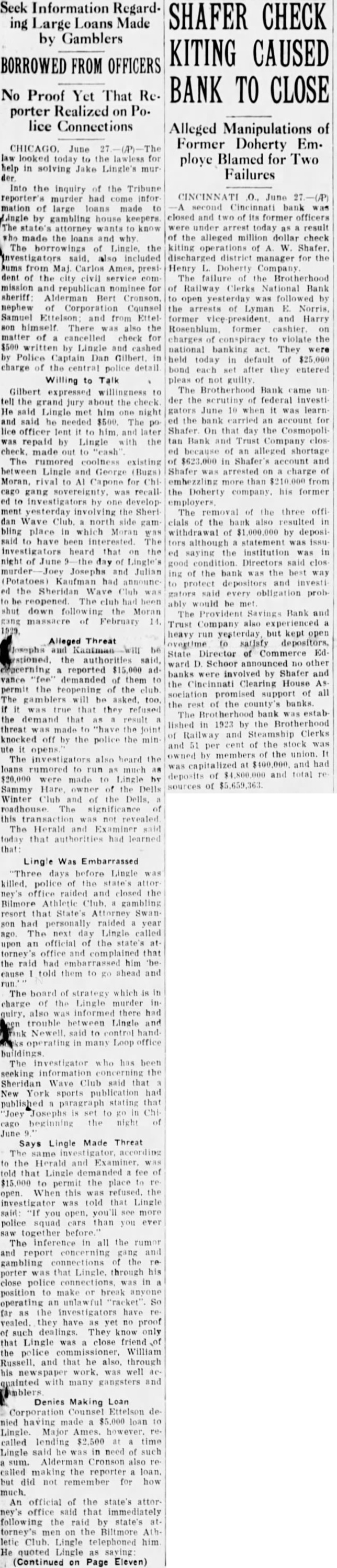
Seek Information RegardSHAFER CHECK Large Loans Made by Gamblers KITING CAUSED OFFICERS BANK TO CLOSE No Proof Yet That Re- porter Realized on Police Connections CHICAGO. June law looked today lawless for help in solving Jake Lingle's mur Into the inquiry of the Tribune murder had mation of large made by gambling house keepers attorney made the loans why The borrowings included Bums from Maj. Carlos Ames, service nominee for nephew Corporation Counsel Samuel from himself There also the cancelled check by Lingle and Police Captain Dan charge the police detail Willing to Talk Gilbert expressed willingness the grand about He Lingle him night said needed The officer lent and repaid by Lingle with the check. made rumored coolness existing between Lingle and George (Bugs) Capone for cago gang yesterday involving the Sheri dan north side bling place in which Moran said have The heard that on the night day Lingle's Josephs and Julian (Potatoes) had the Sheridan Wave Club reopened. The club shut down massacre February 14. Alleged Threat the authorities reported demanded them permit the reopening the The asked, they the result threat the knocked off by the police the opens The investigators also heard loans rumored run much $20,000 made Lingle Sammy owner the Dells Winter Club and the Dells. roadhouse this The Herald and today that authorities had learned Lingle Embarrassed "Three days before Lingle killed. police attor raided and closed Bilmore Athletic Club. gambling resort that State's Attorney had personally raided year ago. The next Lingle called upon an official the state's torney's office and complained that the had embarrassed him told them to go ahead and The board strategy which charge of the Lingle murder also informed there had trouble Lingle said to control in many investigator has information the Sheridan Wave Club said that York sports publication had published paragraph stating is to Chicago beginning the night Says Lingle Made Threat The same according the Herald and told that Lingle demanded fee permit the place open. When this refused. investigator told that Lingle open. you'll more police squad cars than you ever before.' The inference all the rumor report concerning gang gambling connections the through his porter close police position make break anyone operating an unlawful So far investigators have vealed. they have no proof such dealings. They only that Lingle close friend the police William and that he through newspaper work. well quainted many gangsters Denies Making Loan Corporation Counsel Ettelson denied made loan Lingle. Major Ames. called lending time Lingle need of Alderman Cronson also called reporter loan. did not remember for how much. An official of the state's attoroffice said that immediately following raid state's torney's men the Biltmore letic Club. Lingle telephoned him quoted Lingle (Continued on Page Eleven) Alleged Manipulations of Former Doherty Employe Blamed for Two Failures second bank closed and former officers today result of alleged dollar check kiting Shafer. discharged district manager for the Henry Doherty Company failure the Bank by of Lyman Norris, former Harry Rosenblum former cashier. charges violate the national act. They held today default bond after they entered pleas not guilty The Brotherhood Bank came der the federal investi gators when learn the carried account for Shafer On day the tan Bank and Trust because alleged shortage in account and Shafer arrested more the Doherty his former employers The the three offi the bank also resulted withdrawal of by deposialthough statement issu institution good condition. Directors clos the the best way ing protect depositors investi gators every obligation would be The Provident Savings Bank and Trust Company also experienced heavy run but kept satisfy State Director Commerce D. Schoor announced other banks were involved by Shafer and the Cincinnati Clearing House sociation support all the the county's banks bank lished in 1923 by the Brotherhood and Steamship Clerks and of the stock by members of the union. and and total deposits


Article from Kingsport Times, June 29, 1930

Click image to open full size in new tab

Article Text

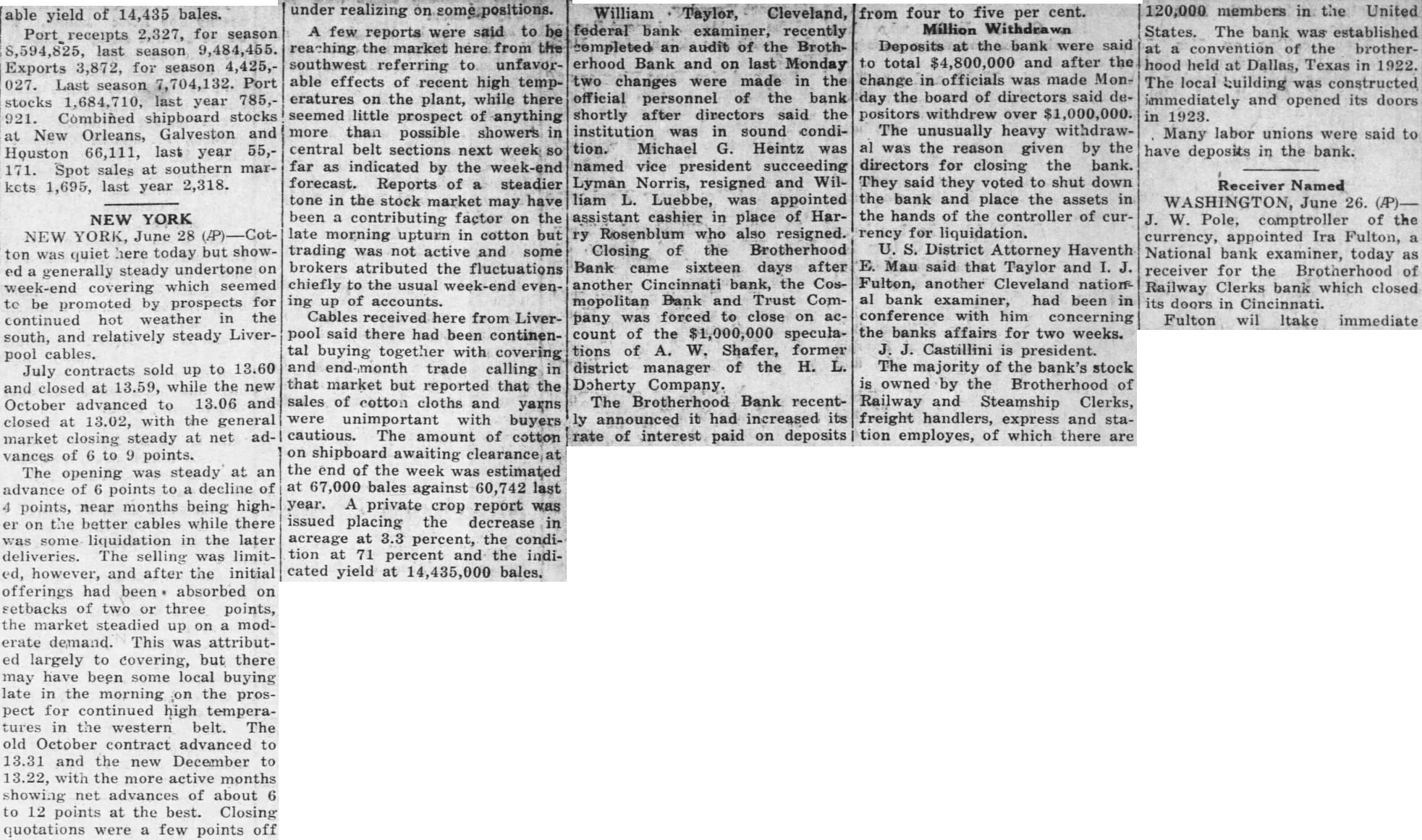
able yield of 14,435 bales. Port receipts 2,327, for season 8,594,825, last season 9,484,455. Exports 3,872, for season 4,425,027. Last season 7,704,132. Port stocks 1,684,710, last year 785,921. Combined shipboard stocks at New Orleans, Galveston and Houston 66,111, last year 55,171. Spot sales at southern markets 1,695, last year 2,318. NEW YORK NEW YORK, June 28 (P)-Cotton was quiet here today but showed a generally steady undertone on week-end covering which seemed to be promoted by prospects for continued hot weather in the south, and relatively steady Liverpool cables. July contracts sold up to 13.60 and closed at 13.59, while the new October advanced to 13.06 and closed at 13.02, with the general market closing steady at net advances of 6 to 9 points. The opening was steady at an advance of 6 points to a decline of 4 points, near months being higher on the better cables while there was some liquidation in the later deliveries. The selling was limited, however, and after the initial offerings had been absorbed on setbacks of two or three points, the market steadied up on a moderate demand. This was attributed largely to covering, but there may have been some local buying late in the morning on the prospect for continued high temperatures in the western belt. The old October contract advanced to 13.31 and the new December to 13.22, with the more active months showing net advances of about 6 to 12 points at the best. Closing quotations were a few points off under realizing on gome positions. A few reports were said to be reaching the market here from the southwest referring to unfavorable effects of recent high temperatures on the plant, while there seemed little prospect of anything more than possible showers in central belt sections next week so far as indicated by the week-end forecast. Reports of a steadier tone in the stock market may have been a contributing factor on the late morning upturn in cotton but trading was not active and some brokers atributed the fluctuations chiefly to the usual week-end evening up of accounts. Cables received here from Liverpool said there had been continental buying together with covering and end-month trade calling in that market but reported that the sales of cotton cloths and yarns were unimportant with buyers cautious. The amount of cotton on shipboard awaiting clearance, at the end of the week was estimated at 67,000 bales against 60,742 last year. A private crop report was issued placing the decrease in acreage at 3.3 percent, the condition at 71 percent and the indicated yield at 14,435,000 bales. William Taylor, Cleveland, federal bank examiner, recently completed an audit of the Brotherhood Bank and on last Monday two changes were made in the official personnel of the bank shortly after directors said the institution was in sound condition. Michael G. Heintz was named vice president succeeding Lyman Norris, resigned and William L. Luebbe, was appointed assistant cashier in place of Harry Rosenblum who also resigned. Closing of the Brotherhood Bank came sixteen days after another Cincinnati bank, the Cosmopolitan Bank and Trust Company was forced to close on account of the $1,000,000 speculations of A. W. Shafer, former district manager of the H. L. Doherty Company. The Brotherhood Bank recently announced it had increased its rate of interest paid on deposits from four to five per cent. Million Withdrawn Deposits at the bank were said to total $4,800,000 and after the change in officials was made Monday the board of directors said depositors withdrew over $1,000,000. The unusually heavy withdrawal was the reason given by the directors for closing the bank. They said they voted to shut down the bank and place the assets in the hands of the controller of currency for liquidation. U. S. District Attorney Haventh E. Mau said that Taylor and I. J. Fulton, another Cleveland national bank examiner, had been in conference with him concerning the banks affairs for two weeks. J. J. Castillini is president. The majority of the bank's stock is owned by the Brotherhood of Railway and Steamship Clerks, freight handlers, express and station employes, of which there are 120,000 members in the United States. The bank was established at a convention of the brotherhood held at Dallas, Texas in 1922. The local building was constructed immediately and opened its doors in 1923. Many labor unions were said to have deposits in the bank. Receiver Named WASHINGTON, June 26. (AP) J. W. Pole, comptroller of the currency, appointed Ira Fulton, a National bank examiner, today as receiver for the Brotherhood of Railway Clerks bank which closed its doors in Cincinnati.
Article from The Cleveland Press, July 4, 1930

Click image to open full size in new tab

Article Text

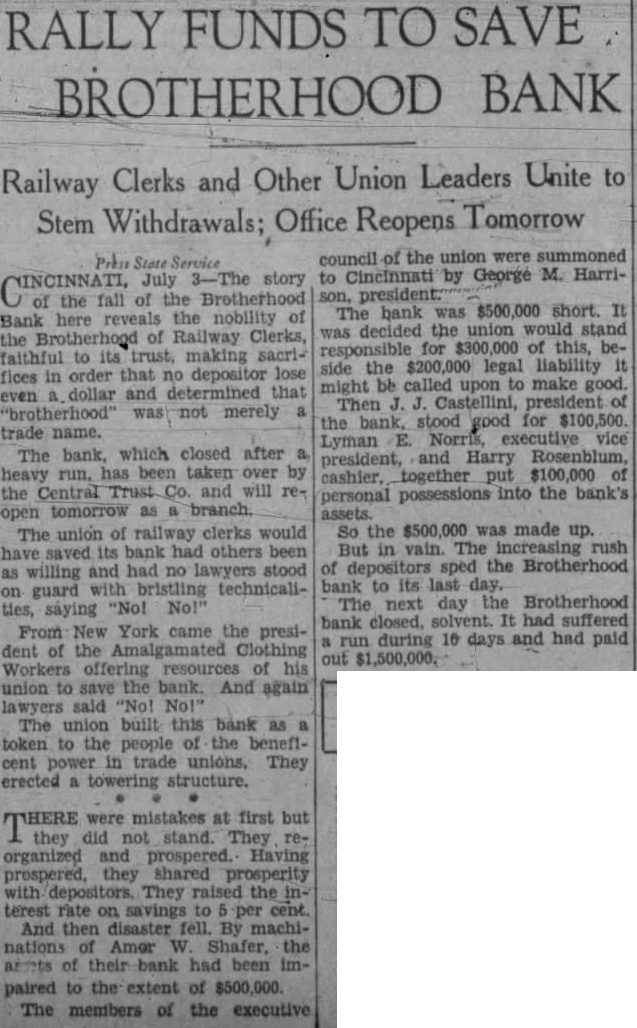
RALLY FUNDS TO SAVE BROTHERHOOD BANK Railway Clerks and Other Union Leaders Unite to Stem Withdrawals; Office Reopens Tomorrow Press NINCINNATI, July The story of the fall of the Brotherhood Bank here reveals the nobility of the of Railway Clerks, faithful to its making sacrifices in order that no depositor lose even dollar and determined that not merely the trade name. The bank, which closed after heavy run, has been taken over by the Central Trust and will reopen as branch The union of railway clerks would have saved its bank had others been as willing and had no stood on guard technicalities, saying "No! From New York came the president of the Amalgamated Clothing Workers offering resources of his union save the bank. And again lawyers said "No! The union built this bank as token to the people the beneficent power in trade unions. They erected towering structure. THERE were mistakes at first but they did not They reorganized and prospered. Having prospered, they shared prosperity with They raised the interest rate on to per cent And then disaster fell By machinations Amer W Shafer, the of bank had been impaired to the extent of $500,000. The members of the executive council of the union were to Cincinnati by George M. HarriThe bank was $500,000 short It was decided the union would stand responsible for $300,000 of this, beside the $200,000 legal liability it might be called upon to make good. Then J. Castellini, president bank, stood good for $100,500 Lyman E. Norris, executive vice president, and Harry Rosenblum, cashier, together $100,000 of personal into the bank's So the $500,000 was made up. But in vain. The of sped the Brotherhood to its last The day the Brotherhood bank It had suffered run during 10 days and had paid out $1,500,000.


Article from The Cincinnati Enquirer, March 27, 1931

Click image to open full size in new tab

Article Text

CASE RECALLS HISTORY. Two Bank Crashes Found Due To Dissimilar Deals Of One Man. The trial Castellini, former President of the Brotherhood of Rail way Clerks National result of the closing of the after of Bank Trust through of Amor Shafer Cincinnati office of H. & Co. their cases were entirely disIn the Cosmopolitan case, Shafer kited checks more than giving bad checks of his own in exchange for cashier to the Bank where he main total of these checks found later to ag the capital and surplus of the thus virtually wiping out In the Brotherhood Shafer's dealings the form of selling Cities Service securities to the bank at several points under the market so they turn sell these at the regular market price and make the failure of the Cosmopolitan Bank June attention turned the Brotherhood Bank had dealings The bond were and in the resig of the President and the up by him and others the of Rail way Clerks. stockholder in the bank funds sufficient to over Rumors became afloat however caused on the bank, which forced to close June 26. For time banks in the city due to fear that other banks might be It was found that the Brotherhood Bank was solvent the day unlike the Bank and its closing really was As the Brotherhood Bank national bank incrs the and un covered which led to five indictments by a Federal Grand Jury Norris Rosenblum and Shafer. One charged that Cas tellini. Norris and Rosenblum bought bonds from Shafer under the market placed some of them on the bank's books and concealed others, which subsequently used for various purposes, that to cover these Inlse entries were made on the and one false the Comp troller of the Currency March 27 1930 Another indictment charged that 195.82 through the alleged purchase bank with of these for the Ellison & Co. account fumily account of Castellini, and that they misapplied $383.8 the bal ance left in bank advertising ac account conducted in Cas account, at the time the third indictment charged that Shafer defraud the bank through of false entries false and misapplication of funds were 10 counts in this fourth named Norris only the fifth and Rosenblum only. in connection with Norris and Rosenblum subsequent ly pleaded guilty one of the false false report count in first and who was the only 10 years in on charge pleaded but was called the


Article from The Cincinnati Enquirer, March 27, 1931

Click image to open full size in new tab

Article Text

CASE RECALLS HISTORY. Two Bank Crashes Found Due To Dissimilar Deals Of One Man. The trial Castellini, former President of the Brotherhood of Clerks National was direct result of the closing of the bank June 1930, two weeks after the closing of the Cosmopolitan Bank Trust Company. Both trouble through the operations of Amor Shafer, then manager of office Doherty Co., specialists their cases were entirely dissimiliar. In the Cosmopolitan case, Shafer kited checks the more than $500,000, giving bad checks his own in exchange for checks, most which the Bank where tained an total these was later gregate the capital and surplus of the thus virtually out. In the case, Shafer's took the of selling Cities the bank at several points under the market, they could turn sell these the regular market price and make profit. With the failure of the Cosmopolltan Bank June turned to the Brotherhood Bank, where was known have had dealings. The bond discovered in the resignation Castellini, the President, the setting up others including the Brotherhood Railway Clerks, majority stockholder in the bank, of funds to overall discrepancies. Rumors became afloat, however, caused the bank, which forced close June 26. time serious caused several other banks in the city, fear that other banks might be involved. was found that the Brotherhood Bank solvent day closed, the Cosmopolitan Bank, and that its closing really was As Brotherhood Bank bank iners into the uncovered which five by Federal October 13, 1930, against Castellini, Norris, Shafer. One indictment charged that Cas tellini, Norris bought bonds from Shafer under the market, placed some them the bank's books others, which were subsequently for various cover these purposes, transactions false entries were made on the bank's books and one false report made the Comptroller of the Currency March 1930. Another indictment charged that Norris $11, through the alleged with of these for the Ellison family account of Castellini, and they misapplied $383.89, the balance bank advertising vertising account conducted tellini's account, at the time the bank closed. third indictment charged that Norris, Shafer defraud the bank through series of false entries, report misapplication funds. There were 10 counts in this fourth indictment named Norris and the fifth named Norris and Rosenblum connection with Norris and Rosenblum pleaded guilty to the false entry counts and the false report in the first and count who the only stand serving 10 years Ohio state charge growing out his pleaded guilty also, but When the present trial began, the


Article from The Cleveland Press, September 13, 1932

Click image to open full size in new tab

Article Text

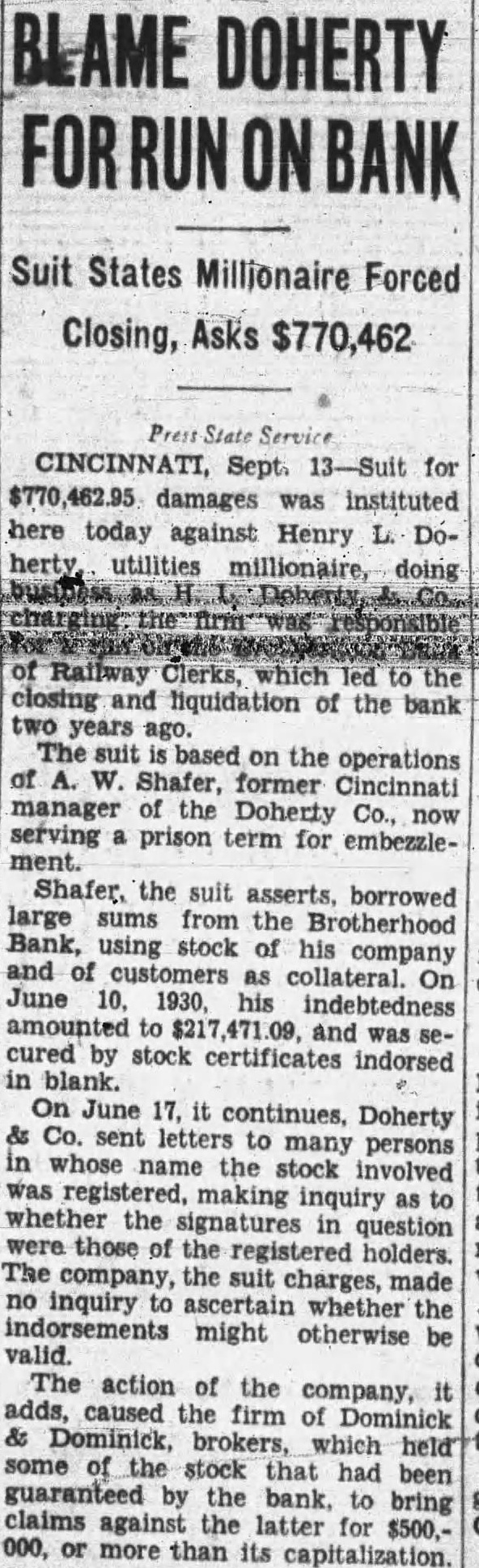
DOHERTY Suit States Millionaire Forced Closing, Asks CINCINNATI, Sept. for damages instituted here today against Henry Doherty utilities millionaire, doing Clerks, which led closing and liquidation of the bank two years ago. The based the operations Shafer, former Cincinnati manager of the Doherty Co., serving prison term for embezzlement. Shafer, the suit asserts, borrowed large sums from the Brotherhood Bank, using stock of his company and of customers collateral. On June 1930, his indebtedness amounted to and cured by stock certificates indorsed blank. On June 17. continues, Doherty Co. sent letters to many persons whose name the stock involved making inquiry as whether the signatures in question the registered holders. The the suit charges, made no inquiry ascertain whether might otherwise be valid. The action of the company, caused the of Dominick brokers, which held some of the stock had been guaranteed the bring claims against the latter for 000, or more than its


Article from The Cincinnati Post, September 13, 1932

Click image to open full size in new tab

Article Text

BROTHERHOOD BANK IS SUING FOR $770,462 Doherty Blamed for Run That Brought Closing DAMAGES ARE SOUGHT Suit Based on Operations of Convicted Manager Holding Henry L. Doberty, doing business as H. L. Doherty & Co., responsible for the run on the Brotherhood Bank which led to its closing July 26, 1930, and its subsequent liquidation, the bank filed against Doherty in Common Pleas Court Tuesday, demanding total of $770,462.95 damages in two causes of action. The suit, filed by Milton Schmidt, of the law firm Nichols, Morrill, Marx, Wood Ginter, asked in one action for compensatory $100,000 as punitive damages, and in the second for compensatory and damages. time Schmidt sought by another action attach all property and funds of Doherty of its Cincinnati branch, with offices in the Dixie Terminal Building Shafer Recalled In the damage suit the court was the event the claim not upheld to an count to the Brotherhood Bank for all funds that it allegedly converted to its own The based on the operations of W. Shafer, former Cincinnati the a prison term for embezzlement. Shafer, the suit asserts. borrowed sums from the Brotherhood Bank. using stock his company and customers as collateral. June his and was secured by stock certificates indorsed in blank June the suit alleges, the stock was presented to Doherty & Co. for payment and the company, without making sufficient investigation the of the signatures, conthe Doherty Co. since has failed to meet numerous demands the bank for the return the stock, claiming that doubt exists the validity of certain indorsements, according to the June Doherty Co. sent letters to persons whose name the stock involved was registered. making inquiry as to whether the signatures question registered holders company the suit charges, made inquiry to wheththe indorsement might otherwise be valid. Claims Rcalled The action of the company, adds, Dominick, caused the of Dominick brokers held some the stock that had been guaranteed by the bank, bring claims against latter for $500,000 or The suit that Doherty & must have been aware geries that by Shafer that at the time sent the letters knew the confidence the had been undermined by ascribed to Shafer's operaSending of the letters and the other of precipitated the run which forced the bank close, the charges. Losses Are Listed It also asserts that many of the allegedly confiscated Doherty and that these, have been appropriated by the comThe other specific sum sought 000. damages is the $550.which bank estimates forced liquidation after had made closing According the the exact cannot ascertained now. but will exceed this figure Items of enumerated Surplus good will, and all large part the capital,


Article from The Cincinnati Post, May 23, 1934

Click image to open full size in new tab

Article Text

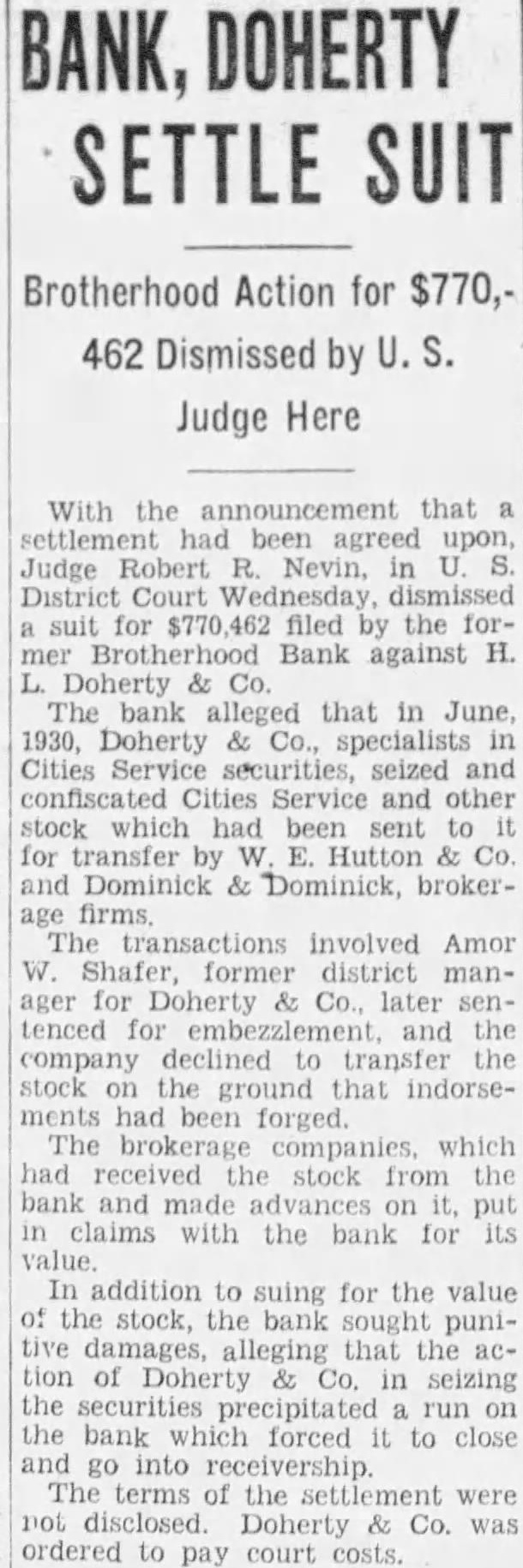
BANK, DOHERTY SETTLE SUIT Brotherhood Action for $770,462 Dismissed by U.S. Judge Here With the announcement that settlement had been agreed upon, Judge Robert R. Nevin, in U. S. District Court Wednesday, dismissed suit for $770,462 filed by the former Brotherhood Bank against H. L. Doherty & Co. The bank alleged that in June, 1930, Doherty & Co., specialists in Cities Service securities, seized and confiscated Cities Service and other stock which had been sent to it for transfer by W. E. Hutton & Co. and Dominick & Dominick, brokerage firms. The transactions involved Amor W. Shafer former district manager for Doherty & Co., later sentenced for and the company declined to transfer the stock on the ground that indorsements had been forged. The brokerage companies, which had received the stock from the bank and made advances on it, put in claims with the bank for its value. In addition to suing for the value of the stock, the bank sought punitive damages, alleging that the action of Doherty & Co. in seizing the securities precipitated run on the bank which forced it to close and go into receivership. The terms of the settlement were not disclosed. Doherty & Co. was ordered to pay court costs.