Article Text
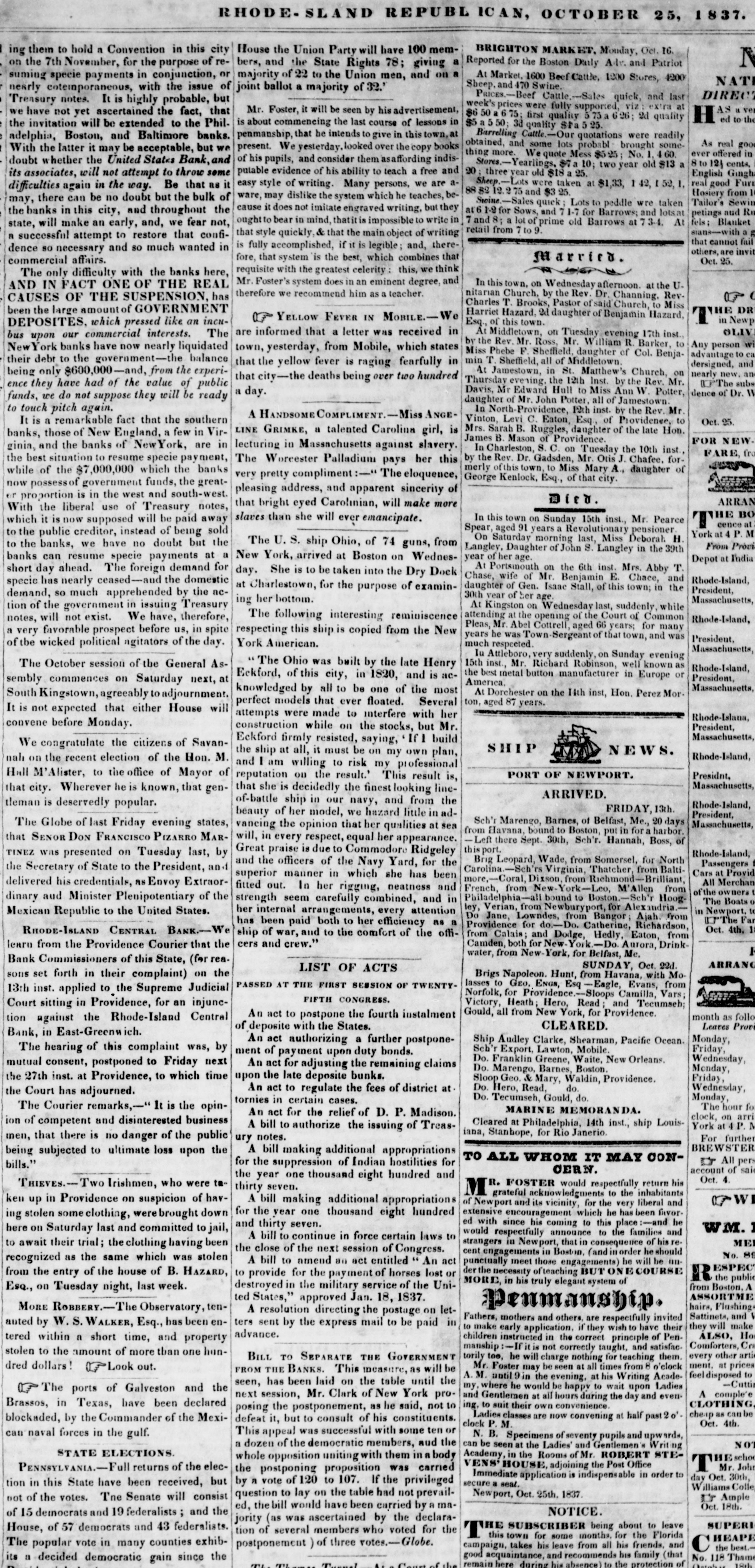
RHOD SLAND REPUBL ICAN, OCTOBER 25, 1837. ing their to hold a Convention in this city House the Union Party will have 100 memBRIGHTON MARKET, Monday, Oct. 16. N on the 7th November, for the purpose of reReported for the Boston Daily A.v. and Patriot bers, and the State Rights 78; giving a majority of 22 to the Union men, and on a suming specie payments in conjunction, or At Market, 1600 Beef Cattle, 1200 Stores, 4200 NATI Sheep, and 470 Swine. nearly cotemporaneous, with the issue of joint ballot a majority of 32.' DIREC PRICES.--Beef Cattle -Sales quick, and last Treasury notes. It is highly probable, but were fully supported, viz at Mr. Foster, it will be seen by is advertisement, we have not yet ascertained the fact, that $6 50 a 6 75: first quality 5 75 a 626; 2d quality ed to the is about commencing the last course of lessons in the invitation will be extended to the Phil. $5 a 5 50; 3d quality Sra 25. penmanship, that he intends to give in this town, at Barrelling Cattle -Our quotations were readily adelphia, Boston, and Baltimore banks. As real goo obtained, and some lots probabl brought some present. We yesterday. looked over the copy books With the latter it may be acceptable, but we ever offered in thing more. quote Mess $5.25; No. 1. 4 60. of his pupils, and consider them asaffording indisdoubt whether the United Status Bank, and 12 cents, Stores.-Yearlings, 87 a 10; two year old $13 putable evidence of his ability to teach a free and 20 old $18 25. its associates, will not attempt to throw some English Gingh real good Furu easy style of writing. Many persons, we are aSheep. were taken at $1,33, 42, 152,1 difficulties again in the way. Be that as it 88 88 19 2 75 and Hosiery from ware, may dislike the system which he teaches, bemay, there can be no doubt but the bulk of Tailor's Sewin Steine.-Sales quiek; Lots to peddle wre taken cause it does not imitate engraved writing, but they the banks in this city, and throughout the and 1-7 for Barrows: and lots at petings aud Rn ought to bear in mind, that it is impossible to write in fels: Blanket and 8; of prime old Barrows at 734. At state, will make an early, and, we fear not, retail from 7to 9. sians-with that style quickly, & that the main object of writing A successful attempt to restore that confithat cannot fail is fully accomplished, if it is legible; and, theredence so necessary and so much wanted in others, invit Married fore, that system is the best, which combines that commercial affairs. Oct.25. requisite with the greatest celerity this, we think The only difficulty with the banks here, Mr. Foster's system does in an eminent degree, and AND N FACT ONE OF THE REAL In town, on Wednesday afternoon. at the U. therefore we recommend him as a teacher. nitarian Church, by the Rev. Dr. Channing. RevCAUSES OF THE SUSPENSION, has Charles T. Brooks, Pastor of Church, to Miss been the large amount of GOVERNMENT Harriet Hazard, 2d daughter of Benjamin Hazard, YELLOW FEVER IN MOBILE.-We in Newp Esq., of this town. DEPOSITES, which pressed like an incuare informed that a letter was received in OLIVI At Middletown, on Tuesday evening 17th inst. bus upon our commercial interests. The by the Rev. Mr. Ross, Mr. William R Barker, to Any person wi York banks have now nearly liquidated town, yesterday, from Mobile, which states advantage Miss Phebe F. Sheffield, daughter of Col. Benjatheir debt to the government-the balance min T. Sheffield, all of Middletown. that the yellow fever is raging fearfully in dersigned, and being only $600,000-and, from the experiAt Jamestown, in St. Matthew's Church, on nearly new. that city-the deaths being over two hundred Thursday evening. the 12th Inst. by the Rev. Mr. TOThe subs ence they have had of the value of public Davis, Mr Edward Hull to Miss Ann W. Potter, a day. dence of Dr. W funds, we do not suppose they will be ready daughter of Mr. John Potter, all of Jamestown to touch pitch again. In rth-Providence, 12th inst. by the Rev. Mr A HANDSOMECOMPLIMENT.-Miss ANGEIt is a remarkable fact that the southern Vinton, Levi C. Eaton, Esq., of Providence, to Oct. 25. Mrs. Sarah B. Ruggles, daughter of the late Hon. LINE GRIMKE, a talented Carolina girl, is banks, those of New England, a few in VirJames B. Mason of Providence. FOR NEW. ginia, and the banks of York, are in lecturing in Massachusetts against slavery. In Charleston, S. C. on Tuesday the 10th inst. FARE, fre the best situation to resume specie payment, by the Rev. Dr. Gadsden, Mr. Otis J. Chafee. forThe Woreester Palladium pays her this while of the $7,000,000 which the banks merly this town, to Miss Mary A., daughter of very pretty compliment The eloquence, George Kenlock, Esq., of that city. now possess of government funds, the greatpleasing address, and apparent sincerity of or proportion is in the west and south-west. Died. ARRAN that bright eyed Carohnian, will make more With the liberal use of Treasury notes, WHE BO In this town on Sunday 15th inst., Mr. Pearce slaves than she will ever emancipate. which it is now supposed will be paid away cence at Spear, aged 91 years a Revolutionary pensioner. to the public creditor, instead of being sold York at4 P.M On Saturday morning last, Miss Deborah H. The U. S. ship Ohio, of 74 guns, from to the banks, we have no doubt but the From Provi Langley, Daughter of John S. Langley in the 39th year of her age. New York, arrived at Boston on Wednesbanks can resume specie payments at Depotat India At Portsmouth on the 6th inst. Mrs. Abby T. short day ahead. The foreign demand for day. She is to be taken into the Dry Dock Chase, wife of Mr. Benjamin E. Chace, and Rhode-Island, specie has nearly ceased-and the domestic daughter of Gen. Isaac Stall, of this town; in the at Charlestown, for the purpose of examinPresident, demand, so much apprehended by the ac30th year of ber age. Massachusetts, ing her bottom. tion of the government in issuing Treasury At Kingston on Wednesday last, suddenly, while attending at the opening of the Court of Common The following interesting reminiscence notes, will not exist. We have, therefore, Rhode-Island, Pleas, Mr Abel Cottrell, aged years; for many a very favorable prospect before us, in spite respecting this ship is copied from the New years he was Town Sergeant of that town, and was President, York American. of the wicked political agitators of the day. much respected. Massachusetts, Iu Attleboro, very suddenly, on Sunday evening The October session of the General As15th inst., Mr. Richard Robinson, well known as The Ohio was built by the late Henry Rhode-Island, Eckford, of this city, in 1820, and is acthe best metal button manufacturer in Europe or President, sembly commences on Saturday next, at America. Massachusetts, knowledged by all to be one of the most At Dorchester on the 14th inst, Hon. Perez MorSouth Kingstown, agreeably to adjournment. perfect models that ever floated. Several ton, aged 87 years. It is not expected that either House will attempts were made to interfere with her Rhode-Islana, convene before Monday. President, construction while on the stocks, but Mr. Massachusetts Eckford firmly resisted, saying, If build We congratulate the citizens of SavanNEWS. the ship at all, it must be on my own plan, Rhode-Island, nah on the recent election of the Hon. M. and I am willing to risk my professional PORT OF NEWPORT. Hall Alister, to the office of Mayor of Presidnt, reputation on the result.' This result is, Massachusetts, that city. Wherever he is known, that genthat she is decidedly the finest looking lineARRIVED. of-battle ship in our navy, and from the tleman is deservedly popular. Rhode-Island, FRIDAY, 13th. beauty of her model, we hazard little in adPresident, Sch'r Marengo, Barnes, of Belfast, Me., 20 days Massachusetts, The Globe of last Friday evening states, vancing the opinion that her qualities at sea from Havana, bound to Boston, put in for a harbor. that SENOR DON FRANCISCO PIZARRO MARwill, in every respect, equal her appearance. -Left there Sept. 30th, Sch'r. Hannah, Boss, of this port. Great praise is due to Commodore Ridgeley Rhode-Island, TINEZ was presented on Tuesday last, by Brig Leopard, Wade, from Somersel, for North and the officers of the Navy Yard, for the Passengers the Secretary of State to the President, and Virginia, Thatcher, from BaltiCars at Provid superior manner in which she has been more,-Coral, chmond-Brilliant, All Merchan delivered his credentials, as Envoy Extraorfitted out. In her rigging, neatness and French, from New-York-Lco, M'Allen from the owners dinary aud Minister Plenipotentiary of the Philadelphia-allbound to Boston.-Sch'r Hoogstrength seem carefully combined, and in The Boats ley, Verian,fromNewburyport,forAlexandria. in Newport, her internal arrangements, every attention Mexican Republic to the United States. Do Jane, Lowndes, from Bangor; Ajah. from The Far has been paid both to her efficiency as a Providence for do.-Do. Catherine, Richardson, Oct. 4th, RHODE-ISLAND CENTRAL BANK.-We ship of war, and to the comfort of the offifrom Calais: and Dodge, Hedly, Eaton, from cers and crew." lenru from the Providence Courier that the Camden, both for Aurora, Drinkwater, from New-York, for Belfast, Me. Bank Commissioners of this State, (for rea. ARRANG SUNDAY, Oct. 22d. LIST OF ACTS Brigs Napoleon. Hunt, from Havana, with Mo sons set forth in their complaint) on the PASSED AT THE FIRST SESSION OF TWENTYlasses to GEO, ENGS, Esq - Eagle, Evans, from 13th inst. applied to the Supreme Judicial Norfolk, for Providence. Camilla, Vars: FIFTH CONGRESS. Victory, Heath: Hero, Read and Tecumseh: Court sitting in Providence, for an injuncGould, all from New York, for Providence. An act to postpone the fourth instalment month as follo tion against the Rhode-Island Central Leaves Provi CLEARED. of deposite with the States. Bank, in East-Greenwich Monday, Ship Audley Clarke, Shearman, Pacific Ocean. An act authorizing a further postponeThe hearing of this complaint was, by Friday, Seb'r Export, Lawton, Mobile. ment of payment upon duty bonds. Orleans, Do. Franklin Greene, Waite, New Wednesday, mutual consent, postponed to Friday next An act for adjusting the remaining claims Do. Marengo, Barnes, Boston. Monday, the 27th inst. at Providence, to which time upon the late deposite bunks. Friday, Sloop Geo. & Mary, Waldin, Providence. Do. Hero, Read, do. Wednesday, An act to regulate the fees of district at the Court has adjourned. Monday, Do. Tecumseh, Gould, do. tornies in certain cases. The hour fo The Courier remarks,-" It is the opinMARINE MEMORANDA. An act for the relief of D. P. Madison. clock, on arri ion of competent and disinterested business Cleared at Philadelphia, 14th inst., ship LouisYork N A bill to authorize the issuing of Treasiana, Stanhope, for Rio Janerio. men, that there is no danger of the public For further ury notes. BREWSTER A bill making additional appropriations being subjected to ultimate loss upon the TO ALL WHOM IT MAY COND All pers for the suppression of Indian hostilities for bills." account of said CERN. the year one thousand eight hundred and Oct. 4. FOSTER would respectfully return his THIEVES.--Two Irishmen, who were tathirty seven. M' grateful acknowledgments to the inhabitants ken up in Providence on suspicion of havA bill making additional appropriations of Newport and its vicinity, for the very liberal and extensive encouragement which he has been favorfor the year one thousand eight hundred ing stolen some clothing, were brought down ed with since his coming to this place -and he and thirty seven. WM. here on Saturday last and committed to jail, would respectfully announce to the families and A bill to continue in force certain laws to MEI strangers in Newport, that in consequence of his re. to await their trial the clothing having been the close of the next session of Congress. cent engagements in Boston, (and order should No. 89 recognized as the same which was stolen A bill to amend 80 act entitled " An act punctually meet those engagements) he will be anDESPECT der the necessity of teaching BUT ON E COURSE from the entry of the house of B. HAZARD, to provide for the payment of horses lost or public MORE in his truly elegant system of destroyed in the military service of the Unifrom Boston, A Esq., on Tuesday night, last week. ASSORTME ted States," approved Jan. 18, 1837. hairs, Flushing Penmanship MORE ROBBERY.-The Observatory, tenA resolution directing the postage on letSattinets, and Fathers, mothers and others. are respectfully invited auted by W. S. WALKER, Esq., has been enters sent by the express mail to be paid in they will make to make early application. if they wish to have their advance. ALSO, Ho children instructed in the correct principle of Pentered within a short time, and property Comforters,Cn manship is not correctly taught, and satisfac. stolen to the amount of more than one hunevery other arti BILL TO SEPARATE THE GOVERNMENT torily too, he will charge nothing for teaching them ment. at prices dred dollars! Look out. Mr. Foster may be seen at all times from 8 o'clock FROM BANKS. This measure, as will be feel disposed to M. until in the evening, at his Writing Acadeseen, has been laid on the table until the -Cutti my, where he would be happy to wait upon Ladies The ports of Galveston and the A comple'e next session, Mr. Clark of New York proand Gentlemen at all hours during the day and evenBrassos, in Texas, have been declared CLOTHING, ing, to suit their own convenience. posing the postponement, as he said, not to cheap as Ladies classes are now convening at half past 2 defeat it, but to consult of his constituents. blockaded, by the Commander of the MexiOct. 4th. clock P. M. This appeal was successful with some ten or can naval forces in the gulf. N. B. Specimens of seventy pupils and upwards, a dozen of the democratic members, aud the NOT can be seen at the Ladies' and Gentlemen Writing STATE ELECTIONS. Academy, in the Rooms of Mr. ROBERT STEwhole opposition uniting with them in body THE school VENS HOUSE, adjoining the Post Office Mr. John PENNSYLVANIA.-Full returns of the electhe postponing proposition was carried Immediate application is indispensable in order to day Oct. 30th, by a vote of 120 to 107. If the privileged secure a seat. tion in this State have been received, but Williams Colle question to lay on the table had not prevailNewport, Oct. 25th. 1837. not of the votes. The Senate will consist L'r Ample Oct 18th. ed, the bill would have been carried by a maNOTICE. of 15 democrats and 19 federalists and the jority (as was ascertained by the declaraSUPERI House, of 57 democrats and 43 federalists. tion of several members who voted for the TV SUBSCRIBER being about to leave this town for some months. for the Florida HEAPE The popular vote in many counties exhibpostponement of three votes.-Globe. campaign, takes his leave from all his friends, and the best. good acquaintance, and recommends his family (that No. Tham its a decided democratic gain since the of the remain here during his absence) to the protection of