16966. Miners Savings Bank (Wilkes Barre, PA)

Bank Information

Episode Type
Run → Suspension → Unsure
Bank Type
savings bank
Start Date
January 3, 1879
Location
Wilkes Barre, Pennsylvania (41.246, -75.881)

Metadata

Model
gpt-5-mini
Short Digest
34b38e2766e7ce69

Response Measures

None

Description

Multiple contemporaneous newspaper dispatches (Jan 3–4, 1879) report a run on the Miners' Savings Bank in Wilkes-Barre triggered by the failure of the commercial firm Bennett, Phelps & Co. The run was stopped by the enforcement of the sixty day regulation (a temporary/partial suspension of payments). Articles do not report a subsequent reopening or permanent closure, so the outcome is uncertain — classified as run → suspension (unsure). Corrected minor OCR variants (e.g., Bennett/Pheips/Phelps).

Events (2)

1. January 3, 1879 Run
Cause
Local Shock
Cause Details
Failure of local commercial firm Bennett, Phelps & Co. precipitated deposit withdrawals
Measures
Enforcement of the sixty-day regulation (temporary restriction on withdrawals)
Newspaper Excerpt
The failure of Bennett, Phelps & Co. caused a run on the Miners' Savings Bank
Source
newspapers
2. January 3, 1879 Suspension
Cause Details
Bank adopted the sixty-day regulation (temporary suspension/limit on withdrawals) in response to the run
Newspaper Excerpt
run on the Miners' Savings Bank, which was stopped by the enforcement of the sixty day regulation
Source
newspapers

Newspaper Articles (9)

Article from Daily Press and Dakotaian, January 3, 1879

Click image to open full size in new tab

Article Text

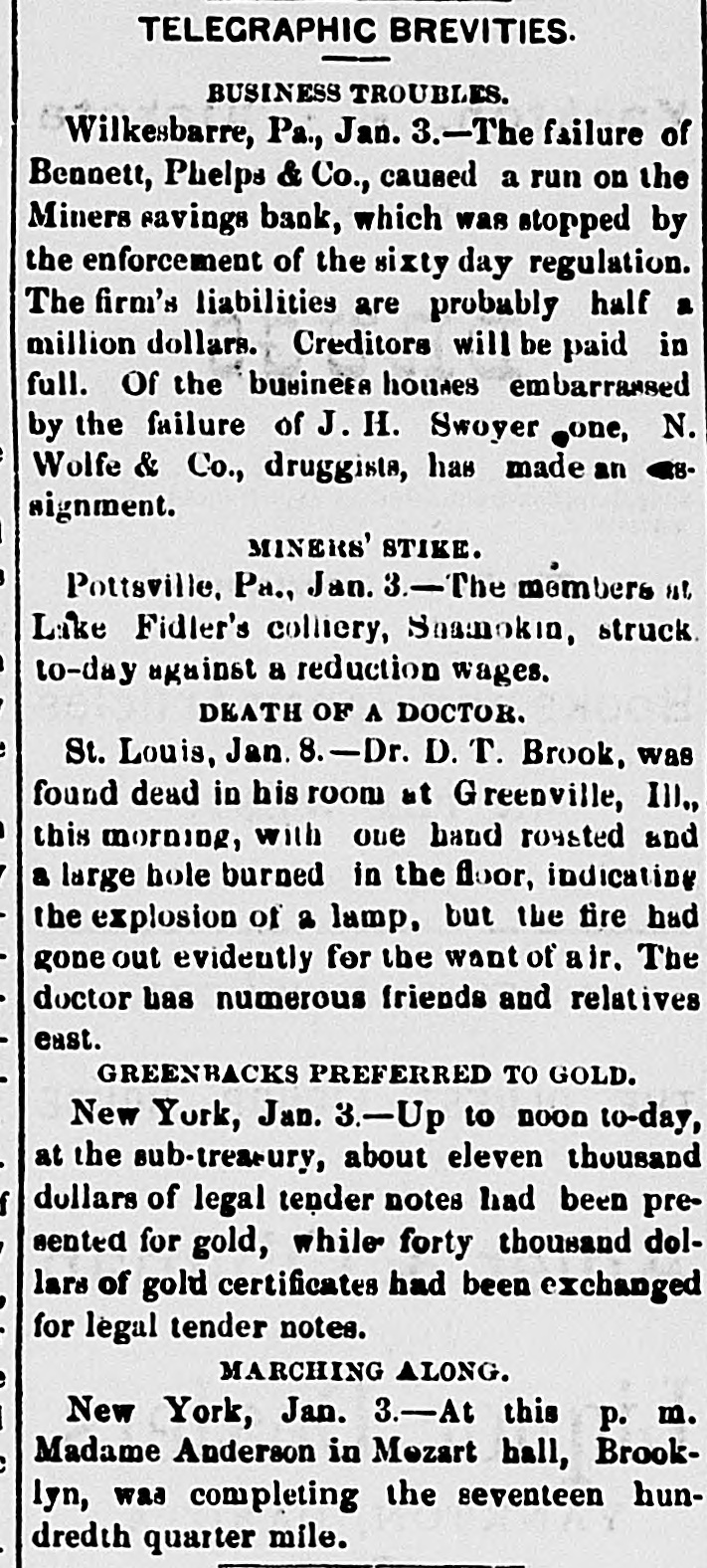
TELEGRAPHIC BREVITIES. BUSINESS TROUBLES. Wilkesbarre, Pa., Jan. 3.-The failure of Bennett, Phelps & Co., caused a run on the Miners savings bank, which was stopped by the enforcement of the sixty day regulation. The firm's liabilities are probably half a million dollars. Creditors will be paid in full. Of the business houses embarrassed by the failure of J. H. Swoyer one, N. Wolfe & Co., druggists, has made an as signment. MINERS' STIKE. Pottsville, Pa., Jan. 3.-The members 11 Like Fidler's colliery, Saamokia, struck. to-day against a reduction wages. DEATH OF A DOCTOR. St. Louis, Jan. 8.-Dr. D. T. Brook, was found dead in his room at Greenville, III., this morning, with one hand roysted and a large hole burned in the floor, indication the explosion of 2 lamp, but the fire had gone out evidently for the want of air. The doctor has numerous friends and relatives east. GREENBACKS PREFERRED TO GOLD. New York, Jan. 3.-Up to noon to-day, at the sub-treatury, about eleven thousand dollars of legal tender notes had been presented for gold, while forty thousand dollars of gold certificates had been exchanged for legal tender notes. MARCHING ALONG. New York, Jan. 3.-At this p. m. Madame Anderson in Mozart hall, Brooklyn, was completing the seventeen hundredth quarter mile.


Article from The Rock Island Argus, January 3, 1879

Click image to open full size in new tab

Article Text

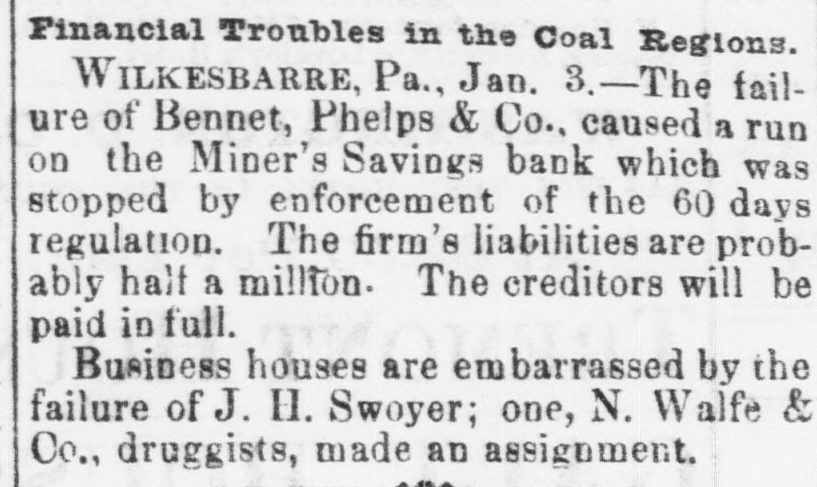
Financial Troubles in the Coal Regions. WILKESBARRE, Pa., Jan. 3.-The failure of Bennet, Phelps & Co., caused a run on the Miner's Savings bank which was stopped by enforcement of the 60 days regulation. The firm's liabilities are probably half a million. The creditors will be paid in full. Business houses are embarrassed by the failure of J. H. Swoyer; one, N. Walfe & Co., druggists, made an assignment.


Article from The Sun, January 4, 1879

Click image to open full size in new tab

Article Text

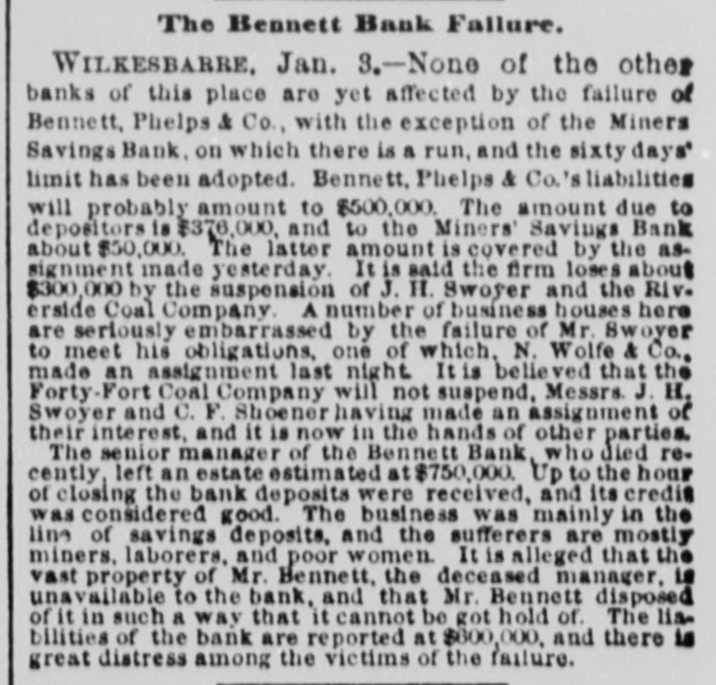
The Bennett Bank Failure. WILKESBARRE, Jan. 3.-None of the other banks of this place are yet affected by the failure of Bennett, Phelps & Co., with the exception of the Miners Savings Bank, on which there is a run, and the sixty days limit has been adopted. Bennett, Phelps & Co.'s liabilities will probably amount to $500,000. The amount due to depositors is $376, 000, and to the Miners' Savings Bank about $50. 000. The latter amount is covered by the assignment made yesterday. It is said the firm loses about $300, 000 by the suspension of J. H. Swoyer and the Riv. erside Coal Company. A number of business houses here are seriously embarrassed by the failure of Mr. Swoyer to meet his obligations, one of which, N. Wolfe & Co., made an assignment last night It is believed that the Forty-Fort Coal Company will not suspend, Messrs. J. H. Swoyer and C. F. Shoener having made an assignment of their interest, and it is now in the hands of other parties. The senior manager of the Bennett Bank, who died re. cently, left an estate estimated at $750,000. Up to the hour of closing the bank deposits were received, and its credit was considered good. The business was mainly in the line of savings deposits, and the sufferers are mostly miners. laborers, and poor women. It is alleged that the vast property of Mr. Bennett, the deceased manager, is unavailable to the bank, and that Mr. Bennett disposed of it in such a way that it cannot be got hold of. The lia. bilities of the bank are reported at $600 000, and there is great distress among the victims of the failure.


Article from The Wheeling Daily Intelligencer, January 4, 1879

Click image to open full size in new tab

Article Text

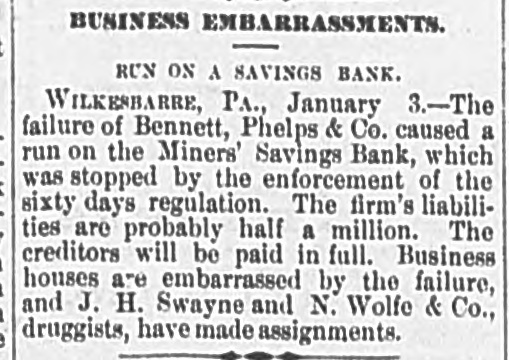
BUSINESS EMBARRASSMENTS. RUN ON A SAVINGS BANK. WILKESBARRE, PA., January 3.-The failure of Bennett, Phelps & Co. caused a run on the Miners' Savings Bank, which was stopped by the enforcement of the sixty days regulation. The firm's liabilities are probably half a million. The creditors will be paid in full. Business houses are embarrassed by the failure, and J. H. Swayne and N. Wolfe & Co., druggists, have made assignments.


Article from Knoxville Daily Chronicle, January 4, 1879

Click image to open full size in new tab

Article Text

PENNSYLVANIA. WILKESBARRE, Jan. 3.-None of the other banks of this place are affected by the failure of Bennett, Philps & Co. with the exception of the Miners' Savings Bank, on which there is a slight run, and the sixty days' limit has been adopted. Bennet, Philps & Co.'s liabilities will probably amount to $500,000. They claim that their creditors will not lose a dollar, as their property will more than cover the above sum. POTTSVILLE, Jan. 3.-A strike occurred at the Luke Fidler colliery, one of the Minoral Bailroad and Mining Co.'s mines, at Shamokin, this morning, because of a reduction of the wages of employes. The colliery has been in operation all season, employing 325 men and boys, while a great many other collieries have been idle.


Article from Daily Globe, January 4, 1879

Click image to open full size in new tab

Article Text

The quantity received from United States ports was 25,112,939 cwts. Thus, of the total importations of wheat into the United kingdom during the six months ended June 30, 1878, nearly 631/2 per cent. was from the United States. American competition in breadstuffs and the cheap grazing lands of this country are telling more upon English farm production from year to year. The United Kingdom imported of live animals in 1877 about 300,000 cattle, 1,000,000 sheep, from 40,000 to 50,000 swine, and 30,524 horses. Since the first of last May and up to the 1st of September, there have been an average of 3,000 cattle a week shipped to Great Britain from Montreal, Boston, New York, Philadelphia and Baltimore. The shipping of live stock and dead meat to Great Britain, now in its infancy, bids fair in a no distant future to assume enormous proportions. Of the $1,595,000,000 worth of British imports for the year 1876, $795,000,000 were for food; $595,000,000 for raw materials; $205,000,000 for manufactured and miscellaneous articles. With the improvement of the northern water way, as urged by the convention, the exportation of products from the West to Europe must rapidly increase and largely contribute to supply the seven hundred and ninety-five million dollars worth of food now annually imported by Great Britain. The great valley of the Red river is peculiarly adapted to the production of the cereals as well as the raising of stock. It is capable of producing. one hundred million bushels of wheat annually, and is destined to become with contiguous areas, the food producing region of the American continent, and largely the source of the food supply of the world. The opening and cheapening of the lake route, via Lake Superior to the Atlantic, is speedily to develop this now comprratively unused source of the nation's wealth, as well as to cheapen to millions at home and abroad, the necessaries of life. With the hope that your honorable bodies will grant the reasonable request of your petitioners, they will ever pray. GEO. H. ELY, Cleveland, H. M. RICE, St. Paul, E. W. DURANT, Stillwater, H. A. TAYLOR, Hudson, C. H. GRAVES, Duluth, R. CHUTE, Minneapolis, E. S. TYLER, Fargo, S. F. SHERMAN, Buffalo, B. HAGAMAN, Oswego. Besides the promulgation of the above, the committee have about completed the proceedings of the convention in pamphlet form for general and widespread distribution. Half a Million Failure at Wilkesbarre, Pa. WILKESBARRE, Pa., Jan. 3.-The failure of Bennett Pheips has caused a run on the Miners' savings bank, which was stopped by the enforcement of the sixty day regulation. The firm's liabilities are probably half a million, but creditors are to be paid in full. Business houses are embarrassed by the failure of J. H. Swoyer. One, N. Wolf & Co., druggist, made an assignment.


Article from Daily Globe, January 4, 1879

Click image to open full size in new tab

Article Text

42,182,102 The quantity received from United States ports was 25,112,939 cwts. Thus, of the total importations of wheat into the United kingdom during the six months ended June 30, 1878, nearly 631/2 per cent. was from the United States. American competition in breadstuffs and the cheap grazing lands of this country are telling more upon English farm production from year to year. The United Kingdom imported of live animals in 1877 about 300,000 cattle, 1,000,000 sheep, from 40,000 to 50,000 swine, and 30,524 horses. Since the first of last May and up to the 1st of September, there have been an average of 3,000 cattle a week shipped to Great Britain from Montreal, Boston, New York, Philadelphia and Baltimore. The shipping of live stock and dead meat to Great Britain, now in its infancy, bids fair in a no distant future to assume enormous proportions. Of the $1,595,000,000 worth of British imports for the year 1876, $795,000,000 were for food; $595,000,000 for raw materials; $205,000,000 for manufactured and miscellaneous articles. With the improvement of the northern water way, as urged by the convention, the exportation of products from the West to Europe must rapidly increase and largely contribute to supply the seven hundred and ninety-five million dollars worth of food now annually imported by Great Britain. The great valley of the Red river is peculiarly adapted to the production of the cereals as well as the raising of stock. It is capable of producing one hundred million bushels of wheat annually, and is destined to become with contiguous areas, the food producing region of the American continent, and largely the source of the food supply of the world. The opening and cheapening of the lake route, via Lake Superior to the Atlantic, is speedily to develop this now comprratively unused source of the nation's wealth, as well as to cheapen to millions at home and abroad, the necessaries of life. With the hope that your honorable bodies will grant the reasonable request of your petitioners, they will ever pray. GEO. H. ELY, Cleveland, H. M. RICE, St. Paul, E. W. DURANT, Stillwater, H. A. TAYLOR, Hudson, C. H. GRAVES, Duluth, R. CHUTE, Minneapolis, E. S. TYLER, Fargo, S. F. SHERMAN, Buffalo, B. HAGAMAN, Oswego. Besides the promulgation of the above, the committee have about completed the proceedings of the convention in pamphlet form for general and widespread distribution. Half a Million Failure at Wilkesbarre, Pa. WILKESBARRE, Pa., Jan. 3.-The failure of Bennett Pheips has caused a run on the Miners' savings bank, which was stopped by the enforcement of. the sixty day regulation. The firm's liabilities are probably half a million, but creditors are to be paid in full. Business houses are embarrassed by the failure of J. H. Swoyer. One, N. Wolf & Co., druggist, made an assignment.


Article from Chicago Daily Tribune, January 4, 1879

Click image to open full size in new tab

Article Text

FINANCIAL. Special Disputch to The Tribune. Tenns HAUTE, Ind., Jan. 3.-J. M. Refner & Bon, fancy groceries, to-day made au assignment to E. H. Bindley. . . It is a bad failure. Liabilities supposed about $8,000; assets about $1,000. WILKESDARRE, Pa., Jan. 3.-The failure of Bennett, Phelps & Co. caused a run on the Miners' Savings Bank, which was stopped by the enforcement of the sixty-day regulation. The firm's liabilities are probably half & million. The creditors will be paid in full. Many business houses are embarrassed bv the failure. J. H. Swoyer and N. Wolte & Co., druggists, have made assignments.


Article from The Red Cloud Chief, January 16, 1879

Click image to open full size in new tab

Article Text

Judge Sherman, brother of General and Secretary Sherman, died at Cleveland, O., a few days ago. James Young, aged 14, fell in a coal shaft, 100 feet, Dec. 31st, at LaSalle, Ill., and was instantly killed. A fire at Farmersville, La., January 2d, destroyed four buildings. Loss, $10,000; Insurance, $4,000. At Walpole, Mass., January 4th, the house of Benjamin Neal burned, his wife perishing in the flames. Charles Smith's saw and grist mill, Davison, Mich., burned Dec. 31st. Loss, $12,000; Insurance, $3,000. The city debts of Brooklyn, N. Y., amount to $27,475,318, an increase within the last year of $1,285,506. A fire in the general office of the Michigan Central Railroad, Detroit, Jan. 4th, caused a loss of $5,000. The Avenue Hotel and four other buildings were burned in Huntington, West Virginia, Jan. 4th. Loss, $13,000. The 41st General Assembly of Tennessee organized Jan 6th. The Louisiana Legislature organized the same day. Two brakemen on freight trains on the Central New Jersey and North Pennsylvania road, froze to death, January 3d. The Academy of Holy Angels at Buffalo, N. Y., was burned Jan. 4th. The children were removed. Loss, $60,000; Insurance $25,000. The Nevada Legislature convened Jan. 6th, and effected a permanent organization by electing the Republican caucus nominees in both Houses. Dempster Hall at Evanston, Ill., was burned to the ground January 2nd. Loss, $35,000; Insurance, $3,000. It was a branch of the Evanston University. Justice Hunt, of the United States Supreme Court, was stricken with paralysis at his residence in Washington, a few days since, and his recovery is despaired of. It is reported that 15,000 Mennonites will arrive in this country from Russia by May next. This is the last year of their exemption from military service in that country. The Second Baptist Church, St Louis, burned January 2nd. It cost about $175,000, being one of the finest and most imposing edifices in the city. Insurance, $100,000. A team crossing on the ice near Richmond, Ind., Dec. 31st, broke through, and were carried under by the rapid current. The occupants, two men and a woman, were drowned. Three men were killed by the explosion of nitro-glycerine works near Paterson, N. J., December 28th. All were men with families. Houses were shaken as if by an earthquake. An explosion of three boilers in a large distillery at Terre Haute, Ind., occurred January 2nd. A colored fireman and a boy were instantly killed. Damages to property about $5,000. The Miners' Savings Bank at Wilkes-barre, Pa., was subjected to a run caused by the failure of Bennette, Phelps & Co., which was stopped by the enforcement of the sixty days regulation terms. The employes of the Beechwood colliery, near Pottsville, Pa., who struck for their wages, were paid Jan. 6th, and orders were given to close the colliery. This throws 300 men and boys out of employment. A fire in the Cocheco Print works, at Dover, N. H., Dec. 28th, damaged the building and contents $75,000. On the same day, the Emerson Piano Co.'s factory burned, and eighty-five men were thrown out of employment. Charles Longley, of Nicholsville, Ky., attempted to light a fire with a coal oil lamp. The lamp exp'oded, fatally burning Longley and a child, and seriously injuring another child. The house caught fire and was entirely destroyed. The new First Presbyterian church of Quincy, Ill., was totally destroyed by fire January 2nd. Loss, $60,000; insurance, $30,000; the fire caught from the heating apparatus. The church was to have been dedicated January 5th. Dr. S. F. Brooks was found dead in his room, at Greenville, Ill., January 3d, with his hand frosted and a hole burned in the floor. There were indications of the explosion of a lamp, but the fire had gone out for the want of air. By the burning of a barn at East Orange, N. Y., December 28th, two young men were burned to death. On the same day an o'd lady, and the watchman, lost their lives by the burning of a small house attached to Irving House, at New London, Ct. The Harmony Cotton Mills, Cahoes, N. Y., employing 3,500 hands, have reduced working time to three days a week. The operatives of the Newburgh steam cotton mills have also been placed on half time. The low price of manufactured goods is given as the cause. The Secretary of the Treasury has is-