1694. Commercial National Bank (Washington, DC)

Bank Information

Episode Type
Run → Suspension → Closure
Bank Type
national
Bank ID
7446
Charter Number
7446
Start Date
February 27, 1933
Location
Washington, District of Columbia (38.895, -77.036)

Metadata

Model
gpt-5-mini
Short Digest
50284ef2e46221ad

Response Measures

Borrowed from banks or large institutions, Fed/other loan, Capital injected, Full suspension, Books examined

Receivership Details

Depositor recovery rate
70.0%
Date receivership started
1933-02-28
Share of assets assessed as good
42.6%
Share of assets assessed as doubtful
50.5%
Share of assets assessed as worthless
6.8%

Description

Newspaper articles indicate heavy/abnormal withdrawals culminating Feb. 27, 1933 (run) and the bank was closed/suspended by the controller and placed in receivership (receiver named by March 1). The bank remained in receivership and did not resume normal independent operations; receivers later paid dividends. Cause is tied to the nationwide/state banking crisis in late Feb.–Mar. 1933 rather than a discrete misinformation event.

Events (7)

1. October 19, 1904 Chartered
Source
historical_nic
2. February 27, 1933 Run
Cause
Macro News
Cause Details
Abnormal/large withdrawals amid the widespread banking crisis and state restrictions in late Feb.–Mar. 1933 (panic conditions around bank holidays and bank closings).
Measures
Bank and depositors' committees later considered reorganization plans; receiver allowed depositors to obtain statements; no temporary payment-withdrawal measure (30/60/90) described prior to suspension.
Newspaper Excerpt
there had been abnormal withdrawals from the Commercial National Bank; withdrew funds the day before the bank closed
Source
newspapers
3. February 27, 1933 Suspension
Cause
Macro News
Cause Details
Closed by regulator after heavy withdrawals and deteriorating liquidity during the national banking crisis in late February 1933; controller of the currency and receiver took charge shortly thereafter.
Newspaper Excerpt
found the bank closed by order of the controller of the currency
Source
newspapers
4. February 28, 1933 Receivership
Source
historical_nic
5. March 1, 1933 Receivership
Newspaper Excerpt
Commercial National Bank, which was taken over by a receiver on March 1, today asked the aid of the District Supreme Court ... Robert C. Baldwin, receiver for the bank, announced ... previous articles refer to the bank as 'in receivership'.
Source
newspapers
6. April 12, 1933 Other
Newspaper Excerpt
doors of the bank would be open to commercial depositors tomorrow morning ... that they may obtain statements as to their standing at the time the bank suspended business on February 27; statements only are to be furnished, the cancelled checks will be held for the present.
Source
newspapers
7. September 26, 1933 Other
Newspaper Excerpt
Receiver announced initial dividend checks of 20 percent ... bank remains insolvent but paying dividends to creditors over time.
Source
newspapers

Newspaper Articles (21)

Article from Los Angeles Evening Post-Record, March 2, 1933

Click image to open full size in new tab

Article Text

STATES RELIEVING BANKS Nevada, Arizona, Oklahoma, Among Last to Join BY UNITED PRESS The to restrict withdrawals of deposits spread through the south and west today bringing the total number of states to enact emergency legislation to 16. Beside California, the four most recent states to take action are Arizona, Nevada, Oregon and Oklahoma, Mississippi acted late last night. Louisiana went step further and also declared three-day holiday for all Executives announcing the new holidays generally blamed conditions in other states for forcing the extension of restrictions by placing an unusual strain on banks which sought to continue business EIGHT CLOSED Eight banks in the District of Columbia imposed restrictions on withdrawals as an aftermath of the clos* ing of the Commercial National Bank. In several states already operating under restrictions, business appeared to be moving back toward nor- President-elect Roosevelt, after discussing the bank situation with William H. Woodin, who will be his secretary of the treasury, indicated that he would not issue any state= ment on the subject. Washington dispatches had reported pressure upon him make reassuring declaration before he is inaugurated CUT WITHDRAWALS The states in which banks had been authorized to operate emergency status before last night were Alabama, Kentucky, Michigan, Ohio, Pennsylvania, Arkansas, West Virginia and Maryland, In several others passed measures permitting governors and banking officials restrict with drawals should become necessary, In Indiana, Illinois and some other states, some banks operated under restrictions without formal authorization of the state Efforts continued in Michigan to put into effect the plan of Henry Ford to take over two big banks and reorganize them. One of the banks, was indicated, might reopen soon without Ford's assistance.
Article from Evening Star, March 17, 1933

Click image to open full size in new tab

Article Text

BANK OFFICER SUES FOR FUNDS IN BOX Action Seeks to Recover Money of Estate Withdrawn Before Closing. Thomas Blackwell Smith, assistant cashier of the Commercial National Bank, which was taken over by a receiver on March 1, today asked the aid of the District Supreme Court in recovering more than $29,000 of trust funds which he withdrew from the bank February 27. the day before it closed, and placed in a safe deposit box. The money represented the proceeds from the estate of Gertrude L. Hoffman. who died March 22. 1931. As executor of the estate, Smith, in compliance with a provision of the will, had drawn a check for $20,233.42 in favor of the Domestic and Foreign Missionary Society of the Protestant Episocpal Church while the money was still on deposit in the bank. On February 27. the day before the bank closed, Smith, according to his petition, "became apprehensive that all banks in the District might close," and withdrew the $20,233.42 covered by the outstanding check, and an additional $9,000. comprising all the money he had on deposit as executor of the estate. He placed this money in a safe deposit box in the vault of the bank. Refused Access to Box. Subsequently, he said, he was informed the check had been returned to the missionary society marked "unpaid." Thereupon, he said, he applied to the receiver for the bank, Robert C. Baldwin, for permission to get the money out of the safe deposit box to pay the legacy to the society and to determine whether any of the currency was in the form of gold certificates, which should be turned over to the Government in accordance with President Roosevelt's proclamation. Baldwin, he said, refused to give him access to the safe deposit box on the theory that the transfer had been made in violation of law. He asked the court to issue a. rule (Continued on Page 2, Column 6.)


Article from The Washington Times, March 17, 1933

Click image to open full size in new tab

Article Text

EXECUTOR SUES JULU CLOSED BANK A fight was begun in District Supreme Court today by Thomas B. Smith, assistant cashier of the Commercial National Bank, to recover $29,000 from a safe deposit vault in the bank. The money represents a trust fund of which he is executor. Smith, as executor, withdrew the money from his checking account the day before the bank was closed. According to the petition filed today, he withdrew the money because he "became apprehensive that all banks in the District might close." The fund belonged to the estate of Gertrude L. Hoffman, who died in March, 1931. In compliance with provisions of the will, Smith said, he sent a check for $20,233.42 to the Domestic and Foreign Missionary Society of the Protestant Episcopal Church against the money on deposit in the bank. Before the check was honored he withdrew slightly more than $29,000 from the checking account, representing the entire fund he had on deposit as executor, placing it in the safe deposit box. Subsequently he learned that the check had been returned from the missionary society marked "unpaid," Smith said. Robert C. Baldwin, receiver for the bank, refused to give him I ermission to take the money from the box to pay the missiontry legacy, Smith says, on the theory that the banking law governing transfers and withdrawals with a view to giving preference to one depositor over another was violated.


Article from Evening Star, March 17, 1933

Click image to open full size in new tab

Article Text

BANK OFFICER SUES FOR FUNDS PLACED IN SAFETY DEPOSIT (Continued From First Page.) requiring the receiver to show cause why the money should not be turned over to him as executor and to decide whether the bank or the society is entitled to the funds. Justice Daniel W. O'Donoghue set March 28 as the date for the hearing on the petition. The will directed that $20,000 be paid to a hospital at Fort Yukon, Alaska, but the hospital was not incorporated and could. not accept the money. Withdrew Funds. The court ordered it with interest turned over to the society which operates the hospital. After drawing the check Smith transferred the amount it called for from his savings account as executor to his checking account as executor. In his petition, Smith said: "For many years your petitioner has been employed by the bank in charge of the savings department with the title of assistant cashier. He had knowledge of the fact that banks in several States had been closed, and was informed that there had been abnormal withdrawals from certain banks in the District and had personal knowledge that there had been adnormal withdrawals from the Commercial National Bank. On the morning of February 27 he became apprehensive that all banks in the District might close and in order to protect the interest of the beneficiaries of the estate withdrew about $9.000 in cash, the same being the entire balance to his credit as executor in a savings account. and later on the same day withdrew the $20,233.42 from the checking account." Both sums were placed in the safe deposit box which already contained various notes and other property of the estate. Found Bank Closed. Smith told the court he was not a general executive officer of the bank. that he was not a member of the board of directors, that he was not informed as to the bank's policies and that on the day of the withdrawals he did not know the bank was insolvent, nor that its closing was in contemplation. On the morning of February 28. he said. he went to the bank for work as usual, and found it closed by order of the controller of the currency. Some time later. he said. he learned that the check had been returned unpaid to the missionary society. On March 13. he applied to Baldwin for access to the box, but this request was refused. The refusal was on the theory that the transfers violated a section of the United States code relating to transfers made in contemplation of insolvency, or with a view to preferring one creditor to another. Smith says the transfers were made. not with any intention of violating the law. but to carry out an order of the court to safeguard the trust funds. The petition was filed through Attorneys G. B. Craighill and B. D. Boteler.


Article from Evening Star, April 4, 1933

Click image to open full size in new tab

Article Text

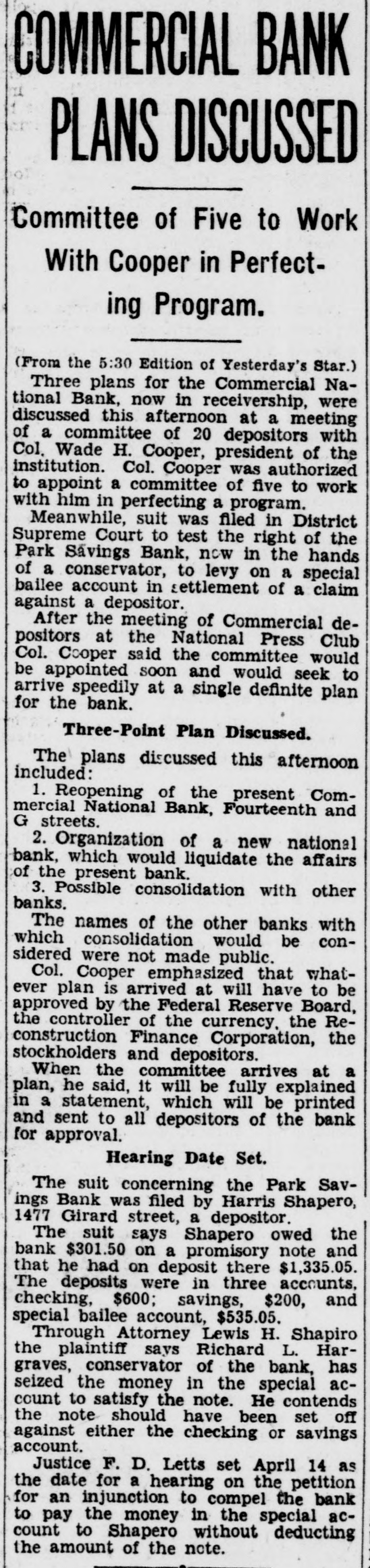
COMMERCIAL BANK PLANS DISCUSSED Committee of Five to Work With Cooper in Perfecting Program. (From the 5:30 Edition of Yesterday's Star.) Three plans for the Commercial National Bank, now in receivership, were discussed this afternoon at a meeting of a committee of 20 depositors with Col. Wade H. Cooper, president of the institution. Col. Cooper was authorized to appoint a committee of five to work with him in perfecting a program. Meanwhile, suit was filed in District Supreme Court to test the right of the Park Savings Bank, now in the hands of a conservator, to levy on a special bailee account in settlement of a claim against a depositor. After the meeting of Commercial depositors at the National Press Club Col. Cooper said the committee would be appointed soon and would seek to arrive speedily at a single definite plan for the bank. Three-Point Plan Discussed. The plans discussed this afternoon included: 1. Reopening of the present Commercial National Bank, Fourteenth and G streets. 2. Organization of a new national bank, which would liquidate the affairs of the present bank. 3. Possible consolidation with other banks. The names of the other banks with which consolidation would be considered were not made public. Col. Cooper emphasized that whatever plan is arrived at will have to be approved by the Federal Reserve Board, the controller of the currency. the Reconstruction Finance Corporation, the stockholders and depositors. When the committee arrives at a plan, he said, it will be fully explained in 3. statement, which will be printed and sent to all depositors of the bank for approval. Hearing Date Set. The suit concerning the Park Savings Bank was filed by Harris Shapero, 1477 Girard street, a depositor. The suit says Shapero owed the bank $301.50 on a promisory note and that he had on deposit there $1,335.05. The deposits were in three accounts, checking, $600; savings, $200, and special bailee account, $535.05. Through Attorney Lewis H. Shapiro the plaintiff says Richard L. Hargraves, conservator of the bank, has seized the money in the special account to satisfy the note. He contends the note should have been set off against either the checking or savings account. Justice F. D. Letts set April 14 as the date for a hearing on the petition for an injunction to compel the bank to pay the money in the special account to Shapero without deducting the amount of the note.


Article from Evening Star, April 12, 1933

Click image to open full size in new tab

Article Text

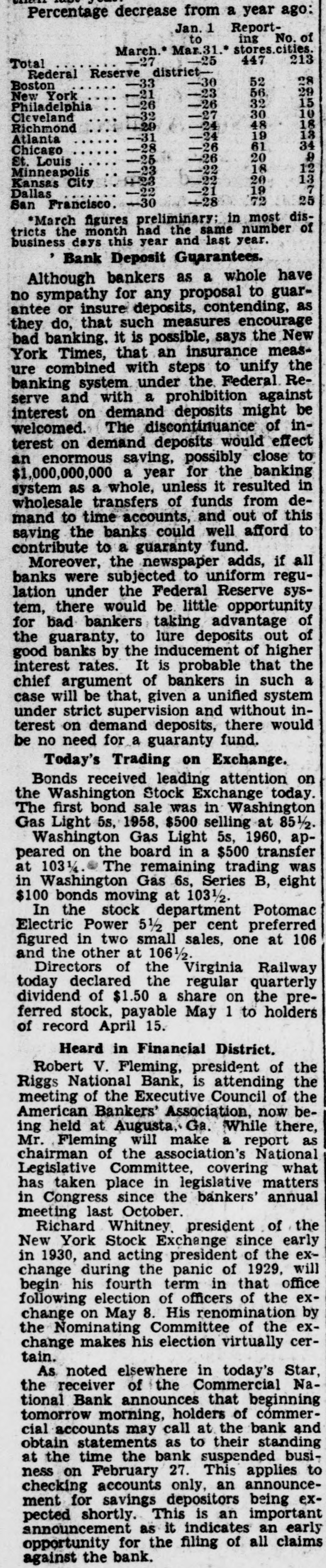
Percentage decrease from a year ago: Jan. 1 Reporting No. of to March.* Mar.31. stores.cities 213 25 447 -27 Total Rederal Reserve district28 52 -30 33 Boston 29 56. -23 21 New York 15 32 -26 -26 Philadelphia 10 30 -27 32 Cleveland 48 18 -24 29 Richmond 13 19 -24 -31 Atlanta 34 61 -26 -28 Chicago 20 9 26 -25 Et. Louis 12 18 -22 -23 Minneapolis 20 13 E-33 Kansas City 7 19 -21 -22 Dallas 25 72 +28 San Francisco. -30 *March figures preliminary; in most districts the month had the same number of business days this year and last year. , Bank Deposit Guarantees. Although bankers as a whole have no sympathy for any proposal to guarantee or insure deposits, contending, as they do, that such measures encourage bad banking. it is possible, says the New York Times, that an insurance measure combined with steps to unify the banking system under the Federal Reserve and with a prohibition against interest on demand deposits might be welcomed. The discontinuance of interest on demand deposits would effect an enormous saving, possibly close to $1,000,000,000 a year for the banking system as a whole, unless it resulted in wholesale transfers of funds from demand to time accounts, and out of this saving the banks could well afford to contribute to a guaranty fund. Moreover, the newspaper adds, if all banks were subjected to uniform regulation under the Federal Reserve system, there would be little opportunity for bad bankers taking advantage of the guaranty, to lure deposits out of good banks by the inducement of higher interest rates. It is probable that the a chief argument of bankers in such case will be that, given a unified system under strict supervision and without interest on demand deposits, there would be no need for a guaranty fund. Today's Trading on Exchange. Bonds received leading attention on the Washington Stock Exchange today. The first bond sale was in Washington Gas Light 5s, 1958, $500 selling at 851/2. Washington Gas Light 5s, 1960, appeared on the board in a $500 transfer at 1031/4 The remaining trading was in Washington Gas 6s, Series B, eight $100 bonds moving at 1031/2. In the stock department Potomac Electric Power 51/2 per cent preferred figured in two small sales, one at 106 and the other at 1061/2 Directors of the Virginia Railway today declared the regular quarterly dividend of $1.50 a share on the preferred stock. payable May 1 to holders of record April 15. Heard in Financial District. Robert V. Fleming, president of the Riggs National Bank, is attending the meeting of the Executive Council of the American Bankers' Association, now being held at Augusta, Ga. While there, Mr. Fleming will make a report as chairman of the association's National Legislative Committee, covering what has taken place in legislative matters in Congress since the bankers' annual meeting last October Richard Whitney president of the New York Stock Exchange since early in 1930, and acting president of the exchange during the panic of 1929, will begin his fourth term in that office following election of officers of the exchange on May 8. His renomination by the Nominating Committee of the exchange makes his election virtually certain. As noted elsewhere in today's Star, the receiver of the Commercial National Bank announces that beginning tomorrow morning, holders of commercial accounts may call at the bank and obtain statements as to their standing at the time the bank suspended business on February 27. This applies to checking accounts only, an announcement for savings depositors being expected shortly. This is an important announcement as it indicates an early opportunity for the filing of all claims against the bank.


Article from The Washington Times, April 12, 1933

Click image to open full size in new tab

Article Text

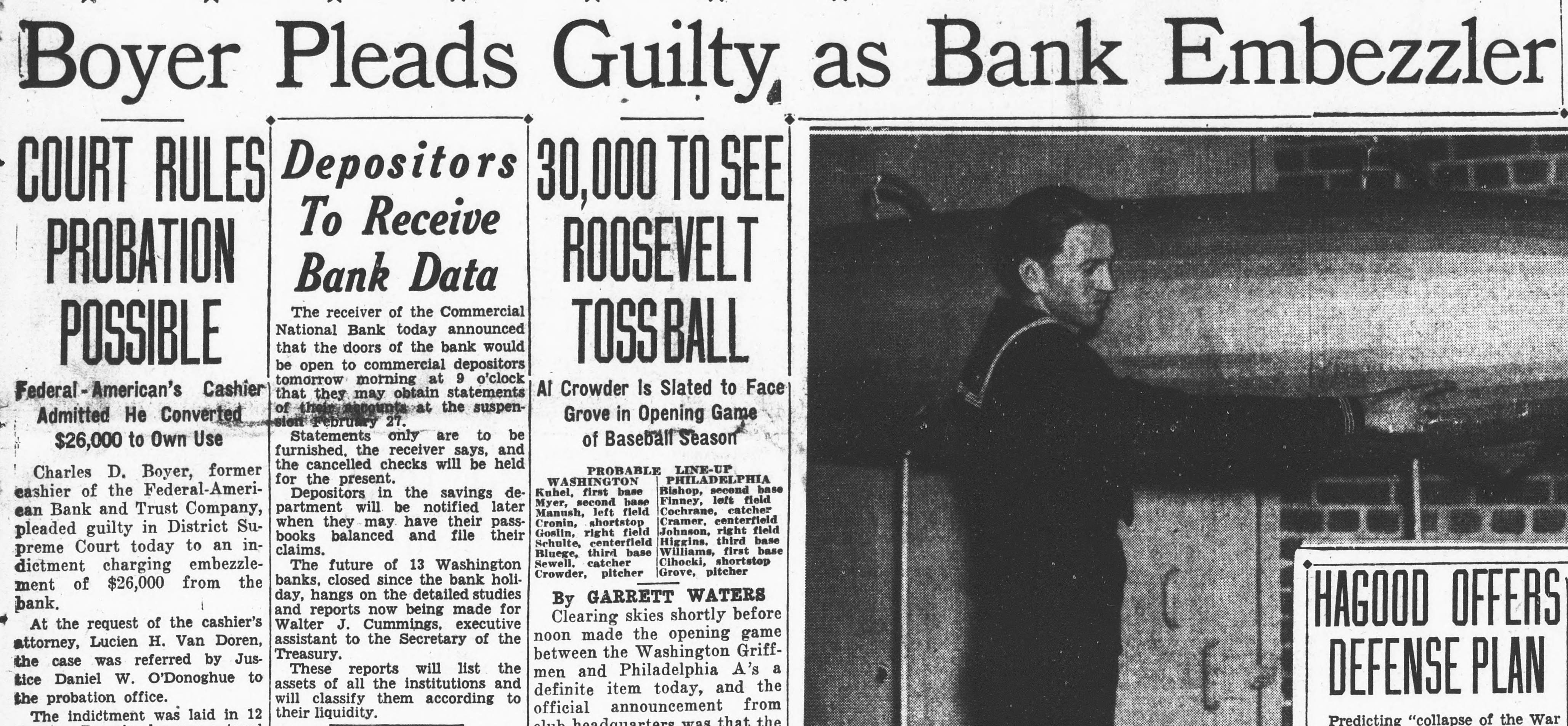
Boyer Pleads Guilty as Bank Embezzler Depositors COURT RULES 30,000 TO SEE To Receive ROOSEVELT PROBATION Bank Data The receiver of the Commercial National Bank today announced that the doors of the bank would TOSS BALL POSSIBLE be open to commercial depositors tomorrow morning at 9 o'clock Al Crowder Is Slated to Face Federal - American's as Cashier that they may obtain statements of at the suspenAdmitted He Converted Grove in Opening Game sion Februa 27. Statements only are to be of Baseball Season $26,000 to Own Use furnished, the receiver says, and the cancelled checks will be held LINE-UP PROBABLE Charles D. Boyer, former PHILADELPHIA for the present. WASHINGTON Bishop, second base cashier of the Federal-AmeriKuhel, first base Depositors in the savings deFinney, left field Myer, second base partment will be notified later Cochrane, catcher can Bank and Trust Company, Manush, left field Cramer, centerfield Cronin, shortstop when they may have their passJohnson, right field Goslin, right field pleaded guilty in District Subooks balanced and file their Higgins. third base Schulte, centerfield claims. preme Court today to an inWilliams, first base Bluege, third base Cihocki, shortstop Sewell. catcher The future of 13 Washington dictment charging embezzleGrove, pitcher Crowder, pitcher banks, closed since the bank holiment of $26,000 from the day, hangs on the detailed studies By GARRETT WATERS bank. and reports now being made for Clearing skies shortly before HAGOOD OFFERS At the request of the cashier's Walter J. Cummings, executive noon made the opening game assistant to the Secretary of the attorney, Lucien H. Van Doren, between the Washington GriffTreasury. the case was referred by JusThese reports will list the men and Philadelphia A's a tice Daniel W. O'Donoghue to assets of all the institutions and DEFENSE PLAN definite item today, and the the probation office. will classify them according to official announcement from their liquidity. The indictment was laid in 12 was Predicting "collapse of the War that the


Article from Evening star, April 12, 1933

Click image to open full size in new tab

Article Text

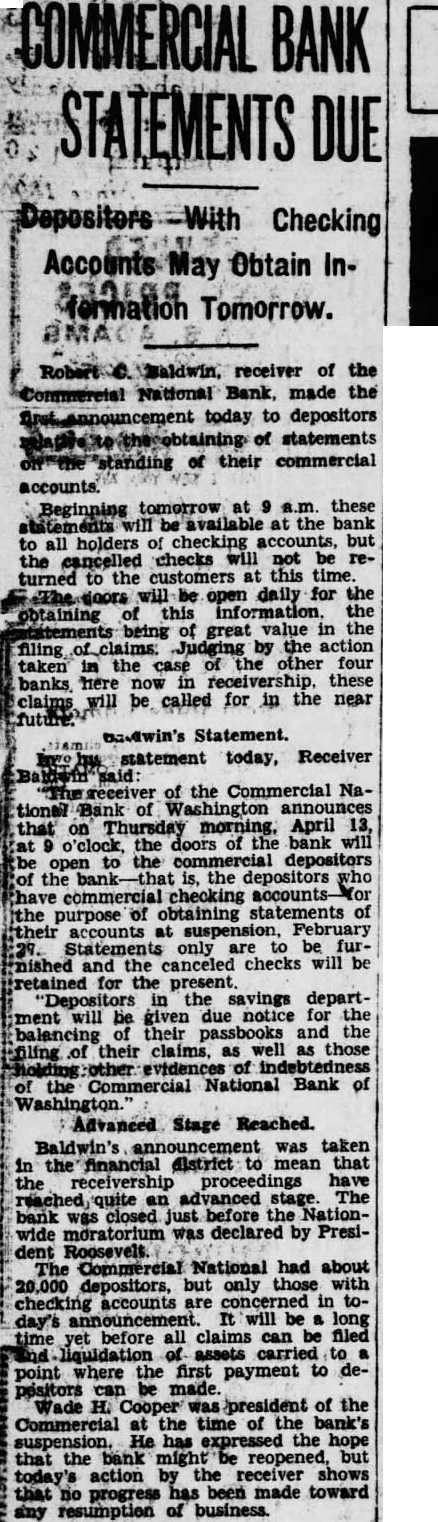
COMMERCIAL BANK STATEMENTS DUE Depositors With Checking Accounts May Obtain InTomorrow. Baldwin. receiver of the Bank, the depositors statements of their commercial accounts. tomorrow these the the cancelled checks will turned to the customers time. daily for the taken the here these now be called for in the near statement today, Receiver of the Commercial National Bank Thursday April doors the bank will o'clock, the the depositors the depositors checking accountspurpose of obtaining February of Statements only are be "nished and the canceled checks will be for present savings departwill given balancing their passbooks and their claims, other Bank of Advanced Stage Reached. was taken the financial district mean that an stage closed just before the wide was declared by PresiRoosevelt Commercial National had about 20,000 but checking accounts concerned day's will be before claims can filed liquidation point where the first payment to depositors Wade Cooper president of the Commercial at the time the bank reopened, action receiver shows that progress has been made toward any resumption of business.


Article from Evening Star, April 15, 1933

Click image to open full size in new tab

Article Text

COOPER TO PRESENT BANK PLAN TO AWALT Commercial National Reorganization Proposal Approved by Committee of 20. Col. Wade H. Cooper, president of the Commercial National Bank, which is in the hands of a receiver, plans to present to Controller of the Currency Awalt, as soon as possible, a plan for reorganizing the bank, which was adopted yesterday by a committee of 20 business men. The committee was appointed by Col. Cooper as a result of a mass meeting of depositors at the Mayflower Hotel, and developed the plan at a lengthy meeting yesterday afternoon. The action of the committee was said to be unanimous. Col. Cooper said today he would not discuss details of his plan for the present.


Article from Evening Star, April 16, 1933

Click image to open full size in new tab

Article Text

PAY CUT APPLIES TO CLOSED BANKS Conservators, Receivers and Other Employes to Take 15 Per Cent Slash. Because they are classed as Government employes, conservators, receivers and their assistants in local banks must take a 15 per cent pay cut under the economy act, according to a decision by Controller General McCarl. The ruling, tendered to Secretary of the Treasury Woodin, affects a large number of persons in the 13 banks which have been in the hands of conservators since March 14 and in the 5 banks which have been in receivership for a longer period. The controller general held that the new economy act was different from its predecessor in regard to salaries paid to so-called Government employes, where the money comes from sources outside of the regularly appropriated funds in the Treasury Department. Under the previous economy act all persons whose pay was derived from banks or from other sources outside the Government were exempt from the pay cut of 81/3 per cent and the consequent furlough. Only those persons specifically named in the new act are exempt now, McCarl ruled. The money paid to conservators and their assistants, however, it was emphasized in official circles, does not come out of appropriated funds, but must come from the assets of the closed banks. Meantime Walter J. Cummings, executive assistant to the Secretary of the Treasury, continued his task of attempting to release the more than $50,000,000 in deposits tied up in the closed banks here. Mr. Cummings said his organization is hard at work on the problem, but he can offer no prophecy as to the exact time element involved. Among the many who called to see him yesterday, was Col. Wade H. Cooper, president of the Commercial National Bank, who headed a committee of five representing depositors of the bank. Col. Cooper said he had laid before the Treasury official a plan for reorganizing and reopening the bank. This plan had been approved at a previous meeting of the committee. Details of the new plan were not made public.


Article from Times Herald, April 28, 1933

Click image to open full size in new tab

Article Text

BANK TO FIGHT $30,000 SUIT A denial that T. Blackwell Smith, assistant cashier of the Commercial National Bank, is entitled to $30,031.09 now held by the institution was made yesterday in District Supreme Court by Robert C. Baldwin, the bank's receiver, in answer to a suit for the money instituted by Smith. Smith, as executor of the estate of Gertrude L. Hoffman, to whom the money belonged. withdrew the funds on February 27, the day before the bank closed, and placed it in a safe deposit bank. The receiver, later, refused to turn over the money and Smith filed Baldwin alleged Smith was an officer of the bank, knew the institution's solvency was in peril by large withdrawals, and by his action sought to make himself a preferred creditor in violation of law. Baldwin said Smith had acted similarly in withdrawing $853 on deposit in another case, and the bank also refused to turn the money over to him. D. C. CADET PRAISED Edgar Morris, jr., of 5242 Colorado Ave., cadet colonel in the Clemson College military corps, was commended by Major William Spann, as the result of a review of drills at Clemson, it was announced yesterday.


Article from Evening Star, April 29, 1933

Click image to open full size in new tab

Article Text

From Page.) (Continued day, or which before that time were in the hands of receivers. "No statement can be made at this time as to the probable amount depositors will receive in a reorganization or liquidation of banks in hands of conservators or receivers." Another new plan to reopen any bank in the District of Columbia was presented to Mr. Cummings yesterday by Col. Wade H. Cooper, president of the Commercial National Bank: which is in the hands of a receiver. Col. Cooper's plan was drawn up in the form of a contract. to be signed by the depositor, and reads as follows: "The undersigned hereby gives you authority to charge his or her account not to exceed twenty-five (25 per cent) of his or her balance in said bank as of March 2, 1933, same to be used to place the blank bank, Washington, D. C., in a position to reopen for business 100 per cent. I sign this waiver of up to 25 per cent on my account voluntarily and of my own free will and accord and urge and request that this plan for the reopening of said bank be approved by the Treasury Department. "I also desire to state that I do not want this bank to be placed in liquidation under any circumstances. It is also understood that this order and agreement shall be binding upon me if and when seventy-five (75 per cent) of the total desposits of said bank as of March 2, 1933, excluding public and fiduciary deposits, are thus pledged as herein set forth. It is fully understood that all criticized or charged off assets will be trusteed for the benefit of the depositors waiving the 25 per cent of the deposits. The stockholders of said bank, as far as possible, agree that all net earnings of said bank, shall be applied to the repayment of the 25 per cent hereby waived until said amount has been fully returned to said depositors. "Participating certificates shall be issued to depositors so waiving, for their share and interest in the trusteed assets." No statement was forthcoming from the Treasury on Col. Cooper's plan.


Article from The Washington Times, May 9, 1933

Click image to open full size in new tab

Article Text

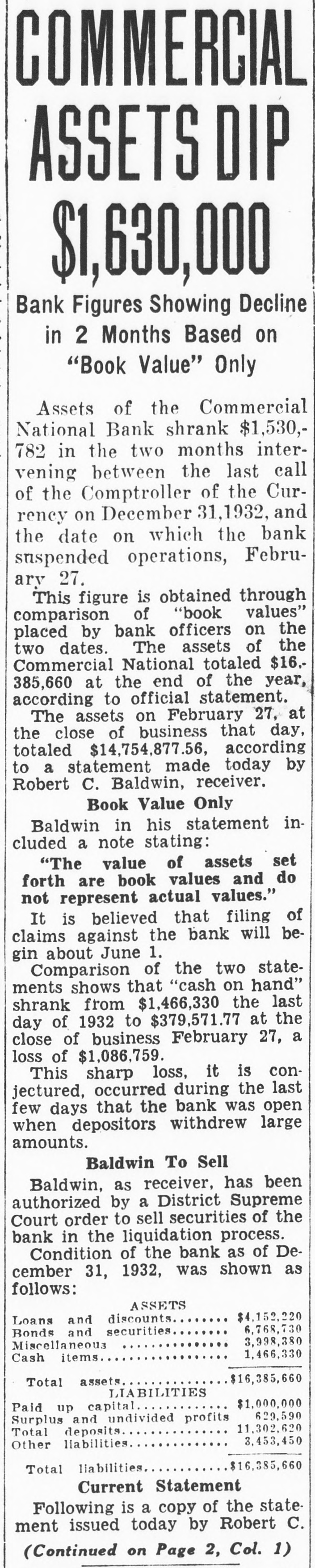
COMMERCIAL ASSETS DIP $1,630,000 Bank Figures Showing Decline in 2 Months Based on "Book Value" Only Assets of the Commercial National Bank shrank $1,530,782 in the two months intervening between the last call of the Comptroller of the Currency on December 31,1932, and the date on which the bank suspended operations, February 27. This figure is obtained through comparison of "book values" placed by bank officers on the two dates. The assets of the Commercial National totaled $16.385,660 at the end of the year, according to official statement. The assets on February 27, at the close of business that day, totaled $14,754,877.56, according to a statement made today by Robert C. Baldwin, receiver. Book Value Only Baldwin in his statement included a note stating: "The value of assets set forth are book values and do not represent actual values." It is believed that filing of claims against the bank will begin about June 1. Comparison of the two statements shows that "cash on hand" shrank from $1,466,330 the last day of 1932 to $379,571.77 at the close of business February 27, a loss of $1,086,759. This sharp loss, it is conjectured, occurred during the last few days that the bank was open when depositors withdrew large amounts. Baldwin To Sell Baldwin, as receiver, has been authorized by a District Supreme Court order to sell securities of the bank in the liquidation process. Condition of the bank as of December 31, 1932, was shown as follows: ASSETS $4,152,220 Loans and discounts 6,768,730 Bonds and securities 3,998,380 Miscellaneous 1,466,330 Cash items $16,385,660 Total assets LIABILITIES $1,000,000 Paid up capital 629,590 Surplus and undivided profits 11,302,620 Total deposits 3,453,450 Other liabilities $16,385,660 Total liabilities Current Statement Following is a copy of the statement issued today by Robert C. (Continued on Page 2, Col. 1)


Article from Evening Star, May 27, 1933

Click image to open full size in new tab

Article Text

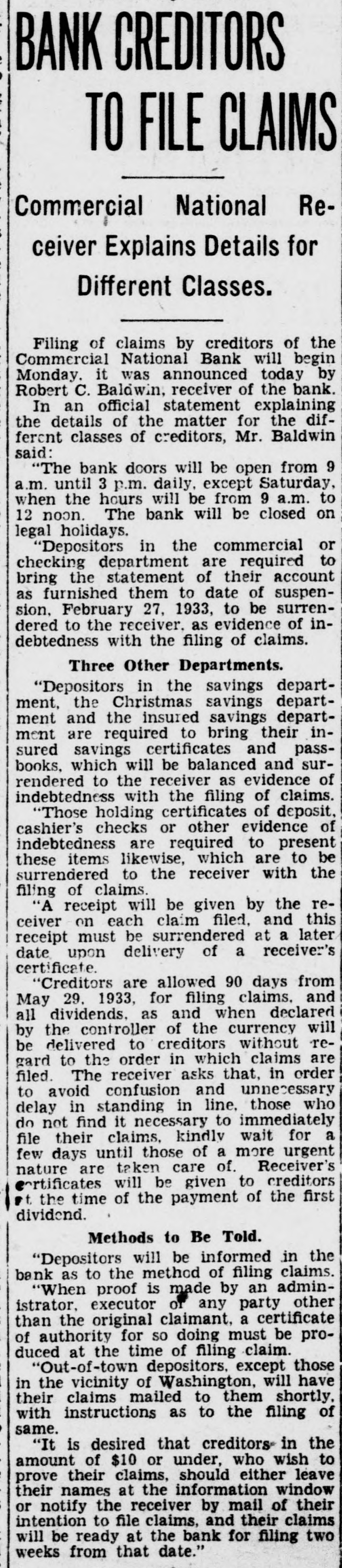
BANK CREDITORS TO FILE CLAIMS Commercial National Receiver Explains Details for Different Classes. Filing of claims by creditors of the Commercial National Bank will begin Monday. it was announced today by Robert C. Baldwin, receiver of the bank. In an official statement explaining the details of the matter for the different classes of creditors, Mr. Baldwin said: "The bank doors will be open from 9 a.m. until 3 p.m. daily, except Saturday, when the hours will be from 9 a.m. to 12 noon. The bank will be closed on legal holidays. "Depositors in the commercial or checking department are required to bring the statement of their account as furnished them to date of suspension. February 27, 1933, to be surrendered to the receiver. as evidence of indebtedness with the filing of claims. Three Other Departments. "Depositors in the savings department, the Christmas savings department and the insured savings department are required to bring their insured savings certificates and passbooks. which will be balanced and surrendered to the receiver as evidence of indebtedness with the filing of claims. "Those holding certificates of deposit, cashier's checks or other evidence of indebtedness are required to present these items likewise, which are to be surrendered to the receiver with the filing of claims. "A receipt will be given by the receiver on each claim filed, and this receipt must be surrendered at a later date upon delivery of a receiver's certificate. "Creditors are allowed 90 days from May 29. 1933, for filing claims. and all dividends. as and when declared by the controller of the currency will be delivered to creditors without regard to the order in which claims are filed. The receiver asks that, in order to avoid confusion and unnecessary delay in standing in line. those who do not find it necessary to immediately file their claims. kindlv wait for a few days until those of a more urgent nature are taken care of. Receiver's cortificates will be given to creditors at the time of the payment of the first dividend. Methods to Be Told. "Depositors will be informed in the bank as to the method of filing claims. When proof is made by an administrator, executor or any party other than the original claimant, a certificate of authority for so doing must be produced at the time of filing claim. "Out-of-town depositors, except those in the vicinity of Washington, will have their claims mailed to them shortly. with instructions as to the filing of same. "It is desired that creditors in the amount of $10 or under, who wish to prove their claims. should either leave their names at the information window or notify the receiver by mail of their intention to file claims, and their claims will be ready at the bank for filing two weeks from that date."


Article from The Washington Times, July 21, 1933

Click image to open full size in new tab

Article Text

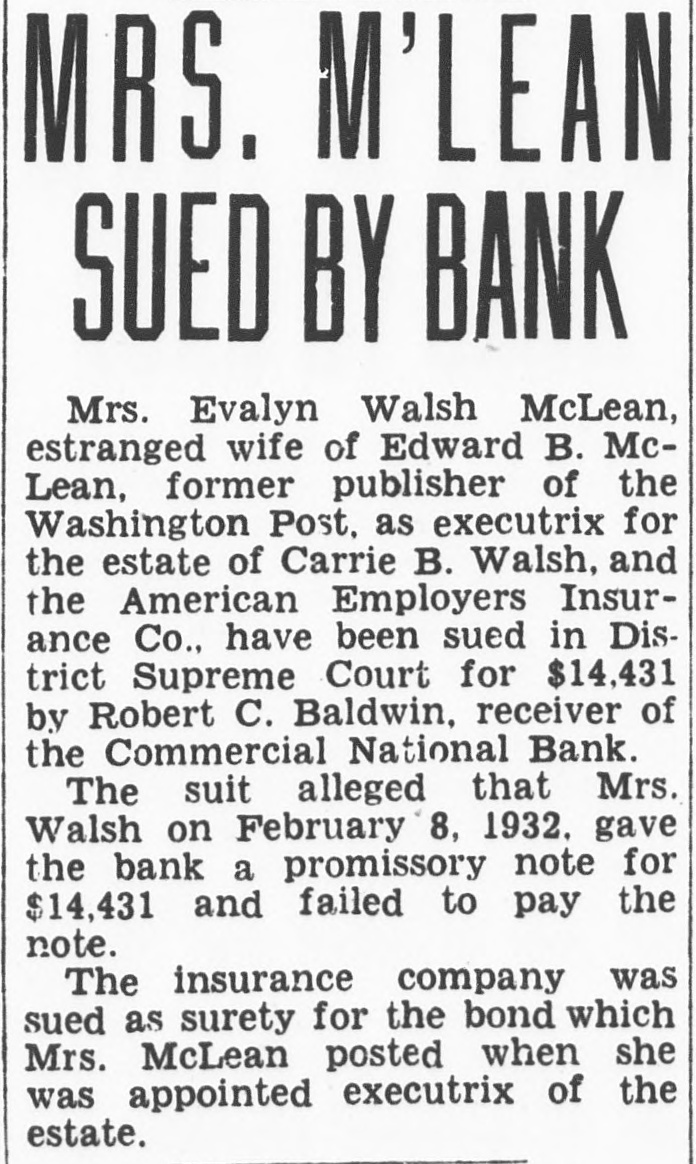
# MRS. M'LEAN # SUED BY BANK Mrs. Evalyn Walsh McLean, estranged wife of Edward B. McLean, former publisher of the Washington Post, as executrix for the estate of Carrie B. Walsh, and the American Employers Insurance Co., have been sued in District Supreme Court for $14,431 by Robert C. Baldwin, receiver of the Commercial National Bank. The suit alleged that Mrs. Walsh on February 8, 1932, gave the bank a promissory note for $14,431 and failed to pay the note. The insurance company was sued as surety for the bond which Mrs. McLean posted when she was appointed executrix of the estate.


Article from Evening Star, September 25, 1933

Click image to open full size in new tab

Article Text

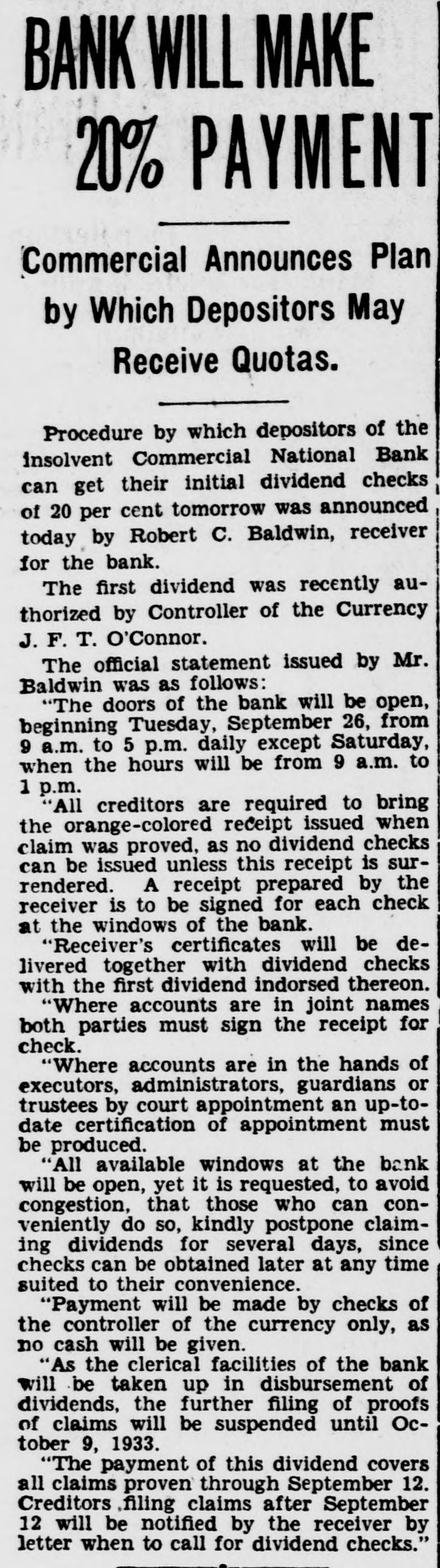
BANK WILL MAKE 20% PAYMENT Commercial Announces Plan by Which Depositors May Receive Quotas. Procedure by which depositors of the insolvent Commercial National Bank can get their initial dividend checks of 20 per cent tomorrow was announced today by Robert C. Baldwin, receiver for the bank. The first dividend was recently authorized by Controller of the Currency J. F. T. O'Connor. The official statement issued by Mr. Baldwin was as follows: "The doors of the bank will be open, beginning Tuesday, September 26, from 9 a.m. to 5 p.m. daily except Saturday, when the hours will be from 9 a.m. to 1 p.m. "All creditors are required to bring the orange-colored receipt issued when claim was proved, as no dividend checks can be issued unless this receipt is surrendered. A receipt prepared by the receiver is to be signed for each check at the windows of the bank. "Receiver's certificates will be delivered together with dividend checks with the first dividend indorsed thereon. "Where accounts are in joint names both parties must sign the receipt for check. "Where accounts are in the hands of executors, administrators, guardians or trustees by court appointment an up-todate certification of appointment must be produced. "All available windows at the bank will be open, yet it is requested, to avoid congestion, that those who can conveniently do so, kindly postpone claiming dividends for several days, since checks can be obtained later at any time suited to their convenience. "Payment will be made by checks of the controller of the currency only, as no cash will be given. "As the clerical facilities of the bank will be taken up in disbursement of dividends, the further filing of proofs of claims will be suspended until October 9, 1933. "The payment of this dividend covers all claims proven through September 12. Creditors filing claims after September 12 will be notified by the receiver by letter when to call for dividend checks."


Article from Evening Star, November 14, 1933

Click image to open full size in new tab

Article Text

common Edward C. Baltz. will be composed of James Berry. Marvin A. Curtis and Edward C. Baltz Mr. Baltz, the secretary is one of the most active building and loan men in the city and has held many high offices outside of his own association The stockholders were informed that the company's assets had eased $1,500,000 during the year ending October 20, 1933, and that the concern had made $5.000.000 in new loans during the past 12 months Loans were in such condition that very few foreclosures were necessary, the stockholders were told The organization is the largest of the kind in the city and ranks sixth largest among the members of the United States Building and Loan League. D. C. Brokers See Upward Trend. The majority of stock brokers in this city consider that the latest report on the short interest in the New York stock market indicates a wide belief that the long-term outlook is much more favorable than unfavorable. The total short interest existing as of the opening on October 31 as compiled from information secured by the New York Stock Exchange from its members was 779.228 shares. The last published figure as of September 29 showed total short interest of 875,000 shares. The short position on October 31 last was the smallest on record since the New York Stock Exchange began the practice of publishing short interest figures in the Spring of 1931 The largest short position reported was May 25. 1931, when total short interest was reported at 5.589.700 shares. Capital brokers state that the latest report might not reveal such a light short interest if good signs did not outweigh poor ones. Enough progress has been made in the last eight months, or since the administration's recovery plans were started, to lead to a stronger market when some present uncertainties are out of the way. While most of the gossip in the board rooms relates to the gold-buying effort to raise commodity prices, trade, earnings, profits, industrial expansion and a host of other factors must not be overlooked, brokers assert. Just when the next big move will come, nobody attempts to say Rail Presidents on Committee. The Association of Railway Executives has decided to reorganize its Advisory Committee by increasing membership from 11 to 15 members and establishing the committee on a regional basis, with 6 from the East, 6 from the West and 3 from the South. A. H. Ashton has been re-elected chairman of the Executive Committee and R. V. Fletcher has been reappointed its general counsel. These men will be ex-officio members of the Advisory Committee which will have its own chairman At a meeting in Chicago the other day three additional members of the Executive Committee were elected N P Pitcairn receiver for the Wabash Railway; N Hicks, president of the Virginian Railway, and George Be Bagby, president of the Western Maryland Fiduciaries Section to Meet. The next meeting of the Fiduciaries Section of the District Bankers Association. will take place Friday afternoon at 4 o'clock in the board room of the American Security & Trust Co. Various matiers of special interest to this department of bar king will come up for discussion This year's officers of this section are T Stanley Holland chairman: Sidney F Taliaferro, vice chair man; David Bonet secretary James A Soper and Irving Zirpel, members of the executive council During the first 10 days of November 13 national banks completed reorganization plans and were issued licenses to resume business or were granted charters for new banks. Controller of the Currency O'Connor announces Frozen deposits of the banks which reopened aggregated $15,062,000 with unrestricted deposits totaling $1,022,000. The lobby of the Commercial National Bank was a lively place again today as further payments were made in connection with the disbursement of the second dividend since the bank went into receivership last February Checks now being paid bring the total amount up to 50 per cent SC far distributed to depositors. Bonds Lead Exchange Trading. Bonds were the most active securities on the Washington Stock Exchange during today's session. The market opened with $1,000 Potomac Electric Consolidated 5s coming out at 1031/4 The next bond sale was in Washington Gas 6s. series B, $500 moving at 1021/4 Washington Railway & Electric 4s moved to the extent of $500 at 85 Interest then turned to Capital Traction 5s which strengthened as the session advanced. The first sale of $500 was made at 61, after which $1,000 changed hands at 61% and $1.000 and $500 at 61 1/2 In the stock division the day's only sales were in small lots of Potomac Electric Power 51/2 per cent preferred, all made at 1051 Noted in Financial District. Secretary Woodin has announced his full support of the President's monetary policy, at the same time making the following comment The President has been good enough to consult me on his plans from time to time I am thoroughly in accord and heartily in sympathy with all of his policies, and will back him to the limit. The administral plan for expanding bank capital by issuance of preferred stock, part of which would be bought by the R F C., has been ap proved by the Pittsburgh Clearing House Association, also in Los Angeles. Bankers here say that many other clearing houses all over the country have also approved it since New York and Chicago took such action. It is left to the individual banks to decide whether they wish to expand their capital or leave as it is The Georgia Central Railway has requested authorization from the Interstate Commerce Commission to establish a local passenger coach fare of 2 cents per mile. effective December until May 3. 1934 Wholesale commodity prices advanced sharply during the week ended November 11. according to the index of the National Fertilizer Association. The index advanced 9 points to 69.4 from 68.5; during the preceding week the index declined 4 points. The index nowfis back to where it was September 30.


Article from Evening Star, April 1, 1934

Click image to open full size in new tab

Article Text

dating assets, it is generally admitted that there will be considerable losses, whereas under the McLeod bill, a slow orderly liquidation extending over a period of 10 years would, it is believed by the best authorities, eliminate any possibility of loss." Expanded to State Banks. The McLeod bill provides for payment to depositors of 100 per cent on their deposits, in the case of certain specified banks. The bill first included national banks, then was expanded to State banks which were members of the Federal Reserve system, and now is proposed to include also banks which borrowed from the R. F. C. Col. Cooper has been the center of prolonged litigation since he started the fight which kept the United States Savings Bank from joining the proposed Hamilton merger. At present, Col. Cooper is under an indictment growing out of his presidency of the now insolvent Commercial National Bank. Another Cooper case involving the United States Savings Bank is now pending before the Court of Appeals. in which he still is endeavoring. after a decision against him in District Supreme Court. to force the Treasury to reopen the bank. This bank is now one of the 15 banks in this city in the hands of a receiver, and is one of those understood to be under consideration for a 100 per cent stock assessment. Meantime, the complex case of the Park Savings Bank. still is pending in District Supreme Court before Justice Jesse C. Adkins. In that case. the Treasury Department's receiver, John F. Moran. has joined with the depositors committee in an attempt to sue directors for the complete losses in the bank, exceeding $2,500,000. According to reports from the reorganization committee of the Industrial Savings Bank, colored institution, the campaign to raise the $65,000 required capitalization for the new Industrial Bank will be completed during the coming week. More than 95 per cent of the stock has now been sold and plans for the reopening are being worked out.


Article from Evening Star, August 14, 1934

Click image to open full size in new tab

Article Text

RECEIVER OF BANK ACCUSED IN SUIT Commercial Official Faces Charge of Illegally Paying Deposits. Robert C. Baldwin, receiver for the Commercial National Bank, was accused of paying in full deposits of two quasi-governmental agencies and a private corporation while the majority of the bank's depositors were receiving only 50 cents on the dollar, in a suit filed in District Supreme Court today by Thomas E. Rhodes, Southern Building. Rhodes charged this action by the receiver was "unlawful, illegal and unconscionable and to the prejudice of the rights and in fraud of the interests of this plaintiff as well as all other creditors of the bank." Pledges Held Illegal. The deposits paid in full, it was alleged, had been illegally secured by officials of the bank before the receiver took charge. The suit said the former officials induced the three agencies to open the accounts by pledging assets of the bank to guarantee their payment in full. Rhodes declared this was in violation of the banking laws and a fraud on the other depositors. The alleged preferential payments, it is alleged, were made to the alien property custodian, the United States Shipping Board's Merchant Marine Fleet Corp. and the Philippine-Manila Railway Co. The plaintiff said similar action was taken in the case of other depositors, whose names he does not know. Security Totaled $1,683,377. Rhodes said he does not know the amounts of the several deposits, but that the security given the Merchant Fleet Corporation aggregated $1,683,377.08. Through Attorneys Robert H. McNeill and Philip H. Marcum, he asked that a receiver be appointed to take charge of the moneys so paid out and that Baldwin be required to make full disclosure of the identities of the creditors receiving full payment and the amounts paid to them.


Article from Evening Star, October 11, 1934

Click image to open full size in new tab

Article Text

COMMERCIAL BANK INCOME $328,685.51 Quarterly Figures Released by Receiver Shows Reduction of R. F. C. Loan. Current income of the insolvent Commercial National Bank, including interest, premiums and rents, amounted to $328,685.51 at the end of the quarter, September 30. The cost of receivership was placed at $114,354. These figures were disclosed today in the quarterly report by Receiver Robert C. Baldwin, which shows the loan from the Reconstruction Finance Corporation to the bank, amounting to $3,327,400, had been reduced by $2,059,400. Out of a total of assets to be accounted for amounting to $15,902,919.73, including a stock assessment of $1,000,000, there has been collected a total of $11,910,265.67, including the R. F. C. loan. Collections on the stock assessment were $218,338.43, while total cash from assets and stock assessment was $8,228,288.84. Offsets were allowed totaling $556,758.96, and losses have been charged off including $743,851.52 on assets, and $2,500 on stock assessment. Total remaining uncollected assets, including the stock assessment, stand at $6,371,520.41. Secured and preferred liabilities paid in cash were $6,834,206.60. Unsecured liabilities for which receivers' certificates have been issued total $5,572,833.41, and dividends of 50 per cent have been paid to unsecured creditors amounting to $2,786,854.56.


Article from The Washington Times, December 1, 1934

Click image to open full size in new tab

Article Text

BANK DEFERS PAYMENT OF DIVIDEND Federal-American Holds Up Funds Till Spring; Commercial National May Pay Depositors in the defunct Federal-American National Bank and Trust Company will receive another dividend sometime in the spring, it was disclosed at the Treasury Department today. This definitely blasts hopes of depositors who had been anticipating a payment before the Christmas holidays in view of the collections recently made by the receiver of the bank as a result of assessments levied against the stockholders, Levy Insufficient These assessments, aggregating about $700,000, will not prove sufficient to pay a substantial dividend at this time, and, furthermore, it was explained by Treasury officials, it would require more than a month to make a disbursement of this amount. Neither will there be another dividend at the District National Bank for some time, Treasury officials said. This bank, likewise, has a large sum of money "on tap" for the depositors, but the payments will not be made before spring, it was predicted. Commercial May Pay Treasury officiais indicated today there will be an interesting announcement soon regarding the status of the Commercial National Bank. The Commercial National Bank refunded to many of the Government agencies with savings accounts there the full amount of the deposits, while the ordinary depositors received only 50 per cent of their funds. It was hinted a readjustment will be effected whereby some of the funds paid to the Government agencies will be returned to the bank and then paid to the depositors.