16929. First National Bank (Uniontown, PA)

Bank Information

Episode Type
Run โ†’ Suspension โ†’ Closure
Bank Type
national
Bank ID
270
Charter Number
270
Start Date
January 18, 1915
Location
Uniontown, Pennsylvania (39.899, -79.724)

Metadata

Model
gpt-5-mini
Short Digest
ab0ebd28ce25361a

Response Measures

Accommodated withdrawals, Borrowed from banks or large institutions, Public signal of financial health, Capital injected, Full suspension, Books examined

Receivership Details

Depositor recovery rate
100.0%
Date receivership started
1915-01-19
Date receivership terminated
1932-10-31
OCC cause of failure
Governance
Share of assets assessed as good
30.7%
Share of assets assessed as doubtful
67.9%
Share of assets assessed as worthless
1.4%

Description

Contemporary articles report prolonged heavy withdrawals (virtually a run on the bank for many months), the bank voluntarily closed its doors about Jan 18โ€“19, 1915 and was placed in the hands of federal examiners; receivers were appointed and a permanent receiver named in April 1915. Although Thompson later announced a negotiated loan and talked of reopening, the bank remained in receivership and was treated as a failure; investigations and prosecutions followed. OCRed names/dates corrected where obvious (J. V. / Josiah V. Thompson).

Events (7)

1. February 20, 1864 Chartered
Source
historical_nic
2. January 18, 1915 Run
Cause
Bank Specific Adverse Info
Cause Details
Large withdrawals over many months (reported $1,400,000 in 14 months and $200,000 since Dec. 31, 1914) and heavy loans/insider advances to bank president J. V. Thompson; bank dominated by Thompson and unable to realize on paper.
Measures
Directors closed the bank, placed it in charge of a federal bank examiner; directors pledged private funds to aid rehabilitation; receivers later appointed.
Newspaper Excerpt
there has been virtually a run on the bank for many months.
Source
newspapers
3. January 18, 1915 Suspension
Cause
Bank Specific Adverse Info
Cause Details
Bank voluntarily suspended payments/closed after sustained withdrawals and discovery of irregularities and heavy insider loans tied to Thompson's coal interests.
Newspaper Excerpt
voluntarily closed its doors; failed to open yesterday.
Source
newspapers
4. January 19, 1915 Receivership
Source
historical_nic
5. January 19, 1915 Receivership
Newspaper Excerpt
Receivers were appointed for Josiah V. Thompson...; receivers were named for the First National. (Jan. 19, 1915 reports).
Source
newspapers
6. April 15, 1915 Receivership
Newspaper Excerpt
John H. Strawn has been appointed permanent receiver to take effect April 15. (Comptroller statement Apr. 8/Apr. 15, 1915)
Source
newspapers
7. May 4, 1915 Other
Newspaper Excerpt
Thompson announced he had negotiated a $20,000,000 loan and said the bank would reopen within six weeks (plans announced but not clearly realized).
Source
newspapers

Newspaper Articles (23)

Article from Evening Public Ledger, January 19, 1915

Click image to open full size in new tab

Article Text

RECEIVERS NAMED FOR J. V. THOMPSON ON CREDITORS' PLEA Liabilities of Banker and Coal Operator Set at $22,000,000, With Estimated Assets of $70,000,000. UNIONTOWN, Pa., Jan. 19.-Receivers were appointed for Josiah v. Thompson. banker and coal operator, by Judges J. Q. Van Swearingen and R. E. Umbel in Common Pleas Court this morning, on petition of John M. Freeman, of the law firm of Watson & Freeman, of Pittsburgh. The Court appointed as reecivers Andrew Thompson. a son; William G. Laidley. of Carmichaels, a business associate of Thompson, and John P. Brennan, of Scottdale, president of the Producers' Coke Company and of the Thompson-Connellsville Coke Company. The receivership was asked for in order to protect the unsecured creditors. It was stated by Mr. Freeman that the assets of Thompson are three times as great as the liabilities. The unsecured debts of Thompson amount to about $7,000,000. Thompson was in court this morning when the petition was presented, but declined to make any statement regarding his financial affairs or the closing of the First National Bank yesterday. The petition for a receiver was brought by Fuller Hogsett, of Uniontown, an unsecured creditor to the amount of $900,000, and David L. Durr, of Masontown, an unsecured creditor to the amount of $400,000. In the petition it is asserted the assets of Mr. Thompson are $70,000,000 and the liabilities $22,000,000. of which $7,000,000 are unsecured claims and $15,000,000 are secured by mortgages and collateral. The mortgages are on property worth form three to five times the value of the claims. Following is a partial list of properties mortgaged or pledged to secure loans: Seven thousand one hundred and three acres Fayette County coal, 72,000 acres Greene County coal, 2000 acres Greene County land, 7224 acres Washington County coal, 26,025 acres West Virginia coal, residential property in Uniontown, 1000 acres; Highland Building, Pittsburgh, rolling mill plant, site and ground at West Elizabeth and Clairton, Allegheny County, and at Aliquippa, Beaver County. The value of these properties is $53,000,000 and these with stocks and bonds to the value of $17,000,000 and other large tracts of unincumbered properties make up the assets.

Article from New-York Tribune, January 20, 1915

Click image to open full size in new tab

Article Text

Uniontown's Suspension Laid to Plot Against Josiah Thompson. RECEIVERS TAKE HIS PROPERTY His Assets Placed at $70,000.000 and Liabilities at $22,000,000. (By Telegraph to The Tribunal Uniontown, Penn., Jan. 19.-Following the suspension of the Uniontown "Honor" First National Bank, which vesterday voluntarily closed its doors and is now in charge of federal inrestigators, Josiah Thompson is facing an army of angry creditors. He is head of the $100,000,000 Greene County Coal Land Syndicate, one of the largest independent coal land owners in the United States and president of the closed bank. He accepted to-day R voluntary recoivership in the Fayette County Court, turned over his affairs to a triumvirate of receivers and started New York, ostensibly to negotiate loan to save the bank. Probably ten thousand persons are affected by this financial upheaval. which has upturned all of Western Pennsylvania and parts of Ohio and West Virginia The Controller of the Currency in Washington admits that the affairs of the bank have been unsatisfactory since 1912, and there has been virtually a run on the bank for many months. One of Thompson's creditors. by his own admission, is Republican State Chairman William Crow, virtually political "ruler" of Fayette County. He acknowledged to-day that he had sold coal lands to Mr. Thompson and that he held the latter's notes. He maintains that Thompson's affairs will be righted. Thompson was an aspirant for the Governorship nomination in 1906. It is common talk about town that millions of dollars have been withdrawn from the bank by depositors in the last two years. It is said the withdrawal of $200,000 of deposits since December 31, 1914, coming on top of the withdrawal of $1,400,000 in the preceding fourteen months, caused the crisis. Scarcity of money and inability to realize on the vast amount of paper which the bank is reputed to hold are said by Thompson's many friends to have caused the embarrassment of the institution. Likewise, it is said, Thompson has been forced into a corner RS the result of sales of coal lands to operators dating back to 1907. In the bill of equity filed to-day it is set forth that Thompson's assets are $70.000,000 and that his total indebtedness is $22,000,000, of which $7,000,000 is unsecured. Back of the crash, it is said, is a battle between Thompson, as the head of an independent syndicate, and powerful financial interests, in which the latter are said to have aimed at the overthrow of Thompson and his lieutenants by forcing the value of their coal and coke land holdings to such a low level that they could be bought for a song Thompson's rise from a poor boy to the dominating head of & large corporation has been meteoric Starting with an inheritance of $100,000, he is accredited with having won a $100,000.000 fortune. The confidence of those who have invested with him is shown by the fact that the directors of the First National Bank have voluntarily pledged their private funds for rehabilitation of its affairs and as a guarantee to depositors that they will be paid. While the creditors' petition declares there is $7,000,000 of unsecured property, it asserts that the balance of $15,000,000 is secured by mortgage or pledge of substantially the entire assets of the defendant, leaving nothing but equities out of which unsecured creditors can be paid and on which they cannot realize. Three large coal land deals, said to be pending are Thompson's hope for prompt relief. Closing any one of them, according to report, will enable him to set the bank on its feet. When the bank became a member of the District Regional Reserve Bank it is said to have had a surplus of $1,700,000 and that $700,000 was distrib-


Article from The Sun, January 20, 1915

Click image to open full size in new tab

Article Text

RECEIVER FOR HEAD OF $100,000,000 CO. Josiah Thompson, President of Failed Uniontown Bank. Put Assets at $70,000,000. CAME UP FROM POOR BOY UNIONTOWN, Pa., Jan. 19.-Following the suspension yesterday of the Uniontown First National Bank, Josiah Thompson, head of the $100,000,000 Greene County Coal Land Syndicate, and one of the largest independent coal land owners in the country and president of the bank, accepted voluntary receivership in the Fayette County courts to-day, turned over his affairs to three receivers and left for New York. His assets were given as $70,000,000. and his debts $22,000,000, with $7,000,000 unsecured. Probably 10,000 persons are involved in the failure. The statement of the Comptroller of the Currency in Washington that the affairs of the bank have been unsatisfactory since 1912, is followed by the admission here that there has been virtually a run on the bank for many months. One of Thompson's creditors, by his own admission. is Republican State Chairman William Crow, who said today that he had sold coal lands to Mr. Thompson and that he held the latter's notes. He maintains Thompson's affairs will be righted. Thompson was an aspirant for the Gubernatorial nomination in 1906. While the affairs of the bank are guarded. it is said the withdrawal of $200,000 of deposits since the first of the year. coming on top of the withdrawal of $1,400,000 in the preceding fourteen months, precipitated the crisis. Back of the present disturbance, it is said, lies the story of a gigantic battle between Thompson as the head of an independent syndicate and powerful financial interests engaged in the coal and coke business. Thompson's rise in the world, his progress from a poor boy to the dominating head of a vast financial. holding corporation. has been meteoric. Starting with an inheritance of $100,000 from a relative he is accredited with having fought his way up to a $100,000,000 fortune. The faith to those who have invested with him is shown by the fact that directors of the First National Bank have voluntarily pledged their private funds for rehabilitation of the affairs of the bank and as a guarantee to depositors that they will be paid. When the bank became a member of the Federal reserve system it is said to have had a surplus of $1,700,000. and that the $700,000 was distributed in a "700 per cent. dividend." This was paid on July 6. 1914. Organized in 1854 with a capital of $100.000 the bank came up so fast that it has been paying dividends at the rate of 22 per cent. annually.


Article from The Wheeling Intelligencer, January 20, 1915

Click image to open full size in new tab

Article Text

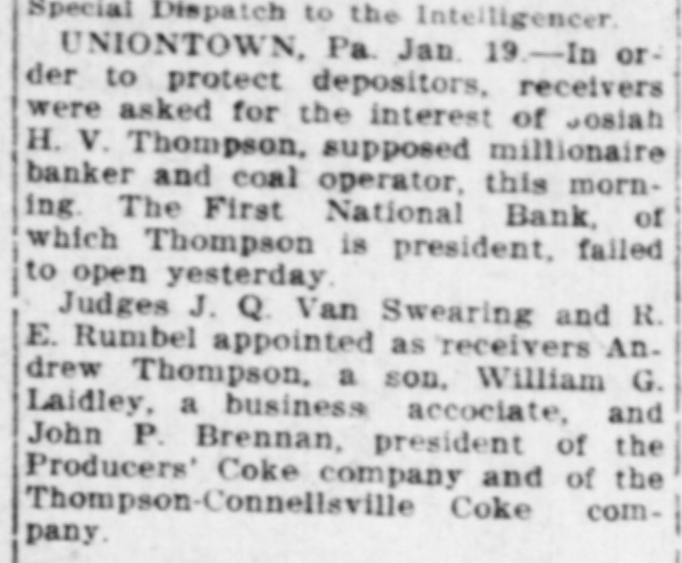
Special Dispatch to the Intelligencer. UNIONTOWN, Pa. Jan. 19.-In order to protect depositors, receivers were asked for the interest of Josiah H. V. Thompson, supposed millionaire banker and coal operator, this morning. The First National Bank, of which Thompson is president, failed to open yesterday. Judges J. Q. Van Swearing and R. E. Rumbel appointed as receivers Andrew Thompson, a son, William G. Laidley, a business accociate, and John P. Brennan, president of the Producers' Coke company and of the Thompson-Connellsville Coke company.


Article from Evening Star, January 22, 1915

Click image to open full size in new tab

Article Text

STOPPED "RECKLESS" ACTS. Controller of Currency Issues Statement Regarding Uniontown Bank. The controller of the currency has issued a statement outlining attention given by his office to the First National Bank of Uniontown, Pa., recently closed by order of its directors, and placed in the hands of a national bank examiner. This statement sets forth that an examination of this institution in April, 1913, showed that the bank, claiming capital of $100,000, surplus of $1,531,000 and deposits of $2,629,000, had made direct and indirect loans of $1,227,000 to J. V. Thompson, by whom the bank was "dominated and run." As a result of efforts of the Treasury Department, the statement said, the loans on which Mr. Thompson was either maker or guarantor were reduced by August. 1914, to $65,000. "Meanwhile," continued the statement, "other reckless and unlawful practices which had been in force for a period of years were stopped; the depositors were enabled to collect from the bank $1,318,000 of the $2,689,000 held in April, 1913, so that the total deposit liabilities at the time of the failure had been reduced to $1,371,000, and the loans to Mr. Thompson on his direct paper and indorsements, as appears at the present time, to approximately $100,000.


Article from The Sun, January 22, 1915

Click image to open full size in new tab

Article Text

OTHER COMPANIES FAIL. Receivers Named for Coke Concern and Subsidiary. UNIONTOWN, Pa., Jan. 21.-Receivers were named by Judge J. Q. Van Swearingen this afternoon for the Tower Hill Connellaville Coke Company, a large independent concern operating two plants in Fayette county, and a subsidiary, the Tower Hill Supply Company. The receiverships are attributed directly to the failure of Josiah Thompson's bank, the First National. The assets of the coke company are $3,500,000 and its liabilities $3,000,000. The liabilities of the supply company are $40,000 and the assets $120,000. Receivers named for both concerns are L. W. Fogg, G. S. Harah and John Thompson.


Article from New-York Tribune, January 24, 1915

Click image to open full size in new tab

Article Text

to-day is easily worth 550.000,000 over and above all his liabilities." A feature of the situation here is the "get together" spirit manifested by bankers and merchants. The local papers to-day are full of advertisements calling for "courage and confidence." One small independent coke company went into the hands of friendly receivers to-day. More are expected to follow on Monday. In connection with the charge that Pittsburgh interests were very much interested in Thompson's notes, and that a prominent financier there is engaged in picking them up, this advertisement, left at "The Uniontown Herald's" office to-night by a stranger, is interesting: "Turn your old notes into cash. State price asked and full particulars in first letter. William C. Swartz, 5817 Ellsworth av., Pittsburgh." [By Telegraph to Inc Tribune.) Pittsburgh, Jan. William C. Swartz, of 5817 Ellsworth av., when seen to-night stated that he personally had nothing to do with the purchase of notes, but that a prominent financier who was now in Uniontown buying up old notes had asked him Swartz) to allow the use of his name in all transactions, as he, the real purchaser, did not wish his name to become public. Sequels to the closing of the First National Bank at Uniontown, involving J. V. Thompson, developed here today when the Somerset County Court appointed receivers for the United Railway Company and the United Lumber Company.


Article from New-York Tribune, January 25, 1915

Click image to open full size in new tab

Article Text

Persons Close to Pittsburgh Banker Declare Whatever Money Is Needed to Allow His Bank to Reopen Will Be Forthcoming This Week. [By a Staff Correspondent of The Tribune.] pect to. Six days a week is enough." The religious side of the coke land Uniontown, Penn., Jan. 24.-The efking, wjho is now battling with the big feet of the uproar caused in this part steel and financial interests in Pittsof the country by charges that Josiah burgh for continuance of his control V. Thompson and his associates are of the coke land situation, is a phase being pursued by "big business" and little known to any except his most the threat of a federal inquiry as to intimate friends. For forty-four years the causes leading up to the closing of the First National Bank, exclusivehe has been a member of the Presbyterian Church, and among his other ly told of in The Tribune to-day, was seen when persons close to Mr. Thomppossessions he is owner of a half inson received intimations from New terest in "The Presbyterian Banner," York and Pittsburgh to-day that he the oldest religious weekly published would probably find little difficulty this west of the Alleghanies. week in arranging to get such money In those forty-four years Mr. Thompas may be needed to straighten out son has rarely missed services on Sunhis affairs and allow the bank to reday morning and then only to sleep. open. The necessity for this sleep will be understood when it is said that he gets The money, if it is recived, will not be in the form of a loan. Mr. Thompalong with less sleep than Thomas A. Edison. son has not had a loan in New York "I rarely sleep more than an hour in ten years. It will probably come or two a night from Sunday night to through the sale of a comparatively Saturday night," Mr. Thompson recentsmall block of coke land. ly told a visitor. "It is a good week If this fails it is not unlikely that that I get in more than eight or nine part of the Thompson holdings will be hours between Sundays. I do not find turned over to a stock company that it hurts me, and I will be sixtyformed by his friends, who will put one, if I live until the middle of next up the $3,000,000 or $4,000,000 necesmonth." sary to meet maturing obligations and It is probable that Mr. Thompson will pressing charges and give Mr. Thompgo to New York to-morrow, though this son and his associates time to move is by no means certain, his movements around in. depending in large measure on what With Mr. Thompson, they believe his counsel in Pittsburgh may advise. that the tide has turned in the steel He retains his apartments in the Waltrade, and that the coke business, dedorf, in New York, where W. H. Conpressed when the steel trade is bad. way, of his legal staff, is in charge. Michael J. Ryan, of Philadelphia, is soon to come into its own. In orchief counsel for the H. C. Frick Coke ers of the H. C. Frick Company, the Company, was in Uniontown yesterday, coke subsidiary of the United States and attacked the receiverships of variSteel Corporation, to start full time ous Uniontown business men connected to-morrow. after months of partial with Mr. Thompson and the First Naidleness, they see confirmation of this tional Bank. He said it was illegal for faith. individuals to go into receiverships, as From sources outside the steel busireceivers should be appointed only for ness Mr. Thompson is in receipt of corporations, and individuals must go considerable offers of assistance. What into bankruptcy. His comments caused these are he declines to say. To-day, considerable excitement, especially in fact, he was inaccessible as ever to among the business men who have gone interviewers, for, following the pracinto receivers' hands following the tice of a lifetime, he dropped all busibank's trouble. ness at midnight and devoted the day In nearly all the churches in Unionto rest and church duties. town to-day the pastors prayed for the "I have never yet found it necessary speedy settlement of the bank's affairs to work on Sunday or to talk business and the return of prosperity to Unionin any of its phases on Sunday," Mr. town. Thompson said, "and I do not ever ex-


Article from Yorkville Enquirer, February 2, 1915

Click image to open full size in new tab

Article Text

# MERE-MENTION Three masked men held up the cashier of the bank of Avant, Okla., Friday, and secured $1,000. Receivers were appointed on Saturday for William Barton, the twelfth coal operator whose property has gone into receivership in Uniontown county, Pa., since the closing of the First National bank of Uniontown, a $100,000 institution. The assets of the twelve operators total more than $36,000,000, while their liabilities are only $12,000,000. More than 33,000 bales of cotton were shipped from Savannah, Ga., to foreign ports last Saturday. The Vermont legislature last Friday, passed a resolution commending Mrs. Bettie Van Metre of Berryville, Va., for her care of Lieut Bedell of Westfield, Vt., after he was injured during the civil war. Floods and storms in Arizona on Saturday, did more than $100,000 damage in the Salt river valley. Animals in a menagerie in Phoenix, valued at $30,000, were drowned. An explosion which occurred on the flagship San Diego, January 21, claimed its ninth victim Saturday, by the death of Ralph B. Glidden, a fireman. Four other sailors remain in a serious condition as a result of the accident. John P. Edder and his two sons, all farmers, were shot while seated at breakfast in their home near Andalusia, Ala., Saturday. The sons will die and the father is seriously wounded. A shot gun was used, the gun being discharged through a window. An old feud is believed to have been the cause. The first shipment of cotton from Mobile, Ala., to Liverpool, left Mobile on Saturday. There were 5,000 bales. A monster black bear was killed near Luray, Va., Saturday. The bear was placed on exhibition and people walked many miles to see it. Between $40,000 and $50,000 worth of diamonds were secured by four men who drove up to a New York pawnshop in an automobile, Saturday, held up three clerks, threw the jewels in a suit case and made their escape. Sam Merrick, a negro, died in Wilmington, N. C., a few days ago, leaving $5,000 in cash and several pieces of real property. The negro lived alone and so far as is known had no relatives. Since his death the clerk of court of New Hanover has received no less than sixty letters from people claiming to be near relatives of the dead negro. Miss Nora McAdoo, daughter of Secretary McAdoo, sailed for France last week, where she will engage in Red Cross work. Herman Aurebach, a prominent real estate operator of New York, on Sunday shot and killed his wife and two daughters, and then committed suicide, after leaving a note under his son's door informing him of the tragedy. The shooting was done with a repeating rifle to which was attached a silencer apparatus. Worry over financial reverses is supposed to have been the cause of the act. W. B. M. Brown, congressman-elect from the twenty-fourth Pennsylvania district, died suddenly in New York, Sunday. Rear Admiral Montagu of the British navy, died in London, Sunday, aged 74 years. The Atlantic Coast Line's New York and West Indian limited train was wrecked at Callahan, Fla., Saturday. Five passengers were slightly injured. Advices received at Toronto, are to the effect that 32,000 Canadian troops have been sent from the training camp in England, to the front in France. War prices for wheat for May delivery reached $1.52ยฝ a bushel, Saturday, in Chicago. In a fight on the 17th floor of the Adams Express building in New York, Saturday, Jos. F. McLaughlin stabbed Wm. B. Irvine to death with a pocket knife. Twenty-seven men were sentenced in the Federal court in St. Louis, Mo., Saturday, to serve terms of 30 days to three and a half years, and pay fines of $5,000 to $10,000 each, for violation of the Federal tax laws in relation to the manufacture and sale of oleomargarine. Mrs. Ann Miller died at Bedford, N. Y., Saturday, aged 100 years. For the past 70 years she had been a strict vegetarian. Gen. George B. Milman of the British army, and for 39 years keeper of the Tower of London, is dead. The British government has placed an order for 8,000 tons of steel bullets with a Birmingham, Ala., steel company.


Article from The Wheeling Intelligencer, April 9, 1915

Click image to open full size in new tab

Article Text

JUSTICE DEPARTMENT TO INVESTIGATE THE UNIONTOWN, PA., BANK. WASHINGTON. April 8.Comptroller of the Currency Williams today announced in a formal statement that Irregularities discovered in the conduct of the First National bank of Uniontown, Pa., which closed its doors several weeks ago, have been placed before the department of justice. John H. Strawn has been appointed permanent receiver to take effect April 15. Comptroller Williams said: "The investigation of the affairs of the First National bank of Uniontown have disclosed further irregularities and violations of law on the part of certain of the officers of that institution and the secretary of the treasury has formally placed the matter be. fore the department of justice, which has already begun its investigations."


Article from The Bridgeport Evening Farmer, April 12, 1915

Click image to open full size in new tab

Article Text

John H. Strawn of Pennsylvania, was appointed permanent receiver for the First National Bank of Uniontown, Pa., by Controller of the. Curreney Williams.


Article from The Bridgeport Evening Farmer, April 12, 1915

Click image to open full size in new tab

Article Text

A special meeting of stockholders of the Atlas Powder Co., was called at Wilmington, Del., April 24, to vote on increasing the capital to $10,500,000. Approval was given by the British Treasury Department for the issue of $10,000,000 Central Argentine Railway, Ltd., 5 per cent. 5-year notes at 98. Machine shops of the Pennsylvania Co. at Altoona, Pa., were put on 40 hours a week, compared with 45 and 4,000 55 hours as formerly. Over d men ar eaffected. Alfred Read was arrested in an "L" train when he tried to brighten up sleeping passengers by singing. He paid a fine of $3 rather than promise to refrain. David J. Mackey, pioneer railroad builder in the Central'West, and former president of the Evansville & Terre Haute Railroad, died at Evans ville, Ind., aged 81. A decree prohibiting the tango and other similar dances in Paris is being prepared by the municipal authorities. John Wanamaker donated $10,000 as the first subscription toward a building to house the Greater Philadelphia Chamber of Commerce, now being organized. Governments of Bolivia, Panama, Guatamala and Cuba have accepted the invitation of the United States to send representatives to the PanAmerican financial conference in Washington. Dr. Leopold H. R. Hibbe, of New York, was sentenced to three months in the penitentiary for failing to enter purchases of cocaine on his books. "Bob" Fitzsimmons, former heavyweight champion, was married at Washington to Miss Temo Zillih, who was associated with him on the stage. The historic frigate Constellation, tied up at the Norfolk Navy Yard during the winter, will go back as S schoolship at the naval training station at Newport, R. I. An eight-hour day in place of nine hours for its women employes will be put into effect by the Western Union Telegraph Co. in its larger offices throughout the country next week. John H. Strawn of Pennsylvania, i was appointed permanent receiver for the First National Bank of Uniontown, Pa., by Controller of the.Curreney Williams. E 1 A despatch from Breslau, the second largest city of Prussia, declared the daily ration of bread there was doubled to prevent further rioting. s Secretary of the Treasury McAdoo is so far recovered from his recent TO operation for appendicitis that his 3 doctors allowed him to sit up in an arm chair. 3 Governor Dunne of Illinois, will accompany the House and Senate waterways. committee over the full route of the proposed Illinois waterway. US In a duel with knives at the Howell < school house at Letart, W. Va.. while a school entertainment was in progress, Earl Shirly, 28, and Urson Bosworth. 28, were killed. e HORLICK'S


Article from The Star-Independent, May 4, 1915

Click image to open full size in new tab

Article Text

HE BORROWS $20,000,000 Josiah V. Thompson, of Uniontown, Says He Will Soon Be Freed of Financial Troubles By Associated Press. Uniontown, Pa., May 4.-Josiah V. Thompson, banker and holder of extensive coal properties in Western Pennsylvania, Eastern Ohio and West Virginia, whose financial embarrassment has been widely felt in the three States for several months, announced to-day that he had negotiated a loan of $20,000,000 and that he and his associates would soon be freed of their troubles. Mr. Thompson said further that the First National Bank of Uniontown, which has been in the hands of a receiver since January 18, would reopen within six weeks, that receivers appointed for the many persons associated with him would be discharged and that the 430,000 acres of coal lands involved would be withdrawn from the market. Mr. Thompson did not disclose the names of the persons who have agreed to advance the money, but added that they were conversant with the situation, although a corps of expert accountants was to go into every phase of the situation without delay.


Article from The West Virginian, May 4, 1915

Click image to open full size in new tab

Article Text

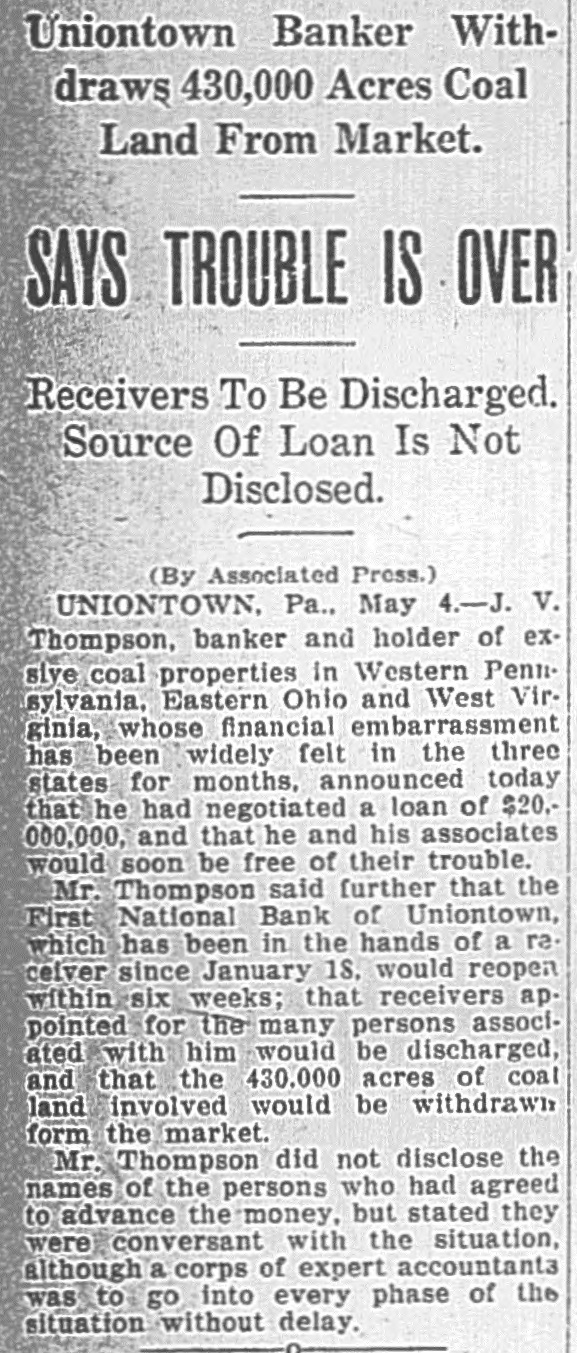
Uniontown Banker Withdraws 430,000 Acres Coal Land From Market. SAYS TROUBLE IS OVER Receivers To Be Discharged. Source Of Loan Is Not Disclosed. (By Associated Press.) UNIONTOWN, Pa., May 4.-J. V. Thompson, banker and holder of exsive coal properties in Western Pennsylvania, Eastern Ohio and West Virginia, whose financial embarrassment has been widely felt in the three states for months, announced today that he had negotiated a loan of $20.000,000, and that he and his associates would soon be free of their trouble. Mr. Thompson said further that the First National Bank of Uniontown, which has been in the hands of a raceiver since January 18, would reopen within six weeks; that receivers appointed for the many persons associated with him would be discharged, and that the 430.000 acres of coal land involved would be withdrawn form the market. Mr. Thompson did not disclose the names of the persons who had agreed to advance the money, but stated they were conversant with the situation, although a corps of expert accountants was to go into every phase of the situation without delay.


Article from The Wheeling Intelligencer, May 5, 1915

Click image to open full size in new tab

Article Text

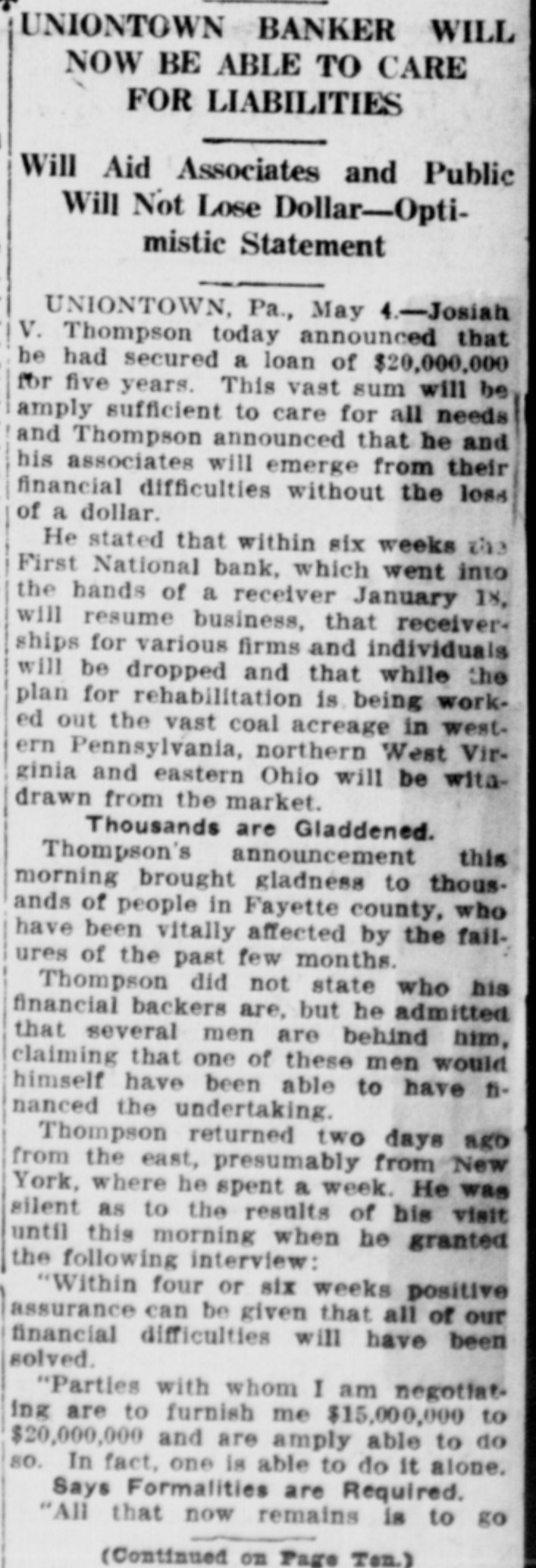
UNIONTOWN BANKER WILL NOW BE ABLE TO CARE FOR LIABILITIES Will Aid Associates and Public Will Not Lose Dollar-Optimistic Statement UNIONTOWN, Pa., May 4.-Josiah V. Thompson today announced that he had secured a loan of $20,000,000 for five years. This vast sum will be amply sufficient to care for all needs and Thompson announced that he and his associates will emerge from their financial difficulties without the loss of a dollar. He stated that within six weeks the First National bank, which went into the hands of a receiver January 18, will resume business, that receiver ships for various firms and individuals will be dropped and that while the plan for rehabilitation is being worked out the vast coal acreage in west. ern Pennsylvania, northern West Virginia and eastern Ohio will be witadrawn from the market. Thousands are Gladdened. Thompson's announcement this morning brought gladness to thous. ands of people in Fayette county, who have been vitally affected by the failures of the past few months. Thompson did not state who his financial backers are, but he admitted that several men are behind him, claiming that one of these men would himself have been able to have financed the undertaking. Thompson returned two days ago from the east, presumably from New York, where he spent a week. He was silent as to the results of his visit until this morning when he granted the following interview: "Within four or six weeks positive assurance can be given that all of our financial difficulties will have been solved. "Parties with whom I am negotlating are to furnish me $15,000,000 to $20,000,000 and are amply able to do so. In fact, one is able to do it alone. Says Formalities are Required. "All that now remains is to go (Continued on Page Ten.)


Article from The Sun, May 5, 1915

Click image to open full size in new tab

Article Text

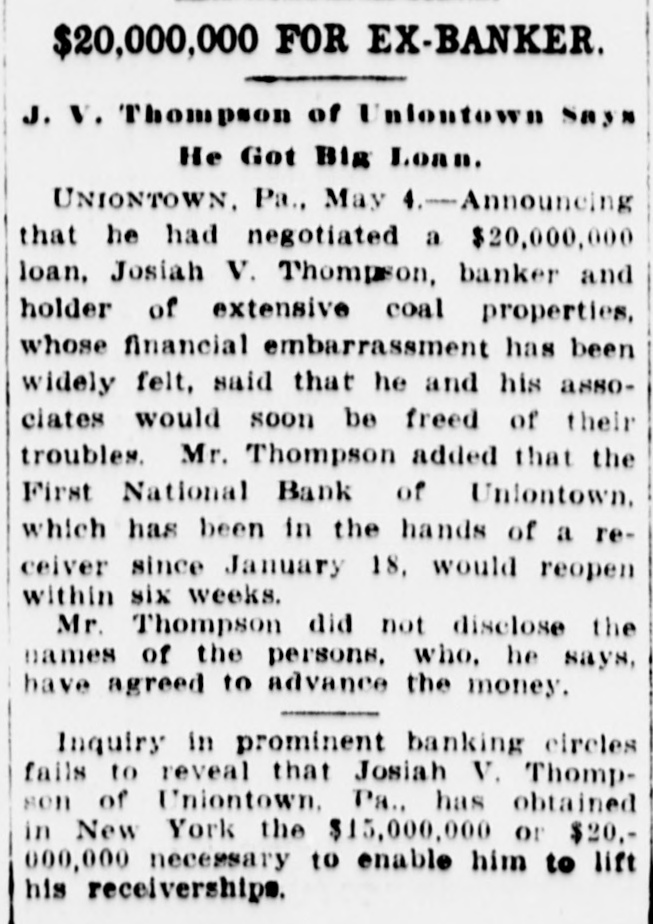
$20,000,000 FOR EX-BANKER. J. v. Thompson of Uniontown Says He Got Big Loan. UNIONTOWN. Pa., May 4.-Announcing that he had negotiated a $20,000,000 loan, Josiah V. Thompson, banker and holder of extensive coal properties, whose financial embarrassment has been widely felt, said that he and his assoclates would soon be freed of their troubles. Mr. Thompson added that the First National Bank of Uniontown. which has been in the hands of a receiver since January 18, would reopen within six weeks. Mr. Thompson did not disclose the names of the persons, who, he says, have agreed to advance the money. Inquiry in prominent banking circles fails to reveal that Josiah V. Thompson of Uniontown. Pa., has obtained in New York the $15,000,000 or $20.000,000 necessary to enable him to lift his receiverships.


Article from Belington Progressive, May 6, 1915

Click image to open full size in new tab

Article Text

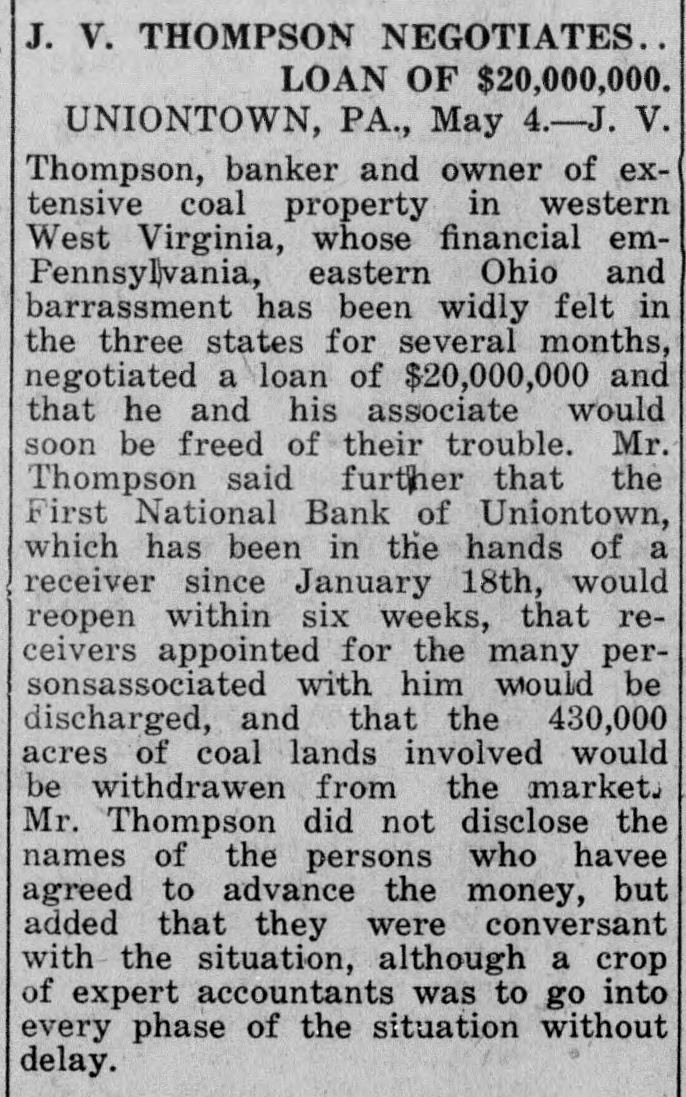
J. V. THOMPSON NEGOTIATES LOAN OF $20,000,000. UNIONTOWN, PA., May 4.-J. V. Thompson, banker and owner of extensive coal property in western West Virginia, whose financial emPennsylvania, eastern Ohio and barrassment has been widly felt in the three states for several months, negotiated a loan of $20,000,000 and that he and his associate would soon be freed of their trouble. Mr. Thompson said further that the First National Bank of Uniontown, which has been in the hands of a receiver since January 18th, would reopen within six weeks, that receivers appointed for the many personsassociated with him would be discharged, and that the 430,000 acres of coal lands involved would be withdrawen from the market. Mr. Thompson did not disclose the names of the persons who havee agreed to advance the money, but added that they were conversant with the situation, although a crop of expert accountants was to go into every phase of the situation without delay.


Article from Eagle River Review, July 16, 1915

Click image to open full size in new tab

Article Text

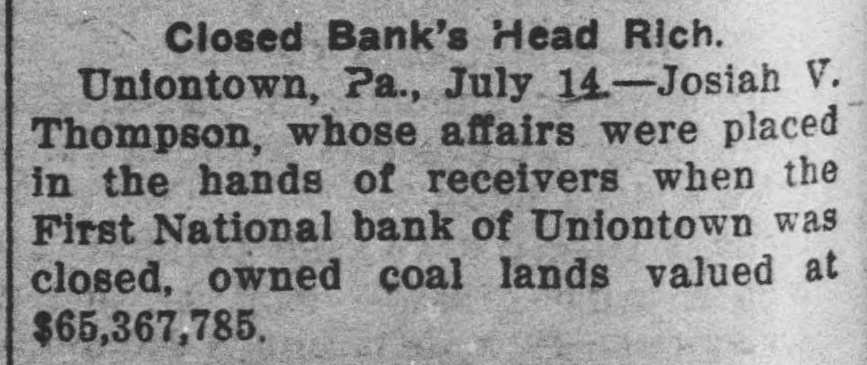
Closed Bank's Head Rich. Uniontown, Pa., July 14-Josiah V. Thompson, whose affairs were placed in the hands of receivers when the First National bank of Uniontown was closed, owned coal lands valued at $65,367,785.


Article from The Wheeling Intelligencer, November 6, 1915

Click image to open full size in new tab

Article Text

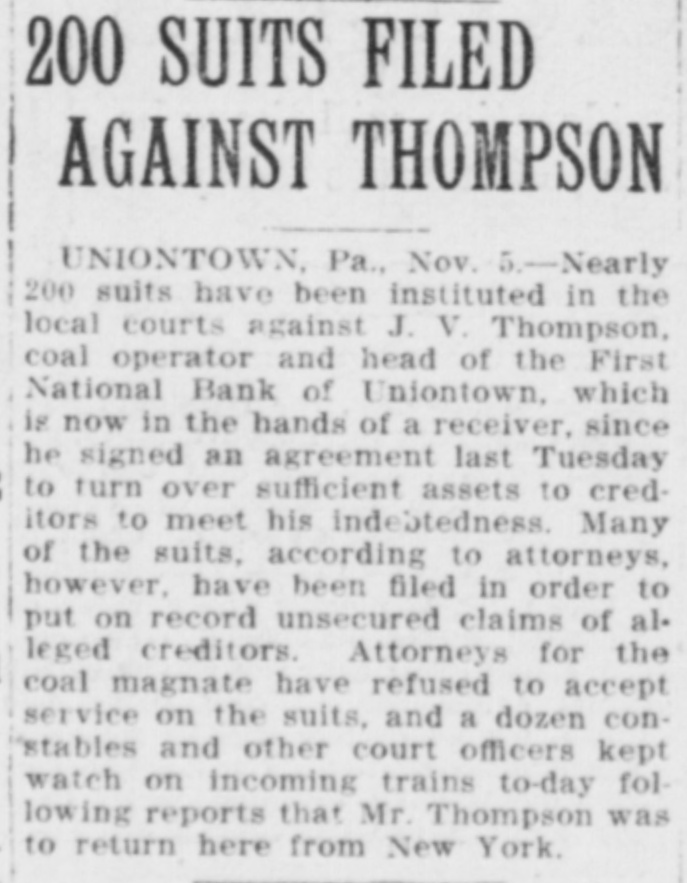
200 SUITS FILED AGAINST THOMPSON UNIONTOWN, Pa., Nov. 5.-Nearly 200 suits have been instituted in the local courts against J. V. Thompson, coal operator and head of the First National Bank of Uniontown. which is now in the hands of a receiver. since he signed an agreement last Tuesday to turn over sufficient assets to creditors to meet his indebtedness. Many of the suits, according to attorneys, however, have been filed in order to put on record unsecured claims of alleged creditors. Attorneys for the coal magnate have refused to accept service on the suits, and a dozen constables and other court officers kept watch on incoming trains to-day following reports that Mr. Thompson was to return here from New York.


Article from The Richmond Virginian, November 7, 1915

Click image to open full size in new tab

Article Text

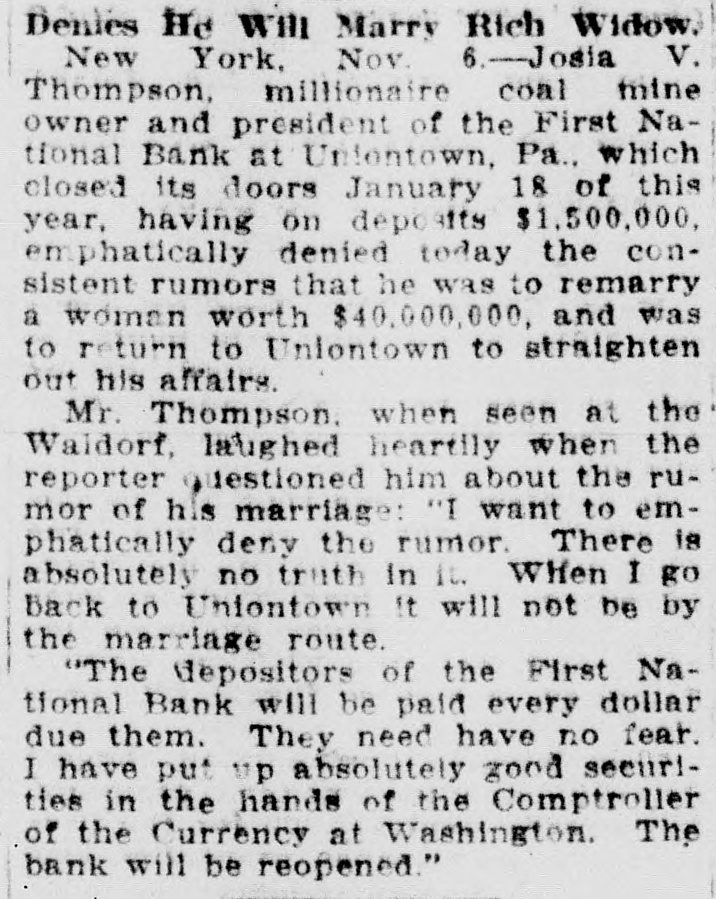
Denies He Will Marry Rich Widow. New York, Nov. 6.-Josia V. Thompson, millionaire coal mine owner and president of the First National Bank at Uniontown, Pa., which closed its doors January 18 of this year, having on deposits $1,500,000, emphatically denied today the consistent rumors that he was to remarry a woman worth $40,000,000, and was to return to Uniontown to straighten out his affairs. Mr. Thompson. when seen at the Waldorf, laughed heartily when the reporter questioned him about the rumor of his marriage: "I want to emphatically deny the rumor. There is absolutely no truth in IL. When I go back to Uniontown It will not be by the marriage route. "The depositors of the First National Bank will be paid every dollar due them. They need have no fear. I have put up absolutely good securities in the hands of the Comptroller of the Currency at Washington. The bank will be reopened."


Article from Yorkville Enquirer, November 23, 1915

Click image to open full size in new tab

Article Text

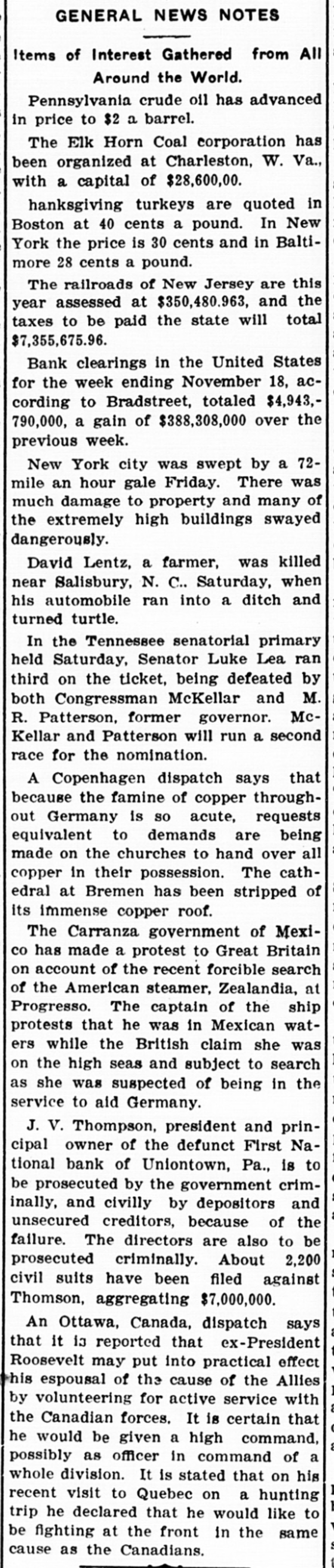
GENERAL NEWS NOTES Items of Interest Gathered from All Around the World. Pennsylvania crude oil has advanced in price to $2 a barrel. The Elk Horn Coal corporation has been organized at Charleston, W. Va., with a capital of $28,600,00. hanksgiving turkeys are quoted in Boston at 40 cents a pound. In New York the price is 30 cents and in Balti- more 28 cents a pound. The railroads of New Jersey are this year assessed at $350,480.963, and the taxes to be paid the state will total $7,355,675.96. Bank clearings in the United States for the week ending November 18, ac- cording to Bradstreet, totaled $4,943,- 790,000, a gain of $388,308,000 over the previous week. New York city was swept by a 72- mile an hour gale Friday. There was much damage to property and many of the extremely high buildings swayed dangerously. David Lentz, a farmer, was killed near Salisbury, N. C.. Saturday, when his automobile ran into a ditch and turned turtle. In the Tennessee senatorial primary held Saturday, Senator Luke Lea ran third on the ticket, being defeated by both Congressman McKellar and M. R. Patterson, former governor. Mc- Kellar and Patterson will run a second race for the nomination. A Copenhagen dispatch says that because the famine of copper through- out Germany is so acute, requests equivalent to demands are being made on the churches to hand over all copper in their possession. The cath- edral at Bremen has been stripped of its immense copper roof. The Carranza government of Mexi- co has made a protest to Great Britain on account of the recent forcible search of the American steamer, Zealandia, at Progresso. The captain of the ship protests that he was in Mexican wat- ers while the British claim she was on the high seas and subject to search as she was suspected of being in the service to aid Germany. J. V. Thompson, president and prin- cipal owner of the defunct First Na- tional bank of Uniontown, Pa., is to be prosecuted by the government crim- inally, and civilly by depositors and unsecured creditors, because of the failure. The directors are also to be prosecuted criminally. About 2,200 civil suits have been filed against Thomson, aggregating $7,000,000. An Ottawa, Canada, dispatch says that it is reported that ex-President Roosevelt may put into practical effect this espousal of the cause of the Allies by volunteering for active service with the Canadian forces. It is certain that he would be given a high command, possibly as officer in command of a whole division. It is stated that on his recent visit to Quebec on a hunting trip he declared that he would like to be fighting at the front in the same cause as the Canadians.


Article from Evening Times-Republican, July 25, 1919

Click image to open full size in new tab

Article Text

ed, It is pandemontum." Hearing was continued for a week. WILLIAMS COVETED STOCK. Comptroller Accused in $750,000 Deal in Securities. Washington, July 25- A. E. Jones. counsel for Independent stockholders of the old First National bank of Uniontown, Pa., testifying before the senate banking committee, charged John Skelton Williams, controller of the currency, with unfair management of the bank's affairs after its failure, and with having a personal interest in the disposition of 10,000 shares of coal mining stock given by J.V. Thompson, the bank president, to secure his indebtedness. Mr. Jones said the stock had been turned over to the controller under an agreement by which Mr. Thompson was to be given an opportunity to redeem it for $750,000. The witness also testifled that Mr. Williams had his stock assigned to himself, and that the controller's representative went to a meeting of bank stockholders and controlled that meeting for the purpose of bringing about the sale of the coal stock. "Do you intend to charge Mr. Williams engaged in this conference for the purpose of obtainig that stock?" asked Senator Fletacher, democrat, of Florida. "It is the only conclusion any reasonable man can draw that Mr. Williams wanted the stock, or was a party to proceedings that would enable some of his friends to get it," Mr. Jones replied. "The charges are absolutely without basis," said Mr. Williams, who followed Mr .Jones before the committee. "I want to denounce Mr. Jones as a contemptible slanderer in charging that I have any personal motters in this matter. His statements are full of inconsistencies." "Mr. Williams puts me in the same class as other critics of his administration," Mr. Jones said following the controller's statement. Mr. Williams told the committee that he had summoned Mr. Thompson to Washington several times to criticize certain banking methods and asserted the action in the Thompson case showed the efficiency of the controller's office.


Article from The Wheeling Intelligencer, July 25, 1919

Click image to open full size in new tab

Article Text

MANIPULATION is CHARGED BY UNIONTOWN MAN WASHINGTON July 24-A E. Jones, counsel for independent stockholders of the old First National Bank of Uniontown, Pa., testifying today before the senate banking committee. charged John Skelton Williams, comptroller of the currency with unfair manipulation of the bank's affairs after its failure and with having a personal interest in the disposition of 10,000 shares of coal mining stock given by J. V. Thompson, the bank president, to secure his indebtedness. Mr. Jones said the stock had been turned over to the comptroller under an agreement by which Mr. Thompson was to be given an opportunity to redeem it for $750,000. He also testified that Mr. Williams had this stock assigned in himself, and that the comptroller's representative went to a meeting of bank stockholders and controlled that meeting. for the purpose of bringing about the sale of the coal stock. Under an agreement alleged to have been reached at a conference of stock. holders and representatives of the comptroller's office in New York at the home of Samuel Untermeyer in January 1918. Mr. Jones said, sale of the bank's building was to be postponed and proceedings brought to enable an interpretation of the agreement relative to the stock ib. tained in the courts. Instead. Mr. Jones alleged, foreclosure proceedings were instituted and all testimony relative to the Thompson agreement kept out of the record. "Do you intend to charge Mr. Wil. liams engaged in this conference for the purpose of gaining that stock?" asked Senator Fletcher, Democrat, of Florida. "It is the only conclusion any reasonable man can draw-that Mr. Williams wanted the stock. or was a party to proceedings that would enable some of his friends to get it" Mr. Jones replied "The charges are absolutely without basis" said Mr. Williams, who followed M. Jones before the committee. 'I want to denounce Mr. Jones as a contemptible slanderer in charging that I have any personal motives in this matter His statements are full of inconsistencies."