Click image to open full size in new tab
Article Text
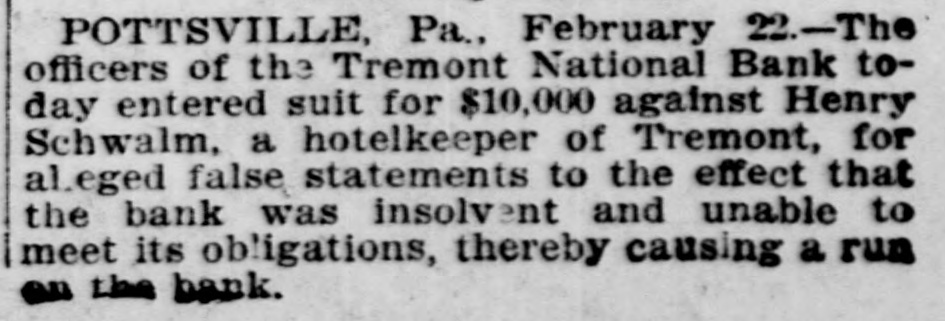
ITEMS CONDENSED. Odd Fellows of Shamokin have puron chased a building site for $15,000, which a temple is to be erected. The recent floods in Chester county of have entirely changed the course and Brandywine creek, near Lenape Bowers Island. Whooping cough is epidemic in the Sumney school, in Nottingham town- Friship, Washington county, and on day morning only one pupil remained the unaffected, when the teacher closed school. While Robert Davis, of Reading, was passing a sheet of hot iron,at the Oley and street mill, on Friday, he slipped so badly burned his knee as to entirely remove a large and painful boil. Edwin Wright and George Scherer, of Glen Lyon,near Wilkes-Barre, were killed by a car last Friday night,leaving twenty children orphans. Scherer is survived by eight daughters and Wright by twelve children. Two hundred members of the Union Steam Fire Engine and Hose company of Lebanon, on Saturday evening enjoyed an elaborate banquet in honor of the 128th anniversary of the institution of the company. The officers of the Tremont National bank, at Tremont, Schuylkill county, on Saturday entered suit for $10,000 damages against Henry Schwalm, a hotel keeper of Tremont, for alleged false statements to the effect that the bank was insolvent, thereby causing run on it. There is such an abundance of natural gas in the wells in the Armstrong county gas field that further drilling has been discontinued, as the companies are unable to find a market of for the product since the closing many establishments using the gas as fuel. The annual county convention of the camps of the Patriotic Order Sons of America in Berks county was held at Womelsdorf, on Saturday, with about 250 delegates and visitors in attendance. There are fifty-five camps in the county with a membership of 9,534, a gain of 545 during the past year. While a search was being made by detectives and county officials of York county for the will of David Heckert, who had been murdered about a week before, a hoard of $3,200 in bank bills and gold coin was found beneath a pile of old papers. No doubt this was old the treasure the murderer of the man was after. The University of Pennsylvania at Philadelphia has for this term an enrollment of 4,279 students,204 evening school students, 435 members of the teaching force, 194 administrative officers and 105 regular employes. A dog belonging to Mrs. Galt, of Morgantown, Berks county, went mad a few days ago and bit a score of other dogs before it was killed. The sixty-ninth annual session of the East Pennsylvania conference of the Evangelical association will convene at Shamokin on Thursday and the fourteenth annual session of the United Evangelical conference will meet in ReadingJon the same date. Dickinson college, at Carlisle, was threatened with a strike of nearly all the students because of the disciplining of four members of the sophomore class, but the troubles have been adjusted and peace again prevails. Six men violently assaulted Sabato Citzano, a foreigner, .in a saloon in Pittston. Luzerne county.on Saturday night. His skull was fractured by beating him with a chair, and he his is not expected to recover. Five of assailants have been arrested. Today two little daughters of James Leban, of Scott township, Allegheny county, will be placed in one grave. Ruth, aged 4 years, died on Friday of measles, and Blanche, aged 2 years, died on Sunday, of pneumonia. William Dickey,the last of the stage drivers on the old'National pike, died in Washington county on Sunday,age 85 years. He was born in Westmoreland county and became a stage driver when 22 years old. Millions of tons of the smaller sizes of anthracite coal, mined nearly thirty years ago. are to be sent to market this spring. They are of the chestnut and pea sizes and were then dumped aside as unfit for burning, but now there is a great demand for them. The robe which John Wesley wore when he was christened, over 200 years ago,is now the property of Miss Emily Pashley, of Workshop, England.