gpt-5-mini (chosen from majority vote of a three-model LLM ensemble)
Short Digest
18edcc2cb19f3d9e
Response Measures
None
Receivership Details
Depositor recovery rate
65.3%
Date receivership started
1905-01-03
Date receivership terminated
1911-09-30
OCC cause of failure
Fraud
Share of assets assessed as good
14.1%
Share of assets assessed as doubtful
53.0%
Share of assets assessed as worthless
32.9%
Description
Receiver appointed immediately upon suspension; bank remained defunct with later prosecutions and settlements.
Events (4)
1.December 2, 1868Chartered
Source
historical_nic
2.January 3, 1905Receivership
Source
historical_nic
3.January 3, 1905Receivership
Newspaper Excerpt
The First National bank of Faribault, Minn., has been closed and Bank Examiner Lyman D. Baird appointed as receiver.
Source
newspapers
4.January 3, 1905Suspension
Cause
Bank Specific Adverse Info
Cause Details
Lawful reserve fund fell below statutory limit and large holdings of securities could not be readily converted to cash (inability to realize on securities).
Newspaper Excerpt
The First National bank of Faribault has closed its doors and suspended payment, and the controller of the currency has appointed Bank Examiner Lyman D. Baird of Austin, Minn., receiver.
FARIBAULT BANK CLOSES ITS DOORS Inability to Realize on Securities Given as Reason for First National's Failure. Special to The Journal. Faribault, Minn., Jan. 3. The First National bank of Faribault has closed its doors and suspended payment, and the controller of the currency has appointed Bank Examiner Lyman D. Baird of Austin, Minn., receiver. The crisis in the affairs of the bank culminated yesterday afternoon when the board of directors adopted the following resolution: Whereas the lawful reserve fund of the First National bank of Faribault has fallen below the limit fixed by law and with its other assets there is a considerable amount of securities which cannot be readily converted in to ready money. Therefore Resolved, That the bank remain temporarily closed and the controller of the currency be at once notified with a view to an official examination of the actual condition of the bank and such action thereafter as may be directed by said controller. J. B. Clement is president of the bank and T. M. Whitney is cashier. The following is a statement of its resources and liabilities at the close of business on Nov. 10, 1904, the date of the last report to the controller:
2.January 3, 1905Evening Times-RepublicanMarshalltown, IA
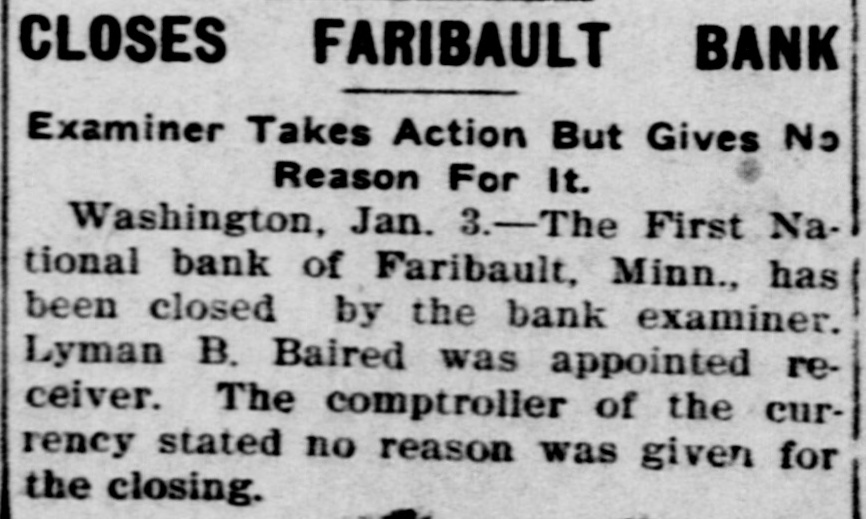
CLOSES FARIBAULT BANK Examiner Takes Action But Gives No Reason For lt. Washington, Jan. 3.-The First National bank of Faribault, Minn., has been closed by the bank examiner. Lyman B. Baired was appointed receiver. The comptroller of the currency stated no reason was given for the closing.
4.January 4, 1905Evening JournalWilmington, DE
Click image to open full size in new tab
Article Text
TAF WORLD'S NEWS WASHINGTON. HE PRESIDENT has selected Seth T Low for Ambassador to France, to succeed General Horace Porter. The Navy Department issued an official statement of deductions from events of the Russian-Japanese war, asserting the superiority of the battleship in naval conflict. It was announced that President Roosevelt has accepted several invitations for occasions on which he will make notable speeches. The Supreme Court reversed two Iowa cases involving the enforcement of the State prohibition law, holding that packages of liquors shipped from another State are interstate commerce and cannot be interfered with. The First National Bank of Faribault, Minn., was closed and a bank examiner appointed receiver. S. A. D. Puter, one of the withesses against Senator Mitchell in the land frauds, reiterated the charge that he paid Mitchell $2000 to influence Hermann. More indictments are expected. LEGISLATURES. The Pennsylvania Legislature received Governor Pennypacker's message; elected W. C. Sproul, of Delaware, President pro tem. of the Senate, and H. F. Walton, of Philadelphia; Speaker of the House. P. C. Knox was nominated for Senator. The Legislature agreed to adjourn April 13 next. FOREIGN. The Chief of Police of Romny, Russia, ordered all typewriters in possession of private persons confiscated, because typewritten revolutionary proclamations were being circulated. The Porte notified the American and British Governments that street sales of Bibles will not be allowed in Turkey. The Hungarian Parliament was dissolved after scenes of disorder. Aurel Batonyi the noted whip and man of fashion, fought a duel on the Austrian frontier with Count Szchenji, and was wounded in the arm. MISCELLANEOUS. Several societies in New York attacked the city administration for lax enforcement of laws against Sunday liquor selling and gambling. United States Marshal Chanler declined to permit a private interview between Doctor Chadwick and his wife. A writ of habeas corpus was secured for Nan Patterson, and a motion for bail will be heard today.
5.January 4, 1905The Saint Paul GlobeSaint Paul, MN
Click image to open full size in new tab
Article Text
BANK CLOSES DOORS But No Run on Other Faribault Bank Is Expected I Special to The Globe FARIBAULT, Minn., Jan. 3.-The First National Bank, of Faribault suspended payment today and the comptroller of the currency appointed Bank Examiner Lyman D. Baird, of Austin, Minn., receiver. The failure was a complete surprise to the public by whom the bank was regarded as one of the strongest, as it is one of the oldest in the state. The directors had adopted this resolution: Whereas, The lawful revenue fund of the First National Bank of Faribault has fallen below the limit fixed by law, and with its other assets there is a considerable amount of securities which cannot therefore be readily converted into ready money, Resolved, That the bank remain temporarily closed and the comptroller of the currency be at once notified of the actual condition of the bank and such action taken thereafter as may be directed by such comptroller. The amount of bonds and securities held by the bank which they have found it impossible to convert into ready money is $128,575, according to the statement made in December. This does not include United States bonds held to secure circulation. It had been much larger than this, having been reduced since the previous statement $50,000. It is believed that the process of liquidation had been carried on as far as practicable and that the bonds and securities still held are of such a character that their actual value is a matter of considerable doubt. As the capital of the bank, with its surplus, only amounts to $60,000, it can be readNy understood that so large an amount invested in questionable securities could not fail to prove a source of embarrassment. Up to the day it closed the bank had been apparently conducting a safe and prosperous business. People had the utmost confidence in it, and its stock was considered a gilt-edged investment. Its deposits amounted to $552,579, a large part of which represented the savings of people in moderate circumstances, who had been willing to accept a low rate of interest because
6.January 5, 1905The Saint Paul GlobeSaint Paul, MN
Click image to open full size in new tab
Article Text
by the report of the temporary receiver in deciding whether the First National Bank of Faribault shall be permitted to reopen. Receiver Baird will consult stockholders and report in a week or ten days. -Walter E. Clark.
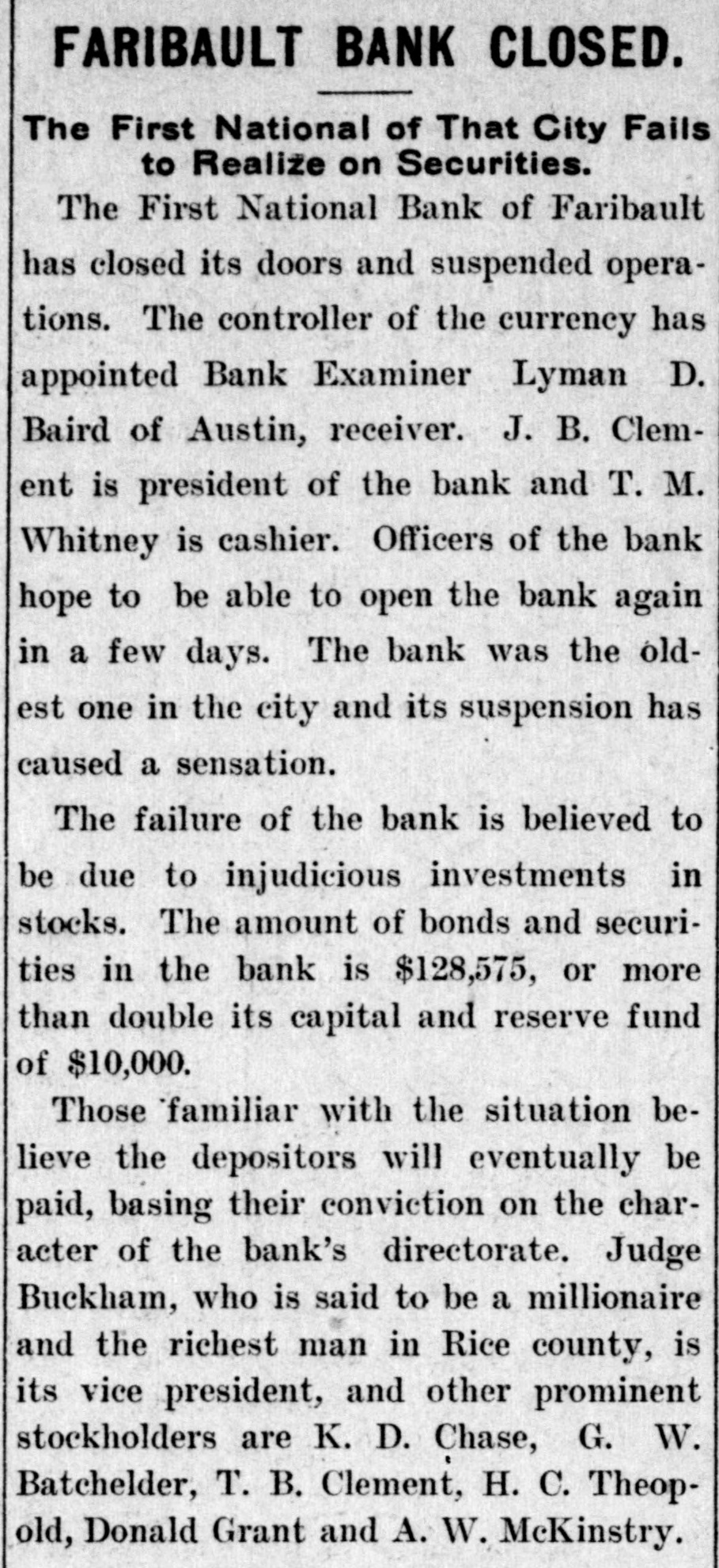
FARIBAULT BANK CLOSED. The First National of That City Fails to Realize on Securities. The First National Bank of Faribault has closed its doors and suspended operations. The controller of the currency has appointed Bank Examiner Lyman D. Baird of Austin, receiver. J. B. Clement is president of the bank and T. M. Whitney is cashier. Officers of the bank hope to be able to open the bank again in a few days. The bank was the Γ³ldest one in the city and its suspension has caused a sensation. The failure of the bank is believed to be due to injudicious investments in stocks. The amount of bonds and securities in the bank is $128,575, or more than double its capital and reserve fund of $10,000. Those familiar with the situation believe the depositors will eventually be paid, basing their conviction on the character of the bank's directorate. Judge Buckham, who is said to be a millionaire and the richest man in Rice county, is its vice president, and other prominent stockholders are K. D. Chase, G. W. Batchelder, T. B. Clement, H. C. Theopold, Donald Grant and A. W. McKinstry.
BANQUET FOR GUNSAULUS Large Audience at Northfield Hears His Lecture. NORTHFIELD, MINN.-The auditorium was filled to hear Dr. Gunsaulus of Chicago deliver his great lecture. "Gladstone." Previous to the lecture a banquet in honor of Dr. Gunsaulus was served in the parlors of the Congregational church. The president of the Men's club, Donald A. Adams, presided. The toasts were: "Our Community," by Alfred W. Norton, president of the Commercial club; "Our College," by President Sallmon of Carleton: "Our Club," by Professor Tompkins of Carleton, and "Our Guest," by Rev. J. E. McConnelly. Sixty men partook of the dinner. Carleton's second semester began on Tuesday with chapel exercises and an address on "Reading" by President Sallmon. The day was devoted to registration. Northfield citizens are impatiently waiting for the report of the receiver of the First National bank at Faribarlt. The impression has gained currency that the bank will not reopen.
9.February 7, 1905The Madison Daily LeaderMadison, SD
Click image to open full size in new tab
Article Text
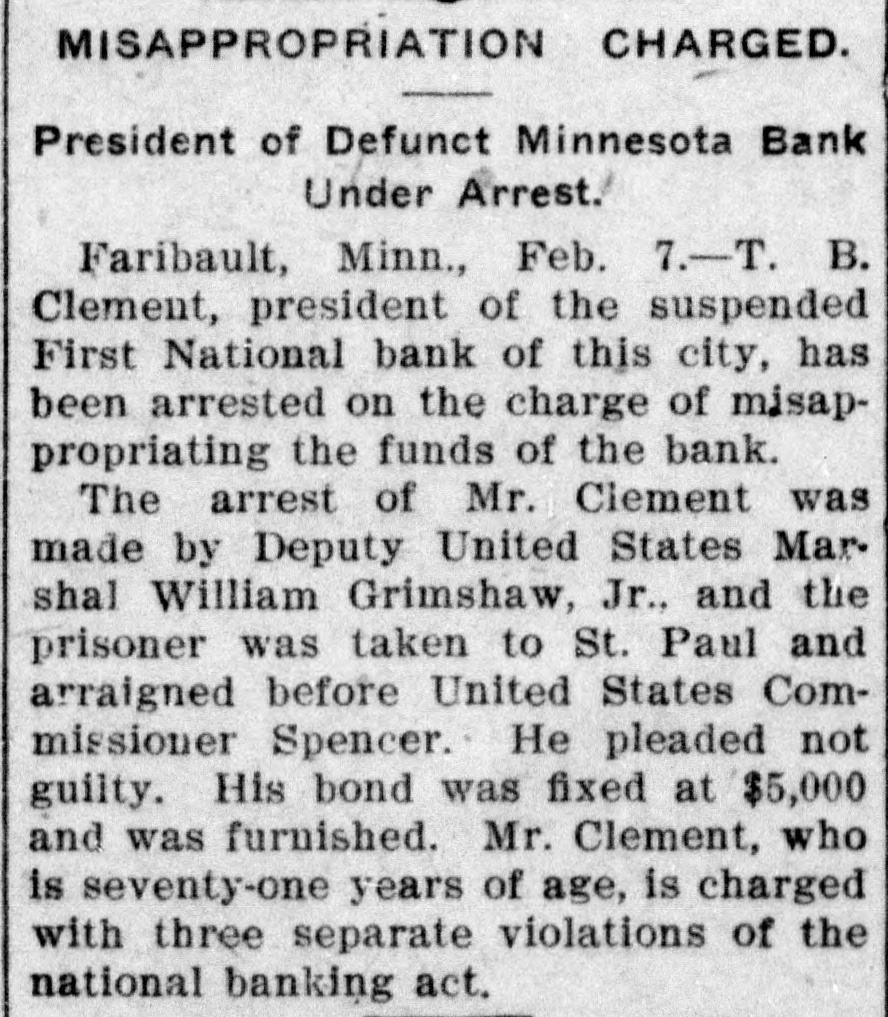
MISAPPROPRIATION CHARGED. President of Defunct Minnesota Bank Under Arrest. Faribault, Minn., Feb. 7.-T. B. Clement, president of the suspended First National bank of this city, has been arrested on the charge of misappropriating the funds of the bank. The arrest of Mr. Clement was made by Deputy United States Marshal William Grimshaw, Jr., and the prisoner was taken to St. Paul and arraigned before United States Commissioner Spencer. He pleaded not guilty. His bond was fixed at $5,000 and was furnished. Mr. Clement, who is seventy-one years of age, is charged with three separate violations of the national banking act.
INSPECTING BANK'S GEORGIA ASSETS Receiver Baird of Faribault First National Looks into Southern Loans. Washington, Feb. 18.-Lyman D. Baird, receiver of the defunct First National bank of Faribault, Minn., left Washington yesterday for points in Georgia, to inspect the properties, the fruit farm and Member tract on which the bank made excessive loans. He will spend several days in inspecting these properties, and will return by way of Washington that he may advise the controller of the currency regarding what he finds out. Then he will return to Minnesota. His southern trip will last for a week or ten days. The controller's office is watching the bank's affairs very closely, and finds in Mr. Baird a very faithful helper.
FARIBAULT BANK REORGANIZATION Depositors' Committee Has a Plan to Rehabilitate the Failed Institution. Eighty Cents on Dollar Proposed in Payment - Depositors' Meeting Postponed. Special to The Journal. Faribault, Minn., Feb. 21.-The meeting of the depositors of the defunct First National bank, which was to have been held Feb. 25, has been postponed until March 4, in order that the committee may be in a position to report to the depositors the condition of the properties in Georgia in which much of their money is invested. Plan for Bank Reorganization. The members of the committee have a plan for the reorganization of the bank which they believe to be feasible and which they expect to formulate and to submit to the directors. The depositors will be willing, they believe, to accept 80 cents on the dollar as full payment of their claims, and they will also be willing to wait any reasonable length of time for their money. In making this concession they would cancel at once $100,000 of the bank indebtedness. It is proposed to ask the directors, whose ability to finance the business is not questioned, to agree to pay this 80 per cent, and all other claims. and reopen the bank. Of course, before this could be done, all depositors would have to agree in a some legal form to such settlement, but it is the opinion of the committee that this obstacle could be overcome. How the directors would regard such a proposition is not known, but there can be no doubt that there is not one of them who would not sacrifice to rehabilitate himself in the opinion of the public. Whether there is a method by which the receiver could/vacate his office and turn the bank over to the directors is 8 matter which has not vet been given much consideration, but if the claims of all creditors are satisfied there can be little doubt that some way could be found of reopening the bank. Want to Hear from Baird. Mr. Baird, the receiver, is making a personal investigation of the affairs of the De Soto Fruit, Agricultural & Man ufacturing company and of the Minne sota Lumber company of Georgia and is not expected to return before the end of this week. The committee ex pects to avail itself of the information he will acquire and present it to the de positors at the meeting on March 4. While the statement of the condition of the De Soto property, recently pub lished in T h J ur n al, has familiar ized the public with regard to its af fairs, the committee so far has only Mr Clement's statement of the business done and the property owned by the Minnesota Lumber company. This it members would prefer to have Mr Baird substantiate before they accept it as authoritative, and as representing the facts. This statement was givei the members of the committee in an in terview held at Mr. Clement's hous a day or two ago, and is of a very roseate character. Lumber Company's Showing. The Minnesota Lumber company owns two "lots" near Valdosta, which are represented as bearing a heav growth of timber, mostly pine. Each 0 these 'lots' centains 480 acres. Th company has also purchased stumpag besides that on its own property. has built into these lots temporary rail roads for the transportation of logs an has equipped them with suitable rolling stock. It has two sawmills, a shingl mill and a planing mill. It was turnin out at the time when the report wa made from which Mr. Clement quote to the committee, 25,000 feet of lum ber a day, and had more orders that it could fill. The price of lumber wa good and was advancing. The company, Mr. Clement said, wa at that time making a net profit 0 $2,000 a month. Just why, when it wa doing so well, it was necessary to sen it in December, $71,000, Mr. Clement di not explain, altho he admitted that pos sibly some of it was used in the pur chase of the outlying stumpage th company has acquired. He still pro fesses to regard the investment as gilt edged and to think that under prope management the company will be abl to pay the bank all it owes. What It Had Planned. The committee has learned from othe sources that the lumber company ha extended, or at the time of the bank failure was about to extend, its opera tions into Florida and to add to it other industries that of the constructio of railroads. It has not yet all th facts in its possession, but the nature o the prospective contracts is known The railroad was to build thru Florid timber lands and in part payment fo its work the company was to be give alternate sections of the timber land which is traversed. Much of this timbe land is reported to be primeval fores and to be very valuable. The chairman of the committee ha written letters to friends in a positio to inform him as to the facts of thes alleged grants and expects by March to be able to make a full statement o them to the depositors. Many Loyal to Clement. It would be a great mistake to sur pose that any revelations of his method of doing business which have been mad have turned away from Mr. Clement a public sympathy or that he has alread been condemned in everybody' min by the ex parte statements of th
Calumet
Baking
Powder
Health-
Economy.
# LUMBER COMPANY FAILS.
Receiver Appointed at Request of Faribault, Minn., Bank Receiver.
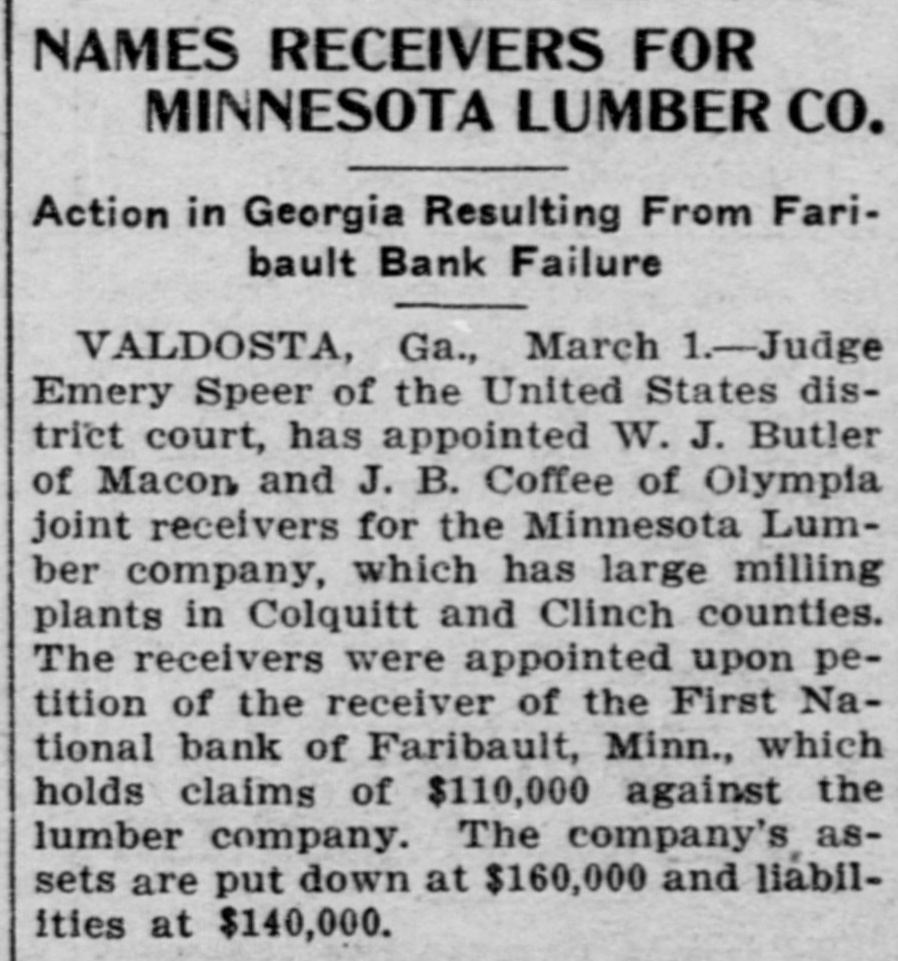
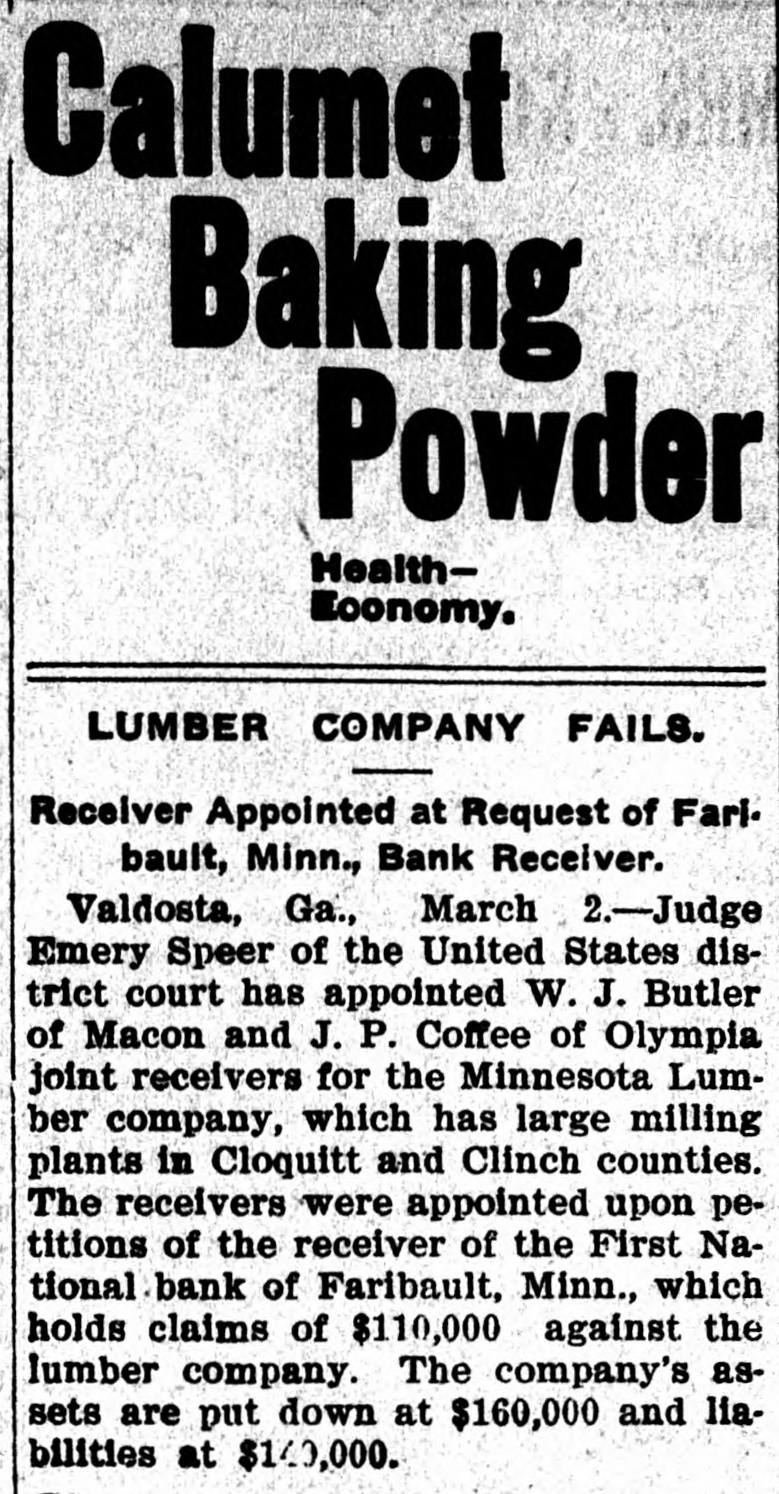
Valdosta, Ga., March 2.-Judge Emery Speer of the United States district court has appointed W. J. Butler of Macon and J. P. Coffee of Olympia joint receivers for the Minnesota Lumber company, which has large milling plants in Cloquitt and Clinch counties.
The receivers were appointed upon petitions of the receiver of the First National bank of Faribault, Minn., which holds claims of $110,000 against the lumber company. The company's assets are put down at $160,000 and liabilities at $140,000.
# Receivers of Lumber Company.
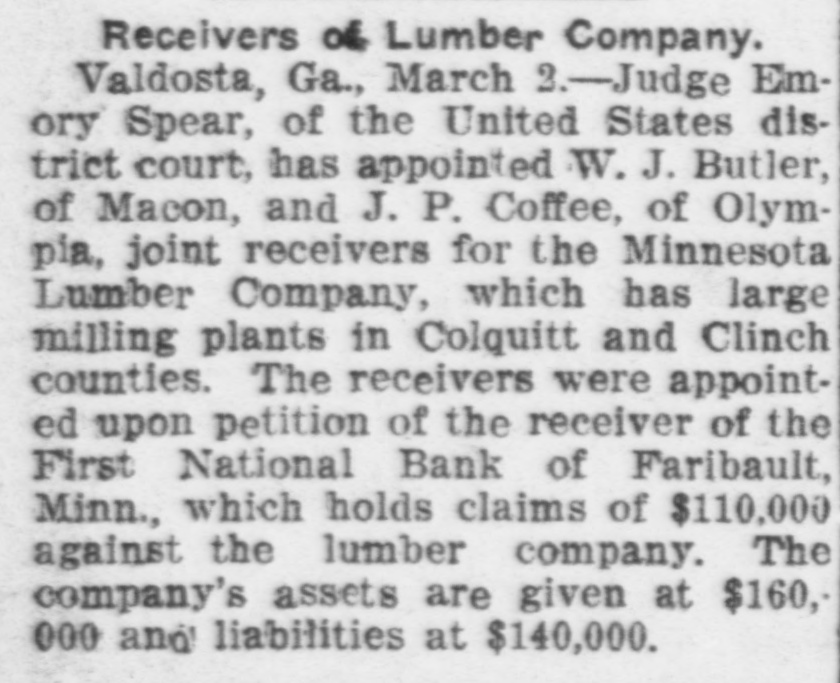
Valdosta, Ga., March 2.-Judge Emory Spear, of the United States district court, has appointed W. J. Butler, of Macon, and J. P. Coffee, of Olympia, joint receivers for the Minnesota Lumber Company, which has large milling plants in Colquitt and Clinch counties. The receivers were appointed upon petition of the receiver of the First National Bank of Faribault, Minn., which holds claims of $110,000 against the lumber company. The company's assets are given at $160,000 and liabilities at $140,000.
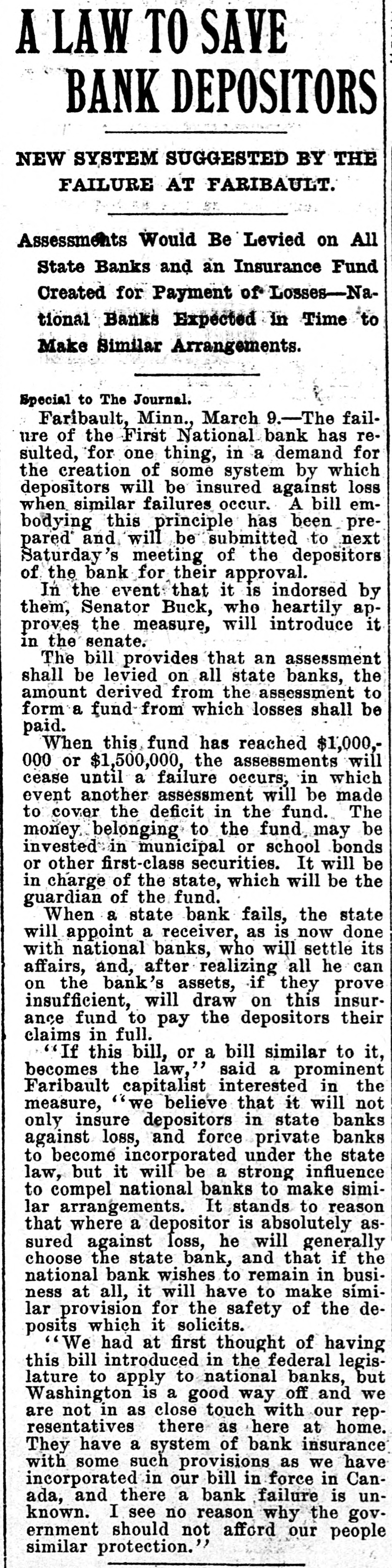
A LAW TO SAVE BANK DEPOSITORS NEW SYSTEM SUGGESTED BY THE FAILURE AT FARIBAULT. Assessments Would Be Levied on All State Banks and an Insurance Fund Created for Payment of Losses-National Banks Expected in Time to Make Similar Arrangements. Special to The Journal. Faribault, Minn., March 9.-The failure of the First National bank has resulted, for one thing, in a demand for the creation of some system by which depositors will be insured against loss when similar failures occur. A bill embodying this principle has been prepared and will be submitted to next Saturday's meeting of the depositors of the bank for their approval. In the event that it is indorsed by them, Senator Buck, who heartily approves the measure, will introduce it in the senate. The bill provides that an assessment shall be levied on all state banks, the amount derived from the assessment to form a fund from which losses shall be paid. When this fund has reached $1,000,000 or $1,500,000, the assessments will cease until a failure occurs, in which event another assessment will be made to cover the deficit in the fund. The money belonging to the fund may be invested in municipal or school bonds or other first-class securities. It will be in charge of the state, which will be the guardian of the fund. When a state bank fails, the state will appoint a receiver, as is now done with national banks, who will settle its affairs, and, after realizing all he can on the bank's assets, if they prove insufficient, will draw on this insurance fund to pay the depositors their claims in full. "If this bill, or a bill similar to it, becomes the law," said a prominent Faribault capitalist interested in the measure, "we believe that it will not only insure depositors in state banks against loss, and force private banks to become incorporated under the state law, but it will be a strong influence to compel national banks to make similar arrangements. It stands to reason that where a depositor is absolutely assured against loss, he will generally choose the state bank, and that if the national bank wishes to remain in business at all, it will have to make similar provision for the safety of the deposits which it solicits. "We had at first thought of having this bill introduced in the federal legislature to apply to national banks, but Washington is a good way off and we are not in as close touch with our representatives there as here at home. They have a system of bank insurance with some such provisions as we have incorporated in our bill in force in Canada, and there a bank failure is unknown. I see no reason why the government should not afford our people similar protection."
Receiver for Lumber Company.
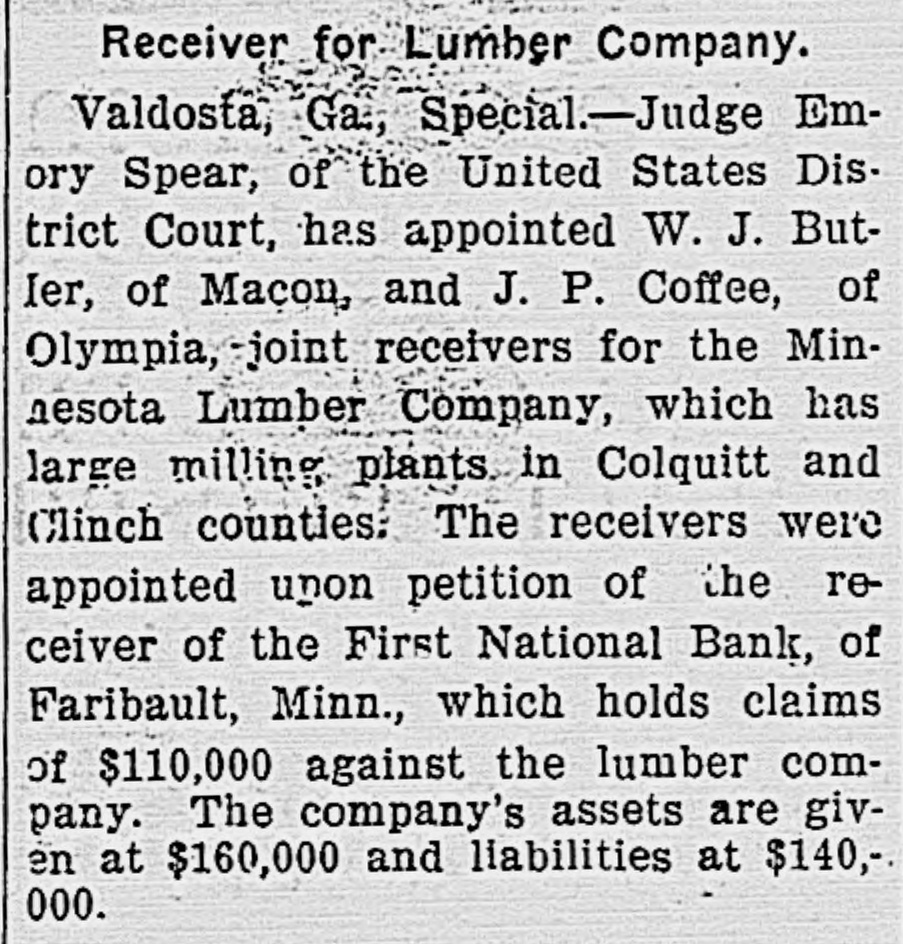
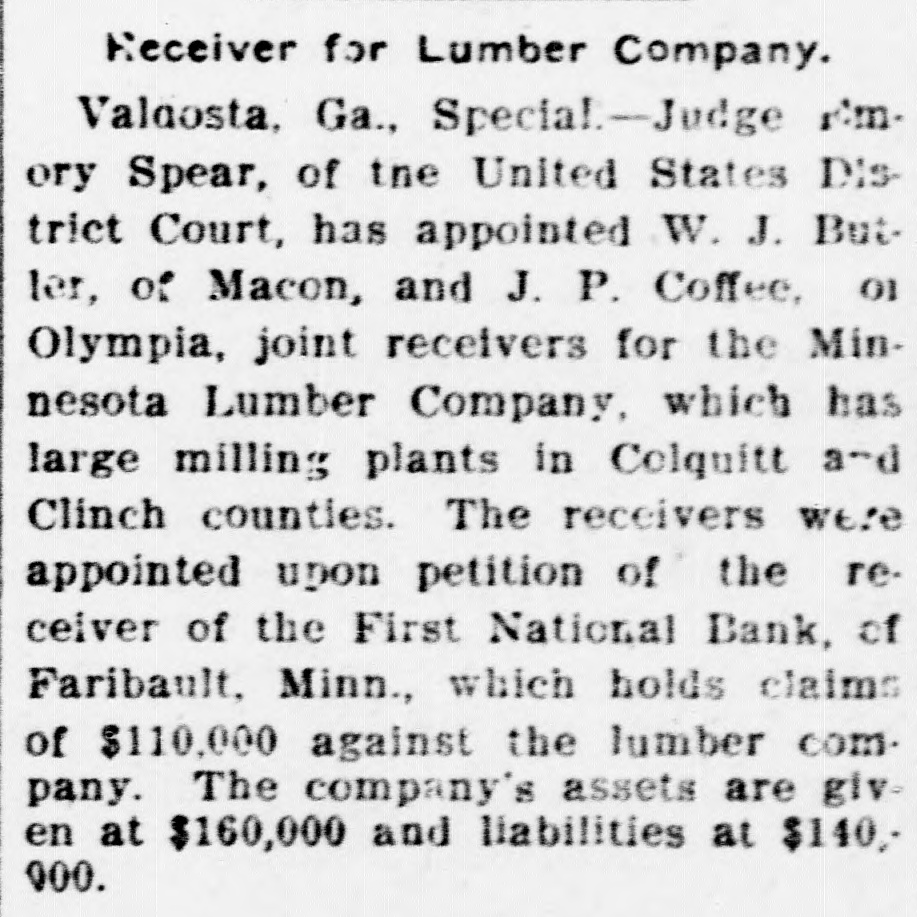
Valdosta, Ga., Special.-Judge Emory Spear, of the United States District Court, has appointed W. J. Butler, of Macon, and J. P. Coffee, of Olympia, joint receivers for the Minnesota Lumber Company, which has large milling plants in Colquitt and Clinch counties. The receivers were appointed upon petition of the receiver of the First National Bank, of Faribault, Minn., which holds claims of $110,000 against the lumber company. The company's assets are given at $160,000 and liabilities at $140,900.
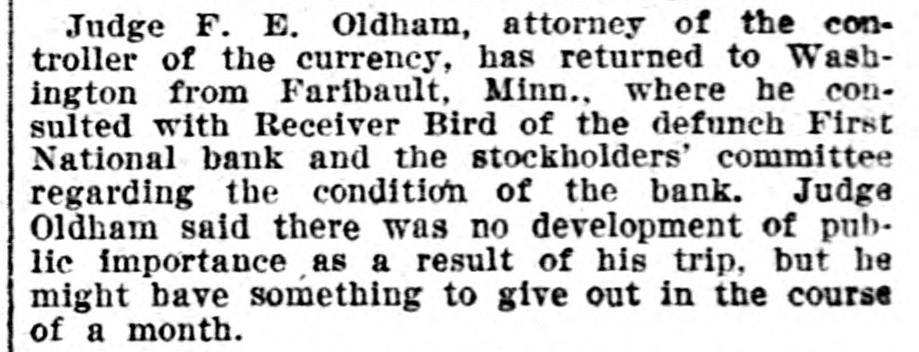
Judge F. E. Oldham, attorney of the controller of the currency, has returned to Washington from Faribault, Minn., where he consulted with Receiver Bird of the defunct First National bank and the stockholders' committee regarding the condition of the bank. Judge Oldham said there was no development of public importance as a result of his trip, but he might have something to give out in the course of a month.
18.May 4, 1905The Evening StatesmanWalla Walla, WA
Click image to open full size in new tab
Article Text
TEST CASE BEGUN Bank Receiver Sues Maker of Accommodation Note. FARIBAULT, Minn., May 4.-Lyman Baird, as receiver of the First National bank, has brought suit in the district court against John Hutchinson, president of the Faribault Furtiture company, to collect a $4,500 note given the bank. This is a test case and on the decision important issues depond. The note is one of several accommodation notes given to tthe bank at the solicitation of its president, T. B. Clement. Mr. Hutchinson received no consideration. With other like notes it was used by Mr. Clement to pad the
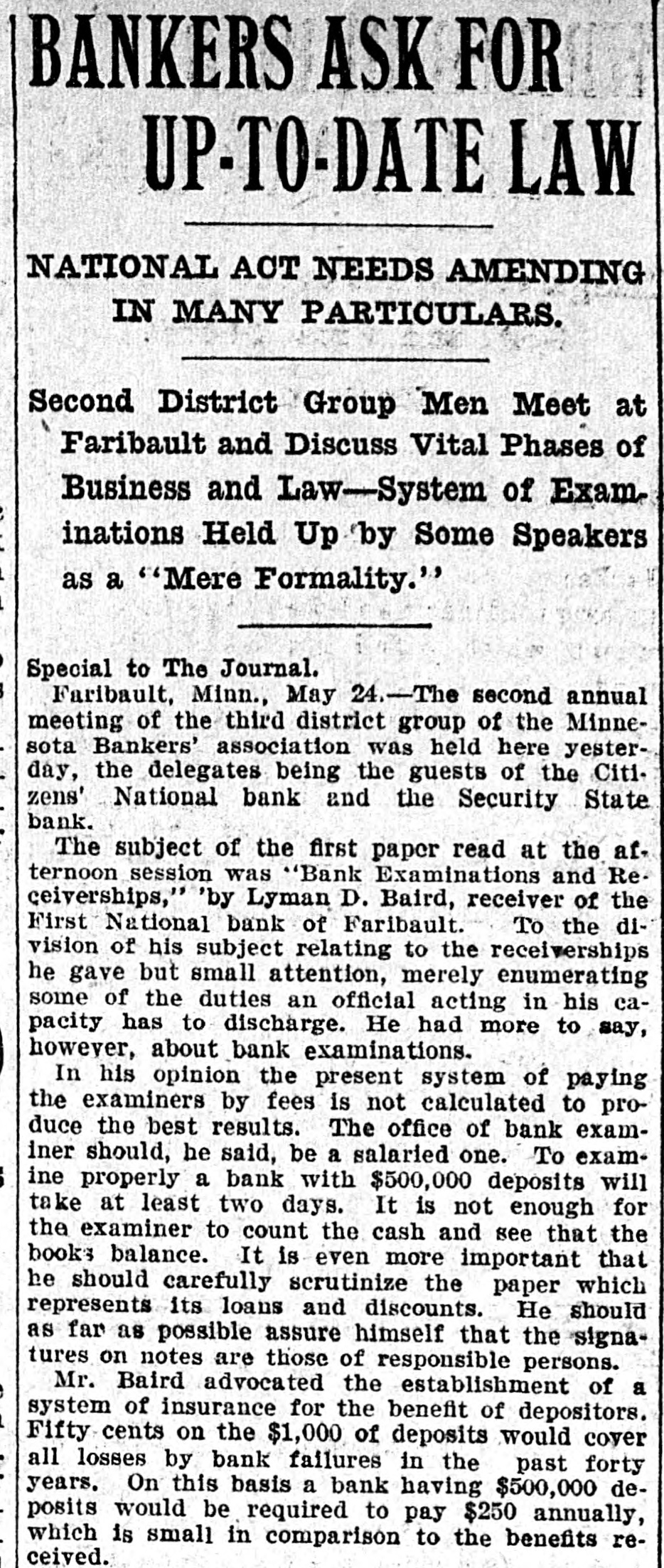
# BANKERS ASK FOR
# UP-TO-DATE LAW
NATIONAL ACT NEEDS AMENDING
IN MANY PARTICULARS.
Second District Group Men Meet at
Faribault and Discuss Vital Phases of
Business and Law-System of Exam-
inations Held Up by Some Speakers
as a "Mere Formality."
Special to The Journal.
Faribault, Minn., May 24. -The second annual
meeting of the third district group of the Minne-
sota Bankers' association was held here yester-
day, the delegates being the guests of the Citi-
zens' National bank and the Security State
bank.
The subject of the first paper read at the af-
ternoon session was "Bank Examinations and Re-
ceiverships," by Lyman D. Baird, receiver of the
First National bank of Faribault. To the di-
vision of his subject relating to the receiverships
he gave but small attention, merely enumerating
some of the duties an official acting in his ca-
pacity has to discharge. He had more to say,
however, about bank examinations.
In his opinion the present system of paying
the examiners by fees is not calculated to pro-
duce the best results. The office of bank exam-
iner should, he said, be a salaried one. To exam-
ine properly a bank with $500,000 deposits will
take at least two days. It is not enough for
the examiner to count the cash and see that the
books balance. It is even more important that
he should carefully scrutinize the paper which
represents its loans and discounts. He should
as far as possible assure himself that the signa-
tures on notes are those of responsible persons.
Mr. Baird advocated the establishment of a
system of insurance for the benefit of depositors.
Fifty cents on the $1,000 of deposits would cover
all losses by bank failures in the past forty
years. On this basis a bank having $500,000 de-
posits would be required to pay $250 annually,
which is small in comparison to the benefits re-
ceived.
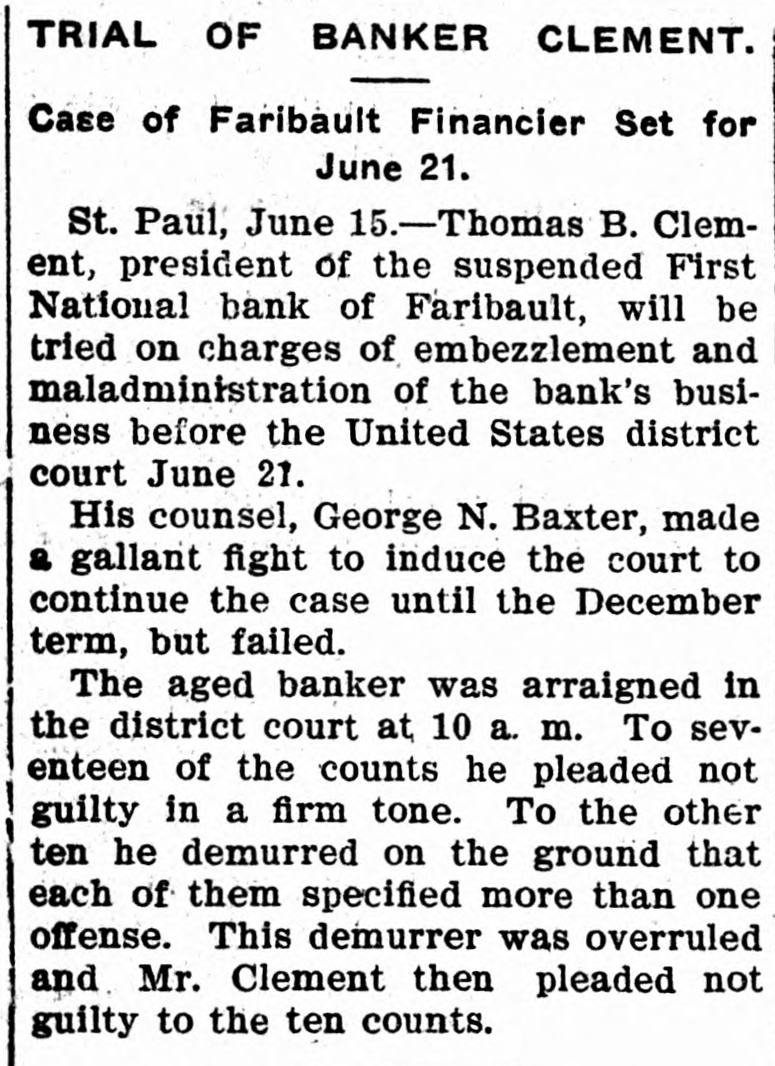
# TRIAL OF BANKER CLEMENT.
Case of Faribault Financier Set for June 21.
St. Paul, June 15. -Thomas B. Clement, president of the suspended First National bank of Faribault, will be tried on charges of embezzlement and maladministration of the bank's business before the United States district court June 21.
His counsel, George N. Baxter, made a gallant fight to induce the court to continue the case until the December term, but failed.
The aged banker was arraigned in the district court at 10 a. m. To seventeen of the counts he pleaded not guilty in a firm tone. To the other ten he demurred on the ground that each of them specified more than one offense. This demurrer was overruled and Mr. Clement then pleaded not guilty to the ten counts.
# TRIAL OF BANKER CLEMENT.
Case of Faribault Financier Set for June 21.
St. Paul, June 15. - Thomas B. Clement, president of the suspended First National bank of Faribault, will be tried on charges of embezzlement and maladministration of the bank's business before the United States district court June 21.
His counsel, George N. Baxter, made a gallant fight to induce the court to continue the case until the December term, but failed.
The aged banker was arraigned in the district court at 10 a. m. To seventeen of the counts he pleaded not guilty in a firm tone. To the other ten he demurred on the ground that each of them specified more than one offense. This demurrer was overruled and Mr. Clement then pleaded not guilty to the ten counts.
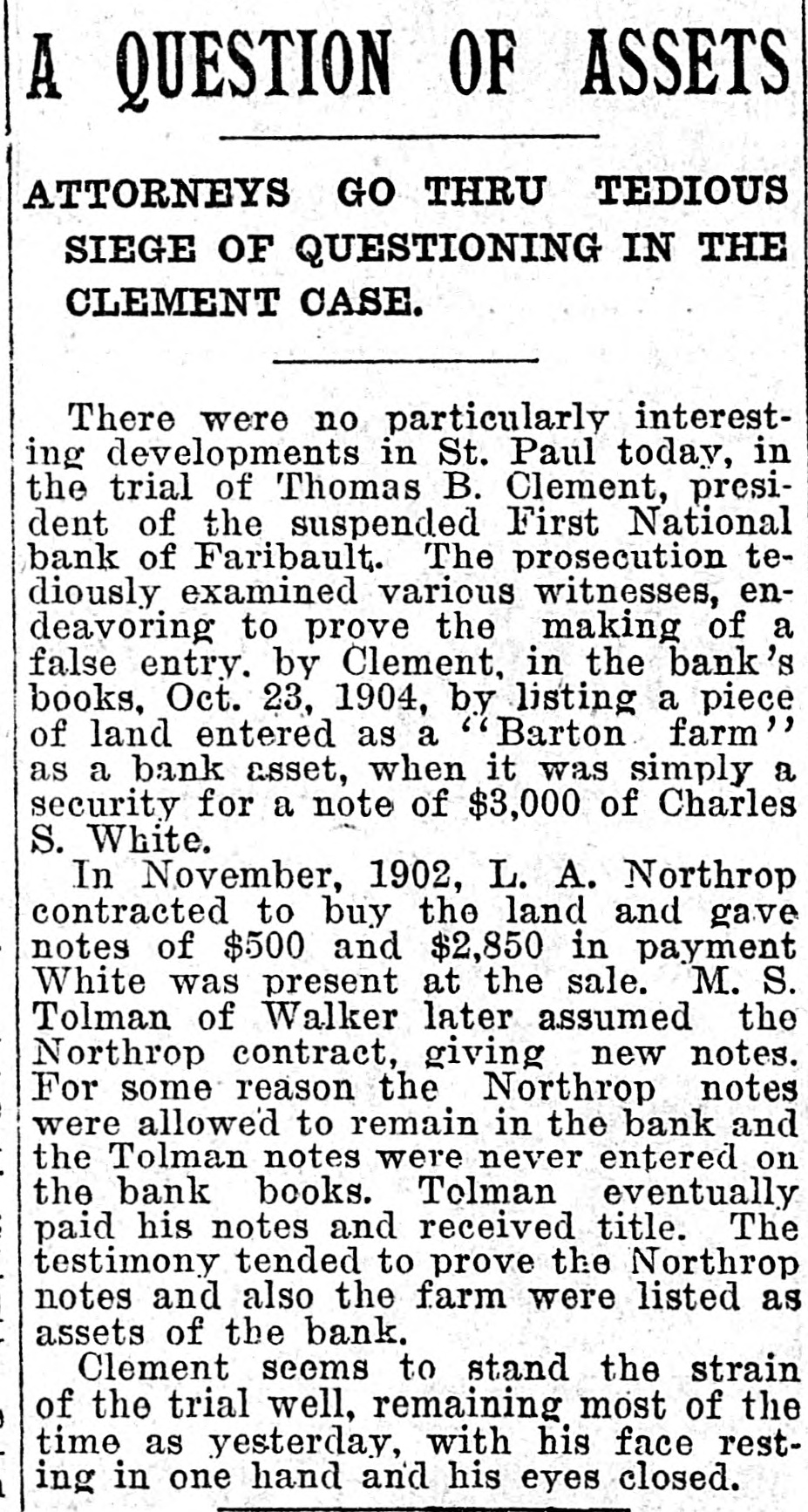
# A QUESTION OF ASSETS
ATTORNEYS GO THRU TEDIOUS
SIEGE OF QUESTIONING IN THE
CLEMENT CASE.
There were no particularly interesting developments in St. Paul today, in the trial of Thomas B. Clement, president of the suspended First National bank of Faribault. The prosecution tediously examined various witnesses, endeavoring to prove the making of a false entry, by Clement, in the bank's books, Oct. 23, 1904, by listing a piece of land entered as a "Barton farm" as a bank asset, when it was simply a security for a note of $3,000 of Charles S. White.
In November, 1902, L. A. Northrop contracted to buy the land and gave notes of $500 and $2,850 in payment White was present at the sale. M. S. Tolman of Walker later assumed the Northrop contract, giving new notes. For some reason the Northrop notes were allowed to remain in the bank and the Tolman notes were never entered on the bank books. Tolman eventually paid his notes and received title. The testimony tended to prove the Northrop notes and also the farm were listed as assets of the bank.
Clement seems to stand the strain of the trial well, remaining most of the time as yesterday, with his face resting in one hand and his eyes closed.
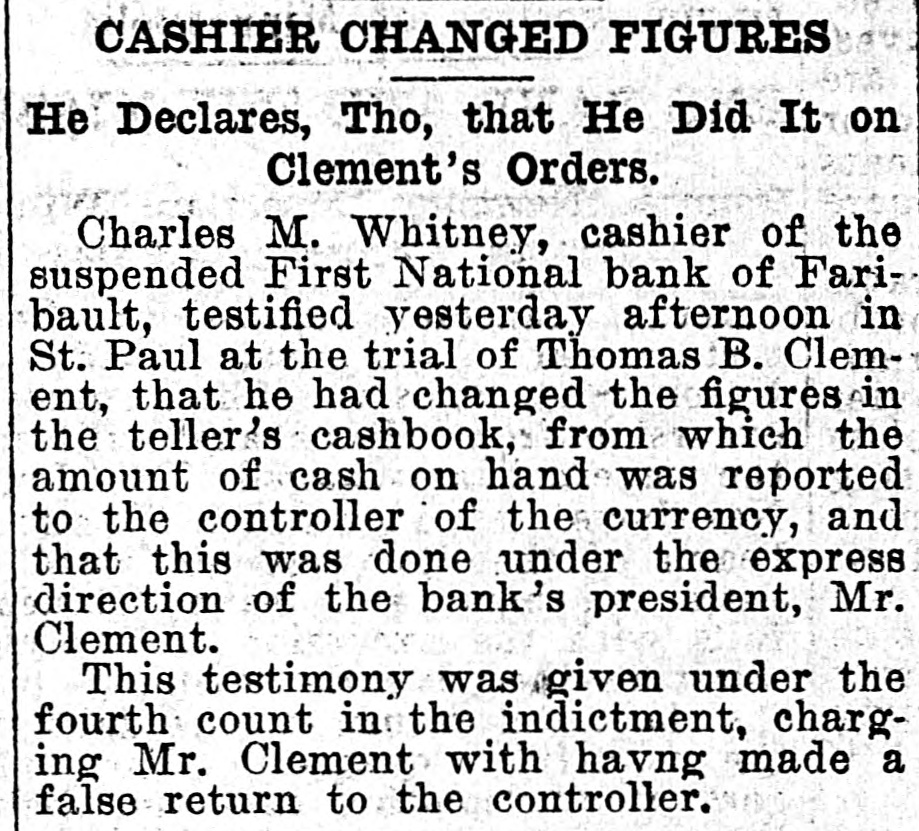
# CASHIER CHANGED FIGURES
He Declares, Tho, that He Did It on Clement's Orders.
Charles M. Whitney, cashier of the suspended First National bank of Fari-
bault, testified yesterday afternoon in St. Paul at the trial of Thomas B. Clem-
ent, that he had changed the figures in the teller's cashbook, from which the
amount of cash on hand was reported to the controller of the currency, and
that this was done under the express direction of the bank's president, Mr.
Clement.
This testimony was given under the fourth count in the indictment, charg-
ing Mr. Clement with havng made a false return to the controller.
24.July 8, 1905The Cairo BulletinCairo, IL
Click image to open full size in new tab
Article Text
BANK PRESIDENT FOUND GUILTY AT ST. PAUL. St. Paul, July 7.-Thomas B. Clements, president of the fa'led First National Bank of Faribault, Minn., who was indicted on twenty-seven counts, charging embezzlement, misapplica tion of funds and making false reports to the comptroller of the currency, tonight was found guilty by the jury in the United Sttes District court on 24 counts. The defendant was recommended to the mercy of the court. Sentence was suspended until November 10, pending hearing for a new trial.
25.January 5, 1906Omaha Daily BeeOmaha, NE
Click image to open full size in new tab
Article Text
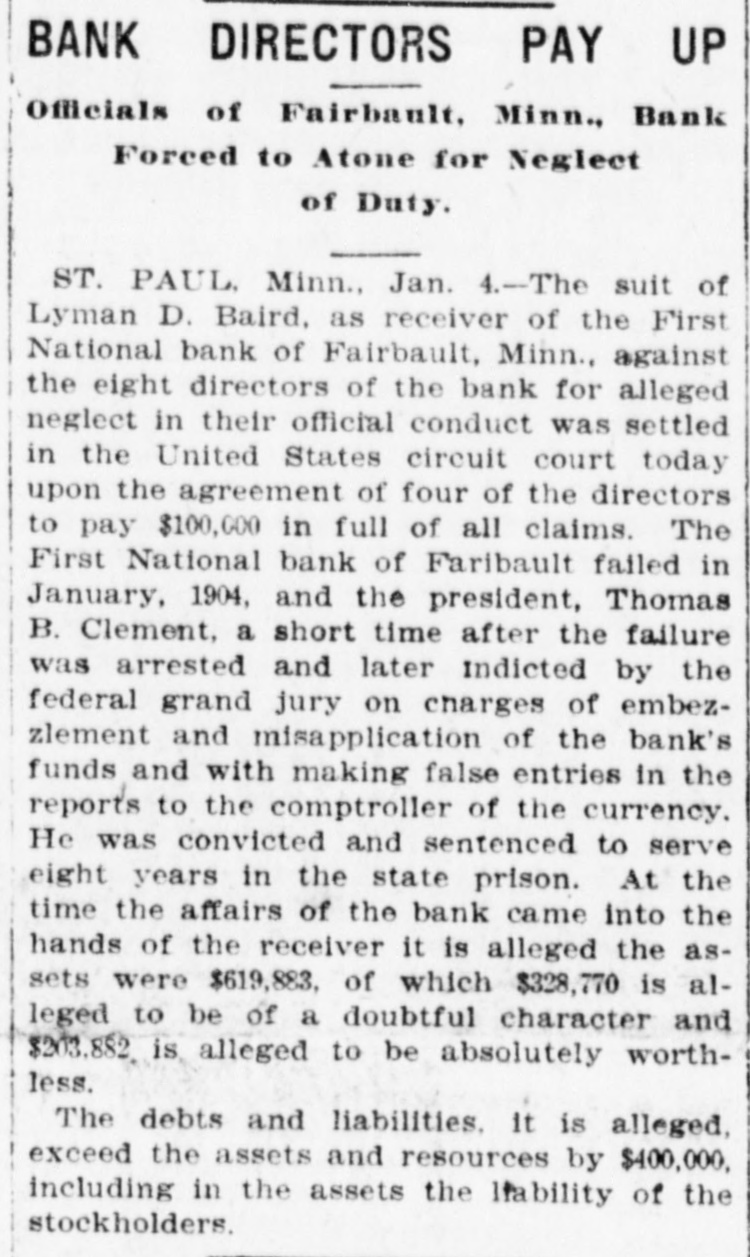
BANK DIRECTORS PAY UP Officials of Fairbault, Minn., Bank Forced to Atone for Neglect of Duty. ST. PAUL, Minn. Jan. 4.-The suit of Lyman D. Baird, as receiver of the First National bank of Fairbault, Minn., against the eight directors of the bank for alleged neglect in their official conduct was settled in the United States circuit court today upon the agreement of four of the directors to pay $100,000 in full of all claims. The First National bank of Faribault failed in January, 1904, and the president, Thomas B. Clement, a short time after the failure was arrested and later indicted by the federal grand jury on charges of embezzlement and misapplication of the bank's funds and with making false entries in the reports to the comptroller of the currency. He was convicted and sentenced to serve eight years in the state prison. At the time the affairs of the bank came into the hands of the receiver it is alleged the assets were $619,883. of which $328,770 is alleged to be of a doubtful character and $203,882 is alleged to be absolutely worthless. The debts and liabilities. It is alleged, exceed the assets and resources by $400,000. including in the assets the liability of the stockholders.
Bank runs are almost always and everywhere a deterioration of bank fundamentals.
But not for you.
You are the measure-zero exception: great fundamentals, solid bank, and yet the Diamond Dybvig fairy spread its rumor. Depositors woke up. Your collateral was not prepositioned. The Clearinghouse had it for you.
Do not pass Go. Do not collect $200. Go directly to jail… or worse.