16836. Commercial Bank (Oswego, NY)

Bank Information

Episode Type
Suspension → Closure
Bank Type
state
Start Date
April 24, 1844
Location
Oswego, New York (43.455, -76.510)

Metadata

Model
gpt-5-mini
Short Digest
729a21a1

Response Measures

None

Description

Articles from 1844–1845 describe the Commercial Bank of Oswego as insolvent with a receiver appointed and the Comptroller redeeming circulating notes under the Safety Fund act. There is no description of a depositor run; the bank was in receivership and its notes were being redeemed, indicating suspension/closure rather than a run or later reopening.

Events (4)

1. April 24, 1844 Receivership
Newspaper Excerpt
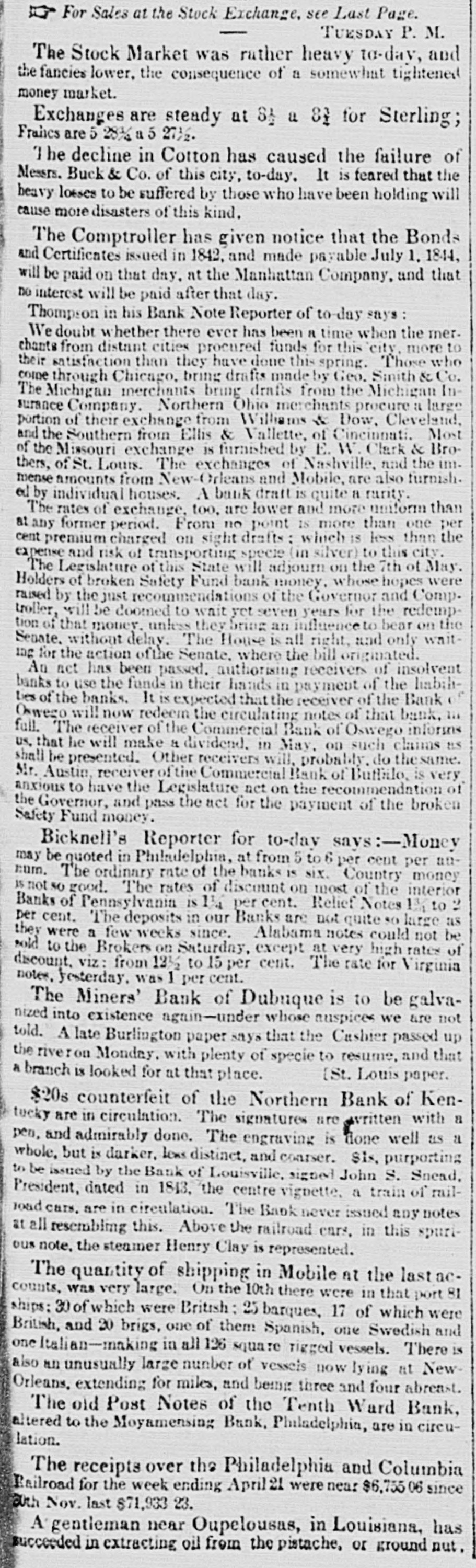
The receiver of the Commercial Bank of Oswego informs us, that he will make it dividend. in May, on such claims as shall be presented.
Source
newspapers
2. April 24, 1844 Suspension
Cause
Bank Specific Adverse Info
Cause Details
Bank was insolvent and placed in receivership; receiver handling assets and preparing dividends.
Newspaper Excerpt
It is expected that the receiver of the Bank Oswego will now redeem the circulating notes of that bank, full. The receiver of the Commercial Bank of Oswego informs us, that he will make it dividend. in May, on such claims as shall be presented.
Source
newspapers
3. June 6, 1845 Other
Newspaper Excerpt
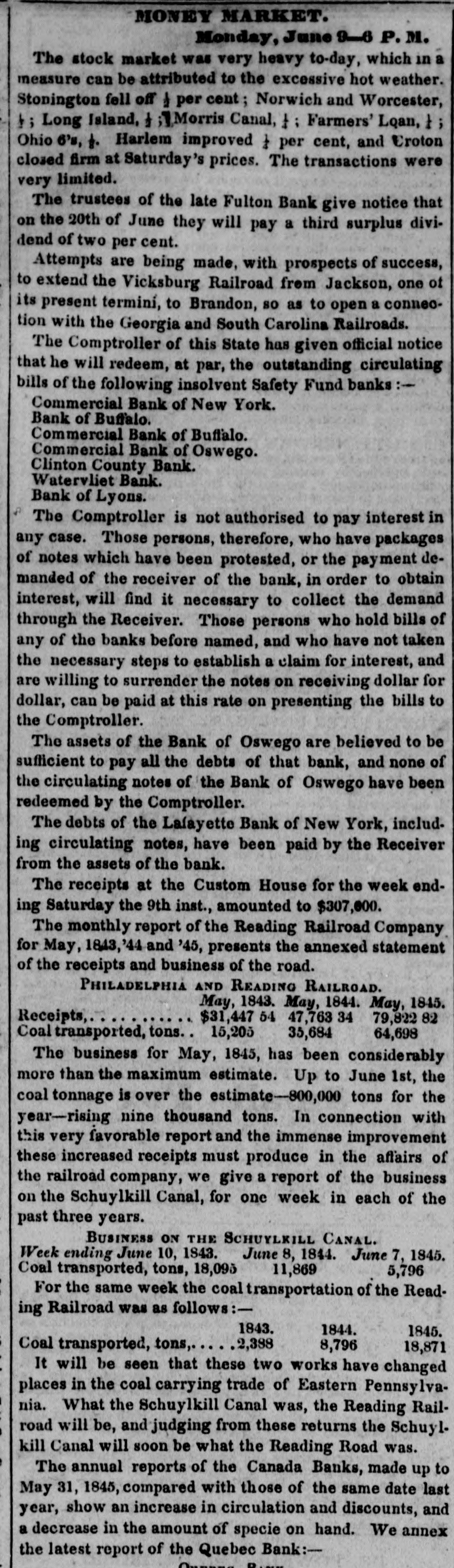
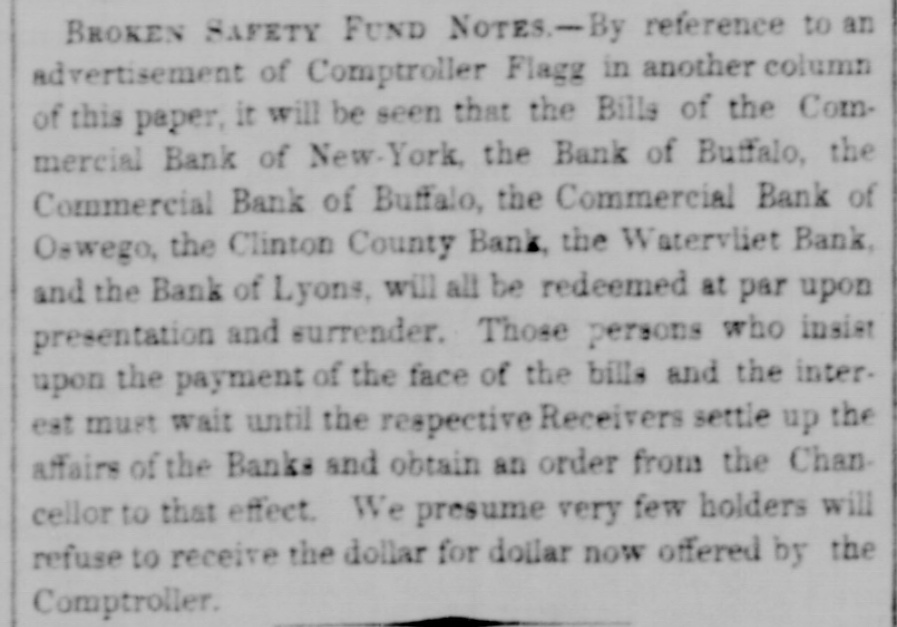
The Comptroller ... will redeem at par, the outstanding circulating bills of the ... Commercial Bank of Oswego. The assets of the Bank of Oswego are believed to be sufficient to pay all the debts of that Bank, and none of the circulating notes of the Bank of Oswego have been redeemed by the Comptroller.
Source
newspapers
4. October 10, 1845 Other
Newspaper Excerpt
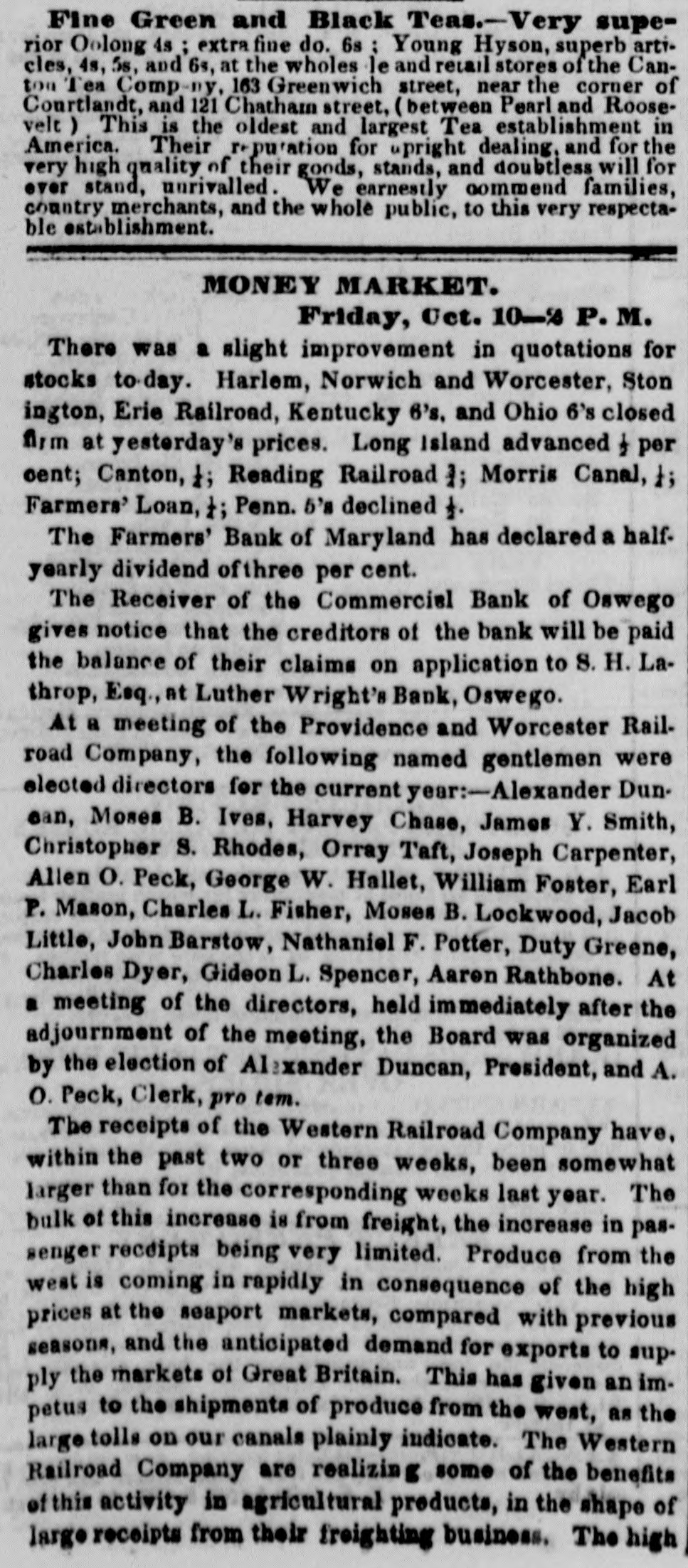
The Receiver of the Commercial Bank of Oswego gives notice that the creditors of the bank will be paid the balance of their claims on application to S. H. Lathrop, Esq., at Luther Wright's Bank, Oswego.
Source
newspapers

Newspaper Articles (9)

Article from New-York Daily Tribune, April 24, 1844

Click image to open full size in new tab

Article Text

For Sales at the Stock Exchange, see Last Page. TUESDAY P. M. The Stock Market was rather heavy to-day, and the fancies lower, the consequence of a somewhat tightened money market. Exchanges are steady at 81 a 81 for Sterling; Francs are 5 2814 a 5 273 The decline in Cotton has caused the failure of Messrs. Buck & Co. of this city, to-day. It is feared that the heavy losses to be suffered by those who have been holding will cause more disasters of this kind. The Comptroller has given notice that the Bonds and Certificates issued in 1842, and made payable July 1. 1844, will be paid on that day, at the Manhattan Company, and that Do interest will be paid after that day. Thompson in his Bank Note Reporter of to day says: We doubt whether there ever has been a time when the merthants from distant cities procured funds for this city, more to their satisfaction than they have done this spring. Those who come through Chicago, bring drafts made by Geo. Smith & Co. The Michigan merchants bring drafts from the Michigan Insurance Company. Northern Ohio merchants procure it large portion of their exchange from Williams " Dow. Cleveland, and the Southern from Ellis & Vallette, of Cincinnati. Most of the Missouri exchange is furnished by E. W. Clark & Brothers, of St. Louis. The exchanges et Nashville, and the im. mense amounts from w-Orleans and Mobile, are also furnish. al by individual houses. A bank draft is quite a rarity. The rates of exchange, too, are lower and more uniform than at any former period. From no point IS more than one per cent premium charged on sight drafts: which 18 less than the expense and risk of transporting specie (in silver) to this city, The Legislature of this State will adjourn on the 7th of May. Holders of broken Safety Fund bank money. whose hopes were raised by the just recommendations of the Governor and Comp. troller, will be doomed to whit yet seven years for the redemption of that money. unless they bring an influence to bear on the Senate. without delay. The House is all right, and only wait10g for the action of the Senate, where the bill originated. An act has been passed. authorising receivers of insolvent banks to use the funds in their hands in payment of the liabiliLies of the banks. It is expected that the receiver of the Bank Oswego will now redeem the circulating notes of that bank, full. The receiver of the Commercial Bank of Oswego informs us. that he will make it dividend. in May, on such claims as shall be presented. Other receivers will, probably, do the same. Mr. Austin, receiver of the Commercial Bank of Buffilo, is very anxious to have the Legislature net on the recommendation of the Governor, and pass the act for the payment of the broken Safety Fund money. Bicknell's Reporter for to-day says:-Money may be quoted in Philadelphia, at from 5 to 6 per cent per anrum. The ordinary rate of the banks is six. Country money is not so good. The rates of discount on most of the interior Banks of Pennsylvania is 14 per cent. Relief Notes 134 to 2 per cent. The deposits in our Banks are not quite so large as they were a few weeks since. Alabama notes could not be sold to the Brokers on Saturday. except at very high rates of discount. viz: from 12 1/2 to 15 per cent. The rate for Virginia notes, yesterday. was 1 per cent. The Miners' Bank of Dubuque is to be galvanized into existence again-under whose auspices we are not told. A late Burlington paper says that the Cashier passed up the rivere Monday. with plenty of specie to resume. and that a branch is looked for at that place. (St. Louis paper. $20s counterfeit of the Northern Bank of Kentucky are in circulation. The signatures are written with a pen, and admirably done. The engraving is done well as a whole, but is darker. leas distinct. and coarser. Sis, purporting to be issued by the Bank of Louisville, signed John S. Snead, President, dated in 1843, the centre vignette, a train of railroad cars. are in circulation. The Bank never issued any notes at all resembling this. Above the railroad cars. in this spurious note, the steamer Henry Clay is represented. The quantity of shipping in Mobile at the last accounts, was very large. On the 10th there were in that port 81 ships: 30 of which were British: 25 barques, 17 of which were British, and 20 brigs, one of them Spanish, one Swedish and one Italian-making in all 126 square tigged vessels. There is also an unusually large number of vesseis now lying at New Orleans, extending for miles, and being three and four abreast. The old Post Notes of the Tenth Ward Bank, altered to the Moyamensing Bank, Philadelphia, are in circulation. The receipts over the Philadelphia and Columbia Railroad for the week ending April were near $6,755.06 since with Nov. last $71,933.23 gentleman near Oupelousas, in Louisiana, has succeeded in extracting oil from the pistache, or ground nut.

Article from New-York Daily Tribune, September 26, 1844

Click image to open full size in new tab

Article Text

For Commercial and Money Matters. see Last Page. WEDNESDAY P. M. There not much done in Stocks to-day. and gerolation appears to be just now mesmerized. Prices were needy. The supply of Exchange exceeds the demand, which limited. Sterling is 934 a 10: Francs 5 23% The Hadson and Berkshire Railroad runs from of Hudson to W. Stockbridge in Berkshire County, Name-distance 32 miles. The capital is $400,000. It cost t construct, $550.00 this left the Company in debt $150,000. Application being made to the Legislature of this State in 1839, the credit of the State was granted by issuing $150,000 State stock at 336 percent. interest, redeemable in twenty yearsconditioned that the interest should always be promp tly paid and the sum of: per cent. per annum paid into the State Trea. tory wasinking fund for its final liquidation. both of which have been promptly complied with by the Company out 01 its regulat earnings. The debt is now reduced to $138,000. which N all that the Company owes for any purpose. so far as we can learn. The road intersects the great Wettern Railroad from Boston to Albany at Chatham, 14 miles from Hudson, sad TUCS to West Stock bridge. where it joins with the Housa. todic and forms R part of the line of railroad communication from Bridgeport to Albany. The expenditures of the Com pany for running the road. the payment of the State interest. and the 83,000 annual p lyment to the sinking fund for the final liquidation of the debt, are about $31,000 per annum. These the Company have promptly paid out of the earnings of the road DO to the end of the year 1843. During the present year the receipts of the road have increased largely. as will be seen by the following comparative statement-which will leave suples in the hands of the Company: From the opening of the road in ApriltoistJune N3.$4.914.51 2,40:91 For the month of June July Do 2,578.50 August Do 2,857.11 $12,785.06 Total $8,299 54 From opening April. to st June, 1841 3,237 For the month of June 3,086 17 July Do August Do 3,181 93-17,805.47 Excess in favor of 184 $5,020.41 That Boston Post man is very funny. He savs, speaking of the Illinois Canal Loan. The demand of a tax levy as additional security is deemed an insult by the people of it think an Illinois. and will no: be complied with." Does he insult to be asked to pay a small interest on his debts The following statement of the exports of Cotton Manufactures. Yarn, amount of circulation of the Bank of England, Bullion, &c. will show the course of trade in Englast four years. !t would seem that an expansion af currency does not always produce. as is charged, an undue expansion of trade. The exports of Cottons and Cotton Yarn in 1840 were £24,668,618. and in 1843 £23, 3,449,629. H falling off of.c1.2:0.(00. while in the same interval the circulation of the Bank had gone up from 17 millions to 183 millions, The im. provement in the Cotton trade from 1843, the exports be inz £3.0.0.00 ab ve that of 1842 may be fairly ascribed to the opening of new markets in China and other foreign countries, rather than to the expansion of the currency. The increase of the bution in the Bank, it will be seen, has been. since 1841 very great. and the decrease of the rates of discount equally considerable The rate of discount quoted for 1843 18 the ave. rage the year. It lower, say 11/2 per cent. at times 1842 1841 1840. 1843. Exp. Cotton Manuf. 17,567,310 16 232,510 13 $ 910,084 16 5,248,759 In do Yorn 7,101,308 7,266,968 7,752,676 7,191,870 Av.cir. Bk of Eng. in 17 17 173 182, millions pounds Avamit. of bullion in 8 4 433 11% Bk. in mill'ns pinds Rates if discount by 3 43 1 % per cent. Brokers The following table shows the price of Wheut per quarter in England. at the dates specified. For the last two years it has averaged much lower than for the three years previous: Dec. January. May. Sept. 1840 664. 4d. 684. 8d. 69s. 3d. 63s. 2d 1811 6%s. 1d. 63s. 5d 73s. 2d. 61s. 9d 1:42 62s. 9d 59s 8d. 598 7d. 48s 8d, 1843 4ds 2d. 46. td. 558 lld. 51s 3d. 1811 50s. 6d. 55s. 4d. Aug. 51s. The following were the rates of Upland bowed fair Cotton in Laverpooi in August of the following years: 1843 1842. 1841 1844. 1840. 43dd. 63rd 5% 4%d 57/d. The following statement in relation to Specie shipments was made up by J. F Entz. E.g. of the N Y. Life and Trust Co. who is perfectly conversant with such operations. The interest calculation is probably rather too large: Proforma Account of a Shipment of Mexican Dollars from New York to L ndon. $10,125 CO $10,000 in New York 14 premium $6.60 Shipping charges 58.47 Marine insurance 1/2 per cent policy $125..5187 8.0.183.47 £2 097 611 810,000 weighing 8660 oz. sold at 583/d 15 3 Landing charges. porter -ge. &c Freight 3 UPT cent: primage 6 per cent. 8 41 6 22 2 Commission 1/2 per cent: brokerage Y. 13 2 £2,075 5 17 18 2 Add interest of 63 days at 5 per cent £ 3,093 3 7 Net proceeds The above $10,183 47 drawn against the same amount, would give an exchange of $109 46. These calculations founded on actual transactions, give rates of exchange as follows Price in London. Price in Exchange Sept. 3. 814. New-York. Mexican dollars 4s. 103d. 1 1/4 a 11/2 prem. 109 46 100.109 73.100 111 n5 4 all2 6100 Spanish dollars 4 103/3 Here is another bit of financial wisdom from the Berald: "The time is very near at hand when orders for the spring's importation must be made out and forwarded for manufacture. Before this carried to any great extent payments for our chares already received must be made. This will compel the importento remit more rapidly and largely than they other wire woult under the existing state of commercial affairs here. and we therefore look for a very Active demand for exchange, some very large shipments of specie within the next sixty days Why is it necessary to forward the orders' for manufacture? Have not our importers ability sufficient to make their ow n or der?? Could not Mor S. Colporteur have made the first part of the last sentence H trifle clearer 2 The Board of Supervisors, by a vote of S to 7, decided in permit the Farmers' I onn Company to pay n tax upon only 8809 694 95 cents instead of $1,533,283 53 cents. as nlessed The capitalef the company has very much depredated. The first marked sum is considered the real value of the Company's property, after deducting indebtedness. The Receiver of the Commercial Bank of Oswero has declared a dividend of 25 per cent. on all ascertained claims" against the Bank. Markets-Carefully reported for The Tribune. WEDNESDAY. September 26. ASHES at $4.25 for good bills. but the sup.


Article from The New York Herald, June 10, 1845

Click image to open full size in new tab

Article Text

MONEY MARKET. Monday, June 9-6 P.M. The stock market was very heavy to-day, which in a measure can be attributed to the excessive hot weather. Stonington fell off 1 per cent; Norwich and Worcester, 1; Long Island, I Morris Canal, 1; Farmers' Lqan, Ohio 6's, 1. Harlem improved 1 per cent, and Eroton closed firm at Saturday's prices. The transactions were very limited. The trustees of the late Fulton Bank give notice that on the 20th of June they will pay a third surplus dividend of two per cent. Attempts are being made, with prospects of success, to extend the Vicksburg Railroad from Jackson, one of its present termini, to Brandon, so as to open a conneotion with the Georgia and South Carolina Railroads. The Comptroller of this State has given official notice that he will redeem, at par, the outstanding circulating bills of the following insolvent Safety Fund banks:Commercial Bank of New York. Bank of Buffalo. Commercial Bank of Buffalo. Commercial Bank of Oswego. Clinton County Bank. Watervliet Bank. Bank of Lyons. The Comptroller is not authorised to pay interest in any case. Those persons, therefore, who have packages of notes which have been protested, or the payment demanded of the receiver of the bank, in order to obtain interest, will find it necessary to collect the demand through the Receiver. Those persons who hold bills of any of the banks before named, and who have not taken the necessary steps to establish a claim for interest, and are willing to surrender the notes on receiving dollar for dollar, can be paid at this rate on presenting the bills to the Comptroller. The assets of the Bank of Oswego are believed to be sufficient to pay all the debts of that bank, and none of the circulating notes of the Bank of Oswego have been redeemed by the Comptroller. The debts of the Lafayette Bank of New York, includ. ing circulating notes, have been paid by the Receiver from the assets of the bank. The receipts at the Custom House for the week ending Saturday the 9th inst., amounted to $307,000. The monthly report of the Reading Railroad Company for May, 1843,44 and '45, presents the annexed statement of the receipts and business of the road. PHILADELPHIA AND READING RAILROAD. May, 1843. May, 1844. May, 1845. Receipts $31,447 47,763 34 79,822 82 15,205 Coal transported, tons. 35,684 64,698 The business for May, 1845, has been considerably more than the maximum estimate. Up to June 1st, the coal tonnage is over the estimate-800,000 tons for the year-rising nine thousand tons. In connection with this very favorable report and the immense improvement these increased receipts must produce in the affairs of the railroad company, we give a report of the business on the Schuylkill Canal, for one week in each of the past three years. BUSINESS ON THE SCHUYLKILL CANAL. Week ending June 10, 1843. June 8, 1844. June 7, 1845. Coal transported, tons, 18,095 11,869 5,796 For the same week the coal transportation of the Reading Railroad was as follows:1843. 1844. 1845. 2,388 Coal transported, tons, 8,796 18,871 It will be seen that these two works have changed places in the coal carrying trade of Eastern Pennsylvania. What the Schuylkill Canal was, the Reading Railroad will be, and judging from these returns the Schuyl. kill Canal will soon be what the Reading Road was. The annual reports of the Canada Banks, made up to May 31, 1845, compared with those of the same date last year, show an increase in circulation and discounts, and a decrease in the amount of specie on hand. We annex the latest report of the Quebec Bank:-


Article from New-York Daily Tribune, June 11, 1845

Click image to open full size in new tab

Article Text

BROKEN SAFETY FUND NOTES. - By reference to an advertisement of Comptroller Flagg in another column of this paper, it will be seen that the Bills of the Commercial Bank of New-York, the Bank of Buffalo, the Commercial Bank of Buffalo, the Commercial Bank of Oswego, the Clinton County Bank the Watervliet Bank, and the Bank of Lyons, will all be redeemed at par upon presentation and surrender. Those persons who insist upon the payment of the face of the bills and the inter. est must wait until the respective Receivers settle up the affairs of the Banks and obtain an order from the Chan cellor to that effect. We presume very few holders will refuse to receive the dollar for dollar now offered by the Comptroller.


Article from The New York Herald, June 11, 1845

Click image to open full size in new tab

Article Text

REDEMPTION OF NOTES OF INSOLVENT SAFETY FUND BANKS. COMPTROLLER'S OFFICE, Albany, June 6th, 1845. COMPTROLLER, in obedience to the Third Section THE of the Act, Chapter 114 of the Laws of 1845, hereby gives notice, that he will redeem at par, the outstanding circulating bills of the Commercial Bank of New York, the Bank of Buffalo, the Commercial Bank of Buffalo, the Commercial Bank of Oswego, the Clinton County Bank, the Watervliet Bank, and the Bank of Lyons. The Comptroller is not authorised to pay interest in any case: Those persons, therefore, who have packages of notes which have been protested or the payment demanded of the Reeceiver of the Bank. in order to obtain interest, will find it necessary to collect the demand through the Receiver. Those persons who hold bills of any of the Banks before named, and who have not taken the necessary steps to establish a claim for interest, and are willing to surrender the notes on receiving dollar for dollar, can be paid at this rate, on presenting the bills to the Comptroller. All other claims which have been presented and established againstany of the insolvent Banks will be paid by the receiver, who cannot get an order from the Chancellor on the safety fund, until he has collected the sums due the bank and applied the avails to the payment of its debts. The balance then remaining is a charge on the safety fund, and these balances can be paid as soon as the Receiver disposes of the assets of the Bank and gets a final order from the Chancellor. either in cash or six per cent stock at par, which the Comptroller is authorised to issue under the 'Act t' provide for paying the debts of insolvent Safety Fund Banks,'o passed April 28, 1845. In the case of the Bank of Buffalo, the final order has been made by the Vice-Chancellor of the 8th circuit, and the means for paying the balance of all the claims against the Bank have been paid to the Receiver. The assets of the Bank of Oswego are believed to be sufficient to pay all the debts of that Bank, and none of the circulating notes of the Bank of Oswego have been redeemed by the Comptroller. The names and residences of the Receivers of the several Banks are as follows:Commercial Bank of New York, J. M. Blatchford, New York. Commercial Bank of Buffalo, S. G. Austin, Buffalo. Commercial Bank of Oswego, T. Beekman, Kinderhook. Watervliet Bank, George R. Davis, Troy. Clipton County Bank, Henry K. Averill, Plattsburgh. Bank of Lyons, Theron R. >trong, Palmyra. Bank of Oswego, Charles Stebbins, Cazenovia. Wayne County Bank, Samuel Miller, Rochester. City Bank of Buffalo, G. W. Newell, Albany. The debts of the Lafayette Bank of New York, including circulating notes, have been paid by the Receiver from the assets of the Bank. A. C. FLAGG, jll Stre Comptroller


Article from The New York Herald, June 12, 1845

Click image to open full size in new tab

Article Text

REDEMPTION OF NOTES OF INSOLVENT SAFETY FUND BANKS. COMPTROLLER'S OFFICE, Albany, June 6th, 1845. T HE COMPTROLLER, in obedience to the Third Section of the Act, Chapter 114 of the Laws of 1845, hereby gives notice, that he will redeem at par, the outstanding circulating bills of the Commercial Bank of New York. the Bank of Buffalo, the Commercial Bank of Buffalo, the Commercial Bank of O.wego, the Clinton County Bank, the Watervliet Bank, and the Bank of Lyons. The Comptroller is not authorised to pay interest in any case: Those persons, therefore, who have packages of notes which have been protested or the payment demanded of the Reeceiver the Bank. in ord to obtain interest, will find it necessary to lect the demand through the R ceiver. Those persons who hold bills of any of the Banks before named. and who have not taken the necessary steps to establish a claim for interest, and are willing to surrender the notes on receiving dollar for dollar, can be paid at this rate, on presenting the bills to the Comptroller. All other claims which have been presented and established againstany of the insolvent Banks will be paid by the receiver, who cannot get an order from the Chancellor on the safety fund, until he has collected the sums. due the bank and applied the avails to the payment of its debts. The balance then remaining is a charge on the safety fund, and these balances can be paid as soon as the Receiver disposes of the assets of the Bank and gets a final order from the Chancellor. either in cash or six per cent stock at par, which the Comptroller is authorised to issue under the Act t' provide for paying the debts of insolvent Safety Fund Banks,'o passed April 28, 1845. In the case of the Bank of Buffalo, the final order has been made by the Vice-Chane-llor of the 8th circuit, and the means for paying the balance of all the claims against the Bank have been paid to the Receiver. The assets of the Bank of Oswego are b lieved to be sufficient to pay all the debts of that Bank, and none of the circulating notes of the Bank of Os wego have been redeemed by the Comptroller. The names and residences of the Receivers of the several Banks are as follows:Commercial Bank of New York, J. M. Blatchford, New York. Commercial Bank of Buffalo, S. G. Austin, Buffalo. Commercial Bank of Oswego, T. Beekman, Kinderhook. Watervliet Bank, Georze R. Davis, Troy. Clinton County Bank, Henry K. Averill, Plattsburgh. Bank of Lyous, Theron R. Strong, Palmyra. Bank of Oswego, Charles Stebbins, Cazenovia. Wayne County Bank, Samuel Miller, Rochester. City Bank of Buffalo, G. W. Newell, Albany. The debts of the Lafayette Bank of New York, including circulating notes, have been paid by the Receiver from the assets of the Bank. A. C. FLAGG, jll Stre Comptroller.


Article from New-York Daily Tribune, June 13, 1845

Click image to open full size in new tab

Article Text

REDEMPTION OF NOTES Of Insolvent Safety Fund Banks. COMPTROLLER'S OFFICE, Albany, June 6, 1845 THE COMPTROLLER, in obedience to the third Section of the Act Chapter 114 of the Laws of 1845, here. by gives notice, that he will redeem at par, the outstanding circulating bills of the Commercial Bank of New York, the Bank of Buffalo, the Commercial Bank of Buffalo, the Commercial Bank of Oswego, the Clinton County Bank, the Watervliet Bank, andth Bank of Lyons. The Comptroller is not authorized to pay interest in any case: Those persons, therefore, who have packages of notes which have been protested or the payment demanded of the Receiver of the Bank, in order to obtain interest, will find it necessary to collect the demand through the Receiver.Those persons who hold bills of any of the Banks before named, and who have not taken the necessary steps to estab. lish a claim for interest, and are willing to surrender the notes on receiving dollar for dollar, can be paid at this rate, on presenting the bills to the Comptroller. All other claims which have been presented and established against any of the insolvent Banks will be paid by the Receiver, who cannot get an order from the Chancellor on the Safety Fund, until be has collected the sums due the bank and applied the avails to the payment of its debts. The balance then remaining is a charge on the Safety Fund, and these balances can be paid as soon as the Receiver disposes of the assets of the Bank and gets a final order from the Chancellor, either in cash or six per cent. stock at par, which the Comptroller is authorized to issue under the " Act to provide for paying the debts of insolvent Safety Fund Banks," passed April 28, 1845. In the case of the Bank of Buffalo, the final order has been made by the Vice-Chancellor of the 8th Circuit, and the means for paying the balance of all the claims against the Bank have been paid to the Receiver. The assets of the Bank of Oswego are believed to be sufficient to pay all the debts of that Bank, and none of the circulating notes of the Bank of Oswego have been redeemed by the Camptroller. The names and residences of the Receivers of the several Banks are as follows: Commercial Bank of New-York, J. M. BLATCHFORD New-York. Commercial Bank of Buffalo, S. G. AUSTIN, Buffalo. Commercial Bank of Oswego, T. BEEKMAN, Kinderhook. Watervliet Bank, GEORGE R. DAVIS. Troy. Clinton County Bank, HENRY K. AVERILL, Plattsburgh. Bank of Lyons, THERON R. STRONG, Palmyra. Bank of Oswego, CHARLES STEBBINS, Cazenovia. Wayne County Bank, SAMUEL MILLER, Rochester. City Bank of Buffalo, G. W. NEWELL, Albany. The debts of the Lafayette Bank of New-York, including circulating notes, have been paid by the Receiver from the A. C. FLAGG, Comptroller. assets of the Bank. jell St


Article from The New York Herald, June 14, 1845

Click image to open full size in new tab

Article Text

MUSIC. LADY, who has a thorough knowledge of music, being A taught by the first masters in Europe, and feeling heself fully competent to instruct in thataccomplishment, would wish to devote her time to the instruction of young ladies, on moderate terms. A note addressed to A B. C., at the office of jell 1w*re this paper, shall be punctually attended to. ANTED-By a French young woman, a situation to take W charge of children, or as lady S maid, with a family going to France. She can give the best of references. Address by letter, to M. P. A.. Herald Office. ju10 lw*m FOLLOWING STATEMENT is from one lof the THE most eminent Physicians of New Jersey, and well and favorably known to very many of the citizens of New York. Having seen in the New York papers certain advertisements emanating from P. S. Beekman, I would beg to inform the public that I am acquainted with J. H. Scheuck, and have been so since 1834-that in 1839 he commenced the manufacture of Schenck's Pulmonic Syrup in Flemington. I have seen several persons of this vicinity who have been cured of Pulmonary disease by this Syrup when all other means had failed. I am acquainted with P. S. Beekman, and know that the original Pulmonic Syrup had been established several years before he heard of it, and that Beekman has said that it was Schenck's Pulmonic Syrup that cured him. Beekman has told me that he acted as Agent for Mr. Schenck, and had no interest in the business further than the agency. I know, also, that Mr. Schenck is the originator of the Pulmonic Syrup, and believe that Beekinan knows nothing of its composition, and is using every eadeavor to deceive the public. I am a practising physician, residing near Flemington, Hunterdon county, N.J., and am utterly opposed to all Empericism; but having seen the good effects of the Pulmonic Syrup, and believing that an effort is now being made, by every unpiincipled means, to injure an honest and honorable man, it is from a sense of duty that I make the above statement. GEORGE P. REX. M. D. Office exclusively for the sale of Schenck's Pulmonic Syrup, No. 4 Courtla d street New York. P.S. Beekman, of 491/2 Courtland street, is no longer Agent j14 3t*rh for the sale of Schenck Pulmonic Syrup. REDEMPTION OF NOTES OF INSOLVENT SAFETY FUND BANKS. COMPTROLLER'S OFFICE, Albany, June 6th, 1845. THE COMPTROLLER. in obedience to the Third Section of the Act. Chapter 114 of the Laws of 1345, hereby gives notice, that he will redeem at par, the outstanding circulating bills of the Commercial Bank of New York, the Bank of Buffalo, the Commercial Bank of Buffalo, the Commercial Bank of Oswego, the Clinton County Bank, the Watervliet Bank, and the Bauk of Lyons. The Comptroller is not authorised to pay interest in any case: Those persons, therefore, who have packages of notes which have been protested or the payment demanded of the Reeceiver of the Bank. in order to obtain interest, will find it necessary to collect the demand through the Receiver. Those persons who hold bills of any of the Banks before named. and who have not taken the necessary steps to establish a claim for interest. and are willing to surrender the notes on receiving dollar for dollar, can be paid at this rate, on presenting the bills to the Comptroller. All other claims which have been presented and established againstany of the insolvent Banks will be paid by the receiver, who cannot get an order from the Chancellor on the safety fund, until he has collected the sums due the bank and applied the avails to the payment of its debts. The balance then remaining is a charge on the safety fund, and these balances can be paid as soon as the Receiver disposes of the assets of the Bank and gets a final order from the Chancellor. either in cash or six per cent stock at par, which the Comptroller is authorised to issue under the Act t provide for paying the debts of insolvent Safety Fund Banks,'o passed April 28, 1845. In the case of the Bank of Buffalo, the final order has been made by the Vice-Chancellor of the 8th circuit, and the means for paying the balance of all the claims against the Bank have been paid to the Receiver. The assets of the Bank of Oswego are believed to be sufficient to pay all the debts of that Bank, and none of the circulating notes of the Bank of Oswego have been redeemed by the Comptroller. The names and residences of the Receivers of the several Banks: are as follows:Commercial. Bank of New York, J. M. Blatchford, New York. Commercial Bank of Buffalo, S. G. Austin, Buffalo. Commercial Bank of Oswego, T. Beekman, Kinderhook. Watervliet Bank, George R. Davis, Troy, Clinton County Bank, Henry K. Averill, Plattsburgh. Bank of Lyons, Theron R. Strong, Palmyra. Bank of Oswego, Charles Stebbins, Cazepovia. Wayne County Bank, Samuel Miller, Rochester. City Bank of Buffalo, G. W. Newell, Albany. The debts of the Lafayette Bank of New York, including circulating notes, have been paid by the Receiver from the as sets A. C. FLAGG, of the Bank Comptrolle j11 Stre


Article from The New York Herald, October 11, 1845

Click image to open full size in new tab

Article Text

Fine Green and Black Teas.-Very superior Oolong 4s : extra fine do. 6s : Young Hyson, superb articles, 4s, 5s, and 6s, at the wholes le and retail stores of the Cantoo Tea Comp-ny, 163 Greenwich street, near the corner of Courtlandt, and 121 Chatham street, (between Pearl and Roosevelt ) This is the oldest and largest Tea establishment in America. Their repuration for upright dealing, and for the very high quality of their goods, stands, and doubtless will for ever stand, unrivalled. We earnestly commend families, country merchants, and the whole public, to this very respectable establishment. MONEY MARKET. Friday, Oct. 10m's P. M. There was a slight improvement in quotations for stocks today. Harlem, Norwich and Worcester, Ston ington, Erie Railroad, Kentucky 6's. and Ohio 6's closed firm at yesterday's prices. Long Island advanced 1 per cent; Canton, 1; Reading Railroad 1; Morris Canal, 1; Farmers' Loan, t; Penn. 5's declined 1. The Farmers' Bank of Maryland has declared a halfyearly dividend ofthree per cent. The Receiver of the Commercial Bank of Oswego gives notice that the creditors of the bank will be paid the balance of their claims on application to S. H. Lathrop, Esq., at Luther Wright's Bank, Oswego. At a meeting of the Providence and Worcester Railroad Company, the following named gentlemen were elected directors for the current year:-Alexander Duncan, Moses B. Ives, Harvey Chase, James Y. Smith, Christopher S. Rhodes, Orray Taft, Joseph Carpenter, Allen O. Peck, George W. Hallet, William Foster, Earl P. Mason, Charles L. Fisher, Moses B. Lockwood, Jacob Little, John Barstow, Nathaniel F. Potter, Duty Greene, Charles Dyer, Gideon L. Spencer, Aaron Rathbone. At a meeting of the directors, held immediately after the adjournment of the meeting, the Board was organized by the election of Alexander Duncan, President, and A. O. Peck, Clerk, pro tem. The receipts of the Western Railroad Company have, within the past two or three weeks, been somewhat larger than for the corresponding weeks last year. The bulk of this increase is from freight, the increase in passenger receipts being very limited. Produce from the west is coming in rapidly in consequence of the high prices at the seaport markets, compared with previous seasons, and the anticipated demand for exports to supply the markets of Great Britain. This has given an impetus to the shipments of produce from the west, as the large tolls on our canals plainly indicate. The Western Railroad Company are realizin some of the benefits of this activity in agricultural products, in the shape of large receipts from their freighting business. The high