Article Text
TWO BANKS SUSPENDED. (Associated Press Cable to The Star.) PITTSBURG, January 22.-The Traders & Mechanics Bank and The Treasury Trust Company of this city have suspended.
2bc3aec96867cbfeNone
Click image to open full size in new tab
TWO BANKS SUSPENDED. (Associated Press Cable to The Star.) PITTSBURG, January 22.-The Traders & Mechanics Bank and The Treasury Trust Company of this city have suspended.
Click image to open full size in new tab
PITTSBURG BANK QUITS. Traders and Mechanics' Closes Its Doors-Receiver's Statement. PITTSBURG, January 22.-The Traders and Mechanics' Bank, a state institution with a capital of $100,000. closed its doors today. The following notice was posted: "Closed by order of State Banking Commissioner James L. White, temporary receiver." The Treasury Trust Company, a subsidiary. occupying the same building, at 4th avenue and Market street. was also closed. Some time ago the trust company made preparations to absorb the bank. but permission was refused by the state banking department. The plan was then reversed and the trust company had been practically taken over by the bank, but no official announcement had been made. According to Temporary Receiver White the trouble results from the inability of the bank to make clearings and maintain its reserve. From present conditions, Re. ceiver White says, the depositors will be paid in full.
Click image to open full size in new tab
PITTSBURG BANK AND TRUST COMPANY CLOSE. Institutions Will Pay Depositors in Full, Declares Receiver White. PITTSBURG, Pa., Jan. 22.-The Traders' and Mechanics' Bank, a State inetitution, with a capital of $100,000, closed its doors today. The following notice was posted: "Closed by order of State Banking Commissioner James L. White, temporary receiver." The Treasury Trust Company, a subsidiary, occupying the same building at Fourth avenue and Market street, was also closed. Some time ago the trust company made preparations to absorb the bank, but permission was refused by the State Banking Department. The plan was then reversed, and the trust company had been practically taken over by the bank, but no official announcement had been made. According to Temporary Receiver White. the trouble results from the inability to make clearings and maintain its reserve. From present conditions Receiver White says the depositors will be paid in full.
Click image to open full size in new tab
TWO SMALL PITTSBURG BANKS CLOSE DOORS Pittsburg, Pa., Jan. 22.-The Traders and Mechanics Bank, a small institution here, was closed today by the state bank examiner. The Treasury Trust Company, a subsidiary of this bank, was also closed. James T. White, temporary receiver of the bank said the trouble resulted from an inability to make clearings and maintain a reserve. The indications he said. are that the depositors will be paid in full.
Click image to open full size in new tab
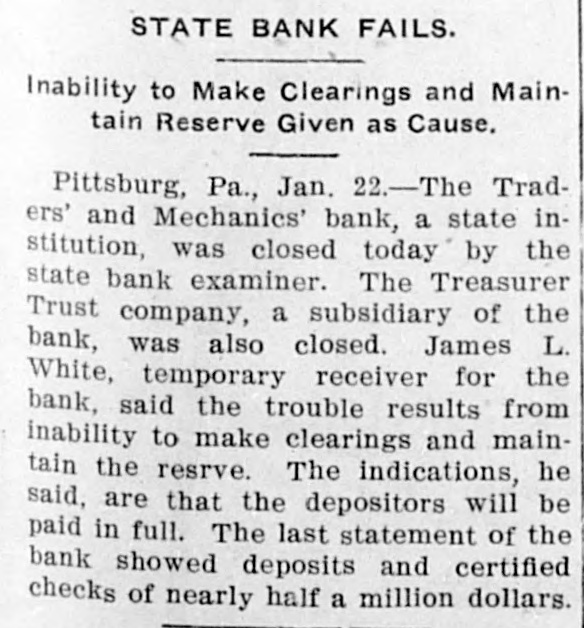
STATE BANK FAILS. Inability to Make Clearings and Maintain Reserve Given as Cause, Pittsburg, Pa., Jan. 22.-The Traders' and Mechanics' bank, a state institution, was closed today by the state bank examiner. The Treasurer Trust company, a subsidiary of the bank, was also closed. James L. White, temporary receiver for the bank, said the trouble results from inability to make clearings and maintain the resrve. The indications, he said, are that the depositors will be paid in full. The last statement of the bank showed deposits and certified checks of nearly half a million dollars.
Click image to open full size in new tab
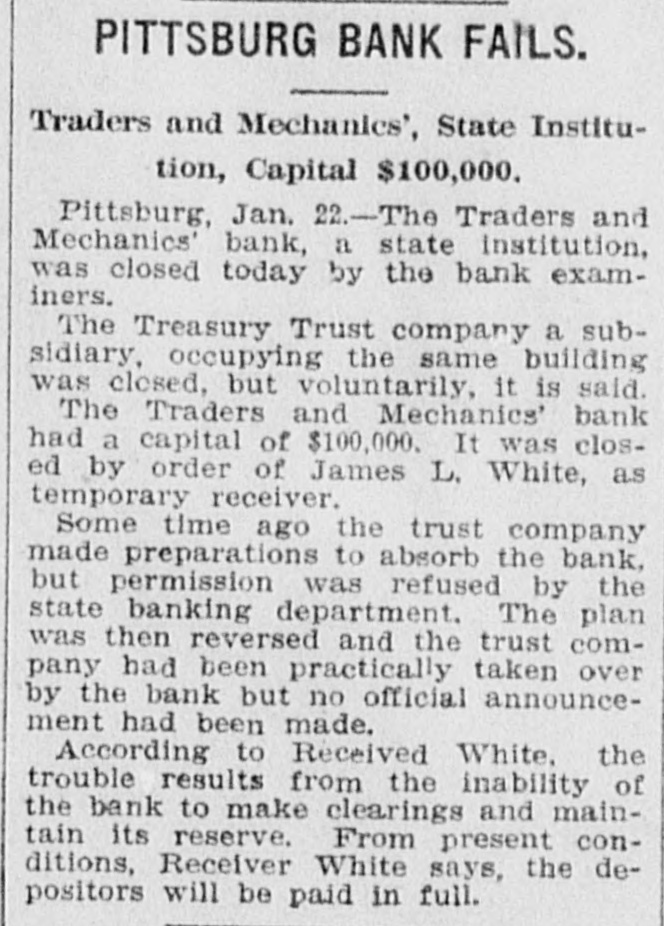
PITTSBURG BANK FAILS. Traders and Mechanics', State Institution, Capital $100,000. Pittsburg, Jan. 22-The Traders and Mechanics' bank, a state institution, was closed today by the bank examiners. The Treasury Trust company a subsidiary, occupying the same building was closed, but voluntarily, it is said. The Traders and Mechanics' bank had a capital of $100,000. It was closed by order of James L. White, as temporary receiver. Some time ago the trust company made preparations to absorb the bank, but permission was refused by the state banking department. The plan was then reversed and the trust company had been practically taken over by the bank but no official announcement had been made. According to Received White, the trouble results from the inability of the bank to make clearings and maintain its reserve. From present conditions, Receiver White says, the depositors will be paid in full.

Click image to open full size in new tab
ANOTHER BANK SUSPENDS. PITTSBURG, January 22.-The Traders and Mechanics Bank and the Treasury Trust Company have suspended. -
Click image to open full size in new tab
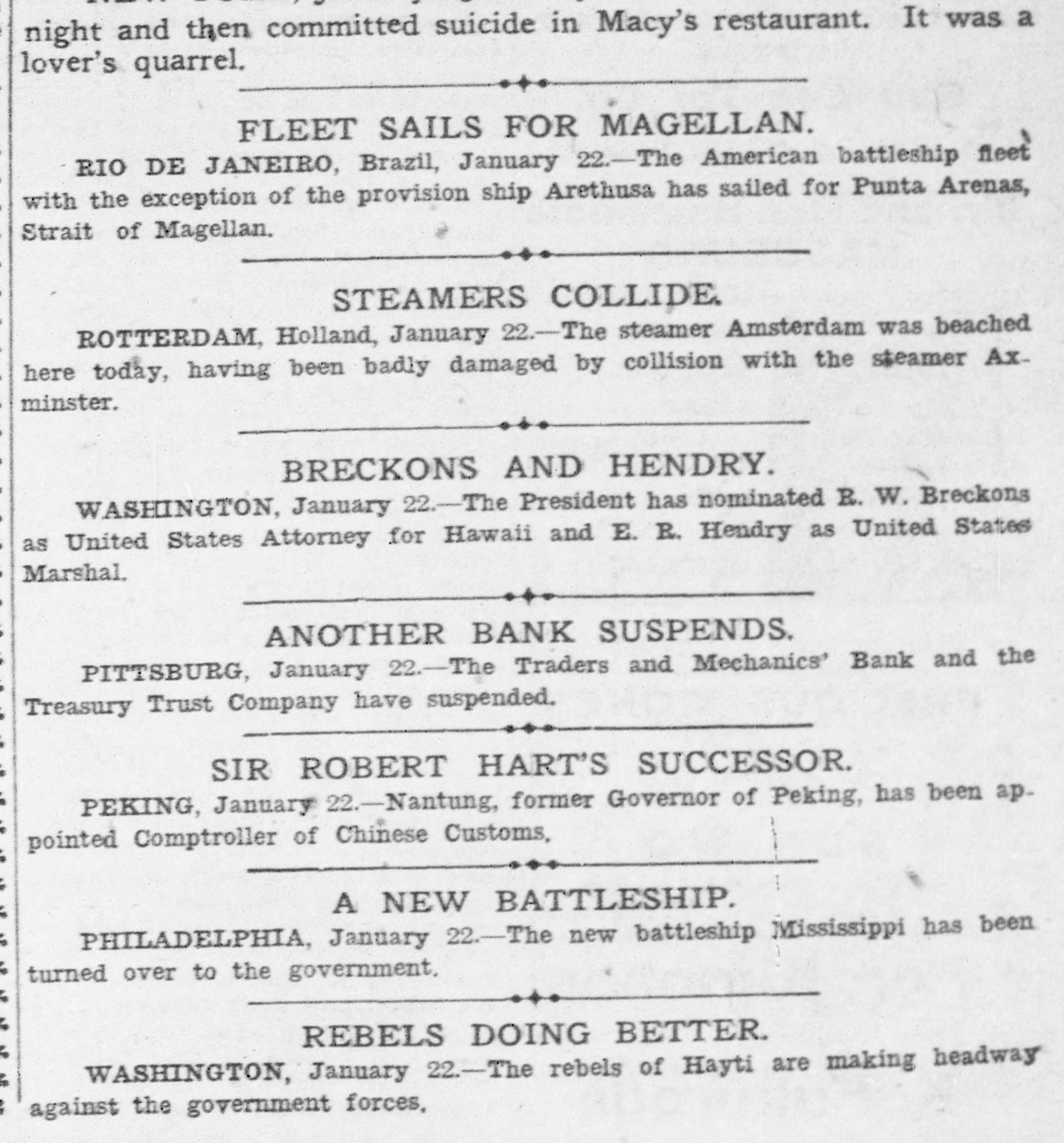
a was It night and then committed suicide in Macy's restaurant. lover's quarrel. FLEET SAILS FOR MAGELLAN. RIO DE JANEIRO, Brazil, January 22. The American battleship fleet with the exception of the provision ship Arethusa has sailed for Punta Arenas, Strait of Magellan. STEAMERS COLLIDE. ROTTERDAM, Holland, January 22.-The steamer Amsterdam was beached here today, having been badly damaged by collision with the steamer Ax minster. BRECKONS AND HENDRY. WASHINGTON, January 22.-The President has nominated R. W. Breckons as United States Attorney for Hawaii and E. R. Hendry as United States Marshal. ANOTHER BANK SUSPENDS. PITTSBURG, January 22.-The Traders and Mechanics Bank and the Treasury Trust Company have suspended. SIR ROBERT HART'S SUCCESSOR. apPEKING, January 22.-Nantung, former Governor of Peking, has been pointed Comptroller of Chinese Customs, A NEW BATTLESHIP. PHILADELPHIA, January 22.-The new battleship Mississippi has been turned over to the government. REBELS DOING BETTER. WASHINGTON, January 22.-The rebels of Hayti are making headway against the government forces,
Click image to open full size in new tab
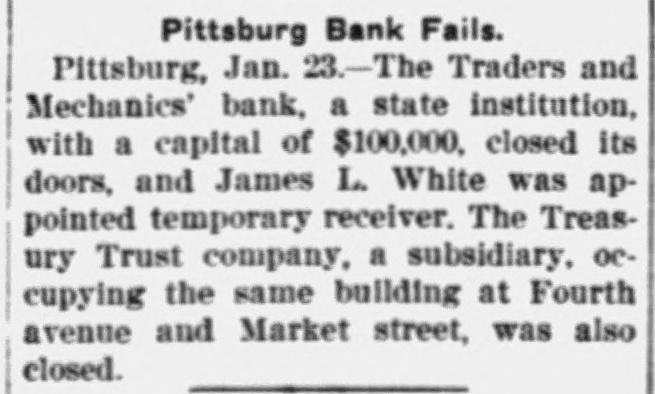
Pittsburg Bank Fails. Pittsburg, Jan. -The Traders and Mechanics' bank, a state institution, with a capital of $100,000. closed its doors, and James L. White was appointed temporary receiver. The Treasury Trust company. a subsidiary, occupying the same building at Fourth avenue and Market street, was also closed.
Click image to open full size in new tab
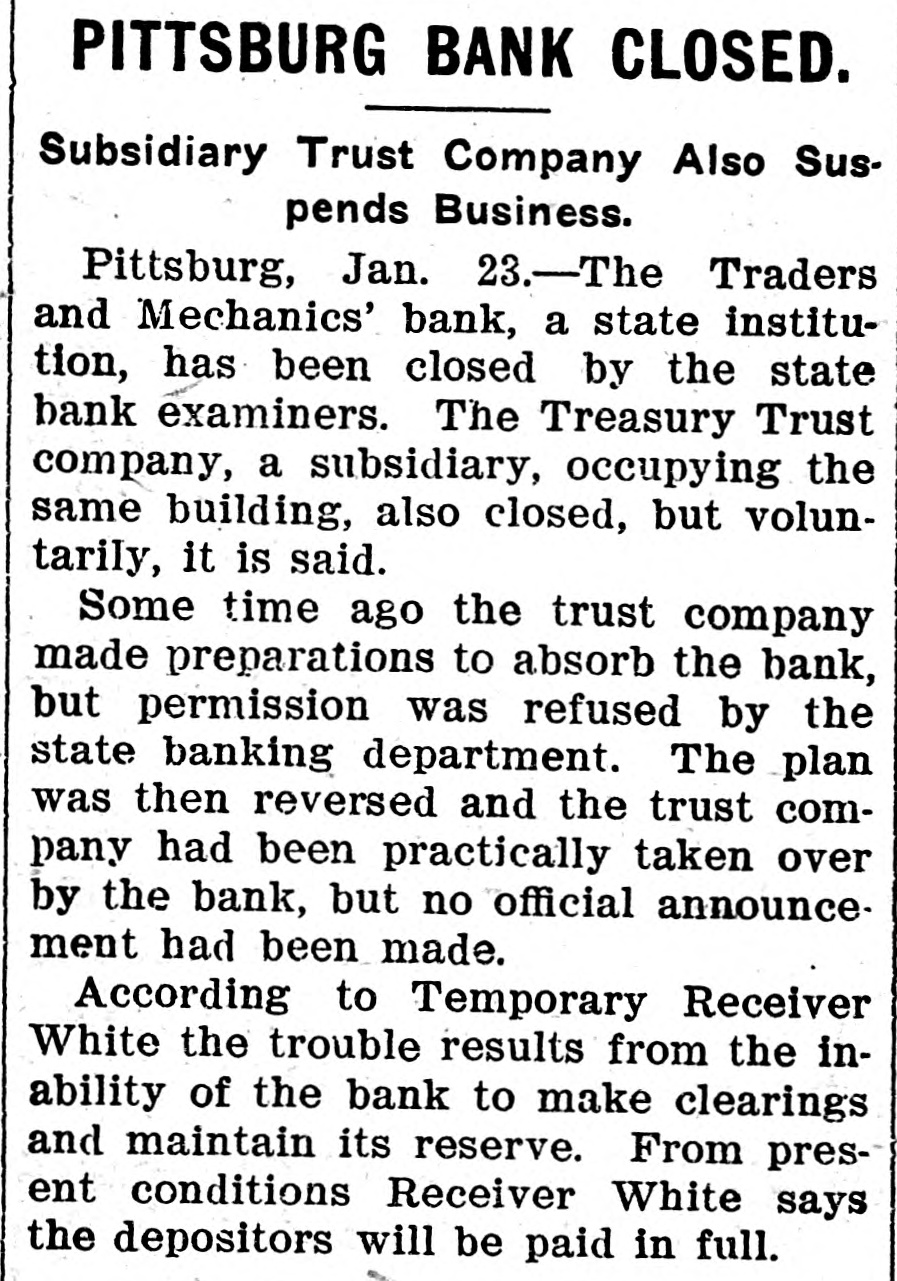
PITTSBURG BANK CLOSED. Subsidiary Trust Company Also Suspends Business. Pittsburg, Jan. 23.-The Traders and Mechanics' bank, a state institution, has been closed by the state bank examiners. The Treasury Trust company, a subsidiary, occupying the same building, also closed, but voluntarily, it is said. Some time ago the trust company made preparations to absorb the bank, but permission was refused by the state banking department. The plan was then reversed and the trust company had been practically taken over by the bank, but no official announcement had been made. According to Temporary Receiver White the trouble results from the inability of the bank to make clearings and maintain its reserve. From present conditions Receiver White says the depositors will be paid in full.
Click image to open full size in new tab
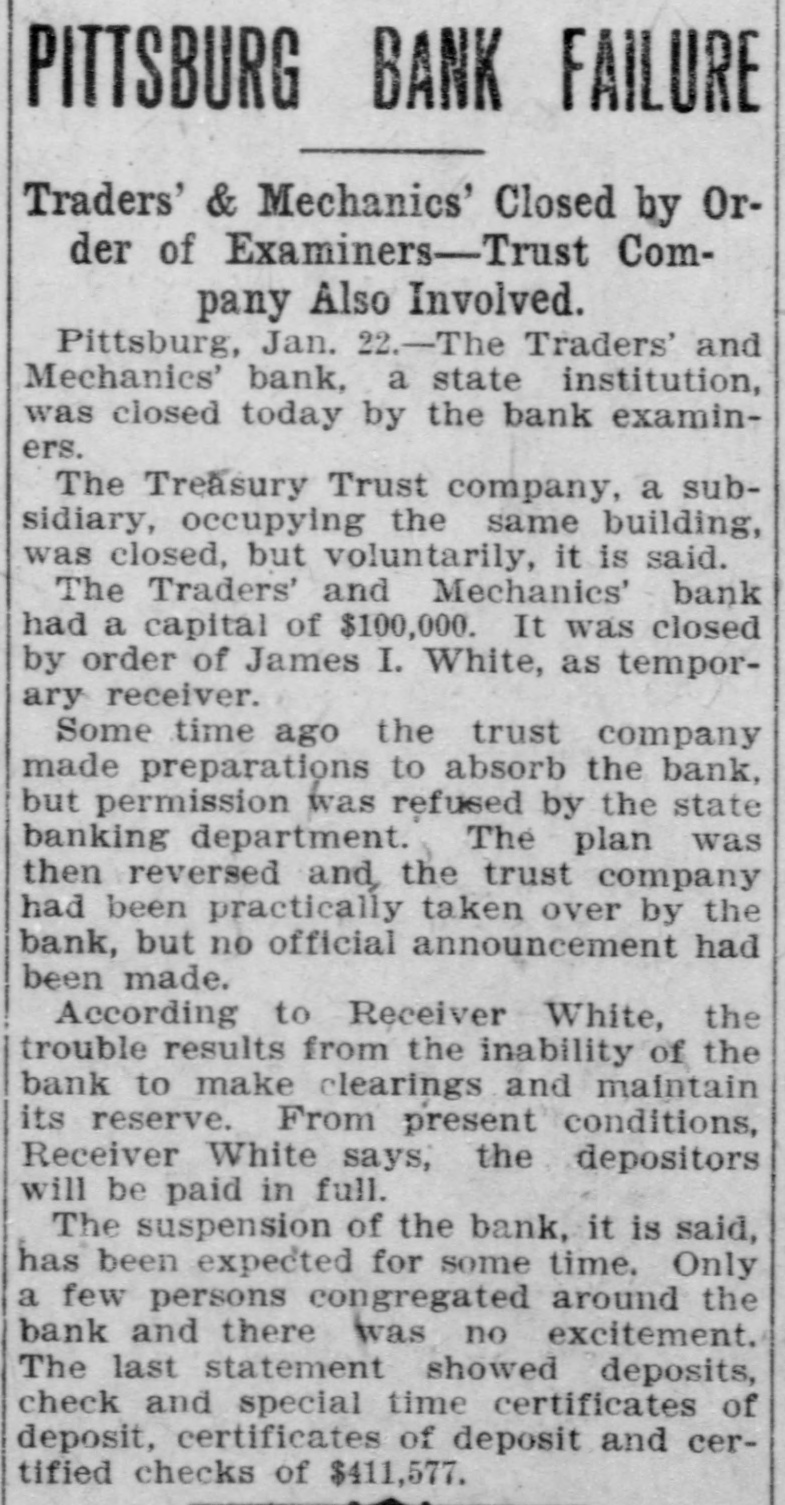
PITTSBURG BANK FAILURE Traders' & Mechanics' Closed by Order of Examiners-Trust Company Also Involved. Pittsburg, Jan. 22.-The Traders' and Mechanics' bank, a state institution, was closed today by the bank examiners. The Treasury Trust company, a subsidiary, occupying the same building, was closed, but voluntarily, it is said. The Traders' and Mechanics' bank had a capital of $100,000. It was closed by order of James I. White, as temporary receiver. Some time ago the trust company made preparations to absorb the bank, but permission was refused by the state banking department. The plan was then reversed and the trust company had been practically taken over by the bank, but no official announcement had been made. According to Receiver White, the trouble results from the inability of the bank to make clearings and maintain its reserve. From present conditions, Receiver White says, the depositors will be paid in full. The suspension of the bank, it is said, has been expected for some time. Only a few persons congregated around the bank and there was no excitement. The last statement showed deposits, check and special time certificates of deposit, certificates of deposit and certified checks of $411,577.
Click image to open full size in new tab
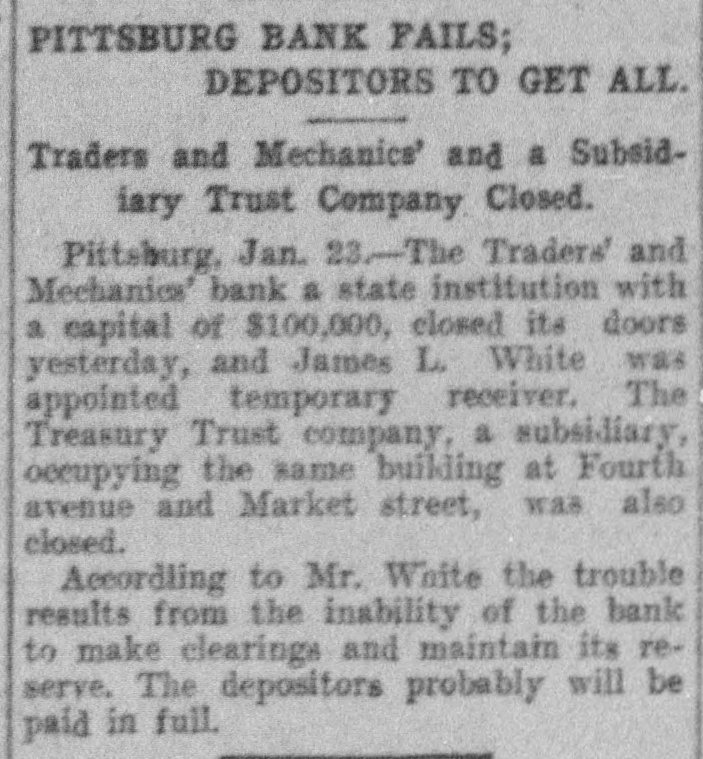
PITTSBURG BANK FAILS; DEPOSITORS TO GET ALL. Traders and Mechanics' and a Subsidiary Trust Company Closed. Pittsburg, Jan. 23.-The Traders' and Mechanics' bank a state institution with a capital of $100,000, closed its doors yesterday, and James L. White was appointed temporary receiver. The Treasury Trust company, a subsidiary, occupying the same building at Fourth avenue and Market street, was also closed. Accordling to Mr. White the trouble results from the inability of the bank to make clearings and maintain its reserve. The depositors probably will be paid in full.
Click image to open full size in new tab
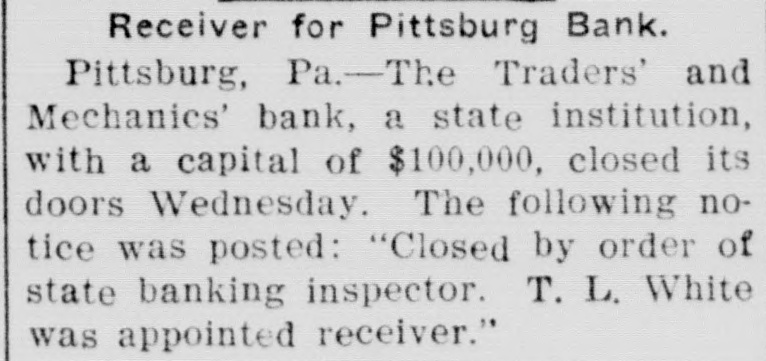
Receiver for Pittsburg Bank. Pittsburg, Pa.-The Traders' and Mechanics' bank, a state institution, with a capital of $100,000, closed its doors Wednesday. The following notice was posted: "Closed by order of state banking inspector. T. L. White was appointed receiver."
Click image to open full size in new tab
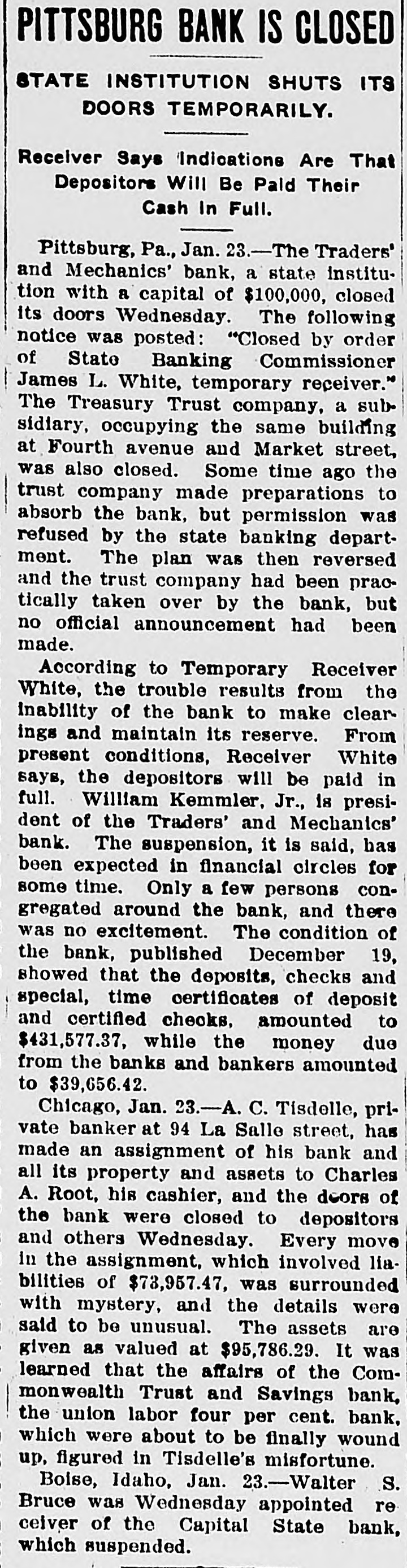
PITTSBURG BANK IS CLOSED STATE INSTITUTION SHUTS ITS DOORS TEMPORARILY. Receiver Says Indications Are That Depositors Will Be Paid Their Cash In Full. Pittsburg, Pa., Jan. 23.-The Traders' and Mechanics' bank, a state institution with a capital of $100,000, closed its doors Wednesday. The following notice was posted: "Closed by order of State Banking Commissioner James L. White, temporary receiver." The Treasury Trust company, a subsidiary, occupying the same building at Fourth avenue and Market street, was also closed. Some time ago the trust company made preparations to absorb the bank, but permission was refused by the state banking department. The plan was then reversed and the trust company had been practically taken over by the bank, but no official announcement had been made. According to Temporary Receiver White, the trouble results from the inability of the bank to make clearings and maintain its reserve. From present conditions, Receiver White says, the depositors will be paid in full. William Kemmler, Jr., is president of the Traders' and Mechanics' bank. The suspension, it is said, has been expected in financial circles for some time. Only a few persons congregated around the bank, and there was no excitement. The condition of the bank, published December 19, showed that the deposits, checks and special, time certificates of deposit and certified checks, amounted to $431,577.37, while the money due from the banks and bankers amounted to $39,656.42. Chicago, Jan. 23.-A. C. Tisdelle, private banker at 94 La Salle street, has made an assignment of his bank and all its property and assets to Charles A. Root, his cashier, and the doors of the bank were closed to depositors and others Wednesday. Every move in the assignment, which involved liabilities of $73,957.47, was surrounded with mystery, and the details were said to be unusual. The assets are given as valued at $95,786.29. It was learned that the affairs of the Commonwealth Trust and Savings bank, the union labor four per cent. bank, which were about to be finally wound up, figured in Tisdelle's misfortune. Boise, Idaho, Jan. 23.-Walter S. Bruce was Wednesday appointed re ceiver of the Capital State bank, which suspended.

Click image to open full size in new tab
by whitecaps. Fire destroyed a baggage car containing all the baggage of a party of 100 Shriners from St. Louis, Chicago and Kansas City, returning from the City of Mexico, where they had been to institute a new organization. 91 "O Canton, JO Marlier 'V Bennte thought to be lost in the mountains near Los Angeles, Cal. He has been missing since January 15. It is announced in New York that W. D. Haywood, who was acquitted on the charge of murdering ex-Gov. Steunenberg of Idaho, will be the candidate of the Socialists for president. Nils Nielson, tender of the lighthouse on the New Haven breakwater, committed suicide by cutting his throat. He had saved many lives. Mrs. Mary Roberts Clark, a manicure, shot and killed Frank Brady, a newspaper advertising man, in the restaurant in Macy's store in New York, and then committed suicide. She was enraged because Brady had left her to make a home for his aged Gov. mother. Warner of Michigan announced that former Gov. John T. Rich had accepted an appointment as state treasurer to succeed Frank P. Glazier, who To resigned. the booming of guns and the cheers of thousands on the accompanying pleasure craft, the American warships sailed from Rio Janeiro, bound for Punta Arenas. The Michigan constitutional convention committee on elections unanimously reported out a proposal granting women suffrage, with a recommendation that it be passed. Judge Phillips at Cleveland, O., in deciding the case against the Amalgamated Glass Workers' union held that the organization was in restraint of trade and ordered its dissolution on the ground of public policy. At Albuquerque, N. M., the trial of the divorce suit of Mrs. Pearl Turner against Mark C. Turner, a federal clerk, was discontinued when the court was notified by telephone that Mrs. Turner had shot and killed herself. Robert Boyd Burch of Cincinnati, member of the Junior Academic class, was elected captain of the Yale football team. The girls' dormitory of Bethany college at Bethany, W. Va., was partially destroyed by fire, a hundred girls being rescued by male students. Fire Commissioner Lantry of New York said the city's fire hose was so old and rotten they had never dared "II test 01 The secretary of the treasury announced that, owing to the great improvement in financial conditions throughout the country, he had begun the gradual withdrawal of deposits of public moneys in moderaté amounts from the national banks. The Free Methodist seminary at Wessington Springs, S. D., was destroyed by fire. The loss is $15,000. The Traders' and Mechanics' bank of Pittsburg, Pa.; the private bank of A. C. Tisdelle of Chicago, and the Citizens' bank at Beckley, W. Va., were closed. Gov. Magoon of Cuba was summoned to Washington by President Roosevelt. George R. Haynes, a judge of the Sixth judicial circuit of Ohio. died at Toledo. Arnold C. Saunders, 56 years old, a well-known coal and vessel man, died at his home in Cleveland, O., of pneumonia. Charges were filed at Charleston, W. Va., before Judge Burdette of the circuit court against Judge John S. McDonald, president of the Kanawha county court, accusing him of official misconduct, neglect of duty, habitual drunkenness and gross immorality. The Spanish minister of foreign affairs announced that the Spanish representatives in Morocco have been instructed to recognize Abd-el-Aziz as the only sovereign and that Spain regarded Mulai Hafid as a pretender. Earthquake shocks, which have caused the shutting down of the Glendon mines at Hibernia, N. J., are thought to be due to the settling of the mountain range in which the mines are situated. Socialist suffrage demonstrations in Brunswick, Germany, led to a collision with the police, in which several persons were wounded and many arrests were made. Morris J. Jessup, retired banker and long prominent in civic affairs in New York, died from heart disease. The marriage contract between Count Szechenyi and Gladys Vanderbilt provides that they shall share mutually in the proceeds of their esstates. An attempt to dynamite a loose tobacco factory at Clarksville, Tenn., resulted in the killing of two negroes by a watchman. Gov. Patterson of Tennessee commuted the death sentence of Lee Holder, aged 19, to life imprisonment. Holder, about a year ago, murdered his father. at Stamford, Conn.,
Click image to open full size in new tab
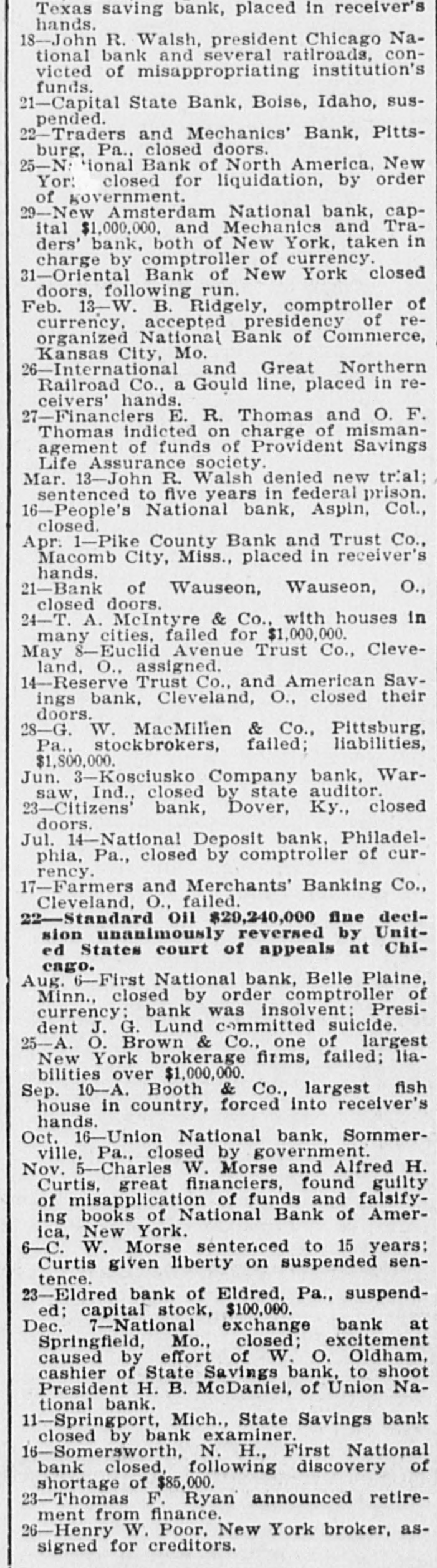
o tional bank and se railroads, convicted of msapprop aring institution's f funds. 22-Traders and Mechanics' Bank, Pittsburg, Pa. closed doors. t 25-NationalBank of North America, New York, closed for liquidation, by order of government. 29-New Amsterdam National bank, capital $1,000,000, and Mechanics and Traders' bank, both of New York, taken in charge by comptroller of currency. Feb. of 13-W. B. Ridgely, comptroller currency, accepted presidency of reorganized National Bank of Commerce, Kansas City, Mo. 27-Financiers E. R. Thomas and O. F. Thomas indicted on charge of mismanagement of funds of Provident Savings Life Assurance society. Mar. 13-John R. Walsh denied new trial; sentenced to five years in federal prison. Apr. 1-Pike County Bank and Trust Co., Macomb City, Miss., placed in receiver's hands. 24-T. A. McIntyre & Co., with houses in many cities, failed for $1,000,000. May 8-Euclid Avenue Trust Co., Cleveland, O., assigned. 14-Reserve Trust Co., and American Savings bank, Cleveland, O., closed their doors. 28-G. W. MacMillen & Co., Pittsburg, Pa., stockbrokers, failed; liabilities, $1,800,000. Jun. 3-Kosciusko Company bank, Warsaw, Ind., closed by state auditor. Jul. 14-National Deposit bank, Philadelphia, Pa., closed by comptroller of currency. 17-Farmers and Merchants' Banking Co., Cleveland, O., failed. 22-Standard Oil $29,240,000 fine decision unanimously reversed by United States court of appeals at Chicago. Aug. 6-First National bank, Belle Plaine, Minn., closed by order comptroller of currency; bank was insolvent; President J. G. Lund committed suicide. 5-A. O. Brown & Co., one of largest New York brokerage firms, failed; liabilities over $1,000,000. ep. 10-A. Booth & Co., largest fish house in country, forced into receiver's hands. OV. 5-Charles W. Morse and Alfred H. Curtis, great financiers, found guilty of misapplication of funds and falsifying books of National Bank of AmerIca, New York. -C. W. Morse sentenced to 15 years; Curtis given liberty on suspended senlence. ec. 7-National exchange bank at Springfield, Mo., closed; excitement aused by effort of W. O. Oldham, ashier of State Savings bank, to shoot President H. B. McDaniel, of Union Nadonal bank. Springport, Mich., State Savings bank losed by bank examiner. Somersworth, N. H., First National ank closed, following discovery of hortage of $85,000. Thomas F. Ryan announced retire2 ent from finance. Henry W. Poor, New York broker, as2 gned for creditors.
Click image to open full size in new tab
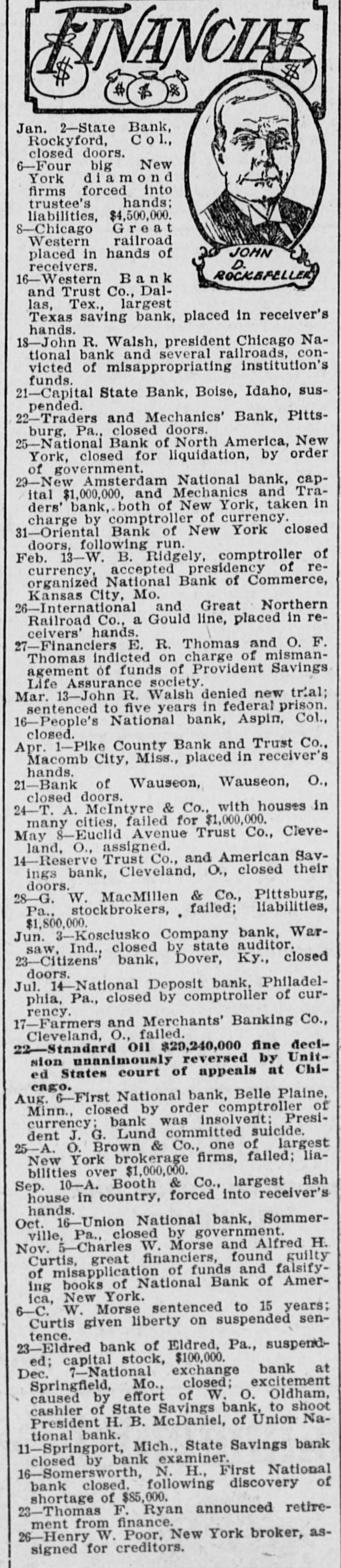
Texas saving bank, placed in receiver's hands. 18-John R. Walsh, president Chicago National bank and several railroads, convicted of misappropriating institution's funds. 21-Capital State Bank, Boise, Idaho, suspended. 22-Traders and Mechanics' Bank, Pittsburg, Pa., closed doors. 25-N: ional Bank of North America, New Yor: closed for liquidation, by order of government. 29-New Amsterdam National bank, capital $1,000,000. and Mechanics and Traders' bank, both of New York, taken in charge by comptroller of currency. 31-Oriental Bank of New York closed doors, following run. Feb. 13-W. B. Ridgely, comptroller of currency, accepted presidency of reorganized National Bank of Commerce, Kansas City, Mo. 26-International and Great Northern Railroad Co., a Gould line, placed in receivers' hands. 27-Financiers E. R. Thomas and O. F. Thomas indicted on charge of mismanagement of funds of Provident Savings Life Assurance society. Mar. 13-John R. Walsh denied new trial; sentenced to five years in federal prison. 16-People's National bank, Aspin, Col., closed. Apr: 1-Pike County Bank and Trust Co., Macomb City, Miss., placed in receiver's hands. 21-Bank of Wauseon, Wauseon, O., closed doors. 24-T. A. McIntyre & Co., with houses in many cities, failed for $1,000,000. May 8-Euclid Avenue Trust Co., Cleveland, O., assigned. 14-Reserve Trust Co., and American Savings bank, Cleveland, O., closed their doors. 28-G. W. MacMillen & Co., Pittsburg, Pa., stockbrokers, failed; liabilities, $1,800,000. Jun. 3-Kosciusko Company bank, Warsaw, Ind., closed by state auditor. 23-Citizens' bank, Dover, Ky., closed doors. Jul. 14-National Deposit bank, Philadelphia, Pa., closed by comptroller of currency. 17-Farmers and Merchants' Banking Co., Cleveland, O., failed. 22-Standard Oil $29,240,000 flue decision unanimously reversed by United States court of appeals at Chicago. Aug. 6-First National bank, Belle Plaine, Minn., closed by order comptroller of currency: bank was insolvent: President J. G. Lund committed suicide. 25-A. O. Brown & Co., one of largest New York brokerage firms, failed; liabilities over $1,000,000. Sep. 10-A. Booth & Co., largest fish house in country, forced into receiver's hands. Oct. 16-Union National bank, Sommerville, Pa., closed by government. Nov. 5-Charles W. Morse and Alfred H. Curtis, great financiers, found guilty of misapplication of funds and falsifying books of National Bank of America, New York. 6-C. W. Morse sentenced to 15 years; Curtis given liberty on suspended sentence. 23-Eldred bank of Eldred, Pa., suspended; capital stock, $100,000. Dec. 7-National exchange bank at Springfield, Mo., closed; excitement caused by effort of W. O. Oldham, cashier of State Savings bank, to shoot President H. B. McDaniel, of Union National bank. 11-Springport, Mich., State Savings bank closed by bank examiner. 16-Somersworth, N. H., First National bank closed, following discovery of shortage of $85,000. 23-Thomas F. Ryan announced retirement from finance. 26-Henry W. Poor, New York broker, assigned for creditors.
Click image to open full size in new tab
FINANCIAL Jan. 2-State Bank, Rockyford, Col., closed doors. 6-Four big New York diamond firms forced into trustee's hands; liabilities, $4,500,000. 8-Chicago Great Western railroad JOHN placed in hands of receivers. ROCKEFELLER 16-Western Bank and Trust Co., Dallas, Tex., largest Texas saving bank, placed in receiver's hands. 18-John R. Walsh, president Chicago National bank and several railroads, convicted of misappropriating institution's funds. 21-Capital State Bank, Boise, Idaho, suspended. 22-Traders and Mechanics' Bank, Pittsburg, Pa., closed doors. 25-National Bank of North America, New York, closed for liquidation, by order of government. 29-New Amsterdam National bank, capital $1,000,000, and Mechanics and Traders' bank, both of New York, taken in charge by comptroller of currency. 31-Oriental Bank of New York closed doors, following run. Feb. 13-W. B. Ridgely, comptroller of currency, accepted presidency of reorganized National Bank of Commerce, Kansas City, Mo. 26-International and Great Northern Railroad Co., a Gould line, placed in receivers' hands. 27-Financiers E. R. Thomas and O. F. Thomas indicted on charge of mismanagement of funds of Provident Savings Life Assurance society. Mar. 13-John R. Walsh denied new trial; sentenced to five years in federal prison. 16-People's National bank, Aspin, Col., closed. Apr. 1-Pike County Bank and Trust Co., Macomb City, Miss., placed in receiver's hands. 21-Bank of Wauseon, Wauseon, O., closed doors. 24-T. A. McIntyre & Co., with houses in many cities, failed for $1,000,000. May 8-Euclid Avenue Trust Co., Cleveland, O., assigned. 14-Reserve Trust Co., and American Savings bank, Cleveland, O., closed their doors. 28-G. W. MacMillen & Co., Pittsburg, Pa., stockbrokers, failed; liabilities, Jun. $1,800,000. 3-Kosciusko Company bank, Warsaw, Ind., closed by state auditor. 23-Citizens' bank, Dover, Ky., closed Jul. doors. -National Deposit bank, Philadelphia, Pa., closed by comptroller of cur17-Farmers rency. and Merchants' Banking Co., Cleveland, O., failed. 22-Standard Oil $29,240,000 fine dectsion unanimously reversed by United States court of appeals at ChiAug. engo. 6-First National bank, Belle Plaine, Minn., closed by order comptroller of currency; bank was insolvent; President J. G. Lund committed suicide. 25-A. O. Brown & Co., one of largest New York brokerage firms, failed; liabilities over $1,000,000. Sep. 10-A. Booth & Co., largest fish house in country, forced into receiver's Oct. hands. 16-Union National bank, Sommerville, Pa., closed by government. Nov. 5-Charles W. Morse and Alfred H. Curtis, great financiers, found guilty of misapplication of funds and falsifying books of National Bank of America, New York. 6-C. W. Morse sentenced to 15 years; Curtis given liberty on suspended sen23-Eldred tence. bank of Eldred, Pa., suspended; capital stock, $100,000. Dec. 7-National exchange bank at Springfield, Mo., closed; excitement caused by effort of W. O. Oldham, cashier of State Savings bank, to shoot President H. B. McDaniel, of Union National bank. 11-Springport, Mich., State Savings bank closed by bank examiner. 16-Somersworth, N. H., First National bank closed, following discovery of shortage of $85,000. 23-Thomas F. Ryan announced retirement from finance. 26-Henry W. Poor, New York broker, assigned for creditors.
Click image to open full size in new tab
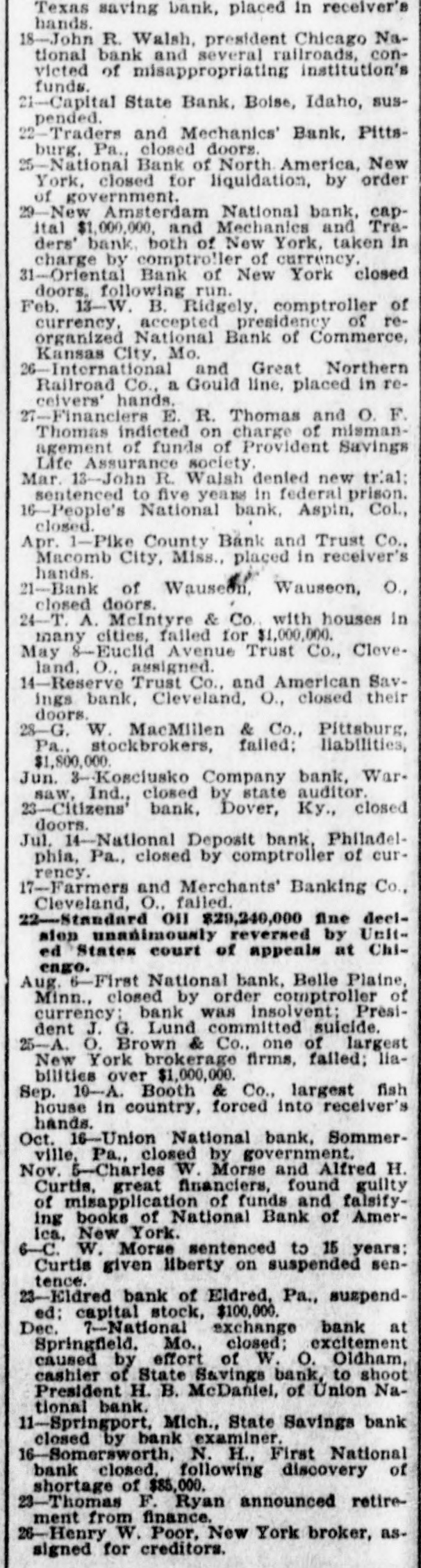
Texas saving bank, placed in receiver's hands. 18-John R. Walsh, president Chicago National bank and several railroads, convicted of misappropriating institution's funds. 21-Capital State Bank, Boise, Idaho, suspended. 22-Traders and Mechanics' Bank, Pittsburg. Pa., closed doors. 25-National Bank of North America, New York, closed for liquidation, by order of government. 29-New Amsterdam National bank, capital $1,000,000, and Mechanics and Traders' bank. both of New York, taken in charge by comptroller of currency. 31-Oriental Bank of New York closed doors. following run. Feb. 13-W. B. Ridgely, comptroller of currency, accepted presidency of reorganized National Bank of Commerce, Kansas City, Mo. 26-International and Great Northern Railroad Co., a Gould line, placed in receivers' hands. 27-Financiers E. R. Thomas and O. F. Thomas indicted on charge of mismanagement of funds of Provident Savings Life Assurance society. Mar. 13-John R. Walsh denied new trial: sentenced to five years in federal prison. 16-People's National bank, Aspin, Col., closed. Apr. 1-Pike County Bank and Trust Co., Macomb City, Miss., placed in receiver's hands. 21-Bank of Wauseon, Wauseon, O., closed doors. 24-T. A. McIntyre & Co., with houses in many cities, falled for $1,000,000. May 8-Euclid Avenue Trust Co., Cleveland. O., assigned. 14-Reserve Trust Co., and American Savings bank, Cleveland, O., closed their doors. 28-G. W. MacMillen & Co., Pittsburg, Pa., stockbrokers, failed: liabilities, $1,800,000. Jun. 3-Kosclusko Company bank, Warsaw, Ind., closed by state auditor. 23-Citizens' bank, Dover, Ky., closed doors. Jul. 14-National Deposit bank, Philadelphia, Pa., closed by comptroller of currency. 17-Farmers and Merchants' Banking Co., Cleveland, O., failed. 22-Standard on $29,240,000 fine declstep unanimously reversed by United States court of appeals at Chiengo. Aug. 6-First National bank, Belle Plaine, Minn., closed by order comptroller of currency: bank was insolvent: President J. G. Lund committed suicide. 25-A. O. Brown & Co., one of largest New York brokerage firms, failed; liabilities over $1,000,000. Sep. 10-A. Booth & Co., largest fish house in country, forced into receiver's hands. Oct. 16-Union National bank, Sommerville, Pa., closed by government. Nov. 5-Charles W. Morse and Alfred H. Curtis, great financiers, found guilty of misapplication of funds and falsifying books of National Bank of America, New York. 6-C. W. Morse sentenced to 15 years: Curtis given liberty on suspended sentence. 23-Eldred bank of Eldred, Pa., suspended: capital stock, $100,000. Dec. 7-National exchange bank at Springfield. Mo., closed; excitement caused by effort of W. O. Oldham, cashier of State Savings bank, to shoot President H. B. McDaniel, of Union National bank. 11-Springport, Mich., State Savings bank closed by bank examiner. 16-Somersworth, N. H., First National bank closed, following discovery of shortage of $85,000. 23-Thomas F. Ryan announced retirement from finance. 26-Henry W. Poor. New York broker, assigned for creditors.
Click image to open full size in new tab
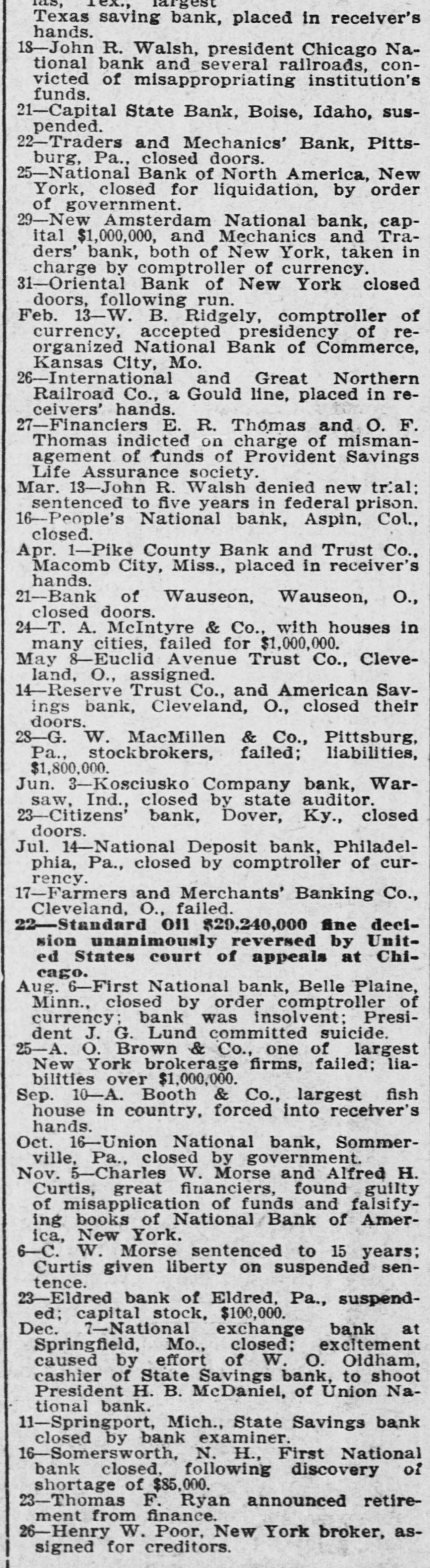
Texas saving bank, placed in receiver's hands. 18-John R. Walsh, president Chicago National bank and several railroads, convicted of misappropriating institution's funds. 21-Capital State Bank, Boise, Idaho, suspended. 22-Traders and Mechanics' Bank, Pittsburg, Pa., closed doors. 25-National Bank of North America, New York, closed for liquidation, by order of government. 29-New Amsterdam National bank, capital $1,000,000, and Mechanics and Traders' bank, both of New York, taken in charge by comptroller of currency. 31-Oriental Bank of New York closed doors, following run. Feb. 13-W. B. Ridgely, comptroller of currency, accepted presidency of reorganized National Bank of Commerce, Kansas City, Mo. 26-International and Great Northern Railroad Co., a Gould line, placed in receivers' hands. 27-Financiers E. R. Thomas and O. F. Thomas indicted on charge of mismanagement of funds of Provident Savings Life Assurance society. Mar. 13-John R. Walsh denied new tr:al; sentenced to five years in federal prison. 16-People's National bank, Aspin, Col., closed. Apr. 1-Pike County Bank and Trust Co., Macomb City, Miss., placed in receiver's hands. 21-Bank of Wauseon, Wauseon, O., closed doors. 24-T. A. McIntyre & Co., with houses in many cities, failed for $1,000,000. May 8-Euclid Avenue Trust Co., Cleveland, O., assigned. 14-Reserve Trust Co., and American Savings bank, Cleveland, O., closed their doors. 28-G. W. MacMillen & Co., Pittsburg, Pa., stockbrokers, failed; liabilities, $1,800,000. Jun. 3-Kosciusko Company bank, Warsaw, Ind., closed by state auditor. 23-Citizens' bank, Dover, Ky., closed doors. Jul. 14-National Deposit bank, Philadelphia, Pa., closed by comptroller of currency. 17-Farmers and Merchants' Banking Co., Cleveland, O., failed. 22-Standard on $29,240,000 fine decision unanimously reversed by United States court of appeals at Chicago. Aug. 6-First National bank, Belle Plaine, Minn., closed by order comptroller of currency; bank was insolvent: President J. G. Lund committed suicide. 25-A. O. Brown & Co., one of largest New York brokerage firms, failed; liabilities over $1,000,000. Sep. 10-A. Booth & Co., largest fish house in country, forced into receiver's hands. Oct. 16-Union National bank, Sommerville, Pa., closed by government. Nov. 5-Charles W. Morse and Alfred H. Curtis, great financiers, found guilty of misapplication of funds and falsifying books of National Bank of America, New York. 6-C. W. Morse sentenced to 15 years; Curtis given liberty on suspended sentence. 23-Eldred bank of Eldred, Pa., suspended; capital stock, $100,000. Dec. 7-National exchange bank at Springfield, Mo., closed: excitement caused by effort of W. O. Oldham, cashier of State Savings bank, to shoot President H. B. McDaniel, of Union National bank. 11-Springport, Mich., State Savings bank closed by bank examiner. 16-Somersworth, N. H., First National bank closed. following discovery of shortage of $85,000. 23-Thomas F. Ryan announced retirement from finance. 26-Henry W. Poor, New York broker, assigned for creditors.