16774. State Bank (Pittsburg, PA)

Bank Information

Episode Type
Suspension → Closure
Bank Type
state
Start Date
February 13, 1904
Location
Pittsburg, Pennsylvania (40.441, -79.996)

Metadata

Model
gpt-5-mini
Short Digest
dd7bb873929af2c8

Response Measures

None

Description

Articles report the State Bank of Pittsburg, Pa., suspended/closed in Feb 1904 and placed in the hands of a receiver. Causes cited are injudicious loans/insolvency. No article describes a depositor run; therefore classified as suspension followed by closure/receivership.

Events (3)

1. February 13, 1904 Receivership
Newspaper Excerpt
The state bank examiner is temporarily in charge. ... a national bank examiner has been appointed receiver. John F. Steele, receiver of the bank ... was said to have urged the arrest of the entire directorate. (articles Feb–Aug 1904).
Source
newspapers
2. February 13, 1904 Suspension
Cause
Bank Specific Adverse Info
Cause Details
Injudicious loans and insolvency led directors/state examiner to close the bank; statements indicate liabilities exceeded assets.
Newspaper Excerpt
PITTSBURG BANK IS OUT OF BUSINESS Pittsburg, Pa., Feb. 13.-The State Bank of Pittsburg ... was closed today by order of the state banking department.
Source
newspapers
3. August 11, 1904 Other
Newspaper Excerpt
WARRANT FOR BANKERS ... directors of the State Bank of Pittsburg, which failed last February. The warrants were issued ... charging that this bank had accepted deposits after it was known that it was insolvent. (Aug 11, 1904).
Source
newspapers

Newspaper Articles (6)

Article from The Salt Lake Herald, February 14, 1904

Click image to open full size in new tab

Article Text

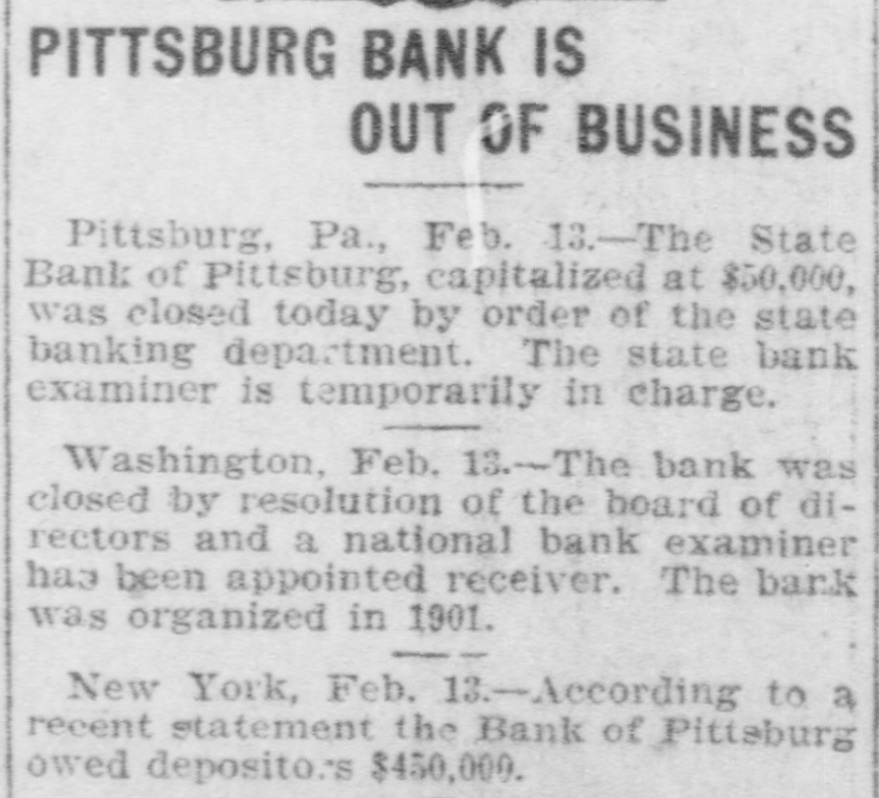
PITTSBURG BANK IS OUT OF BUSINESS Pittsburg, Pa., Feb. 13.-The State Bank of Pittsburg, capitalized at $50,000, was closed today by order of the state banking department. The state bank examiner is temporarily in charge. Washington, Feb. 13.-The bank was closed by resolution of the board of directors and a national bank examiner has been appointed receiver. The bank was organized in 1901. New York, Feb. 13.-According to a recent statement the Bank of Pittsburg owed depositors $450,000.


Article from The Newark Journal, February 19, 1904

Click image to open full size in new tab

Article Text

ent war. Many Japanese in the United States navy have deserted to fight for their country. Missouri democrats are working for Senator Cockrell for the presidential nomination. The State Bank of Pittsburg, Pa., has suspended. Injudicious loans caused the failure. Russian officials at St. Petersburg regard the attitude of the United States as distinctly anti-Russian. It is possible Russia wil labandon her world's fair exhibit at St. Louis in case the war with Japan is not speedily settled. The press of Turkev is urging the government to take advantage of the war in the far east to declare war on Bulgaria with the object of recovering southern Roumania. Fire at Topeka, Kas., destroyed $400,000 worth of property in the business section. The fire started by an explosion of chemicals in the Parkhurst-Davis Mercantile Company's building. The position of the German government respecting the Russo-Japanese war is well defined in a proclamation issued by the imperial chancellor, Count von Buelow. It is exact neutrality in act, but in sentiment it is sympathetic toward Russian predominance in China rather than Japanese predominance there. Since hostilities began in the far east the Japs seem to have been victorious in every engagement, though the news in conflicting as to the extent of damage done. It is known that seven Russian vessels have been put out of action and that several Russian transports have been captured, but the number casualties has not been officially verified. Japan has gained a big advantage in the war with Russia through victorious in the first naval battles. The defeat of Russia on the sea will doubtless mean her defeat on land, as she would be practically without means of transporting supplies to her troops in Manchuria. Russia's only line of communication with her troops is the Siberian railroad, some 4,000 miles long, which can be easily destroyed. Gen. Reyes, president of Colombia, has gone to Germany on a secret mission. It is believed he will offer Germany a large slice of Colombian territory in return for her help in regaining Panama. For the elected president of a country to act as his own envoy and personally visit the ruler of another nation with the object of asking her to intercede with a third power is a most astonishing spectacle, say diplomats. William Rudolph, who with George Collins robbed the bank at Union, Mo., December 26, 1902, been later term effect sensational Louis in killed sentenced his jail the arrest, in escape Kansas an broad officer to and from penitentiary an daylight, then who indefinite made the tried has St. for to a safe robbory. Rudolph was sentenced under the name of Albert Goryo. A Kansas pardon will be asked for Rudolph at once, that he may be taken to Missouri on a requisition and tried for murder and bank robbery. W. W. Wentz, Jr., has been succeeded as general of


Article from Evening Times-Republican, August 11, 1904

Click image to open full size in new tab

Article Text

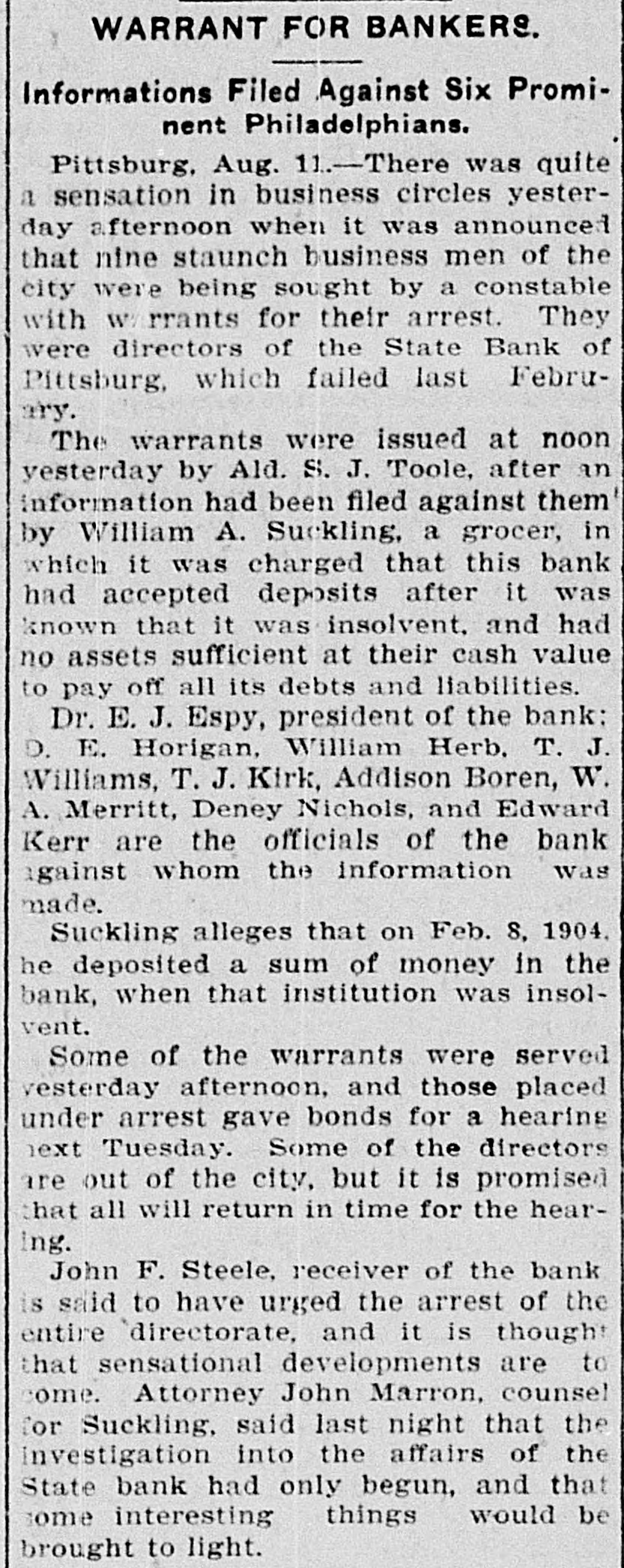
WARRANT FOR BANKERS. Informations Filed Against Six Prominent Philadelphians. Pittsburg, Aug. 11.-There was quite a sensation in business circles yesterday afternoon when it was announced that nine staunch business men of the city were being sought by a constable with W rrants for their arrest. They were directors of the State Bank of Pittsburg, which failed last February. The warrants were issued at noon yesterday by Ald. S. J. Toole, after an information had been filed against them by William A. Suckling, a grocer, in which it was charged that this bank had accepted deposits after it was known that it was insolvent, and had no assets sufficient at their cash value to pay off all its debts and liabilities. Dr. E. J. Espy, president of the bank: D. E. Horigan, William Herb. T. J. Williams, T. J. Kirk, Addison Boren, W. A. Merritt, Deney Nichols, and Edward Kerr are the officials of the bank against whom the information was made. Suckling alleges that on Feb. 8, 1904. he deposited a sum of money in the bank, when that institution was insolvent. Some of the warrants were served vesterday afternoon, and those placed under arrest gave bonds for a hearing next Tuesday. Some of the directors are out of the city, but it is promised that all will return in time for the hearing. John F. Steele, receiver of the bank is said to have urged the arrest of the entire `directorate, and it is though! that sensational developments are to come. Attorney John Marron, counsel for Suckling, said last night that the investigation into the affairs of the State bank had only begun, and that some interesting things would be brought to light.


Article from The Cairo Bulletin, March 28, 1908

Click image to open full size in new tab

Article Text

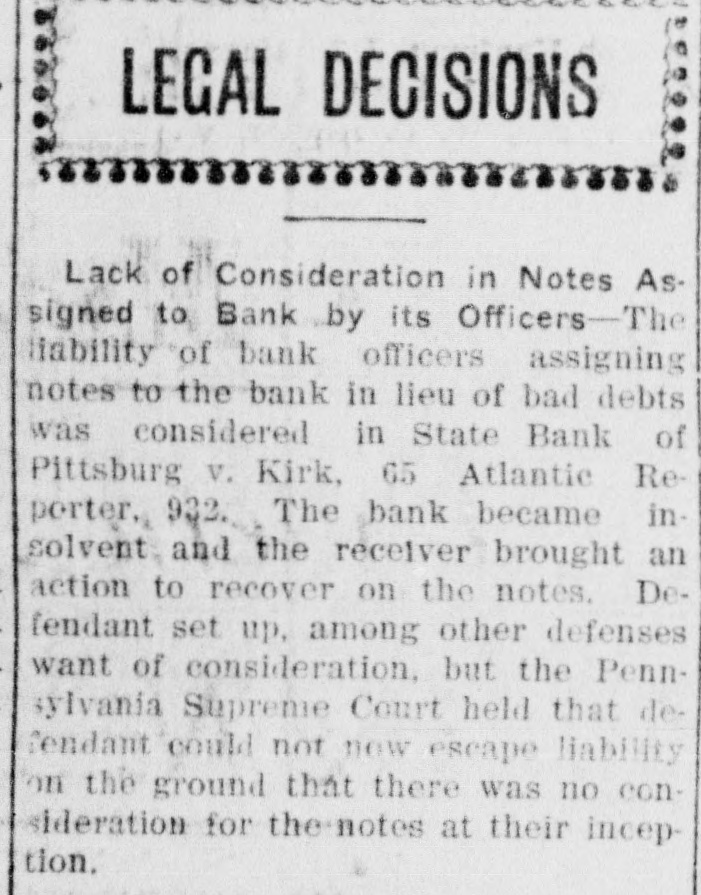
# LEGAL DECISIONS Lack of Consideration in Notes Assigned to Bank by its Officers—The liability of bank officers assigning notes to the bank in lieu of bad debts was considered in State Bank of Pittsburg v. Kirk, 65 Atlantic Reporter, 932. The bank became insolvent, and the receiver brought an action to recover on the notes. Defendant set up, among other defenses want of consideration, but the Pennsylvania Supreme Court held that defendant could not now escape liability on the ground that there was no consideration for the notes at their inception.


Article from The San Juan Islander, December 26, 1908

Click image to open full size in new tab

Article Text

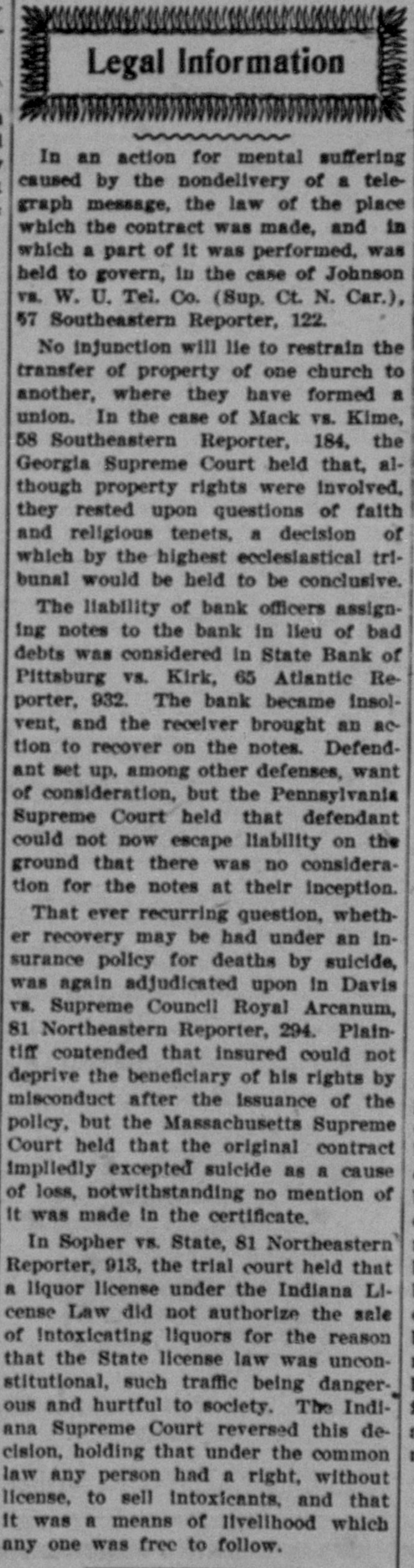
Legal Information In an action for mental suffering caused by the nondelivery of a telegraph message, the law of the place which the contract was made, and in which a part of it was performed, was held to govern, in the case of Johnson vs. W. U. Tel. Co. (Sup. Ct. N. Car.), 57 Southeastern Reporter, 122. No injunction will lie to restrain the transfer of property of one church to another, where they have formed a union. In the case of Mack vs. Kime, 58 Southeastern Reporter, 184, the Georgia Supreme Court held that, although property rights were involved, they rested upon questions of faith and religious tenets, a decision of which by the highest ecclesiastical tribunal would be held to be conclusive. The liability of bank officers assigning notes to the bank in lieu of bad debts was considered in State Bank of Pittsburg vs. Kirk, 65 Atlantic Reporter, 932. The bank became insolvent, and the receiver brought an action to recover on the notes. Defendant set up, among other defenses, want of consideration, but the Pennsylvania Supreme Court held that defendant could not now escape liability on the ground that there was no consideration for the notes at their inception. That ever recurring question, whether recovery may be had under an insurance policy for deaths by suicide, was again adjudicated upon in Davis vs. Supreme Council Royal Arcanum, 81 Northeastern Reporter, 294. Plaintiff contended that insured could not deprive the beneficiary of his rights by misconduct after the issuance of the policy, but the Massachusetts Supreme Court held that the original contract impliedly excepted suicide as a cause of loss, notwithstanding no mention of it was made in the certificate. In Sopher vs. State, 81 Northeastern Reporter, 913, the trial court held that a liquor license under the Indiana License Law did not authorize the sale of intoxicating liquors for the reason that the State license law was unconstitutional, such traffic being dangerous and hurtful to society. The Indiana Supreme Court reversed this decision, holding that under the common law any person had a right, without license, to sell intoxicants, and that it was a means of livelihood which any one was free to follow.

Article from The Nezperce Herald, January 21, 1909

Click image to open full size in new tab

Article Text

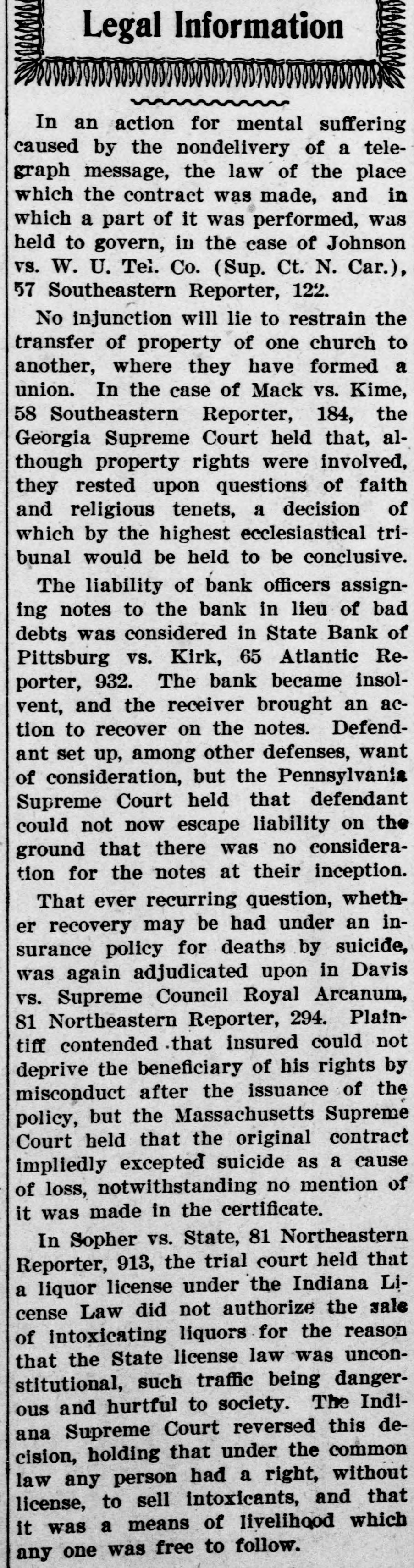
# Legal Information In an action for mental suffering caused by the nondelivery of a telegraph message, the law of the place which the contract was made, and in which a part of it was performed, was held to govern, in the case of Johnson vs. W. U. Tel. Co. (Sup. Ct. N. Car.), 57 Southeastern Reporter, 122. No injunction will lie to restrain the transfer of property of one church to another, where they have formed a union. In the case of Mack vs. Kime, 58 Southeastern Reporter, 184, the Georgia Supreme Court held that, although property rights were involved, they rested upon questions of faith and religious tenets, a decision of which by the highest ecclesiastical tribunal would be held to be conclusive. The liability of bank officers assigning notes to the bank in lieu of bad debts was considered in State Bank of Pittsburg vs. Kirk, 65 Atlantic Reporter, 932. The bank became insolvent, and the receiver brought an action to recover on the notes. Defendant set up, among other defenses, want of consideration, but the Pennsylvania Supreme Court held that defendant could not now escape liability on the ground that there was no consideration for the notes at their inception. That ever recurring question, whether recovery may be had under an insurance policy for deaths by suicide, was again adjudicated upon in Davis vs. Supreme Council Royal Arcanum, 81 Northeastern Reporter, 294. Plaintiff contended that insured could not deprive the beneficiary of his rights by misconduct after the issuance of the policy, but the Massachusetts Supreme Court held that the original contract impliedly excepted suicide as a cause of loss, notwithstanding no mention of it was made in the certificate. In Sopher vs. State, 81 Northeastern Reporter, 913, the trial court held that a liquor license under the Indiana License Law did not authorize the sale of intoxicating liquors for the reason that the State license law was unconstitutional, such traffic being dangerous and hurtful to society. The Indiana Supreme Court reversed this decision, holding that under the common law any person had a right, without license, to sell intoxicants, and that it was a means of livelihood which any one was free to follow.