The bank was closed by order of the Pennsylvania banking department on Dec 22, 1915 and a state-appointed receiver took charge. Articles mention a prior run in 1913 but the December 1915 action is a suspension by government order leading to receivership and liquidation; the institution did not reopen as a going concern (receivership/dividends followed). OCR variations of 'Pittsburg' appear in sources; I preserved the provided bank name.
Events (2)
1.December 22, 1915Receivership
Newspaper Excerpt
G. H. Getty, bank examiner, has been appointed temporary receiver; Representatives of the state department of banking took charge of the affairs of the Pittsburgh Bank for Savings, which failed to open this morning.
Source
newspapers
2.December 22, 1915Suspension
Cause
Government Action
Cause Details
Closed by order of the Pennsylvania banking department after depreciation of securities (Kuhn securities) made assets inadequate; state moved to conserve assets for depositors.
Newspaper Excerpt
tacked to the front door at 9 o'clock was a notice which said that it had been closed by order of the Pennsylvania banking department
Source
newspapers
Newspaper Articles (22)
1.December 22, 1915The Washington TimesWashington, DC
Click image to open full size in new tab
Article Text
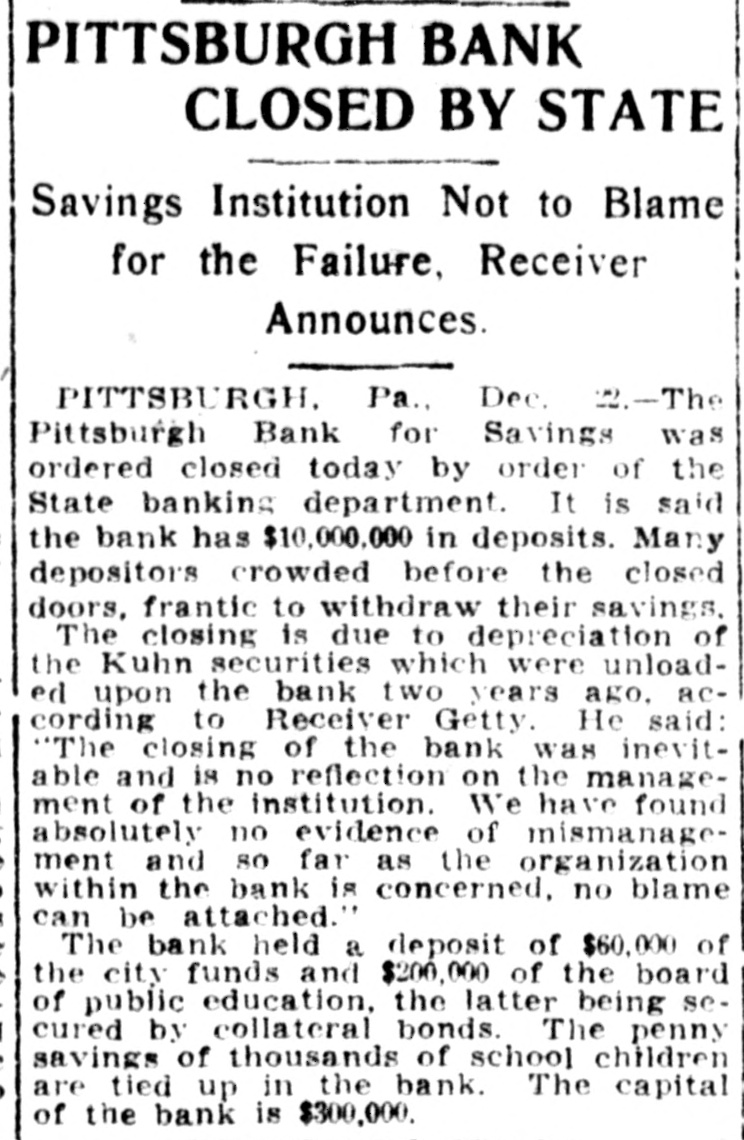
PITTSBURGH BANK CLOSED BY STATE Savings Institution Not to Blame for the Failure, Receiver Announces. PITTSBURGH. Pa., Dec. 2.-The Pittsburgh Bank for Savings was ordered closed today by order of the State banking department. It is said the bank has $10,000,000 in deposits. Many depositors crowded before the closed doors, frantic to withdraw their savings. The closing is due to depreciation of the Kuhn securities which were unloaded upon the bank two years ago. according to Receiver Getty. He said: "The closing of the bank was inevitable and is no reflection on the management of the institution. We have found absolutely no evidence of mismanagement and so far as the organization within the bank is concerned, no blame can be attached." The bank held a deposit of $60,000 of the city funds and $200,000 of the board of public education, the latter being secured by collateral bonds. The penny savings of thousands of school children are tied up in the bank. The capital of the bank is $300,000.
2.December 22, 1915The Topeka State JournalTopeka, KS
Click image to open full size in new tab
Article Text
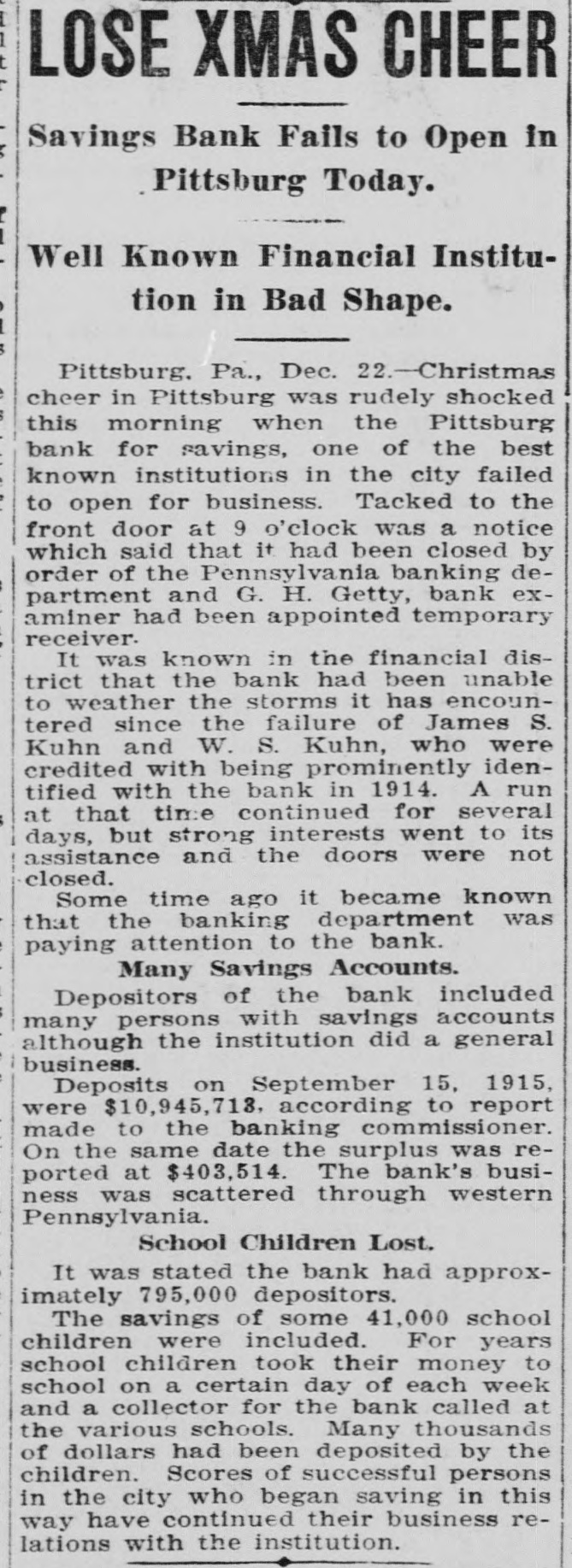
LOSE XMAS CHEER Savings Bank Fails to Open in Pittsburg Today. Well Known Financial Institution in Bad Shape. Pittsburg. Pa., Dec. 22.-Christmas cheer in Pittsburg was rudely shocked this morning when the Pittsburg bank for savings, one of the best known institutions in the city failed to open for business. Tacked to the front door at 9 o'clock was a notice which said that it had been closed by order of the Pennsylvania banking department and G. H. Getty, bank examiner had been appointed temporary receiver. It was known in the financial district that the bank had been unable to weather the storms it has encountered since the failure of James S. Kuhn and W. S. Kuhn, who were credited with being prominently identified with the bank in 1914. A run at that time continued for several days, but strong interests went to its assistance and the doors were not closed. Some time ago it became known that the banking department was paying attention to the bank. Many Savings Accounts. Depositors of the bank included many persons with savings accounts although the institution did a general business. Deposits on September 15, 1915, were $10,945,713, according to report made to the banking commissioner. On the same date the surplus was reported at $403,514. The bank's business was scattered through western Pennsylvania. School Children Lost. It was stated the bank had approximately 795,000 depositors. The savings of some 41,000 school children were included. For years school children took their money to school on a certain day of each week and a collector for the bank called at the various schools. Many thousands of dollars had been deposited by the children. Scores of successful persons in the city who began saving in this way have continued their business relations with the institution.
3.December 22, 1915The Fargo Forum and Daily RepublicanFargo, ND
Click image to open full size in new tab
Article Text
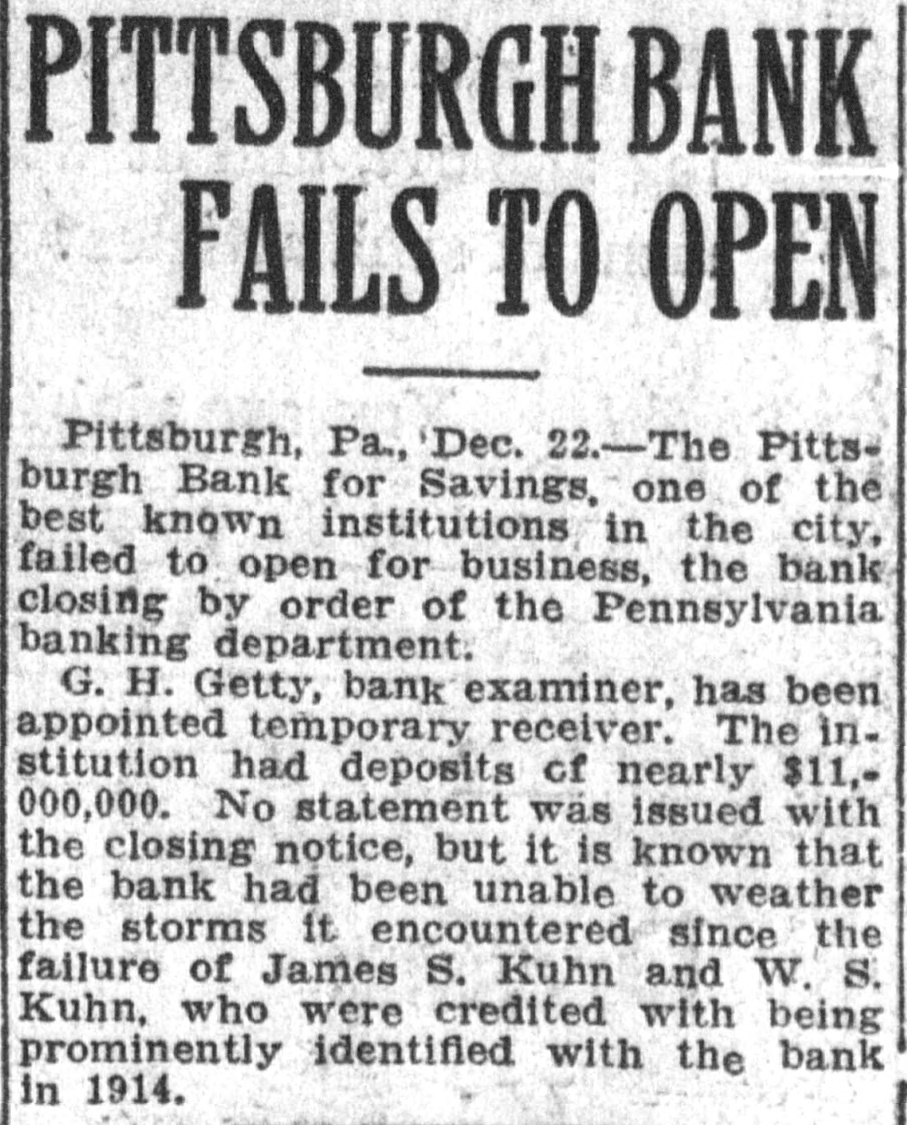
PITTSBURGH BANK FAILS TO OPEN Pittsburgh, Pa., Dec. 22.-The Pittsburgh Bank for Savings, one of the best known institutions in the city, failed to open for business, the bank closing by order of the Pennsylvania banking department. G. H. Getty, bank examiner, has been appointed temporary receiver. The institution had deposits of nearly $11,000,000. No statement was issued with the closing notice, but it is known that the bank had been unable to weather the storms it encountered since the failure of James S. Kuhn and W. S. Kuhn, who were credited with being prominently identified with the bank in 1914.
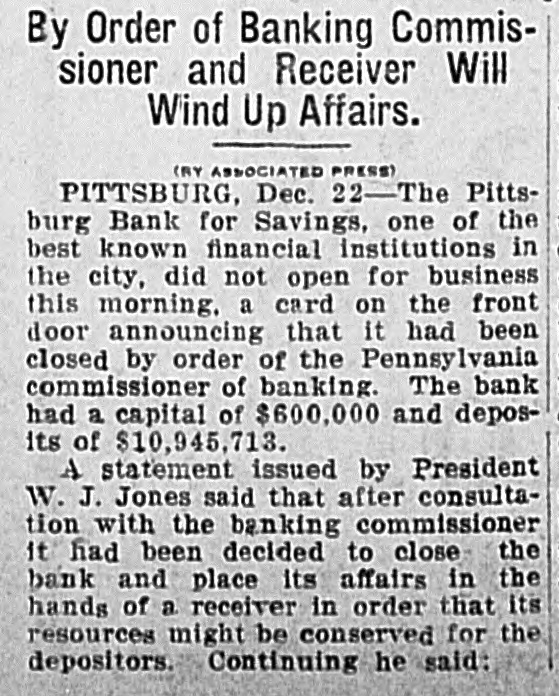
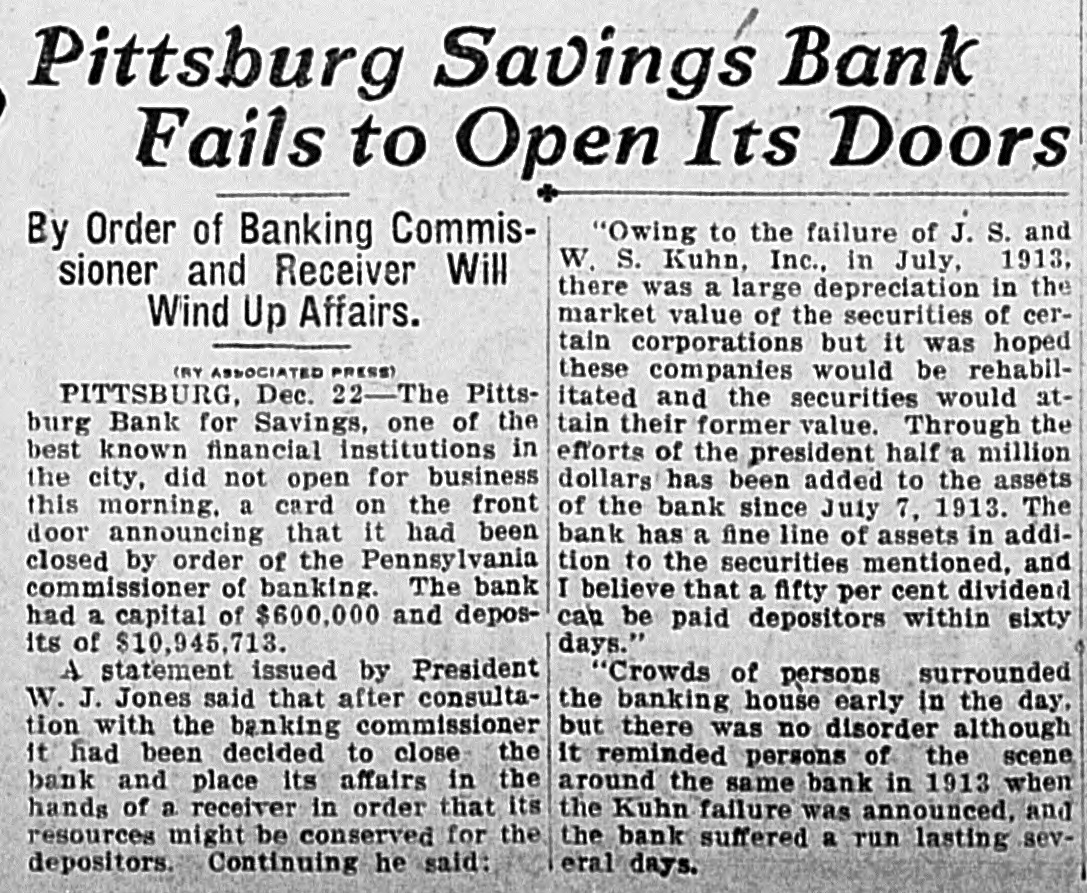
By Order of Banking Commissioner and Receiver Will Wind Up Affairs. (RY ASSOCIATED PRESS) PITTSBURG, Dec. 22-The Pittsburg Bank for Savings, one of the best known financial institutions in the city, did not open for business this morning, a card on the front door announcing that it had been closed by order of the Pennsylvania commissioner of banking. The bank had a capital of $600,000 and deposits of $10,945,713. A statement issued by President W. J. Jones said that after consultation with the banking commissioner it had been decided to close the bank and place its affairs in the hands of a. receiver in order that its resources might be conserved for the depositors. Continuing he said:
Pittsburg Savings Bank Fails to Open Its Doors "Owing to the failure of J. S. and By Order of Banking CommisW. S. Kuhn, Inc., in July, 1913, sioner and Receiver Will there was a large depreciation in the market value of the securities of cerWind Up Affairs. tain corporations but it was hoped (RY ASSOCIATED PRESS) these companies would be rehabilPITTSBURG, Dec. 22-The Pittsitated and the securities would atburg Bank for Savings, one of the tain their former value. Through the best known financial institutions in efforts of the president half a million the city, did not open for business dollars has been added to the assets this morning. a card on the front of the bank since July 7, 1913. The bank has a fine line of assets in addidoor announcing that it had been closed by order of the Pennsylvania tion to the securities mentioned, and commissioner of banking. The bank I believe that a fifty per cent dividend had a capital of $600,000 and deposcan be paid depositors within sixty its of $10,945,713. days." A statement issued by President "Crowds of persons surrounded W. J. Jones said that after consultathe banking house early in the day, tion with the banking commissioner but there was no disorder although it had been decided to close the It reminded persons of the scene around the same bank in 1913 when bank and place its affairs in the hands of a. receiver in order that its the Kuhn failure was announced, and resources might be conserved for the the bank suffered a run lasting sevdepositors. Continuing he said: eral days.
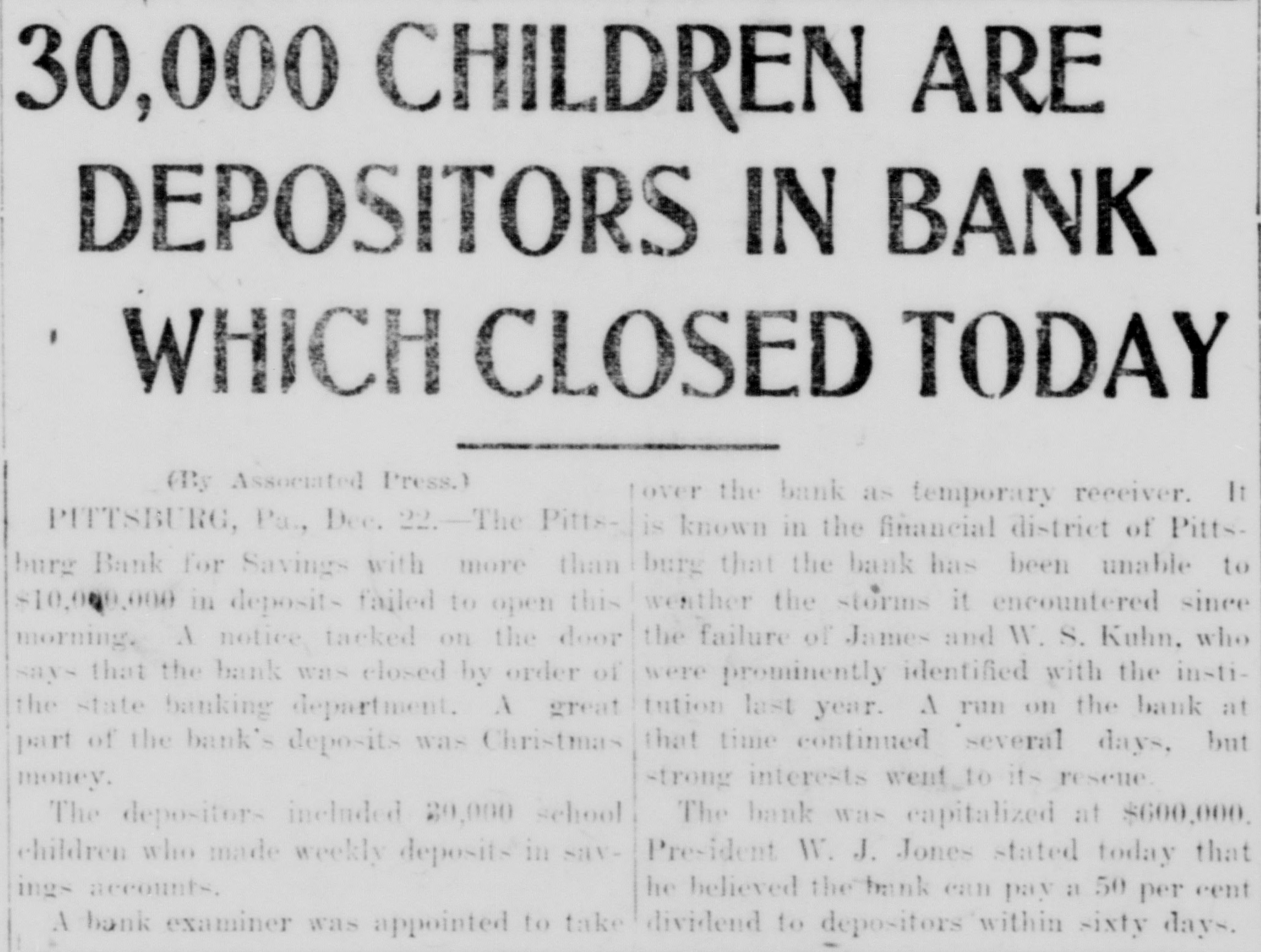
30, 000 CHILDREN ARE DEPOSITORS IN BANK WHICH CLOSED TODAY (By Associated Press.) lover the bank as temporary receiver. PITTSBURG, Pa., Dec. 22 The Pitts- is known in the financial district of Pittburg Bank for Savings with more than burg that the bank has been unable to $10,000,000 in deposit- failed to open this weather the storms it encountered since morning. A notice tacked on the door the failure of James and W. S. Kuhn. who the in-tiwith says that the bank was closed by order of were prominently identified the state banking department. A great tution last year. A run on the bank at part of the bank's deposits was Christmas that time continued several days, but money. -trong interests went to it- resette The bank was capitalized at $600,000 The depositors included 30,000 school Pre-ident W. J. Jones stated today that children who made weekly deposits in sayings accounts. he believed the trank ean pay a 50 per cent A bank examiner was appointed to take dividend to depositors within -ixty days.
7.December 22, 1915Rock Island ArgusRock Island, IL
Click image to open full size in new tab
Article Text
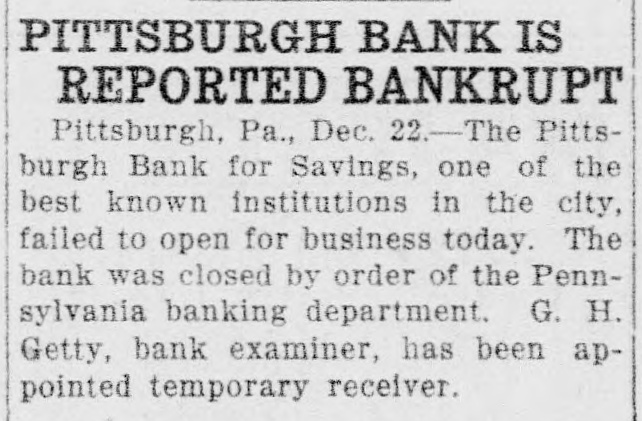
PITTSBURGH BANK IS REPORTED BANKRUPT Pittsburgh, Pa., Dec. 22.-The Pittsburgh Bank for Savings, one of the best known institutions in the city, failed to open for business today. The bank was closed by order of the Pennsylvania banking department. G. H. Getty, bank examiner, has been appointed temporary receiver.
8.December 22, 1915Harrisburg TelegraphHarrisburg, PA
Click image to open full size in new tab
Article Text
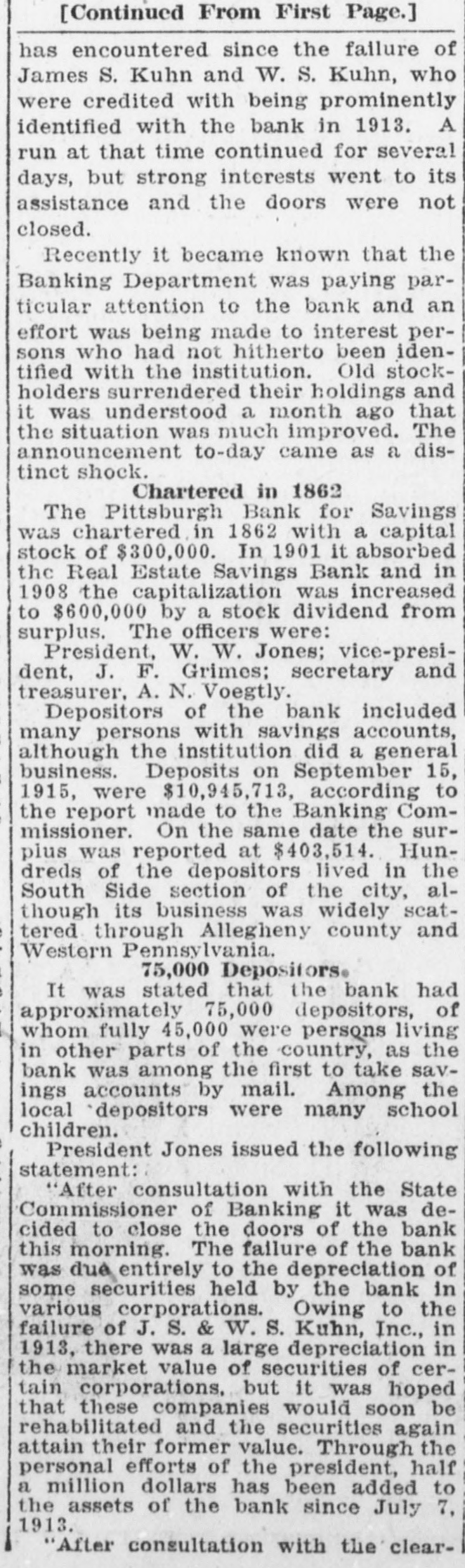
[Continued From First Page.] has encountered since the failure of James S. Kuhn and W. S. Kuhn, who were credited with being prominently identified with the bank in 1913. A run at that time continued for several days, but strong interests went to its assistance and the doors were not closed. Recently it became known that the Banking Department was paying particular attention to the bank and an effort was being made to interest persons who had not hitherto been identified with the institution. Old stockholders surrendered their holdings and it was understood a month ago that the situation was much improved. The announcement to-day came as a distinct shock. Chartered in 1862 The Pittsburgh Bank for Savings was chartered. in 1862 with a capital stock of $300,000. In 1901 it absorbed the Real Estate Savings Bank and in 1908 the capitalization was increased to $600,000 by a stock dividend from surplus. The officers were: President, W. W. Jones; vice-president, J. F. Grimes; secretary and treasurer. A. N. Voegtly. Depositors of the bank included many persons with savings accounts, although the institution did a general business. Deposits on September 15, 1915, were $10,945,713, according to the report made to the Banking Commissioner. On the same date the surplus was reported at $403,514. Hundreds of the depositors lived in the South Side section of the city, although its business was widely scattered through Allegheny county and Western Pennsylvania. 75,000 Depositors® It was stated that the bank had approximately 75,000 depositors, of whom fully 45,000 were persons living in other parts of the country, as the bank was among the first to take savings accounts by mail. Among the local 'depositors were many school children. President Jones issued the following statement: "After consultation with the State Commissioner of Banking it was decided to close the doors of the bank this morning. The failure of the bank was due entirely to the depreciation of some securities held by the bank in various corporations. Owing to the failure of J. S. & W. S. Kuhn, Inc., in 1913, there was a large depreciation in the market value of securities of certain corporations, but it was hoped that these companies would soon be rehabilitated and the securities again attain their former value. Through the personal efforts of the president, half a million dollars has been added to the assets of the bank since July 7, 1913. "After consultation with the clear-
9.December 22, 1915Harrisburg TelegraphHarrisburg, PA
Click image to open full size in new tab
Article Text
ing house committee yesterday afternoon it was thought best that a receiver be appointed in order to conserve all the assets for the depositors. The bank has a fine line of assets in addition to the securities mentioned, and I believe that a 50 per cent. dividend can be paid to depositors within sixty days." School Children Lose Receiver Getty also issued a statement in which he declared that the depreciation in the Kuhn securities was the cause of the failure, which could in no way be traced to the management. The savings of some 30,000 school children are included in the bank's deposits. By this plan school children would take their money to school on a certain day of each week and a collector for the bank would call at the various school buildings, giving them credit on their books for the amounts deposited. This practice was in effect for years and many thousands of dollars had been deposited by the children. It was said that scores of successful persons in the city who began saving in this way have continued their business relations with the institution ever since. Declines to Discuss Failure William H. Smith, State Banking Commissioner, who was in Philadelphia to-day, declined to discuss the affairs of the Pittsburgh Bank for Savings, except to say that the institution had been closed by order of the department. Mr. Smith referred all requests for information to the Attorney General's department, whose representative, Deputy Horace W. Davis, is in Pittsburgh.
10.December 22, 1915Evening StarWashington, DC
Click image to open full size in new tab
Article Text
PITTSBURGH FINANCIAL INSTITUTION IS CLOSED Bank for Savings Fails to Open on Order of State Officials. PITTSBURGH. December 22.-Christmas cheer in Pittsburgh was rudely shocked this morning when the Pittsburgh Bank for Savings, one of the best known institutions in the city, failed to open for business. Tacked to the front door at 9 o'clock was a notice which said that it had been closed by order of the Pennsylvania banking department, and that G. H. Getty, bank examiner. had been appointed temporary receiver.
PITTSBURGH BANK SHUT; HUNDREDS OF CHILDREN HIT School Pupils Prominent Among 75,000 Depositors Affected. Pittsburgh, Dec. 22-Christmas cheer in Pittsburgh was rudely shocked today when the Pittsburgh Bank for Savings, one of the best known institutions in the city, was closed by order of the Pennsylvania Banking Department. G. H. Getty, bank examiner, was appointed temporary receiver. The bank, it was known in the financial district, had been embarrassed by the failure in 1914, of James S. Kuhn & W. S. Kuhn, who were said to have been interested in the institution. A run at that time continued for several days but strong interests went to the bank's assistance. Subsequently old stockholders surrendered their holdings and wit was. understood a month. ago that! the situation was much improved, The announcement today came as a distinct shock. The Pittsburgh Bank for Savings was chartered in 1862 with a capital stock of $300,000. In 1901, it absorbed the Real Estate Savings Bank and in 1909 the capitalization was increased to $600,000 by a stock dividend from surplus Deposits on September 15, 1915, were $10,945,713, according to the re. port made to the banking Commissioner and the surplus was $403,514. It was stated that the bank had approximately 75,000 depositors, of whom fully 45,000 were persons living in other parts of the country as the bank was among the first to take savings accounts by mail. Among the local depositors were many schoolchildren.
12.December 23, 1915Alexandria GazetteAlexandria, VA
Click image to open full size in new tab
Article Text
MONEY OF 75,000 PERSONS TIED UP - #1 Christmas Cheer in Pittsburgh, Pa., is Given a Rude Shock CLOSING OF BIG BANK Forty-One Thousand School Children Had Money on Deposit in Defunct Institution. - 29 Pittsburgh, Pa. Dec. 23- Representatives of the State Department of Banking yesterday took charge of the affairs of the Pittsburgh Bank for Savings, which failed to open this morning, and every effort will be made to effect a liquidation as soon as possible. G. H. Getty, a bank examiner. who was appointed temporary receiver, has placed accountants at work on the books, and the investigation into the institution's affairs will be expedited. Small crowds collected at the entrances during the day. but there was no excitement. Bank officials expressed the belief that a 50 per cent dividend could be paid depositors within 60 days. No statement, was issued with the closing notice, but it was known in the financial district that the bank had been unable to weather the storm has encountered since the failure it Kuhn, of James S. Kuhn and W. S. who were credited with being promin ently identified with the bank in at that time continued but strong for 1913. several A run days, interests went to its assistance and the doors were not closed. Recently it became known that the banking department was paying particular attention to the bank and an effort was being made to interest persons who had not hitherto been identified with the institution. Old stockholders surrendered their hold. ings and it was understood a month ago that the situation was much improved. The announcement yesterday morning came as a distinct shock The Pittsburgh Bank for Savings was chartered in 1862 with a capital stock of $300,000. In 1901 it absorbed the Real Estate Savings Bank and in 1908 the capitalization was increased to $600,000 by a stock dividend from surplus. The officers were: Presi dent, W. J. Jones; vice-president, Jt F. Grimes; secretary and treasurer, A. N. Voegtly. Depositors of the bank included with many persons savings account although the institution did^ a general business. Deposits on September 15, 1915, were $10,945,713, according to made to the report the banking the commissioner. On the same date surplus was reported at $403,514.Hundreds: of the depositors lived in the side section of the its was south though business widely city, seat- altered through Allegheny county (and 3 Western."Pennsylvania. was stated that the bank {had 75,000 approximately It depositors, liv- of 30,000 were persons in other parts of as whom ing fully the country. the bank was among the first to take 8 savings accounts by mail. Among the local depositors were many school children. Receiver Getty issued a statement , in he declared that which the depreciation in the Kuhn securities was the cause of the falure which could in no way be traced to the management. The savings of some 41,000 schoolC children are included in the bank's
13.December 23, 1915The Birmingham Age-HeraldBirmingham, AL
Click image to open full size in new tab
Article Text
PITTSBURG BANK CLOSES ITS DOORS Inability to Realize on Old Securities Results in Suspension Pittsburg, December 22-Representatives of the state department of banking today took charge of the affairs of the Pittsburg Bank for Savings, which failed to open this morning, and every effort will be made to effect a speedy liquidation. G. H. Getty, a bank examiner, who was appointed temporary receiver, has placed accountants at work on the books and the investigation into the institution's affairs will be expedited. Small crowds collected at the entrance during the day but there was no excitement. Bank officials expressed the belief that a 50 per cent dividend could be paid depositors within 60 days. Bank Examiner Getty and President W. J. Jones, of the bank, issued statements today. Mr. Getty said the officials were not to blame for mismanagement, but were unable to realize an old securities despite efforts of stockholders to weather the storm. Mr. Jones said he had increased the institution's assets $500,000 since July 13, when a run lasting three days occurred following the failure of J. S. and W. S. Kuhn, Inc. Among the deposit of the bank are 41,000 school children, who had $167,136.68 on deposit. Of this number 33,000 were Pittsburg school children, while 8000 lived outside the city. By an agreement with the board of education, bank collectors weekly visited the 132 schools. The children brought their pennies with them and the collectors took them and gave credits in little bank books. These savings are unsecured. The board of education had $201,666 on deposit but had good security to cover possible losses.
14.December 23, 1915Pine Bluff Daily GraphicPine Bluff, AR
Click image to open full size in new tab
Article Text
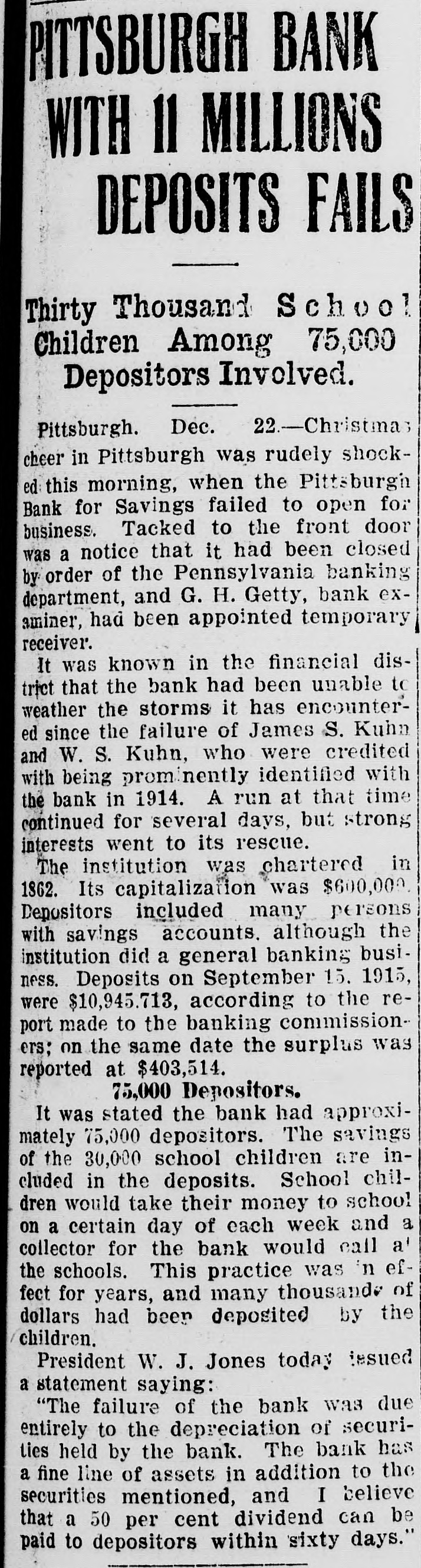
PITTSBURGH BANK WITH Il MILLIONS DEPOSITS FAILS Thirty Thousand School Children Among 75,000 Depositors Involved. Pittsburgh. Dec. 22.-Christma cheer in Pittsburgh was rudely shocked this morning, when the Pittsburgh Bank for Savings failed to open for business. Tacked to the front door was a notice that it had been closed by order of the Pennsylvania banking department, and G. H. Getty, bank examiner, had been appointed temporary receiver. It was known in the financial district that the bank had been unable to weather the storms it has encountered since the failure of James S. Kuhn and W. S. Kuhn, who were credited with being prominently identified with the bank in 1914. A run at that time continued for several days, but strong interests went to its rescue. The institution was chartered in 1362. Its capitalization was $600,000 Depositors included many persons with savings accounts. although the institution did a general banking business. Deposits on September 15. 1915, were $10,945.713, according to the report made to the banking commissioners; on the same date the surplus was reported at $403,514. 75,000 Depositors. It was stated the bank had approximately 75,000 depositors. The savings of the 30,000 school children are included in the deposits. School children would take their money to school on a certain day of each week and a collector for the bank would call a' the schools. This practice was in effect for years, and many thousand. of dollars had been deposited by the children. President W. J. Jones today issued a statement saying: "The failure of the bank was due entirely to the depreciation of securities held by the bank. The bank has a fine line of assets in addition to the securities mentioned, and I believe that a 50 per cent dividend can be paid to depositors within sixty days.
15.December 25, 1915Tulsa Daily WorldTulsa, OK
Click image to open full size in new tab
Article Text
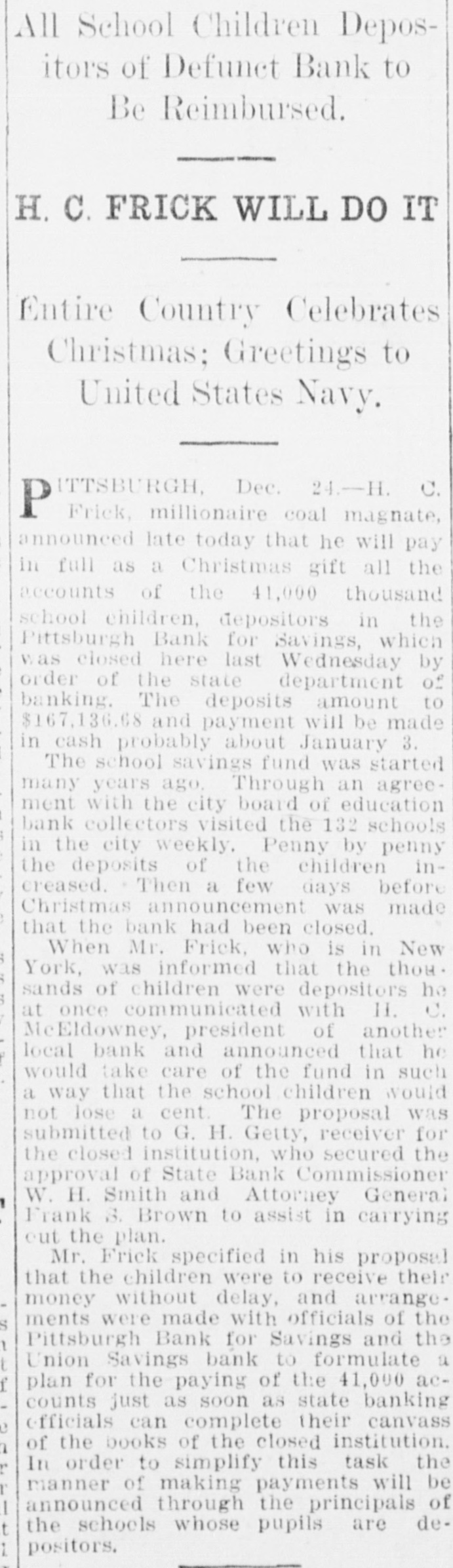
All School Children Depositors of Defunct Bank to Be Reimbursed. H. C. FRICK WILL DO IT Entire Country Celebrates Christmas; Greetings to United States Navy. ITTSBURGH, Dec. 24.-H. C. P Frick millionaire coal magnate, announced late today that he will pay in full as a Christmas gift all the accounts of the 41,000 thousand school children, depositors in the Pittsburgh Bank for Savings, which was closed here last Wednesday by order of the state department of banking. The deposits amount to $167,136.68 and payment will be made in cash probably about January 3. The school savings fund was started many years ago. Through an agreement with the city board of education bank collectors visited the 132 schools in the city weekly. Penny by penny the deposits of the children increased . Then a few days before Christmas announcement was made that the bank had been closed. When Mr. Frick who is in New : York, was informed that the thou. sands of children were depositors he at once communicated with 11. C. McEldowney, president of another local bank and announced that he would take care of the fund in such a way that the school children would not lose a cent The proposal was submitted to G. H. Getty, receiver for the closed institution, who secured the approval of State Bank Commissioner W. H. Smith and Attorney General 1 Frank 3. Brown to assist in carrying out the plan. Mr. Frick specified in his proposal that the children were to receive their money without delay, and arrange. ments were made with officials of the S Pittsburgh Bank for Savings and the I Union Savings bank to formulate a l f plan for the paying of the 41,000 accounts just as soon as state banking officials can complete their canvass e of the books of the closed institution. a In order to simplify this task the manner of making payments will be l' I announced through the principals of the schools whose pupils are det 1 positors.
16.December 25, 1915The PatriotIndiana, PA
Click image to open full size in new tab
Article Text
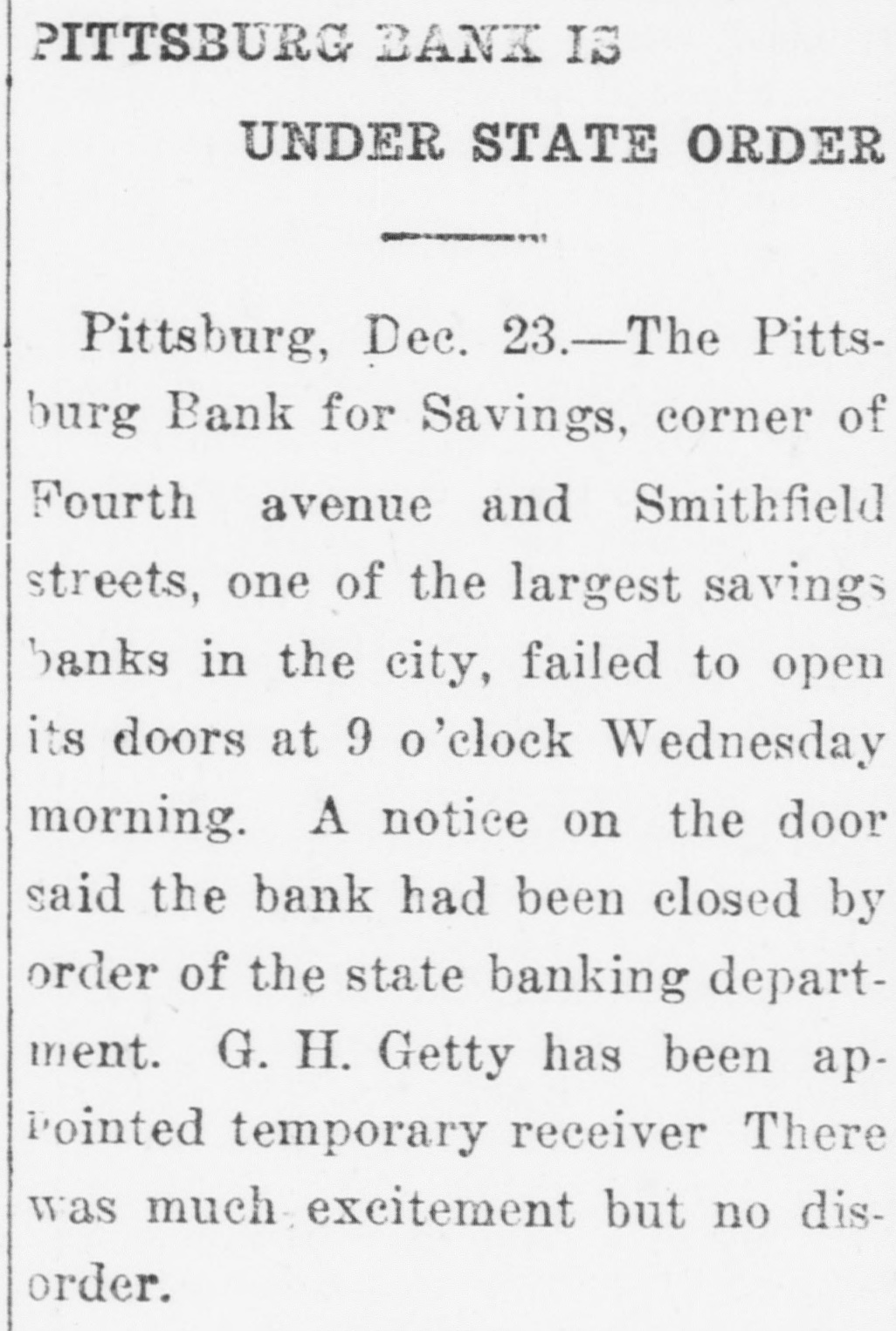
PITTSBURG BANK IS UNDER STATE ORDER Pittsburg, Dec. 23.-The Pittsburg Bank for Savings, corner of Fourth avenue and Smithfield streets, one of the largest savings banks in the city, failed to open its doors at 9 o'clock Wednesday morning. A notice on the door said the bank had been closed by order of the state banking department. G. H. Getty has been apPointed temporary receiver There was much excitement but no disorder.
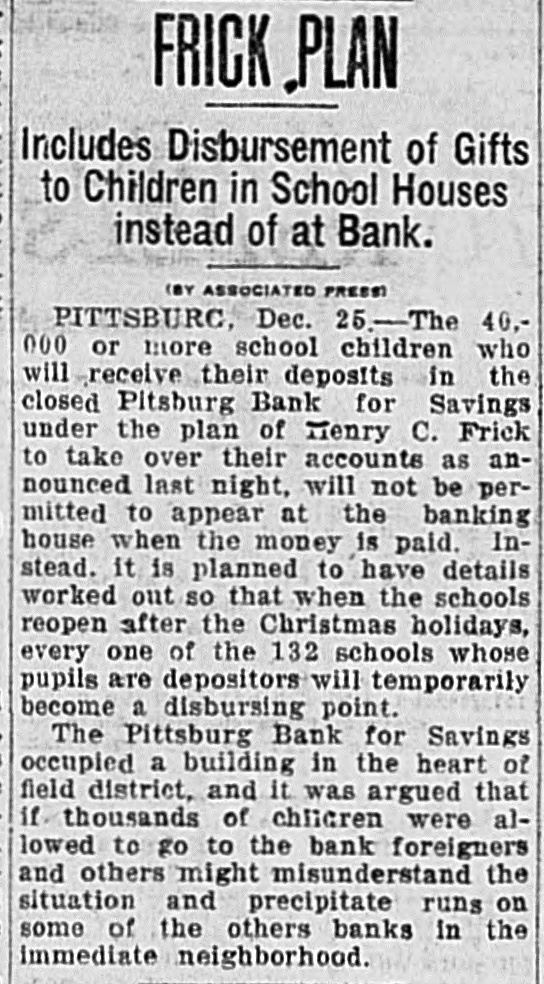
FRICK PLAN Includes Disbursement of Gifts to Children in School Houses instead of at Bank. (BY ASSOCIATED PRESS) PITTSBURC, Dec. 25.-The 40,000 or more school children who will receive their deposits in the closed Pitsburg Bank for Savings under the plan of Menry C. Frick to take over their accounts as announced last night, will not be permitted to appear at the banking house when the money is paid. Instead. it is planned to have details worked out so that when the schools reopen after the Christmas holidays, every one of the 132 schools whose pupils are depositors will temporarily become a disbursing point. The Pittsburg Bank for Savings occupied a building in the heart of field district, and it was argued that if thousands of children were allowed to go to the bank foreigners and others might misunderstand the situation and precipitate runs on some of the others banks in the immediate neighborhood.
18.December 29, 1915Norwich BulletinNorwich, CT
Click image to open full size in new tab
Article Text
# FRICK'S GENEROUS RESPONSE.
Too much credit cannot be given to H. C. Frick, the Pittsburg steel magnate, who, upon hearing of the closing of the Pittsburg Bank for Savings in which the school children of that city to the number of over 40,000 had deposited their pennies in response to the movement for thrift, made arrangements to have the deposits of the children paid them at the very earliest moment through other institutions, the expense of which would be borne by him.
The action is in accord with the step taken by the Norwich Savings society a number of months ago when, through the generosity of certain of its officials, the deposits of school children who had been interested in, a similar system of saving in another institute, only to have them tied up by a receivership, were made good to them, either in the form of new accounts or in cash.
Such acts cannot fail to win widespread approval and commendation.
They recognize the need of overcoming the wrong impression which the closing of banking institutions conveys to children and the detrimental effect which it is bound to have upon the important principle of systematic saving as well as the distrust and lack of confidence which is likely to prevail throughout their entire lives as the result of acts which they are not able to understand.
Thrift and the importance of making provisions for the future are things which every school child should be taught but the lessons lose their value if when they are put into actual use the money which they have managed to save is only returned to them in part.
Mr. Frick in providing the money to see that they get the $170,000 or more that is due the Pittsburg children has quickly recognized the need of the situation and its importance to the future.
19.December 30, 1915Harrisburg TelegraphHarrisburg, PA
Click image to open full size in new tab
Article Text
is calculated that the State can carry its own insurance. Charters Approved. ----- The Public Service Commission has approved the charter applications of the Topton, Alburtis and Myers electric companies, which design to operate in Eastern Pennsylvania towns. More Arrests Likely.-More arrests for the sale of cattle feeds not properly branded are likely within a short time, as reports made to the Department of Agriculture show considerable misbranding. Appointed Notary.-Henry N. Peifer, of Geiger's Mills, has been appointed a notary public. Spoke at State College. - Members of the State farm advisory corps spoke at the State College farmers' week exercises this week, telling what the State is doing in farm educational work and the plans for the future. Attended Mecting.-Commissioner of Health Dixon attended the meeting of the board of trustees of the University of Pennsylvania, of which he is a member. Davis at Pittsburgh.-Deputy Attorney General Horace W. Davis is at Pittsburgh looking after the legal end of the State's supervision of affairs of the Pittsburgh Bank for Savings. Juniata County Names Sealer.-Chief Sweeney, of the Bureau of Standards, has received word that Juniata county has named a sealer of weights and measures. Practically every county now has such an officer. Can Furnish Power. - The Public Service Commission has approved a contract for S. H. Mussellman to furnish power to Franklin township, Adams county. This is one of the few instances wherein an individual has received approval of such a contract. Getty Is Receiver. - The Allegheny county courts yesterday named Banking Examiner G. H. Getty as receiver of the Pittsburgh Bank for Savings. This gives the State control and cuts out big fees of a receiver and counsel. It is estimated that it will save $150,000 to the depositors. Wants $20,000. - The widow of W. W. Wunder, of Reading, a deputy State fire marshal who died as the result of an automobile accident, has sued the owner of the car for $20,000 damages. State Armory Board. - The State armory board will meet on December 12 to make plans for the West Chester armory. Chairman in Philadelphia. -Chairman Ainey, of the Public Service Commission is in Philadelphia on inspection work to-day. Gets New Place. - James B. Wheeler, schedule clerk in the Department of Public Grounds and Buildings has tendered his resignation, effective January 1 to take a position with a new bank in Detroit, Mich., being established by Henry Ford. General Good Retires.-BrigadierGeneral J. Lewis Good, of Philadelphia, for years commander of the First Regiment, was to-day retired at his own request with the rank of majorgeneral in the National Guard. General Good was named several years ago as a brigadier-general and assigned to the staff of the commanderin-chief. His retirement leaves the Guard with three brigadiers-general, General C. M. Clement, of Sunbury, who commanded the Third Brigade, having been promoted to major-general commanding the division and his place not having been filled. General Good never had a field command and it is said to be possible that no one will be named to fill his place on the list. Want Train Restored.-Patrons of the Bloomsburg and Sullivan railroad to-day petitioned the Public Service Commission to have the morning and evening train between Benton and Jamison City restored. Representative Here. - Representative Miles A. Milliron, of Kittanning, was at the Capitol to-day on his way home from Scranton. Big Increase.-The American Manganese Manufacturing Company, of Philadelphia, has filed notice at the Capitol of increase of stock from
20.January 13, 1916Harrisburg TelegraphHarrisburg, PA
Click image to open full size in new tab
Article Text
# Evening Chat
Within a few days the Harrisburg Public Library will undertake the establishment of libraries in half dozen of the schools of the city in accordance with the plan worked out with Superintendent F. E. Downes, of the Harrisburg School Board, for extending educational advantages to the children throughout the city. The collections of books are now being made up and will be sent to widely separated and outlying schools where they will be placed under Dr. Downes' direction after which Miss Susan R. Clendinin, who is temporarily in charge of the extension work of the Library, will visit the schools and assist the teachers in organizing the circulation, special instruction having already been given the teachers by Miss Alice R. Eaton, the librarian. The plan is to have good, wholesome reading placed within the reach of every youngster. Not all of the boys and girls can get to the Library where a special department has been created for them so the Library is going to them. The parents of the children will also be interested by the teachers in the plans for the extension of the activities of the new institution.
The receivership of the Pittsburgh Bank for Savings, which was established by the Attorney General's and Banking Commissioner's departments under the new act recently, is already showing good results. The other day securities were sold for almost at what the bank held them and the expenses of the receivership are lower than ever known in Allegheny county. In addition Deputy Attorney General Davis is looking after the legal end so that the State is saving the depositors legal costs as well as receivership expenses.
At least one man who sat through most of yesterday's session of January criminal court is of that type that knows what he wants and when he wants it. Incidentally he got what he wanted. President Judge Kunkel was charging a jury at the time. The spectator arose in his seat and started to leave the room. The tipstave, mindful of instructions to prohibit walking about while the judge was addressing a jury, refused to let the man pass. The man muttered; the tipstave motioned him to a seat; the muttering grew louder; the man began talking aloud; finally he raised his voice. Then Judge Kunkel saw him.
"Why do you permit that?" he demanded of the tipstave, "don't you know this interrupts us as we are addressing the jury? Put that man out!"
"Thank you, Judge Your Honor," replied the impatient one relievedly as he hurried out. "That's all I wanted to get out!"
John S. Musser, president of the Dauphin Electrical Supplies Company, has just returned from a visit of several weeks among old friends in Nebraska. Few people know that Mr. Musser was at one time a deputy sheriff and later a practicing attorney in Nebraska. He was also prominent in secret society circles of that State, and, whisper it gently, led the Aurora band and played in the Sunday school orchestra. He was appointed a member of the Governor's military staff of the State and as an officer in the State Guard accompanied Buffalo Bill to assist in putting down the last Indian uprising in that part of the West. He has not been in his old stamping ground for nearly twenty years, but found most of the men he knew still on the job and mighty glad to renew old acquaintance.
The Wilkes-Barre Record almanac, one of the few almanacs published by the newspapers of Pennsylvania nowadays, has been issued for 1916, handsomely gotten up and abounding with information not only of the State's third greatest county and one of its most progressive of municipalities, but of the State as well. The Record has issued this almanac for thirty-one years and has never allowed anything to interfere with its appearance so that it is "an old and reliable," for the people of that flourishing district. The Record almanac fills a niche in Luzerne county that nothing can touch and it is probably the most extensively used publication of any in the heart of the hard coal country.
Among visitors to the city yesterday was Paul W. Houck, of Shenandoah, one of the workmen's compensation referees. He was here on business connected with the board. He met a number of State officials and talked over things.
21.March 29, 1916Harrisburg TelegraphHarrisburg, PA
Click image to open full size in new tab
Article Text
CLOSED BANK PAYS 50 PER CENT Special to the Telegraph Pittsburgh, March, 29.-Depositors of the Pittsburgh Bank for Savings which was closed last December, will receive a 50 per cent. dividend on April 15, according to announcement by Horace E. Davis, deputy attorney general, who is receiver for the bank.
22.January 10, 1918Harrisburg TelegraphHarrisburg, PA
Click image to open full size in new tab
Article Text
# DETRICH MOVES
# TO HARRISBURG
Examiner-in-Chief Has Lofty
Office in Statehouse; News
of Capitol Hill
The office of the chief examiner of the State Insurance Department, which has been located in Philadelphia for many years, has been removed to the State Capitol and A. Nevin Detrich, the examiner in chief, is now temporarily located in the room on the top floor of the Capitol formerly used for state photographic work. The movement of Mr. Detrich's headquarters to this city, which brings him closer to his home in Chambersburg, is not without political significance as he was secretary of the Washington party state organization and for years was active among the grangers.
Mellhenny Sees Governor-Governor Brumbaugh is extending his interest in who the legislative candidates are likely to be this year to Dauphin and nearby counties. Today he was visited by George W. McIlhenny, former Dauphin county deputy sheriff, who called at the Governor's request and was closeted with the Governor and Secretary Ball for an hour. Ex-Revenue Collector H. L. Hershey, of this city, was a caller at the Governor's office yesterday to discuss Dauphin politics.
Rettew Named Again-C. Vernon Rettew, alderman of the Thirteenth ward, was reappointed by the Governor to-day for a term ending January, 1920.
Governor Will Speak Governor Brumbaugh has accepted an invitation to deliver the address at the Harrisburg Y. M. C. A. men's meeting on Sunday.
Mr. Hoke Hurt-Howard M. Hoke, secretary to the Attorney General, is confined to his home with a sprained ankle.
Getty's Good Work The Attorney General's and the Banking Departments are being complimented upon the showing made by C. H. Getty, one of the state bank examiners, who was named to act for the state as receiver for the Pittsburgh Bank For Savings. The concern had about ten millions and thus far the depositors have received eighty-two and a half per cent. This is a splendid showing.
No Substitutes-Dr. Samuel G. Dixon, state commissioner of health, was to-day informed by an opinion from the office of the Attorney General's office that the Act of 1917 providing for leaves of absence with certain pay for officers and attaches of the state government entering the military service of the United States does not apply to men who may enter state service as substitutes for those who have gone to war. If substitutes enter United States service they do so without any obligation upon the state. In an opinion to the Governor the department holds that the offices of mayor of a city and notary public are not incompatible. In 1895 it was held that a burgess could be appointed a notary.
Must Obey Orders-The Philadelphia Electric Company to-day sent a letter to the Public Service Commission that it would refuse service to patrons who failed to obey the orders of the fuel administrators not to use display signs.
Reading Hearing-Hearings in complaints against the fare increase of the Reading Transit and Light Company were to-day fixed by the Public Service Commission for Reading on February 8. The city authorities gave notice that excess fare slips for the 6-cent fare would be issued to patrons pending the decision.
O'Neil Plans Meeting - Arrangements were made to-day for a conference to be held at Lebanon next Wednesday on the William Penn Highway improvement between Highway Commissioner O'Neil and the representatives of Lebanon, Berks and Dauphin counties.
Governor Inviteed-Governor Brumbaugh was to-day invited by a committee of clergymen representing the Polish residents of Luzerne county to attend the formation of the Polish regiment at Wilkes-Barre on January 27. The Governor will attend if possible, his callers were informed.
Studying Report-The report of W. C. Thompson, of Wilkes-Barre, on utilization of anthracite mine gases and means to stimulate inventions to employ these waste products is being studied by Governor Brumbaugh. He will probably make some recommendations as to organization to obtain results by offering prizes.
Dinner to Uhler-William D. Uhler, chief engineer of the State Highway Department, who recently was commissioned a major in the United States Army Reserve, will be the guest of honor at a dinner, which is to be given to-night at the Senate Hotel by department officials. Major Uhler will take up his Army duties next week.