Contemporary reports describe heavy withdrawals and a run in mid-May 1884, an initial suspension/closure (May 22), resumption (May 23) with cash on hand, a second suspension May 26, and appointment of an assignee/receiver May 29. Cause throughout appears to be bank-specific problems (overdrafts, oil-pool speculation, missing securities) rather than mere random rumor. Spelling Pittsburg follows articles; modern spelling is Pittsburgh.
Events (5)
1.May 22, 1884Run
Cause
Bank Specific Adverse Info
Cause Details
Rumors and reports that oil brokers had been allowed to overdraw accounts; large withdrawals (~$700,000 over five days) and suspected speculative/oil-pool exposures.
Measures
Bankers concerted action; clearing-house loan assistance; bank prepared to reopen with large cash reserve.
Newspaper Excerpt
In the afternoon the failure of the Penn Bank of Pittsburg was reported ...
Source
newspapers
2.May 22, 1884Suspension
Cause
Bank Specific Adverse Info
Cause Details
Continued run driven by large withdrawals tied to suspected overdrafts and oil speculation exposures; clearing-house assistance required.
Newspaper Excerpt
Owing to a continued run by depositors, the Penn Bank of this city closed its doors at noon yesterday.
Source
newspapers
3.May 23, 1884Reopening
Newspaper Excerpt
Its Doors to be Reopened This Morning with $600,000 on the Counters. ... will open their doors with $600,000 in cash on the counters; many large depositors signified intention to leave money in bank.
Source
newspapers
4.May 26, 1884Suspension
Cause
Bank Specific Adverse Info
Cause Details
Second suspension followed large checks/clearing-house rejecting $265,000 of checks and heavy certified checks out; directors reported shortages and certified checks not returned; president suddenly ill but operational causes tied to liquidity and missing securities.
Newspaper Excerpt
The Penn bank closed its doors again at noon today...It is said there has been a heavy run on the bank this morning...the clearing house throwing out checks amounting to $265,000.
Source
newspapers
5.May 29, 1884Receivership
Newspaper Excerpt
Henry Warner, assignee of the Penn Bank, has taken charge ... The deficiency ... will reach fully $1,250,000. A great shortage of securities is also reported ... bonds, stocks and other collaterals ... missing.
Source
newspapers
Newspaper Articles (24)
1.May 22, 1884Savannah Morning NewsSavannah, GA
Click image to open full size in new tab
Article Text
MARKETS BY TELEGRAPH. FINANCIAL. LONDON, May 21.-Consols, 1013/8 for money; 101½ for account. NEW YORK. May 21, noon.-Stocks weak. Money, 6 per cent. per annum. Exchangelong, $4 83@4 84; short, $4 84½4 85½, State bonds quiet. Government bonds firmer. 5:00 p. m.-Exchange, $488. Money, 2½3 per cent. Sub-Treasury balances-Gold, $128,379,000: currency, $10,255,000. Government bonds closed irregular; four per cents, 120½; three per cents. 99½. State bonds quiet. Share speculation to-day was exceedingly erratic. At times the market was positively strong, and again at intervals there were periods of depression. During the morning there were rumors afloat that certain large houses were in trouble, and that their suspension was likely. Subsequently the failure of a small stock concern was made public, but no other suspensions were announced. The market opened irregular but lower, and then advanced 1/4@1 per cent. Northwest sold up 1, St. Paul 3/4, Louisville and Nashville 3/4, Lake Shore ½,2, Missouri Pacific 3/4, and Pacific Mail % per cent. A vigorous attack was afterwards made on coal shares, and round amounts of long stock was shaken out. New Jersey Central broke 5, Reading 23/8, and Lackawanna 2½ per cent. Shares were depressed on reports that the question of curtailment of production during June would probably result in the disruption of the coal combination. Reading and New Jersey Central were also affected by the issuance of scrip by the former company. The general market declined sharply in sympathy with the break in anthracite coal shares, Canada Southern dropped 1½ Northwest 1½, St, Paul 23/4, Louisville and Nashville 1½ Lake Shore 13/4, Missouri Picific 2½ New York Central 1, Northern Pacific preferred 23/49 Oregon Transcontinental 11/4, Pacific Mail 1, Union Pacific 11/2, and Western Union 15/8 per cent. The last mentioned became strong, rising 23/8 per cent., and this changed the temper of speculation. A sharp demand set in for all active stocks, prices moving up 11/2021/2 per cent. In the afternoon the failure of the Penn Bank of Pittsburg was reported, and this occasioned a fresh selling movement. It was also rumored that an instiution at Philadelphia was in trouble, Reading dropped to 29,
2.May 23, 1884Savannah Morning NewsSavannah, GA
Click image to open full size in new tab
Article Text
THE PENN BANK SECURE. Its Doors to be Reopened This Morning with $600,000 on the Counters. PITTSBURG, May 22.-A more complete understanding of the exact condition of the Penn Bank and the feeling that it will be able to pay all its liabilities, together with the concerted action of the bankers last night, has had a reassuring effect, and confidence to a large extent has been restored. It was feared that there would be runs on several banks that were reported on the street last night as in a weak condition, but a visit to the alleged shaky institutions at noon to-day showed that all was serene with the checking out not much greater than usual. Bankers expressed themselves as perfectly able to meet the demands made on them. The officials of the Penn Bank are busy to-day getting their affairs in shape for resumption to-morrow. Their clearances were made good to-day, and to-morrow they will open their doors with $600,000 In cash on the counters. Many of the largest depositors have signified their intention of allowing their money to remain in the bank. The Masonic Bank, on which there was a small run yesterday, received deposits this morning of $30,000 more than was paid out. st Mckeesport a run was inaugurated on the People's Bank, but by noon confidence was restored. The deposits exceeded the cash drawn out by $24,000. The situation improves here with every hour, and the general impression prevails that there will be no more trouble, Penn Bank stock is quoted at y per cent. above par. In order to accommodate customers the Penn Bank was open this afternoon to receive deposits.
e. FINANCIAL FACTS. THE GOULD-VANDERBILT LETTERS On the Business Situation-Ferdimand Ward in Ludlow Birest Jall-Lis WIII Confess All-The Penn Bank to Resume To-day-A Short Hun on the McKeesport Bank. NEW YORK, May 22.-Several attachments were granted to-day against the property in this city of the Penn Bank of e Pittaburgh. The suita were brought by Henry & Newman and the Fourth Na. tional Bank. William II. Sweeney, banker and broker, 104 Massau street, was arrested in the suit of Garrett B. Haight to recover a balance of several thousand dollars in stock transactions. The following cable correapondence has passed between Gould and Vanderbilt on the financial situation: NEW YORK, May 21. To W H Vanderbill, London: Since your departure the failure of Grant & Ward, of the Marine bank, Metro. politan bank and others, have 80 greatly disturbed confidence that good securities have suffered a large depreciation, in common with poorer ones. But to-day we have a steadier market, a better feeling, with no further failures, and none likely to occur. Mr. Sage opened his doors to-day and accepted all of his outstanding privileges. I think matter will continue to improve. The new pools between theitrunk lines on amoney basis were completed and signed to-day. Mr. Fink is HOW considering an advance of East-bound rates to 20 cents, which he will probably order. All the threatened dis turbances among the roads west of Ohicago have been averted. The crop prospects throughout the Weat and South and Northwest were never looking more pros. perous than now, which will guarantee a large fall businees. [Signed] JAY GOULD. LONDON, May 22, 1884. J. Gould, New York: I am very much obliged for your mesta eage. My advices look as if the depressing influences of the past were about over. I think you will find the results will be in 80 flo accordance with the views expressed in your dispatch. th (Signed) W. H. VANDERBILT. no
4.May 23, 1884The Indianapolis JournalIndianapolis, IN
Click image to open full size in new tab
Article Text
THE PENN BANK. Getting Its Affairs in Shape Preparatory to Resuming Business. PITTSBURG, May 22.-A more complete understanding of the condition of the Penn Bank, and a feeling that it will be able to pay all liabilities, together with the concerted action of the bankers last night, has had a reassuring effect, and confidence, to a large extent, has been restored. It was feared that there would be a run on several banks, reported on the street last night as in a weak condition, but a visit to the alleged shaky institutions at noon found all serene, with the checking out not much greater than usual. Bankers expressed themselves as perfectly able to meet all demands made on them. Officials of the Penn Bank are busy to-day, getting affairs in shape for resumption to-morrow. Their clearance was made good to-day, and to-morrow they will open their doors with $600,000 in cash on their counters. Many of the largest depositors have signified an intention of allowing their money to lay in the bank, and long before the regular hour for opening this morning a number of the heaviest depositors forced their way to the side entrance, and insisted on making deposits. The bank refused to accept them, however, until it resumes to-morrow. The Masonic Bank, on which there was a small run yesterday, received deposits this morning of $30,000 more than was paid out. At McKeesport a run was inaugurated on the People's Bank, but by noon confidence was restored, and the deposits exceeded the cash drawn out by $24,000. The situation improves with every hour, and a general impression prevails that there will be no more trouble Penn Bank stock is quoted $7 above par. The stockholders of the Penn Bank have been in session all day. This evening announcement was made that business would be resumed tomorrow noon with $680,000 cash on the counter and a reserve of $450,000 for emergencies. The amount liable to draft by depositors, is $100,000, but depositors representing $150,000 have signed an agreement not to withdraw.
5.May 23, 1884Daily RepublicanWilmington, DE
Click image to open full size in new tab
Article Text
Banks and Business. The excitement caused by the suspension of the Penn Bank, in Pittsburg, had subsided yesterday, and there was no run on any of the banks. The Penn Bank officials say they will re-open their doors to-day with $600,000 cash on their counters. The stockholders of the Penn Bank were in session all day, and it was announced last evening that "business would be resumed at noon to-morrow with $680,000 in cash on the counter, and a reserve fund of $450,000 for emergencies." The amount liable to draft by depositors is $900,000, but depositors representing $150,000 have signed an agreement not to withdraw. Eilett, Drewry & Co., wholesale dry goods dealers, of Richmond, Virgina, yesterday made an assignment with preferences amounting to $103,000. Their total liabilities are placed at $200,000. Mr. Drewry thinks they will be able to pay in full. In St. Louis yesterday morning attachments aggregating over $40,000 were filed against the firm of Kaufman, Cohen & Co., wholesale milliners
6.May 24, 1884The Ottawa Free TraderOttawa, IL
Click image to open full size in new tab
Article Text
END OFTHE LATE PANIC CONFIDENCE RESTORED IN COTHAM. Several of the Squeezed Firms Preparing to Resume-Ward Under Arrest for Swindling-Failure of the Leading Pittsburgh Bank. A BETTER FEELING. NEW YORK, May 19.-Saturday morning passed very quietly and confidence seemed fully restored. Affairs progressed in a fair way toward the speedy recovery of values in stocks. There was no crowd at Russell Sage's office. Sage had paid out over $3,000,000 since Wednesday and lost probably $5,000,000. The opinion prevailed last Saturday that Sage's trouble was not over, but he is reported to have more=ready money than any man on Wall street. The firm of Hotch. kiss & Burnham have liquidated over $1,000,000 of indebtedness and will resume soon. The other broker firms are fixing up their accounts and can not yet tell where they will stand. The banks now hold $3,127,025 in excess of legal requirements. Share speculation in the Exchange opened with a marked improvement. The sales for the day were unusually heavy, reaching 456,000 shares, a large number of which were taken for for foreign account. Money which at one time lent at one-quarter per cent. per diem closed at two per cent. per annum. In the afternoon the banks were free lenders, causing a buoyancy in which the active stocks participated, heavy sales being made at the advanced figures, and closing deals indicated that values had improved over the finish Friday to the extent of 1@4 per cent. Government bonds were active at higher rates. The feeling in railroad bonds marked an improvement, but State securities were rather tame. United States called bonds to the amount of $323,600 were redeemed. C. McCulloch, Beecher & Co., shipping and commission merchants and bankers, suspended Saturday and made a general assignment. The head of the firm is a nephew of Henry Ward Beecher. The liabilities were not definitely known, but were estimated at from $250,000 to $500,000. William Pinkney, doing business as Benner & Pinkney, shipping and commission, also made an assignment, giving $22,300 preferences. His liabilities are estimated at about $100,000. GRANT'S PARTNER ARRESTED. NEW YORK, May 21.-Ferdinand Ward, of the firm of Grant & Ward, was arrested yesterday afternoon on the application of City Chamberlain J. Nelson Tappan, who claims that the firm owes him $535,000. Bail was fixed at $300,000. PITTSBURGH, Pa. May 22.-Owing to a continued run by depositors, the Penn Bank of this city closed its doors at noor yesterday. The capital is $250,000. The latest statement showed loans and discounts of $1,087,000 and deposits of $2,137,000. Distrust was caused by rumors that oil brokers had been allowed to overdraw their accounts, causing the withdrawal of nearly $700,000 within five days. Willian N. Riddle, the President, who has been prostrated by illness, claims to have the largest de. posit and the greatest amount of stock. The Farmers' National helped the Penn Bank through the clearing-house on Tuesday by a loan of $100,000.
7.May 26, 1884Lancaster Daily IntelligencerLancaster, PA
Click image to open full size in new tab
Article Text
FINANCIAL FLURRY. The Penn Bank in Pictsbarg Again Closed. PITTSBURG, May 26-The P enn bank closed its doors again at noon to day. The notice pasted on the door says that as the president of the bank has been taken suddenly ill and cannot communicate with the directors, it is deemed best to close the bank temporarily. There is great excitement. The surprise was great, as everybody had faith in the ability of the bank to pay all claims. The immediate cause of the suspension is not clear and the directors refuse to be interviewed. The pavement in front of the bank is crowded. President Riddle appeared in his usual health at ten o'clock this morning, but since then has been stricken down with a hemorrhage of the lungs.
8.May 27, 1884Daily Kennebec JournalAugusta, ME
Click image to open full size in new tab
Article Text
SHUT UP AGAIN. The Penn Bank Again Closes, Amid Great Excitement-The President at Death's Door. PITTSBURG, May 26. The Penn bank closed again at 12 o'clock today, and posted the following notice on its door: Mr. Riddle, president and chief executive of the bank, having become sundenly and seriously ill and unable to communicate with the board of directors, it is deemed proper to close the bank, under the existing circumstances, until he sufficiently recovers to be present at an adjustment of its affairs. The officers have been placed in charge, who refuse to permit an audience with any of the board. There is great excitement. The news of the second suspension spread rapidly, and created intense excitement and surprise, owing to the fact that everybody had faith in the bank's ability to pay all claims against it. The immediate cause is at present unknown, and nothing definite can be learned, as the directors positively refuse to be interviewed. Large crowds have been flocking to the bank and the pavement in front is filled with anxious depositors and persons attracted by curiosity. Pres. Riddle appeared to be in his usual health at 10 o'clock this morning, but half an hour later he was prostrated with hemorrhage of the lungs. which has since been thrice repeated. He is lying at the Duquesne club rooms unconscious, with only slight hopes of recovery. Close friends of Riddle are unable to give any explanation of the sudden turn of affairs. It is said, however, that there has been a heavy run on the bank this morning, principally in checks, and that $260,000 were drawn in this way through the clearing house. The crash was brought about by the clearing house throwing out checks amounting to $265.000. According to the statement of the directors the bank had raised $931,000 to pay liabilities of $918,000. It is said there were $300,000 in certified checks out, which were not included in the amount, and which had to be paid. The banks which loaned the suspended bank funds to tide it over are amply secured. The cause of Pres. Riddle's illness was an over dose of morphia. Pres. Riddle recovered consciousness tonight, and will probably be able to attend to business in a few days.
re FINANCIAL FANCIES. 8 a to THE PENN BANK AGAIN SUSPENDS. The President Prostrated and the Doors Closed. e The Cause of the Second Minfortune-Condle tion of the Instliution-Ferdinand Ward's Schemes-Ills Open Letter to the Pablic. PITTSBURGH, PA., May 26.-The Clearing a House throw out $265,000 of checks of the Penn Bank this morning and again the bank is closed. Exactly what led to this condition of affairs is not definitely known at this time, Yesterday afternoon President Riddle had a long talk with the writer and he was hopeful both as to the bank and his own health. This morning at quarter past ten o'clock he WHB as cheerful as before and said business was going on smoothly. An hour and a half later he lay dying in his room at the Duquesne Club and the bank was closed, the following notice being posted on the panels of its door: "Mr. Riddle, the President and chief executive officer of the bank, having becomesuddenly and seriously ill and unable to communicate with the Board of Directore, it is deemed proper to close the bank under the existing circumstances until he sufficiently recovers to be present in the adjustment of affairs. By ORDER OF THE BOARD." It was impossible to gain admission to the bank. Police officers had charge of the building, and refused to admit any one except the directors. Although there were many large depositors and many who are largely interested in the outcome of the failure among those who sought admission, they were not able to get into the room where the directors were in session. It was impossible to learn just what caused the crash. According to the statement of the bank it had raised $931,000 to pay $918,000 of liabilities. It is said there were $300,000 of certified checks of the bank out, which were not included in the statement of liabilities and which bad to be paid. There has been a quiet run on the bank and it has paid out $300,000 in the last twenty-four business hours. There were eleven banks in the pool which loaned the Penn $310,000, and they are all amply secured against any loss. CAUSE OF MR. RIDDLE'S ILLNESS. What happened in the bank to cause Mr. Riddle's eudden illness is not known. It is evident that large checks were unexpectedly drawn against the bank, and persons who were supposed to be friends of the bank, and willing to aid it, suddenly showed a want of faith It is known that President Riddle was suddenly stricken down with a hemorrhage. He had several small hemorrhages during the week, but W86 up at 6 o'clock this morning, and seemed to be in better and brighter spirits than for several days. There is no doubt that the sudden collapse of the bank was not looked for. The most intimate busineas friends of Mr. Riddle, who had essieted him and were entirely in his confiti dence, knew nothing until the bank was closed and he was prostrated at the club. Mr. Riddle felt most keenly the blow which had fallen upon him, and at the residence of Mr. D. A. Stewart, yeeterday, he said: "There were a couple of days last week when I believed that after all it i was possible for a man to die of a broken heart."
FORTUNE'S WRECKS. The Penn Bank Again Closed-New and Old Failures-Freaks of the Fickle Goddess. THE PENN BANK CLOSED AGAIN. PITTSBURG, May 26.-The Penn bank closed its doors again at 12 o'clock to-day and posted the following notice on the door: "Mr. Riddel, the president and chief executive officer of the bank, having become suddenly and dangerously ill and unable to cemmunicate with the board of directors, it is deemed proper to close the bank under existing circumstances, until he sufficiently recovers to be present at the adjustment of its affairs." Officers placed in charge refuse to permit audience with any of the board. There is great excitement. President Riddel appeared in his usual health at 10 o'clock this morning, but half an hour later was prostrated by hemorrhage of the lungs. Since then he has had three repetitions thereof, and is lying at the Duquesne club rooms unconscious, with only a slight hope of recovery. Close friends of Mr. Riddel are unable to give an explanation of the sudden turn of affairs. It is said, however, that there has been a heavy run on the bank this morning. According to a statement of the directors the bank had raised $931,000 to pay its liabilities. The cause of Riddel's Illness is an over dose of morphia or chloroform taken this morning.
11.May 28, 1884The Farmer and MechanicRaleigh, NC
Click image to open full size in new tab
Article Text
Ralph Beaumont, of Elmira, N. Y., President of the Knights of Labor, will make a tour of the States on foot, from Maine to California, advocating the claims of B. F. Butler for the Presidency. Mr. Randall thinks that Congress will be ready to adjourn by the 15th of June. J. L. Brownell & Co., stock brokers, New York, failed; liabilities light.-The Senate confirmed the nomination of Wheeler for Internal Revenue collector of the Fifth N. C. District. Tobacco warehouse burned at Lancaster, Pa.; loss $15,000. The Penn Bank of Pittsburg, Pa., closed its doors owing to a continued run for several days. The Democratic State Convention of New Hampshire denounced the protection policy, and declared in favor of a tariff for revenue only; the delegates will support the "old ticket" at the National convention.
12.May 30, 1884New-York TribuneNew York, NY
Click image to open full size in new tab
Article Text
PENN BANK IN A RECEIVER'S HANDS. ANOTHER JUDGMENT CONFESSED BY RIDDLEBEAL'S STATEMENT. PITTSBURG, May 29.-Henry Warner, assignee of the Penn Bank, has taken charge, and has discharged the clerks. He will begin work at once, but says that it will be two weeks and possibly thirty days before a statement of the exact condition of affairs can be made. The deficiency, it 18 believed, will reach fully $1,250,000 It is said that of $40,000 known to have been on the counter when the bank closed, only $4,000 was turned over to the assignee. A great shortage of securities is also reported since Saturday, and bonds, stocks and other collaterals in the bank at the time of the suspension are said to be missing. President Riddle is still confined to his home. He has issued a card asking his friends to withhold their judgment until he is able to make a statement. He has confessed another judgment for $82,400 in favor of F. B. Laughlin This judgmeut will follow the one confessed on Tuesday night. John P. Beai, the oil broker for the Penn Bank, made a statement to Receiver Warner this afternoon in regard to the oil speculations of the suspended institution. He admitted that he was a representative of a blind pool operated last summer. The pool was composed of men from New-York, Philadelphia, Chicago, Pittsburg, and other cities. Their usual course was to buy heavily when they wanted an advance, or sell when it was necessary to have a decline. From another man it was learned that the pool was conceived by Riddle, who, after his friends had approved his plans, went to New-York and negotiated a loan of $2,000,000. Oil was forced from 90 to 124% when the Standard Oil Company interfered, and despite every effort of the syndicate the market collapsed and the pool was finally compelled to seil at 98, losing heavily. From that time to this the Penn Bank people have been taking desperate chances in the cil market 10 win back enough money to repair the bank's losses, but became more involved all the time. The depositors had a consultation to-day and talked of proceedings against the bank officers and directors for conspiracy.
13.May 30, 1884Wheeling RegisterWheeling, WV
Click image to open full size in new tab
Article Text
THE OILED BANK. The Way It Looks Two Days Later. Still Investigating the Affairs of the Late Finest-in-the-City---Prospects for Good Dividends for Depositors Very Slim. PITTSBURG May 29.-So much that was amazing has become known in connection with the failure of the Penn Bank, that it would take something quite out of the ordinary to excite even a ripple of interest. The rumors which are afloat to-day are ugly ones in part. It is said that although there was over $10,000 in the hands of the bank when it closed the amount which was turned over to the assignee was not quite $4,000. It is also said there has been a great shrinkage in the amount of securities, and that there is not as much be half in the way of collateral and securities in the bank now as there was on Saturday night, or even when it closed its doers finally This has had a very bad effect the men who toward are not friendly upon de the much bank. have and aid they been it. feeling disposed to to Among other barrels of for a rtwo oil things were bought it is said the that bank 300,000 day before checks are out for of it the closed. bank and that in the payment certified the same There is no trace of this oil, although the certificates ought to be in the bank now. Re-hypotheenting. It is asserted by oil brokers that the bank was in the habit when it carried the accountst the Oil Exchange of re-hypotheeating the oil held by it for their customers. Among the facts discovered by the directors is that a very large amount of securities, reaching a sum between $200,000 and $250,000 were sent on to New York by President Riddle as collateral for notes which were being floated in New York It is thought he was floating a large amount of paper in New York and eisewhere and that the sudden contraction in the money market caused the trouble The Pictitions Firms. The individual bookkeeper, George W. asked directors Rowley, the fictitions Jr. was upon and his particularly other examination overdrawn in regard by the to accounts. He replied that he could have told the board as to them 'long ago, but he had been engaged by President Riddle and he did not consider it his business to report to M. acin never to any counts keeper. other J. question authority. Young. had The stated general been that sent the bookhim for entry The usual bookkeeping customary in banks requires that that this should have been done. and had the rule been complied with the directors might have discovered the looseness before the great break came A Statement Coming. Some of the directors stated this morning that overdrafts reach over a million but about $150,000 of this is legitimate being the overchecking of responsible de positors business men who will make their accounts good. Everything however, they said was in such confusion that they were not in a position to produce a definite statement at this time. John Dalzell, Esq., counsel for President Riddle, declined to to to answer bank any affairs, questions but put stated him that relative the a statement by Mr. Riddle is in preparation and will be forthcoming in a few days. Asks Suspension of Judgment. President Riddle in a card published to day asks for a suspension of judgment uniil he is able to make a statement Lucky Fellows. On Monday morning last two diseansolate looking bankers sat in the rotur la of the Monongahela House looking and wait had an an they it in true ing. were They executing just conceived Napoleonic idea had each for their had sent up by and were see messengers style. balances: They drawn waiting them checks to what the harvest would be Both entlemen assert that they collected their balances in full. but a director of the bank says not. He SAVS that one (a banker of Washington Pa..) who had on when has thus far out $101,000 only deposit gotten the $20,000 bank of broke, Cleve the The other Rose, is amount land, ex-Mayor gentleman said by the from director of to have only secured a small portion his balance. There is little doubt. however the money which was said by some to have been a MonHouse was in Rose's papers ongahela that deposit reality by Mr. the money which was being drawn out.
14.May 30, 1884The Daily DispatchRichmond, VA
Click image to open full size in new tab
Article Text
The Penn Bank Failure. [By telegranh to the Dispatch.] PITTSBURGH, May 29.-Henry Warner, the assignee of the Penn Bank, has taken charge and discharged all the clerks. He will begin work at once, but says it will require two weeks and possibly thirty days before a statement of the exact condition of affairs can be made. The deficiency, it is believed, will reach fuily a million and a quarter of dollars. It is said that of the $40,000 which were known to be on the counter when the bank closed only $4,000 was turned over to the assignee. A great shortage in securities is also reported since Saturday, and bords, stocks, and other collateral in the bank at the time of the suspension are said to be missing. President Riddle is still confined at home. He has issued a card asking his friends to withhold their judgment until he is able to make his statement.
15.June 2, 1884The Portland Daily PressPortland, ME
Click image to open full size in new tab
Article Text
GENERAL NEWS. The billiard match in Chicago between Slosson and Senafer Saturday night, champions game, 800 points, was won by the former, who ran out on the 25th inning. Schaefer SCO ed 687. Depositors in the Union bank at Greensburg, Pa., will receive three cents on a dollar. Cashier Hoyt, of the Butter county, Pa., savings bank, is short $22,000 in his accounts. President Arthur left New York for Washington Laturday afternoon Samuel M Shoemaker, the pioneer in the express business of the country, and one of the organizers of Adams' Express Co., died in Baltimore Saturday night, aged 64. Doctor Strausberg, the well known financier of Berlin, is dead. The rolling mills in the vicinity of Cincinnati all shut down Saturday night, throwing 3000 men out of employment. Ricker's store, the Knights Templar Hall and three dwellings were burned at Paducah, Ky., Saturday night. Loss $50,000. Mr. Levi Lincoln Thaxter, husband of Mrs. Celia Thaxter, died in Boston Saturday, at the age of 60. He was a fine scholor and critic, and was devoted especially to Greek literature and the poetry of Robt. Browning. He had appeared as a reader of Browning upon the platform, as well as in private circies, and was an enthusiastic admirer and interpreter of that writer. His home was at Kittery, on the shore opposite the Isle of Shoals, but his winters were mainly spent in Boston. John C. Eno, the absconding president of the Second National Bank of New York, was arrested in Quebec, Saturday, on board the Vancouver, just as she was about to leave for England. Eno refuses to return to the United States voluntarily, and his extradition will be attempted. In a drunken row in Springfield, Mass, Saturday night, James O'Brien stabbed P. Murphy savagely in the head, face, 8 de and leg and then escaped. Five bodies have thus far been recovered from the ruins of the collapsed buildiug in Baltimore and three are yet under the wreck. The decay of a large girder caused the disaster. "Rufe" Minor, a noted bank robber has been arrested in New York. He is credited with having "cracked" banks in nearly every section of the country Three men were killed by the explosion of a boiler Saturday in a Detroit. Mich., mill. Four others were seriously injured, one of whom will die. Cashier Reiber and President Riddle of the Penn bank, Pittsburg, Pa., have been placed under arrest. The despatch sentfrom Hanover, N. H., Friday, announcing the suspension of two Dartmouth col lege editors was erroneous. 1 he trustees were recommended to withhold their diplomas but have taken no action.
16.June 8, 1884Savannah Morning NewsSavannah, GA
Click image to open full size in new tab
Article Text
BRIGHT BITS. A GREAT many fashionable ladies are going to wear nothing this summer but black silk dresses and white dresses made with a good deal of lace and embroidery.-Päladelphia Times. "FERDINAND WARD'S father's greatest mistake was in not giving him a trade," observes a Boston paper. It is probable thatthe State will remedy this defect in his education.Daily Graphic. IF you will sit down and wait. yung man, at least one haff ov the good things ov life will at some time eddy around near yu, while the more yu chase them the more they will break into a run.-Josh Billings. THE Pittsburg Chronicle summarizes the Penn Bank failure in this fashion: "What the reporter asked, '-?-?-?-?' What the bank director answered, '-!-!-!-!-!' What the public learned, '-0-0-0-0.'' "WHAT 18 a liberal education?" asks Prof. Eliot of Harvard in the June Century. The average student seems to think that it consists entirely in having a liberal father and living next door to a boat house.-Burlington Free Press. THE father of five marriageable daughters was in town a few days ago trying to buy some four-leaf clover seed to plant in his back yard. He said he had read that when a young girl finds a four-leaf clover it is a sign that she will be married within a year.-Norristoron Herald. "You remind me of Barnum since he secured his white elephant," said a Brooklyn man to his wife, who never tired of talking. "Because he holds as sacred a priceless and peerless beauty?" she timidly and blushingly suggested. "Not quite," replied the wretch: "it's because he owns a Toung Toulong." That heartless husband no longer carries a night-key.-New York Morning Journal. MAN that is married to a woman is of many days and full of trouble. In the morning he draws his salary, and in the evening Behold, it is gone! It is a tale that is told; It is vanished, and no man knows whither it goeth. He riseth up clothed in the chilly garments Of the night And seeketh the somnolent paregoric Wherewith to soothe his infant posterity. He cometh as a horse or OX And draweth the chariot of his offspring. He spendeth his shekels in the purchase of fine linen To cover the bosom of his Family; Yet himself 18 seen at the gates of the city With one suspender. Yea, he is altogether wretched. -Philadelphia News.
17.June 12, 1884The Bolivar BulletinBolivar, TN
Click image to open full size in new tab
Article Text
NEWS IN BRIEF. Compiled from Various Sources. CONGRESSIONAL PROCEEDINGS. the THE Senate was not in session on 31st The House had but short A bill was passe the law of 1867 in matter of appeals from Circuit Courts to United the States Court In habeas Bills also right th Indian Ter the Gulf. & Santa Fe and the Southern Kansas Companies IN the Senate on the 21 a mem orial ask ing for an appropriation of $25,000 in aid of the Industria was pre sented The louse relating to second persons other than also trade and the the supplies fixing for the The exempting mash the of brandy distilled from fruits motion to adjourn prevented action any In the Senate on the 31 sixty two bills the leave with following: right of way through Selden to the Pacific the Hays the Oregon for the THE not in on the 4th, Hite in the House, the of quorum. The Orezon land bill Com The passed Built report the the the meet ings held with doors. THE Senate not in on the 5th. but held The House the the Convention ab Chicago from ports sorbed too much attention to low legisla to tion extent great any forfeiture the bill; Railway Iron forfeiture Mountain land and Helena the con the Tean. the and at Kas PERSONAL AND POLITICAL (CHRISTOPHER DOYLE. the hero who saved 'fifteen' women and children from drowning at the time of the Tivoli disaster. near Baltimore, was drowned on the 1st while sailing in Curtis Creek. REV FATHER P. J. GLEASON, of St Louis, Mo., having been restored by the Propaganda at Rome to his pastoral functions, he will go to Denver to take charge of church. O'DONOVA N ROSSA asserts that the re cent London explosions are but the beginning of what may be expected in the near futur M L. BUNDY, of Newcastle, Ind., has been appointed receiver of the Hot Springs National Bank. POPE LEO IS much exercised over votes in the French Senate and House of Deputies granting and ing sem infarians liable to military ADJUTANT-GENERAL FINLEY, of Ohio, has disbanded the Fourth Regime ent of In fantry, Ohio National Guard, for ineffi ciency at the Cincinnati riots, and partial ly re-organized it as the Seventh R egiment under the of the officers who re ported for duty at the riots. IT is charged by President Riddle of the Penn Bank. Pittsburgh that the col lapse of the institution was due to the directors' connection with the oil pool. A JUDGMENT has been ob ained against Dr. J.H. McLean for legal rendered him in his contest for Colonel Broad head's.beat in Congress. THE Quebec authorities on the 2d dis charged from arrest John C. Eno, ex- Presi dent of the Second National Bank, New York, on account of a fatally de fective warrant, but he was rearrested and lodged in jail, JOHN STEW ART PARNELL President of the Irish National League of Ireland. sends to Sullivan, President of the American League, a letter of thanks for contributions from the United States, to be used in the approaching elections. JUDGE JAMES L WORDEN, of the Su perior Court at Fort Wayne, Ind., died on the night of the 2d, af er an illness of three His age was sixty -five. He Judge of the Suprem Court nineteen years, and was regarded as the ablest lawyer that bad ever graced the bench His mind was eminently judicial and his terse, compact and energetic sty le gave to opinions value rarely equaled. THE delegates from Oregon to the Na tional Democratic Convention were in structed for Tilden and Hendricks USCAR WILDE was married in London on "the 3d to Miss Lloyd. EMPEROR WILLIAM on the 3d signed an decreeing the Crown Prince of Germany President and Bismarck Vice President of the new Staat zrath. THE Stephens Monument Association has purchased Liberty Hall, the home of the late Alex. H. Stephens, of Georgia. its session in New Orleans R. H. Wit ter, of St. Louis, was elected President of International Typographical Union. THE delegates to the Georgia State Dem ocratic Convention are all known to be for Tilden. Three fourths of the counties so instruct THE Territorial Democratic delegates from Montana are for Tilden and Hendricks ON the 3d Henry Gillig, representative of the New Orleans Exposition, was banqueted at Berlin. Many Americans were present, including Minister Sargent. Hox JAMES G. BLAINE arrived at his home in Augusta, Me. on the 3d A publie reception was declined, but the people cheered him loudly as he passed through the streets THE National Republican Convention met and organized in Chicago on the 8d with Hon. John R. Ly nch, of Mississippi, temporary chairman. Committees were appointed and the convention adjourned until the 4th. ON the 5th Wm. H. Vanderbilt sailed from Liverpool for New York THE National Republi Convention at Chicago held two short sessions on the 4th General John B. Henderson, of St. Louis, Mo.. was elected permanent chairman and addressed the Convention. The Committee on Credentials not being ready to report
18.June 12, 1884The True NorthernerPaw Paw, MI
Click image to open full size in new tab
Article Text
NEWS CONDENSED. Concise Record of the Week. EASTERN. Mr. Riddle, who was President of the wrecked Penn Bank, of Pittsburgh, is in a critical condition of health. He states that the directors were interested in the oil pool which caused the collapse of the bank; that the fictitious accounts were opened two years ago; and that the directors have recently appropriated $400,000 in stock and deposits which he left for depositors. The Directors of the Reading Road, after numerous meetings, announced that the coupons on the consolidated bonds will be cashed at par. They then applied to the Cirouit Court for a set of receivers, and H. C. Kelsey, Stephen N. Caldwell, Edwin M. Lewis, and George De B. Keim were appointed in bonds of $500,000 each. Jesse Carter (colored) was hanged at Pittsburgh for being accessory to a murder He prayed and sung on the scaffold, and asserted his innocence. Near Miss Nivison's Children's Sanitarium, at Hammonton, N.J., was found buried the remains of twenty-one children, incased in rude pine boxes. Recently the death-rate in the institution, which is a purely charitable one, has been excessive, the manageress ascribing it to the use of Irish mose as food. The discovery caused much excitement, and the positions of the bodies showed that but a hasty interment was given the little victims. Mr. Austin Corbin, who acts as Treasurer for the institution, says he knows little of its management.
Deposited Money. " It is getting to be a very serious question with small depositors, who after all furnish the banks the greater part of the money that those institutions receive, whether the accommodation that they get is at all adequate for the risks they run of being seriously crippled by the operations of thieving or speculating cashiers and presidents. In investigating the affairs of the recently suspended Penn bank in Pittsburg, Penn., this week, for instance, it was found that two accounts together were overdrawn to an amount $7,000 larger than the entire capital and surplus of the institution. Who can wonder that the confidence of the community in the whole banking system is shaken by such developments as this, and the details, which are gradually being made public, of the wreck of the New York banks during the past two weeks, or that small depositors are withdrawing their funds quietly from even the oldest and most stable banks in the country So says the New England Farmer editorially. There are a good many people in Vermont who are painfully realizing the truth of the Farmer's remarks. But there is an easy remedy for the difficulty, so far, at least, as the farmers and other working men of the country are concerned, in the immediate establishment of post-office savings-banks. By taking deposits of money at all the post-offices, and paying it back on demand, or at short notice, the government of the nation will assume a most useful function, and relieve many poor men with small savings from much health-destroying anxiety. So long as the government has to pay interest anywhere it might pay say two per cent on these deposits, and use them to take up the bonds as they become due. But security is of more importance than interest, and such a safe depository would not be likely to be run upon in a panic. These post-office banks have proved a great success in England, and attempts have been made to establish them in this country, but the banking interest has so far been able to buy up enough congress. men to defeat the project. In fact, our congress is mostly made up of bank offi cers and their paid attorneys.
20.July 3, 1884Weekly Chillicothe CrisisChillicothe, MO
Click image to open full size in new tab
Article Text
place at Dodge City on the Fourth of July. Five matadors and a leader from Mexico are already on the ground. I Iowa railroads announce that they will not : carry liquor into that state unless on certificate that the consignee is authorized by the county : supervisors to sell. 1 Ira D. Sankey, the singer evangelist, wife 1 and two children were among the passengers by the Brittanic, which arrived at New York Saturday. t A cablegram announcing the shipment of £ $750,000 in American gold for New York as) signs as a reason that money is a drug in Lon$ don. The Garfield Monument association of Cleveland has awarded the first prize of $1,000 for a t design to George H. Keller, of Hartford. The property of the wrecked Penn Bank at 1 Pittsburgh has been appraised at $125,000, while the liabilities amount to $1,500,000. For a distance of twenty-five miles along the Youghiogheny river the fish have been killed by sulphur water from the coal mines. I Barney Kelley, of Champaign, III., well known as a breeder of fine horses and as a 1 business man, died Saturday, aged 70. The America, of the National Steamship 1 Line, enjoys the distinction of having made e the fastest trip on record to Europe. American cattle from the western states are henceforth to be shipped in bond through r Canadian territory down to Montreal. 1 A tabernacle in memory of Bishop Simpson e is to be erected by the Ocean Grove Campa Meeting association of New Jersey. The democrats of Florida nominated Gen(+ eral E. A. Perry for governor and M. H. :Mabry for lieutenant governor. IF Mrs. Doud died Tuesday on a farm near e Peru, Ind., at the age of 105 years. Her grandchildren number forty-five. it The strike in the Hocking valley mines in y Ohio against a reduction of wages, includes about five thousand men. y Hon. S. Caldwell, vice president of the United it States National bank, and ex-mayor of Omaha, is dead, aged 50 years. d General Ward B. Burnett, who graduated at West Point in 1832, and was known as a veteran h of five wars, is dead. 1From all parts of the Pennsylvania oil region y come reports that the shut-down movement is quite general. e Judge Drummond. of Chicago, has forwardn ed his resignation to President Arthur to take V. effect July 1. n The Bay State Casket company, of Boston, h which owes $400,000, has suspended payment. Yale college has conferred the degree of 88 LL. D. upon Governor Hoadly, of Ohio. a Mrs. Langtry has invested another $15,000 in New York real estate. ce A cyclone occurred at Bayou black, Louisi1ana, Tuesday.
AN INTERESTING SUIT WITH THE PINN.BANK FOR A PARTY. The Dispute Between the Assignee and Directors of Pittsburgh's Defunct Bask Indirectly at lieus is a Wherling Court-A Complicated Case Before a Wheeling Equire. There was an Interesting sult in Equire W. Caldwell's court yesterday, in which, although the sam involved was comparatively small, all the questions now In dispute over the affairs of the bankrupt Penn Bank were directly or Indirectly at lastie. The parties to the suit were Charles 0 Emmons, of Pitts. burgh, n depositor in thelate bank, Thomas Hare, one of the Directors, and Ed. ward L. Hose, agent in this city of the Howe Bewlog Machine Company. Home time before the Pean Bank suspended payment the Howe Bewing Machine Company, through its agent at Pittsburgh, drew on Mr. Rose for $900 due on account, and taking the draft to the Penn Bank, had It discounted, the draft thus ber coming the property of the bank. The bank a afterwards suspended, but, as will be rememd bered by the public, reopened its doors in a K few days, having In the meantime secured enough money by loans, as was supposed, to tide the institution over its difficulties. Itis e claimed by interested parties that after re' opening the doors of the bank the members 8 of the Board of Directors quietly and quickly withdrew all money on deposit to their Indi10 vidual credit, and then again suspended. At any rate the back W:B open only a few days. d after the second suspension Charles C. Emmons, of Pittsburgh, came to thiscity and d entered suit against the Penn Bank, for n $209 33, due him as a depositor, and gar1 maheed the monay due on the draft in Mr. 1. Rose's hands. Mr. Rose answered that he le had funds belonging 10 the bank, and judg. ment was given in favor of Mr. Emminous k against the bank. n, n The Howe Bewing Machine Company also 1⑈ had a claim against the bank for $180.73, d which claim It transferred to д. W. Donel, book-keeper in the fillse here, and he sued in Squira Caldwell's court and garnisheed ce the funds of the bank in Mr. Rose's pornesd sion. Judgment was also given in this case. 10 Yesterday Mr. Hare, one of the Directors n of the Penn Bank, attempted In Squire = Caldwell's court to prevent the payment by e Mr. Rose of the claims of Messra. Emmons and Donel, alleging that the draft upon Mr. d Rose purchased by the bank had come into his possession before the funds were garnie, sheed, and that the money held by Mr. Rose is was really not the property of the bank, but his individual property. Mr. Hubbard ap0, peared for Mr. Hare and Mr. Dovener for Γ. Mr. Emmons. It was sought by Mr. Hubbard to have Mr. Rose amend his answer and deny 18 that he had any money belonging to the à Penn bank, but this he declined to do. Mr. Hare's only recourse, therefore, is a suit against Mr. Hose to recover on the draft. In the meantime the assignnee of the Penn bank, Henry Warner, has entered suit at 18 Pittsburgh against the members of the Board of Directors, to recover money drawn from 10 the bank by them after the first suspension. If this suit is auccessful Mr. Hare's claim to da the draft on Mr. Hose falls to the ground.
22.October 18, 1884Morning Journal and CourierNew Haven, CT
Click image to open full size in new tab
Article Text
A Grave Robber Sentenced. PITTSBURG, Oct. 17.-In the Penn bank investigation before the master this afternoon Selah Reed, hall boy at the Duquesne club rooms, testified that on the day of the second suspension of the Penn bank President Riddle gave him two packages to destroy. One was burned without opening and the other contained a number of small leather books. All were burned and for this service he received $5 from Mr. Riddle.
23.March 1, 1885The Indianapolis SentinelIndianapolis, IN
Click image to open full size in new tab
Article Text
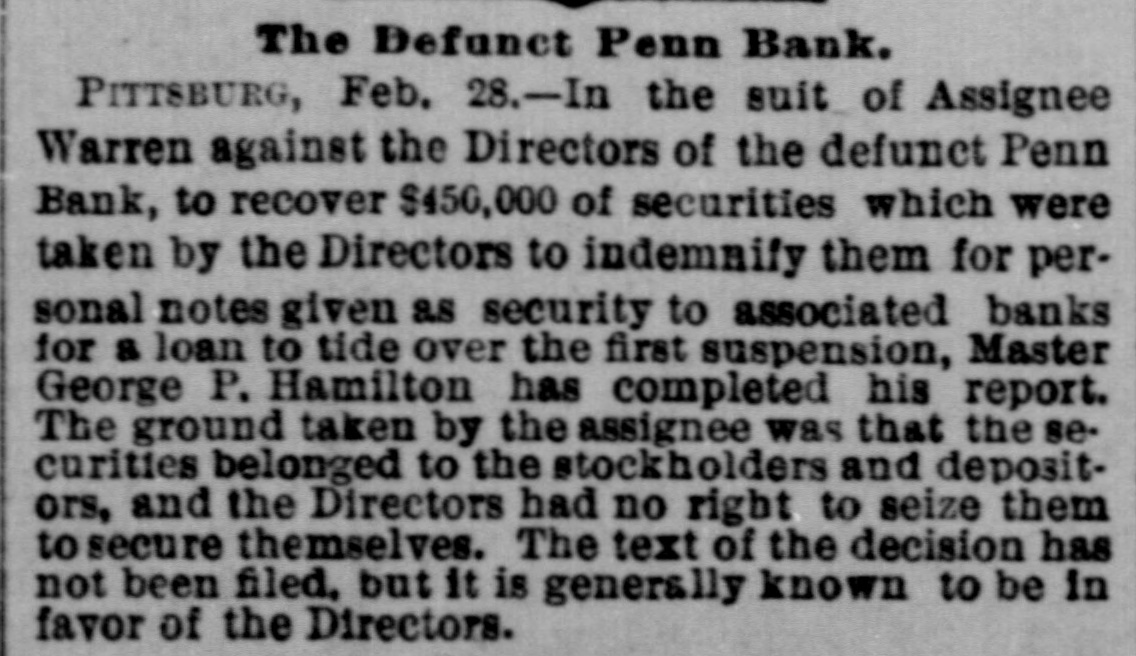
The Defunct Penn Bank. PITTSBURG, Feb. 28.-In the suit of Assignee Warren against the Directors of the defunct Penn Bank, to recover $450,000 of securities which were taken by the Directors to indemnify them for personal notes given as security to associated banks for a loan to tide over the first suspension, Master George P. Hamilton has completed his report. The ground taken by the assignee was that the securities belonged to the stockholders and depositors, and the Directors had no right to seize them to secure themselves. The text of the decision has not been filed. but it is generally known to be in favor of the Directors.
24.January 23, 1886New-York TribuneNew York, NY
Click image to open full size in new tab
Article Text
# HOTEL GOSSIP AND STRAY CHAT.
Senator Camden, of West Virginia, with his
white chin whiskers and mustache, in which there is
generally a trace of the constant chewing of tobacco,
is often seen in New-York. He is slightly stoop-shoul-
dered. In conversation he is one of the everyday men-
common, plain and sensible. I was chatting with him
on Monday about the inquiries made by the Senate Com-
mittees for information from the Executive branch of
the Government, when he said: "This is all poitties,
of course-sparring fer position. Every one understands
that. My own view of the matter is that the Senate has
no right to ask the President his reasons for the suspen-
pension of an officer. That act is his Presidential and ex-
ecutive prerogative. If a Senator votes for a confirmation
or against a confirmation no one has the right to ask him
for the reasons why he so voted. That is the Senatorial
prerogative. If the Senate should ask the President for
his reason for suspending an official he has only to an-
swer that he did it for reasons satisfactory to himself
and for the good of the service. Then he has the Senate
in a hole. The Senate has, however, a right to all the
information regarding an appointment that is submitted
for confirmation. It has also a right to any information
from the Departments, unless, possibly, from the State
Department in the matter of secret negotiations within
the province of the President and the Secretary of
State."
I fell into conversation with the Senator about the
charges made in regard to the election of Senator Payne
of Ohio, when he said: "Although I have been actively
engaged in politics and political movements of all kinds
for over twenty years, I have never in all that time
known of any transaction that amounted to the direct
sale or purchase of a vote. I do not believe we are any
more virtuous in West Virginia than they are in Ohio, or
In other States. I have known money to be spent freely
in politics in various ways by which votes were in-
fluenced and secured. We pay the bright men to organ-
ize their friends, and as it takes time for the work the
pay is generally liberal. So it is customary to pay the
expenses of men running for the Legislature who can-
not afford to go into that body for the mere pittance that
is paid them. But such things are always done
through the committees. I am inclined to
think that this talk about buying members at Columbus
has come about through the fact that several of the men
who were there to advocate Mr. Payne's election are in
the habit of spending money lavishly in their everyday
affairs. They spent money liberally at Columbus and
paid the expenses of large numbers of persons to stay
there and help them in their fight. They may have paid
the expenses of persons who went over the State in Mr.
Payne's Interest. These men who went over the State
may have been members of the Legislature. But I do
not believe that any member of the Legislature received
a dollar for his vote. I am positive too, that Senator Payne
himself had nothing whatever to do even with the pay-
ment of the expenses such as I have suggested."
Mayor Fulton, of Pittsburg, who is at the
Hoffman House, has a big face of hatchet shape, smooth-
shaven, and a powerful frame. He was a bell founder
before he became Mayor, and showed me proudly the
other day that the callouses were still on his hands. He
was backed for the Mayoralty by "Chris." Magee and
received the labor vote. He isn't exactly a moralist, and
there were people in Pittsburg who held up their hands
in horror at the idea of making him the city's chief ex-
ecutive, since he has been in office, so I am told by
Pittsburgers who opposed his election, he has managed
the city affairs with an iron hand and a grasp that has
not only astonished his opponents, but has created
genuine admiration for him. There has even been talk
of running him for Governor, but he has stopped it by
the emphatic declaration that he knows enough to run a
Mayor's office, but would have to let other men run the
Governor's office if he were put there, and that he does
not propose to undertake any business or accept any
office that he cannot run himself.
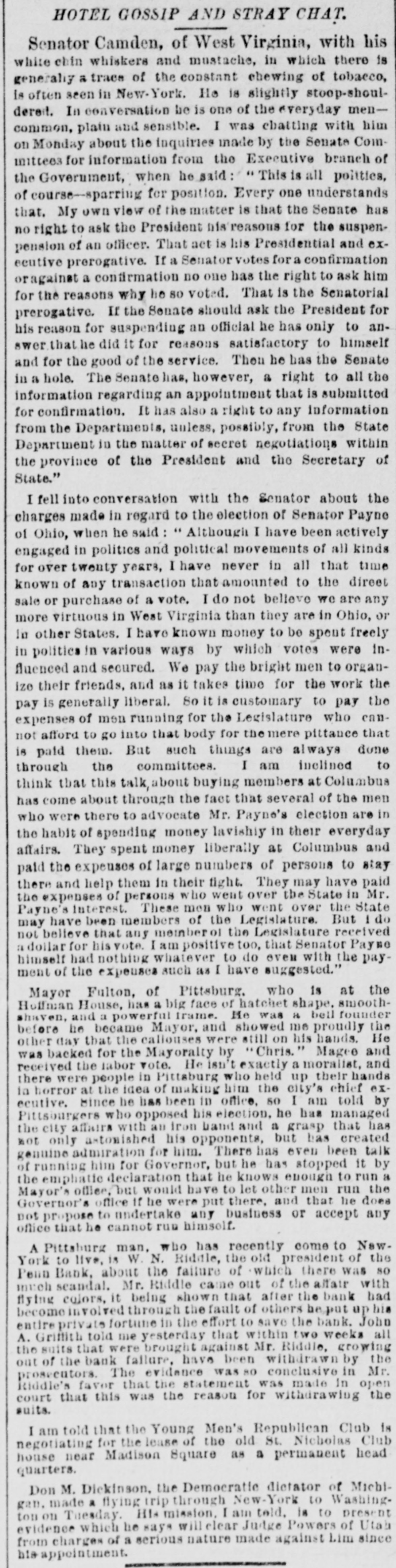
A Pittsburg man, who has recently come to New-
York to live, is W. N. Riddle, the old president of the
Penn Bank, about the failure of which there was so
much scandal. Mr. Riddle came out of the affair with
flying colors, it being shown that after the bank had
become involved through the fault of others he put up his
entire private fortune in the effort to save the bank. John
A. Griffith told me yesterday that within two weeks all
the suits that were brought against Mr. Riddle, growing
out of the bank failure, have been withdrawn by the
prosecutors. The evidence was so conclusive in Mr.
Riddle's favor that the statement was made in open
court that this was the reason for withdrawing the
suits.
I am told that the Young Men's Republican Club is
negotiating for the lease of the old St. Nicholas Club
house near Madison Square as a permanent head
quarters.
Don M. Dickinson, the Democratic dictator of Michi-
gan, made a flying trip through New-York to Washing-
ton on Tuesday. His mission, I am told, is to present
evidence which he says will clear Judge Powers of Utah
from charges of a serious nature made against Lim since
his appointment.