16746. Yorkville Savings Bank (New York, NY)

Bank Information

Episode Type
Suspension → Closure
Bank Type
savings bank
Start Date
July 10, 1877
Location
New York, New York (40.714, -74.006)

Metadata

Model
gpt-5-mini
Short Digest
a6d77c9e

Response Measures

None

Description

The Yorkville Savings Bank was enjoined/suspended by the NY Bank Superintendent/Attorney General in July 1877 and a receiver (Vedder Van Dyck) was appointed. There is no contemporaneous description of a depositor run; the closure was by court order and the bank remained in receivership with large reported deficiencies, so this is a suspension followed by permanent closure/receivership.

Events (2)

1. July 10, 1877 Suspension
Cause
Government Action
Cause Details
Injunction obtained by the Attorney General on recommendation of the State Bank Superintendent (order to restrain the bank from exercising corporate rights).
Newspaper Excerpt
The Yorkville Savings Bank ... was closed yesterday on an order of injunction issued by Judge Landon ...
Source
newspapers
2. July 13, 1877 Receivership
Newspaper Excerpt
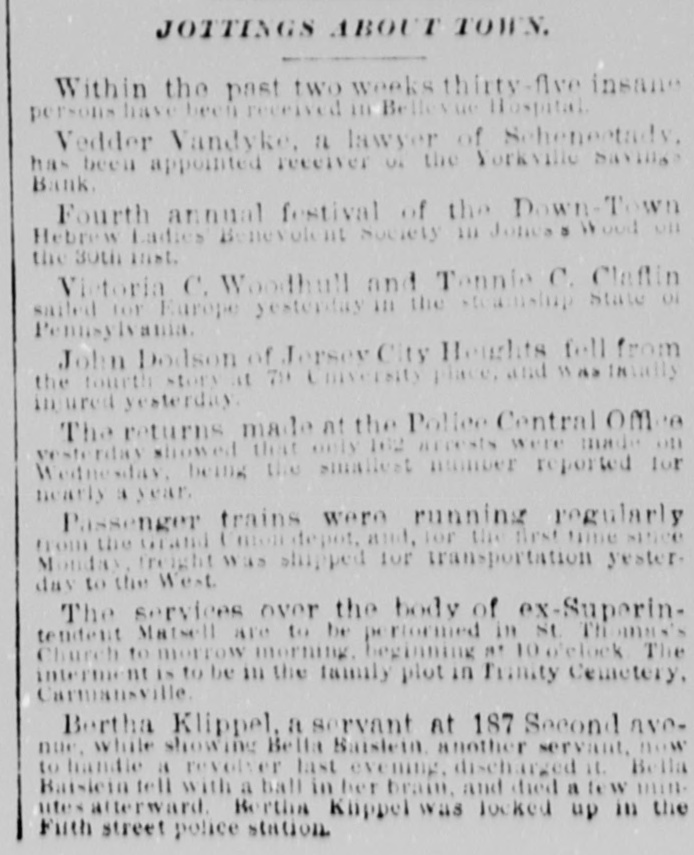
Within the past two weeks thirty-five insane persons ... Vedder Vandyke, a lawyer of Schenectady, has been appointed receiver of the Yorkville Savings Bank. (JOTTINGS ABOUT TOWN.) The Yorkville Savings Bank... the receiver's office was at No. 291 Broadway, room 29. At this address ... Vedder Van Dyck himself answered to the appellation of receiver, ... collected from all sources some $2,200 in cash. Vedder Van Dyck, the receiver of the Yorkville Savings Bank, in his report ... states ... the condition on December 10, 1877 ... (report).
Source
newspapers

Newspaper Articles (16)

Article from Evening Star, July 12, 1877

Click image to open full size in new tab

Article Text

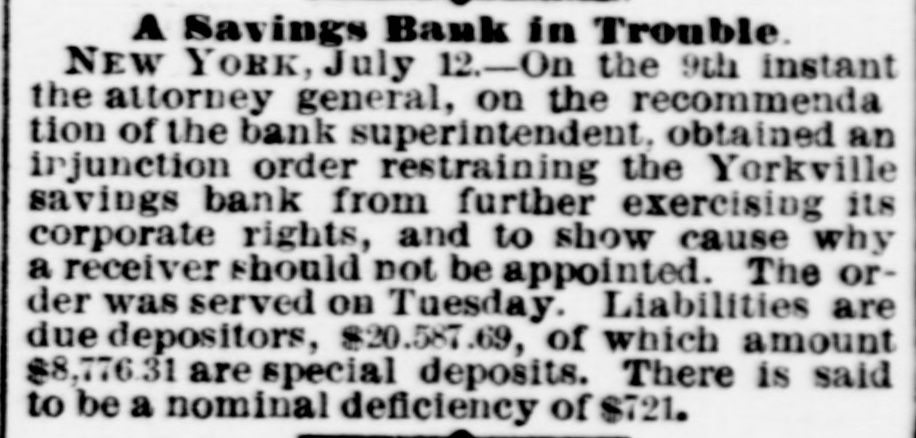
A Savings Bank in Trouble. NEW YORK, July 12.-On the 9th instant the attorney general, on the recommenda tion of the bank superintendent, obtained an injunction order restraining the Yorkville savings bank from further exercising its corporate rights, and to show cause why a receiver should not be appointed. The order was served on Tuesday. Liabilities are due depositors, $20.587.69, of which amount $8,776.31 are special deposits. There is said to be a nominal deficiency of $721.


Article from New-York Tribune, July 12, 1877

Click image to open full size in new tab

Article Text

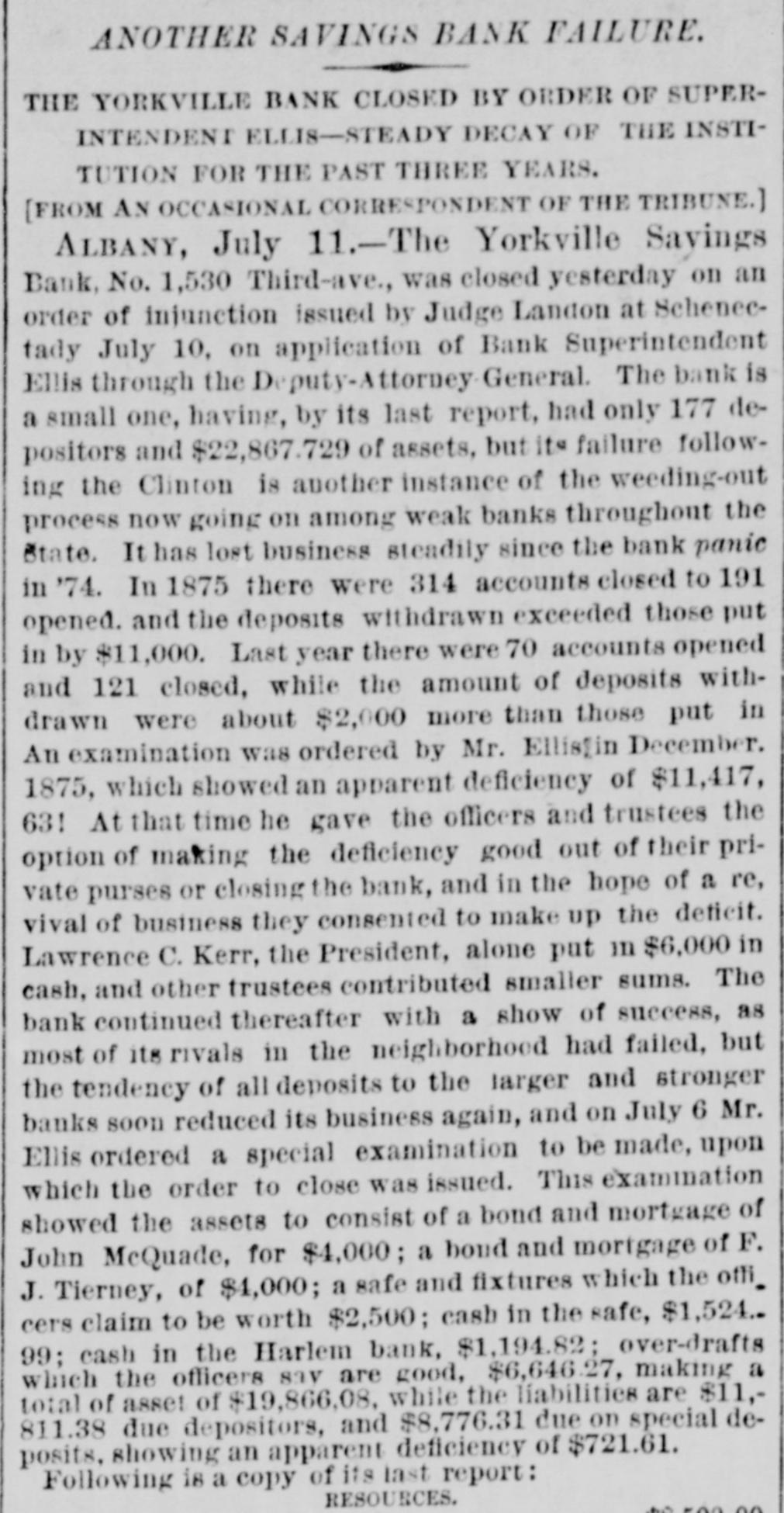
ANOTHER SAVINGS BANK FAILURE. THE YORKVILLE BANK CLOSED BY ORDER OF SUPERINTENDENT ELLIS-STEADY DECAY OF THE INSTITUTION FOR THE PAST THREE YEARS. [FROM AN OCCASIONAL CORRESPONDENT OF THE TRIBUNE.] ALBANY, July 11.-The - Yorkville Sayings Bank, No. 1,530 Third-ave., was closed yesterday on an order of injunction issued by Judge Landon at Scheneetady July 10, on application of Bank Superintendent Ellis through the Deputy-Attorney General. The bank is a small one, having, by its last report, had only 177 depositors and $22,867.729 of assets, but its failure following the Clinton is another instance of the weeding-out process now going on among weak banks throughout the State. It has lost business steadily since the bank panic in '74. In 1875 there were 314 accounts closed to 191 opened. and the deposits withdrawn exceeded those put in by $11,000. Last year there were 70 accounts opened and 121 closed, while the amount of deposits withdrawn were about $2,000 more than those put in An examination was ordered by Mr. Ellistin December. 1875, which showed an apparent deficiency of $11,417, 631 At that time he gave the officers and trustees the option of making the deficiency good out of their private purses or closing the bank, and in the hope of a re, vival of business they consented to make up the deficit. Lawrence C. Kerr, the President, alone put in $6,000 in cash, and other trustees contributed smaller sums. The bank continued thereafter with a show of success, as most of its rivals in the neighborhood had failed, but the tendency of all deposits to the larger and stronger banks soon reduced its business again, and on July 6 Mr. Ellis ordered a special examination to be made, upon which the order to close was issued. This examination showed the assets to consist of a bond and mortgage of John McQuade, for $4,000; a bond and mortgage of F. J. Tierney, of $4,000; a safe and fixtures which the offi cers claim to be worth $2,500; cash in the safe, $1,524.. 99; cash in the Harlem bank, $1,194.82; over-drafts which the officers say are good, $6,646.27, making a total of asset of $19,866.08. while the liabilities are $11,811.38 due depositors, and $8,776.31 due on special deposits, showing an apparent deficiency of $721.61. Following is a copy of its last report: RESOURCES.


Article from The New York Herald, July 13, 1877

Click image to open full size in new tab

Article Text

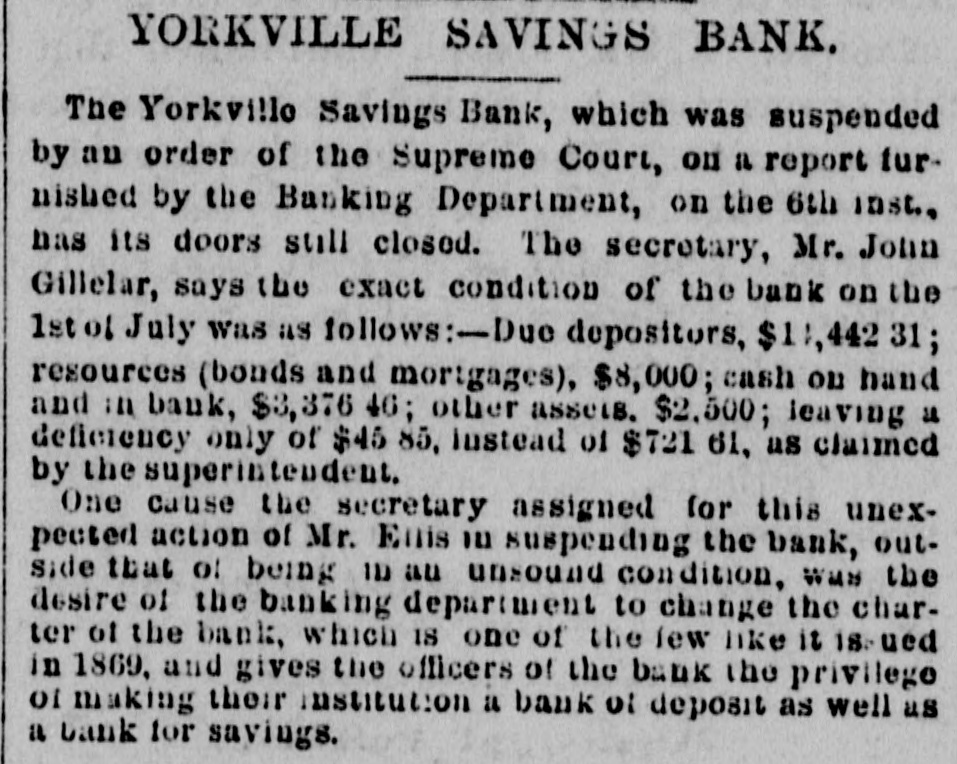
YORKVILLE SAVINGS BANK. The Yorkvillo Savings Bank, which was suspended by an order of the Supreme Court, on a report turmislied by the Banking Department, on the 6th lost., has its doors still closed. The secretary, Mr. John Gillelar, says the exact condition of the bank on the 1st of July was as follows:-Due depositors, $11,442 31; resources (bonds and mortgages), $8,000; cash ou hand and ill bank, $3,376 46; other assets. $2,500; leaving is deficiency only of $45 85, instead of $721 61, as claimed by the superintendent. One cause the secretary assigned for this unexpected action of Mr. Emis 111 suspending the bank, outside that of being ID au unsound condition, was the desire of the banking department to change the charter of the bank, which IS one of the few like it 18. ued in 1869, and gives the officers of the bank the privilege of making their institution is bank of deposit as well as a bank for savings.


Article from The New York Herald, July 17, 1877

Click image to open full size in new tab

Article Text

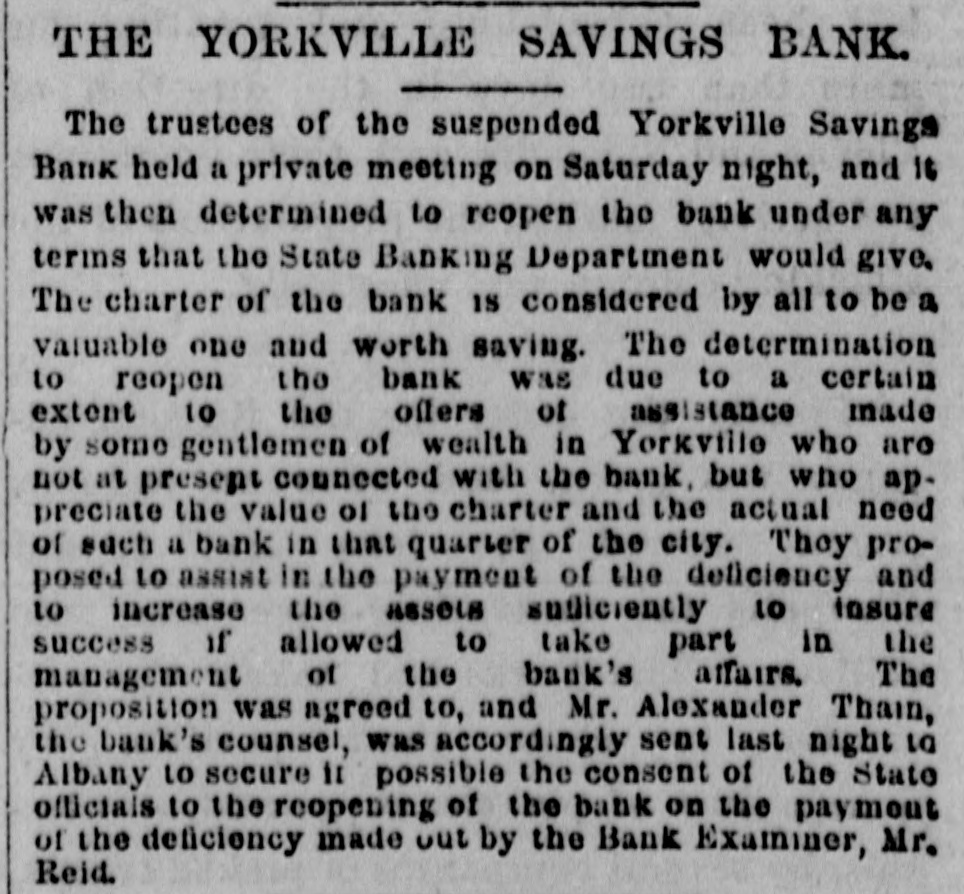
THE YORKVILLE SAVINGS BANK. The trustees of the suspended Yorkville Savings Bank held a private meeting on Saturday night, and it was then determined to reopen the bank under any terms that the State Banking Department would give. The charter of the bank IS considered by all to be a valuable one and worth saving. The determination to reopen the bank was due to a certain extent 10 the offers of assistance made by some gentlemen of wealth in Yorkville who are not at present connected with the bank, but who appreciate the value of the charter and the actual need of such a bank in that quarter of the city. They proposed to assist in the payment of the deficiency and to increase the HOSOLA sufficiently 10 insure success if allowed to take part in the management of the bank's affairs. The proposition was agreed to, and Mr. Alexander Thain, the bank's counsel, was accordingly sent last night to Albany to secure it possible the consent of the State officials to the reopening of the bank on the paymout of the deficiency made out by the Bank Examiner, Mr. Reid.


Article from Essex County Herald, July 21, 1877

Click image to open full size in new tab

Article Text

SUMMARY OF NEWS. Interesting Items from Home and Abroad. In India over .250 .000 persons are receiving from Troops famine Gen. Ord crossed th Rio Grande into Mexico in pursuit of band of horse thieves, with whom they had severe fight and defeated recovering the stolen horses. The event caused considerable excitement throughout the countrv. as the occupation of Mexican territory by American troops is supposed to be the result of the policy determined upon by the towards Mexican on the border The plague is raging in portion of Persia, and many persons There daily are will dying will be State election in Alabama and Kentucky, August California and Vermont Septe Maine. September 10 Colorado Iowa and Ohio, October 25 Louisiana, Massa chusetts, Minnesota Mississippi, Nevada New Jersey, New York, Pennsylvania, South Carolina, Tennessee, Texas, Virginia and Wisconsin November Dr. W Gadding of Taunton Mass., has been appointed of Dr Nicholls intendent of the government hospital for the insane at Washington A tornado in Wisconsin destroyed the lumbering village of Pensaukee, killing eight persons and severely injuring about twelve others, All the buildings in the village -including hotel, schoolhouse and lumber mills swept away. The neighboring town of Coullardville was also severely damaged. The one hundredth anniversary of the capture of the British General Prescott at Ports mouth, R. was celebrated monument to P Bliss, the evangelist and writer of popular religious songs, who was killed at the Ashtabula railroad accident was dedicated at Rome. Pa Capt in brackett, the revenue officer who recently unearthed huge and systematic silk smuggling scheme in New been has York removed The German car Bank of St. Lonis has suspended A riage containing two ladies and two gentlemen was upset in the canal about six miles from Trenton, N and Dr. E. H Reed and one of the ladies were drowned The steamer Granger was destroyed by fire on the Mississippi, near Little Rock. Ark During desperate fight between about dozen men at Chester, Pa., two of them were badly, if not fatally stabbed The international cotton convention opened its in session Liverpool About forty men were overcome by coal gas from furnace used in coal mine near Wheatland, Pa., and seven were taken out dead The Iowa Greenback convention met at Des Moines, adopted a platform and nominated a State ticket The bank superintendent of the State of New York closed the Yorkville Savings bank, an examination having shown that there was deficiency of about $700 Mrs John Green, living near Roanoke, Mo. was shot by her husband and mortally wounded A few days after a party of fifty men took Green from the custody An of the sheriff and hung him to tree engine and caboose near Greenfield, Mass. ran into team contaning party returning from berrying and the whole party of five personsone man and four wome killed A gang of about twenty young men con gregated in front of the military barracks in Montreal and attem pted to force an entrance by wresting the rifle from the hands of the sentry and stoning him. The sentry fixed his bavonet and one of his assailants through the body. kill ing him, while the rest of the rioters were dispersed by the police Frank Wilson was hung Harrisburg, Pa. for the murder of John B. Rudy. one-armed man, last summer the ob John Mcject of the crime being robber Nulta, of Illinois, has been appointed minister Brazil Secretary Evarts and General Devens. among others of the cabinet wil soon visit the coal mines of Pennsylvania. General Grant arrived at Frankfort-on-the Maine, Germany where a banquet was given in his honor young man named Hackett belonging to the order of Orangemen, was sur rounded by crowd of men and boys in Montreal, and after desperate struggle was shot dead. This occurred on the twelfth of July the day which is observed by Orangement in commemoration of the battle of the Boyne This year great deal of troubl on that day was antici pated in Montreal and the police force and military made extent ations to quell any disturbance that might occur but as the Orange lodges resolved to have no parade at the last moment the day passed without the occurrence of the sanguinary riot which was expected, although the streets were filled with armed and excited crowds, and the shooting affair above noted took place The Indian war in the West has become so serious that the President may call out the Pacific coast militia The superintendent of insurance of New York reports deficiency in the Universal life insurance company of over 1,000,000, and the attorney -general has for the appointment of receiver Capt James Werner died in Warwick, R aged He Free ninety years. made -eight Mason in Providence in 1803. and is believed to have been the oldest Mason in the United States The subscription to the new four per cent loan amounts to over $25,000,000 and the bonds are at par in London The President has offered the mission to Bismarch Prince Russia to Bavard Taylor declares the mediation between Turkey and Indemnity Russia impossible at present for outrages upon American vessels is to be demanded from Spain by the President Several dealers in New York who used false weights and measures have been exposed, and charges have been made against an inspector. Poindexter Edmonson who was convicted of murder months ago and once respited at the last moment was hung at Bloomfield. Missourl for the murder of man named Shaw. Edmonson protested his to near the last train passenger Missour track the Murphysboro jumped and the whole train was thrown into creek. Every passenger was in jured more less severely Six striking sill weavers in Paterson, N J. were sent to jail to answer a suit for damages not finishing their warps David and Pierce according to contract George Stevens were hung in Charleston C. for the murder of young man named Edings last May, the purpose of their crime being robbery. A party of thirty-one Chinamen were sur prised by the Indians who revolted in Idaho and Oregon recently and all but one of the An Celestials were killed official spatch from General Howard by way of Portland Oregon, states that the Indians were routed after severe engagement near the mouth the Cottonwood. The savages were about 300 strong and they lost about thirteen killed and large number of wounded. while the loss of the ound troops was eleven killed and twenty-six two The ed. Butchers includ ng and Drovers' bank of Sf. Louis has A boiler exploded in mine nine from Macungie and three men were stantly killed and five fatally and three seri broker revolution has A onsly wounded Moore Beatty out in San Domingo wealthy builder of Philadelph went to the rescue of Mrs. Matilda Phillips of New York who was drowning in the surf at Atlantic City of N. taken water out were Both the conscious, and it was found impossible vive them A result of the bitter feeling engendered by the trouble of the twelfth July another desperate fight broke out days after between the Orangemen and Catho lies of Montreal, One man was fatally wound ed. and the city was for time under control of mob Daniel Mur phv and Michael Cahil quarreled after night of dissipation togethe in New York and Murphy hurled brick at Cahill knocking him down His head struck stone as he fell and he died of a fractured be will There skull genera an hour in election in France on the eleventh of Septem ber.


Article from The Sun, July 27, 1877

Click image to open full size in new tab

Article Text

JOTTINGS ABOUT TOWN. Within the past two weeks thirty-five insane persons have been received 111 Bellevue Hospital. Vedder Vandyke, a lawyer of Schenectady, has been appointed receiver U. the Yorkville Savings Bank. Fourth annual festival of the Down-Town Hebrew Ladies Benevolent Society 111 Jones # Wood on the 30th inst. Victoria C. Woodhull and Tennie C. Claftin sailed for Europe yesterday 111 the steamship State or Pennsylvania. John Dodson of Jersey City Houghts fell from the fourth story it 711 University place, and was family injured yesterday. The returns made at the Police Central Office vesterday showed that only 162 arrests were made on Wednesday, being the smallest number reported for nearly a year. Passenger trains were running regularly from the Grand depot, and, for the first time since Monday, freight was shipped for transportation yester. day to the West. The services over the body of ex-Superintendent Matsell are to be performed in St. Thomas's Church to morrow morning. beginning at 10 o'elock The interment is to be in the family plot in Primity Ceinetery, Carmansville. Bertha Klippel, a servant At 187 Second avenue. while showing Bella Baistein. another servant, now to handle a revolver last evening, discharged 11. Bella Baislein tell with a ball in her brain, and died a few 111111utes atterward. Bortha Khppel was locked up in the Firth street police station.


Article from The New York Herald, December 5, 1877

Click image to open full size in new tab

Article Text

POLITICS AND SAVINGS. The Incongruity of the Two Aptly Illustrated. A LITTLE YORKVILLE BANK One of Harry Genet's Commercial Adventures and Its Sorry Results. In the year 1869, when Harry Genes was rejoicing in his political strength and accumulating fortunes, one of his speculative humors turned in the direction of Yorkville, which he deemed to be sadiy in need of a savings bank. It seemed to him a proper thing that the industrious people of that section of the city should have some little convenient institution in which to deposit such a proportion of their weekly earnings as circumstances would permit them to lay by. Mr. Genet was a philanthropist, 100, and, seeing a hard time abead (for others, if not for himself), he yearned to implant an early disposition for economy among the working classes of Yorkville. Thus It happened that the Yorkville Savings Bank sprang into existence under a very favorable charter, which permitted the officers to accept deposits as well as sav. ings. The list of organizers was selected mainly from the ranks of Mr. Genet's acquaintances, and not a few of them will be recollected by those familiar with the city polities of that day. Their names were as follows:-President, Harry Genet: Vice Presidents, John McQuaue and Thomas Crombie; Secretary, John Gillelan; Trustees, Bernard Kelly, John B. McKeon, Thomas Donsbue, Jeremiah Feore, John S. Mastertoo, William H. Johnson, Peter McGinnis, Laurence R. Kerr, Gilbert Palmer, Prank S. Tuomey, Edward A. Moore, Isaac Edwards, John M. Hall, Michael McCunn, with the loug officers first named. ON ITS LEGS. So the philauthropic plan was inaugurated, and an office was opened on Third avenue, near Eighty-eighth street. Mr. Genet contributed a safe, furnished by Messrs. McBride Davidson & Co., for which that worthy officer was duly rewarded by a vote of thanks from the trustees. The Industrious people of York. ville were invited to deposit their carnings with the new and promising concern, and for the convenience of the hardest working classes the doors were kept open on three evenings of each week. As an infant the bank flourished moderately, but history must record the painful truth that its second childhood fell where its first should have begun. Outsidethe few good souls who devoted themselves to its management and the depositors, little was known of the bank until the time when Mr. Genet found it convenient to leave the city. For some time before that, personal matters had so occupied his time that it may be supposed the interests of the bank were allowed to languish. When he left he sent in a formal resignation, which was accepted. An examination soon alterward showed that the bank's affairs did not altogether balance. and a few thousand dollars were wisely contributed by the officers "10 keep the thing going." SOMETHING WRONG AGAIN. But these generous men bad not reached their last point of sacrifice. Among the (at one time) assets of the concern were $10,000 bonds of the Alabama and Chattanooga Railroad. These defaulted in interest after the second instalment and became virtually of no value. Nevertheless both the bonds and accrued interest were carried as assets and so reported to Albany. Au "examination took place in December, 1875, when is was discovered that the bonds were worthless and the officers were ordered to replace them. The then President, Mr. Laurence R. Kerr, donated $6,000 in cash for this purpose, and she balance was made up by two mortgages-one from Frank S. Tuomey, the then Vice President and Clerk of the Common Council, for $4,000, and another from John McQuade for a similar amount. From this time the bank eked out an existence, with no visible means of support. The Yorkvillers did not seem to feel the same amount of confidence in " that Mr. Genet and his friends had done. Perhaps the largest business done with any single depositor was with one Horace F. Tilden, and that was afterward regretted, as will appear below. On the 6th of last June another examination was made by the Bank Superintendent, and deficiency of $700 appeared. Thereupon Judge Landon was applied to at Schenectady and on June 10 an order Was granted suspending the business of the bank. Later on in the same month Mr. Vedder Van Dyck was appointed receiver, and he alterward employed Mr. C. H. W. Sibley, an accountant, to make an analysis of the little institution. ANXIOUS DEPOSITORS. For a few months past those who have been awaiting adividend from the assets of the bank have become naturally irritated at the silence of the receiver. The official examination showed but a small deficiency, and high hopes were entertained of a large dividend. The report made to Superintendent Eilis showed liabilities of $20,587 69 and assets of $19, 866 08. or the latter sum $8,000 lay in the two bonds and mortgages of Tuomey and McQuade, ciready mentioned; safe and fixtures, $2,500; cash, $2,729 81, and overdratts claimed to be good by officers, $6,646 27. The bank's statement of the preced ng January claimed surplus of $504 65. Amoug the assets as then reported Bonds and mortgages, $8,500; Long island City bonds, $5,702 50; cash in other banks, $2,462 92, and cash on band, $2,841 24. The writer undertook yesterday to discover what remained of the once beautiful institution, and where the remoant was buried. At No. 1,530 Third avenue, the former office, he found a placard stating that the receiver's office was at No. 291 Broadway, room 29. At this address, and until Mr. Vedder Van Dyck himself answered to the appellation of receiver, there was nothing observable to denote that the Yorkville Savings Bank had ever been heard of in that locality. Such au experience alone would be sufficiently discouraging to depositors, but a conversation with Mr. Van Dyck was enough to dispel all hope He began by saying that the absence 01 Mr. Sibley had somewhat deferred his making report to the Court. He said he had collected from all sources some $2,200 in cash. This included what he had lound in the office of the bank, in other banks and recovered from overdrafts. He thought the turniture and safe would realize about $500 at auction sale and there were the two mortgages for $4,000 each, which completed the list of assets. But of the two concluding items there were some explanations to be made. WHO OWNS THE SAFE? The members of the old set, of which Mr. Genet was one, were never put to much expense in obtaining little articles for their personal use. So it happened that Mr. Genet presented his bank with a safe, and was duly thanked by the trustees. When Messrs McBride Davidson & Co. got into the hands of re. ceiver, in 1875, the Inter brought RUIS against the savings bank for the price of the safe, $2,500. He claimed that it had been sold to Mr. Genet the Prestdent, not to Mr. Genet the politician. This suit isstill pending, and It may not matter much to the depositors whether that sale will bring at auction $500 or $2,500. THE MORTGAGES. The receiver then went on to explain that both of the $4,000 mortgages were contested by the mortgagors. They were given in the early part of 1876, and in the early part of 1877 Mr. Tuomey handed in his resignation, and requested that bis mortgage be returned, as he wished to sell the property. The mortgage had been recorded, but Mr. Tuomey claimed that 11 and never been intended, and ollered a new one for the same amount, in order to satisfy the first of record. The Executive Committee referred the subject to Mr. Alexander Thain to "draw up and ex. amine. Mr. Thain newly elected member of the
Article from New-York Tribune, December 12, 1877

Click image to open full size in new tab

Article Text

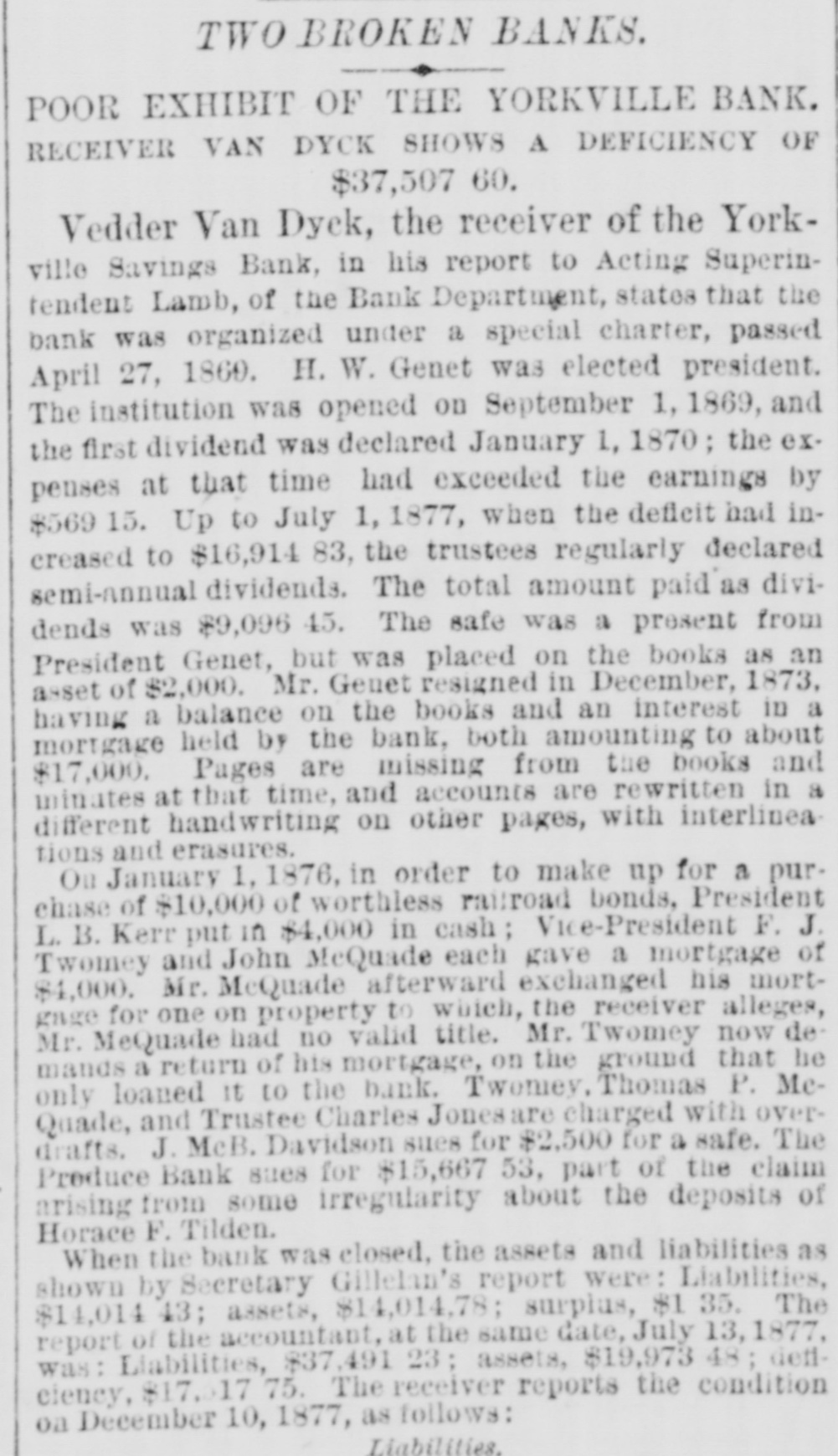
TWO BROKEN BANKS. POOR EXHIBIT OF THE YORKVILLE BANK. RECEIVER VAN DYCK SHOWS A DEFICIENCY OF $37,507 60. Vedder Van Dyck, the receiver of the Yorkville Savings Bank, in his report to Acting Superintendent Lamb, of the Bank Department, states that the bank was organized under a special charter, passed April 27, 1860. H. W. Genet was elected president. The institution was opened on September 1, 1869, and the first dividend was declared January 1, 1870; the expenses at that time had exceeded the earnings by $569 15. Up to July 1, 1877, when the deficit had increased to $16,914 83, the trustees regularly declared semi-annual dividends. The total amount paid as dividends was $9,096 45. The safe was a present from President Genet, but was placed on the books as an asset of $2,000. Mr. Genet resigned in December, 1873, having a balance on the books and an interest in a mortgage held by the bank, both amounting to about $17,000. Pages are missing from the books and minutes at that time, and accounts are rewritten in a different handwriting on other pages, with interlineations and erasures. On January 1, 1876, in order to make up for a purchase of $10,000 of worthless railroad bonds, President L. B. Kerr put in $4,000 in cash; Vice-President F. J. Twomey and John McQuade each gave a mortgage of $4,000. Mr. McQuade afterward exchanged his mortgage for one on property to which, the receiver alleges, Mr. MeQuade had no valid title. Mr. Twomey now demands a return of his mortgage, on the ground that he only loaned it to the bank. Tweniey, Thomas P. MeQuade, and Trustee Charles Jonesare charged with overdrafts. J. McB. Davidson sues for $2,500 for a safe. The Produce Bank sues for $15,667 53, part of the claim arising from some irregularity about the deposits of Horace F. Tilden. When the bank was closed, the assets and liabilities as shown by Secretary Gillelan's report were: Liabilities, $14,014 43; assets, $14,014,78; surplus, $1 35. The report of the accountant, at the same date, July 13,1877, was: Liabilities, $37,491 23; assets, $19,973 48; deficiency, $17,517 75. The receiver reports the condition on December 10, 1877, as follows: Liabilities.


Article from The New York Herald, December 12, 1877

Click image to open full size in new tab

Article Text

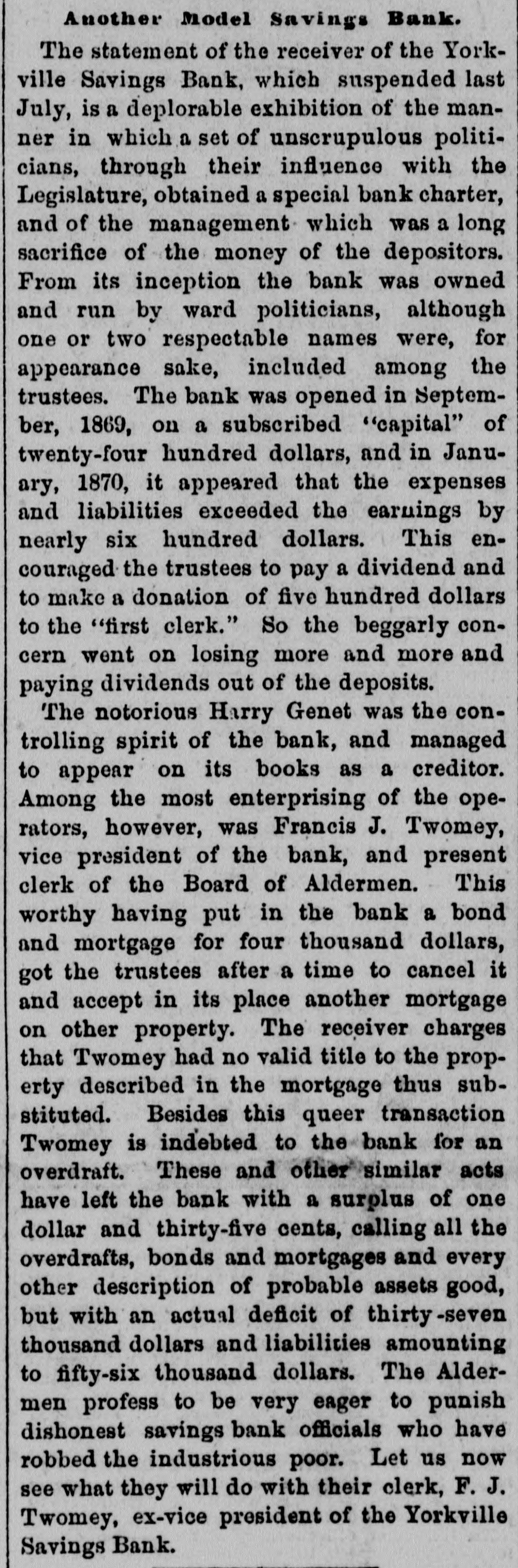
Another Model Savings Bank. The statement of the receiver of the Yorkville Savings Bank, which suspended last July, is a deplorable exhibition of the manner in which a set of unscrupulous politicians, through their influence with the Legislature, obtained a special bank charter, and of the management which was a long sacrifice of the money of the depositors. From its inception the bank was owned and run by ward politicians, although one or two respectable names were, for appearance sake, included among the trustees. The bank was opened in September, 1869, on a subscribed "capital" of twenty-four hundred dollars, and in January, 1870, it appeared that the expenses and liabilities exceeded the earnings by nearly six hundred dollars. This encouraged the trustees to pay a dividend and to make a donation of five hundred dollars to the "first clerk." So the beggarly concern went on losing more and more and paying dividends out of the deposits. The notorious Harry Genet was the controlling spirit of the bank, and managed to appear on its books as a creditor. Among the most enterprising of the operators, however, was Francis J. Twomey, vice president of the bank, and present clerk of the Board of Aldermen. This worthy having put in the bank a bond and mortgage for four thousand dollars, got the trustees after a time to cancel it and accept in its place another mortgage on other property. The receiver charges that Twomey had no valid title to the property described in the mortgage thus substituted. Besides this queer transaction Twomey is indebted to the bank for an overdraft. These and other similar acts have left the bank with a surplus of one dollar and thirty-five cents, calling all the overdrafts, bonds and mortgages and every other description of probable assets good, but with an actual deficit of thirty -seven thousand dollars and liabilities amounting to fifty-six thousand dollars. The Aldermen profess to be very eager to punish dishonest savings bank officials who have robbed the industrious poor. Let us now see what they will do with their clerk, F. J. Twomey, ex-vice president of the Yorkville Savings Bank.


Article from The New York Herald, December 12, 1877

Click image to open full size in new tab

Article Text

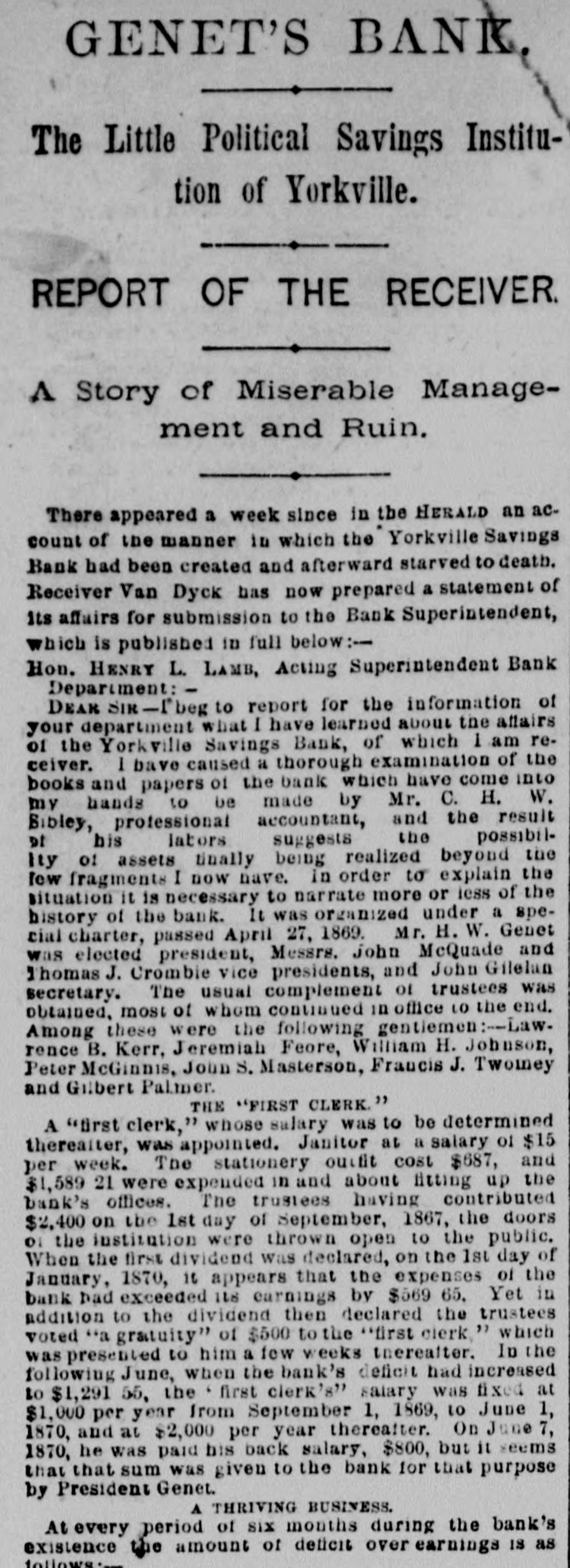
GENET'S BANK. The Little Political Savings Institution of Yorkville. REPORT OF THE RECEIVER. A Story of Miserable Management and Ruin. There appeared a week since in the HERALD an ac- count of the manner in which the Yorkville Savings Bank had been created and afterward starved to death. Receiver Van Dyck has now prepared a statement of its affairs for submission to the Bank Superintendent, which is published in full below:-- Hon. HENRY L. LAMB, Acting Superintendent Bank Department: - DEAR SIR-I beg to report for the information of your department what I have learned about the affairs of the Yorkville Savings Bank, of which I am re- ceiver. I have caused a thorough examination of the books and papers of the bank which have come into my hands to be made by Mr. C. H. W. Bibley, professional accountant, and the result of his labors suggests the possibil- ity of assets finally being realized beyond the few fragments I now have. in order to explain the situation it is necessary to narrate more or less of the history of the bank. It was organized under a spe- cial charter, passed April 27, 1869. Mr. H. W. Genet was elected president, Messrs. John McQuade and Thomas J. Crombie vice presidents, and John Gilelan secretary. The usual complement of trustees was obtained, most of whom continued in office to the end. Among these were the following gentlemen:--Law- rence B. Kerr, Jeremiah Feore, William H. Johnson, Peter McGinnis, John S. Masterson, Francis J. Twomey and Gilbert Palmer. THE "FIRST CLERK." A "first clerk," whose salary was to be determined thereafter, was appointed. Janitor at a salary of $15 per week. The stationery outfit cost $687, and $1,589 21 were expended in and about fitting up the bank's offices. The trustees having contributed $2,400 on the 1st day of September, 1867, the doors of the institution were thrown open to the public. When the first dividend was declared, on the 1st day of January, 1870, it appears that the expenses of the bank had exceeded its earnings by $569 65, Yet in addition to the dividend then declared the trustees voted "a gratuity" of $500 to the "first clerk," which was presented to him a few weeks thereafter. In the following June, when the bank's deficit had increased to $1,291 55, the first clerk's" salary was fixed at $1,000 per year from September 1, 1869, to June 1, 1870, and at $2,000 per year thereafter. On June 7, 1870, he was paid his back salary, $800, but it seems that that sum was given to the bank for that purpose by President Genet. A THRIVING BUSINESS. At every period of six months during the bank's existence the amount of deficit over earnings is as follows


Article from The New York Herald, December 14, 1877

Click image to open full size in new tab

Article Text

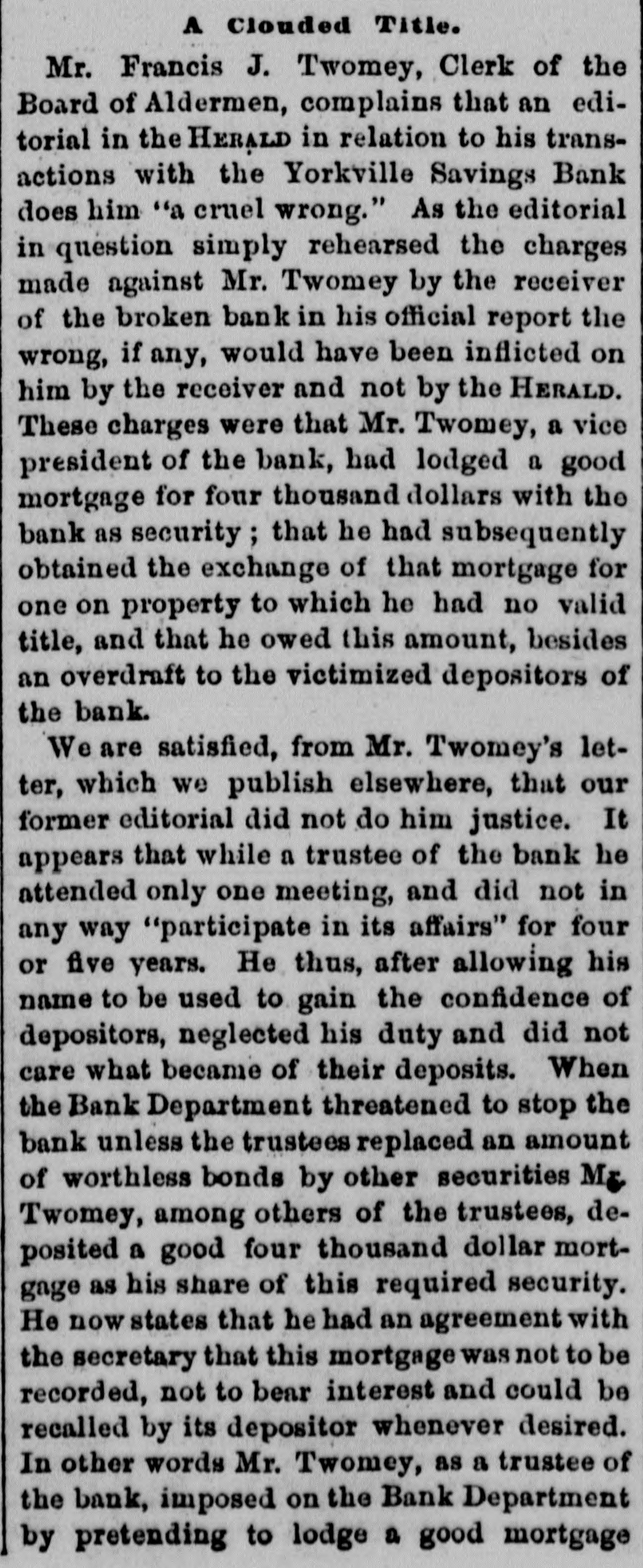
A Clouded Title. Mr. Francis J. Twomey, Clerk of the Board of Aldermen, complains that an editorial in the HERALD in relation to his transactions with the Yorkville Savings Bank does him "a cruel wrong." As the editorial in question simply rehearsed the charges made against Mr. Twomey by the receiver of the broken bank in his official report the wrong, if any, would have been inflicted on him by the receiver and not by the HERALD. These charges were that Mr. Twomey, a vice president of the bank, had lodged a good mortgage for four thousand dollars with the bank as security; that he had subsequently obtained the exchange of that mortgage for one on property to which he had no valid title, and that he owed this amount, besides an overdraft to the victimized depositors of the bank. We are satisfied, from Mr. Twomey's letter, which we publish elsewhere, that our former editorial did not do him justice. It appears that while a trustee of the bank he attended only one meeting, and did not in any way "participate in its affairs" for four or five years. He thus, after allowing his name to be used to gain the confidence of depositors, neglected his duty and did not care what became of their deposits. When the Bank Department threatened to stop the bank unless the trustees replaced an amount of worthless bonds by other securities M& Twomey, among others of the trustees, deposited a good four thousand dollar mortgage as his share of this required security. He now states that he had an agreement with the secretary that this mortgage was not to be recorded, not to bear interest and could be recalled by its depositor whenever desired. In other words Mr. Twomey, as a trustee of the bank, imposed on the Bank Department by pretending to lodge a good mortgage


Article from The New York Herald, January 23, 1878

Click image to open full size in new tab

Article Text

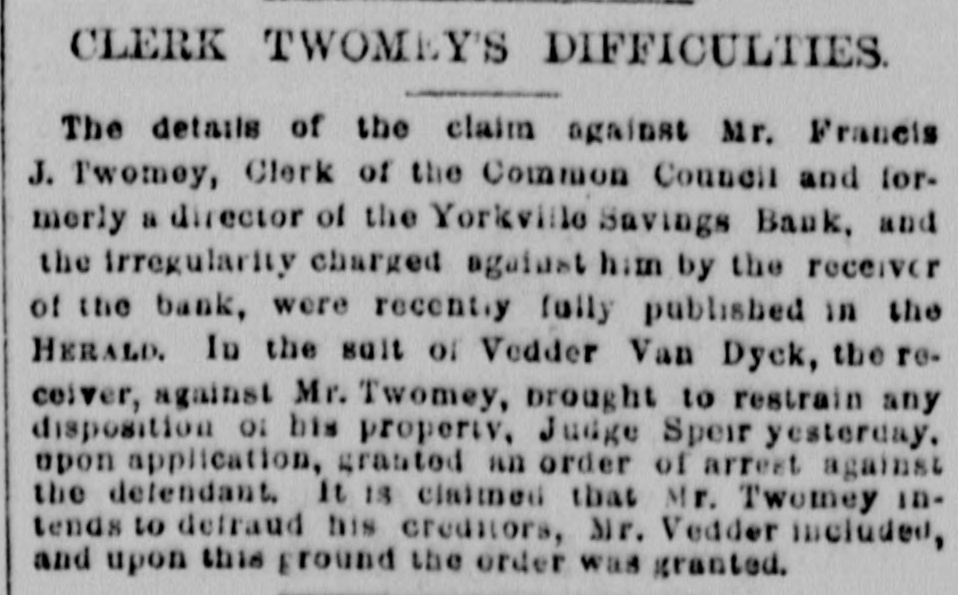
CLERK TWOMEYS DIFFICULTIES The details of the claim against Mr. Francis J. Twomey, Clerk of the Common Council and formerly a director of the Yorkville Savings Bank, and the irregularity charged against him by the receiver of the bank, were recently fully published in the HERALD. In the suit of Vedder Van Dyck, the receiver, against Mr. Twomey, brought to restrain any disposition or his property, Judge Speir yesterday. upon application, granted an order of arrest against the defendant. It is claimed that Mr. Twomey intends to defraud his creditors, Mr. Vedder included, and upon this ground the order was granted.


Article from The Forest Republican, April 17, 1878

Click image to open full size in new tab

Article Text

NEWS SUMMARY. Eastern and Middle States. Before & commistee of the Pennsylvania Legislature appointed to investigate the Pittsburgh railroad riots, R. A. Ammon, of Pitteburgh, who was at the head of the Trainmen's Union at the time of the strike, testified that the citizens offered the strikers arms to resist the troops two prominent citizens having of fered a hundred stand of arms each one of these citizens went to see him at Allegheny told him that he hoped the men would stand for their rights, and promised them arms and money. The steam chimney of the Hudson river steamer Magenta exploded two miles below Sing Sing, N. Y., and two passengers were killed outright, two were fatally scalded and several others received seriousinjuries. Warren Lane, bookkeeper of the Planet Mills Manufacturing Company, Brooklyn, N. Y., was returning from the company's bank in New York where he had drawn $4,000 with which to pay off the employees. He was ao companied by an assistant, who carried $700 in silver. When in an unfrequented locality they were approached by three men, dressed as laborers, who suddenly attacked the two, knocking them down with blows from sand clubs and relieving them of the money in a twinkling. Before they could gain their feet the thieves were rattling off in a wagon that was waiting in charge of a confederate and made good their escape. Peter McHugh, Patrick Hester and Patrick Tully were hanged at Bloomsburg. Pa., for the murder of mining superinteudent named Rea, in 1868. The town was filled with people from the surrounding country, but only about two hundred persons were admitted to the jail The yard where the execution took place, three men were hanged together, and exhibited little signs of fear. Hester, who was in substantial circumstances and for whom strenuous efforts had been made to obtain an amelioration of the death sentence, protested his innocence to the last. While the men were still hanging a shed on the side of the jail yard gave way with a crash, precipitating about fifty persons to the ground and injuring a little boy 80 severely that he died soon after. Fires Twenty-three buildings were destroyed by fire in Keeseville, N Y., causing a loss aggregating $65,000. Nearly a whole block of large business houses in Philadelphia was burned, the fire being one of the largest that has ever visited the city and causing an estimated loss of over $1,000,000. Comptroller John Kelly, of New York city, has written a letter to the attorney general of the State in favor of the release of William M. Tweed from further confinement. Comptroller Kelly says in his letter " As a public officer I urge his discharge, because I believe his further detention in a debtors' prison is neither beneficial to the State as an example to evildoers, nor in any sense serviceable to the Meanwhile. Tweed has refused to testify further in regard to ring frauds until he is released. The Higgins Building five-story marble structure on Canal street, New York-was almost totally destroyed by fire, and seventeen business firms suffered losses aggregating $645,000. Judge Blatchford, of New York, has rendered an opinion against ex-Governor Samuel J Tilden. in the suit of the United States for the recovery of several years income tax. This snit was instituted during the election campaign in 1876. The effect of the deci-ion will be to bring the case before a jury on the question of the amount of Mr. Tilden's income during the eleven years from 1862 to 1872, during which he made up no return himse'f, but allowed the assessor to make up the return and paid the tax thereon subject to a penalty of five per cent. The recent report of Acting Superintendent Henry L Lamb on the condition of the savings banks in the State of New York shows that nine savings banks were closed during 1877the Long sland. of Brooklyn: Clairmont, Clinton. German, Oriental and Yorkville, of New York Rock and of Nyack, Saratoga, of Saratoga Springs, and the New Rochelle, with a total amount due depositors of $1,601,719.34. In the State, to-day, 186 savings banks are doing business. The total deposits and the number of depositors have decreased during the year. The deposits fell off nearly $6,000,000 the transactions of the year were smaller in their volume than in other recent years more accounts were opened than were closed the average of each deposit declined, and the surplus of the institutions has shrunk. The total resources of the banks. now in operation, was on January 1. 1878, $56,786,336 total liabilities, $51,455,238, leaving a surplus of $5,331,098. From these facts the superintendent finds reason for the belief that the savings banks are coming back to sound rules in administration, are commanding reasonable confidence of depositors, and are sound. The Broadway Savings Bank, of Lawrence, Mass., and the Sixpenuy Savings Bank, of New York city have been enjoined from doing further business. The latter institution was patronized by the remarkably large number of 33.000 depositors, most of them poor people and children with little accounts. Its liabilities are $1,808 269 77, and the deficiency is estimated at #82, 425. Careless management. amounting almost to indifference, is charged against its officers by the bank examiners The trial of Insurance Superintendent Smyth, of New York, charged by the governor with regularities in office, ended in his acquittal by the Senate by & vote of 19 to 12. The Vanderbilt contested will case drag along in the New York surrogate's court. Much of the evidence offered to show that the Commodore wasmentally unsound or unduly influenced in making his will is excluded. The Pennsylvania Republican State convention will be held at Harrisburg, May 15. Thomas P. Fisher was hanged at Mauch Chunk, Pa., for complicity in the murder of Morgan Powell, a mine boss." While on the scaffold Fisher read part of a statement, emphatically averring his innocence. A bill has been introduced in the New York Legislature providing for a Moffet liquor law similar to that which prevails in Virginia. By ts provisions liquor dealers will be compelled to register each drink sold. A receiver has been appointed for the emearrassed Sixpenny Savings Bank, of New York city. Western and Southern States. Rumors of an Indian confederation in the Northwest have been confirmed. Scouts are reported to have found several thousand Cheyennes and Sioux in Northern Montana on the warpath It is said that Big Bear, one of the chiefs of the league demands as an ultimatum hat the buffalo law shall be repealed, and that Indians shall be allowed to settle their troubles among themselves without interference from the mounted police or the Canadian government. Mrs. George Wallace. her infant child and Miss Church, & schoolgirl, were murdered near Wheeling, W Va., by the former's brother-inlaw, John Wallace. After the murder he aocused his brother of the crime and both we re


Article from New-York Tribune, April 25, 1878

Click image to open full size in new tab

Article Text

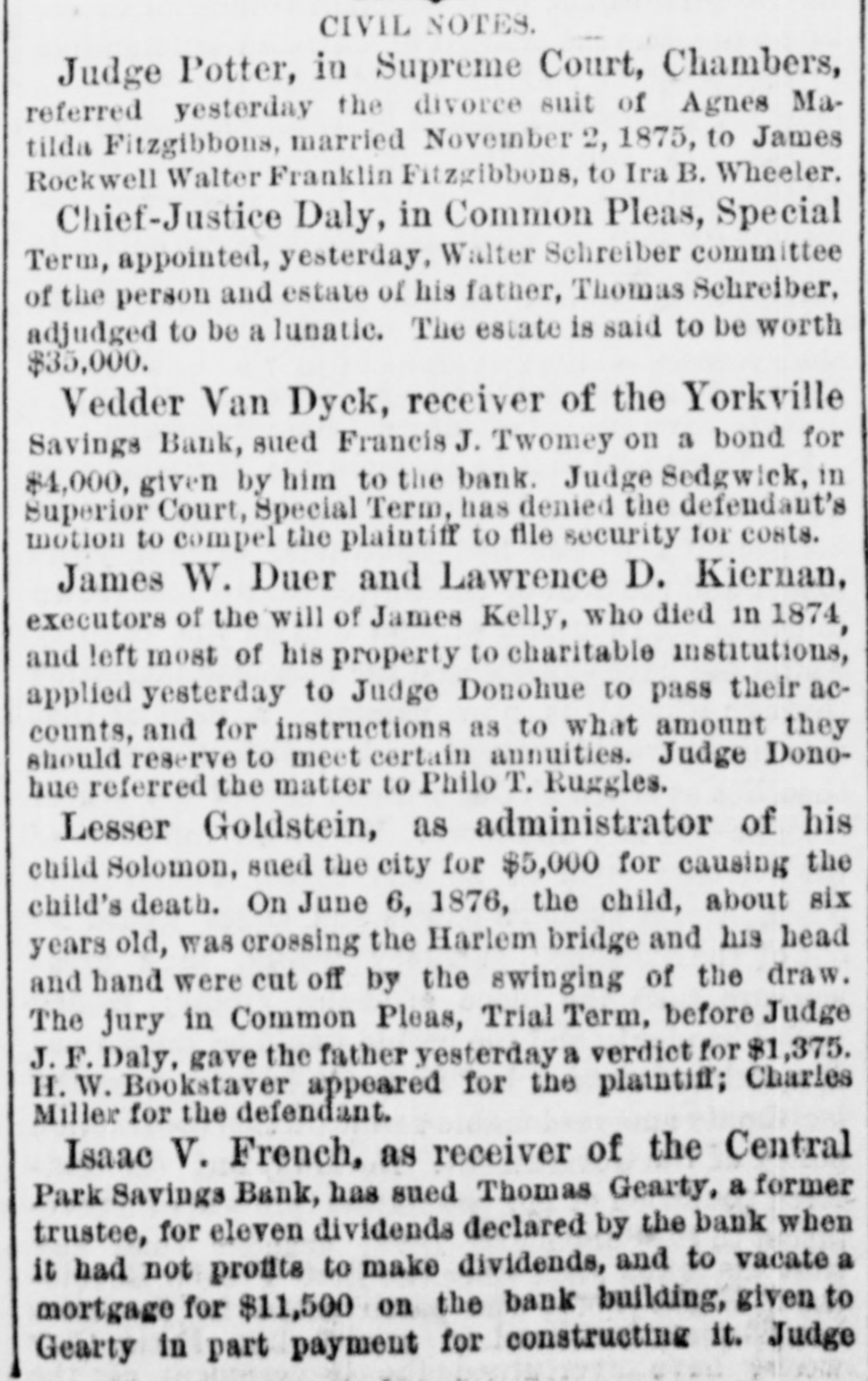
CIVIL NOTES. Judge Potter, in Supreme Court, Chambers, referred yesterday the divorce suit of Agnes Matilda Fitzgibbons, married November 2, 1875, to James Rockwell Walter Franklin Fitzgibbons, to Ira B. Wheeler. Chief-Justice Daly, in Common Pleas, Special Term, appointed, yesterday, Walter Schreiber committee of the person and estate of his father, Thomas Schreiber, adjudged to be a lunatic. The estate is said to be worth $35,000. Vedder Van Dyck, receiver of the Yorkville Savings Bank, sued Francis J. Twomey on a bond for $4,000, given by him to the bank. Judge Sedgwick, in Superior Court, Special Term, has denied the defendant's motion to compel the plaintiff to file security for costs. James W. Duer and Lawrence D. Kiernan, executors of the will of James Kelly, who died in 1874, and left most of his property to charitable institutions, applied yesterday to Judge Donohue to pass their accounts, and for instructions as to what amount they should reserve to meet certain annuities. Judge Donohue referred the matter to Philo T. Ruggles. Lesser Goldstein, as administrator of his child Solomon, sued the city for $5,000 for causing the child's death. On June 6, 1876, the child, about six years old, was crossing the Harlem bridge and his head and hand were cut off by the swinging of the draw. The jury in Common Pleas, Trial Term, before Judge J. F. Daly, gave the father yesterday a verdict for $1,375. H. W. Bookstaver appeared for the plaintiff; Charles Miller for the defendant. Isaac V. French, as receiver of the Central Park Savings Bank, has sued Thomas Gearty, a former trustee, for eleven dividends declared by the bank when it had not profits to make dividends, and to vacate a mortgage for $11,500 on the bank building, given to Gearty in part payment for constructing it. Judge


Article from New-York Tribune, July 1, 1878

Click image to open full size in new tab

Article Text

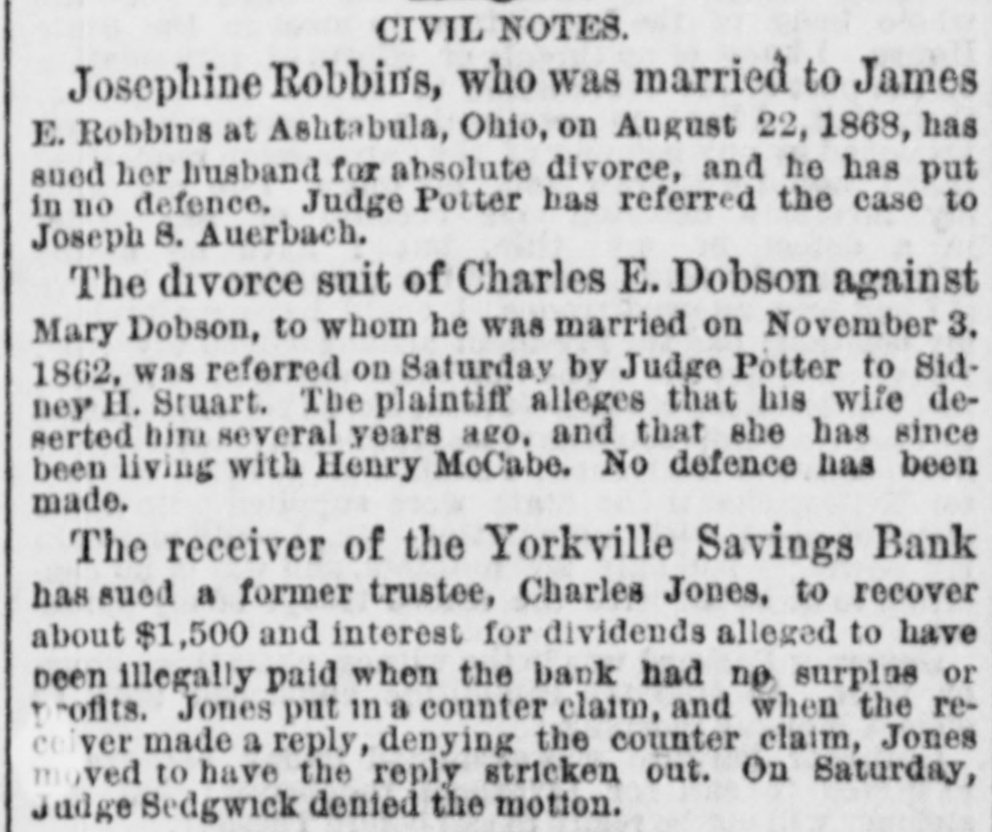
CIVIL NOTES. Josephine Robbins, who was married to James E. Robbins at Ashtabula, Ohio, on August 22, 1868, has sued her husband for absolute divorce, and he has put in no defence, Judge Potter has referred the case to Joseph S. Auerbach. The divorce suit of Charles E. Dobson against Mary Dobson, to whom he was married on November 3, 1862, was referred on Saturday by Judge Potter to Sidney H. Stuart. The plaintiff alleges that his wife deserted him several years ago, and that she has since been living with Henry McCabe. No defence has been made. The receiver of the Yorkville Savings Bank has sued a former trustee, Charles Jones, to recover about $1,500 and interest for dividends alleged to have been illegally paid when the bank had no surplus or profits. Jones put in a counter claim, and when the receiver made a reply, denying the counter claim, Jones moved to have the reply stricken out. On Saturday, Judge Sedgwick denied the motion.


Article from The New York Herald, December 6, 1878

Click image to open full size in new tab

Article Text

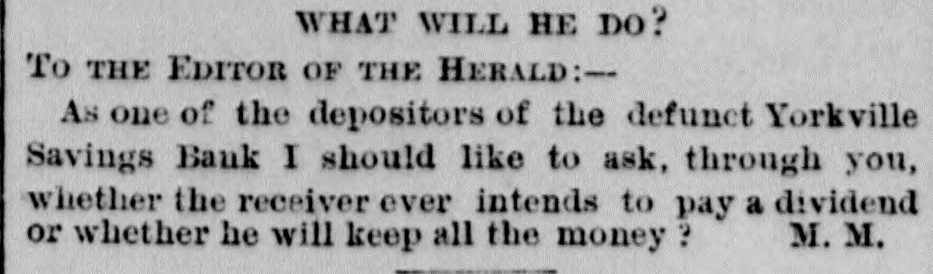
WHAT WILL HE DO? To THE EDITOR OF THE HERALD:-As one of the depositors of the defunct Yorkville Savings Bank I should like to ask, through you, whether the receiver ever intends to pay a dividend M. M. or whether he will keep all the money ?