April 1902 articles describe a rumor-induced flurry/withdrawals that were met. In November 1902 the bank suspended payment and invoked the sixty-day rule because of unusually heavy withdrawals (a 'quiet run'). By January 1903 receivers were appointed and the bank was being wound up. Sequence: run → suspension (60 days) → receivership/closure. OCR in some articles corrected (e.g., Terrell is Robert H. Terrell; some addresses vary: 605/609 F St).
Events (3)
1.April 6, 1902Run
Cause
Rumor Or Misinformation
Cause Details
Rumor that Capital Savings Bank was connected with the Industrial Building and Savings Company after a suit by Daniel Jordan claiming a debt; directors issued statement denying any connection and clarifying funds were separate.
Random Run
Yes
Random Run Snippet
Rumor bank tied to Industrial Building & Savings; directors denied connection
Measures
Bank publicly denied connection; honored all presented checks and met demands to reassure depositors.
Newspaper Excerpt
If there was a run on the bank after the suit had been filed, every demand has been met and every check honored that had been presented.
Source
newspapers
2.November 24, 1902Suspension
Cause
Rumor Or Misinformation
Cause Details
Prolonged heavy withdrawals and a 'quiet run' beginning earlier in the year and continuing into the fall led directors to require sixty days' notice for withdrawals and suspend payments to meet check demands; directors cited unusually heavy withdrawals and falling off in deposits as reason.
Newspaper Excerpt
The Capital Savings Bank ... suspended payment this morning. ... We have asked the depositors for sixty days in which to meet the payment of checks, and in the meantime ... the bank will remain open to receive payment of notes and to renew the same where it is necessary.
Source
newspapers
3.January 24, 1903Receivership
Newspaper Excerpt
Now that receivers have been appointed to take hold of the affairs of the Capital Savings Bank ... the business is in a fair way to be adjusted to the advantage of all concerned. / NOTICE TO DEPOSITORS. By direction of the court, all depositors are requested to promptly present their bank books for settlement to JOSEPH H. STEWART, Receiver ... (Jan. 24, 1903). (combined reporting).
Source
newspapers
Newspaper Articles (24)
1.April 6, 1902The Washington TimesWashington, DC
Click image to open full size in new tab
Article Text
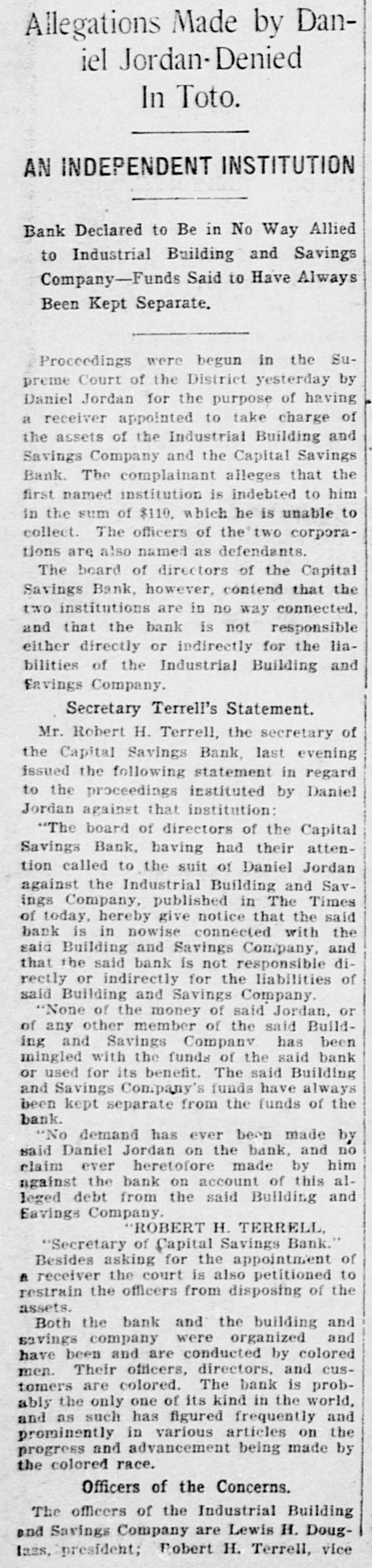
Allegations Made by Daniel In Toto. AN INDEPENDENT INSTITUTION Bank Declared to Be in No Way Allied to Industrial Building and Savings Company-Funds Said to Have Always Been Kept Separate. Proceedings were begun in the Supreme Court of the District yesterday by Daniel Jordan for the purpose of having a receiver appointed to take charge of the assets of the Industrial Building and Savings Company and the Capital Savings Bank. The complainant alleges that the first named institution is indebted to him in the sum of $110. which he is unable to collect. The officers of the two corporations are also named as defendants. The board of directors of the Capital Savings Bank, however, contend that the two institutions are in no way connected, and that the bank is not responsible either directly or indirectly for the liabilities of the Industrial Building and Savings Company. Secretary Terrell's Statement. Mr. Robert H. Terrell, the secretary of the Capital Savings Bank, last evening issued the following statement in regard to the proceedings instituted by Daniel Jordan against that institution: "The board of directors of the Capital Savings Bank, having had their attention called to the suit of Daniel Jordan against the Industrial Building and Savings Company, published in The Times of today, hereby give notice that the said bank is in nowise connected with the said Building and Savings Company, and that the said bank is not responsible directly or indirectly for the liabilities of said Building and Savings Company. "None of the money of said Jordan, or of any other member of the said Building and Savings Company has been mingled with the funds of the said bank or used for its benefit. The said Building and Savings Company's funds have always been kept separate from the funds of the bank. "No demand has ever been made by said Daniel Jordan on the bank, and no claim ever heretofore made by him against the bank on account of this alleged debt from the said Building and Savings Company. "ROBERT H. TERRELL, "Secretary of Capital Savings Bank." Besides asking for the appointment of A receiver the court is also petitioned to restrain the officers from disposing of the assets. Both the bank and the building and savings company were organized and have been and are conducted by colored men. Their officers, directors, and customers are colored. The bank is probably the only one of its kind in the world, and as such has figured frequently and prominently in various articles on the progress and advancement being made by the colored race. Officers of the Concerns. The officers of the Industrial Building and Savings Company are Lewis H. Douglass, president; Robert H. Terrell, vice
2.April 12, 1902The Washington BeeWashington, DC
Click image to open full size in new tab
Article Text
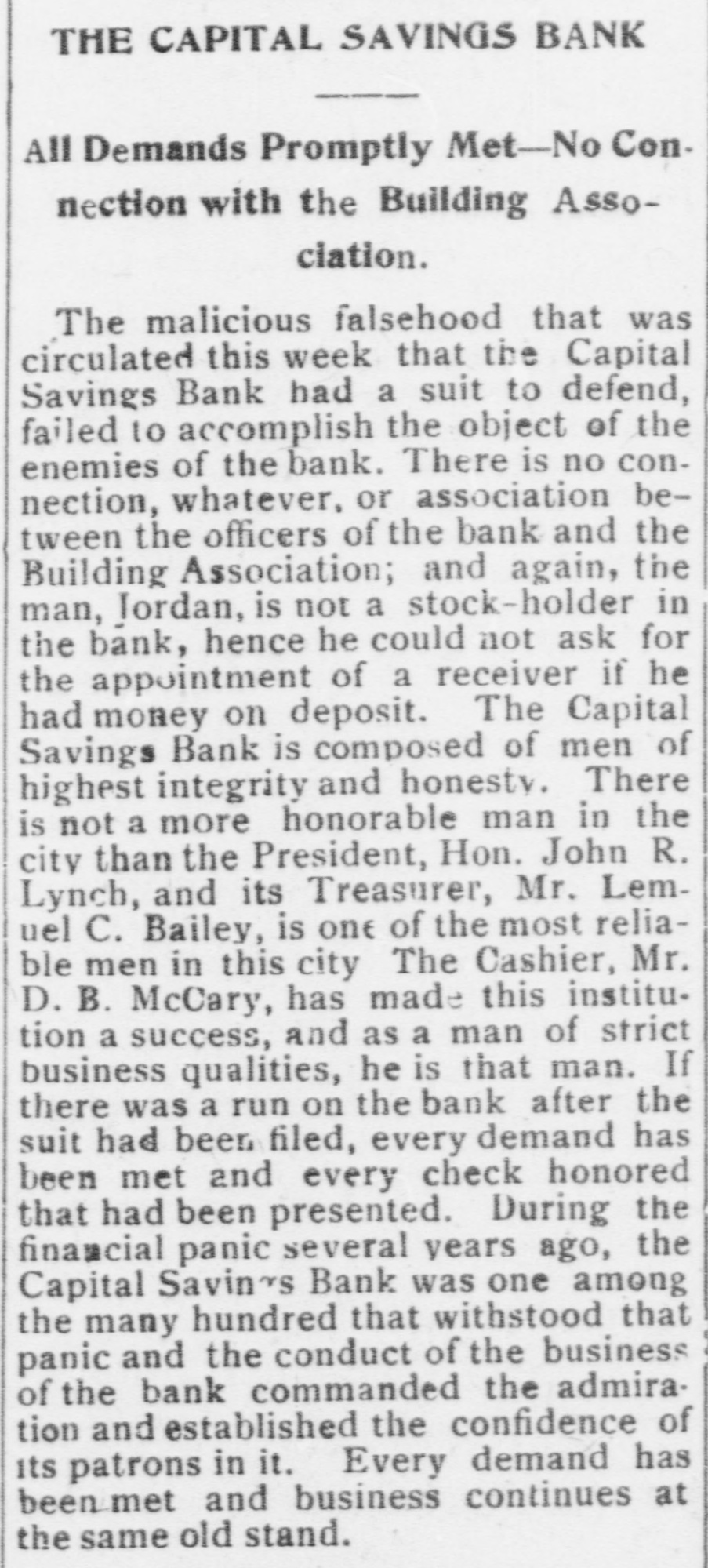
THE CAPITAL SAVINGS BANK All Demands Promptly Met-No Connection with the Building Association. The malicious falsehood that was circulated this week that the Capital Savings Bank had a suit to defend, failed to accomplish the object of the enemies of the bank. There is no connection, whatever, or association between the officers of the bank and the Building Association; and again, the man, Jordan, is not a stock-holder in the bank, hence he could not ask for the appointment of a receiver if he had money on deposit. The Capital Savings Bank is composed of men of highest integrity and honesty. There is not a more honorable man in the city than the President, Hon. John R. Lynch, and its Treasurer, Mr. Lemuel C. Bailey, is one of the most reliable men in this city The Cashier, Mr. D.B. McCary, has made this institution a success, and as a man of strict business qualities, he is that man. If there was a run on the bank after the suit had been filed, every demand has been met and every check honored that had been presented. During the financial panic several years ago, the Capital Savings Bank was one among the many hundred that withstood that panic and the conduct of the business of the bank commanded the admiration and established the confidence of its patrons in it. Every demand has been.met and business continues at the same old stand.
3.April 12, 1902The Colored AmericanWashington, DC
Click image to open full size in new tab
Article Text
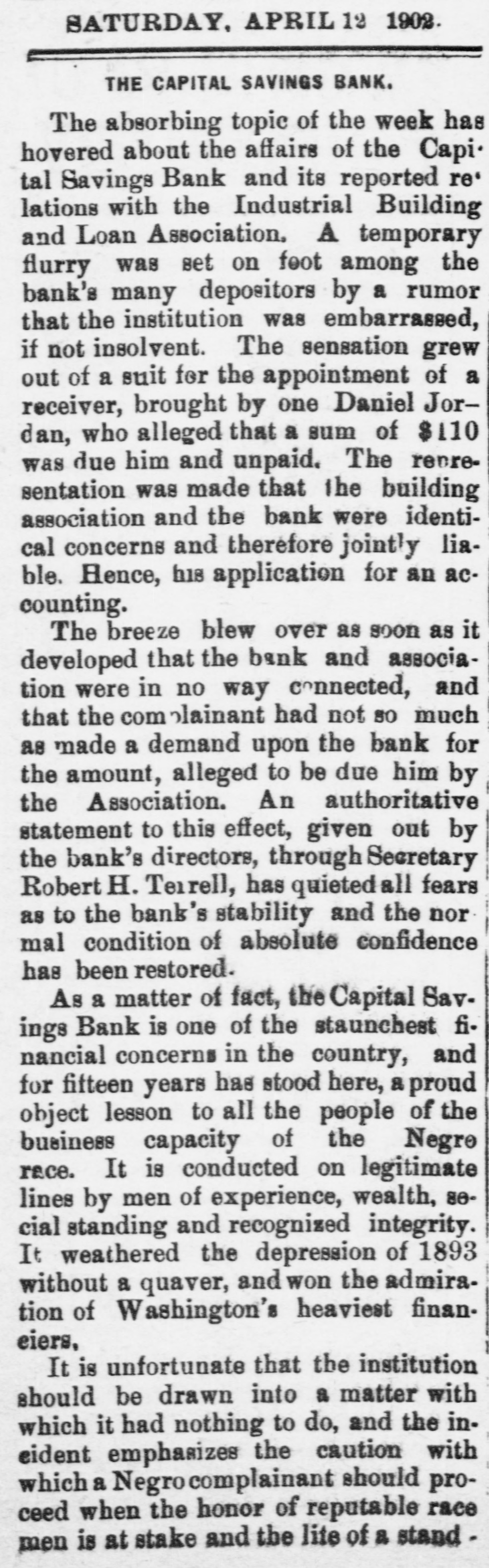
SATURDAY, APRIL 12 1902. THE CAPITAL SAVINGS BANK. The absorbing topic of the week has hovered about the affairs of the Capi tal Savings Bank and its reported re' lations with the Industrial Building and Loan Association. A temporary flurry was set on foot among the bank's many depositors by a rumor that the institution was embarrassed, if not insolvent. The sensation grew out of a suit for the appointment of a receiver, brought by one Daniel Jordan, who alleged that a sum of $110 was due him and unpaid. The renresentation was made that the building association and the bank were identical concerns and therefore jointly liable. Hence, his application for an accounting. The breeze blew over as soon as it developed that the bank and association were in no way connected, and that the com plainant had not so much as made a demand upon the bank for the amount, alleged to be due him by the Association. An authoritative statement to this effect, given out by the bank's directors, through Secretary Robert H. Terrell, has quieted all fears as to the bank's stability and the nor mal condition of absolute confidence has been restored. As a matter of fact, the Capital Savings Bank is one of the staunchest financial concerns in the country, and for fitteen years has stood here, a proud object lesson to all the people of the business capacity of the Negro race. It is conducted on legitimate lines by men of experience, wealth, 80cial standing and recognized integrity. It weathered the depression of 1893 without a quaver, and won the admiration of Washington's heaviest finaneiers, It is unfortunate that the institution should be drawn into a matter with which it had nothing to do, and the ineident emphasizes the caution with which a Negrocomplainant should proceed when the honor of reputable race men is at stake and the lite of a stand -
4.November 26, 1902The Evening TimesWashington, DC
Click image to open full size in new tab
Article Text
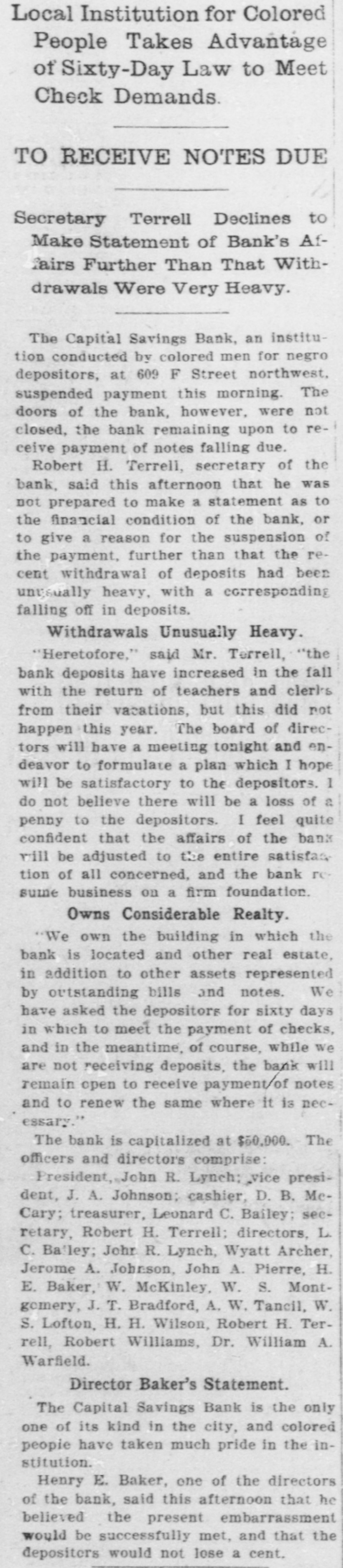
Local Institution for Colored People Takes Advantage of Sixty-Day Law to Meet Check Demands. TO RECEIVE NOTES DUE Secretary Terrell Declines to Make Statement of Bank's Affairs Further Than That Withdrawals Were Very Heavy. The Capital Savings Bank, an institution conducted by colored men for negro depositors, at 609 F Street northwest. suspended payment this morning. The doors of the bank, however, were not closed, the bank remaining upon to receive payment of notes falling due. Robert H. Terrell, secretary of the bank. said this afternoon that he was not prepared to make a statement as to the financial condition of the bank, or to give a reason for the suspension of the payment, further than that the recent withdrawal of deposits had been unusually heavy. with a corresponding falling off in deposits. Withdrawals Unusually Heavy. 'Heretofore," said Mr. Terrell, "the bank deposits have increased in the fall with the return of teachers and clerks from their vacations, but this did not happen this year. The board of directors will have a meeting tonight and endeavor to formulate a plan which I hope will be satisfactory to the depositors. 1 do not believe there will be a loss of a penny to the depositors. I feel quite confident that the affairs of the bank will be adjusted to the entire satisface tion of all concerned, and the bank resume business on a firm foundation. Owns Considerable Realty. "We own the building in which the bank is located and other real estate, in addition to other assets represented by outstanding bills and notes. We have asked the depositors for sixty days in which to meet the payment of checks, and in the meantime, of course, while We are not receiving deposits, the bank will remain open to receive payment/of notes and to renew the same where it is necessary." The bank is capitalized at $50,000. The officers and directors comprise: President, John R. Lynch; vice president. J. A. Johnson: cashier, D. B. MeCary; treasurer, Leonard C. Bailey; secretary, Robert H. Terrell; directors, L. C. Balley; Johr R. Lynch, Wyatt Archer, Jerome A. Johnson, John A. Pierre, H. E. Baker, W. McKinley, W. S. Montgemery, J. T. Bradford, A. W. Tancil, W. S. Lofton, H. H. Wilson, Robert H. Terrell, Robert Williams, Dr. William A. Warfield. Director Baker's Statement. The Capital Savings Bank is the only one of its kind in the city, and colored people have taken much pride in the institution. Henry E. Baker, one of the directors of the bank, said this afternoon that he believed the present embarrassment would be successfully met, and that the depositors would not lose a cent.
5.November 26, 1902Evening StarWashington, DC
Click image to open full size in new tab
Article Text
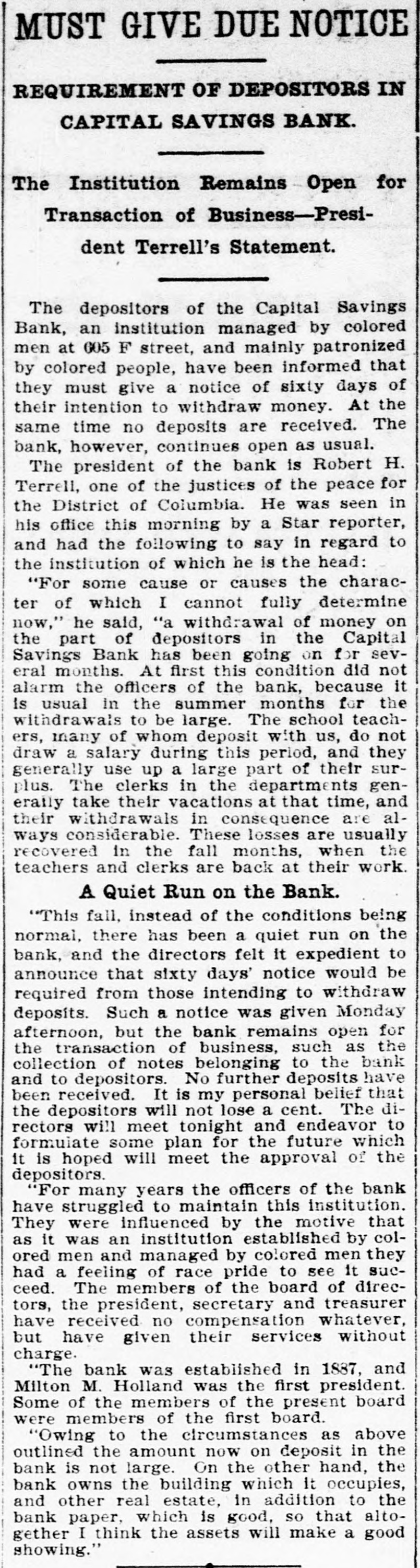
MUST GIVE DUE NOTICE REQUIREMENT OF DEPOSITORS IN CAPITAL SAVINGS BANK. The Institution Remains Open for Transaction of Business-President Terrell's Statement. The depositors of the Capital Savings Bank, an institution managed by colored men at 605 F street, and mainly patronized by colored people, have been informed that they must give a notice of sixty days of their intention to withdraw money. At the same time no deposits are received. The bank, however, continues open as usual. The president of the bank is Robert H. Terrell, one of the justices of the peace for the District of Columbia. He was seen in his office this morning by a Star reporter, and had the following to say in regard to the institution of which he is the head: "For some cause or causes the character of which I cannot fully determine now," he said, "a withdrawal of money on the part of depositors in the Capital Savings Bank has been going on for several months. At first this condition did not alarm the officers of the bank, because it is usual in the summer months for the withdrawals to be large. The school teachers, many of whom deposit with us, do not draw a salary during this period, and they generally use up a large part of their surplus. The clerks in the departments generaily take their vacations at that time, and their withdrawals in consequence are always considerable. These losses are usually recovered in the fall months, when the teachers and clerks are back at their work. A Quiet Run on the Bank. "This fall, instead of the conditions being normal, there has been a quiet run on the bank, and the directors felt It expedient to announce that sixty days' notice would be required from those intending to withdraw deposits. Such a notice was given Monday afternoon, but the bank remains open for the transaction of business, such as the collection of notes belonging to the bank and to depositors. No further deposits have been received. It is my personal belief that the depositors will not lose a cent. The directors will meet tonight and endeavor to formulate some plan for the future which it is hoped will meet the approval of the depositors. "For many years the officers of the bank have struggled to maintain this institution. They were influenced by the motive that as it was an institution established by colored men and managed by colored men they had a feeling of race pride to see it succeed. The members of the board of directors, the president, secretary and treasurer have received no compensation whatever, but have given their services without charge. "The bank was established in 1887, and Milton M. Holland was the first president. Some of the members of the present board were members of the first board. "Owing to the circumstances as above outlined the amount now on deposit in the bank is not large. On the other hand, the bank owns the building which It occupies, and other real estate, in addition to the bank paper, which is good, SO that altogether I think the assets will make a good showing."
6.November 27, 1902Alexandria GazetteAlexandria, VA
Click image to open full size in new tab
Article Text
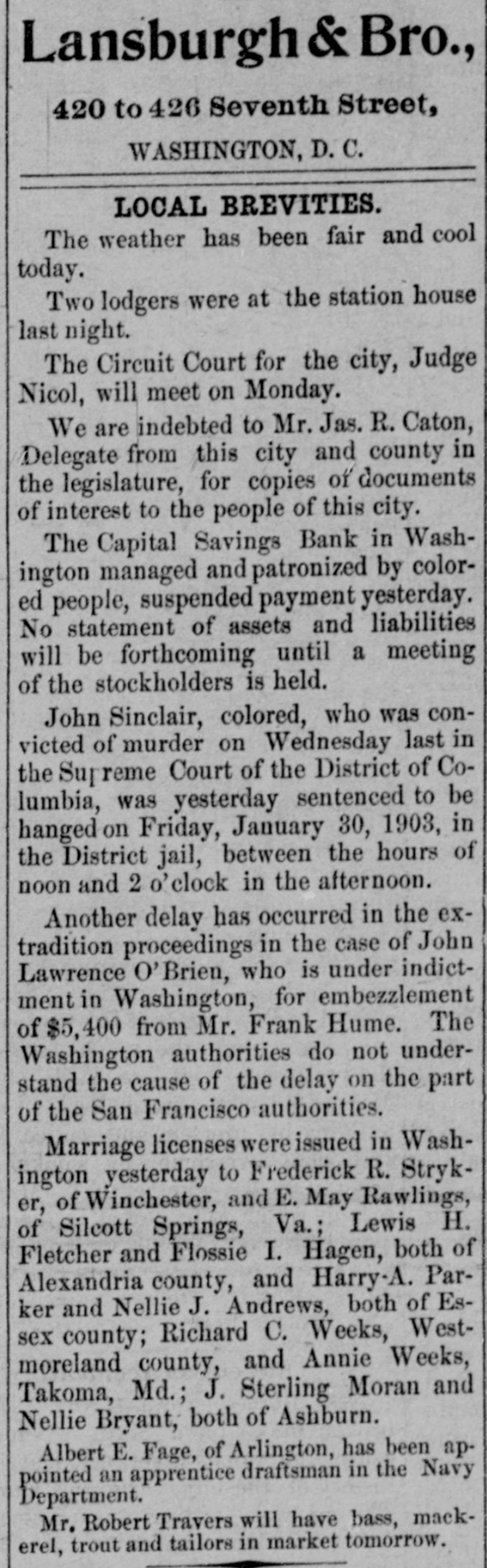
Lansburgh & Bro., 420 to 426 Seventh Street, WASHINGTON, D. C. LOCAL BREVITIES. The weather has been fair and cool today. Two lodgers were at the station house last night. The Circuit Court for the city, Judge Nicol, will meet on Monday. We are indebted to Mr. Jas. R. Caton, Delegate from this city and county in the legislature, for copies of documents of interest to the people of this city. The Capital Savings Bank in Washington managed and patronized by colored people, suspended payment yesterday. No statement of assets and liabilities will be forthcoming until a meeting of the stockholders is held. John Sinclair, colored, who was convicted of murder on Wednesday last in the Sup reme Court of the District of Columbia, was yesterday sentenced to be hanged on Friday, January 30, 1903, in the District jail, between the hours of noon and 2 o'clock in the afternoon. Another delay has occurred in the extradition proceedings in the case of John Lawrence O'Brien, who is under indictment in Washington, for embezzlement of $5,400 from Mr. Frank Hume. The Washington authorities do not understand the cause of the delay on the part of the San Francisco authorities. Marriage licenses were issued in Washington yesterday to Frederick R. Stryker, of Winchester, and E. May Rawlings, of Silcott Springs, Va.; Lewis H. Fletcher and Flossie I. Hagen, both of Alexandria county, and Harry-A. Parker and Nellie J. Andrews, both of Essex county; Richard C. Weeks, Westmoreland county, and Annie Weeks, Takoma, Md.; J. Sterling Moran and Nellie Bryant, both of Ashburn. Albert E. Fage, of Arlington, has been appointed an apprentice draftsman in the Navy Department. Mr. Robert Travers will have bass, mackerel, trout and tailors in market tomorrow.
7.November 29, 1902The Washington BeeWashington, DC
Click image to open full size in new tab
Article Text
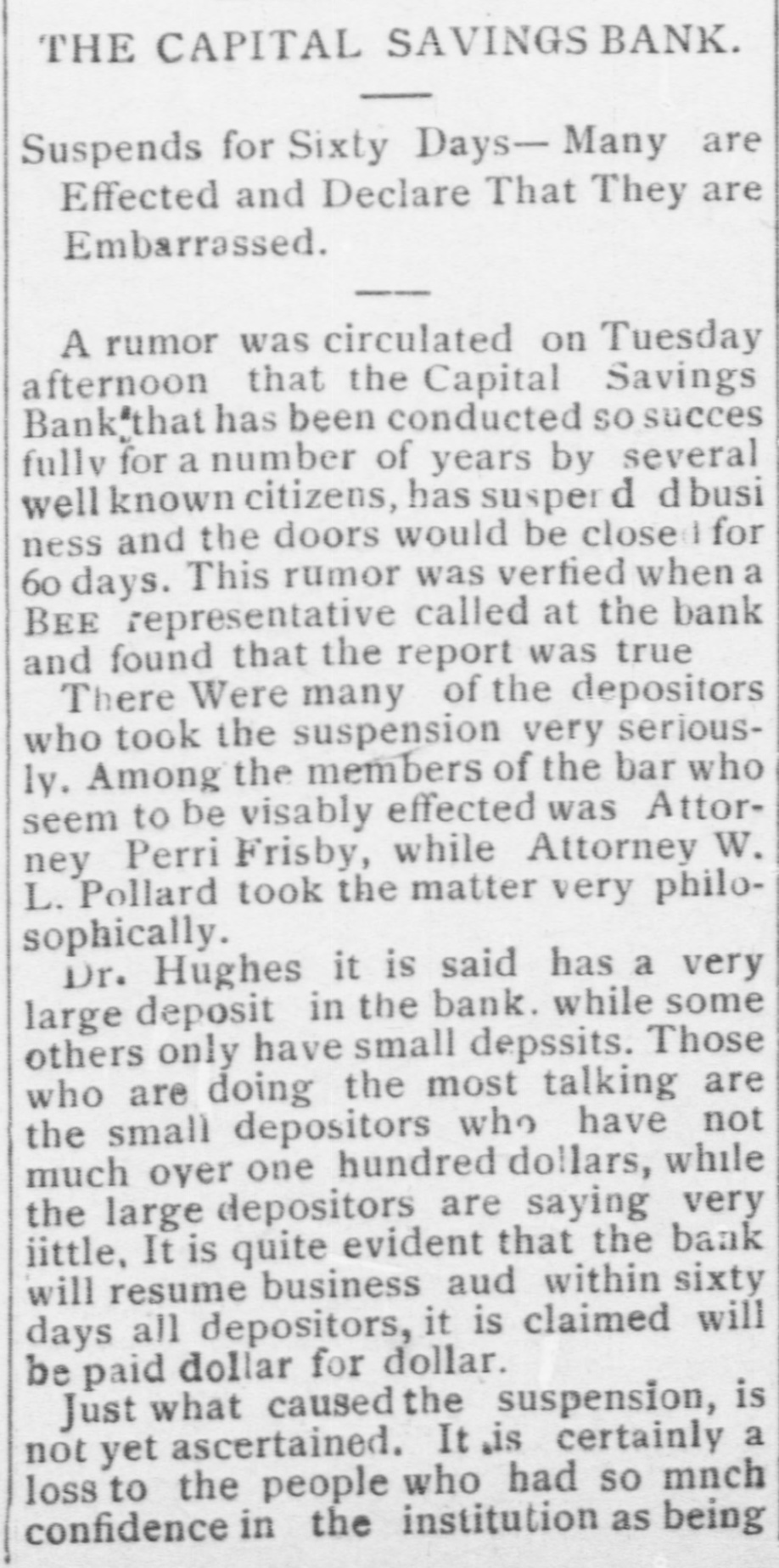
THE CAPITAL SAVINGS BANK. Suspends for Sixty Days- Many are Effected and Declare That They are Embarrassed. A rumor was circulated on Tuesday afternoon that the Capital Savings Bank that has been conducted so succes fully for a number of years by several well known citizens, has suspend Ibusi ness and the doors would be close I for 60 days. This rumor was verfied when a BEE representative called at the bank and found that the report was true There Were many of the depositors who took the suspension very seriously. Among the members of the bar who seem to be visably effected was Attorney Perri Frisby, while Attorney W. L. Pollard took the matter very philosophically. Dr. Hughes it is said has a very large deposit in the bank. while some others only have small depssits. Those who are doing the most talking are the small depositors who have not much over one hundred dollars, while the large depositors are saying very little, It is quite evident that the bank will resume business aud within sixty days all depositors, it is claimed will be paid dollar for dollar. Just what caused the suspension, is not yet ascertained. It is certainly a loss to the people who had so mnch confidence in the institution as being
8.November 29, 1902The Colored AmericanWashington, DC
Click image to open full size in new tab
Article Text
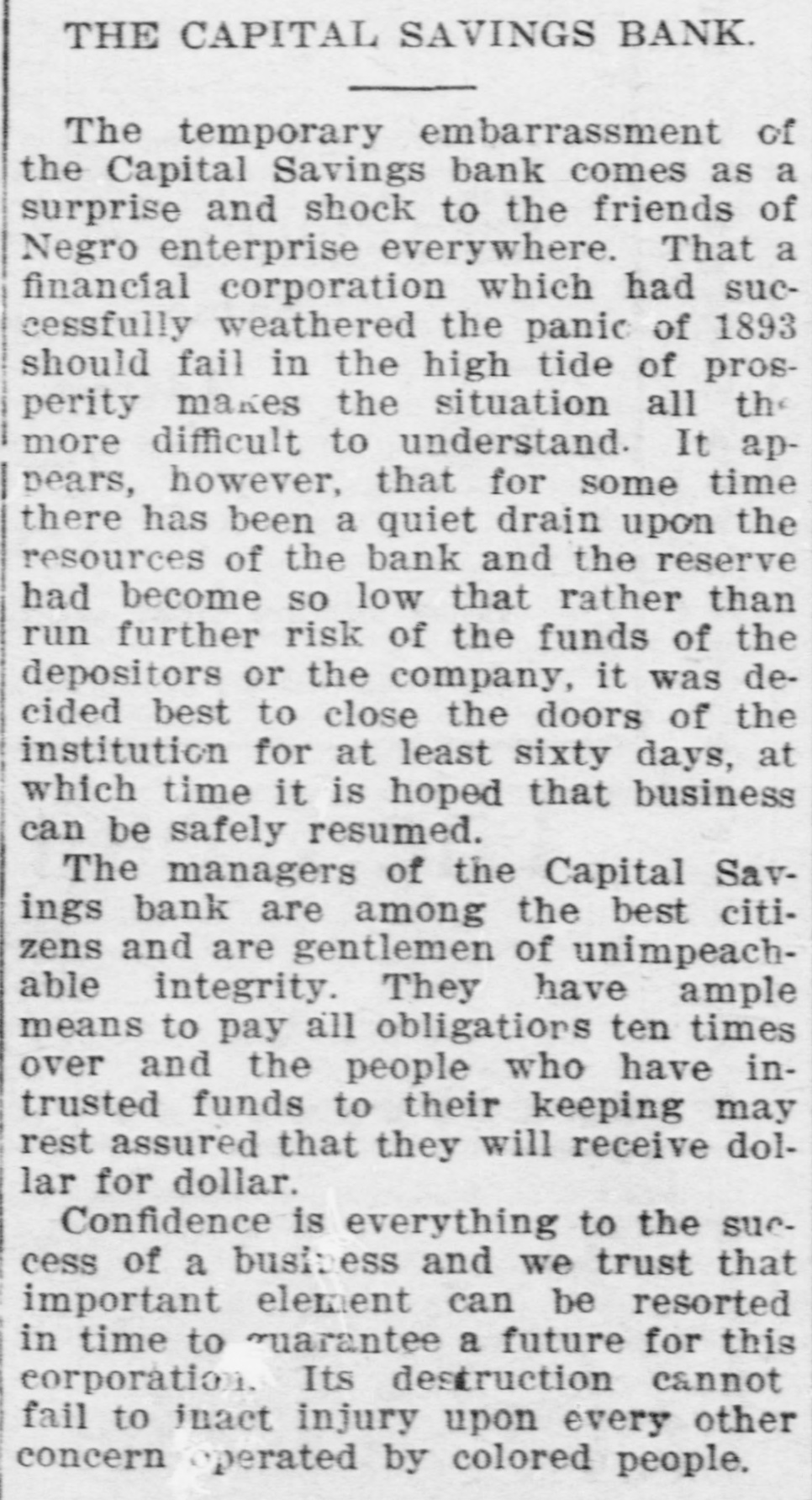
THE CAPITAL SAVINGS BANK. The temporary embarrassment of the Capital Savings bank comes as a surprise and shock to the friends of Negro enterprise everywhere. That a financial corporation which had successfully weathered the panic of 1893 should fail in the high tide of prosperity makes the situation all th more difficult to understand. It appears, however, that for some time there has been a quiet drain upon the resources of the bank and the reserve had become so low that rather than run further risk of the funds of the depositors or the company, it was decided best to close the doors of the institution for at least sixty days, at which time it is hoped that business can be safely resumed. The managers of the Capital Savings bank are among the best citizens and are gentlement of unimpeachable integrity. They have ample means to pay all obligations ten times over and the people who have intrusted funds to their keeping may rest assured that they will receive dollar for dollar. Confidence is everything to the success of a business and we trust that important element can be resorted in time to guarantee a future for this corporation. Its destruction cannot fail to inact injury upon every other concern operated by colored people.
9.December 4, 1902Gloucester County DemocratWoodbury, NJ
Click image to open full size in new tab
Article Text
In Washington, D. c., the Capitol Savings Bank, managed by Negroes for Negro depositors has been forced to suspend. In the world of finance as well as in politities it is not always wise to draw the color line.
10.December 12, 1902The Seattle RepublicanSeattle, WA
Click image to open full size in new tab
Article Text
Had No Race Pride. The suspension of payment by the Capital Savings Bank of for Washington sixty days, because of large withdrawals of deposits, is much to be regretted. Captain John R. Lynch is president of the bank. If it were properly supported by the Afro-Americans of Washington it would easily be one of the strongest banks in the country. We hope that it will soon resume business.-N. Y. Age.
11.December 22, 1902Evening StarWashington, DC
Click image to open full size in new tab
Article Text
ASKS FOR RECEIVER. William A. Warfield Brings Capital Savings Bank's Affairs Into Court. Steps to wind up the affairs of the Capital Savings Bank were taken this afternoon when William A. Warfield filed suit for dissolution of partnership, the appointment of receivers and an injunction, certain officers and directors of the bank being named defendants as follows: John R. Lynch, the president; Jerome A. Johnson, the vice president; Robert H. Terrell, the secretary; Lorenzo C. Bailey, the treasurer; Douglass B. McCary, the cashier, and Wyatt Archer, James T. Bradford, William S. Lofton, Whitefield McKinlay, Arthur W. Tancil and Robert Williams, directors and stockholders. The complainant sets forth that he is a stockholder of the bank, the institution, he explains, being organized as a partnership. It is insolvent, declares Mr. Warfield, having suspended payment November 24 last. The complainant, among other things, charges that overdrafts have been made by certain directors. there being one overdraft amounting to $30,000 by one director alone, while the capital stock of the bank is only $50,000. Mr. Warfield, who is represented by Attorneys A. A. Birney and J. H. Stewart, asks that the defendants be enjoined from disposing of any of the assets of the bank, that receivers be appointed to take charge of the same, and that the partnership be dissolved. Justice Hagner issued a rule to show cause returnable January 5.
12.January 5, 1903Evening StarWashington, DC
Click image to open full size in new tab
Article Text
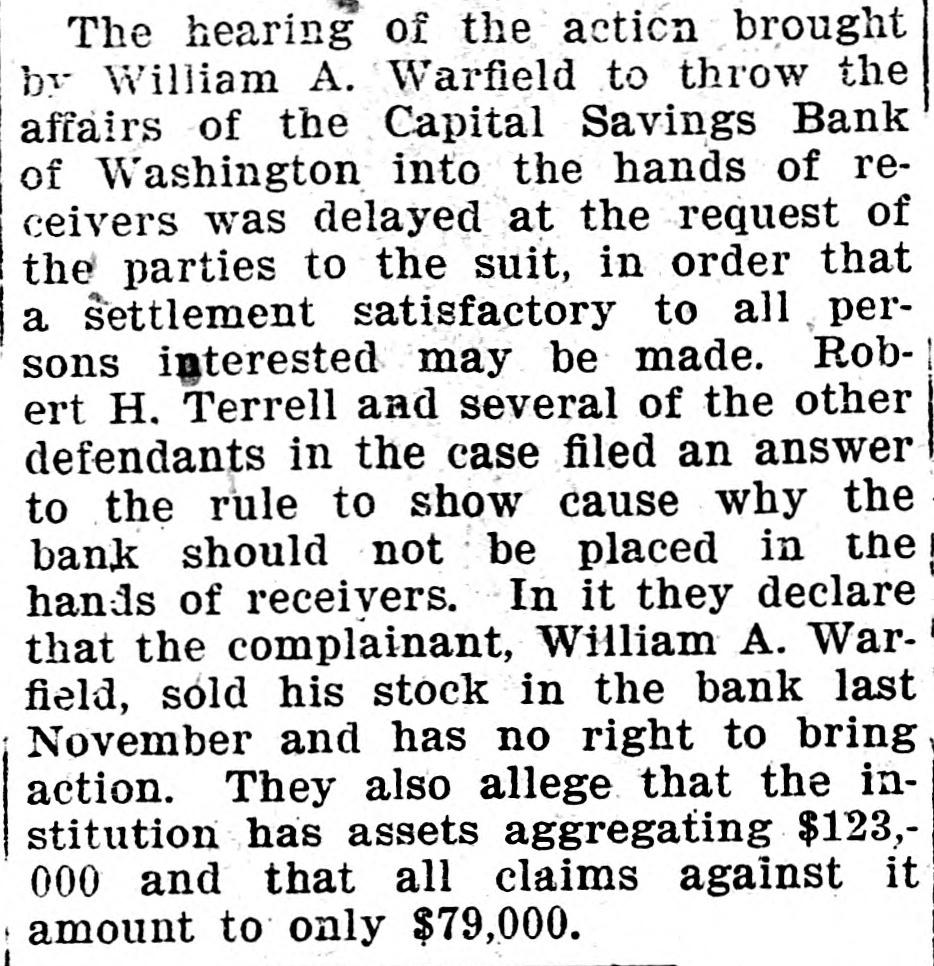
HEARING POSTPONED. Answer of Defendants in Suit Against Capital Savings Bank. The hearing set for today before Justice Hagner in Equity Court No. 1 in connection with the rule requiring the defendants in the case of William A. Warfield against Wyatt Archer and others to show cause why a receiver should not be appointed to take charge of the Capital Savings Bank was postponed until tomorrow. It was explained that by that time an order satisfactory to all concerned may be agreed upon and in readiness for signing by the court. The complainant Instituted the proceeding in view of having the court wind up the affairs of the bank, which recently suspended payments. Robert H. Terrell and several others, who are named as defendants, today, through Attorneys. Lambert & Baker, filed answer to the rule to show cause. In general they assert that the complainant Warfield, November 18 last, sold the shares of Capital Savings Bank stock which he had owned, and for that reason, they contend, he is not entitled to maintain the proceedings he has instituted. It is not true, these defendants declare, that the bank is in a deplorable and insolvent condition. The institution possesses assets of the value of $123,000 and net assets of the value of $98,000, the court is informed, while all the claims against it do not exceed $79,000. These defendants say they hope that with proper, conservative management. under the care of carefully selected committees and officers. the depositors will receive all to which they may be entitled. It is denied that the best interests of all concerned would be promoted by the appointment of a receiver. A number of depositors and others interested in the bank met Saturday evening at the Vermont Avenue Baptist Church. A previous meeting had been held, when it was decided to give the stockholders an opportunity to raise the money needed to pay the depositors. It is stated, however, that Saturday night it was concluded that as this chance had not been availed of, it was time that a receiver be appointed. This result was reached after a discussion which was taken part in by directors and depositors. Rev. George Lee, pastor of the church, was in the chair, and Prof. W. Scott Montgomery acted as secretary. Robert H. Terrill and Prof. Montgomery, both stockholders, and the finance director, expressed their willingness to assume their share of making good the amount due to depositors, which was then approximated to be $70,000. Dr. W. S. Lapton, another director, spoke in the same vein. It was estimated that If each of the thirty-nine stockholders would contribute $2,000, this result would be secured. Dr. W. A. Warfield, the stockholder who has brought suit asking for the appointment of a receiver, stated, in reply to a question, that he believed the sum of $50 was in the bank when the sixty days' notice was served on depositors.
The hearing of the action brought by William A. Warfield to throw the affairs of the Capital Savings Bank of Washington into the hands of receivers was delayed at the request of the parties to the suit, in order that a settlement satisfactory to all persons interested may be made. Robert H. Terrell and several of the other defendants in the case filed an answer to the rule to show cause why the bank should not be placed in the hands of receivers. In it they declare that the complainant, William A. Warfield, sold his stock in the bank last November and has no right to bring action. They also allege that the institution has assets aggregating $123,000 and that all claims against it amount to only $79,000.
14.January 17, 1903The Colored AmericanWashington, DC
Click image to open full size in new tab
Article Text
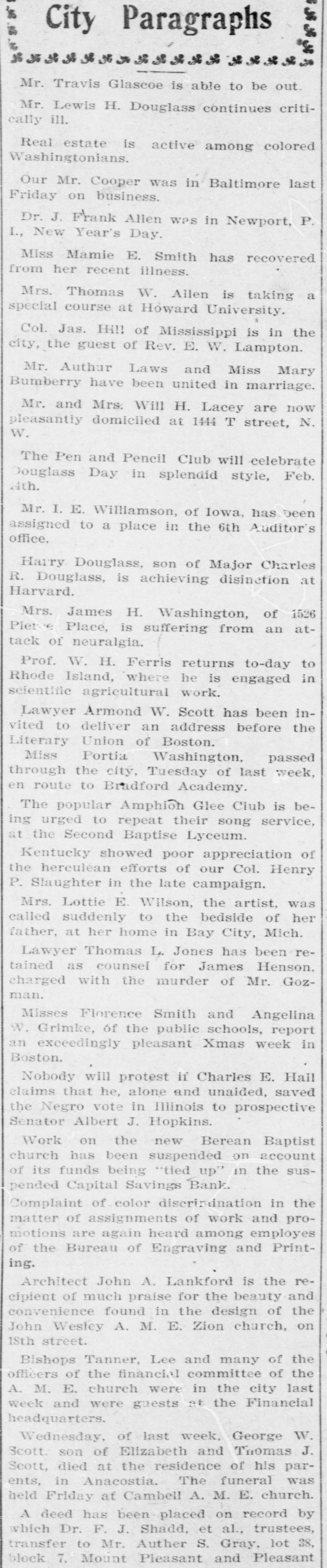
City Paragraphs Mr. Travis Glascoe is able to be out. Mr. Lewis H. Douglass continues critically ill. Real estate is active among colored Washingtonians. Our Mr. Cooper was in Baltimore last Friday on business. Dr. J. Frank Allen was in Newport, P. I., New Year's Day. Miss Mamie E. Smith has recovered from her recent illness. Mrs. Thomas W. Allen is taking a special course at Howard University. Col. Jas. Hi!! of Mississippi is in the city, the guest of Rev. E. W. Lampton. Mr. Authur Laws and Miss Mary Bumberry have been united in marriage. Mr. and Mrs. Will H. Lacey are now pleasantly domiciled at 1444 T street, N. W. The Pen and Pencil Club will celebrate Douglass Day in splendid style, Feb. 14th. Mr. I. E. Williamson, of Iowa, has been assigned to a place in the 6th Auditor's office. Harry Douglass, son of Major Charles R. Douglass, is achieving disinction at Harvard. Mrs. James H. Washington, of 1526 Pierce Place, is suffering from an attack of neuralgia. Prof. W. H. Ferris returns to-day to Rhode Island, where he is engaged in scientific agricultural work. Lawyer Armond W. Scott has been invited to deliver an address before the Literary Union of Boston. Miss Portia Washington, passed through the city, Tuesday of last week, en route to Bradford Academy. The popular Amphion Glee Club is being urged to repeat their song service, at the Second Baptise Lyceum. Kentucky showed poor appreciation of the herculean efforts of our Col. Henry P. Slaughter in the late campaign. Mrs. Lottie E. Wilson, the artist, was called suddenly to the bedside of her father, at her home in Bay City, Mich. Lawyer Thomas L. Jones has been retained as counsel for James Henson, charged with the murder of Mr. Gozman. Misses Florence Smith and Angelina W. Grimke, of the public schools, report an exceedingly pleasant Xmas week in Boston. Nobody will protest if Charles E. Hail claims that he, alone and unaided, saved the Negro vote in Illinois to prospective Senator Albert J. Hopkins. Work on the new Berean Baptist church has been suspended on account of its funds being "tied up" in the suspended Capital Savings Bank. Complaint of color discripination in the matter of assignments of work and promotions are again heard among employes of the Bureau of Engraving and Printing. Architect John A. Lankford is the recipient of much praise for the beauty and convenience found in the design of the John Wesley A. M. E. Zion church, on 18th street. Bishops Tanner, Lee and many of the officers of the financial committee of the A. M. E. church were in the city last week and were guests at the Financial headquarters. Wednesday, of last week, George W. Scott. son of Elizabeth and Thomas J. Scott, died at the residence of his parents, in Anacostia. The funeral was held Friday at Cambell A. M. E. church. A deed has been placed on record by which Dr. F. J. Shadd, et al., trustees, transfer to Mr. Auther S. Gray, lot 38, block 7. Mount Pleasant and Pleasant
# The receivers of the defunct Capital Savings Bank of Washington, D. C.,
16.January 24, 1903The Colored AmericanWashington, DC
Click image to open full size in new tab
Article Text
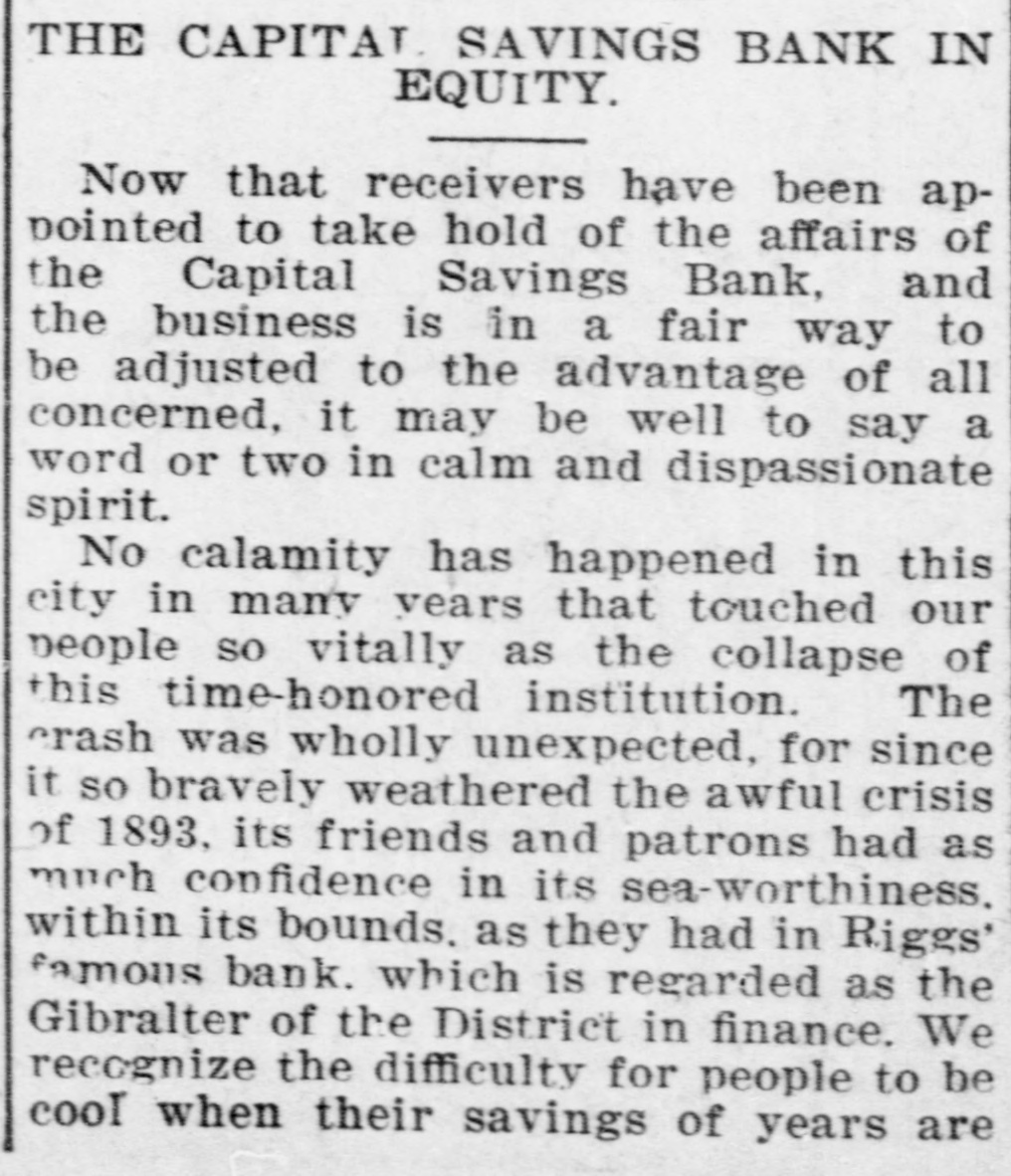
THE CAPITAL SAVINGS BANK IN EQUITY. Now that receivers have been appointed to take hold of the affairs of the Capital Savings Bank, and the business is in a fair way to be adjusted to the advantage of all concerned, it may be well to say a word or two in calm and dispassionate spirit. No calamity has happened in this city in many years that touched our people so vitally as the collapse of this time-honored institution. The crash was wholly unexpected, for since it so bravely weathered the lawful crisis of 1893, its friends and patrons had as much confidence in its sea-worthiness, within its bounds. as they had in Riggs' famous bank. which is regarded as the Gibralter of the District in finance. We recognize the difficulty for people to be cool when their savings of years are
17.January 24, 1903The Washington BeeWashington, DC
Click image to open full size in new tab
Article Text
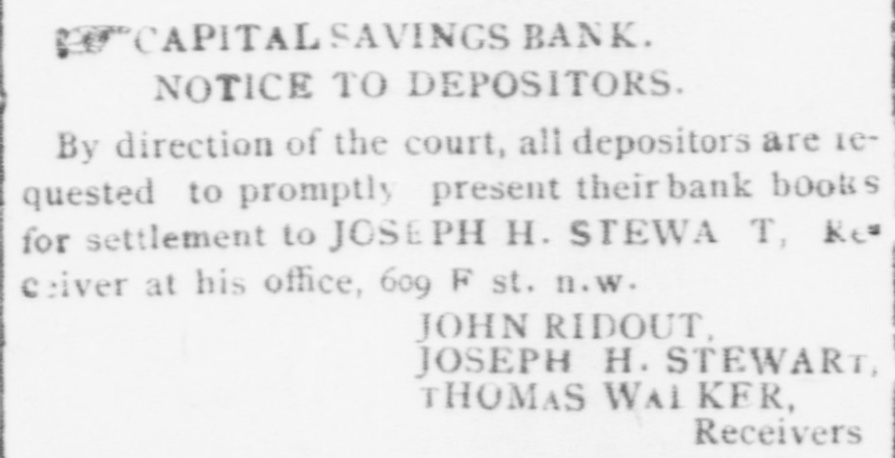
CAPITAL SAVINGS BANK. NOTICE TO DEPOSITORS. By direction of the court, all depositors are ICquested to promptly present theirbank books for settlement to JOSEPH H. STEWA T, Re: ceiver at his office, 609 F st. n. W. JOHN RIDOUT JOSEPH H. STEWART, THOMAS WAL KFR, Receivers
18.February 3, 1903Evening StarWashington, DC
Click image to open full size in new tab
Article Text
# JUDGMENT FOR DEPOSITORS.
Action Taken Against the Capital Savings Bank.
In connection with the proceedings instituted by H. Augustus Guess, a depositor with the Capital Savings Bank, against Jerome A. Johnson and others, directors of that institution, Justice of the Peace Mills has rendered judgment in javor of the plaintiff for $25.
Since the bank suspended payment a number of its depositors have filed suit. Mr. Guess' action was the first to be heard. The defendants contended at the hearing
19.February 14, 1903The Washington BeeWashington, DC
Click image to open full size in new tab
Article Text
They Say. It is the suspicious person that suspects everybody. Interlopers who have rostanding at their own homes are burdens upon the city. If balf of these would deal with their patrons honestly one there would be no trouble. The Washington people are responsible for their own burdens. It is best notto tell all all you know Never be party to a crime neither should you allow yourself to be used for criminal purpose*. It 18 the honest man who will not allow himself to be used by others. Be certain of what you say;and do. The northern negroes who conmake faces at southtiunously failures the ern negroes are Be what you are and nething more. A man who is too ecowardly to make his owa fight, but will take from other papers, Caany pable of doing excerpts dishonorable is act. Othello's occupation is gone at any sale. He has about borrowed out of lost himself of existence fraud and and cheat. his reputation President Roosevelt will appoin twonew Judges of the Police Court. It is best to be truthful to your friends. A dishonest man is bound to fail. The man who thinks that he 18 theonly citizen in # state is affected with a disease called conceit. Lieut. Gov. Tllman of South Carolina has fully demonstrated his cowardice. Wait and see if South Carolina's boasted civilization is correct, Can an innocent mant shot down in cold blood with ou being avicted. Gonzales has become a victim of cowardice and brutality. Senator Platt will be the next Sevator from New York. The next President of the United States will be Marcus A. Hanna Senator Fairbanks has been returned to the Senate, Next December will cause the politicians to come to the front gain Let us ha ethe election franchise Ditizens who are disfranchised and too cowardly to protest are not entitled to citizenship Has the right man been detected in the Jordan murder. The loyal north has now rebelled g inst the negro. The Armstrong Manue training school is fast improving. The wizzard of Tuskegee is about to be a back numder politically. The depositors of the Capital Savings Bank have their receivers what next. There may be something rotten in Denmark, This is not the first bank that has failed. People must lose sometimes to be successful. Never allow of prisoner to suffer because you do not like his lawyer. Justice Bundy, O'Donnell or g ould make good Judges. It mab unise toa know. District Attorney Beach W some good things. He willshowhimself to be a man Nothing is more distas elul than a deceptive person. Editor Fortune seeking whome for the American negro. THE BEE suggests that he first nd one for himself. The agent will return some time with a great report.
20.April 1, 1903The Washington TimesWashington, DC
Click image to open full size in new tab
Article Text
RECEIVERS OF CAPITAL SAVINGS BANK REPORT Indebtedness of the Officers and Others in Detail. A report of the receivers of the Capital Savings Bank, filed yesterday, in the Supreme Court of the District, shows that the officers in charge of its affairs were indebted to the institution in the sum of $47,398.04 when payment was suspended last November. The amounts charged against the officers are: John R. Lynch, president, as maker of notes, $1,734.15; as indorser, $176.74, and overdrafts, $431.07. Leonard C. Bailey, treasurer, in his official capacity, $265; maker of notes, $1,450: overdrafts, $1,011.53. Henry E. Baker, director, as maker of notes, $38,468.55; as indorser, $1,217.37. A. W. Tancil, director, as maker of notes, $301.75; indorsed, $613. Douglas B. McCary, cashier, as maker of notes, $475.73. Robert T. Douglas, teller, as maker of notes, $1.68. Robert H. Terrell and John R. Lynch, notes, $1,068. It is stated that Leonard C. Bailey has conveyed to the trustees of the bank real estate valued at $750, on Stoddard Street, as partial security for his indebtedness. A complete list of other debtors to the Capital Savings Bank is also filed as part of the report of the receivers. These vary in amount from $5 to about $500. A letter by Mr. Bailey to the receivers says: "I have acted as treasurer of the bank since 1889, and as superintendent of the building since 1891, to November 24, 1902, and have never received any compensation. At $25 a month the amount due me now is $3,926."
21.April 6, 1903Evening StarWashington, DC
Click image to open full size in new tab
Article Text
Get a Copy of the Record for complete report of the receivers of Capital Savings Bank. Office, 12th st. and Vermont ave. ap4-3t*
22.May 2, 1903The Washington TimesWashington, DC
Click image to open full size in new tab
Article Text
# CAPITAL SAVINGS BANK
# AFFAIRS IN COURT
The procedings instituted by the receivers of the Capital Savings Bank against Henry E. Baker, for the purpose of having the court to declare void his conveyance to his wife, Violetta C. Baker, of lot 37 in square 640, will play an important part in the settlement of the affairs of the bank. The receivers allege the transfer was made by Baker to his wife with the object of avoiding the payment of certain claims held by his creditors, and of selling the property to the Philadelphia, Wilmington and Baltimore Railroad Company. It is also alleged that among the assets of the Capital Savings Bank are promissory notes and overdrafts made by Baker, aggregating nearly $40,000.
The receivers of the Capital Savings Bank ask the court to declare the real estate in question, to be part of the assets of the bank, and that it be credited to the account of the defendant.
23.July 3, 1903Evening StarWashington, DC
Click image to open full size in new tab
Article Text
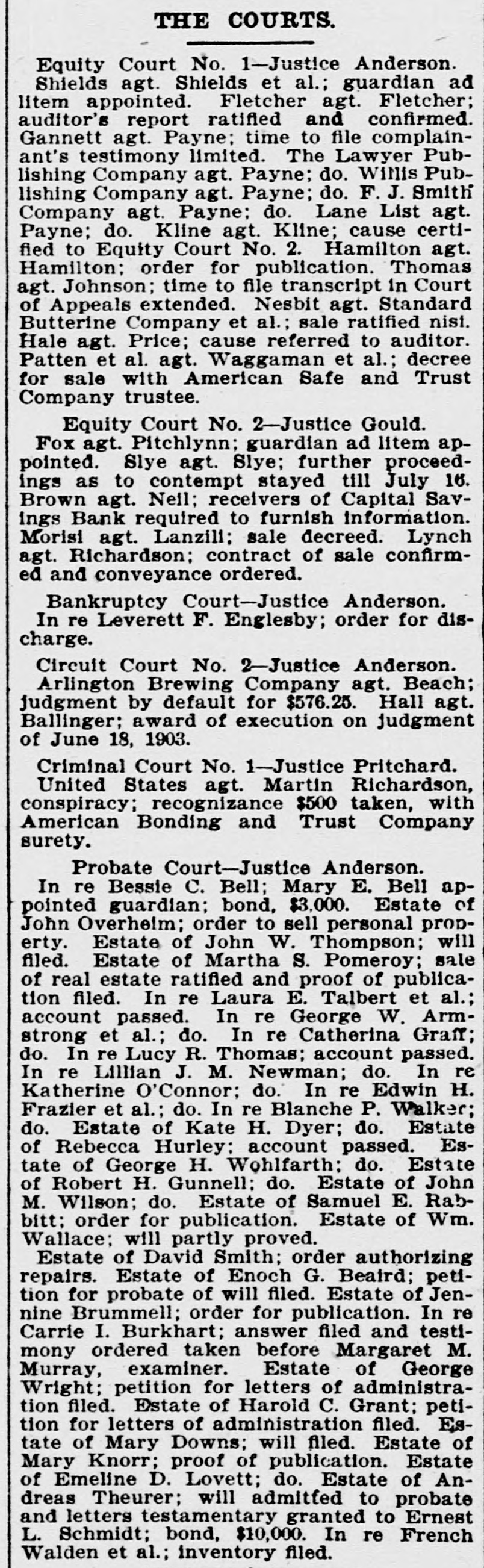
# THE COURTS.
Equity Court No. 1-Justice Anderson.
Shields agt. Shields et al.; guardian ad litem appointed. Fletcher agt. Fletcher; auditor's report ratified and confirmed. Gannett agt. Payne; time to file complaint's testimony limited. The Lawyer Publishing Company agt. Payne; do. Willis Publishing Company agt. Payne; do. F. J. Smith Company agt. Payne; do. Lane List agt. Payne; do. Kline agt. Kline; cause certified to Equity Court No. 2. Hamilton agt. Hamilton; order for publication. Thomas agt. Johnson; time to file transcript in Court of Appeals extended. Nesbit agt. Standard Butterine Company et al.; sale ratified nisi. Hale agt. Price; cause referred to auditor. Patten et al. agt. Waggaman et al.; decree for sale with American Safe and Trust Company trustee.
Equity Court No. 2-Justice Gould.
Fox agt. Pitchlynn; guardian ad litem appointed. Slye agt. Slye; further proceedings as to contempt stayed till July 16. Brown agt. Neil; receivers of Capital Savings Bank required to furnish information. Morisi agt. Lanzill; sale decreed. Lynch agt. Richardson; contract of sale confirmed and conveyance ordered.
Bankruptcy Court-Justice Anderson.
In re Leverett F. Englesby; order for discharge.
Circuit Court No. 2-Justice Anderson.
Arlington Brewing Company agt. Beach; judgment by default for $576.25. Hall agt. Ballinger; award of execution on judgment of June 18, 1903.
Criminal Court No. 1-Justice Pritchard.
United States agt. Martin Richardson, conspiracy; recognizance $500 taken, with American Bonding and Trust Company surety.
Probate Court-Justice Anderson.
In re Bessie C. Bell; Mary E. Bell appointed guardian; bond, $3,000. Estate of John Overheim; order to sell personal property. Estate of John W. Thompson; will filed. Estate of Martha S. Pomeroy; sale of real estate ratified and proof of publication filed. In re Laura E. Talbert et al.; account passed. In re George W. Armstrong et al.; do. In re Catherina Graff; do. In re Lucy R. Thomas; account passed. In re Lillian J. M. Newman; do. In re Katherine O'Connor; do. In re Edwin H. Frazier et al.; do. In re Blanche P. Walker; do. Estate of Kate H. Dyer; do. Estate of Rebecca Hurley; account passed. Estate of George H. Wohlfarth; do. Estate of Robert H. Gunnell; do. Estate of John M. Wilson; do. Estate of Samuel E. Rabbitt; order for publication. Estate of Wm. Wallace; will partly proved.
Estate of David Smith; order authorizing repairs. Estate of Enoch G. Beaird; petition for probate of will filed. Estate of Jennine Brummell; order for publication. In re Carrie I. Burkhart; answer filed and testimony ordered taken before Margaret M. Murray, examiner. Estate of George Wright; petition for letters of administration filed. Estate of Harold C. Grant; petition for letters of administration filed. Estate of Mary Downs; will filed. Estate of Mary Knorr; proof of publication. Estate of Emeline D. Lovett; do. Estate of Andreas Theurer; will admitted to probate and letters testamentary granted to Ernest L. Schmidt; bond, $10,000. In re French Walden et al.; inventory filed.
24.March 14, 1904Evening StarWashington, DC
Click image to open full size in new tab
Article Text
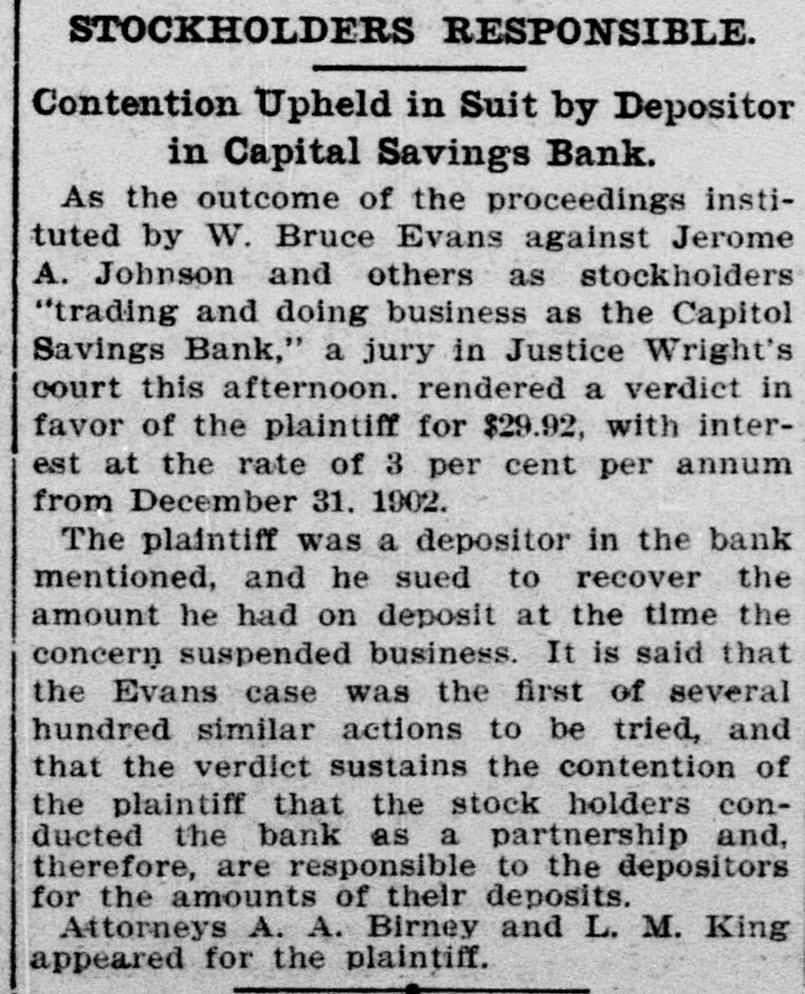
STOCKHOLDERS RESPONSIBLE. Contention Upheld in Suit by Depositor in Capital Savings Bank. As the outcome of the proceedings instituted by W. Bruce Evans against Jerome A. Johnson and others as stockholders "trading and doing business as the Capitol Savings Bank," a jury in Justice Wright's court this afternoon. rendered a verdict in favor of the plaintiff for $29.92, with interest at the rate of 3 per cent per annum from December 31. 1902. The plaintiff was a depositor in the bank mentioned, and he sued to recover the amount he had on deposit at the time the concern suspended business. It is said that the Evans case was the first of several hundred similar actions to be tried, and that the verdict sustains the contention of the plaintiff that the stock holders conducted the bank as a partnership and, therefore, are responsible to the depositors for the amounts of their deposits. Attorneys A. A. Birney and L. M. King appeared for the plaintiff.