16714. Washington Bank (New York, NY)

Bank Information

Episode Type
Suspension → Closure
Bank Type
state
Start Date
November 10, 1839
Location
New York, New York (40.714, -74.006)

Metadata

Model
gpt-5-mini
Short Digest
83cd189f

Response Measures

None

Description

Newspaper items (Nov 10–12, 1839) report the Washington Bank's notes protested and explicitly state the bank has failed. There is no description of a depositor run prior to suspension; failure appears driven by depreciated mortgage/state-stock assets (bank-specific insolvency). No explicit receiver assignment mentioned in the snippets, but the bank is described as failed/closed.

Events (2)

1. November 10, 1839 Suspension
Cause
Bank Specific Adverse Info
Cause Details
Bank insolvency due to depreciated mortgages and state stocks (assets greatly reduced in value), leading to failure and suspension/closure as reported Nov 11–12, 1839.
Newspaper Excerpt
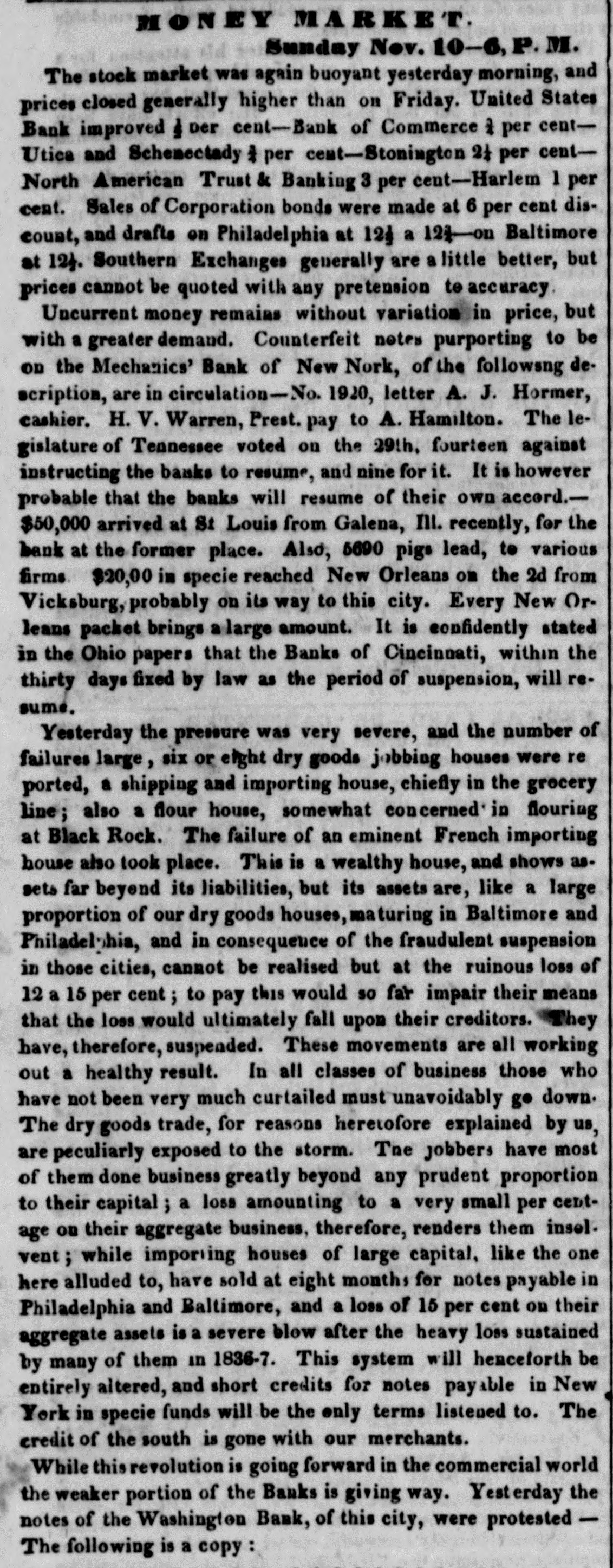
Yesterday the notes of the Washington Bank, of this city, were protested
Source
newspapers
2. November 12, 1839 Other
Newspaper Excerpt
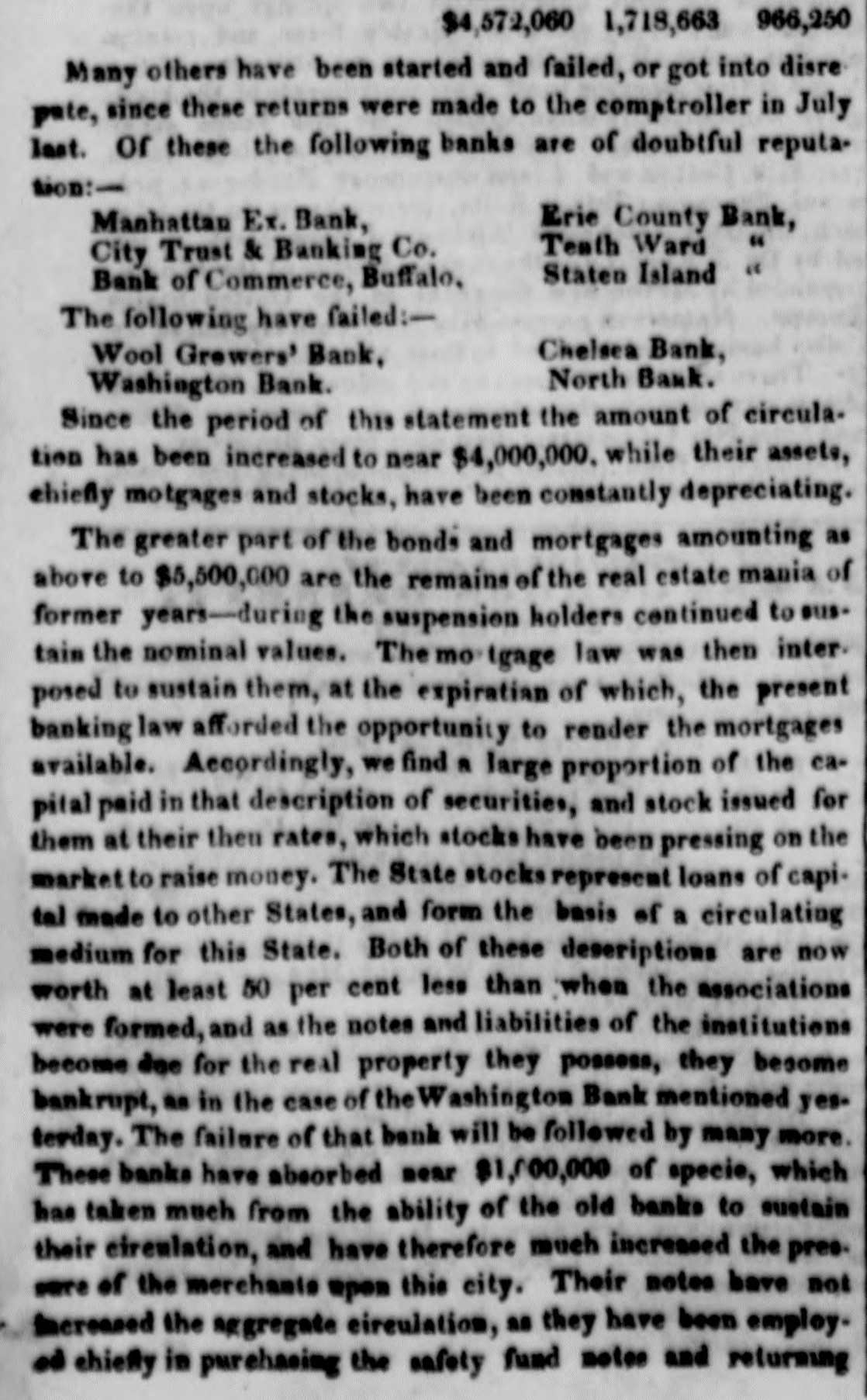
The following have failed: ... Washington Bank. The failure of that bank will be followed by many more.
Source
newspapers

Newspaper Articles (2)

Article from Morning Herald, November 11, 1839

Click image to open full size in new tab

Article Text

# MONEY MARKET. Sunday Nov. 10-6, P. M. The stock market was again buoyant yesterday morning, and prices closed generally higher than on Friday. United States Bank improved ¼ per cent-Bank of Commerce ¾ per cent-Utica and Schenectady ⅜ per cent-Stonington 2¼ per cent-North American Trust & Banking 3 per cent-Harlem 1 per cent. Sales of Corporation bonds were made at 6 per cent discount, and drafts on Philadelphia at 12¼ a 12½-on Baltimore at 12¼. Southern Exchanges generally are a little better, but prices cannot be quoted with any pretension to accuracy. Uncurrent money remains without variation in price, but with a greater demand. Counterfeit notes purporting to be on the Mechanics' Bank of New Nork, of the following description, are in circulation-No. 1920, letter A. J. Hormer, cashier. H. V. Warren, Prest. pay to A. Hamilton. The legislature of Tennessee voted on the 29th, fourteen against instructing the banks to resume, and nine for it. It is however probable that the banks will resume of their own accord.-$50,000 arrived at St Louis from Galena, Ill. recently, for the bank at the former place. Also, 5690 pigs lead, to various firms. $20,00 in specie reached New Orleans on the 2d from Vicksburg, probably on its way to this city. Every New Orleans packet brings a large amount. It is confidently stated in the Ohio papers that the Banks of Cincinnati, within the thirty days fixed by law as the period of suspension, will resume. Yesterday the pressure was very severe, and the number of failures large, six or eight dry goods jobbing houses were reported, a shipping and importing house, chiefly in the grocery line; also a flour house, somewhat concerned in flouring at Black Rock. The failure of an eminent French importing house also took place. This is a wealthy house, and shows assets far beyond its liabilities, but its assets are, like a large proportion of our dry goods houses, maturing in Baltimore and Philadelphia, and in consequence of the fraudulent suspension in those cities, cannot be realised but at the ruinous loss of 12 a 15 per cent; to pay this would so far impair their means that the loss would ultimately fall upon their creditors. They have, therefore, suspended. These movements are all working out a healthy result. In all classes of business those who have not been very much curtailed must unavoidably go down. The dry goods trade, for reasons heretofore explained by us, are peculiarly exposed to the storm. Tne jobbers have most of them done business greatly beyond any prudent proportion to their capital; a loss amounting to a very small per centage on their aggregate business, therefore, renders them insel-vent; while importing houses of large capital, like the one here alluded to, have sold at eight months for notes payable in Philadelphia and Baltimore, and a loss of 15 per cent on their aggregate assets is a severe blow after the heavy loss sustained by many of them in 1836-7. This system will henceforth be entirely altered, and short credits for notes payable in New York in specie funds will be the only terms listened to. The credit of the south is gone with our merchants. While this revolution is going forward in the commercial world the weaker portion of the Banks is giving way. Yesterday the notes of the Washington Bank, of this city, were protested - The following is a copy:

Article from Morning Herald, November 12, 1839

Click image to open full size in new tab

Article Text

$4,572,060 1,718,663 966,250 Many others have been started and failed, or got into disre pate, since these returns were made to the comptroller in July last. or these the following banks are of doubtful reputation:Erie County Bank, Manhattan Ex. Bank, Teath Ward City Trust & Banking Co. Staten Island a Bank of Commerce, Buffalo, The following have failed:Chelsea Bank, Wool Grewers' Bank, North Bank. Washington Bank. Since the period of this statement the amount of circula. tion has been increased to near $4,000,000. while their assets, chiefly motgages and stocks, have been constantly depreciating. The greater part of the bonds and mortgages amounting as above to $5,500,000 are the remains of the real estate mania of former years-during the suspension holders continued to sustain the nominal values. The mo tgage law was then inter. posed to sustain them, at the expiration of which, the present banking law afforded the opportunity to render the mortgages available. Accordingly, we find a large proportion of the capital paid in that description of securities, and stock issued for them at their then rates, which stocks have been pressing on the market to raise money. The State stocks represent loans of capital made to other States, and form the basis of a circulating medium for this State. Both of these descriptions are now worth at least 50 per cent less than when the associations were formed, and as the notes and liabilities of the institutions become dec for the real property they possess, they become bankrupt, as in the case of the Washington Bank mentioned yes. terday. The failure of that bank will be followed by many more. These banks have aboorbed near $1,000,000 of specie, which has taken much from the ability of the old banks to sustain their circulation, and have therefore much increased the pres. sere of the merchants open this city. Their notes have not increased the aggregate circulation, as they have been employw chiefly in purchasing the safety fund notes and returning