1671. Capital Savings Bank (Washington, DC)

Bank Information

Episode Type
Run Only
Bank Type
savings bank
Start Date
January 1, 1893*
Location
Washington, District of Columbia (38.895, -77.036)

Metadata

Model
gpt-5-mini
Short Digest
79dafa4680488886

Response Measures

None

Description

Article 1 (Colored American, 1901) describes Capital Savings Bank meeting all demands during the Panic of 1893 after Treasurer Leonard C. Bailey raised cash โ€” indicating heavy withdrawals/pressure (a run) but the bank remained open. Articles 2 and 3 (1934) mention a 'Capitol/Capitol Savings Bank' that opened in 1878 and closed after 16 years; this conflicts with Article 1 and may refer to a different institution or be an OCR/name error. I therefore record a run during the 1893 panic with no suspension/closure evident in these articles.

Events (1)

1. January 1, 1893* Run
Cause
Macro News
Cause Details
Withdrawals and pressure on the bank occurred during the nationwide Panic of 1893
Measures
Treasurer Leonard C. Bailey raised all necessary cash to meet demands and tide the bank over
Newspaper Excerpt
During the terrible panic of 1893 he readily raised all the cash necessary to tide over the fright and enabled the bank to continuously meet all demands
Source
newspapers

Newspaper Articles (3)

Article from The Colored American, November 2, 1901

Click image to open full size in new tab

Article Text

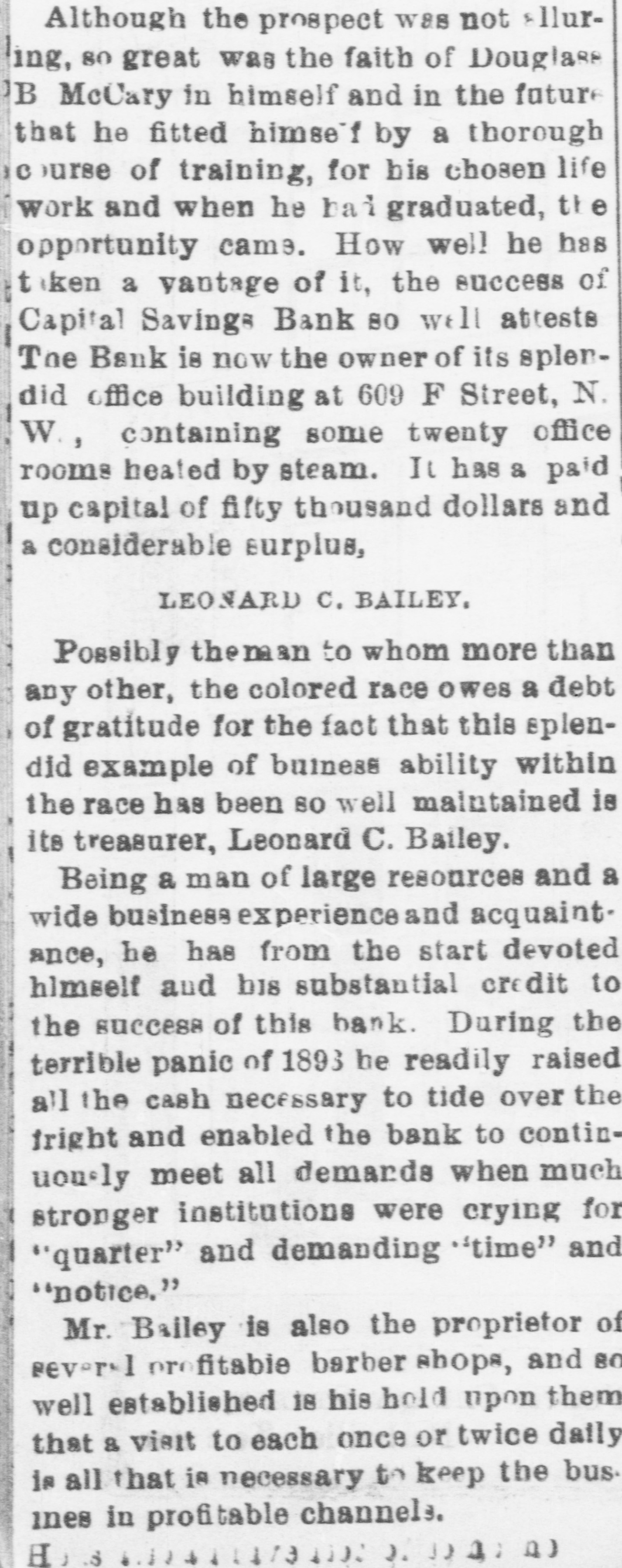
Although the prospect was not alluring, 80 great was the faith of Douglass B McCary in himself and in the future that he fitted himse'f by a thorough purse of training, for his chosen life work and when he bai graduated, the opportunity came. How well he has tiken a vantage of it, the success of Capital Savings Bank 80 well attests The Bank is now the owner of its splendid office building at 609 F Street, N. W., , containing some twenty office rooms heated by steam. It has & paid up capital of fifty thousand dollars and a considerable surplus, LEONARD C. BAILEY, Possibly theman to whom more than any other, the colored race owes a debt of gratitude for the fact that this splendid example of business ability within the race has been so well maintained is its treasurer, Leonard C. Bailey. Being a man of large resources and a wide business experience and acquaintsnce, he has from the start devoted himself and bis substantial credit to the success of this bank. During the terrible panic of 1893 he readily raised all the cash necessary to tide over the fright and enabled the bank to continuously meet all demands when much stronger institutions were crying for "quarter" and demanding "time" and "notice." Mr. Bailey is also the proprietor of reversl profitable barber abops, and 80 well established is his hold upon them that a visit to each once or twice daily is all that is necessary to keep the busines in profitable channels. a)
Article from The Northwest Enterprise, November 1, 1934

Click image to open full size in new tab

Article Text

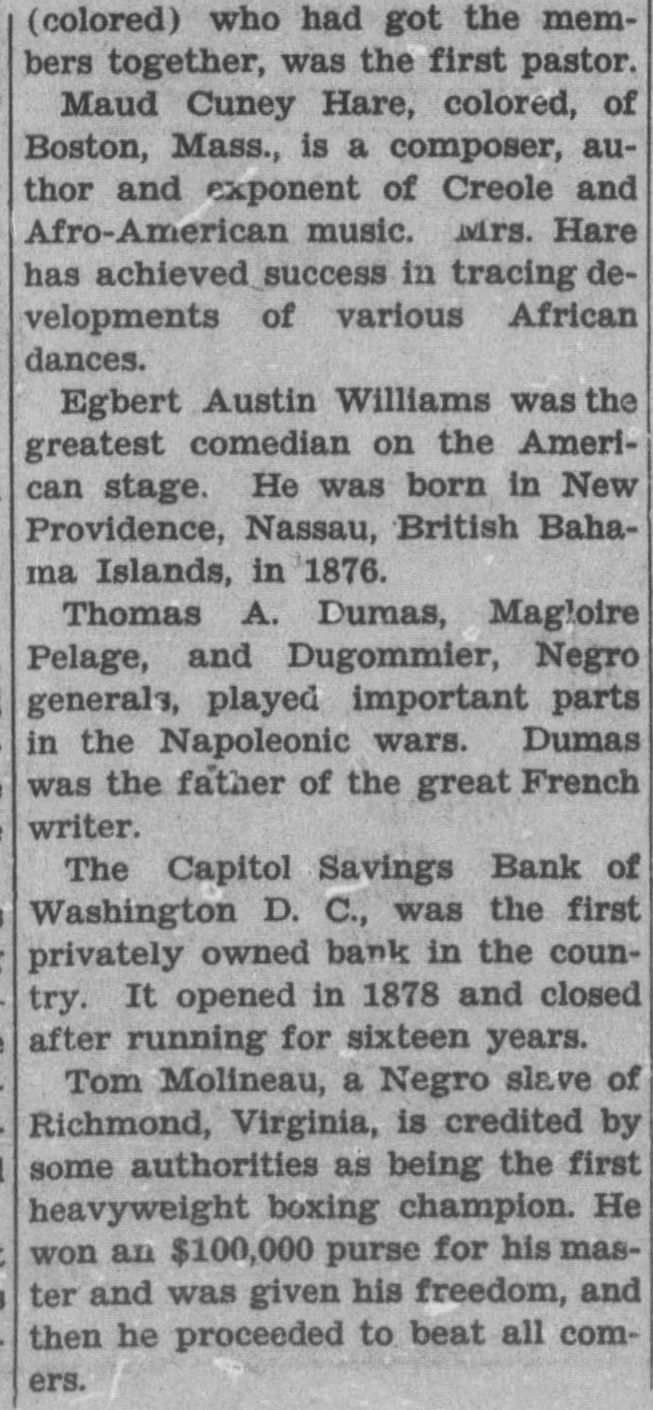
(colored) who had got the members together, was the first pastor. Maud Cuney Hare, colored, of Boston, Mass., is a composer, author and exponent of Creole and Afro-American music. Mrs. Hare has achieved success in tracing developments of various African dances. Egbert Austin Williams was the greatest comedian on the American stage. He was born in New Providence, Nassau, British Bahama Islands, in 1876. Thomas A. Dumas, Magloire Pelage, and Dugommier, Negro generals, played important parts in the Napoleonic wars. Dumas was the father of the great French writer. The Capitol Savings Bank of Washington D. C., was the first privately owned bank in the country. It opened in 1878 and closed after running for sixteen years. Tom Molineau, a Negro slave of Richmond, Virginia, is credited by some authorities as being the first heavyweight boxing champion. He won an $100,000 purse for his master and was given his freedom, and then he proceeded to beat all comers.


Article from Twin-City Herald, November 10, 1934

Click image to open full size in new tab

Article Text

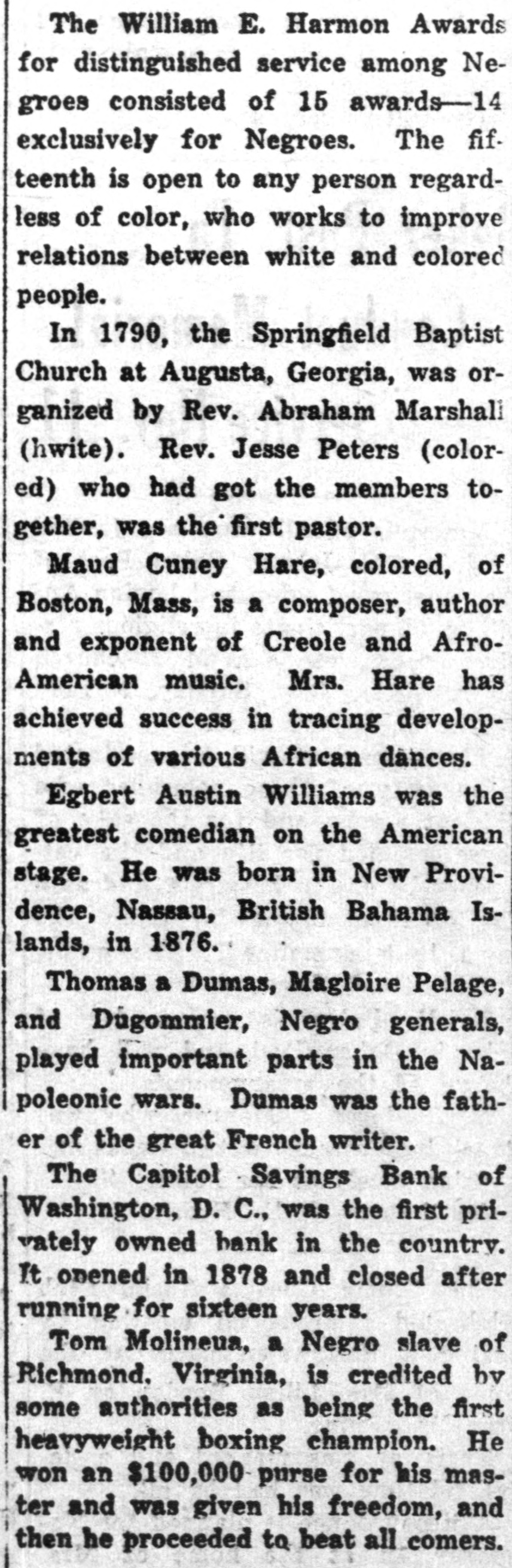
The William E. Harmon Awards for distinguished service among Negroes consisted of 15 awards-14 exclusively for Negroes. The fif. teenth is open to any person regardless of color, who works to improve relations between white and colored people. In 1790, the Springfield Baptist Church at Augusta, Georgia, was organized by Rev. Abraham Marshall (hwite). Rev. Jesse Peters (colored) who had got the members together, was the first pastor. Maud Cuney Hare, colored, of Boston, Mass, is a composer, author and exponent of Creole and AfroAmerican music. Mrs. Hare has achieved success in tracing developments of various African dances. Egbert Austin Williams was the greatest comedian on the American stage. He was born in New Providence, Nassau, British Bahama Islands, in 1876. Thomas a Dumas, Magloire Pelage, and Dugommier, Negro generals, played important parts in the Napoleonic wars. Dumas was the father of the great French writer. The Capitol Savings Bank of Washington, D. C., was the first privately owned bank in the country. It onened in 1878 and closed after running for sixteen years. Tom Molineua, a Negro slave of Richmond. Virginia, is credited bv some authorities as being the first heavyweight boxing champion. He won an $100,000 purse for his master and was given his freedom, and then he proceeded to beat all comers.