16679. Union Trust Company (New York, NY)

Bank Information

Episode Type
Run → Suspension → Reopening
Bank Type
trust company
Start Date
September 19, 1873
Location
New York, New York (40.714, -74.006)

Metadata

Model
gpt-5-mini
Short Digest
3b7473dc

Response Measures

Accommodated withdrawals, Borrowed from banks or large institutions, Public signal of financial health, Capital injected, Full suspension, Books examined

Other: Defalcation by company secretary (Carlton/Carleton) and large Lake Shore loan played central role; government bond purchases and clearing-house loan certificates also important.

Description

Contemporary articles describe a run on the Union Trust Company (Sept 19), suspension (Sept 20), appointment of a receiver (by Sept 23), and eventual resumption of business (resumed Dec 1, 1873). Cause of initial run was the broader financial panic triggered by Jay Cooke & Co.'s failure and related railroad/market rumors; Commodore Vanderbilt later supplied funds/notes to stabilize the loan. No single discrete false-telegram or hoax is described, so this is not a 'random' misinformation run.

Events (5)

1. September 19, 1873 Run
Cause
Macro News
Cause Details
Run triggered by the financial panic following Jay Cooke & Co.'s failure and widespread rumors about Vanderbilt-associated institutions and railroad loans; depositors feared contagion.
Measures
Company paid out large sums and declared its soundness; representatives and banking community acted to reassure depositors.
Newspaper Excerpt
many of the depositors of the Union Trust Company ... congregating about the paying window ... demanded their money. A large amount was paid
Source
newspapers
2. September 20, 1873 Suspension
Cause
Macro News
Cause Details
Widespread panic and inability to liquidate securities quickly amid the crisis (after Jay Cooke failure and related market collapses) led to suspension of payments on Sept 20, 1873.
Newspaper Excerpt
SUSPENSION OF THE UNION TRUST CO. ... The Union Trust Company suspended at half-past ten.
Source
newspapers
3. September 21, 1873 Other
Newspaper Excerpt
VANDERBILT PAYS $2,000,000 INTO THE UNION TRUST COMPANY ... the Union trust company is in the hands of The a receiver. ... The Union trust company is in the hands of a receiver. (reports around Sept 21-22).
Source
newspapers
4. September 23, 1873 Receivership
Newspaper Excerpt
The Union Trust Company in the Hands of a Receiver. ... The Receiver of the Union Trust Company officially announced the adjustment of the loan to the Lake Shore Railroad ... 'The Union Trust Company in the hands of a receiver.' (New York Herald, Sept 23, 1873).
Source
newspapers
5. December 1, 1873 Reopening
Newspaper Excerpt
The principal item of interest ... was the resumption of business by the Union Trust Company. ... During the early part of the day a run was made on the part of depositors, which, being fully met, gradually fell off. (New York Herald, Dec 2 reports resumption 'yesterday').
Source
newspapers

Newspaper Articles (25)

Article from New-York Tribune, September 19, 1873

Click image to open full size in new tab

Article Text

gallery, and there was the greatest anxiety to obtain favorable positions from which to view operations. On the floor of the Stock Exchange the wildest excitement prevailed. The market had opened feverishly under the pressure of evil rumors and the manipulation of the "bears." Each and every operator was prepared for the most direful calamities. Stocks were ruthlessly hammered, and the " bears" ruled the bour. When it became known that Jay Cooke & Co. had failed, dread seemed to take possession of the multitude; and when it was announced that Jay Cooke's First National Bank of Washington and the Philadelphia house had suspended, the scene was simply indescribable. The stock market "broke," and securities were sacrificed in the most ruthles manner. New-York Central dropped from 991 to 944, Harlem from 126 to 125, Erie from 552 to 53). Lake Shore from 901 to 86, Wabash from 561 to 49, Northwestern from 53 to 482. Northwestern Preferred from 76 to 73, Rock Island from 102 to 971, St. Paul from 431 to 39, St. Paul Preferred from 68 to 66, Union Pacific from 24 to 21. Western Union from 881 to 78, and Pacific Mail from 42) to 37. A FAILURE, AND A BANK THREATENED. This decline from 1 to 104 per cent was the cause of the circulation of fresh rumors, this time about weakness in the Vanderbilt party. Once more the rumors were true, for it was officially announced that Richard Schell, a brother of Augustus Schell, and a friend and favorite of Commodore Vanderbilt, had failed. In consequence of the depression in the Vanderbilt stocks, and the failure of Richard Schell, there was an impression that the institutions with which the Vanderbilt party were identified would be affected, and with this idea in view many of the depositors of the Union Trust Company (of which the late Horace F. Clark was President) became frightened, and congregating about the paying window of the Company, demanded their money. A large amount was paid, and the confidence returning, the Company resumed itsusual appearance after bank hours. POVERTY CORNER AND THE GOLD EXCHANGE. The south-east corner of Exchange-place and Broad-st. known as " Poverty Corner," was densely packed by an agitated crowd of impecunious stock brokers eagerly looking for money. Owing to the natural stringency of the market and the fears of additional disasters, the borrowers outnumbered the lenders about ten to one. The early operations on call were at 7 per cent. currency to gold interest, but when the Cooke, Schell, and other failures became known in the afternoon, the price advanced to : per cent per diem, which rate has not been reached since the exciting times of last Winter and Spring. The final business was at 7 per cent, later in the day. The scenes on the Stock Exchange were repeated on a less excited scale, although the attendance on the floor was nearly equally numerous and the gallery very much thronged. The price opened at 111 advanced to 112), and closed at 112g.
Article from New-York Tribune, September 19, 1873

Click image to open full size in new tab

Article Text

# A FINANCIAL THUNDERBOLT. Continued from First Page. Broadway and Rector-st. This company does a regular banking business, is a depository for trust and other funds, and was presided over by the late Horace F. Clark, son-in-law of Commodore Vanderbilt. This fact taken in connection with the failure of Richard Schell led people to think that the concern was involved by the general decline, and there was an immediate run upon it, which lasted until about the close of banking hours. The scenes at the bank were peculiarly exciting, long lines of anxious depositors extending from the entrance on Broadway to the rear of the building. Large sums were paid out, but when it was discovered that the Company was able to meet its engagements, a portion was afterward restored. Whether the "run" will be renewed to-day depends materially upon the course of events and the degree of public confidence. # VANDERBILT DESERTS RICHARD SCHELL. The fact that the friends and adherents of Commodore Vanderbilt failed to assist Richard Schell elicited some comment. It was supposed that they would come forward with material, but as they did not do so, however, their neglect to do so furnished food for fresh reports. Richard Schell, like all other Vanderbilt men, was popularly supposed to have been "long" of stocks, particularly New-York Central, Lake Shore, Western Union, and others. The break of 10 per cent in Western Union, with other losses, is supposed to have been the cause of his troubles. The extent of his liabilities is not known, but they are supposed to be large. When applied to yesterday for a statement he politely but firmly declined to make any. # OTHER FAILURES. Other failures were freely reported, but on investigation the rumors proved to be unfounded with the single exception of a small house, Robinson & Suydam. This house was carrying a quantity of stocks at high figures, and was compelled to suspend, but hopes to resume soon. It was also reported that a director of the Milwaukee and St. Paul Railroad and the Pacific Mail Steamship Company had suspended, but this was denied. It was further stated that the Pennsylvania Company had gone to protest. In regard to this the following dispatch was published: PHILADELPHIA, Sept. 18. J. P. Morgan, Drexel, Morgan & Co., New-York. Have seen the slanders respecting Pennsylvania Railroad Company. The Company are perfectly easy in their finances. A. J. DREXEL. In addition to the ordinary revenue of the Company, they have recently negotiated their bonds to the extent of $10,000,000 in London, the proceeds of which are at their disposal.


Article from Wilmington Daily Commercial, September 20, 1873

Click image to open full size in new tab

Article Text

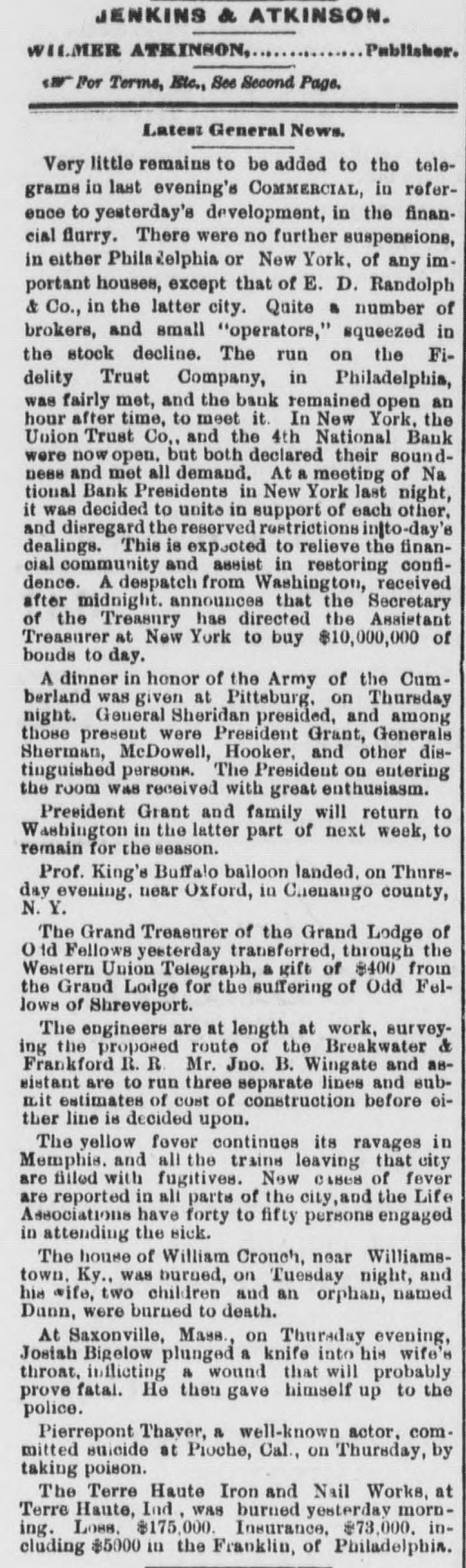
JENKINS & ATKINSON. Publisher. WILMER ATKINSON, w For Terms, Etc., See Second Page. Latest General News. Very little remains to be added to the telegrams in last evening's COMMERCIAL, in reference to yesterday's development, in the finanwere no in or cial either flurry. Philadelphia There New further York, suspensions, of any important houses, except that of E. D. Randolph & Co., in the latter city. Quite a number of brokers, and small "operators," squeezed in the stock decline. The run on the Fidelity Trust Company, in Philadelphia, was fairly met, and the bank remained open an hour after time, to meet it. In New York, the Union Trust Co,, and the 4th National Bank were now open. but both declared their soundness and met all demand. At a meeting of Na tional Bank Presidents in New York last night, it was decided to units in support of each other, and disregard the reserved restrictions into-day's dealings. This is expected to relieve the financial community and assist in restoring confidence. A despatch from Washington, received after midnight. announces that the Secretary of the Treasury has directed the Assistant Treasurer at New York to buy $10,000,000 of bonds to day. A dinner in honor of the Army of the Cumberland was at on given Pittsburg, Thursday night. General Sheridan presided, and among those present were President Grant, Generals Sherman, McDowell, Hooker, and other distinguished persons. The President on entering the room Was received with great enthusiasm. President Grant and family will return to Washington in the latter part of next week, to remain for the season. Prof. King's Buffalo bailoon landed. on Thursday evening. near Oxford, in Chenango county, N.Y. The Grand Treasurer of the Grand Lodge of O d Fellows yesterday transferred, through the Western Union Telegraph, a gift of $400 from the Grand Lodge for the suffering of Odd Fellows of Shreveport. The engineers are at length at work, surveying the proposed route of the Breakwater & Frankford R. R. Mr. Jno. B. Wingate and assistant are to run three separate lines and submit estimates of cost of construction before either line is decided upon. The yellow fever continues its ravages in Memphis. and all the trains leaving that city are filled with fugitives. New CASES of fever are reported in all parts of the city, and the Life Associations have forty to fifty persons engaged in attending the sick. The house of William Crouch, near Williamstown. Ky., was burned, on Tuesday night, and hie wife, two children and an orphan, named Dann, were burned to death. At Saxonville, Mass., on Thursday evening, Josiah Bigelow plunged a knife into his wife's throat. inflicting a wound that will probably prove fatal. He then gave himself up to the police. Pierrepont Thayer, a well-known actor. committed suicide at Pioche, Cal., on Thursday, by taking poison. The Terre Haute Iron and Nail Works, at Terre Haute, Ind. was burned yesterday morning. Loss. $175,000. Insurance. $73,000. including $5000 in the Franklin, of Philadelphia.


Article from Evening Star, September 20, 1873

Click image to open full size in new tab

Article Text

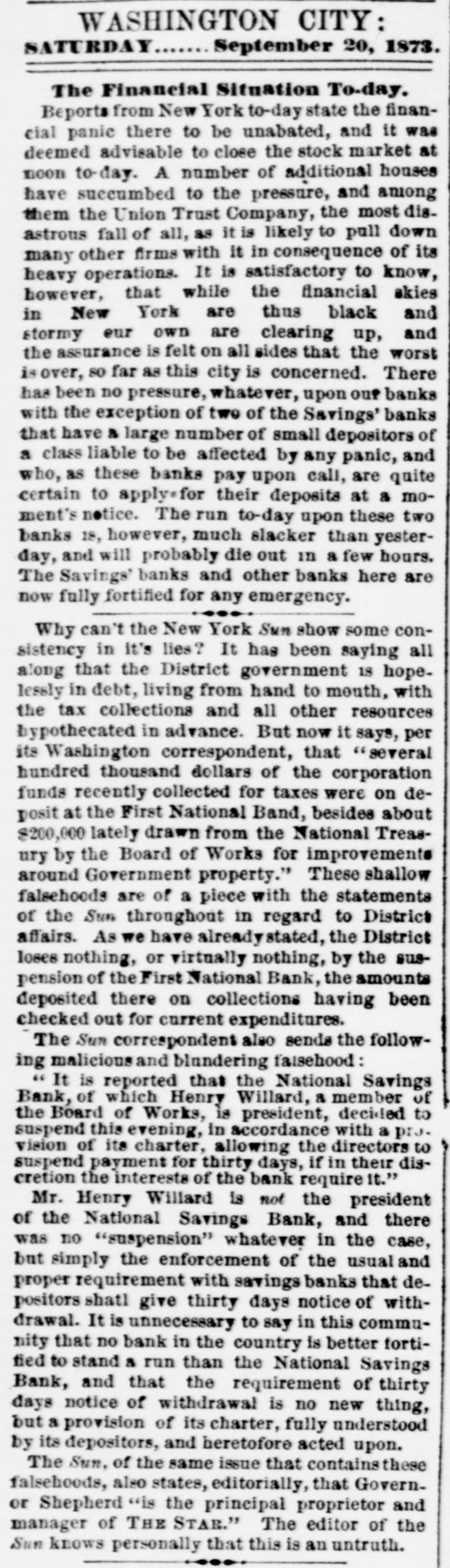
WASHINGTON CITY: SATURDAY September 20, 1873. The Financial Situation To-day. Beports from New York to-day state the financial panic there to be unabated, and it was deemed advisable to close the stock market at noon to-day. A number of additional houses have succumbed to the pressure, and among them the Union Trust Company, the most disastrous fall of all, as it is likely to pull down many other firms with it in consequence of its heavy operations. It is satisfactory to know, however, that while the financial skies in New York are thus black and stormy our own are clearing up, and the assurance is felt on all sides that the worst over, so far as this city is concerned. There has been no pressure, whatever, upon our banks with the exception of two of the Savings' banks that have a large number of small depositors of a class liable to be affected by any panic, and who, as these banks pay upon call, are quite certain to apply=for their deposits at a moment's notice. The run to-day upon these two banks 18, however, much slacker than yesterday, and will probably die out in a few hours. The Savings banks and other banks here are now fully fortified for any emergency. Why can't the New York Sun show some consistency in it's lies? It has been saying all along that the District government 18 hopelessly in debt, living from hand to mouth, with the tax collections and all other resources hypothecated in advance. But now it says, per its Washington correspondent, that "several hundred thousand dollars of the corporation funds recently collected for taxes were on deposit at the First National Band, besides about $200,000 lately drawn from the National Treasury by the Board of Works for improvements around Government property." These shallow falsehoods are of a piece with the statements of the Sun throughout in regard to District affairs. As we have alreadystated, the District loses nothing, or virtually nothing, by the suspension of the First National Bank, the amounts deposited there on collections having been checked out for current expenditures. The Sun correspondent also sends the following malicious and blundering falsehood: It is reported that the National Savings Bank, of which Henry Willard, a member of the Board of Works, is president, decided to suspend this evening, in accordance with a pro. vision of its charter, allowing the directors to suspend payment for thirty days, if in their discretion the interests of the bank require it.' Mr. Henry Willard is not the president of the National Savings Bank, and there was no "suspension" whatever in the case, but simply the enforcement of the usual and proper requirement with savings banks that depositors shatl give thirty days notice of withdrawal. It is unnecessary to say in this community that no bank in the country is better tortified to stand a run than the National Savings Bank, and that the requirement of thirty days notice of withdrawal is no new thing, but a provision of its charter, fully understood by its depositors, and heretofore acted upon. The Sun, of the same issue that contains these falsehoods, also states, editorially, that Governor Shepherd "is the principal proprietor and manager of THE STAR." The editor of the Sun knows personally that this is an untruth.


Article from The Daily Phoenix, September 20, 1873

Click image to open full size in new tab

Article Text

NEW YORK, September 19.-Fisk & Hatch say their suspension is temporary. Their advances are upon Chesapeake and Ohio Road and Central Pacifio. They expect to resume as soon as the panic ceases. Fitch & Co. have suspended. The office of Fisk & Hatch is strongly guarded by police. A prominent Wall street banker says if the movement now making, to get the Secretary of the Treasury to come to their relief, with $10,000,000, should fail, there will be a general suspension of banks and others. A meeting of bank presidents is now being held at the clearing house. Vernon & Hoy have suspended. The police prevent any but members to enter the Stock Exchange. E. D. Randolph & Co., bankers of the Pennsylvania Central Railroad, and Wm. H. Anner, announce their suspension. The clearing house appointed a committee of five for the purpose of adopting a plan to relieve the present difficulties. At 2 o'clock, there was a better feeling. Western Union stock at 72. The run on the Union Trust Company is subsiding. There is more or less of a crowd around every paying teller's desk. Geo. B. Alley, whose suspension is already announced, is widely known in connection with fast horses, having raised Dexter. He says his suspension is caused by the general decline in stocks; especially Vanderbilt stocks. His liabilities are not large, and he expects to resume soon. Greenleaf, Norris & Co. is an old and wealthy stock firm. President Calhoun, of the Fourth National Bank, says: "We have no reason to fear anything." President Tappan, of the Gallatin National Bank, says he believes the better banking institutions will weather the storm. Secretary Carlton, of the Union Trust Company, says the company is perfectly solvent, and will meet all demands. It is reported that the company had $700,000 on deposit last night. Mr. Fahnestock, of Jay Cooke & Co., said, in an interview, this afternoon, that the firm hoped to pay all liabilities. Mr. Garland, another member of the firm, says the London house will have a large surplus after payment of all its debts, unless there is a great shrinking in the value of their securities. The latest rumor on the street is, that the Government will come to the rescue to-morrow, by buying $5,000,000 of bonds. The grain and provision markets are all unsettled by the Wall street panic. State and railroad bonds and city bank shares have been practically neglected, while dealings in railroad stocks continued on au enormous scale. This afternoon, the principal transactions have been Pacific Mail, Central and Hudson, Western Union, Rock Island, Wabash and St. Paul, Western Lake Shore, and Erie. Outside purchasers continue in considerable numbers on the declining market, for investment, which aided in strengthening the market this afternoon. Assistant Treasurer Hillhouse says it is in the power of the national banks to avert further disaster, and they will undoubtedly do so. The Evening Post is informed that Secretary Richardson will offer to buy from $5,000,000 to $10,000,000 of five-twenties to-morrow. This will throw into the banks legal tender notes, for the large currency balance in the Treasury is nearly all composed of legal tenders. With the panic thus checked, a calm, with low rates for money, will soon follow. Jacobs, Little & Co. have failed. PHILADELPHIA, September 19.-The following have suspended: H. H. Douglass, Bayard, J. H. Yerkes, John Lloyd, Gilbaugh & Co., and Bond; all smali, except Gilbaugh. WASHINGTON, September 19.-The Committee of the Bar Association of the District of Columbia, appointed at the request of R. T. Merrick, Esq., to investigate certain charges made against him, by Ben. E. Green, son of General Duff Green, and formerly of this city, made their report to-day. The report contains copious extracts from the evidence, and sets forth that the charges have been shown to be without the slightest foundation, and that Green knew them to be false when he published them; and that the committee are forced to this conclusion by Green's own testimony, taken under oath, before the committee. A series of resolutions were unanimously adopted by the association, endorsing the views of the report, condemning Green in dignified but severe language, and declaring that the conduct of Mr. Merrick, in the transactions referred to, was not only irreproachable, but was highly honorable, efficient, faithful and magnanimous.


Article from The New York Herald, September 21, 1873

Click image to open full size in new tab

Article Text

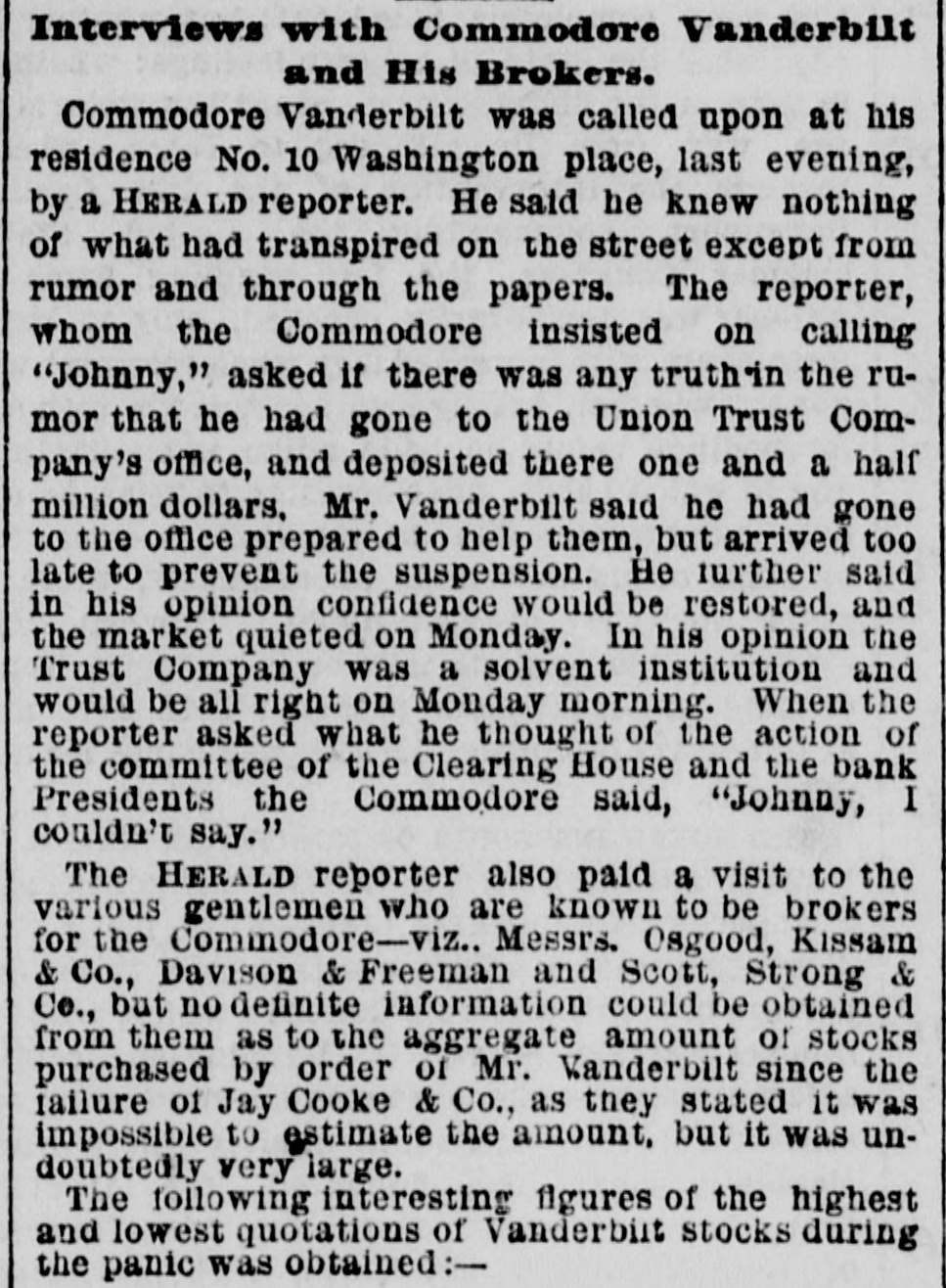
Interviews with Commodore Vanderbilt and His Brokers. Commodore Vanderbilt was called upon at his residence No. 10 Washington place, last evening, by a HERALD reporter. He said he knew nothing of what had transpired on the street except from rumor and through the papers. The reporter, whom the Commodore insisted on calling "Johnny," asked if there was any truth in the rumor that he had gone to the Union Trust Company's office, and deposited there one and a half million dollars. Mr. Vanderbilt said he had gone to the office prepared to help them, but arrived too late to prevent the suspension. He further said in his opinion confidence would be restored, and the market quieted on Monday. In his opinion the Trust Company was a solvent institution and would be all right on Monday morning. When the reporter asked what he thought of the action of the committee of the Clearing House and the bank Presidents the Commodore said, "Johnny, I couldn't say." The HERALD reporter also paid a visit to the various gentlemen who are known to be brokers for the Commodore-viz.. Messrs. Osgood, Kissam & Co., Davison & Freeman and Scott, Strong & Co., but no definite information could be obtained from them as to the aggregate amount or stocks purchased by order of Mr. Vanderbilt since the failure of Jay Cooke & Co., as they stated it was impossible to estimate the amount, but it was undoubtedly very large. The following interesting figures of the highest and lowest quotations of Vanderbit stocks during the panic was obtained:-


Article from Evening Star, September 22, 1873

Click image to open full size in new tab

Article Text

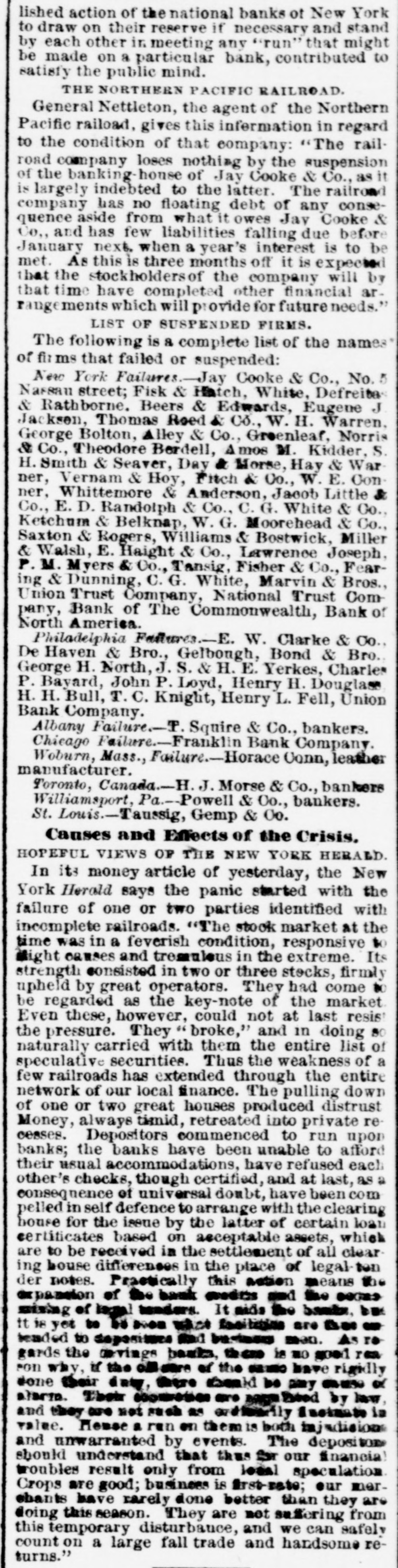
Lished action of the national banks ot New York to draw on their reserve if necessary and stand by each other in meeting any "run" that might be made on a particular bank, contributed to satisfy the public mind. # THE NORTHERN PACIFIC RAILROAD. General Nettleton, the agent of the Northern Pacific raiload, gives this information in regard to the condition of that company: "The rail- road company loses nothing by the suspension of the banking-house of Jay Cooke & Co., as it is largely indebted to the latter. The railroad company has no floating debt of any conse- quence aside from what it owes Jay Cooke & Co,, and has few liabilities falling due before January next, when a year's interest is to be met. As this is three months off it is expected that the stockholders of the company will by that time have completed other financial ar- rangements which will provide for future needs." # LIST OF SUSPENDED FIRMS. The following is a complete list of the names of firms that failed or suspended: New York Failures. Jay Cooke & Co., No. 5 Nassau street; Fisk & Hatch, White, Defreita & Rathborne. Beers & Edwards, Eugene J Jackson, Thomas Roed & Co., W. H. Warren. George Bolton, Alley & Co., Greenleaf, Norris & Co., Theodore Berdell, Amos M. Kidder, S. H. Smith & Seaver, Day Morse, Hay & War- ner, Vernam & Hoy, Fitch & Co., W. E. Con ner, Whittemore & Anderson, Jacob Little Co., E. D. Randolph & Co., C. G. White & Co., Ketchum & Belknap, W. G. Moorehead & Co., Saxton & Rogers, Williams & Bostwick, Miller & Walsh, E. Haight & Co., Lawrence Joseph, P. M. Myers & Co., Tansig, Fisher & Co., Fear- ing & Dunning, C. G. White, Marvin & Bros., Union Trust Company, National Trust Com pany, Bank of The Commonwealth, Bank of North America. Philadelphia Fatures.-E. W. Clarke & Co.. De Haven & Bro., Gelbongh, Bond & Bro.. George H. North, J. S. & H. E. Yerkes, Charles P. Bayard, John P. Loyd, Henry H. Douglase H. H. Bull, T. C. Knight, Henry L. Fell, Union Bank Company. Albany Failure. T. Squire & Co., bankers. Chicago Failure. Franklin Bank Company. Woburn, Mass., Failure.-Horace Conn, leather manufacturer. Toronto, Canada.-H. J. Morse & Co., bankers Williamsport, Pa.--Powell & Co., bankers. St. Louis. Taussig, Gemp & 00. # Causes and Effects of the Crisis, HOPEFUL VIEWS OF THE NEW YORK HERALD. In its money article of yesterday, the New York Herald says the panic started with the failure of one or two parties identified with incomplete railroads. "The stock market at the time was in a feverish condition, responsive to slight causes and tremulous in the extreme. Its strength consisted in two or three stocks, firmly upheld by great operators. They had come to be regarded as the key-note of the market. Even these, however, could not at last resist the pressure. They "broke," and in doing so naturally carried with them the entire list of speculative securities. Thus the weakness of a few railroads has extended through the entire network of our local finance. The pulling down of one or two great houses produced distrust Money, always timid, retreated into private re- cesses. Depositors commenced to run upon banks; the banks have been unable to afford their usual accommodations, have refused each other's checks, though certified, and at last, as a consequence of universal doubt, have been com- pelled in self defence to arrange with the clearing house for the issue by the latter of certain loan certificates based on acceptable assets, which are to be received in the settlement of all clear- ing house differences in the place of legal-ton- der notes. Practically this action means the expansion of the bank credits and the sens mixing of legal tenders. It aids the banks, but it is yet to be seen what facilities are thus ex- tended to depositors and business men. As re- gards the savings banks, there is no good rea- son why, if the officers of the same have rigidly done their duty, there should be any cause of alarm. Their investments are regulated by law, and they are not such as ordinarily fluctuate in value. Hence a run on them is both injudicious and unwarranted by events. The depositors should understand that thus far our financial troubles result only from local speculation. Crops are good; business is first-rate; our mer- chants have rarely done better than they are doing this season. They are not suffering from this temporary disturbance, and we can safely count on a large fall trade and handsome re- turns."


Article from The Daily State Journal, September 22, 1873

Click image to open full size in new tab

Article Text

[SUNDAY NIGHT'S DISPATCHES.] NEW YORK, September 21, 8:10 P. M.-President Grant and Secretary Richardson, have been in consultation with Vanderbilt and other leading capitalists, bankers and merchants since noon. No action reported yet. LATER-RESULT OF THE CONFERENCE, NEW YORK, September 21.-The following is the result of the conference at Avenue hotel, between the and others, as to of the remeans President the Fifth overcoming difficulties the best from the recent financial President positively sulting The declines disasters action to interfere in the matter, as any be of his in connection therewith would unconstitutional. committee of bankers and mercome down to to the government, chants proposition The had the to issue final $80,000,000 of the legal reserve. Reverdy Johnson is said to have given his opinion to the effect that to use the legal reserve is unconstitutional. Secretary Richardson opposes the placing at any considerable sum of the reserve To of the disposal of the New York banks. use his own words, quoted on the authority of one of the committee 'This, gentlemen, is not my funeral." VANDERBILT PAYS $2,000,000 INTO THE UNION TRUST COMPANY-GI ERAL CAUSE OF THE SUSPENSIONS CONDITION OF HEVARIOUSTRADES NEW YORK, September 21.-At a late hour last (Saturday) night, it was stated in one the clubs that Commodore Vanderbilt into the Union the day $2,000,000, the during had of paid Trust amount company due the by the Lake Shore road thus enabling Trust company to restime business Monday morning. The general cause of suspension on the of the banks and bankers yesterday part inability to convert securities into Even government not of except at be cash. was disposed the bonds immense officers could yester- loss. action of the bank difficulty is done away by depositing in the day, By Any the bank, this hands obtain with. of committee good securities, can amount of can an be in the clearing business the used equal certificates, which instead into of legal tenders. The certificates will go effect to-morrow (to-day). The dry goods men believe that Jay Cooke & Co. will pay the last cent of their liabilities. The tea trade is in a healthy cendition, nearly all of that branch of business being done through foreign bankers. The wholesale druggists fear nothing, in unless the stress continues. Sales other branches of trade run along in the same old channels. [TO-DAY'S DISPATCHES.] September 22.-It is offiannounced that Secretary continue to buy bonds at cially NEW will YORK, Richardson Richard- Saturson quotations. Secretary the last he did not see to do more than buy said day's power night bonds, he without had and offered, will be bought or " The government," the all delay 5-20s red tape." secretary says, trust company or loan is doubtful if congress and "is not it a would institution, power." sancsuch construction of my alludes to the using of 000 of the tion [The any above reserves.] $40,000, Thirty savings banks have resolved to rigidlv enforce the previous notice clause. The Union trust company is in the hands of The a receiver. New York stock exchange remains closed to-day. The manager of the clearing house says check passed through clearing will no every paid. He says the banks are in danger, be and that they were never stronger. is The suspension of Marvin & Brothers announced. All banks have pulled through except loan the two settling through the two committee. All the savings banks are having a run on them. The clearing house loan committee have issued $2,500,000 certified checks. The government has bought a million to in bonds. Large crowds are waiting sell. Montreal and Europe are buying stocks at the shrinkage. The gold exchange is closed, 112 has been established as the basis of settlement. The rate of interest is fixed at 7 for carry70-100. ing. The sub-treasury is buying 5-20s at Arun on the Seaman's bank has commenced. They pay all sums of $100 law's and under. Larger sums must wait the delay* WASHINGTON, September 22.-In President the of the morning, the called at the treasury department course Richardson. and had conference with Secretary a of it may be the fact The result that subsequently inferred secretary Associated from stated the of the New York to the President will do bethe law, but in no go within Press the that agent particular will anything main+ clear legal authority. He tain yond the safety of the treasury department, States protect the credit of the United financial and from the influences of the present London house. embarrassment. Jay Cooke reassures the solvency of the PHILADELPHIA, September 22. The the savings uks has subsided. run on September 22. The savings of the banks CHICAGO, give notice of the enforcement sixty days' notice.


Article from The Wheeling Daily Intelligencer, September 22, 1873

Click image to open full size in new tab

Article Text

Conference with Bankers Yester day The Treasury to Buy all Bonds Offered The $44,000,000 Reserve to be Drawn on If Needed. Prospect for Improvement To-Day. Saturday's Report. REPORT ON THE WARKHOUSE AND BECURITX COMPANY w-York, Sept. 20-The Examining Committee on the condition of the Ware. house & Security Company, reports the total assets of the loans on stocks, bonds, cash on hands and bonds, stocks and real estate owned by the company at $2,946,421; total liabilities including capital at $2,827,400; excess of assets over liabilities $619,020. Estimating at the minimum value the collateral pledged for loans and property owned by the company, there remains a surplus of $1,124,884. Excluding the capital stock, the company believe this will guarantee the payment of their indebtedness and recommend an extension of twelve months from October first; that the Directors convert the assets into cash as fast as practicable, and declare a dividend when the cash on hands amounts to 10 per cent of the liabilities, and four of the present directors be replaced by four elected by the creditors. HOBOKEN SAVINGS BANK IN ROUBLE. The suspension of Fisk & Hatch is said to make probable the embarassment of the Hoboken Bank for Savings. A defalcation of nearly $70,000 was discovered in the bank lately, securities and the to directors make disposed of some up the deficiency, depositing with Fisk & Hatch $94,000 of the amount realized. The suspension of the firm makes this amount unavailable at present. EFFORT TO RECOVER LETTERS SENT TO JAY COOKE & 00. A number of telegrams were received at the Postoffice yesterday, requesting the postmaster to withhold from delivering letters bearing the stamp of the firms send ing the messages, and which were ad. dressed to Jay Cooke & Co. The postmaster could not comply with the request as the postal regulations provide that after a letter has passed from the mailing office, the delivery of it cannot be prevented or delayed by the alleged writer. The Court of General Sessions adjourned early yesterday to give the jurors and court officers an opportunity to look after their bank accounts and securities. SUSPENSION OF THE UNION TRUST CO. NEW YORK, Sept. 20.-The Union Trust Company suspended at half-past ten. THE TREASURY ROND PURCHASE. NEW YORK, Sept. 20.-The sub-T'reasurer has posted a notice stating that has beer instructed by the Secretary of the Treasury to purchase ten millions dollars of bonds to-day, This prompt response of the government to the request made for relief by brokers yesterday gives apparently additional strength to the strong and encouragement to the weak, and it looks now as though the worst was over. The stock market shows an improvement of five per cent. The Union Trust company announces that it will re's some Monday morning. FAILURE OF PHILADELPHIA UNION BANKING CO. 88 PHILADELPHIA, Sept. 20.-The Union es Banking Company has failed. This bank 10 has a State charter and bore a heavy IND n. yesterday. es STOCKS ON THE SEE-SAW. at st NEW YORK, Sept. 20.-Stocks are going a up and down lively and several sales have been made under rules which would imply that other failures have taken place, ed although the only one made known yet is ay that of the firm of C. G. White & Co. Western Union has touched 60. The susd pension of the Union Trust Company it


Article from The Rock Island Daily Argus, September 22, 1873

Click image to open full size in new tab

Article Text

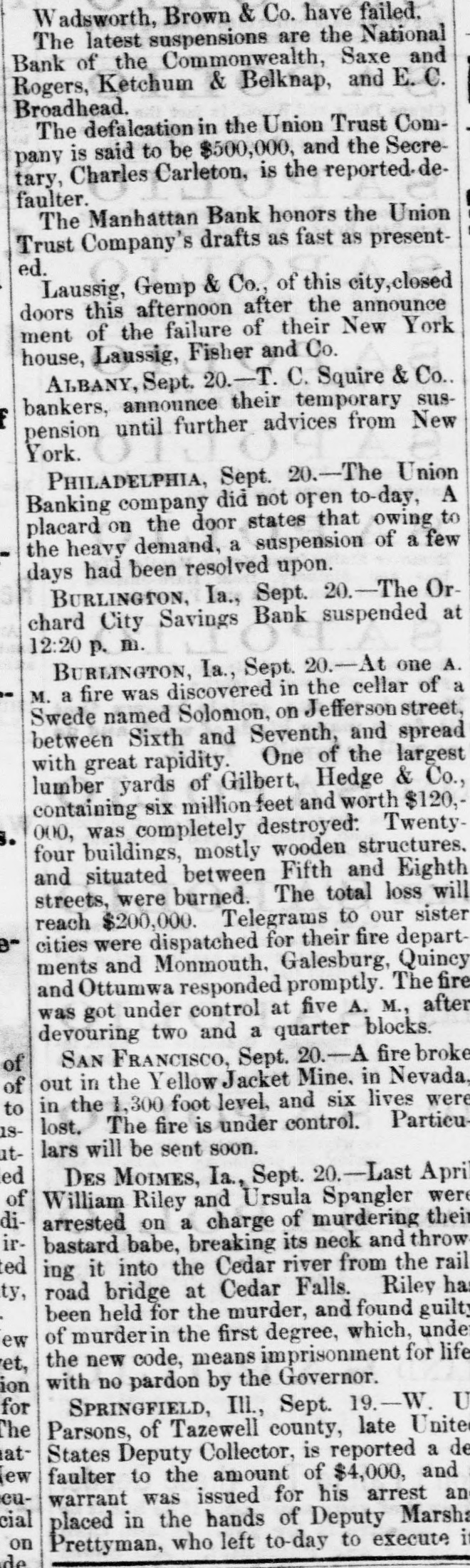
Wadsworth, Brown & Co. have failed. The latest suspensions are the National Bank of the Commonwealth, Saxe and Rogers, Ketchum & Belknap, and E.C. Broadhead. The defalcation in the Union Trust Company is said to be $500,000, and the Secretary, Charles Carleton, is the reported defaulter. The Manhattan Bank honors the Union Trust Company's drafts as fast as presented. Laussig, Gemp & Co., of this city, closed doors this afternoon after the announce ment of the failure of their New York house, Laussig, Fisher and Co. ALBANY, Sept. 20.-T. C. Squire & Co. bankers, announce their temporary suspension until further advices from New York. PHILADELPHIA, Sept. 20.-The Union Banking company did not open to-day, A placard on the door states that owing to the heavy demand, a suspension of a few days had been resolved upon. BURLINGTON, Ia., Sept. 20.-The Orchard City Savings Bank suspended at 12:20 p. m. BURLINGTON, Ia., Sept. 20.-At one A. M. a fire was discovered in the cellar of a Swede named Solomon, on Jefferson street, between Sixth and Seventh, and spread with great rapidity. One of the largest lumber yards of Gilbert, Hedge & Co., containing six million feet and worth $120,000, was completely destroyed: Twentyfour buildings, mostly wooden structures. and situated between Fifth and Eighth streets, were burned. The total loss will reach $200,000. Telegrams to our sister cities were dispatched for their fire depart ments and Monmouth, Galesburg, Quincy and Ottumwa responded promptly. The fire was got under control at five A. M., after devouring two and a quarter blocks. SAN FRANCISCO, Sept. 20.-A fire broke of out in the Yellow Jacket Mine. in Nevada of in the 1,300 foot level, and six lives were to lost. The fire is under control. Particu18lars will be sent soon. uted DES MOIMES, Ia., Sept. 20. - -Last April of William Riley and Ursula Spangler were diarrested on a charge of murdering their its irted into the ing bastard it babe, breaking Cedar river neck from and the throw rail ty, road bridge at Cedar Falls. Riley ha been held for the murder, and found guilty of murder in the first degree, which, under ew the new code, means imprisonment for life et, with no pardon by the Governor. ion for SPRINGFIELD, Ill., Sept. 19.-W. U The Parsons, of Tazewell county, late Unite atStates Deputy Collector, is reported a de few faulter to the amount of $4,000, and cuwarrant was issued for his arrest an cial placed in the hands of Deputy Marsha on Prettyman, who left to-day to execute it


Article from The New York Herald, September 23, 1873

Click image to open full size in new tab

Article Text

The Union Trust Company in the Hands of a Receiver. Six Millions of Currency Disbursed by Sub-Treasury. Meeting of the Jay Cooke Firm To-Day. "E"CRISIS" IN THE COURTS The change in the aspect of Wall street from the turmoil and painful agitation of last week was strikingly noticeable yesterday. The closing of the Stock Exchange, the government declaration to buy an unlimited offer of five-twenties, the action of the banks in resolving to issue loan certificates, and the intervention of the Sabbath all contributed to calm the troubled waters and induce a better and clearer view of the situation. Friday and Saturday will long be remembered for the fierce and unprecedented excitement of the street. It was uncommon and at times feariul enough to make men tremble for the prospect ahead. A deep pall of impenetrable clouds hung over the monetary skies, and no where seemed to appear a solitary ray of light to illuminate the course of the future. Sunday evening the darkness broke, and Monday morning Wall street, with a few exceptional features wore its OLD-TIME APPEARANCE. There were no hurrying crowds, no pale and anxious groups, no heavy fringe of vacant eyed spectators on the sidewalks. In fact, had not the Stock Exchange been closed there was little to indicate that the street had so recently passed through a terrific financial nurricane. A tolerable calm settled down in the morning, and there was every appearance when the day ended that the period of panic was passed, and that with ordinary prudence the old state of things will in a few days prevail. THE ACTION OF THE PRESIDENT on Sunday night was very generally canvassed, but the preponderance of opinion was in favor of the course he selected. Had he yielded to the clamor of the big guns of the monetary world and stepped outside the law by loaning the currency reserve to the banks, those who, in the rash thought of the moment, implored him to commit the illegality might have been the first to condemn him. The feature of yesterday, in connection with the panic, was the unusual withdrawal of money by depositors from the savings banks. This is to be deplored, for of all other institutions the savings banks should be triply guarded from the disastrous innuence of a panic originating among speculators in Wall street. HERALD reporters visited yesterday THE SAVINGS INSTITUTIONS on the east and west side of town, and furnish accounts of what they saw in another column. The policy of keeping THE STOCK EXCHANGE closed until further notice met with general approval, as there is yet some time needed to arrange matters and allow the excitement of the hour to die out. When this is accomplished, and when the Exchange opens again, reasonable prices for settlement can be made. THE GOLD EXCHANGE voted to keep the Gold Room open, but to allow no dealings in gold on the penalty of loss of member ship. It was resolved to place the quotation of gold at 112 as the price and as a basis of clearance. There IS still a good deal of talk over THE PLAN DISCUSSED at the Fifth Avenue Hotel, Sunday, to meet the crisis. It appears the first proposition was that the Treasury should put anywhere from $20,000,000 to $40,000,000 legal tender in the banks as a deposit for which the associated banks should be responsible, Commodore Vanderbiit offering to deposit with the sub-Treasurer $10,000,000 as an additional guarantee. The proposition was declined because of no legal authority for the act, and for the reason that a few banks would reap the whole benefit and profit, to which the banks, not government depositories, would not assent. The plan that was finally agreed upon was that the Treasury should buy five-twenty bonds at fixed rate, privately, as shey were offered, until, if necessary, the legal tender reserve and the currency balance were exhausted. To this plan, which, it cannot be denied, works so far only ID milk and water way, the objections are that it obliges people to sacrifice the best securities in the market and which are sale to keep any time that the people who hold these bonds are not those who need the money, and that the institutions having these bonds, where they are savings banks, will probto use their reserved right of thirty to notice than ninety ably prefer days' from their depositors, bonds, and rather that accept a low price for institutions like insurance companies will consider it the most prudent thing to hold on to their bonds. The Treasury received offers for $3,339,150 PIVE-TWENTY BONDS YESTERDAY, being the issues to which purchases were these confined. Along with the amount taken in on Satbe about $6,000,000 currency will thrown urday, on the market, from which it be expected much relief will be may With the exception of the Bank experienced. North America, the Bank oi the Commonwealth of and the Fourth National Bank, there comparatively no run on the rest of the banks. The com- exhouses abstained from increasing the citement, mercial and few large amounts were withdrawn dein cases where business imperatively except manded. To-day will, in all likellhood, be squiet as yesterday. It will be devoted chiefly to consult tation, and the opinion prevails that the Stock Exchange will remain closed, and as consequence, stock there will be no quotation the volume of of transactions will be reduced. The condition THE TWO TRUST COMPANIES' affairs will be found narrated in another place, and be the statement of Jay Cooke & Co. cannot tail to read with interest. The HERALD reporters supply a mass of information, gathered from bankers and others. on the effect of the panic on American securities abroad, and the views of leading merchants on the situation are also given. The way in which the Brooklyn banks weather the storm is also told, and the reader 18 referred to the financial column for further statistical and speculative information. THE JAY COOKE FIRM. Messrs. Pitt Cooke & McCulloch arrived yesterday by the Egypt. To-day they will meet the other Cooke & affairs of the to in partners consuitation gentlemen in decline the on firm the or Jay speak firm. reference Co. Both and to hold these the a crisis. They LAT that were at sea when the storm


Article from Edgefield Advertiser, September 25, 1873

Click image to open full size in new tab

Article Text

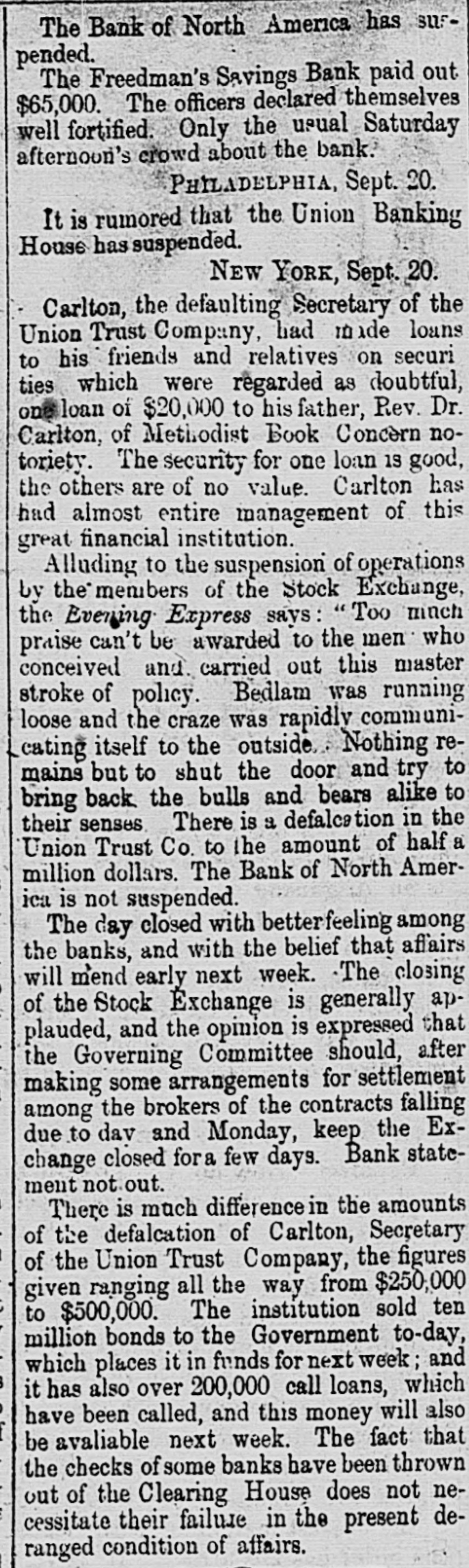
The Bank of North America has surpended. The Freedman's Savings Bank paid out $65,000. The officers declared themselves well fortified. Only the usual Saturday afternoon's crowd about the bank. PHILADELPHIA, Sept. 20. It is rumored that the Union Banking House has suspended. NEW YORK, Sept. 20. Carlton, the defaulting Secretary of the Union Trust Company, had made loans to his friends and relatives on securi ties which were regarded as doubtful, one loan of $20,000 to his father, Rev. Dr. Carlton, of Metiodist Book Concern notoriety. The security for one loan 19 good, the others are of no value. Carlton has had almost entire management of this great financial institution. Alluding to the suspension of operations by the members of the Stock Exchange, the Evening Express says: "Too much praise can't be awarded to the men who conceived and carried out this master stroke of policy Bedlam was running loose and the craze was rapidly communicating itself to the outside Nothing remains but to shut the door and try to bring back the bulls and bears alike to their senses There is a defalcation in the Union Trust Co. to the amount of half a million dollars. The Bank of North America is not suspended. The day closed with betterfeeling among the banks, and with the belief that affairs will mend early next week. The closing of the Stock Exchange is generally applauded, and the opinion is expressed that the Governing Committee should, after making some arrangements for settlement among the brokers of the contracts falling due to dav and Monday, keep the Exchange closed fora few days. Bank statement not out. There is much difference in the amounts of the defalcation of Carlton, Secretary of the Union Trust Company, the figures given ranging all the way from $250,000 to $500,000. The institution sold ten million bonds to the Government to-day, which places it in funds for next week; and it has also over 200,000 call loans, which have been called, and this money will also be avaliable next week. The fact that the checks of some banks have been thrown out of the Clearing House does not necessitate their failure in the present deranged condition of affairs.


Article from The Fremont Weekly Journal, September 26, 1873

Click image to open full size in new tab

Article Text

THE FINANCIAL PANIC of last week was equal to that of the memmorable "Black Friday," if not even greater. The excitement was intense, and af ter the crash commenced in earnest there was no let up until Saturday noon, when the Stock Exchange closed until otherwise ordered, and forbid all purchases of stock outside. Each new failure had added to the general excitement, until it was feared the Savings Banks would also go down in the general crash. A meet ing of the Associated banks was held, however, and arrangements entered into by which certificates for $10,000,000 were issued, for which the faith of the Association was pledged. These were receivable at the Clearing House, and by the use of them all solvent banks were enabled to realize upon their securities without loss, in case of need. Sate urday the President and Secretary of the Treasury were on the ground, anxious to avert the calamity, yet unable to do more than arrange for the purchase of all bonds offered. Ten millions were purchased on Saturday, and the currency thus set afloat with the capital sent from a distance to buy stocks while low, leased matters and made money more easily attainable. Monday the scene opened with more calmness but with forebodings. The Assistant Treasurer continued to buy bonds, which still further eased matters; confidence began to be felt, and a feeling that the worst was over was experienced when the announcement was made that the government had sent forward twenty millions more with which to purchase bonds. There is a probability that a few days will see money more plenty in New York than it had been for months, and also that some of the leading houses among those obliged to suspend will be enabled to resume business again. On Tuesday morning, the feeling in New York was indicative of more confidence, yet a nervous dread prevailed,which upon the announcement of the failure of Henry Clews & Co., broke out into wild excitement, and the panic was renewed. Wednesday the panic grew and the banks virtually suspended, paying no checks only for small amounts except through the Clearing House. The crash commenced with the failure of Kenyon, Cox & Co., who had been carrying the Canada South ern Railway, then followed in a few days Jay Cooke & Co., with their branches at Philadelphia and Washington-that at London remaining sound. In their efforts to sustain the Northern Pacific, and their failure to realize from its bonds, they were forced to the wall. Fisk & Hatch, who had floated the Chesspeake and Ohio, were also obliged to give way, with scores of others of less note; and when the panic seemed to have culminated, away went the Bank of the Commonwealth and the Union Trust Company, on Saturday, amid renewed excitement.The Cashier of the Union Trust Company adding to its embarrassment by suddenly leaving with $350,000 of bonds belonging to it. This bank h failed to realize on a million of bonds


Article from Chicago Daily Tribune, September 29, 1873

Click image to open full size in new tab

Article Text

NEW YORK. Special Disvatch to The Chicago Tribune, NEW YORK, Sept 28.-The bright prospects with which the wook closed for Wall street continuo to-day, and there is visible nothing of the intense excitement which characterized last Sunday. The street yesterday, and the hotels today, have been dull in fact, business on tho street le 80 far suspended that the excitement thore, on Saturday, was less than on ordinary days at this time of the year. The prospects for tho week are that BUSINESS WILL RESUME WITHOUT DELAY or much excitement, unless in the Stock Exchango. Tho difficulty in selling foreign exchange Becms to have been overcomo in a large measure, and heavy shipments of allsorts of grain were made yesterday. The demand for freight room WAS unusually heavy at generally advanced rates. The suspended firms are rapidly reorganizing, and promise a resumption of business before the end of the week. Howes & Macy have practically resumed already. Clows & Co. say they will bo ready to begin anow before the statement of their affairs is ready for publication. Fisko & Hatch, more conservativo, declino to begin again until all their past indebtedness is cleared off. Jay Cooke & Co. promise n favorable showing soon, but it is believed they will be kept down by the Northorn Paciflo Railroad. The Union Trust Company will get on italegengain. It is naturally a strong concern, each sharoholder being hold liablo for the amount of his stock; but the Bank of the Commonwoulth is probably a hopeless wreck. The opening of the Stock Exchange on Tuesday, BB resolved on, creates great unoasinoss, both in stock and commercial circles, particularly in the latter, whose members anticipate renowal of excitement, which may again extend to the commoreial exchanges and produce great distross to morcantilo houses. The Produce and Gold Exchanges RESUMED WITHOUT DISARTROUS RESULTA, and this fact encourages the hope that 110 bad effects will follow the roopening of stock gambling. The announcement that business will be resumed at the Stock Exchange implies that the conflicting and confused nocounts of the brokers have boon straightened out and settled. Otherwise, the opening would be only a signal for & renewal of the pauio, and of a fierce light between bulls and boars. Now, it is hold, there is little cause for controversy on the Bourne, and EVERYTHING PROMISES PEACE and quietness, at loast until the futuro shall divido the members into distinct parties again. It in claimod by dealers that business, for some time, at least, will be conducted with more modoration than formerly. Dr. Thomas Carlton. on being asked if he


Article from Nashville Union and American, October 12, 1873

Click image to open full size in new tab

Article Text

# SOLVENT IN SPITE OF HIMSELF. A New York correspondent writes that a retired merchant, somewhat advanced in life, who had some $30,000 deposited in the Union Trust Company when it stopped, mentioned so repeatedly to his friends that he had failed, that one of them asked him how much he could pay on the dollar. “I don't owe anything," he replied; "but as all my ready money is locked up in a suspended concern, I must have failed, of course. But since I have come to reflect on it, I don't see that I have, either. A man that has no debts can't fail—can he? Really, I never thought of that. I am delighted to know I have made a mistake. I am solvent, after all."


Article from New-York Tribune, October 25, 1873

Click image to open full size in new tab

Article Text

UNEASINESS IN WALL-ST. A SERIES OF STARTLING RUMORS A STOCK EXCHANGE MISUNDERSTANDING. Startling rumors, persistently circulated, contributed to make operations in Wall-st. yesterday exceedingly animated. With the beginning of business the published statements in circulation for several days regarding frauds in the management of the Lake Shore Railroad and Union Trust Company were discussed, the lack of authoritative information in the matter contributing to augment the alarm. In addition, it became very generally known that the New. Jersey Southern Railroad was very seriously involved, and that if it had not actually gone to protest. suits for very heavy sams had been or were about to be begun by creditors who had been unable to obtain their money. Again, it was freely reported that one of the largest manufacturing firms in the country, having extensive mille in Rhode Island, had failed for extraordinary amounts. To crown all, it was further alleged that & prominent Broadway bank because embarrassed through the operations of one of its officers in Wall-et. stock operations. All these rumors were circulated with depressing effect on the stock market. and prices fell from è to 6 per cent, and alarm spread throughout the street. Upon the announce ment, however, that the Lake Shore loan had been arranged and the Union Trust Company, Kenyon Cox & Co., and Fisk & Hatch would BOOD resume business, a more cheerful feeling prevailed and prices regained as much as they had previously lost. Inquiry of the members of the Rhode Island manufacturing house, reported to have suspended, elicited the information that they bad not suspended. And did not


Article from The Wheeling Daily Register, October 25, 1873

Click image to open full size in new tab

Article Text

Phelps tions. The court then adjourned. morning and day. closes the evidence his case will to-morrow be finished during the Political. the Apollo Hall County Conven of the At held to-night, the report to tion Committee, appointed was confer Conference with outside organizatione, received. reportstat that after of Tammany the recent The at the hands no furthtreatment State Convention, unite with could be following as er of them: Hall steps at It the also named the taken various the to county fices candidates for McCool; County Clerk, J. Sheriff, M. Patterson; John Vanbrunt Supreme and E. Court A.S. Judges, C. Superior H. Court Judges, Spalding Foncher; and Isaac Dayton. of a Bishop. The election meeting Election of the House of Bishops of Rev resulted in the of St Paul's toddy John H. Spaulding rector Missionary BiehErie, Pa., as and Mexico, op his headquarters Church, of Colorado, Wyoming being at Denver, Colorado. New Jersey Southern of the directors Railroad. of the At 8 meeting Southern Railroad Com- was pary New Jereey Wednesday, a statement made on by the unable officers to meet that their the liabilities, company and had been included about a mill 00 :clud of start which quarter of floating inde inz three hundred either The turing notes which during showed are the next 8 wonderful existy days app m accounts was with their be saved of ed affairs. to confer A committee road could creditore, 10 hope that the The capital etock is debt millions bankruptcy. and the understood funded that and is the largest distributed the Gould millions. bonds have It is been ghare holder. Tribase. all Shanks, over The case the country of shanks of the the Tribune ediThe who case was of committed by the Court Kings for County tor Oyer and Terminer question before Judge the asswer a before refusing grand Fancher jury. to in the came The Supr up District me Court 8 Attorney written cham bers to-day presented corpus. the petition of Kings forth to county the the writ commitment of habeas the questions until setting answer counwas objected to it was different prisoner This the should ground that by made Shanks yesterday gel on return adjourned until from matter the oral was finally the counsel to The enable new an-wer return. to-morrow the facts to set forth in the of the Union Trust Company. trustees At 8 Trust meeting Company of the Lake this Shore aftarnoon railroad about Union of the debt of payment The notes for the proposition was acceptedt. of its Shore propo800,000 was to give Lake and nine months, secured sition at three, six stock at ninety. advanced which was maturing by Harlem by Commodore Vanderbilt. Mannfactories Para Connecticut lyzed. who returned The World sayathata from gentleman Connecticut interests recently the manufacturing have represente in that State From fixteen as in an to twenty hand thousand been Shore Stor Some operatives already dition. and thrown Lake factory Formation. out of Stock-III employment ago The Pool in tory of 115 months The Sun says: Clark, President. James August H. Lake Schell, Horace Vice Treasure F. President and and all a pool of the for op* Banker corporation. in the the pool was and the Shore The erating capital Company, of stock $15,000.00 of that 000 stated B at $9,000,000 to through George was With the to defrom Grinnell pool & operated Co shares began approach was of railroad combination money cline, the panic, and loaded as this with wits Lake to raise Shore, they heavily to their good and hold were put their margins imperative to keep stocks. Finally brokers on for more their from officers they called on money, demand Shore, their as of the of them Trust the selves Lake officers the which latter as of bonds held & Co. Amount, by Company for $250,000 in whowere money Company to Grinsell the needed to of authourized were taken Commodoreresidency realise Vanderbilt the 00 them. Clark in the by legal means from preceeding Lake Shore Union road, Trust Company bonds and rented the a transfer members of these of the their pool insists making that the replace the bonds has or made should either The bank valequivalent. Commodere real estate dollars over to the hundred assumed thousand Clark's share. ued The at Commodore seven Schell has is said to be doing his share and make good his best to Financial matters agitated today by Wall street was of trouble and mercas- rumora was various rumors denial of these between tile failures. Lake followed Shore The by railroad and 8 gettlement an announcement and suspended the Union progress At & large Co of the Trust great Company, firms. among Cox meeting & which to- of banking of it creditors was and as day, the was a proposition accepted the by matter all present, would .COOD be looks


Article from The Wheeling Daily Intelligencer, October 25, 1873

Click image to open full size in new tab

Article Text

# STOCKS Early in the day, weak and unsettled; declined 1/8. The heaviest decline was in Lake Shore, which fell from 67 1/2, last night's closing price, to 61. After two o'clock the market improved steadily to the close. Western Union opened at 56 1/2, fell to 54 1/4, closed at 57. Pacific Mail closed at an advance of 1 1/4 over the advance; Harlem at 2 1/4 advance; Pittsburgh at 1 advance and 1/4 advance on the opening price in the remainder of the principal stocks. The Express says that the Lake Shore matter with the Union Trust Company is being rapidly cleared up, and had a much better look than this morning. Commodore Vanderbilt to-day offered in settlement for the loan of $1,750,000, his notes at three, six and nine months, with collaterals, understood to be Harlem at 90. The trustees of the Trust Company have just voted to accept the offer, and the matter may now be considered closed. An offer to discount the notes has already been received, and the Receiver will ask permission of the court to accept the same. In regard to the many stories afloat, to-day, it is proper to state that Mr. Wesley continues to deny that the Lake Shore bonds, which were transfer-


Article from New Orleans Republican, October 28, 1873

Click image to open full size in new tab

Article Text

WHOLE NUMBER 2013. to effect a settlement of the Union Trust PH. Company's loan to the Lake Shore Railroad Company, the agent of the Associated Press called this morning upon Receiver Wesley, R. of the Trust Company, who authorized him to say that the transaction had been definitely closed; that on Saturday he obllowing tained permission from Judge Fancher to y cemeaccept the Lake Shore Company's note, seding at cured by Commodore Vanderbilt with AssociaHarlem railroad stock at ninety, and that years; he (Wesley) now has the notes in his posred, 60; session. Thomas Wesley stated that it is within his own 7; Mrs. knowledge that when Commodore Vanderbilt came into the presidency of the Lake Shore after the death of Horace F. to 7 twenClark, Company, he found this debt the Trust Company, amounting on the twentieth to the four by sum of $1,809,979 32; a debt of which he vo new had previously known nothing, and in the . Temcontraction of which he had no personal share: that this loan was made by as just the Trust Company at 7 per cent at a time ning. when money was very cheap and lending h there at 41/2 @5. and that altogether Commodore he and Vanderbilt personally was not responsible for a dollar of it. He had, in order to take Sunday burteen care of Lake shore interest on one hand, e from and to help the Union Trust Company out orning. of its difficulties on the other, put up his Howard personal securities as collateral for the railnurses. road company's notes, which are drawn in a new and very stringent form. (nights es the Wall Street. ponded The situation in Wall street to-day was em sin marked by an unsettled feeling and a lower t funds range of values generally at intervals. affering Some unfavorable rumore were sfloat, but nothing of an exciting character occurred. vailable Money was irregular, being easy in the hat the morning at seven per cent and closing in g. The the afternoon at one thirty-second to oneincrease sixteenth. red. On Capitalists in many cases carry over a r applilarge balance daily, being indifferent about the belending fresh, owing to the condition of 3 of the affairs which prevents the money market 1 with from to its bon the at Exchange returning dull, nominally normal steady condition. 6% em, as Gold heavy, declined at urge is Money-Rates for carrying 67-16@61-32. Death of a Centennial. Hannah Rutland, aged 100 years, died. e been Boy Murdered by a Boy. er here , deaths William Scanlon, aged eighteen, stabbed t hours. and killed James McMahon, aged sixteen, this afternoon. The quarrel grew out of a debt of fifty cents which Scanlon owed undred McMahon. The wound was made by a for one cheese knife, in the left shoulder. (emphis Marine. scribed Arrived-Heela, Sherman, Flag, City of Mexico, from Havana, and City of Monpolice, treal, from Liverpool; Champion and Herf police man Livingstone. Arrived out-Silesia and Aragon. The Stokes Trial, arker's Arguments in the Stokes case have coms liberal menced. is and The two points of Tremaine's argument er, Mr. for the defense of Stokes thus far are: First. | Eightthat Fisk died from the effects of morphine; raction. second, that if Stokes killed Fisk, was it concert. murder or manslaughter? Tremaine had tponed. not concluded when the court adjourned. yellow To be Investigated. the past Governor Dix has ordered that on the first of December a referee shall hear testin postmony against District Attorney Britton for r 18, illegal action in his prosecution of T. G. yeather Shanks, city editor of the New York Tribune. rces a


Article from New-York Tribune, October 28, 1873

Click image to open full size in new tab

Article Text

WALL-STREET FEVERISH. NEW COMPLICATIONS THREATENED. BANKRUPICY PROCEEDINGS INSTITUTED AGAINST THE UNION TRUST COMPANY-ADJUSTMENT OF THE LAKE SHORE LOAN-DEPRESSING EFFECT OF RECENT RUMORS. The most important of recent events in Wallst. is the institution of bankruptcy proceedings in the case of the Union Trust Company. Late last evening Audley Gazzam, attorney for William Siney, a depositor in the Trust Company, caused the preliminary papers to be served upon I. H. Frothingham, President of the Company, at his residence in Brooklyn. These proceedings, although in course of preparation for several days. were not generally known in the street yesterday, and therefore did not affect a stock market already very much depressed by unfavorable rumors of fraud and corruption. The Receiver of the Union Trust Company officially announced the adjustment of the loan to the Lake Shore Railroad of $1,800.000, by the acceptance of Commodore Vanderbilt's notes. payable at intervals of three, six, and nine months. He intimated that they might be withdrawn in a short time. There were also intimations of an early resumption of business. Beyond these events there was nothing of unusual importance announced, although the rumors in circulation combined to keep not only the stock market. but all Wall-st. in a feverish condition.


Article from Helena Weekly Herald, October 30, 1873

Click image to open full size in new tab

Article Text

DURING the run on the Union Trust Company, of New York, an excited individual offered a boy fifty dollars for his place in the line, and afterwards increased his bid to one hundred dollars. The boy would not sell bis place for the tempting offer. A man ahead of him, however, responded, and said he would sell his place fon two hundred. The money was paid him immediately, and the place was given up. As he walked away he said to a friend: 'Let us take a drink; I had only one hundred in that concern, and I think I have coupe out a little ahead."


Article from The Wheeling Daily Intelligencer, October 31, 1873

Click image to open full size in new tab

Article Text

NEW YORK CITY. NEW YORK, October 30.-The trial of Captain I. Irving, and Patrolmen Farley, the detective police, has been begun before the Police Commissioners. The charges against the officers were preferred by Chief Clerk Hawley, and among the specifications it is recited that McDonnel, being in their custody, delivered to them a package containing $17,250 in United States bonds, a letter of credit for £500, and a diamond ring valued at £400, with the express understanding that they were to be used in defense of McDonnel and that in pursuance of this understanding they returned $6,000 worth of bonds to McDonnel, having good grounds for believing and knowing the bonds were the property of the Bank of England. It is also recited that the officers charged were in communication with McDonnel by mail and telegraph, and had entered into the conspiracy to defraud the Bank of England: Counsel for the Bank of England refused to go to trial on all these specifications, on the ground that they had never been included in the charges made by the Bank. After argument by counsel the specifications were amended and testimony was taken. The Bank of England claims the return of $6,000 in bonds and a certain diamond ring. J. Lloyd Hamilton & Co., of this city, have suspended. They were largely interested in Pennsylvania. There will be no sale of gold or purchase of bonds by the Treasury Department next month. Judge Davis, in his charge to the Grand Jury to-day, said complaints would be made against petit jurors for violation of their oath, and Court officers for negligence and corruption. This is supposed to have reference to acts in connection with the Stokes trial. Wednesday next has been fixed for the trial of William M. Tweed on the so-called ring indictments. Early this morning, owing to a misplaced switch, two freight trains came in collision near Port Jervis, on the Erie road. Both locomotives were badly smashed, and eleven cars, with their contents, burned. A dispatch from Wilmington, Del., says that Captain Dougherty, chief clerk in the postoffice at that place, has been held in bail to explain the deficiency in his accounts. Joseph Arch will be the guest to day of Demas Barnes, proprietor of the Argus, and Henry Ward Beecher. The officers of the Central Branch of the Union Pacific railroad say they will ask the holders of their first mortgage bonds to fund the first coupons maturing subsequent to this date, and pay interest on them at the rate of six per cent from the date of their maturity to November 1st, 1870. The failure of a firm of German ship ping merchants is announced, but excites little discussion. A large number of indictments have been found against lottery dealers. C. Britton vs. Benj. F. Butler to recover $15,000, the amount of two drafts seized by Gen. Butler in 1862 while he was Military Governor of New Orleans came on to day before Judge Woodruft in the United States Circuit Court. A meeting of the Trustees of the Union Trust Company was held to day to take action on the result of the examination of a its pared affairs. and The considerable capital remains surplus. unim- The present officers and committee of the company have tendered their resignations with a view of reorganizing. Resolutions were adopted increasing the capital stock to two millions, double the present amount of new stock to be offered to the present stockholders to November 15th, to an amount equal to that now held by each, 25 per cent., and December 10th the remainder on call after December 31st upon three days notice. Resolved also to resume business on or before December 1st next. Committees were appointed to carry into effect the above resolutions. A temporary suspension of C. Milman, Schmidt & Co. has taken place. The firm 18 in the produce export trade. The suspension is said not to be of a serious character. A great amount of goods and grain had been sent over to Europe, against which drafts were drawn and it was impossible to obtain money upon them, consequently it became necessary


Article from Memphis Daily Appeal, November 15, 1873

Click image to open full size in new tab

Article Text

Matters. Money NEW YORK, November 14.-A meeting of Grinnel creditors was held before Register Allen to-day, when the register decided that unsecured creditors alone were entitled to vote for an assignee. Against this the secured creditors made a protest. The question will be decided by court. By a vote of the unsecured creditors, the election of an assignee was postponed until December 5th. E. B. Wesley, receiver of the Union Trust company, has notified the Pacific mail steamship company not to transfer about one thousand shares of stock, claiming that they are the property of the Union Trust company. Parties holding any of these certificates, on satisfying Wesley that they have given full value for them, may obtain his assent to a transfer of them. The stock


Article from The New York Herald, December 2, 1873

Click image to open full size in new tab

Article Text

UNION TRUST COMPANY. The principal item of interest in monetary circles yesterday was the resumption of business by the Union Trust Company. As the suspension of this company was one of the initial events of the recent panic, tending largely to produce that result, the resumption yesterday was regarded as correspondingly indicative of recovery. During the early part of the day a run was made on the part of depositors, which, being fully met, gradually fell off. The company owes depositors $5,150,000. To meet these debts it has in clean cash over $4,000,000, and in assets convertible readily into cash more than double the balance due to depositors. The capital of the company is unimpaired, its surplus before the panic having been sufficient to cover the losses by Carleton's defalcation, and also by the depreciation or loss on loans. It will thus be seen that in point of financial strength it is in a position to safely challenge each depositor to draw whatever he has to his credit. The new officers of the company are gentlemen whose names should inspire confidence in its future management. Mr. Edward King is President, Mr. James McLean is first VicePresident and Mr. Freeman Clarke second VicePresident-he to fill the vacancy caused by the resignation of Mr. Henry K. Bogert, who resigned last April. The following gentlemen compose the new Executive Committee Messrs. A. A. Low, James McLean, B. H. Hutton, c. D. Wood, George G. Williams, William Wainwright, Jr., E. B. Wesley and Samuel Willets. The new Secretary is Mr. James H. Ogilvie. It is stated on behalf of the trustees that the reports which gained circulation that Carleton was not promptly arrested because his arrest would implicate some of the trustees, is wholly unfounded. The company has not lost anything by any action of the trustees, nor do the trustees owe the company anything.


Article from The Hickman Courier, August 1, 1874

Click image to open full size in new tab

Article Text

MISCELLANEOUS. Bristow consents that Spinner shall have the selecting of his own clerks. The last suviving sister of the late Edgar Allen Poe died at Washington last week, aged 68. There have been about one thousand applications for office under the district comThe aggregate amount due the clerks of the late board of public works, including the engineer department and employes under the superintendent of property, is $1,207, 393. Mr. Price McGrath, says that Tom Bowling has been turned out, and will not run again this year. Perhaps he will never grace the turf more. Slight hopes, however, are still entertained for his recovery. A dangerous counterfeit having appeared on the five dollar notes of the Traders deNational bank of Chicago, the treasu partment offers one-half per cent. premium, for the return of the genuine five dollar notes of that bank to the department for destruction. The attention of bank officers is especially called to the necessity of retiring these notes, which will entirely prevent the circulation of counterfeità. In the case of the Union Trust Company of New York vs. the Rock Island & St. Louis railway, brought in the United States court, to foreclose the nine million dollars trust deeds against the company, and for the appointment of a receiver, Judge Blodgett has dismissed the bill on the ground that the necessary number of bondholders had not joined in the request to foreclose as to former defaults in interest. The bids for the five per cent. funded loan forwarded from New York, representing those filed by foreign bankers for European markets as well as those for domestic holdings, will aggregate not less than $80,000,000. The large bids will come from syndicates which have been formed, the principal one representing a combination of German bankers, and to each of those bids will be attached a condition that the bidders are to have a call on the entire remainder of the loan so that should the secretary accept any one of the bids, it would be to the exclusion of all others. A dividend of five per cent., authorized by the committee of creditors of Jay Cooke & Co., has not yet been paid, the register having deubts as to its binding effect upon him. He has, however, proceeded with the necessary calculations, so that there should be no delay if the court ordered him to proceed. In the meantime the funds in his hands have increased to such an amount as will warrant the payment of seven instead of five per cont. It is believed that he will bring the matter before the court when its opinion can be obtained, and if a proper order is made, payment will be proceeded with as early as possible. The lieutenant governor of Mississippi has telegraphed that he has sent to the president by mail a statement 'of affairs at Vicksburg, which led him to apprehend disturbance of the peace, which, owing to the unorganized state of the militia, he would be unable to suppress. The mayor and postmaster of Vicksburg have on the other hand telegraphed to the president protesting against the sending of troops to that city, as such an act would have the effect of increasing the excitement, as there are no indications of an outbreak. The secretary of war, in view of the protest of the mayor of Vicksburg and the postmaster at that city against sending troops there, has countermanded his order directing troops to proceed to that place ntil the full particulars of the whole trouble be received from the acting governor.