16651. Twelfth Ward Bank (New York, NY)

Bank Information

Episode Type
Run Only
Bank Type
state
Start Date
January 9, 1911
Location
New York, New York (40.714, -74.006)

Metadata

Model
gpt-5-mini
Short Digest
507c020c

Response Measures

Accommodated withdrawals, Borrowed from banks or large institutions, Public signal of financial health, Capital injected

Description

After the failure/suspension of the Carnegie Trust Company (Jan 7–8, 1911), the Twelfth Ward Bank experienced withdrawals/lines on Jan 9, 1911 but was supported by J.P. Morgan & Co. and other financiers (cash/securities replaced) and remained open; no suspension or receivership of the Twelfth Ward Bank is reported in these articles.

Events (1)

1. January 9, 1911 Run
Cause
Local Banks
Cause Details
Withdrawals triggered by the failure/closing of the Carnegie Trust Company and concern about affiliated institutions; depositors queued to withdraw after Carnegie Trust collapse.
Measures
J. P. Morgan & Co. (with other financiers and the Clearing House) guaranteed solvency, replaced questionable securities with cash, sent packages of currency/gold to be on hand, and Equitable Trust absorbed Madison Trust to reassure depositors.
Newspaper Excerpt
J. P. Morgan & Co. have guaranteed the solvency of the Twelfth Ward bank... there were steady withdrawals from these banks and their several branches all day, at no time was there a panicky feeling.
Source
newspapers

Newspaper Articles (17)

Article from Perth Amboy Evening News, January 9, 1911

Click image to open full size in new tab

Article Text

MORGAN HELPS SAVE THE BANK Financiers Take Over Three Institutions. New York, Jan. 9.-After forty-eight hours of conference between representatives of all the big banking houses and the clearing house It was announced that J. P. Morgan & Co. have guaranteed the solvency of the Twelfth Ward bank and the Nineteenth Ward bank, that the Equitable Trust company has bought the Madison Trust company and that these three institutions have been shorn of their Carnegie Trust company connections. The announcement was made by formal statements. They make it clear that whatever danger had been cast on the three banks by the failure of the Carnegie Trust company had been removed. Work For Grand Jury, Perhaps. The Carnegie Trust company, which was closed Saturday by the state banking department, is now beyond hope of salvation. With respectable securities to offer it could have had on the very night before the superintendent of banking descended upon it at least $1,000,000, but these securities were not forthcoming. The deposits in the company had shrunk from $18,500,000 at the time of the company's greatest prosperity in 1909 to hardly more than $1,500,000 in individual deposits subject to check at the time of the failure. To meet this steady drain the company was forced to sacrifice what reliable securities it possessed. The banking department has called in District Attorney Whitman to look into the history of the concern and determine whether or not there was any criminal liability in its management. The district attorney is silent as to what steps he is taking in the matter. It is known, however, that he worked overnight on the trust company matter late into the morning and that he held many consultations about it at his home at the Hotel Iroquois. The outcome of this labor may very well be a matter for the consideration of the grand jury. Nearly Falled In 1907. It has developed that the company nearly went under in the panic days of 1907. The general impression that the influence of Andrew Carnegie was behind the company and the fact that the name of Leslie Shaw, who 80 recently had been secretary of the treasury, was with the concern were two things that saved the trust company at that time. Of course the big steel man asíde from his friendship for Charles M Schwab had no interest In the company. More than that, he was extremely adverse to the use of his name.

Article from The Barre Daily Times, January 9, 1911

Click image to open full size in new tab

Article Text

BIG FINANCIERS COME TO ASSISTANCE Of New York Banks Which Were Wobbly As Result of Closing of the Carnegie Trust company Saturday. New York, Jan. 9. A meeting of rep. resentatives of several large financial interests, bankers and others, was held last night at the home of Paul D. Gravath, a lawyer, and steps were taken to the of the company prevent (formerly closing the Madison Van Ward Norden Trust bank Trust company), the Twelfth and the Nineteenth Ward bank. which, together with their branches, make nine banks throughout the city. Ample capital was provided to meet all emergencies to which these banks might be subjected. These three institutions had former close with closed as an affiliations Saturday the Carnegie indirect Trust result G. the fallen now Robin, company, of the operations banker, of Joseph in prison. Among the interests represented at the conference were J. Pierpont Morgan & Co., New York Clearing House association and the Equitable Life. Assurance society. C. H. Cheney, state superof was as was Lawrence intendent Phipps, banks, jr., said present. to represent the Standard Oil company. It was announced that a radical change will be made in the Madison Trust company, that institution being taken over by the Equitable Trust company and certain changes in the directorate made. Statement by Cheney. Late last night the following statement out was given at Mr. Cravath's house, authorized by Superintendent Cheney: "I have been in close touch with the situation in the Madison Trust company, Ninteenth Ward bank and Twelfth Ward bank. I have objected to certain of the assets and some of the loans. In my opinion it became necessary to consult prominent bankers so that steps have been taken to allay public apprehension which might arise after the closing of the Carnegie Trust company. As a result of conference with bankers and am announce that in others interested my a judgment I arrangements able to have now been completed that are such as to effect that result. "The assets to which I have objected have been taken out of the two banks and substituted with cash. The Madison Trust company is to be acquired by with the Equitable trust and rearrangements Morgan merger & Co. have In been my made opinion with the J.P. sult of the foregoing arrangements is that these three institutions are in sound condition. "O. H. Cheney." Henry P. Davison, representing Morgan & Co., gave out a statement, in part as follows: 'At the time of the failure of the Carnegie Trust company certain members of the board of directors were also directors of the Madison Trust company, the Nineteenth Ward bank and the Twelfth Ward bank. Fearing that announcement of this fact might lead depositors to withdraw deposits, the superintendent of banks promptly took up the situation with prominent banking interests. After a conference held Saturday and Sunday, J. P. Morgan & Co. authorized the following statement: "Understanding that arrangements have been made for the absorption by merger of the Madison Trust company by the Equitable Trust company, J. P. Morgan & Co. have agreed to provide financial assistance to the Nineteenth Ward bank and the Twelfth Ward bank." "A Barton Hepburn gave out a state. ment similar in tone adding that "A very happy solution of possible complications has been arrived at for which the publie thanks are largely due to the very efficient services of the bank superintendent." Mr. Hepburn concluded with a statement that "after as complete an inE vestigation as We were able to make from the outside. I am of the opinion that the customers of the banks should continue their deposits and can continue their business with safety."


Article from The Detroit Times, January 9, 1911

Click image to open full size in new tab

Article Text

CARNEGIE TRUST FAILURE DOESN'T AFFECT OTHER BANKS J. P. Morgan and Other Financiers Stand Together To Meet Any Emergency. NEW YORK, Jan. 9.-That the allied banking institutions here are prepared to prevent any disturbance of present conditions was made plain today by the presence in the clearing house of a number of the leading captains of finance. "There is nothing the matter with the business world, and the public must be made to understand it at once," is the word that came from J. P. Morgan. By Morgan's order, the Madison Trust Co., formerly the Van Norden Trust Co., was taken over by the Equitable Trust Co. This $35,000,000 concern backed the Equitable Insurance Co., of which Morgan is now controlling owner. Morgan also personally assumed responsibility for all of the obligations of the Nineteenth Ward and the Twelfth Ward banks, and their branches, and it was by his direction that securities held by these two concerns which were not of a sort which could be sold readily in the open market, were replaced by actual cash. Morgan & Co., Kuhn, Loeb & Co., the Guggenheims, Standard Oil, Henry Phipps, Halgarten & Co., and every big bank allied with the New York clearing house stand together. The string of southern and western banks affected by the closing on Saturday of the Carnegie Trust Co., will be fully taken care of. Statements by Morgan & Co., President Krech, of the Equitable Trust Co.; A. Barton Hepburn, president of the Chase National bank, and the Clearing House association; Bradley Martin, Jr., and Supt. of Banks Cheney, all of a character intended to reassure the timid regarding the stability of all of the banks affected by the Carnegie Trust Co.'s failure, were given widespread publicity early today and had their effect as was planned. At 9:30 this morning a line of about 100 persons had formed outside of the Nineteenth Ward bank. Many of them were women and all were there to draw out the money they had on deposit. It was said that all checks presented would be promptly paid. There were 300 depositors in line at the Ninteenth Ward bank when the paying teller's window was thrown open. All were paid off as rapidly as possible. President Bradley Martin, Jr., said: "We will pay off all depositors who want their money. The run is of little consequence, inasmuch as those who are withdrawing cash, are people who had only small amounts on deposit.


Article from The Tacoma Times, January 9, 1911

Click image to open full size in new tab

Article Text

MORGAN QUIETS DEPOSITORS (By United Press Leased Wire.) NEW YORK, Jan. 9.-As a result of the influence of J. P. Morgan, financial clouds that gathered following the suspension Saturday of the Carnegie Trust company were dissipated today. The strength of the money king -was felt in the market as well as in banking circles, and the leaders of the financial world are breathing freely again. The power of piles of gold stacked on the counters of the banks in full view of the timid depositors had a quieting effect. Only foreigners withdrew their deposits from the Nineteenth and Twelfth ward banks, and incoming deposits more than offset the withdrawals. There were few withdrawals from the Madison Trust company.


Article from The Evening World, January 10, 1911

Click image to open full size in new tab

Article Text

Didn't Risk a Cent and His Equitable Trust Absorbs Madison Institution. GOLD IS UNTOUCHED. Big Packages Sent to Avert Run Are Not Even Opened. In saving the Madison Trust Comany, the Nineteenth Ward Bank and be Twelfth Ward Bank from going the wall by the mere lending of his name to these institutions Mr. Morgan has added about $20,000,000 to the ten billions of dollars he already has under his control, and at the same time obtained possession virtually of the Madison Trust Company. It was learned to-day that the house of Morgan did not put up so much as a cent, because after the publication yesterday that Morgan had come to the rescue of the banks and trust company the Institutions threatened were able to meet the demands made on them from their own resources. Although money was sent to all the banks to be on hand in case it was needed, the big packages of gold and currency were not even opened. Bound to Avert Panic. Business men. and the public generally interpreted Morgan's intervention to mean that powerful financial interests had determined there should be no repetition of the monetary panic of 1907, and that any bank which might be in trouble would be supported. That, practically, is the situation, it is said, and although stockholders may have to pay dearly, the depositors will be protected. In addition to being willing to drive a good bargain the Morgan interests, it is asserted, do not desire any finanetal disturbance at this time, causing, as it would, the securities held by the various banks to be thrown on the stock market and reducing the prices there they have been so anxious to maintain. The Carnegie Trust Company synd:cate paid $315 a share for the Van Norden holdings in the Madison Trust Company. Mr. Morgan has agreed to take them over, it is understood at book. or liquidation value, which it is estimated will be about $184 a share. Got a Bargain Rate. According to Wall street information, the Mndison Trust Company was virtually forced into the Morgan arms. It was said that the Morgan interests for a long time had been determined to eliminate the Carnegie Trust Company and obtain control of the Madison, the majority of the stock of which was held by,a syndicate of Carnegie directors. In support of this a remark said to have been made by Joseph T. Howell. President of the Carnegie Company, was quoted. According to this Mr. Howell had said that the sudden closing of his company by the State Banking Department had been an outrage. Whether or not Mr. Howell made this remark, the sentiment attributed 10 him was held by many of his directors. "The company is absolutely solvent and will pay dollar for dollar," said former Judge Keener, one of its directors. Forced to Go to Morgan? "How, then, do you explain the action of the State Banking Department: he was asked. "That is for them say," he replied, with a shrug. To continue the Wall street story the Nineteenth and Twelfth Ward banks were forced by the State Banking Department to go to the Morgans for aid. The Nineteeuth Ward, it was said, had about 35 per cent. of its deposits in actual cash, and about $1,500,000 in commercial paper 50 good that it could have been sold anywhere. The State Banking Department, it was asserted. declined to give the management time to sell this and informed the bank that it would take possession on Monday morning if the institution had not by that time obtained the support of strong banking


Article from Pine Bluff Daily Graphic, January 10, 1911

Click image to open full size in new tab

Article Text

BIG BANK RUNS ARE PREVENTED Morgan and Co., Kuhn-Loeb and Others Come to Aid of N. Y. Banks. MANY WITHDRAWALS Carnegie Trust Company's Failure Made People Uneasy and They For in Line. International News Special New York, Jan. 9.-Owing to the quick and strong support given by J. P. Morgan and Company, Kuhn, Loeb and Co., and other powerful banking interests to a situation that was for a short time delicate, the City of New York today was saved from bank runs that might have led to general excitement and temporary financial derangement. When it became known this morning that the interests named had organized themselves into a committee of defense against the probable bad effect of the failure on Saturday of the Carnegie Trust Company, the apprehended run on the Madison Trust Company and its subsidiaries, the Twelth Wiard Bank and the Nineteenth Ward Bank, with several branches scattered through the city and all affiliated with the unfortunate Carnegie Trust Company, were virtually averted. Although there were steady withdrawals from these banks and their several branches all day, at no time was there a panicky feeling among the scores of women and men who waited patiently in the lines all day in front of the institutions tio get their deposits out.


Article from The Cairo Bulletin, January 10, 1911

Click image to open full size in new tab

Article Text

SITUATION IS AGAIN NORMAL GOOD WORK ACCOMPLISHED IN BANKING SITUATION IN NEW YORK CITY. DEPOSITORS REASSURED Stock Market is Optimistic, and Joseph G. Robin, the Indicted Banker, Remains in the Tombs Prison. New York, Jan. 9.-Aside from progressive work of reorganization and reconstruction in affected institu tions, which will necessary extend over the first few weeks of the new year, the banking situation is normal tonight. Timid depositors are reassured, the stock market is optimistic and Joseph G. Robin, whose operations caused the flurry, remains in the Tombs. With powerful interests behind the Tweltf Ward Bank and the Nineteen th Ward Bank and with the absorp ilon of the Madison Trust Company by the Equity Trust Company, two institutions whose integrity had been questioned because of alleged affiliations with the Caruegle Trust Company, closed as the result of Robin's operations, weathered today, not only successfully, but with suggestiveness that there were no runs and almost normal deposits. Last night's consultation between financiers had laid a strong ground work which proved adequate to avert any serious complications. Another member of the Robin family entered the Tomos today. Dr. Louise Robinovitch, sister of Robin was indicted for perjury and remanded in default of $3,000 bail. She had sworn in an effort to have Robin conmitted to an asylum and his estate taken over by a committee, that she and her brother, Edward, known as Edward Robinson, were his only heirs at law. But Investigation dis closed an aged couple which the prosecution contends are the parents of Robin On this discovery the indictment is based. After Dr. Robinovitch has been indicted she was arraigned in the court of general sessions where she entered a plea of not guilty. Chas. Hyde, the city chamberlain, who was sought as a witness by the legislative graft committee and who is now sought by the city off!cials to look after the city's interests in view of funds deposited in some of the banks involved in the trouble, was still missing tonight. Controller Pendergast sent a spec ial message to the mayor today ask ing for a meeting of the banking commission to consider the matter. In the course of the day Andrew Carnegie issued a statement denying any connection with the Carnegie Trust Company, and reissuing a letter published in 1906 objecting to the use of his name.

Article from New-York Tribune, January 10, 1911

Click image to open full size in new tab

Article Text

by the passage of the control of the Madison Trust Company and the Nineteenth and Twelfth Ward banks to the Morgan interests. Without that aid it was believed that the three institutions would have been unable to withstand the run on them yesterday and probably would have been forced to suspend. In fact, Mr. Cheney was ready to close all three banks. Such an outcome, it was said, might have frightened depositors in other institutions in reality perfectly sound and have made difficulty in meeting withdrawals in cash that would have precipStated a very serious situation. Last Weak Spot Gone, Says Banker. One banker who played an important part in the conference that brought about the settlement of the difficulty said yesterday: "The action which has been taken places the Nineteenth Ward Bank, the Twelfth Ward Bank and the Madison Trust Company on an absolutely sound footing It also cleans up the last weak spot that existed in the local banking situation. The methods employed by the Carnegie Trust Company had for a long time been & source of danger, and the public at large is to be congratulated on the closing of the chapter of that sort of banking in New York. "It should be distinctly understood by the public that the conservative banking interests in this city are glad to welcome others into the same field. provided they are going to conduct a conservative, legitimate business. They will not, however, tolerate the use of questionable methods or unsound banking practices. The city is now well rid of institutions of that sort. and the public is entitled to know the stand that the conservative and influential banking interests have taken in this matter. "The plan for solving the problems presented by the failure of the Carnegie Trust Company on Saturday was evolved by Paul D. Cravath, who is entitled to a large part of the credit for bringing about a settlement of the troubles. Mr. Cravath took up the work


Article from The Richmond Virginian, January 10, 1911

Click image to open full size in new tab

Article Text

PESSIMISTS PICK FLAWS IN MORGAN EXPRESS DOUBT AS TO NEW YORK FINANCIERS BRAND OF PHILANTHROPY. MADE PROFITABLE DEAL REPORT THAT HE WILL BE LARGELY "AHEAD OF THE GAME" BY TAKING OVER EMBARRASSED BANKS, NEW YORK, Jan. 10.-Whether J. P. Morgan, in clearing the local financial skies, cleared up some twenty millions of dollars or lost a half a million is the question financiers here are trying to solve to-day. The friends of Mr. Morgan, who say he acted unselfishly to save the financial situation yesterday. insist that he took over the stock in the Madison Trust Company, the Nineteenth Ward Bank and the Twelfth Ward Bank at the market price and that In doing so he also shouldered obligations which made his atock cost $586,000 additional. Pessimists, however, who seem to question the Morgan brand of philanthropy. point out that he paid only $2,450,000 for control of three banking institutions whose allied resources are in excess of $20,000,000. Mr. Morgan, these people say, will shortly liquidate the three organizations and open in their stead branches of his Equitable Trust Company. T he minority stockholders, it is pointed out, will have no say in the matter, as Mr. Morgan, as the price of preventing a run by the mere use of his name, secured the control of all of the three concerns. He paid $700,000 for control of the Nineteenth and Twelfth Ward Banks and $1,750,000 for the Madison Trust Company. The latter was a valuable purchase, as the Morgan interests had been after It ever since it was reorganized from the old Van Norden Trust Company. To pay for the threee institutions it is expected Mr. Morgan will increase the stock of the Equitable Trust Company and exchange it for the outstanding shares of the three companies, making the actual cost to Mr. Morgan personally only about what the engraver's bill will be who furnishes the new stock. The $20,000,000 of assets of the three concerns which were in danger will add materially to the attractiveness of the Equitable Trust Company's balance sheets hereafter, in the opinion of financial exprest who have watched the present situation. Normal condition prevailed at all of the banks to-day, the slight run on the Nineteenth and Tweifth Ward banks and the Madison Trust Company which prevailed yesterday is not being renewed. It was stated by State Superintendent of Banks Cheney to-day that the affairs of the Carnegie Trust Company will be liquidated at once and no attempt will be made to put the institution in shape to continue business.


Article from Evening Journal, January 10, 1911

Click image to open full size in new tab

Article Text

DID MORGAN WIN OR LOSE? Made Millions, Some Say, by "Clearing the Financial Skies" of New York HOW HE GOT CONTROL OF SEVERAL INSTITUTIONS By United Press Leased Special Wire. NEW YORK, Jan. 10.-Whether J. p Morgan, in clearing the local financial skies, cleared up some millions of dollars or lost half a million is the question financiers here are trying to solve today. The friends of Morgan, who say he acted unselfishly to save the financial situation yesterday insist that he took over the stock in the Madison Trust Company, the Nineteenth Ward Bank and the Twelfth Ward Bank at the market price and that in doing so, he also shouldered obligations which made his stock cost $585,000 additional. Pessimists, however, who seem to question the Morgan brand of philanthropy point out that he paid only $2,500,000 for control of three banking institutions whose allied r'9sources are in excess of $20,000.000. Morgan, these people say, will shortly liquidate the three organizations and open in their stead branches of his Equitable Trust Company. The minority stockholders, it is pointed out, will have no say in the matter, as Morgan, as the price of preventing a run by the mere use of his name, secured the control of all of the three concerns. He paid $700,000 for control of the Nineteenth and Twelfth Ward Banks and $1,750.000 for the Madison Trust Company. The latter was a valuable purchase, as the Morgan interests had


Article from Evening Journal, January 10, 1911

Click image to open full size in new tab

Article Text

been after it ever since it was reorganized from the old Van Norden Trust Company. How He Will Pay For Them. To pay for the three institutions it is expected Morgan will increase the stock of the Equitable Trust Company and exchange it for the outstanding shares of three companies, making the actual cost to Morgan personally only about what the engravers' bill will be who furnishes the new stock. The $20,000,000 of assets of the three concerns which were in danger will add materially to the attractiveness of the Equitable Trust Company's balance sheets hereafter, in the opinion of financial experts, who have watched the present situation. Normal conditions prevailed at all of the banks today, the slight run on the Nineteenth and Twelfth Ward Banks and the Madison Trust Company, which prevailed yesterday not being renewed. It was stated by State Superintendent of Banks Cheney today that the affairs of the Carnegie Trust Company will be liquidated at once and no attempt will be made to put the institution in shape to continue business.


Article from The Birmingham Age-Herald, January 10, 1911

Click image to open full size in new tab

Article Text

BANK SITUATION IN NEW YORK IS BETTER Financiers Come to Rescue of Carnegie Trust ROBIN IS NOW IN PRISON Another Dramatic Scene Is Enacted in Court When Members of Robin's Family Meet Face to Face New York, January 9.-Aside from progressive work of reorganization and reconstruction in affected institutions which will necessarily extend over the week, New York's banking situation is normal tonight; timid depositors are reassured, the stock market is optimistic and Joseph G. Robin, whose operations caused the flurry, is still in the Tombs. With powerful financial interests behind the Twelfth Ward bank and the Nineteenth Ward bank and with absorption of the Madison Trust company by the Equitable Trust company, these three institutions whose integrity had been questioned because of affiliations, direct or indirect with the Carnegie Trust company, which was closed as a result of Robin's operations, weathered the day not only successfully but with such aggressiveness that there were no runs and almost normal deposits. Some uneasy depositors were out early to get their money but last night's consultation between financiers had laid a strong groundwork which proved adequate to avert any serious complications. Another member of the Robin family entered the Tombs today. Dr. Louise Robinovitch, sister of Robin, was indicted for perjury and remanded in default of $3000 bail. She had sworn, in an effort to have Robin committed to an asylum and his estate taken over by a committee, that she and her brother Edward, known as Edward Robinson, were his only heirs at law. But investigation disclosed an aged couple which the prosecution contends are the parents. On this discovery the indictment is based. There was enacted, as the grand jury filed forthwith the indictment against Dr. Robinovitch, a scene similar in dramatic aspect to the recent repudiation of the old pair by Robin. Both old persons had been witnesses before the jury as had the alleged son, Edward Robinson. When they met face to face, in the court room, the elderly woman attempted to throw her arms around Robinson's neck, but he drew back and repulsed her. "Is that your father and mother?" Robinson was-asked. "I am not sure," replied Robinson. "I know these people and have known them for a number of years. We caine to this country with them, and as a youngster I always thought that they were my parents. But of late something has happened which leads my brother and myself to the belief that they are not our parents. We have the evidence which proves it." "Have you seen them lately?" was the next question put to Robinson. "Yes, I have seen them about once a month for many years. My brother and myself looked after their wants. That is all I can say.' After Dr. Robinovitch had been indicted she was arraigned and entered a plea of not guilty. Justice Page in the supreme court today appointed Maurice Deiches, a lawyer, receiver for the property of the Aetna Indemnity company in the state of New York with a bond of $50,000. The company collapsed after the Robin exposures and a court in Hartford appointed Theodore McDonald receiver for its property in Connecticut. The company is a Connecticut corporation with a capital stock of $350,000.


Article from The Dillon Herald, January 12, 1911

Click image to open full size in new tab

Article Text

MORGAN A BUCCANEER. Hailed 24 Hours Ago As Saviour of Three Banks-Now Charged That He Wrecked Them Deliberately. New York, Jan. 10.-While J. P. Morgan was hailed 24 hours ago as the saviour of three New York banks, sober reflection on the part of various financial leaders not in the Morgan camp to-day led them to renew his appellation of "financial buccaneer." Following revelations that if the Carnegie Trust Company had been given 24 hours longer it would have been able to continue its financial operations, Wall street dealers declare that Morgan had manipulated cleverly to force a merger of the $20,000,000 Madison Trust Company with his $35,000,000 Equitable Trust Company. According to a report current in the financial district Mr. Morgan had forced the hands of his opponcuts and practically bagged three new banks in so doing; the three being the Madison Trust, the Twelfth and Nineteenth ward banks. The Madison Trust Company is now Morgan's but how far his ascendency goes over the other two institutions has not been made public. It is understood, however, that he torced an agreement to the effect that the Carnegie Trust Company shall not be re-organized. The assertion is made that the house of Morgan did not expend a cent but merely lent its name to avert financial crashes that might have had a national bad effect. The money sent by J. P. Morgan & Co. to the banks in question was not needed and was returned. Much of it war not opened. The Madison Trust Company and the Twelfth ward and Nineteenth ward banks opened their doors at the usual hour to-day. There was a slight run on the savings department of the Nineteenth ward institution. About 50 persons, most of them women, were waiting to make withdrawals when the savings department was opened. They were paid promptly. I In the check department of the Nineteenth ward bank there were more persons waiting to make deposits than withdrawals. , Superintendent of Banks Cheney said to-day that the financial situ: ation had cleared up entirely and added: "I give you my word that not another bank or trust company under the jurisdiction of our department is under the least suspicion." Just before 11 o'clock to-day $1,000.000 in bills, packed in three suit cases, arrived at the Nineteenth ward bank, from the offices of J. P. Morgan & Co. The money was taken there by three men, who rode in a taxicab. President Bradley Martain, Jr., of the bank, said the money really was not needed by the institution, but had been there as a precautionary measure. There was no run on the check department of the bank during the morning. AAA


Article from The Guthrie Daily Leader, January 12, 1911

Click image to open full size in new tab

Article Text

GOTHAM BANKS SAVED Powerful Financial Interests Come to Aid of Affected Institutions (By Leased Wire) New York, Jan. 11.-Aside from progressive work of reorganization and reconstruction in affected institutions which will necessarily extend over the week, New York's banking situation is normal tonight, timid depositors are reassured. the stock market is optimistic and Joseph G. Robir. whose operations caused the flurry. remains in the Tombs. With powerful financial interests behind the Twelfth Ward Bank and the Ninteenth Ward bank and with the absorption of the Madison Trust company by the Equitable Trust comjary. these institutions whose integrity had been questioned because of alleged affiliations with the Carnegie Trust company, closed as a result of Robin's operations, weathered the day not only successfully, but with such aggressiveness that there were no runs and almost normal deposits. Last uight's consultation between financiers had laid a strong groundwork, not proved adoguate to avert any serious complications.


Article from Watertown Leader, January 13, 1911

Click image to open full size in new tab

Article Text

SUPPORT HALTS BANK TROUBLES Quick Action by Big Interests Prevents Possible Runs. New York.-Owing to the quick and strong support given by J. P. Morgan & Co., Kuhn, Loeb & Co. and other powerful banking interests to a situation that for a short time was delicate, the city of New York was saved from bank runs that might have led to general excitement and temporary financial derangement. When it became known that the interests named had organized themselves into a committee of defense against the probable bad effects of the failure of the Carnegie Trust Co., the apprehended runs on the Madison Trust Co. and its subsidiaries, the Twelfth Ward bank and the Nineteenth Ward bank, with several branches scattered through the city and all affiliated with the unfortunate Carnegie Trust Co. were virtually averted. Although there were steady withdrawals from these banks and their several branches all day, at no time was there a panicky feeling.


Article from Vernon County Censor, January 18, 1911

Click image to open full size in new tab

Article Text

SUPPORT HALTS BANK TROUBLES Quick Action by Big Interests Prevents Possible Runs. New York.-Owing to the quick and strong support given by J. P. Morgan & Co., Kuhn, Loeb & Co. and other powerful banking interests to a situation that for a short time was delicate, the city of New York was saved from bank runs that might have led to general excitement and temporary financial derangement. When it became known that the interests named had organized themselves into a committee of defense against the probable bad effects of the failure of the Carnegie Trust Co., the apprehended runs on the Madison Trust Co. and its subsidiaries, the Twelfth Ward bank and the Nineteenth Ward bank, with several branches scattered through the city and all affiliated with the unfortunate Carnegie Trust Co. were virtually averted. Although there were steady withdrawals from these banks and their several branches all day, at no time was there a panicky feeling.


Article from New-York Tribune, December 9, 1911

Click image to open full size in new tab

Article Text

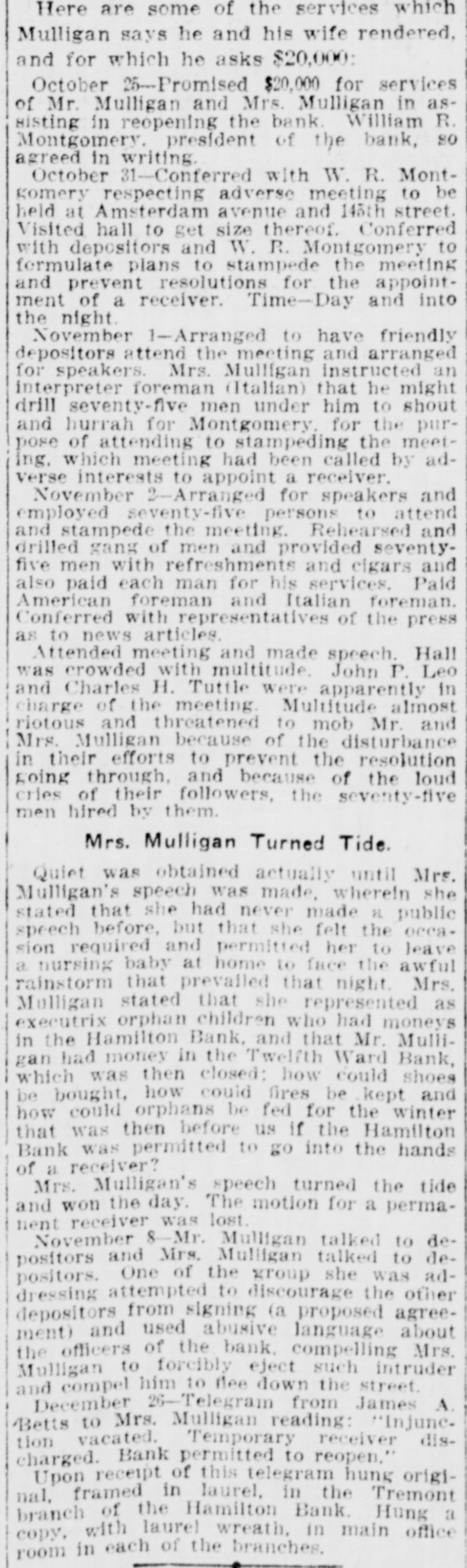
Here are some of the services which Mulligan says he and his wife rendered, and for which he asks $20,000: October 25--Promised $20,000 for services of Mr. Mulligan and Mrs. Mulligan in assisting in reopening the bank William R. Montgomery. president of the bank, so agreed in writing. October 31-Conferred with W. R. Montgomery respecting adverse meeting to be held at Amsterdam avenue and 145th street. Visited hall to get size thereof. Conferred with depositors and W. R. Montgomery to formulate plans to stampede the meeting and prevent resolutions for the appointment of a receiver. Time-Day and into the night. November 1-Arranged to have friendly depositors attend the meeting and arranged for speakers. Mrs. Mulligan instructed an interpreter foreman (Italian) that he might drill seventy-five men under him to shout and hurrah for Montgomery for the purpose of attending to stampeding the meeting. which meeting had been called by adverse interests to appoint a receiver. November 2-Arranged for speakers and employed seventy-five persons to attend and stampede the meeting. Rehearsed and drilled gang of men and provided seventyfive men with refreshments and elgars and also paid each man for his services. Paid American foreman and Italian foreman. Conferred with representatives of the press as to news articles. Attended meeting and made speech. Hall was crowded with multitude John P. Leo and Charles H. Tuttle were apparently in charge of the meeting Multitude almost riotous and threatened to mob Mr. and Mrs. Mulligan because of the disturbance in their efforts to prevent the resolution going through and because of the loud cries of their followers, the seventy-five men hired by them. Mrs. Mulligan Turned Tide. Quiet was obtained actually until Mrs. Mulligan's speech was made. wherein she stated that she had never made a public speech before, but that she felt the occa. sion required and permitted her to leave a nursing baby at home to face the awful rainstorm that prevailed that night Mrs. Mulligan stated that she represented as executrix orphan children who had moneys in the Hamilton Bank, and that Mr. Mulligan had money in the Twelfth Ward Bank, which was then closed: how could shoes be bought, how could fires be kept and how could orphans be fed for the winter that was then before us if the Hamilton Bank was permitted to go into the hands of a receiver? Mrs. Mulligan's speech turned the tide and won the day. The motion for a permanent receiver was lost. November 8-Mr. Mulligan talked to depositors and Mrs. Mulligan talked to depositors. One of the group she was addressing attempted to discourage the other agreeand depositors ment) the officers from used of the signing abusive bank (a compelling language proposed about Mrs. Mulligan to forcibly eject such intruder and compel him to flee down the street. December 26-Telegram from James A. Betts to Mrs. Mulligan reading: "Injunetion vacated. Temporary receiver discharged. Bank permitted to reopen.' Upon receipt of this telegram hung original, framed in laurel, in the Tremont branch of the Hamilton Bank Hung a copy. with laurel wreath, in main office room in each of the branches.