Articles describe a slight run/large withdrawals on Aug 29, 1906 after rumors about the president's death and condition of the company; the trust closed/suspended Aug 29 and a receiver (George H. Earle Jr.) was appointed. Plans to reorganize and resume operations within days are reported and later articles describe Earle reorganizing and putting the company on its feet. Cause of suspension was bank-specific insolvency/embezzlement tied to heavy bad loans to promoter Adolph Segal.
Events (4)
1.August 29, 1906Run
Cause
Rumor Or Misinformation
Cause Details
Rumors about the president's death/condition and the company's affairs precipitated early withdrawals.
Measures
Bank officers closed the doors at about 2:25 p.m.; trustees/clearing house bankers met to consider assistance; court petitioned for a receiver.
Newspaper Excerpt
Rumors of the condition of the bank caused a slight run early in the day and in the last half hour thousands of dollars were drawn out by depositors.
Source
newspapers
2.August 29, 1906Suspension
Cause
Bank Specific Adverse Info
Cause Details
Investigation after President Hipple's death disclosed massive bad loans and alleged embezzlement (large loans to promoter Adolph Segal), leaving the trust insolvent; receiver appointed (George H. Earle, Jr.).
Newspaper Excerpt
The Real Estate Trust company closed its doors at 2:25 o'clock p. m.... the officials found themselves unable to continue business... the court has been applied to for a receiver.
Source
newspapers
3.August 31, 1906Reopening
Newspaper Excerpt
A high financier said late this afternoon... arrangements were completed for securing sufficient funds to enable the collapsed Real Estate Trust Company to resume business within the next forty-eight hours. A petition will also be presented to the court to discharge Mr. Earle as receiver.
Source
newspapers
4.September 6, 1906Other
Newspaper Excerpt
Receiver Earle's plan for the reorganization of the defunct Real Estate Trust company will be mailed to the depositors tomorrow. It provides for the reopening of the bank by the payment of 30 per cent in cash to depositors and 30 per cent in preferred stock ... remaining 40 per cent to be paid within sixty days.
Source
newspapers
Newspaper Articles (25)
1.August 29, 1906The Madison Daily LeaderMadison, SD
Click image to open full size in new tab
Article Text
SECOND LARGEST CONCERN IN PHILADELPHIA FORCED TO CLOSE ITS DOORS. if DEPOSITS OF OVER SEVEN MILLIONS INVESTIGATION FOLLOWS DEATH OF PRESIDENT HIPPLE LAST FRIDAY. Philadelphia, Aug. 29.-The Real Estate Trust company closed its doors at 2:25 o'clock p. m. It was then the second in point of standing of the Philadelphia trust companies. It has a capital and surplus of $2,900,000 and deposits of $7,500,000. It was established in 1885 and Frank K. Hipple was its president up to the time of his death last Friday. The company did a large business in call loans, having about $6,700,000 of such loans outstanding. An investigation by the trustees of the company followed the death of Mr. Hipple and disclosed such a state of affairs that a meeting of representative bankers was called to consider the situation. After examining the situation exhaustively these bank officials found themselves unable to lend the required assistance and called a meeting of their own trustees for 8:30 p. m. Meanwhile, at 2:20, those in charge of the Real Estate Trust company found it necessary to close Its doors. There are rumors to the effect that Mr. Hipple's death, which was assigned to cerebral hemorrhage, was not the result of natural causes. In addition to the deposits the company has $26,167,682 of trust funds invested and $60,483,400 held by the company as depository and trustee for issues of collateral trust bonds. Affairs Very Much Involved. Samuel F. Houston, vice president of the Real Estate Trust company issued a statement after the trust company had closed its doors in which he haid that the affairs of the company were very much involved and that the officials found themselves unable to continue business. "In round numbers," he said, "the failure will amount to $7,000,000. At a meeting of the banks and trust companies of the Philadelphia clearing house an effort was made to raise money to tide the company over its difficulties, but all we could get was $3,000,000, or about one-half what was needed. Consequently the court has been applied to for a receiver." Rumors of the condition of the bank caused a slight run early in the day and in the last half hour thousands of dollars were drawn out by depositors. Frank K. Hipple was treasurer of the board of trustees of the general assembly of the Presbyterian church and it is said had all of the funds on deposit in his company. Hipple had been engaged in heavy real estate deals and, It is said, lost millions of dollars. Judge Audenreid, in common pleas court, has appointed George H. Earle, Jr., president of the Finance company of Pennsylvania, receiver of the Real Estate Trust company.
2.August 29, 1906Evening JournalWilmington, DE
Click image to open full size in new tab
Article Text
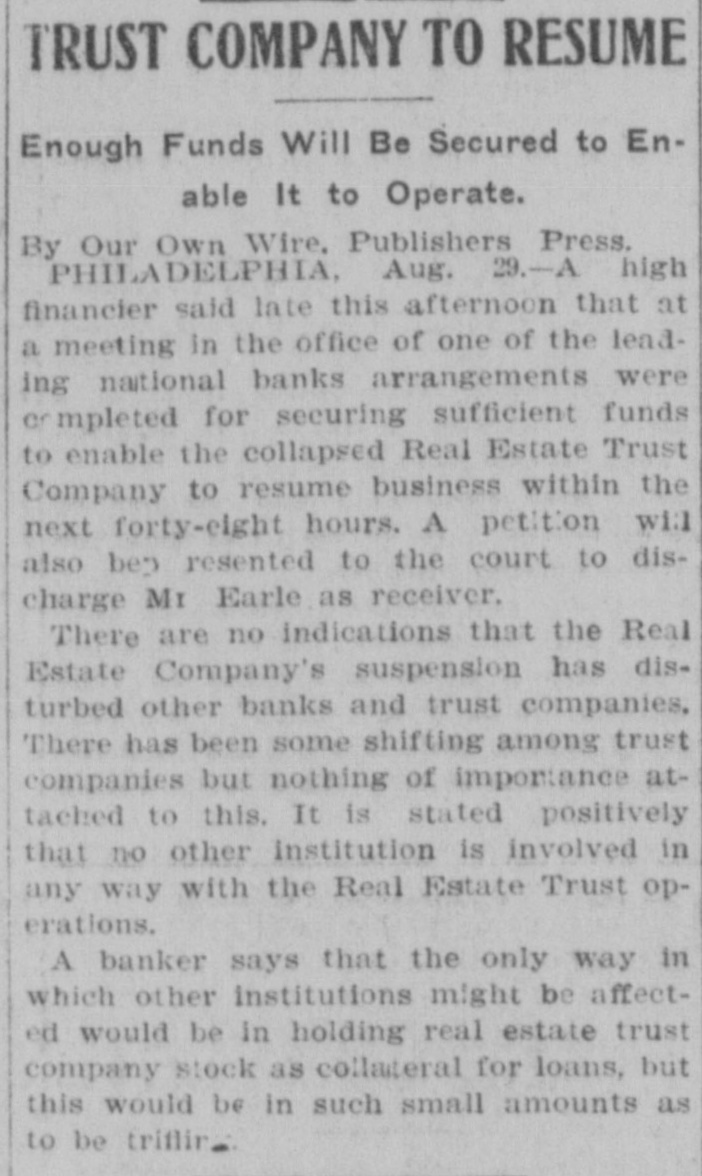
TRUST COMPANY TO RESUME Enough Funds Will Be Secured to Enable It to Operate. By Our Own Wire, Publishers Press. PHILADELPHIA, Aug. 29.-A high financier said late this afternoon that at a meeting in the office of one of the leading national banks arrangements were or impleted for securing sufficient funds to enable the collapsed Real Estate Trust Company to resume business within the next forty-eight hours. A petition will also bey resented to the court to discharge MI Earle as receiver. There are no indications that the Real Estate Company's suspension has disturbed other banks and trust companies, There has been some shifting among trust companies but nothing of importance attached to this. It is stated positively that no other Institution is involved in any way with the Real Estate Trust operations. A banker says that the only way in which other institutions might be affected would be in holding real estate trust company stock as collateral for loans, but this would be in such small amounts as to be triflir_
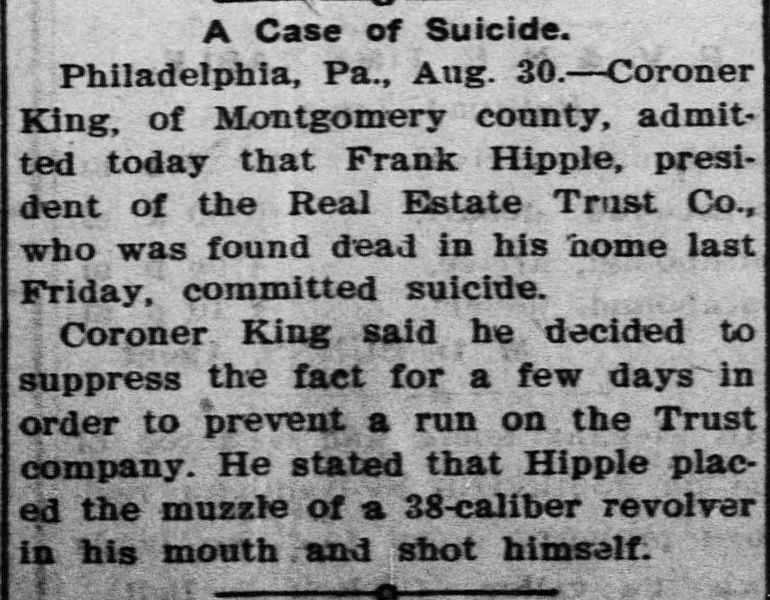
A Case of Suicide. Philadelphia, Pa., Aug. 30.-Coroner King, of Montgomery county, admitted today that Frank Hipple, president of the Real Estate Trust Co., who was found dead in his nome last Friday, committed suicide. Coroner King said he decided to suppress the fact for a few days in order to prevent a run on the Trust company. He stated that Hipple placed the muzzle of a 38-caliber revolver in his mouth and shot himself.
4.August 31, 1906Daily Kennebec JournalAugusta, ME
Click image to open full size in new tab
Article Text
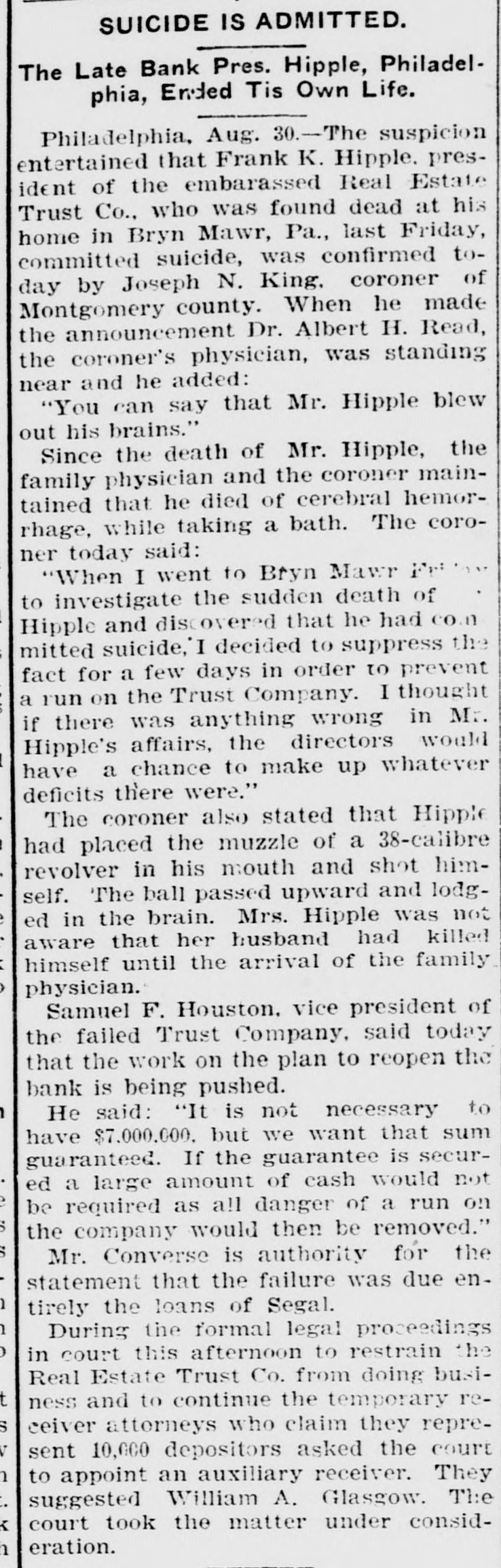
SUICIDE IS ADMITTED. The Late Bank Pres. Hipple, Philadelphia, Ended Tis Own Life. Philadelphia, Aug. 30.-The suspicion entertained that Frank K. Hipple. president of the embarassed Real Estate Trust Co., who was found dead at his home in Bryn Mawr, Pa., last Friday, committed suicide, was confirmed today by Joseph N. King. coroner of Montgomery county. When he made the announcement Dr. Albert H. Read, the coroner's physician, was standing near and he added: "You can say that Mr. Hipple blew out his brains." Since the death of Mr. Hipple, the family physician and the coroner maintained that he died of cerebral hemorrhage, while taking a bath. The coroner today said: "When I went to Bryn Mawr Fr to investigate the sudden death of Hipple and discovered that he had co.n mitted suicide,'I decided to suppress the fact for a few days in order to prevent a run on the Trust Company. I thought if there was anything wrong in Mr. Hipple's affairs, the directors would have a chance to make up whatever deficits there were." The coroner also stated that Hipple had placed the muzzle of a 38-calibre revolver in his mouth and shot himself. The ball passed upward and lodged in the brain. Mrs. Hipple was not aware that her husband had killed himself until the arrival of the family physician. Samuel F. Houston. vice president of the failed Trust Company. said today that the work on the plan to reopen the bank is being pushed. He said: "It is not necessary to have $7,000,000. but we want that sum guaranteed. If the guarantee is secured a large amount of cash would not be required as all danger of a run on the company would then be removed." Mr. Converse is authority for the statement that the failure was due entirely the loans of Segal. During the formal legal proceedings in court this afternoon to restrain the Real Estate Trust Co. from doing business and to continue the temporary receiver attorneys who claim they represent 10,000 depositors asked the court to appoint an auxiliary receiver. They suggested William A. Glasgow. The court took the matter under consideration.
5.August 31, 1906The Stark County DemocratCanton, OH
Click image to open full size in new tab
Article Text
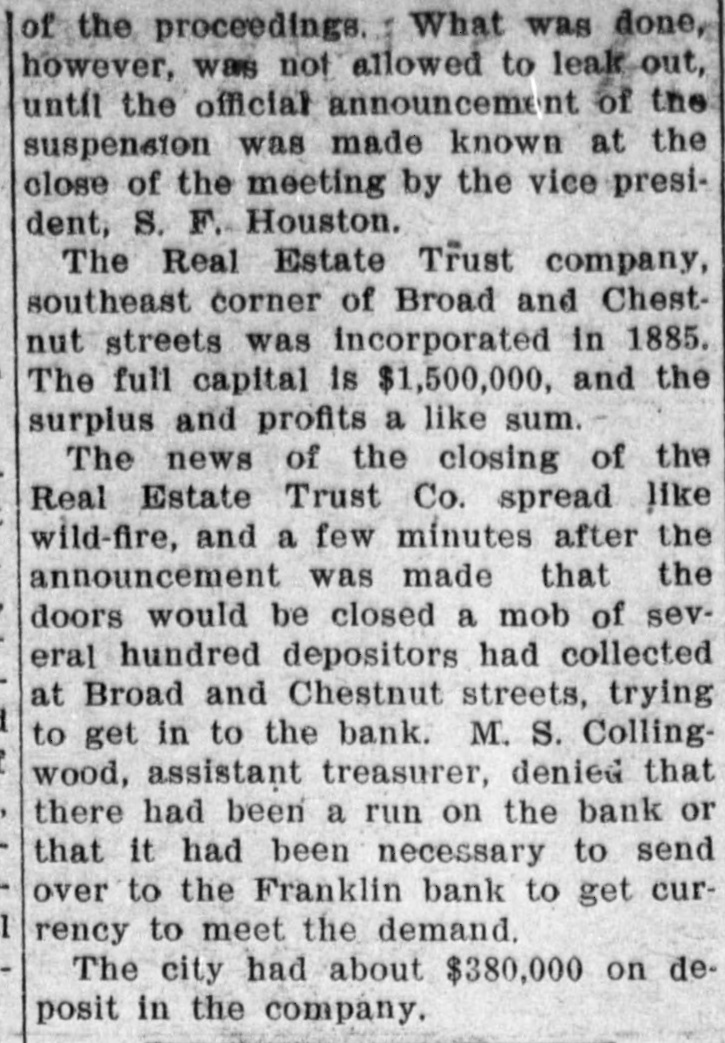
lof the proceedings. What was done, however, was not allowed to leak out, until the official announcement of the suspension was made known at the close of the meeting by the vice president, S. F. Houston.
The Real Estate Trust company, southeast corner of Broad and Chestnut streets was incorporated in 1885. The full capital is $1,500,000, and the surplus and profits a like sum.
The news of the closing of the Real Estate Trust Co. spread like wild-fire, and a few minutes after the announcement was made that the doors would be closed a mob of several hundred depositors had collected at Broad and Chestnut streets, trying to get in to the bank. M. S. Colling-wood, assistant treasurer, denied that there had been a run on the bank or that it had been necessary to send over to the Franklin bank to get currency to meet the demand,
The city had about $380,000 on deposit in the company.
Philadelphia, Pa., Aug. 30.-Receiver Earle said today that the plan for a reorganization of the Real Estate Trust company was to ask the creditors to take preferred stock in the trust company for their claims and to appoint their own officers in the company. This, he said he felt assured, would give the depositors their only chance to get back their money dollar for dollar. Coroner King of Montgomery county admitted today that Frank Hipple, president of the Real Estate Trust company, who was found dead in his home last Friday, committed suicide. Coroner King said that he decided to suppress the fact for a few days in order to prevent a run on the trust company. The coroner stated that Hipple placed the muzzle of a .3 caliber revolver in his mouth and shot himself.
7.September 1, 1906The Jersey City NewsJersey City, NJ
Click image to open full size in new tab
Article Text
HIPPLE'S FREE HAND Permitted by Directors of Failed Trust Company to Run Its Affairs. NO EXAMINATION IN YEARS. Clearing House Member Explains Why No Aid Was Rendered to Wrecked Institution - Hipple's Defalcations ShockAssociates-Failure May Lead to Revision of Banking Laws. Philadelphia, Sept. 1.-Additional desensational continue out in velopments, to crop connection in character, with of the It has become company. the failure Real been Estate known meeting Trust publicly that there had not a of the directors of the failed bank for three years, every detail having been left to the late nearly Hipple, president who of the company, Frank K. comIt was this caused the fairs mitted which suicide. Clearing state House of af- to association to hesitate about coming the aid of the trust company. the meeting of the clearing bankers house During Joseph D. Junkin, counsel for the Real Estate Trust company, was asked: "When did the directors of the trust company last examine its affairs?" Examined Years Ago. His answer, "Not for more than two and caused men the affairs of guide a half years," Philadelphia's the who financial institutions to gasp. Criticism of the members of the House association was refor the sponsible Clearing information. Several of the directors of the trust company had since the crash comsaid saved that the had the pany could have been local bankers advanced $7,000,000. A member of the Clearing House association who was present at Tuesday's meeting said: directors of the Real Estate Trust knew as "The affairs company little about of the of the company as any the apto know whether pear bankers present. They the did shortage not and was $5,000,000 or $10,000,000, it been folly for us would have affairs to have advanced the cash when the of the bank were in such a deplorable condition. Had No Security to Offer. "The three directors of the company who came before us with outstretched hands for $7,000,000 had absolutely to offer in return but Dead had not even in their company's dence nothing Sea fruit. They future to confi- of for when they were their fer, would pledge fortunes asked banks to if might make they losses that the allied it blind' sustain good by 'going their answer was a painful silence." of Receiver President had stolen The statement Hipple Earle securities that and that lending to Adolph on valued of $5,000,000 at $65,000 Segal the to theft in sufficient security amounted created a profound sensation through out the city. was an cruel to his many The blow revelation intimate especially friends, whom are prominent in the church, as most Presbyterian of either elergy men or laymen. So high was their estimation of the man who abhorred tobacco and liquor and refrained from reading Sunday newspapers that not only the various in the Presbyterian the trust company church organizations made of members their but hundreds of money depository, that denomination placed number their of pas in his company. The tors who used the bank to care for their savings was exceptionally large. Hipple a Political Reformer. In addition to his church work, Mr. took an active interest in re form and is said to been a contributor to Hipple heavy politics the have reformers' campaign fund in last year's contest In this city. The failure of the Real Estate Trust company is likely to lead to a revision of the state laws governing trust com Under the present in this state are companies panies. laws permitted trust to do a surety business, and a move ment is now on foot to separate the two.
The failure of the Philadeiphia Real Datate Trust company, yesterday, has emphasized the fact so often announced by the press of the country, in telegrams and editorials, that realty speculation in most sections has run riot. In the adjoining column is presented a good article on the subject from the Chicago Financial World. It is well for Albuquerque that this craze has not struck this city. Realty here is in good demand, and there is considerable movement, but there has been no boom and fortunately there seems no danger of inflated speculation.
9.September 4, 1906Arizona RepublicanPhoenix, AZ
Click image to open full size in new tab
Article Text
therefor. All indebtedness will be fully met on call from the receiver." Discussing the liabilities of the directors. John H. Converse, head of the Baldwin Lecomotive works and one of the board of directors, said today: "That which was done in the case of the Real Estate Trust company would be possible, under existing laws and regulations, in the affairs of any other trust company in Philadelphia. The directors went through the forms that are observed by other boards of directors. The fault is with the present system, which must be radically changed before it may safely be said that another real estate trust crash is out of the question." Mr. Converse denied a statement that the directors had held but one meeting in two years.
10.September 5, 1906The Forest RepublicanTionesta, PA
Click image to open full size in new tab
Article Text
Saturday.
Investigation into the Paterson Canoe club scandal showed that about 25 girls have been attacked on Laurel island.
President Roosevelt has asked that the Roosevelt Home club of New York city be probed by the postoffice department.
Rear Admiral Thomas in a letter to the mayor of Newport indignantly resents discrimination against bluejackets because of their uniforms.
Frank Hipple, president of the wrecked Real Estate Trust company of Philadelphia, was an embezzler, the receiver declared, and killed himself to escape punishment.
George J. Gould and D-Cady Herrick retired as directors of the Equitable Life Assurance society, Mr. Gould ending all connection between Wall street and the society.
11.September 7, 1906Evening Times-RepublicanMarshalltown, IA
Click image to open full size in new tab
Article Text
# PLANTING INDIA RUBBER TREES
Planting India rubber trees is fast
becoming a favorite enterprise for cap-
italists. Groves are planted in India
which now begin to bear, producing
14,010 pounds in 1905-06. Burma leases
land in lots of 1,200 acres for rubber
tree groves. In Ceylon the cultiva-
tion of rubber is proceeding at a rap-
id pace. In 1892 but 6,500 pounds were
exported, but in 1905 the exportation
was 140,100 pounds. By 1913 it is es-
timated that Ceylon will be exporting
$12,500,000 worth yearly. Java, Bor-
neo and the Malay states have gone
largely into the industry. Central
America also has the rubber fever. The
growing demand for rubber and the
stiff price make the ownership of a
grove of trees attractive.
Recognized. - She-This is my por-
trait with my two dogs. Do you rec-
ognize me?
He- Why, yes. That's you in the
middle with the hat, isn't it? - Bon
Vivant.
On investigation it proves that no
examination of the wrecked Real Es-
tate Trust Company of Philadelphia
had been made by the state banking
department for three years, or by the
board of directors for two and one-
half years. Three of the directors
Junkin, Porter and Henry, have ad-
mitted that they had served at times
as counsel for Segal, the promoter,
whose operations caused the bank to
suspend. Four of the directors are
charged with having knowledge of the
immense loans President Hipple made
to Segal. Junkin, attorney and di-
rector of the trust company, was also
president of a Maryland real estate
company, which borrowed $250,000
from the Real Estate Trust Company.
Together with Directors Benson, Henry
and Borden and President Hipple, Jun-
kin took 50 per cent of the loan to
Junkin's Maryland company for guar-
anteeing its bonds if the loan was not
paid. Junkin's Maryland company did
not pay the loan and was foreclosed
by the Real Estate Trust Company
because Junkin and his fellow direc-
tors and guarantors did not make good
their guarantee.
This is father's holiday;
Little Willie is at play;
Sister's making ragtime din;
Brother's nine goes forth to win.
Idle men on corners stand;
Hear the music of the band:
East and West, the unions say,
This is labor's holiday.
One all union rule ignores;
Just keeps busy doing chores;
Washes dishes, makes a bed,
Cooks, that hungry folks be fed;
Doing in each dusty room
Calesthenics with the broom
None to hint at strike or pay
For an eight-hour working day.
Union labels don't go here;
No one works but mother dear!
-New York World.
12.September 7, 1906The Salt Lake HeraldSalt Lake City, UT
Click image to open full size in new tab
Article Text
ADOLPH SEGAL GOT THE MONEY Hipple Left a Confession Taking the Blame for the Trust Company Failure. HEARING OF THE PROMOTER HELD TO COURT IN $25,000 BONDS. Philadelphia, Sept. 6.-Receiver Earle's plan for the reorganization of the defunct Real Estate Trust company will be mailed to the depositors tomorrow. It provides for the reopening of the bank by the payment of 30 per cent in cash to depositors and 30 per cent in preferred stock guaranteed by collateral bonds, the remaining 40 per cent to be paid within sixty days. The directors of the Real Estate Trust company are to raise the capital necessary for this settlement.
13.September 8, 1906Pullman HeraldPullman, WA
Click image to open full size in new tab
Article Text
# LATE NEWS NOTES.
A conspiracy has been suppressed in the province of Ilcocos Norte, on the Island of Luzon, by the prompt action of Governor Florey in arresting 15 of the Filipines said to be implicated.
The public power house of the Kansas City & Leavenworth Railway company at Walcott, Kan., 15 miles west of Kansas City, was burned recently, with all its valuable machinery. Loss, $300,000.
It is announced in Goldfield that the films for the moving pictures became exhausted after the 38th round. As a result the concluding rounds of the great fight will not be shown in these pictures.
President Rickard states that the receipts for the fight amounted approximately to $780,00, and that the number of spectators at the ringside aggregated 7000. This is the greatest amount of money taken in for a prize fight in the history of the ring.
He says he does not make any charges against Siler, but I know that Nelson did not foul Gans. I don't care who says that he did.
A thousand strong, the second contingent of Farley strikebreakers have landed in San Francisco.
The report is confirmed from Honlulu that the transport Sehridan practically will be a total loss.
Conditions existing at this time call for an increase in the pay of the army, says Brigadier General Constant Williams, commanding the department of Columbia, in his annual report.
Receiver Earl of the Real Estate Trust company of Philadelphia says that the farthed he probes into the affairs of the defunct company the worse he finds them. He thinks the trust department intact, but the bank department is hopelessly involved. Indications are that Hipple's stealing exceeds $1,000,000.
14.September 9, 1906The SunNew York, NY
Click image to open full size in new tab
Article Text
ious financier" of Philadelphia among the business men with whom he dealt in Virginia. He was also trustee for the Washington, Alexandria and Mount Vernon Electric Company, and this gave him the opportunity to work his swindle with the paid bonds. In the stated case found to-day Hipple made a loan of $65,000 to himself and as security gave the trust company 6 per cent. bonds of the Electric Company of a par value of $48,000. But the whole issue had been paid off and was worth less than confederate money. Just who passed on these old bonds District Attorney Bell is trying to find out, and as a result of his discovery a number of officers of other banks who had dealings with Hipple will spend Sunday looking through their securities. The next issue of bonds of the Electric Company, the 5s, are still running and selling at par. None of these is among the collateral. As for Hipple's system of forgery, it could readily have been continued for a long time without discovery. He had taken copies of the signatures of a number of the most prominent business men of Philadelphia while their checks were passing through the bank, but in every instance he avoided the use of the name of a depositor of the Real Estate Trust Company. When pinched for money Hipple would draw up a note, forge the signature, take it to the cashier or paying teller, inform him that he had personally made the loan, and to put in the account as a discounted paper. With this amount to his credit he would satisfy the claim that was pressing him at the time. For this branch of the business Hipple kepta private book. in which he entered the amounts of the forged notes and when they became due, and at no time did he allow one of these spurious papers to get away from him. He always explained to the employee of the bank who cashed the note that it was a private matter between the maker of the note and himself and that he desired it to be entered as such. When the bogus note became due Hipple invaria bly either met it with some of the Segal paper, or if this was not expedient he would make out another note with the forged signature of some ot her business man. Incidentally Hipple had been so consciencious in looting the trust company that when a balance of $11,000 remained out of a loan sunk into one of Segal's enterprises he carefully placed that amount in the bank to his own account. The trustees of the General Assembly of t he Presbyterian Church have issued an authoritative statement giving the loss in the crash of the Real Estate Trust Company as $49,000. The $49,000 does not. of course, include the total loss to Presbyterian institutions. It represents only the actual loss to the executive body of the church. When the total loss to Presbyterian organizations, boards. churches, pastors. &c., is computed it will reach nearly $400,000. Depositors to-day refused the directors' plan of reorganization, which provided for an issue of preferred stock to depositors in the place of their deposits and a morton gage it - Broad the and Real Chestnut Estate streets Trust's and property the profits for ten years from the trust accounts. By this plan the depositors figured that
15.September 13, 1906Mrs. GrundyTracy City, TN
Click image to open full size in new tab
Article Text
The coroner in Philadelphia now says that Frank D. Hipple, late president of the Real Estate Trust company, that failed, committed suicide by blowing out his brains. It was reported at the time that Hipple died from heart failure. The coroner says he suppressed the truth for fear of a run on the banking institutions.
16.September 14, 1906Omaha Daily BeeOmaha, NE
Click image to open full size in new tab
Article Text
Receiver Earle's plan to reorganize the Philadelphia Real Estate Trust company will probably meet with favor from all persons except those called upon to put up the cash.
17.September 29, 1906The SunNew York, NY
Click image to open full size in new tab
Article Text
Except from very rare and exceptional causes, such as sudden panics or runs due to false rumors, there is never any reasonable excuse for the failure of a bank or trust company. It is almost always the result of inexcusable folly and incompetence, or dishonesty and fraud, and often due to all of these combined. When a bank does fail it is the fault of the board of directors. - Comptroller of the Currency RIDGELY.
As the failure of the Real Estate Trust Company was not due to a panic or to false rumors, and as Mr. RIDGELY was speaking to Philadelphia bankers, he must have had that institution in mind.
18.December 21, 1906New-York TribuneNew York, NY
Click image to open full size in new tab
Article Text
WOULD SUE THE SUGAR TRUST. Pennsylvania Company Alleges Its Operation as Refinery Was Illegally Prevented. Philadelphia, Dec. 20.-George H. Earle, jr., receiver for the Pennsylvania Sugar Refinery, presented a petition in the Common Pleas Court here to-day asking permission to bring suit for damages against the American Sugar Refining Compary for illegal exercise of its control of a majority of the stock of the Pennsylvania company in preventing the operation of the refinery of the company. Mr. Earle was appointed receiver of the Pennsylvania Sugar Refinery Company after the collapse of the Real Estate Trust Company, when it was found that stock of the refining company had been given to the trust company as security by Adolph Segal. Mr. Earle asks authority to have the trust company, as trustee under the mortgage securing $3,000,000 of bonds of the sugar company, to foreclose. The receiver says: My investigations show that Gustav E. Kissel, of New York, surreptitiously acting as agent for the Sugar Trust, made a loan to Adolph Segal and got trust securities and bonds of the Pennsylvania Refinery Company and, with John E. Parsons, held a controlling interest in the board of managers of the company and voted to make the refinery inoperative. The conduct of the alleged trust, Mr. Earle says, has not only been illegal, but criminal, and he seeks authority to bring action. Its conduct, he alleges, contributed to the failure of the Real Estate Trust Company.
Philadelphia, Pa., Dec. 21.-Their desire to thwart the threatening ambitions of Adolph Segal, the wizard promoter who inspired the Sugar trust and certain of its New York agents to form a conspiracy that led to the ruin of Frank K. Hipple and the looting and wrecking of the Real Estate Trust company, was the sensational charge made today in behalf of George H. Earle, receiver of the Pennsylvania Sugar Refining company and president of the reorganized trust company. Net Spun by Sugar Trust. In direct terms, the entire net of crime that caused the suicide of Hipple and the downfall of the big financial institution is alleged to have been spun by the Sugar trust, its officers or agents. The men connected with the trust directly named as the active conspirators are Gustave Kissel, John E. Parsons and Theodore A. Havemeyer, all of New York city. Leave to Proceed. Mr. Earle was granted leave to proceed at once, civilly or criminally, against the big trust and the men named. Not only will millions in damages be asked, but action will be taken to force the dissolution of the corporation that has a monopoly on the sugar products of the United States.
20.January 19, 1907Evening BulletinHonolulu, HI
Click image to open full size in new tab
Article Text
# GOVERNMENT WILL ATTACK
# SUGAR TRUST
Washington, Dec. 22. -The Federal authorities will in the near future institute proceedings to dissolve the American Sugar Refining Company, better known as the sugar trust. The chief evidence upon which the Government will rely to sustain its case will be that conveyed to it by William R. Hearst and the New York "American."
Supplemental to this will be the evidence submitted by George H. Earle, receiver of the Real Estate Trust Company of Philadelphia, the looting of which by its president, Frank K. Hipple, is a matter of record. Within the
21.July 1, 1909The Princeton UnionPrinceton, MN
Click image to open full size in new tab
Article Text
ence the conduct of an honorable man or the suspicions of one of like character.
# H. W. Taft Appears In New York.
Lawyers and financial men in New York who have followed the sugar trust matter are recalling this corre- spondence with not a little interest. The firm of attorneys "with Washing- ton connections" was Strong & Cad- walader, of which, at the time Mr. Earle wrote, 'both Henry W. Taft, a leading counsel for the sugar trust in all the litigation growing out of the Segal loan, and George W. Wicker- sham, the present attorney general, were members.
The fact that Henry W. Taft is an attorney of the sugar trust in this identical Segal case, thus involving the law firm of which Attorney General Wickersham was a member, raises an interesting question as to what the present administration will do toward prosecuting the trust. Judging by the vigor with which Collector Loeb pro- ceeded against the same trust in the matter of the short weight frauds, the law business of Henry W. Taft and of the firm of Strong & Cadwalader will have little or no influence on President Taft, and the prosecution will go for- ward with the same vim that marked Receiver Earle's case. If a private in- dividual could accomplish what he did, what could not the United States gov- ernment accomplish if it proceeded against the trust with all its great power? One of the most remarkable interviews that have appeared in years grew out of this identical suit. It was from no less a man than Sam- ☐☐uel Untermyer, the famous corporation lawyer of New York, who was re- tained by Segal. Mr. Untermyer stated in effect that the government, if it were in earnest, could not only suc- cessfully prosecute the sugar trust, but many other gigantic corporations that pursue the same methods. That inter- view took the lid off.
Whatever the government does, how- ■ever, George H. Earle has given the sugar trust a staggering blow. He has not alone wrested from it many mil- lions of dollars, but has shown the country what can be done in curbing criminal combinations by any man who means business. That perhaps is the greatest service of all. Moreover, he has put the Real Estate Trust Com- pany of Philadelphia on its feet, thus saving the money of thousands of in- nocent depositors, and has made it possible for the Pennsylvania Sugar Refining company to open its Camden plant and resume business. For his services to the trust company he was unanimously elected its president.
# Other Concerns Saved by Earle.
This is but one of a long series of tottering or wrecked institutions that George H. Earle, Jr., has successfully reorganized. Among the others are the Pennsylvania Warehousing and Safe Deposit company, which he took when its stock was down to $5 per share and by cutting out the dead wood, ju- dicious buying of wharfs and busi- ness principles brought it up until its stock is in the neighborhood of $100 per share; the Finance Company of Pennsylvania, which needed a strong bracing and in Earle's hands got it; the Tradesman's National bank, which got into deep water with its stock down to 50, called on Earle, a was set on its feet and now is above par; the Market Street National bank, which was floundering, sent out a hail for Earle and is now selling at a pre- mium of 60; the Reading railroad, which the last time it failed was put back on its feet by Earle and Freder- ick P. Olcott of New York; the Choc- taw, Oklahoma and Gulf railroad, which struck a slump and went under, but with Earle as chairman of its com- mittee of reorganization has been made a paying property, and the Chestnut Street National Bank and Trust company, involving the owner- ship of the great newspaper, the Phila- delphia Record, all three of which Mr. Earle, with the help of one other re- ceiver, put back into flourishing con- dition, although the bank and trust company had actually failed and the paper was heavily involved.
This noteworthy triple success was perhaps Earle's greatest achievement up to the time that he reinstated the Real Estate Trust company and the Pennsylvania Sugar Refining company and forced the sugar trust to disgorge several millions of money, credits, stocks and bonds. And now, after the famous street car strike in Philadel- phia, Mr. Earle has been asked by the mayor and councils to take charge of this situation and in a letter that boldly outlines his views and cuts to the heart of the question has consent- ed to do so. The regard with which he is held in Philadelphia is shown by the fact that since his appointment public confidence that the traction question is at last in the hands of a -man who will solve it has been gener- ally expressed. The same trust in his ability and integrity was displayed several years ago when he took charge
22.July 7, 1909Rock Island ArgusRock Island, IL
Click image to open full size in new tab
Article Text
# H. W. Taft Appears In New York.
Lawyers and financial men in New York who have followed the sugar trust matter are recalling this correspondence with not a little interest. The firm of attorneys "with Washington connections" was Strong & Cadwalader, of which, at the time Mr. Earle wrote, both Henry W. Taft, a leading counsel for the sugar trust in all the litigation growing out of the Segal loan, and George W. Wickersham, the present attorney general, were members.
The fact that Henry W. Taft is an attorney of the sugar trust in this identical Segal case, thus involving the law firm of which Attorney General Wickersham was a member, raises an interesting question as to what the present administration will do toward prosecuting the trust. Judging by the vigor with which Collector Loeb proceeded against the same trust in the matter of the short weight frauds, the law business of Henry W. Taft and of the firm of Strong & Cadwalader will have little or no influence on President Taft, and the prosecution will go forward with the same vim that marked Receiver Earle's case. If a private individual could accomplish what he did, what could not the United States government accomplish if it proceeded against the trust with all its great power? One of the most remarkable interviews that have appeared in years grew out of this identical suit. It was from no less a man than Samuel Untermyer, the famous corporation lawyer of New York, who was retained by Segal. Mr. Untermyer stated in effect that the government, if it were in earnest, could not only successfully prosecute the sugar trust, but many other gigantic corporations that pursue the same methods. That interview took the lid off.
Whatever the government does, however, George H. Earle has given the sugar trust a staggering blow. He has not alone wrested from it many millions of dollars, but has shown the country what can be done in curbing criminal combinations by any man who means business. That perhaps is the greatest service of all. Moreover, he has put the Real Estate Trust Company of Philadelphia on its feet, thus saving the money of thousands of innocent depositors, and has made it possible for the Pennsylvania Sugar Refining company to open its Camden plant and resume business. For his services to the trust company he was unanimously elected its president.
# Other Concerns Saved by Earle.
This is but one of a long series of tottering or wrecked institutions that George H. Earle, Jr., has successfully reorganized. Among the others are the Pennsylvania Warehousing and Safe Deposit company, which he took when its stock was down to $5 per share and by cutting out the dead wood, judicious buying of wharfs and business principles brought it up until its stock is in the neighborhood of $100 per share; the Finance Company of Pennsylvania, which needed a strong bracing and in Earle's hands got it; the Tradesman's National bank, which got into deep water with its stock down to 50, called on Earle, was set on its feet and now is above par; the Market Street National bank, which was floundering, sent out a hail for Earle and is now selling at a premium of 60; the Reading railroad, which the last time it failed was put back on its feet by Earle and Frederick P. Olcott of New York; the Choctaw, Oklahoma and Gulf railroad, which struck a slump and went under, but with Earle as chairman of its committee of reorganization has been made a paying property, and the Chestnut Street National Bank and Trust company, involving the ownership of the great newspaper, the Philadelphia Record, all three of which Mr. Earle, with the help of one other receiver, put back into flourishing condition, although the bank and trust company had actually failed and the paper was heavily involved.
This noteworthy triple success was perhaps Earle's greatest achievement up to the time that he reinstated the Real Estate Trust company and the Pennsylvania Sugar Refining company and forced the sugar trust to disgorge several millions of money, credits, stocks and bonds. And now, after the famous street car strike in Philadelphia, Mr. Earle has been asked by the mayor and councils to take charge of this situation and in a letter that boldly outlines his views and cuts to the heart of the question has consented to do so. The regard with which he is held in Philadelphia is shown by the fact that since his appointment public confidence that the traction question is at last in the hands of a man who will solve it has been generally expressed. The same trust in his ability and integrity was displayed several years ago when he took charge of a failed trust company. The manner in which this particular failure had been brought about had enraged the depositors, large numbers of whom entered suit. On Mr. Earle's mere appeal these suits were all withdrawn, he was given complete voting power
23.July 8, 1909Yellowstone MonitorGlendive, MT
Click image to open full size in new tab
Article Text
pany. The new controlling interest in the Pennsylvania Sugar Refining company forthwith elected a new board of directors, and this board soon afterward adopted a resolution that the Segal refinery should not be operated at that time. Segal also borrowed heavily from the Real Estate Trust company of Philadelphia, with which he deposited the securities of the sold sugar trust loan. President Hipple, of the Real Estate Trust company, had been made custodian of these securities. The trust company became involved hopelessly and suspended. President Hipple committed suicide.
Capt. Schultz of Kansas City, chief engineer of rivers and harbors improvements from Kansas City to Helena, was here Tuesday in consultation with Messrs. Hagan, Mead and Hollecker in reference to the improvement of the Yellowstone, and the placing of a lock in the government dam at the Head Gates.
Messrs. Mead and Hollecker made a trip down to the Head Gates with Capt. Schultz in an auto and had dinner with the captain on the U. S. boat, Mandan. Prospects seem bright for the improvements mentioned.
24.August 5, 1909The Emmett IndexEmmett, ID
Click image to open full size in new tab
Article Text
ence the conduct of an honorable man or the suspicions of one of like character.
# H. W. Taft Appears In New York.
Lawyers and financial men in New York who have followed the sugar trust matter are recalling this corre- spondence with not a little interest. The firm of attorneys "with Washing- ton connections" was Strong & Cad- walader, of which, at the time Mr. Earle wrote, both Henry W. Tart, a leading counsel for the sugar trust in all the litigation growing out of the Segal loan, and George W. Wicker- sham, the present attorney general, were members.
The fact that Henry W. Taft is an attorney of the sugar trust in this identical Segal case, thus involving the law firm of which Attorney General Wickersham was a member, raises an interesting question as to what the present administration will do toward prosecuting the trust. Judging by the vigor with which Collector Loeb pro- ceeded against the same trust in the matter of the short weight frauds, the law business of Henry W. Taft and of the firm of Strong & Cadwalader will have little or no influence on President Taft, and the prosecution will go for- ward with the same vim that marked a Receiver Earle's case. If a private in- dividual could accomplish what he did, what could not the United States gov- ernment accomplish if it proceeded against the trust with all its great power? One of the most remarkable interviews that have appeared in years grew out of this identical suit. It was from no less a man than Sam- uel Untermyer, the famous corporation lawyer of New York, who was re- tained by Segal. Mr. Untermyer stated in effect that the government, if it were in earnest, could not only suc- cessfully prosecute the sugar trust, but many other gigantic corporations that pursue the same methods. That inter- view took the lid off.
Whatever the government does, how- ever, George H. Earle has given the sugar trust a staggering blow. He has not alone wrested from it many mil- lions of dollars, but has shown the country what can be done in curbing criminal combinations by any man who means business. That perhaps is the greatest service of all. Moreover, he has put the Real Estate Trust Com- pany of Philadelphia on its feet, thus saving the money of thousands of in- nocent depositors, and has made it possible for the Pennsylvania Sugar Refining company to open its Camden plant and resume business. For his services to the trust company he was unanimously elected Its president.
# Other Concerns Saved by Earle.
This is but one of a long series of tottering or wrecked institutions that George H. Earle, Jr., has successfully reorganized. Among the others are the Pennsylvania Warehousing and Safe Deposit company, which he took when its stock was down to $5 per share and by cutting out the dead wood, ju- dicious buying of wharfs and busi- ness principles brought it up until its stock is in the neighborhood of $100 per share; the Finance Company as of Pennsylvania, which needed a strong bracing and in Earle's hands got it; the Tradesman's National bank, which got into deep water with its stock down to 50, called on Earle, was set on its feet and now is above par; the Market Street National bank, which was floundering, sent out a hail for Earle and is now selling at a pre- mium of 60: the Reading railroad, which the last time it failed was put back on its feet by Earle and Freder- ick P. Olcott of New York; the Choc- taw, Oklahoma and Gulf railroad, which struck a slump and went under, but with Earle as chairman of its com- mittee of reorganization has been made a paying property, and the Chestnut Street National Bank and Trust company, involving the owner- ship of the great newspaper, the Phila- lelphia Record, all three of which Mr. Earle, with the help of one other re- ceiver, put back into flourishing con- dition, although the bank and trust company had actually falled and the paper was heavily involved.
This noteworthy triple success was perhaps Earle's greatest achievement up to the time that he reinstated the Real Estate Trust company and the Pennsylvania Sugar Refining company and forced the sugar trust to disgorge several millions of money, credits, stocks and bonds. And now, after the famous street car strike in Philadel- phia, Mr. Earle has been asked by the mayor and councils to take charge of this situation and in a letter that boldly outlines his views and cuts to the heart of the question has consent- ed to do so. The regard with which he is held in Philadelphia is shown by the fact that since his appointment public confidence that the traction question is at last in the hands of a man who will solve it has been gener- lly expressed. The same trust in his ability and integrity was displayed several years ago when he took charge of a failed trust company. The man- ner in which this particular failure had been brought about had enraged the depositors, large numbers of whom entered suit. On Mr. Earle's mere ap- peal these suits were all withdrawn. He was given complete voting power for the depositors, and he finally paid them every cent with interest.
25.August 5, 1909The Emmett IndexEmmett, ID
Click image to open full size in new tab
Article Text
# One Man Driven to Suicide.
There is more of the story, though that is the nub of it. The Real Estate Trust Company of Philadelphia was involved with Segal, and when the sugar trust pressed for payment of its loan the Real Estate Trust company went to the wall and its president, Frank Hipple, committed suicide. It was here that Earle came into the game. He had already straightened out the affairs of a number of failed banks and had a reputation as a financial doctor and life saver. He was therefore made receiver of the Real Estate Trust, and from that hour the benevolent sugar octopus did not have things so much its own way. Earle found plenty of in-