16607. Third Avenue Bank (New York, NY)

Bank Information

Episode Type
Run Only
Bank Type
state
Start Date
January 2, 1872
Location
New York, New York (40.714, -74.006)

Metadata

Model
gpt-5-mini
Short Digest
fc8a4d4d

Response Measures

Accommodated withdrawals, Books examined

Other: Ticket system to manage lines; heavy police presence and paying out over many days.

Description

Newspaper articles from January 1872 describe a multi-week run on the Third Avenue Bank in New York with continuous payments being made and crowd control measures; there is no clear report in these pieces that the bank suspended operations or was placed in receivership. The run lasts at least through Jan 25–26, 1872. I corrected OCR oddities (e.g., 'sieze' -> 'siege/run') and treated all items as referring to the New York Third Avenue Bank.

Events (1)

1. January 2, 1872 Run
Cause
Bank Specific Adverse Info
Cause Details
Depositor alarm over the bank's condition and alleged mismanagement/trustee problems and general loss of confidence in the institution (trustee investigations and heavy withdrawals over several weeks).
Measures
Payments were continued (tellers paid out daily), a ticket/line system (later abolished), police maintained order, and trustees/statements to the press were solicited.
Newspaper Excerpt
There was a run on the Third avenue bank, of New York, yesterday, and over $1,000,000 was withdrawn. It will meet all liabilities.
Source
newspapers

Newspaper Articles (9)

Article from Memphis Daily Appeal, January 3, 1872

Click image to open full size in new tab

Article Text

LATEST TELEGRAMS. A full Cabinet meeting was held yester day. New Year's was well observed in Louis. ville. The Prince of Wales continues to improve. French successes are reported from Algiera. New Years was not very generally observed in Chicago. Tweed has not claimed his seat in the New York State senate. The new city government of Boston was inaugurated on Monday. Boston owes $29,383,390 52-with amounting to $11,770,162 35. Fisk is convalescent. We are sorry for the Eris stockholders' sake. A drugstore in Wilkinsburg, near Pittsburg, was burned yesterday. One murder by railroad and one suicide by audanum in Chicago yesterday. Queen Victoria and Prince Leopold left Sandringham for Windsor yesterday. Twenty-six cases of small-pox and four deaths in New York, since Saturday. William B. Allison will succeed Harlan in the United States senate from Iowa. The Connecticut Republican convention meats is Hartford on the 24th inst. Minister Schenck has gone to Paris from London to meet General Sherman. Tolls on the New York canals are nearly half a million more than the year previous. The insurance companies of the State of New York paid twenty millions losses by the Chicago fire. J. C. DeLeon assumed the duties of managing editor of the Mobile Register on the las instant. A special committee of the State legislature will look into the financial affairs of New York city. Sixteen indictments for murder are on the docket of the present term of the Jefferson, Kentucky, circuit court, The debt of the State of New York has been reduced $29,000,000 the past year. Good for & Damoeratic governor. Chicago speculators ask $2,000,000 for the ground the government wants for a customhouse. They can't get it. The Penneylvania legislature convened yesterday. William Elliott, of Philadelphia, was elected speaker of the house. There was a run on the Third avenue bank, of New York, yesterday, and over $1,000,000 was withdrawn. It will meet all liabilities. Dennis McCarthy was kicked to death in Church street, New York, yesterday, by three unknown roughs, while peaceably going home. Colonel Dent, 8 prominent lawyer, and formerly adjutant goneral of the Confederate Army or the Tennessee, died at Washington yesterday. The passengers in S Broadway railroad in New York yesterday, beat a thief almost car to death, whom they caught in the act of robbing S lady. Alexis enjoyed himself hugely in Chiespecially at & pigeon match, in which cago, he LOOK a hand. He now knows how Chicago kills hogs. Governor Hoffman of New York thinks Federal constitution should be amended the so that United States senators would be elected by the people. Olive Logan says "unclean hands" have been laid upon the woman's suffrage question, and adds, "let it go." "So much for Claflin and Woodhull. Duke d'Aumale has been elected a member of the academy of France. The disannouncing that the election was to take place was patch yet incorrect. Rondout, New York, has an abortion the abortionist has fied, and the citizans case, offer $500 for his capture. His victim was one Mrs. Henrietta Gray. John W. Pittock, of Pittsburg, gave the a newsboys and bootblacks of his city grand dinner on New Year's Daycustom of his for the past thirty years. The Grand Dake Alexis is in Milwaukee, He returns to Chicago to-morrow, and goes thence to St. Louis and to the plains for a builalo hunt via Kansas City. At the installation of a conservative mayor in Limerick, Ireland, yesterday, a tumultuous mob alternately hissed at the name of the Prince of Wales and cheered for "home rule." " The storm on Sunday morning biew down the dwelling of Smith Yeager, two miles from Lagrange, Kentucky, and several barns in that vicinity. One lady was fatally injured. The American Ring company's shop and machinery in Waterbury, Connecticut, damaged by fire Monday night dolthe were extent of twenty-five thousand lars, Fully insured. fourth annual meeting of the Women's The Board of Missions was held in in Beston yesterday. condition, The the receipts society is for the a flourishing year being $51,000 and the expenditures $46,000. Rochester (New York) mob attempted the A break the jail, yesterday, where to outrager of a little white girl was negro confined. but were prevented by the the police. Great excitement exists in town. the banquet given to the TelegraphAt Conference at Rome by C. W. Field, from ie were present representatives 600,there countries, aggregating twenty-one of people, speaking twenty-siz languages. 000,000 Priyate capital to the amount


Article from The Wheeling Daily Intelligencer, January 6, 1872

Click image to open full size in new tab

Article Text

NEW YORK CITY. NEW YORK, January 5.-In the case of the poisoning of R. F. Burroughs, at Pat. terson, N. J., the jury returned a verdict that Burroughs was poisoned by Libby Garrabrant. The Union Republican General Committee last evening re-elected Mr. Horace Greeley as chairman. A messenger boy was robbed of $11,000 in checks and coupons while in the Central National Bank Wednesday. the of dore it herself Mrs. Chauncey, Chauncey, appears, widow dressed Commoattire to watch a man named an admirer, who her Snowhill, in male discovered her clothes and attempted to tear off. fired a revolver at his disguise She and him keep and them companions to scare them from her and then Noone Mrs. is inwas hurt. stripping Chauncey fled. slightly jured and under nominal arrest for amurderous assault. Andrew Boyle and Mike Scanlan were committed without bail up town yesterday, for rape on a girl of 12 years. of the Supreme Court, in an to Judge elaborate Brady, opinion decides Mrs. Mansfield continue the injunction restricting from Jas. Fisk's to Permission was Mansfield. publishing letters granted Miss Miss Mansfield however, to make use of Fisk's letters in her suit against him for the recovery of $50,000 of her money alleged to be retained by Fisk. At Albany this morning, the counsel not arguof the motion ment for Tweed being appealing ready for the bail, the order and a reduction of Tweed's the order until Friday next. vacating postponed denying for his arrest, The argu- was ment in the Connolly case, is being proceeded with. A lease of the building with considerablc material of the Printing Company, was sold at Sherifl's sale to-day, for $50,000, to satisfy a demand on the Ocean Bank for $109,000. While a sale at anwas in the proceedwere by an of other ings office stopped progress, injunction of party Barnard, in the interest a A large was pressome stir was a ent, named Judge and Tracy. created crowd by report that Tweed was going to be taken to jail. Judge Cardoza decides to accept the suretics on Tweed's bail, on condition that the transfer of the deeds of young Tweed's property be recorded. Immense crowds of depositors, mostly people, are at the Third Avenue Bank. The run is poor Savings being fully met by the bank. states a Amerito present cans, The shareholders, Post opposed committee empowered the of Eric management, have been to act for the stockholders of this country, holding $10,000,000 worth of shares. This added to $30,000,000 worth in England, leaves only about $3,000,000 or $4,000,000 to enable them to and Gould. This necessary oust Fisk is victoriously expected electo be accomplished before the next tion. Against Thos. C. Fields and Jas. M. indictments will not ed Court until Sweeney, to the discharged be present- by Jury. the Court of and Terminer Grand and James was John Neville Oyer Walters, in the to-day sentenced to four years penfor revolt on the notorious ruflian, was itentiary, The Peter ship Burke, Neptune. to five years in prison, for asa at an sentenced saulting challenger shooting election. There was a pigeon tournament at Fleetwood Park today. The trial of the Cuban General Jordan, postponed until Friday, when if the is not ready, ings will be is government discontinued. further proceedWilliams, one who got away from in George recently of the Sing convicts Sing a tug boat but was captured, has again escaped. The ice in the Hockensack river last night destroyed plank road and railroad bridges. Tweed said to-day that he was entirely in the hands of hiscounsel. Asto his visit to Albany, it is asserted that they will advise him to remain in the city. The battery willed to the State of New the late Commodore is is as far as can Jersey completed by be until Stephens, it launched and docked. that a preIt is reported bill will providing be sented in Congress next week for the election of inspectors to canvass the Presidential and Congressional vote. Meaghor, Broadthis evening way Officer squad, Thomas attempted of the sui- He cide at his residence by shooting. refuses to state the reason. The wound is dangerous. This evening Senator Daniel D. Pratt, of while in a street Indiana, Twenty-third his omnibus, was robbed of pocket-book containing $51 in money and a draft for $500, together with valuable private


Article from The New York Herald, January 6, 1872

Click image to open full size in new tab

Article Text

"It was a bill introduced in the Senate-I think the last bill passed at the last session." "Did the Governor sign it y" "Certainly, and it is the law governing my acti on regarding savings banks." 6.I have not-seen it. What are its provisions ?" "I will send you a copy. All I can say briefly is that I cannot appoint a receiver. If a bank is in a critical condition it is my duty to report the evidence taken by the examiners to the Attorney General, whose duty it is to appoint a receiver. So far I 1all to And any justification for the appointment of a receiver for the Third Avenue Bank. Still, it is very proper that the trustees should give you a statement of their assets and liabilities." "Not to me, Mr. Howell. Say to the press." "Yes, I mean the press when I say you; and if they do not give it to you to-night, I will see them to-morrow and urge them to do so." This terminated the interview as far as the public are interested, and Mr. Howell, bidding the reporter good night, remarked:-"I will do all I can to aid the press and protect depositors." Mr. Howell has come to New York to stay until the panic 19 over, and it is safe to say that If he does his duty fearlessly and faithfully he will return to the capital only after every bank of savings in the city has been carefully examined and the securities in which their trustees have invested the savings of the poor are personally handled.


Article from The Wheeling Daily Register, January 12, 1872

Click image to open full size in new tab

Article Text

NEW YORK. The Vice Presidency of the Erie. YORK, January 11.-In regard to rumor that the Vice of railroad has been to NRW the the Erie Presidency tendered that Geo. B. McClellan, it is stated Fisk's successor has not yet been appointed. The Remonstrance against Tweed. The committee met and presented to Senate the memorial remonallowing to strating the State against Tweed that take the his seat as Senator, asking be declared vacant, and a new ordered. The into the frauds by which seat election fully memorial election. Tweed's enters to have secured his also, that in various were marked down for more is It alleged shows, votes districts Tweed entire than were actually cast inthe district. It is believed in certain official circles Hall will not resume his as Mayor. and that of porary position that Mayor appointment General the Coch- tem- the a preliminary step to is of his office. A final rane is resignation only opinion Such also General Cochrane's rumor was prevalent yesterday afternoon to this effect. An Albany letter states that Tweed not has notified his triends that he is going to claim his seat in the Senate. ill. Erastus Corning is dangeronsly The Russian Squadron, which arrived here with Alexis, is still in port. The Admiral's flagship is and at the navy yard, undergoing repairs is about to receive new boilers. The Case of Stokes. Up to a late hour yesterday no pahad been received from the coroner pers District Attorney in the case of The District Stokes. by the Attorney received states that as soon as the papers are they will be laid before the Grand Jury Mexican Revolutionists Routed. A Herald special from Matamoras, Mexico, confirms the news of the defeat Gen. of the revolutionists under Diaz Alia, at the head of a large government the force, is marching on the capital of still State of Oaxaca. General Rocha pursues Diaz's army. Fighting is going on near Mier. Tammany to be Closed. The sachems of Tammany have passed a resolution closing Tammany Hall to all political committees or or The preamble asserts Democratic as no general ganizations. committee this action that in 1871, consequently the recently constructed on the part of the committee ignores elected Tamma- general which organization a proceeding furny Herald thinks will lead to a ther the disruption of the Democratic party of this State. General Items. Judge Aixby, before whom the FiskMansfield libel case had been proceeding, states that the case is, of course, be now practically ended, and will not brought up again. A meeting of the Methodist Sunday Union was held yesterday. Morris was chosen Board of Managers. A School Bishop the President thousand Sundollars each were appropriated for and day School work in Germany. India South America. Bergh states that Mayor Hall's his that the former in Russia is a base assertion namewhen Mr. changed slander. signed Governor Hoffman last night finan the bill passed yesterday for the cial relief of New York city. The Times says that the election Republi- of John Cochrane, a Tammany of to the Presicency of the Board retirecan, and the subsequent Hall, 80 that of be Mayor, is the ment would Alderman, of Mayor acting Cochrane privately result Tammany tactics, as proposed by Tweed. The New York Yacht Club is making for a cruise in Russia Grand next summer, preparations by invitation of the Duke. It is now stated that Mayor Hall has gone to visit Sweeney at St. Catharine, The Canada. Run Diminishing. on the Savings Bank The run on the Third Avenue Bank appears to be somewhat The officers assert a diminished. Savings and better new feeling now among depositors, deposits are now made every day. Investigations against Harbor Master will Hart were continued to-day, and probably be closed soon. Stokes continues to manifest much indifferThe District Attorney will probably ence. receive the papers from them the to to-morrow and submit session. coroner one of the grand juries now in Affairs Around City Hall. Everything is quiet around City Hall. Many rumors are current regarding the probability of Mayor Hall ever resuming his official position. Tweed has not left the city but looked his departure for Albany is daily for. Connolly is still in retirement and maintains strict seclusion. The Custom House Investigation continued to-day. General George was W. Palmer was examined and testified his knowledge of the abuses, &c. in to the Custom House. He complained of compromising of who had smuggled merchants the system goods order and witnesses a monopoly as to the detail of general testified business considered the Other general orders and bonded warehouses.


Article from The New York Herald, January 25, 1872

Click image to open full size in new tab

Article Text

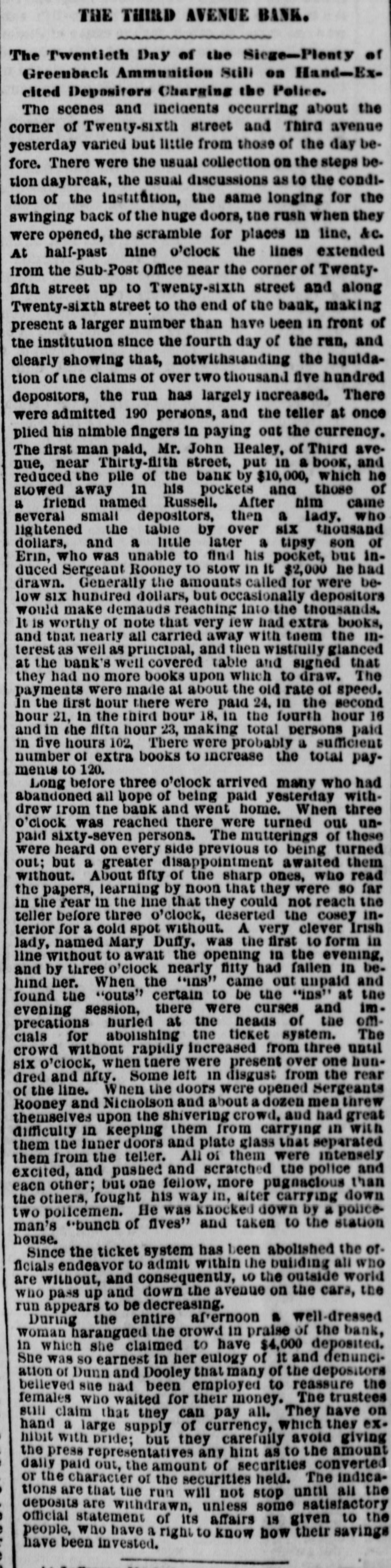
THE THIRD AVENUE BANK. The Twentieth Day of the Sieze-Plenty of Greenback Ammunition Still on Hand-Excited Depositors Charging the Police. The scenes and inciaents occurring about the corner of Twenty-sixth street and Third avenue yesterday varied but little from those of the day before. There were the usual collection on the steps betion daybreak, the usual discussions as to the condition of the institation, the same longing for the swinging back of the huge doors, the rush when they were opened, the scramble for places in line, &c. At half-past nine o'clock the lines extended from the Sub-Post Office near the corner of Twenty. fifth street up to Twenty-sixth street and along Twenty-sixth street to the end of the bank, making present a larger number than have been in front of the institution since the fourth day of the run, and clearly showing that, notwithstanding the liquidation of ine claims of over two thousand five hundred depositors, the run has largely increased. There were admitted 190 persons, and the teller at once plied his nimble fingers in paying out the currency. The first man paid, Mr. John Healey. of Third avenear Thirty-firth street, put in a book, and reduced nue, the pile of the bank by $10,000, which he of slowed away in his pockets and those came friend named Russell. After nim a several small depositors, then a lady. who lightened the table by over six thousand of dollars, and a little later a tipsy son Erin, who was unable to find his pocket, but induced Sergeant Rooney to stow in It $2,000 ne had drawn. Generally the amounts called for were below six hundred dollars, but occasionally depositors would make demands reaching into the thousands. It 18 worthy of note that very few had extra books, and that nearly all carried away with them the interest as well as principal, and then wistfully glanced at the bank's well covered table and signed that they had no more books upon which to draw. The payments were made at about the old rate of speed. In the first hour there were paid 24. in the second hour 21, in the third hour 18. in the fourth hour 16 and in the fifta hour 23, making total persons paid in tive hours 102, There were probably a sufficient number of extra books to increase the total paymenus to 120. Long before three o'clock arrived many who had abandoned all hope of being paid yesterday withdrew irom the bank and went home. When three o'clock was reached there were turned out unpaid sixty-seven persons. The mutterings of these were heard on every side previous to being turned out; but a greater disappointment awaited them without. About fifty or the sharp ones, who read far the papers, learning by noon that they were so in the Year in the line that they could not reach the teller before three o'clock, deserted the cosey interior for a cold spot without. A very clever Irish in named Mary Duffy. was the first to form lady, without to await the opening in the evening, beline by three o'clock nearly nity had fallen in and and When the "ins" came out unpaid found hind her. the "outs" certain to be the "ins" at im. the session, there were curses and omevening nurled at the neads of the The precations for abouthing the ticket system. cials without rapidly increased from three until crowd O'clock, when there were present over one hun- rear six and nity. Some left in disgust from the dred line. When the doors were opened Sergeants threw of the and Nicnolson and about a dozen men themselves Rooney upon the shivering crowd. and had great with in keeping them from carrying in difficulty inner doors and plate glass that separated them the the teller. All of them were intensely and them from and pushed and scratched the police than excited, other; but one fellow. more pugnacious down each others, fought his way in, after carrying policethe He was knocked down by a station two man's policemen. "bunch of fives" and taken to the house. the ticket system has been abolished all the who ofSince endeavor to admit within the building world ficials without, and consequently, 10 the outside the are who pass up and down the avenue on the cars, run appears the to be entire decreasing. afternoon a well-dressed During harangued the crowd in praise of deposited. the bank, woman in which she claimed to have $4,000 denunciwas so earnest in her eulogy of it and She ation of Dunn and Dooley that many of the depositors the belleved sue had been employed to reassure trustees females who waited for their money. The have on still claim that they can pay all. They they exhand a large supply of currency, which hibit with pride; but they carefully avoid giving the press representatives any hint as to the converted amount daily paid out, the amount of securities indicaor the character of the securities held. The the tions are that the run will not stop until all deposits are withdrawn, unless some satisfactory the official statement of its affairs 18 given to people, who have a right to know how their savings have been invested.


Article from The New York Herald, January 26, 1872

Click image to open full size in new tab

Article Text

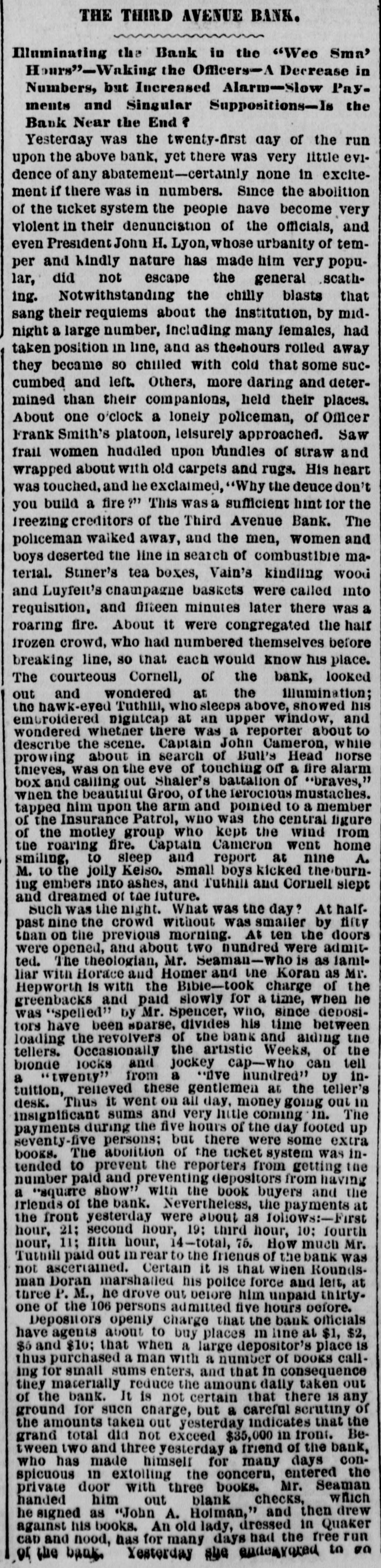
THE THIRD AVENUE BANK. Illuminating the Bank in the "Wee Sma' Hours"_Waking the Officers-A Decrease in Numbers, but Increased Alarm-Slow Payments and Singular Suppositions-Is the Bank Near the End ? Yesterday was the twenty-first aay of the run upon the above bank, yet there was very little evidence of any abatement-certainly none in excitement if there was in numbers. Since the abolition of the ticket system the people have become very vlolent in their denunciation of the officials, and even President John H. Lyon, whose urbanity of temper and kindly nature has made him very popular, did not escape the general scathing. Notwithstanding the chilly blasts that sang their requiems about the institution, by midnight a large number, including many females, had taken position in line, and as the-hours rolled away they became so chilled with cold that some succumbed and left. Others, more daring and determined than their companions, held their places. About one o'clock a lonely policeman, of Officer Frank Smith's platoon, leisurely approached. Saw frail women huddled upon bundles of straw and wrapped about with old carpets and rugs. His heart was touched, and he exclaimed, "Why the deuce don't you build a fire?" This was a sufficient hint for the ireezing creditors of the Third Avenue Bank. The policeman waiked away, and the men, women and boys deserted the line in search of combustible material. Stiner's tea boxes, Vain's kindling wood and Luyfeit's cnampagne baskets were called into requisition, and fifteen minutes later there was a roaring fire. About it were congregated the half irozen crowd, who had numbered themselves before breaking line, so that each would know his place. The courteous Cornell, of the bank, looked out and wondered at the illumination; the hawk-eyed Tuthill, who sleeps above, snowed his embroidered nightcap at an upper window, and wondered whether there was a reporter about to describe the scene. Captain John Cameron, while prowling about in search of Bull's Head horse trieves, was on the eve of touching Off a fire alarm box and calling out Shaler's baltalion of "braves," when the beautiful Groo, of the rerocious mustaches. tapped him upon the arm and pointed to a member of the Insurance Patrol, who was the central figure of the motley group who kept the wind from the roaring fire. Captain Cameron went home smiling, to sleep and report at nine A. M. to the jolly Kelso. small boys kicked the-burning embers into ashes, and Tuthila and Cornell slept and dreamed of the future. Such was the night. What was the day? At halfpast nine the crowd without was smaller by fifty than on the previous morning. At ten the doors were opened, and about two hundred were admitted. The theologian, Mr. Seaman-who is as lamiliar with Horace and Homer and the Koran as Mr. Hepworth is with the Bible-took charge of the greenbacks and paid slowly for a time, when he was "spelled" by Mr. Spencer, who, since depositors have been sparse, divides his time between loading the revolvers of the bank and aiding the tellers. Occasionally the artistic Weeks, of the bionde locks and jockey cap-who can tell "twenty" from a 'vve hundred" by intuition, a relieved these gentlemen at the teller's desk. Thus it went on all day, money going out in insignificant sums and very little coming in. The payments during the five hours of the day footed up seventy-five persons; but there were some extra books. The abolition of the ticket system was intended to prevent the reporters from getting the number paid and preventing depositors from having a "square show", with the book buyers and the iriends of the bank. Nevertheless, the payments at the front yesterday were about as follows:-First hour, 21: second hour, 19: third hour, 10: fourth hour, 11; filth hour, 14-total, 75. How much Mr. Tuthill paid out in rear to the friends of the bank was not ascertained. Certain it is that when Roundsman Doran marshalled his police force and leit, at three P. M., he drove out before him unpaid thirty. one of the 106 persons admitted five hours before. Depositors openly charge that the bank officials have agents about to buy places in line at $1, $2, $6 and $10; that when a large depositor's place IS thus purchased a man with a number of DOOKS calling for small sums enters, and that in consequence they materially reduce the amount daily taken out of the bank. It is not certain that there 18 any ground for such charge, but a careful scrutiny of the amounts taken out yesterday indicates that the Begrand total did not exceed $35,000 in ironi. tween two and three yesterday a friend of the bank, who has made himself for many days conspicuous in extolling the concern, entered the private door with three books. Mr. Seaman handed him out blank checks, which he signed as "John A. Holman," and then drew against his books. An old lady, dressed in Quaker can and nood, has for many days had the free run ga or the bank. Yesterday she enderfored to


Article from The New York Herald, January 27, 1872

Click image to open full size in new tab

Article Text

THE SICKLY SAVINGS BANKS. The Affairs of the Market Bank in a Wretched Condition-Report of the ReceiverWhere the Blame Belongs. The Run on the Third Avenue Bank Decreasing. THE MARKET SAVINGS BANK. Discouraging Prospects-The Report Directed of the the Receiver-How the Directors Institution-The Depated Depositors the Exam- Re= the Accounts-Statement of ceiver-The line Liabilities Double the Assets. entrusted dozen of the unfortunates who when to the Market Bank in the for trustworthiness was of its day yesterday in the "waiting for their lingered About reputation savings a all unimpeached, something hall times that to steadily that turn institution, up," apparently and hoping of course that it some- was when it turned up, sunshine would cast some gleam of sure to prospects which filled the thing, darkened do, as their bring financial abso- upon The blow of misfortune might class futures. on'y to a few, but to men of their any own lute poverty gained their worldly goods by their bave of any of the fruit of exertions the energy loss and application it is with felt of They do not bid goodby to "a who strained longing, much years very deeply. are apt to cast many been cheerfulness, look and behind, at what might so little, have by this hope not stroke, been daunted, as she climbed if ever upward the path WIDOW'S SAVINGS lingering of had undeserved life. SQUANDERED. as soon widow appeared early and waited in A the doors A were thrown hour open, in the was morning, almost entirely the hall, which until at nine so o'clock, when some one empty, as with bank first early arrived. an The frigid, temperature connected and pe- of the was most severely the breath the atmosphere went on their way gniveringly, The woman was destrians their lips. used of and industrious life. and the clerks had made his she ventured at to get congealing had a modest a quiet the on appearance. desks. manner, evidently Wuen wished length the Receiver to fallen ask her to to for work admittance, which at she saying had deposited that spoken she in the arguments bank. The she to money show coorkeep her the tried uselessness by entreaties, loud 01 the application. which trusted were but very still persisted in said her that she her had five years to affecting. the She little savings which of she had the together only from the property before his most modest fasmion, and her husband gathered the of bank winowhood, to herself money by assiduously living that in tolling had She had added to it sell-sacrificing chilhoping all the time reached womanno a death. rondly belonged with the needle and and a boy by that by given when them her economy, two gentle and she could for the same the in which she had to her lite. This but advent of mislortune her own lips the bank, sphere education manhood not dren- learned a girl and fl from largest ted them have creditors ways very moved intimately of before story refined before from and was one of known the her family had broken it up the death, who had and catastrophe The widow is last failure ealth to want. ner blood, and the the who is now left her, and or mislertune 18 the loss of mismanageme lowered only most one bitter, it from that nas assail reck of the less greater Dennis, part perhaps confused the im- her Re- or property the Market Funally through Savings assured the Bank. paid her Mr. until that the it was for her to be were entirely could affairs of the she should receive all This ceiver, possible then institution fortune. that intelligence, overhauled, went DO saved and that of given, her squar anandered sne received IS the only very one quietly at of a this and touching bank kindly away. The which incident has occurred the creditors being encharacter its failure, most doubtless, had institution, strong trusted their all to could bear lonely the widow of unpathetic culture, with two children is a rennement and small financial crash, whose since with and, If men, they this nad, who, iortitude. one of creditors, But guardian a misfortune exchange not different deepest so dispicture tressed by than is only that evinced of male voices by the which nervous the betoken mute race 1e-8 of of agitation of opinions in excited and sugering than woman. ESTIGATING meetings committees THE appointed at presenting $1,000, quiet a patient The endurance INV Thursday COMMITTEES. the than of those and depositors accounts are of accounts are of at other those to W the bank receiver for several whose the together held on hose with higher the yesterday, value less and midday, value- the were They prepared from then awaited and went report hours. which closeted was examined being pleted. the books It them. ready and for departed when before it was a lawyer com committee before it adjourned was was to Before the meeting this publication. attestation morning, pursued. to hold the further action tees, have depositors, through wretchedly bad of The determine arranged proof upon of the Indeed, another the the responsibility. committ negligence to management be is most those post- da- a of tive the bank. rested the least morally there of upon whom and. If not legally, is IS a defaulter; at be but if criminal 18 any excuse for that such his a temptation was surveil grant, mm He in was the nature. fact unchecked fullest Conklin man direction by moment it any should of questioned is a young accorded reillance, absolute. all algiven the never for a he did. He and fairs, to the propriety of reputation has contact with the man as whose and previous come what closely in as an been actor good, or a unhas never of crume either was belore him, consequences The temptation possibility of it tune resulting veiled and circumstance, spectator. who veiled and alluring; from the yielding unperceived to mistor- and, was not He the creature punishment. of should in the future, of those gentlemen as was worthy sufferer than wrought his ruin though be made a greater and folly have under their stupidity of the institution THE CREDITORS. THE are lar more the Secretary, whose well as that FEELING OF bitter against direction. investi- the and atof the bank by members rectors The depositors hinted than that against they of bunishable the were guilt not the inquiry will of the c creditors gating attached wholly it was convinced to committee his acts determine alone. all of this Further the to matter sue prosecution the It directors is pro- of completed In for posed the by amount some STATEMENT of liabilities. OF his THE statement RECEIVER. was of found the affairs that nity The of Mr. the Dennis bank about goes seven into bankruptcy o'clock. can be paid statement:- only to the apout depositors. Total liabilities If per the cent bank of following their money is Mr. Dennis' $960,452 572,755 Total assets THE What EDITOR OF THE HERALD:Can Be Done About It.


Article from The New York Herald, January 27, 1872

Click image to open full size in new tab

Article Text

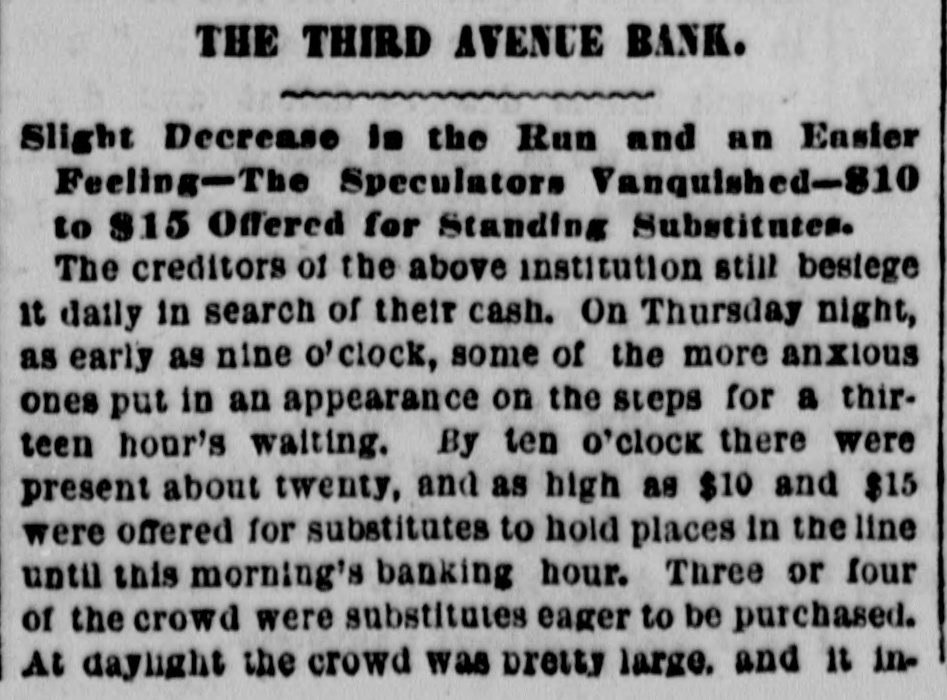
THE THIRD AVENUE BANK. Slight Decrease is the Run and an Easler Feeling-The Speculators Vanquished-810 to $15 Offered for Standing Substitntes. The creditors of the above institution still bestege it daily in search of their cash. On Thursday night, as early as nine o'clock, some of the more anxious ones put in an appearance on the steps for a thirteen hour's waiting. By ten o'clock there were present about twenty, and as high as $10 and $15 were offered for substitutes to hold places in the line until this morning's banking hour. Three or four of the crowd were substitutes eager to be purchased. At daylight the crowd was pretty large. and it in-


Article from The New York Herald, December 28, 1875

Click image to open full size in new tab

Article Text

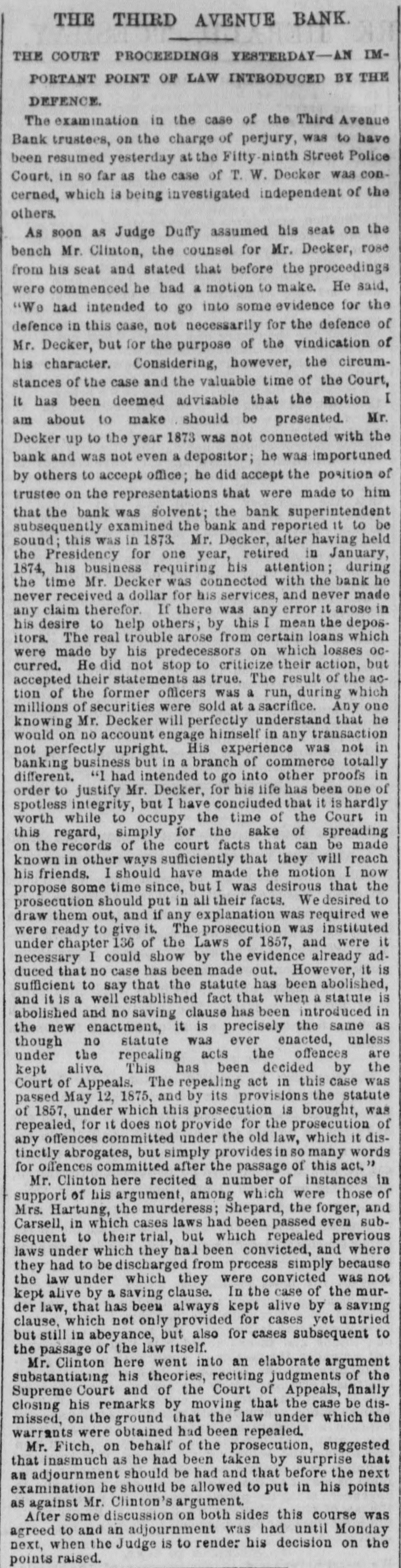
THE THIRD AVENUE BANK. THE COURT PROCEEDINGS YESTERDAY-AN IMPORTANT POINT OF LAW INTRODUCED BY THE DEFENCE. The examination in the case of the Third Avenue Bank trustees, on the charge of perjury, was to have been resumed yesterday at the Fitty-ninth Street Police Court, in so far as the case of T. W. Decker was concerned, which is being investigated independent of the others. As soon as Judge Duffy assumed his seat on the bench Mr. Clinton, the counsel for Mr. Decker, rose from his seat and stated that before the proceedings were commenced he had a motion to make. He said, "We had intended to go into some evidence for the defence in this case, not necessarily for the defence of Mr. Decker, but for the purpose of the vindication of his character. Considering, however, the circumstances of the case and the valuable time of the Court, it has been deemed advisable that the motion I am about to make should be presented. Mr. Decker up to the year 1873 was not connected with the bank and was not even a depositor; he was importuned by others to accept office; he did accept the position of trustee on the representations that were made to him that the bank was solvent: the bank superintendent subsequently examined the bank and reported it to be sound; this was in 1873. Mr. Decker, after having held the Presidency for one year, retired in January, 1874, his business requiring his attention; during the time Mr. Decker was connected with the bank he never received a dollar for his services, and never made any claim therefor. If there was any error it arose in his desire to help others; by this I mean the depositors. The real trouble arose from certain loans which were made by his predecessors on which losses occurred. He did not stop to criticize their action, but accepted their statements as true. The result of the action of the former officers was a run, during which millions of securities were sold at a sacrifice. Any one knowing Mr. Decker will perfectly understand that he would on no account engage himself in any transaction not perfectly upright. His experience was not in banking business but in a branch of commerce totally different. "I had intended to go into other proofs in order to justify Mr. Decker, for his life has been one of spotless integrity, but I have concluded that it is hardly worth while to occupy the time of the Court in this regard, simply for the sake of spreading on the records of the court facts that can be made known in other ways sufficiently that they will reach his friends. I should have made the motion I now propose some time since, but I was desirous that the prosecution should put in all their facts. We desired to draw them out, and if any explanation was required we were ready to give it. The prosecution was instituted under chapter 136 of the Laws of 1857, and were it necessary I could show by the evidence already adis duced that no case has been made out. However, it sufficient to say that the statute has been abolished, and it is a well established fact that when a statute is abolished and no saving clause has been introduced in the new enactment, it is precisely the same as though no statute was ever enacted, unless under the repealing acts the offences are kept alive. This has been decided by the Court of Appeals. The repealing act in this case was passed May 12, 1875, and by its provisions the statute of 1857, under which this prosecution is brought, was repealed, for it does not provide for the prosecution of any offences committed under the old law, which it distinctly abrogates, but simply provides in so many words for offences committed after the passage of this act." Mr. Clinton here recited a number of instances in support of his argument, among which were those of Mrs. Hartung, the murderess; Shepard, the forger, and Carsell, in which cases laws had been passed even subsequent to their trial, but which repealed previous laws under which they hal been convicted, and where they had to be discharged from process simply because the law under which they were convicted was not kept alive by a saving clause. In the case of the murder law, that has been always kept alive by a saving clause, which not only provided for cases yet untried but still in abeyance, but also for cases subsequent to the passage of the law itself. Mr. Clinton here went into an elaborate argument substantiating his theories, reciting judgments of the Supreme Court and of the Court of Appeals, finally closing his remarks by moving that the case be dismissed, on the ground that the law under which the warrants were obtained had been repealed. Mr. Fitch, on behalf of the prosecution, suggested that inasmuch as he had been taken by surprise that an adjournment should be had and that before the next examination he should be allowed to put in his points as against Mr. Clinton's argument. After some discussion on both sides this course was agreed to and an adjournment was had until Monday next, when the Judge is to render his decision on the points raised.