16598. Philadelphia Bank (Philadelphia, PA)

Bank Information

Episode Type
Run Only
Bank Type
state
Start Date
January 31, 1842
Location
Philadelphia, Pennsylvania (39.952, -75.164)

Metadata

Model
gpt-5-mini
Short Digest
7164e122fc339e9e

Response Measures

None

Description

Newspaper accounts in early 1842 report a run on the Philadelphia Bank (31 Jan reference) but the bank continued redeeming notes and by mid-March (Mar 18) was among the banks that resumed/specie payments. Several neighboring banks did suspend/close, but Philadelphia Bank stayed open and paid specie.

Events (2)

1. January 31, 1842 Run
Cause
Local Banks
Cause Details
Run followed actions against the Bank of Pennsylvania and runs on neighboring banks (failure/injunction against Bank of Pennsylvania led to contagion and depositors testing other banks).
Measures
Redeemed notes through the day (until closing hour), paid out specie to depositors; officers met with other banks to coordinate arrangements.
Newspaper Excerpt
There is great trouble among the banks at Philadelphia. A run was made on the Philadelphia Bank on the 31st ult... The crowd was immense but no disturbance took place. They redeemed their notes mostly in Moyamensing.
Source
newspapers
2. March 18, 1842 Other
Newspaper Excerpt
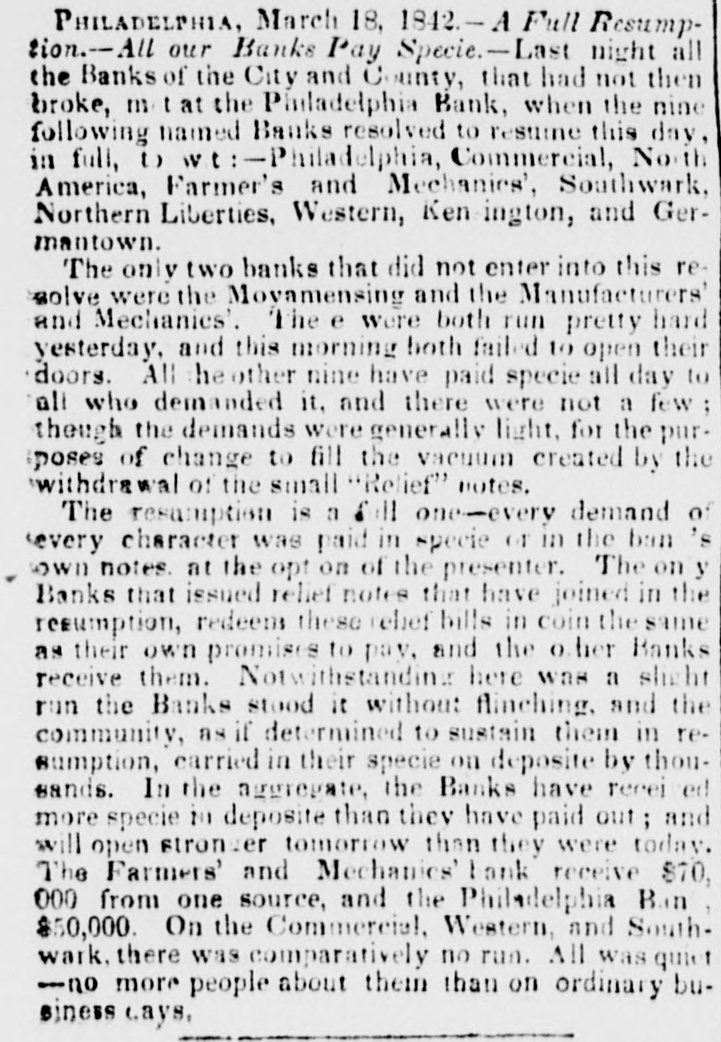
All the Banks of the City and County... resolved to resume this day, in full... Philadelphia ... paid specie all day to all who demanded it. The Philadelphia Bank received on deposit yesterday a larger amount of specie than it paid out.
Source
newspapers

Newspaper Articles (11)

Article from Richmond Enquirer, February 16, 1841

Click image to open full size in new tab

Article Text

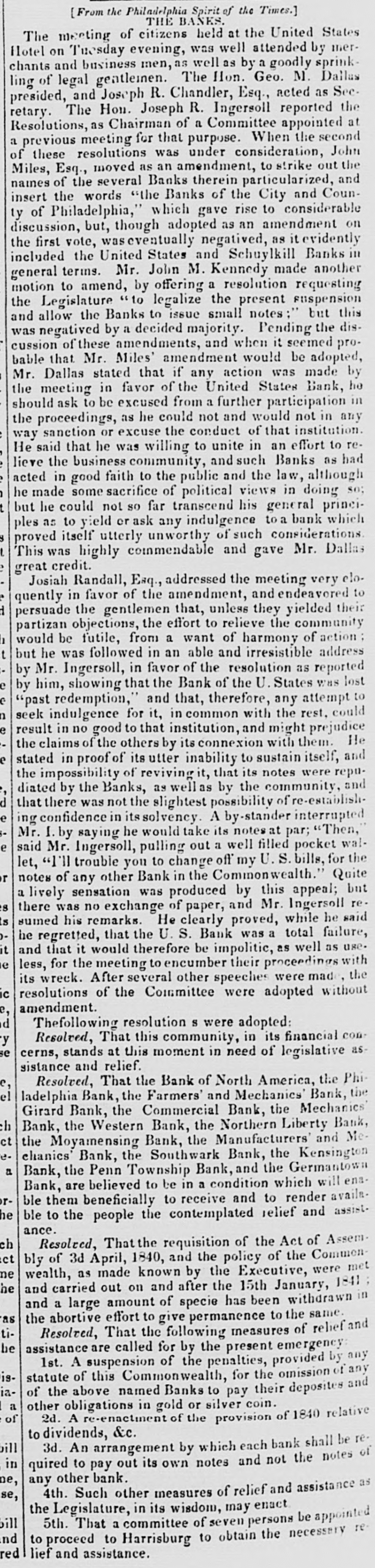
# THE BANKS. The meeting of citizens held at the United States Hotel on Tuesday evening, was well attended by merchants and business men, as well as by a goodly sprinkling of legal gentleinen. The Hon. Geo. M. Dallus presided, and Joseph R. Chandler, Esq., acted as Secretary. The Hon. Joseph R. Ingersoll reported the Resolutions, as Chairman of a Committee appointed at a previous meeting for that purpose. When the second of these resolutions was under consideration, John Miles, Esq., moved as an amendment, to strike out the names of the several Banks therein particularized, and insert the words "the Banks of the City and County of Philadelphia," which gave rise to considerable discussion, but, though adopted as an amendment on the first vote, was eventually negatived, as it evidently included the United States and Schuylkill Banks in general terms. Mr. John M. Kennedy made another motion to amend, by offering a resolution requesting the Legislature "to legalize the present suspension and allow the Banks to issue small notes;" but this was negatived by a decided majority. Pending the discussion of these amendments, and when it seemed probable that Mr. Miles' amendment would be adopted, Mr. Dallas stated that if any action was made by the meeting in favor of the United States Bank, he should ask to be excused from a further participation in the proceedings, as he could not and would not in any way sanction or excuse the conduct of that institution. He said that he was willing to unite in an effort to relieve the business community, and such Banks as had acted in good faith to the public and the law, although he made some sacrifice of political views in doing so; but he could not so far transcend his general princi-ples as to yield or ask any indulgence to a bank which proved itself utterly unworthy of such considerations. This was highly commendable and gave Mr. Dallas great credit. Josiah Randall, Esq., addressed the meeting very eloquently in favor of the amendment, and endeavored to persuade the gentlemen that, unless they yielded their partizan objections, the effort to relieve the community would be futile, from a want of harmony of action; but he was followed in an able and irresistible address by Mr. Ingersoll, in favor of the resolution as reported by him, showing that the Bank of the U. States was lost "past redemption," and that, therefore, any attempt to seek indulgence for it, in common with the rest, could result in no good to that institution, and might prejudice the claims of the others by its connexion with them. He stated in proof of its utter inability to sustain itself, and the impossibility of reviving it, that its notes were repudiated by the Banks, as well as by the community, and that there was not the slightest possibility of re-establishing confidence in its solvency. A by-stander interrupted Mr. I. by saying he would take its notes at par; "Then, said Mr. Ingersoll, pulling out a well filled pocket wallet, "I'll trouble you to change off my U. S. bills, for the notes of any other Bank in the Commonwealth." Quite a lively sensation was produced by this appeal; but there was no exchange of paper, and Mr. Ingersoll resumed his remarks. He clearly proved, while he said he regretted, that the U. S. Bank was a total failure, and that it would therefore be impolitic, as well as useless, for the meeting to encumber their proceedings with its wreck. After several other speeches were made, the resolutions of the Committee were adopted without amendment. Thefollowing resolution s were adopted: Resolved, That this community, in its financial concerns, stands at this moment in need of legislative assistance and relief. Resolved, That the Bank of North America, the Philadelphia Bank, the Farmers' and Mechanics' Bank, the Girard Bank, the Commercial Bank, the Mechanics' Bank, the Western Bank, the Northern Liberty Bank, the Moyamensing Bank, the Manufacturers' and Mechanics' Bank, the Southwark Bank, the Kensington Bank, the Penn Township Bank, and the Germantown Bank, are believed to be in a condition which will enable them beneficially to receive and to render available to the people the contemplated relief and assistance. Resolred, That the requisition of the Act of Assembly of 3d April, 1840, and the policy of the Commonwealth, as made known by the Executive, were met and carried out on and after the 15th January, 1841; and a large amount of specie has been withdrawn in the abortive effort to give permanence to the same. Resolved, That the following measures of relief and assistance are called for by the present emergency: 1st. A suspension of the penalties, provided by any statute of this Commonwealth, for the omission of any of the above named Banks to pay their deposites and other obligations in gold or silver coin. 2d. A re-enactment of the provision of 1840 relative to dividends, &c. 3d. An arrangement by which each bank shall be required to pay out its own notes and not the notes of any other bank. 4th. Such other measures of relief and assistance as the Legislature, in its wisdom, may enact 5th. That a committee of seven persons be appointed to proceed to Harrisburg to obtain the necessary relief and assistance.
Article from Richmond Enquirer, February 16, 1841

Click image to open full size in new tab

Article Text

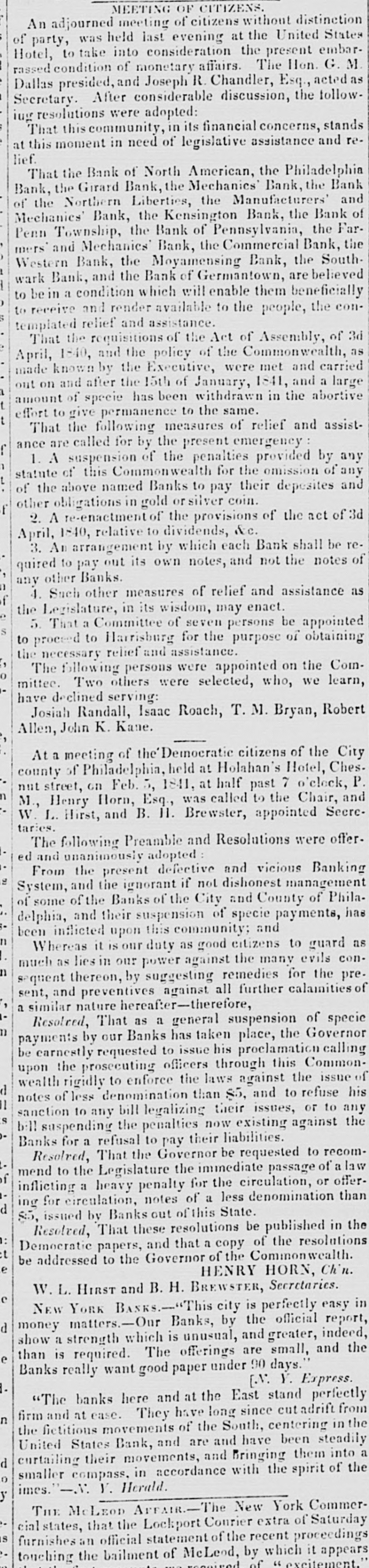
MEETING OF CITIZENS. An adjourned meeting of citizens without distinction of party, was held last evening at the United States Hotel, to take into consideration the present embarrassed condition of monetary affairs. The Hon. G.M. Dallas presided, and Joseph R. Chandler, Esq., acted Secretary. After considerable discussion, the following resolutions were adopted: That this community, in its financial concerns, stands at this moment in need of legislative assistance and relief. That the Bank of North American, the Philadelphia Bank, the Girard Bank, the Mechanics Bank, the Bank of the Northern Liberties, the Manufacturers' and Mechanics' Bank, the Kensington Bank, the Bank of Penn Township, the Bank of Pennsylvania, the Farmers and Mechanics Bank, the Commercial Bank, the Western Bank, the Moyamensing Bank, the South. wark Bank, and the Bank of Germantown, are believed to be in a condition which will enable them beneficially to receive and render available to the people, the contemplated relief and assistance. That the requisitions of the Act of Assembly, of 3d April, 1840, and the policy of the Commonwealth, as made known by the Executive, were met and carried out on and after the 15th of January, 1841, and a large amount of specie has been withdrawn in the abortive effort to give permanence to the same. That the following measures of relief and assistance are called for by the present emergency 1. A suspension of the penalties provided by any statute of this Commonwealth for the omission of any of the above named Banks to pay their deposites and other obligations in gold or silver coin. f 2. A re-enactment of the provisions of the act of 3d April, 1840, relative to dividends, &c. 3. An arrangement by which each Bank shall be required to pay out its own notes, and not the notes of any other Banks. a 4. Such other measures of relief and assistance as if the Legislature, in its wisdom, may enact. 5. That a Committee of seven persons be appointed to proceed to Harrisburg for the purpose of obtaining the necessary relief and assistance. The following persons were appointed on the Committee. Two others were selected, who, we learn, have declined serving: Josiah Randall, Isaac Roach, T. M. Bryan, Robert Allen, John K. Kane. At a meeting of the Democratic citizens of the City county of Philadelphia, held at Holahan's Hotel, Ches. nut street, on Feb. D, 1841, at half past 7 o cleck, P. M., Henry Florn, Esq., was called to the Chair, and W. L. Hirst, and B. 11. Brewster, appointed Secretaries. The following Preamble and Resolutions were offered and unanimously adopted From the present defective and vicious Banking System, and the ignorant if not dishonest management of some of the Banks of the City and County of Philadelphia, and their suspension of specie payments, has been inflicted upon this community; and Whereas it is our duty as good citizens to guard as much as lies in our power against the many evils consequent thereon, by suggesting remedies for the present, and preventives against all further calamities of a similar nature hereafter-therefore, Resolred, That as a general suspension of specie payments by our Banks has taken place, the Governor be earnestly requested to issue his proclamation calling upon the prosecuting officers through this Commonwealth rigidly to enforce the laws against the issue d notes of less denomination than $5, and to refuse his 11 sanction to any bill legalizing their issues, or to any s bill suspending the penalties now existing against the Banks for a refusal to pay their liabilities. Resolred, That the Governor be requested to recommend to the Legislature the immediate passage of a law f inflicting a heavy penalty for the circulation, or offering for circulation, notes of a less denomination than $5, issued by Banks out fithis State. Resolved, That these resolutions be published in the Democratic papers, and that a copy of the resolutions t be addressed to the Governor of the Commonwealth. e HENRY HORN, Chin. W. L. HIRST and B. H. BREWSTER, Secretaries. NEW YORK BASKS.-"This city is perfectly easy in money matters.-Our Banks, by the official report, d show a strength which is unusual, and greater, indeed, than is required. The offerings are small, and the Banks really want good paper under 90 days. [.N" Y. Express. "The banks here and at the East stand perfectly firm and at ease. They have long since cut adrift from In the fictitious movements of the South, centering in the United States Bank, and are and have been steadily curtailing their movements, and Bringing them into a d smaller compass. in accordance with the spirit of the o times."- Y. Herald. y THE McLEOP AFFAIR.-The New York Commercialstates, that the Lockport Courier extra of Saturday is furnishes an official statement of the recent proceedings touching the bailment of McLeod, by which it appears of " excitement.

Article from The New York Herald, January 22, 1842

Click image to open full size in new tab

Article Text

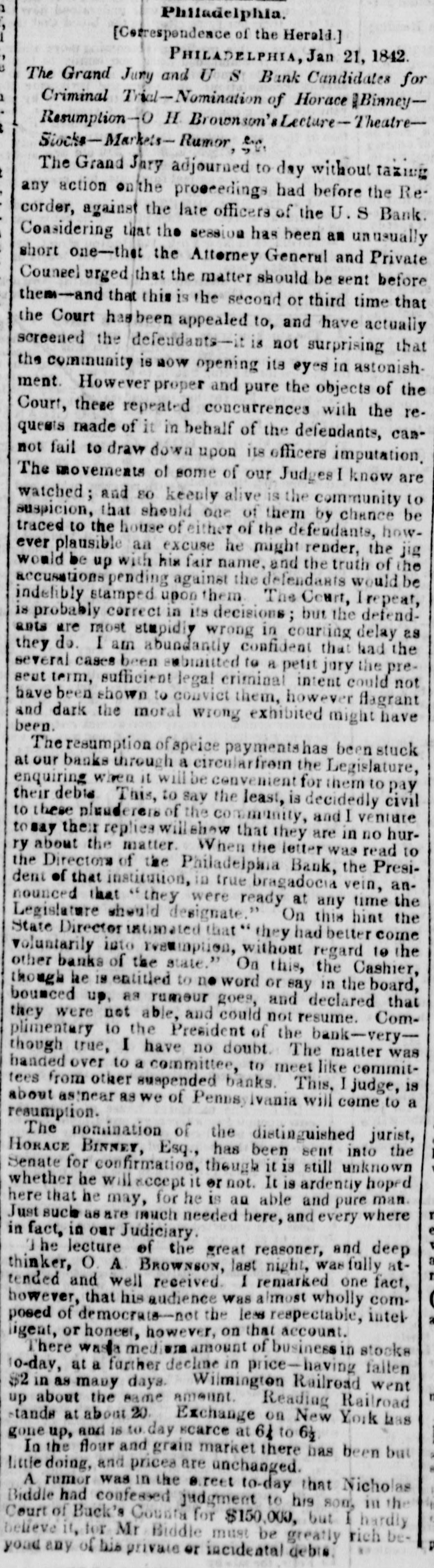
1 Philadelphia. i [Cerrespendence of the Herald.] , PHILADELPHIA, Jan 21, 1842 u The Grand Juny and U S Bank Candidates for 1 Criminal Trial--Nomination of Horace BinneyResumption-0 H Brownson'sLecture-Theatret Stocks-Markets-Rumor e.g. t The Grand Jary adjourned to day without taxing any action on the proceedings had before the Recorder, against the late officers of the U.S Bank. Considering that the session has been an unusually short one-that the Attorney General and Private Councelurged that the matter should be sent before them--and that this is the second or third time that the Court has been appealed to, and have actually screened the defendants-it is not surprising that the community is NOW opening its eyes in astonishment. However proper and pure the objects of the Court, these repeated concurrences with the requests made of it in behalf of the defendants, cannot fail to draw dowa upon its efficers imputation. The movements of some of our Judges I know are watched; and so keeply alive is the community to suspicion, that should one of them by chance be traced to the house of either of the defendants, however plausible aa excuse he might render, the jig would be up with his fair name, and the truth of the accusations pending against the defendants would be indefibly stamped upon them The Court, Irepeat, is probably correct in its decisions; but the defendants are most stapidly wrong in couring delay as they do. I am abundantly confident that had the several cases been submitted to a petit jury the preseut term, sufficient legal criminal intent could not have been shown to convict them, however flagrant and dark the moral wrong exhibited might have been. The resumption of apeice paymentshas been stuck at our banks through a circularfrem the Legislature, enquiring when it will be convenient for them to pay their debie This, to say the least, is decidedly civil to these phone relo of the community, and I venture to say their replies will show that they are in no hurry about the matter. When the letter was read to the Directors of the Philadelpina Bank, the President of that institution, in true bragadocia vein, announced that " they were ready at any time the Legislature should designate." On this hint the State Director internated that they had better come voluntarily into resumption, without regard to the other banks of the state." On this, the Cashier, though he is entitled to no word or say in the board, bounced up, as rumour goes, and declared that they were not able, and could not resume. Complimentary to the President of the bank-very-though true, I have no doubt. The matter was handed over to a committee, to meet like committees from other suspended banks. This, I judge, is about as'near as we of Pennsy Ivania will come to a resumption. The nomination of the distinguished jurist, HORACE BINNEY, Esq., has been sent into the Senate for confirmation, though it is still unknown whether he will accept it or not. It is ardently hoped here that he may, for he is ao able and pure man. Just such as are much needed here, and every where in fact, in our Judiciary The lecture of the great reasoner, and deep thinker, O. A BROWNSON, last night, was fully attended and well received I remarked one fact, however, that his audience was almost wholly composed of democrate-not less respectable, intelligent, or honcer, however, on that account. There wask med. and amount of business in stocks 10-day, at a further declane in price-having fallen $2 in as many days. Wilmington Railroad went up about the same amount. Reading Railroad tands at about 20. Exchange on New York lass gone up, and 18 to day scarce at 61 to 61 In the flour and grain market there has been but little doing, and prices are unchanged. A rumor was in the e.reet to-day that Nicholas Biddle had confessed judgment to his son, in the for believe Court of it, Back's for Mr Counta $150,000, but I hardly Biddle must be greatly rich beyoad any of his private or incidental debts


Article from The Cecil Whig, February 5, 1842

Click image to open full size in new tab

Article Text

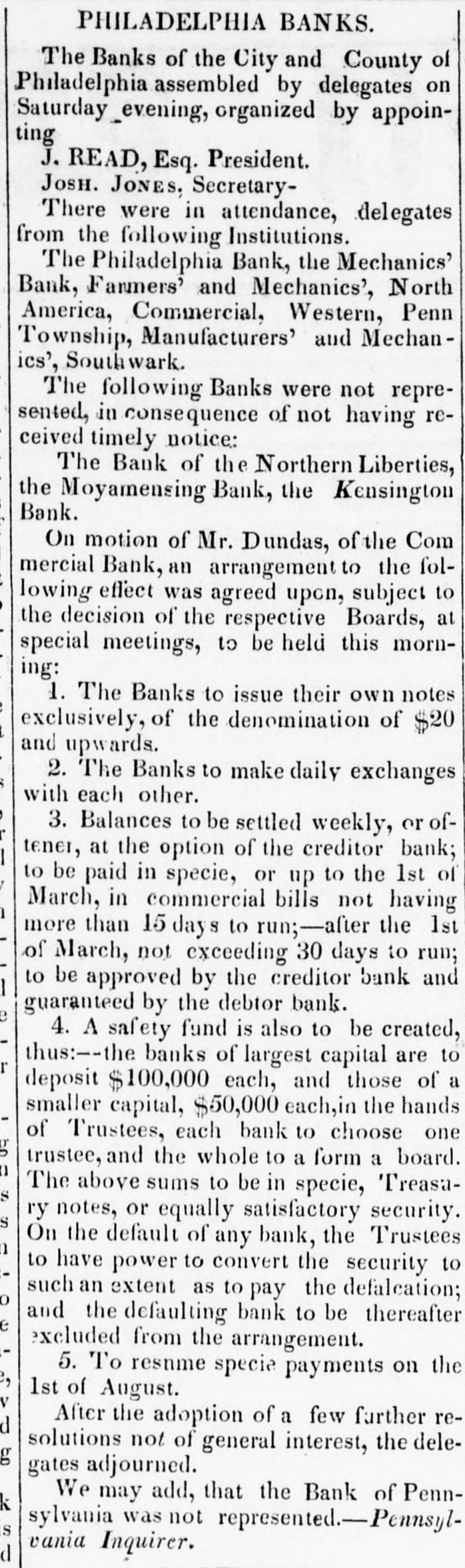
PHILADELPHIA BANKS. The Banks of the City and County of Philadelphia assembled by delegates on Saturday evening, organized by appointing J. READ, Esq. President. JOSH. JONES, SecretaryThere were in attendance, delegates from the following Institutions. The Philadelphia Bank, the Mechanics' Bank, Farmers' and Mechanics', North America, Commercial, Western, Penn Township, Manufacturers' and Mechan ics', Southwark. The following Banks were not represented, in consequence of not having received timely notice: The Bank of the Northern Liberties, the Moyamensing Bank, the Kensington Bank. On motion of Mr. Dundas, of the Com mercial Bank, an arrangement to the following effect was agreed upon, subject to the decision of the respective Boards, at special meetings, to be held this morning: 1. The Banks to issue their own notes exclusively, of the denomination of $20 and upwards. 2. The Banks to make daily exchanges with each other. 3. Balances to be settled weekly, or oftener, at the option of the creditor bank; to be paid in specie, or up to the 1st of March, in commercial bills not having more than 15 days to run;-after the 1st of March, not exceeding 30 days to run; to be approved by the creditor bank and guaranteed by the debtor bank. 4. A safety fund is also to be created, are to a deposit thus:--the $100,000 banks of each, largest and capital those of smaller capital, $50,000 each, in the hands of Trustees, each bank to choose one trustee, and the whole to a form a board. The above sums to be in specie, Treasary notes, or equally satisfactory security. On the default of any bank, the Trustees to have power to convert the security to such an extent as to pay the defalcation; and the defaulting bank to be thereafter excluded from the arrangement. 5. To resnme special payments on the 1st of August. After the adoption of a few further resolutions not of general interest, the delegates adjourned. We may add, that the Bank of Pennsylvania was not represented.-Pennsylvania Inquirer.


Article from Lexington Union, February 26, 1842

Click image to open full size in new tab

Article Text

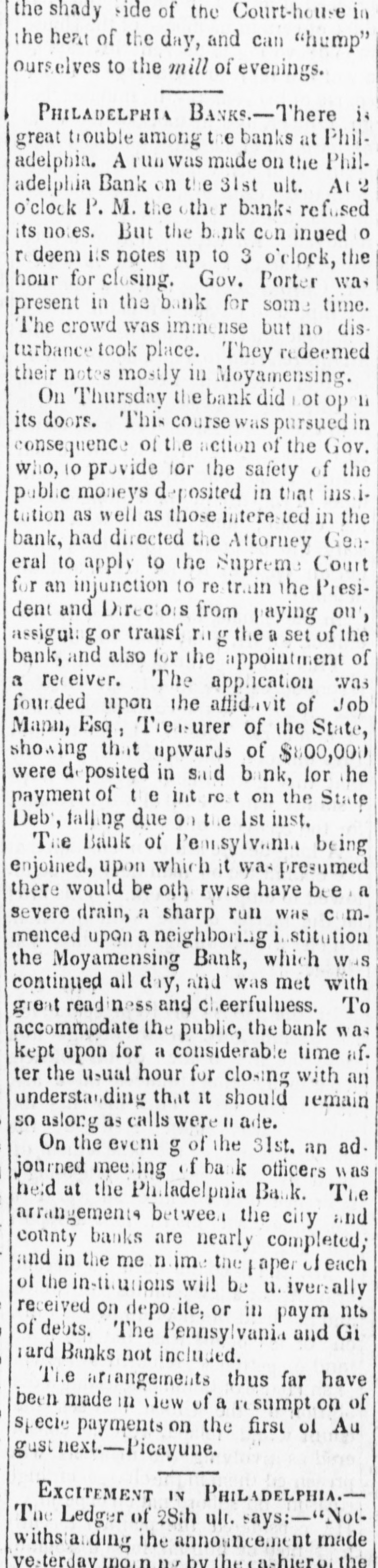
the shady side of the Court-house in the heart of the day, and can "hump" ourselves to the mill of evenings. PHILADELPHIA BANKS.-T'here is great trouble among the banks at Philadelphia. A runwas made on the Philadelphia Bank on the 31st ult. A12 o'clock P. M. the other bank refused its notes. But the b. nk con inued o r deem its notes up to 3 o'clock, the hour for closing. Gov. Porter was present in the bank for some time. The crowd was immense but no disturbance took place. They redeemed their notes mostly in Moyamensing. On Thursday the bank did Lot op 11 its doors. This course was pursued in consequence of the action of the Gov. who, 10 provide for the safety of the public moneys d posited in that ins.i. tation as well as those interes ted in the bank, had directed the Attorney General to apply to the Supreme Court for an injunction to train the President and Directors from paying ou, assiguia gor transf rig the a set of the bank, and also for the appointment of a receiver. The application was founded upon the affid vit of Job Mann, Esq, Tiesurer of the State, showing that upwards of $800,000 were d. posited in said bank, for he payment of the int rest on the State Deb, falling due On the 1st inst. The Bank of Pentsylvania being enjoined, upon which it was presumed there would be oth rwise have bee severe drain, a sharp run was commenced upon a neighboring i. stitution the Moyamensing Bank, which was continued all day, and was met with great readiness and cleerfulness. To accommodate the public, the bank was kept upon for a considerable time af. ter the usual hour for closing with an understanding that it should remain so aslorg as calls were 11 ade. On the eveni g of the 31st. an adjourned mee ing of ba k officers was held at the Philadelpnia Bank. The arrangements between the city and county banks are nearly completed; and in the me n im the papertfeach of the in-titutions will be u. liverially received on depo ite, or in paym nts of debts. The Pennsylvania and Gi rard Banks not included. Tie arrangements thus far have been made III view of a resumpt on of specie payments on the first of Au ust next.-Picayune. EXCITEMENT IN PHILADELPHIA.The Ledger of 28th ult. says:-"Notwithstanding the announcement made ve-terday by the a-hiere


Article from The New York Herald, March 12, 1842

Click image to open full size in new tab

Article Text

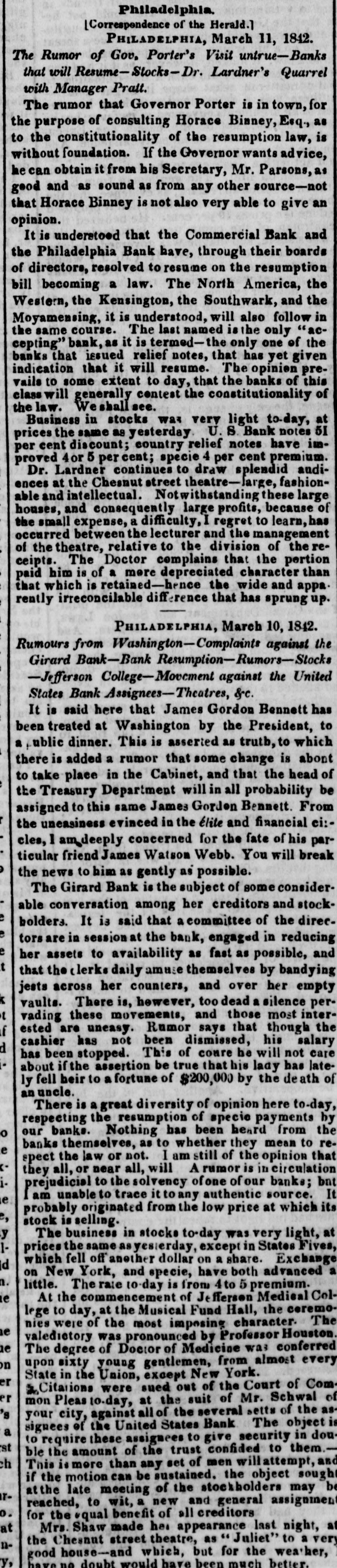
Philadelphia. [Correspondence of the Herald.] PHILADELPHIA, March 11, 1842. The Rumor of Gov, Porter's Visit untrue-Banks that will Resume-Stocks-Dr. Lardner's Quarrel with Manager Pratt. The rumor that Governor Porter is in town, for the purpose of consulting Horace Binney, Esq., as to the constitutionality of the resumption law, is without foundation. If the Governor wants advice, he can obtain it from his Secretary, Mr. Parsons, good and as sound as from any other source-not that Horace Binney is not also very able to give an opinion. It is understood that the Commercial Bank and the Philadelphia Bank have, through their boards of directors, resolved to resume on the resumption bill becoming a law. The North America, the Western, the Kensington, the Southwark, and the Moyamensing, it is understood, will also follow in the same course. The last named is the only "accepting" bank, as it is termed-the only one of the banks that issued relief notes, that has yet given indication that it will resume. The opinion prevails to some extent to day, that the banks of this class will generally contest the constitutionality of the law. Weshallsee. Business in stocks was very light today, at prices the same as yesterday. U. S. Bank notes 51 per cent discount; country relief notes have improved 4or 5 per cent; specie 4 per cent premium. Dr. Lardner continues to draw splendid audiences at the Chesnut street theatre-Jarge, fashionable and intellectual. Notwithstanding these large houses, and consequently large profits, because of the small expense, a difficulty, I regret to learn, has occurred between the lecturer and the management of the theatre, relative to the division of the receipts. The Doctor complains that the portion paid him is of a more depreciated character than that which is retained-hence the wide and apparently irreconcilable difference that has sprung up. PHILADELPHIA, March 10, 1842. Rumours from Washington-Complaints against the Girard Bank-Bank Resumption-Rumors-Stocks -Jefferson College-Movement against the United States Bank Assignees-Theatres, &c. It is said here that James Gordon Bennett has been treated at Washington by the President, to ublic dinner. This is asserted as truth, to which there is added a rumor that some change is about to take place in the Cabinet, and that the head of the Treasury Department will in all probability be assigned to this same James Gordon Bennett. From the uneasiness evinced in the elite and financial ci:cles, 1 am deeply concerned for the fate of his particular friend James Watson Webb. You will break the news to him as gently as possible. The Girard Bank is the subject of some considerable conversation among her creditors and stockbolders. It is said that a committee of the direc. torsarein sessionat the bank, engaged in reducing e her assets to availability as fast as possible, and t that the lerks daily amuse themselves by bandying jests across her counters, and over her empty k vaults. There is, however, too dead a silence pert vading these movements, and those most interested are uneasy. Rumor says that though the If cashier has not been dismissed, his salary d has been stopped. This of coure he will not care about if the assertion be true that his laay has lately fell heir to a fortune of $200,000 by the death of an uncle. There is a great diversity of opinion here to-day, respecting the resumption of specie payments by O our banks. Nothing has been heard from the banks themselves, as to whether they mean to ree spect the law or not. I am still of the opinion that kthey all, or near all, will A rumor is in circulation i. prejudicial to the solvency of one of our banks; bnt am unable to trace it to any authentic source. It e probably originated from the low price at which its e, stock is selling. y The business in stocks to-day was very light, at 1prices the same as yesterday, except in States Fives, which fell off another dollar on a share. Exchange d on New York, and specie, have both advanced h. little. The rate day is from to 5 premium. e At the commencement of Jeffersen Medical Cel lege to day, at the Musical Fund Hall, the ceremonies were of the most imposing character. The e valedictory was pronounced by Professor Houston he The degree of Doctor of Medicine was conferred upon sixty young gentlemen, from almost every on State in the Union, except New York. er Citations were sued out of the Court of Com er mon Pleas to-day, at the suit of Mr. Schwal of 's your city, against all of the several setts of the assignees of the United States Bank The object a to require these assignees to give security in doust ble the amount of the trust confided to them. ch This is more than any set of men will attempt, and if the motion can be sustained. the object sought at the late meeting of the stockholders may be rreached, to wit, a new and general assignment 0. for the equal benefit of all creditors at Mrs. Shaw made her appearance last night, the Chesnut street theatre, as Juliet" to a very ngood house--and which, but for the weather, y, haver doubt would have been much better.


Article from Daily Richmond Whig, March 19, 1842

Click image to open full size in new tab

Article Text

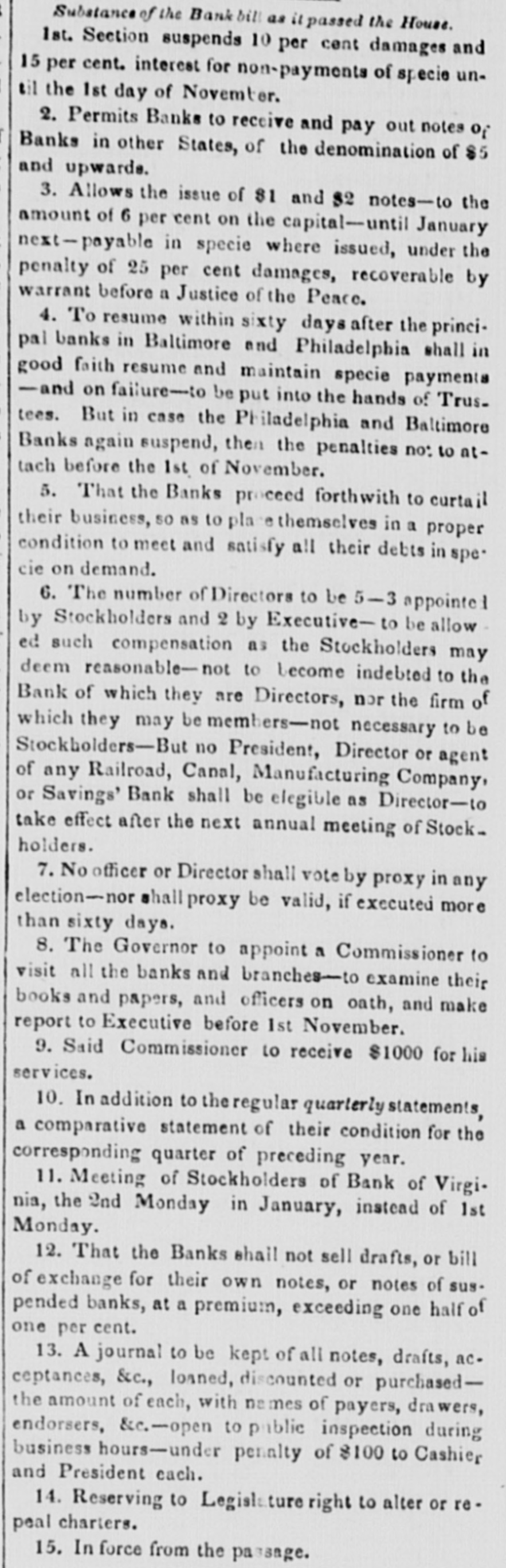
Substance of the Bank bill as it passed the House. 1st. Section suspends 10 per cent damages and 15 per cent. interest for non-payments of specie until the 1st day of Novemter. 2. Permits Banks to receive and pay out notes of Banks in other States, of the denomination of 85 and upwards. 3. Allows the issue of 81 and $2 notes-to the amount of 6 per cent on the capital-un January next-payable in specie where issued, under the penalty of 25 per cent damages, recoverable by warrant before a Justice of the Peace. resume after the 4. banks To in within sixty days principal Baltimore and Philadelphia shall in good faith resume and maintain specie payments -and on failure-to be put into the hands of Trus. tees. But in case the Philadelphia and Baltimore Banks again suspend, then the penalties no: to attach before the 1st of November. 5. That the Banks proceed forthwith to curtail their business, so as to place themselves in a proper condition to meet and satisfy all their debts in spe* cie on demand. 6. The number of Directors to be 5-3 appointe by Stockholders and 2 by Executive- to be allow ed such compensation as the Stockholders may deem reasonable-not to become indebted to the Bank of which they are Directors, nor the firm of which they may be members-not necessary to be no Director or of any Stockholders-But Railroad, Canal, President, Manufacturing Company, agent or Savings' Bank shall be elegible as Director-to take effect after the next annual meeting of Stock. holders. 7. No officer or Director shall vote by proxy in any election-nor shall proxy be valid, if executed more than sixty days. 8. The Governor to appoint a Commissioner to visit all the banks and branches-to examine their books and papers, and officers on oath, and make report to Executive before 1st November. 9. Said Commissioner to receive $1000 for his services. 10. In addition to the regular quarterly statements, a comparative statement of their condition for the corresponding quarter of preceding year. 11. Meeting of Stockholders of Bank of Virginia, the 2nd Monday in January, instead of 1st Monday. 12. That the Banks shall not sell drafts, or bill of exchange for their own notes, or notes of suspended banks, at a premium, exceeding one half of one per cent. 13. A journal to be kept of all notes, drafts, acceptances, &c., loaned, discounted or purchasedthe amount of each, with names of payers, drawers, endorsers, &c.-open to public inspection during business hours-under penalty of 8100 to Cashier and President each. 14. Reserving to Legislature right to alter or repeal charters. 15. In force from the passage.


Article from Lynchburg Virginian, March 24, 1842

Click image to open full size in new tab

Article Text

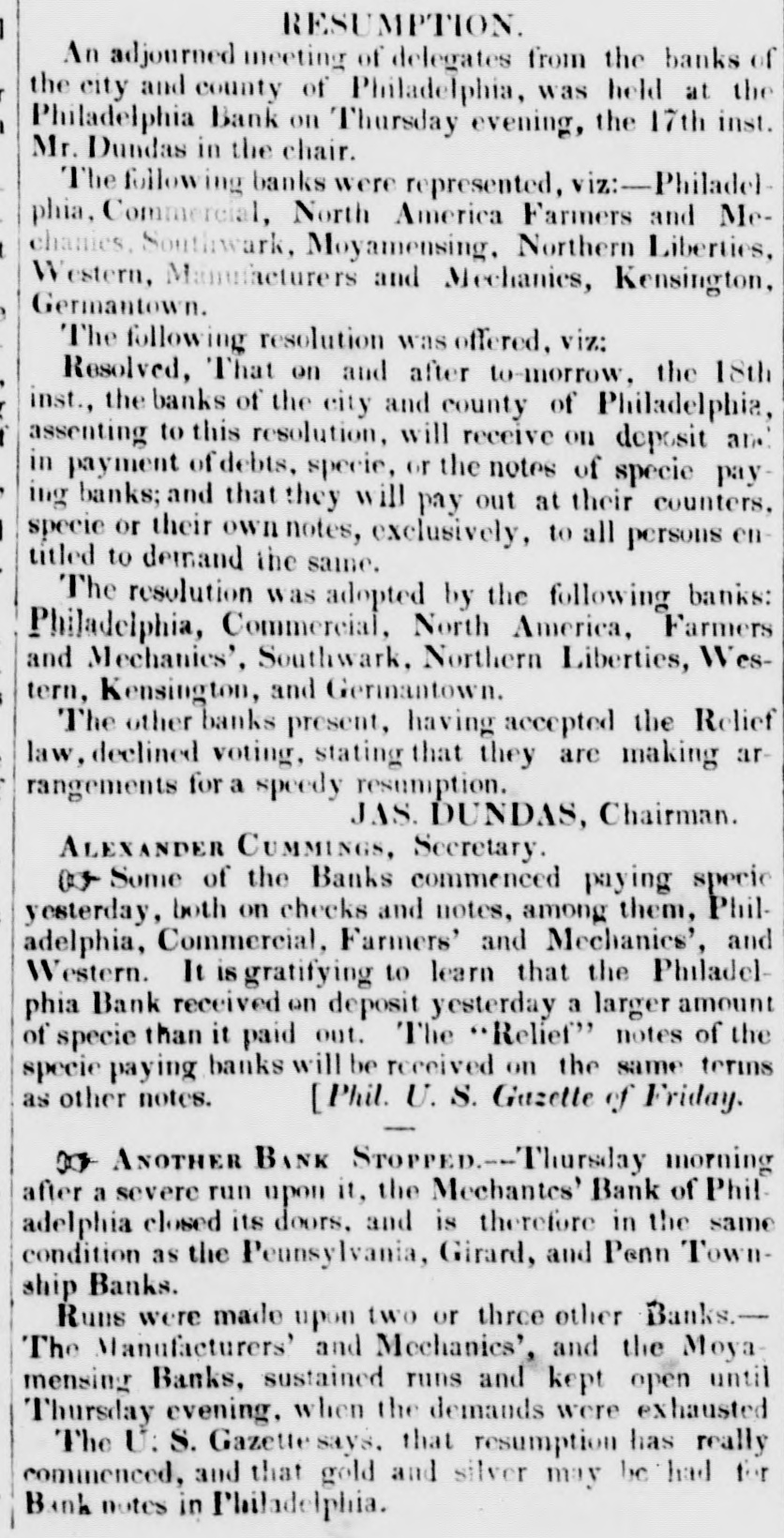
RESUMPTION. An adjourned meeting of delegates from the banks of the city and county of Philadelphia, was held at the Philadelphia Bank on Thursday evening, the 17th inst. Mr. Dundas in the chair. The following banks were represented, viz:-Philadelphia, Commercial, North America Farmers and Mechanics, Southwark, Moyamensing. Northern Liberties, Western, Manufacturers and Mechanics, Kensington, Germantown. The following resolution was offered, viz: Resolved, That on and after to-morrow, the 18th inst., the banks of the city and county of Philadelphia, assenting to this resolution, will receive on deposit an. in payment of debts, specie, or the notes of specie paying banks; and that they will pay out at their counters, specie or their own notes, exclusively, to all persons entitled to demand the same. The resolution was adopted by the following banks: Philadelphia, Commercial, North America, Farmers and Mechanics', Southwark, Northern Liberties, Western, Kensington, and Germantown. The other banks present, having accepted the Relief law, declined voting, stating that they are making arrangements for a speedy resumption. JAS. DUNDAS, Chairman. ALEXANDER CUMMINGS, Secretary. at Some of the Banks commenced paying specie yesterday, both on checks and notes, among them, Philadelphia, Commercial, Farmers' and Mechanics', and Western. It is gratifying to learn that the Philadelphia Bank received on deposit yesterday a larger amount of specie than it paid out. The "Relief" notes of the specie paying banks will be received on the same terms as other notes. [Phil. U.S. Guzette of Friday. 00 ANOTHER BANK STOPPED. -Thursday morning after a severe run upon it, the Mechantes' Bank of Philadelphia closed its doors. and is therefore in the same condition as the Pennsylvania, Girard, and Penn Township Banks. Runs were made upon two or three other Banks.The Manufacturers' and Mechanics', and the Moyamensing Banks, sustained runs and kept open until Thursday evening. when the demands were exhausted The U. S. Gazette says. that resumption has really commenced, and that gold and silver may be had for Bank notes in Philadelphia.


Article from Burlington Free Press, March 25, 1842

Click image to open full size in new tab

Article Text

PHILADELPHIA, March 18, 1842. - A Full Resumption.--All our Banks Pay Specie.-Last night all the Banks of the City and County, that had not then broke, met at the Philadelphia Bank, when the nine following named Banks resolved to resume this day, in full, 1) wt :-Philadelphia, Commercial, North America, Farmer's and Mechanics', Southwark, Northern Liberties, Western, Ken ington, and Germantown. The only two banks that did not enter into this resolve were the Moyamensing and the Manufacturers' and Mechanics'. The e were both run pretty hard yesterday, and this morning both failed to open their doors. All he other nine have paid specie all day to all who demanded it, and there were not a few though the demands were generally light. for the purposes of change to fill the vacuum created by the withdrawal of the small "Relief" notes. The resumption is a fill one-every demand of every character was paid in specie or in the ban 's own notes. at the opt on of the presenter. The on y Banks that issued relief notes that have joined in the resumption, redeem these relief bills in coin the same as their own promises to pay, and the other Banks receive them. Notwithstanding here was a slight run the Banks stood it without flinching, and the community, as if determined to sustain them in resumption, carried in their specie on deposite by thousands. In the aggregate, the Banks have recei ed more specie in deposite than they have paid out and will open stronger tomorrow than they were today. The Farmers' and Mechanics' ank receive 870, 000 from one source, and the Philadelphia Ban $50,000. On the Commercial, Western, and Southwark. there was comparatively no run. All was quiet -110 more people about them than on ordinary bueiners tays,


Article from Democratic Standard, March 29, 1842

Click image to open full size in new tab

Article Text

# MONEY AFFAIRS IN PHILADELPHIA.- More bank failures.-Resumbtion.-Re- sumbtion has fairly commeced in Philadelphia. At a meeting of the Officers of the different Binks on Thursday evening a resolution was paased to commence in full yesterday some of them paid out specie on Thursday. The failure of the Bank of Penn Township caused a run on Thursday on several others, which ended in the stoppage of the Mechanics Bank, the Manufactures and Mechanics' Bank, and a considerable pressure on the Moyamensing Bouk. We copy the following account of the state of affairs from the money article of the Ledger: Yesterday was a day of great bustie and excitement with the people and two or three of our banks. The run on Wednesday against the Penn Township Bank, though it closed at the usual hour that day, with the ssurence of its officers that it would open and meet ail its demands the follo ving moroins trenched so deeply on its means that it filed to fulfil this promise, and, instead of meeting its demands, it remained closed. The announcement of the failure of the above Bank soon spread throughout the city, and the consequence was a general distrust of the Mechanics Bank, the Manufacturers and Mechanics Bank and Moyamensing. A run commenced on all these soon aftor opening, by their note holders and deposi ors. The Mechanic's yielded to this run a few minutes before one o'clock, and clossed its doors. Though two or three hundred persons were present at the time of this occurrence, those who were inside as well as those who were in front of the builaing. quietly dispersed. The run here was so short that unless the demands were for deposits, the iustitution must have stopped full handed or else was very poorly supplied with means. At the Manufactures and Mechanics' Bink the demand was almost entirely from note holders, and it was kepet up unceasing pressure at all sides of the counter, from the opening of the bank until some time after usual hour of closing. In the evening the D rectors met and come to the conclusion not to open the bank, for "the present." At the Moyamensing Bank the run was later commencing, it creaditors being tolerably quiet uutud about the time of the stoppage of the Mechanics. From that time until about 1 o'clock there wisa heavy press about its doors, and though the demands were numerous, the amounts appeared to be generally light, and almost entirely from note holders. Scarefly a depositor drew out any money - Here, at the manufactures and Mechanic's Book payments were made in funds that the brokers have been dealing in for some weeks, at a discount of from 10 to twenty per cent. This kind of currency tended considerably to check the demand as a numner refused it altogether. It wis a profitable operation for the bank, and its officers seemed disposed to make the m stof i instead of discouraging the run, they rather courted it, and closed the doors only when there was no further demand. Although there were collections around all these institutions, and many held notes on which they expected to be losers, there was no where visible ill feeling or noisy dissatisfaction. All seemed to look up you these failures as in some measure necessary to reach a purer and more wholesome state of things. Around the brokers offices there were clusters of people, but these gentlemen pretty generaliy refused to do much basiness. They, too, evine red much distrust and several of them having been losers recently to considerable amounts, chose to forego seeming profis to incurring the risk of further loss. The resuming banks are the Philadelphia, Commercial, North America, Farmers and Mechanics, Southwark, Northern liberties, Western, Kensington, German-town.


Article from New-York Daily Tribune, March 12, 1844

Click image to open full size in new tab

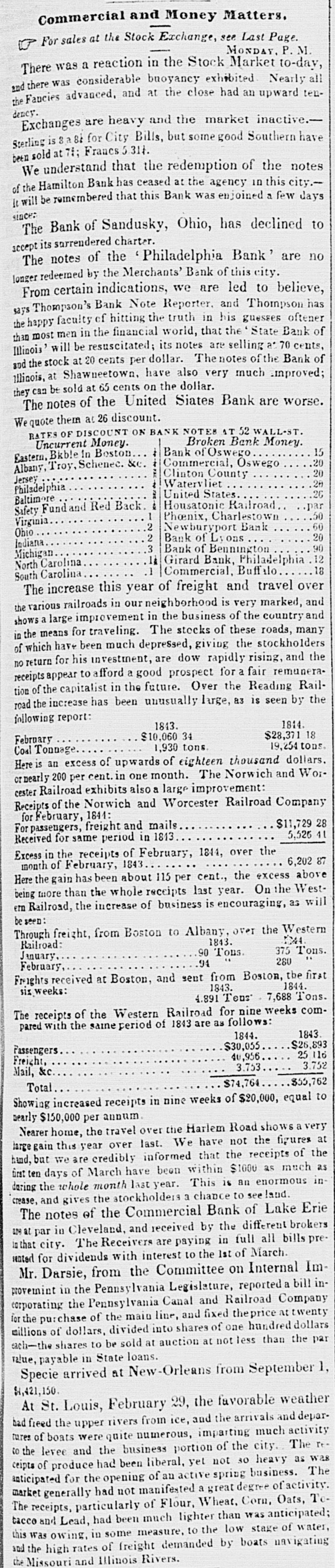
Article Text

days The Bank of Sandusky, Ohio, has declined to accept its surrendered charter. The notes of the Philadelphia Bank' are no longer redeemed by the Merchants' Bank of this city. From certain indications, we are led to believe, says Thompson's Bank Note Reporter. and Thompson has the happy faculty of hitting the truth in his guesses oftener than most men in the financial world, that the State Bank of Illinoi3' will be resuscitated; its notes are selling a 70 cents, and the stock at 20 cents per dollar. The notes of the Bank of Illinois, at Shawneetown, have also very much improved; they can be sold at 65 cents on the dollar. The notes of the United Siates Bank are worse. Wequote them at 26 discount. RATES OF DISCOUNT ON BANK NOTE8 AT 52 WALL-ST. Broken Bank Money. Uncurrent Money. 15 Bank of Oswego Eastern. Bkble in Boston 20 Commercial, Oswego Albany, Troy, Schenec. &c. 20 Clinton County Jersey 20 Watervliet Philadelphia 26 SEA United States Baltimore : Housatonic Railroad par Safety Fund and Red Back 1 50 Phonex, Charlestown Virginia 60 2 Newburyport Bank Ohio 20 2 Bank of Lyons Indiana 90 3 Bank of Bennington Michigan 1: Girard Bank, Philadelphia .12 North Carolina 18 1 Commercial, Buffalo South Carolina The increase this year of freight and travel over the various railroads in our neighborhood is very marked, and shows a large improvement in the business of the country and in the means for traveling. The stocks of these roads, many of which have been much depressed, giving the stockholders no return for his investment, are dow rapidly rising, and the receipts appear to afford a good prospect for a fair remuneration of the capitalist in the future. Over the Reading Railroad the increase has been unusually large, a3 is seen by the following report: 1814. 1813. $28,371 18 $10,060 34 February 19,254 tons. 1,930 tons. Coal Tonnage Here is an excess of upwards of eighteen thousand dollars. or nearly 200 per cent. in one month. The Norwich and Wor cester Railroad exhibits also a large improvement: Receipts of the Norwich and Worcester Railroad Company for February, 1841: $11,729 28 passengers, freight and mails 5,526 41 Received for same period in 1813 Excess in the receipts of February, 1844, over the 6,202 87 month of February, 1843 Here the gain has been about 115 per cent., the excess above being more than the whole receipts last year. On the Western Railroad, the increase of business is encouraging, as will be seen: Through freight, from Boston to Albany, over the Western 1244 1843. Railroad: 375 Tons. 90 Tous January 280 94 February Freights received at Boston, and sent from Boston, tbe first 1844. 1843. six weeks: 4.891 Tour 7,688 Tons. The receipts of the Western Railroad for nine weeks compared with the same period of 1843 are as follows: 1843 1844. $26,893 $30,055 Passengers 25116 40,956 Freight, 3.752 3.753 Mail, &c $55,762 $74,764 Total Showing increased receipts in nine weeks of $20,000, equal to nearly $150,000 per annum Nearer home, the travel over the Harlem Road shows a very large gain this year over last. We have not the figures at hand, but We are credibly informed that the receipts of the first ten days of March have been within $1000 as much as during the whole month last year. This is an enormous in crease, and gives the stockholders a chance to seeland. The notes of the Commercial Bank of Lake Erie are at par in Cleveland, and received by the different brokers in that city. The Receivers are paying in full all bills presented for dividends with interest to the 1st of March Mr. Darsie, from the Committee on Internal Improvemint in the Pennsylvania Legislature, reported a bill incorporating the Pennsylvania Canal and Railroad Company for the purchase of the main line, and fixed the price at twenty millions of dollars, divided into shares of one hundred dollars each-the shares to be sold at auction at not less than the par value, payable in State loans. Specie arrived at New-Orleans from September 1, $4,421,150 At St. Louis, February 29, the favorable weather had freed the upper rivers from ice, and the arrivals and departures of boats were onite numerous, imparting much activity