1659. E. S. Scranton & Co. (New Haven, CT)

Bank Information

Episode Type
Run → Suspension → Closure
Bank Type
private
Start Date
March 26, 1873
Location
New Haven, Connecticut (41.308, -72.928)

Metadata

Model
gpt-5-mini
Short Digest
f714292e

Response Measures

Full suspension

Other: Trustee appointed and sheriff attachment; firm placed in hands of trustee/receiver.

Description

Newspaper reports indicate an unexpected run (Mar 26, 1873) precipitated by heavy losses from stock speculation and ensuing rumors; firm suspended same day and was placed in trusteeship/assignment and involuntary bankruptcy in early April 1873. Bank did not resume operations and was effectively closed/assigned to a trustee.

Events (3)

1. March 26, 1873 Run
Cause
Bank Specific Adverse Info
Cause Details
Heavy losses from stock speculations (Union Pacific, Rock Island, etc.) that crippled the firm and led to rumors and deposit withdrawals.
Newspaper Excerpt
The banking house of E. S. Scranton & Co., suspended this noon, owing to the unexpected run upon tho bank.
Source
newspapers
2. March 26, 1873 Suspension
Cause
Bank Specific Adverse Info
Cause Details
Firm suspended after sustained losses in stock dealings and consequent heavy withdrawals; inability to convert assets to cash to satisfy depositors prompted suspension.
Newspaper Excerpt
The banking house of E. S. Scranton & Co., at New Haven, suspended on Wednesday.
Source
newspapers
3. April 3, 1873 Receivership
Newspaper Excerpt
S. E. Merwin, Jr., who was appointed trustee for the creditors of E. S. Scranton & Co., bankers, lately suspended, took possession under the assignment yesterday, and has given the creditors the following particulars:
Source
newspapers

Newspaper Articles (9)

Article from The Portland Daily Press, March 27, 1873

Click image to open full size in new tab

Article Text

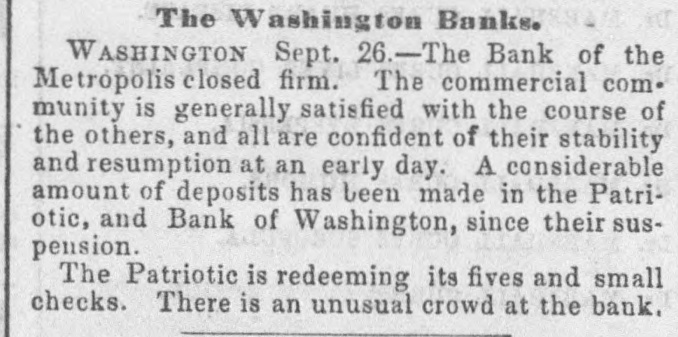
Suspension of a Banking House. NEW HAVEN, Conn., March 26.-The banking house of E. S. Scranton & Co., suspended this noon, owing to the unexpected run upon tho bank. It is probable that the suspension is a temporary one and that the depositors will be paid in full.


Article from The New York Herald, March 29, 1873

Click image to open full size in new tab

Article Text

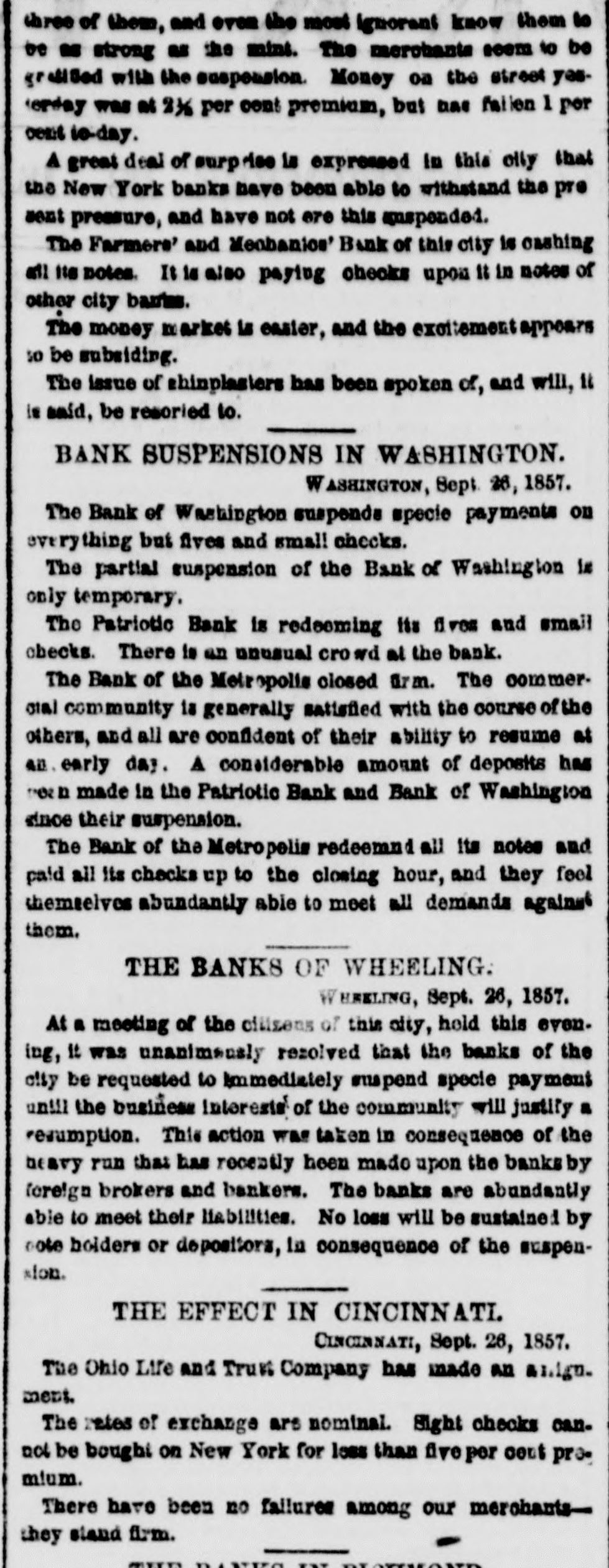
THE BANK FAILURE AT HEW HAVEN. The Hartford Courant thus refers to the suspension on Wednesday of the banking firm of E. S. Scranton & Co., of New Haven:In reply to inquiries a member of the firm stated that the losses of the house had begun shortly after the Boston fire, which depressed stocks and compelled many operators to go under. Some of these. who had stock at Scranton & Co.'s, were unable to make good their margin, and the house lost heavily. Rumors that the firm was crippled spread rapidly, and depositors at once commenced to draw. These misfortunes were followed by the rumored failure of a large operator, who is well known in connection with the Crédit Mobilier and Union Pacific Railroad, which had the effect of irightening country depositors, who drew largely on the firm. This has been going on for two or three weeks past, and Wednesday the firm, acting under the advice of its friends, suspended. Two policemen were guarding the doors at noon. A statement of the affairs of the bank will be made as soon as possible. The Habilities of the firm are said to be $400,000 to $500,000, and it is claimed by the bankers that they have assets enough to meet the demand, but were unable to convert them into cash, 80 as to satisfy the depositors. The firm had a large number of small depositors and was very popular. The safe deposit department of the firm it is understood does not Jose by the suspension.


Article from New-York Tribune, March 31, 1873

Click image to open full size in new tab

Article Text

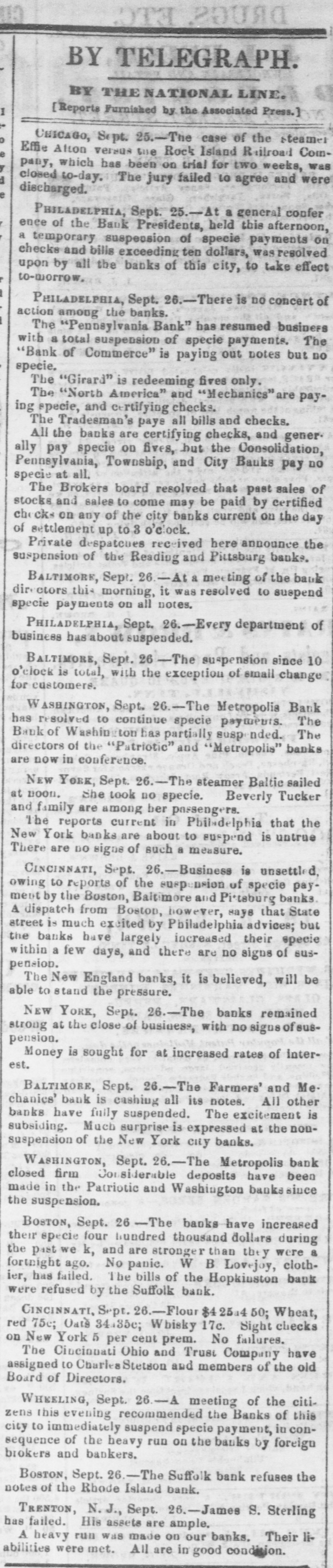
THE SCRANTON FAILURE AT NEW-HAVEN. The affairs of the private banking firm of E. S. Scranton & Co. of New-Haven, which recently suspended, were put into the hands of the Sheriff last Saturday, on an attachment of Scranton, Scovill & Co. of this city for $10,000. The firm began business in 1869 with a capital of $15,000, which was increased to $25,000 in 1870 and $65,000 (in 1871. Last year its capital was $39,000. Paying four, five and six per cent on deposits, the firm did a business of about $800,000 a year, its dealings being generally with persons of limited means, and at the time of failure was liable for $500,000 on deposits. The firm became embarrassed through stock speculations, and within a few days before suspending a number of farmers had withdrawn their deposits, being alarmed at the dealings of the bank with C. S. Bushnell, of Crédit Mobilier fame. It is reported that personal friends were allowed to save their funds, while others were permitted to make deposits when it was evident that the firm must suspend. The Serantons, father and son, as individuals, own about two-thirds of The New Haven Palladium, which may have to be sold for the benefit of the bank's creditors. The Mayor, the Town Treasurer. and other city officials, besides several benevolent institutions and Yale College professors, had funds deposited, all of which will probably be lost, since the firm lost heavily in stocks and had but a limited capital.


Article from The New York Herald, April 1, 1873

Click image to open full size in new tab

Article Text

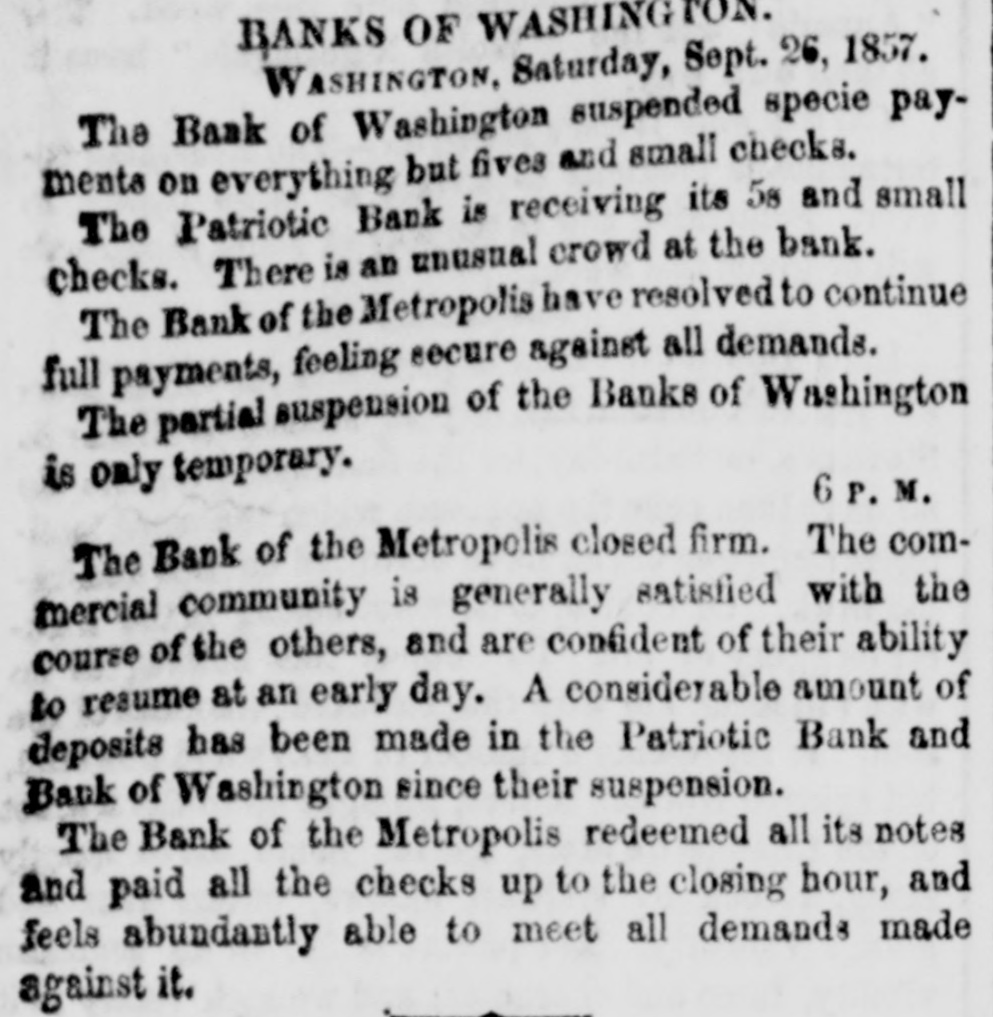
BANK SUSPENSION IN NEW HAVEN. / NEW HAVEN, Conn., March 31, 1873. At a meeting of the creditors of the banking house of E. S. Scranton & Co., lately suspended, held this noon in this city, a committee of seven was appointed to take the necessary measures to force said arm into involuntary bankruntcy.


Article from Litchfield Enquirer, April 3, 1873

Click image to open full size in new tab

Article Text

STATE ITEMS. Oysters are to be bedded in the Niantic this season. A girl in North Stonington, eleven years old, weighs 160 pounds. Three Guilforders dug 834, worth of clams, one day last week. Dr. A. T. Cronin died Friday morning, at his residence in Norwich. A farmer in Baltic has an OX that can trot a mile in four minutes. The Connecticut river is clear of ice from Deep River to the Sound. William Lawrence, of Greenwich, bought a church recently in that town for $220. Only seven of the twenty towns in New London county license the sale of liquor. A firm in Mystic have sold 20,000 bushels of corn, all which was brought there by vessels. The Norwich Universalist church is to have a new pastor, the Rev. Mr. Twiss, of Massachusetts. Over 200 tramps have been lodged at the Hartford station house during the past season. The banking house of E. S. Scranton & Co., at New Haven, suspended on Wednesday. New Haven grand list foots up 56 millions. 802 new electors have been admitted in New Haven. Hon. Henry Stoddard has been renominated for the Senate by the New Haven Democrats. A large number of liquor dealers in Norwich, are being prosecuted for violation of the liquór law. Trinity college has three boat crews this year, and is determined to send one to the inter-collegiate regatta. A young man named Basset committed suicide in Dayville on Sunday by blowing his brains out with a shot gun. Individual sympathizers in Norwich with Mrs. Woodhull, have contributed about $90 to the support of her paper. The trustees of Trinity College have received $59,575 as their portion as a residuary legatee of the estate of Chester Adams. Mrs. C. H. Hummason of Suffield, accidentally smothered to death her babe four months old, while riding home, Saturday night. Six hundred and eighty-five words were required to determine who was the best speller in the senior class of the Coit (New London) school. A young man in Meriden, who has not yet attained his majority, has recently invented two patents which he has sold for $5,000. The Howe sewing machine company commenced the manufacture of the WilCOX & Gibbs machine at Bridgeport on Satuaday. Work has been resumed on the Bridgeport breakwater, 900 feet of which were built last year. About 700 feet more remain to be built. The Store of H. C. Miles, on Main St., Ansonia, was broken open, Monday night, and robbed of $550 worth of silks, dress goods, etc. The New York, New Haven and Hartford is one of nine railroad companies that have refused to continue postal cars after the 1st of April, without extra compensation. The Yale law school has challenged the Dwight society of Columbia college, New York, to a friendly debate, and the challenge has been accepted. An irrepressible confliet has sprung up between the New York and Connecticut oystermen, with regard to the title of a certain rich bed of oysters over which the latter have exclusive jurisdiction. The bed is just off Bridgeport, but the New Yorkers say it is within the limits of the Empire State, and they are organizing to figat the matter out in the courts.


Article from The Wheeling Daily Intelligencer, April 4, 1873

Click image to open full size in new tab

Article Text

The New Haven Bank Failure. NEW HAVEN, April 3.-The trustee for the creditors of E. S. Scranton & Co., the suspended bankers, states that there was due the depositors at the close of business over $55,000. The loans and over draits for the same day were $225,000. The real estate will not bring $100,000.


Article from The New York Herald, April 4, 1873

Click image to open full size in new tab

Article Text

THE AFFAIRS OF SCRANTON & CO. NEW HAVEN, Conn., April 3, 1873. S. E. Merwin, Jr., who was appointed trustee for the creditors of E. S. Scranton & Co., bankers, lately suspended, took possession under the assignment yesterday, and has given the creditors the following particulars:There was due to depositors at the close of business over $550,000. The loans and overdrafts for the same day were $225,000. The real estate will not sell for $100,000.


Article from Chicago Daily Tribune, April 10, 1873

Click image to open full size in new tab

Article Text

The Failure of Scranton & Co. From the Springfield (Hass.) Republican. The failure of the New Haven banking firm of E. S. Scranton & Co., proves, now that all the facts have come out, to be one of the worat and most criminal that We have had in New England for years. - The trustee who was appointed to examine the books, made his report on Saturday. It shows plainly the rise and fall of the house. The firm commenced business in January, 1869, with a capital of only $15,000, but, possessing the entire confidence of the community, their books for the next three years showed a constantly increasing surplus, until the capital stock; last July, with the surplus, showed assets of $228,600. Within the next six months, however, this entire capital was extinguished, and not only this, but $82,000 more. Where had this money gone to ? These figures tell the story: Loss by speculation in Union Pacific, $142.000 Rock Island, $104,000; Western Union, $40,000, &c. Since Jan. 1 there have been more heavy losses, and their liabilities to depositors are about $600,000, not over 5 per cent of which probably can be paid. Could there be more convincing proofs of the folly, not to say the wickedness, of stock gambling ? But the worst feature of the failure is not the gambling it is the fact that, knowing the condition of their business, the firm continued to receive deposits up to the very time of the failure-not from their friends among the business men of New Haven, but from the poor people who trusted implicitly in their honor. What shall be thought of a firm that, knowing itself on the very eve of suspension, received the $700 which constituted & poor colored man's whole fortune?


Article from Morning Journal and Courier, May 21, 1891

Click image to open full size in new tab

Article Text

in the famous E. S. Scranton & Co. bank which failed here so disastrously in 1873. He got to the bank with the check just two minutes after it closed its doors and announced its suspension. One of his friends, a former business partner of his, deposited $4,500 in the same Scranton bank an hour before it failed. Another gentleman started for the Bunnell & Scranton bank the day before it closed its doors with $400 in his hands to deposit it there as a fund to draw from when he and his daughter should go to the White mountains this season. He had arrived at the corner of Orange and Chapel streets when he ran against his friend, Mr. Bartlett of the Union Trust Co. This decided him that he might just as well deposit the money with the Trust company, which pays no interest on balances. He is glad he did so. Among the facts which was current talk yesterday afternoon was the fact that Mr. F.C. Bushnell, of J. D. Dewell & Co., had $2,500 of trust funds on deposit with the firm, belonging to an estate which he is settling up. Mr. George Wykes, jr., of New York, who was business manager of the branch banking house which was conducted for a number of years in this city by W. T. Hatch & Co., of New York, was in town yesterday afternoon. He said there was nothing in the report that his firm would re-establish a branch house in this city. The failure was all the talk about town last evening in the clubs, stores, streets, saloons and private houses. Groups of prominent men discussing the subject were to be seen on Chapel street at most any time during the early evening. A prominent banking man suggests quite an idea, which is, if it can be SO arranged, that the business of the Bunnell & Scranton concern be merged under the control of a joint stock company, said company to be composed of the creditors of the bank, each, of course, sharing pro rata in the stock according to the amount of each of their respective claims; the business to be then resumed. It is urged that this is a good idea, as the legitimate business of the house was a paying one and one well established and altogether too valuable to be allowed to go to waste. He thinks that properly managed the business would under such an arrrangement pan out well for the ereditors and pay them certainly dollar for dollar. Mr. Scranton was feeling improved last night and now that the cloud has burst, as he said to a friend, be had begun to feel e that a burden was partially rolled off from his mind. His great concern was to have all feel that his firm had not intentionally e 1 gone wrong, but that adversity had overtaken the firm despite all their efforts. As to the solicitude of patrons of the bank, who had bought stocks on a margin, the transaction being incomplete when the house went under and who had left money f on deposit toward keeping their margins e from being wiped out by adverse fluctuao tions, a prominent lawyer said yesterday that in such cases such deposits must take o pot luck with the rest, but whether the f dealer could get these stocks or not he did not say.