Click image to open full size in new tab
Article Text
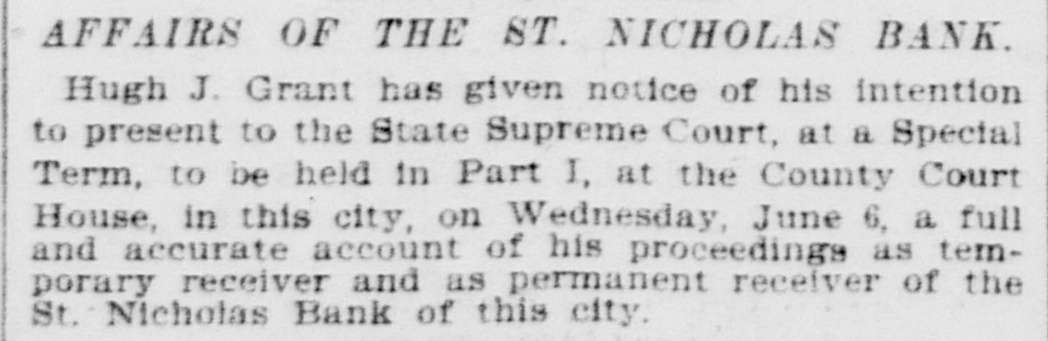
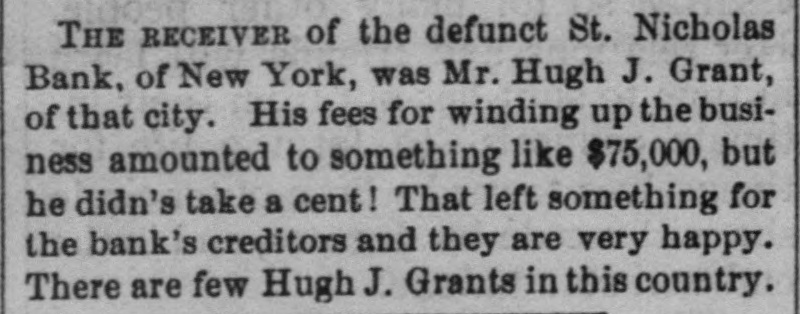
EX-MAYOR GRANT DIES SUDDENLY Stricken in Auto, He Is Carried Into House to Before Doctor's Alrival. JUST BACK FROM VIRGINIA Had Been Seeking Health at Hot Springs There-Twice Elected Mayor and Twice Beaten in Race. Hugh J. Grant. twice elected Mayor of New York City and twice defeated for that office, died suddenly late last evening at his home, No. 20 East 72d street. Mr. Grant had been out on business. and was stricken in his automobile 18 was on his way home. He was helped his room and put to bed. but died before his doctor could reach him. Mr. O'Hanlon, the Coroner's physician. said death was due to nephritis. Early in the evening Mr. Grant had complained of feeling III, but. although a member of the family suggested that a physician be called, the former Mayor said he did not need one. Dr. George M. Swift, the family physician. of No. 20 West 55th street. reported the death to the Coroners' office. as due to heart disease, from which complaint the former Mayor had been a sufferer for some time. Mr. Grant was only fifty-five years old. Mr. Grant had been ill for about a year. Two weeks ago he returned from the Virginia Hot Springs. where he had been for several months, in the hope of recovering his health. Persons in Mr. Grant's house in 72d street were reticent directly after the news of his death became known. Early this morning Anthony N. Brady. with whom Mr. Grant was associated in a number of corporations, called at the house and was admitted at once. Mr. Grant was born in 1855 in West 27th street. His father was a successful liquor dealer. who invested his savings in real estate and became wealthy The elder Grant expended money lavishly on the education of his son. who was his only child. After attending public school Hugh was sent to Europe. where he studied German. French and music He came back to New York when about seventeen years old. and finished his education at St. Francis Xavier's College. where he spent four years. Afterward he studied law. and was graduated from the Columbia Law School. He opened real estate and law offices at No. 25 Chambers street and No. 203 West 54th street. Went Into Politics in 1880. Mr. Grant went into politics about 1880. and two years later was elected to the Board of Aldermen from the 19th District. He was re-elected in 1883, and first acquired fame by refusing to vote for the "boodle" Broadway steal. John Kelly. who then controlled Tammany Hall, took him up for Mayor the next year. but he was defeated by William R. Grace. County Democrat The next year. having Kelly still behind him. Mr. Grant was elected Sheriff He was elected Mayor in 1888, defeating Joel B. Erhardt. Republican candidate. and Abram S. Hewitt, County Democrat. and was re-elected in 1890 over Francis M. Scott. the fusion candidate At the end of his second term Croker refused him another nomination. and Thomas F Gilroy succeeded him. The testimony before the Fassett Investigating Committee of 1890 revealed a system of maladministration in the Sheriff's office running through Mr. Grant's term. It also brought out the remarkable relations which existed between Grant and Richard Croker. including the gift of $10,000 to Flosste" Croker. Richard Croker's infant daughter Grant's excuse for this present to the Tammany Hall chieftain's daughter was that he was godfather to the child. Croker. however, under the prodding of counsel. before the Fassett committee. admitted that he had taken the money himself. and had invested it in his Mount Morris property His Appointments Attacked. Many of Mr. Grant's appointments as Mayor were severely criticised One of his principal achievements in that office was the removal of all overhead electric wires in the city.. In 1894 he ran again for Mayor on the Tammany ticket. the Lexow revelations having made Mayor Gilroy's renomination impossible, but was defeated Since his retirement from office Mr. Grant had been active in the real estata field. His father, John Grant, was a large investor in real estate. and the son was wealthy in his own right while -till a young man. In 1900 he was made receiver of the Third Avenue Railroad, and held the place until the Metropolitan Street Railway took control of the system. in May of the same year. In that year also he was appointed permanent receiver of the Forty-second Street, Manhattanville & St. Nicholas Avenue Railroad. in the proceedings brought by the Lorain Steel Company. of Ohio Mr. Grant was the receiver of the St. Nicholas Bank.