16566. Sixth National Bank (New York, NY)

Bank Information

Episode Type
Suspension → Reopening
Bank Type
national
Bank ID
254
Charter Number
254
Start Date
January 30, 1890
Location
New York, New York (40.714, -74.006)

Metadata

Model
gpt-5-mini
Short Digest
c49c331a

Response Measures

None

Description

The Sixth National was closed/taken into possession by U.S. Bank Examiner A. B. Hepburn at end of January 1890 after discovery of embezzlement/abstracted securities. Depositors gathered but the closure was an examiner/government action rather than a classic depositor-caused run; subsequently Charles H. Leland advanced funds and the bank was declared solvent and resumed business in early February 1890. An arrest of President P. J. Claassen (Classen/Claasen OCR variants) occurred; OCR spelling of Claassen/Claassen/Classen varies across articles and has been normalized to Claassen (P. J. Claassen).

Events (5)

1. February 20, 1864 Chartered
Source
historical_nic
2. January 30, 1890 Suspension
Cause
Government Action
Cause Details
Taken into possession and closed by U.S. bank examiner Hepburn after discovery of missing/abstracted securities and alleged embezzlement by the new management; clearing house dropped the bank.
Newspaper Excerpt
The Sixth national bank ... has been closed by United States Commissioner Hepburn.
Source
newspapers
3. January 31, 1890 Other
Newspaper Excerpt
Peter J. Claassen ... did ... unlawfully embezzle, abstract and wilfully misapply ... $462,406 ... This complaint is made on information obtained by deponent in his examination of the affairs of said bank ... CLAASSEN'S STATEMENT. Peter J. Classsen, of the Sixth National Bank, made a brief appearance ... HE LOSES $27,000 ... held in $25,000 bail ... (OCR name variants present).
Source
newspapers
4. February 4, 1890 Reopening
Newspaper Excerpt
the Sixth national bank was now solvent, the capital unimpaired, and asked for instructions to deliver the bank to the new board of directors. Pending the answer the examiner gave his consent for the bank to open its doors, and this was done.
Source
newspapers
5. January 6, 1899 Voluntary Liquidation
Source
historical_nic

Newspaper Articles (23)

Article from Evening Star, January 30, 1890

Click image to open full size in new tab

Article Text

HARD-WORKED DOLLARS. New York Financiers Trying to Run Three Banks With One Capital. NEW YORK. Jan. 30.-The Sixth national bank. at Broadway and 33d street, which recently passed into new hands, has been closed by United States Commissioner Hepburn. Mr. Hepburn will not speak of the bank's affairs, but some idea of the trouble was gleaned from one of the persons whom he consulted. "The commissioner's attention." said this authority, "was first called to the actions of the present management by finding in the market a lot of securities which the bank had been holding in its vault. A cursory examination has disclosed a scheme to get control of three banks-the Sixth national, the Lenox Hill and the Equitable. It looks a good deal as though those involved were trying to make a dollar appear in three different places at the same time. What the loss will be I cannot say. It will depend a great deal upon the value of a lot of securities which are in a vault down town and upon whether certain checks which came in yesterday are paid. I do not think that lhe trouble will reach further than to cause the closing of the other two banks. They will probably have to go." THE SIXTH NATIONAL SUSPENDS. The Lenox Hill bank has just suspended payments. It is controlled by the same parties who last week bought the control of the Sixth national bank of this city, which had already been closed by the bank examiner. The knowledge of the relation of the two institutions caused a run on the Lenox which it was unable to meet. The president is said to have m de an attempt to obtain funds in Wall street to continue payments, but was unsuccessful. The clearing house association today acted on the Sixth national and decided to drop it from the association. There are all kinds of rumors in regard to the Sixth national. one being that its new officers, who have only been in charge a few days, had sold out its securities as soon as they obtained possession. Its president, P. J. Classen, is said to have been connected with mining schemes in Leadville a number of years ago. The representatives of the bank examiners state that depositors will certainly be paid in full. The Equitable bank has also been mentioned in connection with the other two institutions. Its president makes the following statement: The owners of the Sixth national have a minority interest in the Equitable only, and our bank is not affected." The suspension of the two banks was widely discussed on Wall street, but brokers appeared to think that the effect would be confined to stock holders' losses. and although's the bear traders depressed stocks at the opening the "market easily recovered and some stocks made decided advances. The Lenox Hill bank shut its doors at 11:30 a.m. today, being unable to meet its obligations.


Article from The Evening World, January 31, 1890

Click image to open full size in new tab

Article Text

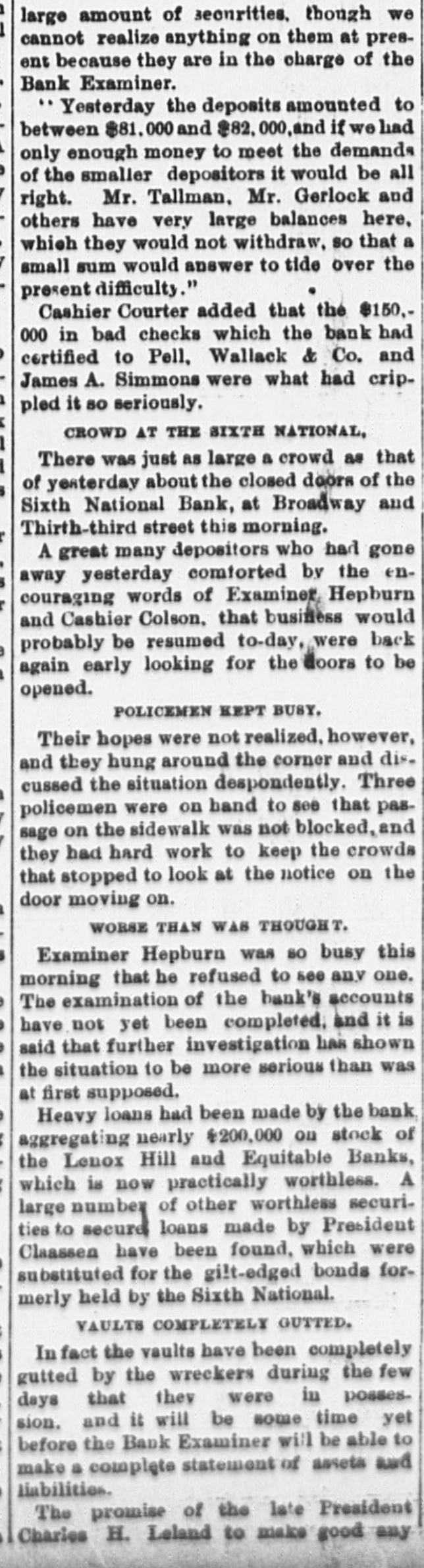
large amount of seonrities. though we cannot realize anything on them at present because they are in the charge of the Bank Examiner. Yesterday the deposits amounted to between $81,000 and $82,000, and if we had only enough money to meet the demands of the smaller depositors it would be all right. Mr. Tallman, Mr. Gerlock and others have very large balances here, which they would not withdraw, so that a small sum would answer to tide over the present difficulty." Cashier Courter added that the $150,000 in bad checks which the bank had certified to Pell, Wallack & Co. and James A. Simmons were what had crippled it so seriously. CROWD AT THE SIXTH NATIONAL, There was just as large a crowd as that of yesterday about the closed doors of the Sixth National Bank, at Broadway and Thirth-third street this morning. A great many depositors who had gone away yesterday comforted by the encouraging words of Examiner Hepburn and Cashier Colson, that business would probably be resumed to-day, were back again early looking for the doors to be opened. POLICEMEN KEPT BUSY. Their hopes were not realized, however, and they hung around the corner and discussed the situation despondently. Three policemen were on hand to see that passage on the sidewalk was not blocked, and they had hard work to keep the crowds that stopped to look at the notice on the door moving on. WORSE THAN WAS THOUGHT. Examiner Hepburn was so busy this morning that he refused to see any one. The examination of the bank's accounts have not yet been completed. and it is said that further investigation has shown the situation to be more serious than was at first supposed. Heavy loans had been made by the bank aggregating nearly $200,000 on stock of the Lenox Hill and Equitable Banks, which is now practically worthless. A large number of other worthless securities to secure loans made by President Claassen have been found, which were substituted for the gilt-edged bonds formerly held by the Sixth National. VAULTS COMPLETELY GUTTED. In fact the vaults have been completely gutted by the wreckers during the few days that they were in possession. and it will be some time yet before the Bank Examiner will be able to make a complete statement of assets and liabilities. The promise of the late President Charles H. Leland to make good any


Article from The Evening World, January 31, 1890

Click image to open full size in new tab

Article Text

and trust, require that this case should be severely den't with." HELD IN $25,000 BAIL. Commissioner Shields-In view of the Bank Examiner's affidavit I will fix the bail at $25,000. Bernhardt received his commitment for the prisoner and then took him to Marshal Jacobus's office. Commissioner Shields showed the reporter the affidavit made by Bank Examiner Hepburn. which was heretofore zealously kept from the eyes of the reporters. He selected it from two or three others, remarking: Let me get the right one?" Then there are other persons wanted ?" suggested THE EVENING WORLD man. The Commissioner smiled. HERE ARE THE CHARGEE. The affidavit is as follows: Southern District of New York: A. B. Hepburn. being duly sworn. says that is a National Bank Examiner of the cities of New York and Brooklyn. That on or about the 23d day of January. 1890, in the district aforesaid.o Peter J. Claassen. being then and there the President and a director and an agent of a National Bank association called the Sixth National Bank of the city of New York. incorporated under act of Congress approved June 3. 1864, did for the use, benefit and advantage of himself, unlawfully embezzle. abstract and wilfully misapply certain moneys, funds and credits of the said bank-to w.i. the sum of $462,406. with the intent to do injury and defraud said bank, and at'the same time one George H. Pell. with the like intent. did unlawfully aid and abet the said Claassen as such President. director and agent in the commission of such offense. This complaint is made on information obtained by deponent in his examination of the affairs of said bank: a letter of said P. J. Classen. dated New York. Jan. 30, 1890, addressed to the President of the Clearing-House Ass ciation: statements of the Clearing-House Committee and the cashier of the said bank. A. B. HEPBURN. Sworn to before me this 30th day of JanJOHN M. SHIELDS, uary. 1890. Commissioner. This affidavit sets at rest any doubt that may exist as to the issuance of a warrant for Claassen's arrest. The affidavit says he got away with the bank's funds, and Mr. Hepburn gives no inkling of where they have disappeared to. Pell's lawyer went out after a short consultation with Pell. and refused to give his name or the firm that be represented. Marshal Jacobus said this morning that neither Claassen nor Wallack had been arrested yet. CLAASSEN'S OFFICE LOCKER. Inquiry was made by an EVENING WORLD reporter at Claassen's office at 45 Broadway. The reporter called there. The door of his office was locked. There was on the door a note written in slate pencil as follows Empire Gas Company: Your twenty-four bundies of iron was delivered to L. I. R. R. Co.. Jan. 28, 1890. (Signed) PENNSYLVANIA R. R. Co. On the reverse side of the state was the word Rats. MR. SIMMONS ABSENT TOO. Inquiry was also made at the office of James A. Simmons. who is located in the same building. and who was one of the directors of the broken bank. A pretty typewriter with snapping black eyes received the reporters. No. Mr. Simmons is not in. and has not been at bis office to-day." she said. She did not know whether he would be down to-day or not. NO CEINCE OF RESUMING. President Frederick D. Ta: pen, of the Gallatin National Bank. called at the Sixth National Bank about n on to-day and had a conference with Examiner Hep. burn. Is it probable that the Sixth National will resume business he was asked. No." said Mr. Tappen. very decidedly. "There is no probability that it can. As soon as poss ble a receiver will be appointed and its afta rs will be wound up." HE LOSES $27,000. One old gentleman who deposited $27,000 in the bank only two days before its suspension. drove up to the door in his carriage. and seemed to be in a state of extreme ryous excitement. He shook and trembled all over as he stood in front of the door trying to gain admittance, and when he was finally informed by a clerk inside that he could get nothing to-day be looked as if the last spark of hope had been extinguished and his $27,000 was done for completely. CLAASSEN'S STATEMENT. Peter J. Classsen, of the Sixth Na. tional Bank. made a brief appearance in


Article from Evening Journal, January 31, 1890

Click image to open full size in new tab

Article Text

BANK WRECKERS WORK. Been Closed. Two Have New York Institutions "ANOTHER IVES-STAYNER CASE." The Sixth Half Ruined Nearly by National Alleged and Dishonest Lenox HIII Banks Has the Money? a Million Missing-Who Practices. condition light of affairs 31-A most Commissioner who A. B by United has been startling NEW Hepburn, YORK, Jan. States Bank brought to Sixth National its examining It day. been discovered P. J. accounts all and Broadway, and Thirty-fourth busy Possession of street the that of the new the bank, president who days two only Classen, of $622. has since dispose ago, of of 000 the bank's consisting of a of over gilt value market bonds gilt edged but of All bonds these $800,000. and have been sold, is gone assumed Tuesday. the bank, and sents the syndicate control former president interest on yet unknown. of of Charles Mr last H. the Classen week money has Leland, bought repre- the Notice. and In the was the bank closed on sheet the and The doors surrounded of crowd panic depositors and morning, and from gleaned assistants, the premissioner Hepburn following liminary Statement. of "Mr. stock. at parties controlling of in and control gave them 23, $622,000 possession to the belonging bank Wallace and follows: 1890, Received the New York, Sixth for sold for the books of the show any bank the for The book stock called original the bonds $622,000 amount and to Pell. president, and for with that them. they Bud. of $201,000 "They bonds. not could the renother bank. with of the the bank dered in imperative carry out the reopen taking will the possession anything. all. that stated Hepburn the new of the office oath of the Bank. The organized the 1864. presj. Leland dent. the cate two days. 45 Broad Classen M. way County T H and regarded Broadway the drug Cutter store the Kings concerns and city, of the The bank Alexander bought Hudnut surplus, last ing market. the Cashier D. has Andrew of been is by mentioned He notified Were They Commission are $401,000. that thus far the Bank stated Wreckers of $180,000 hand nt which missing. market There value last par night protested Mr. of report controller be and ready rency will of speedily ch pointment it He says of b. this city. wrecking The Fails. ng The the National Sixth in Hill the at the the de Lenox trouble the bas failed. ust bank son late Lester of There new board the he The ip $50,000 their apintions-the acquired table and red is prime Lexon and the syndicata on. Case." Another Frederick Gallatin he of bank and resident a of the to pay to the the certified Sixth committee stocks national and says member bank


Article from St. Paul Daily Globe, January 31, 1890

Click image to open full size in new tab

Article Text

FRAUDS. FINANCIAL A of Syndicate in Speculators Succeeds Wrecking TWO Banks. of The Ives Schemes Gigantic Are Totally Eclipsed. of Giltand the Steal in and one SevJail NOW Be Will eral Others soon. of the bank of The the of the run to the The in Wall but The on acted the to drop Sixth are the from There the Sixth regard its that one new being in only been charge had few its secur posthey Its sident, who have sold out obtained Claato con been have Chemes Lead The has bank the other resident makes the of two The banks but in Wall street widels the that think effect the bear the the and marke Wall decided advers the upon this the of by the of bank, high bery Presends from to simply that bonds them over to ting his Mr. of the the bank leartified Claasen and bank house the The latter began afternoo the in the bonds of bank Claase These of of the the short value $ 10,000. None been this the ban of fairs bank, up the that bonds FOUND. the Their He loan bank by bar which and was 000 of doubtured bank Gas and in Orlea ComOcean in of pany and $50,000 pantral The third on Mr. Hep these loans, In addi prob M to tion these found loans. on in 308 000 Hepated of the and others of alleged the Hill bank Sixth cleared. and for being his make specton the be his that that that the they H the has see Even the ex him bank, he ANY GOOD in of his ing the the to his was the most in the It the The of liable an the the While Miltation recobus and into hour and were where held. an very the was and their came When talkebled the he was coming his the object he first bank would he had made any to but finally the catch Way men ble. How he they the Charles came Late Trenho: affairs banks the of liam into Faultable the said, sion bank after was it look and evening theire they taken posnded lately


Article from St. Paul Daily Globe, January 31, 1890

Click image to open full size in new tab

Article Text

its a complete examination of and that be made to-morrow. In affairs would the Equitable bank. the prob- doregard to that it would be able to go The ing abilities business saw to-morrow President as usual. Jacob said B. examiners and his directors. They all of the Tallman able to take care of the they were They announced to to raise examiners bank's paper. that they expected and that they $50,000 to put a in release the bank, from the Western clearing could secure bank which did their to-morNational business. If this is done, then row everything BE WORKING SMOOTHLY the WILL Equitable bank. During P. F. Mcat the a gentleman named The evening called upon Mr. Hepburn. good Donald were informed upon man who reporters that he was the National authority the sale of the Sixth president, negotiated between the then alleged bank stock H. Leland, and the said that Mr. syndicate. Charles Mr. Hepburn McDonald's the object of ascertain for Mr. the visit was how to matters in for bank Leiand stood, and if it was necessary to make good him deficit to produce in the any depositors' funds the accounts. afterthe A report was started Nicholas during bank in the noon Equitable that Life the St. building on transaction, Broadway mixed up in the J. Gardwas also denial was made by W. He but the a cashier of that institution. $40,000 in ner, the statement that H. Pell & said protested in that the checks St. Nicholas of George bank bonds was to given the in Co. lieu of abstracted Sixth National is not examiner the at the amount had been Wednesday. paid by true, Sixth as National bank on Lenox Hill the of checks on the to the St bank A number had been presented refused. In Nicholas, but they were it was recircles to-day concerned banking some of the parties National a lated the that transaction of the Sixth establis 1 in some time ago to Knickerattempted under the name of the howthe bocker. bank The scheme fell through, pledged subever, as failed some of to materialize, bank and scribers the St. Nicholas been also because to clear for it. It the has scheme refused that out of the ruins of that the said Equitable was raised, and the the National bank took up was Western business. Mr. Leland said that clearing with much difficulty. but for his seen of $650 a share. paid was noththe price in the Sixth National, for stock ing extraordinary. as stock negotiations at that price had the purcnase been made of the three years ago. At that price he said it PAY SIX PER CENT. WOULD A. Simmons, said to be the one bank, of James principal stockholders in is at No. the not be seen. His office States 45 found George could Broadway. A deputy United Pell this at his took evening, marshal house and on H. Fifty-fifth him and arrested him, directed before street, Marshal Jacobus, in Ludlow who street that he be locked he was up incarcerated bank, later. jail, where of the Lenox Hill Charles E. which The president suspended to-day. the is late Chester Wallack. a son of with the new He went in was $40,Wallack. directors Dec.19 There opened boa dof on hand when the bank $20,000 000 cash morning. By great efforts entire $60,000 this procured. The by more was paid out to depositors doors. had been and the cashier closed the bank is noon, financial condition of the $270,000; The follows: Deposits, and disabout capital as paid in $100,000; amount loans due other counts. $50,000. $300,000; It is stated that changed at the banks. time the Lenox Hill bank control of same a syndicate acquired Hill, Sixth hands institutions-t Lenox St. Nicholas four Equitable and obtained a National, J. A. Simmons, who Lenox Hill banks. interest in the in the syndicontrolling a prime mover president bunk, was Frederick D. Tappan, and a cate. Gallatin National bank commitof the of the clearing house the sale member said to-day the proceeds belonging of to the tee, and securities to pay of stocks Natioual bank were used had been Sixth fied checks which presithe cert to Mr. Leland, the former stock. These given for his 1,035 shares of several banks, dent. drawn upon Equitable. checks were the Lenox Hill and transaction Mr. including Tappan denounced the as IVES-STAYNER CASE." "ANOTHER explained that the purchasers bank on He possession of the and were given of the certified checks found in payment the securities they then and deposited the honse to meet the the clearing vaults sold proceeds certified stated in the Mr. Tappan further paid to checks. his opinion, the price excessive. Mr. that, Leland in for his stock was


Article from Waterbury Evening Democrat, January 31, 1890

Click image to open full size in new tab

Article Text

BANKS IN A CRASH Two Big Financial Surprise for New York City. ARRESTING THE WRECKERS The Timely Warning of a Oashier Stop the Work of a R-ckless Syndicate. The Bank Examiner Recovers Part o the Steal--Big Price Paid for Bank Stock The Nafe Gutted to Raise the Money-Queer Financial Tricks of the Conspirators. NEW YORK, Jan. 31.-Two banks closed and the third in a shaky condition and broker George H. Pell arrested for alleged complicity in a deal that caused the trouble. Such is the record of the last two days in New York following on the announcement of the managers in the Sixth National Bank, Broadway and Thirty-third street. Bank Examiner Hepburn yestęrday brought to light an astounding state of affairs. The new T esident of the bank. P. J. Classen. du ing his two days' term of office had endeavored to dispose of $622,000 worth of the bank's securities, consisting of bonds with a market value of $800,000. These bonds were all sold with the exception of $ 50,000 worth. and no one can tell where the money has gone. The syndicate which bought the con trolling interest in the bank from Charles H. Leland, the former president. is represented by Mr. Classon,and the most mysterious part of the whole affair is the fact that that Mr. Leland sold his 1,035 shares of stock at $650, though they never brought more than $350 in the market before. The Bank Ruined A week ago the Sixth National Bank was considered one of the soundest financial institutions of this city. 11 had :1 record of 25 years' standing, and its depositors were proud of the prud ence and energy which the manage ment was reputed to have $0 wisely combined. Its capital had been strengthened by a handsome reserve fund. while its stock was rated very high by judicious investors. and commanded a handsome premium. Last evening the United States Bank Examiner who had made a thorough investigation of the bank's affairs, was compelled to admit that the bank was ruined, and that it was "the most scandalous case of bank wrecking which had ever come within his juris diction." Method in Their Madness. The payment of $650 a share for bank stock which was quoted at $250 was not the piece of recklessness which it would at first appear. Immediately upon the payment of the checks the keys of the vault were turned over to them. In the vaults of the bank were gilt edged securities valued at $692,000. These were taken and the greater part either sold or bypothecated. The proceeds were deposited in the banks on which the checks were drawn, so that they would not be protested. In other words, they used the assets of the bank to pay for the stock they had purchased. A very clever scheme, when it is remembered not a dollar was actually paid out of their own pockets. Exposed by the Cashier. They obtained control of the bank for nothing and at the same time succeeded in getting rid of a lot of worthless stock, certificates that were not even notable as specimens of the lithographer's art. The privilege which the bank possesses of raising the capital stock of the bank from $200,000 to $1,000,000 afforded such glorious opportunities for fleecing the public by watering the stock that it is fair to presume it would be taken ad vantage of had not the exposure occurred. The cashier of the bank, A. E. Colson, first put into active shape the suspicions which had lain dormant in the minds of many. He became alarmed when he saw the new control making big loans on the stock of the Equitable and the Lenox Hill banks, two comparatively small concerns. He laid the facts before the Clearing House Committee. and the National Bank Examiner Hepburn was called in to make an investigation. This resulted in the closing of the doors of the bankr. The Scene at the Bank. The scene at the door of the bank was an exciting one. Before it stood policemen, who good naturedly but firmly urged along even the most substantial looking of the depositors, who began to arrive at the Broadway ontrance. Not only these, but citi-


Article from Telegram-Herald, January 31, 1890

Click image to open full size in new tab

Article Text

BANKS CLOSED. Two New York Financial Institutions Suspend SOME QUEER METHODS DISCLOSED. The Sixth National and the Lenox Rill Banks Close Their Doors and the Equitable Said to Be in a Shaky Condition CAUSE OF THE FAILURES NEW YORK Jan so The street in front of the Sixth National Bank was so packed this morning with anxious de positors that the services of policement were required to keep order. The de mands of the depositors became finally so pressing that a representative of Bank-Examiner Bepburn, who has taken possession of the bank opened the front door a few inches and made a statement to the depositors that the examination would soon be oom pleted He also said that sufficient money was known to be in the bank to assure the depositors that they would all he paid in full and that the bank would probably resume business in a few days. Wednesday the bank commissioner took possession of the bank and com menced an examination of its affairs The concern changed bands last week but that fact was not made known until Wednesday. Rumors to the effect that the bank was in an insolvent condition immediately followed the change in the management, and an investigation was ordered. Some cooked proceedings must have been discovered by Examiner Hepburn, for soon after he made his report to the clearing-house officers the Sixtb Nation al Bank was suspended from the clear ing-house A prominent bank official. in speaking of the affair, said: The control of the Sixth National Bank had been for many years in the hands of Charles H Loland during which time the institution was carefully managed Last week be sold in out, transferring his controlling terest to James A Simmons H Cutler J K Watson D. M Ripley James Jourdan and 1' J. Classen The last named became president and took possession Since theu there have been remors 10 banking circles that the proceedings of these people have been peculiar and the bank has become discredited with the clearing house and with the community The same people who purchased the Sixth Nation al appear to be interested in the Lenox Hill Bank and the Equitable Bank both institutions organized under the State laws The attitude of Mr. Leland's critics is perfectly reasonable because there were $8,000,000 of deposits in the bank and it would have been expected that be owed a duty 10 the depositors to see that they were protected Many of them did not know until to day that the management had changed bands." The Lenox Hill Bank has also sus. pended payment It is controlled by the same parties who last week bought the control of the Sixth National Bank, of this city, which had already been closed by the bank examiner. The knowledge of the relation of the two institutions caused a run on the Lenox which it was unable to meet The president is said to have made an attempt to obtain funds in Wall street to continue payments, but was unsuccessful The Clearing-House Association acted on the Sixth National and decided to drop it from the association. The Equitable Bank bas also been mentioned in connection with the other two institutions. Its president makes the following statement: "The owners of the Sixth National have a minority interest in the Equitable only. and the bank is not affected."


Article from Richmond Dispatch, January 31, 1890

Click image to open full size in new tab

Article Text

the Bank National uested to resign. which they did, on the vacanciesbeing filled by new The Board of Directors, however, has legally organized since. ould not legally elect a president ause none of the new directors aken the oath of office, which equisite before any legal action kind could be taken by the b Their election of P. J. Classen was t void. Immediately on assumin ffice of president of the bank C1 nade three loans of $60,000 each, see stock of the Lenox-Hill Bank (very ecurity). and then went down to the leposit vaults in the National Park abstracted therefrom first-class rai onds of the par value of $622,000. : onds he placed in the hands of a ared George H. Pell for sale. Pel ormerly & partner in the firm of G teen & Pell, stock brokers, who fail ingust. 1887. The cashier of the Sixt ional Bank. Mr. Colsen. becamealarm extraordinary proceedings of the resident and directors. and he came the clearing-house, met the Clea louse Committee, and gave the star nformation already narrated. Aft careful deliberation of the whole the Clearing-House Committee it liately reached the conclusion that ank should be placed in the hands Government official at once. A. B. urn. a national-bank examiner, was and the facts communicated to with the request that he would take cl the concern the following morning avestigate the charges made by Mr. the cashier. against the officers ar ectors. This examination took place erday, and fully confirmed the stater nade by the cashier. The Clearing-House Committee Vi he Sixth National Bank late yesterd ernoon, and after having verified by onal examination the facts as al tated. telegraphed to the Comptrol he Currency at Washington that the vould not be permitted to excl brough the clearing-house this mor that thenew Board of Directors sì no further control over the ass institution. The bank-exan fter discovering that the bonds for had been taken out of the safe-de vaults, demanded of the putative Pres lassen that they should be at one urned or their equivalent in cash at market value. The examiner by rompt action succeeded in getting $201,000 of the bonds. In lieu or o ount of the rest of the abstracted 1 llassen handed the bank examiner c) $382,000. These checks fell short ( narket value of the abstracted secu $140,000. None of the checks, how have been paid, and they are being ested this morning. The bank wi nto the hands of a receiver. That i only way to protect the interest of and the minority stockholders ourse the customers of the bank wi emporarily inconvenienced, but the the bank was the only way to pro urther depredations. The Comptrol he Currency will appoint a receiver the facts in the case will be laid 1 he District Attorney to-day. There v better bank in New York than the National, continued Mr. Tappen. I $2,000,000 of deposits and a large sur he whole of which was invested in class securities. The market value tock was about $400 per share. L old his stock of 1,035 shares out ( 1,000, however. at an enormous inc eceiving at the rate of $650 per sha He was paid $650,000 in round fl his stock, and immediately on r of the money, which was paid in el turned over the stock and ( juently the control of the bank t ourchasers. The negotiations for burchase of his stock were cond George H. Pell. Leland was I he Clearing-House Committee yest was pretty warmly scored by the very impolite conduct. He se be much disturbed at the situ There was also & very lively scene bei he bank examiner and Classen whe t


Article from The Times, February 2, 1890

Click image to open full size in new tab

Article Text

The Wrecked Banks The Chief Conspirator Has Probably Escaped. NEW YORK, February 1.-One fact that appears most prominent to-day, amid the complex and not yet fully explained story of the wreck of three banks is the fact that the chief conspirator has probably escaped. Pell, the peddler of the stolen securities of the Sixth National Bank, and Claassen, the president of that institu tion, who is under arrect, seem now to have been only small partners of the boss conspirator. James A. Simmons. the contractor, who had many stupendous financial and contracting schemes on hands, has skipped, and SO has Wallack, the president of the ruined Lenox Hill Bank, and Pell's partner. Simmons is said to have been the chief manipulator of the scheme to get possession of the Sixth National Bank and that Claassen was hisagent. Simmons took 785 shares of the 1,035 purchased from President Leland. It is known that he has been pressed by his creditors for money, and the gutting of the Sixth National Bank is regarded as abold scheme for relief from his financial difficulties. THE EIGHTH STREET TUNNEL. One of Mr. Simmons, schemes was the Richmond Tunnel Construction and Rail. road Company, which is building a tunnel under Eighth street, in Richmond, Va. He was the manager of the company, and had charge of the finances, It was bonded for $1,500,000, and he claimed that nearly onehalf of the amount had been sold and used in constructing the work. Mr. Leland former president of the Sixth National Bank, has advanced funds sufficient to guarantee payment depositors in full at as early a date as proper arrangements can be made For a week past State Insurance Examiners Michael Shannon and John A. Horan have been examining into the condition of three insurance companies organized under the laws of this State, and doing business in this city on the assessment plan. If their surmises are true, the Guaranty Mutual, the Security Mutual, and the Mercantile Mutual, of this city, are practically insolvent. THE WASHINGTON CENTENNIAL The Plan and Scope Committee of the Washington Centennial celebration have voted the unexpected balance of the fund amounting to $4,741 in publishing a memorial volume detailing the'work done by the various committees. etc. Most of the members of the General Committee wish the, balance turned over to the arch fund, as the best possible way in which the centennial celebration could be perpetuated and the occasion commemorated. THE WORLD'S FAIR SCANDAL. The real secret of the World's Fair scandal is said to be that Depew and Belden have locked horns with Platt and Hiscock. That's the whole sum and substance of it. Platt's interference with the fair bill has raised a new difficulty. The question has been asked, "Can subscribers to the guarantee fund be compelled to make their subscriptions it they do not wish to do 80, in case Platt's men are added to the incorporators ?" The finance committee, under the terms of the subscription heading, has power to withhold the guarantee fund from the corporation formed if it 80 desires, and it was intimated to-day that such action would be taken it necessary. A trust among the hat manufacturers is being negotiated by a British syndicate. Last Tuesday evening, Cella Luther. fourteen years old, was sent out from her home in Delmonico place. Brooklyn, to buy a loat of bread at a baker's not half a block away. She has not since been seen or heard from Three years ago another girl disappeared almost this time of the year in this same neighborhood. RICHMOND TERMINAL There has been considerable talk about Richmond Terminal in Wall street for the past week in expectation of an advance The following figures were supplied the street by the parties in control: The company now controls 7.521 miles of road and water lines, an increase of 211 within the past year. Last year was the first in which the company had a surplus over fixed charges; in every year before that since its organizatian its interest charges and running expenses exceeded its income, and there were years in which its only income was the proceeds of loans That for the first time there is credit to the profit and loss account is due to the fact that the losses of previous years will be nominally offset by charging up $7,500,000 capital as full paid, although previously carried on the books as half paid. The net revenue for the past year was $668,356, the increase in the bonded debt $4,306,000, the decrease in the floating debt $1,199,193.84. and the net increase in the total debt $2,506,817.16. This net increase se in debt is recommended by an excess of o curities acquired over securities sold $4,175,930. It is probable that during the current yea k the floating debt of a little over $2,000,00 I net can be further reduced by the with drawal of some securities. The company has now left a comparatively small amount of securities which it could withdraw advantage. and it will require an expensive t development of the properties which it con d trols before their surplus earning power car . be largely increased. e or these the Virginia Midland is by fa to the most important. Although it now earn e, but little over its fixed charges, its busines th to is growing as fast as that of any road in e South, and it can hardly fail to keep o d doing so, for the Piedmont Air Line is th Id main trunk line of the South, and its equip P= ment has been largely added to and it 1. motive power largely increased during th past year by the demand of its in reasin it business. ed RZERY'GRIEF.


Article from Wheeling Sunday Register, February 2, 1890

Click image to open full size in new tab

Article Text

ANXIOUS DEPOSITORS. SITUATION OF NEW YORK BANKS. Comptroller of the Currency Interviewed. Officials Decline to TALK ABOUT THE MATTER. The Probable Arrest of the Conspirators. NEW YORK, February 1.-President Cleasen, of the Sixth National Bank, is being held on charges made by Bank Examiner Henburn. In an affidavit the Bank Examiner charged that "Peter J. Classen, president and director of the bank, did for the use, benefit and advantage of himself, unlawfully embezzle, abetract and willfully misapply large some of money and the funds and credita of the bank amounting in the aggregate to $432.466, with the intent to injure and defraud the Sixth National Bank of the City of New York. Comptroller of the Currency Lacy was seen by a reporter for the Associated Press at Washington this morning, and he said that he had received a letter from Ex. aminer Hepburn, stating in general terms that the bank was insolvent, and advising that be placed in the hands of a receiver. The examiner said that the assets of the bank were choice and in good shape, and could easily be liquidated. The examiner said also that he was DOW preparing a detailed statement of the assets f and liabilities of the band and expected to complette it to-day. The Comptroller said that he would take no action in the matter until he has received the examiner's report, which will hardlv reach Washington before to-moriow. He will appoint a e receiver early next week. 1 The situation about the Sixth National, I Equitable and Lenox Hill banks this f morning was practically unchanged excepting that the depositors appeared to be out in larger numbers. There are many business men among them who still indulged t in the hope that some turn might take p'ace which would parmit of their receiving money enough to pay off their creditors. The others held their ground, de termined that if the business men got any 7 money so would they, and as one young lady put it: "They would see that there e W&S no making fish of one and flesh of ane other." I The Superintendent of the State Bank Department, when seen at the Lenox Hill r Bank this morning, said he had charge of the investigation being made into the affairs of the Lenox Hill and Equitable banks. His statement was not ready and it would not be probably before the afternoon. With regard to the probable arrest of the cashiers of the Lenox Hill Bank and the Equitable, Mr. Preston declined to express an opinion. In reply to a number of questions as to whether or not Mr. Preston bad discovered any additional irregularities, since yesterday, Mr. Preston e declined to say. The following notice was posted on the window of the Sixth National Bank at a quarter to twelve e o'clock. 1 "Mr. Leland has advanced funds suffi0 cient to guarantee payment of depositora in full at as early a date 38 proper arrangements can be made for that purpose. [Signed] A. R. HEPBURN, Examiner. Later in the day Mr. George H. Pell was brought down to the U. S. Building from Ludlow street jail. Counsel for Pell, ex-Judge Donahue, says that he will make 1 & motion for a reduction of bail before Commissioner Shielda this afternoon.


Article from New-York Tribune, February 2, 1890

Click image to open full size in new tab

Article Text

WHAT CONTROLLER LACEY SAYS. Washington, Feb. 1.-Mr. Lacey, Controller of the Currency, said this morning that the newspapers contained a great deal more information than he possessed in regard to the affairs of the Sixth National Bank of New-York City. He had been, he continued. in constant communication with Bank Examiner Hepburn up to the time the latter took charge of the affairs of the bank; but since then he had heard little from the Examiner. Mr. Lacey added that Mr. Hepburn was not likely to make a report on the subject until he had completed his examination. The bank was now in the hands of the Government, and there was no particular necessity for haste. The Controller said De received a telegram from Examiner Hepburn soon after the suspension saying that the latter had protected the maturing paper of the bank, and he had received a letter from Mr. Hepburn in this morning's mail saying in general Terms that the bank was insolvent and advising that 1t be placed in the hands of a receiver. The Examiner said that the assets of the bank were choice and in good shape, and could easily be liquidated. The Examiner added that he was now preparing a detailed statement of the assets and llabilities of the bank. The Controller said he would take no action in the matter until he received the Examiner's report, which will hardly reach Washington before to-morrow. He will appoint a receiver early next week.


Article from Daily Republican, February 4, 1890

Click image to open full size in new tab

Article Text

Losses Made Good. WASHINGTON, D. C., Feb. 4.-The Comptroller of the Currency yesterday morning received a telegram from Bank Examiner Mepburn saying that the funds cupplied by ex-President Leland had made good te impaired capital of the Sixth National Bank of New York, and that the bank is now solvent. This will do away with the necessity of appointing a receiver to wind up the affairs of the bank. The amount paid in by Leland yesterday morning was $280,000, the deficiency to be covered being $279,33%.


Article from Evening Star, February 4, 1890

Click image to open full size in new tab

Article Text

BROKEN BANKS REPAIRED. The Wreck of the Sixth National Mended and the Others Likely to Resume. Matters are looking up in the wrecked New York banks. Besides paying out $640,000 for the recovery of his stock Mr. Leland paid to Examiner Hepburn $280,000 to cover the liabilities of the bank, including the $200,000 capital stock, and $79,000 besides. President Tappen of the Gallatin national bank informed Mr. Hepburn that $692,200 had been placed to his credit as United States bank examiner in the Gallatin national bank. In accordance with the results of his investigations into the condition of the bank's affairs and the new aspect which the contributions of Mr. Leland and the efforts of his friends have put upon them Mr. Hepburn was in a position yesterday to declare the bank solvent and ready to do business. He accordingly telegraphed to the controller of the currency, under whose authority he is acting, informing him that the Sixth national bank was now solvent, the capital unimpaired, and asked for instructions to deliver the bank to the new board of directors. Pending the answer the examiner gave his consent for the bank to open its doors, and this was done. The officers of the Lenox Hill bank have retained the firm of Newcomb, Donohue & Cardozo as legal advisers. Application was made in supreme court chambers for the appointment of a receiver for the Lenox Hill bank, but Lawyer Newcomb succeeded in getting the motion delayed. He said that arrangements are being made to meet all obligations, and if successful the appointment of a receiver will be avoided. He asked for time to complete these arrangements, and stated that in all probability the bank will be able to resume in a few days. He said that the resumption of the Sixth national will enable the Lenox also to resume, but that it will take several days to accomplish it. The announcement that the Equitable bank would open its doors yesterday and pay all demands brought many of the depositors to the bank at 10 o'clock. The doors were closed, however, and Examiner Trenholm was in charge. Shortly after 10 o'clock Conrad N. Jordan, president of the Western national bank, accompanied by Arthur Meyer, a son of Siegmund T. Meyer, arrived at the bank. They had a satchel with them full of cash and came for the purpose of opening the bank. Mr. Jordan told Examiner Trenholm what he was there for and tendered the money, which he stated was sufficient to pay all demands. Mr. Trenholm refused to admit Mr. Jordan and Mr. Meyer without a permit from the Attorney General. He said he had no authority to open the bank or to receive the money. Mr. Jordan and Mr. Meyer went away. but returned in half an hour and again demanded admittance. They stated that $200,000 had been raised and the bank could meet all obligations, but Mr. Trenholm was firm and they went off in search of State Superintendent of Banks Preston. They said they would return later in the day and open the bank, but they did not return. The wreckers Claasen and Pell spent most of the day in the office of the United States marshal waiting for bail. They were visited by several friends and their counsel, but did not secure bail. In the afternoon they were returned to jail.


Article from The Cheyenne Daily Leader, February 5, 1890

Click image to open full size in new tab

Article Text

SPARKS FROM THE WIRES. Yesterday's temperature-New York 44°, New Orleans 62°, St. Louis 60°, Cincinnati 58°, Chicago 50°, Washington 20°. The Sixth National Bank of New York resumed business yesterday, and everything moved along as it nothing had happened. A scandal similar to that recently unearthed in London, is coming to the surface in Belfast. Twelve youths have been arrested. A hand car with laborers was run down by a Northern Pacific train yesterday at St. Cloud, Minn. Three laborers are reported killed. Mr. and Mrs. Whitelaw Reid have postponed the ball which they were to give to-morrow evening in Paris, owing to the calamity betallen Secretary Tracy. The prohibition state conference met at Sedalia, Mo., yesterday. The sttendance was small. J. C. Hughes was chosen chairman and the usual committees ap pointed. Mrs. Harriet Beecher Stowe has much improved in health and strength. She is neither insane nor an imbecile as was stated, but has reached the stage of second childhood. The Goff Fleming contest was decided at noon yesterday in tavor of Fleming, the vote standing 40 for Goff and 43 for Fleming. Carr, Union Labor senator, voted with the Democrats. Herr Sormits, editor of the Cologne Gazete has been sentenced to one month's imprisonment in the fortress for publishing calumnies against Empress Frederick, mother of Emperor William. The colored men's convention was in session until early yesterday morning at Washington and after a stormy scene elected Bishop A. W. Wagman permanent president. His chief competitor was ex Senator P. P. Pinchback. It is reported a Philadelphia and New York syndicate, backed by two great European banks, have secured control of the Philadelphia & Reading railroad and that suits will be begun with a view to ousting Austin Corbin, its present president.


Article from Smyrna Times, February 5, 1890

Click image to open full size in new tab

Article Text

News Items. A National Convention of Colored Men is in session in Washington. York The County Democracy of New form. is going for Cleveland and reThe the grippe has reached the in Northwest and the Indians reserves are simply terrorized. Rapid progress is being made on new cruiser Philadelphia. Her the engines will be tried about March 1. Rev. Dr Talmage has returned from his trip to the Holy Land with a ner-stone for his new Brooklyn Taber- cornacle from Mount Calvary. As a result of a conference held between bankers and lawyers, a comprowill mise was effected, which, it is expected result in the Sixth National Bank of New York resuming business totors. morrow under the old board of direcEleven people were killed, and two fatally and nine others seriously injured in a tenement house fire in the North end of Boston, a flaming stairway cutting off all egress to the street and from compelling the inmates to jump the windows to escape the flames and smoke. Buenos Ayres has been for nearly two if years on the edge of a panic, and the large failure just announced is confirmed, the world is likely to the Argentine Confederation in d finan- see cial convulsion, like that in this country in 1837. The confederation has been passing through a like period of land speculation, paper money and vast public improvements.


Article from Wheeling Register, February 6, 1890

Click image to open full size in new tab

Article Text

Both Banks Running. NEW YORK, February 5.-There was nothing to indicate this morning that there had been any trouble with either the Sixth National or Equitable banks. The regular business of both institutions had been resumed and the only feature to at. tract attention was the meager business being transacted.


Article from Delaware Gazette and State Journal, February 6, 1890

Click image to open full size in new tab

Article Text

SIXTH AVENUE IS SOLVENT. WASHINGTON, Feb. 3.-Comptroller of the currency Lacey received a telegram this morning from Bank Examiner Hepburn saying that the funds supplied by ex. ex-Presidant Leland has made good the impaired capital of the Sixth National Bank of New York. and that the bank is now solvent. This will of course do away with the necessity of appointing & receiver to wind up the affairs of the bank.


Article from The Stark County Democrat, February 6, 1890

Click image to open full size in new tab

Article Text

WOOSTER, On Jan. 81,-Karl Merz, di rector of the musical department Wooster University, died yesterday after noon at 4:20 o'clock of pneumonia, H was taken down on Saturday with grippe, which rapidly developed into the fatal disease, Neither of his children, Dr Charles H. Merz, of Sandusky and Mis Bessie Merz, of St. Charles, Mo., were a home. His sudden death has caused profound sensation. COLUMBUS, Jan. 81,-[Special.]-The verdiet of the coroner's jury on the five victims of the recent gasexplosion charges it was due to gross negligence of the con tractor, J. C. Gibney, in leaving one joint in the pipes uncalked. ST. LOUIS, Mo., Jan. 31,-[Special.] Mrs. Nora Dunn of this city and Captain James Cargbett of Gardner, Maine, were remarried here this morning after a seperation of 45 years. He married her near ly half a century ago at Gardner, Maine, and then went to sea, He was reported lost. She married again. After a long time he returned and married again. Her husband and his wife have since died. Both are very wealthy. NEW YORK, ner Hessburn is still in possession of the Sixth National Bank. No receiver has yet been appointed. The numbers on the bonds missing from the bank cannot be ascertained as no entry was made on the books. If nothing can be collected from the protested notes the total loss will be about $750,000. It is believed that President Classen, of the Sixth National, and President Walter, of the Lenox Hill bank, have both skipped. LONDON, Jan. 81.-1 Special. ]-The French Line steamer La Normandie, from Havre for New York, January 25, was sighted three days later in 49 degrees northern latitude 23 degrees west longitude with her machinery partly disabled. She did not signal for assistance. COLUMBUS, Jan. was no trouble in the senate this morning. President pro tem Adams took the chair in the absence of Lieut. Gov. Marquis. Lampson did not try to take the chair as he said he would last night. Later he left for his home in Asthabula. KANSAS CITY, Mo., Jan. 31 [Special.] During his absence from home last evenmasked burglars bound and gagged the wife of Charles Roonan on Mercier street. They tied her by the neck to a bedpost and then robbed the house. The woman is in a precarious condition. Not much booty was secured. SAN FRANCISCO, Jan. 31.-[Special.]The amount realized from the sale of single season tickets to the Patti opera season, of two weeks, aggregated $25.000. This, with the amount realized from the box sales, makes a total of $34,000. CHARLESTON, West Va., Feb. 1,-[Spe cial.]-Delegate Horr, of the Union-Labor party created a great sensation here today in the Legislative Court investigation involving the question of the election of Governor, by filing a written statement that he had been offered a bribe of $1,800 and the State Mine Inspectorship, if he would vote for Goff (Rep for Governor of West Virginia. The affair has created a most profound sensation, as Horr in believed to be an honorable man. An investigating committee of five has been appointed to hunt the rascals down. WASHINGTON, Feb. 1. Special. World's Fair Committee of the Housemet to-day and concluded two bills as proposed by the sub-committee, and while they did not complete the work, they progressed sufficiently to show that two bills will be reported. One making no appropriation and leaving the place for holding the Exposition blank, to be filled by the House, and the other making an appropriation and providing for holding the Exposition at Washington. WASHINGTON, February [Special.] There was a great crowd at the Capitol to-day. The House galleries filled early and the crowd overflowed into the corridors of the main floor. On the conclusion of the reading of the Journal McKinney moved its approval and pending that motion Springer of Illinois moved an adjournment and demanded a roll call on his motion. It is evident the Democrats intend to continue yesterday's tactics. The motion to adjourn was defeated yeas 135, nays 158. WICHITA, Kan., Feb. 1.-[Special.]George Black, a young man doing business here, became violently insane, a raving maniac, yesterday and attacked his sister with a poker inflicting probably fatal injuries. He thenattacked his brother-inlaw injuring him so that he will die. He was arrested only after a terrible fight with the officers. LOUISVILLE, Ky., Feb. 1.-[Special.] Bill Nye, the humorist, and James Whitcomb Riley, the poet, havedissolved partnership, owing, it is said, to the convivial habits of the latter. Riley broke loose on a bender yesterday and he has since been in a dazed condition. YOUNGSTOWN, Jan. 31.-The series of meetings being held here under the auspices of Evangelist C. H. Yatman have been very successful, and $40,000 of the which he started out to raise for building for the Young Men's Christian Association has already been subscribed. WASHINGTON, Feb. 1.-[Special.]-ExSergeant-at-Arms Leedom has received a dispatch from the Mayor of Gerrelbonne, Canada, denying that Silcott is or has been in that place as reported. KANSAS CIUY, Feb. 1,- Special.]-The plant of the Kansas City Packing and Provision house was destroyed by fire last night. The loss is $200,000, insurance $300,000. WASHINGTON, Feb. 1.-[Special.]-The condition of Mrs. Coppinger, Secretary Blaine's daughter, is reported greatly improved to-day, and she will probably recover. WASHINGTON, Jan. 31.-The Washington Post, the Republican newspaper of the capital, edited by Frank Hatton, the Postmaster General of a former Republican administration, has a double-leaded leading editorial in which it calls loudly for precisely what the Democrats in the House of Representatives have been calling for, namely, rules of procedure. Under the heading, "Report the Rules," the editorial says: There is one way out of the disgraceful tangle in which the House found itself yesterday, and that is for the committee charged with the duty of formulating the rules for the government of that body to make a prompt report. Rules are what is needed-rules that give to the majority every right it is entitled to, and rules that protect to the fullest extent the rights of the minority. Until this is done there is little show for the harmonious and effective prosecution of public business. Precedents, to apply to the House of Representatives, should be found inside and not outside of that body. The country at large has rights in this controversy that rise superior to the wild and frantic antics of partisanship. The people know what is right, aud they will be satisfled with nothing short of what is right. Let the rules be reported. Let them be fair and just to both majority and minority. The sooner this is done the more creditable it will be

Article from The Desmet Leader, February 8, 1890

Click image to open full size in new tab

Article Text

To Pay the Depositors. The president of the Sixth National bank of New York city, Peter J. Claas sen, was beld in $30,000 bail by Unit ed State Commissioner Shields in default of which he was committed to jail. He is being held on charges made by Bank Examiner Hepburn, who makes afiidavit that Claaser has embezzled $432,466 of the funds of the Sixth National bank. A dispatch from Washington says the controller of currency, upon receipt of Mr. Hepburn's report, appointed a receiver for the bank. President King, of the Union Trust company, says that Mr. Leland, the former president of the bank, has placed a blank check in his hands, which he has filled out for $500,000, as a guarantee to a syndicate, who will take the assets of the bank and pay the depositors in full, after that the rights of the minority stockholders will be considered. Chief Bank Examiner Cahill has furnished the press with a statement of the affairs of the Equitable bank. The assets are $151,000 of commercial paper of uncertain value, $30,000 in Sixth National bank stock of uncertain value, and a few minor items. total, $190,000. The liabilities are: Deposits, $30,000; due to other banks, $198,000; capital, $100,000, and a few other items total, $333.000. The deficiency is therefore $143,000; but there is also evidence of a liability of $150,000 in certifications which do not appearon the books. The examination is not yet complete. Examiner H. C. Covell also issued a statement of the Lenox Hillbank It shows total liabilities, $549,29s;total assets $370,665, deficiency $178,617. Mr. Covell thinks depositors will get 70 per cent. of thier claims. Bank Examiner Preston says no forgeries have yet been discovered in the investigation of the two banks.


Article from St. Johnsbury Caledonian, February 13, 1890

Click image to open full size in new tab

Article Text

THE WRECKING OF A BANK. The wrecking of the Sixth National bank of New York and the consequent downfall of two smaller state banks, illustrate, in a way as startlingas it is disagreeable, the rapidity and completeness with which, despite our carefully drawn banking laws, the property of stockholders and depositors of a bank may be ruthlessly sacrificed when once it comes under the control of greedy and unprincipled officers. In this case the method of wrecking was as novel as it was bold. The president of the bank was induced to part with his stock, he holding a controlling amount, at a high price, to a set of men who seem to have deliberately planned to appropriate the bank's funds. Not having capital enough to pay for the stock, they persuaded smaller banks which they controlled to falsely certify checks. As soon as Mr. Leland, the former president, received his price for the stock, he turned over securities to a large amount to the new president, Claassen, who promptly handed over all these securities to his confederate, a broker named Pell, who at once sold or pledged them, and used part of the proceeds to cover the checks paid to Mr. Leland. What became of the balance is what the courts must determine. When the bank examiner, learning these facts, took possession of the bank and demanded the return of the securities, he was handed, instead, worthless checks drawn by the confederateso the smaller banks, which at once refused payment and suspended. Opinions differ as to the responsibility of Mr. Leland in the matter, many holding that the circumstances were such as should have awakened his suspicions that his action imperiled the interests of his fellow-stockholders: but it is quite clearfrom his subsequent course that he was not in actual collusion with the wreckers, for he has since come forward and guaranteed the depositors from loss. As to Claassen and Pell, no question exists about their intentions, and they are at present in prison with Ives and Stayner. Through Mr. Leland's provision and the service of five banks, which have been guaranteed from loss by Mr. Leland, the Sixth National has been reorganized and reopened. The entire incident suggests the danger of one man holding absolute control over a great public institution, and the responsibility of men so placed to assure themselves of the integrity as well as the business "smartness" of those with whom they hold large dealings.-[Christian Union.


Article from Crawford Avalanche, February 13, 1890

Click image to open full size in new tab

Article Text

# A Bank Wrecker Out on Bail. P. J. Claasen, accused of causing the suspension of the Sixth National Bank of New York, has been released on $30,000 bail.


Article from The Abbeville Press and Banner, February 19, 1890

Click image to open full size in new tab

Article Text

THE NEWS EPITOMIZED. Eastern and Middle States. THE first annual meeting and banquet of the United States Navy Veteran Association has been held at Boston. Admiral Porter was elected Commander. THE Sixth National Bank in New York city has been closed by the United States Bank Examiner and thrown out of the Clearing House; the Equitable Bank is in the hands of a State Bank Examiner, and its checks have gone to protest; and the Lenox Hill Bank has suspended. All these institutions lately came under the control of a clique, of which one P. J. Claassen was the head. Warrants were out for the arrest of Claassen, who was illegally elected President of the Sixth National, and George H. Pell, a broker. Depositors will lose no money probably, but stockholders will. About $700,000 were misappropriated. THE debate in the New York Presbytery on the revision of the Confessional of Faith was closed by a lively tilt between Dr. Hall on one side and Dr. Hastings on the other. WHILE Frank B. Wilson and Benjamin Townsend were fooling with a revolver at New Brighton, Penn!, Wilson's brains were blown out. The boys were sixteen years old. Townsend was a son of Congressman Townsend. DURING the dress parade of the school regiment at the Latin school, Boston, when an American flag was presented, five of the young boy soldiers fainted in the ranks and were carried off by their comrades. A TRAIN wreck occurred six miles from Lancaster, N. H. The engineer, L. F. Crouch, was killed, and the fireman and brakeman badly injured. A STATEMENT signed by Edward King, President of the Union Trust Company, annonnced that Charles H. Leland, ex-President of the Sixth National Bank, of New York city, made arrangements by which the bank would resume business. DANBURY, Conn., had the most destr nctive fire in the history of the place. Several Wocks of stores were destroyed and many t nants had narrow escapes. Explosions occurred during the fire. Loss, about $300,000. THE steamer Waseland had a rough passage to New York from Antwerp. Her fourth officer and a quartermaster were swept overboard and lost. ALFRED BROWN, a "professor of medicine," at Westchester, Penn., was convicted of practicing medicine without a diploma and using incantations and "voudoo" methods, and sentenced to three years' imprisonment and $70 fine. REV. T. DE WITT TALMAGE, the noted Brooklyn divine, has returned from his pilgrimage to the Holy Land. HON. SETH Low, ex-Mayor of Brooklyn, was installed eleventh President of Columbia College at the Metropolitan Opera House in New York, with impressive ceremonies. THE Gloucester fishing schooner Alice M. Stouple was reported lost at sea with a crew of fourteen souls. THE New York Presbytery, by a vote of 93 to 43, accepted the report by the special committee in favor of revision of the Confession of Faith. THE New England Agricultural Society met at Boston. GENERAL JOHN D. ANDERSON, of Augusta, Me., has been elected Commander G. A. R., Department of Maine.