16556. Siegel bank (New York, NY)

Bank Information

Episode Type
Suspension → Closure
Bank Type
state
Start Date
January 9, 1914
Location
New York, New York (40.714, -74.006)

Metadata

Model
gpt-5-mini
Short Digest
0a967101

Response Measures

None

Description

Articles describe the Siegel bank becoming insolvent, receivers (Melville, Marble & Sheppard) appointed, criminal indictments against Siegel and Vogel, segregation of last-week deposits, and distribution of funds by receiver/trustee. No article describes a depositor run prior to suspension; the bank was placed in receivership/failed and assets were distributed, so classed as suspension leading to closure/receivership.

Events (5)

1. January 9, 1914 Suspension
Cause
Bank Specific Adverse Info
Cause Details
Bank found to be insolvent after large loans/deposits were used to finance Siegel department stores; allegations of accepting deposits after insolvency and misuse of depositor funds to pay preferred stockholders and stores' needs.
Newspaper Excerpt
R. Ross Appleton, president of the Security Bank, in which the deposits of the last week in the Siegel bank were segregated, sent a letter to Receiver Melville yesterday explaining the connection of his institution with the Siegel firm.
Source
newspapers
2. January 22, 1914 Receivership
Newspaper Excerpt
He said he and Vogel considered themselves as personally liable to the depositors for the $2,500.000 in the Siegel bank...the $2,500,000 of deposits have gone into the bankrupt stores. ... testimony before ... receivership ... the receivers of the 14th Street Store, the Simpson, Crawford Store and the other Siegel subsidiaries, ... William A. Marble, John S. Sheppard, Jr., receivers for the Siegel concerns, and Receiver Melville mentioned elsewhere in articles.
Source
newspapers
3. March 13, 1914 Other
Newspaper Excerpt
The Fourteenth street store and the Simpson-Crawford Company store ... are to be closed to-morrow night in accordance with the order of Judge Hough, of the Federal Court. ... many of whom are said to have deposited their savings in the Siegel bank, so they will be without funds until they find other employment. ... clerks and other employes will be thrown out of work, many of whom are said to have deposited their savings in the Siegel bank.
Source
newspapers
4. April 12, 1914 Other
Newspaper Excerpt
Depositors in the Siegel bank stormed the offices of the American Audit Company, 100 Broadway, yesterday, where Henry Melville, the receiver, has established offices to pay them their first dividend.
Source
newspapers
5. June 19, 1914 Other
Newspaper Excerpt
Judge Hough in the federal district court yesterday awarded $15,000 to Henry Melville for his services as receiver for the insolvent Siegel bank. ... The order calls for the discharge of the receiver and the turning over of the funds in his possession to the trustee in bankruptcy.
Source
newspapers

Newspaper Articles (13)

Article from New-York Tribune, January 9, 1914

Click image to open full size in new tab

Article Text

# Siegel Near Collapse, 'Tis Said. Henry Siegel was in his offices in the Simpson-Crawford store yesterday conferring with lawyers and others. For him, in regard to the charges made to the District Attorney's office that the bank had accepted deposits after it had become insolvent, it was said that Mr. Siegel never considered that he or the bank or his several stores were in that condition. "He expected that everything would come out all right if he was given a little time," his spokesman said. Though he spent the greater part of the day in consultations, it was said by those who saw him that he was close to a state of collapse, due to the worries of the last few days. As soon as the condition of affairs will permit he is expected to take a brief vacation to recuperate. R. Ross Appleton, president of the Security Bank, in which the deposits of the last week in the Siegel bank were "segregated," sent a letter to Receiver Melville yesterday explaining the connection of his institution with the Siegel firm.


Article from The Evening World, January 22, 1914

Click image to open full size in new tab

Article Text

number of stocks and bonds and would deliver them to the receivers. He furnished a Het of these unpledged securities, among them stock in the Mamaroneck Hook and Ladder Company, which the merchant said he didn't think would bring a large sum. He likewise had $150,000 worth of Nevada mining stock on which he didn't believe much could be raised. Siegel said he had three personal bank accounts, totalling just $7,000, representing all the money he had in the world. It was shown that he owed several hundred thousand dollars to various banks, secured by collateral. In addition, he is personally liable on leases on the various stores which, in the years they have to run, will aggregate R. great sum. He declared he had given the receivers a full list of his personal belongings except "a few automobiles." Mr. Siegel testified that, roughly. the Simpson Crawford Company had assets of $2,000,000 above liabilities. Siegel testified that he believed the Fourteenth Street Store was worth $1,000,000 more than its liabilities. Examined by Mr. Proskauer for the bank receivers Siegel said he and Vogel considered themselves as personally liable to the depositors for the $2,500.000 in the Siegel bank. He said he had no personal knowledge of the affairs of the bank, seeing its balance sheet not more than twice a year. The Siegel bank, he said, began to loan money to the Siegel stores Immediately after it began business in 1902. "We felt," said Siegel, "that money


Article from New-York Tribune, January 22, 1914

Click image to open full size in new tab

Article Text

VOGEL GRILLED IN SIEGEL BANK CASE Says Loans to Stores Were Made by Him and Siegel as Individuals. SANK $1,400,000 IN ENTERPRISES Witness Professes Ignorance as to Many Details Along Bookkeeping Lines. Frank E. Vogel, vice-president of the Siegel Stores Corporation, told yesterday how he sank $1,400,000 in his department store enterprises in ten years, made himself liable for an indebtedness aggregating $4,242,546 77, and was to-day possessed of only $1,991 in real money. He was a witness before George C. Holt, special master of the receivership, In the offices of Douglass, Armitage &*McCann, in the Woolworth Building, for more than four hours. Under the cross-examination of a half dozen attorneys Vogel described his handling of the Siegel firm finances in the effort to keep four big department stores, a bank and their subsidiary corporations going. He did not give the receivers much new information, but his testimony will come as a shock to the 15,000 depositors of the Siegel bank whose $2,500,000 of deposits have gone into the bankrupt stores. Vogel testified the enormous loans to the department stores were made by himself and Henry Siegel as individuals, not as bankers or as a firm of bankers, and that it was their understanding and agreement that these loans to the stores would come second to debts for merchandise. This statement was assailed by John P. Murray, attorney for the depositors; Henry Melville, receiver of the bank, and Joseph M. Proskauer, his associate. They objected to any testimony along this line that was not substantiated by better evidence than Vogel's impressions and opinions. "This is not a question of fact, or a question to be considered here," said Proskauer. "It is a question of law." "If you will permit an outsider to butt in," said Levy Mayer, of Chicago, attorney for the L. Z. Leiter estate, which is heavily interested in the Chicago store, "that's a question that your courts are going to have some trouble with and you lawyers some fees in determining." James A. Rosenberg, attorney for Sheppard and Marble, receivers of the 14th Street Store, the Simpson, Crawford Store and the other Siegel subsidiaries, crossexamined Vogel. He drew from him his present financial condition and asked him if his wife now held any property, directly or indirectly, that be had given her. The witness said she did not, and swore that since December 29 he had drawn only $495 from his own bank accounts, and now had only $700 deposited in the Union Exchange National Bank, $1,161 in the Central Trust Company of Illinois and $130 in the National Bank of the Republic. He had no cash, he said, but had a claim of $50,000, advanced to the Simp. son-Crawford store. He is on the books of the stores for $44,211 77, he testified. Vogel asserted he had drawn no dividends on his holdings of stock in the
Article from The Sun, March 8, 1914

Click image to open full size in new tab

Article Text

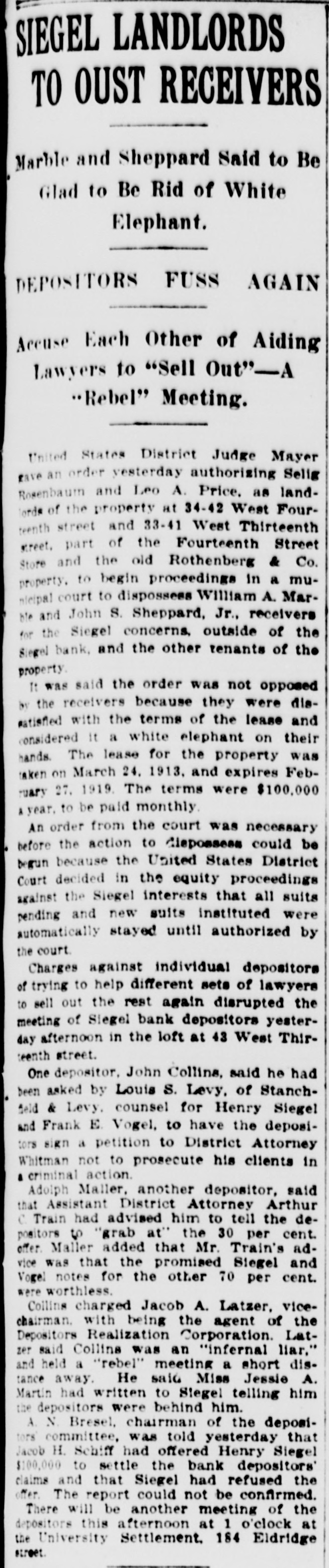
SIEGEL LANDLORDS TO OUST RECEIVERS Marble and Sheppard Said to Be Glad to Be Rid of White Elephant. DEPOSITORS FUSS AGAIN Accuse Each Other of Aiding Lawyers to "Sell Out"-A "Rebel" Meeting. United States District Judge Mayer gave an order yesterday authorizing Selig Rosenbaum and Leo A. Price. as landorde of the property at 34-42 West Fourteenth street and 33-41 West Thirteenth street, part of the Fourteenth Street Store and the old Rothenberg & Co. property. to begin proceedings in a municipal court to dispossess William A. Marbie and John S. Sheppard, Jr., receivers for the Siegel concerns, outside of the Siegel bank, and the other tenants of the property. It was said the order was not opposed by the receivers because they were dissatisfied with the terms of the lease and considered It a white elephant on their hands. The lease for the property was taken on March 24. 1913, and expires February 27. 1919. The terms were $100,000 a year, to be paid monthly. An order from the court was necessary before the action to dispossess could be begun because the United States District Court decided in the equity proceedings against the Siegel interests that all suits pending and new suits instituted were automatically stayed until authorized by the court. Charges against individual depositors of trying to help different sets of lawyers to sell out the rest again disrupted the meeting of Siegel bank depositors yesterday afternoon in the loft at 43 West Thirteenth street. One depositor, John Collins, said he had been asked by Louis S. Levy, of Stanchfield & Levy. counsel for Henry Siegel and Frank E. Vogel, to have the depositors sign a petition to District Attorney Whitman not to prosecute his clients in a criminal action. Adolph Maller, another depositor, said that Assistant District Attorney Arthur C. Train had advised him to tell the depositors to "grab at" the 30 per cent. offer. Maller added that Mr. Train's advice was that the promised Siegel and Vogel notes for the other 70 per cent. were worthless. Collins charged Jacob A. Latzer. vicechairman. with being the agent of the Depositors Realization Corporation. Latzer said Collins was an "infernal liar," and held a "rebel" meeting a short distance away. He said Miss Jessie A. Martin had written to Stegel telling him the depositors were behind him. A N Bresel, chairman of the depositors committee, was told yesterday that Jacob H. Schiff had offered Henry Siegel $100,000 to settle the bank depositors' claims and that Siegel had refused the offer. The report could not be confirmed. There will be another meeting of the depositors this afternoon at 1 o'clock at the University Settlement. 184 Eldridge street.


Article from Harrisburg Telegraph, March 13, 1914

Click image to open full size in new tab

Article Text

2,100 CLERKS ARE THROWN OUT OF WORK BY SIEGEL FAILURE Many of Them Lose Their Savings Which Are Tied Up in Defunct Store Bank By Associated Press New York, March 13.-The Fourteenth street store and the SimpsonCrawford Company store, the management of which has resulted in the indictment of Henry Sigel and Frank E. Vogel, charging violation of the State banking laws and grand larceny, are to be closed to-morrow night in accordance with the order of Judge Hough, of the Federal Court. After an inventory has been taken the stock and fixtures of the two stores and the equipment of the Merchants' Express Company are to be sold on March 24 for the benefit of creditors. With the closing of the two stores, which are among the largest in New York, about 2,100 clerks and other employes will be thrown out of work, many of whom are said to have deposited their savings in the Siegel bank, so they will be without funds until they find other employment. These employes were considered by the court yesterday before the closing order was signed. Judge Hough was assured by William A. Marble, counsel for the store managers under the receivers, that clerks were in demand by other department stores and that virtually all of the 2,100 persons would not be long without work. It is estimated that the total value of the stock in the two stores is about $1,000,000. The grand jury is still in session and Assistant District Attorney Arthur C. Train, in immediate charge of the case, will present additional evidence on which it is said he hopes to obtain ten or twelve indictments against Siegel and Vogel, in addition to those on which they were held on Wednesday and admitted to ball in $25,000 each.


Article from New-York Tribune, March 13, 1914

Click image to open full size in new tab

Article Text

# Dividend Plan Easy. "We have evidence," said Mr. Train yesterday, "that money of the depositors In the Siegel bank was paid to the preferred stockholders of the Siegel Stores Corporation in the guise of dividends upon Simpson Crawford stock, held by the stores corporation. "Whenever those running the stores corporation thought it would be good form to declare a dividend the Simpson Crawford Company would get the money from the Siegel bank, vote a dividend on its own stock held by the stores corporation and turn the money over to it, the stores corporation passing it along to the preferred stockholders. "All there would be to show that the depositors' money was so used would be an entry in the books of the bank. The Simpson Crawford Company would not even take the trouble to enter the 'loan' on its books, much less give a note to the bank." The depositors who met in the West 13th street loft yesterday afternoon were not the same riotous crowd that met on other days, though but few of the familiar faces were missing. One week ago Irving L. Cooms was mobbed because he suggested the acceptance of the offer of 30 cents on the dollar made by Siegel's friends and accept notes for the rest, by the followers of Miss Jessie A. Martin and A. N. Bresel, who were not present yesterday. Yesterday he was cheered when he repeated his advice that depositors take what they could get. Jacob H. Latzer, who a week previous had been called a crook for advising depositors to go slowly, was cheered when he pointed out the error that he considered had been made in rejecting the offer of the Depositors' Realization Corporation, and again when he said he had been informed that the offer would be renewed if the depositors would get Mr. Whitman to stop the prosecution of Siegel and Vogel. "I am in favor of asking the District Attorney to deal gently with these men if they will do what they can for us" declared Latzer, "but I won't lead a committee to Mr. Whitman. If I do, Miss Martin will lead a committee opposed to that to his office the next day." Edward M. Curtin urged the appointment of such a committee to see what promises could be obtained from Siegel and Vogel, and if satisfactory confer with the District Attorney. This suggestion was agreed to unanimously, and Mr. Curtin was named as the head of a committee of ten. When this "about face" was presented to Louis S. Levy yesterday afternoon, he declared his clients were willing to do anything in their power to aid the depositors. "If Messrs. Siegel and Vogel," said he, "are left in a position to work and obtain money, they will do all in their power to reimburse every depositor in full. If they are not left in a position to work and earn money for the depositors they cannot get the money to pay the depositors." # Only $450,000 in Cash. Mr. Levy holds out no hope that more than $450.000 can be looked for from the friends of Siegel and Vogel at this time. That, he says, represents every dollar that can be raised. The longer a settlement is delayed the less money there will be available, as lawyers and preparations to fight prosecution costs money. It was learned yesterday that on Monday Henry A. Platt, of the law office of Levi Mayer, of Chicago, spent the greater part of the afternoon trying to convince Mr. Whitman that the grand jury inquiry should not be reopened, so that the depositors might get some, at least, of their money now, and be given a chance to get the rest. He had $250,000 in his possession at the time, and Mrs. Vogel is understood to have had $200,000 ready to give up from friends of herself and her husband. Platt then learned, as did The Tribune, that Mr. Whitman proposed calling Siegel and Vogel to the bar on Wednesday to plead to three indictments. Piatt soon after left the city, but he is understood to be in Philadelphia, so that the resumption of negotiations would find him back in New York in short order. Pressure has been brought to bear from other sources on Mr. Whitman to induce him to drop the prosecution of Slegel and Vogel. Home have used political arguments, but to all of these he has turned a deaf ear. Just now he is desirous of substantiat-


Article from The Day Book, March 14, 1914

Click image to open full size in new tab

Article Text

"loaned" to the Siegel bank. Now it is gone. Whitman declared that in this fund being swallowed up in "the hole which depositors thought was a bank," the poor workers of the city had been "hit harder through the Siegel failure than in the collapse of the Carnegie Trust Company." It was this beneficiary fund about which the majority of the $6-a-week sales girls and male clerks with families to support felt most concern. An instance of what the deductions meant to the "small pay employes," was recounted by one woman clerk today. "One of the girl clerks, who had been with Simpson-Crawford for years and who was supporting an invalid sister, died after a short illness a few days after the firm went into bankruptcy. "With everything running right," said the informant, "this girl's sister should have received $100 from the beneficiary fund. She got nothing. The dead girl lies in the Potter's field and her sister is in a charity hospital." Still another instance was related of one of the wagon-drivers who broke his leg a week ago. The driver, according to the story vouched for by two employes, went to a charity ward at Bellevue Hospital. He had absolutely nothing to pay for medical attention. While many of the 2,300 girls and men who will go out when the stores close tonight, have secured positions elsewhere, the majority have nothing to fall back on. Those who have been fortunate enough to get other employment are the older ones who can command better salaries than the average. Those who so far have been un-


Article from New-York Tribune, March 19, 1914

Click image to open full size in new tab

Article Text

COURT RULING WILL MAKE SIEGEL TALK Must Tell of Assets Under Decision Barring Plea of Privilege. HEARING WEDNESDAY ON DEPOSIT CLAIMS Lawyers Come to Agreement as to Settlement-Inventories of Stores Completed. Under a ruling by Judge Hand yesterday in a case of the Chemical National Bank and the Merchants' Association growing out of the failure of Tobias, Greenthal & Mendelson, clothing manufacturers, Henry Siegel must answer questions to show what became of his fortune and of the properties he controlled. Judge Hand held that a bankrupt cannot take refuge in the plea that to answer might incriminate him. This ruling. said to be the most important yet made under the bankruptcy law. was on the petition of James N. Rosenberg. counsel for Robert C. Morris, trustee in bankruptcy, for Tobias, Greenthal & Mendelson, for the Chemical Bank and for the Merchants Protective Association, that Charles A. Tobias, head of the firm, be compelled to tell what had become of his assets. Tobias had claimed constitutional exemption. "The mere claim of privilege," says Judge Hand, "is not enough to protect a bankrupt in declining to answer questions. He must submit to a full crossexamination as to his property." "The ruling," said Mr. Rosenberg who is counsel also for the receivers of the 14th Street Store and the Simpson Crawford Company, "means that a bankrupt cannot make a farce of the law by refusing to tell what he has done with his possessions." The committee of depositors in the Henry Siegel bank announced last night that the sum due to the bank from mercantile creditors has been found to be larger than has been thought, and as a consequence a more satisfactory offer has been made by the Depositors' Realization Corporation. They refused to make known exactly what the offer is. The Slegel case went before the United States Court yesterday, when Judge Hough issued an order paving the way for an early settlement of the claims of the depositors in the Siegel bank, the lawyers representing the banking and mercantile creditors having reached a tentative agreement. Judge Hough's order provides for a hearing on March 25, at which an order of settlement will be presented for his approval. What the terms would be none of the lawyers could say yesterday. They have agreed that bank deposits went into the stores to a great extent, that depositors have a claim against the stores, and that it 1s only fair that some agreement be reached whereby they receive at once what is coming to them, avoiding litigation that would eat up a large part, if not all, of that which might be paid to them. The amount to be paid bank depositors cannot be determined until the bids for the properties have been received and disposed of. It is the purpose of the order to have bids and the compromise offer presented at the same time. "The depositors of the bank are mostly poor people," said Mr. Rosenberg, "and Messrs. Marble, Sheppard and myself are anxious that they should get It without delay. If we can reach a fair agreement, and I think we can, the matter can be disposed of very shortly." Siegel and Vogel, through their counsel, Stanchfield & Levv. obtained an order


Article from New-York Tribune, March 28, 1914

Click image to open full size in new tab

Article Text

# Protest Against Allowance. A hitch in the proposed settlement of the claims of the depositors in the Siegel bank developed yesterday when a protest came from Boston against paying the $140,000 toward the $325,000 fund that had been assessed against the Boston store. Mercantile creditors in that city were of the opinion that this was too much to allow. To straighten out that end James N. Rosenberg, counsel for the mercantile receivers, and Pierre Jay, chairman of the mercantile creditors' committee, went to Boston on an early morning train. Neither was expected to return here before Monday. Within a few days the name of Siegel will disappear from the shopping section of Sixth avenue, Captain J. B. Greenhut, who owns the Greenhut-Siegel Cooper Company, having arranged to change the name of his store to the J. B. Greenhut Company, Inc. The change is made to avoid the disagreeable notoriety that now attaches to the name Siegel, the right to use which Mr. Greenhut bought some years ago when he took over the Siegel, Cooper & Co. store in this city and merged it with the prosperous firm that bears his name.


Article from New-York Tribune, April 9, 1914

Click image to open full size in new tab

Article Text

TO PAY SIEGEL BANK VICTIMS Continued from first page. both men would be produced at once. When they did arrive at the Criminal Courts Building, accompanied by Siegfried F. Hartman, of counsel, they were taken into custody and brought to the bar as prisoners. Through Mr. Hartman they entered pleas of not guilty, and asked for ten days in which to examine the indictments and change their pleas. Mr. Train thought five days was enough, and Judge Mulqueen split the difference and gave them one week. Then the question of bail arose. As the men had been freed on the first indictments found against them the $25,000 bonds on which they were at liberty were automatically vacated. They asked that the old bonds be renewed. For the surety company Harold Norris objected unless the Chicago capitalists who had secured the company against loss would give another undertaking. Mr. Hartman induced Mr. Norris to wait until Chicago could be communicated with, and when the required guarantee was received Norris signed the bonds, and the worried look left the face of Siegel. At the time Judge Mulqueen was ordering a bench warrant, Judge Hough, in the United States Court, was considering the question of dispersing the assets of the Siegel bank. The matter came up on a request from Receiver Melville for instructions. Mr. Proskauer, representing the receiver, told the court there was $355,000 cash in hand and that $100,000 from the bond was in sight. Ralph Wolf, of Hays, Herschfield & Wolf, counsel for several hundred depositors, he said, and John P. Murray, counsel for nearly one thousand depositors, had asked that the money in hand be distributed at once. Urges Immediate Payments. Mr. Wolf agreed with Mr. Proskauer, and Mr. Murray aroused a storm of applause from the depositors present, leading to a threat to clear the court, when urging immediate payments. To pay the depositors through bankruptcy, he explained, would wipe out several thousand depositors. He had yet to find a depositor who did not wish to be paid at once. William H. Bonynge, of Olcott, Gruber, Bonynge & MeManus, representing ellents who are depositors, objected to the payment through the receiver in equity, as advocated by Messrs. Wolf and Murray, and in support of his objection presented affidavits from five persons setting forth that at a meeting on April 1 five hundred depositors were unanimous in requesting that none of the money be paid out until it could be distributed. C. O. Leidy, a reporter for "The American," responding to Mr. Murray's request, said that the affidavits did not correctly state the sense of the meeting nor


Article from The Sun, April 11, 1914

Click image to open full size in new tab

Article Text

CITY'S $997 MAY AID BANK. Bruere Seeks Way to Waive Fee in Stegel Bond Forfeiture. Judge Charles M. Hough decided yesterday that the $16,000 deposited with the Siegel bank during the last week of its existence should be paid back directly to the depositors and that it should not be made a part of the general fund. This money was segregated by the receiver immediately after the failure. Mr. Melville said yesterday he would pay it out soon, but that he had not definitely fixed the date. Efforts were made by City Chamberlain Bruere yesterday to find some way of waiving the city's rights to take $997.70 from the $100,000 deposited with the city as forfeit of the bond which the United States Fidelity and Guaranty Company signed for the Stegel bank and which has been turned over to Mr. Melville to distribute among the depositors. He sent to Comptroller Sohmer the following telegram: "Suggestion has been made to me that fees be waived on security deposit made with Chamberlain last Saturday by Siegel bondsmen. The amount of fee is $997.70, nearly 1 per cent. of the amount paid, and is a serious deduction from sum which by order of the court has been turned over for the benefit of mulcted depositors. Kindly advise whether in your opinion or opinion of Attorney-General there is any way open to the Chamberlain to waive the fee. "I have also requested opinion from Corporation Counsel. Personally see no way. but regret necessity for making this deduction from fund for depositors, since cost of service is in no way proportionate and deduction of fee is survival of now obsolete system of paying the Chamberlain out of fees exacted from those having business with this office. Kindly advise at earliest convenience." Mr. Melville sent out notices yesterday to depositors that on April 13 he would begin making payments by mail to those depositors who send him their passbooks by mail. These depositors will be preferred in the distribution. Those who desire to bring their books personally to 100 Broadway have been assigned certain dates. These dates are as follows: Names beginning with letters from A to D. inclusive, April 27: with letters from E to H, inclusive, April 28: with letters from I to M. inclusive, April 29: with letters from N to R. inclusive, April 30, and with letters from S to Z, inclusive, May 1. Depositors are urged to place on the front of their passbooks a slip of paper showing the name and address clearly written. Unless otherwise notified depositors who send in their passbooks need not go to any expense of having papers prepared or executed


Article from New-York Tribune, April 12, 1914

Click image to open full size in new tab

Article Text

Sheriff Will Take Possession at Driftwood When Bond Is Filed. WIFE TO BE WITNESS AT BOSTON HEARING Mrs. Eddy Brown To Be There Also-Siegel Bank Depositors Storm Receiver. Mrs. Henry Siegel served notice yesterday upon Sheriff Doyle, of Westchester County, that she would on Monday file a writ of replevin to recover the personal property she claims is hers in her husband's former summer home at Mamaroneck. With the filing of the writ and the necessary bond, a deputy sheriff will take technical possession of the property. This means that, as arranged. a deputy sheriff will reside at Driftwood until the suits for the ownership of the property are determined. Sheriff Doyle decided to take plenty of time and see that the papers were in proper order before taking any chances of becoming personally responsible for damages to any of the parties in interest. District Attorney Pelletier, in Boston, announced yesterday that Mrs. Siegel, who has favored him with many letters bearing on her husband's affairs, would be a witness before the grand jury to which he will present the Siegel case this week. As Mrs. Dianna Eddy Brown, named as one of the corespondents in Mrs. Siegel's action for divorce, has also promised to be a witness, a lively scene is among the possibilities. In Providence yesterday Mrs. Eddy Brown expressed her willingness to go to Boston if wanted. She said she knew Henry Siegel, had in fact been in his company, usually when his nephew and his wife were present. The idea of any wrongdoing, she said, was preposterous. If she does go to Boston Mrs. Siegel hopes the District Attorney will question her about an alleged charge account in the Boston store of the Henry Siegel Company. Mrs. Siegel, who at Laurel-in-thePines, Lakewood, was said to be seriously ill, was well enough yesterday afternoon to attend the polo game with a maid. She looked the picture of health, but was said to be in an extremely nervous condition and under the constant care of Dr. Charles P. Lindley and a trained nurse. As at the St. Regis, where she had elaborate apartments, Mrs. Siegel keeps much by herself at Lakewood. She is known to few of the guests and is rarely seen outside of her apartments except with a nurse or her maid. Nobody about the hotel knew of her plans for going to Boston. Depositors in the Siegel bank stormed the offices of the American Audit Company, 100 Broadway, yesterday, where Henry Melville, the receiver, has established offices to pay them their first dividend. Mr. Melville had asked that they mail their books, but to hundreds the mails were too slow. All these were given receipts. Hundreds more sent their books in by mail and last night Mr. Melville expressed himself as delighted with the success of the plan. The depositors in the bank whose plan for the payment of moneys in hand was put into force by Judge Hough, will meet in Public School 59, in 57th st., on Tuesday evening. At this meeting plans will be made for further conservation of interests.


Article from New-York Tribune, June 19, 1914

Click image to open full size in new tab

Article Text

# SIEGEL RECEIVER PAID Melville Gets $15,000—Funds Turned Over to Trustee. Judge Hough in the federal district court yesterday awarded $15,000 to Henry Melville for his services as receiver for the insolvent Siegel bank. Judge Hough's order also allows former Judge George C. Holt $1,500 for his work as referee in the bankruptcy proceedings against the Siegel-Vogel concerns. Abram I. Elkus, of the law firm of Elkus, Gleason & Proskauer, attorney for the receiver, was allowed $13,500. The order calls for the discharge of the receiver and the turning over of the funds in his possession to the trustee in bankruptcy.