16551. Jay Cooke & Company (Philadelphia, PA)

Bank Information

Episode Type
Run โ†’ Suspension โ†’ Closure
Bank Type
private
Start Date
September 18, 1873
Location
Philadelphia, Pennsylvania (40.714, -74.006)

Metadata

Model
gpt-5-mini
Short Digest
2ec97cb92c25813b

Response Measures

None

Description

Contemporary newspaper accounts report heavy withdrawals/crowds (runs) and the firm posting notices that it suspend[ed] payment on Sept. 18, 1873 due to large advances to the Northern Pacific and heavy deposit withdrawals. The firm sought forbearance and proposed arrangements, but creditors later moved toward winding up and a trustee/receiver was chosen in Jan 1874. Classified as run -> suspension -> closure (creditor/ trustee proceedings).

Events (3)

1. September 18, 1873 Run
Cause
Bank Specific Adverse Info
Cause Details
Heavy withdrawals and crowds triggered by revelations of the firm's heavy advances to the Northern Pacific Railroad and news of impairment; depositors drew funds.
Measures
Posted notice to depositors, clerks prepared statement, members of the firm sought arrangements and forbearance from creditors; police deployed to control crowds.
Newspaper Excerpt
the sidewalks on Wall, Nassau, and Broadsts. were thronged... Jay Cooke & Co.'s offices were soon crowded... those who had money on deposit... wished to draw it out
Source
newspapers
2. September 18, 1873 Suspension
Cause
Bank Specific Adverse Info
Cause Details
Suspension explicitly attributed to large drawings by the Philadelphia house, heavy advances to the Northern Pacific Railroad, and heavy drains on deposits during the prior fortnight.
Newspaper Excerpt
Jay Cooke & Co. have suspended. ... owing to unexpected demands on us, our office has been obliged to suspend payment.
Source
newspapers
3. January 16, 1874 Receivership
Newspaper Excerpt
Resolved... That Edwin M. Lewis be selected as trustee... The issue will be rendered to the Bankruptcy Court to-morrow. Mr. Lewis was the only candidate named for trustee, and is, therefore, doubtless elected. (creditors' meeting Jan. 16, 1874).
Source
newspapers

Newspaper Articles (24)

Article from New-York Tribune, September 19, 1873

Click image to open full size in new tab

Article Text

cashier came and told me personally of what had happened." "Will the failure effect the operations of the Syndicate: will you make different arrangements regarding the sale of the funded bonds?" "The failure can have no possible effect on the Syndicate, and therefore I shall pay DO attention to it. The Department has simply a contract with certain firms known by the name of Syndicate. It is not a question of appointment nor design. It is a subject of contract, and it must be carried out by the parties who have made the agreement. The Department has nothing to do with Jay Cooke & Co., but with the Syndicate as a whole." "The First National Bank 18 a Government depository, is it not " "Tis," answered the Secretary; "but I do not think there was very much money in it belonging to the Government : besides. we have bonds that will more than cover any losses, and we shall be fully protected. You can say with perfect truth that the Government will not loose a dollar." Notwithstanding the Secretary's confidence, it is generally believed here and it is even asserted by Government officers that the Treasury will be a heavy loser. So far as the First National Bank goes, and there is even reason to believe that the Secretary himself, within a few days, furnished about $100,000 to the bank in fractional currency without collateral, which must, of course, be a total loss. "I have saved." said the Secretary, "a million dollars of the Navy fund by stopping the payment of a draft sent by the Navy Department yesterday to Jay Cooke, McCulloch & Co., London. It was sent for the use of the Navy in foreign waters." The deepest sympathy is felt for Henry D. Cooke, the head of the business in this city. There is not a more peculiar man in the city, and he is respected by all classes on account of his large charities and generosity. No appeal by the needy or friendless was ever disregarded by him: he had no intimation of the pending calamity to his house, and was on the street during the forenoon in his usual buoyant spirits and spoke confidently of going to Europe for his family in about a fortnight. He said he needed a vacation. and was glad beyond measure to be relieved of the business of the office of Governor of the District. He spent his entire time during the afternoon in his private office in the rear of his bank. He said he was as much surprised as anybody at the news. "I knew. of course." said he, "that we were weighed down with the Northern Pacific bonds, and we had felt anxious about it, but I had hoped that it was all arranged. I knew nothing of the condition of affairs We have money, and can pay dollar for dollar here, but I don't know the condition of affairs in Philadelphia and New-York. I closed the doors to-day merely as a precautionary measure. I hope the suspension will be but temporary." Are you not embarrassed with District affairs? Does not the District Government owe you largely? Have you not dealt heavily in District paper?" "No, Sir," he answered, we have never dealt in District securities. My position as Governor and President of the Board of Works made it indelicate for me to do so. The Government of the District will not lose a dollar and has been in no way responsible for the suspension. The fact is that the Government is somewhat in our debt. A few days will determine our course. I have no information as to the extent of our liabilities in the Philadelphia house, but all will be known in a few days. So far as I am concerned I intend to discharge my duty to the public. If the worst comes I will sell the coat off my back and begin life anew in a country printing office."

Article from New-York Tribune, September 19, 1873

Click image to open full size in new tab

Article Text

FAILURE OF JAY COOKE & CO. THE BOLT THAT STARTLED WALL-ST.-THE SUSPENSION CAUSED BY THEIR ADVANCES TO THE NORTHERN PACIFIC RAILROAD-THEIR LIABILITIES SAID TO BE BETWEEN THREE AND FIVE MILLIONS. Early in the day, the rumors which form such an important part of Wall-st. operations were revived with increased emphasis. The names of houses which even the most unscrupulous stock jobber had heretofore spared, passed mercilessly from mouth to mouth. First came renewed rumors of the embarrassments of the New-York and Oswego Midland Railway Company, and their financial agents, George Opdyke & Co. Statements that some banking institutions were on the brink of failure were also made with depressing effect. These rumors, false as they were, made the rounds, growing in evil influence as they became more and more distorted. The crowning rumor of the day was this time unfortunately too true. Jay Cooke & Co., the Government fiscal agents, who had stood 80 high in financial circles throughout the world, were impaired by reason of their connection with the Northern Pacific Railroad, and would probably be obliged to suspend. This rumor, which was in the air early in the morning, spread like wildfire, but although dealers were disposed to believe almost anything, it was still rather difficult to convince 'the street" that the foremost American banking-house in this country was not able to meet its obligations. Of course, measures were immediately taken to verify the statement, and at noon it was officially announced that Jay Cooke & Co. had suspended. This news was immediately flashed over the wires of the stock and gold indicators around which groups had been hovering all the forenoon, and the dispatch was read to all who were within hearing. The effect was electric and Jay Cooke & Co.'s offices were soon crowded with an anxious and curious throug. JAY COOKE & CO.'S-WITHOUT. At about 1 p. m., when the news became generally known, the sidewalks on Wall. Nassau, and Broadsts. were thronged with a mixed assemblage of people. Few of these had any pecuniary interests involved; but, having nothing else to do, concluded that they could as well afford to spend their time there as elsewhere. These formed a awaying, agitated, and excited mass which it was difficult to penetrate. The crowd stretched over the sidewalks into the center of the street, and even filled the basements of contiguous buildings. It was a rude, impertinent crowd, for it peered insultingly into the faces of those who had occasion to enter or leave the offices of the unfortunate bankers. Not content with their places, they clambered over the railings, filled the basement, peered through the windows, and even invaded the offices. So intolerable became the nuisance that the bankers were obliged to have a detachment of police and detectives, the former to disperse the crowd. and the latter to nullify the operations of pickpockets and sneak thieves, who were on hand to avail themselves of any opportunity for plunder. The officers were then permanently stationed around the entrances, with orders to disperse all loungers and keep the sidewalks clear. JAY COOKE & CO.'S-WITHIN. Inside the scenes were even more interesting. The interests or sympathies of those who congregated there being more directly affected, there was a better opportunity to study character. Those who had money on deposit, of course, wished to draw it out and were exceedingly disconsolate when they were informed that the firm had suspended payment. A large number of drafts which fell due were returned unpaid to those who presented them, and were then protested. Although somewhat agitated, it was not a clamorous throng. Finding that nothing could be done, all appeared disposed to make a virtue of necessity and to hope for the best. The clerks within were nervous, and very busy in straightening out the details of their departments 80 that a general statement of the condition of the firm could be made. The members of the firm were closeted together early in the day devising means for the relief of the house. They would not see any one. They sent out a statement. however, that the trouble was owing to the demand upon them for money by their Philadelphia house and the withdrawal of deposits from their New-York house. The general bookkeeper stated that the suspension was only temporary, being caused by a lack of available funds to meet the heavy withdrawale of deposite particularly from


Article from Evening Star, September 19, 1873

Click image to open full size in new tab

Article Text

of others, for that institution was more or less complicated by the banking business of Jay Cooke & Co., and the Pacific railroad bonds, with which they are heavily loaded. The other banks of this city invested mostly within this District or in government securities, and are not involved in outside operations. Mr. Davis then stated their deposits to-day had about balanced that of the withdrawals made, and he antictpated no run on their house. Should it come they are abundantly able and ready to meet all demands. He thought depositors would return their money with Mr. Ruff in a few days again, as he could see no cause for alarm. He expressed his belief that the Freedmen's Savings Bank would not suffer much inconvenience, as they had plenty of currency to meet demands. ACTION OF GOV. SHEPHERD. At an early hour to-day Gov. Shepherd, with commendable forethought, anticipating, perhaps, that some of the banks might be run, and cramped for currency. called upon Secretary Richardson and made an arrangement both with him and Treasurer Spinner, to the effect that any bank of the District depositing at the sub-Treasury in New York, and that fact being telegrap hed to Treasurer Spinner, could procure all the currency desired, direct from the Treasury here. This will enable any bank to convert by telegraph any collateral securities they may hold into currency, and furnish abundant means to meet any emergency. AN ADDITIONAL NOTICE. At half-past one o'clock the following was placarded on the doors of the First National bank: Paper maturing this day in the hands of the First National bank may be found at the Metropolitan bank, (next door.") INTERVIEW WITH MR. TENNEY. At two o'clock, THE STAR reporter was admitted to the banking house of Jay Cooke & Co., and was received by Mr. Tenney, when the following conversation ensued: Reporter.-"Mr. Tenney, THE STAR is anxions to inform the public of the latest news concerning the unfortunate suspension of the banks you represent?" Mr. Tenney.-"You may state that all the clerical force of the office is busily engaged in preparing a statement for the public, and that it will be submitted to them as soon as practicable. You may also state that the firm expect in a few days to open their doors and resume business." THE EXCITEMENT OVER. At o'clock 15th street was virtually deserted, and did not present as animated an appearance as usual. There seems to be a growing contidence that all is well, and that the business of the bank will resume at an early period. The run on the Freedmen's Bank, however, continues to some extent, but hourly grows more languid. FIRM AS A ROCK. At half-past two o'clock the reporter of THE STAR called upon Mr. Stickney, of the Freedman's Savings bank. The rush at that hour still continued. He was informed that the bank would keep open until its usual honr-4 p. m.and that up to that hour he (Mr. S.) did not think that thirty thousand dollars would have been drawn. This is owing to the small individual deposits carried by the bank. There 18 a general feeling that the run will subside tomorrow, although the officers are preparing for any contingency. A RECEIVER APPOINTED At half-1 last two o'clock, Edwin L. Stanton, Secretary of the District of Columbia, called upon Controller Knox and accepted the position as receiver of the First National Bank. He will take charge at once.


Article from The Wheeling Daily Register, September 19, 1873

Click image to open full size in new tab

Article Text

THE JAY COOHE FAILURE. The bankers and merchants of the city were agitated yesterday afternoon and evening by intelligence of the suspension of the famous firm of JAY COOKE and Company of New York. Telegraphic bulletins announced that the liabilities of the firm reached the enormous sum of Nineteen Milions of Dollars in excess of their assets, and every body was on the gui vive to learn the the cause of the suspension and effect it would have upon the general trade of the country. In the abin sence of positive information it relation to the matter was generally conceded that the Northern Pacific Railroad, in the sale of whose bonds JAY COOKE and Company were largely interested, was in some mysterious way the cause of the suspension, though no intelligent man deemed it possible that the insol vency of the firm could be nearly so great as the rumor asserted. At present writing we have DO authoritative explanation of the myetery. It is certain that the banking houses of JAY COOKE and Company in New York and Philadelphia have closed and that the First National Bank of Washington has also suspended payment Beyond this but little is known. There have been vague rumors to the discredit of the COOKES in commercial circles for some time past. The Wall street monarchs never relished the prominence of the Ohio firm that made its fortune entirely from the favoritism of Secretary CHASE. The COOKE family and Mr. CHASE were old friends, and the monopoly given to JAY COOKE in the negotiation of the national bonds laid the foundation of a fortune that was popularly thought to be beyond the reach of adversity. But still the men who had risen by sheer force of financial sagacity and had not been indebted to any adventitious aids, looked with some unfriendliness upon the monetary pretensions of the COOKE family, and thought little of their ability to perform the role they had assumed. In the present crash there will be but little sympathy felt for the COOKES themselves, but much for those who are their companions in misfortune. Who these are it is as yet impossible to say. The ramifications of such a commercial disaster as this are 80 wide and 80 eubtile as to be beyond immediate comprhension. It may affect us through some channel of which we are still unaware We were told yesterday evening that none of our local banks bankers are at all involved in the failure. Messra. CRANGLE and DALZELL, of the City Bank, were agents of JAY COOKE for the sale of Northern Pacific railroad bonds, but we are assured that they have made no advances and are not losers by reason of the disaster that has overtaken Mr. COOKE. We are also informed that none of our Wheeling banks had any considerable deposit with the insolvent firm. It may go hard with European tour ists who an travelling upon letters of credit drawn upon the firm of COCKE, McCollough and company, of Liverpool, but our dispatchee eeem to indicate that the European house will be able to weather the storm and meet all taliabilities. From all the information yet available, it is believed that when the first flush of anxiety is past it will be found that there is no occasion for a financial papic and no necessity for & general crash. It was rumored yesterday that AUGUSTUS SCHELL, SNYDAM and Compa by, and THOMAS A. SCOTT were involved in the ruin of JAY COOKS, but we have yet no confirmation of the report. The financial news of the next few days will be watched with in tense anxiety. but we think there is S good reason to hope that the apprehen sions of yesterday may find morealiza tion. oad Fellowshipin United States Grand Secretary Ridgely reports 5,045 lodges of Odd Fellows in the juriadiction. During the past year 59,250 members were initiated 12,992 were


Article from The Wheeling Daily Register, September 19, 1873

Click image to open full size in new tab

Article Text

Failure of Jay Cooke & Co, Liabilities Two Million Dollars. Excitement in Financial Circles. PHILADELPHIA, September 18.Third street is in a whirl of excitement on account of the failure of Jay Cooke & Co. When the first reports were received here from New York they were discredited, but by noon the truth of the rumor was accertained, and the firm then made it known to the public that they were compelled to suspend They stated, however, that they would present a statement of their affairs to their creditors in a few days, and that they believed their assets to be largely in excess of their liabilities. The streets a are filled with brokers, and present scene of the wildest confusion. The liabilities of the house are reliablv stated at two millions, This unexpected failure has been the cause of the utmost alarm, for many people had their whole financial wealth in the hands of this firm. The Pennsylvania Central stock has declined from 53g at opening to 50 at second call. The News on WallStreet. NEW YORK, September 18-The scenes in and about Wall and Broad streets to-day reminded one forcibly of the disastrous Black Friday, except that the panic to-day was of shorter duration ane did not reach the financial proportions of that day. At the opening of the Stock Exchange an army of brokers poured into the room, wild with excitement, and the Bears made a united and terrible charge of upon the entire list stocks which gave way with a fearful crash. The market became suddenly exhausted and throngs of bankers rushed in to save themselves. The scene at the Exchange was of the wildest character, and several times it seemed as if violence would be resorted to by the Bulls, who were fairly maddened by their terrific losses. The gallery was crowded with spectators. The gold market was neglected and the whole business of the street was centered on stocks. The business was enormous and large blocks of stocks changed hands almost every moment, swelling the aggregate transactions before noon, to an amount equal to the average of many ordinary days. About eleven o'clock a wild panic struck the market, and amid the tremendous sales made it was certain that failures were inevitable Vanderbilt and party were doing their best to sustain the market, while the opposition were fighting with desperate energy. Stocks for the first two or three hours fluctuated wonderfully. Western Union fell 10 per cent without an upward struggle, but about noon recovered their opening figures, 881. At about noon the report was whis. pered that Jay Cooke & Co. had suspended, and at first the rumor was considered as idle or as started by some scheming faction. However it had great effect, and men and boys ran from office to office; the telegraph was in. cessant in ite operations,and the excitement increased. In ten minutes the failure of Jay Cooke & Co. was an nounced from the rostrum of the Stock Exchange, and a rush was made to the Company office to learn the particulars. Crowds began to gather about the office as soon as the rumor got abroad, and in a short time the crowd became 80 dense that travel was impeded, and the police were compelled to clear a passageway. Wall, Broad and Nassua streets were packed with a dense mass of people. The suspension of the firm, it is said will be but temporary. All foreign obligations are provided for. It is claimed that the house holds one million dollars over and above all liabilities the other side the following are the reasons given by Mr. Fornstack, one of the firm of Jay Cooke & Co. He says that for several weeks the uneasy fealing which has prevailed in connection with the new railroad echeme called for heavy drain upon the deposits, both on the Philadelphin and New York houses. The deposits in both houses suffered a conat tinual diminution until, the beginning of the present month, their deposits were low than at any other time during the severeet stringency of last fall and this spring 80 The drain upon deposits already by heavy was still further increased the recent suspensions and the demand for money was increased, and is felt still more severely in Philadelphia The Philadelphia house was compelled to call upon the New York house for aid, and large amount of assistance was rendere The Philadelphia house was under large advances to the North ern Pacific Blood, involving large sums of money, prevent. ing them from maintaining the reserve or dinarially kept, and they were therefore unable to respond to the demands of their creditors. For this reason they were unable to return to the New York house the advances made or to supply collaterals available D New York at the present time. Owto this the cash balances became ixhausted suspension became inev est SAN FRANCISCO


Article from The Rutland Daily Globe, September 19, 1873

Click image to open full size in new tab

Article Text

Suspension of Jay Cooke & Co. NEW YORK, Sept. 18. Jay Cooke & Co. have announced their suspension in consequence of large advances made to sustain their Philadelphia house, and a heavy drain upon their own deposits It is hoped the suspension will be only temporary. NEW YORK. Sept. 18. There is very great excitement in the street in consequence of the announcement of the failure of Jay Cooke & Co., and the question generally asked is, "Who next?" Stocks took a tumble generally from three to ten per cent. caused as much by apprehensions of the future as by the existing Wall condition of affairs. Prominent street men attribute suspension of the firm, not SO much to efforts to sustain the Philadelphia house, as to operations in Northern Pacitic, which it is said, they sought to carry beyond their strength. It is expected that the life insurance company with which Jay Cooke & Co. are connected, may have to go under. PHILADELPHIA, Sept. 18. The firm of Jay Cooke & Co. has suspended. A great crowd is now collecting around their place. JAY COOKE AND co's PHILADPLPHIA HOUSE. PHILADELPHIA, Sept. 18. The following card has been posted in the office door of Jay Cooke & Co., in this city : We regret to be obliged to announce that owing to unexpected demands on us. our office has been obliged to suspend payment. In a few days we will be able to present a statement of our affairs to our creditors, until which time we must ask for their patient consideration. We believe our assets to be largely in excess of our liabilities. JAY COOKE & Co. THE WASHINGTON OFFICE OF JAY COOKE AND CO. CLOSED. WASHINGTON, Sept. 18. The banking house of Jay Cooke & Co., in this city, closed its doors shortly after noon to day, and posted a notice that, in consequence of the suspension of Jay Cooke Co. in New York and Philadelphia, they would remain closed until they heard further from them. There is much exeitement. and a large crowd is congregated in front of the banking house. THE NEWS OF THE SUSPENSION IN BOSTON. BOSTON, Sept. 18. The suspension of Jay Cooke & Co. created no marked sensation on State street beyond the fall of a few of the more specilative stocks. THE WALL STREET EXCITEMENT. NEW YORK, Sept. 18. The tremendous excitement on Wall street.continues, and there are rumors of further failures. Except the official notification of suspension nothing is as yet certainly known regarding the cause of the failure of J Cook & Co. The doors of the banking house are open. It has been said that Jay Cooke has lost large sums in the recent gold movement, and the rumor is that tightness in the money market and inability to dispose of his paper hurried if it did not actually cause the suspension. His having advanced a considerable sum in Northern Pacific is mentioned by others. At present, members of the firm say they are unable to make any further statement save that they expect to resume business in a short time. AN EXPLANATION. The suspension of Jay Cooke & Co, is only temporary, and no business will be transacted to-day." It is understood that all parties will be protected. The recent state of affairs in New York has considerably affected the house. There is great excitement on the street concerning the matter, and a large crowd is gathered around the office. The suspension of the Midland railroad company is said to have something to do with the suspension, and the Northern Pacific road, it is rumored, has likewise assisted to drain their treasury. A dispatch from Washington says the First National bank of Jay Cooke has suspended.


Article from New-York Tribune, September 20, 1873

Click image to open full size in new tab

Article Text

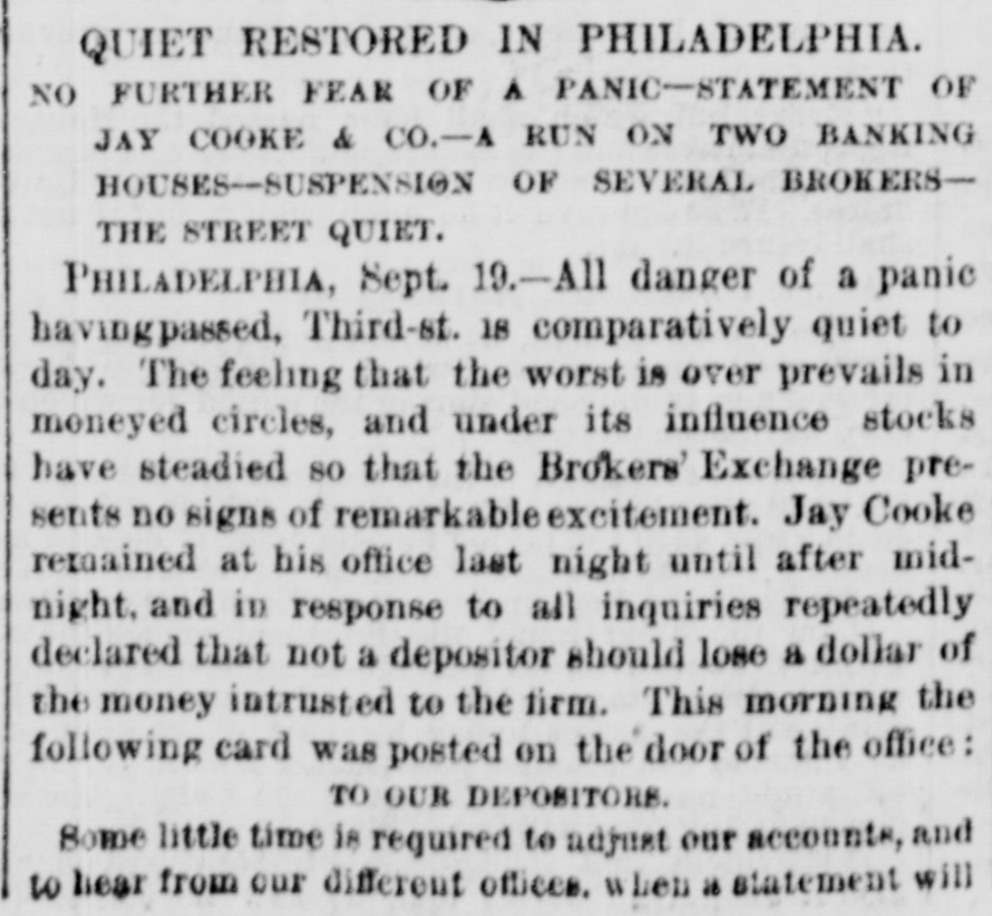
QUIET RESTORED IN PHILADELPHIA. NO FURTHER FEAR OF A PANIC-STATEMENT OF JAY COOKE & CO.-A RUN ON TWO BANKING HOUSES-SUSPENSION OF SEVERAL BROKERSTHE STREET QUIET. PHILADELPHIA, Sept. 19.-All danger of a panic havingpassed, Third-st. 18 comparatively quiet to day. The feeling that the worst is over prevails in moneyed circles, and under its influence stocks have steadied so that the Brokers' Exchange presents no signs of remarkableexcitement Jay Cooke remained at his office last night until after midnight. and in response to all inquiries repeatedly declared that not a depositor should lose a dollar of the money intrusted to the firm. This morning the following card was posted on the door of the office: TO OUR DEPOBITORS. Some little time is required to adjust our accounts, and to hear from our different offices. when a statement will


Article from Pioche Daily Record, September 20, 1873

Click image to open full size in new tab

Article Text

Failure of Jay Cooke a Co.-Financiai Agitation-Stock Excitement -Government Bonds-A Crash Not Apprehended. NEW YORK, Sept. 18. Jay Cooke & Co. have suspended. They announce that their suspension is in consequence of large advances made to sustain their Philadelphia house, and a heavy drain upon their own deposits. Mail advices, from Paris, of the fifth, confirm the report that cholera prevails in France. PHILADELPHIA, Sept. 18. The firm of Jay Cooke & Co. have suspended. A great crowd has collected around their place of business. WASHINGTON, Sept. 18. The First National Bank has suspended. NEW YORK, Sept. 18. There is great excitement on the street in consequence of the announcement of the failure of Jay Cooke & Co. The question is generally asked, who next? Stocks took a tumble. It is said that Jay Cooke has lost large sums in the recent gold movement. The excitement is intense at the Stock Exchange. Vanderbilt stands by his Central, and Lake Shore and the Pacific Mail are cared for; but Western Union dropped from 88 to 781/2. Money quiet 1 at 7. No failures other than Jay Cooke a Co. are announced. It is said that Jay s Cooke, McCulloch & Co., of London. are solvent, with a large surplus above all e abilities. . Eleven bids for Government bonds to day, aggregated $2,317,300, at from 10 to 111/2. No bids accepted. e Specie shipments to-day amounted to le $105,000, in silver bars. y NEW YORK, Sept. 18. There is a general breaking up of stocks of from one to ten per cent., und f der the rush to sell, and great excitement econtinues. d WASHINGTON, Sept. 18. fiThe banking house of Jay Cooke 1Co., of this city, was closed shortly after S, noon to-day. d NEW YORK, Sept. 18. d 1Jay Cooke & Co. make the following Sing statement: The immediate cause of n the suspension of Jay Cooke & Co. was 1the large drawings upon them by their n Philadelphia house, and their own dege positors, during the last fortnight. The ly Philadelphia house had previously been r, weakened by large advances to the it Northern Pacific Railroad Company, of by d which they are the financial agents. as Robinson & Suydam have suspended a, A Philadelphia dispatch says E. W in Clark & Co. have suspended. le in PITTSBURG, Sept. 18. d The Society of the Army of the Cumnt berland held a session this morning, and eselected Columbus, Ohio, as the place ve of their next meeting. The Society releelected Lieutenant General Sheridan 70 President, and instructed the Committee is on the Thomas Monument to employ as of some artist to make a statue of General 10 Thomas, and then adjourned. ve WASHINGTON, Sept. 18. g th Secretary Richardson and Comptroller ot Knox were in consultation to-day relative to to the suspensions here, and a receiver on will probably be appointed to take charge of the First National Bank. of ve PHILADELPHIA, Sept. 18. nMr. Cooke says "I believe this house nwill speedily be relieved from embarhe rassment, and to this end, if needs be, ne pevery dollar of means possessed by the he members of the firm will be applied. rNEW YORK, Sept. 19. on Arrived, steamship Europe from Glas gow. n. rAnother day of intense excitement has of passed over Wall street. Early this remorning predictions were made that this nwould be a hard day, and one that would to ve see the downfall of more than one finan y, cial house, as the late Chicago fire, as was thought, would occasion a drain as at upon deposits, and tend to a panic ty Stocks for the first two or three hour fluctuated wonderfully, but at noon th ll market strengthened. About noon it was an reported that the house of Jay Cooke at rty Co. had suspended. At first the rumo of was considered an idle one, or, at most at started by some scheming faction. Me ece in and boys ran races from office to office The telegraph was incessant in its opera er.


Article from The Wheeling Daily Register, September 22, 1873

Click image to open full size in new tab

Article Text

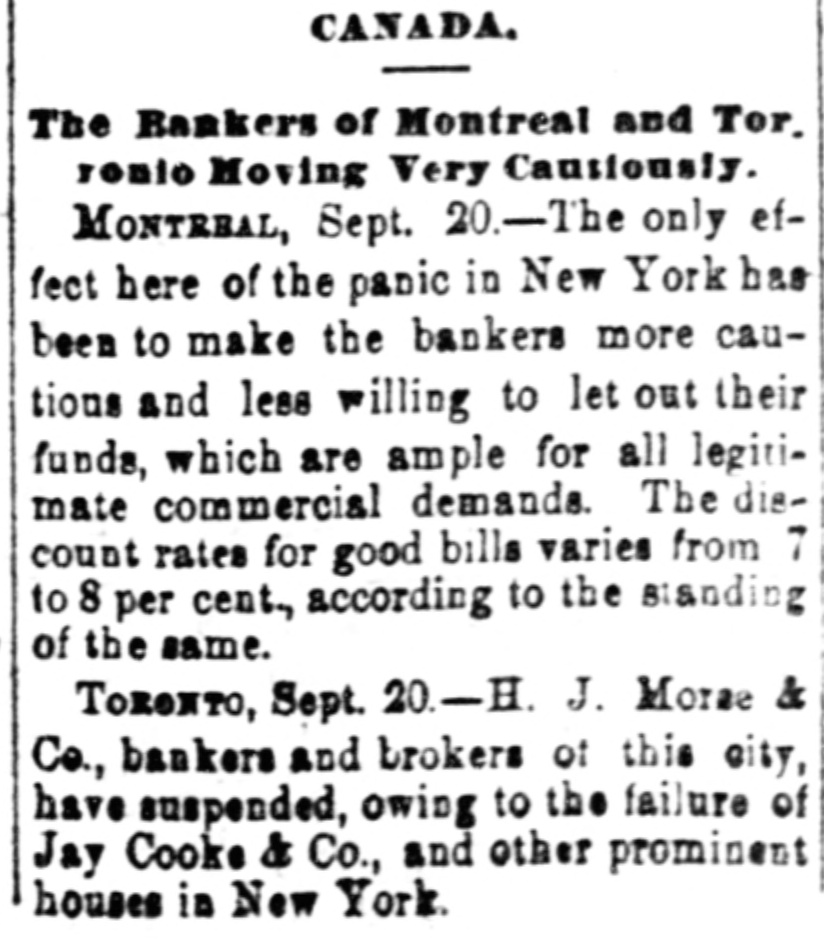
CANADA. The Bankers of Montreal and Tor. ronio Moving Very Causiously. MONTERAL, Sept. 20.-The only effect here of the panic in New York has been to make the bankers more cautions and less willing to let out their funds, which are ample for all legitimate commercial demands. The diecount rates for good bills varies from 7 to 8 per cent., according to the standing of the same. TOKONTO, Sept. 20.-H. J. More & Co., bankers and brokers of this city, have suspended, owing to the failure of Jay Cooke & Co., and other prominent houses in New York


Article from Chicago Daily Tribune, September 25, 1873

Click image to open full size in new tab

Article Text

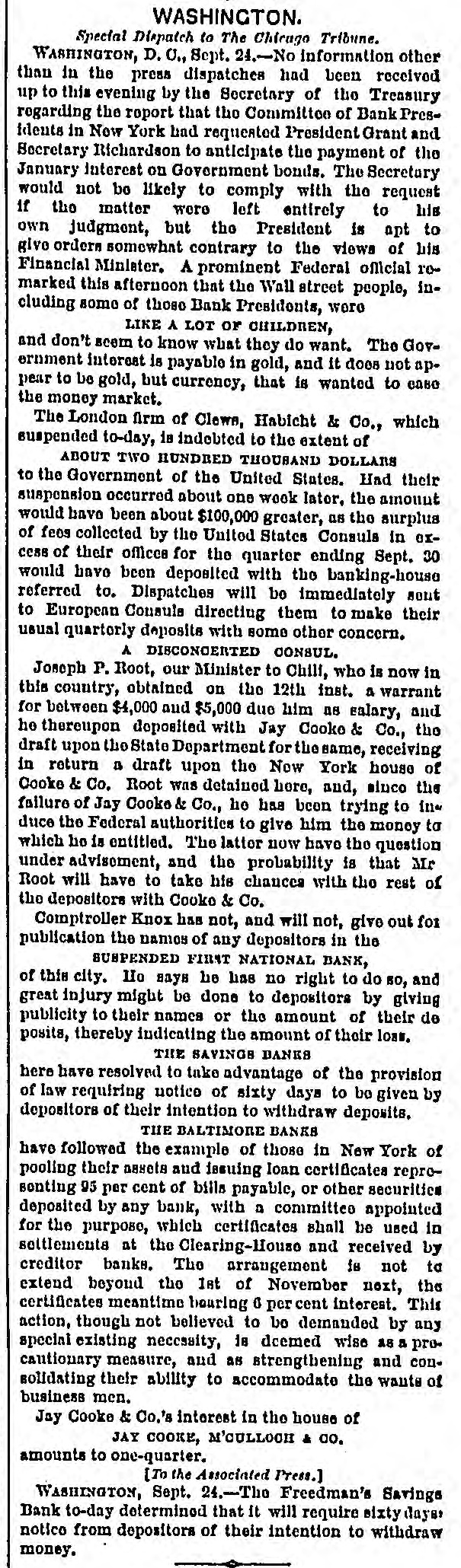
WASHINGTON. Special Dispatch to The Chicago Tribune. WARNINGTON, D. O., Sept. 24.-No information other than in the press dispatches had been received up to this evening by the Secretary of the Treasury regarding the report that the Committee of Bank PresIdents in Now York had requested President Grant and Secretary Richardson to anticipate the payment of the January Interest on Government bonds. The Secretary would not be likely to comply with the request if the matter were left entirely to his own judgment, but the President is apt to give orders somewhat contrary to the views of his Financial Minister. A prominent Federal official romarked this afternoon that the Wall street people, including some of thoso Bank Presidents, were LIKE A LOT or CHILDREN, and don't seem to know what they do want. The Government interest is payable in gold, and it does not appear to be gold, but currency, that is wanted to case the money market. The London firm of Clewn, Habicht & Co., which suspended to-day, is indebted to the extent of ABOUT TWO HUNDRED THOUSAND DOLLARS to the Government of the United States. Had their suspension occurred about one wook lator, the amount would have been about $100,000 greater, as the surplus of fees collected by the United States Consuls in 0Xcess of their offices for the quarter ending Sept. 30 would have been deposited with the banking-house referred to. Dispatches will be immediately sent to European Cousule directing them to make their usual quarterly deposits with some other concern. A DISCONCERTED CONSUL. Joseph P. Root, our Minister to Chili, who is now in this country, obtained on the 12th inst. a warrant for between $4,000 and $5,000 due him as salary, and he thereupon deposited with Jay Cooke & Co., the draft upon the State Department for the same, receiving in return a draft upon the Now York house of Cooks & Co. Root was detained here, and, sinco the failure of Jay Cooks & Co., he has been trying to in duce the Federal authorities to give him the money ta which he is entitled. The lattor now have the question under advisoment, and the probability is that Mr Root will have to take his chances with the rest of the depositors with Cooke & Co. Comptroller Knox has not, and will not, give out for publication the names of any depositors in the SUSPENDED FIRST NATIONAL BANK, of this city. Ho says he has no right to do so, and great injury might be done to depositors by giving publicity to their names or the amount of their de posits, thereby indicating the amount of their loss. THE SAVINGS BANKS here have resolved to take advantage of the provision of law requiring notico of sixty days to bo given by depositors of their intention to withdraw deposits. THE BALTIMORE BANKS have followed the example of those in New York of pooling their assets and issuing loan certificates reprosenting 95 per cent of bills payable, or other securities deposited by any bank, with a committeo appointed for the purpose, which certificates shall be used in settlements at the Clearing-House and received by creditor banks. The arrangement is not to extend beyond the 1st of November next, the certificates meantime bearing 6 per cent interest. This action, though not believed to be demanded by any special existing necessity, is deemed wise 18 a procautionary measure, and as strengthening and consolidating their ability to accommodate the wants of business men. Jay Cooke & Co.'s interest in the house of JAY COOKE, M'CULLOCH & do, amounts to one-quarter. [To the Associated Press.] WASHINGTON, Sept. 24.-The Freedman's Savings Bank to-day determined that it will require sixty days notico from depositors of their intention to withdraw money.


Article from Whig and Tribune, September 27, 1873

Click image to open full size in new tab

Article Text

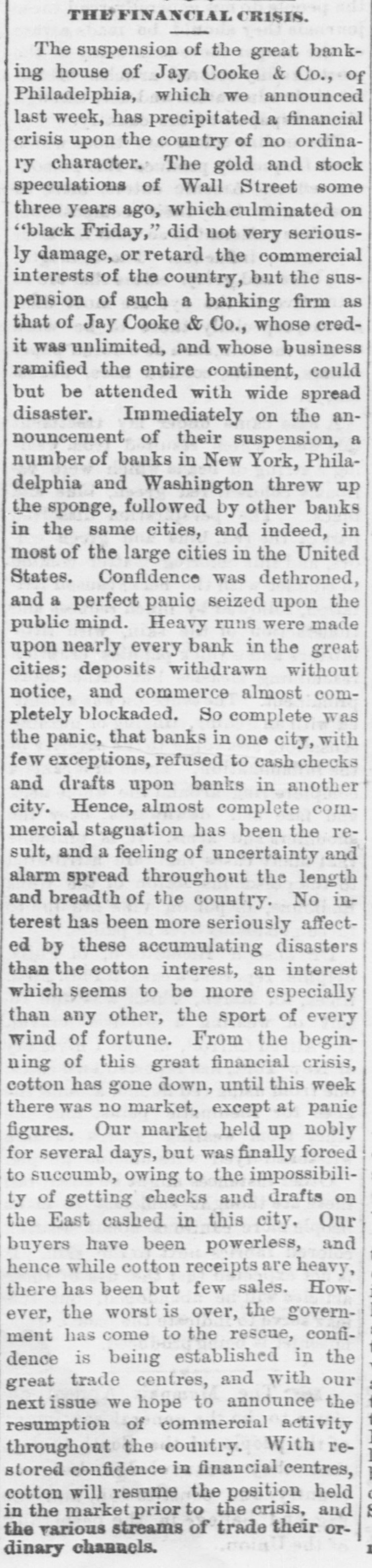
# THE FINANCIAL CRISIS. The suspension of the great banking house of Jay Cooke & Co., of Philadelphia, which we announced last week, has precipitated a financial crisis upon the country of no ordinary character. The gold and stock speculations of Wall Street some three years ago, which culminated on "black Friday," did not very seriously damage, or retard the commercial interests of the country, but the suspension of such a banking firm as that of Jay Cooke & Co., whose credit was unlimited, and whose business ramified the entire continent, could but be attended with wide spread disaster. Immediately on the announcement of their suspension, a number of banks in New York, Philadelphia and Washington threw up the sponge, followed by other banks in the same cities, and indeed, in most of the large cities in the United States. Confidence was dethroned, and a perfect panic seized upon the public mind. Heavy runs were made upon nearly every bank in the great cities; deposits withdrawn without notice, and commerce almost completely blockaded. So complete was the panic, that banks in one city, with few exceptions, refused to cash checks and drafts upon banks in another city. Hence, almost complete commercial stagnation has been the result, and a feeling of uncertainty and alarm spread throughout the length and breadth of the country. No interest has been more seriously affected by these accumulating disasters than the cotton interest, an interest which seems to be more especially than any other, the sport of every wind of fortune. From the beginning of this great financial crisis, cotton has gone down, until this week there was no market, except at panic figures. Our market held up nobly for several days, but was finally forced to succumb, owing to the impossibility of getting checks and drafts on the East cashed in this city. Our buyers have been powerless, and hence while cotton receipts are heavy, there has been but few sales. However, the worst is over, the government has come to the rescue, confidence is being established in the great trade centres, and with our next issue we hope to announce the resumption of commercial activity throughout the country. With restored confidence in financial centres, cotton will resume the position held in the market prior to the crisis, and the various streams of trade their ordinary channels.


Article from Shepherdstown Register, September 27, 1873

Click image to open full size in new tab

Article Text

eitement in financial failure of quite followed by the York and number of good many speedily a places. firms There in aroin New the cause of the suspension, other explanations and afloat many as to opinions as to the Co.-New consequence. CARD FROM 18.-Jay JAY COOKE Cooke & & "The Co. YORK, Sept. following statement make cause of the large & Co. immediate the was the suspension Philadelphia draw- of them ings Jay Cooke upon their own by their depositors houses during have house and Both depossuffered the last fortnight. a large drain of the upon uneasy their and feeling which its which in consequence has recently prevailed all houses closehas affected more or new less railroad interests. ly identified The Philadelphia with weakened by house large had Rail- cash preto advances which viously been the Northern Pacific are the they road Company. of The business of Jay is financial McCullock agents. & Co., house London, is distinct, it will meet all its entirely Cooke, solvent. SO and that that of credit perfeetly drafts and letters travelers and outstanding inconvenience to to the have without a large cash surplus to apply American house. The New York cause Sun of Jay says Cooke's Northern fail"The is the chief attempt to build enormous the and ure Pacific ill-considered Railroad. undertaking That resources. was sufficient Its to exhaust we the fear, strongest will involve confiding thousands people downfall, widows,orphans and and of of limited means in lasting poverty embarrassment." & HATCH. FAILURE OF FISK fiTHE York, September 2.-...The more failnancial panic Among & New reported continues, to-day. and of F isk the announcements ures are is the failure temporary, Hatch, Fish extensive and Hatch brokers. state that the and suspen- was sion can only loans be called in on government realized caused by could not be securities. upon at the which present which crisis. they have They made say the securities on two railroads, Chesadvances are Ohio ON and Central Pacific, They apeake of and which are completed. resume business to ceases. expect both soon be able as the to panic experienced again as street has never on Black Wall storm, and the panic exceeded by it. stock market such Friday a in 1869 is by as far the first failure was In the announced little the in entire the list interim dropped, failure but recovering falling lower a as each successive s'ates was announced. Hatch, of Fisk & Hatch, failure great that Mr. owing to yesterday's suddenly and could unexdemands came their so house that they time peetedly on met. There was no assets not b readily to obtain money on due the the firm, or to made heavy left of firm. in which The house Pacific collect which, money however, advances to the Central of their suspension. Ohio is not the to cause the Chesapeake and advances having brought them down. HENRY CLEWS & CO. re13.-In York, September Clews to the that during gard New firm suspension states of Henry out the & Co., days they have paid and a half efforts to day to impast four the utmost millions in money. it They raise one to made the securities, but finding compelled money on to They do so regard were their suspension no further as only temporary. save that to advisable. statement suspend. possible make and have National they deemed suspension Fourth The cashier of the Clews & Co.'s Bank, which amount of $200,000 their checks to so simply was the bank There did the threw good. out because says the no was not have been had account over draft but would The firm paid until no bank allowed it. remained on hand,and as of they greenbacks could negotiate large no amount,nothing securities, which they had a Clews Co. in remained but $800,000 suspension. in securities against say that Fourth had National amount Bank, of $300,000 the which checks to drawn. the The firm paid deonly had been in legal tenders few days, to and out positors was $1,250,000 the during general the impression past that they would it pull through made known Company,the also a defalThere was Union Trust the cation in the C. Carlton, son of defaulter being Carlton of the Methodist the Concern, Rev. Dr. and secretary of caused which Book Union Trust Company, He had been secretary great surprise. Trust Company since to of the had grown 1860, and Union the financial concern institution under be immeuse The additional an The pensions are as the Bank his management. Company, follows: Trust of the Compa- Union Com- susTrust the National Association, monwealth, Mechanics Banking E. C. Broadhead White & & Belknap & Co., ny,the C.G. Co., Ketchum Co., Taussig & Brown, Fisher, Walsh, Wadsworth & Co., Miller & P. M. Myers & Fearing & Dellinger, & Laurens, Joseph, & Bostwick, W. E. G. Haight MooreWilliams Sexton & Rogers, and Squires


Article from Chicago Daily Tribune, September 29, 1873

Click image to open full size in new tab

Article Text

NEW YORK. Special Disvatch to The Chicago Tribune, NEW YORK, Sept 28.-The bright prospects with which the wook closed for Wall street continuo to-day, and there is visible nothing of the intense excitement which characterized last Sunday. The street yesterday, and the hotels today, have been dull in fact, business on tho street le 80 far suspended that the excitement thore, on Saturday, was less than on ordinary days at this time of the year. The prospects for tho week are that BUSINESS WILL RESUME WITHOUT DELAY or much excitement, unless in the Stock Exchango. Tho difficulty in selling foreign exchange Becms to have been overcomo in a large measure, and heavy shipments of allsorts of grain were made yesterday. The demand for freight room WAS unusually heavy at generally advanced rates. The suspended firms are rapidly reorganizing, and promise a resumption of business before the end of the week. Howes & Macy have practically resumed already. Clows & Co. say they will bo ready to begin anow before the statement of their affairs is ready for publication. Fisko & Hatch, more conservativo, declino to begin again until all their past indebtedness is cleared off. Jay Cooke & Co. promise n favorable showing soon, but it is believed they will be kept down by the Northorn Paciflo Railroad. The Union Trust Company will get on italegengain. It is naturally a strong concern, each sharoholder being hold liablo for the amount of his stock; but the Bank of the Commonwoulth is probably a hopeless wreck. The opening of the Stock Exchange on Tuesday, BB resolved on, creates great unoasinoss, both in stock and commercial circles, particularly in the latter, whose members anticipate renowal of excitement, which may again extend to the commoreial exchanges and produce great distross to morcantilo houses. The Produce and Gold Exchanges RESUMED WITHOUT DISARTROUS RESULTA, and this fact encourages the hope that 110 bad effects will follow the roopening of stock gambling. The announcement that business will be resumed at the Stock Exchange implies that the conflicting and confused nocounts of the brokers have boon straightened out and settled. Otherwise, the opening would be only a signal for & renewal of the pauio, and of a fierce light between bulls and boars. Now, it is hold, there is little cause for controversy on the Bourne, and EVERYTHING PROMISES PEACE and quietness, at loast until the futuro shall divido the members into distinct parties again. It in claimod by dealers that business, for some time, at least, will be conducted with more modoration than formerly. Dr. Thomas Carlton. on being asked if he


Article from New-York Tribune, September 30, 1873

Click image to open full size in new tab

Article Text

HOWES & MACY. It is not the intention of this firm to make any public detailed statement of their affairs. They consider it unnecessary in view of the fact that they are adjusting matters as rapidly as possible, with the purpose of continuing business at as early a date as practicable. They are in daily receipt of letters from their customers, acceding to the proposition contained in their circular, and with the many satisfactory assu* rances thus received they are determined to resume operations on the plan proposed, in the hope that the experiment will eventually prove successful. Mr. Macy says the whole financial difficulty assumes a very peculiar phase. If a person has "money any where else than town in his own control he cannot get it. People out of who make collections for his house write that such and such an amount is deposited to their credit in such and such a bank. But that does not do them any good; that is not what they need; all the exchanges are so bad that certified checks are next to useless if one cannot get the money on them. Mr. Macy had been visited by a country correspondent who had come to New-York to draw a large amount of money which had been deposited in his bank in small amounts, and which the country banker had sent to the city for investment. But be could not procure the funds in) available shape, and remarked that unless he could get his deposits in bills of staall denominations, they were of no more use to him than 80 much brown paper. Mr Macy would have been glad if the Government relief had been proffered through another channel, whereby it would have brought money into the country and distributed it among the people. He thought $10,000,000 in the hands of the merchants at this time would do more good than if distributed among the banks. The present outlook was not very clear, yet they were cheerful and hopeful. Biugham Bros. & Brace of Mount Morris, N. Y., and E. B. Hale & Co. of Cleveland, Ohio, deny that they are correspondents of Howes & Macy. HENRY CLEWS & CO. This firm is still engaged in the preparation of its statement, but the time of completion is uncertain. It will be exclusively for the information of the creditors of the house, publicity probably being given to nothing beyond a report of assets and liabilities. Mr. Clews believes the effect of the panic will be felt for years. He says everybody in the street has virtually suspended that is,they cannot pay their loans or meet their obligations, and if they were applied to for the money they would be obliged to suspend, the same as the rest of us." He thought the outlook was horrible-frightful. With 6 per cent for greenbacks as against certified checks, who could stand I" JAY COOKE & CO. These gentlemen believe the prospect is brighter and that the good or iil of the future is dependent largely on the exercise or lack of caution and a spirit of accommo dation on the part of creditors as against their debtors. They are rather afraid, however, of the effect of the reopening of the Stock Exchange this morning. The fact is, they say, our banks are poor. They hold large quantities of stocks as security for loans. If they press their claims for the money upon which these collaterals are held the result will be disastrous, and will be felt all over the country. But if the banks are inclined to be lenient toward their customers the trouble will be tided over, and we may before long discern the tokens of better times. Messrs. Jay Cooke & Co. have presented, in their report of assets and liabilities, all they intend to make public. They will, however, issue a statement of their condition and accounts for the information of their customers, together with a circular containing plan of resumption, which will be submitted to their patrons, and to the propositions in which the latter will be asked to accede or dissent therefrom. FISK & HATCH. The members of this firm, while not shrinking from reasonable publicity, feel that a detailed statement of their accounts is a matter strictly between themselves and their creditors. The public is entitled to understand their general condition and prospects, and to cover this obligation it is stated that Fisk & Hatch have an abundance of assets and a surplus sufficient to pay everybody and resume business with a large margin. They are now working with a definite object in view, of which, if accomplished, the public will DO fully informed.; THE UNION TRUST COMPANY. Mr. Wesley, the receiver of the Union Trust Company, yesterday morning denied the report that Commodore Vanderbilt had returned to the Company their loan to the Lake Shore Railroad. FAILURE OF THE GLENHAM MANUFACTURING COMPANY The Glenham Manufacturing Company, a corporation in existence for more than fifty years, having extensive woolen mills at Glenham, N.Y., and its office at No. 293 Broadway, suspended yesterday morning. The President, Russel Dart, said that to give in detail the causes of the suspension would involve a long statement, which he was not disposed and had not the time to make. In general terms, it was due to the depression of business, and resulted directly from the financial panic, which had prevented merchants from going on as they otherwise would. Previous to the disturbance in Wall-st., the outlook for business was good. He was not prepared to make even an approximate estimate of the assets liabilities, and could not tell whetner the suspension would be final or only temporary before learning the disposition of the creditors. He was also unable to say whether the creditors where chiefly individuals or corporations. as it is impossible at present to tell where the paper of the Company 18 placed. The Company was organized in 1820 by Peter H. Schenck, the grandfather of President Dart. James Dart, a brother of the latter, is Treasurer, and the organization is wholly a family affair. The original capital was $140,000, and it has always been maintained at that figure, but Mr. Dart said that at least $1,000,000 had been expended on the Company's property, which could not be replaced for that sum. The Company owns 200 acres of land at Glenham. with large factories for the manufacture of woolen goods, and dwelling-houses for all of the 500 operatives. Mr. Dart was unable to say whether the suspension would result in throwing all these operatives out of work, as this would largely depend upon the action of the creditors. Up to the present time the Company had never been involved in any difficulty. A dispatch from Philadelphia announces the suspension of Benjamin Bullock's Sons. extensive wool dealers, in consequence of the suspension of the Glenham Company, which Company owes the firm about $600,000. FINANCIAL PECULIARTIES.


Article from The Albany Register, October 4, 1873

Click image to open full size in new tab

Article Text

Latest News. The financial outlook at the East is gradually assuming a more reassuring character, and it is believed that business will soon resume its old channels. Immense sums in gold have been withdrawn from the Bank of England for shipment to the United States. A financial crisis is threatened in Germany. From Spain comes the news that the Carlists have suffered a series of defeate in the north, and discontent and disertions are spreading in their ranks. The police had closed all gambling houses in Madrid on the 29th ult. Several serious accidents have occurred on British railroads recently. Benicia, it is reported, is to be made a permanent military depot. $60,000 are being spent in erecting officer's quarters; also, an artesian well is being sunk, it having already reached several hundred feet. Notwithstanding the fact that the revenues have been comparatively light, it is asserted the Treasury Department will show a fair reduction of the puulie debt for September. In Philadelphia wool is quoted at 28 to 35c; coarse, 23 to 39c. The missing schooner, Three Brothers, was picked up and towed into Little River, Newfoundland. on the 22d ult. Seven bodies were found in the cabin-the remainder, fourteen. are supposed to have been washed overboard. They have been experiencing earthquakes in Gautemala. All religious communities have been suppressed and their property dedicated to beneficence and instruction, at San Juan del Norte. At the request, of debtors, and by consent of petitioners, orders requiring Jay Cooke & Co. to show cause why they should not be adjudicated bankrupts, have been continued for one week. The Washington Second National Bank has resumed currency payments. The public debt statement shows a reduction of $901,469 during the month. Northrup & Chick, bankers in Wall street, have suspended. Heavy calls from Western depositors was the cause. They have had no dealings with the Stock Exchange. The Grant Locomotive Works, Paterson, N. J., on account of scarcity of greenbacks, discharged an additional 175 men. The work on the Delaware, Lackawanna and Western Railroad Tunnel, through Bergen Hill, has been suspended. throwing 400 men out of ema (if ployment. The death of Hon. J. B. Baldwin is announced. He died at Stantou, Va., on the 30th ultimo.


Article from Nashville Union and American, October 11, 1873

Click image to open full size in new tab

Article Text

When the telegraph first flashed the news that a panic had been inaugurated by the failure of Jay Cooke & Co.'s Philadelphia house, we asked in a head-line "Where are the State Funds of Pennsylvania?" From the Philadelphia Age of the 8th, we see the people are still asking that question. According to the official report of the Radical Treasurer, Mr. Mackey, there is an unexpended balance of over a million dollars somewhere. But the Soldiers' Orphan Fund due Sept. 1, amounting to $125,000, is not yet paid, and the State officials at Harrisburg have been paid only a portion of their salaries for last month. Where then is the State's money? The Lancaster Intelligencer explains that the yearly balances are loaned to various banking institutions in the State, and the interest is divided between the State Treasurer and the Radical "Ring" of Pennsylvania. So the most favorable view of the case, is that the State funds are locked up in some of the semi-suspended banks, and are utterly beyond the control of the Radical Treasurer.


Article from The Ottawa Free Trader, November 8, 1873

Click image to open full size in new tab

Article Text

THE PANIC. While the west seems to bear up manfully against the panic, and the Chicago and St. Louis banks have not only fully resumed, but the former, at least, are able to extend pretty liberal accommodations to their customers and assist in moving our enormous crops, the outlook at the east continues gloomy and discouraging. In New York the shrinkage of values continues, and on Thursday gold went down to 614, the lowest point it has reached since 1862. The slight buoyancy that had shown itself at the close of last week was rudely dashed by the announcement that the great manufacturing firm of A. & W. Sprague, of Rhode Island, had suspended. The firm has for three generations occupied a leading position among the manufacturers of the east, and of late years the business has been extended vastly, SO that at the present time the Sprague influence permeates almost every branch of trade and finance in Rhode Island, as well as extending into Maine and other contiguous states. They control not only all the cotton manufacturies of the state, the national and savings banks, run several immense dry goods and general supply stores, but may, in fact, be said to run the entire state of Rhode Island, commercially, socially and politically. The assets of the firm are estimated at from sixteen to twenty-five millions, and their debts at $8,000,000. Their complete suspension would involve the discharge of 10,000 factory operatives. Negotiations are on foot to put their affairs in such a shape as not to close the factories, On the heels of the Sprague suspension followed on Tuesday another disaster-no less than the suspension of Tom Scott, the great Pennsylvania railroad king. His case is very much like that of Jay Cooke. He was carrying the Texas Pacific as Cooke was the North ern Pacific railroad. Scott had gone to Europe and negotiated a loan of $10,000,000 to continue work on his road, meantime endorsing vast amounts of the road's paper in anticipation of receiving the $10,000,000 loan. But just as the loan was being consummated, the news of the Jay Cooke explosion reached Europe, and the Scott loan collapsed. As a consequence, his Texas Pacific paper has gone to protest, and Tom Scott is floored The greatest fear is, that the Pennsylvania Central will, in consequence, fail to pay its usual semi-annual dividend of five per cent., which would greatly add to the embarrass. ment of things. To add still further to the gloom, a rumor was current on the 4th that the great mercantile house of H. Claflin & Co. was about to suspend, but this proved groundless. The firm not only show that they are abundantly solvent, but even refused to accept assistance tendered them by the New York banks. As a bit of sunshine amid the gloom, the announcement is made of the speedy resumption of the Philadelphia house of Jay Cooke & Co. A member of the firm is reported as saying, on Tuesday: "The agreements are rapidly being signed by our creditors, and are coming in with gratifying promptitude. We have every reason to be encouraged. We have merely asked forbearance of our creditors and we shall avoid bankruptcy with perfect certainty. The house will be able to resume within a few weeks, at any rate just as soon as the confidence of a great majority of our creditors is assured to us."


Article from Alexandria Gazette, November 11, 1873

Click image to open full size in new tab

Article Text

# House of Jay Cooke & Co. The receiver of the First National Bank of this city paid out about $40.000 yesterday, at the rate of thirty ets. on the dollar, to such depositors as had proven their accounts and appeared to receive the same. He is ready to pay the rest of the depositors, at the same rate, when their accounts are adjusted and they demand the money. Ex-President Johnson is reported to have received about $23.000. It is expected that a further dividend of twenty per ct. may be made in the course of next month. By that time it is hoped that the affairs of Jay Cooke & Co. will be so far adjusted as to determine with considerable accuracy the dates and amounts of future dividends. Rapid progress is being made toward the settlement of the affairs of this house under the proposed arrangement, naming Mr. E. A. Rollins trustee. A large proportion of the creditors have assented to this amicable and economical method of settlement, and those who prefer it have the optional offer of Northern Pacific railway seven-thirty bonds for their accounts at eighty-five, and the remaining fifteen per cent. in cash. This latter offer is only made because the firm have the bonds on hand in sufficient amounts to settle up in this manner with all their creditors, and desire to do so. They have lost no faith in those securities, which are now intrinsically worth more than par, and the interest on them has never defaulted. It is also understood that the January interest in gold is provided for already. --- Wash. Republican.


Article from The Wheeling Daily Intelligencer, November 18, 1873

Click image to open full size in new tab

Article Text

NEW YORK CITY. NEW YORK, Nov. 17.-The recruiting of seamen and marines for the United States Navy Yards is in progress at the usual offices. The fine Spanish iron clad Arapeles still occupies the dry dock, with a red and yellow flag floating at her peak. The work on this vessel has not been suspended, as reported. Admiral Rowan contradicts the published report that orders have been given to confine the crew of the Arapeles to the limits of the Navy Yard. John E. Fox & Co., of Philadelphia, have begun involuntary proceedings in bankruptcy in the U.S. District Court in this city, against Jay Cooke & Co., and the defendants have been enjoined from parting with any of their assets until the question of adjudication from involuntary bankrupts has been passed upon Lewis Posenthine, one of the negroes who murdered Abraham Beahm, near Middletown, Friday night, was arrested here this morning. Hugh McCulloch, of Jay Cooke, McCulloch & Co., of London, sailed for England Saturday. The firm will be dissolved at the end of the present year, when McCulloch and his English juniors will continue business under new and strong combinations. Judge Larremore has decided that the new Police Justice act is Constitutional. Mrs. Templeton, who was shot by her husband, Saturday, was still alive this morning. The physicians say they have little or no hope of her recovery. At the navy yard to-day the same activity was manifested as for the past few days, and 250 men were added to the force. The Juniata is now ready for RPA, and will anchor off the Battery to await orders. It is stated by employes of the navy yard that work upon the Spanish iron clad Arpeles was suspended this afternoon. The steamship Cleopatra, which arrived to-day brought the newspaper mails she took on her outward bound trip to Havana. The Spanish authorities refused to allow them to be landed.


Article from The New York Herald, January 17, 1874

Click image to open full size in new tab

Article Text

JAY COOKE'S CREDITORS. Second Meeting To-Day-The Business Done-The Voting for Trustee. Philadelphia, Jan. 16, 1874. Many of the creditors of Jay Cooke & Co., disgusted with the boisterous incidents which characterized their meeting yesterday afternoon, were not present at the meeting to-day, and hence the crowd was not by many hundreds so large. In order to prevent the repetition of those disgraceful proceedings this morning the United States Marshal was on hand, who, with his deputies, insisted upon and preserved perfect order. There was but little business of an interesting order transacted during the first hour of the meeting, nor was any excitement whatever evinced until the proposal of the following resolution by Mr. Christie, of Washington:Resolved, That we, the creditors of Jay Cooke & Co., determine that it is for the interest of the general body of the creditors of the said firm of Jay Cooke & Co. that the estate of the said firm, and the estates of the several members thereof as individuals, should be wound up and settled, and distribution made among the creditors by the trustee, under the inspection and direction of a committee of the creditors of said bankrupts. And be it further Resolved, That Edwin M. Lewis be selected as trustee, and he is hereby nominated to the said District Court for confirmation. And be it turther Resolved, That John Clayton, Isaac Norris and Robert Shoemaker, of Philadelphia; Charles B. Helfenstein. of Northumberland county, Pa.; Joseph Brown. of Wilkesbarre, Pa.: J. Hubley Ashton, of Washington, D. C.; B. R. Cowen, of Ohio. and Coulter Watson. of the city of New York, be selected as the Committee of Creditors. As soon as the above was read Mr. Franklin moved that the expenses of the committee should not exceed $100,000. Some one immediately insinuated that were so large an expenditure allowed there would be nothing at all left for the creditors themselves. A motion was then made to drop altogether the question of compensation, which motion, after a little debate, was carried by a majority of 140 votes. The voting upon the various motions and propositions set forth in to-day's Herald was then resumed, and continued until five o'clock this afternoon. Up to the closing or the polls at that hour it was pretty evident that the proposition for a committee of creditors and the appointment of one trustee was likely to be carried, and that this one trustee was likely to be the present receiver, Mr. Edward M. Lewis, President of the Farmers and Mechanics' Bank, of this city, as advised in the resolution above. Seven hundred creditors voted in the above election to-day, but Mr. Mason states that it will be impossible to give the result to-night. The issue will be rendered to the Bankruptcy Court to-morrow. The creditors will hold another meeting on Monday afternoon to hear what the Court decides upon in the matter. Mr. Lewis was the only candidate named for trustee, and is, therefore, doubtless elected. The largest approved claim was that of the First National Bank of Washington, D. C., amounting to $800,000.


Article from Alexandria Gazette, October 30, 1874

Click image to open full size in new tab

Article Text

NEWS OF THE HAY. To show the very age and body of the Times" The Medical Chirurgical Association of Maryland met in semi-annual session yesterday in Baltimore and was well attended. An effort, is said, is now being made to consolidate all the medical societies of Baltimore under one organization. A number forged telegrams have been recently received at the Postoffice Department in Wsshington, urging the reinstatement of an Iowa special agent. They were all sent as collect messages, and the fraud has been only just discovered. Le Nouvean Monde newspaper contends that it is the duty of the French Canadian members of the Dominion government to insist ou a pardon for Lepine, and an amoesty for Riel, and failing to secure such an action to resign. A motion for the appointment of a receiver of the property of Henry Clews, of New York, on behalf of the First National Bank of Tarrytown aud L. E. Schueider, judgment creditors, has been demed. A gale at Ironton, Ohio, at noon, yesterday, blew down a new three-story brick building, nearly completed, which in falling demolished a two-story frame dwelling. The immates es caped unhurt. Wm. Simpson, newsdealers, convicted in New York of sending obscene matter through the mail, was yesterday sentenced to ten yetrs' imprisonment and a fine of five thousand dollars, to stand committed till paid. The rumor at St. Paul, Minn., that Oliver Dalyrimple the great wheat farmer, has failed and made an assignment, is pronounced by Dalyrimple himself to be entirely without foundation. Mr. O. H. Gill, a prominent citizen and for forty years a member of the wholesale tea house of Martin Gillet & Co., of Baltimore, died yesterday. A telegram from Indian Territory says that the Indian war in the Wachita Agency is rapidly collapsing; sixty-nine warriors and two thousand ponies were captured. The United States Circuit Court of Philadelphia has reversed the order of the District Court appointing a meeting of the creditors of Jay Cooke & Co. It was said in Washington last night that Judge Lemuel D. Evans, of Texas, will succeed Major Thos. B. Ochiltree as Marshai of the Eastern District of that State. The trial of Kullman for attempting to assassinate Bismarck, began yesterday at Wuzberg. Kullman admitted his guilt on all the principal points. Plymouth, Pa., yesterday was visited by a fire, which did damage to the extent of $100,000 ia, which there IS not over $5,000 to $6,000 insurance. Among the passengers by the steamer Algeria, which arrived at New York yesterday, was Counsellor A. P. De Carvalho Borges, minister of Brazil to the United States. John Laird, the well-known shipbuilder and member of Parliament for Birkenhead, England died yesterday. Ex-President Thiers arrived in Nice yesterday, and there was great demonstration in his honor. The Conservatives of Charleston city and county, S. C.,, have fused on it county ticket, and are confident of success. The Prince and Princess of Wales have returned to London from their continental tour. A large shipment of sugar from Mobile to St. Louis is reported. A Rotterdam telegram says that the Old Catholic Bishop of Leycamp is dead. There are still more conflicting reports from the seat of the Carlist war in Spain.


Article from Wilmington Daily Commercial, January 6, 1875

Click image to open full size in new tab

Article Text

The Pacific Mail Investigation, RESUMPTION OF THE INQUIRY AT WASHINGTONHOME RICH REVELATIONS ANTICIPATED-IRWIN HAID TO BE READY TO .. BLOW ON JOHN ROACH. [Special dispatch to the Balto, Sun.] WASHINGTON, January 4.-The sub-committee engaged during the holidays in taking testimony in the Pacific Mail investigation having now rc'urned from New York, the investigation will be continued here by the full committee. Interesting and racy developments are expected, notwithstanding the alleged disappearance of one or two of the chief persons the committee were counting on to have before them. The committee will, among its first acts, now call Mr. Irwin to the stand to ascertain whether he is still afflicted with the nervous prostration which 80 suddenly overtook him when they "began to put leading questions. The belief is that even a continued refusal to answer on the part or Mr. Irwin, and the flight of Mr Schumaker, if he has really gone to Europe as alleged, cannot prevent the committee from getting at the main facts. It is hinted that Mr. Irwin is now ready to "blow" about John Roach getting his $2,000,000 contract on condition that the subsidy passed Congress, and that the present board of directors have ratified the action of the former management, and that he and his friend Stockwell did not spend the most of the $759,000 in stock speculations as has been alleged. Enough has been discovered to indicate, at any rate, that the committee can, by summoning one or two persons, obtain some valuable information. Not a little uneasiness has been evident in certain lobby circles during the progress of this investigation. If Mr. Dawes will throw off a little of his lukewarmness and go thoroughly to work, it is believed he and : is committee will find all about the Pacific Mail corruption fund which is worth knowing. Some of the members of the committee were at the banks to-day engaged in tracing up the checks which were sent to Washington. The Books of Jay Cooke & Co. being in the hands of the receiver in Philadelphia, he has been notified to produce them here before the committee.


Article from Bozeman Avant Courier, September 12, 1878

Click image to open full size in new tab

Article Text

# Odds and Ends. Banning, the great army reducer, has been ingloriously slaughtered in the house of his friends. The Democratic Congressional Convention, which convened at Cincinnati Saturday, put Banning is his little bed by beating him for renomination. Another striking illustration of the ingratitude of republics. The Nursery publishes a charming little story of an army mule at Fort Ripley which, witched to a cart, was used every day by fatigue parties to haul off rubbish. The mule learned the bugle calls so that whenever the recall sounded, no matter what he was doing or where he was, whether at work or play, hitched to his cart or not, he would make a break for the stable at a full gallop. He knew that his work was then ended and it was time to rest. Our readers will act wisely and sensibly by patronizing only such establishments as advertise and make known to the world what they have. The men who decline to sustain a local paper, that strives earnestly to bring the resources of its section to the favorable notice of capitalists and others, are wholly undeserving of patronage from any source. It costs something for the settlement of a large bankrupt estate. Since Jay Cook & Co., of Philadelphia, assigned the lawyers have made havoc of the estate. Before the creditors can draw their honest dues the following reductions are made: Counsel fees to the amount of about $41,311.37; extra counsel fees about $39.235.10; incidental expenses about $16,654.55; salaries about $54,646.49; compensation of committee about $34,480. Amounting in the aggregate to $4,187,327.51. The Rev. A. C. Roe remarks, in The Christian Union, that though it shakes faith in the biologists, he can make nothing out of Nature's free fight in forest or garden, but "the survival of the unfittest." The principle of selection of work there is mere strength and robustness, without regard to fragrance or beauty, or usefulness to man or beast. This is a hard tact, but intrenched behind cold frames and hot beds, and armed with rake and spade, biology cannot dislodge him. If good things gain the upper hand, though but slowly, or even hold their own, depend upon it, there's a gardener somewhere at work. May it not also be true of the great world-garden about us? Are all the fools dead? No, but they are trying to get out of existence as fast as possible. The record says that a Troy woman took strychnine because her husband wouldn't run in debt to get her a velvet cloak; a Chicago youth swallowed an overdose of morphine because a bad woman locked him out of her miserable heart and house; a sixteen year old Kentucky girl took rat's-bane because an old married man told her he had no business to love her; an Arcola, Ill., man hung himself in the smoke-house because he possessed only ten thousand dollars, and feared he might come to want. These are little bits of samples of what is going on in the busy world, and every day brings a fresh item.


Article from The Copiah Signal, October 4, 1883

Click image to open full size in new tab

Article Text

FINANCIAL PANICS. In May, 1837, the New York banks suspended, and the crash, which had threatened for some time, came to the country. This disastrous event was fol. lowed by other failures, many business establishments were forced to close, and even States became bankrupt. Farm products fell greatly in price, credit was n by-word, and the finances of the Government were in such shape that the President of the United States could not always get his salary when it was due. This was about the time when the national debt amounted to only a nominal rum. The panic of 1857 was opened by the failure of the Ohio Life Insurance and Trust Company. Many banks in all the States were obliged to suspend, and certain kinds of paper were abroad, which proved to be worthless. The panic of 1878 was inangurated in September by the failure of Jay Cooke & Co., of Philadelphia. The effects of this last financial hurricane are too well known to need recital here. Various auses have been attributed to these financial caises, almost all writers agreeing, however, that reckless speculation, growing extravagance, and the carelessness with which debts were contracted were among the leading ones.