Click image to open full size in new tab
Article Text
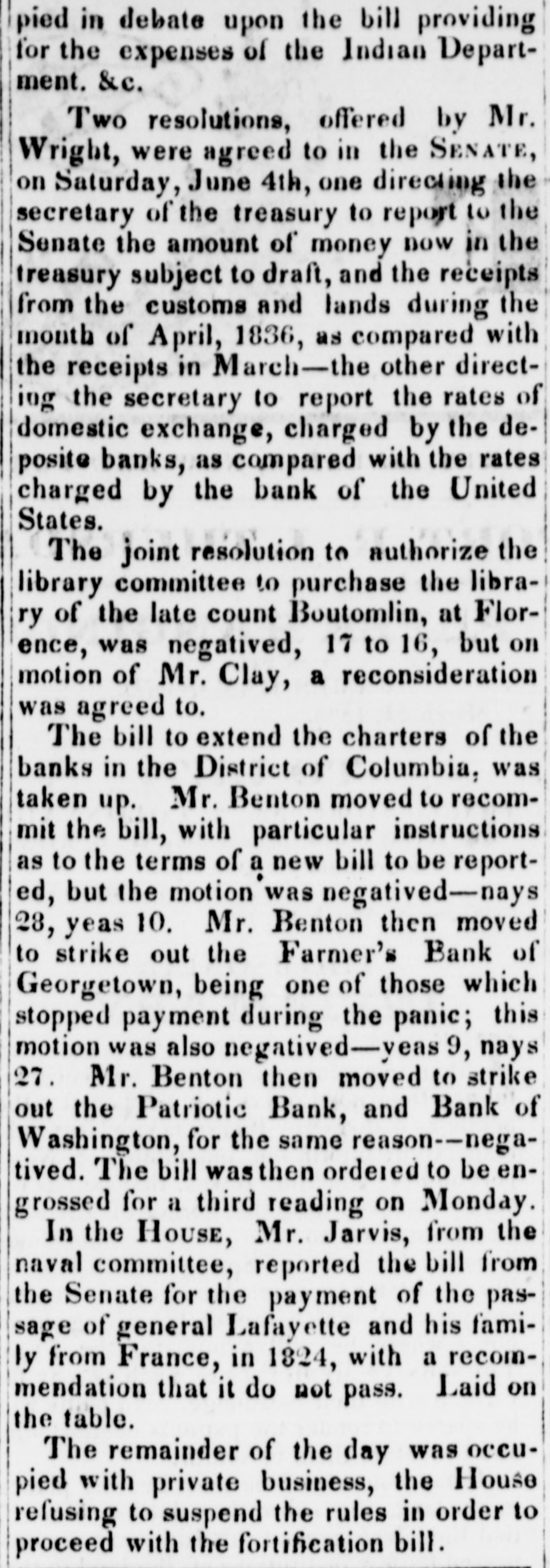
article, and SO must. But won't pay SO high again, and SO I won't. Every short sentence, and he seldom made a long one, was nailed by an emphatic negative or affirma tive, which made his conversation very amusing. He accumulated a verv. considerable fortune, and being without family he bequeathed nearly the whole of it to charitable and benevolent objects. I was with him frequently during his last illness, and he consulted me about the disposition of his fortune, $10,000 of which he left to the Catholic Orphan Asylum of this city, and a similiar amount to the Protestant Orphan Ass lum. "OLD HICKORY". AND THE BANK OF WASHINGTON. The financial storm which swept over the country, beginning about 1833, arose to its height in 1836 and '37, and was felt sever ely in this city. Connected with the suspension and resumption of business by the banks, an incident occurred which afforded a good Inside view of the love of fair play which characteriz ed Gen. Jackson, and showed that glorious "Old Hickory" would do justice, even when by doing SO he had to take back opinions that he ha pressed in his emphatic style. I was then a director of the time-honored institution the Bank of Washington, of which Do tor William Gunton was then and has been ever since the president. We ere unable after some efforts to obtain funds to resume active operations, and had applied unsuccessfully for assistance to one or the banks which had received ample funds by a government deposit. It was absolutely necessary that something should be done, and as a last resort the board of directors, at my suggestion, (I was then acting president, Doctor Gunton having been called to Frederick to attend a meeting of the Canal company, of which he was a director.) appointed a committee comp se or Doctor Gunton and Colonel Bomford. and to which I was added, to wait on President Jackson and request of him the favor that had been extended to other banks. a deposit of public funds. Upon the return of Doctor Gunton to the city, we called on the President, stated the object or our visit, exhibited to him the condition of the bank. and the security we could give if it was required. He replied with some warmth that the Bank of Washington was one or the institutions which had produced the money panic. When addressing the President, I soon convinced him that he was. laboring under a mistake with regard to our bank. when, with that brusque frankness for which he was well known. he complied with our request, and we received a sufficient amount of deposits from the disbursing officers of the government to enable thebank toaccommodate the business men of the city with liberal discounts, and 16 became. many years since. one of the strongest and safest moneyed institutions of the District, and has rendered toour citizens in time of business depression the substantial aid that it extended to the United States in the war or 1812, when it loaned to the government nearly $400,000. in the gloomiest period or that conffict with Great Britain. The bank has been conducted, for nearly forty-five years, under the presidency of Doctor Gunton, our venerable first vice president, now in his 89th year, and who looks strong enough to have at least ten years more of life, in which to continue to illustrate the commanding influence of good business habits. the virtue of integrity, and the power obtained by a resolute persistance in doing right and resisting wrong. for which he has become proverbial in this community. THE OLD MUNICIPAL GOVERNMENT. In the government of the city Congress recognized, at an early day, the American principal 0 home rule, and established a representative municipal government, which conducted its affairs for nearly seventy years, and it is a source of great pleasure to me, and I am sure to every reflecting citizen, that in all that long period, with the exception of its last four years, national politics was permitted but on two occasions to enter into our elections. Every citizen seemed to appreciate our peculiar political relations with the national government, and although party spirit has run as high here as elsewhere, yet when we came to consider the affairs of the city, there was no party known. and men were elected to the municipal offices by the personal preferences or the electors alone, and without reference to their national party affiiations. In heated political contests between whigsand democrats, log cabins were built on one side of Pennsylvania avenue which, every evening, would be filled with whigs, some of hom were members of the City Councils, and who would demonstrate. by conclusive arguments, that unless the whig candidate was elected to the Presidency the country would be ruined beyond redemption; would go to the "demnition how-wows; and on the opposite side of the avenue, under the shadow and protection of a hickory pole, the democrats would assemble, and among them. also, members of the City Council, asserting with equal certainty and greater emphasis, that unless the democratic candidate was elected the wings of the American eagle would be clipped; the republic old to the British, the star spangled banner hung up as a trophy in the tower of London, and many other terrible things would be sure to happen if the whigs got possession of the government; and yet when they met together, (sometimes within a few minutes after they had been declaiming in their respective wigwams.) and engagd in legislating for the city, not one word about whigs or democrats was heard in their debates. THE INTRODUCTION OF POLITICS. In an evil hour national politics were introdnced into our elections, and as a natural conse quence, after a wrangle of six years, our representative government was abolished. and Congress, in the exercise of its constitutional power, has placed the city under the control or Commissioners, wholly independent of the citizens. Whether that measure is founded in true wisdom, or will producean evil influence in our free institution. time alone can determine. But for the present it meets the favor of a majority or the responsible people of the District, especially as in effecting the change in the government the feather dusters have been extinguished. The result of relieving our citizens of all control over the government of the city has thrown the whole responsibility upon the President and Congress, and It is a great pleasure for me to say that the President, in his solicitude for our interests, has confirmed the high opinion in which he is held in this community, for the justice and liberality and for the conscientious discharge or the duties of his exalted position