16544. Seventh Ward Bank (New York, NY)

Bank Information

Episode Type
Run → Suspension → Reopening
Bank Type
state
Start Date
May 1, 1837*
Location
New York, New York (40.714, -74.006)

Metadata

Model
gpt-5-mini
Short Digest
1ef5107e

Response Measures

None

Description

Newspapers report a run on the Seventh Ward Bank on 1837-05-15 during the Panic of 1837; by Sept 22, 1837 the Morning Herald lists the bank among those resuming specie payments, implying it had suspended earlier and is now reopening/resuming specie. Dates for the suspension are not explicitly given in the provided snippets; suspension is inferred from the resumption statement. Bank is a pre-National Era institution (hence classified as state).

Events (3)

1. May 1, 1837* Suspension
Cause
Macro News
Cause Details
Suspensions were part of the broader Panic of 1837 and related banking stoppages in New York; the bank is listed later as resuming specie, implying it had suspended earlier.
Newspaper Excerpt
the measure of suspension was forced... (context: banks had suspended during the crisis)
Source
newspapers
2. May 15, 1837 Run
Cause
Macro News
Cause Details
Run occurred amid widespread panic and multiple bank suspensions during the financial crisis of 1837 (general contagion across New York banks).
Newspaper Excerpt
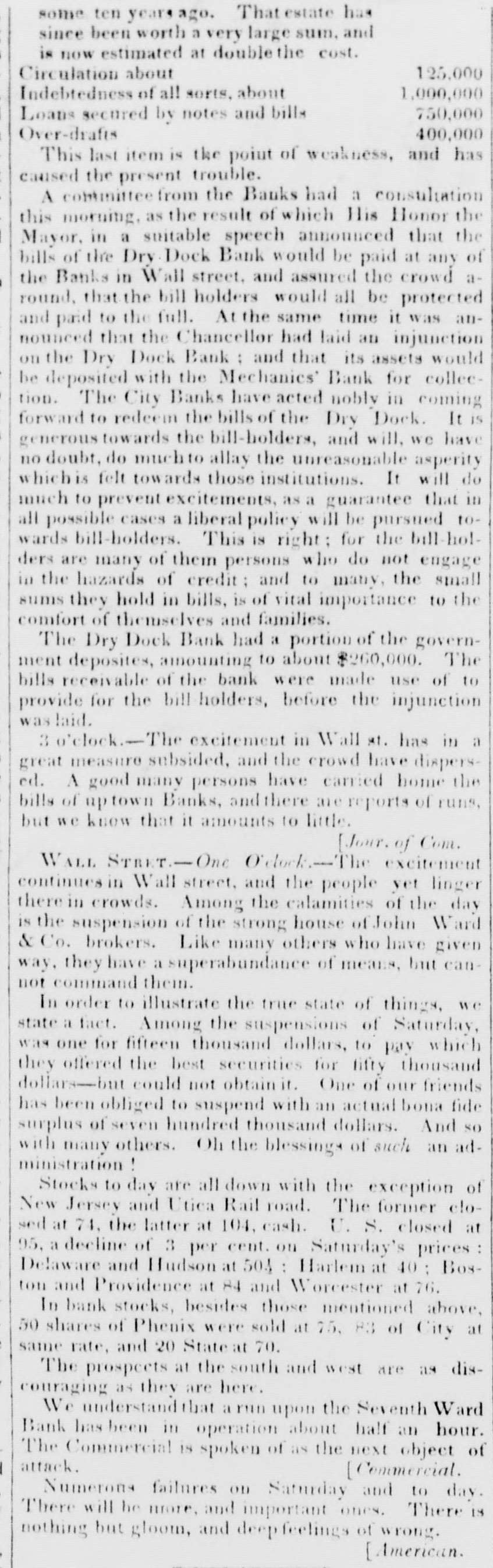
we understand that a run upon the Seventh Ward Bank has been in operation about half an hour.
Source
newspapers
3. September 22, 1837 Reopening
Newspaper Excerpt
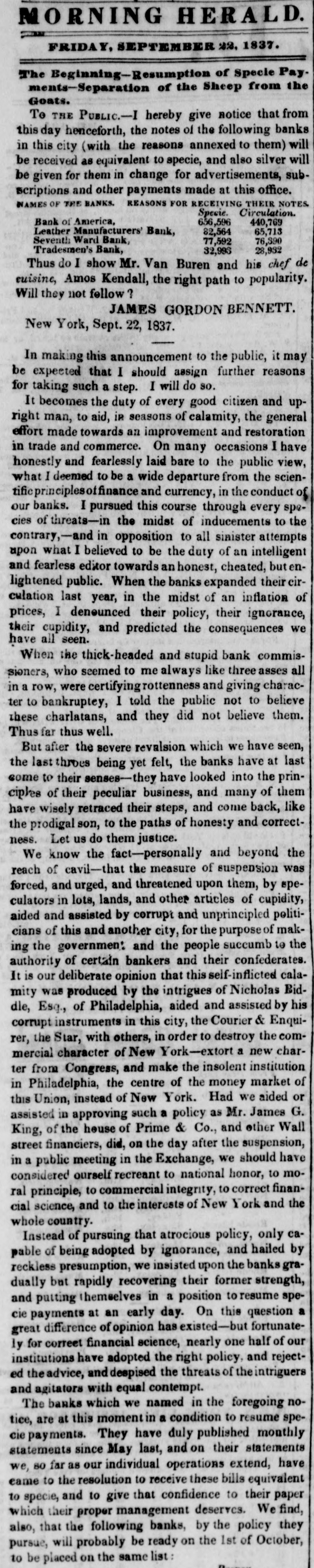
the notes of the following banks in this city ... will be received as equivalent to specie ... Seventh Ward Bank ... New York, Sept. 22, 1837 (Morning Herald).
Source
newspapers

Newspaper Articles (2)

Article from Lynchburg Virginian, May 15, 1837

Click image to open full size in new tab

Article Text

now estimated at COST Circulation about 125,000 1.000,000 Indebtedness of all sorts, about 750,000 Loans secured by notes and bills Over-drafts 400,000 This last item is the point of weakness, and has caused the present trouble. A committee from the Banks had a consultation this morning, as the result of which His Honor the Mayor. in a suitable speech announced that the bills of the Dry Dock Bank would be paid at any of the Banks in Wall street, and assured the crowd around. that the bill holders would all be protected and paid to the full. At the same time it was announced that the Chancellor had laid an injunction on the Dry Dock Bank : and that its assets would be deposited with the Mechanics' Bank for collection. The City Banks have acted nobly in coming forward to redeem the bills of the Dry Dock. It is generous towards the bill-holders, and will, we have doubt, do muchto allay the unreasonable asperity which is felt towards those institutions. It will do much to prevent excitements, as a guarantee that in all possible cases a liberal policy will be pursued towards bill-holders. This is right for the bill-holders are many of them persons who do not engage in the hazards of credit; and to many, the small sums they hold in bills, is of vital importance to the comfort of themselves and families. The Dry Dock Bank had a portion of the government deposites, amounting to about $260,000. The bills receivable of the bank were made use of to provide for the bill holders, before the injunction was laid. 3 o'clock.-The excitement in Wall st. has in a great measure subsided, and the crowd have dispersed. A good many persons have carried home the bills of uptown Banks, and there are reports of runs, but we know that it amounts to little. [Jour. of Com. WALL STRET-One O'dock.--The excitement continues in Wall street, and the people yet linger there in crowds. Among the calamities of the day is the suspension of the strong house of John Ward Co. brokers. Like many others who have given way, they have a superabundance of means, but cannot command them. In order to illustrate the true state of things, we state a fact. Among the suspensions of Saturday, was one for fifteen thousand dollars, to pay which they offered the best securities for fifty thousand dollars-but could not obtain it. One of our friends has been obliged to suspend with an actual bona fide surplus of seven hundred thousand dollars. And so with many others. Oh the blessings of such an administration : Stocks to day are all down with the exception of New Jersey and Utica Rail road. The former closed at 74, the latter at 104, cash. U. S. closed at 95, a decline of 3 per cent. ou Saturday's prices Delaware and Hudson at 504 : Harlem at 40 : Boston and Providence at 84 and Worcester at 76. In bank stocks, besides those mentioned above, 50 shares of Phenix were sold at 75, 83 of City at same rate, and 20 State at 70. The prospects at the south and west are as discouraging as they are here. We understand that a run upon the Seventh Ward Bank has been in operation about half an hour. The Commercial is spoken of as the next object of attack. [Commercial. Numerons failures on Saturday and to day. There will he more. and important ones. There 18 nothing but gloom, and deepfeelings of wrong. [American.

Article from Morning Herald, September 22, 1837

Click image to open full size in new tab

Article Text

MORNING HERALD. FRIDAY, SEPTEMBER 22, 1837. The Beginning-Resumption of Specie Payments-Separation of the Sheep from the Goats. To THE PUBLIC.-I hereby give notice that from this day henceforth, the notes of the following banks in this city (with the reasons annexed to them) will be received as equivalent to specie, and also silver will be given for them in change for advertisements, subscriptions and other payments made at this office. NAMES OF THE BANKS. REASONS FOR RECEIVING THEIR NOTES Specie. Circulation. Bank of America, 656,596 440,769 82,564 65,713 Leather Manufacturers' Bank, Seventh Ward Bank 76,390 77,592 Tradesmen's Bank, 28,932 32,993 Thus do I show Mr. Van Buren and his chef de euisine, Amos Kendall, the right path to popularity. Will they not fellow ? JAMES GORDON BENNETT. New York, Sept. 22, 1837. In making this announcement to the publie, it may be expected that I should assign further reasons for taking such a step. I will do so. It becomes the duty of every good citizen and upright man, to aid, in seasons of calamity, the general effort made towards an improvement and restoration in trade and commerce. On many occasions I have honestly and fearlessly laid bare to the public view, what I deemed to be a wide departure from the scienificeprinciplesof: and currency, in the conduct of our banks. I pursued this course through every species of threats-in the midst of inducements to the contrary,-and in opposition to all sinister attempts upon what I believed to be the duty of an intelligent and fearless editor towards an honest, cheated, butenlightened public. When the banks expanded their eirculation last year, in the midst of an inflation of prices, I denounced their policy, their ignorance, their cupidity, and predicted the consequences we have all seen. When the thick-headed and stupid bank commissioners, who seemed to me always like three asses all in a row, were certifying rottenn and giving character to bankruptey, I told the public not to believe these charlatans, and they did not believe them. Thus far thus well. But after the severe revalsion which we have seen, the last throes being yet felt, the banks have at last come to their senses-they have looked into the principles of their peculiar business, and many of them have wisely retraced their steps, and come back, like the prodigal son, to the paths of honesty and correctness. Let us do them justice. We know the fact-personally and beyond the reach of cavil-that the measure of suspension was forced, and urged, and threatened upon them, by speculators in lots, lands, and other articles of cupidity, aided and assisted by corrupt and unprincipled peliticians of this and another city, for the purpose of making the government and the people succumb to the authority of certain bankers and their confederates. It is our deliberate opinion that this self-inflicted calamity was produced by the intrigues of Nicholas Biddle, Esq., of Philadelphia, aided and assisted by his corrupt instruments in this city, the Courier & Enquirer, the Star, with others, in order to destroy the commercial character of New York-extort a new charter from Congress, and make the insolent institution in Philadelphia, the centre of the money market of this Union, instead of New York. Had we aided or assisted in approving such a policy as Mr. James G. King, of the house of Prime & Co., and other Wall street financiers, did, on the day after the suspension, in a public meeting in the Exchange, we should have considered ourself recreant to national honor, to moral principle, to commercial integrity, to correct financial science, and to the interests of New York and the whole country. Instead of pursuing that atrocious policy, only capable of being adopted by ignorance, and hailed by reckless presumption, we insisted upon the banks gradually but rapidly recovering their former strength, and putting themselves in a position to resume specie payments at an early day. On this question a great difference of opinion has existed-but fortunately for correct financial science, nearly one half of our institutions have adopted the right policy, and rejected e advice, and despised the threats of the intriguers and agitators with equal contempt. The banks which we named in the foregoing notice, are at this moment in a condition to resume specie payments. They have duly published monthly statements since May last, and on their statements we, so far as our individual operations extend, have came to the resolution to receive these bills equivalent to specie, and to give that confidence to their paper which their proper management deserves. We find, also, that the following banks, by the policy they pursue, will probably be ready on the 1st of October, to be placed on the same list