Globe Savings Bank (Chicago, IL)

Episode Information

Episode Type
Run → Suspension → Closure
Start Date
June 5, 1893
Location
Chicago, Illinois (41.850, -87.650)
Bank Type
savings

Metadata

Notes

A run occurred in June 1893; the bank later suspended and went into receivership in April 1897—causal link across years is not fully documented here.

Events (3)

1. June 5, 1893 Run
Cause
Rumor Or Misinformation
Cause Details
Malicious and sensational rumors circulated (board of trade men named) causing depositors to withdraw savings.
Measures
Posted notice invoking the legal thirty (and thirty/sixty) day limit for withdrawals to delay payment of savings deposits.
Newspaper Excerpt
RUNS ON CHICAGO BANKS...The Globe savings bank applied the thirty day rule.
Source
newspapers
2. April 5, 1897 Suspension
Cause
Bank Specific Adverse Info
Cause Details
Assessment on capital stock, reported bad management and alleged embezzlement; stockholder assessment and weak response precipitated collapse.
Newspaper Excerpt
The Globe Savings bank did not open its doors this morning. Later, the Chicago Title and Trust company were appointed receivers.
Source
newspapers
3. April 5, 1897 Receivership
Newspaper Excerpt
A notice on the doors announced that the bank was in the hands of the Chicago Title and Trust Company, assignee.
Source
newspapers

Newspaper Articles (23)

Article from Rock Island Daily Argus, June 6, 1893

Click image to open full size in new tab

Article Text

WILD PANIC ALL DAY, But Only One Failure, Private Bankers, Reported. Rumor had hardly started a story of one bank than the "dame" looked around for another victim. In this way there was a big run on the Bank of Commerce, but every comer was paid in full. President Felsenthal said the bank would pay every demand made upon it and that nobody would be asked to wait a moment for his money. The Prairie State National bank, corner Washington and Desplaines, was called on for a large amount of deposits in the savings department and paid on demand. The officers said they had been preparing for just this sort of thing. A run on the Illinois Trust and Savings bank was met by the announcement that it would keep open till 10 p. m. as long as the run lasted. There are $10,000,000 deposits in the savings department of this bank, and seven men were paying depositors. Working twelve hours a day it would take seven men 100 days to pay out the $10,000,000. There was no run on the deposit accounts. A run was begun on the Globe Savings bank at 2 p. m., and the bank immediately posted notice that its legal thirty and sixty-day limit would be the rule. At 9 p. m. there were 500 persons in line before the paying teller of the Illinois Trust and Savings bank, and the officials announced that they would continue paying until all had their money. At midnight there were 200 and the bank con-


Article from The Salt Lake Herald, June 6, 1893

Click image to open full size in new tab

Article Text

RUNS ON CHICAGO BANKS. Every One of the Savings Banks Crowded with Depositors. DEMANDS MET PROMPTLY. Malicious Rumors Started by Several Board of Trade Men. These Stories, Which Were Very Sensational, Aggravated the Situation Very Much as They Involved Every Bank in the City. CHICAGO, June 5.-The failure of HerMann Schafiner & Co.'s bank, which occurred last week, bore fruit today in well defined runs, which were precipitated on almost If not every one of the savings banks of Chicago. The first to feel the effect of the excitement was the Bank of Commerce, where a great many Jewish citizens of the poorer class keep their accounts. The Schaffner failure had alarmed them, and they bore down upon the Bank of Commerce. At the opening hour the tellors were doubled up and paid checks as fast as presented throughout the day, officials of the bank expressing no alarm whatever, and saying that they were able to meet any demands. The Illinois Trust and Savings bank which has a larger line of this class of deposits than any other bank in this city, amounting at times to over $12,000,000, pution an extra force of tellers and paid every one as fast as possible. At 3 o'clock this afternoon they posted a nothe front door that the bank until 10 would tice on remain open o'clock excite- tonight and so long as the present ment continues. At midnight the Illinois Trust and bank was still paying off, and the of Savings crowd depositors anxious to draw their money was still. as large as ever. The bank officials were rather pleased than otherwise to pay out money, as it means a great saving to the institution in interest. So far the net profit is 35,000. At this hour it was announced that the bank would not close as long as a single depositor cared to draw out a dollar. The paying of money is being continued at seven windows. President Mitchell said: "We will stay right here for three months and not close our doors night or day, if such proWe ceeding should become necessary, are good for any run, no matter how long it keeps up." At 1:30 this Tuesday morning, the Illinois Trust and Savings bank is still open, the force of paying tellers at the seven windows having been relieved by fresh men and enough people are still waiting for their money to keep the bank open two hours more. The Hibernian bank which its name implies, was the depositor for a large number of Irish Americans of small means was crowded all day, but found no difficulty in meeting all demands. The Dime savings bank took advantage of the rule requiring, if necessary, sixty days notice of withdrawal, and paid only a percentage of deposits today. The Globe savings bank applied the thirty day rule. The Milwaukee Avenue savings bank sustained a moderate run throughout the day and they, too, kept an open house until 9 o'clock tonight. Equally spirited checking was noted upon the Prairie State National and the Prairie State savings, as well as upon the Union Trust company and Avenue Savings bank, but in no case was any alarm at felt by well informed people. In fact, many of these institutions large depositors came in during the afternoon and made heavy deposits. Today the situation was greatly aggravated by a number of board of trade brokers, who for reasons of their own, devoted themselves to the circulation of sensational rumors in which they involved at one time or another nearly every bank in this city and a large number of stock yard operotors. Notwithstanding these malicious efforts, no fear is felt as to the safety of any of the banking institutions of the city. The failure of Meadow-Croft Brothers, a minor inwith total perhaps stitution little deposits interest. of, $200,000, aroused or no


Article from The Times, June 7, 1893

Click image to open full size in new tab

Article Text

CONFIDENCE RESTORED. The Run on the Chicago Banks on the Wane Other Failures Reported. CHICAGO; ILL., June 6.-This afternoon the crowds surrounding the different banks have diminished, and a measure of confidence seems to have been restored to the savings depositors. Nobody has attempted to assign any reason for the runs other than distrust. More Banks Under Fire. CHICAGO, June 6.-A run began to-day upon the Globe Savings Bank, which has


Article from The Roanoke Times, June 7, 1893

Click image to open full size in new tab

Article Text

THE CHICAGO FLURRY. The Runs Continue But a Better Feeling of Security Prevails. CHICAGO, June 6.-A run began to-day upon the Globe Savings Bank, which has savings and individual deposits to a total of about $600,000. Its oflicers, however, were prompt in announcing that thirty days' notice would be 10. quired, and savings depositors had consequently to be content with giving notice of their intention to draw out next month. A large number of those who have withdrawn their money from banks within the past twenty-four hours have deposited in safety deposit vaults, and it is now almost impossible to secure lock boxes at any of these institutions. The crowd about the Prairie State National Bank and the Prairie State Savings and Trust Company was even greater than that of yesterday. The former institution suffered but little today, however, as the depositors are business men who have implicit conddence in the stability of the bank. Both institutions met all demands. This afternoon the crowds surrounding the different banks diminished and a measure of confidence seemed to have been restored to savings depositors. No body has attempted to assign any reason for the runs other than distrust. SPOKANE, Wash., June 6. - The Bank of Spokane Falls closed its doors yesterday morning. It was a private institution owned by A. W. Cannon, who is reported to be worth in the neighborhood of $3,000,000. Mr. Cannon is also president of the First National Bank of Palouse, and vice-president of the Washington National Bank, of Spokane. The deposits and correspondence with other banks make the liabilities over $300,000 The six national banks of this city are not affected by the failure, and all were appealed to by the private bank and refused assistance.


Article from Carroll Sentinel, June 9, 1893

Click image to open full size in new tab

Article Text

THE THROES OF A PANIC Failures Follow Each Other Thick and Fast. RUNS ON THE CHICAGO BANKS. Excited Depositors Clamor For Their Money—The Illinois Trust and Savings Bank Kept Open All Night—The Plankinton to Be Investigated. CHICAGO, June 6. — Wild and unfounded rumors of impending financial disaster caused a senseless run on many of the banks in Chicago Monday. Those chiefly affected were the Prairie State National bank, the State Bank of Commerce, the Hibernian Savings bank, the Union Trust Company's bank and the Illinois Trust Savings bank. Under the circumstances it is no small tribute to the sagacity, soundness and foresight of Chicago bankers to say that they all withstood the strain. Where the rumors sprang from is a mystery. Whether malice or ignorance inspired the rumors is unknown, but whichever it was the effect was instantaneous and widespread. Fortunately the effect was confined to uncomfortable crowding in the banking rooms, to pushing and hauling among excited depositors seeking to withdraw their money, and to the gathering of curious crowds upon the sidewalks outside the banks. Unfounded Rumors. One of the earliest and apparently the most malicious rumor of the day was to the effect that John M. Smythe, the large furniture dealer on West Madison street had failed. There was no truth in the report and the managers of the concern could assign no reason for its having been started. Other similar rumors of financial troubles were found to be without basis when traced down, but they had spread far and wide before they could be successfully contradicted, and the movement on the city banks began. Depositors Were Paid In Full. It was the small depositors of savings—the people with from $50 to $500 to their credit—who soon filled many of the banking rooms and began to clamor for their money. In every case they found greatly to their comfort that the cashiers were prepared for them and ready to hand out dollar for dollar, and it then became a question merely of standing in line to await turns at the paying teller's wickets. All who came up to 3 o'clock, the regular hour for closing the banks, were ranged in line, and when the doors were shut the payments proceeded just the same until the last depositor within the bank walls had received the amount due him. Tried to Allay the Panic. Early Monday afternoon the Illinois Trust and Savings bank posted a notice saying the bank would remain open until 9 o'clock at night to pay depositors, and that the commercial branch of the institution would remain open until the same time to pay checks. Later it was announced that the bank would keep open all night, if necessary, to accommodate those who wished to withdraw their money. These notices had no effect, however, in allaying the panic, and the bank continued to pay off depositors as rapidly as the seven tellers could pay out the money. Took Advantage of the Law. The Globe Savings bank posted a notice that it would take advantage of the law requiring from 30 to 60 days notice for the withdrawal of savings deposits. There was no serious run on the bank, but its officers decided to protect themselves as far as possible. The concern is controlled by New England people. A run was started Monday morning on the Milwaukee Avenue State bank. Along toward 11 o'clock it quieted. Then the people learned of the Meadowcraft failure and the run began again. The bank met all demands and the officers say that they are ready to withstand another run.


Article from El Paso Daily Herald, April 5, 1897

Click image to open full size in new tab

Article Text

Savings Bank Fails. CHICAGO, April 5.-The Globe Savings bank did not open its doors this morning. Later, the Chicago Title and Trust company were appointed receivers. The capital stock of the bank is $200,000. A few days agothe assessment of 50 per cent on thecapital stock was made, and the supposed tardy response on the part of stock holders is the cause of the collapse.


Article from Evening Journal, April 9, 1897

Click image to open full size in new tab

Article Text

TELEGRAPHIC BREVITIES. The gunboat Nashville developed 14 1/4 knots, or 1 1/2 knots more than her contract speed, on a preliminary run. The bill authorizing the expenditure by the state of New York of $1,000,000 for Adirondack lands became a law. The Rev. George A. Hubbell of Vineland. N. J., had the sight of one eye destroyed by a sun ray deflected from his prystal inkstand. Alonzo J. Whiteman. who has been DTU trial on a charge of grand larceny in obtaining 8580 from the Columbia National bank in New York, was acquitted. Nearly $500,000 in bonds belonging to the University of Illinois are missing. They were intrusted to President Spalding of the failed Globe Savings bank of Chicago. The bid of the Illinois Steel company was the only one received by the navy department for supplying 8,000 tons of armor plate for the three battleships Illinois, Wisconsin and Alabama. This bid of $240 a ton was conditioned upon the government agreeing to purchase all its armor plate from the company for the next 20 years. No award was made. Firesat Knoxville destroyed property valued at $150,000 in the heart of the business section of the city. Five persons were burned to death and many injured. The dead are W. W. Holloway of Newport, Tenn.: R. W. Hopkins of St. Louis, J. Robertson of Pulaski, Tern.: A. E. Weeks of Locke, N. ¥, and S EI. Williams of Springfield, Mass.


Article from Chicago Eagle, April 10, 1897

Click image to open full size in new tab

Article Text

GLOBE SAVINGS BANK CLOSES. Chicago Concern Is Forced to Give Up the Struggle for Existence. The Globe Savings Bank of Chicago suspended Monday morning. A notice on the doors announced that the bank was in the hands of the Chicago Title and Trust Company, assignee. It has been known in Chicago financial circles for some time past that the bank was having anything but smooth sailing. It was organized Dec. 24, 1890, and has therefore experienced but two good years in its existence. John P. Altgeld was its first vice-president at that time, but he resigned. For the last five years it has had a decidedly hard time, passing through two panies safely by availing itself of the time clause in the payment of savings accounts, which formed the bulk of the deposits. The bank has a capital stock of $200,000, which is held in the ratio of three-fifths in the West and the balance in the East. Under the laws of the State the stockholders are liable for an additional amount equal to the face value of the stock held in their names. This practically makes a guarantee fund of $400,000, provided it can be collected from the stockholders. The State Auditor at a recent examination of the bank's affairs ordered an assessment of 50 per cent on the stockholders, in order to raise a surplus, and notices of this assessment were sent out on the 18th of March. This becoming known, a run was started and the end hastened. The last statement to the Auditor showed $313,000 savings and $142,000 individual deposits. The suspension created no sensation, but there were a few angry depositors around the bank, who had made deposits just before noon on Saturday.


Article from Eagle River Review, April 15, 1897

Click image to open full size in new tab

Article Text

GLOBE SAVINGS BANK CLOSES. / Chicago Concern Is Forced to Give Up the Struggle for Existence. The Globe Savings Bank of Chicago suspended Monday morning. A notice on the doors announced that the bank was in the hands of the Chicago Title and Trust Company, assignee. It has been known in Chicago financial circles for some time past that the bank was having anything but smooth sailing. It was organized Dec. 24, 1890, and has therefore experienced but two good years in its existence. John P. Altgeld was its first vice-president at that time, but he resigned. For the last five years it has had a decidedly hard time, passing through two panics safely by availing itself of the time clause in the payment of savings accounts, which formed the bulk of the deposits. The bank has a capital stock of $200,000, which is held in the ratio of three-fifths in the West and the balance in the East. Under the laws of the State the stockholders are liable for an additional amount equal to the face value of the stock held in their names. This practically makes a guarantee fund of $400,000, provided it can be collected from the stockholders. The State Auditor at a recent examination of the bank's affairs ordered an assessment of 50 per cent on the stockholders, in order to raise a surplus, and notices of this assessment were sent out on the 18th of March. This becoming known, a run was started and the end hastened. The last statement to the Auditor showed $313,000 savings and $142,000 individual deposits. The suspension created no sensation, but there were a few angry depositors around the bank, who had made deposits just before noon on Saturday.


Article from The Republican Journal, April 15, 1897

Click image to open full size in new tab

Article Text

New England will lose quite heavily by the suspended Globe Savings Bank of Chicago. Hon. Parker Spofford of Bucksport holds 15 shares. The bank did a profitable business at first, but has been wrecked by bad management, or worse, and its officers are under arrest.


Article from Crawford Avalanche, April 22, 1897

Click image to open full size in new tab

Article Text

GLOBE SAVINGS BANK CLOSES. I Chicago Concern Is Forced to Give Up the Struggle for Existence. The Globe Savings Bank of Chicago suspended Monday morning. A notice on the doors announced that the bank was in the hands of the Chicago Title and Trust Company, assignee. It has been known in Chicago financial circles for some time past that the bank was having anything but smooth sailing. It was organized Dec. 24, 1890, and has therefore experienced but two good years in its existence. John P. Altgeld was its first vice-president at that time, but he resigned. For the last five years it has had a decidedly hard time, passing through two panies safely by availing itself of the time clause in the payment of savings accounts; which formed the bulk of the deposits. The bank has a capital stock of $200,000, whieh is held in the ratio of three-fifths in the West and the balance in the East. Under the laws of the State the stockholders are liable for an additional amount equal to the face value of the stock held in their names. This practically makes a guarantee fund of $400,000, provided it can be collected from the stockholders. The State Auditor at a recent examination of the bank's affairs ordered an assessment of 50 per cent on the stockholders, in order to raise a surplus, and notices of this assessment were sent out on the 18th of March. This becoming known, a run was started and the end hastened. The last statement to the Auditor showed $313,000 savings and $142,000 individual deposits. The suspension created no sensation, but there were a few angry depositors around the bank, who had made deposits just before noon on Saturday.


Article from The Wichita Daily Eagle, April 30, 1897

Click image to open full size in new tab

Article Text

SPALDING IS ARRAIGNED And on the Same Day His New Hampshire Bank Breaks. Chicago, April 29.-President Charles W. Spalding of the defunct Gloge Savings bank, who has been in jail since last Saturday, in default of bail, was arraigned this afternoon to answer to charges of embezzlement. He waived examination and was held to the criminal court. Cashier Churchill and Vice President Averill also appeared on the same charge, and their cases were continued. Nashua, N. H., April 29. -The New Hampshire Banking company suspended this afternoon. Solomon Spaldinfg. father of Charles W. Spalding, of the broken Globe Savings bank of Chicago, is president of the institution. The bank is a guarantee bank, with a guarantee fund of $125,000. and had a a surplus and interest account of $74,000 at its last report, April 1. The account due depositors of April 1. was $849,352. the bank being the second largest in the city. Courts and Crops in Payne County. Stillwater, O. T., April 29.-Chief Jus. tice Dale will close his last term of court in Payne county this week. Thed ocket was small and will have consumed only about two weeks when the term is clos. ed. Crops of all kinds are fine. Wheat is heading out and corn and cotton aore large enough to cultivate.


Article from The Seattle Post-Intelligencer, May 1, 1897

Click image to open full size in new tab

Article Text

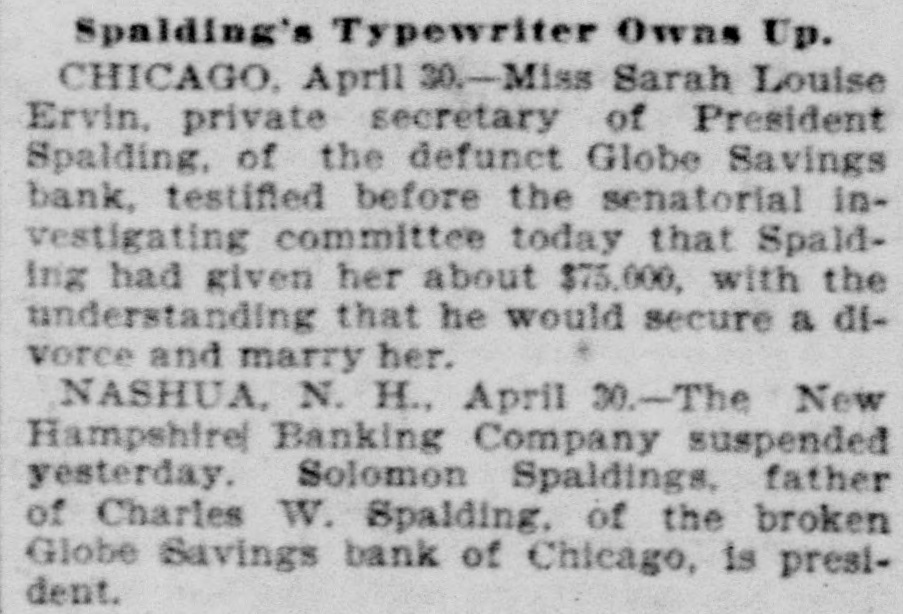
Spalding's Typewriter Owns Up. CHICAGO, April 30-Miss Sarah Louise Ervin, private secretary of President Spalding, of the defunct Globe Savings bank, testified before the senatorial investigating committee today that SpaidIng had given her about $75,000, with the understanding that he would secure a diVorce and marry her. NASHUA, N. H., April 30.-The New Hampshire Banking Company suspended yesterday. Solomon Spaldings, father of Charles W. Spalding, of the broken Globe Savings bank of Chicago, is president.


Article from Warren Sheaf, May 6, 1897

Click image to open full size in new tab

Article Text

from Swansa for Marseilles, was given up as lost with 30 of her crew. A dispatch from Athens saye that King George has signed a decree wi Turkdrawing the exequaturs of all the ish consuls in Greece. The queen regent of Spain has signed decree providing for the application a of the agreed upon reforms for the island of Cuba. Advices received in London say that Greece is disposed to recall her forces LATER. For the murder of an old man, a child and a and the of two near Houston, girls woman, assaulting Tex., by mob six were taken a They were and young hanged. negroes taken captured were by bloodhounds and when smeared with blood, and when confronted with the evidence admitted their guilt. The anti-Sunday base ball law was defeated in the Iowa legislature the 30th. The Michigan legislature the 30th passed a law prohibiting reproduction of prize fights by binetoscopes, etc. Nearly $4,000,000 in gold coin and bullion was withdrawn from the U. treasury the 30th for export. Gin Pong. a brutal Chinaman, was hanged at Spokane, Wash.. the 30th, for the murder of Lee Tung several months ago. Ed Rafferty was shot to death while burglarizing the store of C. W. Yetter at West Branch, Io. The battle of Velestino raged fiercely all day the 30th. The Greeks have been reinforced, the reinforcements arat a critical stage of riving Gen. Smolenski telegraphs the that Phar- fight. the will be unable to capture because the Greek is salos. Turks position Greek strong and the morals of the troops is completely restored. The United States consul at GuadaWest Indies, has telegraphed the department under dalope, state follows: date of April from Point Apitro as "Severe earthquake, loss heavy, many injuries. Fire the 30th destroyed several business houses at Cartersville, Ill., causing a loss of $75,000. Several persons were injured. The grand jury at Chicago, the 1st, indictments ag management of the returned with the inst five defunct men Globe Savings bank. The men indicted are Charles W. Spaulding, presdent of the bank, and ex-treasurer of of vice president of the Averill. state university Illinois; the bank; W. A. D. B. Charles E. Churchill, cashier; Ervin, assistant cashier, and Allison There W. Harlan, one of the directors. are 29 indictments in all. John Gibsen, colored, was hanged at Jackson, Miss., the 1st, for the murder of Robert Stinson, six years ago. The most destructive fire that has visited Pittsburg, Pa., since 1845 broke fire out about midnight, the 2d. The rapidly and soon had consumed several spread large blocks with a total loss of $2,000,000. During the month of April the U. mints coined $10,410,080. Of this amount sil$8,800,400 was in gold, $1,525,000 in ver and $74,680 in minor coins. It was announced, the 2d, that the would not allow the levying of indemnity powers upon Greece and both Aus- intria and Germany were trying to duce Turkey to modify its demands. The journeymen plumbers' association of Chicago, 1,600 strong, decided the 2d to strike. Ex-Congressman John J. Perry died at his home in Portland, Me., the 2d, aged 86 years. The Wisconsin Beet Sugar Co., which has just commenced a plant at Minomonee Falls, Wis., has assigned. The Tennessee centennial exposition the formally opened at Nashville was President McKinley, in Washington, 1st. pressed the button that started the machinery. Fire at Detroit, Mich., the 1st, destroyed a two-story building occupied a store and dwelling. Lizzie Sinig, as ged 20, and her brother Anthony, aged 5, were caught in a back room to without egress and were burned death. August Norman, assaulted the Lari- wife Knudt Hillstead, living near of more, N. D., and because she resisted, cut the throats of fcur of her children, killing two of them. He finally accomplished his purpose, and stealing horse escaped. Mr. Hillstead was absent at the time. The king of Italy has conferred upon Hon. William Potter, minister to Italy of under President Harrison, the order Sante Maurizion and Lazarro, and through Baron Fava, the Italian am-

Article from Kansas Agitator, May 7, 1897

Click image to open full size in new tab

Article Text

GOLDBUG GOOD TIMES. The Globe savings bank of Chicago has assigned. Stealings by "honest" money advocates, about $1,000,000.


Article from Morning Appeal, May 8, 1897

Click image to open full size in new tab

Article Text

Jim Corbett is quoted as follows in New York: "Mr. Muldoon has had something to say about that sixth round. It appears that James Colville of Boston, who was my timekeeper when I met Fitzsimmons, says that the Australian was down more than 10 seconds, and that he could have protested the timing right there, in which case I would have won the fight; but he was so sure that I would win, anyhow, that he let the opportunity slip The Bulletin prints a picture of Miss S. Louisa Ervin and calls her the woman whose smile wrecked the Globe Savings Bank of Chicago. If such a smile as that can wreck a Savings Bank the sooner a man gets his deposite out of the bank the better. We think the bank must have been a little shakey before it run up against Miss Ervin. The Enterprise says two Comstockers went on went on a prospecting trip and drove 1,200 miles at the rate of 45 miles a day. It is probable that a livery sheriff or constable was urging them to create distance. Bodie Index. Durrant has now taken to writing poetry, and it would seem about time to spring the trap.


Article from The Caucasian, May 13, 1897

Click image to open full size in new tab

Article Text

The Globe savings bank of Chicago has assigned. Stealings by "honest" money advocates, about $1,000,000. The City national bank of Gatesville, Tex., has suspended. Stealings by "bonest" money advocates, about $200,000.


Article from The Mitchell Capital, May 14, 1897

Click image to open full size in new tab

Article Text

When the Globe savings bank of Chicago failed recently some very unpleasant incidents were later revealed in connection with the institution. Mr. Altgeld will be remembered for his intimate connection with the Chicago convention, which nominated a certain Mr. Bryan for the presidency. In a recent article concerning Mr. Altgeld and the failure of the savings bank the Minneapolis Tribune says: It looks as if ex-Gov. Altgeld would come out of the Globe savings bank investigation with his business reputation as much damaged as his political standing in the late election. The fact has been elicited that he was a large borrower of the bank's funds when he must have known that it was in an insolvent condition, and there is evidence going to show that he used his official position to keep the institution afloat long after it ought, in justice to the interests of the public and of the depositors, to have been closed. State Senator Aspinwall, a member of the legislative investigating committee, does not hesitate to say openly (as quoted in the Chicago Tribune) that the bank ought to have been closed in December, 1892, and that "for four years that bank was run upon state funds and Gov. Altgeld used emphatic discrimination in its favor." W. M. Robertson, the bank examiner, characterizes Altgeld's published defense as evasive and false, and asserts that through some mysterious manipulation Unity stock which he sold the bank for $10,000 was so manipulated as to be listed as an asset for $20,000. One secret of Altgeld's violent advocacy of the free silver fad is now out. While he was supposed to be a wealthy man and on a solid financial foundation, it appears that he was overwhelmed with debt and was seeking an opportunity to secure a legal discharge of his obligations in cheap money. We have no desire to gloat over Altgeld's downfall, but it is well that his motives be explained. He is a man of considerable ability and has been one of the most dangerous demagogues in public life.


Article from Little Falls Weekly Transcript, May 14, 1897

Click image to open full size in new tab

Article Text

Not only are the officers of the suspended Globe Savings bank being punished in Chicago, but the grand jury has indicted a bank examiner for failing to report the condition of the bank.


Article from The Sun, July 17, 1897

Click image to open full size in new tab

Article Text

# SPALDING ACQUITTED AGAIN. The Chicago Banker Declared Not Guilty on a Second Embezzlement Trial. CHICAGO, Ill., July 16.-Former banker and ex-State University Treasurer Charles Warren Spalding scored another victory to-day in his second trial in the Criminal Court on a charge of embezzling the university's funds. A jury in Judge Dunn's court decided the prisoner not guilty. Spalding, who had apparently looked for a conviction, was brought into the court room this evening to hear the verdict. He looked worn and haggard, but his face lighted up when he heard the words of acquittal. "Of course I am delighted with the verdict," he said to a group of reporters. "I do not see how the jury could have found differently. The Globe Savings Bank was not insolvent at the time it was thrown into the hands of a receiver and it is not to-day, if its affairs are handled properly. I cannot say whether the other indictments against me will be pressed to trial or not, but, if they are, it will be rank persecution, and not prosecution, for the purpose of getting justice. If I must stand trial again I shall defend myself and will be vindicated." State's Attorney McEwen said he could not positively announce the future course of the State in the Spalding matter. There are twenty-seven more indictments against the prisoner, and he presumed that another trial would be had. A point made by Spalding's attorneys, which was ruled out by the court, had a telling effect upon the jury. It was that Spalding was being made a victim of politics, because he was an appointee of Altgeld.


Article from The Telegraph-Courier, June 23, 1898

Click image to open full size in new tab

Article Text

# MISS ERVIN LOSES Spalding's Ranch in Idaho Will Not Be Restored to Her. Hope of again obtaining possession of the Idaho ranch, which Charles Warren Spalding deeded to her in the days of the Globe Savings bank's property, was abandoned yesterday by Sarah Louise Ervin when Judge Tuley continued the contempt proceedings against her with the understanding that she should withdraw her suit in the Idaho courts to recall the deed given to the receiver of the bank. The property consists of a 960-acre tract which Spalding has valued at $25,000. Miss Ervin, the day after the failure of the Globe Savings bank, deeded to the receiver the title to the property, which President Spalding had given her some time before. Later she decided that she had made an error and began suit in Idaho to recover the estate, claiming that the transaction was invalid because she was not aware of its import. This action was held to be in contempt by Judge Tuley, in whose court the affairs of the bank are being adjudicated, and Miss Ervin was cited to appear before him. Attorney Magee for the receiver argued yesterday that if justice had not been done Miss Ervin, Judge Tuley was the chancellor before whom she should come for redress, and his honor took this view of the matter. The case will come up again today with the understanding that the Idaho proceedings will be dismissed. Miss Ervin was not in court today. - Chicago Journal. The many friends of Miss Ervin in this city will be greatly pained to hear of her great financial loss.


Article from The Salt Lake Herald, June 17, 1900

Click image to open full size in new tab

Article Text

# BUYS THE PARK TERRACE. Col. Bruback Gets the Property For $15,000 in Cash. A real estate deal was closed yesterday by which Theodore Bruback became the aowner of the Park Terrace on the corner of Fifth East and Third South for a consideration of $15,000 in cash. The seller is the Chicago Title & Trust company, receiver for the Globe Savings Bank of Chicago. The property has a frontage of seven rods on each street; the building is a two-story stone terrace with convenient appartments for seven families. McCoy's drug store occupies the corner room on the ground floor. Mr. Bruback purchased the property for an investment and it is considered a good one as it is fully occupied and is yielding a very good income on the purchase price.


Article from The Salt Lake Herald, October 6, 1901

Click image to open full size in new tab

Article Text

Foreclosure Suit Filed. The Chicago Title & Trust company, receiver of the Globe Savings bank, yesterday filed suit in the district court against Rodney L. St. George to foreclose a mortgage upon sixteen lots in Grand View subdivision.