16485. Bank of Pennsylvania (Philadelphia, PA)

Bank Information

Episode Type
Run → Suspension → Closure
Bank Type
state
Start Date
September 25, 1857
Location
Philadelphia, Pennsylvania (39.952, -75.164)

Metadata

Model
gpt-5-mini
Short Digest
a68f9d6425ee967d

Response Measures

None

Description

Contemporary reports (Sept 25–30, 1857) describe a heavy run on the Bank of Pennsylvania that led it and other city banks to suspend specie payments. The bank briefly continued business certifying checks/using its notes but refused specie; later investigations (Feb 1858) show insolvency, assignment by the late president, and effectively liquidation. Thus sequence: run → suspension → permanent failure/assignment. 'Bank of Pennsylvania' is identified clearly; OCR errors in some articles corrected (e.g., Allibone/Allibone spelling).

Events (4)

1. September 25, 1857 Run
Cause
Bank Specific Adverse Info
Cause Details
Reports cite large loans to irresponsible parties and losses; president resigned; heavy withdrawals (paid out >$300,000 in coin recently) prompted panic against the bank.
Measures
Redeemed notes where possible; refused to pay specie; posted notice suspending specie payment; other banks convened conference and agreed temporary suspension of specie payments.
Newspaper Excerpt
A run commenced on Friday morning upon most of the institutions... At several of the banks, including the Bank of Pennsylvania, crowds commenced gathering as soon as the doors were opened
Source
newspapers
2. September 25, 1857 Suspension
Cause
Bank Specific Adverse Info
Cause Details
Temporary suspension of specie payments announced after heavy run and inability to meet liabilities in coin; banks agreed to suspend specie on checks and large bills to stem outflow of coin.
Newspaper Excerpt
The Bank of Pennsylvania has suspended. The President says that the suspension is only temporary.
Source
newspapers
3. September 29, 1857 Other
Newspaper Excerpt
The Presidents of the Banks have agreed to restore the Bank of Pennsylvania to a position at the ClearingHouse and to receive its notes and discount liberally for their customers. Had this been sooner done there would have been no suspensions.
Source
newspapers
4. February 10, 1858 Receivership
Newspaper Excerpt
Mr. Allibone, the late president, had assigned his property for the benefit of the bank. The resolution for an assignment by the bank was adopted. ... the whole of the capital ... have been sunk. The stockholders will not get one cent.
Source
newspapers

Newspaper Articles (25)

Article from New Orleans Daily Crescent, September 26, 1857

Click image to open full size in new tab

Article Text

NUMBER 175. Telegraphed to the New Orleans Crescent. PINANOIAL. PHILADELPHIA, Sept. 25-The Bank of Pennsylvania has suspended. The President saya that the suspension is only temporary. The Girard Bank is paying specie for notes, but checks are not honored until 1 o'clock, P.M. There is a heavy run on the city banks. All our banks are besieged by depositors and note holders. There is much alarm, and business is almost en8 tirely suspended. Later. 0 The Girard Bank still refuses to pay checks or notes above $10. The Commercial Bank and other banks are taking the same course. The run will probably cause the entire suspension of specie. The excitement is becoming intense. NEW YORK, Sept. 25.-The Bank of Medina has failed. Bangs & Bros., book auctioneers, have failed. Later. PHILADELPHIA, Sept. 25.-Money matters this afternoon are worse, if possible, than ever. There is great demand for Eastern exchange at 2 per cent. premium. ; A general conference of the Banks, by their presidents, was held to-day. A temporary suspension of specie payments on checks and bills exceeding $10 was resolved upon un animously by all the banks in this city the rule to d commence to-morrow. Domestic Markets. Sr. LOUIS, Sept. 25.-Flour advancing. Wheat declining; Red $112}; White $1 25. Corn firm; Mixed d 50c; White 51 to 55c. Oats firm at 36 to 39c. Hemp $90 to $100. d Rock Island Bridge Case. CHICAGO, Sept. 25.-The case of the steamer Effie e Afton VE. Rock Island Railroad Company has been on I, trial for two weeks. The jary fails to agree and is d discharged. River Intelligence. VICKSBURG, Sept. 25.-The Judah Touro passed at al 3 and the Princess at 4 this evening. g-


Article from The Washington Union, September 26, 1857

Click image to open full size in new tab

Article Text

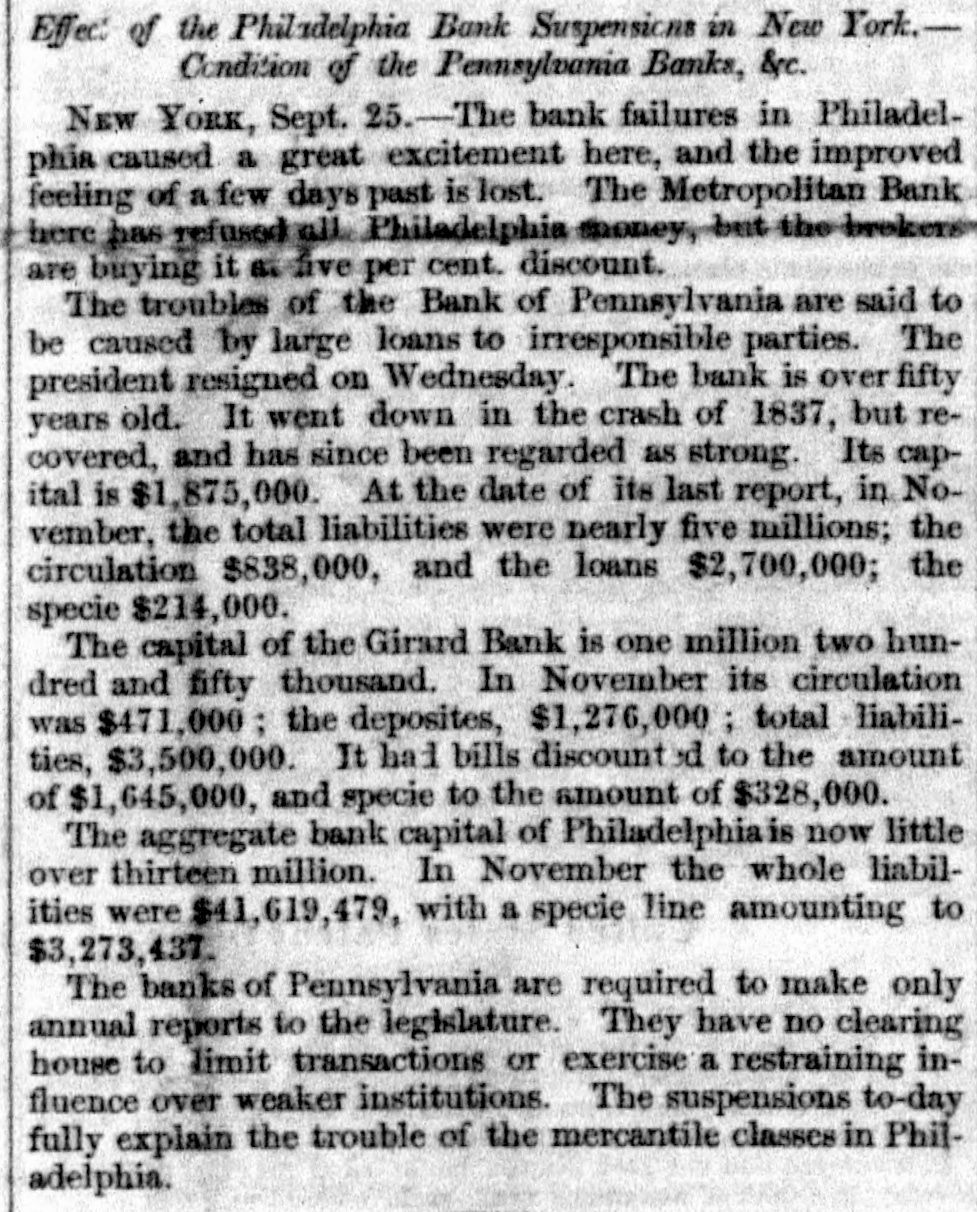
Effect of the Philadelphia Bank Suspensions in New York.Condition of the Pennsylvania Banks, &c. NEW YORK, Sept. 25. The bank failures in Philadelphia caused a great excitement here, and the improved feeling of a few days past is lost. The Metropolitan Bank here has refused all Philadelphia money, but the brokers are buying it a. five per cent. discount. The troubles of the Bank of Pennsylvania are said to be caused by large loans to irresponsible parties. The president resigned on Wednesday. The bank is over fifty years old. It went down in the crash of 1837, but recovered, and has since been regarded as strong. Its capital is $1,875,000. At the date of its last report, in November, the total liabilities were nearly five millions; the circulation $838,000, and the loans $2,700,000; the specie $214,000. The capital of the Girard Bank is one million two hundred and fifty thousand. In November its circulation was $471,000 ; the deposites, $1,276,000 ; total liabilities, $3,500,000. It had bills discounted to the amount of $1,645,000, and specie to the amount of $328,000. The aggregate bank capital of Philadelphiais now little over thirteen million. In November the whole liabilities were $41,619,479, with a specie line amounting to $3,273,437. The banks of Pennsylvania are required to make only annual reports to the legislature. They have no clearing house to limit transactions or exercise a restraining influence over weaker institutions. The suspensions to-day fully explain the trouble of the mercantile classes in Philadelphia.


Article from Evening Star, September 26, 1857

Click image to open full size in new tab

Article Text

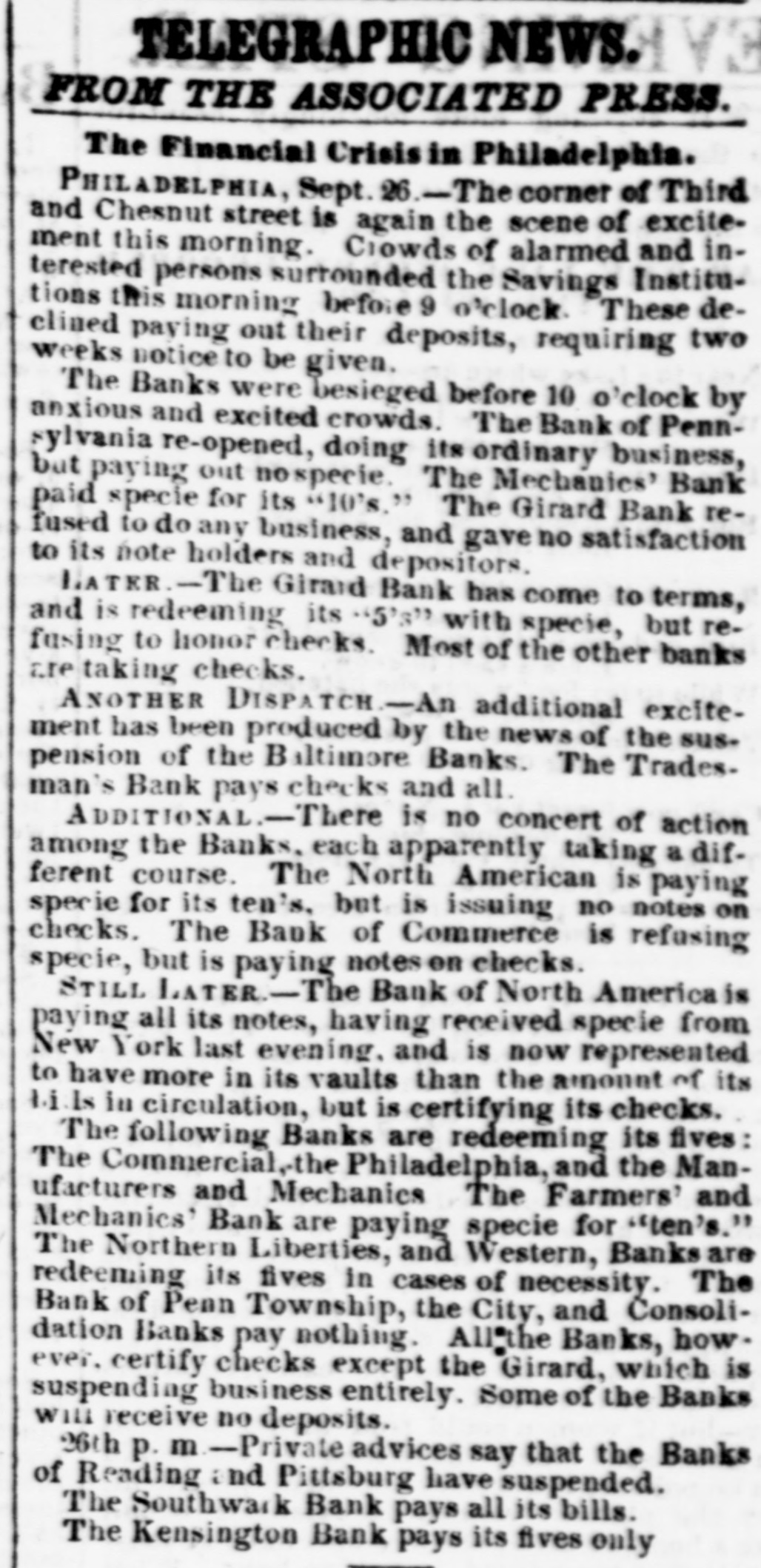
TELEGRAPHIC NEWS. FROM THE ASSOCIATED PRESS. The Financial Crisis in Philadelphia. Philadelphia, Sept. 26.-The corner of Third and Chesnut street is again the scene of excitement this morning. Ciowds of alarmed and interested persons surrounded the Savings Institutions this morning before 9 o'clock. These declined paying out their deposits, requiring two weeks notice to be given. The Banks were besieged before 10 o'clock by anxious and excited crowds. The Bank of Pennsylvania re-opened, doing its ordinary business, but paying out nospecie. The Mechanics' Bank paid specie for its "10's." The Girard Bank refused to do any business, and gave no satisfaction to its note holders and depositors. LATER.-The Giraid Bank has come to terms, and is redeeming its "5's" with specie, but refusing to honor checks. Most of the other banks are taking checks. ANOTHER Dispatch.-An additional excitement has been produced by the news of the suspension of the Baltimore Banks. The Tradesman's Bank pays checks and all. ADDITIONAL-There is no concert of action among the Banks, each apparently taking a different course. The North American is paying specie for its ten's, but is issuing no notes on checks. The Bank of Commerce is refusing specie, but is paying notes on checks. STILL LATER-The Bank of North America is paying all its notes, having received specie from New York last evening, and is now represented to have more in its vaults than the amount of its Mils in circulation, but is certifying its checks. The following Banks are redeeming its fives: The Commercial, the Philadelphia, and the Manufacturers and Mechanics The Farmers' and Mechanics' Bank are paying specie for "ten's." The Northern Liberties, and Western, Banks are redeeming its fives in cases of necessity. The Bank of Penn Township, the City, and Consolidation Banks pay nothing. Allothe Banks, how. ever. certify checks except the Girard, which is suspending business entirely. Some of the Banks WILL receive no deposits. 26th p. m.-Private advices say that the Banks of Reading nd Pittsburg have suspended. The Southwark Bank pays all its bills. The Kensington Bank pays its fives only


Article from Evening Star, September 26, 1857

Click image to open full size in new tab

Article Text

Effect of the Philadelphia Bank Suspensions in New York-Condition of the Pennsylvania Banks, &c. NEW Yor, Sept. 25.-The bank failures in Philadelphia caused a gri at excitement here, and the improved feeling of a few days past is lost. The Metropolitan Bank here has refused all Philadelphia money, but the brokers are buying it at five per cent discount. The to ibles of the Bank of Pennsylvania are said to be caused by large loans to irresponsible parties. The president resigned 01 Wednesday. The bank is over fifty years old. It went down in the crash of 1837, but recovered. and has since been regarded as strong. Its capital is $1,875,000. At the date of its last report in November the total liabilities were nearly five millions; the circulation $838,000, and the loans $2,700,000; the specie $214,000. The capital of the Girard Bank is one million two hundred and fifty thousand. In November its circulation was $471,000; the deposites $1,276000-total liabilities $3,500,000. It had bills discounted to the amount of $1,615,000, and specie to the amount of $328,000. The aggregate bank capital of Philadelphia is now little over thirteen million. In November the whole liabilities were $41,619,479, with a specie line amountin ! to $2,273,437. The banks of Pennsylvania are required to make only annual reports to the Legislature. They have no clearing house to limit transactions or exer cise a restraining influence over weaker institutions. The suspensions to-day fully explain the trouble of the mercantile classes in Philadelphia.


Article from Wheeling Daily Intelligencer, September 27, 1857

Click image to open full size in new tab

Article Text

MNVI 02" sequeding IRR, Sept. 26.-All the banks here ended specie payment. Ker our 'd, 6-95 ndas HDH Manufacturers and the Exchange papuodsn bank ELPHIA, Sept. 26,-There is no concert among the Banks. The Bank of Pennas resitmed business, but a total surf specie payments. Bank "of, Comaving out notes but no specte. The - deeming fives only. Bank of North nd Mechanic Bank are paying specie ving checks. The Tradesmen's Bank bills and checks the Banks certicks. The following Banks pay $5 undicturers' & Mechanics Southwark al, Philadolphia Bank of Northern 3 "II 201 aroads And Rund Messer pur necessity only. Consolidat Bank, , and Bank of Panna. Township, pay it all. The Southwark Bank, pay a 1 itizens checks. The following resolu3º ano 411 Supusom this paBaH Resolved, That all settlements for the and sale of stocks, past, and to come, ade in certified checks of any of the d 10 to current * M dispatches, received here, announce asion of the Reading and Pittsburgh RE, Sept. 26.-At a meeting of the sidents, this morning, it was resolved 1 specie payments on all notes. ELPUIA, Sept. 20.-Business in all deabout suspended to-day. Breadstuffs ! GTON, Sept. 26 The Bank of the : has resolved to continue specie payull, finding themselves secured against 1. The Bank of Washington has parended, but this is temporary. They , on their five dollar notes, and small The Directors of the Metropolis and Banks are now in conference. It is own what action will be taken, RE, Sept. 26.-The suspension-since has been total, with the exception of Pollars may " THE There has been no run one the Sav. S; we have but three and the most ig and quilt only SU ejes SU 038 $ seem to be gratified with the suspenney on the street which yesterday ed 21 per cent, has fallen to-day to one The Baltimore and Oho Railroad advanced to five dollars per share. ORE, Sept. 26.-The Farmers & Meank is cashing all its notes and paying in notes on other city Banks. All banks have fully suspended, but are hing their customers with change.ement is subsiding and the money ensier. Much surprise is expressed anks of New York city have not susThere is no run on the Savings Bank. of shinplasters is talked of. Sept. was the scene xcitement during the day, by advices idelphia, but the Banks have made a ton to their specie within the last few remain tirm. There are no signs of . It is confidently believed that all and Banks are able to stand the pres ORK, Sept. 26. Our Banks remeined the close of business hours and there $ of suspensions. Money on the street sought for and demands higher rates (SECOND DESPATCH.) BK, Sept. 26.-Therfollowing circular Banks has been Issued consethe suspension of specie payments


Article from Richmond Enquirer, September 29, 1857

Click image to open full size in new tab

Article Text

THE MONEY CRISIS-BANK SUSPENSIONS [From the Philadelphia Ledger of Saturday Morning.] Yesterday morning, after 8 quiet run for three or four days, the Bank of Pennsylvania acknowledged its inability to meet its liabilities in coin, and closed its doors. The fact soon spread over the city, and a run was immediately commenced on the other banks. At first all paid both circulation and deposites in coin. In about an hour the Girard Bank and the Commercial Bank stopped the payment of their deposites, but continued the payment of their circulation. All the other banks paid all demands throughout the day The Pennsylvania Bank, since Monday last, has paid out over three hundred thousand dollars in coin and the other banks yesterday paid out over one million and 8 half: making an addition to the amount of coin in the hands of the public, in the last three or four days, of over eighteen hundred thousand dollars. The run being 80 general at all the banks. and 80 very decided that the banks felt it ut. terly impossible to continue on, and in the afternoon, after the closing of the banks, 8 conference of the Presidents of all the banks was held, which resulted in a recommendation to suspend the payment of specie, to-day until further notice. This course seem. forced upon the banks, however objectionable it may be considered by the community. Such results are incidental to the prevailing system of bank credit.We have had repeated warnings in our financial history of the effects of undue expansions of credit; but in times of seeming prosperity which they create, it is difficult to convince the public of their danger, 80 that A sufficient check shall be put upon the evil. In times of disaster like the present, there is, however, 8 lesson to be learned, which may eventually impose such restraints upon the system as will make it con ducive to the interests of business, without subjecting it periodically to such terrible prostrations.


Article from New-York Daily Tribune, September 29, 1857

Click image to open full size in new tab

Article Text

BANK DIFFICULTIES. THE PHILADELPHIA BANKS. PHILADELPHIA, Monday, Sept. 28, 1857. The Banks are pursuing the same course to-day that they pursued on Saturday. The Girard Bank is paying out specie on five dollar bills, and the Mechanics' and Southwark on all their notes. The Bank of North America suspended about 11 o'clock, and the suspension will now probably become general. PHILADELPHIA, 12 M. The Mechanics' Bank now redeems notes of $5 only. The following banks also redeem fives only: The Consolidation, the Northern Liberties, the Mechanics' and Manufacturers', the Commercial, the Western, and the City. The Philadelphia Bank pays out no specie, but redeems checks with its own notes. PHILADELPHIA-1 p. m. The Pennsylvania Bank is now paying out its own notes for checks, but refuses specie. The Mechanics' and Manufacturers' Bank is paying no specie. All the Banks of the city have changed their course since the opening hour. Some of them refuse to certify checks, but give due-bills to deposit with other Banks. It is just rumored on the street that the Governor refuses to issue a proclamation calling the Legislature together, unless the Pennsylvania Bank is placed OR & par with the other Banks, and her notes received on deposit. All is confusion and disorder, but it is not attended with the excitement that has existed in former days of trouble. Every kind of business is completely paralyzed, and it is impossible to make collections. 9 P.M. The Board of Trade have determined to call a meeting for & public expression of the various business interests of the city, with reference to the proposed legalization of the suspensions, believing that the best interests of the community and the State will be subserved thereby. It was suggested at the meeting of the Board this evening that where parties have notes protested only because they refuse to pay other than in par currency, it is the duty of the collecting bank or agency to have that fact made as public as the protest. The Presidents of the Banks have agreed to rectore the Bank of Pennsylvania to & position at the ClearingHouse and to receive its notes and discount liberally for their customers. Had this been sooner done there would have been no suppensions. SPECIAL SESSION OF THE LEGISLATURE. The proclamation of the Governor to convene an extra session of the Legislature will be published to. morrow morning. The proclamation saye: Whereas & perious financial revulsion resulting in the suspension of epecie payments by the Backs of this and other States, and wheresa, the fatlure of many long established commercial houses is leading to the destruction of confidence and to a general embarrasement and deprese on in trade, and is threatening to affect, disastrously. the credit of the Commonwealth and the great industrial interests of the people, and it requiring prompt and efficient action to relieve the alarmed and suffering community, therefore, I convene the Legislature, to meet on the 6th of October, and adopt such measure as the present exigency requires." The Governor has not yet determined what course to pursue regarding a special session of the Legisla. ture. Two Committees-one from the Banks-are now in private conference with him. Much feeling is said to exist between the banks-some, which are incorporated under the old law, and do not forfeit their charter, opposing the call of the Legislature. It is stated that if the Governor does not countermand his order, the proclamation will be issued to-morrow morning.


Article from The Evansville Daily Journal, September 30, 1857

Click image to open full size in new tab

Article Text

Suspension in Philadelphia. The following account of the occurrences that led to the suspension of specie payments by the Banks, is from the Philadelphia Bulletin: "A run commenced on Friday morning upon most of the insti utions. Note holders were desirous of obtaining specie for their paper, and some of the depositors became seared and withdrew their déposits. At several of the banks, including the Bank of Pennsylvania, crowds commenced gathering as soon as the doors were opened, and the tellers had their hunds Tull exchanging gold and silver for paper. The banks redeemed their notes as soon as they were offered. but crowds of curious lookers-on thronged the side-walks and carnestly disensed the ordinary position of The Bank of Pennsylvania opened in the morning. but the doors were soon closed again. This course attracted a great crowd of persons. and the street was thronged during the morning. The entside gates were closed, except to persons who had business at the institution. In a short time notice was posted on the outside door that the bank bread suspended specie payment, till further orders from the Board During the day, as though half the male population of the town were in the vicinity of the banks. the streets were thronged, and policemen were scattered along to keep the crowd moving in the gungways. Among those who were busy discussing money matters, were numerous individuals whose pocketa were probably innocent of a "red." but who nevertheless, canvassed the ability of the banks to meet their demands with as much earnestness as though they had thousands at stake. and their favorite institution was on the eve of an explosion. In passing along Chesnut and Third streets, not a little conversation in various tones might be heard. on the subject of the "run." some persons viewing the matter in the bull' and others in the 'bear' light. Friends. as they meet, exclaim, "Well. has your bank broke {" or, Have you suspended yet p" in tones indicative of amusement at the idea. Some times a fierce argument would spring up as to the cause of the "run." One excited speaker would denounce the up-town banks. A third accused the Democracy of being the cause of the trouble, by not giving us a protective tariff. Here the American. Republican or Democratic proclivities of the interloct would show themselves, and a fierce argument would ensue in half a minute, The crowd generally were very good tempered and the majority were disposed to consider the affair as a sort of serious joke.Some of those who had joined in the rush for specie, came out of the doors jinggling their "shiners." but seemingly at a loss what to do with their eumbrous "piles." At several of the banks there were many who repaired to the receiving teller's desk with new deposits, and we have no doubt that some of the specie drawn on the spur of the moment found its way back again through the hands of the receiving tellers. The excitement which was nueleus-sed at the banks was brilliantly radiated along the streets. and like the fire works described by some author, ended in shining knobs not only in stores but in bar-rooms and lager-beer saloons. The specimens of chirography in the way of signatures to checks were in some instances 80 hurried by the Indicrous fright of the drawers as hardly to be recognizable.


Article from Daily Iowa State Democrat, October 1, 1857

Click image to open full size in new tab

Article Text

Financial Intelligence. St. Louis, Sep. 29. Bogy, Miltenberger & Co., bankers, closed their doors this morning. Assets ample. Cards signed by a large number of the wealthiest citizens are published, guaranteeing the solvency of Lucas & Co., and Renick and Peterson, and assuring deposi tors of the safety of their deposits. and The public mind is very unsettled, there is a general run on the brokers. The banks stand firm and are discounting liberally. Trenton, N, J. Sep. 29. H. H. Dalton & Co., paper dealers, and Bottom, Tiffany & Co., machinists, suspended to-day, on account of protested N. Y. paper. The Burlington, Cumberland and Salem banks are reported to have suspended. The East Jersey banks, including the Trenton, are more immediately affected. Business men complain that if none of our banks discount, it will seriously effect them. Philadelphia, Sep. 29. Bank affairs are settling on the low sjecie basis. The banks are preparing to issue small notes. The Pennsylvania Bank notes are to be received at all of the other banks on and after to-morrow. The proclamation of the Governor to convene an extra session of the Legislature will be published to-morrow morning. The Board of Trade has determined to call a meeting for the public expression of the various business interests of the city with reference to the proposed legislation respecting the suspensions. Believing that the interests of the community and State will be subserved thereby, the presidents of the banks have agreed to restore the Bank of Pennsylvania to a position at the clear house, and to receive its notes and discount liberally for their customers. Had this been done sooner, there would have been no suspensions. New York, Sept. 29. The weekly bank statement shows the following results: Decrease in loans, $982,000; decrease in specie, $290,000; decrease in doposits, $933,000; decrease in circulation, $235,000. Albany, Sept. 29. The run on savings banks subsided this as as it commenced morning, suddenly yestorday. The gold drawn out at the sayings bank yesterday, is being returned this morning. Providence, Sept. 29. The banks of Providence have resolved to suspend specie payments. The liabilities of the banks are not over 25 per cent. of their capital. Baltimore, 28. We have no material change in money matters to day. The banks in some instances, as a matter tion. redemed 5's of accommodaSpecie demands a premium of seven to ten per cent. in exchange for Baltimore funds. Pittsburgh, Sept. 28. the banks of city Pinobang


Article from The Weekly Pioneer and Democrat, October 1, 1857

Click image to open full size in new tab

Article Text

The Financial Troubles. The telegraph still comes laden with sad news of financial troubles in the East, but with an occasional ray of hope, looking to wards a clearing away of the heavy cloud now hanginig over the country. New York appears to be gradually recovering, so far as her bankers are concerned; but with her merchants. the trouble is not yet over. The locus of attraction, at latest accounts. was Philadelphia, the staid old city of the Quakers. with a reputation for commercial and monetary strength equal to any city on the sea-board. Under Philadelphia dates of the 25th. it is announced that the old Bank of Pennsylvania has suspended specie payment, by a resolution of the Boar 1 of Directors. The President says that the suspension was caused by a run against it and its losses by recent failures of dry goods men. He says, also, it will be only tempo rarily, and the capital is untouched. But not only was this old firm Bank in trouble. The Girard. Commercial, and other prominent Banks, on the same day, had decided not to honor any checks upon them, until 1 o'elock of the day, but were paying out specie on their 85 and $10 bills. The Girard Bank holds the funds of the City, and the Bank of Pennsylvania those of the State. There was a very heavy run upon the as also upon the Bankers and great excitement prevailed, and an almost total suspension of business was the consequence. The latest and most important Philadelphia failures, are those of LEVY & Co., silk dealers; SMITH. MURPHY & Co., dry goods merchants: H. BENNEDICT & Co., paper dealers; and FASSETT & Co., a very extensive house. Throughout the interior of New York, numerous failures are being announced. In St. Louis, there was great alarm on Wednesday, but happily, the next day it had subsided, and the business community were feeling better, and congratulating themselves, that they would escape. So far the west has suffered comparatively Tittle; but the end is not over. Every hour of financial disturbance in the east is fraught with incalculable troubles throughout the west. There has been a bountiful harvest gathered, and on the moving forward of that harvest to the east immediately depends the financial salvation of the west. As yet, the only buyers for sixty millions of bushels of wheat in the Chicago market, have been from Canada, and they only to the extent to carry off one-sixtieth part of this surplus. The embarrassments in New York have prevented the merchants of that city from buying up the grain: and if these embarrassments continue until towards the close of lake navigation, the grain cannot go forward. and the indebtedness of the west can. not be paid. The west depends upon her grain to pay her indebtednoss to the east. She has nothing else to pay with, and this grain must go forward immediately, or the east must wait until next spring. This would be a disaster much more fatal to the commercirl prosperity of the east, than the present difficulties. Speaking of this subject, the Chicago Times remarks: But to forward grain to the East regires a reliable market. Who can tell thatan Eastern consignee will be solvent whenthe grainreach es him? This is a vital question. So great is the uncertainty that the probabilities now are that unless our grain be bought here by East ern parties, navigation will close and leave the West unable to discharge its debts, and the East demanding its money by forced proceed ings In that hour strong indeed will be the men who can bear up against the storm. If the West would escape the awful pressure of such an hour. the grain.must go forward before the close of navigation. The only means, then. of preservation, the only means of averting a


Article from The Athens Post, October 2, 1857

Click image to open full size in new tab

Article Text

have reached us, in relation to the panie in commercial circles and the Bank suspensions at the East: Philadelphia, Sept. 26.-The financial exeitement continues. The Bank of Pennsylvania pays no specie-the Mechanies bank redeems its ten dollar notes-the Girard its $5'm, but refuses payment for checks. The majority of the Banks pay checks. The M.V. ing Institutions require two weeks notice be fore paying checks. Ballimore, Sept. 26.-A meeting of the Presidents of all the Banks took place this morning, and they resolved upon 12 total susP. nsion of specie payments. Philadelphia, Sept. 26.-The news of the suspension of banks in Baltimore has caused additional excitement. The Tradesman's Bank as well IIM the North American pay eve. rything. The following banks pav everything. The following banks pay their five dollar notes: The Commercial, Philadelphia Manufacturers and Mechanics, and Farmers and Mechanies-and the followi pay their $10's-the Northern Liberties and Western, and $5's in cases of necessity. The Penn Township and onsolidation Banks have sus pended. All pay certific d checks, except the Girard. Some banks refuse to receive deposits, The Washington Bank, Washington, pays only $5's and small checks Other Banks are hold ng conferences. Philadelphia, Sept. 25.-The Bank of Pennsylvania h N suspended specie payments. in conse quence of a heavy run. There is :1 general alarm ns to the solvency of the banks. The Girard Bank has temporarily refused pay depositors' checks. Busin NS is nearly suspended in consequence of the punie. Philadelphia. Sept. 25:-A conference of the Presidents of the Banks of this city was held today, and they resolved on a temporary suspension of specie payments on the checks of depositors, DN well as on all bank bills over the denomination of ten dollars. This arrangement goes into effect tomorrow. The Presidents desire the public to discredit al exaggerated reports in regard to anything like total failures in Philade lphin. The Brokers are highly excited. Washington, Sept. 28 -Several CANCE of yellow tever have occurr d at Key West. St. Johns, N. B.. Sept. 28-The screw steatner Jura arrived with London dates of the 15th. Consols 901: Money more stringent; Wheat active and firm; Corn active and steady: Flour buyyant. Philadelphia, Sept. 28.-There is still no concert at action among the Banks. They paid specie on five doll- bills till 11 o'etock. when the North American Bank suspended. The suspension iN now exp eted to become universal. The "Philadelphia Bank" has sus pended. Alexandria, Va., Sept. 28.-The Banks are paving on small notes only. Washington, Sept. 28.-The Metropolis Bank suspended. The "Washington" and "Patriotic" Banks are still paying small bills. Savannah, Sept. 28.-The Banks demand the six day's notice from depositors, Virginia bil 8 five per cent. discount. New York. Sept. 28.-There is a panie in the stock market. Philadelphia, Sept. 28.-Business is de r ng. d by the vacillating coursed the Banks. St. Louis, Sept. 28.-.. J. Anderson & Co. and Darby & Co., and Barksdale, Bank. ers, have suspended. New York, Sept. 28 -There is no truth in the reports of the failure of Clark, Dodge & Co. and Phelphs, Dodge & Co. The Metropolitan Republic, Merchants', Mechanics', AmerieanExehange,Union and Phoenix banks have issu d cirentars,stating their intention to maintain a specie busis, The Norto 1. and Richmond Banks are firm. The Staudon Bank and Bank of the Valley of Virginia have suspended. New York. Sept. 28 -Money very strin. gent. The Banks are firm. Some very heavy failures are reported. Albany, Sept. 28.-There has been a run upon the Saving bank by sm ill depositors. Boston, Sept. 28 -The Suffolk bank re. fuses to redeem the bills of New Engl and country banks. New York, Sept. 28.-Cotton dull, flour 5 to 525, whest decline 6 to 10 cents, e.rn offered at 70, mess pork declined 10c. Chiengo beef declined 25c, bacon 12 for hams, 11 for shoulders, whiskey 24, coff. e quiet, sugar heavy. Pittsburg, Sept. 28.-Every bank except the Pittsburg bank had suspended. The ..ffi cers of the bank adopted a resolution that temporary suspension of coin was necessary to protect business men. The excitement has nearly subsid d. Cincinnati, Sept. 28.-Business is paralized Exchange on the East of sums of $5,000. five per cent. N. gotiable P per unsaleable. Flour unsettled, wheat nommal. J. B. Holmes, manufacturers, have assigned. 0 her failures are reported, but names not disclos d. Boston, Sept. 26.-The banks have increas et their specie four hundred th insand dollars during the past week. and are stronger than they were a forthight ago, No panie. 11. B. Lovejov, clothier, has failed. The bills of the Hopkinston bank were refused by the Suffork bank. Trenton, N. J. S pt. 28. -J mes S. Sterfing h N miled. His assets are a ple. A he VV run was made on our banks,Th ir liabi ities were met. All are in good condition. WHAT A NEWSPAPER OUGHT To BR.....


Article from Richmond Enquirer, October 2, 1857

Click image to open full size in new tab

Article Text

THE NORTHERN BANK PANIC. BOSTON, Sept. 30.-Th- banks have decided to ex. pand their di-counts $3 000 000. HARTFORD, Sept. 30 -The banks have no thought of suspending. They are satisfied the crisis has passed. PHILADELPHIA, Sept. 30 -The banks are all acting in harmony with the Bank of Pennsylvania, and arranging for a finn basis business. The community feel outraged at the want of & reliable system in tinance BALTIMORE. Sept 30.-There has been no change to day in monetary eff sire


Article from Wilmington Journal, October 2, 1857

Click image to open full size in new tab

Article Text

Bank Suspensions in Philadelphia. PHILADELPHIA, Sept. 26.-The excitement in this city continues. The Bank of Pennsylvania is paying no specie. The Mechanics' Bank is redeeming its ten. The Girard Bank is redeeming its fives, but refuses to pay checks. Most of the other banks are taking checks. The Savings Institutions require two weeks notice before paying checks. [SECOND DESPATCH.] PHILADELPHIA, Sept. 26.-The news of the suspension of the Baltimore Banks has caused additional excitement: The Tradesmen's Bank pays everything, also the North American. The following Banks pay fives : Commercial, Philadelphia, Manufacturers' and Mechanics', Farmers', Farmers' and Mechanics'. Species is paid for tens of the Northern Liberties and Western fives in cases of necessity. The Pennsylvania Township and Consolidation Banks have totally suspended all payment of certified checks except on the Girard Bank. Some Banks will receive no deposits.


Article from Republican Vindicator, October 10, 1857

Click image to open full size in new tab

Article Text

# Bank Suspensions. The paper currency issued by the government for the Revolutionary war, became worthless and was repudiated. After the long war against Napoleon, the Bank of England suspended and for twenty-five years refused specic payments. During the war of 1814, our Banks again suspended; and the currency which was issued was almost entirely worthless. Specie was at a premium of 20 per cent. (or in other words the paper currency depreciated one fourth;) and after alternate expansion and contraction, the banks resumed in 1817. There was a partial failure again in 1821. The calamities, risks, expenses, and obstruction to business, resulting from war, accounted for these suspensions. The failure of 1837 was the result of wild speculation, and the abuse of credit. Banks without capital were established in the West, whose notes were taken in payment for government lands; and it soon became evident that the lands would soon be bought up with irredeemable paper, when government issued its "spscie circular," requiring the payment of coin. For this simple, honest and salutary act, the government was assailed, and a systematised agitation waged against the administration. The U. S. Bank entered the field for the purpose of extorting a recharter. The combination was resisted by the administration of Mr. Van Buren, and Congress at its extra session, refused to repeal the specie circular. The political agitation was continued till 1840, when laborers were offered "two dollars a day, and roast beef," and the speculators were offered a bankrupt law to wipe out their debts. Four hundred millions of personal indebtedness was extinguished by this law; and full as large an amount by the failure of corporations and of individuals, who did not avail themselves of the white-washing process of the Courts. The suspensions of 1837 was followed in this State by a rapid resumption; and in 1838 all the banks of New York resumed specie payments. But the United States Bank, which had attempted to constitute itself a credit mobilier, and to speculate in cotton, in Western produce, &c., was constrained to fail again in 1839. The Pennsylvania legislature forced the banks of that State to resume in 1841; but after keeping up for three weeks the Regulator again failed, and went into final and irreparable bankruptcy. Relief measures by the State enabled the Banks to resume; but in 1842, the Girard Bank and the Bank of Pennsylvania suspended. These are the Banks that led off in the recent suspension in Philadelphia During the time of this suspension the community was afflicted with the "plague of shinplasters." Banks, companies, individuals and even cities issued a paper currency of denominations as low as a quarter dollar the effect of which was to drive specie out of the country. Most of this wretched currency was never redeemed; but gradually disappeared, the community suffering the loss of its depreciation and final extinction. The present condition of the country differs from the past, in the fact that we not only have a large gold currency, but are the main producers and exporters of gold. But we have had a new source of expenditure and of speculation in our railroads. No country can grow rich by making roads-Should any new community (like Australia for instance) devote its capital and labor for years to the constructing of roads, it would suffer all the evils which follow from misdirected energies and neglected production. A road is an addition to actual wealth only to the extent to which it facilitates the transfer of persons and products. An infallible sign that too much capital was invested in these roads and diverted from production was shown in the fact that, though the roads had multipled to an incredible extent and reached every channel of trade, the ordinary products of the dairy-remained at the highest prices. The community attempted to get rich by making roads, the rivalry became wild and unscrupulous, the stocks of companies were held at unnatural prices, and inflated by systematic exaggerations and sometimes by fraud. As every one in 1836-7, held city lots at unnatural prices, so now, every one has railroad scrips, at valuations from three to ten times their worth. It is the contraction of these false values to the standard of actuality that is now revolutionizing the country. England went through with the crisis a few years ago, and came out sound. And so will we, after a briefer experience, though we hope, not less a salutary one than that of the Bank suspension of 1837.-Albany Argus & Atlas.


Article from The Weekly Minnesotian, October 10, 1857

Click image to open full size in new tab

Article Text

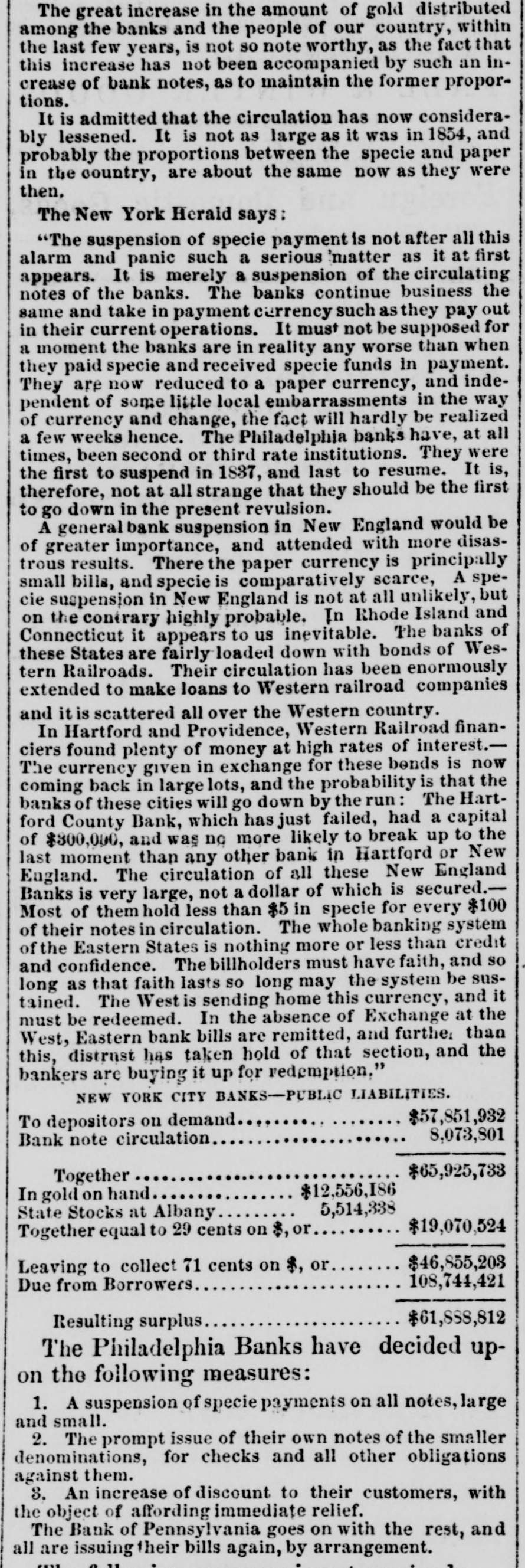
The great increase in the amount of gold distributed among the banks and the people of our country, within the last few years, is not so note worthy, as the fact that this increase has not been accompanied by such an increase of bank notes, as to maintain the former proportions. It is admitted that the circulation has now considerably lessened. It is not as large as it was in 1854, and probably the proportions between the specie and paper in the country, are about the same now as they were then, The New York Herald says: "The suspension of specie payment is not after all this alarm and panic such a serious matter as it at first appears. It is merely a suspension of the circulating notes of the banks. The banks continue business the same and take in payment currency such as they pay out in their current operations. It must not be supposed for a moment the banks are in reality any worse than when they paid specie and received specie funds in payment. They are now reduced to a paper currency, and independent of some little local embarrassments in the way of currency and change, the fact will hardly be realized a few weeks hence. The Philadelphia banks have, at all times, been second or third rate institutions. They were the first to suspend in 1837, and last to resume. It is, therefore, not at all strange that they should be the first to go down in the present revulsion. A general bank suspension in New England would be of greater importance, and attended with more disastrous results. There the paper currency is principally small bills, and specie is comparatively scarce, A specie suspension in New England is not at all unlikely, but on the contrary highly probable. In Rhode Island and Connecticut it appears to us inevitable. The banks of these States are fairly loaded down with bonds of Western Railroads. Their circulation has been enormously extended to make loans to Western railroad companies and it is scattered all over the Western country. In Hartford and Providence, Western Railroad financiers found plenty of money at high rates of interest.The currency given in exchange for these bends is now coming back in large lots, and the probability is that the banks of these cities will go down by the run: The Hartford County Bank, which has just failed, had a capital of $800,000, and was no more likely to break up to the last moment than any other bank in Hartford or New England. The circulation of all these New England Banks is very large, not a dollar of which is secured.Most of them hold less than $5 in specie for every $100 of their notes in circulation. The whole banking system of the Eastern States is nothing more or less than credit and confidence. The billholders must have faith, and SO long as that faith lasts SO long may the system be sustained. The West is sending home this currency, and it must be redeemed. In the absence of Exchange at the West, Eastern bank bills are remitted, and further than this, distrust has taken hold of that section, and the bankers are buying it up for redemption." NEW YORK CITY BANKS-PUBLIC LIABILITIES. $57,851,932 To depositors on demand 8,073,801 Bank note circulation $65,925,733 Together $12,556,186 In gold on hand 5,514,338 State Stocks at Albany $19,070,524 Together equal to 29 cents on $, or $46,855,203 Leaving to collect 71 cents on $, or 108,744,421 Due from Borrowers $61,888,812 Resulting surplus The Philadelphia Banks have decided upon the following measures: 1. A suspension of specie payments on all notes, large and small. 2. The prompt issue of their own notes of the smaller denominations, for checks and all other obligations against them. 3. An increase of discount to their customers, with the object of affording immediate relief. The Bank of Pennsylvania goes on with the rest, and all are issuing their bills again, by arrangement.


Article from Daily Nashville Patriot, October 31, 1857

Click image to open full size in new tab

Article Text

BY TELEGRAPH. BY THE NATIONAL LINE. [Reports Furnished by the Associated Press.] ROUSE'S POINT, N. Y., Oct. 29.-The heavy rains have caused much damage to the Ogdensburg Railroad, delaying the trains several days. The loss to Champlain village is $50,000. NEW YORK, Oct. 29.-Money better, dull. The Bowery bank has decided to wind up its affairs. Specie of dull sile. Crops from the West are beginning to move bither. Sr. LOUIS, Oct. 29-Six feet water to Cairo. NEW YORK, Oct. 30.-The Herald says the Per. sia brought a large amount of certificates of deposit, accepted by the Bank of England and other banks to buy cotton and breadstuffs. Such certificates are held here at 7 to 8 cents premium. The Times was mistaken about the British mission. Sir Ousley goes as minister to Central America. Philadelphia, Oct. 30.-The Ledger contains the statement of the Bank of Pennsylvania. Their liabilities are about two millions independent of the capital. Assets one million and three quarters. It will probably go into legislation. LOUISVILLE, Oct. 30.-River 5 feet 3 inches water in the canal. Sterling nominal, and governed by the New York rates. 1 WASHINGTON, Oct. 30.-At the navy yards at Gosport, Philadelphia, and Pensacola respectively, will be constructed one screw propeiler sloop of war, one of the engines to be constructed at the Washington navy yard. The suspension of operations at the Charleston, Portsmouth, and Brooklyn yards, and the recent discharge at Goeport is temporary. The Secretary of the Navy means to keep the mechanics at these yards employed during the winter. Westervilt's sloop of war will be commenced immediately. NEW ORLEANS, Oct. 30.-Cotton-Sales of 2,000 bales. Prices unchanged. Sales of the week 15,200 bales. Receipts 26,000 bales. Decrease at this port 121.600 bales Decrease at all ports 203,280 bales. Stock 130,250 biles. Flour one shilling higher. Prime sugar 51.6. Sterling 95; nominal New York sight 5 per cent. discount. NEW YORK, Oct. 30.-Cotton quiet. Flour and sugar firm. Wheat 1 33al 50 for white, 1 23al 30 for red. Corn 73.75 for white, 70 for yellow. Mess pork $20 00a$20 25. Lird 9.121 Coffee 10}a 111. Molasses 37₫a40. Pig iron 28a29. Tallow 9094. CINCINNATI, Oct. 30.-Flour 4 00a4 10. Whisky 14% 15. Oats 34, White wheat 65a70; red 80a 85


Article from The New York Herald, November 1, 1857

Click image to open full size in new tab

Article Text

Banks, and the Reforms that are Needed in Them. We request all persons interested in the banking and currency systems of the country to read the articles which we publish elsewhere from the Philadelphia Ledger, on the subject of banks and banking. They will there learn that the ancient Bank of Pennsylvania, which has flourished 80 long and so invariably led the race of suspension whenever there was a chance of doing so, is utterly insolvent, and will be forced to go into liquidation, "leaving," in the words of the Philadelphia journalist, "as little for its shareholders as its great prototype, the Bank of the United States." They will also learn that, on an investigation of the books of the concern, it appeared that eight of the directors of the bank held but eighty-two shares of its stock among them; having evidently lent their names to the bank and enjoyed the privilege of directing its discount operations without the least idea of risking any portion of their capital in its stock. From this one example we may learn the nature and character of one half the banking and corporate monetary institutions throughout the country. We have no hesitation in saying that if all the 1,600 banks of the United States were examined to-day as thoroughly as the Bank of Pennsylvania has been, a very large proportion of them would be found to be as unsound as that institution and the history of many, as told in their stock ledger and discount books, would reveal an equally disgraceful record of imposture and dishonesty. Men who are honest and upright in their private dealings as individuals, notoriously lose all thought of honor, all idea of integrity, all concern even for responsibility when they are associated together in a corporate institution; they will cheat, deceive, defraud the very humblest of their dependents even, so long as the fraud is chargeable directly on the corporate concern, and only ultimately on the individuals composing it: and of all corporate concerns which are liable to be swayed by corrupt purposes and dishonest motives at the present time, there are none with such temptations to evil, and such opportunity for mischief as the banks. It therefore behooves the Legislatures of all the States to afford to the public the largest measure of protection possible against the banks. In Pennsylvania, a special session of the Legislature has so far repealed the law as to rescue the banks from the otherwise inevitable consequence of their suspension of specie payments. In this State the Judges of the Supreme Court, in consideration of the emergency, took the responsibility of nullifying the law, and depriving the Legislature of its vocation. In other States other shifts have been resorted to with a view of screening the banks from the legitimate but disastrous consequences of their failure to perform their duty to society. In every case the difficulty has been surmounted. But also in every case the purpose of the banking laws have been defeated, the public has been disappointed, and foreigners have been encouraged to sneer at American contempt for law, and the laxity of financial obligations in the United States. It is evident that some legal steps should be taken to obviate the recurrence of accidents 80 injurious to ourselves and so disgraceful to all. Every one is a currency doctor at the present time; but we have not yet seen a broad feasible scheme for the equalization and assimilation of the currency of the various States throughout the country. Such a system as this, by which the money of every. State in the Union would be at par in New York would obviate a great amount of mischief-not only such mischief as occurs on the occasion of panics and financial revulsions like the present, but the trouble that is being constantly caused in the best of times by the failure of recognized banks which seem to be sound and command the public favor, but, one day, suddenly collapse, and disappear, no one knows why or how. Under a general law, or a system of uniform laws, regular weekly statements could be exacted from every bank in the country; and, with Clearing Houses in every large city, no such catastrophes as that of the banks of Pennsylvania could occur. Until we have a general.law, indeed, neither billholders nor depositors can ever be considered universally safe. RENT DAY IN THE HARD TIMES.-We have


Article from New-York Daily Tribune, November 12, 1857

Click image to open full size in new tab

Article Text

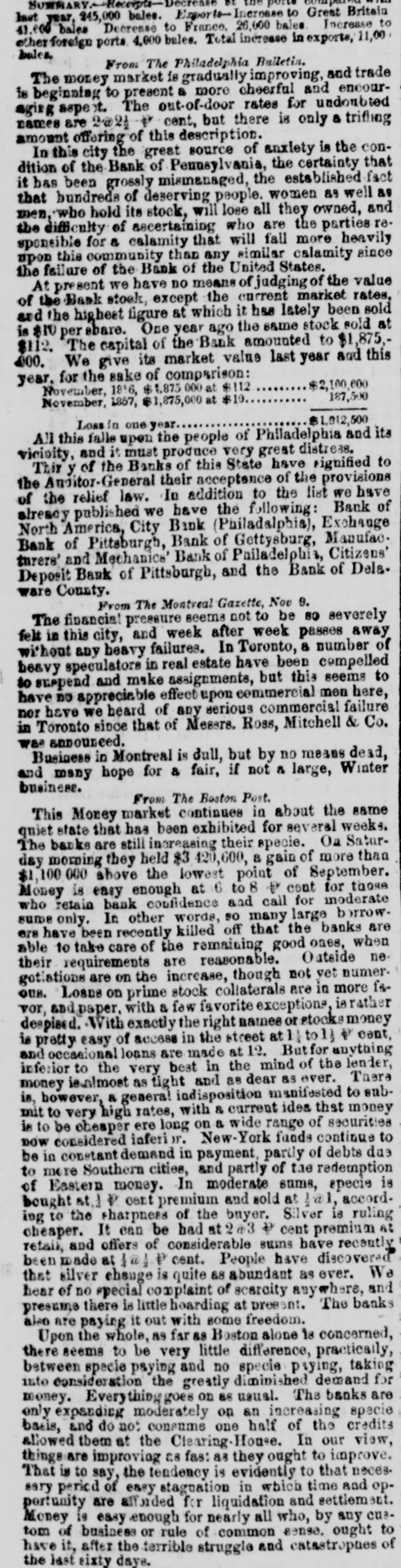
last year, 245,000 bales. Exporto- Increase to Great Britain 41.000 bales Decrease to France, 26,000 bales. Increase to other foreign ports, 4,000 bales. Total increase in exports, 11,00 bales. From The Philadelphia Bulletin. The money market is gradually improving, and trade is beginning to present a more cheerful and encouraging aspect. The out-of-door rates for undombted names are 2@21 cent, but there is only a trifling amount offering of this description. In this city the great source of anxiety is the condition of the Bank of Pennsylvania, the certainty that it has been grossly mismanaged, the established fact that bundreds of deserving people. women 89 well as men, who hold its stock, will lose all they owned, and the difficulty of ascertaining who are the parties respensible for a calamity that will fall more heavily upon this community than any similar calamity since the failure of the Bank of the United States. At present we have no means of judging of the value of the Bank stock, except the current market rates, and the highest figure at which it has lately been sold is $10 per sbare. One year ago the same stock sold at $112. The capital of the Bank amounted to $1,875,400. We give its market value last year and this year. for the sake of comparison: $2,100,000 November, 18'6, $1,875 at $112 187,500 November, 1857, $1,875,000 at $10 1,912,500 Loss in one year All this falls upon the people of Philadelphia and its vicioity, and it must produce very great distress. This y of the Banks of this State have signified to the Anditor-General their acceptance of the provisions of the relief law. In addition to the list we have already published we have the following: Bank of North America, City Bank (Philadalphia), Exchange Bank of Pittsburgh, Bank of Gettysburg, Manufac. thrers' and Mechanics' Bank of Philadelphia, Citizens' Deposit Bank of Pittsburgh, and the Bank of Delaware County. From The Montreal Gazette, Nov 9. The financial pressure seems not to be 80 severely felt in this city, and week after week passes away without any heavy failures. In Toronto, 8 number of beavy speculators in real estate have been cempelled to suspend and make assignments, but this seems to have no appreciable effect upon commercial men here, nor have we heard of any serious commercial failure in Toronto since that of Messrs. Ross, Mitchell & Co. was announced. Business in Montreal is dull, but by no means dead, and many hope for & fair, if not & large, Winter business. From The Boston Post. This Money market continues in about the same quiet state that has been exhibited for several weeks. The banks are still increasing their specie. Oa Saturday morning they held $3 420,600, & gain of more than $1,100 000 above the lowest point of September. Money is easy enough at 6 to 8 P cent for those who retain bank confidence and call for moderate sume only. In other words, SO many large brrowere have been recently killed off that the banks are able to take care of the remaining good ones, when their requirements are reasonable. Outside ne. gotiations are on the increase, though not yet numerous. Loans on prime stock collaterals are in more favor, and paper, with a few favorite exceptions, is rather despised. With exactly the right names or stocks money is pretty easy of access in the street at to $ cent, and occasional loans are made at 12. But for anything inferior to the very best in the mind of the lender, money is almost as tight and as dear as ever. There is, however, & general indisposition manifested to submit to very high rates, with & current idea that money is to be cheaper ere long on a wide range of securities now considered inferi New-York funds continue to be in constant demand in payment, partly of debts due to more Southern cities, and partly of the redemption of Eastern money. In moderate sums, specie is bought at.1 P cent premium and sold at 1@1, according to the sharpness of the buyer. Silver is ruling cheaper. It can be had at P cent premium at retail, and offers of considerable sums have recently been made at 1 cent. People have discovered that silver change is quite as abundant as ever. We hear of no special complaint of scarcity anywhere, and presume there is little hearding at present. The banks also are paying it out with some freedom. Upon the whole, as far as Boston alone 18 concerned, there seems to be very little difference, practically, between specie paying and no specie paying, taking into consideration the greatly diminished demand for money. Everything goes on as usual. The banks are only expanding moderately on an increasing specie basis, and do no: consume one half of the credits allowed them at the Clearing-House. In our view, things are improving as fast as they ought to improve. That is to say, the tendency is evidently to that neces. sery period of easy staguation in which time and opportunity are afforded for liquidation and settlement. Money is easy enough for nearly all who, by any custom of business or rule of common sense, ought to have it, after the terrible struggle and catastrophes of the last sixty days.


Article from The Weekly Pioneer and Democrat, November 19, 1857

Click image to open full size in new tab

Article Text

# Financial News. The New York news of the 11th and 12th is quite cheering. Money matters were continuing to improve, and a cheerful feeling was prevailing among business men. Some of the importing houses were preparing for a revival of trade, and it was rumored that some of the banks would resume specie payment at once. On the 11th, there was a heavy demand for discounts at the banks at the first board, and an advance at 3¼ per cent. was offered for the New York State loans, and also an advance on nearly all the stock sold. The business was quite large at the 2d board. They were firmer with good demand. Ill. Central bonds 80½; N. Y. Central 70¾; Reading 36; N. Y. State sixes of 1865, 107c. On the 12th, the tendency of the money market was still downward. Unexceptionable paper money was discounted at 1 and 2 per cent. Sales of new issue of State bonds were made at $1 08 in store. First board active at an advance on whole line of from 1 to 4 per cent. The prices for stocks ranged as follows: Michigan Southern 14¼; N. Y. Central 12; Erie 15¼; Cleveland and Toledo 36¼; Hudson 16½; La Crosse & Milwaukee 8; Chicago & R. 1. 72; Reading 37½. The steamer Tennessee, from Vera Cruz, arrived at New Orleans, on the 10th, with half a million of specie. The steamship Cahawba, from New York, sailed on the 11th, for New Orleans and Havana, with $250,000 in specie for New Orleans, and $100,000 for WALKER: none for Havana. The steamship Persia sailed from New York, on the 11th, for Liverpool, with 68 passengers and $600,000 in specie. The new loan of the Michigan Central Railroad Company is reported to have been taken by BARING BROTHERS, at 70 cents. The Goshen Bank, at Goshen, N. Y., was robbed, on the night of the 11th, of $20,-000 in bills and about $2,500 in specie. No clue to the perpetrators has yet been found. The Comptroller of New York City advertises for $100,000 to form part of the $225,000 appropriated by the Common Council for the prosecution of the Central Bank. The work cannot continue until the appropriation is rendered available by the issue and sale of these bonds. The Granite Bank of Vallentown, Conn. has been enjoined by Judge BUTLER, of the Superior Court, and a receiver appointed on application of the Bank Commissioners. The Commissioners are pursuing the investigation. The Cincinnati Gazette, of Monday, remarking upon the gradual accumulation of money in the banks of the country, says: "The improvement of which these features afford satisfactory evidence, must soon lead to the adoption of a lower standard for names at the discount houses. It will not pay to keep money unemployed, and the accumulation of currency will therefore create a demand for paper, that will very soon cover the usual range of business. The Ohio, Indiana, and Kentucky banks have withdrawn not far from eight millions of their circulation since the failure of the Trust Co. This, as soon as exchange settles down to the low point, towards which it is now tending, will be re-issued. The supply of money in the country awaiting a market is very large, and it cannot fail, when put into use, as it must be, to produce a plethora of capital." The Philadelphia Press, commenting upon the meeting of the Stockholders of the Bank of Pennsylvania, says: "It seemed to be conceded yesterday, beyond question, that the whole capital of the Bank is sunk, and the shareholders seemed relieved when they had brought themselves to look the fact boldly in the face. If it is to be resusciated, it can only be done by new subscriptions, and such a movement will now scarcely succeed, in view of the fact that only about $300.000, or one-sixth of the whole capital was voted yesterday. We have said that the note holders have no security. The Bank is at present working under the old charter, and though having some three years since accepted the new charter, under which the stockholders are liable for the circulation of the Bank, that charter does not go into operation until the 2d Monday in April next. The effect of the acceptance of the Relief law while it will relieve the Bank from harassing prosecutions, will be to bring upon it a speedy commission from the Governor, and perhaps a summary judgment of utter insolvency." The total capital of the Bank is $1,800,-000, a rather large sum to be abstracted or sunk by the Directors. The Convention of Connecticut Banks adjourned without taking any action upon the subject of Suffolk redemptions. A considerable number of the banks will probably establish a Clearing House in Hartford, of New Haven, and cutting loose from the Suffolk, make their redemptions in New York at 1 per cent. discount. The Banks of Indiana maintain with ease


Article from The Daily Dispatch, February 13, 1858

Click image to open full size in new tab

Article Text

BANK OF PENNSYLVANIA.-A meeting of the stock holders of the Pennsylvania Bank was held in Philadelphia Wednesday afternoon, when it was aunounced that Mr. Alibone, the late president. had assigned his property for the benefit of the bank. The resolution for an assignment by the bank was adopted. Also, resolutions censuring President Alibone and Daniel Deal 88 colluding together in the common plundering of the bank, and declaring that whatever punishment the criminal law infliets on such dishonesty should te enforced.


Article from The Cecil Whig, February 13, 1858

Click image to open full size in new tab

Article Text

BANK OF PENNSYLVANIA. - Philadelphia, Feb. 10.-A meeting of the stockholders stockl olders of the Pennsylvania Bank was held this afternoon, when it was announced that Mr. Alibone, the late President, had assigned his property for the benefit of the bank. The resolution for an assignment by the bank was adopted. Also resolutions censuring President Alibone and Daniel Deal, as colJuding together in the common plunder of the Bank, and declaring that whatever punish ment the criminal law inflicts on such dishonesty should be enforced.


Article from Arkansas True Democrat, February 23, 1858

Click image to open full size in new tab

Article Text

The Bank of Pennsylvania. From a report which the directors have recently made, it appears that the whole of the capital of this institution $1,875,000, and the whole of the surplus fund, $205,316, have been sunk. The stockholders will not get one cent. The notes in circulation amount to $546,392, and the deposits to $413,396: together $960,788. These will be paid in part, perhaps in full-if the note holders and depositors wait long enough. To the other banks of Philadelphia, there is due thesum of $964,288. To cover this debt bills receivable to the amount of $1,222,965, have been pledged as collateral security; but, it is believed that a part of these will ultimately prove unavailable. To foreign banks," e. to banks not within the bounds of Pennsylvania, the sum of $225,433 is due. For this no special provision has been made. Our limits allow 118 to make only the following extracts: Among the assets were found notes,checks, etc., of an insolvent house, the head of which is the brother of the late president, amounting to $119,266 57, of which a small portion was secured by doubtful collaterals, and the effects in the hands of the assignee of the firm are expected to pay a very small dividend. Of this large sum, but $12,350 was discounted by the board of directors. * The obligations of a former director and his firm, appear to the extent of $146,818,21. 'The best inv estigation which the board have, under the pressure of other duties, and in the y short time left them for that purpose, been enabled to make, has satisfied them that some of the declared dividends were not earned, although from the manner in which the books of the bank were kept, and the results exhibited to board, there was in every instance an apparent surplus, which would have justified their being declared; a very large proportion of the deficiency can, in their opinion, be accounted for by the enormous sums paid for usury by the late president, who sold large amounts of the best bills receivable of the bank whenever its exigencies seemed to him to require it, and allowed to some parties excessive interest for deposits without consultati on with, or report to the board as to either. The proceeds of two such sales to a single individual, amounting to $178,128 08, were credited to Mr. Allibone's private account in December, 1853, and March, 1854, and do not appear to be accounted for. Other credits in that account are for sums of money which obviously belonged to the bank. That account which amounted to more than eight millions of dollars during the period for which he held the office of president, embraces very large transactions with brokers, but for whom does not appear." The transactions of the Bank of Pensylvania, of Thomas Allibone acting as President of the individual are bank, capacity, and of Thomas strangely Allibone mixed in up his together. On a thorough examination it may be found that he was not actuated by dishonest motives, but desperate speculation produces as much evil in some cases as does downwright dishonesty. With the reader's consent we will now indulge in a few moral reflections." 1st. The Bank of Pennsylvahia was one of the oldest in the country. It was established in 1792. Only two or three of the existing banks could boast of greater antiquity. It stood through all the vicissitudes of peace and war, of embargo and non-intercourse, of suspensions of specie payments and resumption of specie payments. It did, indeed, occasionally lose a hundred thousand dollars or so through the de fault of a clerk, or some such little accident, but to reduce its to Yet capital has all gone those from mishaps $2,500,000 last. Ought served only $1,875,000. it at not its melancholy fate to be a warning to other banks? 2. While the Bank of Pennsylvania, had no profits to divide, it was making large and handsome dividends. May not other banks equally as unsound as the bank of Pennsylvan be doing likewise? 3. Though the bank of Pennsylvania was rotten to the core, it made, in its quarterly returns to the auditor, as good a show of assets any bank in the country. Can any one, after this, place implicit reliance in the statements which the other banks make of their condition? 4. The personal standing of the president, or other officers of a bank, is not even presumptive which control 8 a to what evidence bank that ought the bank be. Mr. Allibone they was one of the most zealous members of the church (the P. E. C.) in Philadelphia, and of exemplary walk in all the departments of life, except, as DOW appears, was and here he Here he tempted, the banking department. fell, many others would fall, if in like haps placed as percircumstances. Let no man be so selfconfident in his own virtue as to say what he would do, and what be would not do, if he were President of a bank. the affairs so desperately were should those of be the bank entangled of as which of Pennsylvania, and his so with of be to own personal the bank, that affairs it would entangled impossible those separate the one from the other. We have room for only one more extract from the report: estimates the estate he poses as the bank a "Mr. to transfer Allibone giving margin of pro$150,000, over and above all encumbrances; amount upon enquiry, we think in if time, which be correctly realized, informed under proper management, may we are as to the amount of the prior liens."
Article from The Nevada Democrat, May 5, 1858

Click image to open full size in new tab

Article Text

Selections from Late Atlantic Papers. CHANGE OF UNIFORMS FOR THE ARMY.-A change of uniform for the rank and file of the Army has been decided upon by the vigilant and attentiveSecretary of War. which we think, will be a decided improvement, so far as regards the comfort of the soldier, and relieve him at least from the comfortless eye destroying cap now in use. The cap now worn is supplanted by a felt hat with brim 31/4 inches wide and crown 61/4 inches high, bound with ribbed silk for officers and double stitched around the rim for men. The trimmings for general officers are as follows Gold cord, with acorn shaped ends the brim of the hat looped on the right side, and fastened with an eagle attached to the side of the hat: three black ostrich feathers on the left side a gold embroidered wreath in front, on black velvet ground. encircling the letters U. S. in silver, old English characters. For other classifications of officers, and for the privates, there are similar trimmings, varying slightly for each distinctive grade or class. change also extends to the pantaloons and coat, but in respect to them it is confined to the trimmings of the latter and the stripe of the former. Sibley's tent is also to be substituted for that now in use.-N. Y. News. GOLD DISCOVERED IN IOWA.-The Burlington (Iowa) Hawk Eye, of March 19th, announces the discovery of gold in that State. A correspondent writing to that paper, says: "Gold has been discovered in Clark county, (this State) about eight miles north of Oceola. A few days since had occasion to visit the place. and examine for myself, and am satisfied there is no humbug about it. Some six weeks since, Squire Hewett was prospecting for coal on his farm, when he struck a small vein of black sand and quartz rock, which, upon examination was found to contain gold, as he supposed. Several Californians have since visited the place, and tested it. and pronounced it pure gold. Men are engaged in digging and average from two to five dollars a day of the precious metal. Arrangements have been made to open two other leads, which have since been discovered. Great excitement prevails throughout this section of the State in regard to it." END OF A BANK.-The appraisers appointed to value the assets of the Bank of Pennsylvania, at Philadelphia, value the securities turned over by Thomas Allibone, its late President, at $56,322; their nominal amount is $683,696. The Press says that the amount of over-drafts and marginal balance of notes and obligations in the hands of the trustees, for the benefit of other banks, foot up to the amount of $128,510, which the appraisers valued at the astonishingly low estimate of forty three dollars and thirty one cents! The Senate and House Committees on Foreign Affairs are about to recommend the immediate abrogation of the Clayton-Bulwer treaty. Negotiations to that effect are now going on at Washington between the United States and Great Britain. The English government is said to have no objections to the abrogation of the treaty provided certain concessions are made in Central America. AN OLD PRINTER DEAD.-John Warrock, a venerable old citizen of Richmond Va., died recently in that city. He was born in 1773, was a printer by trade, having learned the business in the office of the Petersburg Intelligencer, and bad been Printer to the Senate, thirty eight years. He was the oldest living native of Richmond, and the oldest Mason in the city. He was universally beloved. TEXAS.-The Texas Legislature adjourned on the 21st ult., after a session of fifteen weeks. Thirty six new counties were erected, lying generally on the head waters of the Colorado and Brazos, and along the Big Wachita and Red rivers These. added to the numbers of counties before existing, make the whole number in the State 152. During the last five years 6,650,000 acres, or 10,000 square miles of the public domain have been taken up. COTTON IN TEXAS.-There are upwards of twenty-one thousand bales of cotton now in Galveston, Texas, which is eighteen thousand more than was on hand last year at this time The total receipts are in excess of those of last year 21,750 bales. The crop of Texas, it is estimated, will reach 200,000 bales. HALL, the convict who made a desperate attempt to escape from the Alton, (Illinois) Penitentiary, and was shot by the warden, died a few days after receiving the wound. The ball struck his skull, just below the left ear, and glancing around lodged under the skull. For sixteen hours previous to his death he was paralized and insensible. From the time he was shot till he died, paralysis made slow but certain work upon him. The Richmond South says that a negro child has recently been born in that county, with twenty-six fingers and toes. It has six toes on each foot, and seven fingers on each hand. There are two full sized thumbs on each hand, and two "little" fingers, All these limbs are said to be perfect. COLLEGE STUDENTS IN TROUBLE.-One hundre. of the students of Columbia (S. C.) College, were suspended, March 26th, until October next, for insubordination They tarred the benches of the recitation rooms. and committed other exceptional acts, because the faculty refused to suspend the exercises on Thanksgiving Day. REVIVAL IN CHICAGO-Chiengo is participating in the bles ings of the 'great revival." Meetings are going on in many of the churches of that city, which are being attended by the best results.


Article from Worcester Daily Spy, September 28, 1858

Click image to open full size in new tab

Article Text

# A MEMORABLE ANNIVERSARY. One ago last Saturday, the first impetus to the financial revulsion which swept through the country, was given in the city of Philadelphia. On the day previous the banks of that city resolved to discredit the Bank of Pennsylvania, and on the next morning, Friday, Sept. 25th, that bank announced a suspension of specia payment. Before the day was over the other banks were obliged to adopt a like course. The country banks, the banks of Baltimore, Washington, and of all the West and South followed speedily. Then came the banks of New York and New England, and the business of the country came to a stand, from which it is now slowly but steadily recovering.-Boston Advertiser.


Article from Fayette County Herald, October 16, 1873

Click image to open full size in new tab

Article Text

# THE PANIC OF 1857 of here-could not be had at any rate on ordinary promissory notes and bills of exchange. Commercial house after commercial house, bank after bank succumbed to the panic. The panic extended through the entire country. The failure of the Bank of Pennsylvania in Philadelphia, was followed by that of the other banks of that city, and by those of Baltimore and of the Southern Atlantic States generally. The panic was no respector of persons.- Merchants, bankers, monied corporations, and manufacturing companies were swept down without distinction. Commercial business was everywhere suspended; the purchase and transportation of produce entirely ceased; and the climax only was reached when, on the 14th of October, the bank suspensions of New York and New England took place. For this almost universal suspension the banks could not claim the want of faith among the depositors to be the cause. Despite the distrust that early began to affect the entire country, the depositors stood well by their guns, and not till the 29th of September did they begin to be alarmed. For the five successive weeks preceding, they withdrew less from the banks each week than the banks withdrew from them by the depression of loans. Although the panic started on the 25th of August, caused by the contraction of loans, and was at once carried by the telegram with the speed of light to all parts of the country, no marked withdrawal of deposits by individual depositors took place anywhere till more than an entire month later. Up to that time the depositors presented a steady front, apparently determined to sustain the public credit if anything else failed. But when October came in, resistance ceased at once to be a virtue, and on the third of that month, a marked change came over the spirit of the depositors. Over four millions of the deposits were withdrawn in the seven days following, and over fourteen millions in the next twenty. The 14th of October was the date of the banks' suspension. On the day following, withdrawals ceased and restoration began. One of the causes alleged by the banks themselves for their suspension was the sudden withdrawal of country ballances, and for this the telegraph was responsible. It not only took the news to the country banks of the collapse of credit in the city, but brought back their orders demanding their deposits in specie. The Clearing House, too, was alleged to aid in increasing the general collapse. Its daily settlements in coin forced smaller banks into contracting their loans, into sacrifices of property, and finally into bankruptcy. Default at the Clearing House became the Ban-gro's ghost and appeared at the bank Board of all the smaller institutions. The most universally accepted cause for the panic of 1857 is the violent contraction of bank loans immediately after the 24th of August. And this was entirely the action of the banks. and they had only themselves to blame. It was, too, the expansion of the banks previous to the panic that laid the foundation for the memorable crisis of 1857.