Click image to open full size in new tab
Article Text
to beware of designing demagogues, wno professed friendship for the colored man only to betray him, and assured them that, whatever may be said to the contrary, there could not be, in any section of the country, warmer or more disinterested friends to the colored race than the intelligent classes of the South. They should not pin their political faith to any particular party in the belief that their friends can only be found in that party alone, but should study the institutions and laws of their country in connection with their own welfare, and choose for themselves. The speech- making ended, the Secretary invited them into an adjoining room, where a table was spread with a bounteous supply of refreshments, to which they devoted their attentions with most praiseworthy zeal. To the colored employés of the Interior De- partment this was an epoch, and, judging from the great glee with which they discuss the momentous events of last Saturday, they will serve as an absorb- ing theme for months to come.
The Tariff Question Squelched.
The Tariff bill received its quietus in the House to- day, and it will hardly be brought up again this session, even by its persistent advocate, Mr. Moor- head. With the exception of Moorhead, its friends abandoned it some time ago, chiefly because it has for some time been apparent that no measure of a satisfactory character could be passed at this session.
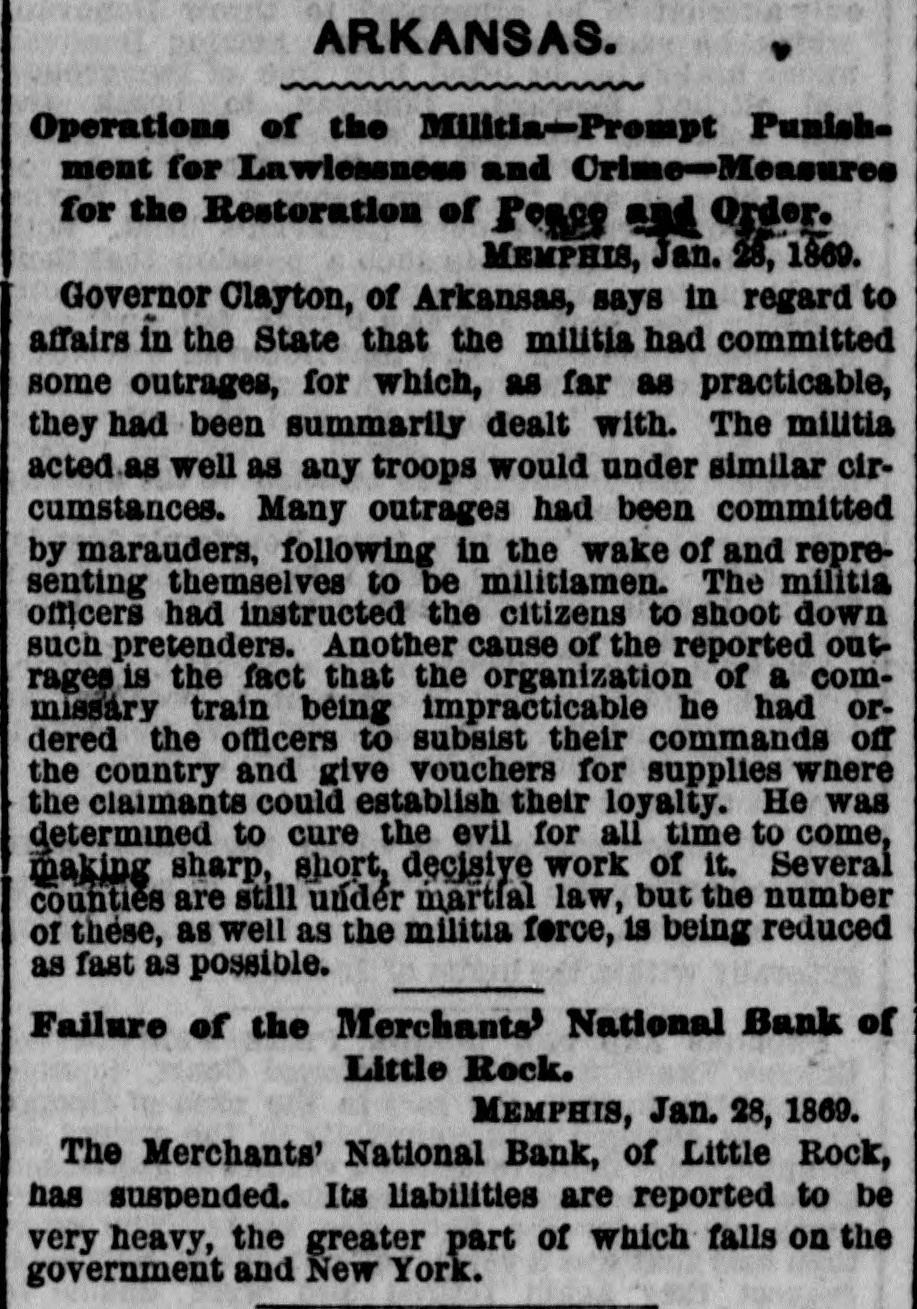
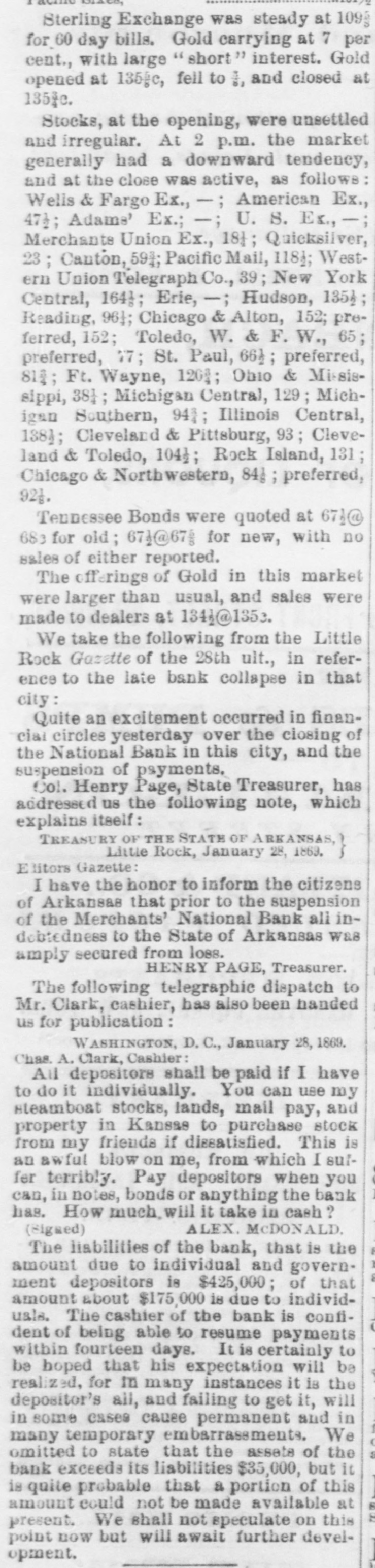
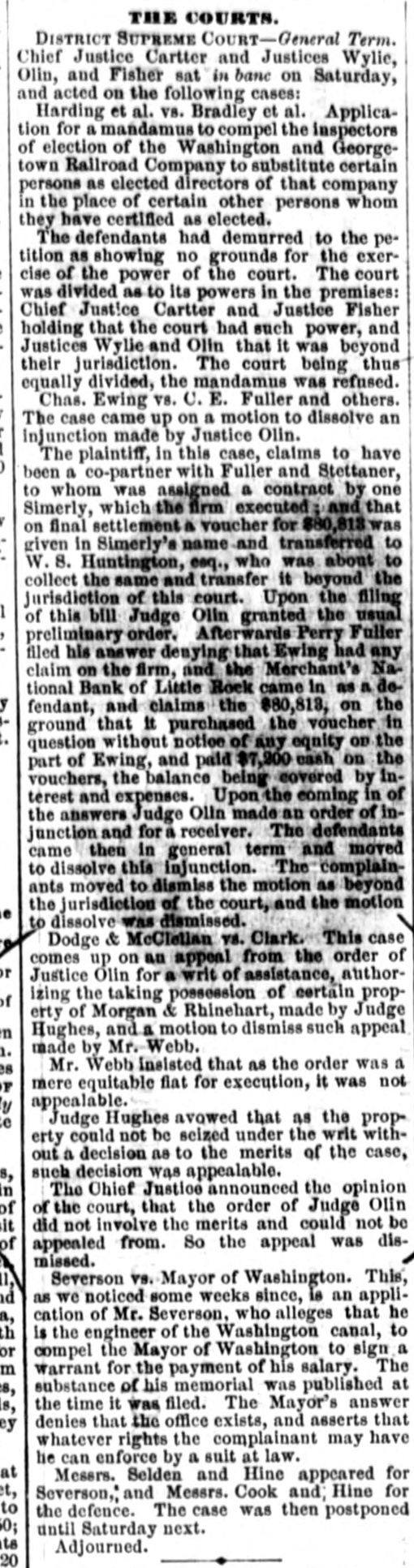
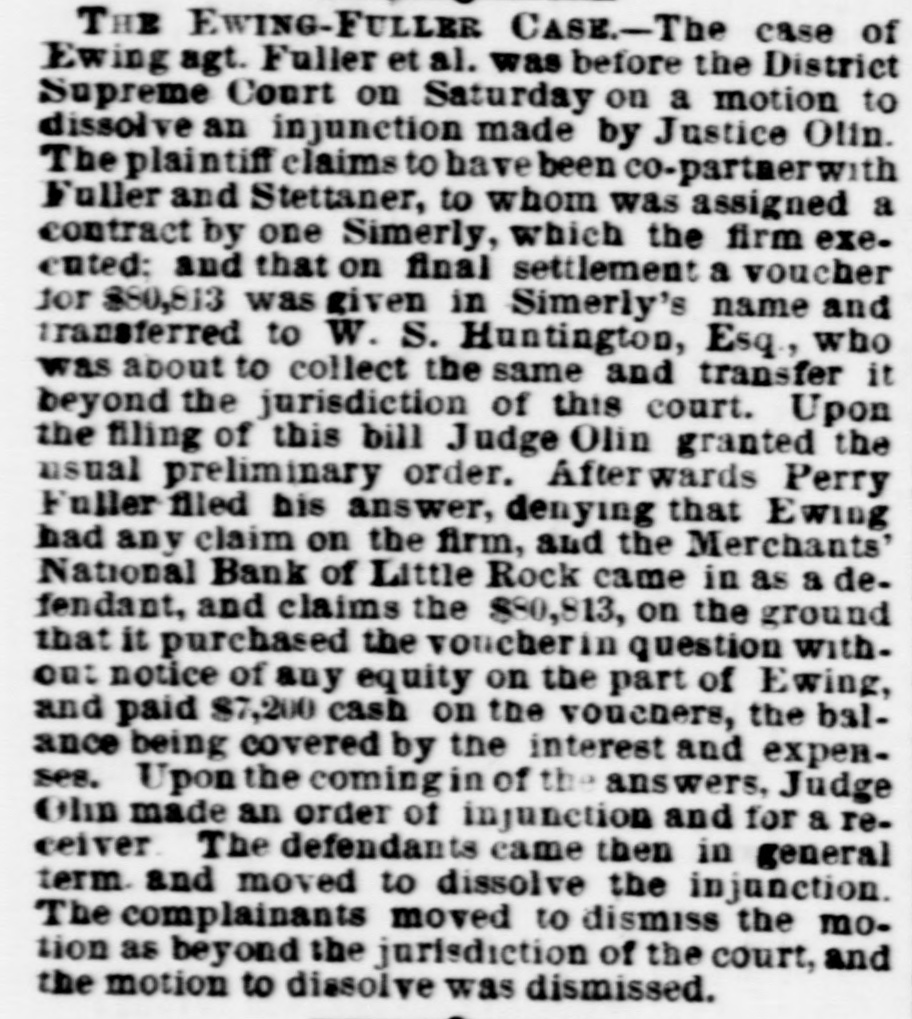
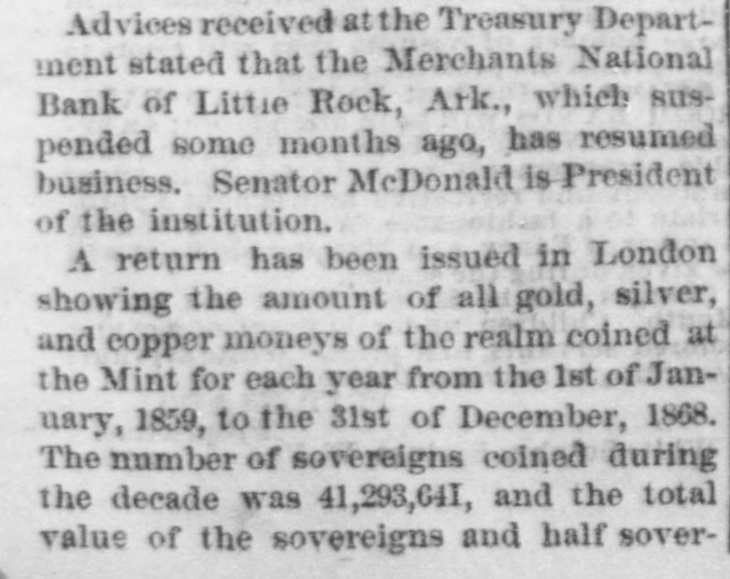
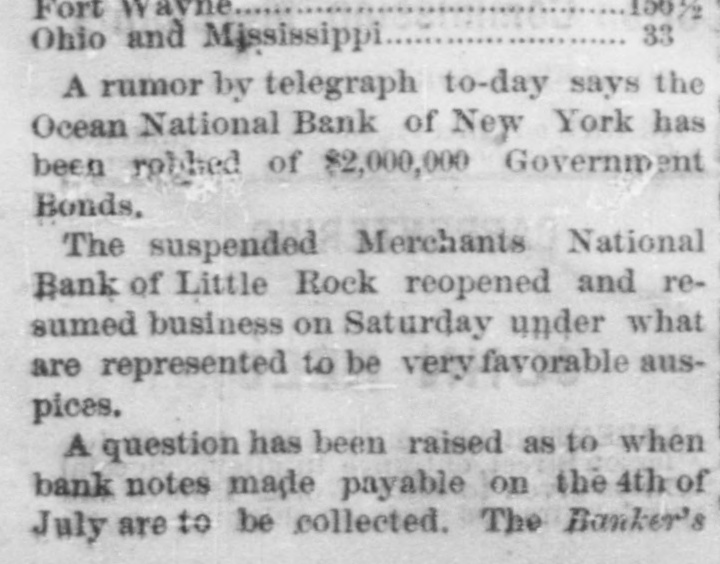
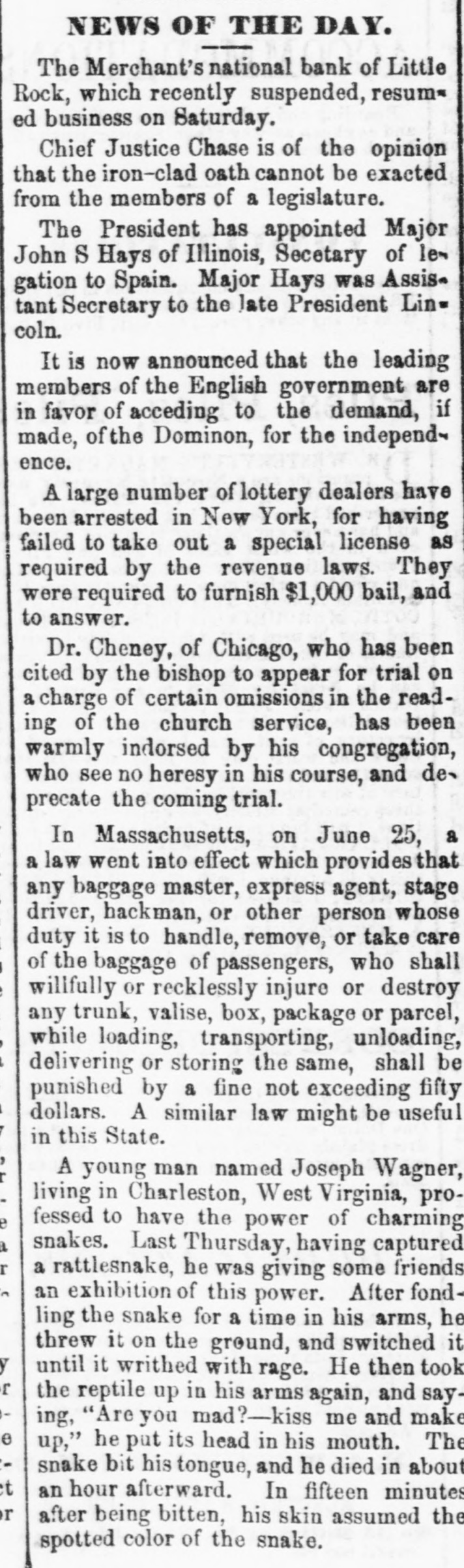
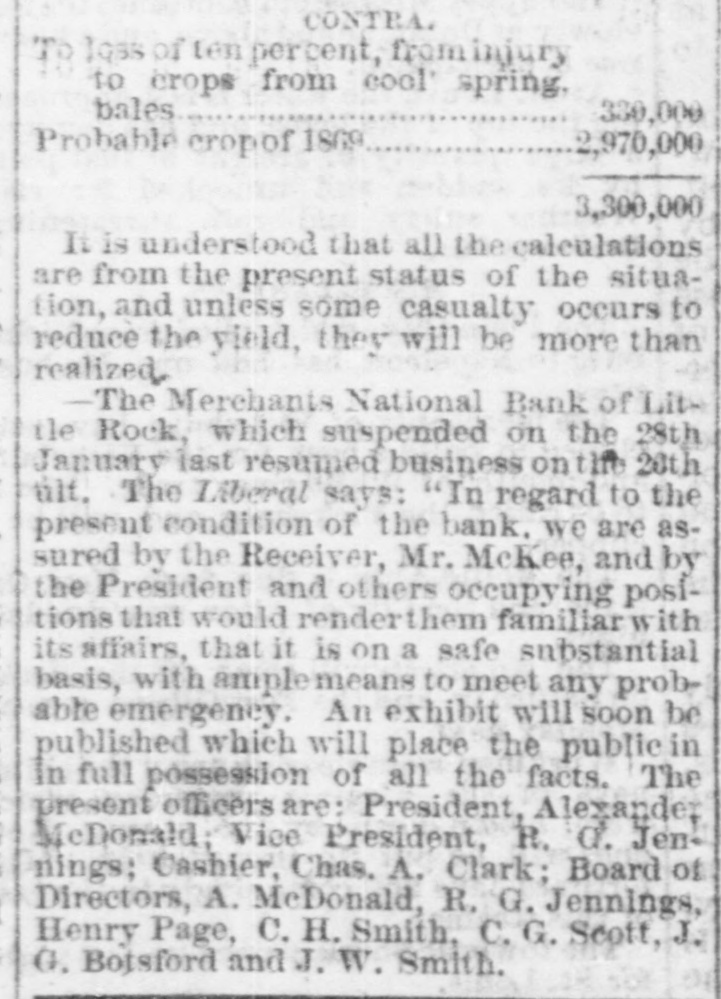
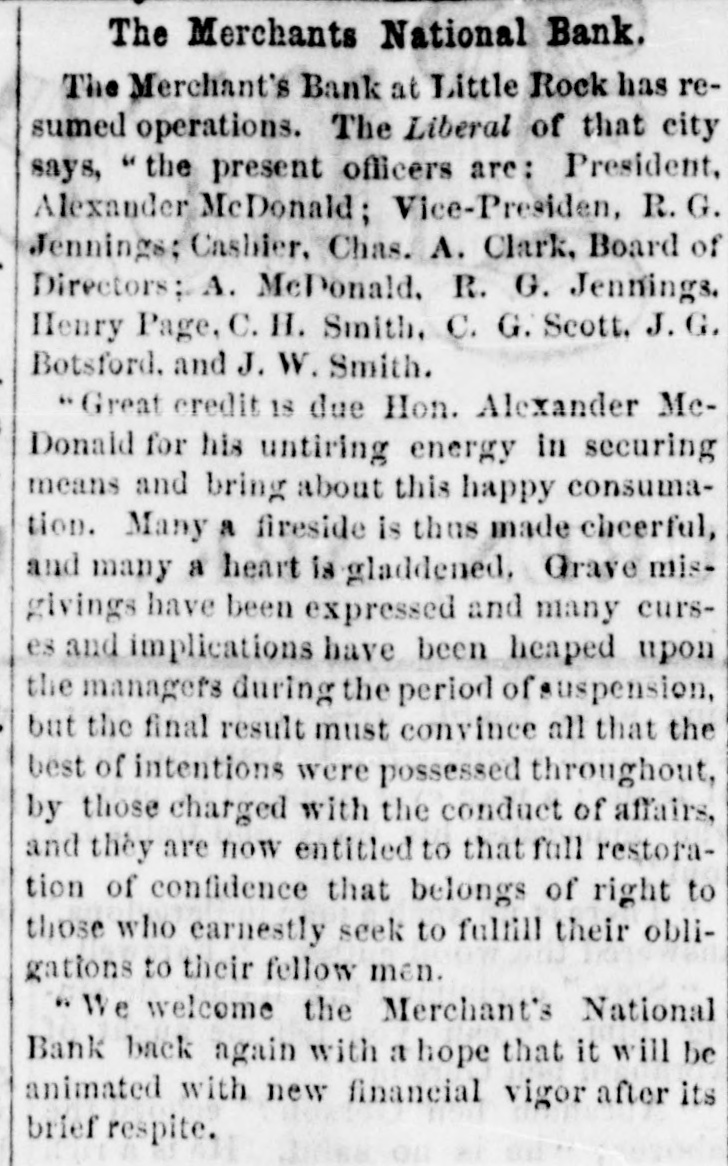
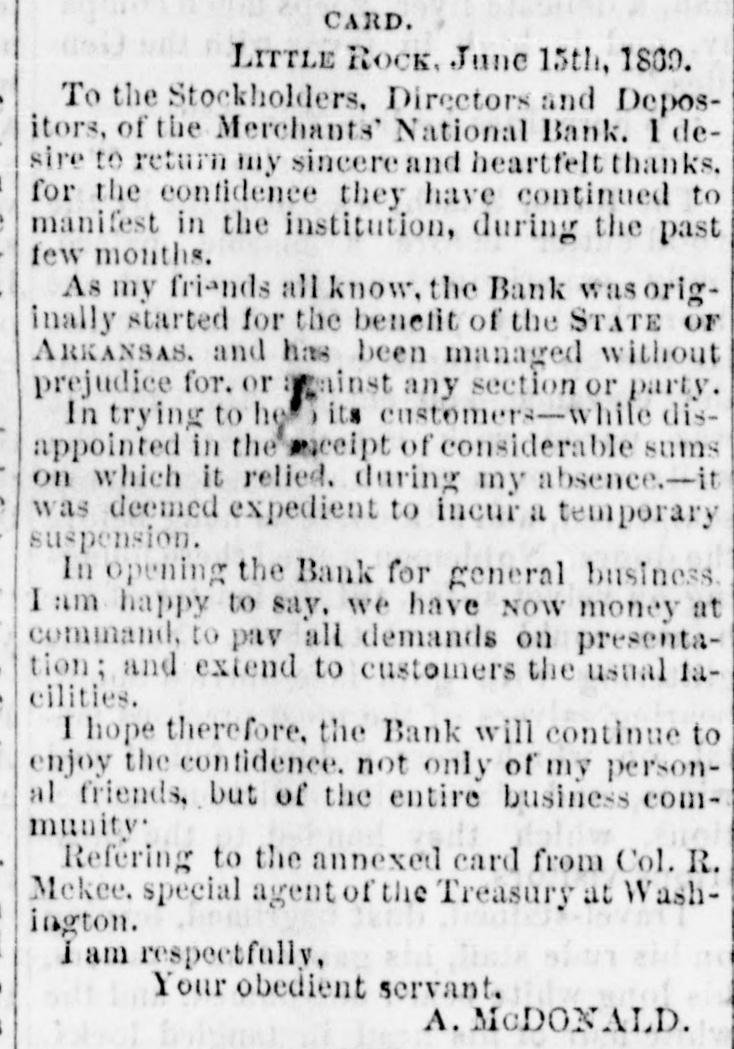
The Merchants' National Bank, of Little Rock.
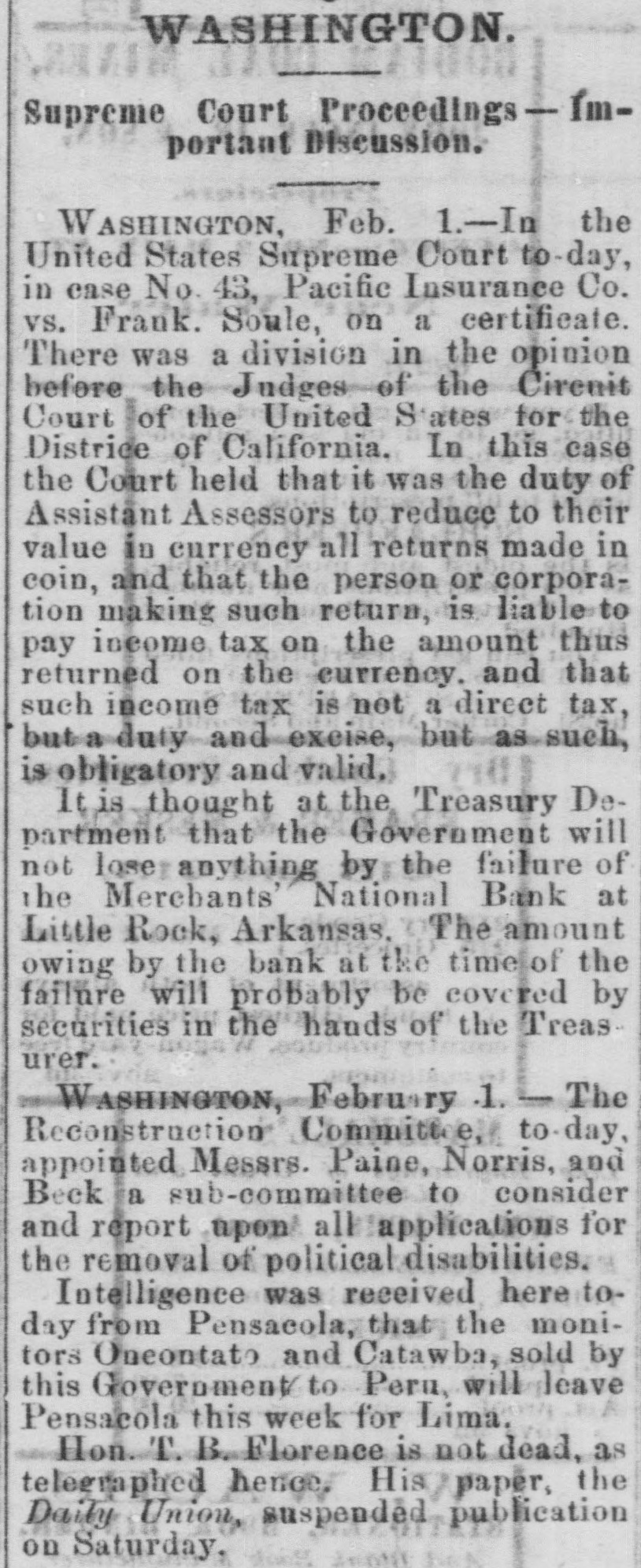
It is thought at the Treasury Department that government will not lose anything by the failure of the Merchants' National Bank, at Little Rock, Ark. The amount owing by that bank at the time of the failure to the Treasurer of the United States and to government disbursing officers was less, than $220,000. The assets of the bank with the Treasurer can be sold for an amount hearly equal to that figure, and if there be anything left to the bank at all it is not possible for the government to lose.
The Bradley Case Still Undecided.
The case of Joseph H. Bradley again came before the Supreme Court of the District of Columbia to- day, all the judges present excepting Judge Fisher. The Court said the paper submitted to it a few days ago by Mr. Bradley professed to have two objects- one to offer an apology to this court for his language to Judge Fisher in the Criminal Court and the other to protest against the courts applying to his case the rule recently adopted excluding from practice in all the courts organized by the act of March 3, 1863, any attorney who may have been dismissed or suspended by either of them, so long as the order for that pur- pose continues in force. The Court, after replying at length to that paper, concluded by saying-
With a proper spirit on the part of Mr. Bradley there would be no difficulty in framing an apology which would be satisfactory to the Criminal Court as well as this, and be creditable to himself. The ab- sence of this spirit has hitherto been the only obstacle to bis restoration. We entertain a sincere respect for his age, his learning and his ability in the profession. We have felt it to be a painful duty to exclude him from the bar, of which he was the acknowledged leader and where we have often witnessed his tri- umphs. We issued our rule upon him to show cause why he should not be punished for contempt of court, and purposely confined our charges to two specifications-one, the use of offensive language to Judge Fisher in the Criminal Court, which we then thought was a branch of our jurisdiction, and the other the letter to Judge Fisher, to which repeated reference has already been made. But his return to that rule was not such as we hoped it would be, and our order of dismissal from the bar was the consequence. He then applied to the Supreme Court of the United States for a mandamus to compel us to restore him, and that court granted the mandamus at its present term. That also was & result which we had not looked to as possible, but we have obeyed the mandate by rescinding our order of dismissal. Self-protection, the authority and life of the very court, was at stake, and this led to the adoption of the rule, against the application of which to his case Mr. Bradley protests in the present paper. The result of all these proceedings, so far as he is concerned, is that the mandamus which he has obtained takes him away from the jurisdiction of this court in General Term and remits him to the Criminal Court, where the trouble commenced. It is not our intention to rescind the rule we have adopted or shrink from its application in a proper case. But we recommend to Mr. Bradley, in a simi- lar spirit of conciliation, that he make the required retraction and apology to the Criminal Court, and thus prevent its application to his case. The result is in his own hands.
Importation Dues of the Spanish West Indies.
The Secretary of State has received a despatch from our Consul at San Juan, Porto Rico, enclosing a copy of a decree published by the Minister of the colonies of the provisional government of Spain, dated October last, by which the importstion into Cuba, Porto Rico and the Philippine Islands of all materials destined for public works is decared free from import duties.
The Peruvian Monitors at Pensacda.
Intelligence was received here to-day from Pensa- cola that the monitors Oneonta and Catavba, sold by the government to Peru, will leave Pensacola this week for Lima.
Important Decisions by the Secretary of the Treasury.
The Secretary of the Treasury has rentered the following decisions:-
Pulied or undressed skins are dutiable atten per cent. All duties must be deposited in coir A de- posit of an equivalent in money is not albwable. Where there is but one deck to a steamer, nd the engines and bollers which rest upon the keelen-pass through that deck, the space so occupied being covered in, the law exempis from admeasurment only that portion which is above the deck. As a general rule the department does not perimit te ex- amination and appraisement of any importe mer- chandise away from the public stores whic can properly te examined and appraised at them. Duti- able articles making part of a person's ordinar lug- gage are not liable to such forfeiture as is defing in section one of the act of June 27, 1864, unless here has been a refusal to open or to afford means of ben- ing the package or envelope in which they areen- closed, or concealment equivalent to such refusa or an omission of articles from a declaration of conants of package required by section forty-six of the at of March 2, 1799, silk and cotton hostery, shirts ind drawers of silk, the chier value should be asseted with the duty of sixty per cent, under the desiga- tion of "ready made clothing" or "wearing appart." A fishing vessel, under enrolment and license, day proceed with a cargo from a United States porta port in the British provinces on taking int a permit for the purpose from the collecter. She must clear on departure and enter in return. National bank depositories and Iscal agents of the United States are not autho- ized to charge individuals for redeeming mutilated or defaced United States currency on rot- ernment account. An importer is liable for anyde- ficiency in the payment of duties on bonded gitds, although said goods may have been transferra to another party. The prohibition in the ninety-seond section of the act of March 27, 1799, against impeta- tions of foreign merchandise from other than ija- cent foreign territories in vessels of less than tirty tons does not apply to importations from Britis Co- lumbia to Alaska. Goods withdrawn from a vire- house the day following the anniversary of the date of their importation are liable to addi- tional duty under the act of March 4, 1866. The revised warehouse regulations of Octoler 30, 1868, supersede the instructions of July 2, 88, concerning the transportation of merchandise to Mexico. Such merchandise cannot be transpotd to Carrizo for exportation. These regulations to not require the establishment of bonded warehoss at por's along the Rio Grande, but provide that ne- chandise may pass through such ports in bondre immediate exportation to Mexico. Cigars, cigaretes and cheroots imported into the United States ate July 20, 1868, pay a duty of two dollars and cents per pound and twenty-five per cent d