16474. Bank of America (Philadelphia, PA)

Bank Information

Episode Type
Run → Suspension → Closure
Bank Type
state
Start Date
April 28, 1890
Location
Philadelphia, Pennsylvania (39.952, -75.164)

Metadata

Model
gpt-5-mini
Short Digest
42ce84612fba482f

Response Measures

None

Description

Multiple contemporaneous newspapers report a run beginning Monday (April 28, 1890) that withdrew about $100,000 and led the Bank of America (a state bank) to 'temporarily suspend' on April 30, 1890. A receiver (William M. Smith) was appointed and the institution is repeatedly described as 'defunct' with criminal/civil actions and asset assignment—indicating permanent closure rather than a temporary reopening.

Events (3)

1. April 28, 1890 Run
Cause
Rumor Or Misinformation
Cause Details
Run began after rumors set afloat affecting the credit of J. J. (James) McFarlane and the American Life Insurance Company; withdrawals of about $100,000 began Monday and continued.
Measures
Heavy withdrawals continued; directors met and later authorized assignment of assets to a receiver.
Newspaper Excerpt
the cause of the suspension was a run on the bank which began Monday morning and resulted in the withdrawal of upwards of $100,000 of deposits.
Source
newspapers
2. April 30, 1890 Receivership
Newspaper Excerpt
William M. Smith, president of the Common Council, was appointed receiver and assignee. Resolutions were adopted ... execute ... a general assignment of all the assets in trust for the benefit of all the creditors without distinction or preference. (Newspaper accounts, Apr 30–May 1, 1890).
Source
newspapers
3. April 30, 1890 Suspension
Cause
Rumor Or Misinformation
Cause Details
Bank closed and posted notice 'This bank has temporarily suspended' after the run and widespread rumors about McFarlane/American Life Insurance damaged confidence.
Newspaper Excerpt
This bank has temporarily suspended. The Bank of America of this city closed its doors this afternoon.
Source
newspapers

Newspaper Articles (23)

Article from Evening Star, April 30, 1890

Click image to open full size in new tab

Article Text

7 Telegrams to The Star. Second Edition Continued from 5th Page DUE TO BANKER McFARLANE. The Bank of America of Philadelphia Goes Under. 1 € PHILADELPHIA, April 30.-The Bank of AmerI ica, a state bank, closed its doors this aftera noon. Beyond the simple announcement: "This bank has temporarily suspended," the o officials of the institution have as yet a made no statement. The direct cause of the o failure is attributed to the troubles of the 1 American Life Insurance Company, of which State Senator Macfariane, vice president of the bank, is president. A meeting of the directors d was called at once, and they are now in session 8 going over the books. I The bank had twelve branches scattered W over the outlying districts. The operation of V these branches had encouraged deposits from ME I business people remote from the financial center who were glad to avail themselves of 8 the facilities which they offered for its enterc prise. The bank was rewarded with a line of o deposits aggregating in amount over $700,000. L including those of the main office. The bank is closely allied to the Insurance Company of America and several other financial institutions of this city. and today's suspension is due W to rumors which were set afloat on Saturday fi affecting the credit of President McFarlane of 1 the insurance company. T


Article from Daily Kennebec Journal, May 1, 1890

Click image to open full size in new tab

Article Text

Bank Failure at Philadelphia. PHILADELPHIA, April 30.-The Bank of America of this city closed its doore this afternoon. Ii is announced officially that the cause of the suspension was a run on the bank which began Monday morning and resulted in the withdrawal of upwards of $100,000 of deposits. The failure will not affect business men to any great extent. The loss+ will fall mostly on small shopkeepers and others who cannot well afford to lose the money. The branches of the bank located in outiving sections of the city attraced this class of customers. The total number of depositors was about 4.000, and the deposits in the bank were stated in the report of November 30, 1889, to be $734,566.


Article from The Portland Daily Press, May 1, 1890

Click image to open full size in new tab

Article Text

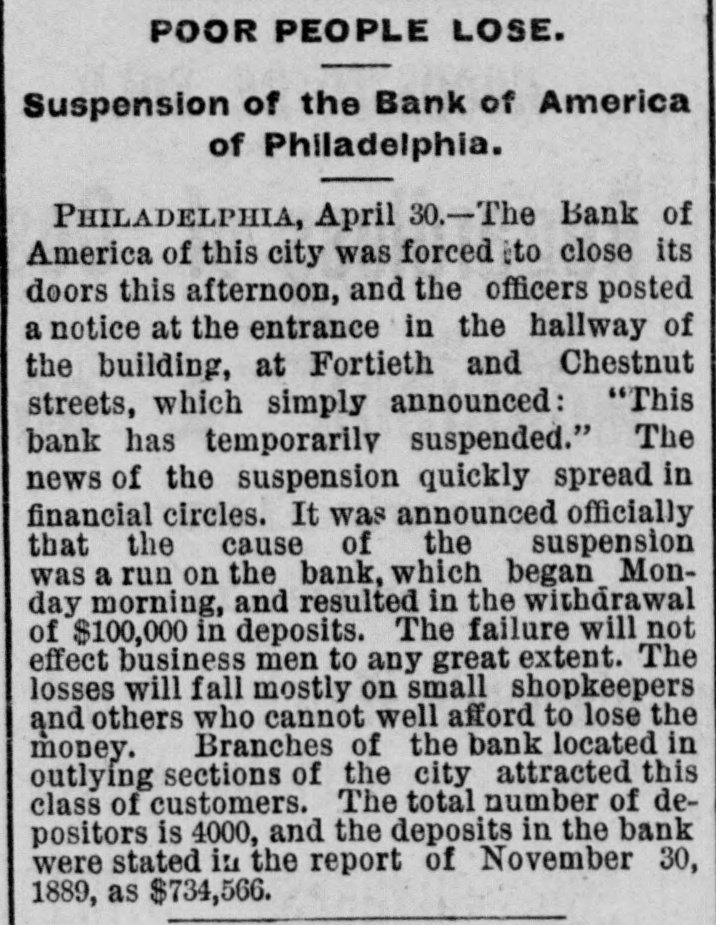
POOR PEOPLE LOSE. Suspension of the Bank of America of Philadelphia. PHILADELPHIA, April 30.-The Bank of America of this city was forced to close its doors this afternoon, and the officers posted a notice at the entrance in the hallway of the building, at Fortieth and Chestnut streets, which simply announced: "This bank has temporarily suspended." The news of the suspension quickly spread in financial circles. It was announced officially that the cause of the suspension was a run on the bank, which began Monday morning, and resulted in the withdrawal of $100,000 in deposits. The failure will not effect business men to any great extent. The losses will fall mostly on small shopkeepers and others who cannot well afford to lose the money. Branches of the bank located in outlying sections of the city attracted this class of customers. The total number of depositors is 4000, and the deposits in the bank were stated in the report of November 30, 1889, as $734,566.


Article from Richmond Dispatch, May 1, 1890

Click image to open full size in new tab

Article Text

A BANK SUSPENDS. The Bank of America of Philadelphia Closes Its Doors. (By telegraph to the Dispatch.] PHILADELPHIA, April 30.-The Bank of America of this city closed its doors this afternoon. There is & placard at the entrance simply announcing: "This bank has temporarily suspended." The failure has not caused much sonsation, because the bank has for three days been known to be in difficulty. A run upon it began Monday which caused it to lose $100,000 in deposits. It is a State Institution and had twelve branches scattered about the city. The deposits of the main office and brauches aggregate $700.000. The bank is closely allied to the Insurance Company of America and several other financial institutions of this city. and to-day the suspension 19 due to rumors which were set affort on Saturday effecting the credit of President Mc. Farlane, of the insurance company. William M. Smith, president of the Common Council, is appointed receiver. The losses will fall mostly ou small shop-keepers and others who cannot well afford to lose their money. The branches of the bank located in outlying sections of the city at tracted this class of customers, the total number of depositors being said to be 4,000.


Article from Evening Journal, May 1, 1890

Click image to open full size in new tab

Article Text

A PHILADELPHIA BANK CLOSED. Vice President McFarlane's Rumored Troubles the Cause. PHILADELPHIA, May 1.-The Bank of America, a state bank, has closed its doors. Beyond the simple announcement, "This bank has temporarily suspended," the officers of the institution have made no public statement. The direct cause of the failure is attributed to the troubles of the American Life Insurance company, of which State Senator McFarlane is vice president. A meeting of the directors was called at once and they are now going over the books. William M. Smith, president of the common council, has been appointed receiver and assignee of the bank There are many rumors affecting the Philadelphia Finance company, the American Financial association and the American Life Insurance company. These rumors are denied by officials of those institutions. The capital of the Bank of America is $371,000. Louis E. Pfeiffer is president and J.S. Dungan cashier. James J. McFarlane was vice president until a fortnight ago, when he resigned from the directorate. The rumor of his being in trouble caused a run on the bank and resulted in its suspension.


Article from The Morning News, May 1, 1890

Click image to open full size in new tab

Article Text

BANK DOORS CLOSED. The Institution a Philadelphia Concern Under the State Laws. PHILADELPHIA, April 30.-The Bank of America of this city closed its doors this afternoon, a placard at the entrance simply announcing, "This bank has temporarily suspended." The failure has not caused much of a sensation, because it has for three days been known to be in difficulties. A run upon it began Monday which caused it to lose $100,000 in deposits. It is a state institution and had twelve branches scattered about the city. The deposits of the main office and its branches aggregate $700,000. ALLIED TO AN INSURANCE COMPANY. The bank is closely allied to the insurance company of America and several other financial institutions of this city, and today's suspension is due to rumors which were set afloat on Saturday affecting the credit of President McFarlane of the insurance company. A RECEIVER APPOINTED. William M. Smith, president of the common council, has been appointed receiver. The losses will fall mostly on small shopkeepers and others who cannot well afford to lose their money. The branches of the bank located in outlying sections of the city attracted this class of customers, the total number of depositors being said to be 4,000.


Article from Morning Journal and Courier, May 1, 1890

Click image to open full size in new tab

Article Text

CRASH IN PHILADELPHIA. The Bank of America at Philadelphia Closes its Doors-The Suspension Expected for Some Time-The Bank Closely Allied to the Insurance Comparv of America. PHILADELPHIA, April 30.-The Bank of America of this city was forced to close its doors this afternoon and the officers posted a notice at the entrance in the hallway of the building at Fourth and Chestnut streets, which simply announced: "This bank has temporarily suspended." The news of the suspension quickly spread in financial circles, but did not occasion very much surprise, as the developments of the past three days had led many people to believe that the stability of the Bank of America was only a question of a few hours. In were on yesthat the fact, terday whispers bank heard would suspend the street inside of forty-eight hours, as it was known in certain quarters that there had been a heavy drain on the institution all day. The branch offices of the institution in different parts of the city were shut up simultaneously with the closing of the main house. There are twelve of these branches scattered over the outlying districts. In the operation of these branch offices the Bank of America had encouraged deposits from business people remote from the finaneial center, who were glad to avail themselves of the facilities which they offered. For its enterprise the bank was rewarded with a line of deposits aggregating in amount over $700,000, including those of the main office. The bank is closely allied to the Insurance Company of America and several other financial institutions of this city, and to-day's suspension is due to rumors which were set afloat on Saturday reflecting on the credit of President McFarlane of the insurance company. The board of directors of the Bank of America this afternoon appointed William M. Smith, president of the common council, receiver and assignee. It was announced officially that the cause of the suspension on the bank, which began Monthe rumors was day after the run publication of the affecting the standing of the American Life Insurance company. The run resulted in the withdrawal of upwards of $100,000 in deposits. The failure will not affect business men to any great extent. The losses will fall mostly on small shopkeepers and others who cannot well afford to lose their money. The branches of the bank located in outlying sections of the city all receive this class of customers, the total number of depositors being about four thousand. The Bank of America is a state institution. The capital stock is $371,000, divided into 3,710 shares of a par value of $100 each. The president is Louis E. Pfeiffer; cashier, e J.S. Dungan; assistant cashier, Joshua Pfeifa fer. The deposits in the bank were stated in t the report of November, 1889, to be $734,566. Rumors affecting the stability of the Philadelphia Finance company, the American Financial association and the American Life Insurance company, all closely allied with the Bank of America, are denied by officials f connected with the institutions. The Bank a of America did business with the Philadelphia t clearing house through the National Bank of the Republic and the latter institution was 3 said to be involved, but prompt denial was made by the cashier.


Article from The Sun, May 1, 1890

Click image to open full size in new tab

Article Text

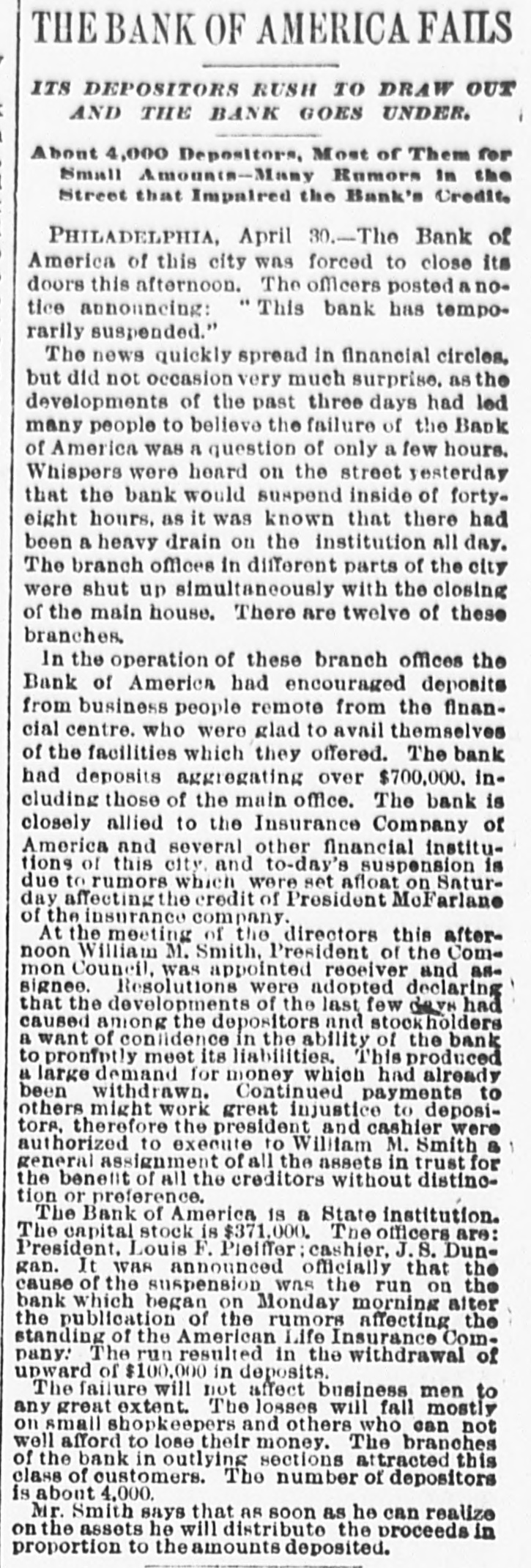
THE BANK OF AMERICA FAILS ITS DEPOSITORS RUSH TO DRAW OUT AND THE BANK GOES UNDER. About 4,000 Depositors, Most of Them for Small Amounts-Many Rumors in the Street that Impaired the Bank's Credit. PHILADELPHIA, April 30.-The Bank of America of this city was forced to close its doors this afternoon. The officers posted a notice announcing: This bank has temporarily suspended." The news quickly spread in financial circles, but did not occasion very much surprise. as the developments of the past three days had led many people to believe the failure of the Bank of America was a question of only a few hours. Whispers were heard on the street yesterday that the bank would suspend inside of fortyeight hours, as it was known that there had been a heavy drain on the institution all day. The branch offices in different parts of the city were shut up simultaneously with the closing of the main house. There are twelve of these branches. In the operation of these branch offices the Bank of America had encouraged deposits from business people remote from the financial centre. who were glad to avail themselves of the facilities which they offered. The bank had deposits aggregating over $700,000. including those of the main office. The bank is closely allied to the Insurance Company of America and several other financial institutions of this city, and to-day's suspension is due to rumors which were set afloat on Saturday affecting the credit of President cFarlane of the insurance company. At the meeting of the directors this afternoon William M. Smith, President of the Common Council, was appointed receiver and assignee. Resolutions were adopted declaring that the developments of the last few days had caused among the depositors and stock holders a want of confidence in the ability of the bank to pronfutly meet its liabilities. This produced a large demand for money which had already been withdrawn. Continued payments to others might work great injustice to depositors, therefore the president and cashier were authorized to execute to William M. Smith & general assignment of all the assets in trust for the benefit of all the creditors without distinotion or preference. The Bank of America is a State institution. The capital stock is $371,000. The officers are: President. Louis F. Pieiffer: cashier, J.S. Dungan. It was announced officially that the cause of the suspension was the run on the bank which began on Monday morning alter the publication of the rumors affecting the standing of the American Life Insurance Company: The run resulted in the withdrawal of upward of $100.000 in deposits. The failure will not affect business men to any great extent. The losses will fall mostly on small shopkeepers and others who can not well afford to lose their money. The branches of the bank in outlying sections attracted this class of customers. The number of depositors is about 4,000. Mr. Smith says that as soon as he can realize on the assets he will distribute the proceeds in proportion to the amounts deposited.


Article from Spokane Falls Review, May 1, 1890

Click image to open full size in new tab

Article Text

SUSPENDED PAYMENT. The Bank of America Compelled to Close His Doors. PHILADELPHIA, April 30.-The Bank of America has suspended payment. The suspension of the bank did not cause much surprise, as it was known in financial circles that there had been a heavy run on it for some days. The branch offices in different parts of this city are also shut up. Deposits said to amount to $70,000in the bank are closely allied to the American Life Insurance Company. To-day's suspension was due to rumors set affoat last Saturday affecting the credit of President McFarlane, of the insurance company. INSECTRE LOANS. Something of a sensation has been caused by the announcement that the examination by the state insurance.com missioner shows that the American Life Insurance Company has loaned over $700, 000 to various concerns which have no commercial standing. As a result the stock of the concern has depreciated nearly a million in value. The president of the company declares that the loans are perfectly safe.


Article from Deseret Evening News, May 2, 1890

Click image to open full size in new tab

Article Text

Another Bank Failure. GLOUCESTER, N. J., May 1.-A run began on the Gloucester City National Bank as soon as the doors were opened this morning. Just before noon the bank suspended. The run was the result of its affiliation with the Bank of America of Philadelphia, which falled yesterday. Touching the condition of the Western farmers, General Butler said that the farms are passing out of the ownership of the tillers of the soil and they are becoming simply tenant farmers, the worth of the land having been wrested from them in spite of all their industry. Referring to the fabulous mortgaged debt on farm property, the speaker closed by saying: "As the payment of the mortgages is simply impossible, the payment of the interest upon them is also impossible, because they call for from 7 to 9 per cent and all statistics show that the average profits on farming industries are between 4 and 5 per cent only, hardly over 4. These mortgages never can be paid, if for no other reason, because they never can be paid if the debtors are ever 80 much disposed to pay them."


Article from Rock Island Daily Argus, May 2, 1890

Click image to open full size in new tab

Article Text

Bank Failure at Camden, N. J. CAMDEN, N.J., May 2-The Gloucester City National bank closed its doors Thursday morning. The suspension is supposed to be due to the failure of the Bank of America Wednesday in Philadelphia, with which it had dealings.


Article from Los Angeles Herald, May 2, 1890

Click image to open full size in new tab

Article Text

Another Bank Failure, GLOUCESTER, N. J., May 1.-A run began on the Gloucester City National Bank as soon as the doors opened this morning. Just before noon the bank suspended. The run was the result of its affiliation with the Bank of America, of Philadelphia, which failed yesterday.


Article from Santa Fe Daily New Mexican, May 3, 1890

Click image to open full size in new tab

Article Text

Kept Bad Company. GLOUCESTER, N. J., May 3.-A run began on the Gioucester City National bank as soon as the doors were opened this morning. Just before noon the bank suspended. The run was the result of its affiliation with the Bank of America of Philadelphia, which failed yesterday.


Article from Los Angeles Herald, May 3, 1890

Click image to open full size in new tab

Article Text

More Bank Failures. ATLANTIC CITY, N. J., May 2.-The Merchants' Bank suspended payment this afternoon, on account of a run caused by the reports that several of their branches in the neighboring towns suspended on account of the suspension of the Bank of America, in Philadelphia. The deposits are estimated at $50,000. CAMDEN, N. J., May 2.-The Fidelity Security Trust Safe Deposit Company suspended payment this morning. Charles L. Work, president of the Gloucester National Bank, which suspended yesterday, is also its president. The company had only a small line of deposits. Its business was mainly fiduciary.


Article from New-York Tribune, May 8, 1890

Click image to open full size in new tab

Article Text

THE BANK OF AMERICA FAILURE. Philadelphia, May 7.-President Louis E. Pfeiffer, cashier James L. Dungan, Assistant Cashier Joshua Pfeiffer and Paying Teller W. H. Hergesheimer, of the suspended Bank of America, were arrested this afternoon, shortly before the stockholders' meeting. on two warrants sworn out by Rodger Maynes, a director and stockholder of the bank. The four officials furnished bail in $3,000 each for a hearing to-morrow. This is the third time President Pfeiffer has been arrested on the same charge, preferred by various depositors. A meeting of the stockholders of the bank was held this afternoon. About seventy were present, including four women. Assignee Smith read his pre. liminary statement, which showed total liabilities of $526,048 23, and total assets of 8753,745 77, leaving a nominal surplus of $227,697 54. The $376,000 paid in by the stockholders does not figure in the liabilities. After considerable discussion two resolutions offered by Mr. Smith were adopted, one ratifying the action of the directors in making the assignment, and the other requesting the solicitor of the bank to apply to the court for the appointment of an appraiser to examine and ascertain the exact value of the assets of the bank. The depositors now hope to get at least 50 per cent of their money back.


Article from The Wahpeton Times, May 8, 1890

Click image to open full size in new tab

Article Text

FOREIGN CULLINGS. It is announced that an English syndicate has purchasad the Western railway Argentine Rrpublic for $41,000,000 gold. A motion for want of confidence in the Jesuit estates act was defeated in the Canadian parliament-32 to 130. Six Conservatives voted against the government. The state ofsiege on the Island of Crete has been raised and martial law has been abolished. The Christians on the island are jubilant. The Brazilian minister to Italy has been recalled because he failed to present to the Italian government the decree of his government forbidding Italian emigrants to enter Brazil. While the duke and duchess of Edinburgh were attending the cerimonies of opening the electric exhibition in Edinburgh, the jewels of the duchess were stolen from their apartments in the Balmoural hotel. The Gloucester City National Bank of Camden, N. J., has closed its doors. The suspension is supposed to be due to the failure of the Bank of America in Philadelphia with which it had dealings. The officials decline to make any statement. The immigration season has opened at Quebec when the fir st two steamships of the year, the Sardinian and Oregon, arrived with nearly 1,600 immigrants, who went West in twenty-twocars, thirteen of which contained passengers for the American Northwest via Chicago.


Article from Crawford Avalanche, May 8, 1890

Click image to open full size in new tab

Article Text

A Philadelphia Bank Suspends. The Bank of America, Philadelphia. has suspended p yment.


Article from The Monitor, May 9, 1890

Click image to open full size in new tab

Article Text

The Bank Failures. Elmer was the scene of quite a panic on Thursday last, caused by the reported unsoundness of the Elmer Bank, which was a branch of the Merchants' Bank, of Atlantic City. The excitement was started by an item in the Philadelphia Press in relation to the failure of the Bank of America, of that city, stating that the Merchants' Bank, of Atlantic, was a branch. Long before the hour of opening large numbers of anxious depositors gathered about the door, with their check and deposit books in hand. Manager Elwell's statement that the newspaper article was incorrect and that the Elmer Bank was a branch of the Merchants' Bank of Atlantic City and that neither the parent institution nor any of its branches were in any way connected with the Bank which had failed, fell as idle words upon men agitated by the fear of danger which seemed to threaten them, and for the first hour after the doors many deposits were reduced to the low water mark. At last the bottom was reached and before eleven o'clock Mr. Elwell had to admit that he had no more cash in the big safe; and finally, at a time when it required considerable courage to do so, a few firms, believers in the institution, began to make their regular daily deposits, with others waiting to take it out as fast as it came On Friday word was received that the parent bank at Atlantic City had suspended, when the rush for money was resumed with a desperation born of despair. The heavy run finally cleared the bank of all its cash, after which Cashier Elwell had to refuse all notes. A few of the many who have been caught in the crash are: Chas. S. Cotting Estate, $1,200; Rev. P. Corson, $800; Abram Cochran, $600; Jackson Clevenger, $400; Rufus W. Smith, $600; Daniel Watkins, $250; Samuel P. Baker, $220; Charles H. Morris, $268; Rev. J. G. Crate, $220; the Misses Long, $250; Thomas W. Brooks, $350. Among those whom are known have lost but have not been able to discover the amounts, are J. Frank Langley, Esq., George M. Bacon, Esq., Creamer Brothers, Drs. Woodruff and Cheesman, Chas. M. Surran, Wm. Strang, F. Wentzell & Bro., Samuel P. Foster, Hiram Nixon, A. M. Seabrook, S. Y. Townsend, R. T. Studimund, S. M. Vanmeter, Barber Collins, Jesse Garrison, Jesse Sordin, Thomas Edmonds, Samuel Christy, Aubery Reed, and a host of others. THE MULLICA HILL BRANCH. The Mullica Hill Bank, another branch of the Merchants', also closed its doors on Friday, caused by the suspension of the parent bank at Atlantic City. The suspension of the Bank of America in Philadelphia on Wednesday set in motion influences which bore too heavily on the branch and it was forced to yield to the stress. The management express the belief that the creditors will be paid dollar for dollar. The earnest hope is that the prediction will be fulfilled. The Mullica Hill branch of the Merchants' Bank at Atlantic City was organized April 30th, 1888. The directors elected at the last annual meeting were Charles W. Elkinton, Albert Parker, J. H. Mounce, William M. Colson, Robert McKeighan. Mr. Elkinton resigned the latter part of March. At the time of closing on Friday last, there was due depositors $16, 024.17; bills receivable, 716.91; cash on hand, $7.92. This paper, bills receivable, is first class. The depositors number 125, from 81 to $1000. William Bunning is the manager. He is a capable and painstaking official, and feels very sad over the misfortune to the bank. The depositors are not willing that the bank should continue. This Bank has done about one-third of the business, and at not more than one-third of the expense. Each director had taken $100 in stock, giving his note. Colson and McKeighan have paid theirs in cash. Among the business portion of the people, there is a feeling of insecurity about the matter, and while the losses, if any, may fall heavily upon some of the poorer classes, generally speaking, a majority will not be hurt very badly. Among the depositors are the following: Wm. Mankin, clerk, $175; John Yeager and wife, $200; Roger E. Costello, farmer, $300; Frye Hopkins, hotel keeper, $900; Amy Murphy, $100; John Garwood, $500; Edward Bunning, butcher, $40; Wm. H. Bunning, livery stable, $300; Jonathan Colson, farmer, $300; Wm. Colson, $300; Mrs. Debbie Smith, $300; Edward Ireland, conductor, $500; Jacob Ware, brakeman, $100; Mrs. Cornelia Thomas, $140; Mrs. Mary Huseback, $50; Rev. Dr. Brown and wife, $100; Rev. B. R. Black, $100; Mrs. With. Howery, $50; Jas. Ecret, $60; Chas.
Article from The Abbeville Press and Banner, May 21, 1890

Click image to open full size in new tab

Article Text

THE NEWS EPITOMIZED. Eastern and Middle States. THE eight-hour workday movement was begun in New York city quietly. Only about a dozen men went on strike. The socialist labor party and the Central Labor Union celebrated the day by a parade and mass meeting at Union Square. There were demonstrations, also, at Philadelphia, Boston. Pittsburg, and throughout the Eastern States generally. JAMES PALMER, convicted of the murder of Henry T. Whitehouse, of Portsmouth, was hanged at Concord, N. H. CATTLE and sheep sheds and barns and stables, covering nearly eight acres of ground in the West Albany (N. Y.) Live Stock Yards. were laid in ashes by an incendiary's match. THE Assembly in Albany, N. Y., passed a bill to abolish capital punishment. GEORGE WEBBER was killed at Belknap crossing, near Attica, N. Y., by being struck by a train. His wife's skull was fractured, injuring her fatally. THE failure of the Bank of America in Philadelphia has been followed by that of the Gloucester City (N. J.) National Bank. At the time of the failure the deposits were about $40,000. The depositors are mostly poor working people. FECHHEIMER, RAU & Co., shirt manufacturers of New Yorkcity, have failed; approximate liabilities, $350,000; assets, $275,000. PATRICK D. FLANNIGAN entered a saloon at Waterbury, Conn., ani asked Michael McDermott to drink with him. As McDermott responded Flannigan, without a word, emptied the six barrels of a 32-calibre revolver into McDermott's face and throat and then walked out. McDermott died within an hour. THE Fidelity Surety, Trust and Safe Deposit Company, of Camden, N. J.; the Port Norris Bank, the Merchants' Bank of Atlantic City, N. J., and the Merchants' Bank of Pleasantville, N. J., suspended payment. SHARPERS stole $1000 from the Rev. Father Thomas J. Ariens at Bridgeport, Conn., and left a baby on his hands. CRIMINAL proceedings have been begun against the officers of the broken Philadelphia banks. WILLIE HULSE. aged ten years. son of J. H. Hulse, No. 329 Hu ison street, New York, was shot and instantly killed by his playmate, Charles Sickles, aged fifteen, at Good Ground, Long Island, N. Y. A RUNAWAY accident occurred in Maple avenue, Penn., in which Willie Fitzpatrick. eight years of age, was instantly killed. His little sister was fatally injured, and two other children were badly bruised and cut, and the father of the dead boy was severely injured. Mrs. Fitzpatrick became violently insane after the accident. THE entire business portion of South Dayton, N. Y., has been destroyed by fire. Loss, $20,000. IN New York and Brooklyn nearly all the carpenters went to work under the eight hour day system. There was no striking necessary to gain this point. ASHINGTON QUINLAN, a member of the New York Stock Exchange, has disappeared owing about $100,000. JOHN CROMOCK, a morphine eater, killed his thirteen-year-old daughter at Foxboro, Mass., and then committed suicide. THE Singer Sewing Machine Works. at Elizabethport, N. J., covering two acres of ground, were almost wholly destroyed by fire, together with a considerable amount of the railroad property adjoining. The works employed about 3500 hands. The loss is about $3,000,000.


Article from New-York Tribune, May 28, 1890

Click image to open full size in new tab

Article Text

COLD COMFORT FOR DEPOSITORS. THE MEN WHO WRECKED THE BANK OF AMERICA MAY GO FREE. Philadelphia, May 27.-Another meeting of the depositors of the defunct Bank of America was held this afternoon. at which the Committee of Thirteen, headed by Chairman Grant, made its report. This report indicated to the depositors the belief of the committee that 50 per cent or more would be realized on their accounts. The committee believes that the dividends declared semi-annually were not from the earnings of the bank. and that there is unmistakable evidence that the officials knew of these violations, and that they, with the directors, are therefore liable to prosecution under the insolvency law. The entire business, the committee say. has been carried on with. out regard to law or method. In many instances money was loaned and notes discounted to parties utterly devoid of credit, without security, and in many cases upon securities that never had face value. Officials exhausted their personal balances shortly before the announcement of the suspension of the bank. Senator MacFarlane is recorded on the minutes as having been elected vice-president on May 1, 1889. At that time the bank was in excellent shape, but the committee thinks that the backward movement began with the accession of MacFarlane to the vice presidency. At the time of the suspension MacFarlane declared that he was not connected with the bank, having resigned some weeks previously. The committee find that the minutes have been doctored to agree with this statement, though Cashier Dungan stated positively that MacFarlane was a director at the time of the suspension. A recommendation was agreed to that counsel be employed to assist in lawsuits to recover property and money unlawfully transferred, to begin criminal proceedings, and otherwise look after the interests of the depositors. The committee adopted a set of resolutions. which, after reciting that the officers of the bank had grossly violated the State laws and the laws of the bank. ends with this remarkable recommendation to the downcast depositors : Resolved, That we recommend that patience. hard work. good judgment. cold blood and forbearance for the time being be endured." It will be remembered that Ewbanks, A clerk in the Bank of America: Yerkes, a note broker. and Boileau, a clerk in the Philadelphia Finance Association. were recorded on the books of the bank as borrowers of nearly $400,000 from the bank on practically valueless securities. This money was placed to the credit of the MacFarlane Work-Pfeiffer syndicate. All these people are denounced in the resolutions as having acted illegally. It is believed that some of the bank officials will be criminally prosecuted in a short while.


Article from The Morning News, May 28, 1890

Click image to open full size in new tab

Article Text

A BADLY RUN BANK. The Officials of the Defunct Philadelphia Concern in a Fix. PHILADELPHIA, May 27.-Another meeting of the directors of the defunct Bank of America was held this afternoon, at which the committee of thirteen, headed by Chairman Grant, made its report. This report indicated to the depositors the belief of the committee that 50 per cent. or more would be realized on their account. The committee is of the opinion that the dividends declared semi-annually were not from the earnings of the bank, and that there is unmistakable evidence that the officials knew of these violations, and that they, with the directors, are, therefore, liable to prosecution under the insolvency law. The entire business, the committee say, has been carried on without regard to law or method. A recommendation was agreed to that counsel be employed to assist in lawsuits to recover the money unla wfully transferred, to begin criminal proceedings and otherwise look after the interests of the depositors.


Article from Evening Journal, May 28, 1890

Click image to open full size in new tab

Article Text

WILL PAY FIFTY PER CENT. Civil and Criminal Proceedings Against Bank of America Officials. PHILADELPHIA, May 28.-At a meeting of depositors of the defunct Bank of America, the committee of investigation reported that probably 50 per cent. would be realized on the deposits. The committee also declared that the bank's semi-annual dividends had not been paid out of earnings, and that the directors are liable to criminal prosecution for this as well as for making loans on bogus securities. Bank officials, the report says, drew out their personal balances just before announcing the suspension of the bank. The bank was in good shape at the time Director MacFarlane was elected vice president, May 1, 1889. The trouble began then. The minutes of the meetings of directors have been doctored so as to make them agree with MacFarlane's assertion that he severed his connection with the bank some weeks before the suspension. Cashier Dungan, however, stated that MacFarlane was in fact a director at the time of the suspension. The meeting adopted a recommendation to employ counsel to bring civil and criminal proceedings on behalf of the depositors. Pfeiffer, MacFarlane, Work, Dungan, Boileau, Ewbanks and Yerkes are mentioned in the resolutions as subject to criminal proceedings.


Article from The Wichita Daily Eagle, December 13, 1890

Click image to open full size in new tab

Article Text

FAILURES. KEOKUK, Iowa. Dec. -The failure of the wholesale grocery house of Collier, Robertson & Hambleton of this place, is announced. The firm filed two mortgages to J. F. Smith, as trustee, in favor of a large number of creditors, both mortgages aggregating about $85,000. It is said that the liabilities will amount to $100,000. CHICAGO, Dec. 12.-The grand jury this afternoon returned bills of indictment against Banker Prettyman. whose bank went to the wall a short time ago, and against his cashier, C. S. Johnson, on charges of embezzlement, and capiases for their arrest were at once issued. The basis of the indictments is the receipt of money from depositors after the insolvency of the bank was apparent. BALTIMORE, Dec. 12.-The Druid-Mills Manufacturing company, B. F. Gamewell, president, assigned today. The assignee's bond was fixed at $600,000. The concern is one of the largest and oldest in the country. The failure was caused by the money stringency. PHILADELPHIA, Dec. 12.-G. F. Work. who was the master mind of the WorkMcFarlane - Ffeffer - Dungan syndicate, which, it is alleged, wrecked the Bank of America, and the American Life Insurance company. was arrested last night on a warrant sworn out by the district attormey, and today, in default of $20,000 bail, was committed to prison. Warrants were also sworn out for McFarlane. Pfeffer and Dungan, but they could not be found. York is charged with re-hypothecatingthe stock and with conspiracy to cheat the depositors and others of the Bank of America. The warrant charges him with similar dishonesty in connection with the insurance company. HARTFORD, Conn., Dec. 12. 1 The commistee on claims. of the defunct Charter Oak Life Insurance company, today filed their report. They allow claims amounting to $3,044,600. being principally claims OR account of policies. On general claims