16465. Bank of America Trust Company (PITTSburg, PA)

Bank Information

Episode Type
Suspension → Closure
Bank Type
trust
Start Date
April 20, 1934
Location
PITTSburg, Pennsylvania (40.441, -79.996)

Metadata

Model
gpt-5-mini
Short Digest
9495af19624ceefd

Response Measures

None

Description

Multiple articles state the Bank of America Trust Co. of Pittsburgh was placed on a restricted-withdrawal basis and was closed by Pennsylvania state authorities in April 1934 because of discovered irregularities/defalcations. FDIC could not act until a receiver was appointed; payments to insured depositors began July 19, 1934. There is no clear report of a depositor run prior to suspension; cause was internal irregularities/defalcations. OCR errors in some articles (e.g., dates and small typos) were corrected where obvious.

Events (3)

1. April 20, 1934 Suspension
Cause
Bank Specific Adverse Info
Cause Details
Placed on restricted-withdrawal basis by Pennsylvania authorities after discovery of irregularities and alleged defalcations by officers/management.
Newspaper Excerpt
the bank suspended business April 20, 1934
Source
newspapers
2. April 21, 1934 Receivership
Newspaper Excerpt
It was closed by the State authorities on April 21... pending liquidation/reorganization; FDIC had no jurisdiction until a receiver was appointed (Evening Star & Daily News reports). — paraphrased from articles indicating state closure/apparent liquidation process began April 21, 1934.
Source
newspapers
3. July 19, 1934 Other
Newspaper Excerpt
Payments to depositors in the Bank of America Trust Company of Pittsburgh, Pa., began on July 19 (Daily News).
Source
newspapers

Newspaper Articles (13)

Article from Evening Star, April 22, 1934

Click image to open full size in new tab

Article Text

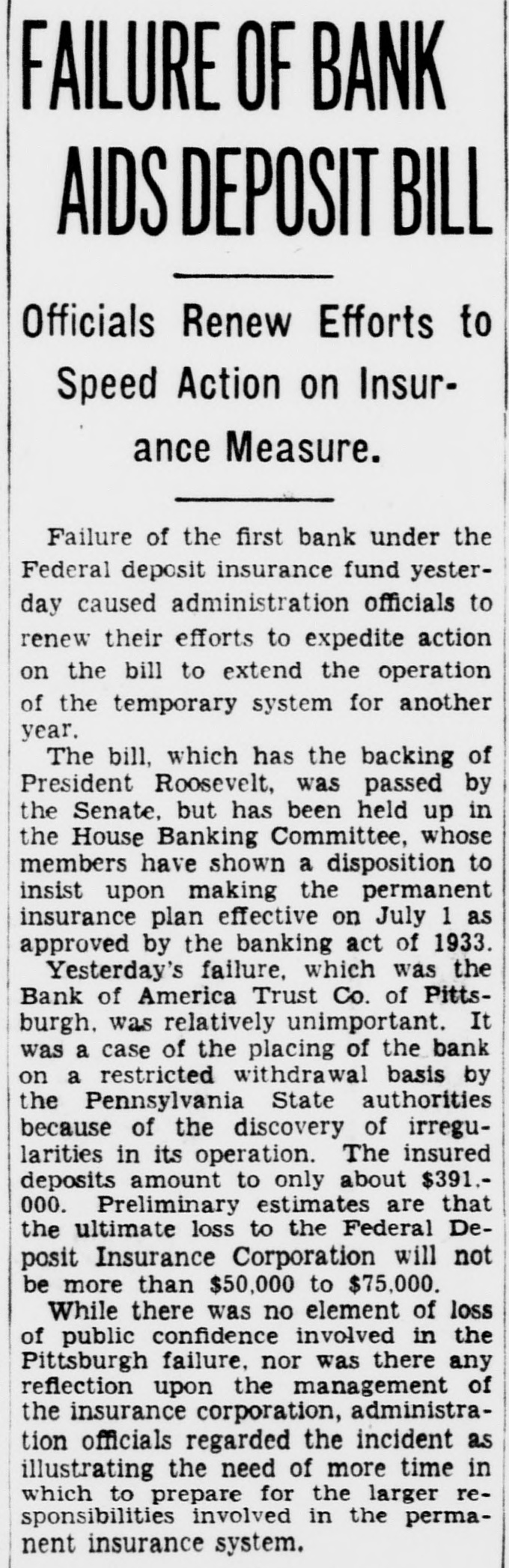
FAILURE OF BANK AIDS DEPOSIT BILL Officials Renew Efforts to Speed Action on Insurance Measure. Failure of the first bank under the Federal deposit insurance fund yesterday caused administration officials to renew their efforts to expedite action on the bill to extend the operation of the temporary system for another year. The bill, which has the backing of President Roosevelt, was passed by the Senate, but has been held up in the House Banking Committee, whose members have shown a disposition to insist upon making the permanent insurance plan effective on July 1 as approved by the banking act of 1933. Yesterday's failure, which was the Bank of America Trust Co. of Pittsburgh, was relatively unimportant. It was a case of the placing of the bank on a restricted withdrawal basis by the Pennsylvania State authorities because of the discovery of irregularities in its operation. The insured deposits amount to only about $391.000. Preliminary estimates are that the ultimate loss to the Federal Deposit Insurance Corporation will not be more than $50,000 to $75,000. While there was no element of loss of public confidence involved in the Pittsburgh failure, nor was there any reflection upon the management of the insurance corporation, administration officials regarded the incident as illustrating the need of more time in which to prepare for the larger responsibilities involved in the permanent insurance system.


Article from Evening Star, May 25, 1934

Click image to open full size in new tab

Article Text

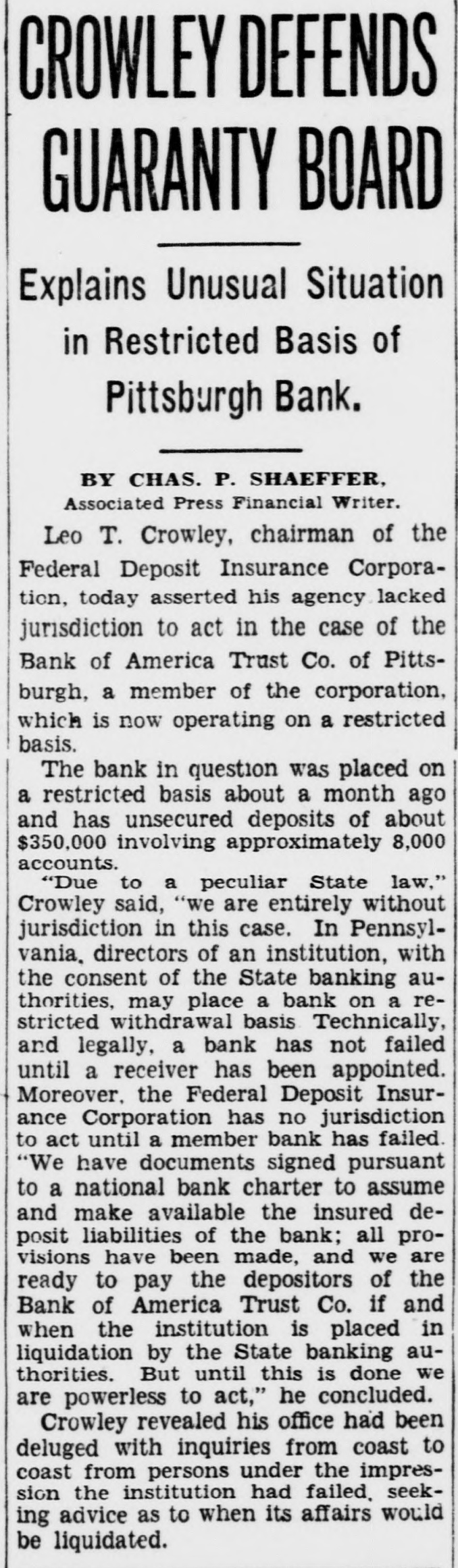
CROWLEY DEFENDS GUARANTY BOARD Explains Unusual Situation in Restricted Basis of Pittsburgh Bank. BY CHAS. P. SHAEFFER, Associated Press Financial Writer. Leo T. Crowley, chairman of the Federal Deposit Insurance Corporation, today asserted his agency lacked jurisdiction to act in the case of the Bank of America Trust Co. of Pittsburgh, a member of the corporation, which is now operating on a restricted basis. The bank in question was placed on a restricted basis about a month ago and has unsecured deposits of about $350,000 involving approximately 8,000 accounts. "Due to a peculiar State law." Crowley said, "we are entirely without jurisdiction in this case. In Pennsylvania, directors of an institution, with the consent of the State banking authorities, may place a bank on a restricted withdrawal basis Technically, and legally, a bank has not failed until a receiver has been appointed. Moreover, the Federal Deposit Insurance Corporation has no jurisdiction to act until a member bank has failed. "We have documents signed pursuant to a national bank charter to assume and make available the insured deposit liabilities of the bank; all provisions have been made, and we are ready to pay the depositors of the Bank of America Trust Co. if and when the institution is placed in liquidation by the State banking authorities. But until this is done we are powerless to act," he concluded. Crowley revealed his office had been deluged with inquiries from coast to coast from persons under the impression the institution had failed, seeking advice as to when its affairs would be liquidated.


Article from The Oklahoma Banker, June 1, 1934

Click image to open full size in new tab

Article Text

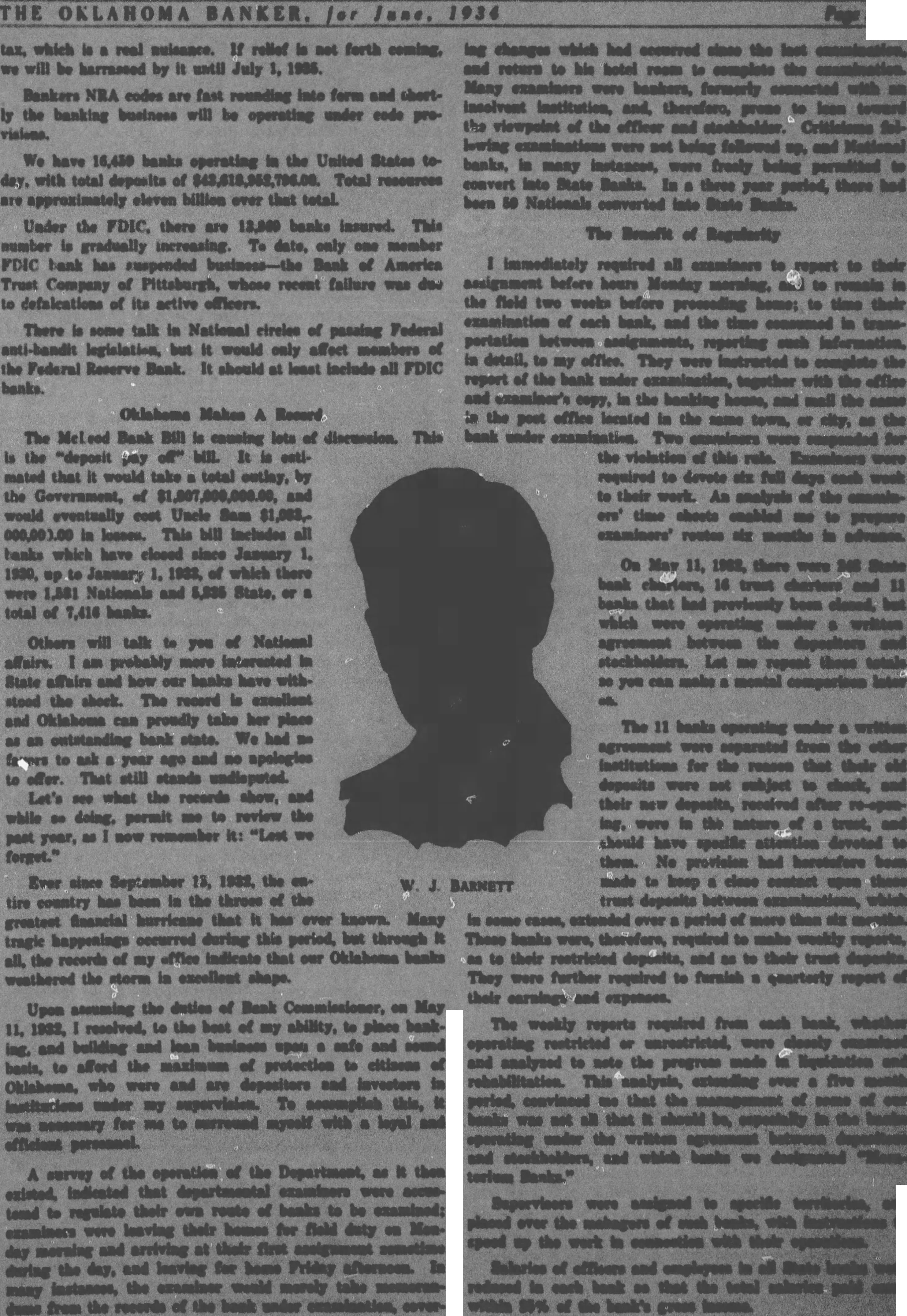
THE OKLAHOMA BANKER, for June, 1934 we will be harrassed by it until July 1, 1935. Bankers nra codes are fast rounding into form and shortly the banking business will be operating under code provisions. We have 16,459 banks operating in the United States today, with total deposits of $43,618,953,796.00. Total resources are approximately eleven billion over that total. Under the FDIC, there are 13,869 banks insured. This number is gradually increasing. To date, only one member FDIC bank has suspended business-the Bank of America Trust Company of Pittsburgh, whose recent failure was dow to defalcations of its active officers. There is some talk in National circles of passing Federal anti-bandit legislation, but It would only affect members of the Federal Reserve Bank. It should at least include all FDIC banks. Oklahoma Makes A Record. The McLeod Bank Bill is causing lots of diseussion. This is the "deposit Day of" bill. It is eatimated that it would take a total outlay, by the Government, of $1,807,000,000.00, and would eventually cost Uncle Sam $1,083.000,000.00 in losses. This bill includes all banks which have closed since January 1. 1930, up to January 1, 1933, of which there were 1,581 Nationals and 5,835 State, or a total of 7,416 banks. Others will talk to you of National affairs. I am probably more interested in State affairs and how our banks have withstood the shock. The record is excellent and Oklahoma can proudly take her place as an outstanding bank state. We had the favors to ask a year ago and no apologies to offer. That still stands undisputed. Let's see what the records show, and while $9 doing. permit me to review the past year, as I now remember it: "Lest we forget." and return to his hotel room to complete the examination. Many examiners were bankers, formerly connected with an insolvent institution, and, thereforo, prone to lean toward the viewpoint of the officer and stockbolder. Critisisms feblowing examinations were not being followed up, and Mational banks, in many instances, were freely being permitted to convert into State Banks. In a three year period, there had been 50 Nationals converted into State Banks. The Benefit of Regularity I immediately required all examiners to report to their assignment before hours Monday morning, and to remain in the field two weeks before proceeding home: to time their examination of each bank, and the time consumed in transportation between assignments, reporting such information. in detail, to my office. They were instructed to complete the report of the bank under examination, together with the office and examiner's copy, in the banking house, and mail the name in the post office located in the name town, or city, as the bank under examination. Two examiners were surpended for the violation of this rule. Examiners were required to devote six full days each work to their work. An analysis of the emaminern' time shoets enabled me to prepare examiners' reutes six months in advance. On May 11, 1982, there were 248 State bank charters, 16 trust charters and 11 banks that had previously been closed, but which were operating under & written agreement between the depositers and so you can make a mental comparison later Ever since September 13, 1932, the entire country has been in the threes of the greatest financial hurricane that it has ever known. Many tragic happenings occurred during this period, but through It all, the records of my office indicate that our Oklahoma banks weathered the storm is excellent shape. Upon assuming the duties of Bank Commissioner, on May 11, 1932, I reselved, to the best of my ability, to place banking. and building and loan business upon a safe and sound basis, to afford the maximum of protection to citizens of Oklahoma, who were and are depositors and investors in institucions under my supervision. To accomplich this, it was neesssary for me to surround myself with a loyal and officient personnel. A survey of the operation of the Department, as it then existed, indicated that departmental examiners were accestend to regulate their own route of banks to be examined: examiners were leaving their homes for field duty on Monday morning and arriving at their first assignment sometime during the day. and leaving for home Friday afternoon. In many instances, the examiner would morely take memoran- The 11 banks operating under a written agreement were separated from the other institutions for the reason that their old deposits were not subject to check, and their new deposits, received after re-sponing, were in the nature of a trust, and should have sportfic attention devoted to them. No provision had heretofore born made to keep a close contact upon these trust deposits between examinations, which in some cases, extended over a period of more than six menths. These banks were, therefore, required to make weekly reports, as to their restricted deponita, and as to their trust deposits. They were further required to furnish a quarterly report of their earnings and expenses. The weekly reports required from each bank, whether operating restricted or unrestricted, were clossly cusmined and analyzed to note the progress made to liquidation and rehabilitation. This analysis, extending over a five month period, convinced me that the management of - of banks was not all that it should be, expecially in the banks operating under the written agreement between depositant and stockholders, and which banks - designated "Mora- Supervisors were assigned to specific territories, and placed over the makagers of such banks, with Instructions to speed up the work in connection with their operations. Salaries of officers and employees in all State bonks reduced is each bank se that the total salaries paid within 85% of the bank's gross Income.


Article from Pittsburgh Sun-Telegraph, August 5, 1934

Click image to open full size in new tab

Article Text

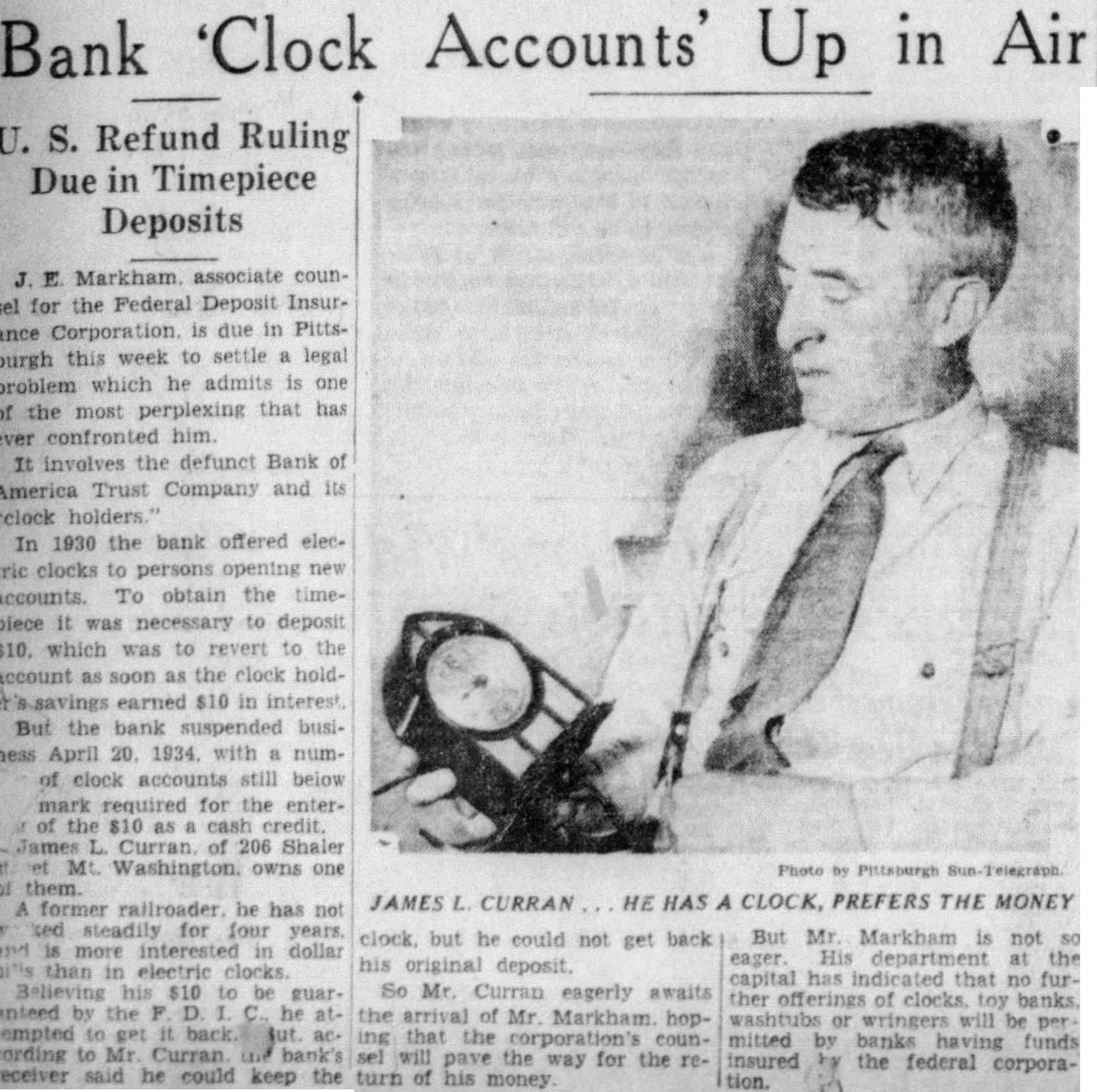
Accounts' in Air 'Clock Up Bank U. S. Refund Ruling Due in Timepiece Deposits J. E Markham. associate counsel for the Federal Deposit Insurance Corporation. is due in Pittsburgh this week to settle a legal problem which he admits is one of the most perplexing that has ever confronted him It involves the defunct Bank of America Trust Company and its "clock holders. In 1930 the bank offered electric clocks to persons opening new accounts. To obtain the timepiece it was necessary to deposit $10, which was to revert to the account as soon as the clock holds.savings earned $10 in interest But the bank suspended business April 20. 1934. with numof clock accounts still below mark required for the enterof the $10 as cash credit. Curran of 206 Shaler Mt. Washington. owns one them. former railroader. be has not ked steadily for four years. and more interested in dollar than in electric clocks Believing his $10 to be guarnnteed by the D. he attempted to get ac. cording to Mr Curran bank's but he could not get back his original deposit. So Mr. Curran eagerly awaits the arrival of Mr. Markham hoping that the corporation's counsel will pave the way for the re- But Mr. Markham is not so eager. His department at the capital has indicated that no further of clocks. toy banks, or will be per mitted by banks funds insured the federal corporation.


Article from Daily News, August 7, 1934

Click image to open full size in new tab

Article Text

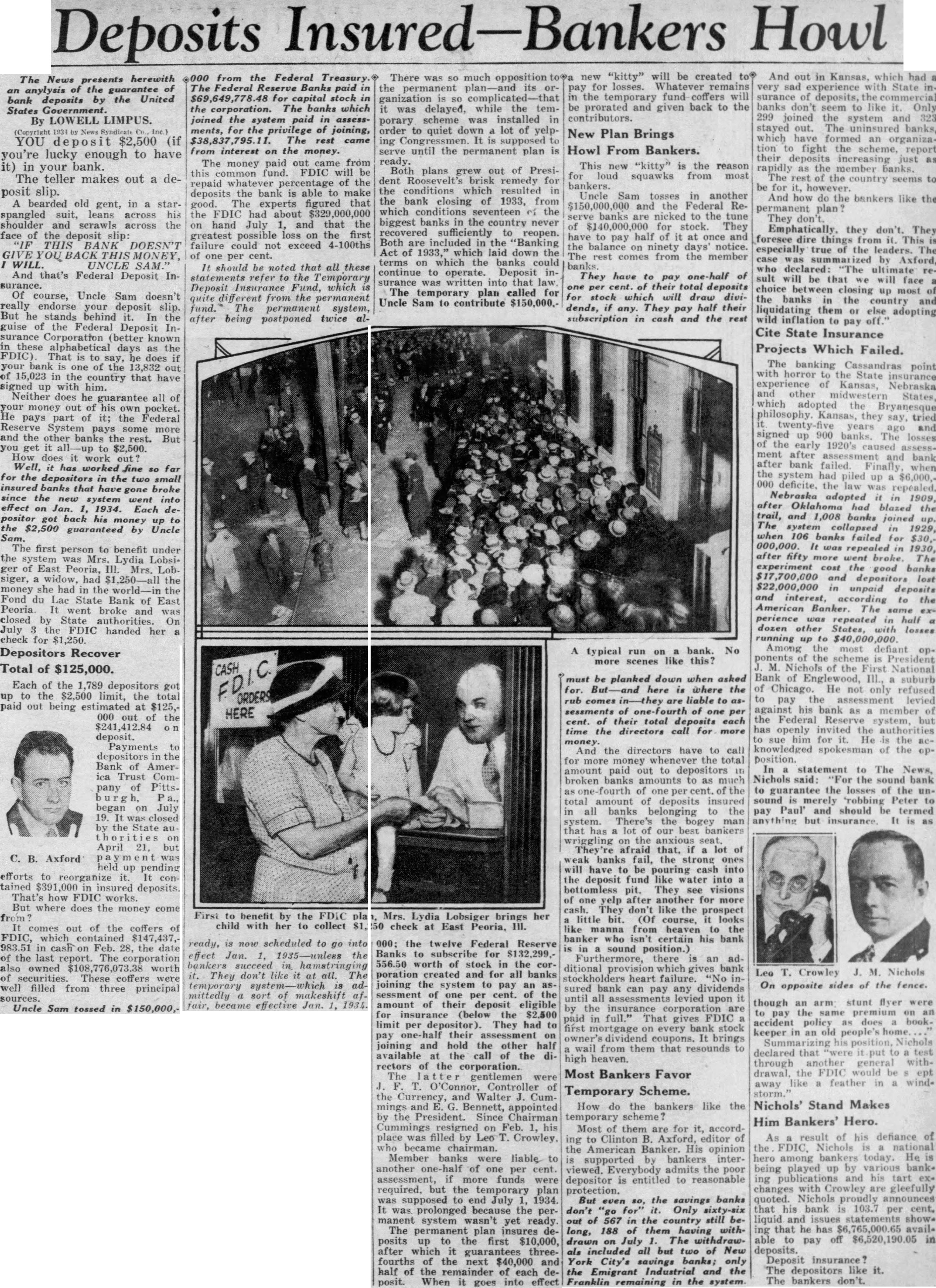
Deposits Insured-Bankers Howl The News presents herewith an anylysis of the guarantee of bank deposits by the United States Government. By LOWELL LIMPUS. (Copyright 1934 by News Syndicate Co., Inc.) YOU deposit $2,500 (if you're lucky enough to have it) in your bank. The teller makes out a deposit slip. A bearded old gent, in a starspangled suit, leans across his shoulder and scrawls across the face of the deposit slip: "IF THIS BANK DOESN'T GIVE YOU BACK THIS MONEY, UNCLE SAM." And that's Federal Deposit Insurance. Of course, Uncle Sam doesn't really endorse your deposit slip. But he stands behind it. In the guise of the Federal Deposit Insurance Corporation (better known in these alphabetical days as the FDIC). That is to say. he does if you, bank is one of the 13,832 out of 15,023 in the country that have signed up with him. Neither does he guarantee all of your money out of his own pocket. He pays part of it; the Federal Reserve System pays some more and the other banks the rest. But you get it all-up to $2,500. How does it work out? Well, it has worked fine so far for the depositors in the two small insured banks that have gone broke since the new system went into effect on Jan. 1, 1934. Each depositor got back his money up to the $2,500 guaranteed by Uncle Sam. The first person to benefit under the system was Mrs. Lydia Lobsiger of East Peoria, Ill. Mrs. Lobsiger, a widow, had $1,250-all the money she had in the world-in the Fond du Lac State Bank of East Peoria. It went broke and was closed by State authorities. On July 3 the FDIC handed her a check for $1,250. Depositors Recover Total of $125,000. Each of the 1,789 depositors got up to the $2,500 limit, the total paid out being estimated at $125,000 out of the $241,412.84 on deposit. Payments to depositors in the Bank of America Trust Company of Pittsburgh, P a., began on July 19. It was closed by the State authorities on April 21, but pay m was C. B. Axford held up pending efforts to reorganize it. It contained $391,000 in insured deposits. That's how FDIC works. But where does the money come from? It comes out of the coffers of FDIC, which contained $147,437,983.51 in cash on Feb. 28, the date of the last report. The corporation also owned $108,776,073.38 worth of securities. These coffers were well filled from three principal sources. Uncle Sam tossed in $150,000,- 4000 from the Federal Treasury. The Federal Reserve Banks paid in $69,649,778.48 for capital stock in the corporation. The banks which joined the system paid in assessments, for the privilege of joining, $38,837,795.11. The rest came from interest on the money. The money paid out came from this common fund. FIDC will be repaid whatever per centage of the deposits the bank is able to make good. The experts figured that the FIDC had about $329,000,000 on hand July 1, and that the greatest possible loss on the first failure could not exceed 4-100ths of one per cent. It should be noted that all these statements refer to the Temporary Deposit Insurance Fund, which is quite different from the permanent fund. The permanent system, after being postponed twice al- the permanent plan-and its organization is so complicated-that it was delayed, while the temporary scheme was installed in order to quiet down a lot of yelping congressmen. It is supposed to serve until the permanent plan is ready. Both plans grew out of President Roosevelt's brisk remedy for the conditions which resulted in the bank closing of 1933, from which conditions seventeen of the biggest banks in the country never recovered sufficiently to reopen. Both are included in the "Banking Act of 1933," which laid down the terms on which the banks could continue to operate. Deposit insurance was written into that law. The temporary plan called for Uncle Sam to contribute $150,000,- pay for losses. Whatever remains in the temporary fund coffers will be prorated and given back to the contributors. New Plan Brings Howl From Bankers. This new "kitty" is the reason for loud squawks from most bankers. Uncle Sam tosses in another $150,000,000 and the Federal Reserve banks are nicked to the tune of $140,000,000 for stock. They have to pay half of it at once and the balance on ninety days' notice. The rest comes from the member banks. They have to pay one-half of 1 per cent. of their total deposits for stock which will draw dividends, if any. They pay half their subscription in cash and the rest must ready, is now scheduled to go into effect Jan. 1, 1935-unless the bankers succeed in ham-stringing it. They don't like it at all. The temporary system-which is admittedly a sort of makeshift affair, became effective Tan. 1, 1934. 000; the twelve Federal Reserve Banks to subscribe for $132,299,556.50 worth of stock in the corporation created and for all banks joining the system to pay an assessment of one per cent. of the amount of their deposit eligible for insurance (below the $2,500 limit per depositor). They had to pay one half their assessment on joining and hold the other half available at the call of the directors of the corporation. The latter gentlemen were J. F. T. O'Connor, Controller of the Currency, and Walter J. Cummings and E. G. Bennett, appointed by the President. Since Chairman Cummings resigned on Feb. 1, his place was filled by Leo T. Crowley, who became chairman. Member banks were liable to another one half of one per cent. assessment, if more funds were required, but the temporary plan was supposed to end July 1, 1934. It was prolonged because the permanent system wasn't yet ready. The permanent plan insures deposits up to the first $10,000, after which it guarantees threefourths of the next $40,000 and half of the remainder of each deposit. When it goes into effect be planked down when asked for. But-and here is where the rub comes in-they are liable to assessments of one-fourth of 1 per cent. of their total deposits each time the directors call for more money. And the directors have to call for more money whenever the total amount paid out to depositors in broken banks amounts to as much as one-fourth of 1 per cent. of the total amount of deposits insured in all banks belonging to the system. There's the bogey man that has a lot of our best bankers wriggling on the anxious seat. They're afraid that, if a lot of weak banks fail, the strong ones will have to be pouring cash into the deposit fund like water into a bottomless pit. They see visions of one yelp after another for more cash. They don't like the prospect a little bit. (Of course, it looks like manna from heaven to the banker who isn't certain his bank is in a sound position.) Furthermore, there is an additional provision which gives bank stock holders heart failure. "No insured bank can pay any dividends until all assessments levied upon it by the insurance corporation are paid in full." That gives FIDC a first mortgage on every bank stock owner's dividend coupons. It brings a wail from them that resounds to high heaven. Most Bankers Favor Temporary Scheme. How do the bankers like the temporary scheme? Most of them are for it, according to Clinton B. Axford, editor of the American Banker. His opinion is supported by bankers interviewed. Everybody admits the poor depositor is entitled to reasonable protection. But even so, the savings banks don't "go for" it. Only sixty-six out of 567 in the country still belong, 188 of them having withdrawn on July 1. The withdrawals included all but two of New York City's savings banks; only the Emigrant Industrial and the Franklin remaining in the system. And out in Kansas, which had a very sad experience with State insurance of deposits, the commercial banks don't seem to like it. Only 299 joined the system and 323 stayed out. The uninsured banks, which have formed an organization to fight the scheme, report their deposits increasing just as rapidly as the member banks. The rest of the country seems to be for it, however. And how do the bankers like the permanent plan? They don't. Emphatically, they don't. They foresee dire things from it. This is especially true of the leaders. The case was summarized by Axford, who declared: "The ultimate result will be that we will face a choice between closing up most of the banks in the country and liquidating them or else adopting wild inflation to pay off." Cite State Insurance Projects Which Failed. The banking Cassandras point with horror to the State insurance experience of Kansas, Nebraska and other mid-wester ates, which adopted the que philosophy. Kansas, they ried it twenty-five years and signed up 900 banks. The losses of the early 1920's caused assessment after assessment and bank after bank failed. Finally, when the system had piled up a $6,000,000 deficit, the law yas repealed. Nebraska adopted it in 1909, after Oklahoma had blazed the trail, and 1,008 banks joined up. The system collapsed in 1929, when 106 banks failed for $30,000,000. It was repealed in 1930, after fifty more went broke. The experiment cost the good banks $17,700,000 and depositors lost $22,000,000 in unpaid deposits and interest, according to the American Banker. The same experience was repeated in half a dozen other States, with losses running up to $40,000,000. Among the most defiant opponents of the scheme is President J. M. Nichols of the First National Bank of Englewood, Ill., a suburb of Chicago. He not only refused to pay the assessment levied against his bank as a member of the Federal Reserve system, but has openly invited the authorities to sue him for it. He is the acknowledged spokesman of the opposition. In a statement to The News, Nichols said: "For the sound bank to guarantee the losses of the unsound is merely 'robbing Peter to pay Paul' and should be termed anything but insurance. It is as though an army stunt flyer were to pay the some premium on an accident policy as does a bookkeeper in an old people's home. Summarizing his position, Nichols declared that "were it put to a test through another general withdrawal, the FDIC would be S ept away like a feather in a wind storm." Nichols' Stand Makes Him Bankers' Hero. As a result of his defiance of the FDIC, Nichols is a national hero among bankers today. He is being played up by various banking publications and his tart exchanges with Crowley are gleefully quoted. Nichols proudly announces that his bank is 103.7 per cent. liquid and issues statements showing that he has $6,765,000.65 available to pay off $6,520,190.05 in deposits. Deposit insurance The depositors like it. The bankers don't.


Article from Daily News, August 7, 1934

Click image to open full size in new tab

Article Text

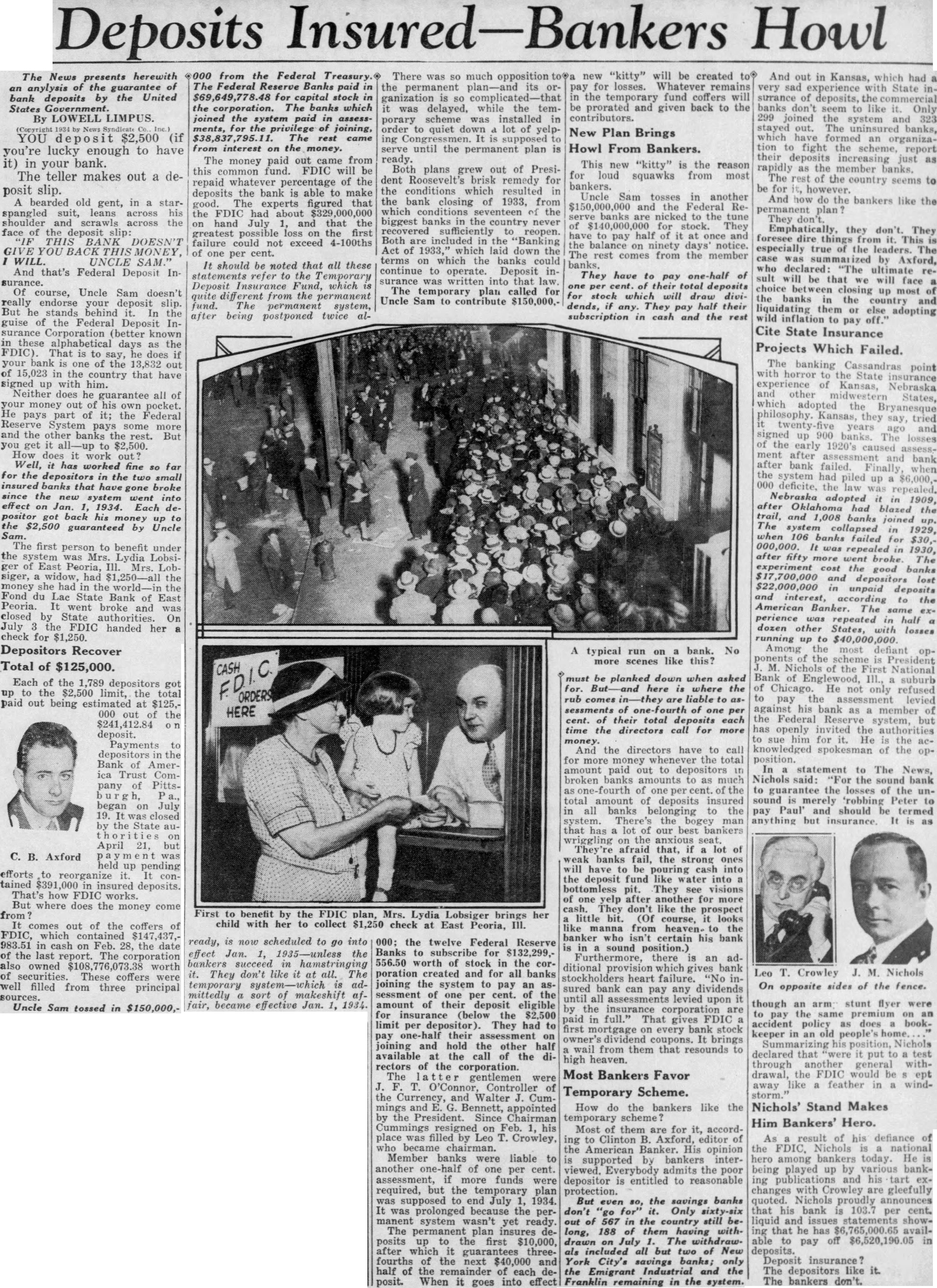
Deposits Insured-Bankers Howl The News presents herewith an anylysis of the guarantee of bank deposits by the United States Government. By LOWELL LIMPUS. (Copyright 1934 by News Syndicate Co., Inc.) YOU deposit $2,500 (if you're lucky enough to have it) in your bank. The teller makes out a deposit slip. A bearded old gent, in a starspangled suit, leans across his shoulder and scrawls across the face of the deposit slip; "IF THIS BANK DOESN'T GIVE YOU BACK THIS MONEY, UNCLE SAM." And that's Federal Deposit Insurance. Of course, Uncle Sam doesn't really endorse your deposit slip. But he stands behind it. In the guise of the Federal Deposit Insurance Corporation (better known in these alphabetical days as the FDIC). That is to say, he does if your bank is one of the 13,832 out of 15,023 in the country that have signed up with him. Neither does he guarantee all of your money out of his own pocket. He pays part of it; the Federal Reserve System pays some more and the other banks the rest. But you get it all-up to $2,500. How does it work out? Well, it has worked fine so far for the depositors in the two small insured banks that have gone broke since the new system went into effect on Jan. 1, 1934. Each depositor got back his money up to the $2,500 guaranteed by Uncle Sam. The first person to benefit under the system was Mrs. Lydia Lobsiger of East Peoria, Ill. Mrs. Lobsiger, a widow, had $1,250-all the money she had in the world-in the Fond du Lac State Bank of East Peoria. It went broke and was closed by State authorities. On July 3 the FDIC handed her a check for $1,250. Depositors Recover Total of $125,000. Each of the 1,789 depositors got up to the $2,500 limit, the total paid out being estimated at $125,000 out of the $241,412.84 on deposit. Payments to depositors in the Bank of America Trust Company of Pittsburgh, P a., began on July 19. It was closed by the State authorities on April 21, but C. B. Axford payment was held up pending efforts to reorganize it. It contained $391,000 in insured deposits. That's how FDIC works. But where does the money come from? It comes out of the coffers of FDIC, which contained $147,437,983.51 in cash on Feb. 28, the date of the last report. The corporation also owned $108,776,073.38 worth of securities. These coffers were well filled from three principal sources. Uncle Sam tossed in $150,000,- 0000 from the Federal Treasury. The Federal Reserve Banks paid in $69,649,778.48 for capital stock in the corporation. The banks which joined the system paid in assessments, for the privilege of joining, $38,837,795.11. The rest came from interest on the money. The money paid out came from this common fund. FDIC will be repaid whatever percentage of the deposits the bank is able to make good. The experts figured that the FDIC had about $329,000,000 on hand July 1, and that the greatest possible loss on the first failure could not exceed 4-100ths of one per cent. It should be noted that all these statements refer to the Temporary Deposit Insurance Fund, which quite different from the permanent fund. The permanent system, after being postponed twice al- There was so much opposition to a the permanent plan-and its organization is so complicated-that it was delayed, while the temporary scheme was installed in order to quiet down a lot of yelping Congressmen. It is supposed to serve until the permanent plan is ready. Both plans grew out of President Roosevelt's brisk remedy for the conditions which resulted in the bank closing of 1933, from which conditions seventeen of the biggest banks in the country never recovered sufficiently to reopen. Both are included in the "Banking Act of 1933," which laid down the terms on which the banks could continue to operate. Deposit insurance was written into that law. The temporary plan called for Uncle Sam to contribute $150,000,- new "kitty" will be created to? pay for losses. Whatever remains in the temporary fund coffers will be prorated and given back to the contributors. New Plan Brings Howl From Bankers. This new "kitty" is the reason for loud squawks from most bankers. Uncle Sam tosses in another $150,000,000 and the Federal Reserve banks are nicked to the tune of $140,000,000 for stock. They have to pay half of it at once and the balance on ninety days' notice. The rest comes from the member banks. They have to pay one-half of 1 per cent. of their total deposits for stock which will draw dividends, if any. They pay half their subscription in cash and the rest must ready, is now scheduled to go into effect Jan. 1, 1935-unless the bankers succeed in hamstringing it. They don't like it at all. The temporary system-which is admittedly a sort of makeshift affair, became effective Jan. 1, 1934. 000; the twelve Federal Reserve Banks to subscribe for $132,299,556.50 worth of stock in the corporation created and for all banks joining the system to pay an assessment of one per cent. of the amount of their deposit eligible for insurance (below the $2,500 limit per depositor). They had to pay one half their assessment on joining and hold the other half available at the call of the directors of the corporation. The latter gentlemen were J. F. *O'Connor, Controller of the Currency, and Walter J. Cummings and E. G. Bennett, appointed by the President. Since Chairman Cummings resigned on Feb. 1, his place was filled by Leo T. Crowley, who became chairman. Member banks were liable to another one half of one per cent. assessment, if more funds were required, but the temporary plan was supposed to end July 1, 1934. It was prolonged because the permanent system wasn't yet ready. The permanent plan insures deposits up to the first $10,000, after which it guarantees threefourths of the next $40,000 and half of the remainder of each deposit. When it goes into effect be planked down when asked for. But-and here is where the rub comes in-they are liable to assessments of one-fourth of 1 per cent. of their total deposits each time the directors call for more money. And the directors have to call for more money whenever the total amount paid out to depositors in broken banks amounts to as much as one-fourth of 1 per cent. of the total amount of deposits insured in all banks belonging to the system. There's the bogey man that has a lot of our best bankers wriggling on the anxious seat. They're afraid that, if a lot of weak banks fail, the strong ones will have to be pouring cash into the deposit fund like water into a bottomless pit. They see visions of one yelp after another for more cash. They don't like the prospect a little bit. (Of course, it looks like manna from heaven to the banker who isn't certain his bank is in a sound position.) Furthermore, there is an additional provision which gives bank stockholders heart failure. "No insured bank can pay any dividends until all assessments levied upon it by the insurance corporation are paid in full." That gives FDIC a first mortgage on every bank stock owner's dividend coupons. It brings a wail from them that resounds to high heaven. Most Bankers Favor Temporary Scheme. How do the bankers like the temporary scheme? Most of them are for it, according to Clinton B. Axford, editor of the American Banker. His opinion is supported by bankers interviewed. Everybody admits the poor depositor is entitled to reasonable protection. But even so, the savings banks don't "go for" it. Only sixty-six out of 567 in the country still belong, 188 of them having withdrawn on July 1. The withdrawals included all but two of New York City's savings banks; only the Emigrant Industrial and the Franklin remaining in the system. And out in Kansas, which had a very sad experience with State insurance of deposits, the commercial banks don't seem to like it. Only 299 joined the system and 323 stayed out. The uninsured banks, which have formed an organization to fight the scheme, report their deposits increasing just as rapidly as the member banks. The rest of the country seems to be for it, however. And how do the bankers like the permanent plan? They don't. Emphatically, they don't. They foresee dire things from it. This is especially true of the leaders. The case was summarized by Axford, who declared: "The ultimate result will be that we will face a choice between closing up most of the banks in the country and liquidating them or else adopting wild inflation to pay off." Cite State Insurance Projects Which Failed. The banking Cassandras point with horror to the State insurance experience of Kansas, Nebraska and other midwestern States, which adopted the Bryanesque philosophy. Kansas, they say, tried it twenty-five years ago and signed up 900 banks. The losses of the early 1920's caused assessment after assessment and bank after bank failed. Finally, when the system had piled up a $6,000,000 deficit, the law yas repealed. Nebraska adopted it in 1909, after Oklahoma had blazed the trail, and 1,008 banks joined up. The system collapsed in 1929, when 106 banks failed for $30,000,000. It was repealed in 1930, after fifty more went broke. The experiment cost the good banks $17,700,000 and depositors lost $22,000,000 in unpaid deposits and interest, according to the American Banker. The same experience was repeated in half dozen other States, with losses running up to $40,000,000. Among the most defiant opponents of the scheme is President J. M. Nichols of the First National Bank of Englewood, III, a suburb of Chicago. He not only refused to pay the assessment levied against his bank as a member of the Federal Reserve system, but has openly invited the authorities to sue him for it. He is the acknowledged spokesman of the opposition. In a statement to The News, Nichols said: "For the sound bank to guarantee the losses of the unsound is merely 'robbing Peter to pay Paul' and should be termed anything but insurance. 11 is as though an arm: stunt flyer were to pay the same premium on an accident policy as does a bookkeeper in an old people's home.' Summarizing his position, Nichols declared that "were it put to a test through another general withdrawal, the FDIC would be S ept away like a feather in a windstorm." Nichols' Stand Makes Him Bankers' Hero. As a result of his defiance of the FDIC, Nichols is a national hero among bankers today. He is being played up by various banking publications and his tart exchanges with Crowley are gleefully quoted. Nichols proudly announces that his bank is 103.7 per cent. liquid and issues statements showing that he has $6,765,000.65 available to pay off $6,520,190.05 in deposits. Deposit insurance? The depositors like it. The bankers don't.
Article from Daily News, August 7, 1934

Click image to open full size in new tab

Article Text

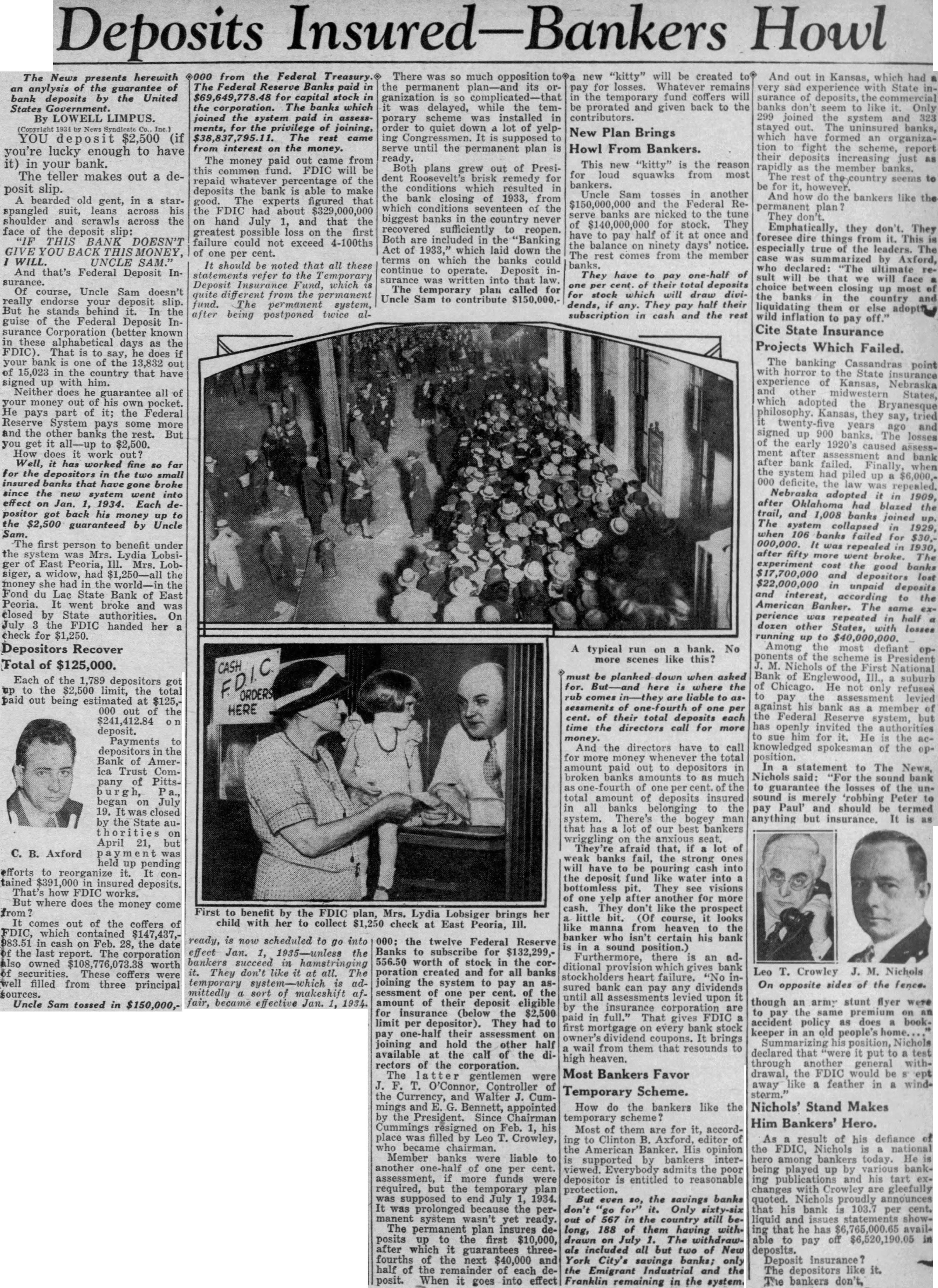
Deposits Insured-Bankers Howl The News presents herewith an anylysis of the guarantee of bank deposits by the United States Government. By LOWELL LIMPUS. (Copyright 1934 by News Syndicate Co., Inc.) YOU deposit $2,500 (if you're lucky enough to have it) in your bank. The teller makes out a deposit slip. A bearded old gent, in a starspangled suit, leans across his shoulder and scrawls across the face of the deposit slip: "IF THIS BANK DOESN'T GIVE YOU BACK THIS MONEY, UNCLE SAM." And that's Federal Deposit Insurance. Of course, Uncle Sam doesn't really endorse your deposit slip. But he stands behind it. In the guise of the Federal Deposit Insurance Corporation (better known in these alphabetical days as the FDIC). That is to say, he does if your bank is one of the 13,832 out of 15,023 in the country that have signed up with him. Neither does he guarantee all of your money out of his own pocket. He pays part of it; the Federal Reserve System pays some more and the other banks the rest. But you get it all-up to $2,500. How does it work out? Well, it has worked fine so far for the depositors in the two small insured banks that have gone broke since the new system went into effect on Jan. 1, 1934. Each depositor got back his money up to the $2,500 guaranteed by Uncle Sam. The first person to benefit under the system was Mrs. Lydia Lobsiger of East Peoria, Ill. Mrs. Lobsiger, a widow, had $1,250-all the money she had in the world-in the Fond du Lac State Bank of East Peoria. It went broke and was closed by State authorities. On July 3 the FDIC handed her a check for $1,250. Depositors Recover Total of $125,000. Each of the 1,789 depositors got up to the $2,500 limit, the total paid out being estimated at $125,000 out of the $241,412.84 on deposit. Payments to depositors in the Bank of America Trust Company of Pittsburg h, P a., began on July 19. It was closed by the State authorities on April 21, but C. B. Axford pay m was held up pending efforts to reorganize it. It contained $391,000 in insured deposits. That's how FDIC works. But where does the money come from? It comes out of the coffers of FDIC, which contained $147,437,983.51 in cash on Feb. 28, the date of the last report. The corporation also owned $108,776,073.38 worth of securities. These coffers were well filled from three principal sources. Uncle Sam tossed in $150,000,- $000 from the Federal Treasury. The Federal Reserve Banks paid in $69,649,778.48 for capital stock in the corporation. The banks which joined the system paid in assessments, for the privilege of joining, $38,837,795.11. The rest came from interest on the money. The money paid out came from this common fund. FDIC will be repaid whatever percentage of the deposits the bank is able to make good. The experts figured that the FDIC had about $329,000,000 on hand July 1, and that the greatest possible loss on the first failure could not exceed 4-100ths of one per cent. It should be noted that all these statements refer to the Temporary Deposit Insurance Fund, which is quite different from the permanent fund. The permanent system, after being postponed twice al- There was so much opposition toya the permanent plan-and its organization is so complicated-that it was delayed, while the temporary scheme was installed in order to quiet down a lot of yelping Congressmen. It is supposed to serve until the permanent plan is ready. Both plans grew out of President Roosevelt's brisk remedy for the conditions which resulted in the bank closing of 1933, from which conditions seventeen of the biggest banks in the country never recovered sufficiently to reopen. Both are included in the "Banking Act of 1933," which laid down the terms on which the banks could continue to operate. Deposit insurance was written into that law. The temporary plan called for Uncle Sam to contribute $150,000,- "kitty" will be created to? new pay for losses. Whatever remains in the temporary fund coffers will be prorated and given back to the contributors. New Plan Brings Howl From Bankers. This new "kitty" is the reason for loud sqúawks from most bankers. Uncle Sam tosses in another $150,000,000 and the Federal Reserve banks are nicked to the tune of $140,000,000 for stock. They have to pay half of it at once and the balance on ninety days' notice. The rest comes from the member banks. They have to pay one-half of one per cent. of their total deposits for stock which will draw dividends, if any. They pay half their subscription in cash and the rest ready, is now scheduled to go into effect Jan. 1, 1935-unless the bankers succeed in hamstringing it. They don't like it at all. The temporary system-which is admittedly a sort of makeshift afjair, became effective Jan. 1, 1934. 000; the twelve Federal Reserve Banks to subscribe for $132,299,556.50 worth of stock in the corporation created and for all banks joining the system to pay an assessment of one per cent. of the amount of their deposit eligible for insurance (below the $2,500 limit per depositor). They had to pay one-half their assessment on joining and hold the other half available at the call of the directors of the corporation. The latter gentlemen were J. F. T. O'Connor, Controller of the Currency, and Walter J. Cummings and E. G, Bennett, appointed by the President. Since Chairman Cummings resigned on Feb. 1, his place was filled by Leo T. Crowley, who became chairman. Member banks were liable to another one-half of one per cent. assessment, if more funds were required, but the temporary plan was supposed to end July 1, 1934. It was prolonged because the permanent system wasn't yet ready. The permanent plan insures deposits up to the first $10,000, after which it guarantees threefourths of the next $40,000 and half of the remainder of each deposit. When it goes into effect must be planked down when asked for. But-and here is where the rub comes in-they are liable to assessments of one-fourth of one per cent. of their total deposits each time the directors call for more money. And the directors have to call for more money whenever the total amount paid out to depositors in broken banks amounts to as much as one-fourth of one per cent. of the total mount of deposits insured in all banks belonging to the system. There's the bogey man that has a lot of our best bankers wriggling on the anxious seat. They're afraid that, if a lot of weak banks fail, the strong ones will have to be pouring cash into the deposit fund like water into a bottomless pit. They see visions of one yelp after another for more cash. They don't like the prospect a little bit. (Of course, it looks like manna from heaven to the banker who isn't certain his bank is in a sound position.) Furthermore, there is an additional provision which gives bank stockholders heart failure. "No insured bank can pay any dividends until all assessments levied upon it by the insurance corporation are paid in full." That gives FDIC a first mortgage on every bank stock owner's dividend coupons. It brings a wail from them that resounds to high heaven. Most Bankers Favor Temporary Scheme. How do the bankers like the temporary scheme? Most of them are for it, according to Clinton B. Axford, editor of the American Banker. His opinion is supported by bankers interviewed. Everybody admits the poor depositor is entitled to reasonable protection. But even so, the savings banks don't "go for" it. Only sixty-six out of 567 in the country still be. long, 188 of them having withdrawn on July 1. The withdrawals included all but two of New York City's savings banks; only the Emigrant Industrial and the Franklin remaining in the system. And out in Kansas, which had a very sad experience with State insurance of deposits, the commercial banks don't seem to like it. Only 299 joined the system and 323 stayed out. The uninsured banks, which have formed an organization to fight the scheme, report their deposits increasing just as rapidly as the member banks, The rest of the country seems to be for it, however. And how do the bankers like the permanent plan? They don't. Emphatically, they don't. They foresee dire things from it. This is especially true of the leaders. The case was summarized by Axford, who declared: "The ultimate result will be that we will face a choice between closing up most of the banks in the country and liquidating them or else adopting wild inflation to pay off." Cite State Insurance Projects Which Failed, The banking Cassandras point with horror to the State insurance experience of Kansas, Nebraska and other midwestern States, which adopted the Bryanesque philosophy. Kansas, they say, tried it twenty-five years ago and signed up 900 banks. The losses of the early 1920's caused assessment after assessment and bank after bank failed. Finally, when the system had piled up a $6,000,000 deficite, the law was repealed. Nebraska adopted it in 1909, after Oklahoma had blazed the trail, and 1,008 banks joined up. The system collapsed in 1929, when 106 banks failed for $30,000,000. It was repealed in 1930, after fifty more went broke. The experiment cost the good banks $17,700,000 and depositors lost $22,000,000 in unpaid deposits and interest, according to the American Banker. The same experience was repeated in half a dozen other States, with losses running up to $40,000,000. Among the most defiant opponents of the scheme is President J. M. Nichols of the First National Bank of Englewood, Ill., a suburb of Chicago. He not only refused to pay the assessment levied against his bank as a member of the Federal Reserve system, but has openly invited the authorities to sue him for it. He is the acknowledged spokesman of the opposition. In a statement to The News, Nichols said: "For the sound bank to guarantee the losses of the unsound is merely 'robbing Peter to pay Paul' and should be termed anything but insurance, It is as though an arm stunt flyer were to pay the same premium on an accident policy as does a bookkeeper in an old people's home. Summarizing his position, Nichols declared that "were it put to a test through another general withdrawal, the FDIC would be S ept away like a feather in a windstorm." Nichols' Stand Makes Him Bankers' Hero. As a result of his defiance of the FDIC. Nichols is a national hero among bankers today. He is being played up by various banking publications and his tart exchanges with Crowley are gleefully quoted. Nichols proudly announces that his bank is 103.7 per cent. liquid and issues statements showing that he has $6,765,000.65 available to pay off $6,520,190.05 in deposits. Deposit insurance? The depositors like it. The bankers don't.

Article from Daily News, August 7, 1934

Click image to open full size in new tab

Article Text

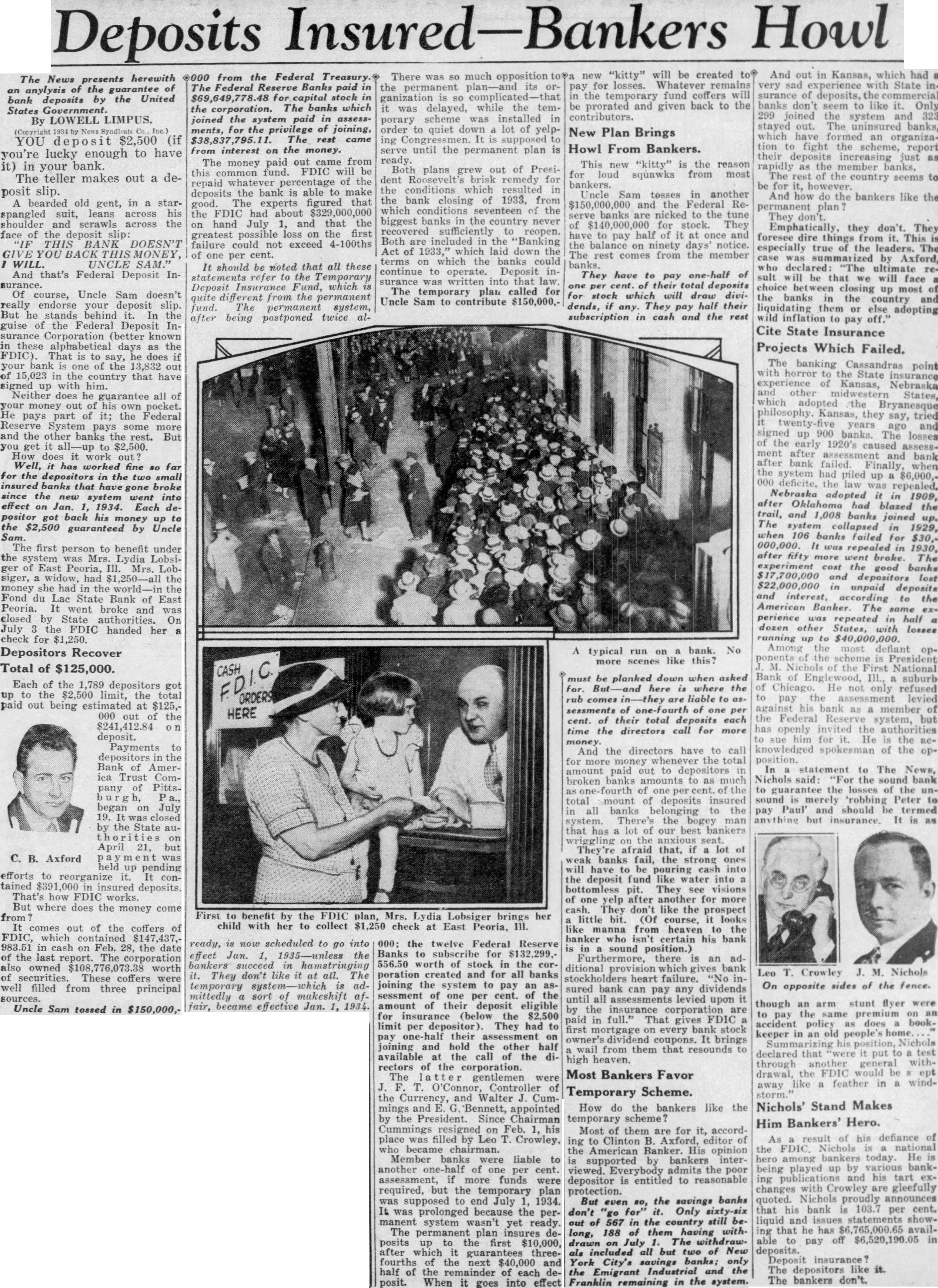
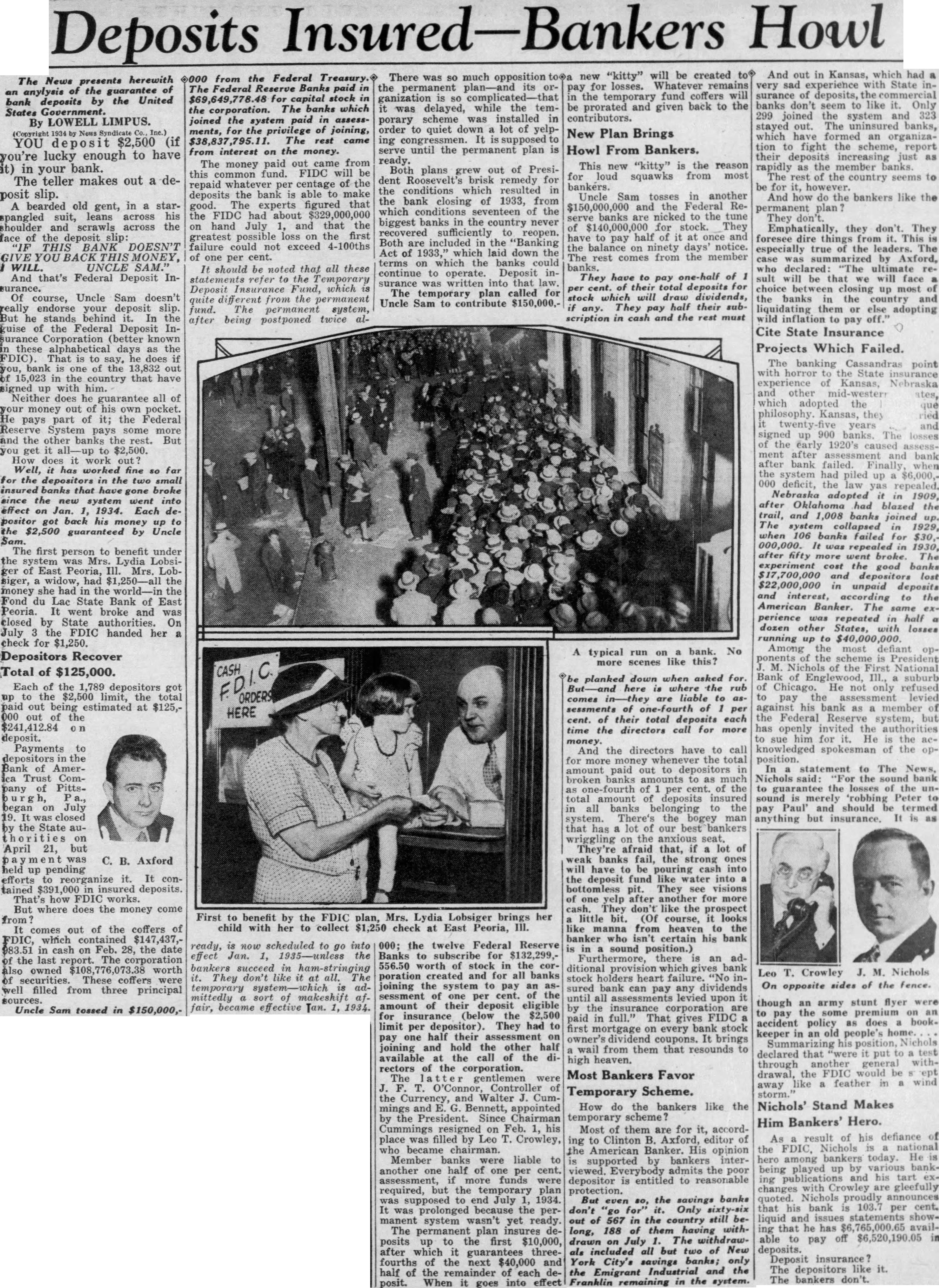
The News presents herewith an anylysis of the guarantee of bank deposits by the United States Government. By LOWELL LIMPUS. (Copyright 1934 by News Syndicate Co., Inc.) YOU deposit $2,500 (if you're lucky enough to have it) in your bank. The teller makes out a deposit slip. A bearded old gent, in a starspangled suit, leans across his shoulder and scrawls across the face of the deposit slip: "IF THIS BANK DOESN'T GIVE YOU BACK THIS MONEY, I WILL. UNCLE SAM." And that's Federal Deposit Insurance. Of course, Uncle Sam doesn't really endorse your deposit slip. But he stands behind it. In the guise of the Federal Deposit Insurance Corporation (better known in these alphabetical days as the FDIC). That is to say, he does if your bank is one of the 13,832 out of 15,023 in the country that have signed up with him. Neither does he guarantee all of your money out of his own pocket. He pays part of it; the Federal Reserve System pays some more and the other banks the rest. But you get it all-up to $2,500. How does it work out? Well, it has worked fine so far for the depositors in the two small insured banks that have gone broke since the new system went into effect on Jan. 1, 1934. Each depositor got back his money up to the $2,500 guaranteed by Uncle Sam. The first person to benefit under the system was Mrs. Lydia Lobsiger of East Peoria, III. Mrs. Lobsiger, a widow, had $1,250-all the money she had in the world-in the Fond du Lac State Bank of East Peoria. It went broke and was closed by State authorities. On July 3 the FDIC handed her a check for $1,250. Depositors Recover Total of $125,000. Each of the 1,789 depositors got up to the $2,500 limit, the total paid out being estimated at $125,000 out of the $241,412.84 on deposit. Payments to depositors in the Bank of America Trust Company of Pittsburgh, P a., began on July 19. It was closed by the State authorities on April 21, but C. B. Axford paymentwas held up pending efforts to reorganize it. It contained $391,000 in insured deposits. That's how FDIC works. But where does the money come from? It comes out of the coffers of FDIC, which contained $147,437,983 51 in cash on Feb. 28, the date of the last report. The corporation also owned $108,776,073.38 worth of securities. These coffers were well filled from three principal sources. Uncle Sam tossed in $150,000,- 4000 from the Federal Treasury. The Federal Reserve Banks paid in $69,649,778.48 for capital stock in the corporation. The banks which joined the system paid in assessments, for the privilege of joining, $38,837,795.11. The rest came from interest on the money. The money paid out came from this common fund. FDIC will be repaid whatever percentage of the deposits the bank is able to make good. The experts figured that the FDIC had about $329,000,000 on hand July 1, and that the greatest possible loss on the first failure could not exceed 4-100ths of one per cent. It should be noted that all these statements refer to the Temporary Deposit Insurance Fund, which is quite different from the permanent fund. The permanent system, after being postponed twice al- There was so much opposition to a the permanent plan-and its organization is so complicated-that it was delayed, while the temporary scheme was installed in order to quiet down a lot of yelping Congressmen. It is supposed to serve until the permanent plan is ready. Both plans grew out of President Roosevelt's brisk remedy for the conditions which resulted in the bank closing of 1933, from which conditions seventeen of the biggest banks in the country never recovered sufficiently to reopen. Both are included in the "Banking Act of 1933," which laid down the terms on which the banks could continue to operate. Deposit insurance was written into that law. The temporary plan called for Uncle Sam to contribute $150,000.- new "kitty" will be created to? pay for losses. Whatever remains in the temporary fund coffers will be prorated and given back to the contributors. New Plan Brings Howl From Bankers. This new "kitty" is the reason for loud squawks from most bankers. Uncle Sam tosses in another $150,000,000 and the Federal Reserve banks are nicked to the tune of $140,000,000 for stock. They have to pay half of it at once and the balance on ninety days' notice. The rest comes from the member banks. They have to pay one-half of one per cent. of their total deposits for stock which will draw dividends, if any. They pay half their subscription in cash and the rest ready, is now scheduled to go into effect Jan. 1, 1935-unless the bankers succeed in hamstringing it. They don't like it at all. The temporary system-which is admittedly a sort of makeshift afjair, became effective Jan. 1, 1934. 000; the twelve Federal Reserve Banks to subscribe for $132,299,556.50 worth of stoch in the corporation created and for all banks joining the system to pay an assessment of one per cent. of the amount of their deposit eligible for insurance (below the $2,500 limit per depositor). They had to pay one-half their assessment on joining and hold the other half available at the call of the directors of the corporation. The latter gentlemen were J. F. T. O'Connor, Controller of the Currency, and Walter J. Cummings and E. G. Bennett, appointed by the President. Since Chairman Cummings resigned on Feb. 1, his place was filled by Leo T. Crowley, who became chairman. Member banks were liable to another one-half of one per cent. assessment, if more funds were required, but the temporary plan was supposed to end July 1, 1934. It was prolonged because the permanent system wasn't yet ready. The permanent plan insures deposits up to the first $10,000, after which it guarantees threefourths of the next $40,000 and half of the remainder of each deposit. When it goes into effect A typical run on a bank. No more scenes like this? must be planked down when asked for. But-and here is where the rub comes in-they are liable to assessments of one-fourth of one per cent. of their total deposits each time the directors call for more money. And the directors have to call for more money whenever the total amount paid out to depositors in broken banks amounts to as much as one-fourth of one per cent. of the total amount of deposits insured in all banks belonging to the system. There's the bogey man that has a lot of our best bankers wriggling on the anxious seat. They're afraid that. if a lot of weak banks fail, the strong ones will have to be pouring cash into the deposit fund like water into a bottomless pit. They see visions of one yelp after another for more cash. They don't like the prospect a little bit. (Of course, it looks like manna from heaven to the banker who isn't certain his bank is in a sound position.) Furthermore, there is an additional provision which gives bank stockholders heart failure. "No insured bank can pay any dividends until all assessments levied upon it by the insurance corporation are paid in full." That gives FDIC a first mortgage on every bank stock owner's dividend coupons. It brings a wail from them that resounds to high heaven. Most Bankers Favor Temporary Scheme. How do the bankers like the temporary scheme? Most of them are for it, according to Clinton B. Axford, editor of the American Banker. His opinion is supported by bankers interviewed. Everybody admits the poor depositor is entitled to reasonable protection. But even so, the savings banks don't "go for" it. Only sixty-six out of 567 in the country still belong, 188 of them having with. drawn on July 1. The withdraw. als included all but two of New York City's savings banks; only the Emigrant Industrial and the Franklin remaining in the system. And out in Kansas, which had a very sad experience with State insurance of deposits, the commercial banks don't seem to like it. Only 299 joined the system and 323 stayed out. The uninsured banks, which have formed an organization to fight the scheme, report their deposits increasing just as rapidly as the member banks. The rest of the country seems to be for it, however. And how do the bankers like the permanent plan? They don't. Emphatically, they don't. They foresee dire things from it. This is especially true of the leaders. The case was summarized by Axford, who declared: "The ultimate result will be that we will face a choice between closing up most of the banks in the country and liquidating them or else adopting wild inflation to pay off." Cite State Insurance Projects Which Failed. The banking Cassandras point with horror to the State insurance experience of Kansas, Nebraska and other midwestern States, which adopted the Bryanesque philosophy. Kansas, they say, tried it twenty-five years ago and signed up 900 banks. The losses of the early 1920's caused assessment after assessment and bank after bank failed. Finally, when the system had piled up a $6,000.000 deficite, the law was repealed, Nebraska adopted it in 1909, after Oklahoma had blazed the trail, and 1,008 banks joined up. The system collapsed in 1929, when 106 banks failed for $30,000,000. It was repealed in 1930, after fifty more went broke. The experiment cost the good banks $17,700,000 and depositors lost $22,000,000 in unpaid deposits and interest, according to the American Banker. The same experience was repeated in half a dozen other States, with losses running up to $40,000,000. Among the most defiant opponents of the scheme is President J. M. Nichols of the First National Bank of Englewood, Ill., a suburb of Chicago. He not only refused to pay the assessment levied against his bank as a member of the Federal Reserve system, but has openly invited the authorities to sue him for it. He is the acknowledged spokesman of the opposition. In a statement to The News, Nichols said: "For the sound bank to guarantee the losses of the unsound is merely 'robbing Peter to pay Paul' and should be termed anything but insurance. It is as though an arm stunt flyer were to pay the same premium on an accident policy as does a bookkeeper in an old people's home. Summarizing his position, Nichols declared that "were it put to a test through another general withdrawal, the FDIC would be S ept away like a feather in a windstorm." Nichols' Stand Makes Him Bankers' Hero. As a result of his defiance of the FDIC. Nichols is a national hero among bankers today. He is being played up by various banking publications and his tart exchanges with Crowley are gleefully quoted. Nichols proudly announces that his bank is 103.7 per cent. liquid and issues statements showing that he has $6,765,000.65 available to pay off $6,520,190.05 in deposits. Deposit insurance? The depositors like it. The bankers don't.

Article from Daily News, August 7, 1934

Click image to open full size in new tab

Article Text

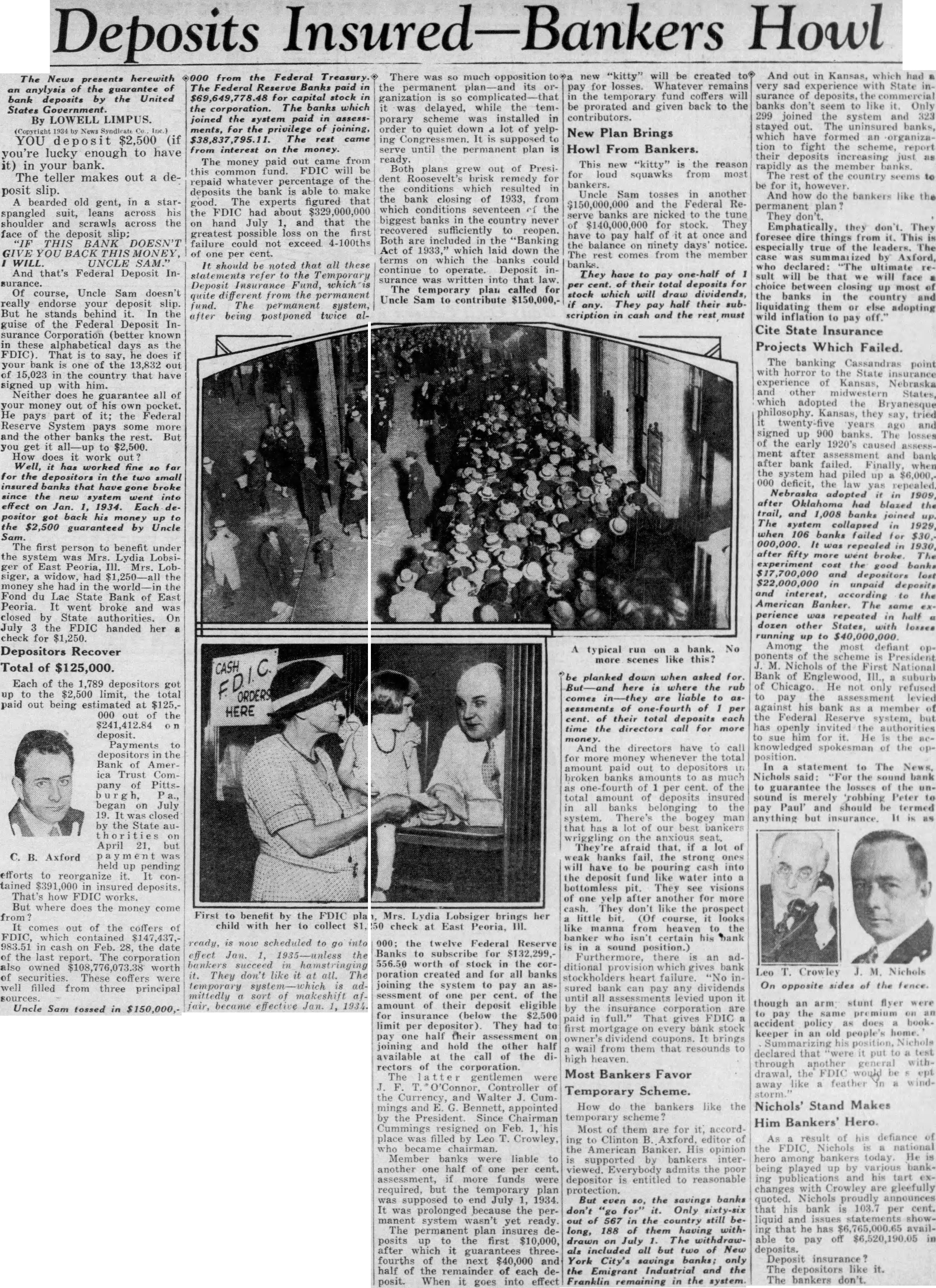
Deposits Insured-Bankers Howl The News presents herewith an anylysis of the guarantee of bank deposits by the United States Government. By LOWELL LIMPUS. (Copyright 1934 of News Syndicate Co., Inc.) YOU deposit $2,500 (if you're lucky enough to have it) in your bank. The teller makes out a deposit slip. A bearded old gent, in a starspangled suit, leans across his shoulder and scrawls across the face of the deposit slip: "IF THIS BANK DOESN'T GIVE YOU BACK THIS MONEY, WILL. UNCLE SAM." And that's Federal Deposit Insurance. Of course, Uncle Sam doesn't really endorse your deposit slip. But he stands behind it. In the guise of the Federal Deposit InSurance Corporation (better known in these alphabetical days as the FDIC). That is to say, he does if you, bank is one of the 13,832 out of 15,023 in the country that have signed up with him. Neither does he guarantee all of your money out of his own pocket. He pays part of it; the Federal Reserve System pays some more and the other banks the rest. But you get it all-up to $2,500. How does it work out? Well, it has worked fine so far for the depositors in the two small insured banks that have gone broke since the new system went into effect on Jan. 1, 1934. Each depositor got back his money up to the $2,500 guaranteed by Uncle Sam. The first person to benefit under the system was Mrs. Lydia Lobsiger of East Peoria, III. Mrs. Lobsiger, a widow, had $1,250-all the money she had in the world-in the Fond du Lac State Bank of East Peoria. It went broke and was closed by State authorities. On July 3 the FDIC handed her a check for $1,250. Depositors Recover Total of $125,000. Each of the 1,789 depositors got up to the $2,500 limit, the total paid out being estimated at $125,000 out of the $241,412.84 on deposit. Payments to depositors in the Bank of America Trust Company of Pittsburgh, P a., began on July 19. It was closed by the State authorities on April 21, but was C. B. Axford held up pending efforts to reorganize it. It contained $391,000 in insured deposits. That's how FDIC works. But where does the money come from? It comes out of the coffers of FDIC, which contained $147,437,983.51 in cash on Feb. 28, the date of the last report. The corporation also owned $108,776,073.38 worth of securities. These coffers were well filled from three principal sources. Uncle Sam tossed in $150,000,- 4000 from the Federal Treasury. The Federal Reserve Banks paid in $69,649,778.48 for capital stock in the corporation. The banks which joined the system paid in assessments, for the privilege of joining, $38,837,795.11. The rest came from interest on the money. The money paid out came from this common fund. FIDC will be repaid whatever per centage of the deposits the bank is able to make good. The experts figured that the FIDC had about $329,000,000 on hand July 1, and that the greatest possible loss on the first failure could not exceed 4-100ths of one per cent. It should be noted that all these statements refer to the Temporary Deposit Insurance Fund, which is quite different from the permanent fund. The permanent system, after being postponed twice al- There was so much opposition tooa the permanent plan-and its organization is SO complicated-that it was delayed, while the temporary scheme was installed in order to quiet down a lot of yelping congressmen. It is supposed to serve until the permanent plan is ready. Both plans grew out of President Roosevelt's brisk remedy for the conditions which resulted in the bank closing of 1933, from which conditions seventeen of the biggest banks in the country never recovered sufficiently to reopen. Both are included in the "Banking Act of 1933," which laid down the terms on which the banks could continue to operate. Deposit insurance was written into that law. The temporary plan called for Uncle Sam to contribute $150,000,- will be created new "kitty" pay for losses. Whatever remains in the temporary fund coffers will be prorated and given back to the contributors. New Plan Brings Howl From Bankers. This new "kitty" is the reason for loud squawks from most bankers. Uncle Sam tosses in another $150,000,000 and the Federal Reserve banks are nicked to the tune of $140,000,000 for stock. They have to pay half of it at once and the balance on ninety days' notice. The rest comes from the member banks. They have to pay one-half of 1 per cent. of their total deposits for stock which will draw dividends, if any. They pay half their subscription in cash and the rest must ready, is now scheduled to go into effect Jan. 1, 1935-unless the bankers succeed in ham-stringing it. They don't like it at all. The temporary system-which is admittedly a sort of makeshift affair, became effective Tan. 1, 1934. 000; the twelve Federal Reserve Banks to subscribe for $132,299,556.50 worth of stock in the corporation created and for all banks joining the system to pay an assessment of one per cent. of the amount of their deposit eligible for insurance (below the $2,500 limit per depositor). They had to pay one half their assessment on joining and hold the other half available at the call of the directors of the corporation. The latter gentlemen were J. F. T. O'Connor, Controller of the Currency, and Walter J. Cummings and E. G. Bennett, appointed by the President. Since Chairman Cummings resigned on Feb. 1, his place was filled by Leo T. Crowley, who became chairman. Member banks were liable to another one half of one per cent. assessment, if more funds were required, but the temporary plan was supposed to end July 1, 1934. It was prolonged because the permanent system wasn't yet ready. The permanent plan insures deposits up to the first $10,000, after which it guarantees threefourths of the next $40,000 and half of the remainder of each deposit. When it goes into effect be planked down when asked for. But-and here is where the rub comes in-they are liable to assessments of one-fourth of 1 per cent. of their total deposits each time the directors call for more money. And the directors have to call for more money whenever the total amount paid out to depositors in broken banks amounts to as much as one-fourth of 1 per cent. of the total amount of deposits insured in all banks belonging to the system. There's the bogey man that has a lot of our best bankers wriggling on the anxious seat. They're afraid that, if a lot of weak banks fail, the strong ones will have to be pouring cash into the deposit fund like water into a bottomless pit. They see visions of one yelp after another for more cash. They don't like the prospect a little bit. (Of course, it looks like manna from heaven to the banker who isn't certain his bank is in a sound position.) Furthermore, there is an additional provision which gives bank stock holders heart failure. "No insured bank can pay any dividends until all assessments levied upon it by the insurance corporation are paid in full." That gives FIDC a first mortgage on every bank stock owner's dividend coupons. It brings a wail from them that resounds to high heaven. Most Bankers Favor Temporary Scheme. How do the bankers like the temporary scheme? Most of them are for it, according to Clinton B. Axford, editor of the American Banker. His opinion is supported by bankers interviewed. Everybody admits the poor depositor is entitled to reasonable protection. But even so, the savings banks don't "go for" it. Only sixty-six out of 567 in the country still belong, 188 of them having withdrawn on July 1. The withdrawals included all but two of New York City's savings banks; only the Emigrant Industrial and the Franklin remaining in the system. And out in Kansas, which had a very sad experience with State insurance of deposits, the commercial banks don't seem to like it. Only 299 joined the system and 323 stayed out. The uninsured banks, which have formed an organization to fight the scheme, report their deposits increasing just as rapidly as the member banks. The rest of the country seems to be for it, however. And how do the bankers like the permanent plan They don't. Emphatically, they don't. They foresee dire things from it. This is especially true of the leaders. The case was summarized by Axford, who declared: "The ultimate result will be that we will face a choice between closing up most of the banks in the country and liquidating them or else adopting wild inflation to pay off." Cite State Insurance Projects Which Failed. The banking Cassandras point with horror to the State insurance experience of Kansas. ka and other mid-west which adopted the philosophy. Kansas, the it twenty-five years and signed up 900 banks. The rosses of the early 1920's caused assessment after assessment and bank after bank failed. Finally, when the system had piled up- a $6,000,000 deficit, the law yas repealed. Nebraska adopted it in 1909, after Oklahoma had blazed the trail, and 1,008 banks joined up. The system collapsed in 1929, when 106 banks failed for $30,000,000. It was repealed in 1930, after fifty more went broke. The experiment cost the good banks $17,700,000 and depositors lost $22,000,000 in unpaid deposits and interest, according to the American Banker. The same experience was repeated in half a dozen other States, with losses running up to $40,000,000. Among the most defiant opponents of the scheme is President J. M. Nichols of the First National Bank of Englewood, III., a suburb of Chicago. He not only refused to pay the assessment levied against his bank as a member of the Federal Reserve system, but has openly invited the authorities to sue him for it. He is the acknowledged spokesman of the opposition. In a statement to The News, Nichols said: "For the sound bank to guarantee the losses of the unsound is merely 'robbing Peter to pay Paul' and should be termed anything but insurance. It is as though an arm: stunt flyer were to pay the some premium on an accident policy as does a bookkeeper in an old people's home. Summarizing his position, Nichols declared that "were it put to a test through another general withdrawal, the FDIC would be S ept away like a feather in a wind storm." Nichols' Stand Makes Him Bankers' Hero. As a result of his defiance of the FDIC, Nichols is a national hero among bankers today. He is being played up by various banking publications and his tart exchanges with Crowley are gleefully quoted. Nichols proudly announces that his bank is 103.7 per cent. liquid and issues statements showing that he has $6,765,000.65 available to pay off $6,520,190.05 in deposits. Deposit insurance? The depositors like it. The bankers don't.

Article from Daily News, August 7, 1934

Click image to open full size in new tab

Article Text

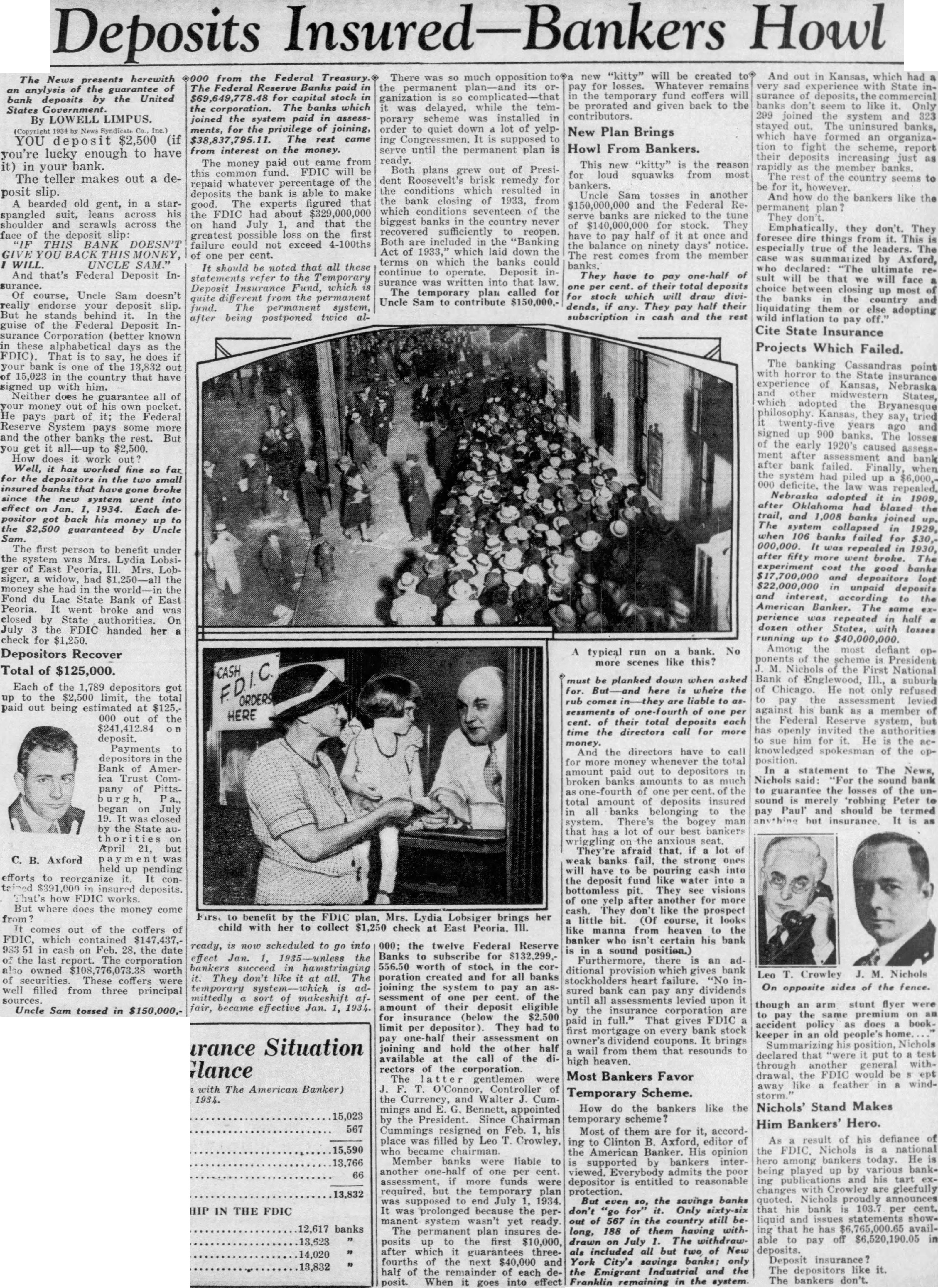
Deposits Insured-Bankers Howl The News presents herewith an anylysis of the guarantee of bank deposits by the United States Government. By LOWELL LIMPUS. (Copyright 1934 by News Syndicate Co., Inc.) YOU deposit $2,500 (if you're lucky enough to have it) in your bank. The teller makes out a deposit slip. A bearded old gent, in a starspangled suit, leans across his shoulder and scrawls across the face of the deposit slip: "IF THIS BANK DOESN'T GIVE YOU BACK THIS MONEY, I WILL. UNCLE SAM." And that's Federal Deposit Insurance. Of course, Uncle Sam doesn't really endorse your deposit slip. But he stands behind it. In the guise of the Federal Deposit Insurance Corporation (better known in these alphabetical days as the FDIC). That is to say, he does if your bank is one of the 13,832 out of 15,023 in the country that have signed up with him. Neither does he guarantee all of your money out of his own pocket. He pays part of it; the Federal Reserve System pays some more and the other banks the rest. But you get it all-up to $2,500. How does it work out? Well, it has worked fine so far for the depositors in the two small insured banks that have gone broke since the new system went into effect on Jan. 1, 1934. Each depositor got back his money up to the $2,500 guaranteed by Uncle Sam. The first person to benefit under the system was Mrs. Lydia Lobsiger of East Peoria, III. Mrs. Lobsiger, a widow, had $1,250-all the money she had in the world-in the Fond du Lac State Bank of East Peoria. It went broke and was closed by State authorities. On July 3 the FDIC handed her a check for $1,250. Depositors Recover Total of $125,000. Each of the 1,789 depositors got up to the $2,500 limit, the total paid out being estimated at $125,000 out of the $241,412.84 on deposit. Payments to depositors in the Bank of America Trust Company of Pittsburgh, P a., began on July 19. It was closed by the State authorities on April 21, but C. B. Axford m was held up pending efforts to reorganize it. It contained $391,000 in insured deposits. That's how FDIC works. But where does the money come from? It comes out of the coffers of FDIC, which contained $147,437,983.51 in cash on Feb. 28, the date of the last report. The corporation also owned $108,776,073.38 worth of securities. These coffers were well filled from three principal sources. Uncle Sam tossed in $150,000,- $000 from the Federal Treasury. The Federal Reserve Banks paid in $69,649,778.48 for capital stock in the corporation. The banks which joined the system paid in assessments, for the privilege of joining, $38,837,795.11. The rest came from interest on the money. The money paid out came from this common fund. FDIC will be repaid whatever percentage of the deposits the bank is able to make good. The experts figured that the FDIC had about $329,000,000 on hand July 1, and that the greatest possible loss on the first failure could not exceed 4-100ths of one per cent. It should be noted that all these statements refer to the Temporary Deposit Insurance Fund, which is quite different from the permanent fund. The permanent system, after being postponed twice al- There was SO much opposition to a the permanent plan-and its organization is so complicated-that it was delayed, while the temporary scheme was installed in order to quiet down a lot of yelping Congressmen. It is supposed to serve until the permanent plan is ready. Both plans grew out of President Roosevelt's brisk remedy for the conditions which resulted in the bank closing of 1933, from which conditions seventeen of the biggest banks in the country never recovered sufficiently to reopen. Both are included in the "Banking Act of 1933," which laid down the terms on which the banks could continue to operate. Deposit insurance was written into that law. The temporary plan called for Uncle Sam to contribute $150,000,- new "kitty" will be created to? pay for losses. Whatever remains in the temporary fund coffers will be prorated and given back to the contributors. New Plan Brings Howl From Bankers. This new "kitty" is the reason for loud squawks from most bankers. Uncle Sam tosses in another $150,000,000 and the Federal Reserve banks are nicked to the tune of $140,000,000 for stock. They have to pay half of it at once and the balance on ninety days' notice. The rest comes from the member banks. They have to pay one-half of 1 per cent. of their total deposits for stock which will draw dividends, if any. They pay half their subscription in cash and the rest must ready, is now scheduled to go into effect Jan. 1, 1935-unless the bankers succeed in hamstringing it. They don't like it at all. The temporary system-which is admittedly a sort of makeshift affair, became effective Jan. 1, 1934. 000; the twelve Federal Reserve Banks to subscribe for $132,299,556.50 worth of stock in the corporation created and for all banks joining the system to pay an assessment of one per cent. of the amount of their deposit eligible for insurance (below the $2,500 limit per depositor). They had to pay one half their assessment on joining and hold the other half available at the call of the directors of the corporation. The latter gentlemen were J. F. T. O'Connor, Controller of the Currency, and Walter J. Cummings and E. G. Bennett, appointed by the President. Since Chairman Cummings resigned on Feb. 1, his place was filled by Leo T. Crowley, who became chairman. Member banks were liable to another one half of one per cent. assessment, if more funds were required, but the temporary plan was supposed to end July 1, 1934. It was prolonged-because the permanent system wasn't yet ready. The permanent plan insures deposits up to the first $10,000, after which it guarantees threefourths of the next $40,000 and half of the remainder of each deposit. When it goes into effect A typical run on a bank. No more scenes like this? be planked down when asked for. But-and here is where the rub comes in-they are liable to assessments of one-fourth of 1 per cent. of their total deposits each time the directors call for more money. And the directors have to call for more money whenever the total amount paid out to depositors in broken banks amounts to as much as one-fourth of 1 per cent. of the total amount of deposits insured in all banks belonging to the system. There's the bogey man that has a lot of our best bankers wriggling on the anxious seat. They're afraid that, if a lot of weak banks fail, the strong ones will have to be pouring cash into the deposit fund like water into a bottomless pit. They see visions of one yelp after another for more cash. They don't like the prospect a little bit. (Of course, it looks like manna from heaven to the banker who isn't certain his bank is in a sound position.) Furthermore, there is an additional provision which gives bank stockholders heart failure. "No insured bank can pay any dividends until all assessments levied upon it by the insurance corporation are paid in full." That gives FDIC a first mortgage on every bank stock owner's dividend coupons. It brings a wail from them that resounds to high heaven. Most Bankers Favor Temporary Scheme. How do the bankers like the temporary scheme? Most of them are for it, according to Clinton B. Axford, editor of the American Banker. His opinion is supported by bankers interviewed. Everybody admits the poor depositor is entitled to reasonable protection. But even so, the savings banks don't "go for" it. Only sixty-six out of 567 in the country still belong, 188 of them having withdrawn on July 1. The withdrawals included all but two of New York City's savings banks; only the Emigrant Industrial and the Franklin remaining in the system. And out in Kansas, which had a very sad experience with State insurance of deposits, the commercial banks don't seem to like it. Only 299 joined the system and 323 stayed out. The uninsured banks, which have formed an organization to fight the scheme, report their deposits increasing just as rapidly as the member banks. The rest of the country seems to be for it, however. And how do the bankers like the permanent plan? They don't. Emphatically, they don't. They foresee dire things from it. This is especially true of the leaders. The case was summarized by Axford, who declared: "The ultimate result will be that ,we will face a choice between closing up most of the banks in the country and liquidating them or else adopting wild inflation to pay off." Cite State Insurance Projects Which Failed. The banking Cassandras point with horror to the State insurance experience of Kansas, Nebraska and other midwestern States, which adopted the Bryanesque philosophy. Kansas, they say, tried it twenty-five years ago and signed up 900 banks. The losses of the early 1920's caused assessment after assessment and bank after bank failed. Finally, when the system had piled up a $6,000,000 deficit, the law yas repealed. Nebraska adopted it in 1909, after Oklahoma had blazed the trail, and 1,008 banks joined up. The system collapsed in 1929, when 106 banks failed for $30,000,000. It was repealed in 1930, after fifty more went broke. The experiment cost the good banks $17,700,000 and depositors lost $22,000,000 in unpaid deposits and interest, according to the American Banker. The same experience was repeated in half a dozen other States, with losses running up to $40,000,000. Among the most defiant opponents of the scheme is President J. M. Nichols of the First National Bank of Englewood, Ill., a suburb of Chicago. He not only refused to pay the assessment levied against his bank as a member of the Federal Reserve system, but has openly invited the authorities to sue him for it. He is the acknowledged spokesman of the opposition. In a statement to The News, Nichols said: "For the sound bank to guarantee the losses of the unsound is merely 'robbing Peter to pay Paul' and should be termed anything but insurance. It is as though an arm: stunt flyer were to pay the same premium on an accident policy as does a bookkeeper in an old people's home. Summarizing his position, Nichols declared that "were it put to a test through another general withdrawal, the FDIC would be S ept away like a feather in a windstorm." Nichols' Stand Makes Him Bankers' Hero. As a result of his defiance of the FDIC, Nichols is a national hero among bankers today. He is being played up by various banking publications and his tart exchanges with Crowley are gleefully quoted. Nichols proúdly announces that his bank is 103.7 per cent. liquid and issues statements showing that he has $6,765,000.65 available to pay off $6,520,190.05 in deposits. Deposit insurance? The depositors like it. The bankers don't.

Article from Daily News, August 7, 1934

Click image to open full size in new tab

Article Text

Deposits Insured-Bankers Howl The News presents herewith an anylysis of the guarantee of bank deposits by the United States Government. By LOWELL LIMPUS. (Copyright 1934 by News Syndicate Co., Inc.) YOU deposit $2,500 (if you're lucky enough to have it) in your bank. The teller makes out a deposit slip. A bearded old gent, in a starspangled suit, leans across his shoulder and scrawls across the face of the deposit slip: "IF THIS BANK DOESN'T GIVE YOU BACK THIS MONEY, I WILL. UNCLE SAM." And that's Federal Deposit Insurance. Of course, Uncle Sam doesn't really endorse your deposit slip. But he stands behind it. In the guise of the Federal Deposit Insurance Corporation (better known in these alphabetical days as the FDIC). That is to say, he does if your bank is one of the 13,832 out of 15,023 in the country that have signed up with him. Neither does he guarantee all of your money out of his own pocket. He pays part of it; the Federal Reserve System pays some more and the other banks the rest. But you get it all-up to $2,500. How does it work out? Well, it has worked fine so far for the depositors in the two small insured banks that have gone broke since the new system went into effect on Jan. 1, 1934. Each depositor got back his money up to the $2,500 guaranteed by Uncle Sam. The first person to benefit under the system was Mrs. Lydia Lobsiger of East Peoria, Ill. Mrs. Lobsiger, a widow, had $1,250-all the money she had in the world-in the Fond du Lac State Bank of East Peoria. It went broke and was closed by State authorities. On July 3 the FDIC handed her a check for $1,250. Depositors Recover Total of $125,000. Each of the 1,789 depositors got up to the $2,500 limit, the total paid out being estimated at $125,000 out of the $241,412.84 on deposit. Payments to depositors in the Bank of America Trust Company of Pittsburgh, Pa., began on July 19. It was closed by the State authorities on April 21, but was held up pending efforts to reorganize it. It contained $391,000 in insured deposits. That's how FDIC works. But where does the money come from? It comes out of the coffers of FDIC, which contained $147,437,983.51 in cash on Feb. 28, the date of the last report. The corporation also owned $108,776,073.38 worth of securities. These coffers were well filled from three principal sources. Uncle Sam tossed in $150,000,- 0000 from the Federal Treasury. The Federal Reserve Banks paid in $69,649,778.48 for capital stock in the corporation. The banks which joined the system paid in assessments, for the privilege of joining, $38,837,795.11. The rest came from interest on the money. The money paid out came from this common fund. FDIC will be repaid whatever percentage of the deposits the bank is able to make good. The experts figured that the FDIC had about $329,000,000 on hand July 1, and that the greatest possible loss on the first failure could not exceed 4-100ths of one per cent. It should be noted that all these statements refer to the Temporary Deposit Insurance Fund, which is quite different from the permanent fund. The permanent system, after being postponed twice al- There was so much opposition to a the permanent plan-and its organization is SO complicated-that it was delayed, while the temporary scheme was installed in order to quiet down a lot of yelping Congressmen. It is supposed to serve until the permanent plan is ready. Both plans grew out of President Roosevelt's brisk remedy for the conditions which resulted in the bank closing of 1933, from which conditions seventeen of the biggest banks in the country never recovered sufficiently to reopen. Both are included in the "Banking Act of 1933," which laid down the terms on which the banks could continue to operate. Deposit insurance was written into that law. The temporary plan called for Uncle Sam to contribute $150,000,- new "kitty" will be created to pay for losses. Whatever remains in the temporary coffers will be prorated and given back to the contributors. New Plan Brings Howl From Bankers. This new "kitty" is the reason for loud squawks from most bankers. Uncle Sam tosses in another $150,000,000 and the Federal Reserve banks are nicked to the tune of $140,000,000 for stock. They have to pay half of it at once and the balance on ninety days' notice. The rest comes from the member banks. They have to pay one-half of one per cent. of their total deposits for stock which will draw dividends, if any. They pay half their subscription in cash and the rest ready, is now scheduled to go into effect Jan. 1, 1935-unless the bankers succeed in hamstringing it. They don't like it at all. The temporary system-which is admittedly a sort of makeshift affair, became effective Jan. 1, 1934. 000; the twelve Federal Reserve Banks to subscribe for $132,299,556.50 worth of stock in the corporation created and for all banks joining the system to pay an assessment of one per cent. of the amount of their deposit eligible for insurance (below the $2,500 limit per depositor). They had to pay one-half their assessment on joining and hold the other half available at the call of the directors of the corporation. The latter gentlemen were J. F. T. O'Connor, Controller of the Currency, and Walter J. Cummings and E. G. Bennett, appointed by the President. Since Chairman Cummings resigned on Feb. 1, his place was filled by Leo T. Crowley, who became chairman. Member banks were liable to another one-half of one per cent. assessment, if more funds were required, but the temporary plan was supposed to end July 1, 1934. It was prolonged because the permanent system wasn't yet ready. The permanent plan insures deposits up to the first $10,000, after which it guarantees threefourths of the next $40,000 and half of the remainder of each deposit. When it goes into effect must be planked down when asked for. But-and here is where the rub comes in-they are liable to assessments of one-fourth of one per cent. of their total deposits each time the directors call for more money. And the directors have to call for more money whenever the total amount paid out to depositors in broken banks amounts to as much as one-fourth of one per cent. of the total amount of deposits insured in all banks belonging to the system. There's the bogey man that has a lot of our best bankers wriggling on the anxious seat. They're afraid that, if a lot of weak banks fail, the strong ones will have to be pouring cash into the deposit fund like water into a bottomless pit. They see visions of one yelp after another for more cash. They don't like the prospect a little bit. (Of course, it looks like manna from heaven to the banker who isn't certain his bank is in a sound position.) Furthermore, there is an additional provision which gives bank stockholders heart failure. "No insured bank can pay any dividends until all assessments levied upon it by the insurance corporation are paid in full." That gives FDIC a first mortgage on every bank stock owner's dividend coupons. It brings a wail from them that resounds to high heaven. Most Bankers Favor Temporary Scheme. How do the bankers like the temporary scheme? Most of them are for it, according to Clinton B. Axford, editor of the American Banker. His opinion is supported by bankers interviewed. Everybody admits the poor depositor is entitled to reasonable protection. But even so, the savings banks don't "go for" it. Only sixty-six out of 567 in the country still belong, 188 of them having withdrawn on July 1. The withdrawals included all but two of New York City's savings banks; only the Emigrant Industrial and the Franklin remaining in the system. And out in Kansas, which had a very sad experience with State insurance of deposits, the commercial banks don't seem to like it. Only 299 joined the system and 323 stayed out. The uninsured banks, which have formed an organization to fight the scheme, report their deposits increasing just as rapidly as the member banks. The rest of the country seems to be for it, however. And how do the bankers like the permanent plan? They don't. Emphatically, they don't. They foresee dire things from it. This is especially true of the leaders. The case was summarized by Axford, who declared: "The ultimate result will be that we will face a choice between closing up most of the banks in the country and liquidating them or else adopting wild inflation to pay off." Cite State Insurance Projects Which Failed. The banking Cassandras point with horror to the State insurance experience of Kansas, Nebraska and other midwestern States, which adopted the Bryanesque philosophy. Kansas, they say, tried it twenty-five years ago and signed up 900 banks. The losses of the early 1920's caused assessment after assessment and bank after bank failed. Finally, when the system had piled up a $6,000,000 deficite, the law was repéaled. Nebraska adopted it in 1909, after Oklahoma had blazed the trail, and 1,008 banks joined up, The system collapsed in 1929, when 106 banks failed for $30,000,000. It was repealed in 1930, after fifty more went broke. The experiment cost the good banks $17,700,000 and depositors lost $22,000,000 in unpaid deposits and interest, according to the American Banker. The same experience was repeated in half a dozen other States, with losses running up to $40,000,000. Among the most defiant opponents of the scheme is President J. M. Nichols of the First National Bank of Englewood, Ill., a suburb of Chicago. He not only refused to pay the assessment levied against his bank as a member of the Federal Reserve system, but has openly invited the authorities to sue him for it. He is the acknowledged spokesman of the opposition. In a statement to The News, Nichols said: "For the sound bank to guarantee the losses of the unsound is merely 'robbing Peter to pay Paul' and should be termed anything but insurance. It is as though an arm: stunt flyer were to pay the same premium on an accident policy as does a bookkeeper in an old people's home Summarizing his position, Nichols declared that "were it put to a test through another general withdrawal, the FDIC would be S ept away like a feather in a windstorm." Nichols' Stand Makes Him Bankers' Hero. As a result of his defiance of the FDIC, Nichols is a national hero among bankers today. He is being played up by various banking publications and his tart exchanges with Crowley are gleefully quoted. Nichols proudly announces that his bank is 103.7 per cent. liquid and issues statements show* ing that he has $6,765,000.65 available to pay off $6,520,190.05 in deposits. Deposit insurance? The depositors like it. The bankers don't.
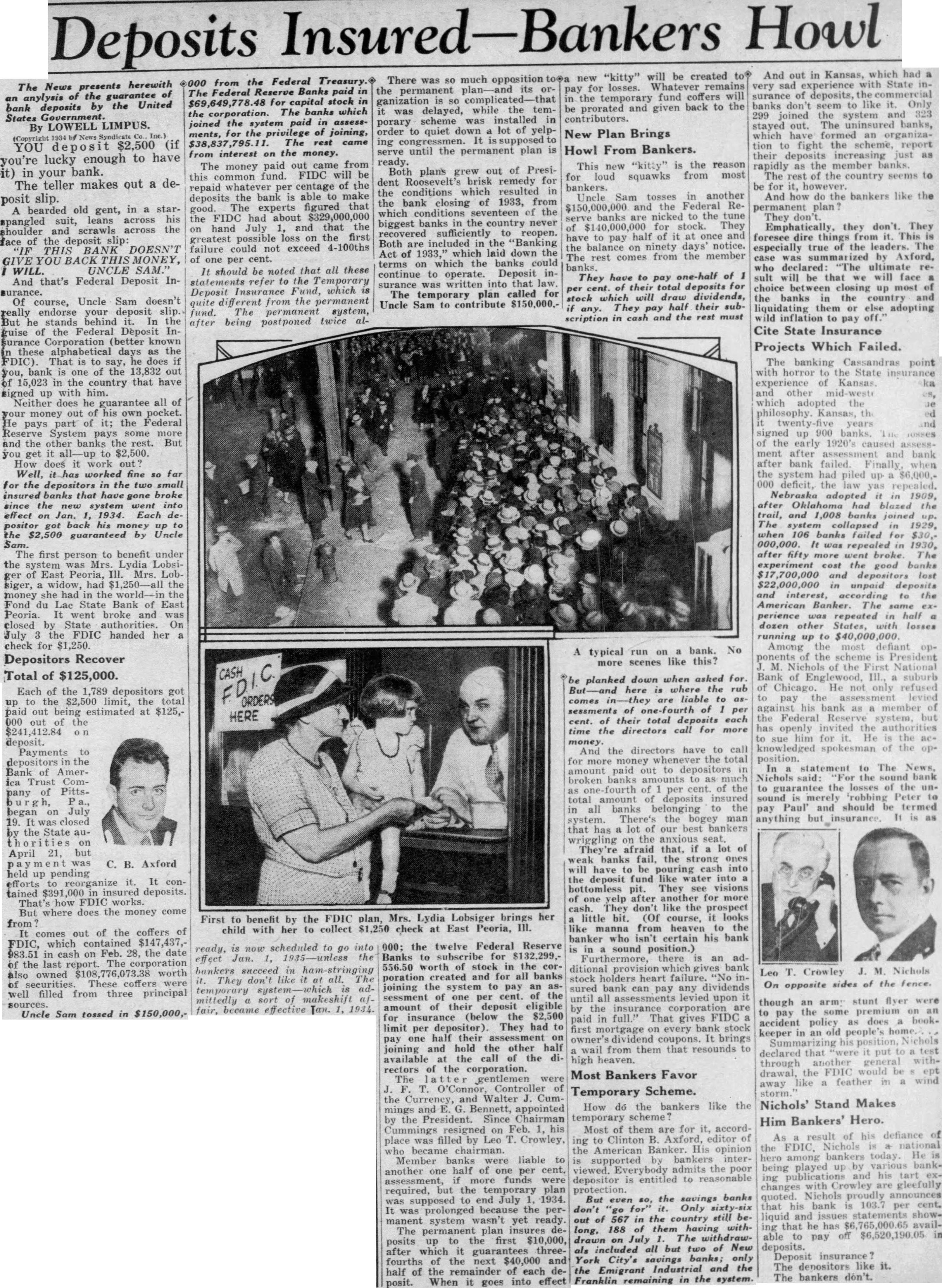

Article from Daily News, August 7, 1934

Click image to open full size in new tab

Article Text

The News presents herewith an anylysis of the guarantee of bank deposits by the United States Government. By LOWELL LIMPUS. (Copyright 1934 by News Syndicate Co., Inc.) YOU deposit $2,500 (if you're lucky enough to have it) in your bank. The teller makes out a deposit slip. A bearded old gent, in a starspangled suit, leans across his shoulder and scrawls across the face of the deposit slip: "IF THIS BANK DOESN'T GIVE YOU BACK THIS MONEY, I WILL. UNCLE SAM." And that's Federal Deposit Insurance. Of course, Uncle Sam doesn't really endorse your deposit slip. But he stands behind it. In the guise of the Federal Deposit Insurance Corporation (better known in these alphabetical days as the FDIC). That is to say, he does if your bank is one of the 13,832 out of 15,023 in the country that have signed up with him. Neither does he guarantee all of your money out of his own pocket. He pays part of it; the Federal Reserve System pays some more and the other banks the rest. But you get it all-up to $2,500. How does it work out? Well, it has worked fine so far for the depositors in the two small insured banks that have gone broke since the new system went into effect on Jan. 1, 1934. Each depositor got back his money up to the $2,500 guaranteed by Uncle Sam. The first person to benefit under the system was Mrs. Lydia Lobsiger of East Peoria, Ill. Mrs. Lobsiger, a widow, had $1,250-all the money she had in the world-in the Fond du Lac State Bank of East Peoria. It went broke and was closed by State authorities. On July 3 the FDIC handed her a check for $1,250. Depositors Recover Total of $125,000. Each of the 1,789 depositors got up to the $2,500 limit, the total paid out being estimated at $125,000 out of the $241,412.84 on deposit. Payments to depositors in the Bank of America Trust Company of Pittsburgh, P a., began on July 19. It was closed by the State authorities on April 21, but C. B. Axford pay m was held up pending efforts to reorganize it. It contained $391,000 in insured deposits. That's how FDIC works. But where does the money come from? It comes out of the coffers of FDIC, which contained $147,437,983.51 in cash on Feb. 28, the date of the last report. The corporation also owned $108,776,073.38 worth of securities. These coffers were well filled from three principal sources. Uncle Sam tossed in $150,000,- 4000 from the Federal Treasury. The Federal Reserve Banks paid in $69,649,778.48 for capital stock in the corporation. The banks which joined the system paid in assessments, for the privilege of joining, $38,837,795.11. The rest came from interest on the money. The money paid out came from this common fund. FDIC will be repaid whatever percentage of the deposits the bank is able to make good. The experts figured that the FDIC had about $329,000,000 on hand July 1, and that the greatest possible loss on the first failure could not exceed 4-100ths of one per cent. It should be noted that all these statements refer to the Temporary Deposit Insurance Fund, which is quite different from the permanent fund. The permanent system, after being postponed twice al- There was so much opposition to a the permanent plan-and its organization is so complicated-that it was delayed, while the temporary scheme was installed in order to quiet down a lot of yelping Congressmen. It is supposed to serve until the permanent plan is ready. Both plans grew out of President Roosevelt's brisk remedy for the conditions which resulted in the bank closing of 1933, from which conditions seventeen of the biggest banks in the country never recovered sufficiently to reopen. Both are included in the "Banking Act of 1933," which laid down the terms on which the banks could continue to operate. Deposit insurance was written into that law. The temporary plan called for Uncle Sam to contribute $150,000,- new "kitty" will be created pay for losses. Whatever remains in the temporary fund coffers will be prorated and given back to the contributors. New Plan Brings Howl From Bankers. This new "kitty" is the reason for loud squawks from most bankers. Uncle Sam tosses in another $150,000,000 and the Federal Reserve banks are nicked to the tune of $140,000,000 for stock. They have to pay half of it at once and the balance on ninety days' notice. The rest comes from the member banks. They have to pay one-half of one per cent. of their total deposits for stock which will draw dividends, if any. They pay half their subscription in cash and the rest ready, is now scheduled to go into effect Jan. 1, 1935-unless the bankers succeed in hamstringing it. They don't like it at all. The temporary system-which is admittedly a sort of makeshift affair, became effective Jan. 1, 1934. 000; the twelve Federal Reserve Banks to subscribe for $132,299,556.50 worth of stock in the corporation created and for all banks joining the system to pay an assessment of one per cent. of the amount of their deposit eligible for insurance (below the $2,500 limit per depositor). They had to pay one-half their assessment on joining and hold the other half available at the call of the directors of the corporation. The latter gentlemen were J. F. T. O'Connor, Controller of the Currency, and Walter J. Cummings and E. G. Bennett, appointed by the President. Since Chairman Cummings resigned on Feb. 1, his place was filled by Leo T. Crowley, who became chairman. Member banks were liable to another one-half of one per cent. assessment, if more funds were required, but the temporary plan was supposed to end July 1, 1934. It was prolonged because the permanent system wasn't yet ready. The permanent plan insures deposits up to the first $10,000, after which it guarantees threefourths of the next $40,000 and half of the remainder of each deposit. When it goes into effect must be planked down when asked for. But-and here is where the rub comes in-they are liable to assessments of one-fourth of one per cent. of their total deposits each time the directors call for more money. And the directors have to call for more money whenever the total amount paid out to depositors in broken banks amounts to as much as one-fourth of one per cent. of the total amount of deposits insured in all banks belonging to the system. There's the bogey man that has a lot of our best bankers wriggling on the anxious seat. They're afraid that, if a lot of weak banks fail, the strong ones will have to be pouring cash into the deposit fund like water into a bottomless pit. They see visions of one yelp after another for more cash. They don't like the prospect a little bit. (Of course, it looks like manna from heaven. to the banker who isn't certain his bank is in a sound position.) Furthermore, there is an additional provision which gives bank stockholders heart failure. "No insured bank can pay any dividends until all assessments levied upon it by the insurance corporation are paid in full." That gives FDIC a first mortgage on every bank stock owner's dividend coupons. It brings a wail from them that resounds to high heaven. Most Bankers Favor Temporary Scheme. How do the bankers like the temporary scheme? Most of them are for it, according to Clinton B. Axford, editor of the American Banker. His opinion is supported by bankers interviewed. Everybody admits the poor depositor is entitled to reasonable protection. But even so, the savings banks don't "go for" it. Only sixty-six out of 567 in the country still belong, 188 of them having withdrawn on July 1. The withdrawals included all but two of New York City's savings banks; only the Emigrant Industrial and the Franklin remaining in the system. And out in Kansas, which had a very sad experience with State insurance of deposits, the commercial banks don't seem to like it. Only 299 joined the system and 323 stayed out. The uninsured banks, which have formed an organization to fight the scheme, report their deposits increasing just as rapidly as the member banks, The rest of the country seems to be for it, however. And how do the bankers like the permanent plan? They don't. Emphatically, they don't. They foresee dire things from it. This is especially true of the leaders. The case was summarized by Axford, who declared: "The ultimate result will be that we will face a choice between closing up most of the banks in the country and liquidating them or else adopting wild inflation to pay off." Cite State Insurance Projects Which Failed. The banking Cassandras point with horror to the State insurance experience of Kansas, Nebraska and other midwestern States, which adopted the Bryanesque philosophy. Kansas, they say, tried it twenty-five years ago and signed up 900 banks. The losses of the early 1920's caused assessment after assessment and bank after bank failed. Finally, when the system had piled up a $6,000,000 deficite, the law was repealed. Nebraska adopted it in 1909, after Oklahoma had blazed the trail, and 1,008 banks joined up. The system collapsed in 1929, when 106 banks failed for $30,000,000. It was repealed in 1930, after fifty more went broke. The experiment cost the good banks $17,700,000 and depositors lost $22,000,000 in unpaid deposits and interest, according to the American Banker. The same experience was repeated in half a dozen other States, with losses running up to $40,000,000. Among the most defiant opponents of the scheme is President J. M. Nichols of the First National Bank of Englewood, Ill., a suburb of Chicago. He not only refused to pay the assessment levied against his bank as a member of the Federal Reserve system, but has openly invited the authorities to sue him for it. He is the acknowledged spokesman of the opposition. In a statement to The News, Nichols said: "For the sound bank to guarantee the losses of the unsound is merely 'robbing Peter to pay Paul' and should be termed anything but insurance. It is as though an arm: stunt flyer were to pay the same premium on an accident policy as does a bookkeeper in an old people's home. Summarizing his position, Nichols declared that "were it put to a test through another general withdrawal, the FDIC would be S ept away like a feather in a windstorm." Nichols' Stand Makes Him Bankers' Hero. As a result of his defiance of the FDIC. Nichols is a national hero among bankers today. He is being played up by various banking publications and his tart exchanges with Crowley are gleefully quoted. Nichols proudly announces that his bank is 103.7 per cent. liquid and issues statements showing that he has $6,765,000.65 available to pay off $6,520,190.05 in deposits. Deposit insurance? The depositors like it. The bankers don't.
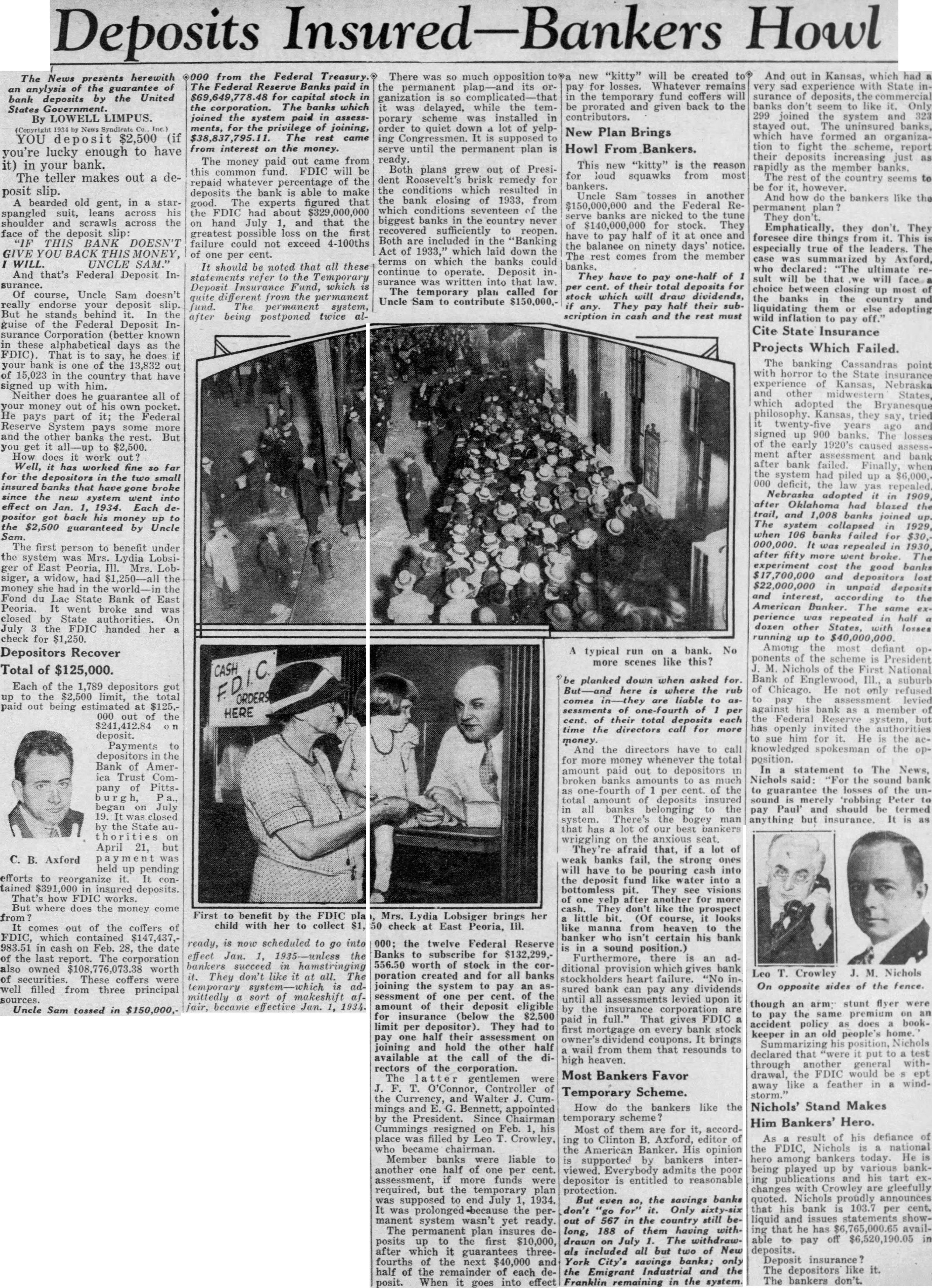

Article from Daily News, August 7, 1934

Click image to open full size in new tab

Article Text

Deposits Insured-Bankers Howl The News presents herewith an anylysis of the guarantee of bank deposits by the United States Government. By LOWELL LIMPUS. (Copyright 1934 by News Syndicate Co., Inc.) YOU deposit $2,500 (if you're lucky enough to have it) in your bank. The teller makes out a deposit slip. A bearded old gent, in a starspangled suit, leans across his shoulder and scrawls across the face of the deposit slip: "IF THIS BANK DOESN'T GIVE YOU BACK THIS MONEY, I WILL. UNCLE SAM." And that's Federal Deposit Insurance. Of course, Uncle Sam doesn't really endorse your deposit slip. But he stands behind it. In the guise of the Federal Deposit Insurance Corporation (better known in these alphabetical days as the FDIC). That is to say, he does if your bank is one of the 13,832 out of 15,023 in the country that have signed up with him. Neither does he guarantee all of your money out of his own pocket. He pays part of it; the Federal Reserve System pays some more and the other banks the rest. But you get it all-up to $2,500. How does it work out? Well, it has worked fine so far for the depositors in the two small insured banks that have gone broke since the new system went into effect on Jan. 1, 1934. Each depositor got back his money up to the $2,500 guaranteed by Uncle Sam. The first person to benefit under the system was Mrs. Lydia Lobsiger of East Peoria, Ill. Mrs. Lobsiger, a widow, had $1,250-all the money she had in the world-in the Fond du Lac State Bank of East Peoria. It went broke and was closed by State authorities. On July 3 the FDIC handed her a check for $1,250. Depositors Recover Total of $125,000. Each of the 1,789 depositors got up to the $2,500 limit, the total paid out being estimated at $125,000 out of the $241,412.84 on deposit. Payments to depositors in the Bank of America Trust Company of Pittsbegan on July 19. It was closed by the State authorities on April 21, but C. B. Axford payment was held up pending efforts to reorganize it. It contained $391,000 in insured deposits. That's how FDIC works. But where does the money come from? It comes out of the coffers of FDIC, which contained $147,437,983.51 in cash on Feb. 28, the date of the last report. The corporation also owned $108,776,073.38 worth of securities. These coffers were well filled from three principal sources. Uncle Sam tossed in $150,000,- $000 from the Federal Treasury. The Federal Reserve Banks paid in $69,649,778.48 for capital stock in the corporation. The banks which joined the system paid in assessments, for the privilege of joining, $38,837,795.11. The rest came from interest on the money. The money paid out came from this common fund. FDIC will be repaid whatever percentage of the deposits the bank is able to make good. The experts figured that the FDIC had about $329,000,000 on hand July 1, and that the greatest possible loss on the first failure could not exceed 4-100ths of one per cent. It should be noted that all these statements refer to the Temporary Deposit Insurance Fund, which is quite different from the permanent fund. The permanent system, after being postponed twice al- There was so much opposition to a the permanent plan-and its organization is SO complicated-that it was delayed, while the temporary scheme was installed in order to quiet down a lot of yelping Congressmen. It is supposed to serve until the permanent plan is ready. Both plans grew out of President Roosevelt's brisk remedy for the conditions which resulted in the bank closing of 1933, from which conditions seventeen of the biggest banks in the country never recovered sufficiently to reopen. Both are included in the "Banking Act of 1933," which laid down the terms on which the banks could continue to operate. Deposit insurance was written into that law. The temporary plan called for Uncle Sam to contribute $150,000,- new "kitty" will be created pay for losses. Whatever remains in the temporary fund coffers will be prorated and given back to the contributors. New Plan Brings Howl From Bankers. This new "kitty" is the reason for loud squawks from most bankers. Uncle Sam tosses in another $150,000,000 and the Federal Reserve banks are nicked to the tune of $140,000,000 for stock. They have to pay half of it at once and the balance on ninety days' notice. The rest comes from the member banks. They have to pay one-half of one per cent. of their total deposits for stock which will draw dividends, if any. They pay half their subscription in cash and the rest ready, is now scheduled to go into effect Jan. 1, 1935-unless the bankers succeed in hamstringing it. They don't like it at all. The temporary system-which is admittedly a sort of makeshift affair, became effective Jan. 1, 1934. 000; the twelve Federal Reserve Banks to subscribe for $132,299,556.50 worth of stock in the corporation created and for all banks joining the system to pay an assessment of one per cent. of the amount of their deposit eligible for insurance (below the $2,500 limit per depositor). They had to pay one-half their assessment on joining and hold the other half available at the call of the directors of the corporation. The latter gentlemen were J. F. T. O'Connor, Controller of the Currency, and Walter J. Cummings and E. G. Bennett, appointed by the President. Since Chairman Cummings resigned on Feb. 1, his place was filled by Leo T. Crowley, who became chairman. Member banks were liable to another one-half of one per cent. assessment, if more funds were required, but the temporary plan was supposed to end July 1, 1934. It was prolonged because the permanent system wasn't yet ready. The permanent plan insures deposits up to the first $10,000, after which it guarantees threefourths of the next $40,000 and half of the remainder of each deposit. When it goes into effect A typical run on a bank. No more scenes like this? must be planked down when asked for. But-and here is where the rub comes in-they are liable to assessments of one-fourth of one per cent. of their total deposits each time the directors call for more money. And the directors have to call for more money whenever the total amount paid out to depositors in broken banks amounts to as much as one-fourth of one per cent. of the total amount of deposits insured in all banks belonging to the system. There's the bogey man that has a lot of our best bankers wriggling on the anxious seat. They're afraid that, if a lot of weak banks fail, the strong ones will have to be pouring cash into the deposit fund like water into a bottomless pit. They see visions of one yelp after another for more cash. They don't like the prospect a little bit. (Of course, it looks like manna from heaven to the banker who isn't certain his bank is in a sound position.) Furthermore, there is an additional provision which gives bank stockholders heart failure. "No insured bank can pay any dividends until all assessments levied upon it by the insurance corporation are paid in full." That gives FDIC a first mortgage on every bank stock owner's dividend coupons. It brings a wail from them that resounds to high heaven. Most Bankers Favor Temporary Scheme. How do the bankers like the temporary scheme? Most of them are for it, according to Clinton B. Axford, editor of the American Banker. His opinion is supported by bankers interviewed. Everybody admits the poor depositor is entitled to reasonable protection. But even so, the savings banks don't "go for" it. Only sixty-six out of 567 in the country still belong, 188 of them having withdrawn on July 1. The withdrawals included all but two of New York City's savings banks; only the Emigrant Industrial and the Franklin remaining in the system. And out in Kansas, which had a very sad experience with State insurance of deposits, the commercial banks don't seem to like it. Only 299 joined the system and 323 stayed out. The uninsured banks, which have formed an organization to fight the scheme, report their deposits increasing just as rapidly as the member banks. The rest of the country seems to be for it, however. And how do the bankers like the permanent plan? They don't. Emphatically, they don't. They foresee dire things from it. This is especially true of the leaders. The case was summarized by Axford, who declared: "The ultimate result will be that we will face a choice between closing up most of the banks in the country and liquidating them or else adopti wild inflation to pay off." Cite State Insurance Projects Which Failed. The banking Cassandras point with horror to the State insurance experience of Kansas, Nebraska and other midwestern States, which adopted the Bryanesque philosophy. Kansas, they say, tried it twenty-five years ago and signed up 900 banks. The losses of the early 1920's caused assessment after assessment and bank after bank failed. Finally, when the system had piled up a $6,000,000 deficite, the law was repealed. Nebraska adopted it in 1909, after Oklahoma had blazed the trail, and 1,008 banks joined up. The system collapsed in 1929, when 106 banks failed for $30,000,000. It was repealed in 1930, after fifty more went broke. The experiment cost the good banks $17,700,000 and depositors lost $22,000,000 in unpaid deposits and interest, according to the American Banker. The same experience was repeated in half a dozen other States, with losses running up to $40,000,000. Among the most defiant opponents of the scheme is President J. M. Nichols of the First National Bank of Englewood, Ill., a suburb of Chicago. He not only refused to pay the assessment levied against his bank as a member of the Federal Reserve system, but has openly invited the authorities to sue him for it. He is the acknowledged spokesman of the opposition. In a statement to The News, Nichols said: "For the sound bank to guarantee the losses of the unsound is merely 'robbing Peter to pay Paul' and should be termed anything but insurance. It is as though an army stunt flyer were to pay the same premium on an accident policy as does a bookkeeper in an old people's home. Summarizing his position, Nichols declared that "were it put to a test through another general withdrawal, the FDIC would be 8' ept away like a feather in a windNichols' Stand Makes Him Bankers' Hero. As a result of his defiance of the FDIC, Nichols is a national hero among bankers today. He is being played up by various banking publications and his tart exchanges with Crowley are gleefully quoted. Nichols proudly announces that his bank is 103.7 per cent. liquid and issues statements showing that he has $6,765,000.65 available to pay off $6,520,190.05 in deposits. Deposit insurance? The depositors like it. The bankers don't,