16446. Oriental (New York, NY)

Bank Information

Episode Type
Run → Suspension → Closure
Bank Type
state
Start Date
October 1, 1907*
Location
New York, New York (40.714, -74.006)

Metadata

Model
gpt-5-mini
Short Digest
7a068e5b

Response Measures

Full suspension

Other: Clearing House demanded retirement of certificates, precipitating run and temporary closing; bank paid depositors and redeemed certificates from own resources within about ten days.

Description

Articles describe the Oriental (New York) being compelled to close during the aftermath of the Panic of 1907 after the Clearing House demanded redemption of its clearing house certificates; this demand precipitated a run and the bank was forced to suspend/close. Depositors were paid within ten days and the bank proved solvent, but it was closed during the crisis. Exact day not given; event occurred during the 1907 panic.

Events (3)

1. October 1, 1907* Run
Cause
Local Banks
Cause Details
Clearing House committee publicly demanded retirement of Oriental's outstanding clearing house certificates, precipitating withdrawals and a run.
Measures
Within ten days of closing depositors were provided for and paid from the bank's own resources; clearing house loan certificates relied.
Newspaper Excerpt
the demand ... compelled the closing of its doors. ... the run, both over the country and through the exchanges which followed, compelled the closing of its doors.
Source
newspapers
2. October 1, 1907* Suspension
Cause
Local Banks
Cause Details
Clearing House call for redemption of certificates forced the bank to suspend (closing of doors) despite later showing of solvency.
Newspaper Excerpt
the demand, publicly announced, for the retirement of the outstanding clearing house certificates ... the run ... compelled the closing of its doors.
Source
newspapers
3. * Other
Newspaper Excerpt
At the time of its suspension the Oriental had collateral up with the clearing house for the value of its capitalization and ... was paying 12 per cent dividends.
Source
newspapers

Newspaper Articles (3)

Article from Daily Kennebec Journal, June 8, 1912

Click image to open full size in new tab

Article Text

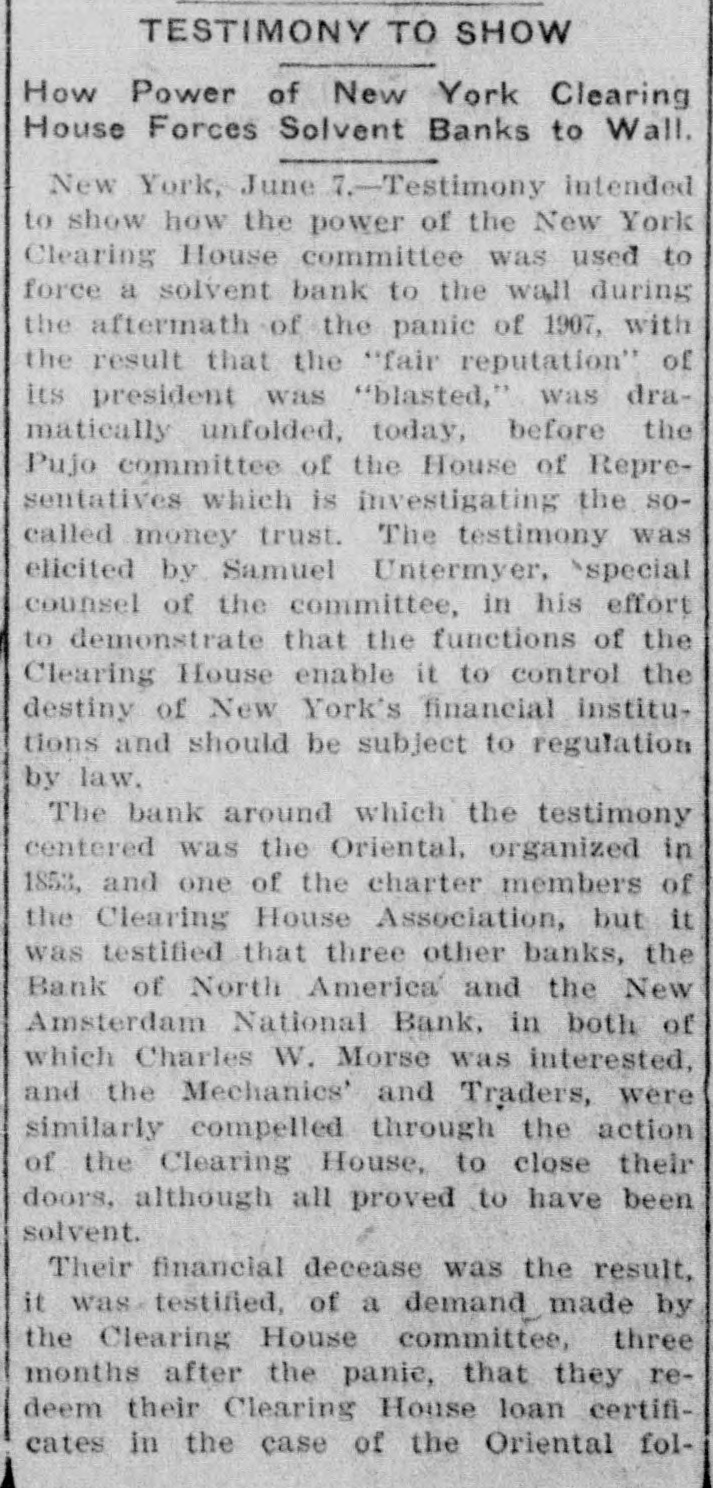
TESTIMONY TO SHOW How Power of New York Clearing House Forces Solvent Banks to Wall. New York, June 7.-Testimony intended to show how the power of the New York Clearing House committee was used to force a solvent bank to the wall during the aftermath of the panic of 1907, with the result that the "fair reputation" of its president was "blasted," was dramatically unfolded, today, before the Pujo committee of the House of Representatives which is investigating the socalled money trust. The testimony was elicited by Samuel Untermyer, `special counsel of the committee, in his effort to demonstrate that the functions of the Clearing House enable it to control the destiny of New York's financial institutions and should be subject to regulation by law. The bank around which the testimony centered was the Oriental, organized in 1853, and one of the charter members of the Clearing House Association, but it was testified that three other banks, the Bank of North America and the New Amsterdam National Bank, in both of which Charles W. Morse was interested, and the Mechanics' and Traders, were similarly compelled through the action of the Clearing House, to close their doors, although all proved to have been solvent. Their financial decease was the result, it was testified, of a demand made by the Clearing House committee, three months after the panie, that they redeem their Clearing House loan certificates in the case of the Oriental fol-

Article from The Sentinel=record, June 8, 1912

Click image to open full size in new tab

Article Text

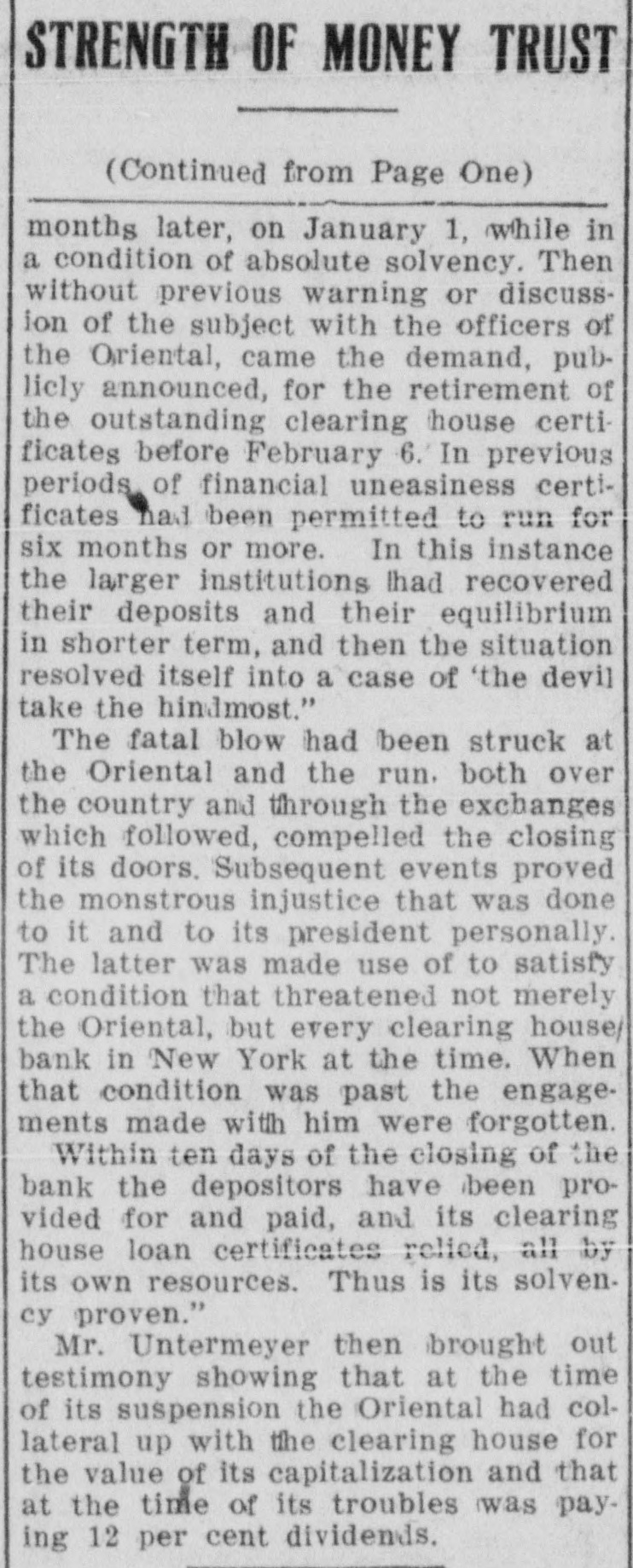
STRENGTH OF MONEY TRUST (Continued from Page One) months later, on January 1, while in a condition of absolute solvency. Then without previous warning or discussion of the subject with the officers of the Oriental, came the demand, publicly announced, for the retirement of the outstanding clearing house certificates before February 6. In previous periods of financial uneasiness certificates had been permitted to run for six months or more. In this instance the larger institutions lhad recovered their deposits and their equilibrium in shorter term, and then the situation resolved itself into a case of 'the devil take the hindmost." The fatal blow had been struck at the Oriental and the run. both over the country and through the exchanges which followed, compelled the closing of its doors. Subsequent events proved the monstrous injustice that was done to it and to its president personally. The latter was made use of to satisfy a condition that threatened not merely the Oriental, but every clearing house/ bank in New York at the time. When that condition was past the engagements made with him were forgotten. Within ten days of the closing of the bank the depositors have been provided for and paid, and its clearing house loan certificates relied, all by its own resources. Thus is its solvency proven." Mr. Untermeyer then brought out testimony showing that at the time of its suspension the Oriental had collateral up with the clearing house for the value of its capitalization and that at the time of its troubles was paying 12 per cent dividends.


Article from Omaha Daily Bee, June 12, 1912

Click image to open full size in new tab

Article Text

PUJO OBJECTS TO VANDERLIP NOTE Chairman of Money Trust Committee Scores Banker for His Criticism of Inquiry. DOES NOT STATE THE FACTS Refuses to Testify and Accuses Committee of Limiting Evidence. FAILURE OF ORIENTAL BANK Chairman Hepburn of Clearing House Asked About it. PROMISED TO SUPPORT IT Kelley Made President on His Pledge and Certificates Were Called in-Bank Forced to Suspend During Absence. NEW YORK, June 11.-With the resumption today of the so-called money trust investigation by the Pujo committee of the house of representatives, Chairman Pujo made public a letter he had written to Frank A. Vanderlip, chairman of the New York clearing house committee. The letter was an answer to one from Mr. Vanderlip in which Mr. Vanderlip charged that "thus far the disposition of the committee as reflected In the attitude of its counsel, has been not so much to ascertain the actual facts as to limit the evidence so as to support, if possible, a pre-conceived assumption." "It is manifect," says Mr. Pujo, "that you have not read the official notes of the testimony of Mr. Sherer, the manager of the New York clearing house assoclation as your statements are not-in accord with the record." He adds that all persons having knowledge of the situation have been invited to appear before the committee and that in response to this "fair and proper invitation," Mr. Vanderlip has seen fit, Instead of acting on suggestion "to indulge in what seems to us a most unjust and unwarranted attack." 1 Hepburn on Oriental Failure. A. Barton Hepburn. chairman of the Chase National bank and chairman of e the clearing house committee during the panic of 1907, was questioned about the failure of the Oriental. 2 The witness admitted he had "suggested" that Hugh Kelly suceed R. W. Jones as president of the Oriental and said that he had told Kelly that the clearing house would stand behind the Oriental "to the last ditch" If this were done. Nevertheless, the Oriental failed. The witness explained. however, that at the time the clearing house called in : the Oriental's certificates. which other J witnesses testified had precipitated the 1 failure, he was in Europe. s The sending of the notice asking for : the retirement of the bank's clearing n house certificates was a mistake. he adJ mitted 5 "The whole thing was a mistake, wasn't y It?" asked Mr. Untermeyer. y Yes. y Mr. Hepburn refused to admit that the e clearing house should be legally regue lated. If congress had given us good, wholesome currency legislation," he said, "there never would have been any question of clearing certificates.